O R I G I N A L A R T I C L E
Cross-cultural Adaptation and Validation of the Dutch Version
of SWAL-QoL
H. C. A. BogaardtÆR. Speyer ÆL. W. J. BaijensÆ W. J. Fokkens
Published online: 15 July 2008
ÓThe Author(s) 2008
Abstract The aim of this work was to translate the 44-item SWAL-QoL into Dutch (SWAL-QoL-NL) and compare the validity of this questionnaire against Euroqol in a Dutch population with dysphagia. SWAL-QoL was translated according to international guidelines. SWAL-QoL-NL and Euroqol were completed by 152 patients in seven diagnosis groups. Internal consistency and correlations were calcu-lated. Scores for nine subscales (General burden, Food selection, Eating duration, Fear of eating, Sleep, Fatigue, Mental health, Social functioning and a symptom score) ranged between 0.80 and 0.92 (Cronbach’s a). Two sub-scales (Eating desire and Communication scored 0.67 and 0.60, respectively, and were removed from the question-naire. The 14-item battery on clinical symptoms showed an internal consistency of 0.80, allowing the use of a sum score on group level in clinical research. Correlation of SWAL-QoL-NL subscales with the Euroqol was negligible to low (Pearson’s correlations range=0.09–0.36). The 39-item SWAL-QoL-NL proved to be a reliable tool to examine the impact of dysphagia on quality of life in a Dutch population. Internal consistency allows the use of nine subscales of SWAL-QoL-NL for comparisons on a group level (0.80\
a\0.92) only. Also a Symptom score can be derived from the raw data.
Keywords Deglutition Deglutition disorders
DysphagiaQuality of lifeOutcome measurements
A large amount of clinical research has been aimed at evaluating the impact of different diseases and health problems on the quality of life of patients. In the early 1990s over 160 different measures were used to assess health-related quality of life (HR-QoL) [1].
Eating and drinking are basic necessities of man. Problems with swallowing (dysphagia) therefore have severe conse-quences for the quality of life of patients [2]. In 2000 the SWAL-QoL was developed by McHorney et al. [3,4] as a patient-based, dysphagia-specific tool to evaluate the impact of swallowing problems on the quality of life in patients with dysphagia. The SWAL-QoL was initially derived from a 185-item pool and scaled down to a 93-185-item questionnaire. Later this 93-item questionnaire was further reduced into two dif-ferent questionnaires: the 44-item SWAL-QoL, a dysphagia-specific quality-of-life questionnaire and the 15-item SWAL-Care, a questionnaire that evaluates dysphagia therapy from a patient’s perspective [3]. SWAL-QoL consists of 10 quality-of-life concepts (General burden, Food selection, Eating duration, Eating desire, Fear of eating, Sleep, Fatigue, Com-munication, Mental health and Social functioning with a total of 30 items and a 14-item battery to provide clinical researchers and practitioners information on symptoms.
Cronbach’sacoefficients [5] were used by the developers of SWAL-QoL to determine the internal consistency reli-ability of each of the ten subscales. According to McHorney et al. [6], coefficients ranged from 0.79 to 0.91, allowing the SWAL-QoL to be used only for group-level research according to Bland and Altman [5]. Thus, SWAL-QoL also allows researchers to derive sum scores for each of the ten concepts from the raw data provided by the questionnaire.
H. C. A. Bogaardt (&)W. J. Fokkens
Department of Otorhinolaryngology/D2-313, Academic Medical Center, Meibergdreef 9, 1100 DD Amsterdam, The Netherlands e-mail: [email protected]
R. SpeyerL. W. J. Baijens
Department of ORL and Head and Neck Surgery,
Since its first publication in 2000, SWAL-QoL has shown to be the gold standard in dysphagia research regarding quality-of-life issues of patients with dysphagia and is fre-quently used [7–9]. Although SWAL-QoL has been translated into and used in other languages, to date no clinimetrical evaluations have been made of these transla-tions. In this study we therefore translated the SWAL-QoL into Dutch (SWAL-QoL-NL) and performed a cross-cultural adaptation and validation of SWAL-QoL in order to provide a clinimetrically valid tool for assessing the patients’ per-spectives of dysphagia treatment in the Netherlands. In our research design we compared SWAL-QoL-NL to Euroqol as a general quality-of-life assessment tool [10]. Because both questionnaires are instruments that measure quality of life, we hypothesized that some correlation between both instruments would be found. However, because the SWAL-QoL was derived from a very dysphagia-specific-item pool [3, 4] compared to general quality-of-life questions, we hypothesized that this correlation would not be strong.
Respondents and Methods
Translation of SWAL-QoL
The original SWAL-QoL was translated into the Dutch lan-guage according to the process of translation and back-translation as described in international guidelines [1]. This process yielded the initial 44-item Dutch version of SWAL-QoL, called SWAL-QoL-NL. Next to the 44-item test battery of SWAL-QoL-NL, general questions on feeding status, marital status, education levels, and time-needed-to-complete SWAL-QoL-NL were evaluated to gather information on social background and the clinical use of SWAL-QoL-NL. Euroqol
Euroqol is a standardized instrument for use as a measure of health outcome. Applicable to a wide range of health condi-tions and treatments, Euroqol provides a simple descriptive profile and a single index value for health status. Euroqol is designed for self-completion by respondents and is developed for use in postal surveys, clinics, and face-to-face interviews [10]. Since its introduction in 1990, Euroqol is frequently used to determine health status of patients in a wide variety of groups and different research projects [11–13].
Euroqol consists of a visual analog scale (also called the ‘‘thermometer’’) from 0 to 100, on which the respondent marks his general well-being. Further, Euroqol consists of five short questions regarding five dimensions or constructs (hence, in literature the name EQ-5D is also used for Euroqol). These five explored constructs are Mobility, Self-care, Usual activities, Pain and Discomfort, and Anxiety and Depression.
Respondents
To establish a broad range of respondents, patients diag-nosed with (oropharyngeal) dysphagia based on a variety of diagnoses were recruited from the outpatient clinics of two large university hospitals (Amsterdam and Maastricht). Also, a range of patients with oropharyngeal dysphagia in nursing home facilities across the Netherlands were asked to participate. All possible respondents were asked to complete both Euroqol and SWAL-QoL-NL.
Statistical Analysis and Considerations
For statistical analysis SPSS 12.0 (SPSS Inc, Chicago, IL, USA) was used. Internal consistency of the SWAL-QoL-NL was calculated using Cronbach’s a. Correlations between the subscales of the SWAL-QoL-NL and the EQ-5D were determined by calculating the Pearson’s correla-tion coefficient (r). According to Bland and Altman [5], Cronbach’savalues between 0.7 and 0.8 were regarded as satisfactory for comparing on group level, and values of 0.9 and higher were considered to be needed for individual applications. For the correlation coefficients (r), a mini-mum value for a strong correlation was set at 0.7 and above [14–16]. Correlation coefficients between 0.3 and 0.7 were considered to be a substantial correlation only, andr\0.3 was considered to be a weak correlation.
For additional analysis, all data were formally tested for normality with the Kolmogorov-Smirnoff test for normal-ity. Based on normality, unpaired tests were used to explore differences in (sum) scores between different patient groups.
Results
SWAL-QoL-NL and Euroqol were completed by 152 respondents, who ranged in age from 19.7 to 91.2 years old (mean =64.8 ±13.2) and 65% were male. Respondents could be split into seven different diagnostic groups (stroke 28%, Parkinson 24%, neuromuscular diseases 9%, other neurologic diseases 16%, head and neck oncology 11%, idiopathic cricopharyngeal problems 5%, and unknown etiology 7%). A vast majority of patients (133 of 152) were on an oral diet, 12.5% (n=19) was dependent on tube feeding. Of all respondents, 69.7% had at least a second-ary-level education (high school) or higher. Over 60% were married or living with a partner. Respondents’ character-istics are presented in Table1.
questions for the respondent. For respondents who received help it took 22 minutes (range=1–60) to complete SWAL-QoL-NL; respondents who completed the ques-tionnaire by themselves took fractionally less time: 20 min on average (range=1–60). Table2shows the clinical use of SWAL-QoL-NL.
For each of the ten subscales, the sum scores were derived from the questionnaires. Mean scores on the sub-scales ranged from 42.9 to 82.9, where a score of ‘‘0’’ represents the worst possible score and ‘‘100’’ the most optimal score. Cronbach’s a coefficients on the
SWAL-QoL-NL ranged from 0.60 to 0.92 on the ten subscales. In addition, a sum score and Cronbach’sawere calculated for the 14-item symptom battery and was estimated to be 62.4 (±18.3) and 0.80, respectively. Table3 shows the clini-metrical characteristics of the SWAL-QoL-NL.
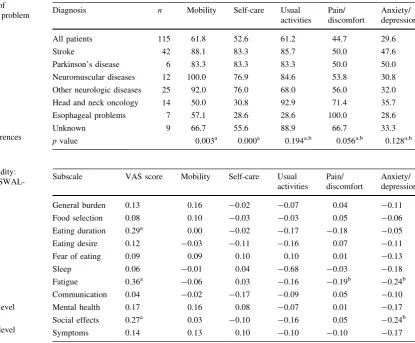
Mean score on the EQ-5D visual analog scale (VAS) was 59.9 (±19.5). On the Euroqol subscale Mobility, 62% of our patients reported a problem. Percentages of patients reporting any problems on the subscales Self-care, Usual activities, Pain/Discomfort and Anxiety/Depression were 53, 61, 45, and 30, respectively. The subscales Mobility and Self-care revealed statistically different scores com-pared with the other subscales of Euroqol (Kruskal-Wallis; p\0.001). Table4 shows the scores on Euroqol for our patient group.
[image:3.595.307.544.72.236.2]Clinical validity of SWAL-QoL-NL was assessed by correlating the subscale scores on SWAL-QoL-NL with the five subscales and the VAS scores on Euroqol. Pearson’s correlation coefficients ranged from -0.24 to 0.36, show-ing in general a weak correlation between the two assessment tools. Significant (2-tailed) correlations at a 0.01 level were found between the Euroqol VAS score and three SWAL-QoL-NL subscales (Eating duration, Fatigue and Social effects. At a 0.05 level three further significant correlations were found. The correlations between the subscores on the SWAL-QoL-NL and the Euroqol are shown in Table5.
Table 1 Patients’ characteristics (n=152)
Characteristic Number
Gender
Male 99 (65%)
Female 52 (34%)
Missing 1 (1%)
Age 64.8±13.2 (19.7–91.2)a
Diagnosis
Stroke 43 (28.3%) Parkinson’s disease 36 (23.7%) Neuromuscular diseases 13 (8.6%) Other neurologic diseases 25 (16.4%) Head and neck oncology 17 (11.2%) Cricopharyngeal problems 8 (5.3%) Unknown 10 (6.6%)
Education
Primary 41 (27.0%) Secondary 74 (48.6%) University 32 (21.1%) Missing 5 (3.3%)
Marital status
Single 24 (15.8%) Married/cohabiting 95 (62.5)% Separated 9 (5.9%) Widowed 22 (14.5%) Missing 2 (1.4%)
[image:3.595.50.289.74.427.2]Tube feeding 19 (12.5%) Euroqol VAS score 59.9±19.5 (0–99)a a Mean±SD (minimum–maximum)
Table 2 Clinical use of SWAL-QoL-NL
Was patient helped with questionnaire? When helped, how? n Time (min)
No 58 (38.2%) 19.6±8.9 (1–60)
Yes 94 (61.8%) 21.5±8.8 (1–60)
Read questions/wrote down answers 83 (83.3%) Caregiver answered for the patient 7 (7.4%)
[image:3.595.50.546.626.715.2]Other 4 (4.3%)
Table 3 Reliability coefficients of Dutch version of SWAL-QoL
Subscale n No. items Mean SD Cronbach’sa
Discussion
In our study we made a cross-cultural adaptation of SWAL-QoL and validated this assessment tool against Euroqol in 152 Dutch patients with dysphagia. None of the subscales of SWAL-QoL-NL reached an internal consistency of 0.95 or higher. Nine subscale scores (General burden, Food selec-tion, Eating duraselec-tion, Fear of eating, Sleep, Fatigue, Mental health, Social functioning and a symptom score) ranged between 0.80 and 0.92 (Cronbach’sa) and can be used for assessment of quality of life in dysphagic patients on a group level. Two subscales (Eating desire and Communi-cation scored only 0.67 and 0.60, respectively, and are less suitable for clinical research. In the final version of SWAL-QoL-NL these two subscales with three and two items, respectively, were removed, reducing the questionnaire to a 39-item tool.
In literature it is described that there are differences in health-related quality of life measures between different cultures. In 1988 Flaherty et al. [17] already described that researchers should give particular attention to cross-cul-tural validity when an instrument designed in one culture is used in a second culture. Consequently, in 1993 Guillemin
et al. [1] described their guidelines for cross-cultural adaptation of health-related quality-of-life measures based on a systematic review of translated questionnaires. Our study shows that some cultural differences seem to exist between dysphagia patients in the U.S. and in the Nether-lands. This supports the findings of Guillemin et al. [1] that one should thoroughly investigate a translated question-naire clinimetrically before using it in another language. Although the subscales Eating desire and Communication are valid in the original version of SWAL-QoL, they are not psychometrically valid for use in the Netherlands. Researchers in the Netherlands should be aware of these findings when comparing their SWAL-QoL-NL outcomes with the outcomes measured by the original SWAL-QoL in other publications. Also, Dutch researchers should specif-ically address in their reports that they have used SWAL-QoL-NL in their research and not the original 44-item version.
[image:4.595.126.542.57.400.2]Interestingly, the 14-item battery that provides clinical researchers and practitioners information on symptoms had an internal consistency of 0.80, allowing the use of a sum score for these 14 items on a group level. We renamed this 14-item battery the Symptom score. This symptom score
Table 4 Percentage of
respondents with any problem on Euroqol
a Kruskal-Wallis
b No significant differences
between groups
Diagnosis n Mobility Self-care Usual activities
Pain/ discomfort
Anxiety/ depression All patients 115 61.8 52.6 61.2 44.7 29.6 Stroke 42 88.1 83.3 85.7 50.0 47.6 Parkinson’s disease 6 83.3 83.3 83.3 50.0 50.0 Neuromuscular diseases 12 100.0 76.9 84.6 53.8 30.8 Other neurologic diseases 25 92.0 76.0 68.0 56.0 32.0 Head and neck oncology 14 50.0 30.8 92.9 71.4 35.7 Esophageal problems 7 57.1 28.6 28.6 100.0 28.6 Unknown 9 66.7 55.6 88.9 66.7 33.3
pvalue 0.003a 0.000a 0.194a,b 0.056a,b 0.128a,b
Table 5 Clinical validity:
correlation of Dutch SWAL-QoL with Euroqol
a Significant at 0.01 level
(2-tailed)
b Significant at 0.05 level
(2-tailed)
Subscale VAS score Mobility Self-care Usual activities
Pain/ discomfort
Anxiety/ depression
General burden 0.13 0.16 -0.02 -0.07 0.04 -0.11 Food selection 0.08 0.10 -0.03 -0.03 0.05 -0.06 Eating duration 0.29a 0.00 -0.02 -0.17 -0.18 -0.05 Eating desire 0.12 -0.03 -0.11 -0.16 0.07 -0.11 Fear of eating 0.09 0.09 0.10 0.10 0.01 -0.13 Sleep 0.06 -0.01 0.04 -0.68 -0.03 -0.18 Fatigue 0.36a -0.06 0.03 -0.16 -0.19b -0.24b
can be derived from the raw data in the same way as the other subscale scores are calculated. Although the symp-tom score can be used only on a group level, it allows researchers to represent a variety of clinical symptoms in one severity score ranging from 0 (worst situation) to 100 (no problems).
The weak correlation in general between SWAL-QoL-NL and Euroqol shows that both instruments are measuring two related but different constructs. The correlations between three SWAL-QoL-NL subscales (Eating duration, Social effects and Fatigue and the VAS score on Euroqol were found to be significantly correlated. The correlations for the first two constructs were found to be weak, but the correlation between the SWAL-QoL-NL subscale Fatigue and the VAS score on Euroqol (r=0.36) can be marked as substantial (rC0.30) and satisfactory for group-level comparisons [15]. These findings support the hypothesis that there is a small overlap between the two quality-of-life questionnaires but that SWAL-QoL measures a very specific construct compared to more general quality-of-life issues. The three described correlations were significant at a 0.01 level. There were also three other significant correlations found, but only at a 0.05 level. These weak correlations might support the findings described above, but considering the fact that 66 correlations were calculated for Table5, these significant findings might also be interpreted as a type 1 error.
Combined with the high internal consistency scores (0.80 and above), SWAL-QoL-NL can be considered a reliable tool to assess the effects of dysphagia on quality of life in different patient populations.
Conclusion
SWAL-QoL-NL proved to be a reliable tool to measure quality of life in patients with oropharyngeal dysphagia. Nine subscales can be used for assessment of quality of life in dysphagic patients on a group level. Two subscales (with a total of 5 items) could be removed from the item list, reducing the SWAL-QoL-NL to a 39-item tool. Interest-ingly, in the Dutch version a sum score can be derived from the items about clinical symptoms, allowing the use of a single score representing the severity of clinical symptoms.
Acknowledgments The authors thank Kathleen Gallagher and
Tamar Gibson for their help in translating and back-translating the questionnaires.
Open Access This article is distributed under the terms of the
Creative Commons Attribution Noncommercial License which per-mits any noncommercial use, distribution, and reproduction in any medium, provided the original author(s) and source are credited.
References
1. Guillemin F, Bombardier C, Beaton D. Cross-cultural adaptation of health-related quality of life measures: literature review and proposed guidelines. J Clin Epidemiol. 1993;46:1417–32. 2. Gustafsson B, Tibbling L. Dysphagia, an unrecognized handicap.
Dysphagia. 1991;6:193–9.
3. McHorney CA, Bricker DE, Kramer AE, Rosenbek JC, Robbins J, Chignell KA, et al. The SWAL-QOL outcomes tool for oropha-ryngeal dysphagia in adults: I. Conceptual foundation and item development. Dysphagia. 2000;15:115–21.
4. McHorney CA, Bricker DE, Robbins J, Kramer AE, Rosenbek JC, Chignell KA. The SWAL-QOL outcomes tool for oropha-ryngeal dysphagia in adults: II. Item reduction and preliminary scaling. Dysphagia. 2000;15:122–33.
5. Bland JM, Altman DG. Cronbach’s alpha. BMJ. 1997;314:572. 6. McHorney CA, Robbins J, Lomax K, Rosenbek JC, Chignell K,
Kramer AE, et al. The SWAL-QOL and SWAL-CARE outcomes tool for oropharyngeal dysphagia in adults: III. Documentation of reliability and validity. Dysphagia. 2002;17:97–114.
7. Lovell SJ, Wong HB, Loh KS, Ngo RY, Wilson JA. Impact of dysphagia on quality-of-life in nasopharyngeal carcinoma. Head Neck. 2005;27:864–72.
8. Costa Bandeira AK, Azevedo EH, Vartanian JG, Nishimoto IN, Kowalski LP, Carrara-de Angelis E. Quality of life related to swallowing after tongue cancer treatment. Dysphagia. 2008;23:183–92.
9. Roe JW, Leslie P, Drinnan MJ. Oropharyngeal dysphagia: the experience of patients with non-head and neck cancers receiving specialist palliative care. Palliat Med. 2007;21:567–74. 10. Euroqol Group, EuroQol—a new facility for the measurement of
health-related quality of life. The EuroQol Group. Health Policy. 1990;16:199–208.
11. Furtado K, Pina E, Moffatt CJ, Franks PJ. Leg ulceration in Portugal: quality of life. Int Wound J. 2008;5:34–9.
12. Knoll GA, Cantarovitch M, Cole E, Gill J, Gourishankar S, Holland D, et al. The Canadian ACE-inhibitor trial to improve renal outcomes and patient survival in kidney transplantation study design. Nephrol Dial Transplant. 2008;23:354–8. 13. Ulvik A, Kvale R, Wentzel-Larsen T, Flaatten H. Quality of life
2-7 years after major trauma. Acta Anaesthesiol Scand. 2008;52:195–201.
14. McDowell I, Newell C. Measuring health. A guide to rating scales and questionnaires. New York, Oxford: Oxford University Press, 1996.
15. Aday LA, Designing and conducting health surveys. San Fran-cisco: Jossey-Bass Publishers, 1996.
16. DeVellis RF, Scale development. Theory and applications. Thousand Oaks, CA: Sage Publications; 2001.
17. Flaherty JA, Gaviria FM, Pathak D, Mitchell T, Wintrob R, Richman JA, et al. Developing instruments for crosscultural psychiatric research. J Nervous Mental Dis. 1988;176:257–63.
H. C. A. Bogaardt Msc
R. Speyer PhD
L. W. J. Baijens MD