City, University of London Institutional Repository
Citation
:
Beck, T., Uras, B. R., Ramrattan, R & Pamuk, H. (2018). Payment instruments, finance and development. Journal of Development Economics, doi:10.1016/j.jdeveco.2018.01.005
This is the accepted version of the paper.
This version of the publication may differ from the final published
version.
Permanent repository link:
http://openaccess.city.ac.uk/19177/Link to published version
:
http://dx.doi.org/10.1016/j.jdeveco.2018.01.005Copyright and reuse:
City Research Online aims to make research
outputs of City, University of London available to a wider audience.
Copyright and Moral Rights remain with the author(s) and/or copyright
holders. URLs from City Research Online may be freely distributed and
linked to.
City Research Online: http://openaccess.city.ac.uk/ [email protected]
Accepted Manuscript
Payment instruments, finance and development
Thorsten Beck, Haki Pamuk, Ravindra Ramrattan, Burak R. Uras
PII: S0304-3878(18)30007-5 DOI: 10.1016/j.jdeveco.2018.01.005 Reference: DEVEC 2198
To appear in: Journal of Development Economics
Received Date: 5 May 2017 Revised Date: 6 December 2017 Accepted Date: 16 January 2018
Please cite this article as: Beck, T., Pamuk, H., Ramrattan, R., Uras, B.R., Payment instruments, finance and development, Journal of Development Economics (2018), doi: 10.1016/j.jdeveco.2018.01.005.
M
AN
US
CR
IP
T
AC
CE
PT
ED
Payment Instruments, Finance and Development
∗Thorsten Beck
†Cass Business School, City, University of London
CEPR
Haki Pamuk
‡Wageningen University
Ravindra Ramrattan
§FSD Kenya
Tilburg University
Burak R. Uras
¶Tilburg University
European Banking Center
December 5, 2017
Abstract
This paper studies the effects of a payment technology innovation (mobile money) on en-trepreneurship and economic development in a quantitative dynamic general equilibrium model. In the model mobile money dominates fiat money as a medium of exchange, since it avoids the risk of theft, but comes with electronic transaction costs. We show that entrepreneurs with higher productivity and access to trade credit are more likely to adopt mobile money as a payment instrument vis-a-vis suppliers. Calibrating the stationary equilibrium of the model to match firm-level data from Kenya, we show significant quantitative implications of mobile money for entrepreneurial growth and macroeconomic development.
Keywords: Payment Technologies, Theft, Trade Credit, Allocations. JEL Classification: D14; G21; O12; O16.
∗For their suggestions and comments we would like to thank two anonymous reviewers, the editor, Erwin Bulte,
Patricio Dalton, Chang-Tai Hsieh, Billy Jack, Damjan Pfajfar, Andrea Presbitero, Ctirad Slavik, Christian Stoltenberg, Edoardo Totolo, and Sweder van Wijnbergen; the conference participants of 2015 Development Economics Workshop at Wageningen University, 2016 CSAE Conference at Oxford University, 2016 Society for Economic Dynamics Confer-ence at Toulouse School of Economics, 2016 CREDIT ConferConfer-ence in Venice; and, seminar and workshop participants at the Central Bank of the Netherlands (DNB), University of Hannover, DIW-Berlin, Groningen University and Tilburg University. This research was funded with support from the Department for International Development (DFID) in the framework of the research project ‘Co-ordinated Country Case Studies: Innovation and Growth, Raising Productivity in Developing Countries’.
†E-mail:[email protected] ‡E-mail:[email protected]
§Before the completion of this paper, our dear friend and co-author Ravindra Ramrattan lost his life at the tragic
Westgate Mall terrorist attacks in Nairobi, Kenya.
M
AN
US
CR
IP
T
AC
CE
PT
ED
1
Introduction
“Mobile-Money helps people to save and borrow and empowers them in a big way.” -Bill Gatesin
2015 Gates Annual Letter.
Can the development of an efficient payment technology stimulate business growth and thereby
contribute to a country’s economic development? In particular, can more efficient payment tools
help small businesses grow and allow credit access in developing countries, where financing
con-straints loom large? We address these questions by focusing on a key financial innovation, which
has drawn attention of many researchers and policy makers over the recent years: mobile money.
Mobile money is an SMS-based money transfer and monetary storage tool, initially developed in Kenya, but now being used in other developing countries across the globe. Mobile money provides
users a safe opportunity to carry and share liquidity with cellular phones, critical in socially volatile
and risky environments. According to the Global Findex data (Demirguc-Kunt et. al, 2015), in
2014, 58 percent of the adult population in Kenya, 37 percent in Somalia, and 35 percent in Uganda
had a mobile money account. While not as wide-spread, mobile money accounts are also being used
by enterprises; 35 percent of firms interviewed in the 2014 FinAcces Business survey in Nairobi
re-ported that they accept mobile money as a common method of payment from their customers, while
32 percent of the firms use mobile money when paying for their input purchases.
While an expanding literature has worked on understanding the effect of mobile money adoption
on household welfare, this paper assesses the interactions between the adoption of mobile money as a payment instrument, entrepreneurial growth and finance.1 For this purpose, we develop a dynamic
general equilibrium model with heterogeneous firms to evaluate the effects of a technologically
ad-vanced payment technology - featuring the properties of mobile money accounts - on firm-level
performance and access to supplier credit in an economy characterized by credit imperfections,
information asymmetries and most importantly the risk of theft. Our analysis shows that the
avail-ability of mobile money reduces the incidence of theft and thus output losses, but also alleviates the
transaction frictions between entrepreneurs and suppliers and increases the valuation of trade credit,
with positive repercussions for entrepreneurial growth. Calibrating the model to firm-level survey
data from Kenya, we uncover significant quantitative effects of the adoption of mobile money on
ag-gregate economic outcomes. Our findings are novel as they reveal the critical interactions between payment instruments, access to finance and business growth.
Figures 1 and 2 motivate our research by revealing two important cross-sectional patterns
regard-ing the utilization of M-Pesa, the main mobile money technology brand in the context of Kenya.
Using FinAccess Business survey, a data-set which covers over 1,000 SMEs from Kenya, Figure 1
1For a review of the recent literature on digital payments, see World Bank, Better than Cash Alliance and Bill &
M
AN
US
CR
IP
T
AC
CE
PT
ED
illustrates that the share of firms using mobile money when purchasing inputs from their suppliers
is significantly higher for businesses with above median productivity. Moreover, Figure 2 shows that businesses that receive inputs from their suppliers in exchange for a (delayed) credit repayment
are more likely to use M-Pesa as well. Both partial correlations hold when controlling for many
other firm characteristics, as we document in Section 2, a result whose firm-level and aggregate
implications we will explore theoretically as well as quantitatively in this paper.
Figures 1 and 2 about here
-Credit enforcement frictions and the risk of theft loom large in many developing economies,
including Kenya. Ample research has shown that financing obstacles hold back firm and ultimately
aggregate growth - as documented in Beck et al. (2005) and Ayyagari et al. (2008). Information
and enforcement frictions are at the core of financing constraints in developing countries, as argued
for instance by Paulson et al. (2006). At the same time, the lack of security is another major
growth constraint in developing world.2 Especially the insecurity due to the risk of theft is striking
in Kenya. Data from the World Bank’s Kenya Enterprise Survey (2013) suggests that every year
Kenyan manufacturing firms lose about 1.9% percent of product value due to theft - which equals twice the world average - from shipping to remote domestic markets. Similarly, 29% of Kenyan
firms experience losses due to theft and vandalism, compared to the world average of 19%. Also
according to the World Bank Enterprise Survey, 82% of firms pay for security services in order to
avoid theft in Kenya, compared to the world average of 55%. As we will delineate in Section 2, the
FinAccess Business survey of Kenya reveals that firms which see theft as an obstacle to business
growth are more likely adopters of the M-Pesa technology. By providing a cheaper and safer money
transfer tool, the use of mobile money technology expanded rapidly and became a frequently and
widely utilized electronic money instrument for private purposes in the country.3
In order to explain the positive association between productivity and mobile money use and the
positive association between mobile money use and access to trade credit observed in our survey data, we develop a dynamic general equilibrium model of entrepreneurial finance. In our model,
entrepreneurs are heterogeneous in their ability to access trade credit, randomly draw idiosyncratic
productivity shocks, and, importantly, get randomly hit by monetary theft. Trade credit expands
production opportunities but it is subject to limited commitment and hence a strategic-default
con-straint. In the benchmark model, theft is a friction that is of primary importance, because it erodes
an entrepreneur’s fiat money balances and thus inhibits entrepreneur’s ability to settle transactions
with suppliers. Additionally, theft also damages the entrepreneur’s commitment to credit repayment
and potentially causes a discontinuation of access to trade credit, because theft is privately observed.
2Ayyagari et al. (2008) show that among all the different obstacles highlighted by firm-level surveys, only obstacles
related to finance, crime, and policy instability directly affect firm growth.
M
AN
US
CR
IP
T
AC
CE
PT
ED
In line with empirical evidence and the existing literature, we model mobile money as a payment
instrument that is a resolution to theft.4
The analytical solution of the model produces a key equilibrium property that matches the
em-pirical regularity of Figure 1: enterprises with higher productivity are more likely to adopt M-Pesa
when transacting vis-a-vis suppliers. The intuition for this “primary impact channel” is related to
the opportunity cost of a foregone trade with a supplier. For productive entrepreneurs the loss of
cash due theft is more costly because of missing an opportunity to invest in a high-yield project;
therefore, productive types are more willing to sign up for M-Pesa.
Our theoretical set-up also allows us to capture the empirical regularity of Figure 2 that access
to trade credit is associated with a higher demand to use M-Pesa when transacting with suppliers,
a “secondary impact channel”. Specifically, using our model we isolate three equilibrium
(sub)-channels through which mobile money use raises a trade credit borrower’s production capacity relative to non-borrowers. First, for a borrower the cost of theft is higher at the input-purchase stage
than for non-borrowers, as it is not only the endowment loss that affects the entrepreneur but also the
inability to utilize this endowment as down-payment (collateral) when borrowing. Therefore, for a
given level of entrepreneurial productivity access to trade credit increases the likelihood of mobile
money use when purchasing inputs. Second, in the case of theft at the trade-credit-repayment stage,
theft is not only associated with the loss of the current value of cash but also with the loss offuture
credit market access. The use of mobile money therefore increases the future credit market valuation
for an entrepreneur, which in turn raises the amount of trade credit that the entrepreneur can obtain,
and thus reinforces the demand for mobile money. Third, given the risk of theft, the contracted
interest rate and thereforerepayment burdenis higher for users of cash compared to mobile money users, lowering the quantity of inputs that an entrepreneur can purchase on credit.
We calibrate the stationary equilibrium of the model to match a set of moments that we observe in
Kenyan FinAccess Business survey data from 2014. The parameterized model matches the Kenyan
business data well along the dimensions that we target as well as important additional statistics that
we do not target directly. Using the parameterized model, we conduct counterfactual quantitative
exercises, where we hypothetically shut down entrepreneurs’ access to mobile money when
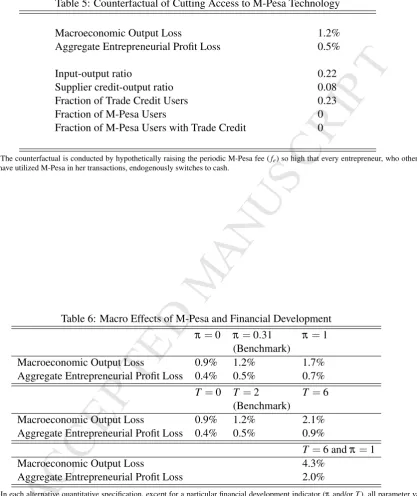
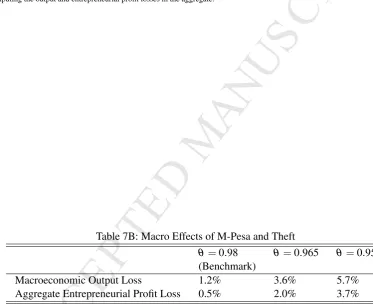
pur-chasing inputs from suppliers. Our key quantitative result reveals that eliminating the use of mobile
money in an environment with a theft probability of 2% translates into a macroeconomic output
loss of 1.2%. About 75% of this effect is due to the primary impact channel (through
productivity-payments complementarity), while the remaining 25% of the effect comes from the secondary im-pact channel (through finance-payments complementarity). Isolating the sub-components of the
secondary impact channel reveals that the collateral (down-payment) channel has negligible growth
4To give one example, Sanches and Williamson (2010) formalize the role of theft in ensuring commitment in a
M
AN
US
CR
IP
T
AC
CE
PT
ED
effects, whereas future credit market access and repayment burden channels explain 33% and 66%
of the secondary impact channel (through alleviating financing constraints), respectively. Impor-tantly, we also show that increasing the extent of trade credit access can substantially increase the
effects of M-Pesa through the finance-payments complementarity and generate a substantial
finan-cial amplifier to raise the macroeconomic effects of M-Pesa. We would like to also highlight that
the measured effects of M-Pesa on entrepreneurial finance and aggregate economy could be a lot
more significant if formal sources of finance can be accessible to entrepreneurs, because limited
commitment problems are expected to be more significant for formal credit contracts compared to
supplier provided informal credit, as argued by Burkart and Ellingsen (2004).
Comparing the estimated outcome effects of M-Pesa with actual growth numbers for the Kenyan
economy shows that the introduction of the M-Pesa technology in 2007 can explain 10% of the
per-capita income growth between 2007 and 2013 thus pointing to quantitatively significant macroeco-nomic effects of mobile money technology through entrepreneurial finance.
We conduct an extensive list of robustness checks and consider theoretical as well as quantitative
extensions to our benchmark framework, which reveal that our qualitative and quantitative findings
are robust to the nature of theft, endogenizing trade credit access, allowing for business capital
accumulation and relaxing the assumption that theft is private information.
Our paper has a set of important policy implications. First, we show that more secure payment
systems that improve on risky cash holdings and allow for more efficient transfers can have
econom-ically meaningful implications for firm performance and macroeconomic development. Specifeconom-ically,
we show that efficient payment systems can have positive effects beyond lowering transaction costs
by allowing firms to extend access to external finance and thus grow faster. Second, our results speak to the debate on financial inclusion. While for a long time there has been a focus on credit
services for micro- and small entrepreneurs, over the past years the conversation has increasingly
broadened to other financial services. Our paper points out the importance of providing efficient
payment services as a means to help SMEs by keeping liquidity holdings safe, increasing credit
market performance and thereby raising entrepreneurial production. While we use data from Kenya
to empirically motivate our study and calibrate the theoretical model, the market frictions we focus
on - namely; information asymmetries, financial constraints and theft - are prevalent throughout
the developing world. Third, most of the firms in our firm survey are formal enterprises. On the
one hand, the underlying mechanism and thus results of household entrepreneurs using M-Pesa to
pay their suppliers should not differ from that of formal enterprises and the aggregate effect of M-Pesa might be even larger, should the M-M-Pesa technology be available for such entrepreneurs. On
the other hand, there is increasing evidence that informal or household enterprises are substantially
less productive than formal enterprises and that this productivity difference is inherent rather than
M
AN
US
CR
IP
T
AC
CE
PT
ED
effect from the use of M-Pesa to pay suppliers by household enterprises than formal enterprises.
Finally, however, there might be a dynamic dimension in the sense that the expansion of formal en-terprises might result in fewer household enen-terprises and a switch of some of the latter into formal
employment.
Related Literature. Our paper relates and contributes to three strands of literature. First, we
con-tribute to the macro-finance literature, which investigates the impact of limited financial
enforceabil-ity on macroeconomic outcomes. Following the seminal studies by Kehoe and Levine (1993) and
Kehoe et al. (2002) we incorporate a limited commitment constraint into a dynamic general
equilib-rium model, where defaulters get excluded from accessing credit in the future. Different from these
papers, in our framework theft raises the likelihood of default and constrains entrepreneurial trade
credit opportunities.5 Our theoretical contribution shows that an efficient payment technology (such
as mobile money) - that lowers the probability of theft - can alleviate trade credit constraints arising from limited enforceability and thereby stimulate entrepreneurial performance. We also quantify
the aggregate implications of mobile money use - through its impact on enforceability - on financial
markets and macroeconomic performance.6
Importantly, we contribute to the above mentioned macro-finance literature by developing a novel
theoretical foundation (and then also measuring its quantitative implications) concerning the
distor-tionary effects of the interaction between theft and access to trade credit. Specifically, when theft is
privately experienced - a feature relevant for the context of a developing country because of limited
enforcement capacity and efficiency of the police force - the strong complementarity between theft
and limited commitment generates a quantitatively important amplifier mechanism to constrain
eco-nomic development.7 As one of our key results we show that M-Pesa is a resolution to this adverse “financial amplifier”.
Second, we relate to the rapidly expanding literature gauging the impact of mobile money on
fi-nancial transaction patterns and welfare, much of which has focused on the Kenyan mobile money
technology M-Pesa. In this literature, Jack and Suri (2011) document that three out of four Kenyan
5An important recent paper on firms’ finance and default is Herranz et al. (2015), with a dynamic model of small
firms who can default on contracts in equilibrium (when it is optimal to do so); the authors decompose dynamic default into three parts: one static term (standard) and two dynamic components. Since it goes beyond the scope of this paper, in our model we do not investigate the consequences of non-trivial default and concentrate on the effects of theft shocks on the inability to repay.
6Closely related to our work, in this literature, Quadrini (2000) and Cagetti and De Nardi (2006) explore the effects
of limited contract enforcement on entrepreneurial wealth accumulation, aggregate saving dynamics and development. Antunes et al. (2008) and Buera and Shin (2013) study the quantitative implications of limited contract enforcement for occupation choice and the efficiency of aggregate capital allocation across a distribution of entrepreneurs.
7Studies concerning trust in police support this argument. Global Barometer Survey results, which was conducted
M
AN
US
CR
IP
T
AC
CE
PT
ED
M-Pesa users indicate that they use M-Pesa to save money. Mbiti and Weil (2011) find that the
in-creased use of M-Pesa lowers the use of informal savings mechanisms (for instance ROSCAS), and raises the propensity to save via formal bank accounts.8 Finally, while Jack and Suri (2014) study
the effect of reduced transaction costs on risk sharing, showing that income shocks lower
consump-tion by 7 percent for non-M-Pesa users whereas consumpconsump-tion of M-Pesa-users is unaffected, Jack
and Suri (2016) quantify the overall effect of M-Pesa as a 2% reduction in poverty in Kenya. While
this literature has almost exclusively focused on the household use of mobile money, our paper is
the first to focus on business use of mobile money and to offer empirical and theoretical evidence
on the strategic complementarity between mobile money and trade credit.
The third line of research we contribute to is the literature on the role of trade credit in economic
development in developing countries.9 Suppliers have an advantage over other lenders in financing
credit-constrained firms, which makes trade credit prevalent in financially less developed countries where the majority of firms has limited - if any - access to bank credit. Unlike credit from financial
institutions, trade credit does not rely on formal collateral but on trust and reputation. Fafchamps
(1997) shows in the context of Zimbabwe, where networks and statistical discrimination affect
the screening of trade credit applicants, black entrepreneurs are disadvantaged by the difficulty to
distinguish themselves from the mass of financially insecure short-lived African-owned businesses.
Using firm-level data from five African countries Fisman and Raturi (2004) show that monopoly
power is negatively associated with trade credit provision. Using a cross-country analysis, Fisman
and Love (2003) show that industries with higher dependence on trade credit financing grow faster
in countries with weaker financial institutions. Ge and Qiu (2007) compare the use of trade credit
between state owned and non-state-owned companies in China and show that the non-state owned firms use relatively more trade credit when financing their operations. Cull et al. (2009) employ a
large panel dataset of Chinese firms and find that poorly performing state-owned firms were more
likely to redistribute credit to firms with limited access to formal financial markets during China’s
economic transition. We contribute to this literature by showing that the use of mobile money as a
payment device can serve as a commitment mechanism vis-a-vis creditors and thus enhance growth
of financially constrained enterprises.
8Kikulwe et al. (2013) analyze the impact of M-Pesa using panel data from small farmers in Kenya. They show
that M-Pesa users purchase more inputs, sell a larger proportion of their output in markets, and as a result have higher farm-profits.
M
AN
US
CR
IP
T
AC
CE
PT
ED
2
M-Pesa and Tade Credit: Evidence from Kenya
After its launch in 2007, M-Pesa rapidly became a popular monetary instrument among Kenyan
households.10 For instance, Jack and Suri (2014) document that as of 2011 70 percent of all
house-holds in Kenya had already adopted at least one M-Pesa account. In Kenya, there was a substantial
demand for money transfer services before the introduction of M-Pesa11, but M-Pesa changed the
landscape of payment instruments dramatically. On the one hand, access to online monetary transfer
had been limited, and other forms of electronic money transfer instruments, such as Western Union,
were too costly to transfer money for the general population.12 On the other hand, cheap money
transfer methods such as bringing cash personally or sending cash via bus drivers or friends had
been common but were subject to risk of appropriation and theft.
This section provides a short overview for how M-Pesa technology works to store and transfer
liquidity safely, introduces the enterprise survey that underpins our work, and shows empirical
evi-dence that motivates our theoretical and quantitative analysis.
2.1
M-Pesa
In Kenya, M-Pesa is the most commonly utilized mobile money service allowing users to send
money to any cell phone owner via SMS messages. Cash (fiat money) can be transferred into
M-Pesa deposits and vice versa via specialized shops, calledM-Pesa Kiosks, which are wide-spread all
across the country. After being introduced in 2007 by Safaricom, mobile money usage has grown rapidly. From March 2007 to December 2014 the number of M-PESA Kiosks grew 148% annually
and reached about 124,000 (about 20 percent of them in Nairobi (FSP interactive maps, 2013)),
and the number of customers grew 307% annually and reached about 25 million. In 2013, about
732.5 million transactions were conducted in total, and the total value of money transferred was 22
billion U.S dollars.13 Since 2007 Kenyan households have utilized M-Pesa for not only transferring
or receiving money but also for saving: 85% of Kenyan households store some money in their
personal M-Pesa account according to the survey evidence provided by Jack and Suri (2011).
Exchanging cash for M-Pesa deposits is free. The individual only has to visit the mobile money
agent and tell the phone number that she wants to deposit money into. However, using M-Pesa
comes withwithdrawal fees- applied when converting M-Pesa into cash - as well asvariable costs
of electronic money transfer increasing in the amount sent. On average, for each unit Kenyan
10M stands for mobile and pesa means money in Swahili.
11High internal labor migration from rural to urban areas has resulted in high demand for sending money from urban
areas to families, relatives and friends living in rural areas (Aker and Mbiti (2010); Jack and Suri (2011)).
12See Aker and Mbiti (2010); Jack and Suri (2011); Jack and Suri (2014).
13The data used for calculating the number of Nairobi M-Pesa agents is from November 2013. We calculated U.S
M
AN
US
CR
IP
T
AC
CE
PT
ED
Shilling (KSh) transferred to a recipient, Safaricom charges the sender with 0.0172 KSh. We will
incorporate both withdrawal and variable cost margins of M-Pesa use into the dynamic general equilibrium model that we will develop below.
In addition to facilitating person to person (P2P) transfers, M-Pesa users can pay water, gas and
electricity bills as well as save money by earning a certain amount of interest if they upgrade to a
special M-Pesa service. There are also some mobile money services through which businesses can
send salaries to mobile phones of their workers and repay loans. P2P service is also utilized for
transactions, such as purchasing supplies and selling goods to customers, which we shall turn to
next.
2.2
Data
In this study we use the Kenya FinAccess Business Survey 2014 - designed by the Financial Sector
Deepening Trust Kenya (FSD-K) together with Tilburg University -, which includes a set of novel
business-level mobile money usage questions. The survey data were collected in 2014 by FSD-K
from a representative cross-section of 1,047 mainly small and medium-size enterprises in Nairobi.
The respondents of the questionnaire are owners or executive managers. In Online Appendix of the
paper we provide the full details of the questions from the survey that are relevant for our empirical
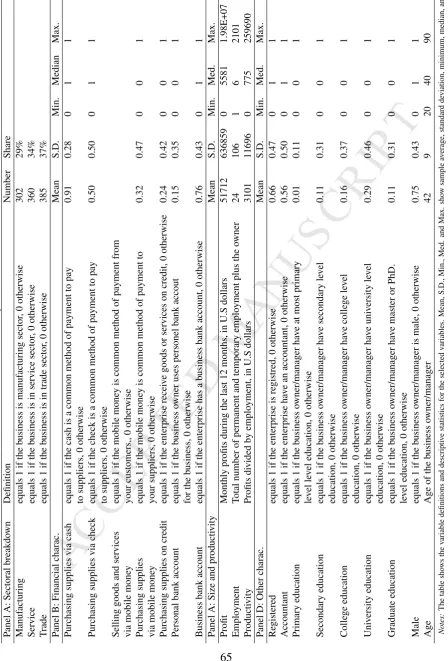
and quantitative analyses as well as a detailed table on descriptive statistics (Table OA1).
There is significant sectoral variation in the sample, with 29 percent and 34 percent of the
busi-nesses operating in manufacturing and service sectors, respectively, while 37 percent of enterprises
operate in trade.
The key question which we exploit to learn whether a business uses mobile money for business to
business transactions asks “whether cash, check or mobile money are common methods of payments
when buying inputs from suppliers”. Descriptive statistics show that, after cash and checks, mobile
money is the third most common method of payment to suppliers when purchasing inputs: 91
percent and 50 percent of the businesses pay for their supplies via cash and check respectively,
while mobile money is a common method for 32 percent of the firms. Most firms in our sample
have access to bank accounts: 75 percent of firms use business bank accounts for their business
operations and 15 percent of them utilize their personal bank accounts for business purposes. In the
sample, 24 percent of the firms report that they purchase inputs from their suppliers on trade credit.
In terms of the size measures, the median firm earns around 5,600 U.S dollars per month, averaged over the last 12 months, and employs on average 6 workers.14 The sample mostly includes formal
14In order to have a representative cross-section of firms, our sample (1,047 firms) includes 3 large firms, which
M
AN
US
CR
IP
T
AC
CE
PT
ED
businesses; 75% of the firms are registered with the Business Registrar at the Attorney General’s
office. The firms in the sample mostly (75%) have male owners (or managers), and 40% of the owner/managers have at least a university degree.
2.3
Empirical Evidence
Using formal regression analysis we explore which businesses are more likely to use M-Pesa when
buying supplies. Specifically, we regress our M-Pesa use indicator,purchasing supplies via mobile
money,on business characteristics. We estimate the model using a probit regression; we control for
sector fixed effects but do not report the coefficient estimates to economize on space.
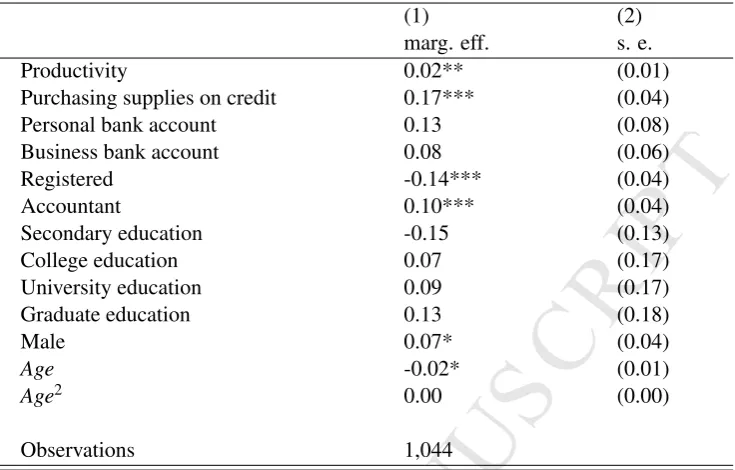
Table 1 about here
-Table 1 presents for each characteristic the marginal effect estimates at mean levels and robust
standard error estimates in columns (1) and (2), respectively. First, the estimates show that there
is a positive correlation betweenproductivity and the likelihood of using M-Pesa to pay suppliers,
where productivity is measured by profits per employee. The coefficient estimate for productivity
shows that, ceteris paribus, one percentage increase in profits per employee is associated with a
2 percentage point increase in the share of firms using M-Pesa to purchase inputs. Second, after
controlling for productivity and other business/owner characteristics we find a strong empirical
association betweenbuying inputs on trade creditand mobile money use. The estimate shows that,
ceteris paribus, the share of firms using M-Pesa to purchase inputs is 17 percentage points higher among the firms purchasing supplies on credit. These two empirical results will constitute the basis
for the theoretical and the quantitative frameworks that we will explore. The empirical results also
show that there is a positive relationship between using mobile money to pay for input purchases
and having younger managers, being unregistered and having an accountant.15
It is important to note that these estimates do not imply any causality; rather, the result may
im-ply that, for instance, having a trade credit relationship leads to mobile money usage when settling
transactions with suppliers and/or using mobile money facilitates trade credit relations between
15In table OA2 of Online Appendix, we test the robustness of our key result concerning trade credit access and the
M
AN
US
CR
IP
T
AC
CE
PT
ED
businesses. Both directions of causation have important and interesting research and policy
im-plications. In sections 3 and 4, we will therefore focus on providing theoretical explanations for both ways of causation and the quantitative implications of positive associations of M-Pesa use with
productivity and trade-credit access.
Before we move on with our theoretical analysis, we would like to mention that we also provide
additional empirical results in Online Appendix (Table OA3) from a formal regression analysis
-using FinAccess Business - to show that businesses which report “crime and theft” as an obstacle to
business growth utilize M-Pesa more often in their transactions vis-a-vis suppliers. This result
vali-dates the theft avoidance motivation associated with M-Pesa - confirming also the empirical results
by Economides and Jeziorski (2016), who show for the context of Tanzania that the willingness to
pay to avoid walking with cash (and using mobile money) an extra kilometer for an extra day is
1.25% of an average transaction. These results demonstrate the property of M-Pesa type payment instruments in alleviating theft-related frictions, which constitutes a key feature of our theoretical
structure.
3
Model
We model an economic environment with infinitely lived agents. Time is discrete and indexed with
t. There are two types of agents in the economy (Entrepreneurs and Suppliers) and two types of
goods (Production Input and Consumption Good). Entrepreneurs are heterogeneous agents, who
convert supplier provided inputs into the consumption good. The stock of entrepreneurs in the economy is constant and has a finite measure ofE.
For expositional convenience we divide each period in two subperiods, which we call Dayand
Night. In theDaysub-period entrepreneurs meet suppliers in a market place for purchases of
pro-duction inputs. Conditional on the contractual agreement between a supplier and an entrepreneur,
the supplier settles to provide inputs to the entrepreneur in return for an immediate payment in the
Day market and for a potential late payment to be made in the Night market. We interpret the
delayed payment option in theNight subperiod as the provision oftrade credit.
There is a large number of suppliers available in the Day market, and each entrepreneur can
contact many suppliers, but she can sign a contract with at most one of them. This implies that the
supplier-profits will be driven to zero in equilibrium. Neither the consumption good nor the supplier provided inputs can be stored in-between anyt andt+1; and therefore, there is no capital
accumu-lation in the model. We relax this assumption in Section 7.4 and show that while the lack of capital
accumulation makes the model more tractable, quantitative results implied by this assumption do
not contradict with the firm-level empirical regularities that we observe in the Kenyan (FinAccess)
M
AN
US
CR
IP
T
AC
CE
PT
ED
level could actually dampen the quantitative effects that we are measuring.
3.1
Preferences, Endowments and Production
Suppliers’ production technology is linear in labor. Specifically, when a supplier convertshs,t units
of his own labor to generate hs,t units of input for an entrepreneur, he suffers −hs,t units of utility
loss. We assume that in every period each supplier has a limited amount of labor capacity to produce
inputs (denoted with ¯h).16 Suppliers have linear preferences to consume the consumption good. By
denotingcs,t as the consumption of a suppliersin periodt, the preferences ofsare described by
E0 ∞
∑
t=0
βt[cs,t−hs,t], (1)
whereβ(≤1) is the intertemporal discount factor.
Entrepreneurs are identical in terms of endowments and preferences: each entrepreneur receives
eunits of consumption good at the beginning of everyDaysub-period that she can choose to
con-sume.17 The entrepreneur can also take fractions of this endowment to the Day market to make
purchases from an input supplier. We assume e< h¯, such that there is room for trade-credit to improve entrepreneurs’ production capacities. Similar to the suppliers, entrepreneurs have linear
preferences with respect to the consumption good: denotingci,t as consumption of an entrepreneur
iin periodt, the preferences of an entrepreneuriare given by
E0 ∞
∑
t=0
βtci,t. (2)
Entrepreneurs convert supplier provided inputs into consumption by operating a production
tech-nology. Entrepreneurial output is a function of the quantity of inputs employed in the production
process and an exogenously determined idiosyncratic productivity term. The entrepreneur i who
purchases and investshi,t units of inputs in theDaysub-period obtains
yi,t(hi,t) =Ai,tf(hi,t) (3)
units of consumption good in the Night sub-period. In this production specification Ai,t is the
entrepreneuri’s idiosyncratic productivity draw in periodt. Entrepreneurial productivity draws are
iid across time and entrepreneurs, assigned from a well-behaved cumulative distribution function
16This assumption is utilized in the analytical solution to the model below and does not play a key role in the
quantitative analysis.
17As we will delineate in Section 7.4, the lack of cross-sectional heterogeneity in entrepreneurial endowment (capital)
M
AN
US
CR
IP
T
AC
CE
PT
ED
G(A)and publicly observable as well as verifiable.18
3.2
Frictions, Trade Credit, Fiat Money and M-Pesa
There are two class of frictions in the model:financial imperfectionsandtheft. Financial
imperfec-tions are twofold. Fracimperfec-tions of inputs can be purchased on supplier provided trade credit; however,
accessibilityandenforceabilityof credit is limited, restricting the use of trade credit at extensive and
at intensive margins respectively. To the end of limited enforceability, strategic default of a borrower
on trade credit can be prevented only with the threat of exclusion of a defaulter from accessing trade
credit for the nextT periods following the incidence of default. With respect to limited accessibility,
only a sub-set of entrepreneurs have the capacity to borrow trade credit and they can do so only if
they provide the supplier with an up-front payment.
Monetary theft can reduce an entrepreneur’s capacity to pay for input purchases from a supplier
in theDayas well as her ability to repay trade credit in the Night. We assume that theft is private
information and unverifiable. The mobile-money technology, M-Pesa, insures entrepreneurs against
theft of monetary holdings at the expense of electronic transaction costs.
We formalize the details concerning trade credit constraints, theft, fiat money and M-Pesa as
follows.
Trade Credit. An entrepreneur can purchase inputs via immediate consumption good transfer in the Daymarket or partially on trade credit, where in this latter case the credit repayment is to be
made after the completion of the entrepreneurial production in the Night market - as presented in
the timing of events in Figure 3.
Figure 3 about here
-In order to represent the trade credit relationships that we observe in our Kenyan business survey
data we assume the following properties. First, at the extensive margin trade credit is available only
for a sub-setπ of entrepreneurs. Specifically, the fractionπ <1 of all entrepreneurs are part of a
network and they can obtain trade credit on their input purchases in theDaymarket. Limited
partic-ipation to access trade credit can be motivated with reputation about the history of past transactions
being storable only for a fraction of the entrepreneurial population.19,20 The remaining 1−π
fraction of the entrepreneurs are not part of the trade credit network lack the reputafraction to repay credit
-18The output from entrepreneurial production in periodtcannot be carried over to periodt+1 because as delineated
above the consumption good is non-storable.
19The available information can be in the form of a network, from which borrowers get excluded forT periods in the
case of trade credit default.
20Theoretical papers that investigate the optimal design of payment methods, such as Kocherlakota (1998) and
M
AN
US
CR
IP
T
AC
CE
PT
ED
and hence can only spot-trade in theDay. Hereafter, we will refer to the entrepreneurs who can
bor-row trade credit as “borbor-rower types” and the entrepreneurs who cannot borbor-row as “creditless types” (or spot-traders). We work with two versions of the model. In the benchmark set-up, we assume
that the trade-credit-access type of an entrepreneur is exogenously given and fixed over time. In an
alternative version of the model that we present in Section 7, we will endogenize access to the trade
credit network as an entrepreneurial decision.
Second, a financially-connected entrepreneur can borrow trade credit only if she makes an upfront
payment to the supplier in theDaythat exceeds ω units of consumption good. Formally, denoting
the up-front consumption good down-payment of an entrepreneur i in period t with xi,t and the
credit-repayment promised by the same entrepreneur withbi,t:
bi,t>0 i f xi,t ≥ω, with ω <e. (4)
This exogenously determined “down-payment” (or in other words, collateral) requirement (ω)
al-lows us to capture the empirical regularity observed in our business survey data that trade-credit
finances only a fraction of an entrepreneur’s operations.
Third, if a trade credit borrower does not repay her credit obligation bi,t in a Night sub-period
t, she will be excluded from accessing trade credit between periodst+1 andt+T and as a result
suffer an endogenously determined consumption loss.21 Therefore, the repayment on trade credit promised by an entrepreneur cannot exceed the nextT periods’ credit market valuation (Vi,t) for that
particular entrepreneur such that
bi,t ≤Vi,t, (5)
generating an intensive margin financial constraint.
As an important remark, we would like to note that the constraint (4) will not be binding in the
equilibrium of our quantitative specification. The reason for that is given the parameterized model,
entrepreneurs will select into becoming either borrowers (for whom (5) might bind depending on
the productivity draw) or savers (for whom (5) does not bind), where no entrepreneur would borrow
trade credit and at the same time save fractions of her beginning-of-the-period endowment for the
Nightsub-period consumption.
Fiat Money and M-Pesa.Consumption goods can be transferred from entrepreneurs to input sup-21In our quantitative analysis we utilizeT to match the aggregate trade credit to output ratio observed in the data.
M
AN
US
CR
IP
T
AC
CE
PT
ED
pliers in two ways: fiat money (hereafter cash) transfer or mobile money (hereafter M-Pesa) transfer.
The key distinctions between cash and M-Pesa are related to the transaction frictions that each pay-ment instrupay-ment is capable of avoiding. Specifically, cash transfers between an entrepreneur and a
supplier, whether it is theDaysub-period upfront input purchase payment or theNight sub-period
trade credit repayment, is subject totheft. As delineated in the timing of events in Figure 3, before
entering (DayandNight) markets to contact suppliers, with probability 1−θ an entrepreneur loses
the entire cash holdings that she carried to the market. The quantity of cash that gets stolen cannot
be spent to make input purchases and leaves the economy; therefore, theft is a source of inefficiency.
Theft shocks areiidamong entrepreneurs and across time and are private information.
Theft constrains the ability to make a payment to the supplier and as a result of aDay-time theft
the entrepreneur cannot operate her production technology in that particular period. To the end of
aNight-time theft, the asymmetric information concerning the incidence of theft implies that in an environment with the option to default strategically, faking a theft shock can be prevented only if
non-repayment due to theft is followed by the exclusion of a defaulter from accessing trade credit
in the future.22
M-Pesa users are not subject to the risk of theft, but the use of M-Pesa comes with electronic
transaction costs. We assume that M-Pesa is a hack-proof technology.23 However, adopting the
M-Pesa technology requires a fixed periodic cost of fefor the entrepreneur, motivated with
M-Pesa-to-cash exchange fees charged by the operator, effort costs to visit an M-Pesa kiosk when converting
M-Pesa into cash and technology adoption efforts. As observed in practice, there are also variable
costs of M-Pesa transfer: the transfer of consumption goods from an entrepreneur to a supplier
using the M-Pesa technology requires the compensation of the technology provider with λ units
of consumption good for each unit transferred. M-Pesa fees are paid ex-post, specifically after the
realization of the Night sub-period cash-flow of the entrepreneur - as illustrated in the timing of
events (Figure 3).
We provide entrepreneurs with a discrete choice of utilizing cash or M-Pesa when transacting
vis-a-vis suppliers. Although payment method decision by assumption is a discrete choice, we do
allow - for borrowers - to switch from one payment method to another between Day and Night
transactions. Throughout the paper we will also assume the following in order to generate room for
M-Pesa technology to enter the market.
22In section 7, we provide robustness checks for our qualitative as well as quantitative findings by relaxing the key
assumptions concerning the nature of theft.
23Theft of money deposited in M-Pesa is much more difficult than cash theft as the M-Pesa account and all transfers
M
AN
US
CR
IP
T
AC
CE
PT
ED
Assumption 1.1−θ >λ.
Assumption 1 will be guaranteed by the real world counterparts ofθ andλ that we will match in
our benchmark model calibration.24
3.3
Contracts and Equilibrium
Contracts. Since theft before the Day-subperiod transactions reduces an entrepreneur’s money balance in the market to zero, a victim of theft in theDaysub-period is forced to leave the market
before making any contact with suppliers. The cost of aDay-time theft is thus a discontinuation of
production for that particular period - for both borrowers and non-borrowers.
If the entrepreneur does not experience a theft shock before entering the Daymarket and if she does not have access to trade credit, she covers the total cost of all inputs purchased upfront without
any delayed payment. In other words,bi,t=0 for the creditless spot-trader. The relationship of this
type of an entrepreneur with a supplier specifies only the amount of inputs to be provided,hi,t, and
the upfront consumption good transfer to the supplier,xi,t, where
e≥xi,t≥hi,t. (6)
The first inequality on the right hand side of (6) guarantees that the quantity of cash carried over to
make purchases in the Daymarket cannot be greater than the beginning of the period endowment
of an entrepreneur, which specifies the Day sub-period budget constraint. The second inequality
at (6) needs to hold such that the input supplier would provide the entrepreneur with hi,t units of
production inputs. The Night sub-period budget constraint for a creditless entrepreneur is then
expressed as
ci,t+xi,t−e≤ f(hi,t). (7)
If the entrepreneur has access to trade credit finance, the contract entails a trade credit clause,
interest payment on credit as well as the payment method of the credit: in return for hi,t units of
input, the payment to the supplier equalsxi,t (paid in theDay) plus the trade credit repayment,bi,t,
to be made in theNight sub-period. Formally, ifxi,t≥ω and the entrepreneur belongs to the trade
credit network,
xi,t+bi,tgi,t(θ)≥hi,t, (8)
where gi,t(θ) is the inverse of a risk premium (interest payment) that is associated with the
en-trepreneur’s exposure to the risk of theft. For an M-Pesa user, gi,t(θ) = 1 and for a cash user
24Safaricom charges aλ =0.0172 on average per-unit M-Pesa transferred, whereas the incidence of theft (1−θ) in
M
AN
US
CR
IP
T
AC
CE
PT
ED
gi,t(θ) =θ. Correction for perceived theft probability is needed in order to induce the supplier
to extend credit, since cash users have a relatively lower likelihood of credit repayment. As we delineated before, deviations from terms of a trade credit contract (non-repayment as well as
devi-ating from the method of payment that parties agreed upon) result in the trade-credit exclusion of
the entrepreneur forT periods. The entrepreneur’sDayandNight sub-period budget constraint are
formulated as
xi,t ≤ e, (9)
ci,t+xi,t−e+bi,t+χiD,tλxi,t+χiN,tλbi,t+χi,tfe ≤ f(hi,t), (10)
where χiD,t (χiN,t) is an indicator function which takes the value 1 if and only if the entrepreneur
utilizes M-Pesa atDay(Night) market transactions andχi,t≡max{χiD,t,χiN,t}.
Based on this contracting environment, we define the dynamic general equilibrium as follows.
Definition The dynamic competitive equilibrium is characterized by an infinite stream of inputs provided to each entrepreneuri, {hi,t}t∞=0, transfers made to suppliers by every entrepreneurito a
particular supplier, that are upfront{xi,t}∞t=0and on credit{bi,t}∞t=0, and payment instrument choices
that satisfy the following three conditions:
i. At each entrepreneur-supplier relationship, indexed by the entrepreneur’s identityi and the
time-periodt, a zero-profit condition holds for the supplier that clears the market at the
en-trepreneur level
xi,t+bi,tg(θ) =hi,t, (11)
wherebi,t>0 if and only if the entrepreneur is part of the trade credit network, did not default
on her trade credit repayment within the lastT periods, andxi,t≥ω.
ii. Deviators of trade credit repayment terms are excluded from accessing trade credit for T
periods.
iii. Entrepreneurs choose profit maximizing input quantities, transfers to suppliers and choice
of payment methods that are subject to (3), (4), (5), (6), (7), (9), (10) and (11) in order to
maximize (2).
4
Analytical Solution
We assume the following general functional-form for the entrepreneurial production technology and
M
AN
US
CR
IP
T
AC
CE
PT
ED
Assumption 2.yi,t(hi,t) =Ai,thαi,t, with 0<α ≤1.
Assumption 2 is equivalent to stating that f0(.)>0 and f00(.)≤0. DenotingAas the lowest
pos-sible productivity draw, let us also assume A> 1
θ, such that for all entrepreneurs it is worthwhile
to bring cash to the Day market in order to purchase inputs in theDay market and undertake
en-trepreneurial production - even if the M-Pesa technology is not available. We make this assumption
on the distribution of productivity draws only for analytical purposes (without loss of generality),
which we relax when calibrating the model.
4.1
Equilibrium M-Pesa Use, Productivity and Access to Trade Credit
For a creditless entrepreneur there are two possible discrete payment choices: paying forDay
trans-actions with M-Pesa or with cash. Our first result establishes a key property of the model that
equilibrium M-Pesa use in the Day and productivity are positively correlated for a creditless
en-trepreneur.
Proposition 4.1 For allα ∈(0,1], the higher an entrepreneur’s productivity the higher is the like-lihood of her using M-Pesa when purchasing inputs from a supplier.
Proof See the Appendix.
This result confirms the empirical regularity that we established in Section 2 regarding the positive
association between the likelihood of M-Pesa usage and business productivity. It also shows that
even entrepreneurs without access to credit could find M-Pesa use optimal depending on the level
of investment productivity. The intuition for this key result follows from the fact that productivity
and the “desire to avoid theft” are complementary to each other, because the opportunity cost of
endowment is larger for high-productivity entrepreneurs. In the remainder of our analysis we will
refer to this “productivity-channel” to demand M-Pesa also as the “primary impact channel” of M-Pesa.
We turn next to evaluating the relationship between access to trade credit and the likelihood of
utilizing the M-Pesa technology when settling payments with suppliers and state the following
im-portant result.
Proposition 4.2 Ceteris paribus, entrepreneurs who purchase goods on trade credit are more likely to use M-Pesa to settle payments at both Day and Night transactions compared to the entrepreneurs
without access to trade credit. This qualitative property holds for allα ∈(0,1]and it emerges due
to
M
AN
US
CR
IP
T
AC
CE
PT
ED
(ii) by the positive impact of M-Pesa on future trade credit valuations and alleviating repayment
burden.
The presence of fixed M-Pesa cost ( fe) does not affect the qualitative properties (i) and (ii), while
a larger feinduces a trade credit borrower to use M-Pesa relatively more compared to a creditless
entrepreneur.
Proof See the Appendix.
The result at Proposition 4.2 reveals that access to credit works as a financial amplifier to stimulate
the demand for M-Pesa, and in turn M-Pesa use alleviates entrepreneur’s financing constraints when
settling transactions vis-a-vis suppliers. For the rest of the analysis we will refer to the “financial
amplifier effect” that works through the complementarity between trade-credit and M-Pesa also as the “complementary- (or “secondary”) impact channel” of M-Pesa.
In the Appendix we provide a detailed derivation of Proposition 4.2. Here we sketch the intuition
for each equilibrium mechanism which gives rise to this important result. Consider a creditless
entrepreneur with productivity-draw A∗, who is indifferent between using cash and M-Pesa.25 If
granted with access to trade credit, the entrepreneur-A∗ will have the opportunity to utilize
M-Pesa at the input purchase stage (in the Day-subperiod) and also at the credit repayment stage (in
the Night-subperiod) - at periodic (fe) and variable (λ) costs. We prove the results presented at
Proposition 4.2 by showing that theA∗-entrepreneur would develop a preference to use M-Pesa in
bothDayandNight transactions once granted with access to trade credit.
The preference ofA∗for M-Pesa in theDayis first related to the accessibility of trade credit being conditional on anupfront collateral payment(down-payment) to be provided to the supplier. This sub-channel is also linked to the primary “productivity” channel of M-Pesa demand. Hence, the
A∗-entrepreneur demands M-Pesa in the Day transaction because doing so generates a net benefit
for her through accessing trade credit in that same period.
Furthermore, in a credit-based relationship, when subject to monetary theft in theNight the
en-trepreneur suffers not only the foregone opportunity to produce, but also loses due to the inability
to borrow in the future. The amount that the entrepreneur can borrow in equilibrium in turn is a
function of the M-Pesa use, because at the trade credit repayment stage theft is not only
associ-ated with the loss of current value of cash but also with the highly important loss of future credit
market access. The lack of M-Pesa therefore contracts thefuture credit market valuationfor an entrepreneur, which in turn reduces the quantity of inputs that the entrepreneur can borrow in the
current period given the expectations of input suppliers. This dynamic complementarity also raises
the value of M-Pesa for entrepreneurs who have access to trade credit.
M
AN
US
CR
IP
T
AC
CE
PT
ED
Therepayment burden channel also raises the demand for M-Pesa. First of all we would like to emphasize thatxi,t+bi,t >hi,t is a possible equilibrium feature, such that suppliers could charge
interest rates on trade credit.26 To this end, the contracted payment to the input supplier with
fiat money is higher because of the likelihood of theft, i.e. for a cash-user in general equilibrium
g(θ) =θ instead of g(θ) =1. For the cash-user this second channel constrains the quantity of
inputs that she can borrow in theDaymarket (as long as the enforcement constraint is binding) and
raises the relative valuation of M-Pesa.
Finally, the intuition for fixed M-Pesa cost fe raising the demand of a trade-credit borrower to
use M-Pesa (relative to a non-borrower) is related to the local increasing returns to scale feature
that fixed costs generate: with fixed costs, the creditless entrepreneurs are less likely to engage in
M-Pesa transfers when making purchases from input suppliers because their transaction volumes
are smaller than the entrepreneurs who can borrow. Hence, fixed technology costs, such as cash withdrawal fees (and non-pecuniary efforts associated with such M-Pesa-to-cash exchange) amplify
the complementarity that we identified between access to trade credit and the use of M-Pesa as a
payment instrument.
One important point to emphasize is that the key qualitative property of the model described in
proposition 4.2 holds as long as the entrepreneur who promises to make the credit repayment with
M-Pesa does in fact have the incentives to pay with M-Pesa and not with cash when the credit
repayment time comes. Such contractual deviations from terms of payment instruments can be
ruled out in equilibria by imposing the exclusion of borrowers from accessing the credit market if
repayments are made with cash instead of M-Pesa - although the contractual repayment promise
was based on an M-Pesa transfer.27
As a final remark, we would like to mention that in the benchmark theoretical analysis we did not
allow for an additional - formal - source of finance for entrepreneurial firms. In the Appendix of the
paper we relax this assumption and show that the presence of a formal financing network that could
channel funds from unproductive firms to productive ones will not alter our qualitative findings.
26Klapper, Laeven and Rajan (2012) use a unique international supplier dataset, which provides detailed information
on trade credit contract terms across the globe, and show that trade credit is an expensive method of input financing: Based on the authors’ analysis, the average effective interest rate charged on trade credit is high at 54% - across the globe. This means that - throughout the world - businesses pay on average more than 50% interest rate for repaying the cost of items at a future due-date. The authors document that interest expenses on trade credit do not apply only if businesses repay trade credit before the due date (which is called credit repayment on discount and which are only offered by trade credit suppliers as a possibility at 13% of the contracts in the dataset analyzed by Klapper et al. (2012). But, the data shows that as long as the repayment is made on a due-date, a non-negligible interest rate is charged on the business for having purchased on trade credit. Given that these statistics of Klapper et al. (2012) come from a cross-country database (including both advanced and developing economies), cost of trade credit is expected to be even higher in the context of a developing country, such as Kenya. Having said this in our quantitative framework we will not capture the high interest rates documented by Klapper et al. (2012), because the only risk factor that the suppliers need to take into account in our model is the risk of theft.
27We note that the creditor will have the incentives to impose this punishment because default following a payment
M
AN
US
CR
IP
T
AC
CE
PT
ED
4.2
Stationary Equilibrium
The only aggregate variable of the model that can exhibit time-variation is the population fraction
of trade credit borrowers. It is easy to note that if the total number of default-penalty periods (T) is infinitely large, there is no stationary equilibrium, where positive measures of the population are
actively borrowing trade credit. For quantitative purposes - in order to match the properties of the
Kenyan business survey data - the analysis requires the existence of a stationary equilibrium with
active trade credit borrowers. Therefore, before we turn to investigating the quantitative properties
of the model, we assume thatT is finite, and establish the following result concerning the existence
of a stationary equilibrium with a constant fraction of trade credit borrowers over-time.
Proposition 4.3 For T finite, the economy exhibits a unique stationary equilibrium characterized by an invariant distribution of trade credit borrowers.
Proof See the Appendix.
5
Benchmark Calibration
Having derived the analytical properties of our model and proved the stationarity of the equilibrium,
we now return to the Kenyan firm-level survey to calibrate the model and to test the quantitative
va-lidity of the theoretical mechanisms that we presented in Section 4. In this section we parameterize
the model in order to calibrate the stationary equilibrium to match the key firm-level moments
ob-served in the 2014 FinAccess Business Survey data. In section 6 we will use this quantitative frame-work to gauge the implications of the M-Pesa technology on trade credit allocations, entrepreneurial
performance and macroeconomic development.
We first specify the concavity parameter of the production function,α, and assign the commonly
applied value of 0.33 to this parameter - as also utilized in other quantitative finance-development
frameworks, such as Antunes et al. (2008). The decreasing returns to scale property generates
occa-sionally binding enforcement constraints in equilibrium. Specifically, given the productivity
distri-bution and the beginning-of-the-period endowment, entrepreneurs of low productivity will choose
not to exhaust their borrowing limits (dictated by (5)) in equilibrium, while high-productivity types
would do.28 This allows us to match the entrepreneurial-productivity draws of the model with the
data so that we can analyze the impact of the M-Pesa technology on the efficiency of allocations.
28Since the decreasing returns to scale production technology specification produces a non-degenerate equilibrium
M
AN
US
CR
IP
T
AC
CE
PT
ED
We assume that the idiosyncratic productivity shocks,Ai,t, are drawn from a log-normal
distribu-tion and we choose the density funcdistribu-tion’s descriptive statistics in such a way to match the cross-sectional entrepreneurial productivity dispersion observed in the FinAccess Business survey data.
Figure 4 depicts the distribution of the productivity levels that we observe in our survey data as well
as the productivity draws of the calibrated model.
Figure 4 about here
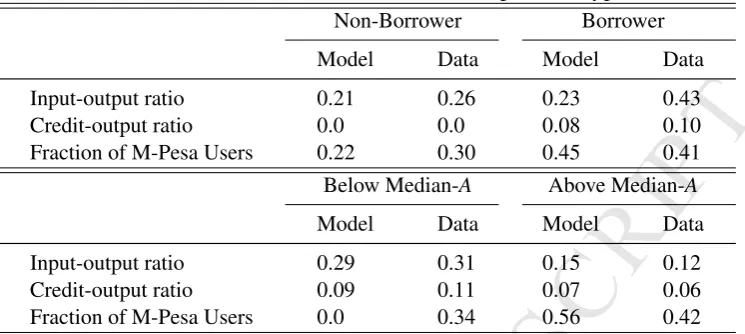
-Additional target moments that we set using the 2014 FinAccess-Business Survey are presented
in Table 2.29 As calibration targets, we choose sample moments (means) that are important for
assessing the overall adoption of M-Pesa (exploiting the productivity-channel of the model) and
trade credit-M-Pesa complementarity (exploiting the amplifier channel) in the economy. Namely, in the stationary equilibrium, using four of our model parameters we aim to match the following four
variables observed in FinAccess Business data: average entrepreneurial input-output ratio, average
trade credit-output ratio for those entrepreneurs who utilize trade credit in their transactions, fraction
of entrepreneurs in the economy who have a trade credit relationship with their suppliers, and finally
the fraction of entrepreneurs in the economy who utilize the M-Pesa technology when purchasing
inputs from suppliers.
There are two additional sample moments that we are interested in our analysis, which we do
not target in order to test the quantitative relevance of our qualitative channels: The first one is
the fraction of M-Pesa users among those entrepreneurs who borrow trade credit (or alternatively
the complementary group of those who do not borrow). The financial-amplifier channel of the model suggests that M-Pesa should be more intensely used among trade credit borrowers (and less
intensely among non-borrowers). By not directly targeting this variable with one of our parameters,
we test the quantitative relevance of this key qualitative mechanism.
Furthermore, as a second test-moment we investigate the ratio between the the average scale of
inputs employed by M-Pesa users and that of by non-users. Based on our theoretical foundation,
M-Pesa user entrepreneurs are expected to be on average larger in their input scale compared to
non-users for the following reasons: M-Pesa users on average (i) are more productive and are more
29The detailed calculation of each target variable is done as follows. The input-output ratio is the share of a firm’s
M
AN
US
CR
IP
T
AC
CE
PT
ED
likely to access trade credit, (ii) are not exposed to theft in theDaymarket, and (iii) have trade credit
constraints, which are relatively more relaxed compared to non-users.
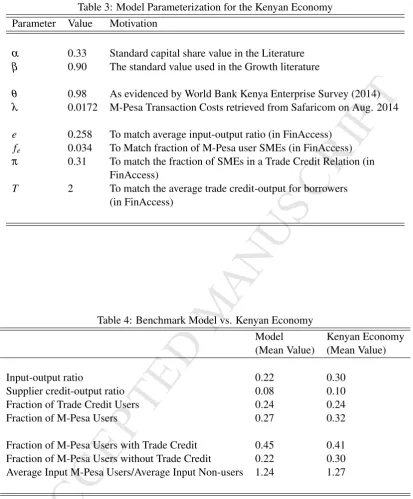
Table 2 about here
-When matching the demand to use M-Pesa observed in the FinAccess survey using our model’s
stationary equilibrium, we apply the following definition in order to be able to have a valid
compar-ison between borrower and non-borrower type entrepreneurs: since by construction a trade credit
borrower has the chance to interact with a supplier twice (in Dayand Night markets) and a
non-borrower only once, we define an entrepreneur with access to trade credit as an “M-Pesa user” only
if she utilizes M-Pesa in both Dayand Night transactions. A non-borrower is called an “M-Pesa
user” if she utilizes M-Pesa when transacting in theDay.
In addition to the M-Pesa user costs (λ and fe), the remainder of the parameter space of the
model also includes local monopoly rents of the entrepreneur which we already set atα =0.33, the
probability of being subject to theft (1−θ), the down-payment requirement (ω), the total number
of penalty periods following a default (T) and the discount factor (β). Finally, we also have the
parameter that determines the fraction of entrepreneurs who can utilize trade credit in their
trans-actions vis-a-vis suppliers, namelyπ. The model parametrization is presented in Table 3. When
parametrizing the stationary equilibrium of the model, some parameters are calibrated to match the
moments observed in the survey data, whereas others are assigned with values based on the existing
empirical evidence.
Table 3 about here
-The details of the model parameters, for which we assign values using existing evidence - and
common practices in the literature - are as follows. We setβ as 0.90 - a standard value utilized in
the growth literature. We use a value of 0.98 forθ, which implies that the likelihood of theft is 2%.
The value of “theft probability” is chosen somewhat conservatively, because the World Bank’s 2013
Kenya Enterprise Survey data documents that every year Kenyan manufacturing firms lose about
5 percent of product value due to theft. Moreover, alternative data sources point out theft being a
larger issue for the Kenyan economy. For instance, according to 2011-2013 round of Afrobarometer
survey about 16% of Kenyan respondents (and 37% of households in Nairobi) report that at least
once something has been stolen from their house over the past 12 months and about 47% of Kenyan respondents state that they feel unsafe when walking in their neighborhood.
The key policy parameters of our model are the M-Pesa user fees. The variable transaction cost