City, University of London Institutional Repository
Citation
: Neate, T., Roper, A. ORCID: 0001-6950-6294, Wilson, S. ORCID:
0000-0001-6445-654X and Marshall, J. ORCID: 0000-0002-6589-221X (2019). Empowering
Expression for Users with Aphasia through Constrained Creativity. In: Brewster, S. and
Fitzpatrick, G. (Eds.), CHI '19 Proceedings of the 2019 CHI Conference on Human Factors
in Computing Systems. (650.). New York, USA: ACM. ISBN 978-1-4503-5970-2
This is the accepted version of the paper.
This version of the publication may differ from the final published
version.
Permanent repository link:
http://openaccess.city.ac.uk/21272/
Link to published version
: http://dx.doi.org/10.1145/3290605.3300615
Copyright and reuse:
City Research Online aims to make research
outputs of City, University of London available to a wider audience.
Copyright and Moral Rights remain with the author(s) and/or copyright
holders. URLs from City Research Online may be freely distributed and
linked to.
City Research Online:
http://openaccess.city.ac.uk/
[email protected]
Empowering
Expression
for
Users
with
Aphasia
through
Constrained
Creativity
TimothyNeate1,AbiRoper1,2,StephanieWilson1,JaneMarshall2 1
CentreforHCIDesign,City,UniversityofLondon,London,UK 2
DivisionofLanguageandCommunicationScience,City,UniversityofLondon,London,UK
{timothy.neate,abi.roper.1,s.m.wilson,j.marshall}@city.ac.uk
ABSTRACT
Creativeactivitiesallow peopleto express themselvesin
rich,nuancedways.However,beingcreativedoesnotalways
comeeasily.Forexample,peoplewithspeechandlanguage
impairments,suchasaphasia, facechallengesincreative
activitiesthatinvolvelanguage.Inthispaper,weexplorethe
conceptofconstrainedcreativityasawayofaddressingthis
challengeandenablingcreativewriting.Wereportanapp,
MakeWrite,thatsupportstheconstrainedcreationofdigital textsthroughautomatedredaction.Theappwasco-designed
withandforpeoplewithaphasiaandwassubsequently
ex-ploredinaworkshopwithagroupofpeoplewithaphasia.
Participantswerenotonlysuccessfulincraftingnovel
lan-guage,but,importantly,self-reportedthattheappwas
cru-cialinenablingthemtodoso.Werefectonthepotentialof
technology-supportedconstrainedcreativityasameansof
empoweringexpressionamongstuserswithdiverseneeds.
KEYWORDS
Constrainedcreativity;accessibility;contentcreation;
apha-sia;creativewriting;poetry;creativity;speechimpairments.
1 INTRODUCTION
“Themoreconstraintsoneimposes,themoreonefreesone’sself ofthechainswhichshacklethespirit.”—IgorStravinsky[44] Creativityreferstotheactof bringingsomethingnew
intoexistence.Itappliesacrossmyriaddomains,beginning
withtheveryprocessofthinkingandcontinuesthroughto
Timothy Neate, Abi Roper, Stephanie Wilson, Jane Marshall. This is the accepted version of the paper, hosted by the authors. Definitive version published at CHI 2019 and available at: doi.org/10.1145/3290605.3300615
theproductionofartisticartefactssuchasmusical
compo-sitions,worksofartandliterature.Beingcreativeisoften
arewardingendeavourandhasbeenshowntoaford
sig-nifcantbenefts,forexample,tomentalwellbeing[10]and
selfesteem[19].Itis,however,challengingtobecreative
andmanyindividualsdonotconsiderthemselves‘creative
people’.Tothisend,varioustechniquesexisttoprovokeand
supportcreativeacts[46].Onesuchtechniqueisconstrained creativity[43]or“thinkinginsidethebox”.Constrainingthe spacewithinwhichacreativeactisenactedafordsthe
ex-plorationofboundariesandisanefectivetoolforinitiating
novelartisticendeavour.ComposerStravinsky[44](pg.60)
describeshischallengeswithcreativityinmusical
compo-sition,statingthatitisthefreedomofnumerouschoices
thatblockshismusicalcreativity;conversely,limitingthe
possibilitiesenablesideationandfreesthecreativespirit.
Therefore, acomposer mightlimit themselvestousinga
specifcsetofnotes(asinserialism),orapaintermightlimit
themselvestoasinglebrushtechnique(asinimpressionism)
togenerateaninitial‘spark’ofanideaortocompletean
entirework.Further,constraintsmightguideandsupporta
user–asimpleexamplebeingdrawingwithastencil.
Inthiswork,weexploretheideaofapplyingconstraints
tothecreationofwrittenlanguage.Thevariousformsof
writtenlanguage,suchaspoetry,lyricsorevenlimericksare
ameansbywhichwecanconveysentimentandareaconduit
throughwhichwemayshapeideas.However,peoplewith
speechandlanguageimpairments,suchasaphasia,struggle
toengagewiththeserichformsofexpression.Whilemuch
oftheliteratureontechnologyforpeoplewithdiverseneeds
focusesonrehabilitation,wefocusonenablingcreativity.
Specifcally,weexplorehowconstrainedcreativitycanbe
employedtobroadenaccesstodigitalcreativityforpeople
livingwithaphasia.Thispapercontributesthefollowing:
– Anew approachfor digitaltechnologytofacilitate
constrainedcreativity;
– MakeWrite,anoveltoolco-designedwithpeoplewith aphasiawhichutilisesintentional,automatedconstraints
onlanguagetofostercreativity;
2 BACKGROUND ConstrainedCreativity
Constrainedcreativityreferstotheprocessofgenerating
somethingnewfromarestrictedsetofresources.These
con-straintscanbeexternalorself-imposed.Whilstconstraints
elsewheremighthavenegativeconnotations,constraining
oneselfintentionally ina creativeprocess isa technique
widely-usedtoinspirenewcreativepossibilities[43].In
im-pressionistpainting,forexample,anartistoftenusesasingle
technique–e.g.thin,smallbrushstrokestobuildupalarger
scene.AsnotedbyBiskjaerandOnarheim[4]“certain con-straintscan alsobehelpfulandeven crucialin creativity". BiskjaerandOnarheim[4]studytwodomains(artand
en-gineeringdesign)reportingthat,inadditiontoconstraints
suchasbudgetandtime,teamsalsoleverageself-imposed
constraintsto promote creativity.Stokes [43]noteshow,
whilethematerialsandprocessoftheactofcreationare
obviousconstraints,thoseassignedbytheactorinthetask
canalsoplayanimportantroleincreativity.Similarly,Lazar
etal.[25]discussmaterialityinarttherapy,arguingthat
dif-ferentmaterialshavediferentexpressivepossibilities.They
propose(viaMoon[33])thatfuidmaterialssupportafective
andsensorystates,whereasrigidmaterialslikepensmight
afordexpressionsofstructureandboundaries.
Constraintsmightalsoservetosupportausermore
ex-plicitly:DahlandMoreau[12]arguethatconsumers’choices
to engage with pre-constrained craftssuch as
‘paint-by-number’,specialitycraftsandmodeltrains,aremotivated
byfeelingsofcompetence,autonomyandadesiretolearn.
Itisimportanttonoteherethateventhoughmostofthe
‘work’isdonebyanoutsideparty–i.e.thosewhodesigned
andbuiltthekit–enjoymentisstillgainedfromsuch
con-strainedcreativeactivities.Thespaceweaddressinthework
reportedinthispaperisintentionallyconstrained.Crucially,
however,weseektoenablepeopletocreateoriginal
arte-factsincontrasttothe‘paint-by-number’approachwhere
theoutcomeispre-defned.
CreativitySupportToolswhichUtilizeConstraints
Digitalcreativitysupporttoolsenablepeopletoarticulate
artisticintentindigitalform.Theextenttowhichthe
soft-wareassiststhecreativeprocessvariesbetweentools,but
thesetoolscommonlyrequireanextensivelearningprocess
inordertoproduceasophisticatedoutput.Shneiderman[42]
however,proposesthat,whenconsideringcreativesupport
tools,oneshould“Designwithlowthresholds,highceilings, andwidewalls”. Thatis, systems shouldbe designedfor non-experts,whileprovidingthefunctionalitythatexperts
need.Tothisend,muchresearchhasconsideredhowwemay
broadenaccesstothedigitalcreativeprocessthroughtools
thatundertakemuchofthecreativecostwithminimal
sacri-fceofexpressionontheuser’sbehalf.Tocreatemusic,for
example,onemustexplicitlyorimplicitlygraspacomplexset
ofheuristics(chordsequences,scalesandrhythm).Many
re-searchershaveconsideredhowtheserulesmaybemodelled
computationallytobroadenaccesstomusicalcomposition
foramateurs.BenglerandBryan-Kinns[3],forexample,
de-scribePolymetros–asystemenablingnon-musicianstobe creativebycontrollinganumberofparameterswithina
con-strainedstructure;meaningthatanumberofpeopleplaying
togetherwillalwayssoundcomplementary.Coughlanand
Johnson[11]identifyhowconstraintsmayserveto
supple-mentmusicalcreativityinanend-userdevelopmenttool,e.g.
byblocking‘unused’notestolowerthecognitiveefortto
engagewithaninstrument,similartotheconceptemployed
bythepopularappGarageband.Similarly,Benedettietal.[2] describeadrawingtoolthatallowsuserstocreatetheirown
versionsofpictures.Thetoolassiststhepaintingprocess
byprovidingcontoursthatautomaticallypaint‘within’the
linesofexistingpictures,allowinguserstoaddtheirown
creativestyle.
GenerativeandSupportedWritenCreativity
Anumberofdigitaltoolsgeneratecreativewriting.These
generallyproducepoemsandsimilartextsfroma
combi-nationofuserinput,suchasthechoiceofwords,andan
algorithmwhichdictatestheoutputpoem[18,35].Other
toolstakeaninteractiveapproach,formingthepoemfrom
liveinput.Forexample,PereiraandMaciel[37]investigate
theefectsofusersinteractingwithgenerativeliterature,
Mendelowitz[31]exploresanalgorithmicapproachtoauser
generatingpoetryfrom sketch-basedinput andMarshall
[30] usestheinputofrunningintensitytoaltertheefects
inareadpoem.Suchpoemgeneratingtoolssitona
con-tinuumwherethereisatensionbetweentheworkdoneby
theuserandtheworkdonebythemachine.Toolssuchas
Zhang’sneural-net-basedpoemgenerator usepreviously
createdpiecestogeneratenewpoems[49].Thisafordsthe
usernoagencyinthecreation.Otherpoetrygenerators(e.g,
onlinehaikugenerators)oferadegreeofcontroloverbasic elementsofthepoemwithinarigidstructure.Regardlessof
whereeachtoolsitsonthiscontinuum,notoolscurrently
existwhichgenerateandsupportcreativewritinginaform
accessibleforapersonwithaspeechandlanguage
impair-mentsuchasaphasia.
AphasiaandContentCreation
Wenowconsidercreativitywithinthecontextofaphasia.
Aphasiaisanimpairmentoflanguagecausedbydamageto
thebrain(mostoftenthroughstroke).Itcanafectallaspects
oflanguage:reading,writing,speechandcomprehension
uponeveryindividualdiferently.Forexample,somepeople
mayfndwritingmoredifcultthanspeaking,whereas
oth-ersmighthavespecifcdifcultiesinunderstandingspoken
language.Theconditionafectsaroundonethirdofstroke
survivorswithestimates thatthere are around2 million
peoplelivingwithaphasiaintheUSAalone[1].However,
despiteitsprevalence,lessthan10%ofthewiderpopulation
knowwhataphasiais[9]–illustratingitsstatusasalargely
invisiblecondition.Anageingpopulationandincreasing
oddsofsurvivingastrokeimplythatthenumberofpeople
afectedbyaphasiawillcontinuetoincrease–andagrowing
numberofindividualswillbefacedwithdiminished
oppor-tunitiestoconveytheirintellectandcreativepotentialdue
totheirlanguagebarriers.
Multipleaspectsofthecreativeprocessmayprove
chal-lengingto people withaphasia. Manycreative activities,
suchaspoetryforexample,necessitateextensivelanguage
processing.ChrisIreland,apoetwithaphasia,getsaround
thisbyengaginga‘poetryeditor’(aspeechandlanguage
therapistfriendwithoutaphasia)tohelpeditandrefneher
work[23].Ireland’swork,andrelateddiscussions[24],
re-portthebenefcialexperienceforherofcreativewriting(via
Boltonetal.[5]).Shedescribesherworkasacelebrationof
thelanguageofaphasia(completewith‘erroneous’spelling
andgrammar)andaliberatingtoolinwhichsheis
empow-eredthroughcreativity.Otherswithaphasiamaynotenjoy
similaraccesstoa‘poetryeditor’friendandmightlookto
technologyforsupport.Researchindicates,however,thatthe
languagedemandsimplicitinmanyaspectsof
technology-usepresentbarriersforpeoplewithaphasia[8,20,32,40].
Thetestingofsocialmediatoolswithpeoplewithaphasia
[39],forexample,hasshownthattheycanpresentanumber
ofbarriers[21].Thismeansthatmanycreativitysupport
tools,suchasthosedescribedpreviously,arenotavailable.
Inevitably,thisleadstochallengesforpeoplewithaphasia
hopingtoengagewiththeprocessofdigitalcreativity.
Workhasbeenundertakentocreatetechnologies
accessi-bletopeoplewithaphasia.Thesetechnologieshavemainly
focusedoneithertherehabilitationofcommunication,e.g. toretrainlostvocabulary[36],ortheuseoflanguageina
veryfunctionalcapacity.Forexample,Walleretal.[47]
in-vestigatedhowwemightassistpeoplewithaphasiatomake
conversation.Onecommonlyreportedmethodemploys
im-agestosupportcommunication[7,28,29].Otherworkseeks
tosupportmorepracticalactivitiessuchascooking[45].
Ac-cessibledigitaltechnologieshavealsoenabledrehabilitative
therapyforimprovinggestures[41]andspokenlanguage
[16,26].Contrastingworkhassoughttoclassifyaphasic
lan-guageinputcomputationally[15].Verylittlework,however,
hasfocusedonenablingcreativedigitaloutput.Whilst reha-bilitationisunquestionablyimportant,weaimtoprovidea
contrasttoexistingfunctionaltechnologiesbyconsidering
howwecanengagepeoplewithaphasiainadigitalprocess
ofcreativewriting.WedothisthroughMakeWrite,anovel toolthatutilisesconstrainedcreativitytoenablepeoplewith
aphasiatoplaywithandshapelanguage,facilitating
mean-ingfulandenjoyablecreativewriting.
3 EXPLORINGCONSTRAINEDCREATIVITY ErasurePoetry
The workreportedhere wasinspiredbythepotentialof
erasurepoetryto allowpeopleto scafoldtheircreativity bybuildingontheworkofothers.Inerasurepoetry(also
knownasblackoutpoetry),oneremovespartsfromasource
text,typicallybyredactingwithapen,to leavebehinda
newpoem(Figure1).Thiscreatespoems,orsmallpiecesof
creativewriting,relatedorunrelatedtotheoriginaltext.
Weexplorederasurepoetryinoneofourregularresearch
teamcreativitysessions.Althoughnoneofuswouldregard
ourselvesascreatives(andcertainlynotaspoets),weall
createderasurepoemswithrelativelylittleefortandalot
ofprideintheoutcome.Filledwithasenseofachievement,
wethenencouragedotherstoparticipatebyplacingpages
fromabookaroundourresearchlab,andreceivedanumber
ofadditionalpoemsinresponse.SeeFigure1.
The world, so beautiful
the car, succumbing to a vortex
offered up
Figure1:Excerptfromanerasurepoemwrittenontheday abillionairelaunchedausedcarintospace,redactedfrom
‘TheBriefWondrousLifeofOscarWao’byJunotDíaz[13].
Subsequentrefectionsuggestedtousthatapplying
con-straintstothecreationoftextcouldbeapowerfulenablerfor
peoplewithspeechandlanguageimpairments–providing
aconstrainedvocabularyspace withinwhich textscould
becreatedandovercomingthechallengeofstartingfrom
ablankslate.Wealsoidentifed,however,thattheerasure
poetryactivity,aswehadundertakenit,waslikelytobe
lin-guisticallychallengingforthosewithalanguageimpairment
–duetothenumberanddensityofwordspresentedona
typ-icalpage–butthattheremaybeanopportunityfordigital
toolstoassistthisprocess.Weundertookaco-design
activ-itytoexplorethisopportunity,leadingtothedevelopment
[image:4.612.317.555.387.496.2]Co-Design
Followingourinitialexplorationoferasurepoetry,weworked
withfourco-designerswithaphasiatoprobethe
feasibil-ityofusingtechnology-assistederasurepoetryasaform
ofconstrainedcreativity.Theco-designerswereemployed
asconsultants.Allhadmild/moderatelanguagedifculties
duetoaphasiaasaconsequenceofstroke,wereatleastsix
monthspost-strokeandhadspokenEnglishfuentlyprior
totheirstroke.Theywereagedbetween44and68years
old(average=58).Weundertookthreeco-designsessions
forthispurpose;thesewereaudioandvideorecordedfor
laterreference.Theco-designersgeneratedideasinthefrst
sessionandworkedwithusinsubsequentsessionstorefne
prototypesasthedesignprogressed.Ourgoalwastoensure
thatanytechnologywouldbebothaccessibletopeoplewith
aphasiaandwouldempowerthemtocreatecreativecontent.
IdeationwithInitialPrototypes
Weworkedwiththeco-designerstoexploretheideaof
auto-matederasureasameansofdigitallyassistingconstrained
creativity–frstthroughapaper-basedsimulation("paper
grids")andthenthroughasimpleprototypeappwhich
mir-roredtheprocessinadigitalform.Wediscussedtheefcacy
ofthesemethodsduringandafterthesessionsupportedby
visualratingscales.Thesescalesprovidevisualcuesin
addi-tiontonumbers(e.g.a‘thumbsup’or‘thumbsdown’atthe
endsofaLikertScale,similarto[17])tosupportpeopleto
expresstheirthoughtsandquantifytheirsentiments.
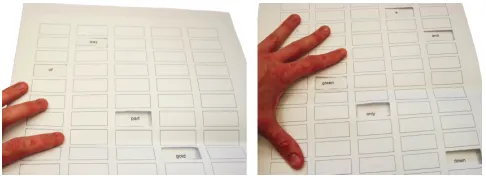
PaperGrids.Wefrstsimulatedtheconceptof‘automated’ redactionusingpapergrids.Co-designersweregivenasource
textlaidoutinagridpatternonA3paperandoverlayswith
holescutout.Theoverlays‘redacted’themajorityofwords
fromthesource.Co-designerswereabletoredactvarying
amountsoftextbymovingtheoverlaysandbyselecting
alter-nativeoverlays(Figure2).Thegoalwastoexplorewhether
reducingthecognitiveburdenof redactionwouldenable
peoplewithaphasiatoborrowwordsfromasourcetextto
createtheirownexpressiveoutputs.
Afterpracticeapplyingoverlaystothepapergrids,allof
theco-designerswithaphasiawereabletocreatewritten
textswithwhichtheyweresatisfed.Indeed,this‘automated’
redactionofalargebodyoftextmadetheselectionofwords
moreachievable.However,achallengewiththewordsets
elicitedby theoverlayswasthatbyspotlightingjustone
wordatatime,elementsoftextswhichnaturallyconsistof
twoorthreewordphraseswerelost–sometimesleaving
theemergentsubsetof wordsfragmentedandlacking in
potentialforcomposingnewphrases.
Overthecourseoftheactivity,itnaturallyevolvedintoa
collaborativeexercise.Wenotedtherewasincreasing
engage-mentwiththepoetryactivityandthatpeoplebeganto‘rif ’
Figure2:Wordblockingexerciseanalogoustoautomatically redactingtexts(self-imposedconstraints).Left,apapergrid
is placed over aspaced gridof words.Right, this gridis turnedupside-downandadiferentsetofwordsemerge.
ideasofeachothertocreatesomethingnewwithlanguage.
Forexample,oneco-designernoted:“Maybeifeachperson doesachunkandthengeteveryonetogetherforthepoem”. Bytakingitinturnstogeneratelinesusingthepapergrids,
thegroupproducedaseriesofcreativetexts,forexample,a
shortHaiku-soundingpoementitled‘TheHemlockGrief’: The Hemlock Grief
The change subsides
Her tree only sank
It’s almost dark
InitialAutomatedRedactionPrototype. Wenextexplored automatedredactionthroughasoftwareprototypebuiltin
theProcessingprogramminglanguage.Thisprototypeused thesameconceptofblockingoutsectionsfromagridof
words,butdidsowithblockinggridswhichblocked out
wordswithanuser-defnedprobability(between10%and
90%inincrementsof10).Thisprototypewasdemonstrated
byoneoftheresearchersandprojectedontoascreeninthe
labduringthesession,withdirectionfromtheco-designers.
Theredactionwasrepeateduntilapreferredsetofwords
wasidentifed.Theselectedwordswerethenwrittenout
andrearrangedbythegrouptocreateanewtext.
Theiterativeapproachofrenderingmultipleredactionsof
thetextsupportedbythisprorotpewasreceivedpositively.
Thisapproachmadeeachsetofwordslessprecious,
mean-ingthatmultipleiterationscouldbeviewedquicklyuntila
preferredsetofwordswasavailable.Thismadeforaneasier
processofbeingcreativewithlanguage.Oneco-designer
statedthattheblockingofthewordsenabledthemtocreate
atextthattheywerehappywith,likeningittoacrossword
anddescribingitasa“surprisinglyrewardingexperience”.
Fromtheseinitialexploratoryactivities,wedrewseveral
conclusionsforthedevelopmentofanappthatwouldutilise
constrainedcreativityto supportpeople increative
writ-ing:thatallowingfortheretentionofmore grammatical
structurefromthesourcetextmightsupportwriting(e.g.by
supportingselectionofsmallchunksoftextinsteadof
[image:5.612.317.560.91.179.2]possiblebuttheappshouldencompassafairpowerdynamic;
andthatfacilitatingmultipleiterationsofredactionsofthe
sourcetextalloweduserstogeneratecreativelanguage.
Co-DesignofMakeWrite
Wenextconductedtwoco-designsessionstoiteratively
de-signanappthatusesautomatedredactiontoenablepeople
toplayandexperimentwithwordsandproducecreative
output.Thegoalswere tobuildonthefndingsfromthe
ideationsessionandtodeliveranaphasia-friendly,
accessi-bleapp.Wedecidedthattheappshouldhavethreestages:
onetoallowtheuserstochoosethesourcetexttheywantto
redact(‘Choose’);onewheretheyapplythecomputer-aided
redaction(‘Erase’);andafnalstagetoarrangethetext
(‘Ar-range’).Theco-designprocessemployedtechniquessuch
asSWIM(SomeoneWhoisnotMe)[48]viaco-created
per-sonas[6,34]andvisualratingscales(asabove)tofacilitate
ideagenerationandfeedbackforthesethreestages.
ChoosingtheSourceText.Althoughasourcetextmight bedrawnfromanywhere(e.g.awebsite,bookorpoem),for
thesakeofthesimplicity,wechosetolimittheprototype
apptosixshortcreativetexts(poemsandshortstories).We
consideredhowthesourcetextsmightbepresentedforusers
tomakeachoice–exploringanumberofmeanstoidentify
eachsourcetext,includingplainwordlabelsandword-clouds
generatedfromthetexts.Theco-designersadvisedthata
picturewithatextlabelwouldsupportthemtounderstand
themainthemeofeachtext:“Youcanputsomepicturein. Thatwouldhelp.Picturewillmakemanywords”.
AutomaticRedactionoftheSelectedSourceText. Wewanted togiveuserscontroloverhowmuchtextisredacted.Based
onfeedbackintheco-designsessionsregardingthenumber
ofwordsthatwouldbeappropriate,theamountof
redac-tionwaschangedtohaveanupperlimitof10%retention
ofthesourcetext(i.e.atleast90%redaction).Furthermore,
informedbythefndingsofthefrstco-designsession,we
wantedtoretainsomeelementsofthesourcetextstructure
asco-designersfounditchallengingtolinkisolatedwords.
Therefore,weexploreduseofa‘textgrouping’functionto
allowuserstospecifythatsomeofthewordsshouldbein
chunksofeithertwoorthreeadjacentwords.Thiswas
re-ceivedpositively. Finally,afterexploring aninitialvisual
design,allUIelementsweremadelargerandarrangedto
afordeasierinteractionforpeoplewithaphasia(i.e.taking
intoaccountnon-dominanthanduseandtheconsequent
needforinteractiontargetswhichrequirelessaccuracy).
ArrangingtheText.Forthefnalpartoftheprocess,we wantedtooferaninterfacethatenablesuserstoorganise
theselectedwordsubsetastheywish.Herewewereinspired
byfridgepoetry(aformofVocabularyclept[27]),aformof
constrainedcreativitywherepeoplearrangeafnitesetof
wordstocreatevaryingoutputs.Afterexploringaninitial
designwiththeco-designers,itbecameclearthatto‘clean
up’anyunwantedwords,thisphaseshouldprovideasimple
waytodeleteselectedwords.Co-designersalsoindicated
thatthereshouldbeanoptiontoaddwords.Tosupportthis,
wecreatedabuttontoallowuserstoelicitone
randomly-selectedadditionalwordatatimefromthepoolofpreviously
rejectedwordsinthesourcetext.Wetookthedecisionto
avoidtheoptionofwordentryviakeyboardinput–which
mightexcludethoseuserswithtypingdifculties–toensure
thatalluserswishingtoaddnewwordscoulddosoonan
equalfooting.ThevisualdesignoftheArrangescreen(e.g. thesizeofthewordsandtheirpadding)andtheinteraction
(multiple fngers) were designedwithinput fromthe
co-designers.
CapturingtheContent.Finally,wediscussedwiththe co-designershowtheyandotherpeoplemightwanttoshare
thecreatedtexts.Allco-designersexpressedadesiretoshare
thetextswithcloseindividualssuchasfamilyandfriends,
butthereweresome reservationsaboutwidersharingto
socialmedia.Hence,ratherthananautomatic‘publishto
socialmedia’option,weoptedtoimplementtheoptionfor
theusertosaveanimageofthetexttheyhadcreated,and
thiscouldlaterbesharedhowevertheymightchoose.
4 OVERVIEWOFMakeWrite
Wenowdescribetheresultantco-designedapp.MakeWrite
isaprototypeappthatenablesuserstotakeasourcetext,
automaticallyredactitaccordingtoselectedparameters,and
thenarrangetheredactedtextinsuchawayastocreatea
newformofwrittenexpression.MakeWritehasthree con-secutivestages,eachdedicatedtoonespecifctask:Choose,
EraseandArrange(Figure3).
The‘Choose’Stage
ThefrstscreenofMakeWriteinvitestheusertochoosea sourcetextfromaselectionofsixshortcreativetexts.
The‘Erase’Stage
Oncetextisloadedfromtheoriginalsource,theusermay
beginredactingwordstofndagroupthattheylike.
Auto-maticredactionisinitiatedbypressingtheyellow‘Refresh’
button(Figure4).Thepercentageofredactioncanbealtered
throughuseofaslider(set,bydefault,sothatonly5%of
textwillremainafterredaction).Userscanchoosetoretain
between0%and10%ofthesourcetext.Thewordgrouping
featureenableschunksofeither1,2or3wordsatatimetobe
generatedbypressingtheappropriatebutton.Here,ifaword
appears,inaccordancewiththepercentageredaction
Figure3:MakeWrite:a)the‘ChooseStage’,b)the‘EraseStage’,c)the‘ArrangeStage’.
userisfreetomanipulatepercentageredactionandgrouping
constraintsuntiltheyarriveatagroupofwordstheywould
liketouseasastartingpointfortheircreativetext.
The‘Arrange’Stage
Theelicitedwordsarethenpresentedonagreycanvasarea
withinthe‘Arrange’screen.Userscandragandrearrangethe
wordswithmultiplefngerstoformanewtextcomposition.
Awordcanbe deletedby movingitto the‘Draghere to
delete’region.Usersmayalsoaddwordsfromthepreviously
‘rejected’setofwordsfromthe‘choose’stage.Pressingthe
‘Newword’buttonwillspawnarandomly-selectedword
intothegreyregionbelowthebutton.
Figure4:Variationsofredaction:topleftandtoprightshow thevariationinwordretention(10%and20%respectively).
Bottomleftandbottomrightshowthevariationintheword grouping(2wordsand3wordspergrouprespectively).
5 ‘POETRY’CREATIONWORKSHOP
ToexploreuseofMakeWritewithinareal-worldsetting,we conductedacreativewritingworkshopatadrop-insession
forpeoplewithaphasia1.Thedrop-insessionisaweekly
eventwherepeoplewithaphasiainthelocalcommunitycan
accesscommunicationsupportfromspeechandlanguage
therapists (SLTs), speechand language therapy students
(SSLTs)andpeerswithaphasia.Thoseattendingweremade
1
Weinitiallyreferredtothesessionasapoetryworkshop.Overtime, how-ever,wehavecometoconsidertheterm‘creativewriting’amoreftting descriptoroftheactivity.
awareinadvancethatthesessionwouldincludeapoetry
ac-tivitywithresearchersandweregiventheoptiontoopt-out
oftheactivityinfavouroftheirregularsessionactivities.
Theaimofthisworkshopwastounderstandthe
efec-tivenessofMakeWriteforenablingpeoplewithaphasiato createnewtexts(referredtoas‘poems’asashorthandwithin
thecontextoftheworkshop).Owingtothenatureofthe
drop-insession,wecouldnotcontrolforaphasiaseverity.
Giventheapphadnotbeencreatedwithexplicitinputfrom
userswithsevereaphasiaweexpectedavarietyofoutcomes
whenputtingittothetestwithinthisbroadercontext.The
workshopwasrunbyahumancomputerinteraction(HCI)
researcher,threeprofessionalSLTsandoneSSLT.TheSSLT
andtwooftheSLTshadnotbeenpartoftheco-designteam.
Procedure
Atthebeginningoftheworkshop,participantswere
sup-portedtoaccesstheinformationandconsentprocedureby
theSLTsandSSLT.Thiswasfollowedbycompletionofan
aphasiaaccessibleinterviewtogatherdemographic
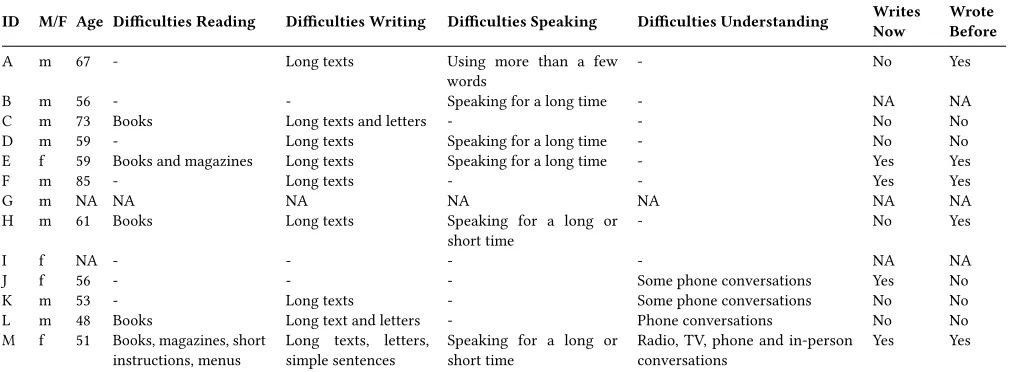
infor-mation(reportedinTable1).Tocapturedetailsofaphasia,
participantswereaskedto self-reporttheirperceived
dif-fcultieswithreading,writing,speakingandlistening,by
refectingontheirabilitytocompleteaseriesoftaskswhich
rangedfrommoretolesscomplex.Forexample,to
under-standaperson’swritingability,weaskedparticipantswhich
(ifany)ofthefollowingtheyfeltabletoproduce:longtexts
(likeastory);aletteroremailtoafriend;simplesentences;
somesinglewords;theirname.Wealsoaskedthemto
re-portanyphysicalimpairments.Datacapturewassupported
byuseofaphasia-accessibleformsandvaryingdegreesof
facilitationfromthe(S)SLTs.
MakeWritewasthendemonstratedwiththeiPadscreen projectedontoalargedisplay.Thiswasundertakenbyone
oftheSLTswhohasextensiveexperienceinusingdigital
technologiesalongside people withaphasia. Participants
thendividedintofveself-selectinggroupstouseMakeWrite
[image:7.612.54.567.92.220.2] [image:7.612.53.294.427.499.2]askedtoworktogethertocreatepoems.Wherenecessary,
theuseoftheappwassupportedbyanSLTorSSLTfacilitator.
Whenparticipantshadfnishedcreatingtheirpoems,they
weresupportedtocompleteafeedbackquestionnairewhich
includedrating theiragreement/disagreementto thekey
statement"IwroteapoemwiththeappthatIcouldnothave writtenwithoutit"(seeTable3).
Weadoptedthisworkshop-basedapproachtoinvestigate
usageofMakeWritebecauseSLTsontheresearchteam ex-pressedtheviewthatitwasnotreasonabletoask
partic-ipantstoengageinunsupportedcreativewriting(indeed,
thischallengewastheoriginalmotivationfortheapp).For
thisreason,aformalcomparativeevaluationbetweenthe
creativewritingoutcomesachievablewithorwithoutthe
appwasrejectedinfavourofparticipants’self-evaluationof
theirMakeWrite’poems’againsttheirabilitytowritepoetry withouttheapp.
DataCollectionandAnalysis.EachiPadrecordedall inter-actionsbothasvideoandaudioandalsoasevent-basedlog
data.Asmentionedabove,aftertheusagephase,participants
reportedtheirexperienceofMakeWritethrougha question-nairewithvisualratingscales(facilitatedbySLTandSSLTs
outsideoftheappdesignteam).Additionalvideoandaudio
recordingsoftheworkshopwereusedtotriangulate
fnd-ingsfromtheprimarydatasources.Logandinteractiondata
wassummarisedusingdescriptivestatistics.Qualitativeand
quantitativedatafromuserevaluationformswerecollated,
summarisedandreviewedforemergingthemes.
Participants
Fifteenpeopleattendedthedrop-insession;allwereofered
theopportunitytotakepartinthecreativewriting
work-shop.Twopeopleoptednottodosoandengagedinother
tasks.Wereportdatafromtheremaining13participants,
identifedasA–M(Table1).Therewere4femaleand9male
participantswithanaverageageof60.7years(SD=10.7;min
=48;max=85).Participantsreportedvaryingdegreesof
lan-guagedifcultiesasaresultoftheiraphasia–refectingthe
typicaldiversityofthebroaderusergroupwithaphasia.Five
participantsreportedsomedegreeofdifcultywithreading,
ninewithwriting,sixwithspeakingandfourwith
under-standingspeech.Oneparticipant(p.I)reportednoidentifed
difcultiesfromthepresentedlistofoptions–indicating
thatsheexperiencedmoresubtlebutnonetheless
impact-fulefectsuponherlanguage.Anotherparticipant(p.M),in
contrast,reporteddifcultiesacrossallfourdomains.All
butfourparticipantsreportedadditionalphysical
impair-ments.Theseweremostlyone-sidedweaknessorparalysis
asaresultofastroke(hemiplegia/hemiparesis),meaning
thatseveralparticipantshadmobilityissuesand/orlimited
useoftheirdominantrighthand.Groupconfgurationsfor
theself-selectinggroupsareidentifedinTable2.
Results:EraseStage
WordRedactionandGroupingParameters.When interact-ingwiththe‘Erase’partoftheapp,participantsusedthe
wordredactionand/orgroupingfeaturestosetparameters
on78.89%ofoccasionswherewordsweretakentothe
‘Ar-range’stage.Interactionwiththegroupingfeaturebuttons
wasmorecommon(68.97%)thanwiththewordredaction
slider(58.62%).Followinguseofthegroupingfeature,the
averagewordgroupsizeincreasedtoanaverageof2.35.The
averageamountoftextremainingfollowinguseofthe
redac-tionsliderwas6.88%.Mostoften,participantsincreasedthe
valuefromitsdefault5%value(70.59%ofthetime).
Results:ArrangeStage
MovementofWords.Asaproxyforengagementwiththe textarrangementactivityatthisstage,weconsiderthe
move-mentofwords.Weloggedeachtimeausermovedtheirfnger.
Somegroupsmovedthewordsconsiderablymorefrequently
thanothers,e.g.,Group2onlytouched72words,whereas
Group3touched149words.
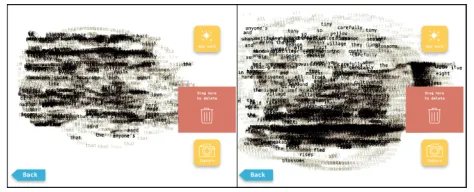
Figure5:Kineticvideoheat-mapofthearrangestage,with interfacesuperimposedforreference:Group2(left)mostly usedthewordschosenfromthe‘Erase’stage.Group3(right) regularlyspawnedandthenmovedwordstothedeletearea.
WordSpawningandDeletion.Acrossthe5groups,428 wordsweredeletedand440wordswerespawned–anetof
12extrawords(428- 440).Thiswasaresultofverydiferent
usagebehavioursbetweenthegroups(withnetdeletionsof
wordsrangingfrom-79(Group1)to165(Group5).Some
groupsdeletedconsiderablymorewordsthanothers.
Anal-ysisofvideoheat-mapssuggestedtwomainvariationsin
userbehaviouratthisstage(Figure5).Thisvarianceisalso
refectedinthewordspawnanddeletiondata.Thiscontrasts
toGroup1andGroup3whousedthewordsgeneratedin the‘Erase’stagemoreoften.
Results:OutputsofProcess
[image:8.612.320.557.377.473.2]ID M/F Age DifcultiesReading DifcultiesWriting DifcultiesSpeaking DifcultiesUnderstanding
Writes
Now
Wrote
Before
A m 67 - Longtexts Using more than a few - No Yes
words
B m 56 - - Speakingforalongtime - NA NA
C m 73 Books Longtextsandletters - - No No
D m 59 - Longtexts Speakingforalongtime - No No
E f 59 Booksandmagazines Longtexts Speakingforalongtime - Yes Yes
F m 85 - Longtexts - - Yes Yes
G m NA NA NA NA NA NA NA
H m 61 Books Longtexts Speaking for a long or - No Yes
shorttime
I f NA - - - - NA NA
J f 56 - - - Somephoneconversations Yes No
K m 53 - Longtexts - Somephoneconversations No No
L m 48 Books Longtextandletters - Phoneconversations No No
M f 51 Books,magazines,short Long texts, letters, Speaking for a long or Radio,TV,phoneandin-person Yes Yes instructions,menus simplesentences shorttime conversations
Table1:Self-reportedparticipantdetails:m=male;f=female;NA=notanswered;- =nodifcultiesidentifed
amongstlistofprovidedoptions.‘Writesnow/before’referringtoparticipant’spoetrywritingpre/poststroke.
(mm:ss.ms)pergroup.Overthecourseofthistime,atotal
of28textswerecreated.Figure6presentsfourofthetexts,
givinganindicationofthevariationinlengthandcontent.
OutputTextscreated. Table2providesanumerical sum-maryoftextsproducedwithinthe‘Arrange’stage.The
aver-agenumberoftextsproducedpergroupwas5.6.Theaverage
numberofwordswas11.3.Wordswerespreadovera
mini-mumof1andamaximumof7lines.Groupsspentanaverage
of7:08.90minutescreatingeachtext.
Group(Participants) Num. Words Lines Time
Group1(B,L,M) 7 5.9 2.3 04:22.1 Group2(C,D,E) 4 11.5 2.5 06:34.2 Group3(F,G,H,I) 7 10 2.1 10:40.6
Group4(A) 4 4.5 1.3 04:53.0
Group5(I,J,K) 6 25 6.2 09:14.7
Averages 5.6 11.3 2.9 07:08.9
Table 2: Descriptive statistics of texts created by
groupsasaresultofthe‘Arrange’stage
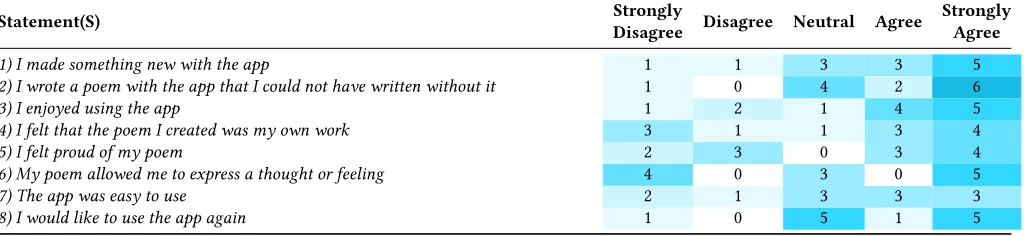
QestionnaireData.ThequantitativeLikertdatafromthe questionnairestatements(S1- S8)areshowninTable3.At
leasthalfofallrespondentseitheragreedorstronglyagreed
witheachstatement(56outofatotalof99responses),
indi-catingagenerallypositiveresponsetowardsMakeWrite;20 (of99)responseswereneutraland23wereindisagreement
orstrongdisagreement.S1,S2andS3elicitedthehighest
levelsofoverallagreementandS4,S5 andS6elicitedthe
greatestdisagreement.Eightof13participantsagreedthat
theyhadmadesomethingnewwiththeapp(S1).However,
twoparticipantseitherdisagreed(p.H)orstronglydisagreed
(p.C)withthis.ParticipantH,inhiswrittencomments,
ex-pressedthatthereweretoomanywordsforhimtowork
with“3wordsenough!”.Eightof13and9of13participants respectivelyagreedthatMakeWriteenabledthemtowritea ‘poem’thattheycouldnothavewrittenwithoutitandthat
theyhadenjoyedusingtheapp.Oneparticipantnotedthat
helikedtoreducethecomplexity–i.e.cutdownthenumber
ofwords–toworksomethingintoaanewform“Ienjoyed makingchoicetomakesomethingsimple"(p.L)
Fourof12participantsdisagreedwithstatementS4:“Ifelt thepoemIcreatedwasmyownwork”.Thoseindisagreement generallycitedoneoftworeasons:eitherthatthewords
camefromtheoriginaltextandthereforeitwasnottheirs–
“fromthebook!”(p.A)or,thatbyworkinginagroup,theyfelt thattheothermembersoftheteamdidmostofthework,for
examplep.C–“teamhelped”.Someparticipantsexpressed adesiretoaddtheirownwords,forexamplep.B:“Nonot myownworkI wouldliketotypemyownwords".Fiveof 12participantsdisagreedwithstatementS5:“Ifeltproudof mypoem”.Someparticipants,whofeltthattheprocessof redactingandarrangingthetextwassomethingthatthey
did,wereveryenthusiasticabouttheprocess–“Itwasme" (p.B).Howeverothers,again, feltthatasthewordswere
sourcedfromapre-existingtext,theworkwasnotasmuch
theirs.Finally, 4 of 12disagreed withstatement S6: “My poemallowedmetoexpressathoughtorfeeling”.Participant Bwrote:“Noitwasntthewordsiwouldhaveuse”.
AdditionalComments.Several participantsnoted some improvementsthatcouldmaketheappmoresuitable for
them,forexample,bychangingthecontentavailableduring
[image:9.612.54.561.95.281.2]Figure6:Fourdiferingexamplesoftextsfromthegroups:a)fromGroup3;b)Group2;c)Group4;d)Group5.Textsa)and b)takeanalmostHaiku-typeform.c)takesamoreminimalistapproach,whereinp.Amostlyusedafewwordstocreate
sentenceshefoundamusing,andd)wastypicalofGroup5,whooftenuseda(comparably)largenumberofwordsintheir creativetexts.
Strongly Strongly
Statement(S) Disagree Neutral Agree
Disagree Agree
1)Imadesomethingnewwiththeapp
2)IwroteapoemwiththeappthatIcouldnothavewrittenwithoutit
3)Ienjoyedusingtheapp
4)IfeltthatthepoemIcreatedwasmyownwork
5)Ifeltproudofmypoem
6)Mypoemallowedmetoexpressathoughtorfeeling
7)Theappwaseasytouse
8)Iwouldliketousetheappagain
1 1 3 3 5
1 0 4 2 6
1 2 1 4 5
3 1 1 3 4
2 3 0 3 4
4 0 3 0 5
2 1 3 3 3
1 0 5 1 5
Table3:Likertscaleresultsfromtheworkshop.S1-S3elicited13participantresponses;S4-S8elicited12.
Forexample,football”(p.K).Additionally,participantsnoted thatitwouldbeusefuliftheappwasabletoreadoutthe
morechallengingwords:“Itwouldhelptoreadoutdifcult words"(p.M);“Itshouldtalk"(p.B).Finally,participantswith moresevereaphasiaindicatedthatthecomplexityofthe
originaltextsintheappwastoogreatandthat,ideally,it
shouldbesimpleror thattheywouldrequiremoretime:
“writtenwordsaredifcult.1-2or3wordsatonceisthemost thatIcanimagine" – “confusing.Toomanywords.Abstract words"(p.H).
DiscussionofResults
Thediversityoftheparticipantgroupintheworkshopcan
beconsideredrepresentativeoftheuserpopulationofpeople
withaphasia.However,theconsequentheterogeneityofthe
resultsmakesitchallengingtoidentifyagroupconsensus
andhencetoinferspecifcimplicationsforindividualaphasia
profles.Theresultshave,however,provideduswithvaluable
insightsintodesigningforthisdiversepopulationandwe
areabletoidentifyimportantoverallthemes.
Signifcantly,theresultsindicatethatMakeWriteenabled avarietyofuserswithaphasiatocreatenewtext
composi-tions.Severaloutcomessupportthis:fromthefactthateach
groupwasabletoproduceanumberofnewtextsduring
theworkshop,throughtothenumberofparticipantswho
agreedwithstatementS2onthequestionnaire(“Iwrotea
poemwiththeappthatIcouldnothavewrittenwithoutit”).At agrouplevel,thevariationinthenumberofwordsspawned
anddeletedisindicativeofthewaythatthediferentgroups
workedtocreatethetexts.Thebehavioursnotedfromthe
logs(Figure5)suggestthatsomegroupsutilisedthe
con-strainedredactiontechniquefully,whereasothersuseditas
theinitial‘spark’toelicitabasictext.Tomakethetexttheir
own,theythenoptedforamore‘bruteforce’approachby
spawningandrejectingwords.
Thereisevidencethatmostparticipantsenjoyedusing
theapp(S3,Table3).Some,however,experienceddifculty.
ParticipantsCandHexpresseddisagreementwiththe
state-mentsthattheyhadbeenabletomakesomethingnew(S1)
andthattheyhadfoundtheappeasytouse(S7).Itis
interest-ingtonotethatthesetwoparticipantsself-reported
difcul-tiesinbothreadingbooksandwritingtexts(Table1).This
mayindicatethat,forsomeusers,acombinationofreading
andwritingdifcultiesmightinhibittheiruse.However,this
combinationofdifcultiesdidnotappeartohaveanegative
impactontheexperienceforotherparticipants.Participants
E,LandM,forexample,eachindicatedstrongagreement
withthesameS1andS7,inspiteofalsoreporting
difcul-tieswithreadingandwriting.Furthermore,participantM,
theonlyusertoreportextensivedifcultiesacrossallfour
domainsoflanguage,nonethelessreportedenjoymentand
[image:10.612.64.558.91.198.2] [image:10.612.55.567.259.377.2]ofdifcultieswithlanguagecanuseMakeWritesuccessfully butfurtherresearchisrequiredtounpackthesefndings.
Asmightbeexpected,participantsidentifedseveral
addi-tionalfeaturesthatmightenhanceMakeWriteforthemselves orothers.Theseincludedmoresimplistictextcontentatthe
‘Choose’stage;fewerwordsatthe‘Arrange’stage;andthe
capacitytoread-aloudtext.Suchfeedbackcaninformthe
designofotherappsforconstrainedcreativitywhichwill
meettheneedsofavarietyofusers.Finally,theenvironment
–agroupworkshop–workedformost,butdidnotforsome.
Some,withmoresevereaphasia,reportedfndingthepace
toofast.Beyondthis,manynotedthattheywouldliketo
experimentwiththeappintheirowntime.Futureresearch
shouldexploretheuseofMakeWriteoverthelongerterm.
6 REFLECTIONSANDWIDERIMPLICATIONS
UseofAutomatedConstraintsforCreativity.Thework re-portedherefocusesonprovidingsomeautomatedsupport
forconstrainedcreativityinthecontextofcreativewriting.
Thiscomplements–butdivergesfrom–previousworkon
creativitysupportwithconstraints.Previousworkhas
con-sideredconfningtheuserwithinasetofparameters(e.g.
drawingwithinlines[2]orkeeping inthesamekey[3]),
buthasnotsoughttousetheseconstraintsdynamicallyfor
contentandideageneration.MakeWriteencouragesusersto manipulateandshapetheconstraints,beforeallowingfor
morefree-formexpression.Webelievethisdesignconcept,
integratedintoanaccessible,co-designedappaswehave
here,showsconsiderablepromise.
OwnershipofCreativeWriting. Wediscoveredsome ten-sion relatingto theownership of the textscreated with
MakeWrite.Someworkshopparticipantsthoughtthe ‘creativ-ity’camefromtheoriginalsourcetextortheappitself,and
notfromthem.Benedettietal.[2]notesimilarfndingswhen
testinganapptoassistpeopletomakepaintings.Likeour
results,thiswasattributedtothesource(theoriginal
paint-ingintheircase)andalsolikelyattributedtothealgorithm
‘doingsomeofthework’,whichreducedusers’perceived
senseofaccomplishment.
Suchtensionsmightbeaddressedinanumberofways.
Onecouldconsiderallowingmorecontroloftheparameters
withintheappor,alternatively,morechoicein selecting
asourcetext(orindeeduser-generatedcontent).Itcanbe
arguedthatthesource of thecontent isan intrinsicpart ofthisclassofart-form,andrefectstheartisticintent.For
someerasurepoetry,thesourceofthecontentisintended
tomakeastatement.Forexample,NiinaPollari[38]uses
anerasurepoetryapproachtoartisticallysubvertanofcial
governmentnaturalisationapplicationformtobecomeaUS
citizen.WhilesuchcapabilitiesarepossiblewithMakeWrite, thebroaderissueofsourcetextswasnotexploredwithinthe
workshop.Finally,onemightre-imaginethewaythatthe
appispresentedtotheuser.Itisclearthatmanyviewedthe
appasanenjoyablechallenge.Gamifcation[14]technology,
forexample,mightmotivatepeopletoengageindiferent
ways,fosterchallenge[22]andthereforedeliverasenseof
heightenedaccomplishmentinthefnalresult.
BroaderApplications. Inthispaperwehavearguedthat peoplewithaphasiacanbeenabledtoproducecreative
dig-italwritingthroughmeansofautomatedconstrained
cre-ativity.Duetothebarriersthatpeoplewithaphasiaface,we
focusedourexplorationonthedomainoflanguage.However,
theideasproposedmayalsobeconsideredasaparadigmfor
wideruse.Themodelisofasteppedprocesswhereauser
choosesapieceofsourcecontent,manipulatesitthrough
automatedredactionandthendynamicallyarrangesthe
re-sultantoutput.Asimilarprocesscouldreducethecognitive
demandofcreativeactivitiesinothermodalities–sound,
videoor picturesforexample.Loweringthecognitive
re-quirementsofwritingandothercreativeactivitieswould
openthemuptoabroaderrangeofusers–acrossawider
agespanandawidercognitiverange–andwouldinclude
thosewithsituationaldisabilitieswhichtemporarilyimpact
upontheircognitiveresources.
7 CONCLUSION
Asourengagementswithcreativitybecomeincreasingly
dig-ital,itisvitaltoconsiderthedesignoftechnologythatcan
supporteveryonetobecreative,suchthatthedomainof artis-ticexpressionisaccessibletoall.Littletechnologypresently
supportscognitivelydiversegroupsinfulfllingtheir
cre-ativepotential,includingthosewithspeechandlanguage
impairmentssuchasaphasia.Weaddressthisbyproposing
anapproachthatusesautomatedanddynamicconstrained
creativity.Throughco-designwithpeoplewithaphasia,we
developedMakeWrite,aprototypeappforcreativewriting basedonthisconcept.MakeWriteenablespeoplewith apha-siatocreatemeaningful,elegantandsometimeshumorous
creativewriting.Webelievethatthisapproach,andthe
in-sightwehavegainedfromapplyingit,ofersrealpotential
fordesigningtechnologyfordiverseuserstoenablemore
equalaccesstodigitalcreativity.
8 ACKNOWLEDGEMENTS
Wewouldliketothanktheco-designersfortheir
involve-mentin developingthisprototypeandthosewho
partici-patedintheworkshop,includingSallyMcVickerandHeather
Tyasfortheirguidanceandassistance.Thisworkwas
car-ried out as part of the INCAProject, funded by EPSRC EP/P025587/1incollaborationwiththeStrokeAssociation
andDyscover.Finally,thankstotheanonymousreviewers
REFERENCES
[1] Aphasia.org.2018. NationalAphasiaOrganization. https://www. aphasia.org/
[2] Luca Benedetti, Holger Winnemöller,Massimiliano Corsini, and RobertoScopigno.2014. PaintingwithBob:assistedcreativityfor novices.InProceedingsofthe27thannualACMsymposiumonUser interfacesoftwareandtechnology.ACM,419–428.
[3] BenBenglerandNickBryan-Kinns.2013. Designingcollaborative musicalexperiencesforbroadaudiences.InProceedingsofthe9thACM ConferenceonCreativity&Cognition.ACM,234–242.
[4] MichaelMoseBiskjaerandBalderOnarheim.2011.Theambiguous roleofconstraintsincreativity:Across-domainexploration. [5] GillieBolton.1999.Thetherapeuticpotentialofcreativewriting:writing
myself.JessicaKingsleyPublishers.
[6] AikateriniBourazeriandSimoneStumpf.2018.Co-DesigningSmart HomeTechnologywithPeoplewithDementiaorParkinson’sDisease. InProceedingsofthe10thNordiCHIConference.
[7] JordanBoyd-graber,SonyaNikolova,KarynMofatt,KenrickKin, JoshuaLee,LesterMackey,MarilynTremaine,MariaKlawe,andBC Vt.2006.ParticipatoryDesignwithProxies:Developinga Desktop-PDASystemtoSupportPeoplewithAphasia.CHI2006Proceedings (2006),151–160. https://doi.org/10.1145/1124772.1124797
[8] CaitlinBrandenburg,LindaWorrall,AmyD.Rodriguez,andDavid Copland.2013.Mobilecomputingtechnologyandaphasia:An inte-gratedreviewofaccessibilityandpotentialuses. Aphasiology27,4 (2013),444–461. https://doi.org/10.1080/02687038.2013.772293 [9] ChrisCode, IliasPapathanasiou,SilviaRubio-Bruno,Maríadela
PazCabana,MariaMartaVillanueva,LineHaaland-Johansen, Tat-janaPrizl-Jakovac,AnaLeko,NadaZemva,RuthPatterson,etal.2016. Internationalpatternsofthepublicawarenessofaphasia.International journaloflanguage&communicationdisorders51,3(2016),276–284. [10]TamlinSConner,ColinGDeYoung,andPaulJSilvia.2018.
Every-daycreativeactivityasapathtofourishing.TheJournalofPositive Psychology13,2(2018),181–189.
[11]TimCoughlanandPeterJohnson.2007. Constrainyourselves: Ex-ploringenduserdevelopmentinsupportformusicalcreativity.In Proceedingsofthe6thACMSIGCHIConferenceonCreativity&
Cogni-tion.ACM,247–248.
[12]DarrenWDahlandCPageMoreau.2007.Thinkinginsidethebox: Whyconsumersenjoyconstrainedcreativeexperiences. Journalof MarketingResearch44,3(2007),357–369.
[13]JunotDaz.2008.ThebriefwondrouslifeofOscarWao.Penguin. [14]SebastianDeterding,DanDixon,RillaKhaled,andLennartNacke.2011.
Fromgamedesignelementstogamefulness:defninggamifcation.In Proceedingsofthe15thinternationalacademicMindTrekconference:
Envisioningfuturemediaenvironments.ACM,9–15.
[15]KathleenCFraser,FrankRudzicz,andElizabethRochon.2013.Using textandacousticfeaturestodiagnoseprogressiveaphasiaandits subtypes..InINTERSPEECH.2177–2181.
[16]JuliaGalliers,StephanieWilson,JaneMarshall,RichardTalbot, Ni-amhDevane,TraceyBooth,CeliaWoolf,andHelenGreenwood.2017. ExperiencingEVAPark,aMulti-UserVirtualWorldforPeoplewith Aphasia. ACMTrans.Access.Comput.10,4,Article15(Oct.2017), 24pages. https://doi.org/10.1145/3134227
[17]JuliaGalliers,StephanieWilson,AbiRoper,NaomiCocks,Jane Mar-shall,SamMuscroft,andTimPring.2012. Wordsarenotenough: empoweringpeoplewithaphasiainthedesignprocess.InProceedings ofthe12thparticipatorydesignconference:Researchpapers-volume1. ACM,51–60.
[18]MarjanGhazvininejad,XingShi,YejinChoi,andKevinKnight.2016. Generatingtopicalpoetry.InProceedingsofthe2016Conferenceon
EmpiricalMethodsinNaturalLanguageProcessing.1183–1191. [19] RonaldEGoldsmithandTimothyAMatherly.1988.Creativityand
self-esteem:Amultipleoperationalizationvaliditystudy.TheJournal ofpsychology122,1(1988),47–56.
[20] Carole-AnnGreig,RenéeHarper,TanyaHirst,TamiHowe,and Bron-wynDavidson.2008. BarriersandFacilitatorstoMobilePhoneUse forPeoplewithAphasia.TopicsinStrokeRehabilitation15,4(2008), 307–324. https://doi.org/10.1310/tsr1504- 307
[21] BrianGrellmann,TimothyNeate,AbiRoper,StephanieWilson,and JaneMarshall.2018.InvestigatingMobileAccessibilityGuidancefor PeoplewithAphasia.InProceedingsofthe20thInternationalACM SIGACCESSConferenceonComputersandAccessibility(ASSETS’18). ACM,NewYork,NY,USA,410–413. https://doi.org/10.1145/3234695. 3241011
[22] J.Hamari,J.Koivisto,andH.Sarsa.2014.DoesGamifcationWork? –ALiteratureReviewofEmpiricalStudiesonGamifcation.In2014 47thHawaiiInternationalConferenceonSystemSciences(HICSS),Vol.00. 3025–3034. https://doi.org/10.1109/HICSS.2014.377
[23] ChrisIrelandandMariaBlack.1992.Livingwithaphasia:theinsight story.(1992).
[24] ChrisIrelandandCarolePound.2003. Cebrelatingaphasiapoetry power. Aphasiainsideout:Refectionsoncommunicationdisability (2003),145.
[25] AmandaLazar,JessicaLFeuston,CarolineEdasis,andAnneMarie Piper.2018.Makingasexpression:Informingdesignwithpeoplewith complexcommunicationneedsthrougharttherapy.InProceedings ofthe2018CHIConferenceonHumanFactorsinComputingSystems. ACM,351.
[26] JaimeLee,RobertFowler,DanielRodney,LeoraCherney,andStevenL. Small.2010. IMITATE:Anintensivecomputer-basedtreatmentfor aphasiabasedonactionobservationandimitation.Aphasiology24,4 (2010),449–465. https://doi.org/10.1080/02687030802714157 [27] JamesLindon.1969.TheVocabularycleptPoem,No.1.WordWays2,
2(1969),8. https://digitalcommons.butler.edu/wordways/vol2/iss2/8/ [28] AbdullahAlMahmud,YvonneLimpens,andJeanBernardMartens. 2013.Expressingthroughdigitalphotographs:Anassistivetoolfor personswithaphasia.UniversalAccessintheInformationSociety12,3 (2013),309–326. https://doi.org/10.1007/s10209- 012- 0286- 8 [29] AbdullahAlMahmudandJean-BernardMartens.2015. 3Iterative
DesignandFieldTrialofanAphasia-FriendlyEmailTool. ACM TransactionsonAccessibleComputing7,13(2015),13.1–13.36. https: //doi.org/10.1145/2790305
[30] JoeMarshall.2009.ISeektheNervesUnderYourSkin.InProceedings oftheSeventhACMConferenceonCreativityandCognition(C&C
’09).ACM,NewYork,NY,USA,477–478. https://doi.org/10.1145/ 1640233.1640364
[31] EitanMendelowitz.2006.DraftingPoems:InvertedPotentialities.In Proceedingsofthe14thACMInternationalConferenceonMultimedia
(MM’06).ACM,NewYork,NY,USA,1047–1048. https://doi.org/10. 1145/1180639.1180874
[32] FionaMenger,JulieMorris,andChristosSalis.2016. Aphasiainan Internetage:widerperspectivesondigitalinclusion.Aphasiology30, 2-3(2016),112–132. https://doi.org/10.1080/02687038.2015.1109050 arXiv:https://doi.org/10.1080/02687038.2015.1109050
[33] CatherineHylandMoon.2011.TheorizingMaterialityinArtTherapy: NegotiatedMeanings.InMaterials&MediainArtTherapy.Routledge, 81–120.
[34] TimothyNeate,AikateriniBourazeri,AbiRoper,SimoneStumpf,and StephanieWilson.2019. Co-CreatedPersonas:Engagingand Em-poweringUserswithDiverseNeedsWithintheDesignProcess.In ProceedingsoftheSIGCHIConferenceonHumanFactorsinComputing
[35]HugoGonçaloOliveira.2012. PoeTryMe:aversatileplatformfor poetrygeneration.ComputationalCreativity,ConceptInvention,and GeneralIntelligence1(2012),21.
[36]RebeccaPalmer,PamEnderby,CindyCooper,NickLatimer,Steven Julious,GailPaterson,MunyaradziDimairo,SimonDixon,Jane Mort-ley,RoseHilton,etal.2012.Computertherapycomparedwithusual careforpeoplewithlong-standingaphasiapoststroke:apilot random-izedcontrolledtrial.Stroke43,7(2012),1904–1911.
[37]ViníciusCarvalhoPereiraandCristianoMaciel.2013.Theuser’sand thedesigner’sroleandtheaestheticexperienceofgenerativeliterature. InProceedingsofthe12thBrazilianSymposiumonHumanFactorsin ComputingSystems.BrazilianComputerSociety,188–197.
[38]NiinaPollari.2017.FormN-400Erasures. http://magazine.nytyrant. com/form- n- 400- erasures/
[39]AbiRoper,IanDavey,StephanieWilson,TimothyNeate,JaneMarshall, andBrianGrellmann.2018.UsabilityTesting- AnAphasiaPerspective. InProceedingsofthe20thInternationalACMSIGACCESSConferenceon ComputersandAccessibility(ASSETS’18).ACM,NewYork,NY,USA, 102–106. https://doi.org/10.1145/3234695.3241481
[40]AbiRoper,JaneMarshall,andStephanieWilson.2014. Assessing TechnologyUseinAphasia. Assets’14(2014),239–240. https://doi. org/10.1145/2661334.2661397
[41]AbiRoper,JaneMarshall,andStephanieWilson.2016.Beneftsand limitationsofcomputergesturetherapyfortherehabilitationofsevere aphasia.Frontiersinhumanneuroscience10(2016),595.
[42]BenShneiderman.2007.CreativitySupportTools:Accelerating Dis-coveryandInnovation. Commun.ACM50,12(Dec.2007),20–32.
https://doi.org/10.1145/1323688.1323689
[43] PatriciaDStokes.2014.Crossingdisciplines:Aconstraint-basedmodel ofthecreative/innovativeprocess.JournalofProductInnovation Man-agement31,2(2014),247–258.
[44] IgorStravinsky.1970.PoeticsofMusic(16thed.).HarvardUniversity Press.
[45] KimberlyTee,KarynMofatt,LeahFindlater,EveMacGregor,Joanna McGrenere,BarbaraPurves,andSidneyS.Fels.2005.AVisualRecipe BookforPersonswithLanguageImpairments.InProceedingsofthe SIGCHIConferenceonHumanFactorsinComputingSystems(CHI’05). ACM,NewYork,NY,USA,501–510. https://doi.org/10.1145/1054972. 1055042
[46] OlivierToubia.2006.Ideageneration,creativity,andincentives. Mar-ketingScience25,5(2006),411–425.
[47] AnnaluWaller,FionaDennis,JanetBrodie,andAlistairCairns.1998. EvaluatingtheuseofTalksBac,apredictivecommunicationdevicefor nonfuentadultswithaphasia. InternationalJournalofLanguage& CommunicationDisorders33,1(1998),45–70.
[48] StephanieWilson,AbiRoper,JaneMarshall,JuliaGalliers,Niamh Devane,TraceyBooth,andCeliaWoolf.2015. Codesignforpeople withaphasiathroughtangibledesignlanguages.CoDesign11,1(2015), 21–34.
![Figure ‘a1: Excerpt from an erasure poem written on the day billionaire launched a used car into space, redacted from The Brief Wondrous Life of Oscar Wao’ by Junot Díaz [13]](https://thumb-us.123doks.com/thumbv2/123dok_us/1350056.88650/4.612.317.555.387.496/figure-excerpt-erasure-written-billionaire-launched-redacted-wondrous.webp)