Vol.48, No. 1 JOURNALOFVIROLOGY, OCt. 1983,p.52-60
0022-538X/83/100052-09$02.00/0
Copyright© 1983, AmericanSociety forMicrobiology
Antigenic Drift in Influenza Virus H3 Hemagglutinin from
1968
to
1980: Multiple Evolutionary Pathways and
Sequential
Amino
Acid Changes
at
Key
Antigenic Sites
GERALD W. BOTH,'*MERILYN J. SLEIGH,' NANCY J. COX,2ANDALAN P. KENDAL2 Commonwealth Scientific andIndustriial Research Organization, MoleculacrandCellularBiology Unit, North
Ryde, New South Wales, 2113, Australia,' and World Health Organization Collaborating Center for Influenza, Division of Viral Diseases, Center for Infectious Diseases, Centers fo'r Disease Control, Atlanta,
Georgia 303332
Received 21 March 1983/Accepted 29 June 1983
Surveys ofthe antigenic properties ofa wide range of variants of the H3N2
(Hong Kong)influenza virus subtype haverevealedcomplexpatternsof variants
cocirculating during each of the main epidemic eras of the subtype. We
deter-mined hemagglutinin (HA) gene sequences for 14 isolates chosen to give the
wildest possible spread ofvarianttypes.Theaddition ofthese datatoexisting HA
genesequenceinformation for other variantsprovidesacomprehensive pictureof HAgeneevolutionduring antigenicdriftamongH3N2 subtype viruses. The data reveal the existence ofmultiple evolutionarypathways duringatleastoneperiod
ofdevelopmentofthesubtypeandstrikinglydemonstratethat amino acidchanges
are limited to a small number oflocations on the HAmolecule duringantigenic
drift. The occurrence of sequential amino acid changesat key positions within these variable regions suggests that the HA structure has remained constant
during subtype evolution so that only limited possibilities remain for further
antigenic drift amongH3N2 viruses.
Attempts to control influenza by vaccination
have so far been of limited success and are
hindered by continual changes in the major surfaceantigen of influenza viruses, the hemag-glutinin (HA), against which neutralizing
anti-bodiesareprimarilydirected (3, 5, 8). In the last
25 years there have been several pandemics
associated with a change in the hemagglutinin subtype of circulating virus (antigenic shift).
Thus, Asianflu, which arosein1957, contained
H2HA,theHong Kong fluepidemicof1968was
caused by viruses with H3 HA, and in 1977, a
pandemic of Russian flu occurred in younger
persons after the reappearance of viruses with
Hi
HA(reviewed in reference 22). H3N2virushas now circulated in the humanpopulationfor
14 years. Antigenic changes, detectable with
whole sera, began to occur in HA only 3 to 4
yearsafter thesubtypewasfirst isolated in 1968,
althoughall isolatesretainsomeantigenic
prop-erties common to the subtype (antigenic drift).
Some of the variantswereableto causerenewed
epidemics(althoughof varyingseverityin
differ-entcountries), presumably because changes
ac-cumulating in HA prevented neutralization by
antibodies directed against previous epidemic
strains. At thesametime, these particular
vari-ants retained the ability to grow rapidly and
spread widely in thecommunity. Other variants
with altered antigenic properties have also been
detected, but many caused only localized
out-breaks or isolated cases of influenza (9). It is
certainly truethat the relative abilities of
differ-ent virus isolates to survive and achieve
domi-nancemightbeinfluenced bychanges other than
those inHA, e.g., amongagroupof
antigenical-ly equivalent strains. However, it appears that the major force promoting influenza subtype
evolutionhas beenthe need to overcome
immu-nity, either natural or induced by vaccination,
and that escape from immunity has been
achieved by HAalterations. The most
compre-hensive studies of antigenic drift in HA have
been carried out for the Hong Kong (H3N2)
subtypeofinfluenzavirus,butourknowledge of
changes occurring in the HA protein or in the
gene coding for it is largely limitedtoafew key
strains which have caused renewed epidemics
since 1968. To understand the differences
be-tween successful and unsuccessful variants so
that future evolutionary directions for the
sub-typemight bepredicted, information onamuch wider range of variants is needed.
In theexperiments reported in this paperwe
examined the HA gene sequence of influenza
strains chosentoprovide amuch more
compre-hensive view ofantigenic drift at the molecular
level than has been available previously. The
52
on November 10, 2019 by guest
http://jvi.asm.org/
ANTIGENIC DRIFT IN INFLUENZA VIRUS H3 HA
study shows that there are significant restric-tions operating on HA gene variation during
antigenic drift; extrapolation of the results to
other HA types mayhelptoexplain thelimited lifespanofsubtypes previously circulatingin the
population.
MATERIALSANDMETHODS
Preparationof influenza virus RNA. Influenza virus-esgrowninembryonated chicken eggswerepurified,
and the RNAwasextracted as previously described
(17).
Detennination of the HAgene nucleotidesequence. The methodsfordetermining the sequence of cDNAs copied from influenza virus RNA have been described previously (2).
Antigenic analysisof strains.Viruseswere character-ized withpostinfection ferretsera asdescribed previ-ously (9).
RESULTS AND DISCUSSION
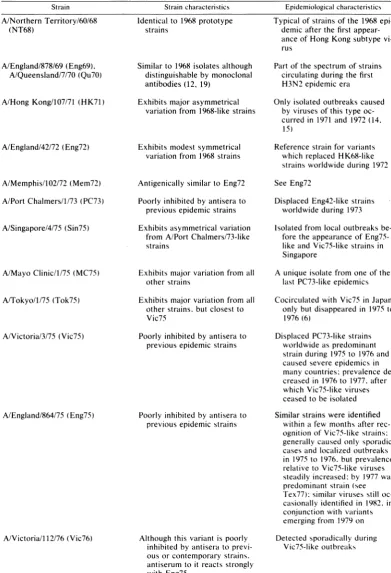
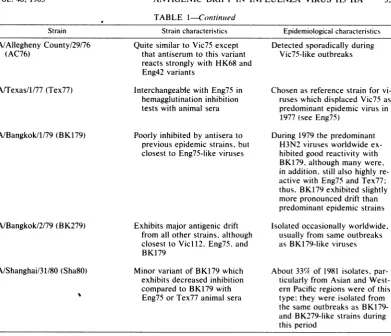
Epidemiology of H3N2 subtype isolates. Tables
1 and2summarize
epidemiological
andantigen-ic data for H3N2 isolates spanning the period
from 1968 to 1980. These isolates were chosen
for detailedstudyaftera
preliminary
surveyofamuch widerrange of isolates (data not shown).
Amongthe strains listedinTable 1 areall ofthe
sevenisolates for whichHAgene sequence data
have been reported
previously
(except for theX31 recombinant of Aichi/2/68
[20],
which isclosely related toNT68).
From thedescriptions of strains in Table1it is
apparent that virus isolates can be divided into
four groups. The first group contains
interna-tional reference strains for
epidemic variants,
e.g.,
Eng72, PC73,
Vic75, Tex77,
and BK179.Thetransition fromone
epidemic
era toanother has been less clear since 1975 because of thecocirculation and
persistence
ofsome variants.The second group is composed of lateral vari-antswhich,when testedwithwholeanimalsera, are antigenically
equivalent
toepidemic
strainsbut represent separate
geographical
isolates(e.g.,NT68,Eng69, andQu70, whicharesimilar
toHK68;Mem72, which is similartoEng72; and Eng75, which is similar to Tex77). The third
group contains terminal variants, which are
in-consistently
isolated in the midst ofepidemics
caused by viruses similar to reference strains.
Examples include HK71, MC75, Tok75, Sin75, Vic76, and AC76. Although antigenically
dis-tinct from contemporary strains, these variants
failed to spread beyond local or regional
out-breaks and werenormally notdetected for more
than a few months at most. The fourth group
consistsof variants which appeartoderive from
prototype strains and appear consistently with
them inmany parts of the world overaperiodof
1 or more years, i.e., distinct from local or
regional isolates. Examples include BK279 and Sha80.
Since we couldnot hope to study every isolate
from a particular influenza subtype, we
exam-ined, in detail,isolates fromeachofthese groups
to achieve the broadest possible view of HA
variation duringantigenic drift.
HA gene evolution since 1968. In previous
studies of 1968, 1972, 1975, and 1979 H3N2
isolates, silent base differences between 1968
strains and later strains were found widely
spread over the HA gene. However,base
substi-tutions resulting in HAamino acidchanges were
almostentirely limitedto thatregion ofthe gene
coding for HAl,themajor subunit ofthe mature
HA protein (2, 20, 22). Since HAl sequences
form theantibody-bindingandactive siteson the
HAmolecule (23, 24), we concentrated on
iden-tifying changes in the region of thegene coding forHAl.
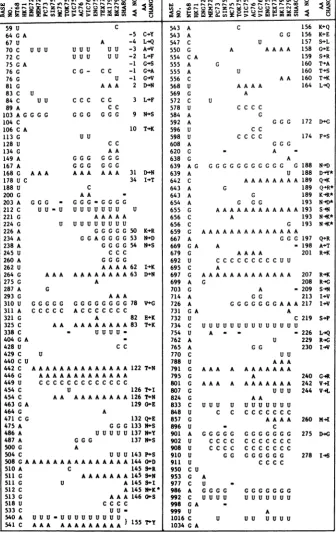
InTable 3 wereportpartialorcomplete HAl
gene sequences for all ofthe strains listed in
Table 1, except for Eng69 and Qu7O, whose
sequenceshave been published previously(18).
Theresultsemphasize the progressive
accumu-lation of mutations
in.
the HA gene, with HAlchangesoccurringat a constantrateofca.0.7%
per year between 1968 and 1979.
Nucleotide changes shown in Table 3 are
predominantly transitions, i.e., C-U or A-G
changes. The ratio of transitions to
transver-sions (54:17) (when BK179 is compared with NT68) shows a pattern of mutation similar to
thatreported fortheRNAphages MS2and R17
(10, 20)andis consistent withtheintroductionof
errorsduring replication of theRNA genomeby
enzymes lackingediting functions.
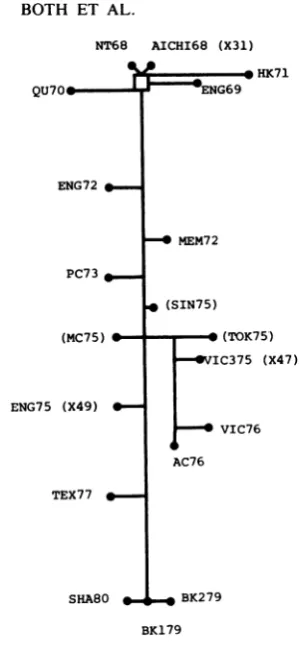
Theevolutionary relationships between
differ-entisolatescan be assessedfrom thenumber of HA gene mutations separating them (Fig. 1). This genetic relatedness tree approximates an
evolutionary tree for the subtype, although it
ignores the possibility that the mutation rate is
high enough to produce independent mutations
atthe samepositionindifferent strains or
unde-tected reversions ofpreviously acquired
muta-tions. At least two examples ofreversions are
apparent atbases692 and726(Table3)in which
1979strainsnow have a sequencesimilartothat
of theoriginal 1968 strains. An actual
evolution-ary treeforthesubtypewould no doubt be more
complex than that shown in Fig. 1 since the
strains examined in this study represent only a
small proportion of the total number of H3N2
variants that have arisen since 1968.
Antigenic drift and conserved mutations. The sequence data summarized in Table 3
demon-strate that viruses present in the population at
any one time constitute a heterogeneous array.
The contemporary strains share some amino
VOL 48,1983 53
on November 10, 2019 by guest
http://jvi.asm.org/
TABLE 1. Summary of antigenicandepidemiological data on influenzaA H3 subtype (Hong Kong) viruses isolated from 1968 to 1980
Strain Straincharacteristics Epidemiologicalchar-acteristics
A/NorthernTerritory/60/68 (NT68)
A/England/878/69(Eng69), A/Queensland/7/70 (Qu7O) A/HongKong/107/71 (HK71)
A/England/42/72(Eng72)
A/Memphis/102/72 (Mem72) A/Port Chalmers/1/73 (PC73) A/Singapore/4/75 (Sin75)
A/MayoClinic/1/75 (MC75) A/Tokyo/1/75 (Tok75)
A/Victoria/3/75 (Vic75)
A/England/864/75 (Eng75)
A/Victoria/112/76 (Vic76)
Identical to 1968 prototype strains
Similarto1968 isolatesalthough distinguishable by monoclonal antibodies(12, 19)
Exhibits major asymmetrical variation from 1968-like strains
Exhibits modestsymmetrical variation from 1968strains Antigenically similarto Eng72 Poorly inhibited by antiserato
previous epidemic strains Exhibitsasymmetrical variation
from A/PortChalmers/73-like strains
Exhibits majorvariationfromall otherstrains
Exhibitsmajorvariationfrom all other strains,but closest to
Vic75
Poorly inhibitedbyantisera to
previousepidemic strains
Poorly inhibitedbyantisera to
previous epi'demic strains
Although this variant ispoorly inhibitedbyantiseriato
previ-ous orcontemporary strains. antiserum to it reacts strongly withEng75
Typicalof strainsof the 1968 epi-demic after the first appear-anceofHong Kong subtype vi-rus
Partof the spectrum of strains circulating duringthe first H3N2epidemic era
Onlyisolatedoutbreaks caused by viruses ofthis type oc-curred in 1971 and 1972(14, 15)
Referencestrain for variants which replaced HK68-like strains worldwide during 1972
See Eng72
Displaced Eng42-like strains worldwide during 1973
Isolated from local outbreaks be-fore the appearance of Eng75-like and Vic75-like strains in Singapore
A uniqueisolatefromoneofthe last PC73-likeepidemics Cocirculated withVic75 in Japan
onlybutdisappeared in 1975 to 1976(6)
Displaced PC73-likestrains worldwide aspredominant strainduring1975 to 1976 and caused severeepidemicsin
manycountries: prevalence
de-creasedin 1976to 1977. after which Vic75-like viruses ceased to beisolated Similar strainswere identified
within afew months after rec-ognition ofVic75-like straiins: generally causedonlysporadic casesandlocalized outbreaks in 1975 to 1976. butprevalence relativetoVic75-like viruses steadily increased: by1977was predominant strain (see Tex77): similarviruses still oc-casionallyidentified in 1982. in conjunction with variants emergingfrom 1979on
Detectedsporadically during Vic75-like outbreaks
54 BOTH ET AL. J. VIROL.
on November 10, 2019 by guest
http://jvi.asm.org/
ANTIGENIC DRIFT IN INFLUENZA VIRUS TABLE 1-Conitinued
Strain Strain characteristics Epidemiological characteristics
A/Allegheny County/29/76 Quite similar toVic75 except Detected sporadicallyduring
(AC76) thatantiserum to this variant Vic75-likeoutbreaks
reactsstronglywith HK68 and Eng42variants
A/Texas/1/77 (Tex77) Interchangeablewith Eng75 in Chosenas reference strain for vi-hemagglutination inhibition ruseswhichdisplaced Vic75as tests with animal sera predominantepidemic virusin
1977(see Eng75)
A/Bangkok/1/79 (BK179) Poorly inhibited by antiserato During 1979the predominant previousepidemicstrains, but H3N2 virusesworldwide ex-closesttoEng75-like viruses hibitedgoodreactivity with
BK179,although many were, inaddition, still alsohighly re-active with Eng75 and Tex77; thus, BK179exhibited slightly morepronounceddriftthan predominantepidemic strains A/Bangkok/2/79 (BK279) Exhibits majorantigenic drift Isolatedoccasionallyworldwide,
from allotherstrains, although usuallyfrom sameoutbreaks closesttoVic112. Eng75, and as BK179-like viruses BK179
A/Shanghai/31/80(Sha8O) Minor variant ofBK179which About 339cof 1981 isolates, par-exhibits decreased inhibition ticularly from Asianand West-comparedtoBK179 with ern Pacificregions wereof this Eng75 or Tex77animalsera type:they wereisolated from
the sameoutbreaks as BK179-and BK279-like strains during this period
acid differences from earlier strains but also carry
changes characteristic ofeach strain.
Presum-ably thecombination ofchangesmostfavorable
to the virus is the one that is seen to be
pre-served
during
evolution because successfulstrains dominate and so become progenitorsfor
future generations. Thus, the most favorable
combinations ofchanges
might
be identified by their transmissionthroughtheviralevolutionaryline. Tohighlight the mutationsassociated with
the evolution ofnew variants while
minimizing
the importance of
background
noise changes, whicharenotintheverticalevolutionary
path of the virus, we illustrated the HA amino acidchanges which have accumulatedand been
con-served in the major epidemic strains from 1968
to 1980 (Fig. 2). The changes are distributed
overtheproposed antigenic sites, A,. B, and C (23)(Fig.3). Ifputative siteD(23)is extendedto
include residues suchas172, 174, 207, 242, and
244 (3a), then some D site changes are also
conservedand transmitted duringthe
evolution-ary process(Fig. 2).
The results shown inFig. 1and 2 suggest that
in about 1975 viral evolution resulted in two
divergent pathways. One led to viruses with
sequences most closely related to Vic75. This
path subsequently died out after 1 or 2 years.
Theotherled,via Eng75-like strains,to viruses
of the type still in circulation. Analysis of the
sequencesimplies thatdivergence occurredfrom
ahypothetical variant which existed duringthe
last period of circulation of PC73-like viruses
(such as Sin75), but in addition, the variant
acquired changes at amino acids 189 and 217
seenin all subsequent epidemic strains.
Selective pressures conserving sequences in
some areas of the gene but favoring changes in
others. From our analysis of the HA gene
se-quence for thestrain BK179it was apparentthat
HAamino acid changes in this successful strain
were found clustered in proposed antigenic
re-gions of the molecule, with other regions
con-tainingfew, if any, changes (2). Itisevident that
when a larger number ofvariants is studied the
changes are still restricted to these same vari-able regions even in relatively unsuccessful
strains. This is illustrated inFig.3, which shows
thelocations of HA amino acid changes in all of
the strains described in this study. It appears
VOL 48 1983 55
on November 10, 2019 by guest
http://jvi.asm.org/
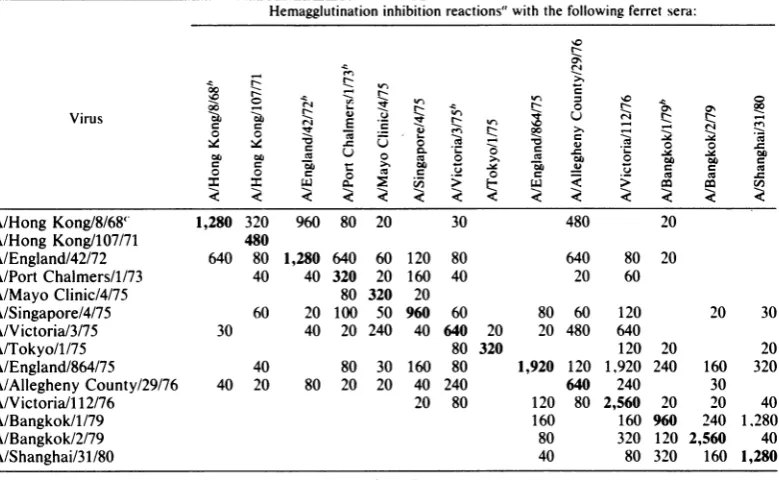
[image:4.492.47.439.65.401.2]TABLE 2. Hemagglutination inhibition reactions of influenzaA(H3N2) virus isolates, from 1968to1980,for whichHAl sequenceshave beendetermined
Hemagglutination inhibition reactions" with thefollowing ferretsera:
000- 0 00
Virus 7aZb IeZZ
A/HongKong/8/68'1,280 320 960 80 20 30
20~~~~~~~~~~~~~00
480-A/May ~Clinic/4.75o 80 320 2
ASgoe/60 0 1 -590 60
A
i0
40 2 4 0 64002 0 0M 0~~ to0
C~~~~~~~~~~~~
.t
000
aA/Tokyo/1/75~ ~ C280 120 202
A/Hong Kong/8/684 1,280 320 960 80 20 30 480 20
A/Hong Kong/107/71 480
A/England/42/72 640 80 1,280 640 60 120 80 640 80 20
A/Port Chalmers/1/73 40 40 320 20 160 40 20 60
A/MayoClinic/4/75 80 320 20
A/Singapore/4/75 60 20 100 50 960 60 80 60 120 20 30
A/Victoria/3/75 30 40 20 240 40 640 20 20 480 640
A/Tokyo/l/75 80 320 120 20 20
A/England/864/75 40 80 30 160 80 1,920 120 1,920 240 160 320
A/AlleghenyCounty/29/76 40 20 80 20 20 40 240 640 240 30
A/Victoria/I12/76 20 80 120 80 2,560 20 20 40
A/Bangkok/l/79 160 160 960 240 1,280
A/Bangkok/2/79 80 320 120 2,560 40
A/Shanghai/31/80 40 80 320 160 1,280
Blank indicates titer of<20. Results are meansofduplicatetests.
hSerum torecombinant with neuraminidase N7.
Sequences have been determined forantigenically similar strains A/Aichi/2/68 and A/NorthernTerritory/68.
thatthesiteswhereamino acid changescanalter
antigenicity are so limited that in some strains
key amino acids in these sites change for a
second time as evolution proceeds (Fig. 3 and
Table 3). The occurrence of these sequential
changes at residues 145, 188, 189, and 193
sug-gests that the HA three-dimensional structure
remainsconstantduringantigenic drift,
presum-ably sothat thebiologicalfunctionofHAcanbe
maintained.
The considerable conservation of core
resi-dues both within the upperglobular section of
HA and in the supporting stalk region noted earlier(23, 24)nowextends acrossfour
influen-zasubtypes,HI,H2, H3, and H7 (1, 4, 7, 11, 13,
21, 25), suggestingthat theoverall conformation
and thelocations ofbiologicallyactive and
anti-genic regionsarefundamentally similar for HAs
of allsubtypes. It has beensuggestedthat some
residues may be conserved in differentsubtypes
to act asanchors thatmaintainequivalentloops
ofamino acidsatthe HAsurface(23, 24). Inthe
B antigenic region (Fig. 2), anchor residues
correspondingtoamino acids184, 185,190, 191,
194, and 195 of H3 HA are conserved both
within and among HA types (2, 4, 7, 13, 20, 25).
Ofthe surface residues in this region, 188, 189,
and 193 are highly variable among H3 strains
and amongsubtypes aswell. Onthe otherhand,
the adjacent residues 187, 192, and 196 vary
among subtypes but have been conserved
among all H3 strains examined so far. It is
possible that changes in these residues (and in
analogous residuesin othersites,e.g.,140to142
in the Asite)mayalter thenatureofthe
antigen-ic loopssufficiently to accountfortheantigenic differences amongsubtypes(16).
Generation ofantigenic diversity among 1975to
1976 isolates by sequential amino acid changes.
Analysis of strains from the 1975 to 1976 and 1979 to 1981 periods has demonstrated that at
these times avariety ofdistinctive viruseswere
isolated (3b,26). Fourvariants from the 1975 to 1976 period (MC75, Tok75, Vic76, and AC76)
were also the first variants identified to carry
sequential amino acid changes of the type
de-scribed above. Amino acid 193, which changed
toasparagine in PC73, changed again tolysinein
MC75 and to aspartic acid in Tok75, AC76, and
Vic76. AC76 also has a second base change within the codon for residue 189, producing
arginine inAC76compared tolysine in
contem-porary strains. (In contrast, Sin75 appears to
have mutated at residue 189 directly from
gluta-mine to arginine.) AC76 and Vic76 differ from
eachotherbychanges at residues 157, 189, 209,
and 240, and of these, the changes at 157 and 189
(both part of the B region of Fig. 3) are most
56 BOTH ET AL. J. VIROL.
on November 10, 2019 by guest
http://jvi.asm.org/
TABLE 3. Summary of HAl nucleotidesequence changes from A/Northern Territory/60/68 (18) for 15 H3N2 influenza isolates"
- 1 (4N In tn rs C1 C1 WIni %oXu-ir-07sC 0 0 91 m _ r_L' f- r-%Or-r-rlr-P-c z i eSZX0_ N r.r-%NNDr. r-r,P- r,axz0
z
*Z d z I2 j Z Xz
<C3 i.U3 Z 3I-f~O3aQ ° '-4 > y>X 1 tyytZo
59 U
64 G A 67 U 70C 72 C 75 G A 76 G 76 G 81 G 83 C 84C 89A
103AG
104 C 106 C A
113 G 128 U 134 G 149 A 167 A 168 G
178 U C 188 U 200 G 203 A 212C 221 G 224 G 226A 234 A 238 A 245 U 260 A 262U 264 G 275G 287 A 293 G 310 U 311 A 321 G 325 C
U U U
U U
G GG
c
A
UUU UU
UUU UU
C G - C C U A AA CCC CC
C C G G G GG
U U C C AA -5 C-Y -4 L-.Q -3 A-v -2 L-F -1 G-S -1 G.A -1 G.V 2 D-'1N 3 L-F 9 N-*S 10 T-'K
G G GG
G G G G G G
AAA AAA AAA 31 D+N
34 I-T C
AA
-G -G -G - GG G GG
UU-U UUUUUUU U
A A AAA U U U U U U U U U
G GG G G 50 K-R G GAG G G G 53 N-eD G G G G 54 N+S
C C C G G G G A AAA62 I-K A A A AAAAAAA A 63 DeN
A G
G GG GG A A
A A A G G G GG G G G 78 V-G AC C C C C C C
A 82 E-K
A AAAAAA A 83 T1K
338 C - U U U
U-404 G A
428U CC
429 C U
440 C U
442 C AAAAAAAAAAAAAA 122T-N
446G AAAAAAAAAAAAA
449 U C C C C C C C C C C C C C
454 C U 1261TI
454 C AA AAAAAAAA 126TeN
463 G A 129GeE
464G A
471 C G 132 Q-E
475A G G G 133NeS
486A U U U U U 137NY
487A G G G 137NS
500G A
504C U U U 143P+S
508 GA AAAA A AA A AA A A AA 144 0D
510A C 1459-+R
511 G A AAA A A A 145 N
511 G U A 145S-I
512 C A 145 NIK
513 G A A A 146 0-S
518U C C C C
533C
UU-540 A UU U = U UU U U U U UUU 155 Y
541 C AAA AAAAAAAAA)155A
543 A 543 A
547 C 550 G 554 C A 555 A 555 A 556 C 568 U 569 G 572 C 578 U 584 A 592 A 596 U 598 U 608 A 620 G 638 G
639 A G
639 A 642 C 643 A 643 A 654 A 655 G 656 C 656 C 659 G 667 A 669 G A 679 G 692 U 695 C 697 G 699 A 703 G 714 A 726 A 731 G A 732 U 734 C 754 U 762 A 765 A 770 C 788 U 791 G 795 G 801 G 807 G 824 G 833 C 848 U 857 G 896 U 901 A 902 U 908 U 910 U 911 U
950 CU 953 G 977 C 986 A 992 C 998 G A 999 U
1016 C 1034 G A
G
U
C 156 K-Q
G G 156 K- E
U 157 S+L
A AAAA 158 G-E
159 S-R 160 T-A
U 160 T- S
A A 160 T-1K A A A A 164 L-'Q
A
C C C C G C C C C C C
G G G 172 DCG 174 F-S G G G
A A
GGGG G G G G G G G G 188 N-eD U 188 D-Y* A A A A A A A A 189 Q-WK
G 189 Q-R*
G 189 K-R*
G GG 193 N-eD* A A A A A A A A AAA A 193 S-eN
A 193 N-eK*
G 193 N-K* AAAAAAAAAAAAAA
G G G 197 QeR
A =198 A-T
AA A A 201 R-eK C C
A A A A A G
U U U U A
-A -A -A A A A
C
G G GG G
A
G G G G U U U U
CCC C C C CU U A AA A A A A A A 207
208
A -209
G G 213
G GG G G G G A A A 217 A
C 219
UUUUUUUUUU
- - 226
R+K R-G S-eN I-V I-eV S-+P L-.Q
U 229 R-eG
G G 230 1-*V
UU A AA
A AAAAAAA
A
A AAAAAAA
U U U AA U UUUUUUU C CCCCCCC AAAA C C CCCCCCC C CCCCCCC C COCCOC A UU UUUU 240 G-eR 242 V-+I 244 V-eL 260 Mel 275 D-.G 278 I1eS
"Blank areasindicate sequence identity with NT68. Amino acids (AA) are numbered from the N-terminal residueofHAl.Amino acid changes relative to NT68 are given in the single-letter code (2). Symbols: *. Amino acidresidueswhichhave undergone a sequential change;=,a partial sequence wasdetermined. The nucleotide sequencesnotdeterminedare asfollows:Sin75,nucleotides 59 to212. 540 to620.754 to896. and 998 to1.061: MC75, nucleotides59 to 203 and 977 to1.061;Tok75, nucleotides 59 to 338 and 754 to 1.061: Eng75,nucleotides 59to203;and Sha8O, nucleotides 59 to200. 338 to404.533 to620. 669 to703. and 754 to 1.061.
57
1-
I
d-I
on November 10, 2019 by guest
http://jvi.asm.org/
58 BOTH ET AL.
NT68 AICHI68 (X31)
HK71
ENG72
PC73
(MC75)
ENG75 (X49)
TEX77
SHA80
MEM72
(TOK75 )
'C375 (X47)
J.VIROL.
sequential changes arising during the 1975 to 1976 period, the successful variants which emerged from this period carried changes of a different type, e.g., at residues 133 and 143 in the
A region and residues 156 and 197 in the B
region (Fig. 2 and Table 3). This suggests that
not all changes which appear to be antigenically
favorableareoptimal forvirus survival. Evolutionary future of the H3 subtype. One of
the most striking observations to emerge from
our analysis of H3 HA variation is that the
orientation of amino acids involved in antibody
bindingappears toremain constant as evolution
proceeds. Amino acids such as 145, 188, 189,
and193,whichoccupykey positions inpotential
antigenic sites in 1968 strains (24), change early
VIC76
AC76
BK279
BK179
FIG. 1. Interrelationship of Hong Kong subtype strainsaccordingtothe minimum mutational distances between theirHAl codingregions. The figure is drawn to scale, and the number of mutations separating different strainscanbe calculatedrelativetothe NT68-BK179distance (73 mutations). Strains in parentheses have beenonly partiallysequenced. Three mutations at bases 84, 149, and 167 occurred at some point between 1973 and 1975 but cannot be positioned exactly.Thefullnamesof the virus strains examined are listed in Table 1. The Aichi68 and Eng75 strains sequenced were the recombinants X31 andX47, re-spectively. HA gene sequences have been published previously for strains NT68 (18), Eng69 (18), Qu7O (18), Mem72 (18), Vic75(11), and BK179(2).
likelyto producetheconsiderable antigenic
dif-ferences between these strains. Similarly, the
contemporary strains BK179 and BK279,
anti-genically quitedistinct from one another (Table 2), differ only by second changes in amino acids
188and 193.
Thus, it is clear that the sequential change of
keyamino acids withinantigenic regions
gener-ates new antigenic variants. It is a curious
observation that, so far, no virus carrying a
sequentialamino acid change hasgiven rise to a
new variant having major epidemiological
im-pact. Despite the large number of strains with
BANGKOK/1/79 -A (133,143,146) B (156,160,197)
FIG. 2. Evolution of fixed amino acid changes in theHAlregion ofH3influenza HA.Onlythechanges
forming themainstreamofevolutionareincluded(see
text),withvirusesgroupedaccordingtotheirantigenic
and epidemiological characteristics listed in Table 1. Changes are shown for putative antigenic sites A through C or elsewhere on the molecule (Other).
Symbols: +,lacking inTex77 andsuccessiveviruses,
consistent withtwo independent evolutionary paths;
*, different from Vic75-like viruses, consistent with
two independent evolutionary paths; t, change at aminoacid217 hasreverted inthesestrains; A,these
changesare seeninSin75,except thatamino acid189
changedtoarginineinstead oflysine,whichwasfound
insubsequentepidemicstrains.
on November 10, 2019 by guest
http://jvi.asm.org/
[image:7.492.79.229.59.383.2] [image:7.492.265.452.260.535.2]ANTIGENIC DRIFT IN INFLUENZA VIRUS H3 HA
155 *
U. 188
145~
78
I1
/i' .78*tg
.
i
F 4i
I
i
_
I,
I
I. I
i, ..
I Z.,
e:. ..
27 o
5C
.....
C
?~~~~~~~~~~~~~~~~~~~~~~~~~~VI
FIG. 3. Three-dimensional structure of HA for a
1968 strain.Symbols: 0, location of HAl amino acid
changes since 1968 for all of the strains shown in Table
1;*, amino acidsundergoingsequential change during
H3 evolution; U, HA2 changes in strains Mem72,
Vic75,and BK179. Antigenic sites marked Athrough
Eare thoseproposed inreference 24.
during subtype development and are also the
sites for sequential changes. As discussed
above, no changes have been seen in anchor
residues for the antigenic loops or in nearby
residues (e.g., 140 to 142in the A site and 187,
192,and 196 in the Bsite)whichmight influence
loopconformation. Ifnosuch changes occuras
H3 evolution proceeds, then pressure will
con-tinue for change in the same small groups of
residues most closely involved in antibody
at-tachment. Thus, there may bealimited number
of variants which can be produced during
anti-genic drift within an influenza virus subtype. Of these, only a few may be epidemiologically
successful. There are already some indications
that not all substitutions at particular residues
are favorable for subsequent survival of the
virus. There is also evidence from field isolates
for a strong bias in favor of particular types of
changes in different antigenic regions (to
charged or larger residues or both in the A and B regions and to smaller residues in the C region;
Table3). Since such substitutions in the protein
resultfrom single base changes in the HA gene,
the options for further evolution at particular
sites arerestricted. Forexample, the change at residue 155 from threonine to tyrosine may
represent an evolutionaryendpoint, and at
resi-due193, already changed from serine to
aspara-ginetolysine, only a further change to glutamic acid may be effective. An interesting possibility resulting from this type of analysis is the
synthe-sis ofpeptides representingpredicted end points
of antigenic site evolution for evaluation as
prospective vaccines.
The usefulness of this approach in analyzing
constraints and predicting future directions for
HA evolution will become apparent as new H3
variants arise or with examination of the
com-pleted evolutionary process in earlier influenza
subtypes, such as HlNl, which circulated in
humans between1918 and 1957.
ACKNOWLEDGMENTS
We aremostgrateful to E. Hamilton. L. Siegman. C. A. Stocksdale,J.G.Galphin. andR. Blackforexperttechnical assistance, to V. Bender, B. Moss, and P. Underwoodfor helpful discussions, toJ. Drummond and B. Lawrence for typing the manuscript, andtoC.Bucholtz and A.Reisnerfor
assistance withcomputing. Wealso thankD. Wiley forthe
sketch of theHA structureby Hidde Ploegh.
LITERATURE CITED
1. Both,G. W.,andM.J. Sleigh.1980.Complete nucleotide
sequenceof thehemagglutiningenefromahuman
influen-zavirusof the Hong Kongsubtype. Nucleic Acids Res. 8:2561-2575.
2. Both,G. W.,and M. J.Sleigh. 1981. Conservation and
variation in the hemagglutinins of Hong Kong subtype influenza viruses duringantigenicdrift. J. Virol. 39:663-672.
3. Brand,C.M.,andJ. J.Skehel.1972.Crystallineantigen
fromthe influenza virusenvelope.Nature(London)New Biol. 238:145-147.
3a.Caton, A. J.,G. G.Brownlee, J. W. Yewdell, and W. Gerhard. 1982. Theantigenic structure ofthe influenza virus A/PR/8/34 haemagglutinin (Hi subtype). Cell
31:417-427.
3b.Cox,N.J., Z. S. Bai, and A. P. Kendal. 1983.
Laboratory-based surveillance of influenza A(HlNl) and (H3N2) virusesin1980-81:antigenicandgenomic analyses.Bull. W.H.O. 61:143-152.
VOL. 48,1983 59
on November 10, 2019 by guest
http://jvi.asm.org/
[image:8.492.58.228.76.515.2]60 BOTH ET AL.
4. Davis, A.R., D. P. Nayak, M. Veda,A. L.Hiti, D. G.
Kleid, and D. Dowbenko. 1981.Structure of the hemagglu-tinin geneof HON1 strain of human influenza virus and its expression in E. coli,p.159-167. In D.Nayak and C. F. Fox (ed.), Genetic variation among influenza viruses. Academic Press, Inc., New York.
5.Eckert, E. A. 1973. Properties of an antigenic glycoprotein isolated from influenza virus hemagglutinin. J. Virol. 11:183-192.
6. Fukumi, H., and J. Takeuchi. 1977. Antigenic variation of influenza viruses isolated from the recent epidemics. Dev. Biol. Stand. 39:417-420.
7. Gething, M.-J., J. Bye, J. Skehel,and M.Waterfield.1980.
Cloning and DNA sequence of double stranded copies of hemagglutinin genes from H2 and H3 strains elucidates antigenic shift and drift in human influenzavirus. Nature (London) 287:301-306.
8.Jackson, D. C., T. A. Dopheide,R.J.Russell, D.0. White, andC. W. Ward. 1979.Antigenic determinants of influen-za virus hemagglutinin. 11. Antigenic reactivity of the isolated N-terminal cyanogen bromide peptide of A/Mem-phis/72hemagglutinin heavy chain. Virology 93:458-465. 9. Kendal, A. P., J. M. Joseph, G. Kobayashi, D. Nelson, C.R.Reyes,M. R.Ross,J.L.Sarandria,R.White,D. F.
Woodall, G. R. Noble, and W. R. Dowdle. 1979. Labora-tory-based surveillance of influenza virus inthe United States during the winter of 1977-1978. Am. J. Epidemiol. 110:449-461.
10. Min Jou, W.,and W.Fiers.1976.Studies on the bacterio-phage MS2: comparison of the nucleotide sequences in
relatedbacteriophage RNAs. J. Mol. Biol. 106:1047-1060.
11. Min Jou, W., M. Verhoeyen, R. Devos, E. Saman, R. Fang, D. Huylebroeck, and W. Fiers. 1980. Coipplete structure of the hemagglutinin gene from the human influenza A/Victoria/3/75 (H3N2) strain as determined
fromclonedDNA.Cell 19:683-696.
12. Moss,B. A.,P.A.Underwood, V.J. Bender, and R. G.
Whittaker. 1980.Antigenicdrift in thehemagglutinin from various strains of influenza virus A/Hong Kong/68 (H3N2), p. 329-338.InW.G.Laver andG.M.Air(ed.). Structure and variation in influenza virus.
Elsevier/North-HollandPublishingCo.,NewYork.
13. Porter,A.G., C. Barber,N.J. Carey,R. A.Hallewell,G. Threlfall, and J. S. Emtage. 1979. Complete nucleotide sequence of an influenza virus hemagglutinin gene from cloned DNA.Nature(London)282:471-477.
14. Schild, G. C., M. Henry-Aymard, M. S. Pereira, P.
Chakraverty,W.Dowdle,M.Coleman,andW.K.Chang. 1973. Antigenic variation incurrenthumantype A
influ-enzaviruses:antigenic characteristics of the variants and
theirgeographic distribution. Bull W.H.O. 48:269-278.
15. Schild, G. C., J.S.Oxford,W. R.Dowdle,M.Coleman,
M. S.Pereira,andP.Chakraverly. 1974.Antigenic varia-tion incurrent influenza A viruses: evidence forahigh frequency of antigenic "drift" for the Hong Kong virus. Bull. W.H.O. 51:1-11.
16. Sleigh, M. J., andG.W. Both.1982.Antigenic change and hemagglutiningeneevolutionamonginfluenza viruses,p.
357-364. In P. Nagley,A. W. Linnane,W. J. Peacock, and J.A. Pateman(ed.),Manipulation and expressionof
genesineukaryotes.AcademicPress,Sydney, Australia. 17. Sleigh, M.J.,G. W. Both, and G. G. Brownlee. 1979. A newmethod forthe size estimation of the RNAgenome
segmentsof influenza virus. Nucleic Acids Res. 6:1309-1321.
18. Sleigh, M. J., G. W. Both, P. A.Underwood,andV. J. Bender.1981.Antigenic drift inthehemagglutinin of the Hong Kong influenza subtype: correlationof aminoacid changes with alterations in viral antigenicity. J. Virol. 37:845-853.
19. Underwood, P. A. 1982.Mapping of antigenic changesin
thehemagglutinin of Hong Kong influenza H3N2 strains using a large panel ofmonoclonal antibodies. J. Gen. Virol.62:153-169.
20. Verhoeyen, M., R. Fang, W. Min Jou, R. Devos, D. Huylebroeck, E. Saman, and W. Fiers. 1980. Antigenic drift between thehemagglutinin of the Hong Kong
influ-enza strains A/Aichi/2/68 and A/Victoria/3n5. Nature
(London) 286:771-776.
21. Ward, C. W., and T.A.Dopheide.1981.TheHong Kong hemagglutinin. Structuralrelationships betweenthe human
(H3)hemagglutinins and the hemagglutinin from the
puta-tive progenitor strain A/Duck/Ukraine/1/63 (HAV7), p.
323-340. In D. Nayak and C. F. Fox (ed.), Genetic variation among influenza viruses. Academic Press, Inc.,
New York.
22. Webster, R. W., W. G. Laver, G. M. Air, and G. C.
Schild.1982.Molecular mechanisms ofvariation in
influ-enzaviruses.Nature(London) 296:115-121.
23. Wiley, D. C., I. A. Wilson, and J. J. Skehel. 1981. Structural identification of theantibody-binding sites of Hong Kong influenza hemagglutinin and their
involve-ment in antigenic variation. Nature (London) 289:373-378.
24. Wilson, I. A., J. J. Skehel, and D. C. Wiley. 1981. Structure of the hemagglutinin membrane glycoprotein of influenza virus at 3A resolution. Nature (London)
289:366-373.
25. Winter, G., S.Fields, and G. G. Brownlee. 1981. Nucleo-tide sequence of the hemagglutinin gene of a human influenzavirus Hi subtype. Nature(London) 292:72-75. 26. WorldHealthOrganization. 1981. Influenza in the world
October 1979-September 1980. WHO Weekly Epidemiol. Rec. 56:33-37.
J. VIROL.