A Proposal for Records in Event-B
∗Neil Evans1
and Michael Butler2
1
AWE, Aldermaston, U.K. 2
School of Electronics and Computer Science, University of Southampton, U.K.
Abstract. The B method is a well known approach to the formal specifi-cation and development of sequential computer programs. Inspired by ac-tion systems, the B method has evolved to incorporate system modelling and distributed system development. This extension is called Event-B. Even though several of the structuring mechanisms of the original B method are absent from Event-B, the desire to define and maintain struc-tured data persists. We propose the introduction of records to Event-B for this purpose. Our approach upholds the refinement principles of Event-B by allowing the stepwise development of records too.
1
Introduction
The Praxis3
case study of the RODIN project is a (subset of a) VDM devel-opment of an air traffic control display system (CDIS) undertaken by Praxis in 1992. One of the objectives of the case study is to drive the RODIN methodology, including Event-B itself [7]. CDIS is currently being redeveloped using Event-B and existing B tool support. The motivating feature of the case study is its size, and the challenge is to develop techniques for constructing large specifications in general so that the functionality of the overall system can be understood by everyone involved in a project of this kind (a criticism of the original CDIS specification).
Although the case study does not aim to construct a translation from VDM to Event-B, there are several advantages to preserving the VDM record struc-ture. In particular, it serves to organise a vast amount of structured data. So it is worthwhile investigating how records (with arbitrary field types) can be incorporated in Event-B. More generally, however, we have identified the bene-fits of incorporating additional subtyping/inheritance-like properties of records to enable their stepwise development through refinement, and to allow better conceptual modelling during the early stages of an Event-B development. In order to address the challenges of CDIS, this allows us to start with a very abstract/generic view of the system and, through refinement, introduce airport-specific details later in the development. Hence, the project members can choose a suitable level of abstraction to view the system.
∗
This research was carried out as part of the EU research project IST 511599 RODIN (Rigorous Open Development Environment for Complex Systems) http://rodin.cs.ncl.ac.uk.
3
Our proposal does not require any changes to the semantics of Event-B, although we propose an extension to its syntax.
After we have given an introduction to Event-B, we give a brief overview of records (composites) in VDM. We then show how records can be modelled using existing B constructs, namely SETS, CONSTANTS and PROPERTIES. Along the way, we propose some syntactic sugar to make such definitions more succinct. Our intention is to incorporate this syntax into the Event-B language, thereby eliminating the need to define an unsugared version manually. We then introduce two forms of record refinement: record extension and record subtyping. An example is given to illustrate the use of record refinement in a development, which includes a novel use of record refinement to enable the interface extension of an event. Finally, we discuss other issues that arise from our approach. This example demonstrates the refinement techniques currently being used in the CDIS case study.
Note that open source tools supporting Event-B are currently under construc-tion as part of the RODIN project. However, by writing stylised specificaconstruc-tions, existing B tools such as Atelier B [3] and the B Toolkit [5] can be applied to Event-B specifications.
2
Event-B
An abstract Event-B specification comprises a static part called thecontext, and a dynamic part called themachine. The machine has access to the context via a SEES relationship. All sets, constants, and their properties are defined in the context. The machine contains all of the state variables. The values of the variables are set up using the INITIALISATION clause, and values can be changed via the execution ofevents. Ultimately, we aim to prove properties of the specification, and these properties are made explicit using the INVARIANT
clause. The tool support generates proof obligations which must be discharged to verify that the invariant is maintained.
Events are specialised B operations [1]. In general, an eventE is of the form
E =b WHENG(v)THENS(v)END
where G(v) is a Boolean guard andS(v) is a generalised substitution (both of which may be dependent on state variable v)4
. The guard must hold for the substitution to be performed (otherwise the event is blocked). There are three kinds of generalised substitution: deterministic, empty, and non-deterministic. The deterministic substitution of a variable x is an assignment of the form x := E(v), for expression E, and the empty substitution is skip. The non-deterministic substitution ofx is defined as
ANY t WHEREP(t,v)THEN x:=F(t,v)END
4
Here,t is a local variable that is assigned non-deterministically according to the predicateP, and its value is used in the assignment ofx via the expression F. Note that in this paper we abuse the notation somewhat by allowing events to be decorated with input and output parameters (and preconditions to type the input parameters) in the style of classical B [1].
In order to refine an abstract Event-B specification, it is possible to refine the model and context separately. Refinement of a context consists of adding additional sets, constants or properties (the sets, constants and properties of the abstract context are retained).
Refinement of existing events in a model is similar to refinement in the B method: a gluing invariantin the refined model relates its variables to those of the abstract model. Proof obligations are generated to ensure that this invariant is maintained. In Event-B, abstract events can be refined by more than one concrete event. In addition, Event-B allows refinement of a model by adding new concrete events on the proviso that they cannot diverge (i.e. execute forever). This condition ensures that the abstract events can still occur. Since the concrete events operate on the state variables of the refined model, they must implicitly refine the abstract eventskip.
3
VDM Composites
A composite type consists of a name followed by a list of component (field) names, each of which is accompanied by its type. In general, this looks like:
type name::component name1:component type1 ..
.
component namen :component typen
One can see that this resembles record declarations in many programming lan-guages. However, it is possible to constrain the type of a composite further by including an invariant for the values of the components. Note that the nature of invariants in VDM is different from invariants in Event-B: invariants in Event-B have to be proven, whilst in VDM they are enforced. State in VDM is declared as a special kind of record whose components are the state variables which can be accessed and modified via operations (functions having side effects on the state).
Even though we have focused on VDM composite types specifically, record-like structures are also present in other formal notations (for example, composite data types in Z schemas [12], or signatures in Alloy [2]).
4
A Set-based Approach in Event-B
This approach attempts to mimic the record type definitions of VDM by using
CONTEXTFunc SETSR
;
A;
B CONSTANTSr1 ,r2 PROPERTIESr1 ∈R→A∧
r2 ∈R→B ∧
r1 ⊗r2 ∈R→→A×B END
Fig. 1.A simple record type
One of the motivations of this work is to enable a stepwise development of complex record structures (in the spirit of refinement) by introducing additional fields as and when they become necessary. This is also comparable to inheritance in object-oriented programming in which classes arerestricted orspecialised by introducing additional attributes.
Consider the following VDM composite type declarationR
R::r1 :A r2 :B
That is, R is a record with two fields, named r1 and r2, of type A and B respectively. In B, we can model this by declaring three deferred setsR,Aand B in the SETS clause. This is shown in Figure 1 in a context named Func. The sets A and B correspond to the types A and B in the declaration and, as such, these could be replaced by specific B types (such as NAT), or could themselves be other record types. Note that recursive record types are not part of this proposal, although we are investigating this for future work.
The set R represents the record type that we are trying to specify. We can think of this set as representing all of the potential models of the record type. Since we are unaware of the appropriate model for the record, because we may want to refine it during later stages, this set remains deferred until we are sure that we do not want to refine it any further. Instead, we can specify properties of the set within thePROPERTIESclause.
Twoaccessorfunctions are declared in theCONSTANTSclause to retrieve the fields of anRrecord instance:r1retrieves the value of the field of typeA, and r2retrieves the value of the field of typeB. The properties of these functions are given in the PROPERTIESclause. In particular, note that for every pair of values fromAandB there is a record instance (i.e. a member ofR) whose fields have these values. This is expressed succinctly using Event-B’s direct product operator⊗and the surjective mapping→→, where
r1⊗r2 ={(x,(y,z)) | (x,y)∈r1 ∧ (x,z)∈r2}
CONTEXTFunc SETS
R::r1 :A, r2 :B END
Fig. 2.Syntactic sugar for record types
Update r1 of r(x )=b
ANY y WHERE y ∈R∧
r1 (y) =x ∧
r2 (y) =r2 (r )
THEN r :=y END
Fig. 3.A record update operation
composite-like declarations for records. Hence, for this example, we would allow an equivalent context as shown in Figure 2. We choose to put such definitions in the SETS clause because this clause is most closely associated with type definitions.
A machine thatSEES this context may contain state variables of type R. Such variables hold an instance of the record, and events can be defined to update the values of their fields using the accessor functions. The structure of these events follows a definite pattern: non-deterministically choose an instance of the record type such that its fields have certain values. For example, consider the event in Figure 3 that changes ther1 field of a variabler of typeR with a valuex. The new valuey is chosen so that itsr1 value is equal to x, and itsr2 value remains unchanged. It is important to state explicitly which fields do not change, otherwise they will be assigned non-deterministically.
It would be possible to use variables instead of constants to model accessor functions. In some way this would simplify the approach as updates to a field could be specified more succinctly. For example, if r1 andr2 were specified as variables, then the update in Figure 3 could be specified as
Update r1 of r(x) =b r1(r) :=x
The variable r2 is not modified by this assignment. The problem with using variables rather than constants for accessor functions is that it does not work in a distributed setting. In a distributed development we wish to avoid designs in which variables are globally available since maintaining a consistent global view of variables is too much effort. Constants, on the other hand, can easily be globally agreed since they never change. Using constants as accessor functions means we specify a fixed way of accessing fields of a record that is globally agreed.
5
Refining Record Types
We now investigate the effect of refining the record typeR defined in Section 4 by introducing a new accessor function. There are two ways of doing this: we can either ‘extend’ R by adding the accessor function directly, or we can declare a new subtype ofR(which we callQ), on which the accessor function is declared. Since the latter refinement will add further constraints toR,Q’s set of potential models will be a subset of R’s. In this example, both kinds of refinement have an additional field r3 of type C. For a simple record extension, we propose a syntax as follows:
EXTENDRWITHr3 :C
For subtyping, we propose the following syntax:
QSUBTYPES RWITHr3 :C
Their verbose definitions are shown in Figures 4 and 5 respectively. The proposed syntax means that the developer does not have to interact with the verbose defi-nitions directly. Notice that these defidefi-nitions are both refinements of the context machine given in Figure 1. Hence, the properties declared in the refinement are in addition to those of the original machine. The final property in Figure 4 states that all possible field combinations are still available inR, and the corresponding property in Figure 5 states that all possible field combinations are available in Q (without adding any further constraints toR).
Subtyping of this kind can be seen in programming languages such as Niklaus Wirth’s Oberon [11], and specification languages such as Alloy [2]. The accessors r1 andr2 can still be applied to objects of typeQ in Figure 5, butr3 canonly be applied to objects of typeQ (and any of its subtypes).
CONTEXTFuncR REFINESFunc SETSC
CONSTANTSr3 PROPERTIES
r3 ∈R→C ∧
(r1 ⊗r2 ⊗r3 )∈R→→A×B ×C END
Fig. 4.An extended record type
Update r1 of r shown in Figure 3 is still applicable in the refined context
of Figure 4, even though it would assign r’s newr3 field non-deterministically. Refinement could then be used to assign something meaningful to this field. However, using the refined context of Figure 5, if the model is refined so that r is defined to be of type Q then this event is no longer applicable without modification because the quantified variabley ranges overQ’s supersetR. The
ANY clause would need to be strengthened so that it chooses an element of Q (rather thanR). Note that the surjectivity constraints of a record extension are consistent with the constraints of the original record definition. Indeed, the original constraints follow from those of the extension, i.e.:
(r1⊗r2⊗r3)∈R→→A×B×C ⇒ (r1⊗r2)∈R→→A×B
CONTEXTFuncR REFINESFunc SETSC
CONSTANTSQ,r3 PROPERTIES
Q⊆R∧
r3 ∈Q →C ∧
(r1 ⊗r2 ⊗r3 )∈Q →→A×B×C END
Fig. 5.A record subtype
5.1 Other Possible Refinement Combinations
R
Q Q’
(i)
X
Z
Y Y’
[image:8.612.190.431.64.165.2](ii)
Fig. 6.Possible Record Hierarchies
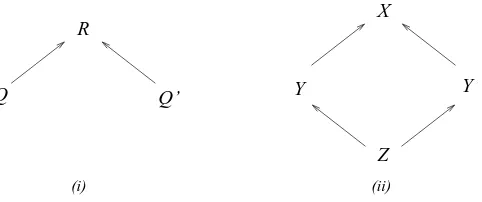
less restrictive, kinds of development. The diagrams shown in Figure 6 give two possible extension hierarchies. Each of these is meaningful, and we would like them to be available in Event-B. Hence, records should not constrain the structuring of context machines.
In Figure 6(i), two different sets,Q andQ0, subtype the same record type R. That is,Q andQ0 have the common ancestorR, and both are defined to be subsets ofR. (The relationship betweenQandQ0in this case is left unspecified, but we can impose an extra property to ensure they are disjoint if necessary.) In (ii), the record typeZ combines the record subtypesY andY0. In this situation, the model forZ must be a model for bothY andY0, and the accessor functions of bothY andY0 can be applied to objects of typeZ. The least constrained set of models that fulfils this relationship is the intersection of Y and Y0. Hence, they should not be disjoint. Syntactically, the fields belonging to a record of type Z (prior to any extensions toZ) are the union of the fields ofY andY0 5
.
6
One-Field Variables
In section 5, we have seen how existing record types can be refined to give new record types with more complex structure. At the most abstract level, the specifier might be unaware that a simple (non-record) state variable requires a record structure at a later stage in the development. For example, we may declare a variablev to be of typeVALUE, but then decide that for every value we need to associate some other characteristic (say, a format). We would then need to define a record type
FVALUE ::val :VALUE, format :FORMAT
and declare a concrete variablefv of typeFVALUE. In order to link the variables v andfv in a refinement, the gluing invariant must link theval component offv withv. In this case, we have
v =val(fv)
5
Hence, at the most abstract level, we are not expected to identify all record types. These can be introduced during the refinement stages.
7
Extension Example
In order to motivate the use of record types, we present an example to show how a very simple abstract specification can be refined into a model with structured objects. We consider an electronic mail delivery system in which users (with identities) can send and receive messages. We begin with a very abstract view of the system. The context (which we callContext) declares two setsUser and Message, and one record typeSend interface. This is shown in Figure 7. The
CONTEXTContext SETS
User
;
Message;
Send interface ::dest :User, mess:Message END
Fig. 7.The Abstract Context
corresponding machine (which we callEmail) declares a variablemailbox, which maps users to their respective set of messages. We specify two events:sendand
read. These are shown in Figure 8. At this stage, thesendevent requires two parameters that represent the message to be sent and the intended recipient. However, during the refinement stagessendwill require additional parameters. Interface extension is not possible in the current B tools, but by using record types instead we can extend the interface of send via record extension. The record typeSend interface is declared for this purpose. Note that this is a very abstract representation of the system because the send operation magically deposits the message in the appropriate user’s mailbox. Subsequent refinements will model how this is actually achieved. The readevent non-deterministically retrieves a message from the input user’s mailbox and returns it as an output.
MACHINEEmail SEESContext
VARIABLESmailbox
INVARIANTmailbox ∈User →P(Message )
INITIALISATIONmailbox :=User × {∅}
OPERATIONS send(ii)=b
PRE ii∈Send interface THEN
mailbox ( dest (ii) ) :=mailbox (dest (ii ) )∪ {mess (ii)}
END
;
mm ←− read(uu)=b
PRE uu∈User THEN ANY xx WHERE
xx ∈Message ∧xx ∈mailbox (uu)
THEN mm:=xx END END END
Fig. 8.The Abstract Machine
particular user. We also extend Send interface by adding a new field source that contains the identities of the senders.
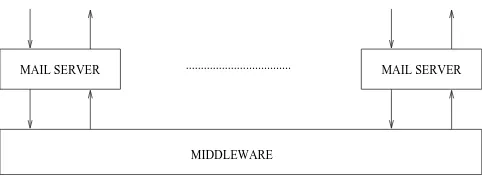
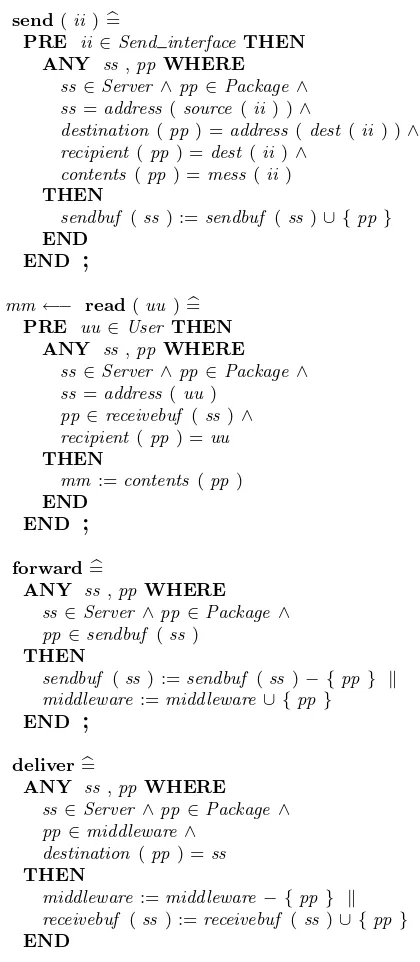
The refined state comprises new variablessendbuf,receivebuf andmiddleware. The variable middleware holds the packages on the communications medium, and each mail server has separate buffers for messages waiting to be sent and messages waiting to be read (i.e. mappings fromServer to P(Package )). The
refined eventsendconstructs packages and adds them to the server associated with the sender. The eventreadselects packages from a user’s server and out-put’s their contents. These are shown in Figure 11.
As part of this Event B refinement, we introduce two new eventsforward
MAIL SERVER MAIL SERVER
[image:11.612.187.428.62.151.2]MIDDLEWARE ...
Fig. 9.Architecture for the e-mail system
CONTEXTContext2 REFINESContext SETS
Server
;
Package::destination :Server , recipient :User , contents :Message
;
EXTENDSend interface WITHsource:User CONSTANTS
address PROPERTIES
address ∈User →Server END
Fig. 10.First refined context
∀s,u,p.(s∈Server ∧ u∈User ∧ p∈Package ⇒
p∈receivebuf(s) ∧ recipient(p) =u ⇒ contents(p)∈mailbox(u))
This fulfils the proof obligation derived from the output ofreadbut, since the eventdeliveradds packages toreceivebuf, we must strengthen the invariant as follows
∀u,p.(u ∈User ∧ p∈Package ⇒
p∈middleware ∧ recipient(p) =u ⇒ contents(p)∈mailbox(u))
That is, in addition to the contents of the packages in receivebuf, the contents of the packages on the medium must also be elements ofmailbox. By attempt-ing to discharge the proof obligations once more, we discover that we have to strengthen the invariant further
∀s,u,p.(s ∈Server ∧ u∈User ∧ p∈Package ⇒
send(ii )=b
PRE ii ∈Send interfaceTHEN ANY ss,ppWHERE
ss ∈Server ∧pp∈Package ∧
ss =address ( source(ii ) )∧
destination (pp ) =address (dest (ii ) )∧
recipient (pp) =dest (ii) ∧
contents (pp) =mess(ii )
THEN
sendbuf (ss ) :=sendbuf (ss )∪ {pp }
END END
;
mm←− read(uu)=b
PRE uu ∈User THEN ANY ss,ppWHERE
ss ∈Server ∧pp∈Package ∧
ss =address ( uu) pp∈receivebuf (ss )∧
recipient (pp) =uu THEN
mm:=contents (pp )
END END
;
forward =b
ANY ss ,pp WHERE ss ∈Server ∧pp∈Package ∧
pp∈sendbuf (ss )
THEN
sendbuf (ss ) :=sendbuf (ss )− {pp } k
middleware:=middleware ∪ {pp }
END
;
deliver=b
ANY ss ,pp WHERE ss ∈Server ∧pp∈Package ∧
pp∈middleware ∧
destination (pp) =ss THEN
middleware:=middleware − {pp} k
receivebuf (ss ) :=receivebuf (ss )∪ {pp }
[image:12.612.189.399.89.570.2]END
This is sufficient to discharge all of the proof obligations. Hence, we have shown that the contents ofanypackage in transit must be an element of the correspond-ing abstract mailbox. Of course, it would be possible to strengthen the invariant further by stating other properties of the system, but this is not pursued here.
As a second refinement, we extendPackage with a priority field. In addition, we extend Send interface with a fieldpri. These refinements are shown (using our proposed notation) in Figure 12.
CONTEXTContext3 REFINESContext2 SETS
EXTENDPackage WITHpriority :BOOL
;
EXTENDSend interface WITHpri :BOOL ENDFig. 12.The second context refinement
This refinement specifically affects the order in which packages are moved onto the middleware: packages with priorityTRUE take precedence over pack-ages with priorityFALSE. In order to model this, we refine the eventssendand
forward (as shown in Figure 13). The send event is refined because we have
extended its interface to incorporate a priority field (namedpri). Using this ex-tension toSend interface, we can assign priorities to the refined packages. The refinement of forward is an example of the refinement of a single event into two events. The first refined event (also called forward) only selects packages with high priority (i.e. those packages whose priority field isTRUE). The sec-ond event, called forward2 selects low priority packages, but only if there are no high priority packages at the same server. Hence, high priority packages are forwarded before low priority packages. Since this refinement does not introduce any new variables, no gluing invariant is required.
8
Subtyping Refinement
The example could be refined further by specialisingPackage using subtyping. Using this technique, it is possible to refinePackage in more than one way (see Figure 6(i)) so that different kinds of packages are dealt with in different ways. For example, consider the following subtype declarations
send(ii )=b
PRE ii ∈Send interface THEN ANY ss ,ppWHERE
ss ∈Server ∧pp ∈Package ss =address (source (ii) )∧
destination (pp ) =address (dest (ii) )∧
recipient (pp) =dest (ii)∧
contents (pp ) =mess (ii)∧
priority (pp) =pri (ii )
THEN
sendbuf (ss ) :=sendbuf (ss )∪ {pp }
END END
;
forward=b
ANY ss ,ppWHERE ss∈Server ∧
pp∈Package∧
pp∈sendbuf (ss )∧
priority (pp) =TRUE THEN
sendbuf (ss ) :=sendbuf (ss )− {pp} k
middleware:=middleware ∪ {pp }
END
;
forward2=b
ANY ss ,ppWHERE ss∈Server ∧
pp∈Package∧
pp∈sendbuf (ss )∧
∀qq. (qq∈sendbuf (ss )⇒priority (qq) =FALSE)
THEN
sendbuf (ss ) :=sendbuf (ss )− {pp} k
middleware:=middleware ∪ {pp }
END
It would then be possible to specialise the servers to meet the needs of the different kinds of package. On the other hand, we would be able to continue to use the middleware unaltered because it would simply treat both subtypes uni-formly (i.e. as objects of typePackage). In the CDIS case study, this technique is being used to model VDM union types in Event-B.
9
Wider Issues
Although we have not set out with the aim of addressing object oriented mod-elling or programming approaches, there is a link between our work and various formal approaches to object oriented modelling and programming. Directly rele-vant to our work is the UML-B approach of Snook and Butler [10] which defines a mapping from a UML profile to B. In UML-B, class attributes and associations are modelled in B as accessor functions on object instance identifiers, i.e., if a is an attribute of type Aof classC, thena is modelled in the B notation as a function a ∈ C →A. UML-B effectively combines our form of subtyping with extension to represent class inheritance. In our approach accessor functions are represented as constants whereas in UML-B attributes and associations can be declared as either constant or variable and the corresponding accessor functions are in turn either constants or variables.
Naumann’s work [8] is a good example of a relevant formal framework for reasoning about object oriented programs. This uses records and record sub-typing to represent objects in an object oriented programming language. There are two significant differences from our work. Firstly, Naumann allows record fields to be methods thus modelling method overriding and dynamic dispatch of method calls, an important feature of object oriented programming. We do not address overriding of events rather we focus on refinement. Secondly, Nau-mann uses record constructors and a rich notion of subtyping for record types as is commonly found in formal approaches to object oriented programming. Our notion of subtyping is simply subsetting of the deferred B type used to model records and is independent of any subtyping of the fields. This means we avoid having to address the issue of covariance versus contravariance of method ar-guments [6]. Naumann’s language is influenced by Oberon [11] which provides inheritance through record extension.
10
Conclusion
Without changing its semantics, we have proposed a method of introducing record types in Event-B that is amenable to refinement. Our experience in the redevelopment of CDIS has identified the benefits of such an approach. In partic-ular, it allows us to start with a very abstract model and defer the introduction of airport-specific information until later in the development.
how it is possible to introduce structured data in a stepwise manner in order to progress towards the formal design and implementation of the system.
During the implementation phase of a B development, it may be necessary to describe how records are to be implemented. Since a record is defined as a deferred set, a decision must be made to give an explicit representation of the set. In addition, fields of such records are declared as constant functions whose algorithmic behaviour must be given as part of the implementation.
Of course, it is not the case that the records within a B development will necessarily be implemented as records in program code - for example, a record could be used to model structured data such as XML messages. However, there is provision for the implementation of record-like structures using existing B technology:SYSTEMdefinitions ofBASEmachines are macros for the imple-mentation (using B libraries) of database style structures. (See [9] for a detailed description ofBASEmachines and the common B libraries.) The similarities be-tween our proposed syntax and the syntax ofBASEmachines suggest that they provide a natural progression from the specification and refinement of records to their implementation, although this has yet to be investigated.
Acknowledgements
The authors thank Jean-Raymond Abrial and Cliff Jones for many valuable discussions, and are also grateful to Helen Treharne for useful advice and sug-gestions.
References
1. Abrial J. R.:The B Book: Assigning Programs to Meanings, Cambridge University Press (1996).
2. The Alloy Analyzer,http://alloy.mit.edu. 3. Atelier B,http://www.atelierb.societe.com.
4. Bicarregui J. C.,Matthews B. M., Ritchie B., Agerholm S.: Investigating the inte-gration of two formal methods, Proceedings of the 3rd ERCIM Workshop on Formal Methods for Industrial Critical Systems (1998).
5. B Core (U.K.) Ltd,http://www.b-core.com.
6. Castagna G.:Covariance and Contravariance: Conflict without a Cause., in ACM Trans. Program. Lang. Syst., volume 17, number 3, pages 431-447 (1995).
7. M´etayer C., Abrial J. R., Voisin L.: Event-B Language, RODIN deliverable 3.2,
http://rodin.cs.ncl.ac.uk (2005).
8. Naumann D. A.:Predicate transformer semantics of a higher-order imperative lan-guage with record subtyping, in Sci. Comput. Program., volume 41, number 1, pages 1-51 (2001).
9. Schneider S.:The B Method: An Introduction, Palgrave (2001).
10. Snook C., Butler M. J.: UML-B: Formal modelling and design aided by UML., in ACM Trans. Software Engineering and Methodology, to appear (2006).
11. Wirth N. :The Programming Language Oberon, in Softw., Pract. Exper., volume 18, number 7, pages 671-690 (1988).