Running head: Acting in Solidarity
Acting in solidarity: Testing an extended dual-pathway model of collective action by bystander group
members
Rim Saab, Nicole Tausch, Russell Spears and Wing-Yee Cheung
1
American University of Beirut, Cardiff University
2University of St Andrews
3Groningen University
4University of Southampton
Word count (exc. figures/tables): 9,092
*Requests for reprints should be addressed to Rim Saab, Department of Psychology, American
1
Running Head: ACTING IN SOLIDARITY
Acting in Solidarity: Testing an Extended Dual-Pathway Model of Collective Action
by Bystander Group Members
Abstract
We examined predictors of collective action among bystander group members in
solidarity with a disadvantaged group by extending the dual pathway model of
collective action, which proposes one efficacy-based and one emotion-based path to
collective action (van Zomeren, Spears, Fischer, & Leach, 2004). Based on two
proposed functions of social identity performance (Klein, Spears, & Reicher, 2007),
we distinguished between the efficacy of collective action at consolidating the identity
of a protest movement and its efficacy at achieving social change (political efficacy).
We expected identity consolidation efficacy to positively predict collective action
tendencies directly and indirectly via political efficacy. We also expected collective
action tendencies to be positively predicted by moral outrage and by sympathy in
response to disadvantaged outgroup’s suffering. These hypotheses were supported in
two surveys examining intentions to protest for Palestine in Britain (Study 1), and
intentions to attend the June 4th vigil in Hong Kong to commemorate the Tiananmen
massacre among a sample of Hong Kong citizens (Study 2). The contributions of
these findings to research on the dual pathway model of collective action and the
different functions of collective action are discussed.
Keywords: efficacy, collective action, identity consolidation, solidarity, bystander
Rebellions often have to rely on support by international non-state actors to
sustain them (Byman, Chalk, Hoffman, et al., 2001; Sharp, 2005). The international
anti-apartheid movement exemplifies how bystander groups can influence the plight
of a disadvantaged group through taking collective action in solidarity with them.
After decades of research into what drives disadvantaged group members to fight
advantaged outgroups (van Zomeren, Postmes, & Spears, 2008), social psychologists
have recently begun examining the antecedents of collective action in solidarity with
disadvantaged groups, hereafter referred to as solidarity-based collective action.
Though research has prioritized solidarity-based collective action by advantaged
group members (e.g. Leach, Snider, & Iyer, 2002; see van Zomeren & Iyer, 2009),
there is increasing interest in collective action by bystander groups (Simon &
Klandermans, 2001; Stewart, Pratto, Bou Zeineddine et al., 2014, Subašic, Reynolds,
& Turner, 2008), who are neither the direct perpetrators of group-based injustices, nor
the direct targets. Nevertheless, empirical data on this topic is relatively scarce. The
present research addresses this gap, drawing on the dual pathway model of collective
action (van Zomeren, Spears, Fischer, & Leach, 2004) to examine predictors of
solidarity-based collective action among bystander groups.
The Dual Pathway Model of Collective Action
A long line of research views participation in collective action as resulting
from people’s belief in the efficacy of collective action at redressing perceived
injustices (Gamson, 1992; Klandermans, 1997). In an important meta-analysis, van
Zomeren, Postmes, and Spears (2008) operationalized efficacy as group efficacy —
the belief that one’s group is capable of collectively solving a problem facing the
group (Mummendey, Kessler, Klink, & Mielke, 1999) – or as the efficacy of
unique predictor of nonviolent collective action (cf. Tausch, Becker, Spears et al.,
2011).
The perceived injustice or illegitimacy of the social order is also considered an
essential antecedent of collective action in social psychological theories of collective
action, such as Social Identity Theory (SIT; Tajfel & Turner, 1979) and Relative
Deprivation Theory (RDT; e.g. Runciman, 1966; see Walker & Smith, 2002, for a
review). But research shows emotional responses to perceived injustice, particularly
anger, as more proximal predictors of collective action (see reviews by Walker &
Smith, 2002; van Zomeren et al., 2008). This is consistent with Intergroup Emotion
Theory (IET, Mackie, Devos, & Smith, 2000; Smith, 1993), which, building on
appraisal theories of emotion (e.g. Frijda, Kuipers, & Ter Schure, 1989), proposes that
group-based emotions mediate between group-based appraisals and specific action
tendencies. In line with IET, group-based anger has been shown to mediate the
relation between perceived injustice toward one’s group and nonviolent collective
action tendencies (Tausch et al., 2011).
Van Zomeren et al. (2004) integrated these two approaches, proposing that
group efficacy and emotional considerations form separate but complementary
pathways to collective action. This dual pathway model has received empirical
support across various contexts (Tausch et al., 2011; van Zomeren et al., 2004; van
Zomeren, Spears, & Leach, 2008; see van Zomeren, Leach, & Spears, 2012, for a
review), but has thus far only been examined among members of disadvantaged
groups. One exception is work by Thomas (2005), who found that the model predicts
volunteering intentions in the context of international aid, but volunteering differs
The present research draws on this dual pathway model to explain
solidarity-based collective action among bystander groups, by adding new predictors to the
efficacy and emotion-based pathways.
Predicting Solidarity-Based Collective Action from Political Efficacy and
Identity Consolidation Efficacy
Although research on the dual pathway model of collective action has focused
on group efficacy (Tausch et al., 2011; van Zomeren et al., 2004; van Zomeren,
Spears, & Leach, 2008), there are multiple operationalisations of efficacy in the
collective action literature (cf. Hornsey, Blackwood, Louis et al., 2006, for a review).
In the present research we focus on the perceived efficacy of collective action itself,
and propose a distinction between two types of efficacy. The first is the classical
conceptualisation of collective action efficacy, which we term political efficacy,
defined as the efficacy of collective action at redressing a group’s disadvantaged
position by pushing outgroups responsible for collective grievances to change their
policies. The second type is identity consolidation efficacy, which we define as the
efficacy of collective action at affirming, confirming and strengthening the identity of
the protesting group. Identity consolidation entails expressing what the movement
stands for (e.g. opposition to the advantaged outgroup’s policies), showing support for
the disadvantaged party, building a mass solidarity movement and increasing public
opinion support for the cause. The basis for this distinction is drawn from the
integration of two different theoretical frameworks.
The first is Hornsey et al.’s work (2006), which critiqued collective action
research for focusing exclusively on political efficacy and disregarding the efficacy at
influencing multiple intended audiences. Blackwood and Louis (2012) indeed
movement as a function of influence on governmental peace policies, suggesting
success is multiply defined. Hornsey et al. (2006) proposed three criteria by which to
judge the efficacy of collective action: (1) the efficacy of collective action at
expressing an individual’s values (e.g. Tice, 1992); (2) the efficacy at building an
oppositional movement, that is, strengthening solidarity within the protesting group,
(Kinder, 1998; see also Klandermans, 1984); and (3) the efficacy at recruiting third
parties like the general public to the cause (Simon & Klandermans, 2001; Subašic et
al., 2008). Importantly, a survey of anti-globalisation protesters in an Australian rally
showed that the perceived political efficacy of the rally did not predict intentions to
participate in similar future protests, while the three other types of efficacy did
(Hornsey et al., 2006). So far, however, these different types of efficacy have not been
incorporated into existing theoretical models of collective action.
We argue that Hornsey et al.’s (2006) typology of collective action efficacy
can be usefully incorporated within a theoretical framework developed by Klein,
Spears and Reicher (2007), outlining two broad functions of collective action1,
namely identity mobilization and/or identity consolidation. Identity mobilization
involves actions aimed at improving the ingroup’s position in the social power
hierarchy, while identity consolidation involves bolstering the identity of the ingroup,
that is, affirming, confirming or strengthening the identity of that group against that of
other groups. Based on these two broad collective action goals, one can generate two
corresponding broad types of collective action efficacy, which also encompass
Hornsey et al.’s (2006) typology. In particular, the potential of collective action to
achieve identity mobilization corresponds to its political efficacy. Conversely, the
potential of collective action to consolidate the identity of the protesting group
oppositional movement, and influencing public opinion (to which we add showing
support for the disadvantaged group). The idea that prior to participation, people think
about the potential of collective action to achieve some form of identity consolidation,
is well illustrated in research by Pehrson, Stevenson, Muldoon and Reicher (2013).
The authors interviewed participants in a St Patrick’s parade in Ireland and found
differences in their expectationsof the event’s potential to help them enact their own
understandings of the Irish identity.
We further argue that the perceived political efficacy of collective action rests
on its perceived identity consolidation potential. Various scholars have proposed that
identity consolidation creates the basis for effective organisation, action and group
power (e.g. Haslam, 2001; Klein et al., 2007; Reicher, Haslam & Hopkins, 2005;
Turner, 2005); that is, consolidating the identity of a movement can allow that
movement to eventually gain the power to achieve social change. It is accordingly
plausible that among protesters, beliefs regarding the political efficacy of collective
action are also based on beliefs about its potential to consolidate the movement’s
identity. Hints of this can be found in research on empowerment, which, similarly to
political efficacy, is defined as confidence in one’s ability to challenge existing
relations of domination (Drury, Cocking, Beale, Hanson, & Rapley, 2005). In
particular, interviews with activists (Drury et al., 2005; Drury & Reicher, 2009;
Pehrson et al., 2013) suggest that the experience of empowerment in collective action
stems from experiences of unity among protesters, expectations of support from the
crowd, the sense that the movement has potential to develop, and the active
realization of one’s identity over against the power of a dominant outgroup (termed
collective self-objectification). Notably, these factors parallel Hornsey et al.’s notions
suggest that empowerment results from a process of identity consolidation. Taken
together, these findings suggest that identity consolidation efficacy should positively
and indirectly predict collective action by feeding into political efficacy perceptions
(Hypothesis 1).
Furthermore, we argue that identity consolidation can be a goal of collective
action in its own right, since solidarity-based collective action typically consists of
methods such as demonstrations and rallies aimed at symbolically expressing political
opinions and communicating a message to audiences such as the public and the
disadvantaged group (Sharp, 2005). The idea that collective action can be a means to
express and enhance an activist identity is well established (Kelly, 1993). However,
evidence for this motivational pathway has traditionally consisted of showing that
politicized identification promotes collective action (van Zomeren et al., 2008), but
the idea also implies that the perceived efficacy of collective action at consolidating
identities should positively predict collective action, regardless of political efficacy
beliefs. Initial empirical evidence for this comes from Hornsey et al. (2006) who
found that after controlling for the political efficacy of collective action, collective
action was still positively predicted by its perceived efficacy at influencing public
opinion, building an oppositional movement and expressing values. Accordingly,
identity consolidation efficacy should positively and directly predict collective action,
independently of political efficacy concerns (Hypothesis 2).
Predicting Solidarity-Based Collective Action from Moral Outrage and
Sympathy
Research on the dual pathway model of collective action has typically studied
group-based anger (see van Zomeren et al., 2012, for a review) in response to
solidarity-based collective action requires shifting to a different form of anger,
namely moral outrage, defined as anger experienced regarding an injustice suffered
by an outgroup, and characterized by blaming a third party such as a government,
rather than the ingroup (Leach et al., 2002; Montada & Schneider, 1989; see Thomas,
McGarty, & Mavor, 2009). A recent review of prosocial emotions in intergroup
helping identified moral outrage as particularly likely to motivate political action
aimed at stopping the mistreatment of a disadvantaged outgroup (Thomas et al.,
2009). This is because moral outrage can be shared by both the bystander and
disadvantaged groups, thus uniting them, and it also normatively prescribes actions
aimed at redressing injustice. Moral outrage remains under-investigated in the
intergroup helping research, but existing studies have found that it positively predicts
intentions to volunteer for international aid (Thomas & McGarty, 2009), take political
action on behalf of disadvantaged groups (Montada & Schneider, 1989), and engage
in collective action against poverty (Thomas, Mavor, & McGarty, 2012). Hence, we
expect moral outrage to positively predict solidarity-based collective action
(Hypothesis 3).
The recent upsurge of research on solidarity-based collective action by
advantaged group members has initiated the study of emotional antecedents beyond
anger, such as sympathy (Iyer & Ryan, 2009; Wright, 2009). The role of sympathy in
promoting collective action among bystander groups, however, has not been properly
explored. Sympathy is a response to a disadvantaged outgroup’s suffering which
involves feeling compassion for them (Eisenberg, 2000; Gruen & Mendelsohn, 1986;
Thomas et al., 2009; Wispé, 1986). Given its focus on the disadvantaged group’s
plight rather than the advantaged group’s actions (Harth, Kessler, & Leach, 2008;
some researchers have questioned sympathy’s power to elicit collective action that
targets the offenders’ ability to mistreat the disadvantaged outgroup, arguing instead
that sympathy promotes attempts to ease the suffering of the outgroup (Pagano &
Huo, 2007; Thomas et al., 2009). Yet research shows sympathy to be a positive
predictor of both types of collective actions among advantaged groups (e.g. Feather,
Woodyatt, & McKee, 2011; Iyer & Ryan, 2009; Thomas, 2005). Accordingly,
sympathy should positively predict solidarity-based collective action (Hypothesis 4).
Further, based on appraisal theories of emotion (Frijda et al., 1989) and
research on moral outrage (e.g. Leach et al., 2002) and sympathy (Harth et al., 2008;
Iyer & Ryan, 2009; Leach et al., 2002), we expected the perceived injustice of
governmental policies toward a disadvantaged outgroup to positively predict both
moral outrage (Hypothesis 5) and sympathy (Hypothesis 6), thus having a positive
indirect effect on collective action via these emotions (Hypothesis 7). Since additional
emotions could mediate this link, in line with previous research (e.g. Tausch et al.,
2011), we also expect a direct positive effect of perceived injustice on collective
action (Hypothesis 8).
To summarize, we propose a dual pathway model of solidarity-based
collective action by bystanders, where efficacy perceptions (political efficacy and
identity consolidation efficacy) and emotional reactions to perceived injustice (moral
outrage and sympathy) represent distinct paths to collective action. We present the
results of two surveys testing our model in different contexts.
Study 1
We first surveyed a sample of protesters at the annual National Demonstration
for Palestine in London, Britain, in May 2008 on their intentions to attend similar
Israeli occupation and a year-long Israeli siege on Gaza, and to oppose Britain’s
support for Israel (Palestine: the Case for Justice, 2007).
Method
Participants. A team of five recruiters approached protesters during the
demonstration, and 242 completed the survey. Fifteen participants with substantial
amounts of missing data (>20%) were excluded (see Tabachnick & Fidell, 2007). The
final sample comprised 227 participants (114 women, 111 men, 2 missing; age: M =
41.00 years; SD = 16.61). Most (N = 162) were British. The rest were international
and included fifteen Arabs. Many (N = 105) indicated they had no religion, while the
rest indicated various religions.
Measures. Unless stated otherwise, all items were measured using a six-point
verbal rating scale with the labels: “not at all” (coded as 1), “slightly” (2),
“somewhat” (3), “moderately” (4), “very much” (5) and “extremely” (6).
Perceived injustice. Using two items, participants evaluated how “unjust”
Israel’s [Britain’s] approach to the Palestinian issue is (Pearson’s r = .72).
Moral outrage. Using two items, participants indicated how “angry” they felt
when thinking of Israel’s [Britain’s] approach to the Palestinian issue in general (see
Montada & Schneider, 1989; Thomas & McGarty, 2009) (Pearson’s r = .57).
Sympathy. Participants indicated the extent to which they felt “sympathy”
when thinking of the Palestinians’ suffering.
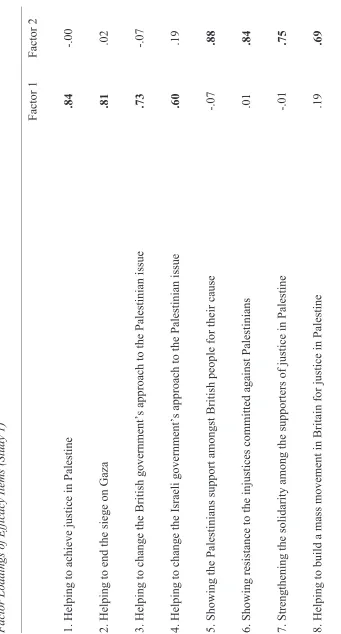
Efficacy. Efficacy beliefs were measured using 9 items adapted from Hornsey
et al. (2006). Since the distinction between political efficacy and identity
consolidation efficacy was novel, we performed an exploratory principal factor
of sphericity: χ2 (36) = 1166.92, p < .001; Determinant =.005). This yielded two
factors with Eigenvalues greater than 1.
Four items assessing perceptions of the demonstration’s political efficacy
(how effective the demonstration would be at helping to achieve justice in Palestine,
to end the siege on Gaza, and to change the British as well as the Israeli governments’
respective approaches to the Palestinian issue) loaded on the first factor, accounting
for 50.96% of variance. The remaining items assessing identity consolidation efficacy
(how effective the demonstration would be at showing resistance to the injustices
committed against Palestinians, strengthening the solidarity among the supporters of
justice in Palestine, helping to build a mass movement in Britain for justice in
Palestine, and showing the Palestinians support amongst British people for their
cause) loaded on the second factor, accounting for 11.49% of variance. One item
(efficacy at increasing support in British public opinion for justice in Palestine)
cross-loaded on both factors, and was thus dropped2. Factor loadings after dropping the
cross-loading item are provided in Table 1. The items were averaged to yield
composites of the demonstration’s perceived identity consolidation (α = .88) and
political (α = .85) efficacies.
Collective action tendencies. Participants indicated on an eleven-point scale
ranging from 0 to 10 how many of the next ten protests scheduled for the support of
justice in Palestine they would be willing to attend, assuming these were accessible to
them.
Table 1 Approximate Location
Missing value analysis and data screening. All variables had less than 10%
missing data points. These were imputed using the expectation maximization method
(EM) (Tabachnick & Fidell, 2007). None of the imputed values were out of range.
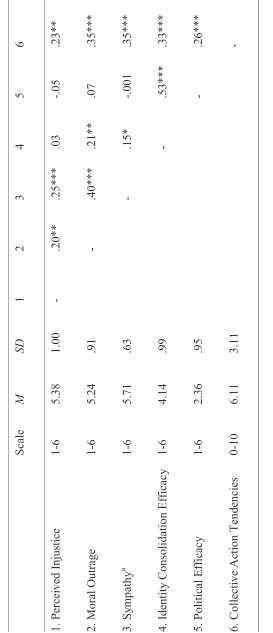
Data screening revealed that sympathy was severely negatively skewed. After
reflecting it to render its skewness positive, we applied an inverse transformation,
which improved its distribution (Tabachnick & Fidell, 2007). Details of all variables
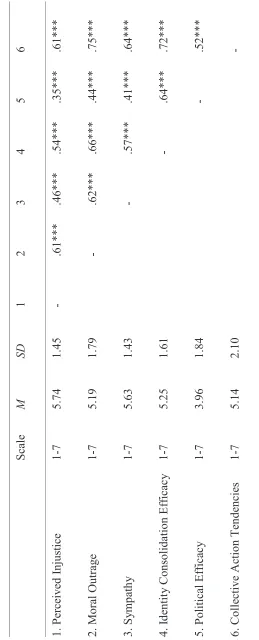
of interest and zero-order correlations are shown in Table 2.
Table 2 Approximate Location
Analytic strategy. To examine our model, in both our studies we conducted a
path analysis with AMOS (version 22) using the raw data as input and
maximum-likelihood estimation. The overall fit of our model was assessed using the chi-square
test, the comparative fit index (CFI), the root mean square of approximation
(RMSEA) for which we report an estimate and a 90% confidence interval, and the
standardized root mean square residual (SRMR). General guidelines for an adequate
model fit include a non-significant chi-square test, a χ2/df ratio < 3, a CFI ≥ .95, a
RMSEA ≤ .06-.08 (p-close > .05-.10), and a SRMR ≤ .08 (see Hu & Bentler, 1999).
To assess the significance of indirect effects, we followed the bootstrapping
procedure and estimated indirect effects using bias-corrected (BC) 95% confidence
intervals, based on 5000 bootstrap samples (Preacher & Hayes, 2008; Shrout &
Bolger, 2002). To assess the strength and significance of specific indirect effects, we
performed focused estimand-based analyses (see Arbuckle, 2013, for details on the
macro).
Path analysis. We specified a model where identity consolidation efficacy
and where perceived injustice positively predicted collective action both directly and
indirectly via moral outrage and sympathy.
We did not allow political efficacy to covary with perceived injustice, moral
outrage or sympathy, because the dual pathway model of collective action (van
Zomeren et al., 2004) conceptualised efficacy and emotions as independent pathways
to collective action. However, we allowed identity consolidation efficacy to covary
with moral outrage and sympathy, because of potentially common antecedents such as
politicized identification (Stürmer & Simon, 2004; see also McGarty, Bliuc, Thomas,
& Bongiorno, 2009). Hornsey et al (2006) indeed found that while politicized
identification is unrelated to political efficacy (see also van Zomeren et al., 2012), it
positively correlated with the three other types of efficacy. Politicized identification
has also been shown to influence or covary with both perceived injustice and resulting
emotions like anger (van Zomeren, Postmes, & Spears, 2008; van Zomeren et al.,
2012). Note, however, that we did not allow identity consolidation efficacy and
perceived injustice to covary in this study as their bivariate correlation was zero (see
Table 2). On the other hand, following previous research (Iyer & Ryan, 2009), we
allowed moral outrage and sympathy to covary.
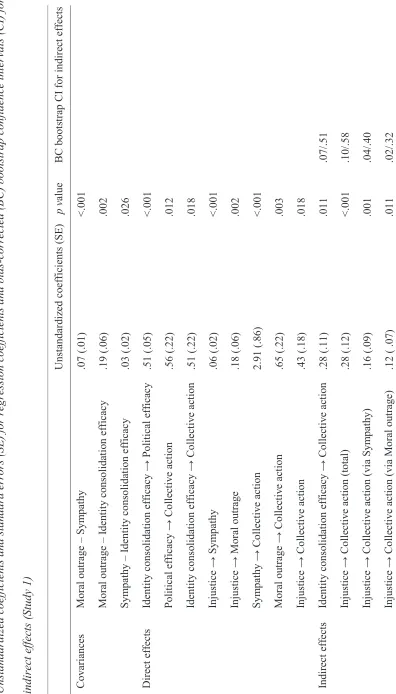
Our model showed excellent fit, χ2 (4) = 2.93, p = .57, χ2/df = .73, CFI = 1.00,
RMSEA = .00 [.00; .09], p-close = .78, SRMR =.02. All unstandardized path
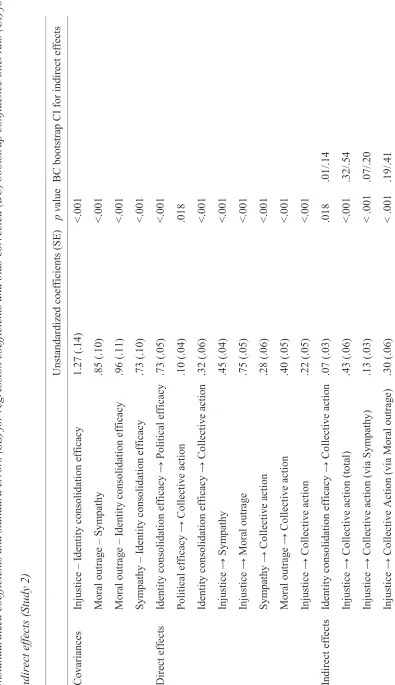
coefficients and covariances are displayed in Table 3, along with estimates of all
indirect effects (total and specific). As shown in Table 3, consistent with our
hypotheses, identity consolidation efficacy positively and directly predicted collective
action tendencies. Identity consolidation efficacy also positively predicted political
consolidation efficacy thus had a significant indirect effect on collective action
tendencies via political efficacy.
Further, as predicted, perceived injustice positively predicted both moral
outrage and sympathy. In turn, moral outrage and sympathy positively predicted
collective action tendencies. As expected, perceived injustice had a significant
positive indirect effect on collective action tendencies, with the specific indirect
effects via sympathy and moral outrage both emerging as positive and significant.
Perceived injustice also positively and directly predicted collective action tendencies.
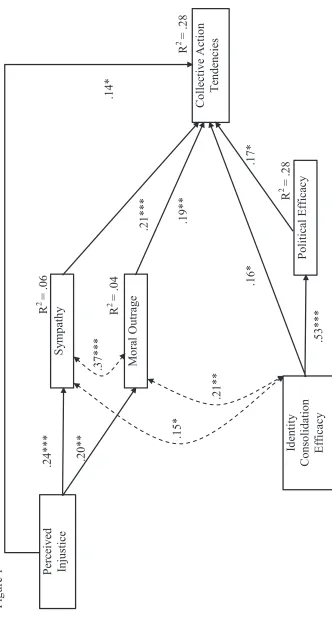
Figure 1 depicts our model along with standardized path coefficients and correlations.
We tested a reverse mediation model that posits identity consolidation efficacy
as a mediator between political efficacy and collective action tendencies. Since there
is no significance test to compare two non-nested competing models involving the
same variables, we used the Akaike Information Criterion (AIC). Models with the
lowest AIC value are preferred (Ullman, 2001). This alternative model also showed
excellent fit, χ2 (4) = 3.14, p = .54, χ2/df = .79, CFI = 1.00, RMSEA = .00 [.00; 0.09],
p-close = .76, SRMR =.02. However, it performed worse on the AIC criterion (AIC =
37.14) compared to our proposed mediation model (AIC = 36.93).
Table 3 Approximate Location
Figure 1 Approximate Location
To summarize, Study 1 provided preliminary evidence for the distinction
between identity consolidation efficacy and political efficacy. Perceiving the
demonstration as an opportunity to consolidate the identity of the protest movement
was associated with greater willingness to attend future protests for the same cause,
partly because the demonstration was seen to help redress the perceived injustice, but
previous findings (Iyer & Ryan, 2009; Thomas, 2005), perceived injustice had
positive indirect effects on collective action tendencies via moral outrage and
sympathy, as well as a direct effect.
Study 2
This study examined our model in a different political context and a less
politically engaged sample, namely an online sample of Hong Kong citizens who
were surveyed on their intentions to attend the June 4th vigil, an annual local tribute
for the victims of the 1989 Tiananmen massacre (the military crackdown by Chinese
authorities on protesters in Tiananmen Square in Beijing, on June 4th 1989) (Human
Rights Watch News, Tiananmen’s legacy, 2009)3. In mainland China, all public
discussion of the massacre, also known as the June 4th event, has been silenced since
then (Human Rights Watch News, Tiananmen’s legacy, 2009). Commemorations are
only allowed in Macau and Hong Kong, which are “special administrative regions”,
enjoying more democratic freedom than mainland China. Hong Kong holds the
largest annual vigil on June 4th as a tribute.
Although Hong Kong is part of China, we consider it as a bystander group in
relations between Chinese authorities and Mainland China citizens. Hong Kong has a
unique history as it was a British colony for over 150 years, only returning to Chinese
rule in 1997. Hong Kong also has a different political system and a high degree of
autonomy due to the “one country, two systems” policy (So, Lin, & Poston, 2001).
Furthermore, Hong Kong citizens have traditionally perceived themselves as different
from Mainland Chinese in terms of values (Hong, Chiu, Yeung, & Tong, 1999).
When we collected our data in 2009, the commemoration activities’ slogans
were: “remember June 4th, inherit the goals of those who came before us, pass the
(“Upcoming activities 2009”, n.d.). They also aimed to support the relatives of the
massacre victims, the Tiananmen Mothers (Human Rights in China, Solidarity with
the Tiananmen Mothers, n.d.), who continue to be victimised by the Chinese
government (Human Rights Watch News, Tiananmen’s legacy, 2009). Our measures
were thus informed by this context. Furthermore, as this was an online study, we
could afford to measure our constructs with more items to improve their reliability.
Method
Procedure. The study was administered as an online survey in Cantonese in
the days preceding the June 4th vigil. It was translated from English by a bilingual
speaker and checked by another bilingual speaker (one of the authors). We recruited
participants through an advertisement via Facebook targeting adult Hong Kong users,
offering an opportunity to enter into a prize draw.
Participants. A total of 390 respondents completed the survey (234 women,
154 men, 2 missing; age: M = 29.03 years; SD = 9.53).
Measures. To provide background information on our study and justify our
measures, we first gave participants a short text on details of the suppression of the
Tiananmen Square protesters, namely that the Chinese government has not apologized
for the killings, refuses to carry out a public inquiry, and interferes with the public
mourning of the victims. After providing sociodemographic information, participants
completed the survey measures, including filler items, and were then debriefed.
Perceived injustice. Participants indicated on a seven-point Likert scale (1 =
strongly disagree; 7 = strongly agree) whether they thought the Chinese
government’s current position on the June 4th event was “illegitimate”, “unjust”,
All emotion items were measured using a seven-point scale (1 = not strongly
at all; 7 = very strongly).
Moral outrage. Participants indicated the extent to which they felt “angry”,
“irritated” and “furious” when thinking about the stance of the Chinese government
on the June 4thevent. These items were combined into a composite score (α = .92).
Sympathy. Participants indicated the extent to which they felt “sympathetic”
and “compassionate” when thinking about those affected by the June 4th event
(Pearson’s r = .84).
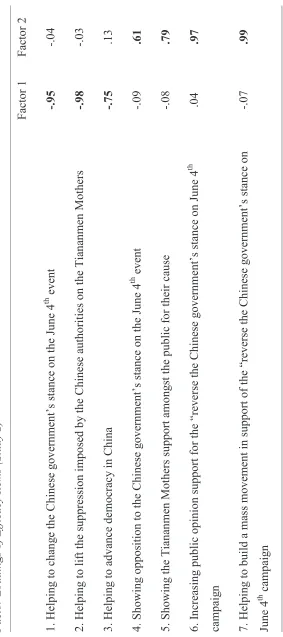
Efficacy. Efficacy was measured using 7 items adapted from Hornsey et al.
(2006) using a seven-point scale (1= not effective at all; 7 = extremely effective).
Because this study measured our constructs in another culture, we again performed an
EFA with oblique rotation to explore the structure of our measure (KMO = .85;
Bartlett’s test ofsphericity: χ2 (21) = 2520.31, p < .001; Determinant = .001), which
yielded two factors (Eigen values > 1). Three items assessing the vigil’s political
efficacy (how effective the June 4th vigil would be at helping to change the Chinese
government’s stance on the June 4th event, to lift the suppression imposed by the
Chinese authorities on the Tiananmen Mothers and to advance democracy in China)
loaded on the first factor. This factor accounted for 64.78% of the variance. Four
items assessing the vigil’s identity consolidation efficacy (how effective the June 4th
vigil would be at showing opposition to the Chinese government’s stance on the June
4th event, showing the Tiananmen Mothers support amongst the public for their cause,
increasing public opinion support for the “reverse the Chinese government stance on
June 4th” campaign, and helping to build a mass movement in support of the
campaign) loaded on another factor. This factor accounted for 12.37% of the
composites of the vigil’s perceived political (α = .93) and identity consolidation (α =
.91) efficacies5.
Collective action tendencies. Participants indicated how willing they would
be to join the annual June 4th Candlelight vigil in future years in order to support the
“reverse the Chinese government stance on June 4th” campaign, using a seven-point
scale (1 = very unwilling; 7 = very willing).
Table 4 Approximate Location
Results and Discussion
Missing value analysis. All variables had less than 5% missing data points.
We imputed these using the EM method (Tabachnick & Fidell, 2007) and adjusted
out of range values to the nearest acceptable score point. Details of all variables of
interest and zero-order correlations are shown in Table 5.
Table 5 Approximate Location
Path analysis. We tested the same model hypothesized in Study 1. However,
following the conceptual reasoning outlined in Study 1, we also allowed identity
consolidation efficacy and perceived injustice to covary. Another reason for this
decision was their significant bivariate correlation (see Table 5). The model showed
excellent fit, χ2 (3) = 2.18, p = .537, ns, χ2/df = 0.73, CFI = 1.00, RMSEA = .00 [.00;
0.08], p-close = .82, ns, SRMR =.01. All unstandardized path coefficients and
covariances are displayed in Table 6, along with estimates of all indirect effects. As
shown in Table 6 and consistent with our hypotheses, identity consolidation positively
and directly predicted collective action tendencies. Further, identity consolidation
efficacy positively predicted political efficacy, which, in turn, positively predicted
collective action tendencies. The indirect effect of identity consolidation efficacy on
Furthermore, as expected, perceived injustice positively predicted both moral
outrage and sympathy. In turn, moral outrage and sympathy positively predicted
collective action tendencies. The indirect effect of perceived injustice on collective
action tendencies was significant, with the specific indirect effects via sympathy and
moral outrage both emerging as positive and significant. Perceived injustice also
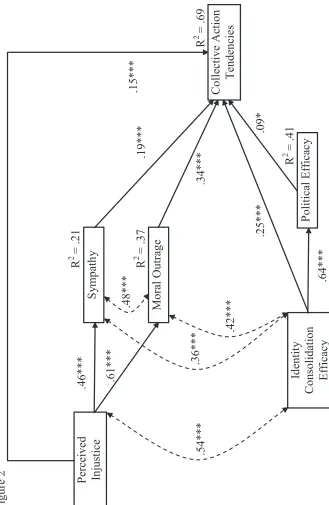
positively and directly predicted collective action tendencies. Figure 2 depicts our
model along with standardized path coefficients and correlations.
As in Study 1, we tested an alternative model, with identity consolidation
efficacy as a mediator between political efficacy and collective action tendencies.
This model showed unacceptable fit, χ2 (3) = 101.07, p < .001, χ2/df = 33.69, CFI =
.92, RMSEA = .29 [.24; 0.34], p-close < .001, SRMR =.18. Furthermore, it fared
worse on the AIC criterion (AIC = 137.07) compared to our model (AIC = 38.18).
Table 6 Approximate Location
Figure 2 Approximate Location
To summarize, this study provided further empirical support for the distinction
between identity consolidation efficacy and political efficacy, this time with a less
politicized sample and a different political context. Importantly, consistent with
predictions, perceiving the June 4th vigil as an opportunity to consolidate the identity
of the protest movement was associated with greater willingness to attend it, because
the vigil was seen as an opportunity to achieve desired political ends, but also
independently of that, suggesting again that identity consolidation had value in and of
itself. Furthermore, as expected, perceived injustice positively predicted collective
action tendencies both directly and indirectly via moral outrage and sympathy.
The aim of this research was to extend van Zomeren et al.’s (2004) dual
pathway model of collective action to the study of bystandergroup members’ motives
for solidarity-based collective action. We thus examined how different efficacy
considerations alongside emotions predicted intentions to attend future
pro-Palestinian protests among a sample of sympathetic protesters in Britain (Study 1) and
intentions to attend the annual June 4th vigil for the commemoration of the Tiananmen
massacre among a less politicized online sample of Hong Kong citizens (Study 2).
Efficacy Considerations in Solidarity-Based Collective Action
A key objective of our research was to provide empirical support for our
proposed distinction between two types of efficacy predictors of collective action,
namely the perceived political efficacy of collective action and what we termed its
identity consolidation efficacy. Importantly, we argued that identity consolidation
efficacy is an antecedent of political efficacy but also an independent predictor of
collective action. These hypotheses were supported across both our studies.
This work furthers our understanding of efficacy considerations in collective
action in various ways. First, our findings support Hornsey et al.’s (2006) argument
that the anticipated success of collective action may not only be evaluated in terms of
its potential to achieve policy changes. Instead, bystander group members vary in
their expectations regarding the potential success of collective action at achieving
various other goals, such as expressing opposition to an advantaged outgroup’s
policies, expressing support for the disadvantaged group, building an oppositional
movement and influencing public opinion. However, while Hornsey et al. (2006) have
treated these goals individually, the present research shows they can be usefully
conceptualised as part of an overarching process of identity consolidation for the
action can be broadly evaluated along two dimensions, corresponding to two broad,
recognized functions of collective action, namely identity mobilization and identity
consolidation (Klein et al., 2007). This serves to integrate two previously separate
frameworks for the evaluation of collective action functions, namely Hornsey et al.’s
(2006) typology of collective action efficacy and Klein et al.’s (2007) typology of
social identity performance functions.
Our research also provides preliminary evidence suggesting that beliefs in the
political efficacy of collective action are grounded in beliefs in its identity
consolidation potential. Given that political efficacy is a well-established precursor of
collective action (e.g. van Zomeren, Postmes, & Spears, 2009), identifying its
antecedents is useful both theoretically and practically, particularly in light of the
scarcity of research in this area (Drury & Reicher, 2009). Hence, our research extends
Hornsey et al.’s (2006) work by drawing previously unexamined links between
political efficacy and the other proposed types of efficacy. Furthermore, our findings
extend the argument that identity consolidation can provide the means for gaining
influence as a protest movement (see Kinder, 1998; Turner, 2005) to beliefs about the
efficacy of collective action. Our work also extends research on empowerment in
collective action (Drury et al., 2005; Drury & Reicher, 2009; Pehrson et al., 2013) by
1) showing that previously identified antecedents of empowerment might be usefully
viewed through the broader lens of identity consolidation, and 2) providing indirect
quantitative evidence suggesting that anticipated empowerment through collective
action may be closely linked to anticipated identity consolidation through collective
action.
The finding that identity consolidation efficacy positively predicts collective
consolidation as an intrinsic motivation for collective action among bystander group
members. These results are consistent with Hornsey et al.’s (2006) findings that
collective action is motivated by assessments of efficacy different from political
efficacy. Our results also support Klein et al.’s (2007) idea that identity consolidation
can be a goal of collective action in its own right. Furthermore, our findings
complement previous results showing a positive link between politicized
identification and collective action (van Zomeren et al., 2008) by providing a direct
form of evidence for the argument that collective action provides a way to affirm and
enhance a politicized identity (Kelly, 1993).
Emotions in Solidarity-Based Collective Action
In the emotion-based pathway to collective action, we showed that both moral
outrage and sympathy positively predicted solidarity-based collective action
tendencies across both our studies. These results extend previous research on moral
outrage (Montada & Schneider, 1989; Thomas, 2005; Thomas et al., 2012), an
under-investigated emotion in intergroup helping (Thomas et al., 2012; Thomas & McGarty,
2009), by highlighting its importance in solidarity-based collective action among
bystander group members, rather than the more commonly investigated advantaged
group members. Moreover, while research on the dual pathway model has hitherto
focused exclusively on anger-related emotions (see van Zomeren et al., 2012 for a
review), probably due to its concentration on collective action by disadvantaged
group members, our work underscores the importance of considering emotions such
as sympathy in the context of solidarity-based collective action, and extends previous
findings on advantaged groups to bystander groups (Feather et al., 2011; Iyer & Ryan,
In line with IET (Mackie et al., 2000), we also found that perceived injustice
positively predicted solidarity-based collective action tendencies indirectly via both
moral outrage and sympathy. Moreover, perceived injustice positively and directly
predicted collective action tendencies, suggesting additional emotions may mediate
this relationship. Future research could consider the role of emotions such as affective
empathy and existential guilt (Montada & Schneider, 1989; Thomas et al., 2009).
It is noteworthy that our effects were stronger in Study 2 compared to Study 1.
This may be due to differences in the level of specificity between predictors and the
outcome variable across the two studies. Study 1 predicted intentions to attend future
protests for Palestine in general based on perceptions of the annual demonstration for
Palestine, whereas Study 2 predicted intentions to attend the June 4th vigil based on
perceptions of the vigil event itself. Future research could investigate this possibility.
Limitations and Directions for Future Research
Our data are cross-sectional, which prevents inferences regarding the causal
relations between variables. However, previous research shows that injustice causally
predicts collective action tendencies (van Zomeren et al., 2004), emotions (Weiss,
Suckow, & Cropananzo, 1999), including group-based anger (van Zomeren et al.,
2004). Furthermore, our data is statistically more consistent with a model that assigns
a causal role of identity consolidation efficacy in predicting collective action
tendencies via political efficacy, rather than the reverse mediation model. Future work
should nevertheless corroborate our findings using experimental evidence. Relatedly,
it should investigate the conditions under which perceived injustice and identity
consolidation efficacy are linked.
Like most past research, we examined collective action tendencies rather than
good proxy predictors of behaviour (e.g. de Weerd & Klandermans, 1999;
Moskalensko & McCauley, 2009; Webb & Sheeran, 2006), future studies should
strengthen our findings by going beyond our single-item measures of collective action
and by measuring actual participation in diverse forms of collective action (Tausch et
al., 2011; Wright, Taylor, & Moghaddam, 1990).
It is worth noting the fluidity of the bystander group identification. McCartney
(2006) argues that third parties to intergroup conflicts vary along a continuum. For
instance, external third parties are less affected by the conflict and are typically
geographically separate from the conflict zone, while internal third parties reside in
the conflict site and have a direct stake in the conflict outcomes. In our research,
Hong Kong seems to fall in the middle: it is geographically separate from mainland
China, and adopts a different political system, but it is also a region within China, and
its population is split between identification as Chinese or as Hongkonger (University
of Hong Kong, 2014). Hong Kong thus captures the diversity and complexity of the
third party concept. Nevertheless, future research would do well to take into account
individuals’ identification with both the advantaged and disadvantaged groups.
Future research could also explore when identity consolidation efficacy is
likely to motivate collective action most strongly. It is possible that for newly-formed
or heterogeneous protest groups, the indirect influence of identity consolidation
efficacy via political efficacy would be more important than its direct influence,
whereas the opposite might be true for older or more homogenous protest groups.
Furthermore, although the distinction between identity consolidation efficacy and
political efficacy was theoretically driven and empirically supported in our studies,
factor structure that includes subtypes of efficacy within political efficacy and within
identity consolidation efficacy.
Conclusion
This work helps identify predictors of solidarity-based collective action among
bystander group members, an emerging topic in collective action research, and a
particularly important one in an era characterized by unprecedented
interconnectedness among nations, where global networks of communication offer
new opportunities for world opinion to influence intergroup struggles. Our findings
extend the dual pathway model of collective action (van Zomeren et al., 2004) by
shedding light on the role of the perceived identity consolidation efficacy of collective
action in predicting collective action both directly as well as indirectly via political
efficacy, and by highlighting the role of emotions such as sympathy over and above
References
Arbuckle, J. (2013). IBM SPSS Amos 22 user’s guide. USA: Amos Development
Corporation.
Blackwood, L.M., & Louis, W. R. (2012). If it matters to the group then it matters to
me: Collective action outcomes for seasoned activists. British Journal of
Social Psychology, 51, 72-92.doi: 10.1111/j.2044-8309.2010.02001.x
Byman, D., Chalk, P., Hoffman, B., Rosenau, W., & Brannan, D. (2001). Trends in
outside support for insurgent movement. Santa Monica, CA: RAND.
De Weerd, M., & Klandermans, B. (1999). Group identification and political protest:
Farmers` protests in the Netherlands. European Journal of Social Psychology,
29, 1073-1095. doi:
10.1002/(SICI)1099-0992(199912)29:8<1073::AID-EJSP986>3.0.CO;2-K
Drury, J., Cocking, C., Beale, J., Hanson, C., & Rapley, F. (2005). The
phenomenology of empowerment in collective action. British Journal of
Social Psychology, 44, 309-328. doi: 10.1348/014466604X18523
Drury, J., & Reicher, S. (2009). Collective psychological empowerment as a model of
social change: Researching crowds and power. Journal of Social Issues, 65,
707-725. doi:10.1111/j.1540-4560.2009.01622.x
Duncan, L. (2012). The psychology of collective action. In K. Deaux, & M. Snyder
(Eds.), Oxford Handbook of Personality and Social Psychology. New York:
Oxford University Press.
Eisenberg, N. (2000). Emotion, regulation, and moral development. Annual Review of
Psychology, 51, 665–697.doi: 10.1146/annurev.psych.51.1.665
Feather, N.T., Woodyatt, L, & McKee, I.R. (2011). Predicting support for social
expectations influence support for the Stolen Generations. Motivation and
Emotion, 1- 13. doi:10.1007/s11031-011-9262-5
Folger, R. (1977). Distributive and procedural justice: Combined impact of "voice"
and improvement on experienced inequity. Journal of Personality and Social
Psychology,35, 108119. doi:10.1037/0022-3514.35.2.108
Frijda, N. H., Kuipers, P., & ter Schure, L. (1989). Relations among emotion,
appraisal, and action tendency. Journal of Personality andSocial Psychology,
57, 212–228. doi:10.1037/0022-3514.57.2.212
Gamson, W. A. (1992). The social psychology of collective action. In A. D. Morris &
C. M. Müller (Eds.), Frontiers in protest movement theory (pp. 53–76). New
Haven, CT: Yale University Press.
Harth, N. S., Kessler, T., & Leach, C. W. (2008). Advantaged group’s emotional
reactions to intergroup inequality: The dynamics of pride, guilt and sympathy.
Personality and Social Psychology Bulletin, 34, 115-129.
doi:10.1177/0146167207309193
Haslam, S. A. (2001). Psychology in organizations: The social identity approach.
London: Sage.
Hornsey, M., Blackwood, L., Louis, W., Fielding, K., Mavor, K., Morton, T., et al.
(2006). Why do people engage in collective action? Revisiting the role of
perceived effectiveness. Journal of Applied Social Psychology, 36(7),
1701-1722. doi:10.1111/j.0021-9029.2006.00077.x
Hu, L. T.,& Bentler, P.M. (1999). Cutoff criteria for fit indexes in covariance
structure analysis: Conventional criteria versus new alternatives, Structural
Human Rights Watch News. (n.d.) Tiananmen’s legacy, 2009. Retrieved from
http://www.hrw.org/en/news/2009/05/13/tiananmen-legacy
Human Rights in China. (n.d.). Solidarity with the Tiananmen Mothers. Retrieved
from http://www.hrichina.org/content/4653
Iyer, A., Leach, C. W., & Crosby, F. J. (2003). White guilt and racial compensation:
The benefits and limits of self-focus. Personalityand Social Psychology
Bulletin, 29, 117-129. doi:10.1177/0146167202238377
Iyer, A., Leach, C. W., & Pedersen, A. (2004). Racial wrongs and restitutions: The
role of guilt and other group-based emotions. In N. Branscombe & B. Doosje
(Eds.), Collective guilt: Internationalperspectives (pp. 262-283). Cambridge,
UK: Cambridge University Press.
Iyer, A., & Ryan, M. K. (2009). Why do men and women challenge gender
discrimination? The role of group status and in-group identification in
predicting pathways to collective action. Journal of Social Issues, 65,
791-814. doi:10.1111/j.1540-4560.2009.01625.x
Kinder, D. R. (1998). Opinion and action in the realm of politics. In D. T. Gilbert, S.
T. Fiske, & G. Lindzey (Eds.), The handbook of social psychology (4th ed.,
Vol. 2, pp. 778-867). New York: Oxford University Press.
Klandermans, B. (1984). Mobilization and participation: Social psychological
expansions of resource mobilization theory. American Sociological Review,
49, 583-600.
Klandermans, B. (1997). The social psychology of protest. Oxford, UK: Basil
Klein, O., Spears, R., & Reicher, S. (2007). Social identity performance: Extending
the strategic side of the SIDE model. Personality and Social Psychology
Review, 11, 28-45. doi:10.1177/1088868306294588
Leach, C. W., Snider, N., & Iyer, A. (2002). Poisoning the consciences of the
fortunate: The experience of relative advantage and support for social equality.
In I. Walker & H. J. Smith (Eds.), Relativedeprivation: Specification,
development, and integration (pp. 136-163). New York: Cambridge
University Press.
Mackie, D. M., Devos, T., & Smith, E. R. (2000). Intergroup emotions: Explaining
offensive action tendencies in an intergroup context. Journal of Personality
and Social Psychology, 79, 602-616. doi:10.1037/0022-3514.79.4.602
McCartney, C. (2006). Dilemmas of third-party involvement in peace processes:
Reflections for practice and policy from Colombia and the Philippines.
London, UK: Conciliation Resources.
McGarty, C., Bliuc, A.M., Thomas, E., & Bongiorno, R. (2009). Collective action as
the material expression of opinion-based group membership. Journal of
Social Issues, 65, 839-857. doi:10.1111/j.1540-4560.2009.01627.x
Montada, L., & Schneider, A. (1989). Justice and emotional reactions to the
disadvantaged. Social Justice Research, 3, 313-344. doi:10.1007/BF01048081
Mummendey, A., Kessler, T., Klink, A., & Mielke, R. (1999). Strategies to cope with
negative social identity: Predictions by social identity theory and relative
deprivation theory. Journal of Personality and Social Psychology,76, 229–
Pagano, S.J., & Huo, Y.J. (2007). The role of moral emotions in predicting support
for political actions in post-war Iraq. Political Psychology, 28, 227-255.
Palestine: the case for justice. (2007). Palestine Solidarity Campaign Publication.
Retrieved from http://www.palestinecampaign.org/files/caseforjustice.pdf
Pehrson, S., Stevenson, C., Multoon, O.T., & Reicher, S. (2013). Is everyone Irish on
St Patrick’s Day? Divergent expectations and experiences of collective
self-objectification at a multicultural parade. British Journal of Social Psychology,
53, 249-264. doi:10.1111/bjso.12029
Preacher, K. J., & Hayes, A. F. (2008). Asymptotic and resampling strategies for
assessing and comparing indirect effects in multiple mediator models.
Behavior Research Methods, 40, 879–891. doi:10.3758/BRM.40.3.879
Reicher, S., Haslam, S. A., & Hopkins, N. (2005). Social identity and the dynamics of
leadership: Leaders and followers as collaborative agents in the transformation
of social reality. The Leadership Quarterly, 16, 547-568.
doi:10.1016/j.leaqua.2005.06.007
Runciman, W. G. (1966). Relative deprivation and social justice: A study of attitudes
to social inequality in twentieth-century England. Berkeley: University of
California Press.
Sharp, G. (2005). Waging nonviolent struggle: 20th century practice and 21st century
potential. (4th ed.) Extending Horizons Books: Canada.
Shrout, P. E., & Bolger, N. (2002). Mediation in experimental and nonexperimental
studies: New procedures and recommendations. Psychological Methods, 7,
Simon, B., & Klandermans, B. (2001). Politicized collective identity: A social
psychological analysis. American Psychologist, 56, 319–331.
doi:1O.1037//OOO3-066X.56.4.319
Smith, E. R. (1993). Social identity and social emotions: Toward new
conceptualisations of prejudice. In D. M. Mackie & D. L. Hamilton (Eds.),
Affect, cognition and stereotyping (pp. 297-315). San Diego: Academic Press.
So, A.Y., Lin, N., & Poston, D. (2001). The Chinese triangle of Mainland China,
Taiwan, and Hong Kong: Comparative Institutional Analyses. London:
Greenwood Press.
Stewart, A.L., Pratto, F., Bou Zeineddine, F., Aiello, A., Cidam, A., Eicher, V., Foels,
R.,..., Sweetman, J. (2014). International support for the Arab uprisings:
Understanding sympathy protests using theories of Social Identity and Social
Dominance. Manuscript submitted for publication.
Stürmer, S., & Simon, B. (2004). Collective action: Towards a dual pathway model.
European Review of Social Psychology, 15, 59–99.
doi:10.1080/10463280340000117
Subašic´, E., Reynolds, K. J., & Turner, J. C. (2008). The political solidarity model of
social change: Dynamics of self-categorization in intergroup power relations.
Personality and Social PsychologyReview, 12, 330-352.
doi:0.1177/1088868308323223
Sweetman, J., Spears, R., Livingstone, A.G., & Manstead, A.S.R. (2013). Admiration
regulates social hierarchy: Antecedents, dispositions, and effects on intergroup
behaviour. Journal of Experimental Social Psychology, 49, 534-542.
Tabachnick, B. G., & Fidell, L. S. (2007). Using multivariate statistics (5th ed.).
Boston: Allyn and Bacon.
Tajfel, H., & Turner, J. (1979). An integrative theory of intergroup conflict. In W. G.
Austin & S. Worchel (Eds.), The social psychology of intergroup relations
(pp. 33-47). CA: Brooks-Cole.
Tausch, N., Becker, J., Spears, R., Christ, O., Saab, R., Sing, P. & Siddiqui, R.N.
(2011). Explaining radical group behavior: Developing emotion and efficacy
routes to normative and non-normative collective action. Journal of
Personality and Social Psychology, 101, 129-148. doi:10.1037/a0022728
Thomas, E. F. (2005). The role of social identity in creating positive beliefs and
emotions to motivate volunteerism. Australian Journal on Volunteering, 10,
45-52.
Thomas, E.F., Mavor, K.I., & McGarty, C. (2012). Social identities facilitate and
encapsulate action-relevant constructs: A test of the social identity model of
collective action. Group Processes & Intergroup Relations, 15 (1), 75-88.
doi:10.1177/1368430211413619
Thomas, E. F., & McGarty, C. (2009). The role of efficacy and moral outrage norms
in creating the potential for international development activism through
group-based interaction. British Journal of Social Psychology, 48, 115-134.
doi:10.1348/014466608X313774
Thomas, E. F., McGarty, C., & Mavor, I. (2009). Transforming “apathy into
movement”: The role of prosocial emotions in motivating action for social
change. Personality and Social Psychology Review, 13, 310-333.
Tice, D. M. (1992). Self-concept change and self-presentation: The looking glass self
is also a magnifying glass. Journal of Personality and Social Psychology, 63,
435-451. doi: 10.1037/0022-3514.63.3.435
Turner, J. C. (2005). Explaining the nature of power: A three-process theory.
European Journal of Social Psychology, 35, 1-22. doi:10.1002/ejsp.244
Ullman, J. (2001) Structural equation modelling. In B.G. Tabachnick and L.S Fidell
(Eds.) Using Multivariate Statistics (4th Edition).Needham Heights, MA:
Allyn & Bacon.
University of Hong Kong, Public Opinion Programme. (2014). Categorical ethnic
identity (per poll) (8/1997 – 6/2014). Retrieved from
http://hkupop.hku.hk/english/popexpress/ethnic/eidentity/poll/eid_poll_chart.h
tml
“Upcoming activities 2009”. (n.d.). Retrieved from http://www.alliance.org.hk /64/64
20/?page_id=521
Van Stekelenburg, J., Klandermans, B., & van Dijk, W. (2011). Context matters:
Explaining how and why mobilizing context influences motivational
dynamics. Journal of Social Issues, 65, 815-838.
doi:10.1111/j.1540-4560.2009.01626.x
Van Zomeren, M. & Iyer, A. (2009). Toward an integrative understanding of the
social and psychological dynamics of collective action. Journal of Social
Issues, 65, 645 – 660. doi:10.1111/j.1540-4560.2009.01618.x
Van Zomeren, M., & Leach, C., & Spears, R. (2012). Protesters as “passionate
collective disadvantage. Personality and Social Psychology Review, 20, 1-20.
doi:10.1177/1088868311430835
Van Zomeren, M., Postmes, T., & Spears, R. (2008). Toward an integrative social
identity model of collective action: A quantitative research synthesis of three
socio-psychological perspectives. Psychological Bulletin, 134, 504–535.
doi:10.1037/0033-2909.134.4.504
Van Zomeren, M. & Spears, R. (2009). Metaphors of protest: A classification of
motivations for collective action. Journal of Social Issues, 65, 661-
679.doi:10.1111/j.1540-4560.2009.01619.x
Van Zomeren, M., Spears, R., Fischer, A. H., & Leach, C. W. (2004). Put your money
where your mouth is! Explaining collective action tendencies through
group-based anger and group efficacy. Journal of Personality and Social
Psychology, 87, 649-664. doi:10.1037/0022-3514.87.5.649
Van Zomeren, M., Spears, R., & Leach, C. W. (2008). Exploring psychological
mechanisms of collective action: Does relevance of group identity influence
how people cope with collective disadvantage? British Journal of Social
Psychology, 47, 353 – 372. doi:10.1348/014466607X231091
Weiss, H.M., Suckow, K., & Cropananzo, R. (1999). Effects of justice conditions on
discrete emotions. Journal of Applied Psychology, 84, 786-794.
doi:10.1037/0021-9010.84.5.786
Walker, I., & Smith, H. J. (Eds.). (2002). Relative deprivation: Specification,
development, and integration. Cambridge, England: CambridgeUniversity
Webb, T. L., & Sheeran, P. (2006). Does changing behavioral intentions engender
behavior change? A meta-analysis of the experimental evidence.
Psychological Bulletin, 132, 249 –268. doi: 10.1037/0033-2909.132.2.249
Wispé, L. (1986). The distinction between sympathy and empathy: To call forth a
concept, a word is needed. Journal of Personality and Social Psychology, 50,
314-321. doi:10.1037/0022-3514.50.2.314
Wright, S.C.(2009).The next generation of collective action research. Journal of
Social Issues, 65, 859-879. doi:10.1111/j.1540-4560.2009.01628.x
Wright, S. C., Taylor, D. M., & Moghaddam, F. M. (1990). Responding to
membership in a disadvantaged group: From acceptance to collective protest.
Journal of Personality and Social Psychology, 58, 994-1003. doi:
Footnotes
1
In fact, Klein et al. outline functions of social identity performance acts, defined as
the public expression of norms conventionally associated with a social group’s
identity. Collective action represents one type of such acts.
2
This cross-loading may suggest a mixed view of the British public as both a neutral
third party to be recruited to the cause, but also a potential accomplice to the British
and Israeli governments.
3
The data of Study 2 are drawn from the same dataset reported in Study 4 by
Sweetman, Spears, Livingstone and Manstead (2013) but with various differences.
Sweetman et al. focused on how admiration predicts collective action alongside anger
and sympathy, without examining efficacy. Anger in Sweetman et al.’s study is
measured in relation to the June 4th incident, whereas our measure of anger is targeted
at the stance of the Chinese government on the incident. Our sympathy measure is the
same as Sweetman et al.’s, excluding one item, namely feeling “empathic”. This was
done to get a cleaner measure of sympathy, because Thomas et al. (2009) argue that
sympathy and empathy are distinct emotions leading to different forms of
solidarity-based collective action. Finally, Sweetman et al.’s outcome variable consists of
various political actions including attending the June 4th vigil, whereas our outcome
variable is restricted to the June 4th vigil given that we focus only on its perceived
efficacy.
4
We originally assessed political efficacy with one additional item and identity
consolidation efficacy using multiple items measuring each of Hornsey et al.’s (2006)
three types of efficacy, plus efficacy at showing support for the disadvantaged group
(solidarity-based component). Details of these measures can be obtained from the
determinant was unacceptably low (< .00001), indicating multicollinearity. Inspection
of the correlation matrix indicated that the extra political efficacy item correlated
highly with some identity consolidation efficacy items (Pearson’s r > .60) so we
dropped it. Furthermore, various items measuring identity consolidation efficacy were
highly intercorrelated (Pearson’s r > .80), contributing to the low determinant. To
remedy this, we selected single items to measure Hornsey et al.’s (2006) three
different efficacy types and the solidarity-based component. Note that using other
single-item combinations continued to yield two-factor solutions.
5
We performed a confirmatory factor analysis with one latent variable called efficacy
and each item measuring efficacy as an indicator. The model fit was very poor, χ2 (14)
= 723.95, p < .001, χ2/df = 51.71, CFI = .72, RMSEA = .36 [.34; .38], p-close < .001,
SRMR =.13, AIC = 751.95. By contrast, the fit of a two-factor model (with political
efficacy and identity consolidation efficacy as latent variables, with three and four
indicators, respectively) was significantly better, according to a chi-square difference
40 A ct ing i n S ol ida T ab le 2 D es cr ip ti ve s and Z er o -or de r C or re lat ion s am on g K ey V ar iabl es ( St ud y 1 ) S ca le M S D 1 2 3 4 5 6 1. P erc ei ve d In jus ti ce 1-6 5.38 1.00 - .20** .25*** .03 -.05 .23** 2. M ora l O ut ra ge 1-6 5.24 .91 - .40*** .21** .07 .35*** 3. S y m p at h y a 1-6 5.71 .63 - .15* -.001 .35*** 4. Id ent it y C ons ol ida ti on E ff ic ac y 1-6 4.14 .99 - .53*** .33*** 5. P ol it ic al E ff ic ac y 1-6 2.36 .95 - .26*** 6. Co ll ec ti ve A ct ion T en de nc ie s 0-10 6.11 3.11 -
a C
[image:41.595.110.383.138.771.2]42 A ct ing i n S ol ida T ab le 4 F ac tor L oadi n gs o f E ff ic ac y It em s (St ud y 2 ) F ac tor 1 F ac tor 2 1. H el p ing t o c h an g e t he C hi ne se g ov ernm ent ’s s ta nc
e on t
he
J
une
4
th e
ve nt -.95 -.04 2. H el p ing t o l ift t he s u p p re ss ion i m p os ed b y t he C hi ne se a ut hori ti es on t he T ia na nm en M ot he rs -.98 -.03 3. H el p ing t o a dv anc e de m oc ra c y i n C hi na -.75 .13 4. S how ing o pp os it ion t o t he C hi ne se g ov ernm ent ’s s ta nc
e on t
he
J
une
4
th e
ve nt -.09 .61 5. S how ing t he T ia na nm en M ot he rs s u pp or t a m o ng st t he p u b li c f or t h ei r c aus e -.08 .79 6. In cre as ing p u b li c o p ini on s u pp ort f or t he “ re ve rs e t he Chi ne se g ove rnm ent ’s s ta nc
e on J
une 4 th ca m p ai g n .04 .97 7. H el p ing t o b ui ld a m as s m ov em ent i n s u p p or
t of t
he “ re v ers e t he Chi ne se g ove rnm ent ’s s ta nc e on June 4
th c
[image:43.595.101.384.138.775.2]