Supporting Decentralisation
and Local Governance
in Third Countries
January 2007
E U R O P E A N
COMMISSION
T
o
o
ls
a
n
d
M
e
th
o
d
s
S
e
ri
e
s
R
e
fe
re
n
c
e
D
o
c
u
m
e
n
t
N
o
2
and
2.
how to ensure that EC support to sector policies (eg in health, education, water & sanitation)
take into account and reinforce ongoing decentralisation processes.
The reference document is intended for EC staff in Delegations and Headquarters, national
partners and donor agencies working and supporting decentralisation processes and local
governance.
Neither the European Commission nor any person acting on behalf of the Commission
is responsible for the use which might be made of the following information
European Commission
EuropeAid Cooperation Office
Directorate E – Quality of Operations
Rue de la Loi 200 — B-1049 Brussels
Tel (32-2) 2991111
E-mail: [email protected]
[email protected]
Comments on this reference document can be sent to:
[email protected]
Internet:
http://ec.europa.eu/world
http://ec.europa.eu/europeaid
http://ec.europa.eu/development
http://ec.europa.eu/external_relations
Throughout this reference document, three kinds of text boxes are being used. These boxes contain
useful tips & tricks, concrete examples from the field, and refer to relevant background information.
The boxes are indicated with the following icons:
Tips and Tricks
Tips and practical suggestions concerning support to decentralisation and local
governance
General Information
Background information - these boxes refer to essential policy documents and
guidelines, and provide suggestions for further reading.
Experiences
Supporting Decentralisation
and Local Governance
in Third Countries
00 800 6 7 8 9 10 11
(*) Certain mobile telephone operators do not allow access to 00 800 numbers or these calls may be billed.
More information on the European Union is available on the Internet (http://europa.eu).
Cataloguing data can be found at the end of this publication.
Luxembourg: Office for Official Publications of the European Communities, 2006
ISBN 92-79-04496-6
© European Communities, 2007
Reproduction is authorised provided the source is acknowledged.
Printed in Italy
Table of contents
Acknowledgments vii
Abbreviations viii
Executive Summary ix
Why this Reference Document may be of interest to you… x
Chapter 1: Why invest in decentralisation? x
Chapter 2: Main concepts and the ‘open-systems’ approach xi
Chapter 3: Understanding the decentralisation arena xii
Chapter 4: Designing a coherent support strategy xiii
Chapter 5: Implementing decentralisation support xiv
Chapter 6: Assessing outcomes and impact xiv
Chapter 7: Enabling the European Commission xv
Introducing this Reference Document 1
1 Why invest in decentralisation? 5
1.1 Why is decentralisation high on the development agenda? 6
1.2 What is different compared to previous attempts? 6
1.3 What are the opportunities and risks? 8
1.4 What support is the European Commission providing? 9
1.5 No shortage of strategic and operational questions 11
2 Main concepts and the ‘open-systems’ approach 13
2.1 Unpacking the decentralisation process 14
2.2 Dimensions of decentralisation and related concepts 15
2.2.1 Political decentralisation 15
2.2.2 Administrative decentralisation 16
2.2.3 Fiscal decentralisation 17
2.2.4 ‘Local government’ 19
2.2.5 ‘Local governance’ 21
2.2.6 ‘Local (economic) development’ 22
2.2.7 ‘Territorial planning’ (aménagement du territoire) 22
2.3 Seeing the broader picture: Adopting an ‘open-systems’ perspective 24
2.4 Can decentralisation be considered a ‘sector’? 25
3 Understanding the decentralisation arena 27
3.1 A complex field 28
3.2 Decentralisation and changing lines of accountability 29
3.3 Civil society and decentralisation 30
3.4 Guiding principles for the design and implementation of support programmes 33
4 Designing a coherent support strategy 35
4.1 Programming 37
4.2 Identification 40
4.3 Formulation 46
4.4 Sector support programmes in a decentralised context (‘indirect support’) 48
4.4.1 Potential risks 50
4.4.2 Linking sector support with decentralisation 51
4.4.3 How can ‘classic’ sector programmes support decentralisation? 54
5 Implementing decentralisation support 55
5.1 Five key functions 56
5.2 Dialogue with partners 56
5.3 Monitoring 57
5.4 Coordination and harmonisation 60
5.5 Supporting implementation 61
5.6 Communicating and reporting 63
5.7 Open questions 64
iv
6 Assessing outcomes and impact 67
6.1 Getting evidence: A complex job 68
6.2 Lessons from experience and innovative approaches 69
6.3 Challenges ahead 71
7 Enabling the European Commission 75
7.1 Capacity to act as a ‘change agent’ 76
7.2 Capacity to ensure coordination, complementarity and coherence 77
7.3 Adapting management approaches, processes and procedures 78
7.4 Becoming a ‘learning organisation’ 79
Annex
Annex 1: List of ongoing EC projects and programmes in support of decentralisation and local governance processes
(December 2006) 82
Annex 2: Thematic note on gender in public administration reform and decentralisation 87
Annex 3: Assessing risks and opportunities with decentralisation 95
Annex 4: Some research findings on decentralisation effects 96
Annex 5: Diversity of entry points for EC support 97
Annex 6: Tools for political, institutional and organisational analysis 98
Annex 7: Capacity building in support of decentralisation 100
Annex 8: Financing Modalities and the Seven Key Assessments 101
Annex 9: Managing multi-actor and multi-level design processes 102
Annex 10: Performance indicators for sector budget support in Jordan, Honduras and Mali 103
Annex 11: Europeaid decentralisation indicators for reporting purposes [work in progress] 107
Literature 108
Useful resources on support to decentralisation and local governance 109
Boxes
Box 1: Workshop with EC Delegation staff (Brussels, 4-6 October 2006) 3
Box 2: EC policy documents on decentralisation and local governance 10
Box 3: Top ten challenges for EC Delegations 11
Box 4: What is devolution? 15
Box 5: What is meant by de-concentration, delegation and divestment? 17
Box 6: What forms can fiscal decentralisation take? 18
Box 7: Perceptions of local governance by local stakeholders 21
Box 8: Taking territorial aspects of decentralisation into account 23
Box 9: Securing critical linkages 25
Box 10: Recognising the role of traditional authorities 29
Box 11: Potential roles of civil society in promoting democratic decentralisation 31
Box 12: Supporting Mauritanian civil society for better local governance 32
Box 13: ‘Preconditions‘for successful decentralisation 38
Box 14: EC engagement in difficult decentralisation processes 38
Box 15: Tips and tricks in choosing to engage with or stay out of decentralisation processes 39
Box 16: Bottom-up experiences shape EC support strategies in Madagascar 39
Box 17: Tips and tricks for improving local government participation in programming 40
Box 18: Requirements of an ‘open-systems’ perspective 42
Box 19: Looking inside the black box of the decentralisation system 42
Box 20: Good practice in Mali: Refocusing the support strategy 44
Box 21: Tips and tricks: some lessons learned on sequencing 45
Box 22: The Ugandan Municipal Partnership Programme 45
Box 23: Tips and tricks for managing the identification process 46
Box 24: Sector budget support to decentralisation in Jordan 49
Box 25: Seven lessons on balancing EC support between the different levels of government 50
Box 27: Complementary information from practice 29
Box 28: OISE – A database on decentralisation in Mali 59
Box 29: Some complementary information from practice 59
Box 30: Some complementary information from practice 61
Box 31: Fostering the participation of European municipalities 61
Box 32: Tips and Tricks from EC Delegations on how to better support implementation 62
Box 33: Some complementary information from practice 63
Box 34: Do not underestimate the relevance of communication! 64
Box 35: Some complementary information from practice 64
Box 36: The time dimension of impact: lessons from Mali 70
Box 37: Comparing local governance in 30 municipalities in Mexico 73
Box 38: Proactive EC support to political and societal transformation 76
Box 39: Tips and tricks regarding the meaning of acting as a ‘change agent’ 77
Box 40: Some complementary information from practice 78
Box 41: Putting in place systems for joint-learning 79
Box 42: EC capacity challenges with regard to decentralisation and local governance 80
Figures
Figure 1: The new ‘wave’ of decentralisation 7
Figure 2: Assess risks and opportunities 9
Figure 3: Political decentralisation 15
Figure 4: Administrative decentralisation 16
Figure 5: Fiscal decentralisation 18
Figure 6: The gravitational tendencies of decentralisation 19
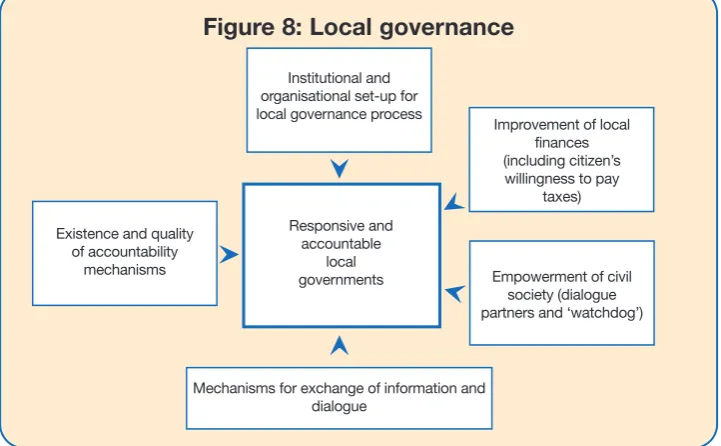
Figure 7: (Elected) local government 20
Figure 8: Local governance 21
Figure 9: Local (economic) development 22
Figure 10: Territorial Planning 23
Figure 11: Looking at decentralisation as an open system 24
Figure 12: The accountability chain 31
Figure 13: Guiding principles to support decentralisation 33
Figure 14: Pathway to supporting decentralisation and local governance 36
Figure 15: Strategic and operational challenges for support to decentralisation 41
Figure 16: Operational considerations with regard to performance indicators 48
Figure 17: Choosing an appropriate institutional set-up 49
Figure 18: EC training for employability programme in Syria 53
Figure 19: The governance process of implementing support programmes 56
Figure 20: Tips and tricks for engaging in meaningful dialogue 58
Figure 21: Monitoring as an ongoing process 58
Figure 22: Coordination and harmonization: Ingredients to consider 60
Figure 23: Supporting implementation following the capacity development approach of the Paris Declaration 63
Tables
Table 1: Two perspectives on decentralisation 8
Table 2: Definitions of decentralisation compared 14
Table 3: Potential tensions and conflicts in the decentralisation arena 30
Table 4: Using typologies: An illustration 43
Table 5: Steps in the ‘mapping process’ 44
Table 6: Is support consistent? 54
Table 7: Definitions of key terms compared 69
Table 8: Assessing decentralisation progress 72
vii
Acknowledgments
This document has been prepared by Jean Bossuyt, Volker Hauck and Niels Keijzer of the European Centre for Development Policy Management (www.ecdpm.org), within the Aid Delivery Methods Programme.
The preparation has been coordinated by the Governance, Security, Human Rights and Gender Unit in EuropeAid and has benefited from comments and inputs of EuropeAid staff.
viii
Abbreviations
3Cs Coordination, complementarity and coherence
ACP Africa, Caribbean and Pacific
AIDCO EuropeAid Cooperation Office
CARDS Community Assistance for Reconstruction, Development and Stabilisation
(for Western Balkan countries)
CBO Community-based organisation
CM Centralised management
CSP Country Strategy Paper
DFID Department for International Development, United Kingdom
DG Directorate-General
DG DEV Development Directorate-General
D-Group Discussion group
DG RELEX External Relations Directorate-General
DM Decentralised management
EC European Commission
ECDPM European Centre for Development Policy Management
EcoFin Analysis Economic and Financial Analysis
EDF European Development Fund
FP Financing proposal
GBS General budget support
LG Local government
LGA Local government administration
MDGs Millennium Development Goals
M&E Monitoring and evaluation
NGO Non-governmental organisation
NIP National Indicative Programme
ODA Official Development Assistance
OECD Organisation for Economic Cooperation and Development
PIF Project Identification Fiche
PIU Project Implementation Unit
PRSP Poverty Reduction Strategy Paper
RIP Regional Indicative Programme
RSP Regional Strategy Paper
SBS Sector budget support
SPSP Sector Policy Support Programme
Executive Summary
Why this Reference Document may be of interest
to you…
1. The European Commission (EC), much like other donor
agencies, is providing growing levels of funds to support
decentralisation and local governance in many parts of the
world. Yet this is still a relatively new area of work for the
European Commission. Not surprisingly, staff involved in
direct or indirect support to decentralisation and local
governance, struggle with many thorny ‘how to’ questions.
2. To respond to this need, the European Commission took the
initiative to produce a Reference Document that should
serve as a practical tool to help EC staff to better
understand the ‘politics’ of decentralisation and local
governance processes; to support the formulation and
implementation of nationally and locally owned
decentralisation policies; and to improve the coherence
between the sector support being provided by the European
Commission (e.g. in health or education) and ongoing
decentralisation processes.
3. Yet this Reference Document should not be seen as a
cookbook with well-tested recipes to be applied universally.
The field of decentralisation does not lend itself to
‘one-size-fits-all’ models. In many countries promising
experiences are taking place, and the EC intends to develop
a comprehensive policy framework to underpin its strategic
support to decentralisation and local governance processes
in a hugely varying set of country contexts. The Reference
Document therefore reflects ‘work in progress’.
4. In order to ensure its relevance for staff in the field, the
Reference Document was elaborated in a highly
participatory manner. Efforts were made to start the
process from realities on the ground; the day-to-day
concerns of staff in charge of managing programmes; as
well as the emerging good practices. These ‘frontline
actors’ were involved through a series of electronic
Discussion-Group (‘D-Group’) consultations which
fundamentally shaped the focus and content of the Paper.
A brainstorming seminar was organised in Brussels (6-8
October 2006) with staff from eighteen EC Delegations from
the various regions which helped to further refine the
Reference Document and define future ‘homework’ for the
EC in the area of decentralisation.
Chapter 1: Why invest in decentralisation?
5. Since the 1990s, decentralisation has gradually gained
prominence. Whether by own choice or as a result of
external pressures, the large majority of third countries are
currently involved in some form of decentralisation, with
varying degrees of commitment and success. A wide range
of ‘push factors’ help to explain the popularity of
decentralisation (>>> see page 6).
6. Decentralisation is not new. The term has been used since
the early 1950s for a wide range of institutional reform
programmes. However, most of the reforms never went
beyond their initial stage, creating local authorities without
democratic legitimacy or genuine powers for local
decision-making and self-governance. The current wave of
decentralisation is considered to be qualitatively different.
The reform agenda has been broadened to ideally
encompass : (i) devolution of power to elected local
governments as a distinct set of state actors; (ii) local
governance (based on principles of participation,
transparency and accountability); (iii) a new paradigm of local
economic development; (iv) a rediscovery of the importance
of territorial (regional) planning; as well as (v) the overall
modernisation of the state (>>> see page 6 and 7).
7. Decentralisation has quickly become a new development
mantra. Some believe it is intrinsically a good thing to do in
all circumstances. Alongside fervent supporters, there is no
shortage of sceptics (>>> for an overview of arguments
used by both sides see Table 1, page 8). A more prudent and
promising approach is to adopt a pragmatic stance towards
decentralisation. This means accepting the risks and
opportunities of engaging in such a process (>>> see Figure
2, page 8 and Annex 3, page 95). It also invites
reform-minded people to take on board some sobering lessons of
experience with decentralisation (>>> see page 8).
8. Over the last decade, the European Commission has
increasingly become involved in support to decentralisation
and local governance processes across the various regions,
mobilising substantial amount of funds (>>> for an overview
of the programmes see Annex 1, page 82). This happened
before a solid policy framework was in place to underpin
interventions (>>> see Box 2, page 10) and through a variety
of ‘entry points’ that evolve over time (>>> see page 10).
9. As the EC moves into the decentralisation arena, it is
confronted with a wide range of strategic and operational
challenges (>>> see Box 3, page 11). On most of these
issues, there are many questions and few answers. Further
experimentation, exchange of lessons learnt and policy
development will be required in the next years to develop a
solid body of knowledge, more specific EC policy positions
and tested tools.
x
Chapter 2: Main concepts and the ‘open-systems’
approach
10. A myriad of notions surround decentralisation. They
originate from a rich variety of public administration
cultures, traditions and history. Some of the terminology –
although sounding similar – can even have different
meanings in different parts of the world. If not properly
understood, one risks getting lost in a jungle of expressions
and terms.
11. There is no universally agreed definition of
‘decentralisation’. While some core elements are common
in the definitions used by major donor agencies, there are
also important variations (>>> see table 2, page 14).
12. As far as the European Commission is concerned, there is a
preference to focus pragmatically on the functional
dimensions of decentralisation. For this reason, this section
first addresses three different types of decentralisation and
their key ingredients :
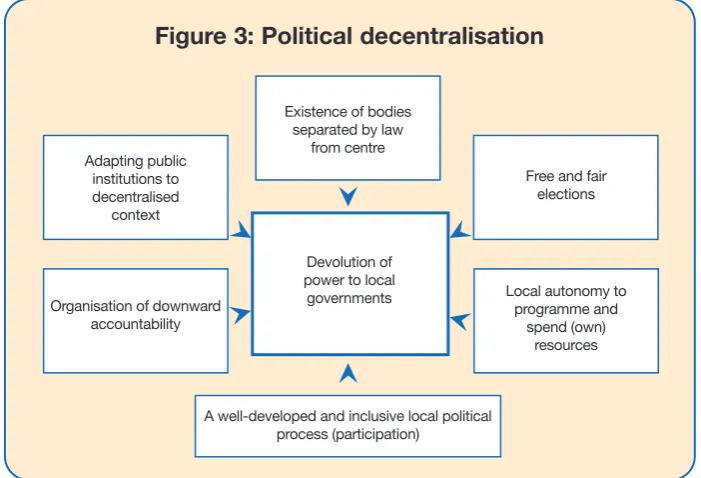
• Political decentralisation usually based on devolution
(>>> page 15)
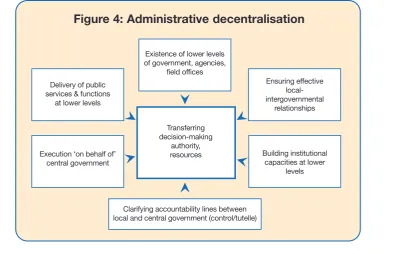
• Administrative decentralisation and its three possible
variants (de-concentration, delegation and divestment)
(>>> page 16)
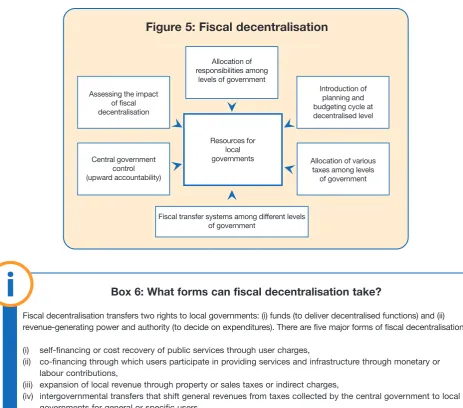
• Fiscal decentralisation (>>> page 17).
13. In designing, implementing and evaluating decentralisation
processes, it is vital to consider the linkages between these
three core dimensions of decentralisation political,
administrative, fiscal. In essence, there can be no effective
decentralisation without addressing all three dimensions, as
they are complementary and interdependent. They need
one another, as the division of power across different levels
of government and society needs to correspond with fiscal
responsibilities; administrative systems and procedures
need to be in line with the execution of political power and
fiscal tasks; and fiscal arrangements need to prevent a
clashing of political and administrative powers.
Furthermore, it might be opportune to address certain
dimensions of the decentralisation process at particular
points in time, depending on local conditions.
14. This section then goes on to examining the meaning of
related concepts such as:
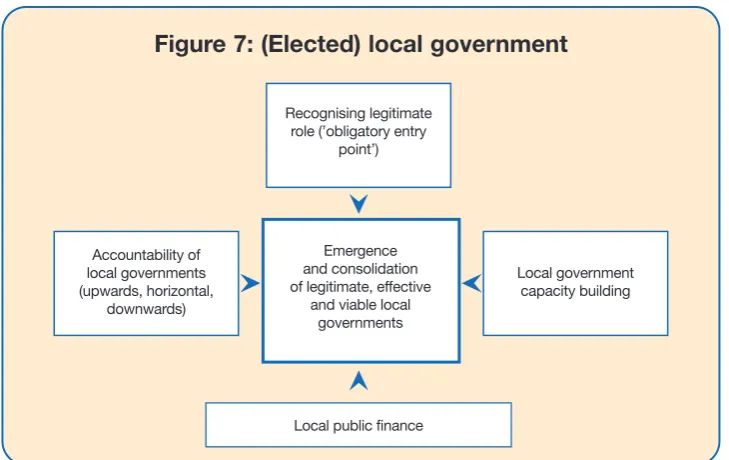
• local government (>>> page 19)
• local governance (>>> page 21)
• local development (>>> page 21)
• territorial planning (>>> page 21)
15. Getting acquainted with these definitions is a necessary but
not sufficient step to engage with decentralisation and local
governance processes. It is critical to look beyond
normative (technocratic) concepts to view the broader
xi Global and Regional Context
Decentralisation Process
Global and Regional Context Overall process of
state modernisation Including
public-sector reform
Democratisation and wider governance
reforms
National development strategies and
processes
(elected) Local governments
municipal development
Local democracy and governance citizen participation
Local development strategies and
processes
Political
Administrative
Fiscal
picture of decentralisation processes as they evolve on the
ground. The way forward lies in adopting an ‘open-systems’
perspective on decentralisation and local governance
processes. This enables those involved to see the global
picture and understand that decentralisation processes
consist of different interacting and interdependent elements
embedded in a particular political and societal context and
influenced by regional and international trends. The figure
above outlines a framework in which to view
decentralisation as an open system.
16. This open model shows
•
the three main dimensions of decentralisation (inner circle),
•
the different ‘ingredients’ of the decentralisation process
(as a system), both upstream (at the national level) and
downstream (at the local level),
•
the linkages between the component elements of the
system,
•
the possible external influences on the system, arising from
regional and global trends (outer circle), the task at hand for
donor agencies: to enhance the effectiveness and impact of
their support, they’re well-advised to adopt a holistic
approach, which enables them to see (and act upon) the
linkages between the different parts of the system (>>>for
practical applications see Box 9, page 25).
17. Finally, the question of whether decentralisation can be
considered a sector is of huge strategic and operational
relevance for EC Delegations, as it will largely determine
the type of support to be provided, the approaches and the
applicable financing modalities. There is no specific EC
policy position on the matter, leaving scope for
country-specific approaches (>>> page 25).
Chapter 3: Understanding the decentralisation
arena
18. Supporting decentralisation and local governance is by
definition a ‘political job’. It is a jump into the unknown and
a long trip on a bumpy road. The decentralisation arena is
characterised by (i) a multitude of actors and stakeholders
(with often competing interests); (ii) a frequent lack of
commitment/capacity at central level to decentralise power
and funds; (iii) a wide range of complex institutional and
technical issues to be sorted out; (iv) confusion on new
roles and responsibilities in a decentralised setting; (v) a
strong (not always consistent) presence of development
partners; (vi) an uncertain impact of reform attempts.
19. In such an arena, there is no shortage of potential sources
of conflict. Local elections can be manipulated by ruling
elites. The newly elected bodies must earn their place and
legitimacy alongside established forms of authorities (e.g.
traditional chiefs) or other service providers (e.g. civil
society organisations). Local governments generally have to
‘scratch power’ from the centre by demonstrating their
added-value. For decentralisation to work, an active
citizenship claiming rights and demanding accountability
-is crucial. Many other tensions can complicate or derail the
reform process (>>> see table 3, page 30).
20. Accountability lies at the heart of many of the potential
benefits of decentralisation. The ‘accountability chain’ is
due to change fundamentally when decentralisation takes
place. Three ‘lines of accountability’ will have to be
considered: (i) the downward accountability of local
governments to citizens (which is the core of democratic
decentralisation); (ii) the horizontal accountability within
local government and administration; (iii) the upward
accountability of local government towards central
government (>>>for more details see figure 12, page 31).
21. Experience has shown the limits of horizontal and upward
accountability mechanisms in countries with a fragile
democratic culture. Donor agencies may therefore choose
to help establishing credible and effective downward
accountability mechanisms. Civil society has a most critical
role to play in this regard (>>> see box 11, page 31). In
various countries, new forms of participatory governance
are gradually emerging. Yet progress is often hampered by
the weakness of civil society and by inconsistent donor
support modalities (e.g. the setting-up of parallel user’s
committees at local level, disconnected from local
governments).
22. When engaging in complex, politically sensitive arenas like
decentralisation, it is important for donor agencies to abide
by a set of guiding principles. While some are obvious and
generic (e.g. the need for country-specific approaches;
ownership and partnership), others are less evident. This is
the case for the principles of ‘legality’ and ‘legitimacy’. It
means that the support provided should be consistent with
the ‘legal’ framework for decentralisation (to avoid parallel
structures) and seek to respect the ‘legitimate’ role division
between central and local governments, civil society and
the private sector (>>> for more details see page 33).
Chapter 4: Designing a coherent support strategy
23. This chapter deals with the three main phases of designing
EC cooperation strategies : programming, identification and
formulation. In this analysis, it is important to recognise the
interrelationships between the various phases of the design
process as well to make the link with the menu of possible
EC approaches (i.e. the project approach, SPSP), financing
modalities (sector budget support, pool funding, EC
procurement and grant procedures), tools (SPSP, Project
Management Cycle guidelines, etc.) and expected outputs
(a project identification fiche, action fiche, financing
proposal, etc.).
24. With regard to programming, four operational challenges
are analysed:
• Should the European Commission engage in
decentralisation or not? (>>> page 37)
• How should existing support best evolve? (>>> page 39)
• How can different stakeholders be effectively involved in
programming? (>>> page 40)
• How can the European Commission move to ‘joint’
programming? (>>> page 40)
25. A wide range of issues, lessons learnt and practical
examples are provided under these four headings. For
instance, a strong plea is made to avoid too many
‘pre-conditions’ before supporting decentralisation (>>> see
page 38 and Box 13) but to get engaged, if need be with
pilot projects (to prepare the ground for decentralisation).
Particular attention is also given to strategic choices with
regard to ‘scaling-up’ support (from one programming cycle
to another); choosing the ‘right’ EC approaches and
financing modalities (possibly including sector budget
support to decentralisation) as well as broadening the
scope of actors involved.
26. With regard to the identification phase, the following
operational challenges arise:
• How to apply an ‘open-systems’ perspective when
identifying support programmes? (>>> page 41)
• How to assess the country-regional perspective?
(>>> page 41)
• How to map and understand the actors to be involved?
(>>> page 43)
• How to identify strategic options for supporting
decentralisation? (>>> page 44)
27. This is a fairly practical section of the document. It provides
(i) a set of glasses to frame EC support in an
‘open-systems’ perspective (>>> see Box 18, page 42); (ii) tools
to look inside the ‘black box’ of the decentralisation process
in a given country (>>> see Box 21, page 42) as well as a
number of typologies (>>>see page 41 and 43 and table 4);
(iii) methodologies to carry out a stakeholder analysis and a
mapping of the various actors and their roles (>>> see
table 5, page 44); as well as a range of tips and tricks to
deal with issues such as the focus of a support programme,
the ideal entry points, the sequencing of the support as well
as the capacity development strategies to be used.
28. For the formulation phase, several operational questions are
addressed:
• When and how to use budget support?
• What are suitable performance indicators and how to
agree upon them?
• How to choose an appropriate institutional set-up for the
programme?
29. Sector budget support is one of the three possible financing
modalities (>>>see Annex 8, page 101) linked to the
choice for an SPSP. For governance-related processes, the
European Commission is promoting, whenever possible, the
use of sector budget support. The main reason is the
potential ‘trigger effects’ that budget support may have in
terms of enhancing ownership, facilitating dialogue,
improving public financial management (at both the central
and local level) and increasing transparency and
accountability.
30. Three EC Delegations are already using sector budget
support (Mali, Jordan, Honduras). Several Delegations are
exploring the possibilities of shifting from a project
approach to supporting decentralisation to an SPSP and
sector budget aid (Niger, Madagascar, Philippines), while the
issue is also on the table in ‘difficult partnerships’.
However, there is also recognition that many thorny ‘how
to’ questions remain to be answered, for example, related
to focus, indicators and trigger clauses (>>> for initial
guidelines see page 47).
31. Defining the ‘right’ set of indicators is a major challenge in
the formulation process. There are obvious differences
between indicators for project approaches and indicators in
the framework of an SPSP. Emerging lessons of experience
suggest the critical importance of making clear choices on
(i) substance (e.g. mix of quantitative and qualitative
indicators); (ii) the process for negotiating and agreeing
upon indicators; (iii) the performance reviews and their
consequences (>>>for details and the example of sector
budget support to decentralisation in Jordan, see page 46
and Box 24, page 49).
32. The final section of this chapter is dedicated to sector
support in a decentralised context (‘indirect support’). The
key task is to design and formulate sector programmes
(e.g. health, education, water and sanitation) that do not
counter ongoing decentralisation processes but where
possible, even strengthen such reform processes and are
mutually reinforcing.
33. Particular attention is given to the centralising tendencies
involved with sector-wide approaches and related dangers
for decentralisation and local governance. A set of key
lessons are provided to counteract these risks (>>> see
Box 27, page 50). Furthermore, practical examples are
analysed whereby the European Commission is trying to
properly articulate sector support with decentralisation
(>>> see page 53 with the cases of Syria and the
Philippines). To conclude, the section offers tools to check
whether EC support is consistent and coherent (>>> see
tables 6 on page 54).
Chapter 5: Implementing decentralisation support
34. Implementation of support programmes opens a huge agenda
of interdependent functions to be performed internally by EC
Delegation staff as well as with their various partners. Practice
confirms the critical importance of a solid ‘governance
process’ and institutional framework for managing the
support programme (>>> see figure 19, page 56).
35. Dialogue is a first - and growingly important - function.
Obviously, different forms of dialogue are required at
various levels, involving all relevant actors and stakeholders
(including associations of municipalities, mayors, civil
society organisations, citizen groups, etc.). The dialogue
with partners is key to work out multi-donor support
packages while there is also a need for stronger internal
dialogue and exchange at the level of the EC Delegations
(e.g. between those directly supporting decentralisation and
staff involved in the sectors). Some tips and tricks as well
as EC experiences in the field can provide guidance
(>>>see page 58).
36. A second function to be performed is ‘monitoring’ - the
systematic assessment of progress achieved in the
implementation of development interventions. Here again,
there will be a need to ensure that the monitoring systems
are closely aligned to the specificity of decentralisation (as
a societal transformation process). This is not an evident
thing to do. It requires an ongoing monitoring process,
which makes use of both quantitative and qualitative data
from various sources (including national databases that are
gradually institutionalised).
37. Effective implementation is furthermore dependent on
coordination and harmonisation. Many ingredients need
to be considered to make this work in practice (>>> see
page 60). The (donor) EC response strategy towards
coordination and harmonisation will have to be adapted to
the respective country context. For instance, in countries
with a strong commitment to decentralisation, donor
support should easily follow and feed into national agendas
and procedures. At the other extreme, one finds countries
which are in their infancy with regard to decentralisation
(including fragile and post-conflict states). The task at hand
there will be to join forces to help creating the conditions
for decentralisation to emerge.
38. The next function relates to supporting the various
implementing agencies involved in the process. These
might include technical assistance personnel, project
implementation units, NGOs as well as European municipal
associations. For an SPSP, it normally involves particular
departments of a ministry or specialised public agencies.
A key lesson learnt is to ensure that supporting
implementation is done with a capacity development
perspective in mind –so as to leave behind sustainable
endogenous capacity (>>>for practical implications, see
figure 23, page 63).
39. Last but not least, effective implementation hinges on
information, communication and reporting systems. The role
of ‘communication’ is particularly important in such
transformation processes. It invites the various actors to go
beyond traditional (top-down) communication patterns and
to invest in multi-stakeholder learning processes. This puts
a premium on communication as an exercise in listening,
building trust, debating and learning from each other. All
this is vital for creating ownership and nurture a change of
norms, values and practices.
Chapter 6: Assessing outcomes and impact
40. In light of the current enthusiasm about decentralisation as
a strategy for pro-poor political transformation processes,
one might expect pronounced interest in the matter.
However, the discourse so far on the advantages and
benefits of decentralisation is a rather normative one. The
D-group consultations suggest that the outcomes and
impact of EC support programmes have not yet been
analysed in a comprehensive and systematic manner.
41. Admittedly, it is not easy to get solid evidence of progress
achieved with the decentralisation process itself and with
related support programmes. There is no shortage of thorny
questions to be addressed including: (i) why carry out
assessments? (ii) what to measure (project or systemic
outcomes)? (iii) how to assess progress? (iv) how to factor
in the pervasive influence of the national political
environment on the success of support programmes?
42. Yet EC Delegation staff have to show results for the growing
amount of funds in support of decentralisation processes
and programmes. A first source of inspiration is provided by
some initial lessons learnt with assessing outcomes and
impact. Experience suggests (i) the importance of agreeing
on terminology among the stakeholders involved; (ii) the
relevance of applying an ‘open-systems perspective’ to
assess the evolution of the decentralisation process in a
given country (>>> for practical implications, see page 68);
(iii) the need for proper incentives to reform; (iv) the danger
of being over-optimistic on quick results; and related to this
(v) the time perspective needed to assess outcomes and
impact.
43. A second source of inspiration is to be found in an
increasingly documented set of innovative practices, tested
out in different places, often at the initiative of local
institutions (>>> page 70). Quite some progress has been
achieved in elaborating toolboxes that allow for qualitative
approaches to assessing the state of affairs of
decentralisation. The search for relevant performance
indicators is also ongoing at the level of the EC (>>>see
Annex 11, page 107) and policy fora such as the OECD
Development Assistance Committee (>>> see page 72).
44. However, several major challenges remain to be addressed.
These include (i) earmarking more funds to evaluations; (ii)
adopting a flexible approach to working with performance
indicators; (iii) combining performance-based assessments
with fair treatment and predictable aid flows; (iv) sharing
local governance evaluation practices and tools.
Chapter 7: Enabling the European Commission
45. According to EC policy documents, governance is all about
supporting locally driven processes of societal change at
various levels (political, institutional, social and economic). It
touches on norms, values and rules for exercising power, on
state-society relations, on vested interests and lines of
accountability. Decentralisation is part of this transformation
agenda. Donor agencies wanting to influence these
governance processes have to be properly enabled to do so
effectively. The D-group consultation reveals the need for
strengthening of the European Commission.
46. A first capacity to be strengthened relates to the role as a
‘change agent’. Donor agencies intervening in
decentralisation processes are not neutral players, but
‘actors’ themselves, with the potential to perform as a
positive ‘change agent’. In several instances, the European
Commission is already adopting this approach (>>> for
examples see Box 39, page 76). In practice, the change
agent role often boils down to ‘walking a tightrope’ and to
‘promote reform without being pushy’ (>>> for trips and
tricks see Box 41, page 77).
47. Second, there is a need to strengthen the EC capacity to
ensure coordination, complementarity and coherence. There
are plenty of good reasons for donors to join forces (to
address the various components of the decentralisation
system; to ensure ownership; to exercise leverage, etc.).
Yet in practice, decentralisation remains marginalised in the
political dialogue while there is generally no shortage of
fragmentation and inconsistencies in donor support.
However, there are also indications that the Paris
Declaration on Aid Effectiveness is giving a new impetus for
multi-donor collaboration in supporting country-owned
decentralisation processes (for examples see Box 40,
page 78).
48. A third area of concern is the whole question of suitable
management approaches, processes and procedures.
Supporting decentralisation is a different type of business
than constructing infrastructure. It implies engagement in a
highly political, unpredictable reform process, with
uncertain outcomes and impact. For the EC to intervene
efficiently and effectively in decentralisation, it needs
adequate management approaches, flexible procedures
(allowing for quick response capacities or for ongoing
adaptation of support provided) as well as the right
‘incentives’ to take risks. The D-group consultations confirm
the existence of a number of institutional constraints to
effective delivery of decentralisation support but also some
promising attempts to go beyond traditional project
approaches (>>> see page 78).
49. A fourth capacity to be strengthened relates to the
European Commission as a ‘learning organisation’. This is a
must if the EC has the ambition to be a major player in
support of complex, country-specific, multi-actor processes
such as decentralisation. In practice, it means investing in
(i) improved learning on the ground (with the various actors
involved as the programmes move on); (ii) internal capacity
development (to further complete and refine the EC policy
frameworks, approaches and tools).
EuropeAid
This Reference Document targets donor agencies and, more
particularly, EC staff working at headquarters and in the
Delegations.
1It seeks to provide strategic and operational
guidance on:
(1) how best to support processes of decentralisation and local
governance in third countries,
(2) how to ensure that EC sector support strategies (e.g. in health
and education) take into account and (indirectly) reinforce
ongoing decentralisation processes.
Growing demand for guidance
The European Commission (EC), much like other donor agencies, is providing growing levels of funds to support decentralisation and local governance in many parts of the world.2
Yet this is still a relatively new area of work for the European Commission. Not surprisingly, staff involved in direct support to decentralisation and local governance, struggle with many thorny ‘how to’ questions. Their colleagues in charge of sector support are also confronted with the need to adapt their interventions to an increasingly decentralised environment.
To respond to these needs, the Governance, Security, Human Rights and Gender Unit and the Aid Delivery Methods and Training Programme of EuropeAid requested the elaboration of a Reference Document on the subject. The European Centre for Development Policy Management (ECDPM), an independent foundation specialised in EU/EC-ACP cooperation, carried out the assignment between April and December 2006 following a participatory methodology (see further).
What is the purpose of this Reference
Document?
This Reference Document was conceived as a practical tool to help EC staff:
• to better understand complex decentralisation and local governance processes;
• to support the formulation and implementation of nationally and locally owned decentralisation policies (in close collaboration with other partners);
• to improve coherence between the sector support being provided by the European Commission and ongoing decentralisation processes;
• to strengthen the overall knowledge base and capacity of the European Commission to intervene in this area;
• to inform the work of the Aid Delivery Methods Training Programme, including through the development of a training programme on decentralisation and local governance (to be further tested and elaborated through interactions with EC staff in the various regions).
Work in progress
It is important to stress, right from the start, that this Reference Document represents a first structured attempt
to better grasp ongoing EC efforts in support of
decentralisation and local governance; to identify emerging lessons from experience; and to distil, on this basis, an initial set of operational guidelines to improve projects and programmes in support of decentralisation. As a result, this paper should be seen as a ‘work in progress’(to be continued in close dialogue with EC Delegations, headquarters units, other donor agencies and the various local actors).
There are good reasons for such a prudent approach:
• Decentralisation and local governance are vast topics, cutting across disciplines, embracing different levels of intervention and covering a wide range of political, institutional, socioeconomic, cultural and technical dimensions. All of these aspects cannot possibly be covered in a single paper providing operational guidance to EC staff in the field.
• The diversity and dynamics of decentralisation processes across regions and countries do not allow for standard support strategies. What works in one country is not necessarily appropriate somewhere else. It therefore makes little sense to present a ‘cookbook’ with recipes based on one-size-fits-all models.
• There is not yet a comprehensive EC policy framework to underpin its support to decentralisation and local governance, nor is there a body of well-documented (good) practices and tested tools readily available. Much like other donor agencies, the Commission is experimenting with new approaches (e.g. using sector budget support for decentralisation) and learning on the job. More time will be required for this to lead to a solid and institutionalised body of knowledge and more specific EC policy positions.
These limitations informed the methodological choices
made in producing this paper, including the following:
➤Bottom-up participatory approach. For such a
Reference Document to be relevant, it has to be conceived and elaborated through and with the ‘frontline actors’ in the EC Delegations. To this end, the EC Learning Network on Support to Decentralisation and Local Governance was set up. This ad hoc network managed to connect more than 100 Delegation staff in all regions as well as key experts from DG Relex, EuropeAid and DG DEV in a discussion group (or ‘D-group’) on the subject under
consideration.3In this process, EC staff provided a remarkable stream of inputs. The concern for a participatory approach was also reflected in the
2
2For a list of EC programmes and projects in support of decentralisation and local governance processes, see Annex 1.
3 The workshop brought together EC officials and technical experts from 18 countries covering all regions as well as
several EC units at the headquarters level. It had three major objectives: (i) to facilitate an open-ended exchange of experiences on how to promote decentralisation and local governance, often in ‘hostile environments’; (ii) to serve as a ‘test-case’ for possible training courses the Commission may organise on the subject; and (iii) to gather comments and suggestions for improving an initial draft of this Reference Document.
Box 1: Workshop with EC Delegation staff (Brussels, 4-6 October 2006)
execution of three field visits (Guatemala, Honduras and Kyrgyzstan) as well as in the the organisation of the Workshop on Decentralisation and Local Governance (Box 1).
➤Selectivity. This paper does not address all of the
burning questions readers may have. What it does provide is information about interesting research, useful links and specialised websites. Readers are also advised to take into account other major policy documents developed by EuropeAid, such as the Guidelines on EC Support to Sector Programmes, the Guide on Budget Support in Third Countries, the Draft Handbook on Good Governanceand, the Concept Paper on Institutional Assessment and Capacity Development: Why, What and How.
➤Learning from a variety of sources. It makes little sense
to produce a Reference Document purely from the EC perspective. For this paper, efforts were made to mobilise other sources of knowledge on
decentralisation (e.g. from multilateral and bilateral donors, specialised agencies in third countries and academia). The recent establishment of an informal donor coordination working group on local governance and decentralisation (on the initiative of the European Commission and KfW Entwicklungsbank) was particularly helpful in this regard.
Navigating this Reference Document
In order to address both the conceptual and operational concerns, this paper is structured around seven major (inter-related) challengesthat EC staff are likely to face when providing support to decentralisation and local governance in third countries or when trying to adjust sector support to an increasingly decentralised environment.
• Chapter 1 looks at the rationalefor investing in decentralisation and local governance processes. The chapter examines why decentralisation is so popular nowadays, considers risks and opportunities, briefly analyses the initiatives that the Commission is currently supporting on the ground and presents some key challenges for future support.
• Chapter 2 seeks to clarify the conceptual confusionthat often characterises the field of decentralisation and local governance. It introduces the different dimensions of a decentralisation process and stresses the need to adopt an ‘open-systems’ perspectivein sorting out possible support strategies.
• Chapter 3 explores the complex and conflict-ridden
decentralisation ‘arena’, particularly focusing on accountability, which lies at the heart of the decentralisation process, and on the role of civil society. It proposes a set of guiding principles for external partners to engage with decentralisation processes.
• Chapter 4 dives into the strategic and operational
challenges of programming, identifying and formulating a proper EC response strategy for both direct support to decentralisation and local governance and indirect support provided via other sectors.
• Chapter 5 focuses on some of the key challenges of
ensuring effective implementationof EC support programmes.
• Chapter 6 looks at the specific challenge of assessing outcomes and impactof support programmes to complex and volatile processes such as
decentralisation and local governance, where results are likely to be evident only after an extended period of time.
EuropeAid
This Chapter:
•
explains the main ‘push factors’ behind the rising interest in
decentralisation,
•
describes how current decentralisation processes differ from
earlier waves,
•
reviews the risks and opportunities of engaging with
decentralisation,
•
briefly analyses what type of support the European Commission
is providing,
•
presents the major strategic and operational challenges faced
by EC Delegations.
1.1
Why is decentralisation high
on the development agenda?
Since the 1990s, decentralisation has gradually gained prominence. Whether by own choice or as a result of external pressures, the large majority of third countries are currently involved in some form of decentralisation, with varying degrees of commitment and success. These processes are fundamentally altering the institutional landscape in third countries. They are adding a new sphere of government at the local level, with (elected) local authorities bound to operate close to citizens and mandated by law to provide a wide range of public goods and services.
A number of push factorshave contributed to this evolution:
• the erosion of the highly centralised ‘developmental state’ in the late 1980s;
• the rediscovery of the ‘local dimension’ of development and related recognition of local governments’ potential role and added-value in promoting local development and contributing to the achievement of the Millennium Development Goals (MDGs);
• the quest for improved efficiency in the delivery of basic social services (health, education, water and sanitation, etc.), especially in reaching out to poor people;
• the global imperative for democratisation and good governance, which has fuelled societal demands for local democracy and accountable local governments;
• the rise of participatory development approaches that allow a wide range of new actors to express their voice and have a stake in policy processes, with local governments, in particular, lobbying to be recognised as a dialogue partner (at all relevant levels) and as aid beneficiary;
• the need to cope with the dual challenge of managing the exponential urban growth in most developing countries while ensuring proper spatial development and regional planning, (including appropriate linkages between cities and rural areas with a view to enhancing local economic development);
• changes in EC aid modalities aimed at supporting national policies and strategies; the result being that the European Commission is increasingly seeking to respond positively to countries that define
decentralisation as a political priority;
• a wide range of other push factors, such as Agenda 21 (on sustainable development) and the concern to protect local economies against globalisation.
The precise mix of factors pushing decentralisation processes tends to vary from region to region. In Latin America, where local governments have long existed but were poor, weak and often led by centrally appointed mayors, decentralisation has been a key component of a transition to democracy. In Eastern Europe and the former Soviet Union, it has been part of the political and
economic transformation process from a socialist system to a market economy. In Africa, decentralisation has often been promoted to consolidate national unity (e.g. in Mali) or to ensure more effective delivery of services in the framework of poverty-reduction strategies.
1.2
What is different compared to
previous attempts?
Decentralisation is not new. The term has been used since the early 1950s for a wide range of institutional reform programmes. In post-colonial Africa, for instance, decentralisation was attempted in a range of countries. However, many of these efforts failed to live up to their initial promise. In some countries, reforms were used by autocratic regimes as a means of tightening their grip over rural areas and became a tool of oppression. In other countries, the reforms never went beyond their initial stage, thus creating local authorities without democratic
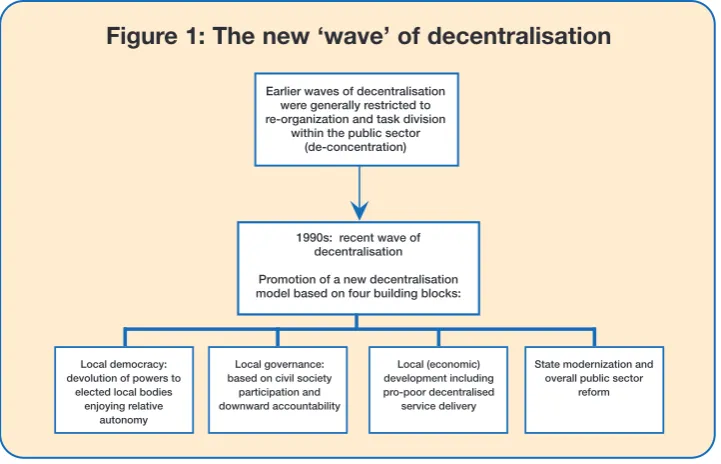
legitimacy or genuine powers for local decision-making and self-governance. However, the current wave of decentralisation is considered to be qualitatively different (Figure 1).
In essence, the shift boils down to the fact that decentralisation is no longer reduced to a public-sector phenomenon. The reform agenda has been considerably broadened:
➤Conceived in a context of democratisation, the new
decentralisation strategies claim to favour ‘devolution’ of power and resources to elected local governments as a distinct set of state actors,with an own identity, legitimacy and added-value in the development process. Thus, the new strategies seek to decentralise part of the management of public affairs to
democratically elected entities that are accountable to citizens.
➤The purpose is not only to put in place effective local
governments, but to promote ‘local governance’. This implies a different way of exercising local power, based on principles such as participation, transparency and
7 accountability. It means going beyond the ‘vertical’
decentralisation of power, responsibility and resources from the central to the local level in order to promote a
‘horizontal’ processaimed at ensuring a participatory management of local affairs, with a key role for civil society. This entails the need to integrate principles of gender equality4to ensure that the potential benefits of decentralisation are equally shared by both women and men. It also calls for a wide range of institutional innovations (such as the introduction of participatory budget processes).
➤The current wave of decentralisation is closely linked to
the emergence of a new paradigm of local (economic) development.This new paradigm calls upon the different actors in a given territory to join forces in order to promote sustainable local development processes, with a strong focus on (re)activating the local economy. In these processes, a special role is reserved for local governments as ‘catalysts’ in fuelling collaboration between local actors and in defending local interests at higher levels of governance.
➤The new decentralisation model reintroduces the notion of territorial (regional) planning(aménagement du territoire), which should help to place local
development planning in a broader spatial perspective. This makes it possible to take into account potential social and economic synergies between urban and rural municipalities and to promote cooperation between different municipalities.
➤Last but not least, the new decentralisation strategies are embedded in broader reforms of the state. The question is not simply ‘who is best placed to provide what service’. In most developing countries, the decentralisation debate raises more fundamental questions on what type of state is needed in the 21st century, on ways and means to improve state-society relations and on the necessary adaptation of the central state to both regionalisation and decentralisation trends.5
4Innovative thinking and action are taking place in this area, including on (i) gender equality in political representation; (ii) decentralisation as a tool to increasing women’s access to services; (iii) and decentralisation as a means for effective women’s participation in a more gender balanced allocation of local resources. For further guidance see the thematic note prepared by the Gender Help Desk, Gender in Public Administration Reform and Administration (see Annex 2). Other relevant sources are the INSTRAW website on gender and governance (http://www.un-instraw.org/en/index.php?option=content&task) as well as the work of UNIFEM (www.unifem.org) and other gender networks at various levels (global, regional, national).
5This broader perspective is crucial in the case of failed or fragile states, characterised by a lack or near lack of state structures (including de-concentrated services) as well as pervasive patrimonial management of authority. In these countries the task at hand is to enhance access to services while building state systems and capacities. This generally requires an overall rethinking of the state concept, its institutional foundations, underlying values and norms and modus operandi. For an interesting and fairly operational overview of key challenges see Berry, C, Ali Forder, Sonya Sultan and Magui Moreno-Torres, Approaches to Improving the Delivery of Social Services in Difficult Environments. PRDE Working Paper 3. October 2004. UK Department for International Development.
Earlier waves of decentralisation were generally restricted to re-organization and task division
within the public sector (de-concentration)
1990s: recent wave of decentralisation Promotion of a new decentralisation model based on four building blocks:
Local democracy: devolution of powers to
elected local bodies enjoying relative
autonomy
Local governance: based on civil society
participation and downward accountability
Local (economic) development including pro-poor decentralised
service delivery
State modernization and overall public sector
[image:22.595.111.472.106.338.2]1.3
What are the opportunities
and risks?
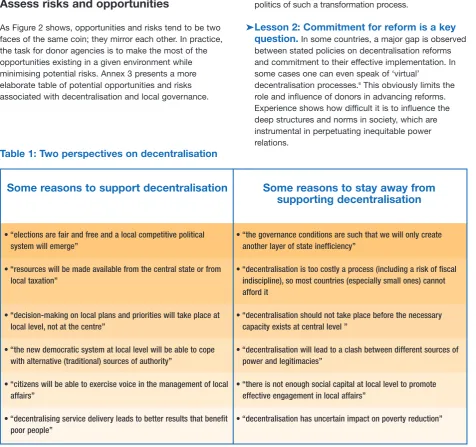
Decentralisation has quickly become a new development mantra. Some believe it is intrinsically a good thing to do in all circumstances. Alongside supporters, however, there is no shortage of sceptics. Table 1 presents both
perspectives.
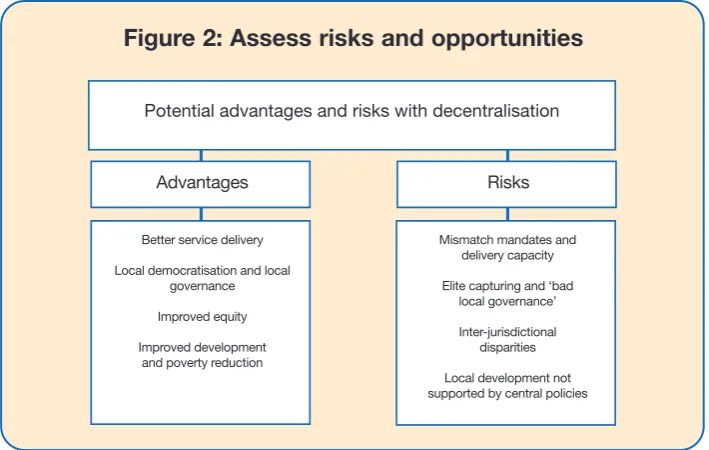
A more prudent and promising approach is to adopt a
detached and pragmatic stance towards decentralisation
(Figure 2). To this end, it is important:
• to properly assess risks and opportunities with decentralisation processes,
• to take into account lessons from experience.
Assess risks and opportunities
As Figure 2 shows, opportunities and risks tend to be two faces of the same coin; they mirror each other. In practice, the task for donor agencies is to make the most of the opportunities existing in a given environment while minimising potential risks. Annex 3 presents a more elaborate table of potential opportunities and risks associated with decentralisation and local governance.
Take into account lessons from
experience and research findings
Decentralisation is often seen as a panacea for addressing a wide variety of development challenges: rebuilding the state, combating corruption, restoring trust in government, promoting more inclusive forms of governance and fighting poverty. In practice, things are not so straightforward. Sobering lessons from experiences with decentralisation must be kept in mind:
➤
Lesson 1: Politics is central to the process.
Decentralisation and local governance are profoundly political processes. They touch upon the core foundations of a polity and a society, relate to the distribution of power and control of (scarce) development resources and are at the heart of the accountability system for delivering essential services to populations. Engaging with decentralisation then requires a fairly sophisticated capacity to deal with the politics of such a transformation process.
➤
Lesson 2: Commitment for reform is a key
question.
In some countries, a major gap is observed between stated policies on decentralisation reforms and commitment to their effective implementation. In some cases one can even speak of ‘virtual’decentralisation processes.6This obviously limits the role and influence of donors in advancing reforms. Experience shows how difficult it is to influence the deep structures and norms in society, which are instrumental in perpetuating inequitable power relations.
8
Some reasons to stay away from
supporting decentralisation
• “the governance conditions are such that we will only create another layer of state inefficiency”
• “decentralisation is too costly a process (including a risk of fiscal indiscipline), so most countries (especially small ones) cannot afford it
• “decentralisation should not take place before the necessary capacity exists at central level ”
• “decentralisation will lead to a clash between different sources of power and legitimacies”
• “there is not enough social capital at local level to promote effective engagement in local affairs”
• “decentralisation has uncertain impact on poverty reduction”
Some reasons to support decentralisation
• “elections are fair and free and a local competitive political system will emerge”
• “resources will be made available from the central state or from local taxation”
• “decision-making on local plans and priorities will take place at local level, not at the centre”
• “the new democratic system at local level will be able to cope with alternative (traditional) sources of authority”
• “citizens will be able to exercise voice in the management of local affairs”
[image:23.595.71.548.339.786.2]• “decentralising service delivery leads to better results that benefit poor people”
Table 1: Two perspectives on decentralisation
➤
Lesson 3: There are no ready-made
blueprints.
A wide range of variables determines the extent, pace and consequences of decentralisation, as well as the effectiveness of external support to these processes. The same degree of decentralisation is not uniformly desirable across, or even necessarily within, countries or sectors. This puts a premium on the elaboration of customised and well-sequenced intervention strategies.➤
Lesson 4: The knowledge base is relatively
thin.
There is a great deal that we do not know about decentralisation. Evidence of impact and benefits (in terms of improved efficiency, governance, equity, development and poverty reduction) is still fragmentary. The growing body of multidisciplinary research on various aspects of decentralisation (e.g. the link with poverty-reduction strategies) shows a mixed picture of the potentials and possible positive impacts of decentralisation processes (more details in Annex 4).➤
Lesson 5: There are several universal
requirements for effective decentralisation.
Despite cross-country differences, there are several universal requirements for progress towards decentralisation: (i) some broad vision of what the decentralised system should be and what it is expected to accomplish over time, (ii) an initial framework that defines – in an adequate and
enforceable way – key components of the system and the linkages among them and (iii) a pragmatic strategy for bringing the system into existence and for adjusting and supporting its evolution over time. That last requirement is often neglected, even though it is probably the most vital element of successful reform.7
1.4
What support is the European
Commission providing?
Over the last decade, the European Commission has engaged in domestic processes of decentralisation and local governance in various parts of the world. A growing number of Country and Regional Strategy Papers include programmes directly or indirectly related to decentralisation and local governance. Moreover, EC-supported
programmes are increasingly sophisticated and mobilise substantial funding.8
This heightened interest in decentralisation and local governance has developed independently from specific EC policy frameworks on this subject (Box 2).
What is the European Commission supporting on the ground? A number of features can be observed:
Advantages
Better service delivery
Local democratisation and local governance
Improved equity
Improved development and poverty reduction
Mismatch mandates and delivery capacity
Elite capturing and ‘bad local governance’
Inter-jurisdictional disparities
Local development not supported by central policies
Risks Potential advantages and risks with decentralisation
[image:24.595.115.470.105.330.2]9
Figure 2: Assess risks and opportunities
7This insight comes from Smoke, P. 2003. “Decentralisation in Africa: Goals, Dimensions, Myths and Challenges.” Public Administration and Development. 23, 7-16.