EULER-LAGRANGE MODEL FOR THE
PREDICTION OF SCOUR AROUND
OFFSHORE STRUCTURES
Thesis submitted in accordance with the requirements of
the University of Liverpool for the degree of Doctor in Philosophy
by
YARU LI
Illustrations v
Notations x
Acknowledgements xiii
Abstract xv
1 Introduction 1
1.1 Initiation of the Study . . . 1
1.2 Aims and Objectives . . . 5
1.2.1 Aims . . . 5
1.2.2 Objectives . . . 6
1.3 Contents . . . 7
2 Literature Review 9 2.1 Introduction . . . 9
2.2 Scour at Offshore Structures . . . 10
2.2.1 Flow Pattern . . . 11
Flow around a Slender Pile . . . 12
Flow around a Pipeline . . . 15
2.2.2 Sediment Transport . . . 17
2.2.3 Scour Process . . . 18
Scour underneath Pipelines . . . 20
2.3 Hydrodynamic Modelling . . . 23
2.3.1 Shallow Water Modelling . . . 24
2.3.2 Computational Fluid Dynamics Modelling . . . 25
2.3.3 Turbulence Modelling . . . 27
Direct Numerical Simulation . . . 28
Large Eddy Simulation . . . 29
Reynolds-Averaged Simulation . . . 31
2.4 Sediment Transport and Scour Modelling . . . 33
2.4.1 Single-phase Model . . . 35
Euler-Euler Method . . . 40
Lagrangian Method . . . 42
Euler-Lagrange Method . . . 43
2.4.4 Treatment of the Solid Phase . . . 45
Drag Force . . . 45
Mixture Viscosity . . . 48
Inter-particle Stress . . . 52
2.5 Conclusions . . . 53
3 Numerical Model 56 3.1 Introduction . . . 56
3.2 Hydrodynamic Module . . . 57
3.2.1 Navier-Stokes Equations . . . 58
3.2.2 Two-Fluid Methodology . . . 59
3.2.3 Existing Terms in Momentum Equation . . . 61
Viscous Stress . . . 61
Body Force . . . 62
Pressure . . . 63
Final Form for Pure Fluid Phase . . . 64
3.2.4 Turbulence Closure . . . 64
3.3 Particle Module . . . 65
3.3.1 Introduction . . . 65
3.3.2 Governing Equation . . . 66
3.3.3 Solid Volume Fraction . . . 69
3.3.4 The Concept of Parcel . . . 70
3.3.5 Drag Force . . . 71
3.3.6 Inter-particle Stress . . . 72
3.3.7 Particle Tracking Method . . . 75
3.4 Coupling of the Fluid Phase and Solid Phase . . . 80
3.4.1 Interphase Momentum Transfer . . . 81
3.4.2 Mixture Viscosity . . . 82
3.4.3 Volume Exclusion Effect . . . 83
3.5 Boundary and Initial Conditions . . . 85
3.5.1 Boundary Conditions . . . 85
3.5.2 Initial Conditions . . . 87
Initialisation of the Parcel Positions . . . 88
3.6 Discretisation and Solution Procedures . . . 89
3.6.1 Discretisation . . . 89
3.6.2 Solution Procedures . . . 96
3.7 Conclusions . . . 97
4 Model Calibration 100
4.2.1 Cases of Various Particle Size . . . 101
4.2.2 Cases of Various Grid Spacing Ratio to Parcel Diameter . . 105
Particle Fall Velocity . . . 105
Interphase Momentum Transfer Term and Volume Exclusion Term . . . 106
4.3 Isolated Block Tests . . . 109
4.4 Extension of the Model Application . . . 118
4.5 Conclusions . . . 120
5 Model Applications 123 5.1 Introduction . . . 123
5.2 Hydrodynamics . . . 124
5.2.1 Vertical Pile under Currents . . . 124
5.2.2 Plunging Waves Test . . . 131
5.3 Sediment Transport . . . 138
5.3.1 Sheet Flow Test . . . 138
5.4 Scour Studies . . . 144
5.4.1 Current-Induced Pipeline Scour . . . 144
Flow Field . . . 145
Turbulence Structures . . . 149
Modified Viscosity . . . 151
Particle Distribution . . . 152
Bed Evolution . . . 153
Influence of Hydrodynamics on Bed Profile . . . 155
Onset of Scour . . . 159
5.4.2 Wave-Induced Pipeline Scour . . . 169
Flow Field and Bed Evolution . . . 170
Particle Distribution . . . 174
5.5 Conclusions . . . 176
6 Discussion, Conclusion and Future Work 180 6.1 Discussion . . . 181
6.1.1 Particle Modelling Approach . . . 181
Advantages . . . 181
Formulation . . . 183
Implementation . . . 184
Validation . . . 187
6.1.2 Euler-Lagrange Multiphase Approach . . . 187
Advantages . . . 187
Implementation . . . 190
6.1.3 Model Application . . . 191
6.2 Conclusions . . . 193
Various Particle Properties . . . 198
Elaborate Implementation of Forces . . . 199
Turbulence-Particle Interaction . . . 200
6.3.2 Model Application . . . 202
6.3.3 Conclusions . . . 203
References 204
List of Figures
2.1 Sketch of the flow pattern around a vertical pile. S refers to the
sepa-ration line. (After Sumer and Fredsøe[80].) . . . 13
2.2 Sketch of the lee wake effect under waves. (After Sumer and Fredsøe[78].) 16 3.1 Sketch of a particle moving from original position a to final position b. (After Macpherson et al.[49].) . . . 77
3.2 Sketch of a computational domain. Red: water; blue: air. . . 86
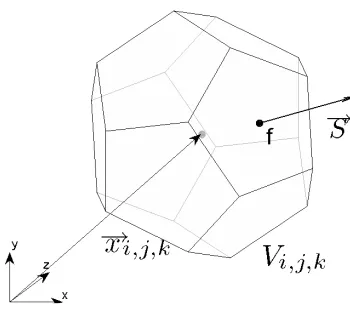
3.3 Control volume. . . 90
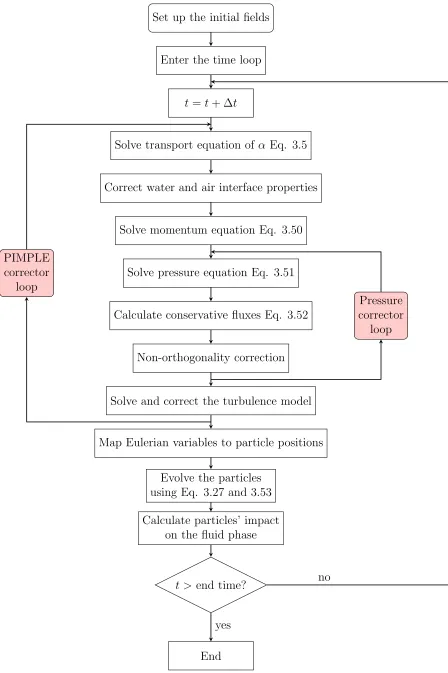
3.4 Flow chart of the solution procedure. . . 98
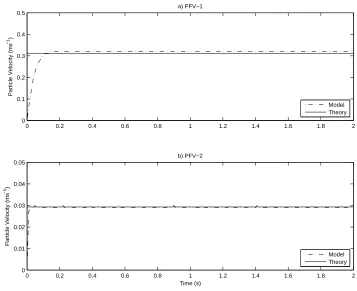
4.1 Computed particle fall velocities in comparison with the theoretical values. . . 104
4.2 Magnitude of the interphase momentum transfer term and volume ex-clusion term. . . 108
4.3 Velocity vector field (left column) and velocity profiles at selected sec-tions (right column) in Tests MDL. Red line: the boundary of the block. . . 113
4.4 Velocity vector field (left column) and velocity profiles at selected sec-tions (right column) in Tests BTM. Red line: the boundary of the block. . . 114
4.5 Velocity vector field in Tests CRN. Red line: the boundary of the block.115 4.6 Velocity difference field. Red line: the boundary of the block. . . 116
4.7 Magnitude of interphase momentum transfer term (left column) and volume exclusion term (right column). . . 117
4.8 Velocity vector field. Red line: the boundary of the wedge. . . 119
sion term. . . 119
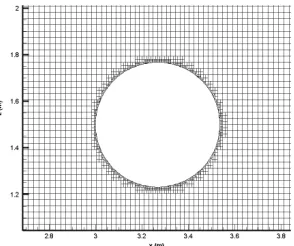
5.1 Refined mesh around the pile. . . 125
5.2 The computational domain. Red: water; blue: air. . . 125
5.3 The developed free surface. Red: water; blue: air. . . 126
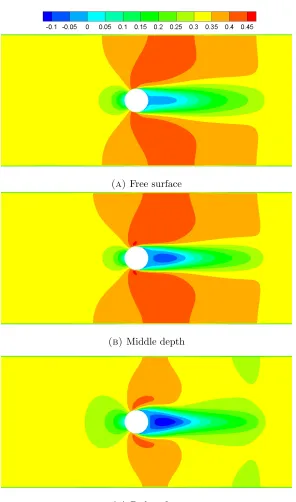
5.4 Streamwise velocity (m/s) distribution at the free surface (A), the middle depth of the flow (B), and near the bed (C). . . 127
5.5 Vertical velocity (m/s) distribution at the free surface (A), in the mid-dle depth of the flow (B), and near the bed (C). . . 129
5.6 Streamwise velocity in the plane of symmetry at different vertical lay-ers. The level heightz is measured from the bed. Solid line: modelling results; asterisks: measurements. . . 131
5.7 Experimental set-up of the plunging wave test by Ting and Kirby[87]. (After Ting and Kirby[87].) . . . 132
5.8 Computational domain. Red: water; blue: air. . . 133
5.9 Snapshot of the computed free surface att = 150s. Red: water; blue: air. . . 133
5.10 Distribution of the wave amplitudes and the mean water surface eleva-tion. Black lines: modelling results; green line: computed mean water level; dots: measurements. . . 134
5.11 Time series of the water surface elevation at selected sections (Part I). Black: modelling results; red: measurements. . . 135
5.12 Time series of the water surface elevation at selected sections (Part II). Black: modelling results; red: measurements. . . 136
5.13 Time-averaged horizontal velocity (u) profile at selected sections. Lines: modelling results; circles: measurements. . . 137
locity w, and turbulent kinetic energy k at selected sections (Part I). Black: modelling results; red: measurements. . . 138
5.15 Phase-averaged surface elevation η, horizontal velocity u, vertical ve-locity w, and turbulent kinetic energy k at selected sections (Part II). Black: modelling results; red: measurements. . . 139
5.16 The velocity profile at selected phases. t/T = 0.0, 0.13, 0.25, 0.4, 0.58,
0.66, and 0.96 as indicated in the figure by each line. Black solid lines:
modelling results; red dashed lines: measurements. . . 140
5.17 Particle distribution and streamwise velocity at selected phases. . . 141
5.18 Comparison of the computed and measured sediment concentration at
various flow phases in the first half of a wave cycle. Lines: modelling
results; circles: measurements. . . 143
5.19 Comparison of the computed and measured sediment concentration at
various flow phases in the second half of a wave cycle. Lines: modelling
results; circles: measurements. . . 144
5.20 Computed flow velocity field at t= 1.5 min. . . 146 5.21 Streamwise velocity and velocity profile at selected sections. Bold solid
line: bed profile. . . 148
5.22 Vorticity magnitude at t = 1.5 min. Bold solid line: bed profile. . . 149 5.23 Sub-grid scale kinetic energy and sub-grid scale eddy viscosity at t =
1.5min. Bold solid line: bed profile. . . 150 5.24 Contour of solid volume fraction (a) and modified viscosity (b) at t=
1.5min. . . 151 5.25 Particle distribution at selected time. a)t= 4 s, b)t = 12s, c) t= 24
s, d) t= 37 s, e) t= 41 s,f) t= 45 s. . . 152 5.26 Computed bed profile at t= 1.5minin comparison with the
measure-ments (black dots). . . 154
5.27 Bed profile and the flow velocity field at selected time. . . 155
ments (black dots). From a) to f) are Test 1 to Test 6 in sequence. . . 157
5.29 Computed flow velocity field at t= 1.5min. From a) to f) are Test 1 to Test 6 in sequence. . . 158
5.30 Detailed flow velocity field at t = 1.5 min in Test 2 (a), Test 4 (b), and Test 6 (c). . . 160
5.31 The initial set-up for simulation of onset of scour. . . 161
5.32 Development of the bed profile and flow velocity field (Part I). . . 162
5.33 Development of the bed profile and flow velocity field (Part II). . . 163
5.34 Development of the bed profile and flow velocity field (Part III). . . 164
5.35 Development of the pressure field. Bold black line: bed profile. . . 165
5.36 Development of the flow field and bed profile. Contour: flow pressure field; vector: flow velocity field; bold red line: bed profile. . . 166
5.37 Development of the bed profile and flow velocity field. . . 172
5.38 Sub-grid scale kinetic energy, eddy viscosity and vorticity at t = 0.5 min. . . 173
5.39 Bed profile comparison against measurements. Red line: modelling result; black dots: measurements. . . 175
5.40 Vorticity and particle distribution (Part I). . . 176
5.41 Vorticity and particle distribution (Part II). . . 177
List of Tables
4.1 Particle properties in Test PFV-1 and PFV-2 . . . 1024.2 Cases of various grid spacing. . . 106
4.3 Theoretical fall velocity and modelling results. . . 106
4.4 Cases of various grid spacing with d50 being 0.36mm. . . 107
4.5 Model set-up in the isolated block tests. . . 110
5.2 Maximum discrepancies observed at the upstream side, scour hole and
downstream side of the pipe in each test. . . 157
6.1 Model applications. . . 192
A particle acceleration
Cd drag coefficient
D cylinder diameter
d50 particle median grain size
Dp parameter related to drag coefficient
g gravitational acceleration
h water depth
k turbulence kinetic energy
ksgs sub-grid scale kinetic energy
KC Keulegan-Carpenter number
n porosity
p subscript for particles
P pressure
Pd dynamic pressure
q sediment transport rate
qb bed load sediment transport
rp particle radius
Re Reynolds number Re viscous stress tensor
ReD pile Reynolds number
Red particle Reynolds number
S equilibrium scour depth S face normal vector
SU momentum source
Simt interphase momentum transfer
t time ∆t time step
T time period of an oscillatory flow
Ts time scale of the scour process
Tve volume exclusion term
Tw wave period U velocity
Uf undisturbed bed shear velocity Uf fluid phase velocity
Up particle velocity
Uw undisturbed orbital velocity
Vp particle volume
x abscissa
x position vector
xp particle position vector
y vertical coordinate
z transverse coordinate
ατ amplification factor
α volume fraction of water
δ bed boundary layer thickness
ε turbulence dissipation
ζ water surface elevation
η Kolmogorov scale
θcr critical Shields parameter
θcs critical solid volume fraction
θf fluid volume fraction
θs solid volume fraction
κ Von Karman constant
λ fraction factor
µ dynamic viscosity
µ0 intrinsic viscosity
µf fluid viscosity
µ0f modified fluid viscosity
ν kinematic viscosity
νt eddy viscosity
ρ density
ρf fluid phase density
ρp particle density
τ bed shear stress
τp inter-particle stress
τ∞ undisturbed bed shear stress
τijs subgrid-scale stress
φ particle distribution function
ω specific dissipation rate
ωs particle fall velocity
I would like to thank Dr. M. Li, of School of Engineering, The University of
Liv-erpool, for teaching me coastal engineering and scientific writing, and for invoking
my scientific scepticism. I would like to thank Dr. J. M. Harris, of HR
Walling-ford, for teaching me knowledge of scour and scientific writing, and nurturing my
enthusiasm for research. I have been particularly privileged to have both as my
supervisors, who provide me with invaluable advice and guidance, generous
sup-port and patient mentoring throughout my Ph.D. study. I would like to thank Dr.
S. Ilic, of Lancaster Environment Centre, Lancaster University, and Dr. J. Zhou,
of School of Engineering, The University of Liverpool, for agreeing to be my
ex-aminers and for their valuable time, detailed attention and invaluable advice given
to the thesis. I would like to thank Prof. X. Chen, of Ocean University of China,
for teaching me Physical Oceanography, and for his care, patient mentoring, and
invaluable support and guidance. I would like to thank Prof. P. D. Thorne and Dr.
J. Wolf of National Oceanography Centre for teaching me sediment transport and
Physical Oceanography, and for the fruitful discussions and guidance. I would like
to thank Dr. D. M. Kelly of HR Wallingford for his initial input into this work, and
his patient teaching and guidance. I would like to thank Dr. J. R. Finn, of School
of Engineering, The University of Liverpool, for his insightful advice, stimulating
discussions, and inspiring suggestions. I would also like to thank Dr. J. Nicholson,
of School of Engineering, The University of Liverpool, for his encouragement and
inspiration over the small talks on the corridor. In memory of him. I am also very
grateful to the financial support from Engineering and Physical Sciences Research
grandmother for their wholehearted support of my study.
Numerical modelling of scour around offshore structures is still a challenging
re-search topic for engineers and scientists due to the complex flow-structure-seabed
interactions. In comparison to single-phase models and Eulerian models with
Exner equation, a multiphase approach has advantages in interpreting the
flow-particle and flow-particle-flow-particle interactions. In the present study, an Euler-Lagrange
multiphase approach is adopted to develop a new scour model in order to simulate
the air-water-sediment interplay simultaneously while being computationally
effi-cient. The model is able to represent free-surface flow with a mobile bed, which
is often critical for realistic scour modelling. Based on the open source
compu-tational fluid dynamics (CFD) software package OpenFOAM®, the model solves
the Navier-Stokes equations on an Eulerian computational grid. The sediment
particles are traced using the multiphase particle-in-cell (MP-PIC) method in a
Lagrangian approach. The drag force from the fluid, body forces and inter-particle
stresses as well as the interphase momentum transfer are all accounted for in the
model. The model system is calibrated using several simple test cases,
includ-ing a fallinclud-ing particle and steady flow passinclud-ing isolated blocks, to identify optimal
parameters for model operation. The model is then validated against available
ex-perimental data on a steady current around a vertical cylinder and sand suspension
under oscillatory sheet flow, amongst other tests, with satisfactory agreement.
Ap-plication of the model against laboratory experiments includes benchmark scour
The tunnel erosion and lee-wake erosion stages are captured well by the model.
The scour prediction matches with the measurements. In addition, the onset of
scour is reproduced vigorously without any additional numerical assumptions or
approximations. The model’s capability to resolve the scour process and reveal
the mechanisms involved is presented well.
Introduction
1.1
Initiation of the Study
Scour has long been recognised as a severe safety hazard to the structures
con-structed in the fluvial and marine environment. Scour is used to distinguish the
sediment transport process caused by the presence of a structure from the more
general term “erosion”[80]. Scour at bridge piers, for example, has been studied
extensively in the past several decades[8, 23, 36, 38, 52, 59]. Studies on scour in the
marine environment did not gain as much attention until three or four decades ago
when the construction of offshore structures became common, and consequently
the geotechnical guidelines towards scour hazard assessment and scour protection
measures were in urgent needs. In engineering practice, the costs of the scour
pro-tections or remedial measures are often significant, especially in coastal or offshore
projects. As indicated by Whitehouse et al.[92], the scour depth at offshore wind
farm monopile foundations can be as large as 1.38 times the monopile diameter.
More recently, Harris and Whitehouse[21] noted that the scour depth has been
observed up to 2.4 times the monopile diameter, depending on the site conditions. At some sites where scour protections are installed, the edge scour or secondary
scour around the protection can cause even deeper scour than the unprotected
ones[92]. For instance, the scour protection at Scroby Sands off the east coast of
England, has caused unintended expansive secondary scour. Therefore, it is still
a challenging and urgent task to better understand the scour process and develop
better prediction tools to minimise the risks associated with scour at the offshore
structures.
Scour processes in the marine environment are also far more complex under
com-bined waves and currents than those in rivers under currents. The time-varying
nature of the sea, the complexity of the seabed formation, and the presence of
structures on the seabed all contribute to the difficulties of scour study in the
marine environment. For example, the flow dynamics around a structure under
currents, waves, or combined waves and currents are still not fully understood,
including the amplification of the bed shear stress around the structure and in the
ambient flow, the flow separation position with respect to different shape, size,
and orientation of the structure etc. The generation and dissipation of
turbu-lence around the structure and in the lee-wake region are also quite challenging,
which are often critical to the sediment dynamics and the ultimate scour pattern.
Furthermore, the influences of the hydrodynamics and turbulence on the
are yet to be implemented in the commonly used prediction tools. The
mechan-ics of the overall scour process from the initiation to the equilibrium status has
not been properly reflected in existing scour models due to the limitation in the
assumptions and approximations when resolving the sediment dynamics and its
interaction with the flow dynamics.
To tackle these challenges, different approaches have been employed, including
in-situ measurements, physical modelling (laboratory based) and computer
mod-elling. Various numerical modelling approaches can be found in the literature,
including the single phase mixture approach, the Eulerian type approaches, and
the multiphase approaches. Works based on the potential flow theory were
car-ried out at the early stage[41, 43, 50]. However, with the many assumptions and
ad-hoc parametrisations, these models often fail to produce the whole picture of
the sediment transport and scour process. Later on, Eulerian models with Exner
equation were developed to study scour problems with the aid of mesh deformation
or dynamic mesh method to resolve the bed. Due to the limitation in resolving
the flow-sediment interactions, the pick-up of the sediment particles from the bed
and the flow-bed interactions rely on many empirical relations that lead to many
uncertainties in the results. Furthermore, mesh deformation and dynamic mesh
method require special and careful treatment to prevent mesh distortion and
main-tain the mesh quality. Therefore, such models usually struggle to resolve the rapid
changing bed profile and often fail to resolve the shape of the scour hole and the
eroded bed profile correctly, especially where large steepness is observed. Lately,
the multiphase approach is gaining in popularity due to its capability to better
interpret the flow-sediment and sediment-sediment interactions. However, in such
multiphase approach models, usually only the water and sediment are considered,
such models, but also implicates inaccuracy in the scour prediction as the free
sur-face effect is often critical for realistic scour processes especially those under waves
or combined waves and currents. Therefore, incorporating the free surface effect
to achieve a better and more reliable scour prediction is one of the motivations of
the present work.
In multiphase approaches, the flow is often referred to as the fluid phase, and the
sediment is named the solid phase. According to the treatment of each phase,
one of the following methods are usually employed: Euler methods,
Euler-Lagrange methods and Lagrangian methods. In Euler-Euler models, both the
fluid phase and the solid phase are regarded as continuum, thus, the fluid-particle
interactions cannot be resolved directly due to the continuum assumption of the
solid phase, and instead they must be addressed explicitly with parameterisations.
Moreover, Eulerian models are typically based on cell-averaged quantities,
there-fore, they often struggle to model complex deformation and interface
fragmenta-tion. By contrast, in Lagrangian models, such as the Smoothed Particle
Hydrody-namics method (SPH) and the Moving Particle Semi-implicit method (MPS), the
inherent discrete-particle property of sediment is well represented. However, as
the most well-known drawback, Lagrangian models are particularly demanding on
computational resources. Moreover, the incorrect pressure approximation caused
by a spurious pressure fluctuation is a common problem associated with the sharp
fluid interfaces in such models.
Drawing on the advantages of these two types of models, Euler-Lagrange type
mod-els provide an attractive alternative. In such modmod-els, the fluid phase is treated as
continuum on an Eulerian grid, and the solid phase is treated as discrete
interaction between the phases can be resolved straightforwardly. It is also
com-putationally efficient compared to Lagrangian models. Therefore, Euler-Lagrange
models can be a powerful tool to resolve the physics and reveal the mechanics
involved in scour processes. However, the coupling of the Eulerian grid and the
Lagrangian framework, the incorporation of the free surface, the treatment of the
solid phase in flows ranging from very diluted to hyper-concentrated, among
oth-ers, are all challenging tasks, and consequently hinder their application in scour
studies. Considering the outstanding advantages of such models to possibly resolve
the scour mechanics and improve scour prediction, this work is therefore motivated
to develop a novel scour model using the Euler-Lagrange multiphase approach to
study the scour process around offshore structures with the free surface effect.
1.2
Aims and Objectives
1.2.1
Aims
The present work has the following two aims:
1. To develop a novel numerical tool based on the Euler-Lagrange multiphase
approach for reliable scour prediction around offshore structures;
2. To improve the understanding of the scour process and reveal the details of
1.2.2
Objectives
The specific research objectives include:
1. To develop an Euler-Lagrange multiphase approach to resolve the
dynam-ics of the flow field and the bed evolution simultaneously during the scour
process;
2. To develop a particle based approach to represent the sediment dynamics and
the sediment-flow interactions in particulate flow ranging from very dilute
to hyper-concentrated flow, as well as a fully packed bed;
3. To perform scour prediction around offshore structures under different
hydro-dynamic conditions and resolve the detailed processes using the new model;
4. To examine the impact of turbulence characteristics on the scour process;
5. To examine the mechanics of scour development from the initiation to the
later stages.
Based on these aims and objectives, the present work also aims to answer several
fundamental questions regarding the scour process and its numerical modelling:
1. How can the free surface effect and a mobile sandy bed be simulated
simul-taneously with the flow dynamics in a computational fluid dynamics (CFD)
2. How can the flow-sediment interactions be represented effectively in a CFD
model?
3. How does the particle motion initiate in the scour process?
4. How does the flow structure, especially the turbulence characteristics, affect
the scour pattern?
5. How does the particle motion affect the overall scour process?
In particular, the current study will focus on the scour processes around
horizon-tal pipelines on the seabed because of its important implications in engineering
practice and the challenges involved in the numerical modelling.
1.3
Contents
An Euler-Lagrange multiphase approach is adopted in the present study to
de-velop a new particle based scour model in order to simulate air-water-sediment
three-phase interplay simultaneously and to reveal the scour mechanism. The
model is able to represent free-surface flow over a mobile bed, to eliminate the
inaccuracy caused by the rigid lid assumption. Based on the open source CFD
software package OpenFOAM®, the model solves the Navier-Stokes equations on
an Eulerian computational gird. The sediment particles are traced using the
mul-tiphase particle-in-cell (MP-PIC) method in a Lagrangian framework. The flow
and sediment particles are fully coupled, and particle-particle interaction is also
In this work, a detailed literature review is presented in Chapter 2. Chapter 3
describes the theories involved in the numerical model. The model calibration is
presented in Chapter 4. Then the results of the model application are presented
Literature Review
2.1
Introduction
In this chapter, the physical processes involved in the scour process, including
the flow regime, sediment transport and scouring, will be reviewed first. Then
the review on the numerical modelling approaches concerning the hydrodynamics,
including the turbulence modelling, and sediment transport and scour, including
the treatment of the solid phase in the multiphase approaches, will be presented
in sequence.
2.2
Scour at Offshore Structures
The presence of structures in the marine environment will change the flow patterns,
turbulence properties, and local sediment transport in its immediate
neighbour-hood, resulting in local scour and further influence on the global scour pattern.
Several phenomena are usually identified, such as flow contraction, a horseshoe
vor-tex in the upstream side, lee-wake vortices and/or vorvor-tex shedding in the
down-stream side, turbulence enhancement, wave reflection, diffraction and breaking
etc.[80]. These changes in the flow field can amplify the local bed shear stress
and enhance sediment transport capacity, which leads to a divergence of sediment
transport rate and ultimately the occurrence of scour.
Conventionally, scour is classified according to different criteria. These terms
below are usually used in scour studies.
Local scour and global scour. For example, in the case of a multi-leg jacket
structure, the scour pits around each single piles are referred to as local scour;
the saucer-shaped depression beneath and around the whole installation is
called the global scour.
Clear-water scour and live-bed scour. If the Shields parameter θ (Eq. 2.1) is lower than its critical value θcr, which means that there is no sediment transport in the far area, it is called the clear-water scour; otherwise, when
θ = U
2
f
g(s−1)d, (2.1)
whereg is the gravitational acceleration,sis the specific gravity of sediment grains, d is the grain size, and Uf is the undisturbed bed shear velocity expressed by Uf =
qτ
∞
ρ , and τ∞ is the bed shear stress for the undisturbed flow. The critical value of the Shields number is a function of the grain
Reynolds number.
2.2.1
Flow Pattern
Despite of the undisturbed flow regime, the flow pattern in the scour process
largely depends on the shape and size of the structure presented in the flow.
Vertical piles and horizontal pipelines are very common structures in the marine
environment. In terms of piles, Sumer and Fredsøe[80] categorise it into two flow
regimes: the slender-pile regime where the pile diameterDis small compared with the wave length L, and otherwise the large-pile regime. The distinguished feature of the former regime is the flow separation with the presence of separation vortices,
which applies to the flow around offshore structures like monopiles in the offshore
Flow around a Slender Pile
A schematic sketch of the slender pile regime is shown in Figure 2.1. When flow is
approaching the pile, the flow structure in the bed boundary layer will be affected
immediately. Induced by the adverse pressure gradient upstream of the pile, the
bed boundary layer separates and a separation line is formed. The separated
boundary layer further generates a horseshoe vortex at the upstream side. In the
case of a steady current, Baker[4] indicates that the ratio of the bed boundary layer
thickness δ to the pile diameter D, i.e., Dδ, the pile Reynolds number ReD = U Dν , the bed boundary layer Reynolds numberReδ = U δν , and the pile geometry (shape and size, etc.) are the main parameters to evaluate a horseshoe vortex. The larger
δ
D, ReD, and Reδ are, respectively, the larger the vortex length xs will be. The cross-sectional shape of pile also influences horseshoe vortex by its impact on the
adverse pressure gradient. Generally speaking, it is more difficult for a streamlined
cross-sectional shape to induce large horseshoe vortex. Sumer et al.[77] studied
the impact of square-shaped (90°orientation), circular-shaped and square-shaped
(45° orientation) cross-sectional piles and found out that the square pile with 90°
orientation was the easiest one to generate longerxs. With respect to pile height, the larger HL (Lis the cross-flow dimension of the pile andH is the pile height) is, the smaller vortices are generated.
Regarding the horseshoe vortex generated under waves, the Keulegan-Carpenter
Figure 2.1: Sketch of the flow pattern around a vertical pile. S refers to the
separation line. (After Sumer and Fredsøe[80].)
KC = UmTw
D (2.2)
where Um is the maximum value of the undisturbed orbital velocity at the bed and Tw is the wave period. It is difficult for the horseshoe vortex to form if KC number is very small; and ifKC number is large, the horseshoe vortex is supposed to behave almost in the same way as in the circumstances of steady flows. Sumer
et al.[77] studied the horseshoe vortex under waves with differentKCnumbers and revealed the impact of KC number on horseshoe vortex by exploring the adverse pressure gradient using the potential flow theory. Their experimental results show
that a KC number smaller than 6 will suppress the boundary layer separation in front of a circular pile. In the case of a square pile with 90°orientation, horseshoe
In the case of waves with a superimposed current, a horseshoe vortex comes into
being more easily. Only a small KC number is required, and the separation distance increases remarkably compared to a case with waves only.
Bed shear stress beneath the horseshoe vortex is an important parameter
asso-ciated with the scour process. The value of the bed shear stress compared to
its undisturbed value is mainly determined by the strength of the horseshoe
vor-tex, and it generally peaks at the side edge of the pile. The study by Baker[4]
on laminar flows indicates that with the presence of a horseshoe vortex, the bed
shear stress can be amplified by a factor of 5−11 compared to the undisturbed
conditions. The study by Hjorth[27] shows that the amplification factor under
the combined action of the horseshoe vortex and the flow contraction effect can
be as large as 11 at the midway between the front and side edges of the slender
pile, which in consequence will lead to dramatically enhanced sediment transport
capacity and scour development around the pile. Under waves, the amplification
factor of the bed shear stress is found to be a function ofKC number, and the bed shear stress increases as KC number increases. Sumer et al.[77] indicate that the transition of a laminar horseshoe vortex into the turbulence regime is dependent
onKC number as well as Dδ and ReD. In the experiments by Sumer et al.[77], the transition occurred when KC number was between 10 and 20.
The lee-wake vortices are formed at the downstream side of the pile. In steady
currents, the lee-wake flow is mainly determined by ReD and the pile geometry, while under waves, the KC number is a more dominant parameter. Sumer and Fredsøe[84] and Sumer et al.[77] point out that compared to steady-current case,
the lee-wake vortex flow is a more essential component for the scour development
Flow around a Pipeline
Apart from vertical piles, the scour around horizontal pipelines on the seabed has
also been studied extensively in the past. The flow around a pipeline is relatively
simpler than that around a vertical pile. The seepage flow underneath the pipe
and the lee-wake effect are the most predominant features. Driven by the pressure
difference between the upstream and downstream side of the pipe, a seepage flow
will take place underneath the pipeline. It acts as the agitating force on the sand,
and when it exceeds the submerged weight of sand, piping will occur. Sumer et
al.[85] measured the pressure gradient around pipelines in a steady current and
it is found to be increasing with an increasing flow velocity. Sumer et al.[85] also
derived the critical condition of the pressure gradient for piping to occur. Their
study indicates that the excessive seepage flow and the resulting piping are the
major mechanisms to induce onset of scour, which is the initial stage of scour
development around a pipe.
In the case of waves, Sumer et al.[85] measured the surface elevation and the
pressure gradient underneath the pipe. The measurements show that there is a
20−25° phase lag in the pressure gradient compared to the surface elevation. In
addition, the pressure gradient large enough for piping to occur is only available
for a short time during each crest half period. Only after several such exposures,
piping takes place.
In addition to the seepage flow, the lee-wake effect also plays an important role.
Chapter 2. Literature Review 16
region, the vortex shedding becomes less pronounced, which might lead to a smaller lee-wake erosion and hence less scour depth.
As far as the influence of 9 is concerned, this must be examined in two different categories: the clear-water case, where the sediment far from the pipe is not moving, and the live-bed case, where sediment is transported far from the pipe. In the clear water case, the variation in scour depth with 9
is more pronounced: as S/D increases from 0 at very small 9-values up to
values of 0.4-1.0 when the 6-value approaches the live-bed case. However,
when the live-bed case is obtained, very small variation in S/D is observed,
as seen from Fig. 2. Kjeldsen et al. (1973) indicate that S/D increases with
8 by a power of 0.2, while others simply disregard this very weak variation. This variation is weak, because any change in 9 results in corresponding changes in sediment transport. These changes occur upstream of the scour hole and inside the scour hole in equivalent amounts, eventually causing practically no change in the equilibrium scour depth.
SCOUR IN TIDAL FLOW AND WAVES
This section considers the case where flow attacks the pipe from both sides due to near-bed flow induced by wind waves or by slowly varying unsteady current conditions like a tidal current. The main difference between this case and the steady case is that the downstream-formed wake system now occurs on both sides of the pipeline. Here the strong lee-wake erosion, which gives
(a) Current
Lee-Wake
(b) Waves
FIG. 3. Lee-Wake Effect: (a) Currents; (/>) Waves
310
J. Waterway, Port, Coastal, Ocean Eng. 1990.116:307-323.
[image:33.596.196.430.85.298.2]Downloaded from ascelibrary.org by University of Liverpool on 08/26/15. Copyright ASCE. For personal use only; all rights reserved.
Figure 2.2: Sketch of the lee wake effect under waves. (After Sumer and
Fredsøe[78].)
found that the lee-wake effect is the key mechanism in this process. Figure 2.2 was
depicted by Sumer and Fredsøe[78] to show the difference of the lee-wake effect
under steady currents and waves respectively. They summarise that the upstream
side of the pipe under a steady current is dominated by potential flow whereas
flow separation and a vortex street, which is formed by the lee-wake vortices, are
observed at the downstream side. Under waves, the lee-wake vortices are observed
at both side of the pipe due to flow reversal during wave cycles as shown in
Figure 2.2[78]. They point out that the extension of the lee-wake vortex street Lv under waves is governed by the KC number, and a linear relation is developed by them according to the flow visualisation study by Jensen and Jensen[31] that
Lv
2.2.2
Sediment Transport
According to the transport mechanism of bed materials, two mechanisms are
iden-tified, namely the suspended load and the bed load. The bed load has continuous
contact with the bed, of which the particles roll, slide or saltate along the bed.
Its transport is almost totally determined by the effective bed shear stress. When
the bed shear velocity just becomes larger than the critical value for the initiation
of motion, the particles will roll and slide, and saltate if the bed shear velocity
continues increasing along the bed, in the regime of bed load transport. Once the
value of the bed shear velocity exceeds the fall velocity of the particles, they will
become suspended in the flow and transfer into the suspended load mode. The
total sum of the bed load and the suspended load is named the total sediment
load.
The Shields number (Eq. 2.1) is an indicator of the initiation of motion for
sed-iment particles. The sediment particles will move once the Shields number θ
exceeds its critical valueθcr, which is given by,
θcr =
Uf c2
g(s−1)d, (2.3)
With the presence of structures, the entrainment of bed materials, the transport
capacity of both the suspended load and the bed load are enhanced due to the
enhanced bed shear stress and stronger turbulence level around the structures.
The amplification factorατ is used to measure the increase in the bed shear stress, which is given by
ατ =
τ τ∞
, (2.4)
where τ is the enhanced bed shear stress and τ∞ is that for the undisturbed
flow. Certain amount of knowledge about the enhanced bed shear stress has been
accumulated, some of which are already reviewed in Section 2.2.1. Sumer and
Fredsøe[80] adopted a formulaqb ∼τ3/2 in the discussion of the bed load sediment transport due to bed shear stress. Although this formula is not strictly derived,
it demonstrates the importance of the bed shear stress to bed load transport.
However, there is still little knowledge on the enhanced turbulence level in the
vicinity of the structure as well as its contribution to the sediment transport and
scour processes.
2.2.3
Scour Process
bed. The scour process continues until ατ = O(1) around the structures when the equilibrium stage is reached. The scour depth at that moment is called the
equilibrium scour depth. The time required for the scour development is called
the time scale of the scour process. Sumer and Fredsøe[80] adopt a formula to
represent the time variation of the scour depth,
St=S(1−exp(−
t Ts
)), (2.5)
whereSis the equilibrium scour depth andTsis the time scale of the scour process.
In the case of steady currents, Sumer and Fredsøe[80] point out that the scour
depth is influenced by such factors as the Shields number, the sediment gradation,
d D,
δ
D, the cross-sectional shape and the alignment factor. Regarding the scour
under waves, the study by Sumer et al.[81] indicates that the KC number is the main parameter governing the scour development on a live bed. In terms of
the scour development in combined wave and currents, Sumer and Fredsøe[79]
obtained an empirical expression concerning the scour depth in live bed regime
from experiments with KC <30, which is given by
S D =
Sc
where Sc is the scour depth in steady current alone, and the coefficients A and B are given by
A= 0.03 + 3 4U
2.6
cw, (2.7)
B = 6−4.7Ucw, (2.8)
where Ucw= UcU+cUm, and Uc is the current velocity andUm is the maximum value of the undisturbed orbital velocity at the bed.
Scour underneath Pipelines
In the scour processes underneath pipelines, three stages are usually identified:
onset of scour, tunnel erosion, and the lee-wake erosion stage. Other
three-dimensional processes like the self-burial and backfilling process along the free span
areas and at span shoulders have also been summarised by Sumer and Fredsøe[80].
Previous studies show that the onset of scour is basically related to the seepage
flow in the bed underneath the pipeline, which is caused by the pressure difference
between the upstream and downstream sides of the pipeline[50, 80]. Sumer and
pressure gradient underneath the pipeline, and found that onset of scour is largely
caused by the pressure-gradient driven seepage flow and the resulting piping. A
criterion for onset of scour is given in the study by Sumer and Fredsøe[79] as
follows,
U2
gD(1−n)(s−1)
cr
≥f(e
D), (2.9)
where U is the undisturbed flow velocity at the top of the pipeline, D is the pipeline diameter, n is the porosity, s is the specific gravity of sand, e is the burial depth, and the function f on the r.h.s. is determined by experiments. This non-dimensional form is derived from the following equation, which means that the
critical condition occurs when the pressure gradient ∂x∂ (γp) outweighs the floatation
gradient (s−1)(1−n)[79]:
∂ ∂x(
p
γ)≥(s−1)(1−n), (2.10)
where γ is the specific weight of water.
When a breach is formed underneath the pipe and it gradually develops into a very
narrow tunnel, the tunnel erosion stage starts. At this stage, the gap between the
However, a considerable amount of water can be diverted through this pathway
towards the downstream side. As the velocity is large in the gap, and the shear
stress can be increased dramatically, and in consequence the sediment transport
there is enhanced considerably. Therefore, at this stage, the scour underneath
the pipe develops substantially and the gap between the bed and the pipeline
is increased fairly quickly. As the gap becomes larger, the flow velocity in the
gap will slow down and this intense scour process will slow down as well. When
the gap reaches a certain depth, the tunnel erosion stage will be followed by
lee-wake erosion, where the bed downstream of the pipe being eroded by the lee-lee-wake
vortices becomes the most prominent feature. Sumer and Fredsøe[80] and Sumer
et al.[83] point out that although the organised wake flow, which is formed by
the agglomeration of separation vortices shed and convected steadily downstream,
takes control of the scour process at this stage, vortex shedding happens from a
very early stage. This process continues until the equilibrium stage is reached
where the bed shear stress underneath the pipeline stays constant and equals to
the undisturbed value, i.e.,τ =τ∞; or in other words by Sumer and Fredsøe[78], it
happens when the sediment transport just below the pipe equals to that far from
the pipe.
Sumer and Fredsøe[78] point out that the scour profile under a steady current
is featured by a steep upstream slope and a gentle downstream slope due to the
different local flow pattern. The upstream side is dominated by a potential flow
whereas the downstream side is featured by a vortex street over a long stretch.
Sumer and Fredsøe[78] also clarify that the downstream side is eroded more
heav-ily due to the higher turbulence level and higher instantaneous velocity. Sumer
et al.[82] found out via experiments that the instantaneous velocity of the
down-stream vortices can be larger than the undisturbed velocity by a factor of 2 or
of scour happens almost at the same time as the passage of a wave crest. The
breakthrough under waves is a more progressive process due to the oscillatory
na-ture of the flow. As reviewed in Section 2.2.1, the extent of the lee-wake vortex
street is dependent on the KC number, Sumer and Fredsøe[78] indicate that the larger the KC number is, the longer the streamwise extent of the bed is affected by the lee-wake vortices during one half-period of the wave cycle. Again due to the
oscillatory nature of waves, the gentle slope being eroded by the lee-wake vortices
happens at both sides of the pipe.
2.3
Hydrodynamic Modelling
A reliable prediction of the hydrodynamics is a prerequisite of a well-functioning
scour model. Two dimensional scour models can give quick assessment of the scour
patterns and predict the maximum scour depth relatively accurately[47]. They are
usually based on the water-depth-averaged shallow water equations (SWEs) and
sediment transport equations. For a better interpretation of the three dimensional
processes, CFD models solve the three-dimensional Navier-Stokes equations
di-rectly, describing the three-dimensional nature of the scouring process without
any hypotheses. Compared to the shallow water modelling, obviously, CFD
mod-els are more capable of capturing the complex hydrodynamics around structures
2.3.1
Shallow Water Modelling
Although it cannot resolve the detailed development of the flow pattern, turbulence
structures or scour characteristics, two dimensional models have their advantages
in giving quick assessment of the main scour parameters with relatively sufficient
accuracy and they are less demanding on computational resources.
The shallow water equations have been employed in most two dimensional models
to simulate the hydrodynamics. With the hydrostatic assumption and the
as-sumption of constant velocity over the water depth, no pressure term is included
in the shallow water equations. Accuracy in second and higher order has been
achieved with the finite volume methods[2, 96]. However, as its name suggests,
shallow water modelling is only applicable to very limited range of scenarios where
the horizontal length scale is much greater than the vertical length scale.
Liu et al.’s model[47] is a typical one using the shallow water modelling approach
by coupling the shallow water equations with the sediment transport equation on
an unstructured mesh. The Godunov scheme was employed to capture the steep
water surface elevation gradient, which was split using the method proposed by
Rogers et al.[68] and Rogers et al.[69] to obtain the hyperbolic formulation. The
inviscid fluxes were solved by Roe’s approach[66, 67], an approximate solver of
Rie-mann problem. Hydrodynamic test of dam break flow in channels with a 90°bend
was performed with fairly good prediction of the free surface compared to
experi-mental data. When it comes to scour modelling, the hydrodynamic performance
resolved well and a recirculation zone was captured in the results. However, due to
the two-dimensional nature of the shallow water equations, three-dimensional
fea-tures such as the horseshoe vortex cannot be resolved, which is a major drawback
to the scour prediction. Moreover, it was problematic of Roe’s approach to cope
with dry-wet interfaces. In addition, scour process usually involves complex
tur-bulence structures, but no turtur-bulence model was employed in their model. There
are many other shallow water approach based models, but the overall structure
and method are similar to those in Liu et al.[47]. No further details are reviewed
herein.
2.3.2
Computational Fluid Dynamics Modelling
Without the assumptions made in shallow water equations, the three-dimensional
Navier-Stokes equations can be solved directly by CFD methods. In scour
mod-elling, the free surface variations often need to be taken into account, such as the
surface gradient induced secondary flow around a bend in open channels and free
surface waves induced scour. However, in cases where the surface variation does
not cause significant effects, the rigid lid method is often applied for simplicity.
Currently, to resolve the free surface effect, the marker and cell method (MAC),
the volume of fluid method (VOF)[26] and the level set method[72] are available
in the literature. In the simulation of multiphase flow, the VOF method has been
widely used. In particular, it has been employed in several scour studies[46, 65].
in steady currents using a three-dimensional finite element model. The
Reynolds-Averaged Navier-Stokes equations (RANS) were solved by the Arbitrary Lagrangian
Eulerian (ALE) scheme and the free surface effects are ignored by using a rigid
lid approximation. They extended the Petrov-Galerkin finite element scheme to
three-dimensional. The weighting function was modified to realise upwind,
mak-ing the upstream value a computational node larger than the correspondmak-ing
down-stream value. It is noteworthy that they calculated a separate case of flow in a
long straight channel (200D long), and used the velocity, sediment concentration
and turbulent quantities at the outlet boundary as the input for the scour model.
Standard wall function was employed in the bed boundary conditions for
com-putational efficiency. The horseshoe vortex and vortex shedding were captured
well by the model, no comparison with flow measurements was presented though.
However, the predicted scour depth along the cylinder perimeter was 10% to 20%
smaller than the measurements. Moreover, the bed shear stress enhancement was
underestimated in the validation test. This could be probably caused by the rigid
lid approximation, as well as the inappropriate treatment in the wall function,
among other simplifications.
Zanganeh et al.[98] investigated current-induced live-bed scour beneath marine
pipelines at tunnel erosion and early stages of lee-wake erosion. The flow was
sim-ulated with the Smoothed Particle Hydrodynamics (SPH) method in a Lagrangian
two-phase model. They adopted the Sub-Particle Scale (SPS) model as the
turbu-lence closure scheme for the flow. The hydrodynamic performance reached good
agreement with experimental data in the upstream and downstream part of the
pipe while the velocity around the pipe was under-estimated. It could be due to
Tofany et al.[88] studied numerically the influence of the breakwater steepness on
the hydrodynamics under standing waves and the scour pattern in front of
im-permeable breakwaters. Their model solves the RANS equations closured by the
k−ε turbulence model for the hydrodynamics. The VOF method was employed to capture the free surface. The predicted near bottom velocity was in good
agree-ment with the experiagree-mental data. However, an additional term of bottom shear
stress had to be included in the momentum equation according to Karambas[32]
such as to achieve a physically sensible scour pattern.
2.3.3
Turbulence Modelling
In scour process, as highlighted previously, the flow tends to be in high
turbu-lence flow region. Vortex shedding and turbuturbu-lence generation/dissipation are very
important processes that often are deterministic to the final scour pattern. To
accurately model the turbulence level is therefore a key factor in the
hydrody-namic simulation. A variety of turbulence models are available to simulate the
turbulence generation and dissipation processes for the flow field, including direct
numerical simulation (DNS), large eddy simulation (LES) and Reynolds-averaged
Direct Numerical Simulation
Direct numerical simulation solves the Navier-Stokes equations directly after
nu-merical discretisation without any averaging or approximation. It gives detailed
information about the velocity and pressure among other variables of interest at
numerous grid points. The results are so detailed that they can even be treated
as equivalent to experimental data and can be adopted for statistical use.
More-over, DNS can control external variables like the wall roughness easily, while it
may be very difficult or even impossible to accurately control some variables in
the laboratory. Hence, it is a great tool to understand the physical mechanisms of
turbulence production and dissipation.
However, this huge amount of information may be unnecessarily sufficient to
coastal engineers, especially considering the large amount of effort needed in
post-processing, let alone the very high expense of computational resources for the
simulation. In order to capture all the significant structures in turbulence as
well as all the kinetic energy dissipation, the computational domain is required
to be no smaller than the physical prototype or the largest turbulent eddy, while
the grid size must be no larger than a viscosity determined scale — Kolmogorov
scale. Even in case of homogeneous isotropic turbulence, the cost of simulation
scales as large as Re3l[15], where Rel is the Reynolds number with respect to the velocity fluctuations and the integral scale l. Therefore, it is less applicable to high-Reynolds-number simulations. On top of that, the time-advance methods,
the generation of the initial and boundary conditions, among other numerical
is-sues are also challenging. Hence, its application in scour studies has hardly been
Large Eddy Simulation
Turbulent flows contain a wide range of eddies, and the large scale ones are more
effective in the transport of conserved properties. It could be a sufficient solution
to most turbulence simulations that the large scale eddies are resolved directly,
and the less effective small scale eddies are simply parameterised. LES is based on
this hypothesis. LES is three-dimensional and time dependent, producing detailed
turbulence structures, and it is much less expensive than DNS. Hence, it is more
suitable in situations where the Reynolds number is too high and the geometry is
too complex for DNS.
The sub-grid scale (SGS) stress τs
ij is an important concept introduced in LES
models for approximation, which is given by τijs =−(uiuj−uiuj). It is the large scale momentum flux caused by the unresolved scales. It contains information
about local averages of the small scale field. There are several SGS modelling
concepts, based on which several LES models are developed such as Smagorinsky
models, dynamic models and deconvolution models.
LES models require less computational resources than DNS, and it can reproduce
a desirable amount of turbulence information. Although its application in coastal
engineering field is still at its early stage due to the limited computational resources
and numerical techniques, with its outstanding advantage and the rapid progress
in the computational technologies, the application of LES in scour studies has
started emerging in recent years. In particular, Li and Cheng[42] indicate that
their own research and that of others[7, 43].
Nguyen and Wells[54] studied the bedform development under turbulent flow
us-ing a coupled LES and Immersed Boundary Method (IBM) to resolve the
three-dimensional flow field. The SGS stress was computed using the shear-improved
Smagorinsky eddy viscosity model by Leveque et al.[40]. The computed shear
stress distribution over a sinusoidal bed surface was compared to DNS results
with fairly good agreement. The mean flow fields including the streamwise
veloc-ity, the vertical velocveloc-ity, the turbulence kinetic energy and the Reynolds stress all
agree well with the DNS results.
Kim et al.[35] studied the local scour at two adjacent cylinders under clear-water
scour conditions using a combined hydrodynamic-sediment-trasnport-morphodynamic
model. The three-dimensional hydrodynamics was resolved using LES with a
Smagorinsky sub-grid model combined with IBM. The time-averaged velocities
and turbulence intensities in the flow through two vertical cylinders agreed well
with the experimental data, even in front of and behind the cylinders. The
ve-locity spike near the bed behind the cylinder due to the high momentum flux
resulted from the transfer of vortices into the wake region was captured by their
LES model. The relatively high turbulence intensity behind the cylinder due to
vortex shedding was also resolved. In their study, Kim et al.[35] also indicate that
the presence of the cylinders are the principal source of turbulence rather than the
bed friction. The good agreement demonstrates the strength of LES in dealing
Reynolds-Averaged Simulation
Even less demanding on the computational resources, in RAS models, variables in
a statistically steady flow can be expressed as the sum of a time-averaged quantity
and a fluctuation. The eddy viscosityνt is introduced to represent the unresolved scales. Different models have been developed to compute νt, including the k−ε model, k−ω model, and k−ω SST model.
k−ε Model
Thek−εmodel has been adopted for turbulence modelling in a number of sediment transport and scour models[19, 46, 88, 93, 99, 100, 103]. A number of damping
functions have been developed for various applications with thek−εmodels so far, and results agree well with DNS data. The k−ε models are proven to be suitable for flows with small pressure gradients, such as free-shear layer flows, wall-bounded
and internal flows where the mean pressure gradients are small[6].
Liu and Garcia[46] studied wall jet scour using the k − ε model as the turbu-lence closure. The strong jet-induced recirculation behind the sluice gate, small
isolated circulation areas, and the circulation zone inside the scour hole were all
captured well by their model. The momentum diffusion along the abscissa
direc-tion was resolved as well. The horizontal velocity along the abscissa agreed well
with the experimental data, whereas the velocity far downstream of the jet inlet
However, in flows with large adverse pressure gradients, the performance of k−ε
models is declining. It was also commented by Liu and Garcia[46] that two
equa-tions models such as k −ε models can become unstable when simulating wave driven orbital motions, especially when the wave is strong or where wave breaking
takes place. Mayer and Madsen[51] performed analytical stability analysis of the
k −ε model under waves, and found out that the turbulent eddy viscosity be-came unbounded. Hence, they proposed a modified two-equation model for waves,
whereas most models rely on the tuning of the empirical parameters[46] when
using the k−ε model.
k−ω Model
Thek−ωmodel is also a popular choice, especially in the sublayer of the boundary layer[53]. Different from the k−εmodel, k−ω model does not implicate damping functions, and simple Dirichlet boundary conditions can be specified[53]. With
its accuracy in predicting the mean flow profiles as well as its numerical stability,
the k−ω model has also been widely adopted[16, 34]. Moreover, k −ω model produces better results in the logarithmic part of the boundary layer than k−ε
model in adverse pressure gradient flows as reported in the literature.
k−ω SST Model
layers andk−εmodel in the outer regions to avoid the strong free stream sensitivity of the originalk−ωmodel. The latter modifies the definition of the eddy-viscosity in the BSL model to represent the effect of the transport of the principal turbulent
shear stress and remarkably improves the modelling results in adverse pressure
gradient flows as found out by Menter[53] and Zhao et al.[101].
Due to its good performance in flows with strong adverse pressure gradient, the
k−ω SST Model has been a popular choice for scour models[10, 101, 102, 104]. Zhao et al.[101] studied the local scour around a submerged vertical cylinder in
steady currents with the k − ω SST turbulence closure model. The modelled pressure distribution upstream of the pile along the stagnation line and along the
abscissa respectively agreed well with the experimental data. The time-averaged
bed shear stress distribution along the symmetry line upstream of the pile was also
reproduced well, the bed shear stress very close to the pile was underestimated
though.
2.4
Sediment Transport and Scour Modelling
Like the modelling of hydrodynamics and turbulence, the prediction of sediment
transport and scour processes are also dealt with by various approaches
depend-ing on the focus of the individual work as well as the available numerical methods
at the time, which now can be largely divided into single phase and multiphase
stage[41, 43, 50]. However, with the massive assumptions and ad-hoc
parame-terisations, these models often fail to produce the whole picture of the sediment
transport and scour process; only certain aspects of the problem, such as scour
depth at the upstream side, can be predicted reasonably. Later on, the Eulerian
approach with Exner equation type models emerged. In such models, the
govern-ing equations of flow and sediment transport equations are solved on an Eulerian
grid, and the sediment continuity equation, i.e., Exner equation, is used to resolve
the bed elevation. Such models are capable of resolving the scour process with
more detailed calculation compared to the single-phase models. However,
empiri-cal or semi-empiriempiri-cal formulas are still indispensable in such models, and the mesh
deformation or dynamic mesh approach used to resolve the bed elevation is a major
difficulty. Therefore, such models often struggle to resolve the rapidly changing
bed profile, the maximum scour depth is usually underestimated, and the bed
profile is much milder due to the limitation of mesh deformation. Deterministic
models and stochastic models have also been used for scour prediction. However,
the former usually involves many uncertainties because of the empirical nature;
and the latter usually requires a large amount of data prior to model
develop-ment, and a number of assumptions have to be made to determine particle motion
as the forces are usually not calculated directly. In recent years, the multiphase
approach is gaining in popularity due to its capability to better interpret the
flow-sediment and flow-sediment-flow-sediment interactions. In multiphase approach, the mesh
deformation is no longer necessary to resolve the bed. According to the
treat-ment of each phase (solid phase and fluid phase), one of the following methods are
usually employed: Euler-Euler methods, Euler-Lagrange methods and Lagrangian
methods.
In multiphase approaches, the coupling between the the solid phase and fluid
fraction of the solid phase θs and the mass loading φm, which is the mass ratio of the solid phase to the fluid phase, are the two determinant parameters with
respect to the interaction level between the two phases[5]. When θs and φm are small, only the influence of the fluid phase on the solid phase is predominant,
thus one-way coupling is sufficient. When the mass is comparable between the
two phases, the influence of the solid phase back on the fluid cannot be neglected,
two-way coupling is therefore needed. If the volume fraction of the solid phase
increases to a critical value, the particle-particle interactions such as inter-particle
stress and collision become more notable and thus four-way coupling is required.
2.4.1
Single-phase Model
Single-phase models are usually based on the potential flow theory and
viscosi-ty/turbulence closure models. They are able to predict the maximum scour depth
and the upstream session of the scour hole, yet their prediction ability of the scour
profile are largely restricted. Moreover, although some fluid-particle interaction
effects can be considered by the addition of an extra production term in the
tur-bulence model equations, single-phase models are usually not capable to account
for the particle-particle interaction.
Li and Cheng[41] developed a numerical model to simulate the equilibrium scour
hole in clear-water scour based on the potential-flow theory. The Laplace equation
of the flow velocity potential was solved for the fluid phase and the free surface
as the bottom boundary condition to the flow, and it was determined by the
force balance acting on a particle. Therefore, no particle-particle interaction was
interpolated in the model. Moreover, the flow field and the bed profile were both
unknown initially and had to be solved iteratively, during which process, the bed
profile had to be adjusted manually to satisfy the bottom boundary condition. In
addition, a characteristic velocity was used in the calculation of the drag force and
lift force acting on a particle. The maximum scour depth was underestimated if
the potential flow velocity was used as this characteristic velocity directly and thus
it had to be modified empirically. With those approximations, the model predicted
relatively well at the upstream part of the scour hole, and failed to reproduce the
downstream slope.
2.4.2
Eulerian Approach with Exner Equation
In Eulerian Exner models, the governing equations of the fluid phase and the
sediment transport equations are solved on an Eulerian grid. The suspended load
transport is usually solved by the the convection-diffusion equations, and the bed
load transport is usually resolved by empirical or semi-empirical formulas. The
bed deformation is determined by the mass balance equation of sediment, i.e.,
Exner equation. Exner equation (Eq. 2.11) was derived from the conservation law
of fluid mass by Exner in 1925 for the first time, which laid the foundation of the
![Figure 2.2: Sketch of the lee wake effect under waves.FIG. 3. Lee-Wake Effect: (a) Currents; (/>) Waves 310 (After Sumer andFredsøe[78].)](https://thumb-us.123doks.com/thumbv2/123dok_us/8053922.224189/33.596.196.430.85.298/figure-sketch-eect-effect-currents-waves-sumer-andfredsoe.webp)
![Figure 3.1: Sketch of a particle moving from original position a to final posi-tion b. (After Macpherson et al.[49].)](https://thumb-us.123doks.com/thumbv2/123dok_us/8053922.224189/94.596.216.428.124.334/figure-sketch-particle-moving-original-position-nal-macpherson.webp)