White Rose Research Online URL for this paper:
http://eprints.whiterose.ac.uk/1423/
Article:
Ruddle, R.A., Savage, J.C.D. and Jones, D.M. (2002) Evaluating rules of interaction for
object manipulation in cluttered virtual environments. Presence: Teleoperators & Virtual
Environments, 11 (6). pp. 591-609. ISSN 1054-7460
https://doi.org/10.1162/105474602321050721
[email protected] https://eprints.whiterose.ac.uk/ Reuse
See Attached
Takedown
If you consider content in White Rose Research Online to be in breach of UK law, please notify us by
Justin C. D. Savage Dylan M. Jones
School of Psychology Cardiff University Cardiff, U.K., CF10 3YG
Presence,Vol. 11, No. 6, December 2002,591– 609
©2002 by the Massachusetts Institute of Technology
Cluttered Virtual Environments
Abstract
A set of rules is presented for the design of interfaces that allow virtual objects to be manipulated in 3D virtual environments (VEs). The rules differ from other inter-action techniques because they focus on the problems of manipulating objects in cluttered spaces rather than open spaces. Two experiments are described that were used to evaluate the effect of different interaction rules on participants’ per-formance when they performed a task known as “the piano mover’s problem.” This task involved participants in moving a virtual human through parts of a virtual build-ing while simultaneously manipulatbuild-ing a large virtual object that was held in the vir-tual human’s hands, resembling the simulation of manual materials handling in a VE for ergonomic design. Throughout, participants viewed the VE on a large monitor, using an “over-the-shoulder” perspective. In the most cluttered VEs, the time that participants took to complete the task varied by up to 76% with different combina-tions of rules, thus indicating the need for flexible forms of interaction in such envi-ronments.
1 Introduction
One important component of interaction in virtual environments (VEs) is object manipulation, for which many different types of interface device and forms of interaction have been developed. Examples include arm extension techniques such as the “go-go” (Poupyrev, Billinghurst, Weghorst, & Ichikawa, 1996), ray casting techniques such as HOMER (Bowman & Hodges, 1997), and image plane interaction (Pierce et al., 1997).
A notable limitation of these algorithms is that they have been developed and evaluated from the point of view of manipulating objects in open spaces that are largely free of obstacles. In contrast to this, many types of VE applica-tion necessitate the use of environments that are cluttered, and particular ex-amples are the simulation of manual materials handling and the design of in-dustrial plant so that it is easy to assemble or maintain.
A fundamental premise of VEs used for these types of application is that in-teraction should have real-world pragmatics. At the object level, this means that collisions must be detected and objects prevented from penetrating each other. At a user’s level, it is important that they should be embodied in the VE because the space they occupy sometimes plays a critical role in determining the manipulations of an object that can be made. In the present study, this was achieved by letting participants “be” a virtual human (a 3D mannequin) and
travel through the environments while directly manipu-lating a virtual object that they effectively held in their hands. A tethered (over-the-shoulder) view perspective was used to help participants see their surroundings in the VEs while still interacting from an egocentric per-spective. The following sections of this paper outline applications that involve object manipulation in clut-tered VEs, describe rules of interaction that promote the manipulation of objects in such VEs, and present data from two experiments that evaluated participants’ performance when they used the rules.
2 Object Manipulation in Cluttered VEs
The two types of application that we will outline are the simulation of manual materials handling (MMH) and the use of VEs for studies of design-for-assembly (or maintenance). In both cases, VEs have great potential for allowing designers to experience per-forming the tasks themselves, thereby gaining insights into the details of—and the problems caused by—a de-sign that would otherwise not become apparent until a physical prototype was constructed.
MMH involves one or more people in carrying an object through an environment. Examples include the movement of automotive subassemblies from storage racks to a manufacturing cell, within a production line, and the evacuation of a casualty on a stretcher from an offshore gas platform (Hubbold & Keates, 2000). Al-though the environments themselves are very different, the MMH tasks shared certain common characteristics. First, the objects being manipulated are generally bulky, and the impoverished field of view (FOV) provided by most VE systems means that it would not be possible to see the whole of the object at one time if a human’s eye perspective was used. Instead, an over-the-shoulder per-spective can be adopted, allowing the object to be seen together with a person’s immediate surroundings in a VE, and this has been shown to significantly aid user interaction (Ruddle, Savage & Jones, in press). Second, interaction involves both manipulation of a virtual ob-ject and travel of a virtual human through the environ-ment, and the space occupied by the virtual human
af-fects how the object can be manipulated. At least nine degrees of freedom (DOFs) are involved: six for the ob-ject (3D position and orientation) and three for the hu-man (position on a plane and orientation in that plane).
In design for assembly and design for maintenance, designers have to assess the installation or removal of equipment from a restricted space, such as a mainte-nance engineer reaching into an aircraft engine to re-move some pipework (McNeely, Puterbaugh, & Troy, 1999). The engineer remains in one position, simplify-ing the requirements for a VE user interface, but the space occupied by his or her hands, arms, and tools is of paramount importance.
These are some of the requirements of applications that involve the manipulation of objects in cluttered virtual spaces. Although the tasks performed in different applications introduce variations in the requirements for interaction, there is currently a distinct lack of studies into user interaction in any type of cluttered space. The following experiments begin to address this void, using a task based on what is known as “the piano mover’s problem” (Lengyel, Reichert, Donald, & Greenberg, 1990) to study object manipulation in cluttered VEs. The task, well known within the field of path planning, was one in which a person had to move a large, tightly fitting object through parts of a virtual building. Clearly, the piano mover’s problem is just one of a range of tasks that could have been chosen, but it does capture many of the elements that are present in any form of MMH.
3 Rules of Interaction
for each of these, and the following subsections describe the likely effects of each rule on a user’s ability to carry a large virtual object through a cluttered VE.
3.1 Collision Feedback
Collision feedback provides information to a user that a collision has occurred and, therefore, helps ex-plain why an object cannot be moved in a particular di-rection or why it appears to be “stuck.” In VEs, the three primary types of collision feedback that can be provided are haptic, visual, and auditory. Haptic feed-back is the “natural” option and the focus of much re-search. However, the technological limitations of cur-rent devices create difficulties in implementing haptic feedback for a task such as the piano mover’s problem because of the scale of movement that is required. The immediate surroundings in which users interact in the piano mover’s problem is approximately a 2⫻2⫻2 m cube, whereas the six-DOF version of the best known type of haptic device, the PHANToM, has a working volume of only 0.2⫻0.27⫻0.38 m and does not
per-mit full 360 deg. rotation. One solution is to scale movements of the physical interface (such as translations of the PHANToM) so that they produce correspond-ingly larger movements of a virtual object, but this in-troduces haptic instabilities. A second solution is to pro-vide a clutch that allows the user to reposition and reorient the input device relative to the virtual object. Evidence from informal user tests indicates that this sec-ond solution has considerable promise (McNeely et al., 1999; personal communication, W. A. McNeely, 27 November 2001).
[image:4.630.59.549.114.363.2]Visual feedback requires no technological advance-ment and does not suffer from the physical constraints of an input device. Graphical highlighting is the most common technique for providing visual feedback, and it can be used to indicate either the general region in which a collision has occurred or the exact parts of ob-jects that are in collision. The most common form of auditory feedback is a simple tone that indicates a colli-sion. Spatial sound could also be used to indicate the approximate direction in which the collision has oc-curred, but, although localization is relatively good in
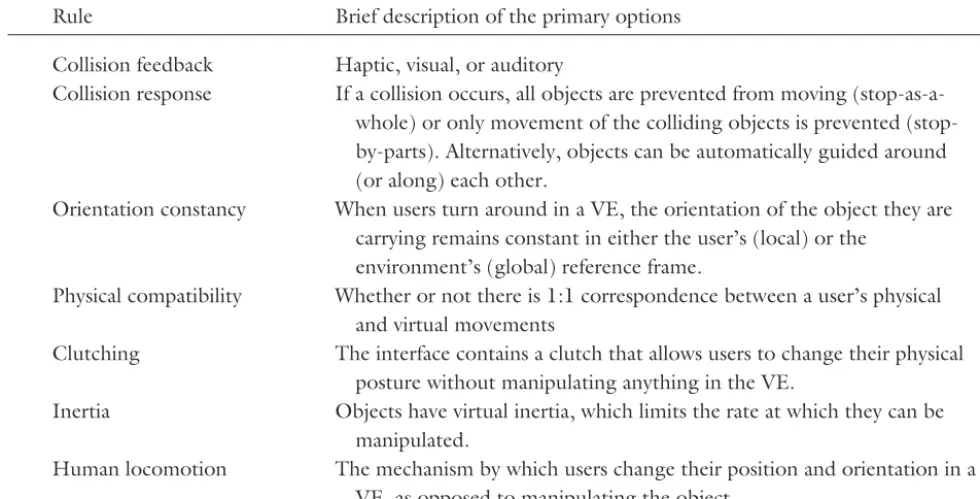
Table 1. Summary of the Rules of Interaction for Object Manipulation in Cluttered VEs
Rule Brief description of the primary options
Collision feedback Haptic, visual, or auditory
Collision response If a collision occurs, all objects are prevented from moving as-a-whole) or only movement of the colliding objects is prevented (stop-by-parts). Alternatively, objects can be automatically guided around (or along) each other.
Orientation constancy When users turn around in a VE, the orientation of the object they are carrying remains constant in either the user’s (local) or the
environment’s (global) reference frame.
Physical compatibility Whether or not there is 1:1 correspondence between a user’s physical and virtual movements
Clutching The interface contains a clutch that allows users to change their physical
posture without manipulating anything in the VE.
Inertia Objects have virtual inertia, which limits the rate at which they can be
manipulated.
Human locomotion The mechanism by which users change their position and orientation in a
frontal azimuth, accuracy is unacceptably low in eleva-tion and rear azimuth (Blauert, 1997). Auditory feed-back has the advantage of providing feedfeed-back for colli-sions that are outside a user’s field of view. Visual feedback provides feedback that is more precise but adds yet more information and, potentially, distracting clutter to a person’s visual channel.
3.2 Collision Response
If a collision has occurred, there are, generally speaking, two types of system response. The first type comprises rules that aid interaction by facilitating move-ment in noncolliding directions. Examples are allowing one object to slide along another usingconstraint-based modeling(Thompson, Maxfield, & Dew, 1998) and usingsliporforce fieldalgorithms to automatically guide a user around obstacles (Jacobson & Lewis, 1997; Xiao & Hubbold, 1998).
The other type simply prevents objects from moving into a colliding position, but within this there are two levels of resolution:stop-as-a-wholeandstop-by-parts. With the former, all movement in a graphics frame is prevented if any collisions take place, no matter where they are. (The whole world freezes). With the latter, only the colliding objects are prevented from moving. From a developer’s perspective, stop-as-a-whole is sub-stantially easier to implement. However, stop-by-parts is a much more flexible rule of interaction. For example, it allows users to reposition themselves in a VE even if the virtual object they are carrying collides with part of the environment and this, in turn, can help the user move the object to a noncolliding position.
Clearly, the applicability of facilitating and prevention rules varies from setting to setting. If interaction is to be made as easy as possible, then a facilitating rule should be chosen. On the other hand, if the purpose of a par-ticular application is to simulate how difficult it would be to maneuver an object into a particular position in the real world, then a facilitating rule is not appropriate because it would make the virtual version of the task artificially easy. Instead, a prevention rule such as stop-by-parts should be chosen.
3.3 Orientation Constancy
This rule defines how an object moves when the user carrying it turns round in a VE. The object’s orien-tation can remain constant either in the user’s (local) frame of reference, or within a global reference frame. (For a video, see appendix A.) The distinction is particu-larly important if a nonimmersive display such as a mon-itor (desktop) or flat-screen projector is being used be-cause, with these types of display, a user always faces the same physical direction. This makes it more difficult for the user to control simultaneously their direction of view, direction of travel, and the orientation of an ob-ject than in an immersive VE, wherein all of the degrees of freedom are controlled using natural body move-ments.
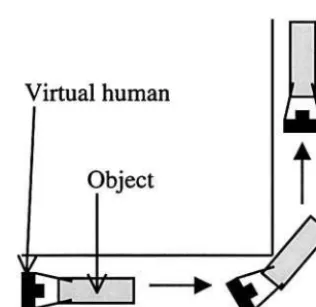
[image:5.630.314.472.89.242.2]In a cluttered VE, either local or global orientation constancy could be optimal, depending on the type of collision response rule that is being used. Consider the example shown in figure 1, where a user wants to carry
an object around a 90 deg. bend in a narrow corridor. With global constancy, the user turns around in the VE without changing the global orientation of an object. This means that separate inputs to the interface are re-quired to change the orientation of the object so that it can be moved around the 90 deg. bend, but there is no difference in the inputs required for stop-as-a-whole and stop-by-parts collision response. With local constancy, the object rotates in conjunction with the user. If stop-as-a-whole is being used, each rotation of the user that causes the object to collide with the walls of the bend will cause all movement in the VE to cease. In turn, this means that a ratcheting motion will have to be adopted to move both the user and the object around the bend, and this is likely to be a substantial impediment to inter-action in the VE system. However, if stop-by-parts is being used, movement around the bend will be only a two-stage operation. First, the person turns through 90 deg., with the object turning as far as it can until it collides. Then the object is manipulated through the remainder of the 90 deg. Of the four combinations of rule, interaction with local orientation constancy and stop-by-parts collision response is likely to be quickest because this will minimize the amount of user input required to manipulate the object. Interaction will be slowest with the local-whole combination because of the ratcheting that is required.
3.4 Physical Compatibility
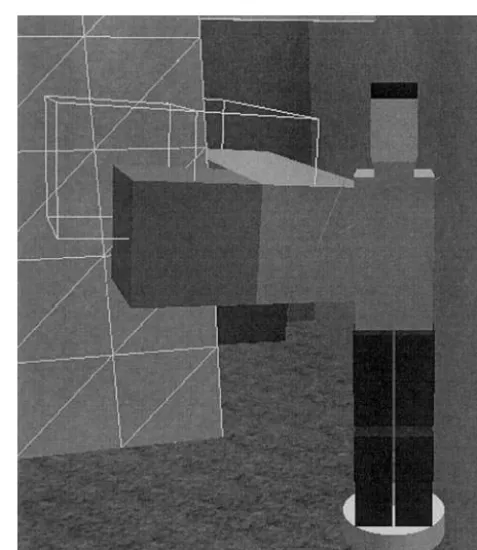
Physical compatibility refers to the difference be-tween a user’s physical and virtual hand positions. If physical compatibility is preserved, the two positions are identical, but in a cluttered VE this can lead to situa-tions in which the user moves his or her hand to a posi-tion that causes the held virtual object to penetrate part of the environment (like a wall), which is something that cannot be allowed to happen if the laws of physics are to be maintained. The solution is to allow physical compatibility unless this would cause an object to be moved to an “impossible” position. (For illustrative vid-eos, see appendix A.) When this occurs, the object re-mains in its last valid position and visual feedback (the wireframe image in figure 2) is turned on to indicate the
physically compatible position of the virtual object. Pro-vision of the visual feedback is a signal to the user that a collision has occurred. A further problem occurs when the physically compatible position becomes valid once more because, potentially, this will cause the virtual ob-ject to “jump” suddenly in position. The solution here is to limit the rate at which the object is allowed to move using a rapid controlled movement algorithm (Mackinlay, Card, & Robertson, 1990) so that the ad-justment between the old and new valid positions oc-curs gracefully but quickly. An added advantage of us-ing controlled movement is that it prevents an object from leaping from one side of a solid barrier such as a wall to another if collisions are checked using only the object’s position at the end of each frame. The
[image:6.630.313.552.90.365.2]tive would be to perform collision detection using the volume that each object travels through, which is tech-nically difficult and computationally time consuming.
If physical compatibility is not preserved, then, con-ceptually, there is an offset between a user’s physical and virtual hand positions. This simplifies the software that controls interaction because, when a collision occurs, the offset is redefined so that the user’s last hand posi-tion is always veridical and controlled movement is not required.
It is not possible to predict whether physical compati-bility will aid or impede interaction. On one hand, phys-ical compatibility forces a user to maintain a natural pos-ture, which is likely to make interaction more realistic. On the other hand, a lack of physical compatibility would allow virtual objects to be manipulated from comfortable physical positions even though the same operation in the real world would be substantially more awkward (such as adjusting something near the limit of a user’s reach). However, this is clearly not desirable in many ergonomic applications that seek to simulate the movements that people will have to make in the real world (such as to remove a component from an aircraft engine).
3.5 Clutching
Clutching is the process by which a user changes their physical posture without modifying anything in a VE. It is most commonly used to allow an interface prop to be reoriented by temporarily disconnecting the control of the virtual object that is under its governance (Hand, 1997). Clutching is particularly useful for avoid-ing awkward postures and allowavoid-ing buttons on the prop to remain in convenient (fingertip) locations irrespective of a virtual object’s orientation. If physical compatibility is not being preserved (see previous), then clutching can also be used to modify the offset between a user’s physi-cal and virtual hand positions, again allowing interaction to be less awkward. Although clutching is generally ac-cepted to be beneficial in an interface, its use has seldom been studied. In one study, however, participants used the clutch for approximately 10% of the total trial time when they had to rotate and translate an object from
one place to another while using a gloved-based inter-face (Zhai, Milgram, & Buxton, 1996).
3.6 Inertia
Virtual objects are “weightless,” which means that they can be manipulated much more rapidly than equiv-alent, physical objects. In addition, small changes of orientation produce large changes in the position of parts of the virtual object a long way from the axis of rotation. One side effect of this is a substantial decrease in the precision with which large virtual objects can be manipulated, and this is of particular importance in clut-tered VEs.
A solution is to limit the rate at which virtual objects are allowed to be manipulated, a form ofvirtual inertia. This can be implemented using a controlled movement algorithm (Mackinlay et al., 1990), with visual feedback indicating to a user the amount of movement that re-mains to be made. (For a video, see appendix A.) For example, if a user attempted to rapidly turn a virtual object through 90 deg., the new orientation could be indicated using a wireframe version of the object (feed-back) while the object gradually rotated to that orienta-tion, at the rate prescribed by the virtual inertia. Once the object reached the new orientation, the feedback would be switched off.
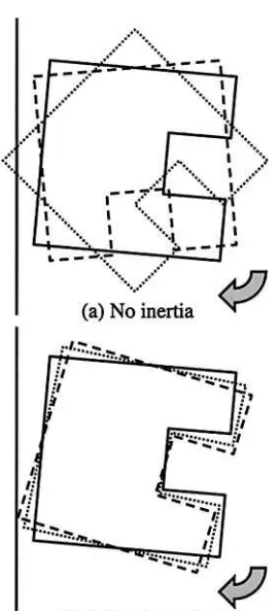
The benefits of virtual inertia are likely to become more evident as the space in which an object is manipu-lated becomes more restricted, because small amounts of noncolliding movement can take place even if the final position that the user was trying to move the ob-ject to is in collision with another part of the VE. (See figure 3.) Without inertia, the object will frequently ap-pear to be “stuck” unless the user’s manipulations are precise and collision free.
3.7 Human Locomotion
can be divided into those that allow movement to take place only in a user’s direction of view, those that de-couple a user’s view and travel direction, or those that allow a user to move directly in any direction irrespec-tive of the orientation of their virtual body (such as
side-step around obstacles). The latter include “walking” interfaces. (For a review, see Templeman, Denbrook, and Sibert (1999).)
In cluttered VEs, view-direction (gaze-directed) movement has been shown to improve performance compared with body-direction movement when partici-pants had to explore room-sized spaces and find target objects (Ruddle & Jones, 2001). Walking interfaces the-oretically enhance maneuverability but require very spe-cialized laboratory facilities. Investigation of different rules for human locomotion is outside the scope of the study reported in the present paper. Therefore, for per-formance and practical reasons, view-direction move-ment was used throughout.
3.8 Summary of Rules
The preceding subsections describe rules of inter-action that are likely to affect the ease with which ob-jects can be manipulated in cluttered VEs. Some of the rules state principles that may seem obvious; for exam-ple, collision feedback will almost certainly help a user understand why a virtual object cannot be moved to a particular location. Others of the rules promote flexibil-ity in interaction by increasing the likelihood that users can make progress in their manipulations of the object at any moment in time. Stop-by-parts collision response does this by allowing noncolliding objects to move if at all possible. Local constancy does this by reducing the amount of user input required to move the virtual hu-man and object around a corner. Virtual inertia does this by breaking manipulations down into increments.
Flexible rules of interaction also have disadvantages. As flexibility (and, inevitably, complexity) is added to an interface, it becomes more difficult to explain to a nov-ice, and thereafter the interface is more difficult to learn. Complex interfaces are also substantially more difficult to implement in a robust manner and to test thor-oughly.
[image:8.630.63.203.90.395.2]Even if flexible rules improve performance, the mag-nitude of those improvements cannot usually be pre-dicted without running human participants in behav-ioral experiments. Given that most aspects of rule flexibility are not required if an environment contains
few obstacles to movement (if collisions are unlikely, then flexible forms of response are not required), experi-mental studies are needed to determine the amount of clutter for which performance benefits to the deploy-ment of such rules begin to occur. Failure to do this will lead to interaction interfaces containing functionality that is not required and, therefore, development re-sources being wasted.
4 Experimental Methodology
The remainder of this paper describes two experi-ments that used the piano mover’s problem to investi-gate the effects of some of the preceding rules of inter-action. This section describes the general methodology, and the subsequent sections describe the detail of each experiment in turn.
In each experiment, participants performed a series of trials in which they moved objects through two shapes of VE (offsetandC-shaped; for videos, see appendix A). One of the objects was a cube, and the others were both an abstract shape of a type that is known as a Shepard-Metzler (SM) object (Shepard & Shepard-Metzler, 1971). Each experiment investigated certain combinations of the rules of interaction. (See table 2.) In experiment 1, one of these combinations was stop-as-a-whole collision re-sponse and global orientation constancy. This provided a baseline for participants’ performance because it is the most straightforward to implement and, therefore, typi-cal of the rules of interaction that are implemented in current VE applications.
In all the experiments, the primary dependent variable was the time taken to complete each trial, but real-time recording of participants’ interactions with the VE sys-tem also allowed analysis to be performed of partici-pants’ behavior. For each participant, the experimenter demonstrated how to move each object through the VEs. This meant that participants only had to re-create that pattern of movement, using the “expert’s” tips. A much more difficult task would have been one in which participants had to determine whether it was possible for particular objects to be moved through a given VE, but that is left for later studies.
The VE software was a C⫹⫹Performer application that was designed and programmed by the authors and ran on a SGI Maximum IMPACT workstation. The po-sition and orientation of the interface prop was mea-sured using a Polhemus FASTRAK sensor and the MR Toolkit (Green, 1995). The application update rate was 30 Hz. The next subsections describe the detail of the environments, the display, and the general user inter-face.
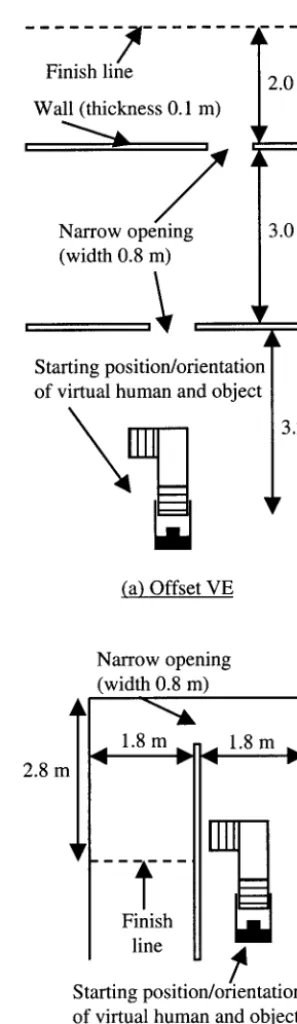
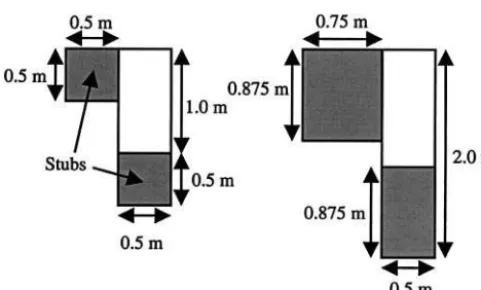
[image:9.630.61.551.109.222.2]4.1.1 Environments. Interior views of the offset and C-shaped environments are shown in figures 2 and 4, and plan views of their layouts are shown in figure 5. The cube object measured 0.5⫻0.5⫻0.5 m, and the dimensions of the two SM objects are shown in figure 6. The ordinary SM object was used in both ments, but the large SM object was used in only experi-ment 2. These two objects were the same general shape but different sizes.
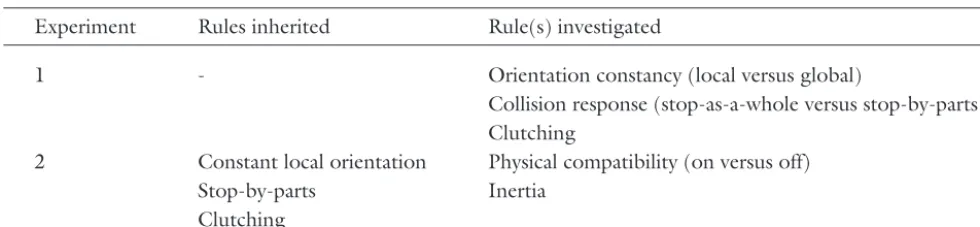
Table 2. Rules of Interaction Investigated by Each Experiment
Experiment Rules inherited Rule(s) investigated
1 - Orientation constancy (local versus global)
Collision response (stop-as-a-whole versus stop-by-parts) Clutching
2 Constant local orientation Physical compatibility (on versus off)
Stop-by-parts Inertia
4.1.2 Display and View Perspective. In the task used in the present study, users had to change their direction of view only occasionally. Unlike studies of navigation in virtual buildings, there was little require-ment (or reason) for frequent “head” moverequire-ments such as glancing to one side. For this reason, a large-screen monitor (86 cm/34 in.) was chosen for the display, rather than a head-mounted display (HMD). If the study had been performed with an HMD, the length of time involved for the experimental trials would have been expected to cause severe symptoms of VE sickness in a number of the participants, even if frequent rest periods had been incorporated into the procedure.
Each participant performed the experiment in an erect posture, facing a large-screen monitor that was positioned 1.6 m away on a table. The participant’s po-sition and orientation within the VE was portrayed by a 3D model of a virtual human that held the object being manipulated, as shown in figures 2 and 4. In other words, the virtual human was the participant’s embodi-ment within the VE.
The participant’s viewpoint was positioned 3 m be-hind the human, connected by an egocentric tether (an over-the-shoulder view). This meant that the partici-pant’s direction of view was always the same as that of
[image:10.630.312.461.87.600.2]their virtual counterpart, but the participant was able to see the virtual human’s immediate surroundings in the VE despite the impoverished field of view (48⫻36
Figure 4. A view inside the offset VE. The virtual human is standing in the first opening and traveling toward the second.
[image:10.630.61.300.92.287.2]deg.). The use of a tethered view meant that the partici-pant’s viewpoint was sometimes on the opposite side of a wall to the virtual human. When this occurred, the walls in question were rendered as semitransparent us-ing an alpha value of 0.2 (0.0 and 1.0 were fully trans-parent and opaque, respectively).
4.1.3 User Interface. Participants held a small box (100⫻75⫻40 mm, an interface prop) in their hands. The box contained a FASTRAK sensor and four buttons. If a participant held down one button, they accelerated forwards (that is, in their direction of view) at 0.5 ms⫺2, to a maximum speed of 0.5 ms⫺1. If they held the second button, they accelerated backwards at the same rate. The third button acted as a clutch. When it was held down, the participant could reposition and reorient the prop in relation to their hands without changing the position of the object. The fourth button was used to change the mode of the FASTRAK sensor. When this button was held down, changes of the prop’s orientation caused the participant’s direction of view to be rotated. At all other times, the prop directly con-trolled the orientation of the object.
When collisions did not occur or the clutch was not being used, there was a 1:1 correspondence between changes in the participant’s physical hand position and orientation, and that of the object, even though the
ob-ject was being manipulated remotely. (It was 3 m away.) This is known ashand-centered manipulation(Bowman & Hodges, 1997).
Collisions of the cube and SM objects with the envi-ronment or the virtual human were detected using the RAPID software library (Gottschalk, Lin, & Manocha, 1996). Two types of response, corresponding to stop-as-a-whole and stop-by-parts collision response, were implemented. For stop-as-a-whole, all movement was prevented until the object was moved in a noncolliding direction, whereas, for stop-by-parts, the virtual human could still be moved if the object was in collision with the environment. Each time a collision occurred, and for both types of response, yellow graphical highlighting indicated which geometric (such as tri-strip) primitives were in collision, and the offset between a participant’s physical and virtual hand position was redefined.
Collisions of the virtual human with the environment were detected by software written by the authors. When this type of collision occurred, a slip response algorithm allowed the virtual human to continue moving in a di-rection that was tangential to the colliding surface. The focus of these studies was on the difficulty users have in manipulating an object through a cluttered VE, whereas, in real life, it is trivial for people themselves to avoid walking into walls while carrying something. In summary, the slip rule ensured that the virtual human could move freely at all times, and the versions of the stop rule that were implemented for object collisions ensured that the users experienced the full difficulty of maneuvering the object in each VE.
5 Experiment 1
[image:11.630.61.302.91.236.2]Experiment 1 investigated local and global orien-tation constancy, and stop-as-a-whole and stop-by-parts collision response. Each participant was randomly allo-cated to one of four groups, each of which used one combination of these rules (i.e.,local-whole, local-parts, global-whole,andglobal-parts). Clutching was imple-mented for all of the combinations. Each participant moved cube and the ordinary SM object through the
offset and C-shaped VEs (for illustrative videos, see Appendix A).
5.1 Method
5.1.1 Participants. A total of 22 participants (four men and eighteen women) took part in the experi-ment. Their mean age was 23.8 (SD⫽7.1). All the par-ticipants volunteered for the experiment and were paid an honorarium for their participation. The first sixteen participants were randomly allocated to the four condi-tions, and the remaining participants replaced those who timed out in a test trial. (See subsection 5.2.)
5.1.2 Materials and Procedure. The materials were as described in section 4. Participants were run individually by the same experimenter and performed the experiment over two separate days. On the first day, they performed the piano mover trials, and this took approximately two hours. On the second day, a partici-pant performed a spatial ability test (Smith & Whetton, 1988). The data for this test are reported in section 8.
At the start of the first day, the experimenter demon-strated how to perform the piano mover’s task, using physical scale models of the SM object, and the offset and C-shaped environments. For the piano mover’s tri-als, there were four combinations of object and VE, and each participant performed trials in these combinations in increasing order of difficulty (cube-offset, cube-C, SM-offset, and then SM-C). In each trial, a participant carried the object from the starting position until the virtual human had crossed the finishing line. (See fig-ure 5.)
The first set of trials (cube-offset) started with the experimenter demonstrating the interface and explain-ing how to move the object through the VE. The par-ticipant then performed three practice trials in which they were given advice and instruction by the experi-menter as the trial progressed. This combination was used solely for training, so no test trials were performed.
Next, the experimenter demonstrated how to carry the cube through the C-shaped VE, and the participant then performed three practice trials and four test trials. The participant was given advice and instruction during
the practice trials (as for the cube-offset combination) but given no help at all in the test trials. If the partici-pant had not completed a test trial after 300 sec., the trial was terminated and the participant progressed to the next trial.
The participant then performed the SM-offset and SM-C trials. For each combination, the experimenter demonstrated how to carry the object through the VE, and then the participant performed practice and test trials as just described. As before, each test trial was ter-minated after 300 sec. if it had not been completed.
5.2 Results
With each combination of the rules of interaction, four participants completed every test trial within the 300 sec. time limit. Of the other participants, one ex-ceeded the time limit in an SM-offset trial, and the other five exceeded the time limit in one or more SM-C trials. The data for the participants who never exceeded the time limit and those who exceeded it in at least one trial are reported in subsections 5.2.1 and 5.2.2, respec-tively.
Figure 7 shows the amount of time that participants took in the test trials for the three combinations of ob-ject and environment. In the cube-C trials, the time taken did not differ significantly between the whole and parts collision rules (F(1, 12)⫽1.05,p⫽.32) or the local and global orientation rules (F(1, 12)⫽0.52,p⫽ .48). Similarly, in the SM-offset trials, the time did not differ significantly between whole and parts collision (F(1, 12)⫽0.29,p⫽.60) or between local and global orientation (F(1, 12)⫽0.55,p⫽.47). However, par-ticipants performed the SM-C trials significantly more quickly with the parts rule than the whole rule:F(1, 12)⫽13.59,p⬍.01. In these trials, there was no ef-fect of orientation (F(1, 12)⫽0.03,p⫽.86), but there was a significant interaction between the orientation and response rules (F(1, 12)⫽11.5,p⬍.01).
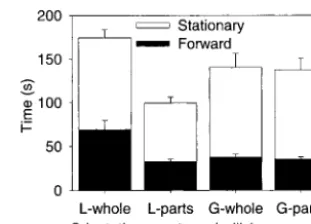
To further investigate these effects, the time data for the SM-C trials were divided into periods when partici-pants were holding down the forward button on the interface prop, the backward button, or neither button. (See figure 8.) Included within the forward time were periods when participants were attempting to move through the VE but were prevented from doing so be-cause the object was in collision. With the parts rule, the neither button time included periods during which par-ticipants were adjusting the position of the virtual hu-man relative to the object by moving their hands while the object was in collision. Overall, participants spent less than 1% of their time holding down the backward button. For the time that participants spent holding
down the forward button, there was a significant inter-action between the collision and orientation rules:F(1, 12)⫽8.15,p⫽.01. Overall, participants spent less time holding down the button with the parts rule than with the whole rule (F(1, 12)⫽10.38,p⬍.01) and with global orientation than local orientation (F(1, 12)⫽5.89,p⫽.03) but further analysis showed that these main effects were solely caused by the time spent by the local-whole group. Analysis of the amount of time in which participants did not hold down either button showed there was no significant difference be-tween whole and parts collision (F(1, 12)⫽2.77, p⫽.12) or between local and global orientation (F(1, 12)⫽1.89,p⫽.19).
Two other types of data were analyzed for the partici-pants who never exceeded the time limit. The first of these was the percentage of the total trial time that par-ticipants spent using the clutch. (See table 3.) In none of the three combinations of object and environment was there a significant effect of response rule or orienta-tion, but there was a significant interaction between the two rules in the SM-offset trials:F(1, 12)⫽6.10, p⫽.03. This is likely to have been caused by the in-creased difficulty participants had in completing the task in the global-whole condition.
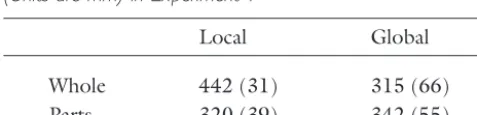
The second type of data was the size of the position discrepancy between participants’ physical and virtual hand positions in the SM-C trials. This was a measure of the extent to which participants adopted a physically incompatible position. In every trial, this was
[image:13.630.60.217.92.206.2]deter-Figure 7. Mean time taken to complete the test trials in experiment 1. C⫽C-shaped VE; offset⫽offset VE; error bars indicate the standard error (SE).
Figure 8. Mean time spent pressing the forward button, or neither button (“stationary”) in the SM-C test trials of experiment 1. L⫽
[image:13.630.312.468.93.205.2]mined by calculating the root mean square (RMS) value of the position discrepancy for each graphics frame. An ANOVA showed there were not significant differences between the response rules (F(1, 12)⫽3.75,p⫽.08) and orientations (F(1, 12)⫽4.48,p⫽.06) but there was a significant interaction between the two (F(1, 12)⫽9.03,p⫽.01). (See table 4.) This interaction was probably caused by the increased difficulty partici-pants had in completing the task in the global-whole condition. Across all four conditions, further investiga-tion showed that 80% of the discrepancy occurred in the lateral direction, relative to participants’ (and the virtual human’s) body.
5.2.2 Time Limit Exceeded. Of the six partici-pants who exceeded the trial time limit, five did so in the SM-C combination of object and environment en-compassing, between them, all four rule conditions. In total, these five participants exceeded the limit in nine of their twenty test trials. To provide information on where these participants experienced difficulties, each trial was divided into five stages:
(i) traveling towards the narrow opening,
(ii) maneuvering the far stub through the opening, (iii) rotating the object in the opening (one stub on
each side),
(iv) maneuvering the near stub through the opening, and
(v) traveling towards the finish line.
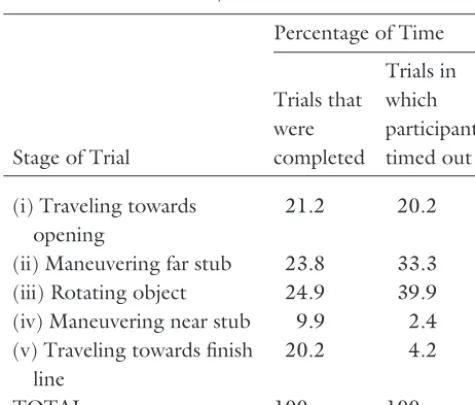
The percentage of time that these participants spent in each stage for trials in which they succeeded and timed out is shown in table 5. These data indicate that participants encountered most of their difficulties ma-neuvering the far stub through the opening and rotat-ing the object in the openrotat-ing.
5.3 Discussion
[image:14.630.59.556.109.198.2]The most important finding from experiment 1 was that local orientation constancy proved superior to global constancy, but only when a flexible collision re-sponse algorithm (stop-by-parts) was also used. This effect was anticipated and can be explained by consider-ing the sequence of movements through which the vir-tual human and virvir-tual object had to be moved to rotate the latter through a large angle (such as 90 deg.) in a cluttered VE. With the local-parts combination of rules, both the human and the object could be rotated simul-taneously. By contrast, with the local-whole combina-tion, a participant had to make incremental rotations in a ratcheting fashion while in between moving the object away from a colliding position. With global constancy, there was little difference between stop-by-parts and stop-as-a-whole. In both these cases, movement was a
Table 3. Mean (Standard Deviation) Percentage of Time Spent Clutching During the Test Trials in Experiment 1
Combination of rules
Local-whole Local-parts Global-whole Global-parts
Cube-C 5.4 (5.4) 8.9 (1.8) 7.1 (3.6) 5.5 (2.4)
SM-offset 15.8 (4.9) 10.0 (1.3) 9.2 (3.3) 11.2 (1.8)
SM-C 10.4 (3.1) 9.4 (3.1) 9.9 (2.1) 12.4 (3.3)
Table 4. Root Mean Square (Standard Deviation) Distance between Participants’ Physical and Virtual Hand Position for Each Combination of Rules in the SM-C Test Trials (Units are mm) in Experiment 1
Local Global
Whole 442 (31) 315 (66)
[image:14.630.61.300.291.348.2]two-stage process. The virtual humans had to be ro-tated, followed by rotation of the object.
There were significant effects for the time data in tri-als in which the SM object was moved through the C-shaped VE, but not for the cube object in that VE or the SM object in the offset VE. In other words, signifi-cant differences between the rules of interaction oc-curred for only the most cluttered combination of the object and VE that was studied, and this provides an indication of the amount of clutter that must exist within a VE before flexible rules of interaction become advantageous.
All of the participants used the clutching facility of the interface. Even in the simplest of the piano mover’s tasks in which test trials were performed (cube-C), par-ticipants clutched for 7% of the time. Although trials without clutching were not run, these data provide a clear indication of the benefits that clutching provides in any form of virtual object manipulation.
Of concern was the proportion (27%) of participants
who failed to complete trials even though they had un-dergone a substantial amount of training with the rules of interaction they had been allocated. Clearly, this is most unlikely to have happened if the task had been performed in the real world, indicating that there is sub-stantial room for improvement in the design of inter-faces for the manipulation of objects in cluttered VEs. Experiment 2 focused on the rules of physical compati-bility and inertia. In experiment 1, participants held the virtual object in a position that was physically incompat-ible by approximately 350 mm (the mean distance be-tween participants’ physical and virtual hand position, relative to their body), and this may have contributed to the difficulties that participants experienced. Inertia re-duces the rate at which the object changed position and orientation, and was predicted to help participants to make small, incremental manipulations in the most diffi-cult parts of the tasks.
6 Experiment 2
[image:15.630.61.299.178.380.2]Experiment 2 used the same tasks as experiment 1, but with different rules of interaction. Participants were allocated to one of four groups, which all used the stop-by-parts and local orientation constancy rules (the com-bination that had proven most effective in experiment 1). For one of the groups (feedback-PC), the virtual object was maintained in a physically compatible posi-tion whenever it was not colliding with any other object in the VE. When a collision did occur, a wireframe ver-sion of the object was used to indicate the physically compatible position (see figure 2), and, after a collision, a rapid controlled movement algorithm ensured that the object moved smoothly to its physically compatible po-sition. A second group (inertia) also used physical com-patibility, but the rate at which the object could be ma-nipulated was constrained. For illustrative videos of the feedback-PC and inertia conditions, see appendix A. Physical compatibility was not implemented for the other two groups. One of these (no-PC) was identical to the local-parts group in experiment 1. With the other (feedback-no-PC), a wireframe version of the object was displayed each time a collision occurred and indicated
Table 5. Mean Percentage of Time that the SM Object was in Each Part of the C-shaped VE for Trials that Participants either Completed Successfully or Timed Out. The Mean Trial Times were 229 sec. (Completed) and 300 sec. (Timed Out). All of these Data are for Participants who Timed Out in at Least One SM-C Trial in Experiment 1
Stage of Trial
Percentage of Time
Trials that were completed
Trials in which participants timed out
(i) Traveling towards opening
21.2 20.2
(ii) Maneuvering far stub 23.8 33.3
(iii) Rotating object 24.9 39.9
(iv) Maneuvering near stub 9.9 2.4
(v) Traveling towards finish line
20.2 4.2
where a participant was trying to move the object. With this condition, unlike the feedback-PC condition, there was only ever a small difference between the position of the object and its wireframe version because, without physical compatibility, the offset between a participant’s physical and virtual hand position was redefined each time a collision took place. During the experimental program, the inertia group was run after the other three groups (it was a supplementary manipulation of ment 2, investigated as a consequence of this experi-ment’s results) but, for the purposes of reporting, all four groups are treated as a single experiment.
6.1 Method
6.1.1 Participants. A total of 35 participants (13 men and 22 women) took part in the experiment. Their mean age was 20.9 (SD⫽3.3). All the participants vol-unteered for the experiment and were paid an honorar-ium for their participation. None had taken part in ex-periment 1. Thirty-two of the participants were randomly allocated to the four conditions, and the re-maining participants replaced those who timed out in a SM-offset or SM-C test trial.
6.1.2 Materials. The experiment used the same hardware and software as experiment 1. The implemen-tation of the rules of interaction for the no-PC, feed-back-no-PC, and feedback-PC condition is as described in section 3. The inertia rule of the fourth group re-stricted the rate at which the virtual object moved to an angular (rotational) speed of 22.5 deg./sec. and a linear speed of 0.621 m/sec., and gave the impression that the object was being manipulated in a clear but viscous fluid. The angular speed was the slowest at which ac-ceptable manipulation performance could be achieved, and the linear speed was calculated as 1.5⫻tan(22.5°.); the SM object was 1.5 m long. If a participant tried to move the object quicker than this, a wireframe version of the object was displayed in its physically compatible position (see figure 2) and the object continued moving to this position at its maximum rate. At all times, the object moved toward the most recent physically com-patible position. If a collision occurred, all residual
tional movement was canceled by modifying the rota-tional offset between a participant’s physical and virtual hand orientations (see subsection 4.1.3). However, due to the physical compatibility rule, any residual transla-tional movement was not canceled.
6.1.3 Procedure. As in experiment 1, partici-pants were run individually and performed the experi-ment over two separate days. On the first day, they per-formed the piano mover trials, and this took
approximately 2.5 hours. On the second day, a partici-pant performed the spatial ability test.
The difference between the two experiments was that, after completing the SM-C trials, a participant did a fur-ther set of practice and test trials in which they maneu-vered a large version of the Shepard-Metzler object through the C-shaped VE. This is referred to as the large-C combination, and the dimensions of the object are shown in figure 6.
6.2 Results
Two participants in the no-PC group and one in the feedback-PC group timed out in the SM-C test tri-als. In total, these participants timed out in seven of the trials, and one also timed out in an SM-offset trial. These participants were excluded from the analyses re-ported here. Seven other participants successfully com-pleted all the SM-offset and SM-C test trials, but each timed out in one of the large-C trials. These participants are included in the following analyses, with their trial time set to 300 sec. for the trials in which they timed out. Thus, the same time-out criterion was used as in experiment 1, in which participants never performed trials with the large-C combination. Initial analyses of the time data showed no effect of trial number, so the data reported here were analyzed using single-factor ANOVAs that treated the experimental group as the independent variable.
feedback-PC and feedback-no-PC groups, but none of the other pairwise comparisons were significant. There was a marginal effect of group in the SM-C trials (F(3, 28)⫽2.81,p⫽.06), but no effect in the large-C trials (F(3, 28)⫽0.85,p⫽.48).
6.3 Discussion
Overall, there was little difference between the four combinations of rules that were investigated in ex-periment 2. The largest difference occurred for the sim-plest of the tasks involving the SM object, and it should be noted that this difference remained similar when par-ticipants who had timed out in the SM-offset or SM-C trials were included in the analysis. The most likely cause of the relatively poor performance of the feedback-no-PC group was that the brief appearances of the wireframe object (every time a participant moved farther into a collision) added visual clutter to the display, which was difficult to comprehend. By contrast, in the feedback-PC condition, the feedback remained displayed for much longer periods.
Although the implementation of virtual inertia had no significant effect on participants’ performance, there was a noticeable increase in the time participants took to complete the SM-C trials, relative to the other condi-tions, and a slight decrease for the most difficult task (large-C). This may be explained as follows. By limiting the rate at which the virtual objects could be manipu-lated, inertia caused an increase in the minimum
amount of time in which it was theoretically possible for participants to perform each task. Therefore, inertia pro-duced a performance penalty if participants found a task straightforward. However, if a task were difficult (such as the large-C condition), then inertia was beneficial. As explained previously (see also figure 3), inertia increased the likelihood that some movement of an object took place in each graphics frame because, when a participant tried to make a large movement, the VE software broke that down into a series of incremental movements that took place in a sequence of frames. Collision detection was performed on a frame-by-frame basis, meaning that the object moved by all increments of movement up to the first collision. The net result of this is that inertia slowed down participants who were skilled at manipu-lating the virtual objects, but was probably beneficial to participants who experienced difficulty in performing the experimental tasks.
The conclusions that can be drawn from experiment 2 are as follows. First, physical compatibility has little effect, either detrimental or advantageous, on object manipulation in the type of cluttered VEs that were un-der investigation. Second, substantial problems remain with the rules of interaction that were investigated, as shown by the participants who continued to experience great difficulty in performing the trials, even in the easi-est two combinations of object and environment.
7. Spatial Ability Test
[image:17.630.60.217.92.204.2]The primary focus of the present study was to evaluate the effect that different rules of interaction had on participants’ performance when they carried bulky objects through cluttered VEs. In this, individual differ-ences in ability represent a nuisance factor because they add noise to the experimental data. However, there is also considerable interest in the magnitude and cause of these individual differences themselves. Of particular interest are psychometric tests that could be used to predict individuals’ likely performance in various VE tasks, and which could be used to identify those people who are either best suited to using VEs for particular design tasks, or are likely to require additional training.
Within the field of VEs, individual differences have most often been measured for tasks that required partic-ipants to navigate large-scale spaces, and the most com-prehensive of these is a study by Waller (2000). How-ever, large-scale navigation is a fundamentally different type of task to the piano mover’s problem because the latter tests participants’ ability to visualize the move-ment of a 3D object and their dexterous skill to execute those movements.
To provide information about the individuals who participated in the present study, all were requested to return to the laboratory on a second day and perform a spatial ability test (Smith & Whetton, 1988). This test contained 22 questions, the first two of which were practice questions. In each question, a participant had to imagine what a flat pattern would look like if it were cut out and folded into a 3D object. Each question con-sisted of drawings of a flat pattern and four similar 3D objects. The participant had to indicate whether each of the four 3D objects could be constructed by folding the flat pattern. Both the questions and the answer sheet were presented on paper, and participants were permitted 20 min. in which to answer the twenty test questions.
In total, 41 of the 57 participants returned to the lab-oratory to complete the spatial ability test, including six of the eight who had timed out during the SM-C task. Participants’ scores in the test ranged from 47 to 80 (M⫽71.4;SD⫽7.4), and the maximum possible score was 80. The scores were compared with the mean time that participants took to complete their SM-C test trials, with a time of 300 sec. used for each trial in which a participant timed out. Analysis showed that there was a significant correlation between the two sets of data:r(41)⫽ ⫺.32,p⫽.04.
A second correlation was performed using time data that were adjusted to take account of the differences among the rules of interaction. For this, each partici-pant’s mean time in the SM-C trials was recalculated as t⬘ ⫽t*n/m, wheretwas the actual mean time (used in the first correlation),nwas the mean time of all partici-pants who took part in the quickest condition (physical compatibility, experiment 2), andmwas the mean time of all participants who took part in the present partici-pants’ condition. The adjustment factors (n/m) ranged
from 0.670 to 1.0. Analysis showed these adjusted times were not correlated with participants’ score in the spatial ability test:r(41)⫽ ⫺.25,p⫽.12.
This spatial ability data provide some evidence for a link between individuals’ abilities, as assessed through the use of a spatial ability psychometric test, and the speed at which they were able to perform a spatial-motor task in a VE. However, the results should be treated with caution until more comprehensive studies are performed that use both a battery of psychometric tests and a substantially larger number of participants.
8 General Discussion
The present study adopted a new paradigm—the piano mover’s problem—for evaluating rules of interac-tion for object manipulainterac-tion in cluttered VEs. The basic problem was for a user to move a bulky virtual object through a restricted space. The user had to separately control the movement of a virtual human through a VE and manipulation of a virtual object that the human held in their hands. Thus, the experimental task made similar demands on users, in terms of the type of user input that was required, to those made by some VE ap-plications, such as ones that seek to simulate the manual handling of materials on an engineering production line.
The more flexible the rules governing a user’s interac-tions the quicker they are likely to be able to move an object from one place to another. However, increases in flexibility come hand in hand with increases with com-plexity. Flexible interfaces are substantially more difficult to implement in a VE system and test in a thorough manner, and they can also be more difficult for a user to learn. Added to this, the potential benefits of flexibility will depend on the difficulty of the task being per-formed and, within the piano mover’s problem, this is closely related to the clearance between the object and the environment.
time required to manipulate an object by up to 75%, but, in less restricted spaces (such as SM-offset), the differences between the rules were negligible.
Physical compatibility had little effect (positive or negative) and neither did the introduction of virtual inertia. However, three potential uses of inertia should still be noted. First, it increases the realism of interac-tions that occur because large objects can no longer be manipulated as if they have no mass, and in this there is substantial scope for implementing an algorithm that models inertia in a mathematically more correct manner to take into account an object’s physical inertia and a user’s strength. Second, it aids interaction for unskilled users because it increases the likelihood that some movement takes place in each graphics frame when the environment is cluttered. Third, a notable difference between inertia and constraint-based modeling is that the latter assumes that no collisions occur between the constrained degrees of freedom (for example, compo-nents are free to slide along one particular axis), but with the inertia rule no such assumptions are made and collisions are checked each frame. With the inertia ap-proach, it is not necessary to know a priori whether an object can be physically manipulated through a particu-lar space. It follows that inertia has great potential as a rule of interaction in situations in which a person such as a designer needs to determine whether it is possible for tightly fitting components to be assembled together.
On this latter note, all participants are likely to have had greater difficulty completing the trials if they had had to determine whether it was possible to maneuver particular virtual objects through a VE (that is, to solve the piano mover’s problem) rather than re-create a se-quence of movement (a known solution) that they were shown by the experimenter. Further studies are planned that address this issue, as are studies in which two users collaborate to solve the piano mover’s problem.
Acknowledgments
This work was supported by grant GR/L95496 from the En-gineering and Physical Sciences Research Council, and
per-formed while Roy Ruddle was employed in the School of Psy-chology at Cardiff University.
References
Blauert, J. (1997).Spatial hearing: The psychophysics of human sound localization.Cambridge, MA: The MIT Press. Bowman, D. A., & Hodges, L. F. (1997). An evaluation of
techniques for grabbing and manipulating remote objects in immersive virtual environments.Proceedings of the 1997 Symposium on Interactive 3D Graphics,35–38.
Gottschalk, S., Lin, M., & Manocha, D. (1996). OBB-Tree: A hierarchical structure for rapid interference detection. Pro-ceedings of the 1996 ACM Conference on Graphics (SIG-GRAPH ’96),171–180.
Green, M. (1995).The MR Toolkit Version 1.4[Computer program]. Department of Computing Science, University of Alberta, Canada.
Hand, C. (1997). A survey of 3D interaction techniques. Computer Graphics Forum, 16,269 –281.
Hubbold, R., & Keates, M. (2000). Real-time simulation of a stretcher evacuation in a large-scale virtual environment. Computer Graphics Forum, 19,123–134.
Jacobson, J., & Lewis, M. (1997). An experimental compari-son of three methods for collision handling in virtual envi-ronments.Proceedings of the Human Factors and Ergonomics Society’s 41st Annual Meeting,1273–1277.
Lengyel, J., Reichert, M., Donald, B. R., & Greenberg, D. P. (1990). Real-time robot motion planning using rasterizing computer graphics hardware.Computer Graphics, 24,327– 335.
Mackinlay, J., Card, S. K., & Robertson, G. G. (1990). Rapid controlled movement through a virtual 3D workspace. Computer Graphics, 24,171–176.
McNeely, W. A., Puterbaugh, K. D., & Troy, J. J. (1999). Six degree-of-freedom haptic rendering using voxel sampling. Proceedings of the 1999 ACM Conference on Graphics (SIG-GRAPH ’99),401– 408.
Pierce, J. S., Forsberg, A., Conway, M. J., Hong, S., Zeleznik, R., & Mine, M. R. (1997). Image plane interaction tech-niques in 3D immersive environments.Proceedings of the 1997 Symposium on Interactive 3D Graphics,39 – 44. Poupyrev, I., Billinghurst, M., Weghorst, S., & Ichikawa, T.
Ruddle, R. A., & Jones, D. M. (2001). Movement in clut-tered virtual environments.Presence: Teleoperators and Vir-tual Environments, 10,511–524.
Ruddle, R. A., Savage, J. C. D., & Jones, D. M. (in press). Levels of control during a collaborative carrying task. Pres-ence: Teleoperators & Virtual Environments.
Shepard, R. N., & Metzler, J. (1971). Mental rotation of three-dimensional objects.Science, 171,701–703. Smith, P., & Whetton, C. (1988).Spatial booklet from the
“General Ability Tests”.Windsor: ASE, A Division of NFER-NELSON (National Foundation for Educational Research).
Templeman, J. N., Denbrook, P. S., & Sibert, L. E. (1999). Virtual locomotion: Walking in place through virtual envi-ronments.Presence: Teleoperators and Virtual Environments, 8,598 – 617.
Thompson, M. R., Maxfield, J. H., & Dew, P. M. (1998). Interactive virtual prototyping.Proceedings of Eurographics UK ’98,107–120.
Waller, D. (2000). Individual differences in spatial learning from computer-simulated environments.Journal of Experi-mental Psychology: Applied, 6,307–321.
Xiao, D., & Hubbold, R. (1998). Navigation guided by artifi-cial force fields.Proceedings of the Computer Human Inter-faces Conference (CHI ’98),179 –186.
Zhai, S., Milgram, P., & Buxton, W. (1996). The influence of muscle groups on performance of multiple degree-of-freedom input.Proceedings of the Computer Human Inter-faces Conference (CHI ’96),308 –315.
Appendix A