and embedded quantifiers
.
White Rose Research Online URL for this paper:
http://eprints.whiterose.ac.uk/44120/
Version: Submitted Version
Article:
Zweig, E. orcid.org/0000-0002-3535-7259 (2007) When the donkey lost its fleas:
Persistence, minimal situations, and embedded quantifiers. Natural Language Semantics.
pp. 283-296. ISSN 0925-854X
https://doi.org/10.1007/s11050-006-9003-6
Reuse
situations, and embedded quantifiers
∗Eytan Zweig New York University
October 3, 2006
Abstract. This paper revisits the question of whether propositions in situation
se-mantics must be persistent Kratzer (1989). It shows that ignoring persistence causes empirical problems to theories which use quantification over minimal situations as a solution for donkey anaphora Elbourne (2005), while at the same time modifying these theories to incorporate persistence makes them incompatible with the use of situations for contextual restriction Kratzer (2004).
1. Introduction
Kratzer (1989) introduces a framework for situation semantics that was taken as a starting point by a substantial body of later work. One property of this framework is that what is true of a small situ-ation must remain true of larger situsitu-ations that it is a part of. This is known as persistence. Kratzer’s argumentation for this condition, however, is primarily of a conceptual nature. This led most of the work which adopted her framework to overlook this condition, and neglect to incorporate it into their theories.
In this paper, I will return to the issue of persistence, with several goals in mind. First and foremost, I aim to show that the persistence condition is not just motivated on conceptual grounds, but it is justified empirically. While doing so, I will also explore some of the requirements that are necessary for a proposition to be persistent. Finally, I shall discuss the consequences of persistence to different lines of research in situation semantics. Specifically, I will show that theories of donkey anaphora that require quantification over minimally small situations are in conflict with Kratzer’s (2004) theory of contextual restriction, as the latter requires that quantification involve large situations in order to ensure persistence.
2. Persistent Propositions
Kratzer (1989) introduces a situation semantics which relies heavily on the part-whole relationship of situations1. Situations, according to this framework, are groupings of entities, their properties, and relations between them. Reference to situations is handled through situation variables, which can be quantified over just like other variables. Much of the power of this framework is derived from the fact that situations in this system are partially ordered by the sub-situation operator ≤. If s≤s′, then s′ may contain at least one entity, property, or relation that s does not. There is a maximal element to this ordering - the possible world, which, naturally, includes all the entities, properties, and relations that exist in that world. For brevity, I shall call a situation
s′ anextension of a situation siff s≤s′ and s6=s′.
In this system, a proposition is defined as a set of situations, such that a proposition p is true in a situation s if s ∈ p. Nothing said so far prevents a proposition from being true in a situation s, but false in some extensions of it. For example, take the proposition p which is expressed in (1):
(1) There are no living kings.
(1) is, under a straightforward analysis of its meaning, true of a situa-tion s1 that includes only an individual x and the fact thatx is alive. However, there may be a larger situation s2 that includes x, the fact that he lives, and the fact that he is a king. (1) is not true of s2. But note that s1 ≤s2.
As mentioned above, Kratzer (1989) takes the view that this is an unwelcome result. She suggests that a condition be added such that all natural-language propositions be persistent, following the definition below:2.
(2) A persistent propositionis a proposition of which it is true that, for everyssuch thats∈p, for everys′ such thats≤s′ it holds thats′∈p.
1
While Kratzer’s later work revises key aspects of this framework (see Kratzer, 2002 and Kratzer, 2005), the issues discussed in this paper remain constant through-out the various iterations of this system, both those authored by Kratzer herself and those adapted by other authors
2
With this condition in place, then, in the world described above, s1 cannot be a member of the proposition expressed by (1), due to the existence of s2.
It is important to note that Kratzer does not enforce this condition by somehow filtering out non-persistent propositions. Rather, she pro-vides denotations for quantifiers that encode persistence. For example, instead of the non-persistent denotation for every provided in (3), she suggests (4)3:
(3) Non-persistent quantification:
JeveryK = λfhhsei,hstiiλghhsei,hstiiλs. For all xhei: if f(λs.x)(s) = 1,g(λs.x)(s) = 1
(4) Persistent quantification:
JeveryK =λfhhsei,hstiiλghhsei,hstiiλs. For all xhei: iff(λs.x)(w) =
1,f(λs.x)(s) = 1 andg(λs.x)(s) = 1
The difference between the two quantifiers is as follows: in (3), the quantifier is restricted to entities which have property f in s, and it predicates of them that they also have propertyg. In (4), the quantifier is restricted to all thefs in the world, and it states that they have that property in s, as well asg. Thus, a proposition only holds of situations that include all the fs inw, and in which all of them are also gs. Both these properties will hold of every larger situation4.
While writing persistence into the determiner denotation ensures that all sentences end up denoting persistent propositions, it also com-plicates these denotations. Since Kratzer does not provide empirical justification for doing so, most of the literature following her work chose to use the simpler, non-persistent denotations5. The next section will examine one such theory, and show why this choice leads to empirical problems.
3
The denotations given below differ from Kratzer’s in their notation, as I use the same formalism as Elbourne (2005). Nonetheless, the ideas are the same, with one major simplification: Kratzer (1989) deals with some distinctions which go beyond the scope of this paper, such as the distinction between propositions that are true accidentally and propositions that are true by some inherent fact about the nature of the world. I will ignore such distinctions here.
4
This is actually not entirely correct. Take the sentenceEvery professor owns an even number of hats- there can be a situationsthat includes all the professors, and each of them has an even number of hats in that situation, but there’s a situations′ in which one professor has an additional hat. I will ignore this issue in the discussion that follows, since it will not carry over to the quantifier denotations that use minimal situations.
5
3. Minimal situations and donkey anaphora
3.1. The Heim/Elbourne solution for donkey anaphora
One recent promising use of situation semantics has been to solve a problem that arises in the resolution of donkey anaphora. This line of research was first suggested by Heim (1990), and elaborated in work such as Elbourne (2005), von Fintel (2004, 1995) and B¨uring (2004). In the following discussion I shall make reference directly only to El-bourne’s theory; however, a similar point could be made with respect to the other implementations.
Situation semantics become necessary because of an apparent prob-lem for the E-type analysis (Evans, 1977, 1980) of donkey anaphora. The E-type analysis is one of the most attractive explanations of this phenomenon. In it, the donkey pronoun is taken to have semantics similar to a definite description, such that (5) is interpreted as (6):
(5) Every farmer who owns a donkey beats it.
(6) Every farmer who owns a donkey beats [the donkey].
However, there is a major problem with this solution: definite descrip-tions require a unique referent. Such a referent does not seem to be available in donkey anaphora; (5) can clearly be true in a context that contains multiple donkeys (and in fact, if there was only a single donkey, it would be hard to imagine (5) used with felicity).
The Heim/Elbourne solution relies on the insight that even if there is more than one donkey involved in the overall world, situation semantics allows us to access sub-situations of that world that contain only one donkey. Thus, it is possible to make use of those situations to ensure unique referents for the donkey pronouns.
All that needs to be done is to take care to only refer to situations small enough to contain exactly one donkey. For this purpose, instead of making reference to just any situations within the denotation of the quantifiers, instead they are taken to quantify over minimal situa-tions. A minimal situation such that p holds is a situation s∈p such that there is no situation s′ ∈p such thats′≤s6.
For example, the following is Elbourne’s denotation for every:
(7) Minimal quantification:
JeveryK=λfhhsei,hstiiλghhsei,hstiiλs1. For allxhei: for each minimal situation s2 such that s2 ≤ s1 and f(λs.x)(s2) = 1, there is a
6
situations3such thats3 ≤s1ands3is a minimal situation such thats2 ≤s3 and g(λs.x)(s3) = 1
Paraphrased informally,every quantifies not over individuals that have a certain property (the NP restriction), but over sub-situations of its argument situation that contain only the individual and said property. For each of these situations, every claims that it is possible to extend it in such a way that a second property (the VP denotation) holds true of the individual7.
By adding this quantifier denotation to the E-type story, (5) can be informally paraphrased as (8):
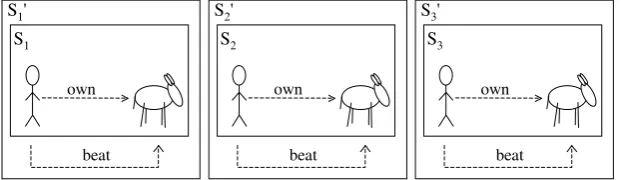
(8) Every situation can be divided up in such a way that for every sub-situation that involves a farmer, a donkey he owns, and nothing else, there is a situation that involves the farmer, the donkey, the ownership, and the fact that the farmer beats the unique donkey in that situation.
An example of such a situation can be seen in figure 1, where for each of the minimal farmer/donkey situations s1, s2, and s3 there is an extension s1′, s2′, and s3′ respectively wherein the farmer beats the donkey.
own
beat
S1 S
1'
own
beat
S2 S
2'
own
beat
S3 S
[image:6.595.139.450.397.487.2]3'
Figure 1. Example of Elbournian situations
At first blush, this solves the problem, as, by virtue of being minimal, the minimal situation will never contain more than than the single donkey necessary to make the subject have the property of being a farmer who owns a donkey. This donkey makes a good unique referent
7
(within the context of the situation) for the definite description to pick up. Thus, the E-type reference problem seems to be solved8.
3.2. The Problem
The preceding discussion, however, contains a henceforth unstated as-sumption. Namely that, whenever donkey anaphora occurs, an appro-priate minimal situation that will provide a unique referent is available. Unfortunately, this is not always the case.
3.2.1. The donkey that lost its fleas
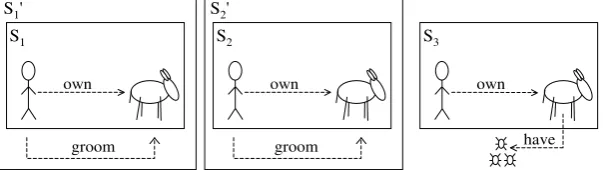
For example, take a world in which there are three farmers (A,B,C), each of which owns a donkey. Farmers A and B each take good care of their respective donkeys, grooming them daily. As a result, their donkeys have no fleas. Farmer C, however, does not groom his donkey, which has many fleas. This situation is shown in figure 2 below.
own
groom
S1
S1'
own
groom
S2
S2'
have own
[image:7.595.137.439.329.414.2]S3
Figure 2. The donkey that lost its fleas
It is pretty uncontroversial that sentence (9) is true in this context (ignoring causality for the sake of simplicity):
(9) Every farmer who owns a donkey which has no fleas grooms it.
But applying the minimal situation analysis as given above to this sentence, (9) is false in this scenario.
This can be seen by closely examining figure 2. There are three situations that involve farmers/donkey pairs (s1,s2, ands3). Note es-peciallys3, which involves farmer C, his donkey, the owning relationship between them, but no fleas, nor possession relations between the fleas and the donkey. s3 conforms to the requirements of being a minimal situation that contains a farmer who owns a donkey which has no fleas.
8
Due to the denotation of every, every such minimal situation needs to have an extension wherein the farmer in question (farmer C) grooms the donkey. However, there is no situation that satisfies that requirement, and thus the sentence is false.
3.2.2. The donkey hiding out of the situation’s reach
A second manifestation of this problem can be seen in the following sentence:
(10) Every man who owns a farm beats every donkey in it.
According to the minimal situation analysis as given above, this is a tautology.
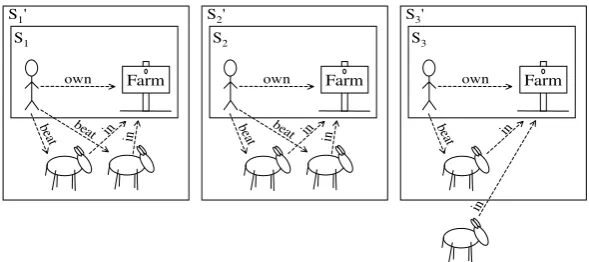
This is because the restriction of the quantifier requires that the quantification be over minimal situations in which a man own a farm. These situations obviously do not include any donkeys, as none are mentioned in the quantifier’s restriction. But every such situation has many extensions which have nothing to do with donkeys or beatings. Let us take the scenario given in figure 3 below. In such a scenario, the sentence intuitively comes out as false, as not all the men beat all the donkeys in their farm. Specifically, the man in s3 fails to beat one of the two donkeys in the farm he owns.
own S1 S1'
Farm
be
at beat in in
own S2 S2'
Farm
be
at beat in in
own S3 S3'
Farm
be at
in
[image:8.595.144.439.401.532.2]in
Figure 3. The donkey hiding out of the situation’s reach
thus the farmer beats every donkey in them by default. Thus, (10) is always going to be true9.
3.2.3. What went wrong
There is a clear intuitive notion of what is wrong in these examples. In (9), The minimal situation that includes farmer C and his donkey includes no fleas; yet it feels like it should not count as a minimal situation of a farmer who owns a donkey with no fleas, as the donkey in question does have fleas outside this situation. In (10), it does not feel sufficient that for every man/farm pair there is an arbitrary extension in which all the donkeys in that extension are beaten. Rather, it seems that the man should beat every donkey in an extension includes all the donkeys in the farm.
It is here that persistence is needed.
In (9), what is necessary is to quantify over minimal situations that involve a donkey with no fleas,andare not sub-situations of a situation for which said donkey has fleas. In (10), it is required that the man beat every donkey in the farm in the situation in question, and that there be no extension of that situation in which the farmer doesn’t beat every donkey in the farm.
Thus, it can be seen that ignoring persistence creates problems for Elbourne’s framework. The obvious way to correct these problems is to reintroduce persistence into the equation.
4. Persistence - consequences and implementation
In the previous section, I found some problems for the Heim/Elbourne analysis of donkey anaphora and suggested that modifying their theory to ensure persistence will solve these problems. In this section I shall demonstrate this.
4.1. Persistence and monotonicity
Not all determiners need to have persistence explicitly written into their denotations. Those that denote quantifiers that are upwards monotone on both arguments are, in fact, persistent by default.
9
To see why monotonicity matters, it is helpful to look at the deno-tation of a quantifier that does not have persistence written in, such as the denotation of every given in (3), repeated below as (11):
(11) JeveryK=λfhhsei,hstiiλghhsei,hstiiλs. For allxhei: iff(λs.x)(s) =
1,g(λs.x)(s) = 1
The quantifier is restricted to entities x that have property f in a situations. Because the sub-situation relation≤is upwards monotone, then, assuming that f does not in itself contain any downwards entail-ing operators, if somethentail-ing has the property f insit has the property
f in every s′ such that s′ ≤s. In other words, the set of xs that have property f insis a subset of the set of xs that have the property f in
s′.
Thus, going from a situation to an extension of it in essence replaces the domain argument of the quantifier by a superset of it. This is always safe if the determiner is upwards monotone in its restriction, but not if it is downwards or non-monotone in that argument. Parallel reasoning applies to the nuclear scope of the determiner. This means that if a determiner is upwards monotone in both arguments, nothing needs to be added for it to provide persistent quantification10.
4.2. Quantifier monotonicity vs. sentential entailment
It is worth noting that it is the monotonicity of the quantifiers that mat-ters, rather than the entailment properties of any particular sentence. For example, note that for (9), the quantifierno fleasis embedded in the restriction of the quantifierevery farmer. This means that the argument slots of no fleas are actually an upwards entailing environment, as can be seen from the following inference pattern:
(12) Every farmer who owns a donkey which has no fleas grooms it. (13) a. ;Every farmer who owns a donkey which has no red fleas
grooms it.
b. ⇒Every farmer who owns a donkey which has no parasites grooms it.
Based on this information, one could be led to expect that there should be no persistence problems associated with the arguments of no. But,
10
as shown in section 3.2.1, that is incorrect. The reason is that while entailment is calculated by the sentence as a whole, persistence must be ensured in embedded propositions as well as matrix ones. (9) can be paraphrased as the follows:
(14) Every x of which it holds that x is a farmer that owns a donkey that has no fleasis such thatxgrooms the relevant donkey.
For the whole sentence to express a persistent proposition, the bolded proposition must itself be persistent for each x. If it is not, then going from a situation to an extension of it may alter the domain of the matrix quantifiers, by changing whether individual farmers fall under the restriction or not. This is the nature of the problem in example (9). Thus, the nature of the embedded quantifier is relevant, even if ultimately its arguments end up being an upwards entailment envi-ronment. This shows that the decision in Kratzer (1989) to include the persistence condition in the denotation of (non-upwards monotone) quantifiers is the correct way to handle persistence, and I will follow suit.
4.3. Implementing persistence
Since failures of persistence arise when a proposition that was true in a small situation fails to be true in a larger one, the best way to prevent this is to check that the proposition holds in as large a situation as possible. This is a potential problem, as the Heim/Elbourne solution for donkey anaphora relies on the presupposition that minimal situations give unique referents. Can persistence be implemented in a way that satisfies both demands?
In fact, there is no need to look beyond what was already discussed to find an implementation that makes this possible. The persistent quantification in Kratzer (1989) adds a condition that the individuals quantified must satisfy the restriction of a quantifier in the largest situation available (i.e., the entire world)in addition to the situation quantified over. This denotation allows checking persistence against the maximal situation w, while at the same time the actual quantification remains on truly minimal situations. Thus, the best of both worlds has apparently been achieved, at least as far as using situations to account for donkey anaphora. Adding such a condition to Elbourne’s
every results in the following:
(15) Persistent minimal quantification:
= 1, then f(λs.x)(s1) = 1 and for every minimal situation s2 such that s2 ≤ s1 and f(λs.x)(s2) = 1, there is a situation
s3 such that s3 ≤ s1 and s3 is a minimal situation such that
s2≤s3 and g(λs.x)(s3) = 1
This denotation of every (and a similarly modified denotation for no) would avoid both of the problems for Elbourne’s system. In the case of the donkey that lost its fleas, the reasoning is simple: farmer C is not a farmer who owns a donkey with no fleas in w, and thus does not fall under the domain of quantification. The other problem is a bit more complex: the matrix every quantifies over all the men in w that own a farm, and for each minimal situation that includes such a pairing, it states that there is an extension wherein every donkey in the farm is beaten. So far, the persistence makes no difference. But the embedded
every now quantifies over every entity in w that is a donkey in the farm in the relevant minimal situation, rather than just those donkeys that are present in an arbitrary situation. Thus, no donkeys can escape notice.
But this denotation is only possible under the assumption that refer-ence towin a determiner denotation is unproblematic. In the following section, it shall be shown that this does not fit comfortably with other recent uses of situation semantics.
5. Persistence and contextual restriction
One property of persistent quantification as discussed so far is that it is global; every quantifier in some sense quantifies over the whole world.
If nothing further is said, this leads to strange-looking predictions. Take the following sentence, for example:
(16) Every tree is laden with wonderful apples.
By global persistence, (16) would only be true if every tree in the entire world is laden with wonderful apples. Kratzer (1989) solves this by ap-pealing to contextual domain restriction to fill in additional descriptive material. According to her, (16) really should be given a reading along the lines of the following:
(17) Every tree [in my orchard] is laden with wonderful apples.
(1989) does not provide an actual theory of contextual restriction, she is clear that this must be done by an additional mechanism rather than then the situations themselves, explicitly rejecting the theory of contextual restriction provided in Barwise and Perry (1983) because it relies on non-persistent propositions.
5.1. Contextual restriction via topic situations
In contrast to her earlier position, Kratzer (2004) proposes that con-textual restriction should be accounted for not by adding descriptive material to the sentence, but rather by applying the proposition in question to a topic situation, which contains only the contextually relevant entities.
According to Kratzer, utterances in context represent an Austinian proposition (after Austin, 1950) - that is, a pairing of a topic sit-uation and a proposition <s, p>. An assertion operator assert is responsible for applying the topic situation as a situation argument for the proposition (i.e., the one required by the λs of the highest scope operator)
(18) JassertK(<s, p>) =p(s)
Since every embedded operator is passed a situation variable by the next higher operator which is a sub-situation of the situation param-eter of that operator, this ensures that all quantifiers are restricted to elements of the topic situation.
Put differently, this system relies on the principle that each operator only has access to the situation that the operator above gives it, and can only pass down parts of that situation to lower operators. This, indeed, recaptures one of the intuitive uses of situations; they are used in order to talk about just part of the world11.
This principle would be nullified if direct reference to w is allowed, such as used above to ensure persistence. Doing so allows a quantifier to see information that was not strictly passed down to it by a higher operator. For example, imagine the following scenario: yesterday, a semantics exam was graded. Exactly one student got a B; surprisingly, she did so without making any actual errors, but just by failing to answer questions in a satisfactory manner. (19) is true in this scenario:
11
(19) Some student who made no errors got a B.
(19) requires the existence of a student who made no mistakes in the relevant context - i.e., on her semantics exam. It will not be falsified if that same student made an error in her phonology exam.
However, if persistence is checked relative to the world, then the error on the phonology exam will be enough to remove the student from the domain of quantification (for there are errors in w which she made), thus falsifying the sentence12.
5.1.1. Local persistence
Accepting the theory of contextual restriction in Kratzer (2004), then, means that a different way of implementing persistence is necessary: one wherein persistence is local to the situation which the quantifier received as an argument.
Note that, if minimal situations are ignored, local persistence actu-ally comes for free in Kratzer (1989). The denotation ofevery given in (3) (repeated below as (20)) is only problematic as far as persistence is concerned because the situation argument a given sentence takes would often be smaller than the entire world, which was the global level up to which persistence was desired. If, following Kratzer (2004), this situation variable is taken to always reflect the contextual domain wherein persistence needs to hold, (3) (repeated as (20)) will suffice.
(20) JeveryK=λfhhsei,hstiiλghhsei,hstiiλs. For allxhei: iff(λs.x)(s) =
1,g(λs.x)(s) = 1
In the Heim/Elbourne system, however, things are not so simple. The first problem is that having the property specified in the restriction is only checked in a minimal situation, not in the actual contextual situa-tion. This can be solved with a minimal modification of (15), replacing
12
One possible objection at this point is that the sentence is true even in the larger situation because of implicit anaphora within it; in other words, that the sentence really means:
(i) Some student who made no errorsin an examgot a Bin that exam.
the reference tow with reference toevery’s situation parameters1, as follows:
(21) Locally persistent minimal quantification:
JeveryK=λfhhsei,hstiiλghhsei,hstiiλs1. For everyxhei: iff(λs.x)(s1) = 1, then for every minimal situations2 such thats2≤s1 and
f(λs.x)(s2) = 1, there is a situations3 such that s3 ≤s1 and
s3 is a minimal situation such that s2 ≤s3 and g(λs.x)(s3) = 1
(21) can handle the problem of the disappearing fleas as well as (15) can. Simply put, it is not sufficient that a minimal situation can be found that contains a farmer, his donkey, and no fleas, it is also necessary that he has no fleas in the context situation. This is all that is necessary to get the correct reading for that sentence.
However, there is a second problem. Unlike in the simple case of (3), in the minimal situation-based theory embedded quantifiers no longer have access to everything in the topic situation, but only have access to what is in the situation passed down to them from the higher quantifier, as desired. This, unfortunately, reintroduces the other problem. To see this, lets return to (10), repeated as (22):
(22) Every farmer who owns a farm beats every donkey in it.
As before, the minimal situation (call it sf arm) in which a farmer x
owns a farm contains no donkeys. Now take an arbitrary extension (sf arm+) of that situation, such that sf arm+ contains no donkeys. By the definition of the quantifier, it is now necessary to check whether
beats every donkey in it is true of x in sf arm+. This involves passing
sf arm+ as the situation parameter of the embedded quantifier every. This is the largest situation which the persistence condition of every
can see. But there are no donkeys in the farm in sf arm+. Thus, the
persistence condition is toothless in this scenario.
Thus, domain restriction that relies on situations variables being passed down from one operator to the next prevents using persistence to solve the problem of elements hiding outside minimal situations.
5.1.2. Possible alternatives
Other methods of using situations for domain restriction may not suffer from this problem:
(23) Locally persistent minimal quantification (alternative): JeveryK= λfhhsei,hstiiλghhsei,hstiiλs1. For every xhei:
iff(λs.x)(stopic) = 1, thenf(λs.x)(s1) = 1 and for every
min-imal situations2 such thats2 ≤s1 and f(λs.x)(s2) = 1, there is a situations3such thats3 ≤s1ands3is a minimal situation such thats2 ≤s3 and g(λs.x)(s3) = 1
Another possibility, raised by Recanati (2004), is that topic situations are not used to saturate a situation argument slot, but rather are added as a form of semantic enrichment. Such a system would differ enough from Kratzer (2004) that the results above would not necessar-ily hold for it (though other problems may well rise, based on the exact implementation).
6. Conclusion
In this paper, I explored the notion of persistence and have shown that the form in which it is implemented has crucial consequences for the applications of situation semantics in linguistics. While it is debatable whether a global implementation of persistence, wherein it holds all the way up to the entire world, is necessary, some form of persistence is needed to avoid information “leakage” between embedded quantifiers and the quantifiers scoping over them. One example of such a problem, which arises in the system of Elbourne (2005), was described.
Attempting to solve this problems taught us more about the nature of persistence and how it interacts with minimal situations. Along the way it was shown that implementing a persistent minimal situations approach to donkeys is impossible if the contextual restriction method proposed in Kratzer (2004) is also used. This incompatibility goes unnoticed if persistence is ignored.
References
Austin, J. L.: 1950, ‘Truth’. In:Philosophical Papers (3rd
edition). Oxford: Oxford University press, pp. 117–133.
Barwise, J. and R. Cooper: 1981, ‘Generalized quantifiers and natural language’. Linguistics and Philosophy4, 159–219.
Barwise, J. and J. Perry: 1983,Situations and attitudes. Stanford, California: CSLI Publications.
Berman, S. R.: 1987, ‘Situation-based semantics for adverbs of quantification’. In: J. Blevins and A. Vainikka (eds.):University of Massachusetts occasional papers 12. Amherst: GLSA.
B¨uring, D.: 2004, ‘Crossover situations’. Natural Language Semantics12, 23–62. Cooper, R. P.: 1991, ‘Persistance and structural determination’. In: J. Barwise, J. M.
Gawron, G. Plotkin, and S. Tutiya (eds.):Situation Theory and its Applications, Volume 2, Vol. 26 of CSLI Lecture Notes Series. Stanford, California: CSLI Publications, pp. 295–309.
Elbourne, P.: 2005,Situations and individuals. Cambridge, Mass.: MIT Press. Evans, G.: 1977, ‘Pronouns, quantifiers and relative clauses’. Canadian Journal of
Philosophy7, 467–536.
Evans, G.: 1980, ‘Pronouns’. Linguistic Inquiry11, 337–362.
von Fintel, K.: 1995, ‘A minimal theory of adverbial quantification’. In: B. H. Partee and H. Kamp (eds.):Context Dependence in the Analysis of Linguistic Meaning: Proceedings of the Workshops in Prague, February 1995, Bad Teinach, May 1995. IMS Stuttgart Working Papers, pp. 159–193.
von Fintel, K.: 2004, ‘Restrictions on quantifier domains’. Ph.D. thesis, U. Mass, Amherst.
von Fintel, K.: 2005, ‘How to Count Situations (Notes Towards a User’s Manual)’. ms, MIT.
Heim, I.: 1990, ‘E-type pronouns and donkey anaphora’. Linguistics and philosophy
13, 137–177.
Kratzer, A.: 1989, ‘An investigation of lumps of thought’.Linguistics and philosophy
12, 607–653.
Kratzer, A.: 2002, ‘Facts: particulars or information units’. Linguistics and philosophy25, 655–670.
Kratzer, A.: 2004, ‘Covert domain quantifier restrictions’. U. Mass Ms.
Kratzer, A.: 2005, ‘Constraining premise sets for counterfactuals’. Journal of semantics22, 153–158.
Kratzer, A.: 2006, ‘Situations in Natural Language Semantics’. Ms, U. Mass, Amherst. To appear in Stanford encyclopedia of philosophy.