SMBs Can Cut IT Costs by over 50%
and Increase Performance by Subscribing to
Hosted IT Infrastructure Services
www.frost.com
Stratecast
(Division of Frost & Sullivan)
TABLE OF
CONTENTS
SMBS CAN CUT IT COSTS BY OVER 50% AND INCREASE
PERFORMANCE BY SUBSCRIBING TO HOSTED IT
INFRASTRUCTURE SERVICES
INTRODUCTION
Data centers and complementary security infrastructure are essential elements of any business. Whether to interact with customers, collaborate with business partners, or equip workers with access to the latest files and productivity-enhancing business applications, these critical operations require a well-designed and well-run IT infrastructure.
Too often, however, businesses conclude that the only means to have the IT infrastructure that can meet—or at least come close to fulfilling—their business objectives is to own and self-operate the entire IT infrastructure. To be blunt, this conclusion is inaccurate. There is a better and more economical alternative, which is known as hosted IT infrastructure—and its benefits to small and mid-sized businesses (SMBs) are overwhelming. Not only can subscribing to a hosted IT infrastructure service match the capabilities of an owned and self-operated approach (frequently referred to as DIY or Do-It-Yourself), but it also has very attractive near- and far-term financial benefits. For SMBs struggling to compete with larger enterprises that have deeper pockets, hosted IT infrastructure also offers an effective pathway to the latest in IT innovation.
To be fair, accepting that hosted IT infrastructure is superior represents a “leap of faith” for many businesses since DIY has long been standard practice. Therefore, it is the foremost purpose of this brief report to describe the financial and other real benefits we believe SMBs gain in subscribing to a hosted IT infrastructure service.
Furthermore, merely recognizing that subscribing to a hosted IT infrastructure service is the right model does not guarantee that the benefits will materialize. Only through the selection of a competent provider can the benefits become real. To that end, in the second section of this report, we share our checklist of essential attributes to seek in a hosted IT infrastructure provider.
Top Five Reasons Why SMBs Should Adopt Hosted IT Infrastructures in 2011
I. SMBs Can Dramatically Cut IT Costs; over 50% Reduction
To arrive at this cost savings, we used a “bottoms-up” approach for estimating the total cost of operation (TCO). We use as a basis a 100-employee business and the costs it would incur in building and maintaining a typical DIY infrastructure to support the SMB’s Web applications, by comparing costs to a hosted IT infrastructure service with
equivalent levels of functionality and quality of service. We have chosen a three year span to calculate our TCO, based on standard amortization rates for equipment.
We estimated the TCO based on a standard configuration for a data closet with two virtualized servers. Table 1 lists the expected TCO associated with the listed components of a DIY installation and the equivalent TCO for a hosted option. (See Appendix for details on DIY option.)
Table 1:
TCO Analysis: Do-It-Yourself Versus Hosted Options
Source: Stratecast
TCO Analysis (Three Years) DIY Hosted
Virtualized Servers (Two)
Dell PowerEdge R710
Dual Intel Xeon E5620 2.4 Ghz, 12M Cache, Turbo, HT, 1066MHz Processors 6x4GB Memory
300 GB 15K RPM Serial-Attach SCSI 6 Gbps 3.5 in Hotplug Hard Drive VMware ESXi v4.0.2, 2CPU Embedded, Standard Virtualization Onsite install
ProSupport and Mission Critical 4 hour 7x24 onsite hardware support
$26,513 Included
Back-up Storage Hardware (One)
Dell PowerVault 114X
ProSupport and Mission Critical 4 hour 7x24 onsite hardware support
$2,848 Included
Network Router (One)
Cisco 2921 Integrated Services Router (ISR)
Cisco Enhanced EtherSwitch Services Module Advanced-switch-15 ports Cisco SMARTnet Onsite Premium extended service agreement—on-site
$5,962 Included
Cyber Security Hardware and Software (One)
Cisco Adaptive Security Appliance (ASA) 5510 IPS Solution Bundle Cisco Services for Intrusion Prevention Systems On-Site Support
$7,460 Included
Basic Colocation
14U rack space
Multi-homed Tier 1 Internet access, 100 Mbps dedicated Redundant power
Carrier-grade data center (e.g., SAS 70 type II certified, video surveillance, multiple factor access authentication)
Server status monitoring (i.e., on or off)
$35,024 Included
IT Personnel
Contracted Network Engineer (40 hours setup per server at $120 per hour) Contracted System Administrator (50 hours per month at $80 per hour)
$153,600 Included
The Cost of Disruptions
To complete the financial analysis of DIY and hosted options, an enterprise also must include for financial loss associated with downtime in its business case. This may include power disruptions, network outages, or equipment failures. It may also include major disasters.
Alternatively, the SMB may take additional measures to ensure high levels of availability and protection in the data center. While these measures may be overlooked or avoided as being too expensive, there is increasing pressure—both economic and regulatory—for SMBs to provide a more resilient data center environment. This is especially true for businesses that rely on e-commerce or provide a Web-based service to clients, in which the costs of outages can be quantified in terms of lost business or penalties. It also is true for businesses that are required by law or best practices to continuously safeguard customer or employee data.
To provide sufficient availability would require fully redundant hardware—or sufficient spare parts on-site to avoid several days of downtime during ordering and delivery. It would require 24x7 monitoring of all systems and hardware, and an on-site expert trained in parts replacement. It would require separate power sources, and sufficient network capacity to handle bursty applications.
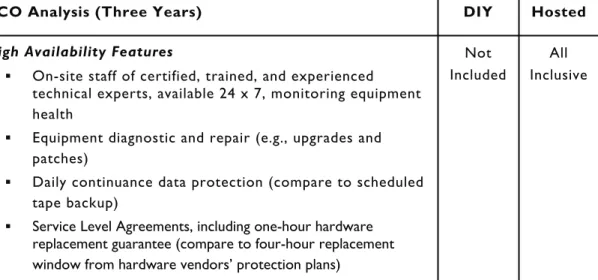
Table 2 lists elements that characterize an enterprise-grade data center, one that meets best-practices criteria for data backup and storage, as well as provides a robust business continuity plan in case of disruption of service. These elements would need to be added to the costs for a DIY data center listed in Table 1; they are included at no additional charge in the offers of a top-tier hosting provider.
Table 2
Additional Elements Required for High-Availability Data Center: DIY and Hosted Options
TCO Analysis (Three Years) DIY Hosted
High Availability Features
▪ On-site staff of certified, trained, and experienced technical experts, available 24 x 7, monitoring equipment health
▪ Equipment diagnostic and repair (e.g., upgrades and patches)
▪ Daily continuance data protection (compare to scheduled tape backup)
▪ Service Level Agreements, including one-hour hardware replacement guarantee (compare to four-hour replacement window from hardware vendors’ protection plans)
Not Included
All Inclusive
Next, we turn from this financial analysis to the equally important quality-of-service analysis. Following are the next four reasons to subscribe to a hosted IT infrastructure provider.
II. Hosted IT Infrastructure Places More Control into the Hands of the SMB
For many businesses, on-site proximity to IT infrastructure and in-house dedicated or contracted personnel provides a comforting sense of control. While there is no question that this is a natural impression, there remains a relevant business question of whether this “comforting sense of control” matters to customers, business partners, and shareholders if the same or better service can be delivered more economically though a hosted IT infrastructure provider. Consider the following points:
The physical location of IT infrastructure is immaterial to users: Globalization, pervasive high-speed Internet access, and user mobilization all contribute to an increasing frequency that users will access Web, e-mail, file, and application servers from an assortment of locations. Consequently, whether the IT infrastructure is on- or off-site to the business is immaterial to users, provided the online experience meets their expectations.
Reputation and credibility are paramount to hosted IT Infrastructure
providers: These providers have been entrusted to manage their subscribers’ IT
infrastructure. For this reason, providers strive to be as devoted to managing their subscribers’ IT infrastructure as if it were their own. Conversely, deviations from that mission jeopardize the provider’s business since they earn their subscribers’ respect and business 24 x 7 x 365. Because hosted IT Infrastructure subscribers typically receive enterprise-grade SLAs, their results can be more predictable than a DIY approach.
Application control remains in the hands of the business organization: In the hosted IT infrastructure model, the provider supplies, monitors, and manages the platform or infrastructure over which applications operate. Since application capabilities—not the platform—are most meaningful to users, businesses should concentrate their focus on applications. Provided the IT infrastructure is managed effectively to complement the applications, the subscriber has then reached an optimal division of labor with the hosted provider that represents core versus non-core.
III. SMBs Gain Technical and Business Flexibility
When a business owns and self-operates its IT infrastructure, conceptually it has unlimited flexibility in choosing infrastructure equipment and suppliers. That flexibility, however, is not free. Time and expertise are required to scan the market, understand the pros and cons of competing products and vendors, purchase, install, configure, test, and place equipment into production. Therefore, reality dictates that IT infrastructure flexibility is not unlimited; it is, in fact, bound by the business’ means to effectively complete each of these essential tasks.
An IT infrastructure provider brings experienced and trained personnel responsible for completing these tasks on behalf of all of its subscribers. As a result, the time spent on these tasks is allocated over the pool of subscribers and, in effect, reduces the cost per subscriber. In addition, hosted IT infrastructure providers conduct these tasks on a frequent basis. Through this exercise, the hosted IT infrastructure provider builds a deeper and fresher market perspective, and hones its expertise to a greater extent than businesses that are engaged in these same tasks on a less frequent basis. Also noteworthy is that SMBs are left to live with their suboptimal selections in a DIY approach. A hosted approach permits flexibility to change.
An additional point on flexibility is the flexibility to scale. Here too, flexibility is bounded by the reality that to rapidly scale requires equipment and facilities—prepared in advance of need—and that preparation is not free. Furthermore, IT infrastructure needs can also fluctuate downward due to economic and seasonal factors that leave the organization with underutilized equipment and facilities that consume similar amounts of power and air conditioning as though they were operating at higher utilization rates. With the hosted IT infrastructure model, fees are more closely aligned with actual consumption, and scaling upward and downward can be accommodated in less than a single business day.
IV. Hosted IT Infrastructure Solutions Reduce Business Risk for the SMB
It is true that a dependency is created when an organization subscribes to the services of a hosted IT infrastructure provider. The organization depends on the reliability of the hosted IT infrastructure provider’s services and the viability of the provider’s business. Service inconsistency—or worse, business failure by the hosted provider—can have serious consequences for subscribers.
While it is impossible to eliminate all of this risk—and no business is immune to business risk—the level of risk is significantly less than at the time of the Internet bubble burst. At that time, there was an overabundance of both hosted data center capacity and providers, and the business plans for many providers were strategically weak. Since the bubble burst, the number of providers has consolidated; the overabundance of data center space has been absorbed; market demand is now growing; and the remaining providers are more experienced and better equipped to adapt to market conditions and to make steady investments in their own businesses. In other words, only the strongest providers have survived and are flourishing. As a positive outcome, the hosted IT infrastructure market is healthier and the business risk to subscribers can be a non-issue if the business completes a little homework before selecting a provider.
In this discussion on business risk, it is paramount to consider the following two points: 1. The hosted provider’s business size, years in the hosted business, and diversity of
subscribers that represent multiple vertical industries will, in many instances, exceed similar measurements of its individual subscribers. Consequently, the hosted provider will have a more stable business climate than many of its
subscribers. Choosing to subscribe to hosted services, in practice, decreases the SMB’s overall business risk.
2. Subscribing to a hosted provider offloads SMB spend and attention to non-core but mission-critical functions. With a hosted provider, the SMB gains undiluted attention and a higher level of expertise on essential business functions, which consequently reduces the SMB’s risk or inability to consistently perform these same functions at an appropriate proficiency level.
V. SMB Competitiveness Improves
If—and this is a major IF—a business has unlimited funds to spend on IT infrastructure and to employ the most experienced and talented IT personnel, a hosted IT infrastructure model is challenged to guarantee that the organization will improve its competitiveness. However, as previously noted, the reality is that most businesses encounter funding and personnel constraints. They cannot afford to have spare capacity available to meet every contingency; they cannot match the competency derived from repetitiveness; their IT staff cannot be singularly and proactively focused on end-to-end management of IT infrastructure; and they do not have the cost advantages produced by the economies of scale of a hosted IT infrastructure model.
Given this reality-based view of resource limitations, organizations that subscribe to a hosted IT infrastructure service are poised to gain the following improvements in their competitiveness:
• A robust and economical IT infrastructure – This leads to favorable and
reliable user experiences, and releases both capital and operational funds to other critical areas of the business.
• Accelerated and dependable adoption of innovation – Through its frequent
analysis of technology, equipment, and suppliers, the hosted provider supports its subscribers by offering new and qualified solutions sooner and with less uncertainty (i.e., certified to deliver incremental benefits) than businesses may be able to accomplish independently. Consequently, in a race to embrace new technologies and products, the hosted provider is a valuable offensive weapon.
• Channeled focus on strategic pursuits – With the IT infrastructure in the
hands of a trusted provider, the SMB’s IT organization is in a new and improved position to funnel more of its attention toward advancing its strategic business goals. In addition, with a more robust IT infrastructure, IT is also better positioned to leverage this infrastructure in ways that were previously not considered (e.g., business continuity and responding to seasonal business opportunities).
Essential Attributes of a Hosted IT Infrastructure Provider
In this section we will describe those attributes that we view as essential in evaluating hosted IT infrastructure providers. While the market consists of a stronger set of providers than in years past, relevant differences do exist such that a side-by-side comparison along these attributes will assist the SMB in making an optimal selection.
• Business vitality – As described previously, the business of hosted IT infrastructure subscribers is dependent on the provider’s “state of business”. A strong state of business is naturally more desirable than a weak one, but certain measurements should be used to make this assessment. Our recommendation is to gather the following measurements:
▪ Growth – Is the provider’s business showing healthy growth (for example:
revenue, number of customers, number of hosted servers, and average level of Internet traffic)?
▪ Customer loyalty– Does the provider have a stable set of customers? For
example, what percent of the provider’s customers have been served for more than three years, and is this percentage increasing?
▪ Cash flow – Is the provider generating a positive rate of return on its
operation?
▪ Re-investments – Is the provider circulating a portion of its profits back into
its core business?
• Proven technical competency – Managing IT infrastructure, by its very nature, is a deeply technical activity. To gauge the provider’s technical competency, the following information should be examined:
▪ Staff accreditations– Staff accreditations should be at least equal to—if not
better than—what the SMB would deem appropriate for its own IT staff. Tenure is also valuable in measuring the collective competency of the technical staff.
▪ Data center and server downtime– “Always open” is the desired metric.
Even a slight amount of downtime at an inappropriate time can have serious consequences for a subscriber’s business, reputation, or both. If the provider’s customer loyalty is strong and growing, this is evidence that downtime has not been an issue with the provider.
▪ Consistent network characteristics– User expectations continue to ratchet
upward. Faster response times are a prime example since faster is always better. Similarly, network tolerances (e.g., latency and jitter) are narrowing as businesses aim to deliver richer, more real-time content and applications to their user communities. Consequently, the network elements within the provider’s data center and with the Internet are critical to assuring that advanced applications function as designed and are available even during peak
loads. Very high bandwidth and redundant peering arrangements with leading Internet backbone providers are critical network characteristics that should be built into a comprehensive hosted IT infrastructure.
• Dependable customer service – An implicit benefit of in-house IT infrastructure is that the IT staff is present to respond—and respond quickly—to operational issues. Moreover, the best staff is proactive; they recognize the link between consistent operations and business objectives; and identify and resolve issues before they affect the business (i.e., noticed by end users). These same attributes should be present in leading hosted IT infrastructure providers. Their technical staff members should demonstrate a genuine ownership mentality through knowledge and actions that previously would only be expected of in-house staff. If this ownership mentality is a consistent theme in customer testimonials from both small and large customers and in unsolicited comments from the provider’s customers, this represents evidence that the hosted provider’s customer service environment is on the mark.
• Flexible service portfolio – Both horizontal and vertical perspectives of the service portfolio should be examined:
▪ With regard to a horizontal portfolio, new server technologies such as virtualization, blades, and chips are constantly being developed, and open source code is gaining momentum in the market. A leading hosted IT infrastructure provider will add steadily to its portfolio server options— horizontal expansion—to give its customers a wider range of price and processing selections to best meet their needs.
▪ From a vertical perspective, there currently is an expanding segment of subscribers that consumes a broader portfolio of on-demand services from their hosted IT infrastructure providers. These subscribers have already confirmed the benefits of a hosted IT infrastructure model and are now leveraging this model in other disciplines of their businesses. Some of the additional on-demand services they are subscribing to include: advanced security services, back-up and recovery, customized support services, and ready-to-go servers. These businesses recognize that an expanded service portfolio can address a critical need for high levels of modularity and flexibility as they create tailored service bundles. These service bundles are optimized quickly and effectively to meet current and future business requirements. These businesses have selected a hosted provider that offers a variety of services with proven high standards of quality for each.
Conclusion
Based on our practical approach to analyzing the business value of the hosted IT infrastructure, the conclusion is clear: hosted IT infrastructure will become a preferred method for supporting the IT needs of SMBs.
In summary, a hosted IT infrastructure service delivers on five critical SMB requirements: 1. Significant cost savings, potentially in excess of 50% over a DIY approach.
2. Greater control over IT operations without increasing internal staff.
3. Higher flexibility in the use of technology and in scaling business operations. 4. A reduction in business and IT risk.
5. Improvement in competitiveness.
Through the course of our research, we examined Lunarpages, a hosted IT infrastructure service provider, and spoke with several of its customers. Based on our analysis, we recommend that Lunarpages be included in SMB evaluations of hosted providers. The company has the experience, business stability, high-end facilities, extremely responsive customer care, and breadth of services SMBs seek; placing Lunarpages as SMBs’ first stop, and likely final stop, in their evaluation cycles.
Lynda Stadtmueller Program Director
Stratecast (a Division of Frost & Sullivan) [email protected]
Michael Suby
Vice President of Research
Stratecast (a Division of Frost & Sullivan) [email protected]
Appendix
Assumptions Behind “Do It Yourself” Costs in Table 1
In creating our “Do It Yourself” data center scenario, we selected components and associated costs that are necessary and typical for a small installation. In this appendix, we provide additional detail behind our assumptions, to enable readers to adapt the model to their own data center needs.
Hardware – The servers, storage device, router and other hardware to support the
SMB applications. The hardware chosen is from Dell and Cisco, due to their popularity among the SMB market; however, comparable equipment is available at comparable prices from other vendors. The cost of the Dell servers includes onsite installation. For our two virtualized servers, we chose Dell PowerEdge R710 quad-core servers, which are popular with SMBs for their energy efficiency and power. In addition, our configuration includes a Dell MD1000 Direct Attached storage device for extra storage; a cabinet to hold the equipment; and a Dell PowerVault 114X tape backup system. Our network router is a Cisco 2921 Integrated Services Router (ISR) with a 15 port Ethernet switch module.
For all hardware, we included mission critical 4 hour 24x7 onsite support for rapid hardware replacement.
Virtualization – As noted above in the hardware section, we choose to virtualize the
two servers. This selection is consistent with recent trends in server virtualization. If a non-virtualized approach was used, the cost of hardware (e.g., three instead of two servers), software, and IT personnel would be higher than currently shown.
Security – Protection of the computing environment; essential for the reliability of the
Web applications (e.g., uptime and responsiveness) and protection of sensitive information. We have selected a Cisco Adaptive Security Appliance (ASA) 5510 IPS Solution Bundle, with the Cisco Services Intrusion Prevention Systems Onsite Support option. As with the server and network router, this hardware also includes onsite hardware support.
Lease premium – Since the use of hosted IT infrastructure is billed monthly, a correct
comparison to a DIY approach must account for the value of monthly billing versus paying for equipment upfront, which reduces an SMB’s available working capital for other critical operations and business investments. We based our calculations on the Fair Market Value lease alternative offered by Dell, with a 36-month fixed-payment plan and similar leasing arrangement from CDW (a Cisco equipment reseller). Other leasing or financing alternatives could be substituted. Regardless of the alternative used, there is a cost incurred by the SMB.
Basic Colocation – A pure DIY approach would require the SMB to build and maintain
a protected (e.g., fire suppression and physical access controls), environment-controlled (e.g., heating and air conditioning) data center facility with multiple Internet links and
redundant power sources. The cost and expertise required for such a facility on a small scale (e.g., a full rack in our SMB example) can be prohibitive for many. For this reason, the popular trend is to subscribe to the services of a colocation provider. Our DIY estimate assumes use of colocation services.
Personnel – With the exception of the lease premium, each of the other cost elements
require regular administrative oversight and management. In our calculations, we assume that an SMB would contract for IT expertise needed to manage the servers, network router, and security appliance rather than hire a full-time employee. We conservatively estimate the requirements at one Network Engineer for 40 hours per server for setup and one Systems Administrator handling backup, patches, security, and other routine functions for 50 hours per month.
We did not include in our estimate other associated staffing costs, such as recruiting, supervision, and training of contracted personnel.
CONTACT US Beijing Bengaluru Bogotá Buenos Aires Cape Town Chennai Delhi Dubai Frankfurt Kolkata Kuala Lumpur London Manhattan Melbourne Mexico City Milan Mumbai Oxford Palo Alto Paris Rockville Centre San Antonio São Paulo Seoul Shanghai Singapore Sydney Tel Aviv Tokyo Toronto Warsaw Silicon Valley
331 E. Evelyn Ave., Suite 100 Mountain View, CA 94041 Tel 650.475.4500 Fax 650.475.1570
San Antonio
7550 West Interstate 10, Suite 400, San Antonio, Texas 78229-5616 Tel 210.348.1000
Fax 210.348.1003
London
4, Grosvenor Gardens, London SWIW ODH,UK Tel 44(0)20 7730 3438 Fax 44(0)20 7730 3343
877.GoFrost
[email protected] http://www.frost.com
ABOUT FROST & SULLIVAN
Frost & Sullivan, the Growth Partnership Company, enables clients to accelerate growth and achieve best-in-class positions in growth, innovation and leadership. The company's Growth Partnership Service provides the CEO and the CEO's Growth Team with disciplined research and best-practice models to drive the generation, evaluation, and implementation of powerful growth strategies. Frost & Sullivan leverages 50 years of experience in partnering with Global 1000 companies, emerging businesses and the investment community from more than 40 offices on six continents. To join our
ABOUT STRATECAST
Stratecast assists clients in achieving their strategic and growth objectives by providing critical, objective and accurate strategic insight on the global communications industry. As a division of Frost & Sullivan, Stratecast’s strategic consulting and analysis services complement Frost & Sullivan's Market Engineering and Growth Partnership services. Stratecast's product line includes subscription-based recurring analysis programs focused on Business Communication Services (BCS), Cloud Computing (CC), Connected Home (CH), Consumer Communication Services (CCS), Communications Infrastructure and Convergence (CIC), OSS and BSS Global Competitive Strategies (OSSCS); and our weekly opinion editorial, Stratecast Perspectives and Insight for Executives (SPIE). Stratecast also produces research modules focused on a single research theme or technology area such as IMS and Service Delivery Platforms (IMS&SDP), Managed and Professional Services (M&PS), Mobility and Wireless (M&W) and Secure Networking (SN). Custom consulting engagements are available. Contact your Stratecast Account Executive for advice on the best collection of services for your growth needs.