This is a repository copy of
A low complexity iterative channel estimation and equalisation
scheme for (data-dependent) superimposed training
.
White Rose Research Online URL for this paper:
http://eprints.whiterose.ac.uk/2483/
Conference or Workshop Item:
Moosvi, S.M.A., McLernon, D.C., Alameda-Hernandez, E. et al. (2 more authors) (2006) A
low complexity iterative channel estimation and equalisation scheme for (data-dependent)
superimposed training. In: 14th European Signal Processing Conference (EUSIPCO), 4 - 8
September 2006, Florence, Italy.
[email protected] https://eprints.whiterose.ac.uk/
Reuse
See Attached
Takedown
If you consider content in White Rose Research Online to be in breach of UK law, please notify us by
Universities of Leeds, Sheffield and York
http://eprints.whiterose.ac.uk/
White Rose Research Online URL for this paper:
http://eprints.whiterose.ac.uk/2483/
Moosvi, S.M.A., McLernon, D.C., Alameda-Hernandez, E., Orozco-Lugo, A.G.
and Lara, M.M. (2006) A low complexity iterative channel estimation and
equalisation scheme for (data-dependent) superimposed training. In: 14th
European Signal Processing Conference (EUSIPCO), 4 - 8 September 2006,
Florence, Italy.
A LOW COMPLEXITY ITERATIVE CHANNEL ESTIMATION AND EQUALISATION
SCHEME FOR (DATA-DEPENDENT) SUPERIMPOSED TRAINING
S. M. A. Moosvi
1, D. C. McLernon
1, E. Alameda-Hernandez
1, A. G. Orozco-Lugo
2, and M. M. Lara
21
School of Electronic and Electrical Eng.,The University of Leeds, Leeds LS2 9JT, UK.
2Secci´on de Comunicaciones. CINVESTAV-IPN. CP 07360. M´exico City, M´exico.
ABSTRACT
Channel estimation/symbol detection methods based on su-perimposed training (ST) are known to be more bandwidth ef-ficient than those based on traditional time-multiplexed train-ing. In this paper we present an iterative version of the ST method where the equalised symbols obtained via ST are used in a second step to improve the channel estimation, approach-ing the performance of the more recent (and improved) data dependent ST (DDST), but now with less complexity. This iterative ST method (IST) is then compared to a different it-erative superimposed training method of Meng and Tugnait (LSST). We show via simulations that the BER of our IST al-gorithm is very close to that of the LSST but with a reduced computational burden of the order of the channel length. Fur-thermore, if the LSST iterative approach (originally based on ST) is now implemented using DDST, a faster convergence rate can be achieved for the MSE of the channel estimates.
1. INTRODUCTION
Digital communication systems require an estimate of the chan-nel prior to equalisation. Chanchan-nel estimation techniques fall into three main categories: blind, semi-blind and trained. In this work we mainly focus on the last category because of its simplicity and satisfactory performance. Normally, the training sequence used for channel estimation is allocated an empty time slot in the transmitted frame, thus wasting band-width. This drawback was overcome when the training se-quence was instead added to the data in what is now called superimposed training (ST) [1, 2]. But since training and in-formation are sent at the same time, from the channel estima-tion point of view, the informaestima-tion interferes with the train-ing and effectively acts as unwanted noise. Later, in [3], a modified ST known as data-dependent ST (DDST) was able to make the information sequence transparent to the training sequence, thus removing the “information noise” and hence significantly improving channel estimation. In this paper we
S. M. A. Moosvi is funded by the ORS Scheme and The School of Elec-tronic and Electrical Engineering, The University of Leeds, Leeds, UK.
E. Alameda-Hern´andez is funded by Secretar´ıa de Estado de Educaci´on y Universidades of Spain and the European Social Fund.
present a similar way of alleviating — but not fully cancelling as DDST achieves— the effects of the information data noise in ST. This is done in an iterative manner, where the equalised symbols obtained through traditional ST in a first step are fed back to the ST algorithm so that the information noise can be reduced, and hence better channel estimation and symbol detection is obtained, which in turn can be used in the next iteration. The cancellation of information noise will only be perfect when accurate equalisation is achieved (i.e. long data records and high SNR). In this situation the iterative ST (IST) will aproach the performance of DDST. The novelty of this IST approach is that by re-using the ST equalised symbols again in the ST algorithm, we get DDST performance, but as we will see later, with relatively little additional computa-tional burden.
An alternative iterative approach, is not to re-use the equal-ised symbols in the actual ST algorithm as we have just pro-posed, but to re-use these symbols for a traditional least squares channel estimate of a fully trained system. This least squares ST (LSST) approach is not new, and has previously been used in [4]. The great disadvantage of LSST is its large computa-tional complexity when compared with the proposed IST al-gorithm.
Now, given that both iterative procedures (the new IST and the already existing LSST) discussed here feed back the equalised symbols obtained with ST, a better performance is expected if DDST is employed instead of ST. But an iterative DDST, in the fashion of IST, will not provide better channel estimates than DDST since DDST already removes the in-formation noise —which is the desired effect of IST. On the other hand, a least squares DDST instead of ST is expected to approach the behaviour of fully trained estimation quicker than the LSST method in [4]. So the objectives of this paper are then:
i) To develop a new low complexity iterative ST (IST) and show that its performance approaches that of DDST.
ii) To develop the iterative method using least squares for DDST (i.e., LSDDST) and to compare its performance with LSST (as proposed in [4]).
and BER after equalisation for the new algorithms of IST and LSDDST along with the existing LSST of [4].
2. ITERATIVE ST (IST) AND LEAST SQUARES DDST (LSDDST)
We start with a brief overview of DD(ST).
2.1. A review of (data dependent) superimposed training
Consider a baseband equivalent digital communications sys-tem within the ST/DDST scenario, where a periodic train-ing sequencec(k)of lengthN and periodP is added to the information bearing symbolsb(k)before transmission over an FIR channel{h(k)}M−1
k=0 contaminated by additive, white, Gaussian noise,n(k). In addition, for DDST a periodic (pe-riodP) data-dependent sequencee(k) =− 1
NP
PNP−1
i=0 b(iP+
k),k= 0,1, . . . , P−1andNP = N
P, is also included at the transmitter [3]. Note that for ST,e(k) = 0. Then in general,
x(k) =
M−1
X
m=0
h(m)b(k−m) +
M−1
X
m=0
h(m)e(k−m)+
+
M−1
X
m=0
h(m)c(k−m) +n(k) +d
(1)
where k= 0, 1, . . . , N−1. In matrix form:
Sh+n+d=x (2)
withs(k) = b(k) +c(k) +e(k). Note thatSis theN ×
M data matrix. We will assume that all terms in (2) can be complex; thatb(k)andn(k)are from independent, identically distributed (i.i.d.) random zero-mean processes, with powers
σb2andσ2nrespectively; thatc(k)is known with powerσ2c = 1
P
PP−1
k=0 |c(k)|2; anddis an unknown DC-offset (see [1, 2] for explanation regardingd). The problem is first to estimate
{h(k)}M−1
k=0 from theN received samples ofx(k), and then via equalisation to estimate the transmitted datab(k). As the method described in [5] can easily be modified to include the iterative process to be described (and this will be shown in a later paper), we will assume for simplicity of presentation that perfect synchronisation and knowledge of the DC-offset are provided. So we can, in what follows, setd = 0 and
P =M. Note thatP > Mis only required if the DC-offset and/or the synchronisation have to be estimated [5].
Now as in [2] we can write
ˆ
y(j) = 1
NP
NP−1
X
i=0
x(iP+j) (3)
withj = 0, 1, . . . , P −1, whereyˆ(j)is an estimate of the periodic (periodP) cyclic meany(j) ≡E{x(iP+j)}. So
from (1) and (3) we can easily show that
ˆ
y(j) =
M−1
X
m=0
h(m)˜b(j−m) +
M−1
X
m=0
h(m)e(j−m)+
+
M−1
X
m=0
h(m)c(j−m) + ˜n(j)
(4)
withj= 0, 1, . . . , P −1, where
˜b(k) = 1
NP
NP−1
X
i=0
b(iP+k) (5)
withk= 1−P, 2−P, . . . , P −1, and
˜
n(j) = 1
NP
NP−1
X
i=0
n(iP+j) (6)
withj= 0, 1, . . . , P −1. So (4) can now be written as
(C+B˜+E)h=ˆy−n˜ (7)
whereCandEareP×Pcirculant matrices with first columns
[c(0)c(1) . . . c(P−1)]T
and[e(0)e(1) . . . e(P−1)]T re-spectively, andh= [h(0)h(1) . . . h(P−1)]T
, with similar expressions foryˆ andn˜. Now theP ×P matrixB˜ can be expressed asB˜ =B˜1+B˜2, whereB˜1is circulant with first column[˜b(0) ˜b(1) . . . ˜b(P−1)]T
andB˜2is upper triangu-lar Toeplitz and [b(−k)−b(N−k)]
NP are the elements of thek-th
(k= 1, 2, . . . , P −1)upper diagonal.
2.2. Iterative ST (IST)
In this section we consider two iterative channel estimation schemes for ST. For the ST case (i.e. whenE=0in (7)) we haveˆy = (C+B˜)h+˜n. And using the channel estimate
C−1yˆ
from [2] then
ˆ hST=C
−1
ˆ
y. (8)
Therefore substitutingˆyfrom (7) we get
ˆ
hST=h+C−1Bh˜ +C−1n˜. (9)
Now we can think of two ways of improving the estimate of
hin the ST scenario. First estimate Sin (2) using the ST algorithm followed by minimum mean square error (MMSE) equaliser (i.e.,SˆST). So the channel estimate using the
least-squares method (ˆhLSST) from (2) (i.e. LSST) would become
ˆ
hLSST= (ˆSHSTSˆST)
−1ˆ
SHSTx (10)
which is essentially what was proposed in [4] and whereˆSST
is a ST estimate ofS. The second approach is to use ST
in (7). So we can improve the channel estimate upon ST in (9) by using iterative ST (hˆIST) via
ˆ
hIST= (C+Bˆ˜)−1ˆy. (11)
Therefore substitutingˆyfrom (7) (withE= 0) we get
ˆ
hIST= (C+Bˆ˜)
−1n
[C+B˜]h+n˜o
= (C+Bˆ˜)−1
(C+B˜)h+ (C+Bˆ˜)−1
˜ n.
Since we assume thatBˆ˜ ≃B˜ then (9) is improved (see (15)) via
ˆ
hIST= (C+Bˆ˜)−1ˆy≃h+ (C+B˜)−1ˆn. (12)
From (11) improved MMSE equalised symbols are obtained that can be fed back again to be used in (11). This itera-tive ST process (IST) can be repeated as needed. The ben-efits of the iterative processes based on (10) or (11) instead of the traditional ST based on (8) are now made clear if we compute the channel estimate MSE. We define MSE(ˆh) :=
EnPM−1
k=0 |ˆh(k)−h(k)|2
o
, then we can show that
MSE(ˆhST) = 1
NP
"
σ2 b
PP−1
k=0 |h(k)|2+σn2
σ2 c
#
(13)
MSE(hˆLSST)≃
σn2
NP(σb2+σc2)
(14)
MSE(hˆIST)≃
σ2n
NPσc2
(15)
assumingSˆST≃SandBˆ˜ ≃B˜in (10) and (11) respectively.
We have assumed training sequences with CCH = P σ2cI, for the usual reasons given in [2, 5]. Since the IST method of (11) is based on first-order statistics, it is computationally very efficient compared to the LSST method proposed in [4], and the performance of the IST will approach that of DDST (see (19)) when accurate equalisation is achieved (i.e. long data records and high SNR).
2.3. Least-squares DDST algorithm (LSDDST)
In this section we present an iterative scheme for DDST. It is not difficult to see that if we choosee(k) = −˜b(k)P, with
k= 0, 1, . . . , N−1and(·)Pimplying arithmetic
modulo-P, in (1) —same result as [3] but obtained via a different analysis— thenE=−B˜1and so for DDST (7) becomes
(C+B˜2)h=yˆ−˜n. (16)
Now if we use a cyclic prefix
b(−k) =b(N−k) P−1
k=1 then
˜
B2=0, but even without a cyclic prefixlimNP→∞B˜2=0.
So let us assume a cyclic prefix (as was done in [3]), but in practice, no cyclic prefix makes little difference sinceB˜2 ≈
0 5 10 15 20
10−5 10−4 10−3 10−2 10−1
SNR (dB)
CHANNEL ESTIMATION ERROR
ST (Theoretical) from (11) ST
IST− 1st iteration IST− 2nd iteration TDM
[image:5.595.326.536.122.290.2]DDST (Theoretical) from (17) Fully Trained (Theoretical) from (12)
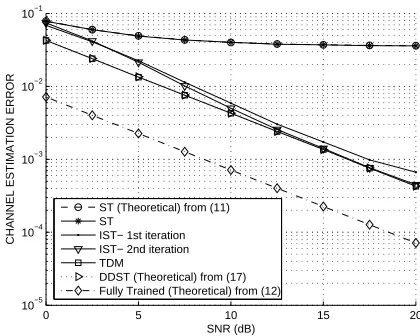
Fig. 1. Channel estimation error for IST. Note that IST ap-proaches DDST. ‘Fully trained’: all transmitted power used for channel estimation (benchmark for any trained algorithm). Note that TDM and DDST coincide and so are indistinguish-able on graph.
0, due to the usual choice of a relatively largeNP. So from (7) with(B˜+E=0)then for DDST we have
ˆ
hDDST=C
−1
ˆ
y=h+C−1
˜
n. (17)
Using an equaliser based on the channel estimates of (17), we can obtain an estimate forSin (2),ˆSDDST. So similarly the
optimum channel estimate (hˆLSDDST) based on (2) andˆSDDST
using least-squares approach would be
ˆ
hLSDDST= (SˆHDDSTSˆDDST)−1ˆSHDDSTx. (18)
As before, usinghˆLSDDSTin (18) and MMSE equalisation a
better estimate forScan be obtained (taking into account the method to removee(k)proposed in [3]), and then fed back to (18) to form an iterative process. Again it is not difficult to show that
MSE(ˆhDDST) =
σ2n
NPσc2
(19)
MSE(ˆhLSDDST)≃
σ2n
NP σb2+e+σc2
(20)
assumingSˆDDST≃Sin (18). Now from (13) we can observe
0 5 10 15 20 10−5
10−4 10−3 10−2 10−1
SNR (dB)
CHANNEL ESTIMATION ERROR
ST TDM DDST
LSST − 1st iteration (method in [4] ) LSST − 2nd iteration (method in [4] ) LSDDST − 1st iteration
Fully Trained (Theoretical) from (12)
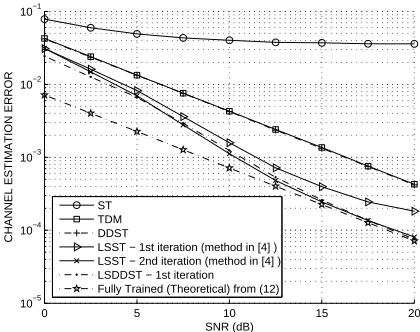
Fig. 2. Channel estimation error for LSST and LSDDST. LSST and LSDDST converge to a fully trained system. Note that TDM and DDST coincide and so are indistinguishable on graph.
2.4. Time Division Multiplexed Training
Traditionally, the training sequence was time division multi-plexed (TDM) with the information sequence. Here we now compare both training schemes in a simplified scenario. So, the first question that arises is how to make a fair compari-sion. We have chosen to force DDST and TDM to provide the same channel estimation error, and then to compare the BERs of both methods. Now, it can be easily be shown that the channel estimation error for TDM is
MSE(ˆhTDM) =
M Nt
σ2n
σt2
(21)
whereNtis the length of TDM training sequence after the memory of the channel is full. Comparing (21) with (19), then DDST and TDM will have same channel estimation error if
N σ2
c = Ntσ2t, since we have assumed P = M, i.e. the period of training sequence is equal to the number of taps in the channel. Note that to estimate the channel under the TDM scheme the memory of the channel must already be full and so Nt+M −1- length training sequence is required with
Nt≥M. Finally, note that for DDST, in addition toNdata samples we require(M −1)- length cyclic prefix. And so TDM and DDST will have the same MSE(ˆh), but TDM will use significantly more symbols(Nt+M−1)for training than DDST uses for its cyclic prefix (M−1)—hence the advantage of DDST.
3. SIMULATION RESULTS
The results of the simulations are shown in Figures 1–3 for three-tap Rayleigh fading channels. The channel coefficients were complex Gaussian, i.i.d. with unit variance. The average
Method Computational Performance
burden approaches
ST ([1, 2]) O(M2+M) –
IST O(3QN) DDST ([3])
for 2 iterations
LSST ([4]) O(N M
2)
Fully trained for 1 iteration
LSDDST O(N M
2)
Fully trained for 1 iteration
[image:6.595.326.545.114.250.2]TDM O(Nt(M2+M) +M2) DDST ([3])
Table 1. Summary of the performance and computational burden of all the methods presented here. Note thatM and
N refer to (1); P refers to the period ofc(k)in (1); andQ
refers to the MMSE equaliser length;Ntrefers to the TDM training sequence of lengthNt+M −1.
energy of the channel was set to unity. The data was a BPSK sequence, to which a training sequence fulfilling CCH=P σ2cI was added before transmission. The training to information
power ratioTIR= σ2c
σ2
b+e
was set to −6.9798dB,P = 7
andN = 420and a linear MMSE equaliser of lengthQ= 11
taps and optimum delay was used throughout. In order to make a fair comparison, we have included the results of chan-nel estimation and BER using the traditional TDM scheme. The channel estimation performance of the DDST scheme is the same as that of the TDM scheme (for the reasons previ-ously described), as is verified in Figures 1 and 2, where the number of training symbols in the TDM scheme isNt+M−
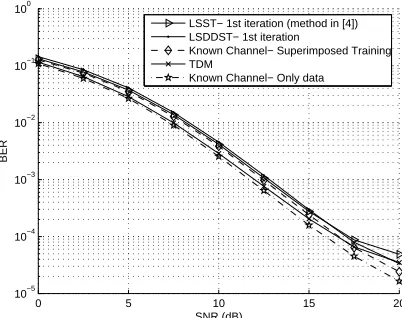
1 = 72, compared to the DDST cyclic prefix ofM −1 = 2. So Figure 1 gives the channel estimation MSE for the IST algorithm. It can be seen that there is a significant improve-ment in channel estimation and it approaches normal DDST and TDM performance just after 2 iterations. Now Figure 2 gives the channel estimation MSE for the LSST algorithm of [4] along with the proposed LSDDST. It can be seen that there is an even larger improvement over the normal DDST and that they both approach the performance of fully trained systems. Note that our method of LSDDST only requires 1 iteration to effectively converge as opposed to the LSST method in [4] that requires 2 iterations. Figure 3 shows the BER perfor-mance for the proposed IST algorithm along with the TDM scheme and when the channel is completely known. We can see that even with the low complexity IST, after two iterations we get virtually the same BER performance as that obtained when the channel is completely known for the superimposed training scheme. Figure 4 shows the BER for the proposed LSDDST algorithm along with the LSST [4]. Again we can observe that the performance of LSDDST is similar to the case when the channel is known completely for superimposed training scheme as well as to that of LSST [4].
[image:6.595.66.276.123.289.2]0 5 10 15 20 10−5
10−4 10−3 10−2 10−1 100
SNR (dB)
BER
ST− No iteration IST− 2nd iteration
Known Channel− Superimposed Training TDM
[image:7.595.71.273.123.283.2]Known Channel− Only data
Fig. 3. BER for IST. ‘Known channel-only data’: BER when the channel is completely known and full power is given to data; ‘Known channel superimposed training’: BER when the channel is completely known and some of the data power is allocated for training.
gives virtually the same BER performance as one iteration of LSST and LSDDST. It can also be observed that while the BER performance of all the proposed methods is very close to the TDM scheme, the latter however consumes more band-width. Table 1 gives the summary of the performance and computational burden of all the methods presented. Note that the computational burden of 2 iterations of IST isO(3QN)
but withO(N M2)per iteration for both LSST and LSDDST, yet all have almost the same BER.
4. CONCLUSIONS
In this paper, the symbols equalised via a hard detector pre-ceded by a linear MMSE equaliser (designed using the chan-nel estimated from an ST approach) are fed back into the ST method. As a result, better channel estimates and hence a more accurate equalisation is possible, which in turn can be used in the next iteration. The theoretical limiting per-formance of this iterative ST method (IST) is that of DDST, which is obtained when good equalisation is possible —long received records and high SNR. In practice, convergence is at-tained in two iterations. Another method, but suffering heav-ier computational burden, was derived by Meng and Tugnait [4]. Here we re-use the equalised symbols, not in the ac-tual ST algorithm as in IST, but for a traditional least squares trained channel estimate (LSST). This LSST method approac-hes, for long data records and high SNR, the performance of a fully trained system after two iterations as regards the channel MSE estimates, and after one iteration as regards the BER. In this paper we also implemented the previous LSST with DDST, so that as simulations illustrate, convergence is achieved after one iteration (for both channel MSE and BER).
0 5 10 15 20
10−5 10−4 10−3 10−2 10−1 100
SNR (dB)
BER
LSST− 1st iteration (method in [4]) LSDDST− 1st iteration
Known Channel− Superimposed Training TDM
[image:7.595.332.533.124.283.2]Known Channel− Only data
Fig. 4. BER for LSST and LSDDST. ‘Known channel-only data’: BER when the channel is completely known and full power is given to data; ‘Known channel superimposed train-ing’: BER when the channel is completely known and some of the data power is allocated for training.
As far as the BER is concerned, simulations have shown that all the iterative methods considered here have approximately the same limiting performance. So, due to their computational burdens it is clear that IST is the algorithm of choice.
One possible application of this work is to use ST on the uplink (with the base-station performing IST estimation) and DDST on the downlink. In this scenario, we will have DDST performance in both directions, but with all the additional computational burden at the base-station, and not at mobile.
5. REFERENCES
[1] J. K. Tugnait and W. Luo, “On channel estimation using superimposed training and first-order statistics,” IEEE Commun. Lett., vol. 7, pp. 413–415, 2003.
[2] A. G. Orozco-Lugo, M. M. Lara, and D. C. McLer-non, “Channel estimation using implicit training,” IEEE Trans. Signal Processing, vol. 52, pp. 240–254, 2004.
[3] M. Ghogho, D. C. McLernon, E. Alameda-Hernandez, and A. Swami, “Channel estimation and symbol detec-tion for block transmission using data-dependent super-imposed training,” IEEE Signal Processing Lett., vol. 12, pp. 226–229, 2005.
[4] X. Meng and J. K. Tugnait, “Semi-blind channel estima-tion and detecestima-tion using superimposed training,” in Proc. IEEE ICASSP, Montreal, May 17–21, 2004.