A Practical Guide to
AUERBACH Data Processing Management Library
James Hannan,
Editor•
Contributors To This Volume
Grayce Booth
Honeywell Information Systems Incorporated PhoenixAZ
James W. Conard Conard Associates, Costa Mesa AZ
Dr. James C. Emery
Professor, Wharton School, University of Pennsylvania Philadelphia PA
Kenneth A. Hamilton
Vice President, Manufacturers Hanover Trust Company New York NY
Samuel B. Harvey
Senior Vice President, Rude, Harvey, Schwartz and Associates Haddonfield NJ
Joseph Hazen
Assistant Vice President, Manufacturers Hanover Trust Company New York NY
John R. Kessler Deere & Company, Moline IL
William E. Perry
CPA, CIA, CISA, President, William E. Perry Enterprises Incorporated Orlando FL
Joseph Podolsky Palo Alto CA
Joseph G. Robertson
Director of Advanced Systems, Rockwell International Corporate Information Systems Center, Seal Beach CA
Jose A. Trinidad
Telecommunications Specialist, Philadelphia PA
Raymond P. Wenig
A Practical Guide to
A
AUERBACH
.
~
Distributed
Processing
Management
Edited by James Hannan
AUERBACH Publishers Inc Pennsauken NJ
Copyright
©
1982 by AUERBACH Publishers Inc
Library of Congress Catalog Card Number 82-11623
ISBN 0-442-20900-2
All rights reserved. No part of this work covered by the copyright hereon
may be reproduced or used in any form or by any means-graphic,
electronic, or mechanical, including photocopying, recording, taping,
or information storage and retrieval systems-without written
permis-sion of the publisher.
Printed in the United States of America
Published in the United States in 1982
by Van Nostrand Reinhold Company Inc
135 West 50th Street
New York NY 10020 USA
16 15 14 13 12 11 10 9 8 7 6 5
Library of Congress Cataloging in Publication Data
Main entry under title:
A Practical guide to distributed processing management.
(Auerbach data processing management library ; 8)
1. Electronic data processing-Distributed processing. 2. Electronic
data processing-Management.
I.Hannan, James,
1946-n.
Series.
QA76.9.D5P73 1982
001.64'404'068
82-11623
Contents
Preface
viiIntroduction
ixChapter
1
A Definitional Framework for Distributed
Processing
Samuel B. Harvey ...
2
Managerial and Economic Issues in
Distributed Processing
Dr. James C. Emery
...
153
Establishing Controls in a Decentralized
Environment
Kenneth A. Hamilton & Joseph Hazen ... 33
4
Planned Migration to Distributed Systems
Grayce Booth ... 49
5
Designing the User System in a Distributed
Environment
Joseph Podolsky
...
596
User Chargeback Procedures for Distributed
Systems
William E. Perry ... 73
7
Establishing Standards for Distributed
Processing
Grayce Booth ... 85
8
Designing an Integrated Communications
Network
Jose A. Trinidad
...
979
Protocols and Compatibility for Distributed
Processing
Contents
10
Information Confidentiality in Distributed
Systems
John R. Kessler ... 123
11
Operational Costs in Distributed Systems
RaymondP. Wenig ... 137
12
The Relationship between Distributed
Processing and Office Automation
Preface
In its relatively brief existence, the computer has emerged from the back rooms of most organizations to become an integral part of business life. Increasingly sophisticated data processing systems are being used today to solve increasingly complex business problems. As a result, the typical data processing function has become as intricate and specialized as the business enterprise it serves.
Such specialization places a strenuous burden on computer professionals. Not only must they possess specific technical expertise, they must understand how to apply their special knowledge in support of business objectives and goals. A computer professional's effectiveness and career hinge on how ably he or she manages this challenge.
To assist computer professionals in meeting this challenge, AUERBACH Publishers has developed the AUERBACH Data Processing Management Library. The series comprises eight volumes, each addressing the management of a specific DP function:
A Practical Guide to Data Processing Management A Practical Guide to Programming Management
A Practical Guide to Data Communications Management A Practical Guide to Data Base Management
A Practical Guide to Systems Development Management A Practical Guide to Data Center Operations Management A Practical Guide to EDP Auditing
A Practical Guide to Distributed Processing Management
Each volume contains well-tested, practical solutions to the most common and pressing set of problems facing the manager of that function. Supplying the solutions is a prominent group of DP practitioners-people who make their living in the areas they write about. The concise, focused chapters are designed to help the reader directly apply the solutions they contain to his or her environment.
AUERBACH has been serving the information needs of computer professionals for more than 25 years and knows how to help them increase their effectiveness and enhance their careers. The AUERBACH Data Processing Management Library is just one of the company's many offerings in this field.
James Hannan Assistant Vice President AUERBACH Publishers
Introduction
In the early days of commercial computing, the size, cost, and technical complexity of computer systems dictated the development of central-ized data processing facilities in most organizations. Requests for application systems were funneled through these central facilities. DP personnel designed, built, and ran these systems at a pace and in a manner designed to accommodate the central computer's capabilities and limitations.
While computers were a novelty and their applications limited, the DP department was able to satisfy most user information needs with this arrangement. As users became knowledgeable about computers and more aware of their applicability to a variety of business problems, however, the DP department was inundated with demands for more and better systems. The now-entrenched centralized DP structure could not respond as quickly or effectively as users thought it should.
Fortunately, a solution lay just over the technical horizon. Advances in engineering and solid-state technology gave rise to computers that were smaller, faster, more powerful, and less expensive than their mammoth forebears. These so-called minicomputers proved to be both a blessing and a curse for DP managers and users alike. Although the new machines promised to reduce the DP department's applications and processing backlogs, they posed serious problems of standards, compatibility, and control. And for those users who gleefully smuggled minis into their departments in a quest for more responsive systems there lurked an unpleasant surprise-effectively operating the new machines required far more technical expertise than users had.
Enter distributed processing. Theoretically compelling, the concept of distributed processing seeks to weave minis, mainframes, software, communications, and data base technology into a responsive, secure corporate information system. Unhappily, the road to such a DP utopia is strewn with technical, procedural, and managerial obstacles. This volume of the AUERBACH Data Processing Management library is designed to help DP professionals charged with planning and administering a distributed system avoid those obstacles.
We have commissioned an outstanding group ofDP practition-ers to share the benefits of their divpractition-erse experience in distributed processing. Our authors have written on a carefully chosen range of topics and have provided proven, practical advice for managing distributed processing more productively.
In Chapter One, Samuel B. Harvey convincingly refutes what
has become almost an article of faith in some DP circles: that distributed processing is so nebulous it cannot be adequately defined. His" A Definitional
Introduction
Framework for Distributed Processing" offers a practical guide that most distributed processing planners will find very useful.
In addition to a useful conceptual framework for distributed
processing, planners and administrators need a high level of managerial and
technical skill. In Chapter Two, Dr. James C. Emery outlines the economic and
managerial considerations that must be taken into account when implementing and administering a distributed system.
Chief among the managerial considerations in a distributed/ decentralized environment is the issue of control. While decentralized units must have a degree of autonomy to profit from decentralization, some level of central control is needed to ensure that the activities of individual units do not work against the overall policies and goals of the organization. Based on their experience in a large banking organization, Kenneth A. Hamilton and Joseph Hazen discuss a strategy for establishing controls in a decentralized environ-ment in Chapter Three.
Many organizations approach distributed processing through the expansion and/or evolution of existing centralized applications. While expanding existing systems is ostensibly less risky than implementing a totally new distributed system, the requirements for migrating current programs, data bases, operating methods, and the like into the new environment can be very complex. Management support of migration planning is needed to minimize the risks. Grayce Booth discusses the management and planning considerations for distributed systems migration in Chapter Four.
No matter how they evolve, distributed systems can provide
users with improved service and greater control over computer resources. In
Chapter Five, Joseph Podolsky examines distributed systems from the user's viewpoint and details the important user-oriented characteristics of distributed
processing. In Chapter Six, William E. Perry discusses the design of user
chargeback systems that, when properly administered, aid management in allocating, promoting, and restricting the use of computer resources.
Planning for distributed processing must also include specific plans for setting and enforcing standards. Because a distributed network in-volves multiple computers, it is all too easy to develop incompatible proce-dures, programs, and documentation. In her "Establishing Standards for Dis-tributed Processing, " Grayce Booth sets down the reasons for standards, points out areas for standardization, and describes practical standardization methods.
The nerve center of any distributed system is its communica-tions network. The current immaturity of telecommunicacommunica-tions technology makes the process of designing a network more complex and delays the fonnulation of a coordinated solution to communications problems. In the face of these conditions, organizations designing a network for distributed process-ing should ensure that their design can grow with the developprocess-ing technologies
Introduction
of the 1980s and 1990s. In Chapter Eight, Jos/! A. Trinidad presents a design methodology that can help planners develop such a network.
An important component of the network planning effort is the area of communications protocols. In his "Protocols and Compatibility for Distributed Processing, " James W. Conard addresses the issues of compatibil-ity inherent in integrating network components and facilities of different suppliers and discusses current efforts to alleviate these problems.
Protecting confidential data is an important concern when dealing with distributed systems. Controls encompass both organizational and procedural issues, including consideration of such elements as return on invest-ment, development methodologies, vendor selection, design alternatives, and education. In his' 'Information Confidentiality in Distributed Systems," John R. Kessler discusses these elements in order to help developers implement the required security measures in distributed systems.
In addition to the direct, visible costs associated with distrib-uted systems (e.g., equipment, space, operators, maintenance), there are also many indirect costs (e.g., media, education, systems support). Many of these costs can be controlled and significantly reduced through proper planning. In Chapter Eleven, Raymond P. Wenig discusses operational costs for distributed systems and the steps that can be taken to control them.
Besides distributed processing, the computer industry has devised another major strategy to increase productivity-office automation. Many organizations with distributed networks will eventually be faced with the task of integrating office information systems into these networks. Joseph G. Robertson outlines the relationship between these two types of information system and includes practical suggestions on how to prepare for their eventual integration.
I
I I
I I
I I
I
I
I
,
II
I
,
I
I I
I I
I
I
I I
I I I I I
I
I
11
A Definitional
Framework for
Distributed
Processing
INTRODUCTION
by Samuel B. Harvey
Several people in the DP industry believe that distributed data processing (DDP) can be all things to all people. Each vested interest can make its own definition to suit its own purpose. To some, in fact, distributed processing is a buzzword created to sell hardware. This lack of clarity would not matter if
DDP were just a fad. DDP is not a fad, however; it is a clearly identifiable
trend that will become the principal method supporting all information
pro-cessing. Definition, therefore, becomes very important. It is impossible to
plan for something that is not well defined. The purpose of this chapter is to provide an analytical framework for understanding and classifying distributed systems.
HISTORICAL DEVELOPMENT
The first electronic computer was built in 1946, and by the early 1950s, business and government began to use computers. The original systems esti-mators felt that a relatively small number of large, powerful machines would perform vast quantities of work because of their high-speed electronic
capa-bilities. It quickly became apparent, however, that even at electronic speeds,
computers had definite limitations. The early expectations of large integrated files from which any combination of desired information could be pulled at random were abandoned. The more realistic approach of bat ching information on relatively slow magnetic tapes was adopted to keep this valuable piece of hardware busy.
Although batch processing suited machine operations quite well, it often inconvenienced the user whose operation, unfortunately, was not batch. In-formation was sometimes late, often not combined in quite the desired man-ner, and frequently difficult to access. These problems often resulted in lost business opportunities. Although the value of computers could not be denied, users became increasingly frustrated by the restrictions imposed by the ma-chine.
2
DISTRIBUTED PROCESSING MANAGEMENTand operating the equipment even higher. Applications were expensive and took a great deal of time to develop. Given these realities, it was necessary to institute tight, organized, central control.
While users were wrestling with the computer's idiosyncrasies, a series of new concepts were built or programmed into equipment in the 1950s and 1960s: simultaneity, multiprogramming, multiprocessing, operating systems, communications monitors, and high-level languages, among others. The ob-jective of these developments was to make big electronic CPUs more effi-cient. Hardware development was so rapid that, by 1965, the DP industry had seen three generations of hardware. Although each generation was technically superior to its predecessor, the rigors of conversion aggravated already strained user relationships.
Rapid technological change also posed major problems for systems profes-sionals. They had to cope with increasing complexity in such areas as commu-nications, data base, operating systems, application specialties, performance monitors, and operations research. The management of these interrelated areas required specialized knowledge and well-developed management skills.
The need for specialization also widened the gap between the systems professional and the user. In the early days ofDP, many systems people were drawn from the business ranks to learn DP. With increased complexity and specialization, however, it became necessary to hire people trained specifi-cally in DP. Unfortunately, these specialists had very little business experi-ence. They were faced with the difficult task of keeping current in a complex technical field while understanding the needs of business users.
Enter DDP
Given the historical problems associated with DP, the need for a new support system that could be modularly designed and tailored to the user's information requirements was obvious. Several developments, which pro-ceeded independently, combined to create the base for a new support environ-ment:
• Large data-utility hardware-Large utilities can process many jobs si-multaneously. These utilities automatically access multibillion-byte files. The utilities also have communications capabilities that make them economically accessible to many people, regardless of their geo-graphic locations.
• Communications-Technical advances in the movement of information over various communications links (e.g., satellites, optics, microwave) provide the capability to transmit information in such large quantities and at such reasonable costs that various geographic locations become insignificant.
A DEFINITIONAL FRAMEWORK 3
• Intelligent tenninals and microcomputers-Low-cost computational ca-pability has been developed at each terminal, along with the ability to tailor terminals to human needs.
• Software-Currently the weakest link in distributed systems, software is showing very positive trends:
-Comprehensive communications multicomputer network systems are being developed.
-Nonprocedural user-oriented languages are being developed. -Data base, random-oriented file systems are maturing.
A FRAMEWORK FOR DDP
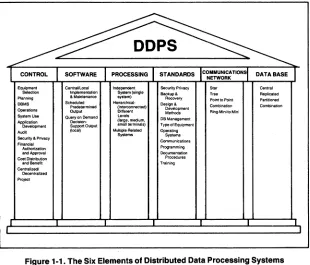
The developments described in the preceding section suggest an analytical framework within which to understand DDP. Distributed processing can be conceived of (and defined) as a group of SUbsystems-processing, networks, software, data base, standards, and control-each with its own functions, yet operating in concert to provide users with more flexible and responsive sys-tems for their business and information needs (see Figure 1-1).
Processing (Hardware)
There are two classes of distributed hardware:
• Class I systems are connected to a communications network. Most distributed systems have (or will have) a communications capability and some logical reason to pass information to another part of the company (or to share corporate resources).
• Class II systems are unique to a particular function and are not con-nected to any ancillary operation. These are independent CPUs that are not part of any master plan.
Distributed Hardware-Class I. There are two types of Class I computer hardware organization: hierarchical systems and distinct-linked systems.
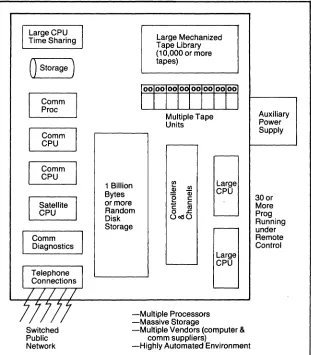
Hierarchical systems are characterized by multiple levels of computational power. For planning purposes, the most common number of levels is four: • Level I-Data Utility. The utility can run many programs and may contain several processors (from one or more vendors). The computer complex can access multibillion-byte files and has a front-end commu-nications capability. The underlying purpose of the utility is to provide modular growth. The utility should provide remote services for trans-action processing, time sharing, and RJE if and when required. A typical Levell configuration is shown in Figure 1-2.
• Level 2-Satellite System. The system can perform four simultaneous functions:
-Multiple RJEs to a Levell (if and when required) by way of high-speed lines (9,600 baud)
-Local batch processing (if and when required)
pass-4 DISTRIBUTED PROCESSING MANAGEMENT
~
~
I CONTROL I SOFTWARE I PROCESSING I STANDARDS ICOMMUNICATION~ NETWORK DATABASE I
Equipment CentrallLocal Independent SecurilyPrivacy Sta, Central Sektction Implementation System (single Baclcup& T ... RepliCated
Planning & Maintel'lBnC8 &yllt.m) Recove.,. Point 10 Polnl Portltloned oeMS Scheduled Hierarchical- Design & Combination
Combination
Predetermined (intetconnected)
Operatlona Output Different Development Methods Ring-Mini 10 Mini SyatemUse Query on Demand Lewd.
DB Management
... lcation Decision- (large, medium,
Development Support Output amaH terminals) Type of Equipment
Audh (local) MuttipleRelated Operating
""' ... P
-Syotem. Systems Financial Communications
Authorization Programming
and Approval Documentation Cost Distribution Procedures
and Benefit Training Centralizedl
Decentralized
Project
[image:17.414.59.369.58.323.2]I
Figure 1-1. The Six Elements of Distributed Data Processing Systems
ing messages to other processors
I
-Performing all message switching necessary to accomplish the pre-ceding tasks
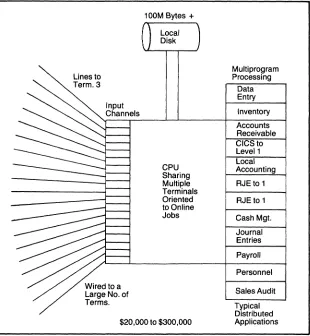
By definition, Level 2 systems range from $30,000 to $300,000 in price. A typical Level 2 configuration is shown in Figure 1-3. • Level3-Intelligent Terminal. There are two types of intelligent
termi-nals: specialized and generalized.
-Specialized terminals contain minicomputers built to handle a spe-cific application (e.g., point of sale [POS], factory data collection, teller terminals, reservation terminals). The terminals are program-mable and can handle a variety of peripheral devices.
-Generalized terminals are small, powerful miniprocessors capable of performing all of the functions of a Level 2 system, except at a reduced capacity. Level 3 processors can approach SOOK bytes of high-speed memory and can support a full range of potential periph-erals. System costs are generally less than $30,000.
A DEFINITIONAL FRAMEWORK
Large CPU Time Sharing
o
Storage)~
~
~
~
Comm CPU Switched Public Network 1 Billion Bytes or more Random Disk Storage Large Mechanized Tape Library (10,000 or more tapes)Multiple Tape Units
f! <IJ
B
~ Gi CPU
e
c::c:
c::as
0 .r:
t)0ISt)
B
CPU-Multiple Processors -Massive Storage
-Multiple Vendors (computer & comm suppliers)
[image:18.414.47.358.61.416.2]-Highly Automated Environment
Figure 1·2. Typical Level 1 Site
Auxiliary Power Supply 30 or More Prog Running under Remote Control
5
The hardware architecture for Levels 2 and 3 is generally engineered to support interactive terminals and a high degree of multiprogramming. Some processors have hardware operating system features.
Most hierarchical systems maintain a degree of central hardware control at the host. A common network control point is sound theory, provided reason-able flexibility within the system is maintained.
6
DISTRIBUTED PROCESSING MANAGEMENTInput Channels
100M Bytes +
CPU Sharing Multiple Terminals Oriented to Online Jobs
[image:19.414.60.370.62.398.2]$20,000 to $300,000
Figure 1-3. Typical Level 2 Processor
Multiprogram Processing
Data Entry
Inventory
Accounts Receivable CICSto Level 1 Local Accounting
RJEto 1
RJEto 1
Cash Mgt.
Journal Entries
Payroll
Personnel
Sales Audit
Typical Distributed Applications
Distributed Systems-Class II. There are systems that process indepen-dent applications that have no relationship to any other processing-there is no reason to communicate. The nature of the specialized function may dictate a completely independent approach to solve a problem. Some scientific appli-cations are in this category, as is process control equipment.
Networks
If computers are the bricks of distributed systems, then communications
networks are the mortar. Communications make distributing the processing a reality. The magnitude of change in communications and the corresponding increase in communications capability are even greater than are advances in the computer hardware field.
A DEFINITIONAL FRAMEWORK
Level 4
-Cards -Badges
Telephones
Level 3
-Small, Powerful CPU -Modular Design -Multiprogramming
Wands-Optical & Magnetic
Level 4
Medium-Speed Printer
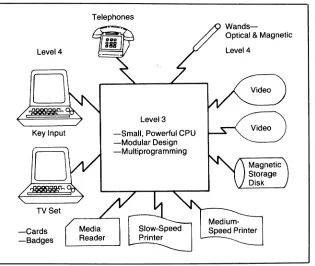
Figure 1-4. Typical Level 3 & 4 Equipment
purposes, this classification scheme is appropriate:
• Classes or spheres of communications (areas being serviced) • Communications architecture (how systems are designed) • Communications elements (the composition of communications)
I
7
Classes or Spheres of Communications. Communications can be
segre-gated into three analytical spheres. Each sphere has distinct characteristics, although they can be bound into a total system:
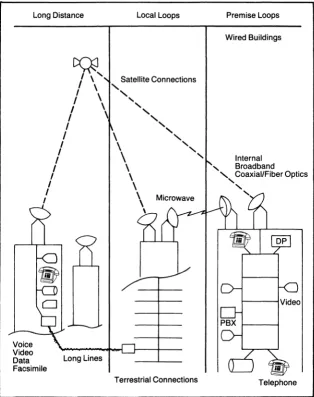
• Premise loops-These are the communications within buildings; this sphere of communications is not regulated. Technological advances, mainly in the areas of coaxial cables and fiber optics, are importarit for this area. The integration of a number of currently independent premise-loop systems into single networks is likely to occur in the near future. The current internal telephone system, office of the future, DP terminals, and video conferencing are key areas that will be affected. • Local loops-These are communications within cities and specific
[image:20.414.49.364.66.332.2]8 DISTRIBUTED PROCESSING MANAGEMENT
• Long distance-These are the channels that link remote areas. Tradi-tionally, they were primarily telephone long lines for voice and, later, high-speed data; slow-speed data was Teletype or TWX. Recently, microwave and satellites have made communication of large quantities of information feasible and economical.
Figure 1-5 illustrates a system composed of the three spheres.
Distributed Communications Architecture. A communications architec-ture is composed of fundamental design elements, which, in turn, are com-bined in a blueprint for a total structure. The architecture should be designed to handle current requirements and to allow for expansion. Examples of design elements are:
• Network structures - Point to point -Ring
-Star -Tree
-Combinations
• Network organization techniques -Store and forward
-Packet switching -Circuit switching -Multiplexing -Compression - Encryption -Data under voice -Digital voice
Examples of total architectures are: • Manufacturers' designs
-IBM's System Network Architecture (SNA) -Digital Equipment Corporation's DECNET
-Sperry Univac's Distributed Communications Architecture (DCA) -AT&T's Advanced Communication System (ACS)
• User designs-These can be service operations, individual users, or consortiums of users, including:
-ARPANET -Telenet -Tymnet -Cybernet
From the maze of available alternatives, each user must select the options that fit the specific organization. The resulting design may be a combination of architectures.
Selecting and designing an architecture is a long-term decision. Because architectural changes are difficult and very expensive, design objectives
should be projected for at least 20 years. Changing elements within an
A DEFINITIONAL FRAMEWORK
Long Distance
~,
I \
I \
I
\
I \
I
\
I
I
I I I
I
I I I
I
Voice Video Data Facsimile
Long Lines
Local Loops
Satellite Connections
'"
,
,
\
\
\
\
\
\
\
\
"
..."
"
,
Terrestrial Connections
9
Premise Loops
Wired Buildings
Internal , Broadband
"
,
Coaxial/Fiber Optics,
,
[image:22.415.46.360.66.463.2]Telephone
Figure 1-5. Spheres of Communications
long-range design, coordinating systems in multiple computers will be costly and cumbersome and will afford the user few options.
10 DISTRIBUTED PROCESSING MANAGEMENT
The elements of a communications system are constantly changing because of rapid technological development. As stated earlier, the objective of the systems planner is to allow insertion of new developments into an architecture that changes much more slowly. Achieving this objective is possible through careful, thorough planning.
Software (Systems and Applications)
Systems software coordinates, drives, and controls the computer! communications network. Systems software includes such items as operating systems, teleprocessing monitors, communications systems, language proces-sors, and service routines.
During the past 25 years, systems software has become so complex that its cost has consumed a major percentage of the savings realized from decreased hardware costs. The large, complicated, centrally oriented systems were de-signed primarily to increase the efficiency of expensive central CPUs. Dis-tributed systems create a completely new environment. The systems problem is more complex because of the number and diversity of elements that must be controlled. The problems, however, are better understood, and the problem-solving tools have much greater power and flexibility.
The trend in distributed processing is toward putting systems software into firmware and also into distributed processors. Using an independent processor to perform a given function avoids the contention problems introduced by multiprogramming, enabling more predictable operating results. In addition, with modular design, a small additional processor can be introduced to in-crease power, providing an alternative to replacing a large system to achieve the same results.
Because the operating systems in distributed processing will proliferate through multiple CPUs and terminals, compatibility among the equipment of competitive vendors becomes a problem. A series of studies designed to address the problems of compatibility are a high-priority item.
While distributed systems raise important issues about systems software, the key questions about distributed systems address applications software:
• How do distributed systems affect users?
• Is there a difference between a distributed and a central system in terms of business operations?
• Is the information support to the business operations stronger? • Are distributed systems a mere technical phenomenon, or do they
rep-resent new business opportunities?
A DEFINITIONAL FRAMEWORK 11
More general advantages in the applications area are also apparent: • Line production operations can now have online tenninal support and
are less vulnerable to CPU failure.
• Input can be validated at its source, eliminating errors that would otherwise be propagated through the system.
• Central control can be effectively implemented by downloading central applications to remote processors and monitoring activity from a cen-tral site. Most large retail POS systems are organized in this fashion. • Conversely, it is possible to allow users to develop their own applica-tions so that applicaapplica-tions will not adversely affect each other and can be clearly charged to the originator.
Parallel developments in applications programming promise to extend the advantages of distributed systems to users. For the most part, programming has been a highly technical activity requiring a good working knowledge of the equipment on which the programs run. The programmer usually translates user specifications into code that can be executed on a computer. Trends in software, coupled with new hardware capabilities, are changing this tradi-tional approach.
A new level of programming-nonprocedural languages-is emerging in which the programmer will no longer have to tell the machine how to fulfill user needs; this step will be automated. In this new environment, the pro-grammer will have to be more familiar with users' needs and ways of doing business than with particular equipment. A new type of programmer-user relationship will emerge. The manner in which this new relationship develops in a distributed environment must be carefully planned and monitored if users are to realize the benefits of more direct interaction with their systems.
Data Bases
The concept of the integrated file, touted in the 1950s as the primaI)' goal of DP, has been resurrected under the rubric data base. The underlying tenets of both concepts are the same: information should be managed as a corporate resource, data should be independent of programs, and storage redundancy should be reduced. Until recently, these goals were unrealizable because the equipment could not handle the load that the goals imposed.
Distributed processing can help solve the problems of equipment limita-tions. Through combinations of specialized modular file processors, distrib-uted computers handling terminals, and distribdistrib-uted communications networks with modular design features, the hardware bottleneck can be opened.
The data base approach is still in the early stages of development; contin-ued research and experience are necessary to fully understand how various data bases will be organized and coordinated on a distributed basis.
Standards
indus-12 DISTRIBUTED PROCESSING MANAGEMENT
try are working to discourage and, in some cases, subvert standardization
efforts (Le., engineering innovation, the competitive desire for product differ-entiation, rapid technological change, and intense market competition). The problem is real because DDP and networks cannot function without stan-dards.
Communications Standards. Communications standards are essential for DDP. Transmitting information among various computers over several types of carriers requires precise interfaces and protocols. Sadly, the cu,rrent situation is not encouraging. Hardware interface standards are difficult to promulgate because so many'vendors desire uniqueness, both for marketing and engineering reasons.
Each vendor also has its own protocols. Either a standard must be devel-oped that defines message formats (the electronic pulse patterns that identify the message, the error recovery procedure, and the message handling sys-tems), or a method must be designed that permits the attachment of nonstan-dard devices to a given system.
Perhaps the most difficult area in the field of communications standards is communications software. The software architecture of distributed systems is not within a single computer but extends into multiple CPUs and even into intelligent terminals. Designing such an architecture is a complex task for a single vendor supplying multiple processing levels; it is many times more complex with various competitive equipment. Advances in this area must await further research and development.
Software Standards. It has been difficult to develop effective application software standards because users seem always to be clamoring for program
changes to meet their specialized needs. Many DP/MIS managers feel that
this problem will be compounded in a distributed environment, as remote users write their own programs with little or no regard for standards.
Standardization is also difficult in systems programming. The different sizes, uses, and configurations of equipment make it difficult to have standard operating systems. As a result, the processing environment between and among systems is often very different. The ideal solution may never be realized. The goal of minimizing intercomputer complexities that do not contribute to a system's utility to the user will be a continuing quest.
Data Base Standards. Data bases that are independent of operating pro-grams containing the basic information of the enterprise will be part of all future systems. Standards are required to help preserve the integrity and control the use of the information. Once again, the issue is complicated by the variety of distributed equipment. The organization and handling of data bases is a major specialty in itself that requires continuing analysis.
A DEFINITIONAL FRAMEWORK 13
FORTRAN, BASIC, and Pascal have been extended to distributed equip-ment. The development of nonprocedural languages that enable users to com-municate directly with the infonnation system will require the same level of standardized effort-the end user has neither the training nor the inclination to deal with nonstandard conditions.
Hardware Standards. For much of its history, the computer industry has witnessed a curious cycle: large, expensive machines have periodically (about every six years) been developed to replace the then-current large, expensive machines. Since it has always been impractical to rewrite the equipment's massive software systems, the new hardware was designed to run the old software. The old software, unfortunately, did not utilize the full capabilities of the new equipment.
Users encountered another problem when their equipment ran out of capac-ity. The only solution was to replace their systems with even larger ones. The incremental steps between generations of hardware were often very large and left many users bewildered.
Distributed processing and networks have significantly altered this histori-cal pattern. Entire networks cannot be replaced periodihistori-cally. Imagine the chaos attendant upon replacing a large POS or hospital system every six years or so. In this environment, growth comes from modular addition rather than from replacement; this requires a new set of standards.
Architectural Standards. Because we are still in the early stages of de-signing and building distributed infonnation networks, the architectural stan-dards for building them have yet to be developed. Until an orderly framework is established, much effort will be expended in uncoordinated efforts that will likely fall short of achieving the real advantages of DDP.
Control
Perhaps no other aspect of DDP raises as many questions or concerns as does control. Essential issues tend to become lost in the swirl of anxieties created by most debates about control. To understand the issues involved, we must ask ourselves two sets of questions: one set from an infonnation manag-er's viewpoint, the other from the point of view of a line manager. Control questions that an information manager must ask include:
• Must all of the equipment be in one room in order to be controlled?
(Doesn't the phone company exert central control over distributed equipment?)
• Who should control data bases?
• How should we treat such issues as standards, downloading, auditing, remote diagnostics, polling, centralized communications, system net-work architectures, and monitoring?
14 DISTRIBUTED PROCESSING MANAGEMENT
A line manager must ask such questions as:
• Do distributed manual operations enable tighter operational control than that of distributed computerized operations?
• Are manual standards easier to enforce than automated ones?
• Are companies going to change their basic organizational philosophies because of a computer system?
• Did control of the business only evolve with the advent of a centralized computer system?
The answer to some of these questions may surprise many managers. For one, the control philosophy of most businesses was established long before that business acquired computers. Organizational control has not changed materially because of computers, nor is there any indication that businesses are reorganizing around computers. In addition, control of a geographically dispersed computer/communications network is not the Byzantine enterprise it is often portrayed as-it is a straightforward, manageable process. Further-more, when information managers really analyze control of input from dis-tributed manual operations and from disdis-tributed automated operations, they will soon realize that it is easier to control input from distributed computers.
CONCLUSION
In order to understand such a complex concept as DDP, it is useful to divide it into categories. For DDP, these categories are discrete subsystems, operating together to form an integral distributed system. We have identified six such subsystems and have outlined the broad dimensions and crucial issues of each. To understand the present and the future of distributed sys-tems, one must carefully track developments in these subsystems. This "modular" approach to understanding the concept will prove a valuable aid
in designing, implementing, and managing an actual DDP system.
72
Managerial and Economic
Issues in Distributed
P rocessi ng
by Dr. James C. EmeryINTRODUCTION
The fantastic mte of development in computer and communications tech-nology opens vast new opportunities for implementing more cost-effective information systems. With opportunities come pitfalls, however: an advance in technology can be applied badly. This is especially true of distributed processing. The distribution of processing power and data throughout an organization can provide more responsive and cost-effective computer sup-port for users; it can also add many new problems of coordination and imple-mentation as well as cause a growth in gmss-roots applications of dubious value. The proper use of technology in a distributed environment calls for increased knowledge and wisdom on the part of managers and technicians alike.
ALTERNATIVE PROCESSING CONFIGURATIONS
Technological developments over the past few years have enabled various new alternatives for system designers. The older approaches-primarily de-centralized standalone computers or shared de-centralized computers-may still be attmctive under certain circumstances, but now designers should also consider hybrid configumtions that combine some of the chamcteristics of both centralized and decentralized systems.
16 DISTRIBUTED PROCESSING MANAGEMENT
central staff provides all technical services and also plays the dominant role in setting development priorities and allocating existing computing resources among competing demands.
Decentralized Systems. Opposite the completely centralized system is the completely decentralized system in which no communications links exist among multiple standalone computers. Each organizational unit having a computer supports the system with its own funds and is totally responsible for development and operation.
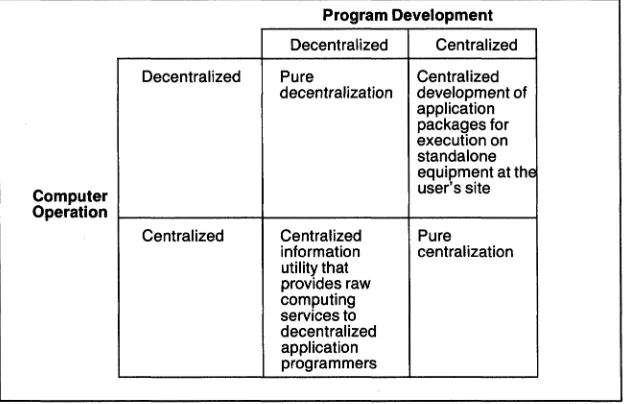
Variations of Centralized/Decentralized Systems. Systems rarely exist in a purely centralized or decentralized form; they usually have some ele-ments of both. Four basic combinations are possible, as indicated in Figure 2-1.
Even within these basic combinations, considerable variation is possible.
For example, decentralized system development and operation may be
con-strained by centrally imposed standards dealing with such matters as proce-dures for cost/benefit justification, equipment selection, design and develop-ment methods, docudevelop-mentation, programming languages, and operating procedures. Similarly, management of a centralized computer center may be influenced by such factors as a policy committee composed of users or a budgeting scheme that permits users some control over their computing ex-penditures (or even over the choice between the central computer or an
exter-nal supplier). Furthermore, the degree of centralization need not be uniform
throughout the organization; for example, a major component of a company
(e.g., the consumer products group) may be decentralized with respect to
Computer Operation
Decentralized
Centralized
Program Development
Decentralized Centralized
Pure Centralized decentralization development of
application packages for execution on standalone equipment at the user's site
Centralized Pure information centralization utility that
[image:29.414.62.374.366.568.2]provides raw computing services to decentralized application programmers
MANAGERIAL AND ECONOMIC ISSUES 17
corporate management but highly centralized with respect to its own subdivi-sions (e.g., the electrical appliances department, refrigerator department).
Distributed Systems. Although the term is often used to describe any-thing from a centralized star network to a completely decentralized system, it is useful to limit the definition to systems with the following characteristics: • Multiple processors with general-purpose computing capabilities
(pos-sibly with a supporting local data base).
• Communications links (often oqly intermittent) among the processors. • Relatively weak interactions among the distributed subsystems, which typically serve separate organizational subunits. (This characteristic excludes tightly coupled processors working in parallel on a coopera-tive computing task. Although many of the technical issues involved in designing a tightly coupled system are analogous to those of a distrib-uted system, the organizational problems may be quite different.) • Considerable centralized coordination in the design and operation of
separate processing subsystems.
Variations in Distributed System Design
A variety of systems fall within the set of characteristics just listed. The principal alternative configurations are indicated in the following sections.
Distributed Processing without Local Data Bases. The most basic form of a distributed processing system is one in which some local processing occurs without the support of a local data base. Any auxiliary storage (e.g., cassette or floppy disk) is limited to storing various routines, input formats, and edited transactions. A typical example is a distributed data entry proces-sor. The local processor prompts the data entry clerk by displaying the data elements required for a given transaction type. The data entered is usually subjected to various editing checks that do not require access to the central data base (e.g., range and mode checks); in particular, a master record to be updated by an incoming transaction is not accessed during first-level editing. Edited transactions are usually stored temporarily in a transaction me and transmitted periodically, perhaps daily, to the central computer for further
processing (generally requiring access to the central data base). If it is
worth-while to reduce the input lag, transactions can be transmitted in frequent batches or even individually (perhaps based on a priority code that governs the transmission delay).
18 DISTRIBUTED PROCESSING MANAGEMENT
during the current pay period, and transaction-level accounting data. The distributed processor may handle all local processing, usually including some online applications (e.g., data entry) and one-time inquiries requiring access to the local data base (e.g., an inquiry on the inventory status of a given raw material). Summary data is periodically transmitted to a central site that handles system-wide processing and maintains a central data base. For in-stance, the central computer might generate weekly aggregate production schedules that take into account overall production requirements and the existing status of each plant. A schedule could then be transmitted to each individual plant, where it is broken down into a more detailed schedule based on the detailed data stored in the local data base.
Rather than being updated from local transactions, a local data base may be
updated by replacing it periodically with a more current version of an ex~
tracted subset of the central data base. This might be a useful approach, for
example, in a bibliographic retrieval system in which new entries are added each day and retrieval concentrated in several geographically separated
loca-tions. Such a design may be justified on the basis of reduced communications
and processing costs (compared with online access to a distant central proces-sor).
Distributed Segmented Data Base with Limited Remote Access. In
some cases, a transaction that originates at one location may require access to data maintained at another location. This design is attractive if there is a relatively low probability of having to access the remote data base; if this is
not the case, a central data base is likely to be more efficient. In a bank
system, for example, each branch may keep the current account balance of
only its own local customers. If a customer wishes to cash a check at a branch
other than his own, the transaction must be transmitted to his own branch to determine whether the account has sufficient funds to cover the check.
To initiate a transaction, a local processor must be able to identify the remote processor that maintains the data base to be accessed. This problem is greatly simplified if the transaction itself contains identifying information (e.g., an account number that uniquely associates a customer with his local bank). Unfortunately, using an external identification number to locate data often builds in unacceptable rigidity, so a more flexible means must often be used. The alternatives are a sequential search (until the desired item is found) of the directory of local data maintained at each site, the creation of a central directory that gives the location of each record, or the maintenance at each site of a duplicate copy of a global directory. The optimum design in a given situation depends on such factors as the frequency of directory updates and inquiries, the cost of communications, and the cost of central versus local storage. Sharing even a relatively simple distributed data base can raise diffi-cult problems (e.g., synchronization among data bases, the avoidance of deadlocks, and fIle security and privacy).
MANAGERIAL AND ECONOMIC ISSUES 19
subsystems. For example, a microprocessor in a petroleum refinery that con-trols a distillation operation might be linked to a plant-wide minicomputer that controls intraplant material flows; the plant computer, in tum, may be linked to a corporate-wide center that handles interplant scheduling.
Fully Distributed Network. The alternatives discussed so far are based on a logically centralized design in which certain functions are physically distrib-uted; they have a hierarchical structure, with a single computer playing a central role. A fully distributed network has no central focus but rather is composed of multiple autonomous processors that have equal control status (although they may vary widely in their computing capabilities). Their pur-pose is to allow resource sharing by separate processors.
The network provides a market in which various services can be bought and sold, with the cost of the services providing the primary means of allocat-ing resources and regulatallocat-ing supply and demand. Hardware economies may motivate some of the network traffic (e.g., load leveling or economy of scale in performing very large "number crunching" jobs). A much more likely application, however, is the opportunity to share specialized programs and data bases. Examples of resources that might be shared include econometric models and data bases, specialized engineering design programs, computer-assisted instructional materials, and bibliographic data bases. A distributed network also provides a mechanism for person-to-person communication among remote sites by means of an electronic mail system.
Other Possible Distributed Configurations. Every information system consists of a collection of functional tasks. In principle, the tasks can be arbitrarily distributed among multiple processors and data bases. In practice, however, problems of coordination, synchronization, reliability, and security may become overwhelming unless the distributed components are largely
independent of one another. If a task interacts strongly with other tasks
(through coupling or shared resources), it is usually better to handle that task within a single processor and data base. Thus, if one subsystem supplies another with high-volume data inputs having very short response-time re-quirements, the two activities should usually be processed within a single computer. Similarly, if such functions as marketing, engineering, manufac-turing, and accounting share a common data base with multiple logical links among data elements, it is extremely unlikely that maintaining duplicate copies of the data base among functionally oriented distributed processors would prove attractive (or even technically feasible at the present time).
CENTRALIZATION VERSUS DECENTRALIZATION
A distributed system is best viewed as a cross between centralization and decentralization. With suitable design, it can provide many of the advantages of both centralized and decentralized systems-and can avoid many of their
disadvantages. It is useful, therefore, to present the arguments in favor of
20 DISTRIBUTED PROCESSING MANAGEMENT
Arguments (and Counter-Arguments) for Centralization
Hardware Economies of Scale. The traditional argument that computer hardware provides substantial economies of scale is no longer very persuasive in most cases. Because hardware constitutes a declining share of total cost, potential economies of scale in hardware have a declining effect on systems design. The availability of very cost-effective minicomputers alters the tradi-tional relationship between capacity and cost and further reduces the pressure for ever-larger computers (although the huge computer-bound tasks found in some branches of science and engineering will no doubt always provide an incentive for expanding the capacity of the largest computers). Auxiliary storage stands as an important exception to the declining significance of hardware economies: very large storage devices continue to provide econo-mies of scale and an incentive to centralize large data bases.
Operating Economies of Scale. Certain operating costs exhibit substan-tial economies of scale. For example, the personnel costs of computer opera-tors, clerical staff, systems programmers, maintenance engineers, and man-agement rise less than proportionally with increases in the size of the computer, provided the variety of functions performed remains relatively
constant. Thus, a single computer center would almost surely be significantly
less expensive to operate than would two or more regional centers that provide a similar full range of services. Frequently, however, growth in center size is
accompanied by an increase in the number and variety of the services it offers.
This can add enormously to the complexity of the system and the costs of operating and maintaining it-and can substantially reduce possible operating economies of scale.
More Powerful Capabilities. A central computer center can support a wide range of services that would be prohibitively expensive to provide at each of several smaller centers. Programmers and designers have become accustomed to powerful operating systems, communications software, data base management systems, application packages, generalized utilities, and programmer aids. Stripped-down minicomputers cannot offer such services. Their less-powerful range of services may reduce programmer productivity or call for a downgrading in the functional specifications of application
pro-grams. If minicomputer applications are simple enough, the lack of
sophisti-cated programmer support services may not be too serious; temptations often arise, however, to add to complexity. To overcome some of their limitations, minicomputer facilities have a habit of growing in size and complexity-and can easily reach an annual budget of several hundred thousand dollars.
Less Total Capacity. The peak load at a centralized computer center is usually less than the sum of the peaks if the same load were distributed among several facilities (unless all peaks coincide, which is unlikely). Thus, the capacity required to provide a given level of service at a central computer is apt to be less than the aggregate capacity needed if demand is split among two
MANAGERIAL AND ECONOMIC ISSUES 21
case of a real-time system that must process randomly arriving transactions within a given response time.
Reduced Number of Facilities. Some difficult management problems arise when the total computing load is fragmented. Hardware maintenance, backup capacity, and physical security become much more serious problems when processing is geographically dispersed. By concentrating all of its ef-forts at a single centralized site, management can more easily provide around-the-clock maintenance, backup capacity, and tight physical security.
Development of Professional Staff. Highly competent systems profes-sionals usually prefer to work with colleagues having similar interests. A central group can more easily achieve a "critical mass" of professionals who work together productively and provide a rich cross-fertilization of ideas. A large central staff can support specialists, who can then be assigned on a temporary basis to given projects. The fragmentation of technicians among decentralized subunits makes it much more difficult to attract and retain competent technical personnel. Assignment to a decentralized subunit may be ideal for someone primarily interested in the career ladder within the subunit; for a person committed to a technical career path, however, a remote assign-ment may make it more difficult to keep current with technical developassign-ments and to compete for advancement with technical personnel who remain in the central staff.
Increased Systems Integration. One of the most persuasive arguments for centralization is that it allows a higher degree of integration than would otherwise be possible. For one thing, centralization fosters the integration of DP by means of increased data and hardware sharing, reduction of undesir-,able redundancy in a common data base, and consolidation of processing
functions (e.g., payroll and personnel). Centralization also facilitates the coordination of organizational activities by providing an organization-wide data base and a more powerful processor capable of handling sophisticated planning and control systems.
Arguments (and Counter-Arguments) for Decentralization
Although a strong case for centralization can often be made, the unfortu-nate fact is that most centralized systems fail to live up to their potential. Large central computer centers are too often inhospitable and unresponsive. They tend to grow continually in size, complexity, and organizational dis-tance from the ultimate user. In reaction to these problems, users often favor a more decentralized system, even at the expense of some lost potential savings from the centralized approach. Although by no means a panacea, decentral-ization does offer some important advantages.
22
DISTRIBUTED PROCESSING MANAGEMENTdecentralized manager can allocate resources and set priorities more in line with the goals of his subunit, rather than conform to the goals of a central group. Contention with other subunits is eliminated so that urgent needs can be satisfied (within the limits of capacity) without coordinating and bargain-ing with external parties. The system can adapt to changbargain-ing needs without negotiating with external groups affected by the change. The argument that equivalent or better service can be provided at lower cost by a central com-puter carries little weight with a lower-level manager who has previously experienced poor service from a central facility. Unfortunately, the expected increase in control and responsiveness of a decentralized computer may often prove illusive, since the small computer often has limited capacity and pro-vides less powerful means to implement effective systems.
Increased Motivation and Involvement of Users. The perception of greater user control, along with the greater simplicity usually offered by a decentralized system, often results in increased user involvement in the opera-tion of a decentralized facility. Users are much more inclined to participate in design decisions and may sometimes even program their applications. The widespread availability of interactive terminals and user-oriented program-ming languages fosters such participation and provides an incentive for users to acquire the skills needed to take advantage of current technology. Further-more, a well-designed decentralized system is likely to become an integral part of daily operations; users thus have a strong motivation to make it work successfully by such means as providing high-quality input data and partici-pating in the correction of design imperfections.
Involvement of this sort is an essential ingredient of a successful system, but, if not adequately controlled, it may have an unfavorable side as well. For example, user control may result in unnecessary duplication of existing appli-cations, waste of programming time, inefficient and ineffective systems be-cause of lack of professional qualifications among decentralized personnel, and hidden costs of systems development.
Economies of Specialization. The argument for decentralization is greatly strengthened if fragmentation permits simplification of each part of a system. Simplification reduces the cost of hardware, systems software, appli-cation program development, and operations. A minicomputer dedicated to interactive BASIC applications, for example, can often get by with a fairly modest amount of primary and auxiliary storage. Only a small staff is required to operate the computer and maintain its relatively simple system and applica-tion programs; it may even run unattended through parts of the day and operate with virtually no software maintenance, beyond infrequent updates to a turnkey system. Similarly, a computer system specialized for chemistry calculations, for example, can avoid unneeded hardware (e.g., high-speed 110 facilities), languages (e.g., COBOL), user services (e.g., program con-sultants), and other overhead costs associated with a large full-service com-.puting center. A specialized online application on a dedicated minicomputer
MANAGERIAL AND ECONOMIC ISSUES 23
required to append it to a finely tuned centralized system. Finally, a special-ized system can substantially reduce the problems of coordination across organizational boundaries and charges for shared resources.
Exploitation of Low-Cost Micro- and Minicomputers. The cost advan-tage of micro- and minicomputers stems from their relative simplicity, their large-volume production (enabling production economies of scale), the lim-ited services furnished by their vendors, their ability to. incorporate recent technology (because of their relatively short design and production cycle), and the keen competition in the marketplace. As a result, these computers offer an extremely attractive price/performance ratio for a variety of jobs. The cost advantage enjoyed by micro- and minicomputers largely depends, how-ever, on their being applied to relatively simple tasks. This, in turn, often comes from the segmentation and specialization achieved through decentral-ization.
Small Increments to Capacity. Because of the limited capacity and low cost of minicomputers, they can usually be added to (or enhanced) in small steps and at low incremental cost. Their delivery lead times from vendors are generally considerably shorter than those of large computers. Capacity adjust-ments can therefore be made fairly quickly in response to existing or antici-pated changes in demand. This fact may substantially reduce the "safety factor" that must be added to expected demand to avoid unacceptable conges-tion. Additions to capacity can incorporate state-of-the-art technology, thus allowing a relatively close tracking of technological advances. In contrast, large computers are typically installed infrequently and in relatively large-capacity increments. This tends to increase excess large-capacity and lengthen the average age of the technology used.
Reduced Communications Costs. A self-contained decentralized com-puter center has little need to communicate with other parts of the organiza-tion. Consequently, communications costs are low, compared with those of a centralized system linked to remote terminals.