V. K. Cody Bumgardner
OpenStack in Action
V. K. CODY BUMGARDNER
www.manning.com. The publisher offers discounts on this book when ordered in quantity. For more information, please contact
Special Sales Department Manning Publications Co. 20 Baldwin Road
PO Box 761
Shelter Island, NY 11964 Email: [email protected]
©2016 by Manning Publications Co. All rights reserved.
No part of this publication may be reproduced, stored in a retrieval system, or transmitted, in any form or by means electronic, mechanical, photocopying, or otherwise, without prior written permission of the publisher.
Many of the designations used by manufacturers and sellers to distinguish their products are claimed as trademarks. Where those designations appear in the book, and Manning
Publications was aware of a trademark claim, the designations have been printed in initial caps or all caps.
Recognizing the importance of preserving what has been written, it is Manning’s policy to have the books we publish printed on acid-free paper, and we exert our best efforts to that end. Recognizing also our responsibility to conserve the resources of our planet, Manning books are printed on paper that is at least 15 percent recycled and processed without the use of elemental chlorine.
Manning Publications Co. Development editors: Susan Conant, Cynthia Kane 20 Baldwin Road Technical development editor: Bill Bruns
PO Box 761 Copyeditor: Andy Carroll
Shelter Island, NY 11964 Proofreader: Katie Tennant
Technical proofreaders: Alain Couniot, David Pombal Typesetter: Dottie Marsico
Cover designer: Marija Tudor
ISBN 9781617292163
Printed in the United States of America
v
brief contents
P
ART
1
G
ETTING
STARTED
...1
1 ■
Introducing OpenStack
3
2 ■
Taking an OpenStack test-drive
20
3 ■
Learning basic OpenStack operations
55
4 ■
Understanding private cloud building blocks
84
P
ART
2
W
ALKING
THROUGH
A
MANUAL
DEPLOYMENT
... 111
5 ■
Walking through a Controller deployment
113
6 ■
Walking through a Networking deployment
161
7 ■
Walking through a Block Storage deployment
195
8 ■
Walking through a Compute deployment
216
P
ART
3
B
UILDING
A
PRODUCTION
ENVIRONMENT
239
9 ■
Architecting your OpenStack
241
10 ■
Deploying Ceph
259
11 ■
Automated HA OpenStack deployment with Fuel
277
vii
contents
foreword xiii preface xv
acknowledgements xvii about this book xviii
P
ART
1
G
ETTING
STARTED
...1
1
Introducing OpenStack
3
1.1
What is OpenStack?
6
1.2
Understanding cloud computing and OpenStack
9
Abstraction and the OpenStack API 101.3
Relating OpenStack to the computational
resources it controls
11
OpenStack and hypervisors 11 ■ OpenStack and network
services 14 ■ OpenStack and storage 15 ■ OpenStack and
cloud terminology 17
1.4
Introducing OpenStack components
18
1.5
History of OpenStack
18
2
Taking an OpenStack test-drive
20
2.1
What is DevStack?
22
2.2
Deploying DevStack
23
Creating the server 25 ■ Preparing the server environment 26
Preparing DevStack 28 ■ Executing DevStack 29
2.3
Using the OpenStack Dashboard
36
Overview screen 38 ■ Access & Security screen 38
Images & Snapshots screen 41 ■ Volumes screen 44
Instances screen 47
2.4
Accessing your first private cloud server
51
Assigning a floating IP to an instance 53 ■ Permittingnetwork traffic to your floating IP 53
2.5
Summary
54
3
Learning basic OpenStack operations
55
3.1
Using the OpenStack CLI
56
3.2
Using the OpenStack APIs
58
3.3
Tenant model operations
59
The tenant model 61 ■ Creating tenants, users, and
roles 62 ■ Tenant networks 65
3.4
Quotas
78
Tenant quotas 79 ■ Tenant-user quotas 80
Additional quotas 82
3.5
Summary
83
4
Understanding private cloud building blocks
84
4.1
How are OpenStack components related?
85
Understanding component communication 85 Distributed computing model 914.2
How is OpenStack related to vendor technologies?
95
Using vendor storage systems with OpenStack 96Using vendor network systems with OpenStack 101
P
ART
2
W
ALKING
THROUGH
A
MANUAL
DEPLOYMENT
...111
5
Walking through a Controller deployment
113
5.1
Deploying controller prerequisites
116
Preparing the environment 116 ■ Configuring the network
interface 117 ■ Updating packages 120 ■ Installing software
dependencies 121
5.2
Deploying shared services
124
Deploying the Identity Service (Keystone) 125 ■ Deploying the
Image Service (Glance) 135
5.3
Deploying the Block Storage (Cinder) service
142
Creating the Cinder data store 143 ■ Configuring a CinderKeystone user 144 ■ Creating the Cinder service and
endpoint 145 ■ Installing Cinder 146
5.4
Deploying the Networking (Neutron) service
147
Creating the Neutron data store 148 ■ Configuring a NeutronKeystone user 149 ■ Installing Neutron 151
5.5
Deploying the Compute (Nova) service
152
Creating the Nova data store 153 ■ Configuring a NovaKeystone user 154 ■ Assigning a role to the nova user 154
Creating the Nova service and endpoint 155 ■ Installing
the Nova controller 156
5.6
Deploying the Dashboard (Horizon) service
158
Installing Horizon 158 ■ Accessing Horizon 159Debugging Horizon 160
5.7
Summary
160
6
Walking through a Networking deployment
161
6.1
Deploying network prerequisites
163
Preparing the environment 164 ■ Configuring the network
interfaces 164 ■ Updating packages 167 ■ Software and
configuration dependencies 168 ■ Installing Open
vSwitch 171 ■ Configuring Open vSwitch 174
6.2
Installing Neutron
177
Installing Neutron components 177 ■ Configuring
Neutron 178 ■ Configuring the Neutron ML2
Configuring the Neutron DHCP agent 180 ■ Configuring
the Neutron Metadata agent 180 ■ Restarting and verifying
Neutron agents 181 ■ Creating Neutron networks 182
Relating Linux, OVS, and Neutron 191 ■ Checking
Horizon 193
6.3
Summary
194
7
Walking through a Block Storage deployment
195
7.1
Deploying Block Storage prerequisites
197
Preparing the environment 198 ■ Configuring the network
interface 198 ■ Updating packages 201 ■ Installing and
configuring the Logical Volume Manager 202
7.2
Deploying Cinder
206
Installing Cinder 208 ■ Configuring Cinder 209
Restarting and verifying the Cinder agents 210
7.3
Testing Cinder
211
Create a Cinder volume: command line 211 ■ Create a
Cinder volume: Dashboard 213
7.4
Summary
215
8
Walking through a Compute deployment
216
8.1
Deploying Compute prerequisites
219
Preparing the environment 219 ■ Configuring thenetwork interface 219 ■ Updating packages 222
Software and configuration dependencies 222 Installing Open vSwitch 223 ■ Configuring Open
vSwitch 225
8.2
Installing a hypervisor
226
Verifying your host as a hypervisor platform 226 Using KVM 227
8.3
Installing Neutron on Compute nodes
229
Installing the Neutron software 230 ■ ConfiguringNeutron 230 ■ Configuring the Neutron ML2 plug-in 231
8.4
Installing Nova on compute nodes
231
Installing the Nova software 231 ■ Configuring core Nova
components 232 ■ Checking Horizon 233
8.5
Testing Nova
234
Creating an instance (VM): command line 234
P
ART
3
B
UILDING
A
PRODUCTION
ENVIRONMENT
... 239
9
Architecting your OpenStack
241
9.1
Replacement of existing virtual server platforms
242
Making deployment choices 245 ■ What kind of networkare you? 246 ■ What type of storage are you? 247 ■ What
kind of server are you? 250
9.2
Why build a private cloud?
251
Public cloud economy-of-scale myth 251 ■ Global scale
or tight control 252 ■ Keeping data gravity private 252
Hybrid moments 253
9.3
Building a private cloud
254
OpenStack deployment tools 254 ■ Networking in your
private cloud 255 ■ Storage in your private cloud 257
9.4
Summary
258
10
Deploying Ceph
259
10.1
Preparing Ceph nodes
260
Node authentication and authorization 261 ■ Deploying
Ceph software 264
10.2
Creating a Ceph cluster
265
Creating the initial configuration 265 ■ Deploying Ceph
software 266 ■ Deploying the initial configuration 267
10.3
Adding OSD resources
268
Readying OSD devices 269 ■ Creating OSDs 271
10.4
Basic Ceph operations
273
Ceph pools 273 ■ Benchmarking a Ceph cluster 274
10.5
Summary
276
11
Automated HA OpenStack deployment with Fuel
277
11.1
Preparing your environment
279
Network hardware 279 ■ Server hardware 282
11.2
Deploying Fuel
290
Installing Fuel 29011.3
Web-based basic Fuel OpenStack deployment
293
Server discovery 294 ■ Creating a Fuel deploymentenvironment 296 ■ Allocating hosts to your environment 298
Final settings and verification 301 ■ Deploying changes 302
11.4
Summary
302
12
Cloud orchestration using OpenStack
303
12.1
OpenStack Heat
304
Heat templates 304 ■ A Heat demonstration 307
12.2
Ubuntu Juju
312
Preparing OpenStack for Juju 312 ■ Installing Juju 314
Deploying the charms CLI 317 ■ Deploying the Juju GUI 319
12.3
Summary
325
xiii
foreword
It’s difficult for me to believe that it’s already been five years since I was looking over the original source code of the Nova project. The code had just been released by the Anso Labs team who created it for NASA. Rackspace, where I worked at the time, was seeking a new code base to act as the next generation of the Rackspace Cloud. A few months later, Rackspace open-sourced the code for its Rackspace Cloud Files platform as the Swift project. Nova and Swift became the first two pillars of the nascent Open-Stack project.
Since that time, both projects have undergone substantial change. Swift’s core team and code base have remained remarkably stable, though the project has added a number of features and seen numerous enhancements in performance and scalabil-ity. On the other hand, when compared with its humble beginnings, Nova’s source code is nearly unrecognizable. New code bases like Glance, Cinder, Keystone, and Neutron were constructed to deliver functionality that originally was handled by Nova. At the same time that this new source code emerged to handle functionality essen-tial to managing large computing infrastructure, a new kind of open source commu-nity was beginning to take form. Open source developers and advocates with experience in operating system distribution and packaging, configuration manage-ment, database design, automation, networking, and storage systems flocked to con-tribute to OpenStack projects.
A world-class continuous integration and build system was created by the community to support the massive growth in both source code and number of contributors. This automated build system’s size and scope now rival or exceed those of much older open source communities like the Apache and Eclipse foundations.
The OpenStack ecosystem has been the fertile ground from which new companies like SwiftStack and Piston Cloud emerged. Existing companies like HP, Mirantis, and Red Hat found the OpenStack landscape to be similarly fruitful, and they continue to drive innovation across the now dozens of projects that comprise the big tent of the OpenStack community.
This expansion of the OpenStack community has brought with it a bewildering complexity to how distributed software components are deployed and how they inter-operate. Those who deploy OpenStack “in the wild” need to understand a broad set of concepts from networking and storage to virtualization and configuration manage-ment. Obtaining the necessary knowledge and skills has been and remains one of the key challenges facing those who wish to build cloud platforms using OpenStack. This book, OpenStack in Action, will provide readers with the knowledge they need to deploy and run OpenStack.
The author leads the audience through the complexity of an OpenStack deploy-ment, demonstrating three ways to deploy the software: via a scripted tool called DevStack, via manual installation of operating system packages, and via the Fuel OpenStack installer. In each section, concepts around networking and storage setup are thoroughly explained, allowing readers to gradually dip their toes into the cloud computing waters and, by the end of the book, feel comfortable diving into the deep end of the pool.
Besides excellent coverage of OpenStack technology, the author also explains how to go about evaluating if and how your organization will benefit from cloud comput-ing. The cloud does not magically solve the manual and time-consuming human-based process problems that exist in many organizations. But, when implemented smartly and for the right reasons, the cloud can transform an IT organization and dra-matically improve the services they provide. In chapter 9, Mr. Bumgardner leads a dis-cussion that should be required reading for any IT director who is considering replacing existing virtualized IT infrastructure with OpenStack or constructing a new private cloud offering for their internal customers.
In short, OpenStack in Action serves as an excellent primer on the complex world of cloud computing and the OpenStack software ecosystem. Read it. Absorb it. And become a “Stacker” at heart!
xv
preface
My first exposure to OpenStack came in the summer of 2011 while I was working at the University of Kentucky. My coworker and friend, Brent Salisbury, and I were invited to meet with a Fortune 50 technology company to discuss a product develop-ment project. During our meeting, the project’s executive sponsor gave us the option to work with existing commercial tools or investigate the use of a community project called OpenStack. Naturally, we chose to work with the framework we knew nothing about, and so began our OpenStack journey. Nothing came of the product develop-ment project, but the OpenStack encounter, as it turned out, became a turning point in our professional, and in my case academic, careers. Brent left the university and cofounded a startup that was acquired by Docker, where he currently works. I, on the other hand, transferred from a master’s to a doctoral program and wrote this book.
By early 2013, the Grizzly release of OpenStack somewhat resembled current ver-sions, but instabilities due to rapid feature inclusion prevented us from considering OpenStack production-ready for our enterprise environment. But although I was not ready to put my neck on the line with OpenStack for the enterprise, research comput-ing was another story. As part of a graduate independent study class, I documented the use cases, architecture, and strategy around using OpenStack in research comput-ing. In addition, I described the process and eventual adoption of the platform as a private cloud for our enterprise.
tried to mix recognizable morsels with new concepts for easier digestion. Although you might not want to taste elephant feet, you’d better know, at least in principle, how they work if you are going to be successful in your adoption of cloud computing.
I’m writing this preface exactly two years to the day after I first spoke with a Man-ning acquisitions editor. When I started this project, there were fewer than 500 Open-Stack contributors, and now there are thousands. Not only has OpenOpen-Stack become one of the fastest-growing open source communities ever, it has been adopted by the biggest organizations in the world. More importantly, at least for you, OpenStack is now mature and ready to serve as a foundation for your organization’s private cloud.
xvii
acknowledgments
This book would have never existed without the encouragement of my doctoral advi-sor and friend, Profesadvi-sor Victor W. Marek. The pushing was always welcome, the confi-dence was always needed, and the responsibility is mine to pay forward.
I would never have imagined the effort that it takes to produce a book if I hadn’t experienced it myself. Whether or not this effort produced the desired result will be decided by my readers, but there should be no doubt that an army of reviewers, edi-tors, and other contributors spent many hours in the pursuit of a high-quality book. Having contributed to and reviewed other books from other publishers as I wrote this book, I can honestly say that Manning does everything they can to produce the very best work possible. I especially want to thank Susan Conant, my development editor for most of this book, for her tireless work, continually pushing for improvements. Thanks also to publisher Marjan Bace and everyone on the editorial and production teams, including Mary Piergies, Cynthia Kane, Andy Carroll, Katie Tennant, and many others who worked behind the scenes. Finally, I want to thank the following individu-als, who read drafts of this book and provided suggestions: Andy Kirsch, Chris Snow, Fernando Rodrigues, Hafizur Rahman, Jeff Lim, Kosmas Chatzimichalis, Matt Hart-ing, Mayur Patil, Michael Hamrah, Peeyush Maharshi, and Toby Lazar.
xviii
about this book
The primary topic of this book is deploying enterprise private clouds using Open-Stack. In this context, I discuss private clouds as pools of infrastructure resources, or
infrastructure as a service (IaaS), that are owned and managed by the organizations they serve. In contrast, public cloud IaaS resources are owned and operated by third-party service providers.
Financially, one can think of private clouds as primarily a capital expense, whereas public clouds are typically operational ones. The distinction is easy to understand, given that in private cloud deployments, organizations typically purchase or lease a fixed infrastructure for the duration of its serviceable life, regardless of actual usage. In public cloud deployments, cost is typically directly related to hourly occupancy (on or off) and communication costs.
Despite the differences in clouds and the types of organizations that are best posi-tioned to take advantage of them, the clouds themselves can be built using the same technologies. Although the ingredients that make up cloud resources might be the same, the recipes and methods of consumption can be very different.
OpenStack is a powerful framework for constructing both private and public clouds. Fundamentally, OpenStack abstracts and provides a common API for the hard-ware and softhard-ware used in building clouds. The framework provides two very impor-tant things:
Abstraction of hardware and software resources, which prevents vendor lock-in of any particular component
A common API across resources, which allows for complete orchestration of connected components
The first aspect is nice from a financial perspective, but the second is the key to a mod-ern IT transformation. For enterprise IT, OpenStack brings the same level of transfor-mational efficiency to cloud deployment.
Why OpenStack in Action?
This book is intended as a step-by-step, bottom-up guide for constructing computa-tional clouds of resources. My intended audience includes researchers, administra-tors, and students interested in the deployment of an OpenStack environment. There are no technical prerequisites beyond a basic operational knowledge of Linux, and the material is suited to people with very different backgrounds and technical abili-ties. Similarly, OpenStack is suited for many use cases.
Despite separate use cases utilizing the same OpenStack framework, the require-ments and design of private clouds can vary greatly from those of service providers. Enterprises are interested in providing private resource clouds for their organizations. These private clouds don’t just represent additional services; they can represent a transformation in the way organizations provide computational resources.
This book comprises
An introduction to OpenStack through the automated deployment of a single-node development environment
A deeper understanding of OpenStack through a step-by-step manual deploy-ment of a multi-node environdeploy-ment
The impacts of private cloud technologies (OpenStack, Ceph, Juju, and the like) from the perspective of IT operations
The deployment of a production OpenStack environment using vendor-provided automated deployment and management tools
This book is about building an understanding of private cloud technologies, the deployment and operation of those technologies, and the long-term impact of cloud orchestration on traditional IT roles. This book will provide you with the ability to develop a convincing argument for the deployment of an OpenStack private cloud in your enterprise and will help you develop the technical knowledge to deploy your private cloud. Configurations and operational scripts demonstrated in the book are also available through the GitHub repository for the book at https://github.com/ codybum/OpenStackInAction.
The most important thing for you to understand is that an OpenStack private cloud is not simply another virtualization tool. OpenStack is a framework that utilizes existing virtualization tools to construct and manage clouds. You’ll learn how to think about cloud construction, deployment, and organization. On the technical side, you’ll gain an understanding of the components of OpenStack and supporting technolo-gies—specifically, OpenStack Compute, Networking, Block Storage, Dashboard, and API components.
Roadmap
The book is divided into three parts, where part 1 (chapters 1–4) gets you started, part 2 (chapters 5–8) provides a deep dive into the ecosystem, and part 3 (chapters 9–12) prepares you for using OpenStack in a production environment.
Chapter 1 introduces the OpenStack cloud operating system, the motivations for developing the framework, and what OpenStack can do for your organization.
In chapter 2 you’ll jump right in and take a test drive with OpenStack, using a rapid deployment tool and minimal infrastructure. This test drive is not just to dem-onstrate the OpenStack Dashboard user experience; it will also provide you with a known working model to use while you learn the OpenStack framework. By the end of chapter 2, you’ll be provisioning virtual machines under your own OpenStack environment.
Chapter 3 makes use of the environment you constructed in chapter 2 and intro-duces the OpenStack command-line interface (CLI). In this chapter, you’ll walk through basic OpenStack operations as you create new tenants (projects), users, roles, and internal networks.
In chapter 4 you’ll progress from using OpenStack to understanding the compo-nent-level functions and their interactions with each other in the overall OpenStack framework. You’ll learn about several cloud design methodologies, which will prepare you for your own multi-node deployment. This chapter covers how OpenStack com-ponents work together and the relationship between OpenStack comcom-ponents and vendor resources.
the OpenStack ecosystem. In addition, this manual deployment will give you valuable troubleshooting experience.
Chapter 9 covers architectural, organizational, and strategic decisions relating to a production OpenStack deployment. Chapter 10 covers the basic deployment and operation of Ceph storage. Chapter 11 will walk you through the automated HA deployment of OpenStack using Fuel. Finally, chapter 12 covers cloud orchestration using OpenStack Heat and Ubuntu Juju.
Who should read this book?
The book is suited for infrastructure specialists, engineers, architects, and support personnel interested in deploying a private cloud environment using OpenStack. Although the book has strategic value for those in executive and strategic roles, the message is tailored for a technical reader. There are no technical prerequisites beyond a basic operational knowledge of Linux.
Code conventions and downloads
All code in the book is presented in a fixed-widthfontlikethis to separate it from ordinary text. Code annotations accompany many of the listings, highlighting impor-tant concepts. In some cases, numbered bullets link to explanations that follow the listing.
You can download the code for the examples in the book from the publisher’s web-site at www.manning.com/books/openstack-in-action and also from https://github .com/codybum/OpenStackInAction.
Author Online
The purchase of OpenStack in Action includes free access to a private web forum run by Manning Publications, where you can make comments about the book, ask technical questions, and receive help from the author and from other users. To access the forum and subscribe to it, point your web browser to www.manning.com/books/openstack-in-action. This page provides information on how to get on the forum once you are registered, what kind of help is available, and the rules of conduct on the forum.
Manning’s commitment to our readers is to provide a venue where a meaningful dialogue between individual readers and between readers and the author can take place. It is not a commitment to any specific amount of participation on the part of the author, whose contribution to the forum remains voluntary (and unpaid). We sug-gest you try asking the author some challenging questions lest his interest stray! The Author Online forum and the archives of previous discussions will be accessible from the publisher’s website as long as the book is in print.
About the author
areas of IT architecture, software development, networking, research, systems, and security. Over the last several years, he has focused on researching, implementing, and speaking about cloud computing and computational economics. He is also currently a PhD candidate in Computer Science at the University of Kentucky (UK), focusing on computational economics and distributed resource management. Cody currently serves as the Chief Technology Architect (CTA) of a large public land-grant university. As CTA, he developed a five-year university strategy and roadmap for cloud comput-ing. This roadmap outlined the introduction of disruptive cloud technologies along with the related transformations of the IT workforce. The plan centered around the deployment of an enterprise OpenStack private cloud, supporting over 40,000 users in academic, research, and health care (academic) divisions. Cody is responsible for the architecture, financial model, deployment, and long-term strategy of the Open-Stack private cloud, research computing, and other cloud computing initiatives.
About the cover
The figure on the cover of OpenStack in Action is captioned “Milkmaid from Cou-tances.” The illustration is taken from a collection of works by many artists, edited by Louis Curmer and published in Paris in 1841. The title of the collection is Les Français peints par eux-mêmes, which translates as The French People Painted by Themselves. Each illustration is finely drawn and colored by hand, and the rich variety of drawings in the collection reminds us vividly of how culturally apart the world’s regions, towns, vil-lages, and neighborhoods were just 200 years ago. Isolated from each other, people spoke different dialects and languages. In the streets or in the countryside, it was easy to identify where they lived and what their trade or station in life was just by their dress.
Dress codes have changed since then, and the diversity by region, so rich at the time, has faded away. It’s now hard to tell apart the inhabitants of different continents, let alone different towns or regions. Perhaps we have traded cultural diversity for a more varied personal life—certainly for a more varied and fast-paced technological life.
Part 1
Getting started
3
Introducing OpenStack
Only a few decades ago, many large computer hardware companies had their own fabrication facilities and maintained competitive advantage by making specialty processors, but as costs rose, fewer companies produced the volume of chips needed to remain profitable. Merchant chip fabricators emerged, able to produce general-purpose processors at scale, and drove down costs significantly. Having just a few computer chip manufacturers encouraged standardized desktop and server platforms around the Intel x86 instruction set, and eventually led to commodity hardware in the client-server market.
The rapid growth of the World Wide Web during the dot-com years of the early 2000s created huge data centers filled with this commodity hardware. But although the commodity hardware was powerful and inexpensive, its architecture was often like that found in desktop computing, which was not designed with centralized
This chapter covers
OpenStack and the cloud ecosystem
Reasons to choose OpenStack
What OpenStack can do for you and your organization
management in mind. No tools existed to manage commodity hardware as a collec-tion of resources. To make matters worse, servers during this period generally lacked hardware management capabilities (secondary management cards), just like their desktop cousins. Unlike mainframes and large symmetric multiprocessing (SMP) machines, these commodity servers, like desktops, required layers of management software to coordinate otherwise independent resources.
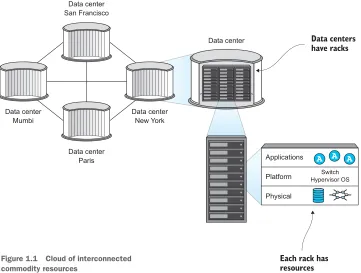
During this period, many management frameworks were developed internally by both public and private organizations to manage commodity resources. Figure 1.1 shows collections of interconnected resources spread across several data centers. With management frameworks, these common resources could be used interchangeably, based on availability or user requirements. While it’s unclear exactly who coined the term, those able to harness the power of commodity computing through management frameworks would say they had a “cloud” of resources.
Out of many commercial and open source cloud management packages to be developed during this period, the OpenStack project was one of the most popular. OpenStack provides a common platform for controlling clouds of servers, storage, networks, and even application resources. OpenStack is managed through a web-based interface, a command-line interface (CLI), and an application programming interface (API). Not only does this platform control resources, it does so without requiring you to choose a specific hardware or software vendor. Vendor-specific
Data center Mumbi
Data center Paris
Data center New York Data center
San Francisco
Data center
Applications
Platform Hypervisor OSSwitch
Physical
A A A
Data centers have racks
[image:27.531.95.456.326.599.2]Each rack has resources
components can be replaced with minimum effort. OpenStack provides value for a wide range of people in IT organizations.
One way to think about OpenStack is in the context of the Amazon buying experi-ence. Users log in to Amazon and purchase products, and products are delivered. Behind the scenes, an orchestra of highly optimized steps are taken to get products to your door as quickly and inexpensively as possible. Twelve years after Amazon was founded, Amazon Web Services (AWS) was launched. AWS brought the Amazon expe-rience to computing resource delivery. A server request that might take weeks from a local IT department could be fulfilled with a credit card and a few mouse clicks with AWS. OpenStack aims to provide the same level of orchestrated efficiency demon-strated by Amazon and other service providers to your organization.
What is OpenStack?
For cloud/system/storage/network administrators—OpenStack controls many types of commercial and open source hardware and software, providing a cloud man-agement layer on top of vendor-specific resources. Repetitive manual tasks like disk and network provisioning are automated with the OpenStack framework. In fact, the entire process of provisioning virtual machines and even applica-tions can be automated using the OpenStack framework.
For the developer—OpenStack is a platform that can be used not only as an Amazon-like service for procuring resources (virtual machines, storage, and so on) used in development environments, but also as a cloud orchestration plat-form for deploying extensible applications based on application templates. Imagine the ability to describe the infrastructure (X servers with Y RAM) and software dependencies (MySQL, Apache2, and so on) of your application, and having the OpenStack framework deploy those resources for you.
For the end user—OpenStack is a self-service system for infrastructure and appli-cations. Users can do everything from simply provisioning virtual machines (VMs) like with AWS, to constructing advanced virtual networks and applica-tions, all within an isolated tenant (project) space. Tenants, also known as pro-jects, are the way that OpenStack isolates assignments of resources. Tenant isolation includes storage, network, and VM isolation, so end users can be given much more freedom than in traditional virtual server environments. Imagine end users being assigned a quota of resources that they could easily provision how and when they want.
Virtual machines and tenants
The OpenStack foundation has hundreds of official corporate sponsors and a com-munity of tens of thousands of people in over 130 countries. Like Linux, many people will be attracted to OpenStack as a community-supported alternative to commercial products. But what they’ll soon learn is that when it comes to cloud frameworks, there are few that compare to OpenStack in terms of depth and breadth of services. Perhaps more importantly, there might not be another product, commercial or otherwise, that the average system administrator, developer, or architect can use on their own and that can provide a greater benefit to their organization.
1.1
What is OpenStack?
Let’s expand on the definition of OpenStack as a framework for managing, defining, and utilizing cloud resources. The official OpenStack website (www.openstack.org) describes the framework as “open source software for creating private and public clouds.” It goes on to say, “OpenStack Software delivers a massively scalable cloud operating system.” If you have experience in server virtualization, you may quickly, yet incorrectly, conclude that OpenStack is just another way to provide virtual machines. Although this is a service enabled by the OpenStack framework, it’s by no means OpenStack’s definitive function.
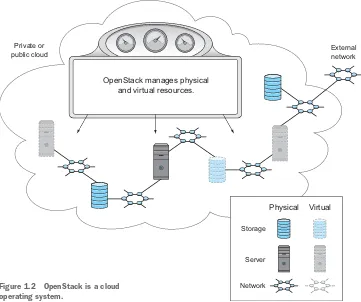
Figure 1.2 shows several of the resource components that OpenStack coordinates to create public and private clouds. As the figure illustrates, OpenStack doesn’t replace these resource providers; it simply manages them, through control points built into the framework.
An experienced systems administrator might take the description of OpenStack as a “cloud operating system” with great skepticism. It’s not like administrators run around to hundreds of servers with a boot disk, and load OpenStack on bare metal, like a traditional operating system. Nevertheless, through its management of resources, OpenStack shares operating systems characteristics, but in the context of cloud computing.
With an OpenStack cloud you can
Harness the resources of physical and virtual servers, networks, and storage systems Efficiently manage clouds of resources through tenants, quotas, and user roles Provide a common interface to control resources regardless of the underlying
vendor subsystem
(continued)
can think of OpenStack as bringing the same level of operational efficiency to your data center that the software hypervisor brought to the server.
At first glance, OpenStack doesn’t look like a traditional operating system, but then again, the “cloud” doesn’t look like a normal computer. One must take a step back and consider the fundamental benefits of an operating system.
Before there were operating systems or even hardware-level abstraction languages (assembly), programs were written in the language (binary machine code) of a spe-cific computer. Then traditional operating systems came along and, among other things, allowed users to standardize not just application code, but also the manage-ment functions of the hardware. Administrators could now manage hardware instances using a common interface, developers could write code for a common sys-tem, and users only had to learn a single user interface. This held true regardless of underlying hardware, as long as the operating system remained the same. In the evo-lution of computers, the development and proliferation of operating systems gave rise to the field of systems engineering and administration.
Figure 1.3 shows the many layers of abstraction in modern computational systems. No doubt, in the past there were developers who didn’t like the idea of losing direct control over hardware through the use of an operating system, just as some sys-tems administrators don’t like the idea of losing control over the underlying hardware and operating systems through server virtualization. In each of these transitions, from
External network Private or
public cloud
OpenStack manages physical and virtual resources.
Storage
Physical Virtual
Server
[image:30.531.103.464.57.359.2]Network Figure 1.2 OpenStack is a cloud
machine code to assembly to the virtual layer, we didn’t lose the underlying layer; it was simply standardized through abstraction. We still have highly optimized hardware, we still have operating systems, and often we have a layer of hardware virtualization between those layers.
Wide adoption of a new abstraction layer typically occurs when the benefits of opti-mizing beyond the standard approach outweigh the cost of translating (virtualization) between those layers. This is to say, when the overall utility of a computational envi-ronment can be increased by sacrificing raw performance for usability, then a layer of abstraction is typically adopted. This phenomenon is most clearly demonstrated by central processing units (CPUs) that conform to the same instruction set for decades, while radically changing their internal architectures.
When most people think of CPUs, they don’t think of virtualization and execution variability on the hardware level, but this is the case. Many of the instructions on x86 processors are virtualized inside the processors themselves, where some complex leg-acy instruction is executed through a series of simpler, yet faster, instructions. The complexity of instruction-level optimization is beyond the scope of this book, but it’s important to understand that even when using bare metal, some form of virtualization is at play, even on the processor level. Now, instead of focusing on losing control, imagine taking it through the use of a common framework for managing, monitoring, and deploying private and public clouds of infrastructure and applications. Once you take this evolutionary step forward, you have OpenStack.
Common layers of abstraction
Common access methods per layer
Processor-specific architecture
Machine code
Instruction set architecture
Operating system
Virtual
layer OpenStack
Assembly Bytecode Vendor API
OpenStack API
Figure 1.3 Layers of computational abstraction
Decades of CPU abstraction and virtualization
1.2
Understanding cloud computing and OpenStack
This book focuses on deploying private enterprise clouds using OpenStack. In this context, I’ll describe private clouds as pools of infrastructure resources (VMs, storage, and so on), also known as infrastructure as a service (IaaS), owned and managed by the organizations they serve. In contrast, public cloud IaaS resources are owned and oper-ated by third-party service providers, like Amazon AWS, Microsoft Azure, and the like. The goal of this book is to help you bring the ease and efficiencies of public cloud offerings to your enterprise.
Whether organizations opt for private or public clouds is often related to the size and scope of those organizations’ IT responsibilities. Enterprise IT departments, with the responsibility to centrally provide the technical architecture and resources for the rest of the organization, have a vested interest in leveraging a private cloud. A multi-tenant (where data, configuration, and user management are logically isolated per tenant), fully orchestrated private cloud provides enterprise IT the ability to become a private cloud broker.
As the demand for faster processors increased, so did the desire to ensure software interoperability between processor generations. CPU designers needed the flexibility to optimize at lower levels of abstraction, while maintaining instruction-level compat-ibility (standardization). Designers didn’t worry about keeping the underlying hard-ware the same, which allowed them to greatly increase the clock speed of processors between generations. In 1995, the Pentium Pro introduced the idea of micro-op decoding. Instead of a specific instruction taking a single clock cycle, it might be translated into several simple instructions, which could take many cycles.
In addition to micro-ops, the Pentium Pro processor introduced optimizations through out-of-order execution of instructions and memory virtualization (addressing 36 bits of memory with a 32-bit bus). But this was all completely abstracted from the devel-oper, allowing the same applications to run on several generations of processors from multiple vendors. This method of maintaining instruction-level compatibility con-tinues to this day with the current generation of x86_64 processors.
The economics of private vs. public clouds
In contrast, departmental IT units often lack the data center facilities and personnel to cost-effectively deploy private clouds. Due to their relatively small resource require-ments, departmental IT units can often take advantage of public cloud resources, or also take advantage of private cloud resources managed by their enterprise IT units, if any are available.
If you use both private and public clouds based on workload, that combination is referred to as a hybrid cloud. Both public and private clouds are built using the same technologies, but although the building blocks might be the same, the motivations for using private and public clouds can be very different. For instance, users often use a private cloud for security compliance reasons. It’s common for a public cloud to be used for workloads that are cyclic in nature or that require a global scale that would be very costly for an enterprise to provide.
Although this book focuses on using OpenStack for private clouds, many of the les-sons learned translate directly to public cloud provider services that are based on the OpenStack API.
1.2.1 Abstraction and the OpenStack API
Fundamentally, OpenStack abstracts and provides a common API for controlling hard-ware and softhard-ware resources provided by a wide range of vendors. The framework pro-vides two very important things:
Abstraction of hardware and software resources, which prevents vendor lock-in for any particular component. This is accomplished by managing resources through OpenStack, not directly using the vendor component. The drawback is that not all vendor features are supported by OpenStack, but common required features are.
A common API across resources, which allows for complete orchestration of connected components.
Multi-tenancy and full orchestration
While the first point is nice from a financial perspective, the second is the key to a modern IT transformation.
The next section will relate OpenStack to other technologies that you might be familiar with.
1.3
Relating OpenStack to the
computational resources it controls
You’ve read all about the great things that OpenStack provides, but how does it work? Perhaps the easiest way to grasp how OpenStack works is to relate the framework to common technologies found in an enterprise environment.
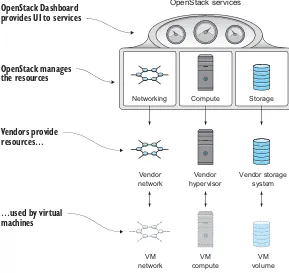
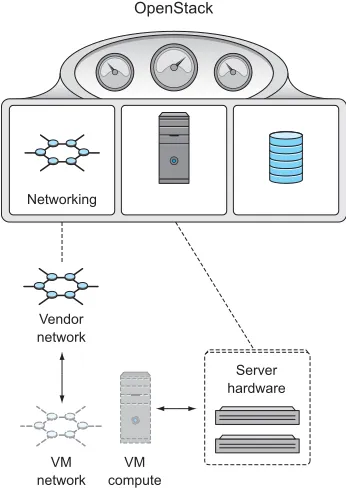
In this section, you’ll learn how OpenStack is related to the foundational resources (compute, storage, network, and so on) that it controls. As you’ll see, OpenStack gen-erally doesn’t provide the actual resource; it simply controls lower-level resources. Fig-ure 1.4 shows how OpenStack manages providers of resources, which in turn are used by virtual machines.
In the following subsections, you’ll see the details related to specific resource com-ponents: server virtualization, via the control of hypervisors; networking, via the con-trol of vendor-provided hardware and OpenStack services; block and object storage, via the control of vendor and OpenStack services. Finally, we’ll look at OpenStack ser-vices in relation to common cloud terms. As you’ll see, OpenStack is a framework that coordinates resources and services, regardless of the underlying technology vendor.
1.3.1 OpenStack and hypervisors
A hypervisor or virtual machine monitor (VMM) is software that manages the emulation of physical hardware for virtual machines. OpenStack is not a hypervisor, but it does con-trol hypervisor operations. Many hypervisors are supported under the OpenStack framework, including XenServer/XCP, KVM, QEMU, LXC, ESXi, Hyper-V, BareMetal,
OK, what’s the catch?
OpenStack provides support for a wide range of functions that are both scalable and abstracted from the underlying hardware. What OpenStack (or any other cloud frame-work) can’t do is conform to all of your current practices. To take advantage of the power of cloud computing, you might have to change some of your own business and architectural practices.
and others (see the hypervisor support matrix: https://wiki.openstack.org/wiki/ HypervisorSupportMatrix). You’re likely familiar with VMware ESX, VMware ESXi, and Microsoft Hyper-V, which at the current time are the dominant hypervisors in enterprise virtualization space. Because of licensing restrictions, cost, and other fac-tors, there has been less OpenStack community support for commercial hypervisors than for open source alternatives.
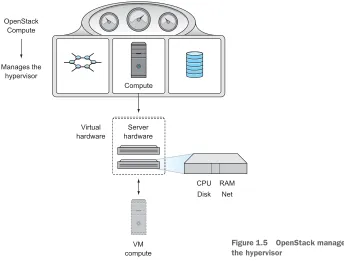
Figure 1.5 shows OpenStack managing resources that are virtualized by a hypervi-sor on physical hardware. OpenStack coordinates the management of many hypervihypervi-sor resources and virtual machines in an OpenStack cluster.
The majority of people and organizations, regardless of deployment size, use either XenServer or KVM hypervisors, which currently support the widest range of features. XenServer, a Citrix product, is technically an open source hypervisor, but commercial support is available through Citrix. KVM is included as part of the Linux kernel, so many Linux distribution maintainers provide commercial KVM support, including Red Hat, Ubuntu, and SUSE, to name a few.
ARE YOU CERTIFIED? As large providers started designing public IaaS offer-ings based on the OpenStack framework, they soon realized that their cus-tomers would require Microsoft certification for Windows hosts running
OpenStack services
OpenStack Dashboard provides UI to services
OpenStack manages the resources
Vendors provide resources…
…used by virtual machines
Compute
Vendor hypervisor
Vendor storage system Storage
VM compute
VM volume Vendor
network Networking
[image:35.531.92.381.58.331.2]VM network
under their hypervisors. At the time, Citrix had gone through the Microsoft certification process with XenServer and fulfilled those requirements. But despite Citrix having a competing platform in the form of CloudStack, many organizations used XenServer as their OpenStack hypervisor. Since that time several Linux distribution providers have gone through the Microsoft certifi-cation process and now fully support Windows guests on the KVM hypervisor, including hypervisors controlled by OpenStack.
Throughout this book, the Kernel-based Virtual Machine (KVM) will be used. KVM has been part of the Linux kernel since the 2.6.20 release in early 2007, and it’s fully supported by OpenStack. KVM also provides paravirtualization, which must be either supported natively by the operating system or added through the use of hypervisor-specific drivers installed on the virtualized operating system image. The traditional problem with open source hypervisors is that there’s a steep learning curve for deploying and maintaining them, often requiring experience in system, network, and application administration. In organizations lucky enough to have centrally sup-ported virtualized resources, the resource request process must pass through the organization’s network, systems, security, and financial elements in the provisioning process. This typically leaves users with three choices:
Self-support using community code—Using community support for community-maintained software, you take responsibility for the design, development, and operation of your deployment.
OpenStack Compute
Manages the hypervisor
Server hardware Virtual
hardware
Compute
VM compute
CPU Disk
[image:36.531.101.445.55.319.2]RAM Net
Commercial support using community code—Using vendor support for community-maintained software, you and/or the vendor are responsible for your deployment. Commercial support using a vendor branch of a community project—Using vendor-provided support and software, you are typically responsible for operation and vendor management in relation to your deployment.
Although several vendors support OpenStack and KVM commercially, many internal clouds are built for workloads that don’t require commercial support or certifica-tion, so OpenStack support of KVM without commercial support is a very popular option. This book covers material that’s useful regardless of your deployment and support path.
1.3.2 OpenStack and network services
OpenStack isn’t a virtual switch, but it does manage several physical and virtual net-work devices and virtual overlay netnet-works. Unlike the OpenStack control of hypervi-sors, which is limited to the services provided by the hypervisor alone, OpenStack directly provides network services like DHCP, routing, and so on. But much like hyper-visor management, OpenStack is agnostic to the underlying vendor technology, which could be a commercial or open source technology.
More importantly, a backend technology change like moving from one type of network or vendor to another doesn’t necessitate client configuration changes. Given the great deal of proprietary hardware, software, and user interfaces involved in net-working, it’s often not trivial to switch from one vendor or technology to another. With OpenStack, those interfaces are abstracted by the OpenStack API, as shown in figure 1.6.
OpenStack can manage many types of network technology (mechanisms), includ-ing those provided by Arista Networks, Cisco Nexus, Linux bridginclud-ing, Open vSwitch (OVS), and others. Throughout this book we use networking services provided by
Linux containers
Recently, there has been great interest in the use of operating-system-level virtualiza-tion in place of infrastructure-level visualizavirtualiza-tion for providing OpenStack instances. Operating-system-level virtualization provides the ability to run multiple isolated OS instances (containers) on a single server. But it isn’t a hypervisor technology—it oper-ates on the system level where containers share the same kernel. You can think of containers as providing virtual separation where needed, without the emulation over-head of full virtualization.
OpenStack and OVS. OVS is a common switch choice for OpenStack that you can easily obtain and replicate in your environ-ment without specific hardware require-ments. Along with the network mechanisms, there are several network types (VLANs, tunnels, and so on) sup-ported by OpenStack, and those are cov-ered in chapter 6.
1.3.3 OpenStack and storage
OpenStack isn’t a storage array, at least not in the way you’d generally think of storage. OpenStack doesn’t physically provide the storage used by virtual machines.
If you’ve ever used a file share (NFS, CIFS, and the like), you were using “file-based” storage. This type of storage is easy for humans to navigate and computers to access, but it’s generally an abstraction of another type of storage: block storage. You can think of operating systems or filesys-tems as being the primary users of block storage.
There’s also another type of storage that people in systems roles might not be familiar with: object-based storage. This type of storage is generally accessed through software APIs (for example, GET/obj=xxx). Object-based storage is a further abstrac-tion of file and block storage, but without the restricabstrac-tions of either. Object-based stor-age can be easily distributed and replicated between many participating nodes. Unlike block storage, which must quickly be accessed by a VM, distributed object storage is much more latent and wouldn’t be used for things like VM volumes (which are actively attached to an instance). It’s common to use object storage to store backups of vol-umes and images (containing operating systems) to be applied to volvol-umes when they’re created.
Let’s first address how OpenStack works with block storage, and then we’ll talk about object storage.
BLOCKSTORAGE
OpenStack doesn’t currently manage file-based storage for end users. In figure 1.7, you can see that OpenStack manages block (VM) storage much like it manages the hypervisor and network.
This figure shows a complete picture from a basic VM resource-management pro-spective. OpenStack can manage many vendor-provided storage solutions, including solutions from Ceph, Dell, EMC, HP, IBM, NetApp, and others. As it does with hypervisor
OpenStack
Vendor network
VM network
VM compute Networking
[image:38.531.301.474.54.298.2]Server hardware
and network components, OpenStack pro-vides you with the flexibility to switch between storage vendors and technologies without changing the client configuration.
OBJECTSTORAGE
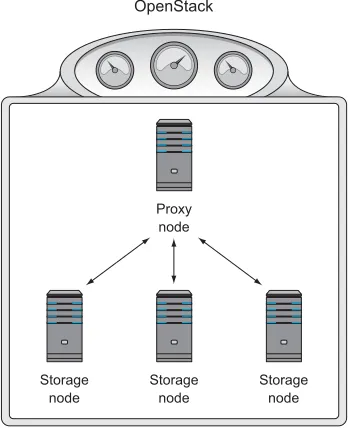
Although OpenStack isn’t a storage array for block storage (used to boot VMs), it does have the native ability to provide object storage. Other than physical hard-ware running a supported version of Linux, no other software is required for OpenStack to provide a distributed object storage cluster. This type of storage can be used to store volume backups, and it’s also common to use object storage for large amounts of data that can be easily isolated into binary objects. Figure 1.8 shows a basic object server deployment that’s all contained in the OpenStack environment.
Vendor network
VM network
VM compute
Vendor storage system
VM volume Server
hardware OpenStack
[image:39.531.93.342.56.332.2]Storage Networking
Figure 1.7 OpenStack manages block (VM) storage.
OpenStack
Proxy node
Storage node
Storage node Storage
node
[image:39.531.290.464.363.577.2]Object storage doesn’t have to be in a single location. In fact, nodes (proxy and stor-age) could be in several locations that replicate between each other.
The traditional use case for object storage is to store data that will be accessed by an application, such as a document or file that will be used by an application on a user’s behalf. There are several use cases for object storage in OpenStack environ-ments. For example, it’s common to use this type of storage as a repository for VM images. This isn’t to say that the VMs use this storage directly, but they’re provisioned from data maintained in this system. This is reasonable because the provisioning pro-cess won’t need low-latency acpro-cess to random data. Object storage might also be used to back up a snapshot of an existing VM for a long-term backup.
1.3.4 OpenStack and cloud terminology
OpenStack is a framework for cloud construction and is used to construct both public and private clouds. Aside from the public and private cloud definitions, there are the “as-a-service” cloud destinations. Which as-a-service is OpenStack? OpenStack can be used as the foundation for several as-a-service clouds.
Suppose you’re interested in providing your enterprise with an Amazon-like expe-rience for acquiring VMs and storage resources. This would be considered infrastruc-ture as a service (IaaS). In this context, users are given direct access to provision individual virtual machines, which users directly manage. Although the physical com-ponents that make up the cloud are hidden from the user, virtual comcom-ponents are directly accessible. The responsibility of OpenStack is to control resources that pro-vide end users with the infrastructure.
Now suppose your cloud users are not given direct access to IaaS features and are only given access to application orchestration functions provided or supported by OpenStack. In this context, OpenStack could be considered the back end of a platform as a service (PaaS) offering. The underlying physical and virtual infrastructure compo-nents are hidden from the user. Consider the case where a development team requires an isolated application landscape (application-layer deployment on IaaS) for software testing. Through cloud orchestration, OpenStack could be used on the back end in the deployment of the described testing platform.
Now suppose your company provides a service to its customers using either IaaS or PaaS provided by OpenStack. In this context, OpenStack serves as the back end com-ponent of software as a service (SaaS). As you can see, OpenStack can be used as a fun-damental component in many layers of cloud computing.
1.4
Introducing OpenStack components
I introduced the basic capabilities of OpenStack in section 1.1; in this section we’ll look at the fundamental components that make up the framework.
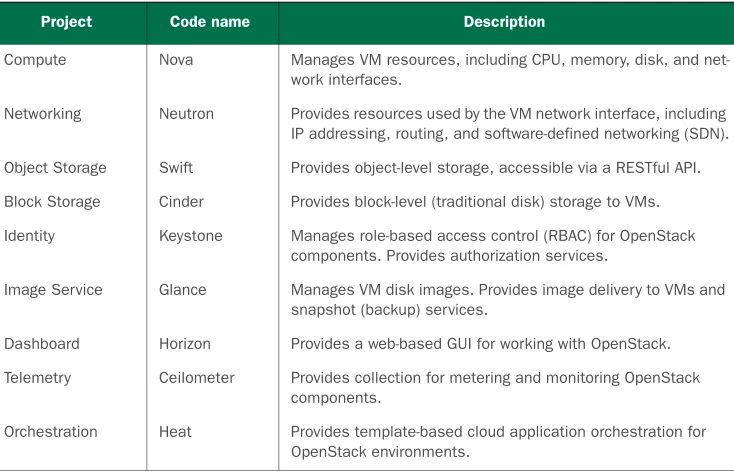
Table 1.1 lists several of OpenStack’s components or core projects. There are many more projects in various stages of development, but these are the foundational com-ponents of OpenStack. The most up-to-date roadmap of OpenStack’s services can be found on the OpenStack Roadmap page: www.openstack.org/software/roadmap/.
Now that you know a bit about what OpenStack is and does, let’s take a quick look at where it came from.
1.5
History of OpenStack
On his first day in office in 2009, US President Barack Obama signed a memorandum to all federal agencies directing them to break down barriers to transparency, partici-pation, and collaboration between the federal government and the people it serves. The memorandum became known as the Open Government Directive.
[image:41.531.97.464.171.409.2]One hundred and twenty days after the directive was issued, NASA announced its Open Government framework, which outlined the sharing of a tool called Nebula. Nebula was developed to speed the delivery of IaaS resources to NASA scientists and researchers. At the same time, the cloud computing provider Rackspace announced it would open-source its object storage platform, Swift.
Table 1.1 Core projects
Project Code name Description
Compute Nova Manages VM resources, including CPU, memory, disk, and net-work interfaces.
Networking Neutron Provides resources used by the VM network interface, including IP addressing, routing, and software-defined networking (SDN). Object Storage Swift Provides object-level storage, accessible via a RESTful API. Block Storage Cinder Provides block-level (traditional disk) storage to VMs. Identity Keystone Manages role-based access control (RBAC) for OpenStack
components. Provides authorization services.
Image Service Glance Manages VM disk images. Provides image delivery to VMs and snapshot (backup) services.
Dashboard Horizon Provides a web-based GUI for working with OpenStack. Telemetry Ceilometer Provides collection for metering and monitoring OpenStack
components.
In July 2010, Rackspace and NASA, along with 25 other companies, launched the OpenStack project. Over the past five years there have been ten releases. OpenStack releases are shown in table 1.2.
OpenStack has maintained a six-month release cycle, which is coordinated with Open-Stack Summits. The project has grown from 25 participating companies to over 200, with thousands of participating users in over 130 countries.
1.6
Summary
IaaS clouds are collections of commodity resources, which are coordinated through management frameworks.
OpenStack is a management framework that provides end-user self-service coor-dination of IaaS and application orchestration (PaaS/SaaS).
OpenStack controls existing commercial and community technologies like hypervisors, storage systems, and networking hardware and software.
OpenStack is composed of a collection of projects, each with a specific purpose. Each OpenStack project has a related code name.
Table 1.2 OpenStack releases
Name Date Core components
Austin October 2010 Nova, Swift Bexar February 2011 Nova, Glance, Swift Cactus April 2011 Nova, Glance, Swift Diablo September 2011 Nova, Glance, Swift
Essex April 2012 Nova, Glance, Swift, Horizon, Keystone
Folsom September 2012 Nova, Glance, Swift, Horizon, Keystone, Quantum, Cinder Grizzly April 2013 Nova, Glance, Swift, Horizon, Keystone, Quantum, Cinder Havana October 2013 Nova, Glance, Swift, Horizon, Keystone, Neutron, Cinder,
Ceilometer, Heat
Icehouse April 2014 Nova, Glance, Swift, Horizon, Keystone, Neutron, Cinder, Ceilometer, Heat, Trove
Juno October 2014 Nova, Glance, Swift, Horizon, Keystone, Neutron, Cinder, Ceilometer, Heat, Trove, Sahara
Kilo April 2015 Nova, Glance, Swift, Horizon, Keystone, Neutron, Cinder, Ceilometer, Heat, Trove, Sahara, Ironic
20
Taking an OpenStack
test-drive
In chapter 1 you learned many of the benefits of OpenStack and how OpenStack fits into the cloud ecosystem. But now that you have an idea of what OpenStack can do for you, you may wonder what it looks like. What will the experience be like for your users? This chapter lets you test-drive OpenStack through the use of DevStack, a rapid OpenStack deployment tool, and answers these questions.
DevStack lets you interact with OpenStack on a small scale that’s representative of a much larger deployment. You can quickly deploy or “stack” (as fellow Open-Stackers call it) components and evaluate them for production use cases. DevStack
This chapter covers
Using DevStack to take a test-drive with OpenStack
Preparing an environment for DevStack
Configuring and deploying DevStack
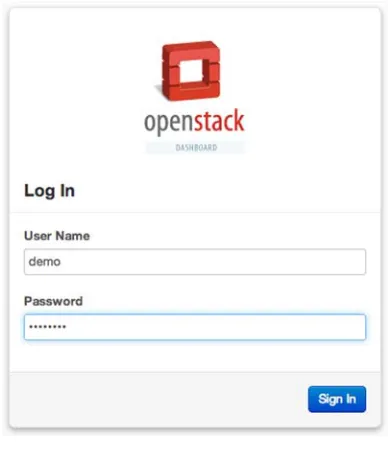
Interacting with the OpenStack Dashboard
Understanding the OpenStack tenant (project) model
helps you deploy the same OpenStack components found in large multiserver envi-ronments on a single server, as shown in figure 2.1. Without knowing a great deal about OpenStack and without the need for a bunch of hardware, you can use DevStack to get the OpenStack experience, just on a smaller scale.
The figure shows several components, including Cinder, Nova, and Neutron, deployed on an arbitrary number of nodes. OpenStack uses codenames for its compo-nents, so the codename Cinder refers to storage components, Nova to compute components, and Neutron to network components. At this point it’s not important that you know the OpenStack components, the codenames, or what they do; this is explained in detail in chapter 4. What you need to know now is that OpenStack is made up of several core components that can be distributed among nodes (servers) based on the intended design. Information related to OpenStack design is also cov-ered in chapter 9.
OpenStack services
Networking
Shared services
Storage Compute
Nova
Neutron Cinder
Controller (server 0)
Neutron (server 2)
VM
Cinder (server 3) Nova
(server 1)