Universities of Leeds, Sheffield and York
http://eprints.whiterose.ac.uk/
This is an author produced version of a paper published in Synthese
White Rose Research Online URL for this paper: http://eprints.whiterose.ac.uk/3338/
Published paper
Forthcoming in Synthese
ROBIN LE POIDEVIN
A PUZZLE CONCERNING TIME PERCEPTION
ABSTRACT. According to a plausible and influential account of perceptual knowledge,
the truth-makers of beliefs that constitute perceptual knowledge must feature in the
causal explanation of how we acquire those beliefs. However, this account runs into
difficulties when it tries to accommodate time perception⎯specifically perception of
order and duration⎯since the features we are apparently tracking in such perception are
(it is argued) not causal. The central aim of the paper is to solve this epistemological
puzzle. Two strategies are examined. The first strategy locates the causal truth-makers
within the psychological mechanism underlying time perception, thus treating facts
about time order and duration as mind-dependent. This strategy, however, is
problematic. The second strategy modifies the causal account of perceptual knowledge
to include a non-causal component in the explanation of belief-acquisition, namely
chronometric explanation. Applying this much more satisfactory approach to perceptual
knowledge of time, we can preserve the mind-independence of order and duration, but
One might find it a difficult question, whether if there were no soul there would be time
or not. For if it is impossible that there should be something to do the counting, it is also
impossible that anything should be countable....
Aristotle, Physics IV.4
It is in my own mind, then, that I measure time. I must not allow my mind to insist that
time is something objective.
Augustine, Confessions, XI.27
1 THE PUZZLE
I am looking at the clock on the mantelpiece, and note that both hands are pointing to
twelve. Here, surely, is a straightforward case of veridical perception. There is the
clock, and I am looking at it in near-ideal conditions. Without question, I see the clock,
and the position of the hands, and I do so in an apparently unmediated way. Only,
perhaps, when I entertain the thought that I might not be looking at a clock at all, but
hallucinating, does this simple ‘direct realist’ view as to what I see when I look at
something come into question. Assuming that I could not tell the difference between the
case in which I genuinely see the clock and one in which I am hallucinating, we have to
explain what the two cases have in common, and this is where the ‘indirect realist’ case
exercises a grip on our thinking. In both cases, I see something, and that something must
be the same in both cases (since they are qualitatively distinguishable), and since it
cannot be the clock⎯this being entirely absent in one case⎯it must be something else,
nearer to the mind, and this we may call a sense datum. Or so goes a familiar line of
thought,1 and it does not impress everyone. For many, the direct realist approach is still
an option, since we do not have to concede (they say) that what the cases of veridical
perception and hallucination have in common is sameness of experiential object.
But now the clock strikes noon, and I perceive a host of other items: not merely
a series of sounds, but one chime as following on from another, the interval between
chimes, and that interval as remaining the same in each pair of chimes. All these are
temporal. But perceiving time in this way, and perceiving the clock, seem very different
kinds of experience. Even if we confine our attention just to veridical time perception,
when our senses do not deceive us as to the order or duration of events, the direct realist
approach seems much less tempting than in the case of ordinary perception of objects.
In fact, it is not clear that direct realism about time perception is even an option. Why is
this?
According to the title of a paper by the psychologist J.J. Gibson, ‘Events are
perceivable but time is not.’2 Insofar as we think of time as something independent of
the events within it, as an unseen, featureless medium, we could hardly fault this
description. But whether or not time is independent of its contents, events themselves
have temporal features: they occur in a certain order, and they last for a certain amount
of time. And if we were completely insensitive to these features, then it would be a
mystery how we come to be aware of motion, interpret Morse code, or appreciate
music.
However, it is one thing to form beliefs about order and duration on the basis of
our perceptions, and quite another actually to perceive order and duration. If the
meaning of Gibson’s dictum is that, although we may come to be aware of the temporal
features of events, those features are never themselves the objects of our perceptual
states, then a number of considerations tell in its favour.
First, there is no specific organ for the time sense. Whereas light is registered by
the visual system, and sounds by the auditory system, there is no anatomically
identifiable system for time awareness. It is true of course that perception of shape is
cross-modal: we are aware of it in both vision and touch (and bats perceive it in terms
of variation of high-frequency sounds), and yet there is no obvious objection to the
direct realist perception of shape. But there is a relatively straightforward story to be
told about the way in which the shape of, say an apple, can be an object of perception
when the apple is (although the details of the story may be complicated): the shape of
the apple modifies the distribution and properties of light rays reflected from its surface
and which then hit the retina; it also modifies both the distribution of pressure exerted
by the apple on our touch receptors, and the kinaesthetic input as we close our hands
around it. With time, in contrast, it does not make sense to suppose that, when a given
occurring after some other event, somehow modifies the input, allowing us just to hear
its duration and position vis-à-vis other events. We are only aware of how long an event
lasted when it has receded into our phenomenal past⎯when, in other words, the event
has ceased to be an object of perception.
Second, perception has temporal limits. What we perceive, we perceive as
present, as happening now. But from this commonplace it seems to follow that a
currently perceived event, or rather that bit of it that is being perceived, cannot be
divided into apparently earlier or later parts. Of course, the item perceived will in fact
have earlier and later parts, for only something that lasts for more than a certain
duration will be perceived at all. But if something is perceived as present, then it cannot
be perceived as having earlier and later parts. This lack of temporal discrimination for
sufficiently short stimuli defines what is often called, in a phrase coined by E.R. Clay
but made famous by William James, the ‘specious present’. The experienced present is
‘specious’ in that it is not the durationless boundary between past and future, but rather
something that takes up time.3 But if what is perceived is perceived as happening now,
then there is no room for the perception of time order, for that would involve perception
of things as non-simultaneous, whereas two events that are perceived as happening now
are, necessarily, perceived as simultaneous. What of duration? A similar problem
presents itself here. To perceive an event as lasting a certain period of time, we have to
perceive it as having earlier and later parts. But of course, these parts cannot all be
perceived as happening now, for then they would be perceived as simultaneous. So
duration is not something that can be an object of perception.
Third, whereas it is possible to be aware just of the colour of an object⎯I can
focus on its redness, say, to the exclusion of all else⎯it is not possible to be aware just
of the relation of temporal subsequence when it obtains between two events. To see one
event as following on from another, I have to be aware of the events themselves. The
relation by itself cannot be an object of perception as colour by itself can. Similarly with
duration: I cannot be aware just of the duration of an event. Somehow, the awareness of
order and duration emerges from a perception of the events.
So, on the one hand, our perceptions inform us of the order and duration of
events. Moreover, the process appears to be a non-inferential one: we can become aware
But, on the other hand, the usual models for ordinary perception, of shape and colour
for example, are not applicable to time. In particular, order and duration are not objects
of perceptual states. What then are the mechanisms underlying our perceptual
awareness of time order and duration? This is the psychological problem of time
perception. Here is one psychologist’s perspective on the problem:
There is no process in the external world which directly gives rise to time experience, nor
is there anything immediately discernible outside ourselves which can apprehend any
special ‘time stimuli’. It is therefore not too surprising that psychological research on
time as a dimension of consciousness has been so diverse, so incoherent, and so easily
forgotten. (Ornstein (1972), p. 96.)4
Of course, a psychological problem requires a psychological answer, not a
philosophical one. But there is a philosophical dimension to the issue, one concerning
the epistemological status of our perceptual awareness of the temporal features of the
environment. If we can take it as a datum that we can form, on the basis of our
perceptions (by some mechanism yet to be determined), beliefs concerning both time
order and duration, we can also take it as a datum that these beliefs are at least capable
of being, and generally are, a form of perceptual knowledge⎯although of course we
often make mistakes. Now, according to an influential and plausible theory of
perceptual knowledge, the truth-makers of those beliefs should occur in the causal
history behind our acquisition of them.5 But one moral of the disanalogies we were
drawing attention to above between ordinary perception and time perception is that time
order and duration are not features of events that cause our perceptual states. And if
they are not the causes of our perceptual states, then it is hard to see how they could be
the causes of beliefs that arise from those perceptual states. This suggestion, that order
and duration do not play a causal role, will be confirmed when we come to look at
models of time perception. It is a problem, then, to explain, compatibly with the causal
theory of perceptual knowledge, how time perception can lead to knowledge of the
temporal features of the environment. This is the epistemological puzzle of time
perception. Solving this puzzle is the aim of this paper.
Making things a little more explicit, the puzzle arises from the following
The causal truth-maker principle: Perceptual beliefs that qualify for the title
‘knowledge’ are caused by their truth-makers.
The acausality of order and duration: Theobjective order and duration of events
are not the causes of our perceptual beliefs concerning order and duration.
Together, these two appear to imply that, even if there is such a thing as time
perception, it cannot count as knowledge, since the truth makers of our beliefs in these
cases play no role in the causal history of those beliefs. (To derive this result formally,
we have of course to add what may seem the rather obvious proposition that actual
order and duration, or facts concerning them, are the truth-makers of perceptual beliefs
about order and duration.)
Plausible though they may be, something needs to be said in defence of the two
propositions, especially in view of their implication. First, the causal theory of
perceptual knowledge, of which the causal truth-maker principle is a component, may
be vulnerable on other grounds. Second, the acausality of order and duration may seem
too strong a lesson to draw from the disanalogies between time perception and
perception of shape or colour. The next section, then, is concerned with a defence of the
component propositions of the puzzle. The section following introduces two plausible
models of time perception. My concern is less to establish their correctness as to show
how, if correct, they confirm the acausality principle. We then turn, in §4, to an
Augustinian resolution of the puzzle, one that treats time, or at least certain aspects of it,
as mind-dependent. This resolution turns out to be problematic, and in §5, I shall argue
for a rather different approach. The moral of the story is twofold: first, that we need to
modify the causal theory of knowledge if it is to apply quite generally to perceptual
belief; second, that a proper understanding of the way in which our perceptual beliefs
concerning temporal properties are both explained and made true may teach us some
2 COMPONENTS OF THE PUZZLE
2.1 The causal truth-maker principle
The causal truth-maker principle (hereafter CTMP) is appealing, first because
perception is evidently a causal process, and second because it successfully
discriminates in very simple terms, and in a wide range of cases, true beliefs that
constitute knowledge from those that do not. For example, I see someone I take to be
Julian, riding a trishaw down the street. I form the belief that Julian is riding a trishaw,
and I happen to be right about that: Julian is indeed riding a trishaw at the very moment
I form my belief, but the person I saw was his brother, Ivan. Here, the truth-maker was
not among the causes of my belief, which therefore fails to count as genuine knowledge.
And so we can go on multiplying the examples. However, there are some trickier cases
where knowledge, or the lack of it, is not so easily captured. They fall into two groups:
those that call into doubt the sufficiency of the causal link with truth-makers to confer
the status of knowledge on a belief, and those that call into doubt its necessity. Strictly,
only the latter directly threaten the CTMP. However, the CTMP gains some of its
plausibility by being part of a wider causal theory of knowledge. If that theory is
vulnerable to objections, the CTMP loses some of that plausibility, even if the
objections do not strictly conflict with its truth. It is not my intention in this paper to
defend a fully worked-out causal theory of knowledge, but I need to show the
possibility of expanding the CTMP so as to provide a plausible theory of perceptual
knowledge.
Here, then, are the kinds of case that cause difficulties for the causal theory:
(a) Against the sufficiency of the causal link with truth-makers
(i) Unreliable causes. I am looking at a series of photographic slides that are being
projected onto a screen. Unknown to me, some of the slides have been placed in the
projector the wrong way around, so the screen image in these cases is left-right inverted
form beliefs concerning the relative positions of the buildings, etc. Since this slide has
not been inverted, my beliefs are true, and they are caused (ultimately) by their
truth-makers, but they do not count as knowledge.
(ii) The presence of relevant perceptual equivalents. I am looking at a scene through a
window. Unknown to me, the scene has been reflected by a series of mirrors, in such a
way, however, that the apparent spatial relations between me and the various objects in
the scene exactly matches their actual spatial relations. Again, although the truth-makers
and the causes of my beliefs coincide, those beliefs do not count as knowledge.6
(iii) Deviant causal chains. I believe that there is a dagger in front of me on the basis of
a visual experience that is caused by a state of affairs precisely matching my belief, but
via a ‘deviant’ causal chain. E.g. my experience is caused directly by stimulation of my
brain by electrical impulses delivered by a machine operated by a scientist whose
intention it is artificially to replicate experiences the kind of which I would be having
were I actually perceiving the dagger that is in fact in front of me.7 I believe, but do not
know, that there is a dagger in front of me.
(b) Against the necessity of the causal link with truth-makers
(iv) Beliefs with conventional conceptual content. I see a tree, and, having some arborial
expertise, form the (correct) belief that it is an Ilex oak. I can be said, in fact, to know
that this is an Ilex oak. The truth-maker of the belief has to do with a conventional
system of classification, however, whereas the causes of the belief are simply to do with
the intrinsic properties of the tree.
(iv) Demonstrative thoughts. I think, looking at the girl who has just walked into the
café, ‘That’s Monica’. Since the person I am looking at is Monica, the truth-maker of
my belief is that Monica = Monica. But this fact is a necessary one, and so cannot be the
cause of my belief. (On the grounds that causal relations entail counterfactual relations,
and counterfactual relations can only obtain between contingently existing facts.) My
belief can nevertheless be classed as genuine knowledge.
The first case can be dealt with by appeals to reliability. The process by which I form
The example shows that whereas there are many cases where reliability can be cashed
out simply in terms of a causal link with the truth-maker, there are others where this is
not enough. Reference must be made to the tendency of the belief-generating process to
produce true beliefs, or (to put it another way) to the high probability that the process
will generate beliefs via their truth-makers. A similar proposal recommends itself in the
second case. Actually, it is not clear that the mere presence of the mirrors (and my
ignorance of them) undermines the epistemic status of the belief. Only perhaps if the
mirrors were regularly moved around in such a way that it is just a matter of luck
whether what is presented corresponds to the scene or not would we want to deny that I
know, on the basis of my perceptions, where things are. But then the second case is just
a variant of the first.
The third case does introduce a new element, that of the deviant causal chain,
which plagues causal theories of perception, memory and action. In the case described,
the deviancy of the chain undermines the experience’s claim to be a genuine perception
of the dagger. But is this a problem of knowledge? It may be possible to gain
knowledge of the dagger by means of a visual or apparently visual experience, even if
one cannot be said to be perceiving the dagger. And perhaps the criterion we use in
deciding whether we have knowledge in this case will depend on the reliability of the
process by which we come to have the belief, so that, once again, the case can be
assimilated to the first. However, this may not go quite far enough. The fact remains
that I mistake the immediate cause of my experience. I am not, as it turns out, really
seeing the dagger. So how can I know that there is a dagger in front of me? But, if this
is so, then it suggests that reliability is not enough. The causal chain leading to a belief
may be both reliable (in that the belief thus caused has a high probability of being true)
and yet deviant. So what distinguishes the deviant case from the non-deviant case in
such a way that explains how non-deviant chains can lead to genuine knowledge? One
proposal is to introduce the notion of higher-order reliability. A process may be
reliable, as in the case of the honest scientist stimulating my brain, and yet not itself
have been generated by a reliable process. In the case of ordinary perception, it is not
only reliable, it also exhibits higher-order reliability: our perceptual systems have
evolved through a process of natural selection which itself makes it highly likely that
higher-order reliability. The possibility remains, perhaps, of a causal chain whose deviant
nature prevents the result from being classified as a genuine perception, even though the
process leading to the apparently perceptual belief exhibits higher-order reliability. In
this case, I would be tempted to say, we have knowledge but not perception. Deviancy
per se need not be a threat to knowledge, as it is to perception, memory and intentional
action.
Now let us turn to the alleged counterexamples to the necessity of a causal link
between truth-maker and belief. Consider the Ilex oak. Is this really a problem? All
perceptual beliefs, let us concede, will have some conceptual content (assuming that
they have a propositional structure; it may be that there are some perceptions lacking
that structure that do not possess conceptual content, but that is not the issue here since
we are concerned only with perceptual beliefs). Those concepts will have their origins
beyond the experience they help to structure. Does that matter? Given the admittedly
conventional system of classification, all that is needed for my belief that this is an Ilex
oak to be true are the intrinsic properties of the tree. And given that I possess the
relevant concepts, and am suitably oriented vis-à-vis the tree, those same intrinsic
properties will be sufficient to cause that belief.
In the case of the demonstrative thought, the obvious reply here is to deny that
the truth-maker in question is Monica = Monica. There are, in any case, other grounds
to question that Monica = Monica is the maker, for the necessity of the
truth-maker would appear to confer necessity onto the belief it makes true, yet ‘That’s
Monica’, being clearly empirical, does not look like a necessary truth. There are a
number of candidates for the role of truth-maker for demonstrative thought, but one that
would satisfy the contingency constraint relates perceiver and object: my thought is true
because the person who stands in the appropriate perceptual relation to me is Monica.
The causal theory of perceptual knowledge, it seems, is robust enough to deal
with a number of apparent counterexamples. So the first proposition of our problematic
2.2 The acausality of order and duration
It was suggested in §1 that, since order and duration are not the objects of perceptual
states, they are not the causes of those states. This is not, in general, a safe inference.
There are any number of hidden causes of our perceptual states, to do for example with
the underlying psychological or physiological mechanisms of perception, which are
never the objects of those states. But we are concerned with external features of the
world, and it is hard to see how they can causally impinge on us if we never perceive
them. But, in any case, there are other reasons for thinking that order and duration may
not be the sort of features that are capable of entering into causal relations.8 I offer here,
not a knock-down argument to the effect that they cannot possibly causally affect
things, but rather some awkward questions for anyone who thinks that they do.
What, first, is a cause? Or rather, what kinds of things are causal relata? Here is
Davidson on the question:
Much of what philosophers have said of causes and causal relations is intelligible only on
the assumption (often enough explicit) that causes are individual events, and causal
relations hold between events. (Davidson (1967), 161.)
But if only events are causes, then order and duration cannot be causes, since order and
duration are features of events, not themselves events. There is no event of the Great
Plague’s standing in the ‘earlier than’ relation to the Great Fire of London.
What then if we allow properties as causes? This seems plausible enough: the
weight of the flour causes the needle of the scales to point to 4 oz. Order, however, is a
relational property, as is duration (an event lasts five minutes if its final boundary is five
minutes later than its initial boundary). Can relations be causes? In a well-known
discussion of the existence of universals in The Problems of Philosophy, Russell makes
the following observation:
Consider such a proposition as ‘Edinburgh is north of London’. Here we have a relation
between two places, and it seems plain that the relation subsists independently of our
knowledge of it.……
Edinburgh and London exist. If we ask ‘Where and when does this relation exist?’ the
answer must be ‘Nowhere and nowhen’. There is no place or time where we can find the
relation ‘north of’. ….Now everything that can be apprehended by the senses or by
introspection exists at some particular time. Hence the relation ‘north of’ is radically
different from such things. (Russell (1912), 56.)
If this correctly characterises ‘north of’, it also characterises ‘later than’. And, since
duration is also a relational property, Russell’s observation would apply to that too. But
now causes are items that have locations, both in space and time. Their having those
locations is what helps to explain why they have their effects at the times and in the
places they do. But if order and duration relations do not have locations, they are
acausal.
However, as he makes clear, Russell takes the ‘north of’ relation to be a
universal, and therefore something that other places can stand in to each other. What if
instead we concern ourselves with the trope, the token of the type, this very instance of
‘north of’, relating Edinburgh and London? What is its location? We still face
difficulties in arriving at anything other than an ad hoc answer to the question. There
seems no good reason to locate the relation just in Edinburgh, or just in London.
Perhaps, then, it is located in the region between Edinburgh and London. But how do
we define this region? Is it just the straight line connecting the two? Is it the whole of
United Kingdom? Should it not include the North Pole? Is it the surface of the Earth?
Even if we are dealing with the trope rather than the universal, perhaps the best thing to
say is that the relation is nowhere: it does not have a spatial location at all. The same
worries arise for order and duration. There is a clap of thunder at 4 o’clock, and the rain
starts pouring down at one minute past 4. These events are readily locatable. But what
of the temporal relation between them? That relation, even if we treat it as a trope, is not
readily locatable at 4, nor one minute past, nor any time in between. And what of the
rainstorm’s property of lasting 20 minutes? Where is that in time? Again, we may be
tempted to say that these properties have no temporal location: they exist timelessly.
But if they are timeless, they cannot be causes. If we insist that these relational
properties do have a location, only that are somehow spread out in a spatio-temporal
region that includes the relata, and that is how those properties can be causes, we are
capable of having effects in all parts of that region? Whether or not some ‘earlier than’
trope is the cause of my belief that the thunderclap preceded the rain, it cannot possibly
cause my belief before I experience the rain. But then why not, if it exists before the
rain does?
We might instead take causal relata to be facts, of which events and their
properties are constituents. Indeed, given the argument that the truth-making role cannot
be occupied by objects, events or properties, but only by structured combinations of
them, namely facts,9 it would seem that the CTMP may be committed to facts as causes.
But this does nothing to relieve the worries expressed above concerning the location of
tropes, since they also arise for facts about order and duration.
Some further worries, not to do with location: are there in fact any cases where
we cannot explain away the apparent causal efficacy of temporal properties? Take the
case of the egg’s being cooked because it has been boiled for 5 minutes. What is doing
the causing here? The mere passage of time? No: the egg is cooked because of the
individual events that took place during those five minutes. Or take a machine that
produces one output, C, if the two kinds of input, A and B, occur in the order AB, and
another output, D, if they occur in the order BA. Is the mere order of the inputs itself a
cause? Or is the correct story rather something like the following: given an initial state
of the machine, S1, the effect of input A is to change the machine’s state to S2. And
when the machine is in S2, the effect of input B is the production of output C. But when
the machine is in S1, the effect of input B is to change the machine’s state to S3, and the
effect then of input A is not to change the machine state to S2, but rather the production
of output D. On this account, it is not the mere order of inputs that determines the
output, but what state the machine is in when it receives a given input. Now, if we are to
take seriously the suggestion that order and duration per se can be causes, then there
have to be cases where the natural form of explanation that applies in these cases of the
egg and the machine is just not available. And this, intuitively, seems odd.
These are just expressions of puzzlement of course. But given that treating order
and duration as causal is problematic in one way or another, it would be best not to give
those properties a causal role in our account of how we acquire order and duration
beliefs. And so we come back to the epistemological puzzle. In trying to solve it, it
perception. It should not be necessary to have at our disposal a detailed description of
this undoubtedly complex process. Since the puzzle we face is one that is raised at a
high level of abstraction, it should be enough to show that some plausible abstract
description of how we acquire beliefs concerning order and duration through perception
of events can be reconciled with epistemological requirements.
3 THE PSYCHOLOGICAL BASIS OF TIME PERCEPTION
It was argued in §1 that perception of precedence and duration cannot be confined to the
‘specious present’, as such perception would require discrimination between earlier and
later events, or earlier and later parts of the same event. In explaining how our
perceptions can give raise to an impression of temporal properties we have to appeal,
therefore, to the operation of short-term memory. In the case of simple precedence, the
mechanism might well be something like this: stimulus a is perceived, and its
occurrence registered in the short-term memory. Stimulus b is subsequently perceived,
and the representation of a in the short-term memory causes b to be represented as
occurring after a. Perception of precedence therefore is not simply a matter of one
perception preceding another, but that earlier perception causally affecting the later one
(Mellor (1995), (1998)).
If we can allow simple introspection here as judge, this account seems very
plausible. Perceptions do seem to be coloured by immediately preceding ones.
However, there are two problems for this as a general account of the awareness of
precedence. The first is that there are cases we can be aware that two perceived events
are not simultaneous without being able to say which one came first (Hirsh and Sherrick
(1961)). If there is any causal connection between perceptions in this case, it is
evidently not sufficient to determine perceived order. The second is raised by instances
of ‘backwards time referral’, where the perceived order of two stimuli, as reported by
the subject, is the reverse of the order of the perceptions.These, and related cases, seem
to require a rather different mechanism underlying order perception. The causal model
above makes order perception sensitive to the time order of perceptions, but insensitive
content-sensitive, but time-insensitive. That is, the perceived order may depend on the
brain’s decision as to what ordering best ‘makes sense’, given what the perceptions are
of. 10
However, these may not be serious objections to the causal model. In both
non-simultaneity-without-order perception and backwards time referral, the events occur
very close to each other in time, and different mechanisms may then come into play.
Where there is a significant gap between perceptions, the suggestion that order
perception could be time-insensitive becomes less plausible. The causal model might
still be appropriate for standard cases. As far as the first kind of case is concerned, even
if the mechanism for non-simultaneity perception is also a component of the more
complex mechanism underlying awareness of time order, it may still be the causal order
of perceptions that accounts for the perceived asymmetry. In the case of backwards time
referral, it is a contentious matter when precisely a perception occurred vis-à-vis
another.
When it comes to perception of duration, whether of a single stimulus or of the
interval between stimuli, the mechanism must be more complex. The considerations of
§2 lead us to suppose that duration is not the kind of thing that can impinge on us
directly. So how do we become aware of it? The answer appears to be that we
‘perceive’ the duration of an event by mimicing it. There is now a considerable amount
of evidence supporting the suggestion that organisms sensitive to time have internal
time-keepers, or ‘biological clocks’. Given the huge variety of time-sensitive behaviour
in animals, including hibernation, circadian sleep cycles, and locomotive control, it
seems likely that there is more than one biological clock governing behaviour.
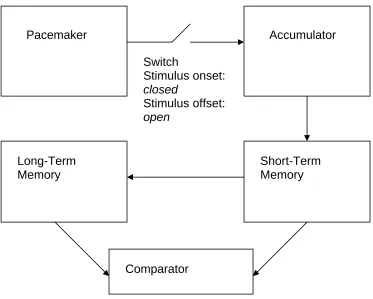
Concentrating on the kinds of case that require fine temporal discriminations, the basic
mechanism proposed by scalar timing theory involves a neural pacemaker, emitting
regular pulses, and an accumulator, which records the number of pulses emitted by the
pacemaker for a given period. Perception of the duration of a given stimulus, according
to this theory, involves the following mechanism. Onset of the stimulus causes a switch
connecting the pacemaker and accumulator to close. The accumulator then records
pulses until the cessation of the stimulus causes the switch to open, breaking the
connection. The accumulator’s record may then lead to a judgement of duration, or can
1984.) In one variant of the model, the pacemaker produces pulses at intervals that are
variable but whose average duration is nevertheless constant.
Switch
Stimulus onset: closed
Stimulus offset: open
Comparator Long-Term
Memory
Short-Term Memory
[image:17.595.111.484.168.467.2]Accumulator Pacemaker
Fig 1: The scalar timing theory of duration perception
Appeal to the slowing down or speeding up of the rate at which the pacemaker emits
pulses provides a simple explanation of the familiar fact that time seems to go faster in
some contexts and more slowly in others. In some cases, the pacemaker appears to be
very seriously altered, with potentially disastrous results. One of the most dramatic
instances of this is the Zeitrafferphänomen or accelerated time phenomenon. In one
case, a patient who had suffered damage to the left prefrontal cortex was driving his car
when he suddenly found that objects outside appeared to be rushing towards him at an
screen were happening too fast to make sense of (Binkofski and Block, 1996). One
explanation of his experiences is that the damage to the left hemisphere had caused the
pacemaker to slow down its production of pulses. In non-pathological cases, the
pacemaker pulse rate appears to be affected, or ‘entrained’, by external stimuli such as a
series of high-frequency clicks (Treisman (1999)). It is a very plausible suggestion that
the pacemaker may also be affected by drugs, since these produce marked distortions of
time estimates (Friedman (1990).
An alternative model for timing involves, not a single pacemaker, but a series of
oscillators, whose cycles differ from each other but nevertheless have well-defined
phases. Instead of an accumulator recording number of pulses is some mechanism that
detects, at any one time, what phase each oscillator is in. Thus time from the onset of a
stimulus may be represented qualitatively, rather than quantitatively, by the
permutations of phases (Church and Broadbent, 1990).
The precise details of the mechanism do not matter in the context of addressing
our epistemological puzzle. What does matter is the key idea underlying all these
models, that of a regular (or averagely regular) neurophysiological process that is
effectively a clock system. Thus the perception of time is not simply a passive reception
of external stimuli, but an active structuring of stimuli based on an internal system of
measurement:
The ear and eye respond to energies from the environment that impinge upon their
receptive surfaces. The tongue and nose sample molecules. To orient us in space, the
vestibular system depends on properties the body possesses as a physical object (its
response to gravity and inertia). It would seem that the time sense relies on properties of
the brain itself as a physical system, the propensity of neurons or neural networks to
produce oscillations that can be used as timing devices. Thus one function of the brain
may be to act as the sense organ for time. (Treisman, 1999, p. 244.)
Controversial though they may be, the models of time perception briefly presented
in this section at least give us a starting point in our approach to the epistemological
puzzle. What is interesting about these models is that they confirm our suspicion that
order and duration do not play a causal role, for on neither model were these temporal
how, if time perception is based on something like the mechanisms described by these
models, it can lead to knowledge of the temporal properties of events. Since there is a
tension between the CTMP and the acausality of order and duration, any resolution of it
must pursue one of two strategies: revise our view of what makes perceptual beliefs
about intervals true, or revise the causal account of perceptual knowledge. In the
remainder of this paper, I shall look at both strategies.
4 FIRST ATTEMPT TO DISSOLVE THE PUZZLE:
ORDER AND DURATION AS MIND-DEPENDENT
4.1 An Augustinian inference
The problem of accounting for time perception greatly exercised Augustine, and it led
him ultimately to his extraordinary conclusion that time was all in the mind. Here was
the initial difficulty:
But to what period do we relate time when we measure it as it is passing? To the future,
from which it comes? No: because we cannot measure what does not exist. To the
present, through which it is passing? No: because we cannot measure what has no
duration.To the past, then, towards which it is going? No again: because we cannot
measure what no longer exists. (Augustine (1961), p. 270.)
What, then, are we measuring? Augustine’s answer is that it is mental item: ‘It is in my
own mind, then, that I measure time.’ An answer, we might note, that has clear parallels
with the sense datum theory of perception. What he infers from it, however, is quite
surprising: that the object of my measurement is a mental item, and since time belongs
only to such objects, time itself is purely mental.11
Now, we might query Augustine’s apparent failure to distinguish the direct
object of measurement (a mental item) from the indirect object (the external event). But
concerns, for his conclusion that time is mind-dependent. We can, as it were, update
Augustine’s argument using the components of our puzzle. So far, we have argued that
the putatively mind-independent facts concerning time order and duration are not the
causes, direct or indirect, of our corresponding perceptual beliefs. But the CTMP
requires that the truth-makers of those perceptual beliefs that constitute knowledge be
part of the causal chain leading to those beliefs. Now, although the items whose
temporal relations we seem to perceive may be external items (two chimes of the clock,
a flash of lightning and clap of thunder, the beginning and end of a musical phrase), the
causes that are responsible specifically for the perception of order and duration are
within the mind. So, the neo-Augustinian argument goes, we should look for the
truth-makers of the relevant beliefs amongst the psychological facts. This would imply, of
course, that time order and duration are mind-dependent.
The models of time perception we looked at in the previous section pave the
way to this approach. The scalar timing theory, for instance, suggests a representative
theory of perception, where the immediate object of perception is some mental
representation of an external state. The mind-dependence strategy simply disposes of
the external state (the duration of the event), leaving us just with the representation.
Let us now look in more detail at what this strategy involves⎯and whether it
works.
4.2 Prospects for a psychological analysis of time order
Our judgements concerning the temporal order of events depend in part on our spatial
relations to those events. On the castle battlements, a cannon is fired to mark the hour of
noon. Simultaneously, half a mile away, the town church begins to strike. People
walking around the castle walls will hear first the noonday gun, and then the church
bell. Those about to enter the church will hear first the bell’s initial strike, and then the
gun’s report. Judgements based solely on observation and in ignorance of one’s location
vis-à-vis the observed events are therefore prone to error. We can capture this in terms
of what I shall call the objectivity constraint: judgements concerning time order are
between observers are genuine. Any theory of time order must either conform to the
objectivity constraint, or give us a compelling reason to abandon it. Can the suggestion
that time order is mind-dependent be reconciled with the objectivity constraint?
At first sight, it might seem that objectivity automatically rules out
mind-dependence, but this in general is not so. Consider the case of spatially indexical beliefs,
such as ‘The centre of the magnetic field is here’. This can be given perfectly objective
truth-conditions, as follows: any utterance or thought, u, of that type, is true iff and only
if u is located at the centre of the magnetic field. Whether or not those truth-conditions
obtain is not a matter of subjective opinion. However, the ‘hereness’ picked out by such
a token is still mind-dependent, in that it is not an intrinsic property of the external
space, but rather a relation between that space and a representation of it. There would
be no sense to the suggestion that, even in the absence of minds, some place would still
be uniquely and absolutely here. The truth-conditions for ‘here’-judgements can both be
mind-dependent and reflect the perspectival nature of such judgements. Any application
of the objectivity constraint, therefore, does not automatically and question-beggingly
imply mind-independence. Objectivity and mind-dependence are both exhibited by
perspectival judgements.
If we represent judgements of time order as similarly perspectival, then we
effectively identify actual order with perceived order. To retain objectivity, we have to
build in the actual spatial relations between observers and events. Thus, the castle
visitors’ judgement that the gun went off before the church bell struck was objectively
true given their location, and the church visitors’ judgement that the bell struck before
the gun went off was objectively true given their location. Only someone equidistant
from castle and church could correctly judge that the two events were simultaneous.
A consequence, however, of this perspectival treatment of order is that, as it stands, it
implies that there cannot be relations of precedence among unperceived events. If this
seems too strong, then we could consider the following compromise: we should
distinguish between the relation of precedence, on which the direction of time depends,
and the relation of temporal betweenness, which by itself does not give time its
direction. We can treat the former as mind-dependent without treating the latter
similarly. So, if we assume that temporal betweenness is independent of psychological
psychological relation between some facts in the series. Take the following, as yet
undirected, series of events, ordered by the relation of temporal betweenness:
e1⎯e2⎯e3⎯e4⎯e5⎯e6⎯e7
Now suppose only e4 and e6 in this series are perceived, by some observer O, and e6 is
perceived as occurring after e4. Then, given that e5 is between e4 and e6, and e4 is
between e3 and e5, it follows that, relative to O, e3 is earlier than e5, although neither is
perceived. Since time order is supposed on this model to be perspectival, however, the
possibility remains that e6 will be perceived by some other observer as preceding e4, and
this would mean that the entire series would have a different direction for this observer.
We do not need to concern ourselves with this consequence, however, since we cannot
make precedence perpectival without making betweenness similarly perspectival, so
this compromise is not an option. We can imagine two observers so situated that for one
of them three spatially separated events occur in the order ABC, while for the other they
occur in the order BAC. Unless betweenness is perspectival, one of these observers is
wrong, thus upsetting the perspectival account of precedence.
Whether or not such a perspectival account is viable, however, it does not help
us solve the epistemological puzzle. For it locates the truth-makers of time order
judgements, not wholly in the mind, but in the relations between external events and
observers. And if we try to represent these relations, or facts concerning them, as the
causes of our perceptual beliefs, then we face the problems raised in §2.2, and little
would have been gained by pursuing the mind-dependence strategy. On the other hand,
if we treat the truth-makers of order judgements as wholly internal to the mind, then we
may have restored their causal status, but at the expense of giving up the objectivity
constraint. Is there a compelling argument for doing this? Well, that it disposes of the
epistemological puzzle is an argument, but its force depends on the CTMP having a
stronger hold on us than the objectivity constraint, and on the absence of any other
4.3 Conventionalism about metric
Intuition may favour the objectivity constraint in the case of time order, but it is perhaps
somewhat less strongly in favour of objectivity when it comes to duration. Are there
objective facts of the matter as to the metric of time? Consider, for example, two
successive swings of a pendulum: did the second swing take exactly as long as the first?
Objectivism about temporal metric says that there is a fact of the matter as to whether it
did or did not, independently of any means we have of establishing the fact.
Conventionalism about metric denies this. The truth or falsity of what we might call
judgements of isochrony (that two intervals are of the same duration) depends on which
clock we adopt as our standard. As Reichenbach articulates it, ‘The equality of
successive time intervals is not a matter of knowledge but a matter of definition...All
definitions are equally admissible’ (Reichenbach (1958), p. 116).
Since the assumption that there are objective facts about metric is a central
aspect of our puzzle, conventionalism appears to offer a way out of the difficulty. The
human brain (indeed, in many cases, the animal brain) is, according to well-confirmed
psychological models, a clock system, and so provides one possible definition of
isochrony. If so, then the conventional, clock-relative truth-conditions of perceptual
judgements of isochrony will obtain simply by virtue of the psychological processes
leading to those judgements. Cause and truth-maker will coincide.
Or will they? Reichenbach says that all definitions of isochrony are equally
admissable. This appears to follow from the conventionalist assertion that no system by
which we measure intervals of time is objectively more accurate than any other, since
accuracy is defined in terms of one’s choice of system. But Reichenbach’s position
seems unduly liberal. William Newton-Smith suggests that, even for the
conventionalist, some judgements about isochrony are not merely eccentric, but false.
There are some constraints on selecting a standard: ‘if I adopt some deviant clock which
gives the ice age, the time between my last two heartbeats and a performance of
Wagner’s Ring the same duration, I am just wrong.’ (Newton-Smith (1980), p. 163.)
Our standard should be what we could call a reasonableclock system (RCS), but how,
without invoking objective metric, do we determine what counts as an RCS? One
system tend to remain approximately congruent with each other, and occasional failures
of congruence would be readily explicable by means of a simple theory, allowing one to
correct errant instances. In addition, the clock system should be compatible with the
construction of a coherent physical theory (e.g. of motion). So, having thus defined
what it is to be an RCS, the conventionalist can say that judgements of isochrony are
true relative to some RCS. The crucial question is then whether the human brain
constitutes an RCS or not. If not, then conventionalism can only offer an escape route
from our puzzle if we adopt Reichenbach’s liberal approach. As a time-measurement
system, our biological clock is notoriously variable, and affected by such things as
temperature, excitement and boredom, and of course drugs. Nevertheless, it is a more
satisfactory clock system than some systems we might choose as the standard: were it
not so, we would be unable to co-ordinate bodily movements as well as we do, nor
detect subtle variations in the motion of external objects, nor be able to appreciate and
produce music. Let us not be too particular, then, and designate our biological clock an
RCS.
Consider, then, the perception of two successive stimuli by an observer who
judges on the basis of their perception that the first stimulus was shorter in duration than
the second. The truth of this judgement, according to the conventionalist, is relative to
the choice of RCS. So which RCS is relevant here? The obvious answer is: the subject’s
own internal clock. This, as we saw above, guarantees the causal connection between
belief and truth-maker. However, all judgements of relative duration will come out true
on this answer, since it is trivial that the deliverances of any RCS are true relative to that
same RCS. So we could no longer make the distinction we would want to make
between those judgements that are accurate and those that are not. If, instead, we chose
some other RCS as the standard, then we can distinguish between accurate and
inaccurate judgements, since not all deliverances of the biological clock will coincide
with those of the other RCS. The price of this manoeuvre, however, is that, except in
cases of a special kinds, there is no causal connection between the judgement of relative
duration and the RCS against which we are assessing the accuracy of the judgement.
The exceptions here are provided by certain experimental conditions, such as the
In the standard free-operant procedure, shocks are delivered, in the absence of responding, at
fixed intervals...and each response postpones the next shock for a fixed period of time (the
response-shock or R-S interval). There is thus considerable regularity to the distribution of
shocks in time, and it is not surprising that this regularity should at least sometimes be
reflected in the subject’s behaviour. Although shock can be completely avoided by a rapid
and sustained pattern of responding, a slower rate of responding may, if the timing is right,
be equally effective. As training continues, some animals learn to avoid an ever-increasing
proportion of shocks while emitting fewer and fewer responses, by timing the interval
between successive responses to something shorter than the R-S interval……
How is such behaviour to be explained? The obvious point to note is that the probability
of responding over time maps the probability of shock. As exposure to the temporal
regularities increases, so the subject comes to respond only at those times when the expected
probability of shock is high. In the absence of any explicit stimuli, the passage of time since
the last response can serve as a signal for the occurrence of the next shock, and also therefore
as a signal that another response will cause the omission of this otherwise expected shock.
(Mackintosh, (1983), p. 169.)
Here an RCS is part of the experimental set-up, and is used to govern the time between
certain stimuli. The RCS in question will then both cause, and define the accuracy of,
the subjects’ judgements. Thus truth-maker and cause will coincide. In other cases, the
choice of RCS will be arbitrary. But is this a problem? After all, for the conventionalist,
there is no objective fact of the matter as to whether s1 is shorter than s2 or not, so the
subject is not tracking anything. A biological clock is simply a regulatory system, not a
means of access to the objective properties of things.
However, if we ask for an explanation of our duration judgements, none is
forthcoming on the conventionalist view of metric. Or rather what explanation there is,
in terms of psychological mechanisms, seems incomplete. Putting this in the context of
the scalar timing model, we might ask: given that we form a given belief on the relative
duration of two stimuli on the basis of the numbers of pulses stored in the accumulator,
what is it that explains the fact that just this number of pulses were collected by the
accumulator? The conventionalist has no answer to give. We can push the demand for
explanation further and ask why, if duration judgements are only trivially true or
contentless, they are so useful. And even in the experimental case described above,
of some timing device, their success in doing so is mysterious unless one adds that the
device in question marks out objectively isochronic intervals.
To sum up the discussion of this section, it initially appeared that that treating
time order and duration as mind-dependent offered a way out of our puzzle. If we could
locate the truth-makers of our beliefs in the psychological processes leading up to those
beliefs, then cause and truth-maker would coincide. This strategy, if successful, would
support Augustine’s contention that the mystery of our ability to perceive time is best
answered by taking time to be in the mind. However, this strategy appears to lead to an
unacceptable subjectivism concerning our judgements⎯unacceptable not only because
it is part of our intuitive conception of time that our judgements have objective
truth-conditions (at least in the case of order), but also because the instrumental value of
those judgements would be entirely mysterious.
So we must now ask whether we are obliged to take order and metric as
mind-dependent in order to solve our puzzle. Is there still room for a view that takes these
aspects as mind-independent?
5 SECOND ATTEMPT: ORDER AND METRIC AS MIND-INDEPENDENT
5.1 Chronometric explanation
In this section, we shall look at a second strategy for resolving the puzzle, one that
involves modifying the CTMP. Instead of confining the explanatory relationship
between perceptual beliefs and their truth-makers to one that is purely causal, we might
expand it to include other, non-causal, components of explanation. The modified CTMP
becomes:
The Explanatory Truth-Maker Principle (ETMP): Perceptual beliefs that qualify
for the title of ‘knowledge’ have truth-makers that figure in a full explanation of
the acquisition of those beliefs.
what other kind of explanation might be relevant? In the case of perceptual beliefs about
time order and duration, I propose that the relevant kind of explanation is one that is
often assimilated to causal explanation, but should be distinguished from it, a kind I
shall dub chronometric explanation. Chronometric explanation appeals to the temporal
location and extent of things, or to the rate of change.12 Often it will occur in the context
of a causal explanation. Thus, a certain effect may be explained, not simply by the
existence of an antecedent cause, but by the location of that cause in time, or by the
interval between that cause and another item, or by the rate at which some antecedent
change proceeded. Here are some examples of causal explanations that include
chronometric explanations:
(a) Why did the firework explode at t?
Because it was lit five seconds before t.
(b) Why did electricity flow around the system?
Because the two buttons were pressed simultaneously, thus closing the circuit.
(c) Why are the two traces on the Campbell-Stokes recorder the same length?
Because the two intervals of sunshine that caused the traces were equal in
duration.
Why should we need to distinguish between purely causal and chronometric
explanation? Because, once again, of the difficulties raised in §2.2. The kinds of fact or
property appealed to in chronometric explanation do not appear to be causal.
Appeals to the rate at which processes take place are also chronometric. This
may seem rather surprising. It implies that we do not, strictly speaking, cause changes
in the rate of processes, and also (since the effects of some things are also causes of
others) that such changes in rate cannot themselves be the causes of things. We need to
be careful how we articulate this point, however. The suggestion is not that changes in
rate cannot feature in causal explanations, either as explanans or explanandum, but
rather that such explanations must involve a non-causal element. Here are two
(d) Why did the reaction speed up?
Because a catalyst was added.
(e) Why did the ball slow down?
Because a force was exerted on it.
In both these cases, the explanandum involves facts about intervals. Yet the explanans
appears to be purely causal, or at least it seems to involve an event or state that can be
given a specific location. What I suggest is happening in these cases is this. It is a brute
fact that a given process proceeds at a certain rate. Different processes may proceed at
different rates. When some factor appears to be affecting the rate of a process, what it is
in fact doing is determining which of a range of related processes is realised. A reaction
in the presence of a catalyst is not the same reaction as one in the absence of a catalyst.
(A catalyst is sometimes described informally as something which may affect the rate of
a reaction without itself being directly involved, but theories of catalysis, whether
chemical or physical, all ascribe a much more active role to the catalyst.) So what we
have here is two factors: the purely causal fact that the catalyst causes a reaction of a
certain type to take place, and the purely chronometric fact that that reaction takes place
at a certain rate. Similar remarks apply to the case of motion.
So, having introduced the notion of chronometric explanation, we can now look
at the role it plays in the explanation of how we acquire beliefs about order and
duration.
5.2 How time order can be explanatory
Suppose you are waiting at the traffic lights, which are currently on red. You now see
the amber light appear, followed shortly by the green light. Consider the causal account
of your perceptual awareness of the order: you see the amber light, the content of which
experience is then stored in the short-term memory, which then affects your perception
of the green light. The causal order of our perceptions determines your belief
concerning the time order of the events perceived. Within this psychological account are
(Pa); the green light (g) causes your perception of it (Pg), and that second perception is
causally affected by Pa. These causal relations, however, are not enough by themselves
to guarantee the truth of your belief that a precedes g. So, how does the truth-maker of
your belief⎯that a is actually earlier than g⎯play any explanatory role in your
acquisition of that belief?
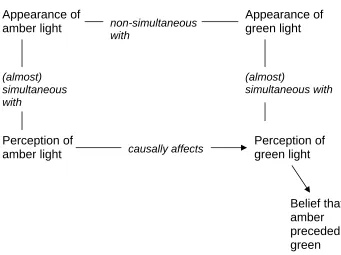
First, we need to appeal to the following chronometric explanation: because of
the high speed of light and the short distance between you and the events perceived, Pa
and Pg are almost simultaneous with a and g respectively. In contrast, a and g are not
even approximately simultaneous. These relations are set out in Fig. 2.
Appearance of
amber light non-simultaneous with
Appearance of green light
(almost) simultaneous with
(almost)
simultaneous with
Perception of
amber light causally affects
Perception of green light
[image:29.595.144.485.305.560.2]Belief that amber preceded green
Fig. 2: Causal and chronometric elements in the acquisition of belief
about time order
Now, there are two ways in which we might articulate the explanatory
connection between truth-maker and belief.
in part, explains how (Pa) can causally affect (Pg). Because the perceptions are virtually
simultaneous with the events of which they are the perceptions, the order of perceptions
will mirror the order of events, which is what enables (Pa) causally to affect (Pg) rather
than the other way around, which in turn explains why you perceive g as following a.
Thus, the truth-maker enters, in a rather simple and obvious way, into the explanation of
how you come to acquire your belief.
The second explanation is a little more interesting. Instead of explaining the
causal order of your perceptions in terms of the time order of the external events, we
could reverse the direction of causation. This involves an appeal to the causal theory of
time order, of which the following is one of the simpler forms:
x is earlier than y iff x is simultaneous with some fact that is a cause of some other
fact that is simultaneous with y13
The non-simultaneity of a and g explains how there can be a causal connection between
(Pa) and (Pg), but does not determine its direction. It is the fact that (Pa) causally affects
(Pg) and not vice versa that fixes the time order of (Pa) and (Pg), and therefore, a and g
themselves. For since a is (virtually)14 simultaneous with a cause, (Pa), of something,
(Pg), that is (virtually) simultaneous with g, it follows by the causal theory of time order
that a is earlier than g. So this time the truth-maker falls out as a logical consequence of
the explanation of the acquisition of your belief.
I favour the second of these explanations, because of its greater economy (the
temporal relation is reduced to the causal relation) but, given the controversial nature of
the causal theory of time order,15 all I can do here is simply to display the two
explanations as illustrations of how objective and mind-independent time order can be
genuinely explanatory of the beliefs it makes true.
5.3 How duration can be explanatory
Employing chronometric explanation (at least of the kind that involves reference to
duration or rate, as opposed to just simultaneity) clearly implies a commitment to
fact of the matter as to whether, e.g., one interval is longer or shorter than, or equivalent
to, some other interval, even in cases where one interval is not contained within the
other. Assuming the legitimacy of this kind of (I submit, non-causal) explanation, we
would expect it to be relevant in explaining our perceptual beliefs about metric.
So, let us say that I am presented with two successive auditory stimuli and asked
to judge whether or not they were of equal duration. Suppose that I correctly judge that
they are isochronous. According to the scalar timing theory, the onset of the first
stimulus closes the switch between pacemaker and accumulator, which then encodes the
number of pulses emitted by the pacemaker. Stimulus offset causes the switch to open.
The encoded pulses now provide a measurement of the length of the first stimulus,
which is stored in the short-term memory. The same process is activated by the second
stimulus. The resulting two measurements are then compared, and a judgement of
isochrony arrived at. Again, the purely causal facts are not sufficient for the truth of my
belief. What more is needed is the chronometric explanation of why just these pulses
were recorded by the accumulator. The chronometric explanation will appeal to the
objective lengths of the intervals between stimulus onset and offset. These lengths then
entail the truth about the isochrony of the stimuli. So, once again, the facts that provide
a full explanation of how I come to acquire my belief that the two stimuli are
isochronous include the truth-maker of that belief, and the Explanatory Truth-Maker
Principle is satisfied.
5.4 A compromise: A-series position as mind-dependent
Objective, mind-independent facts about time order and metric can be genuinely
explanatory of our perceptual beliefs. But not all aspects of time may have an
explanatory role to play. So there may be room for compromise with the Augustinian
position: perhaps some features of time are best understood as mind-dependent. Or so I
shall argue in this section. The aspect I shall focus on is that of A-series position.
The term ‘A-series’ was first introduced by J.E. McTaggart, in his well-known
distinction between two kinds of temporal ordering, which was the prelude to his
of positions in time which runs from the distant past, through the present, and to the
distant future. The A-series position of an event is therefore its pastness, presentness or
futurity. We might augment this and say that pastness and futurity is a matter of degree:
something can be very recently past, or very distantly past, and so on. It is a
characteristic of the A-series positions of events that they change, and this, which is
nothing less than the passage of time itself, is an obvious and apparently entirely
objective aspect of time, one that seems necessary for us to have any experience at all.
McTaggart contrasted this with the B-series, which orders events according to the
relations they stand in to other events⎯more specifically, according to their
simultaneity or precedence relations. B-series positions do not change. If a is at any
time earlier than b, it is so for all time. It is B-series relations and properties that we
have been concerned with for most of this paper. However if, as we naturally assume,
there is such a thing as A-series position, it is clearly logically connected to B-series
position. If Sally’s birth is past, but Jilly’s birth is present, then, inexorably, Sally’s
birth precedes Jilly’s. Given this logical connection, we need to decide which is the
more fundamental: A-series position, or B-series position. Suppose that A-series facts
are the more fundamental, and order facts supervene upon them. We might propose a
reductive analysis along the following lines:
a is earlier than b
iff:
a is less future than b
or
a is present and b is future
or
a is past and b is present
or
a is more past than b
This is just one of a number of reductive analyses we could have proposed16, and one
might regard some aspects of this particular one with suspicion: is the ‘less future than’