The development and validation of the Epilepsy and Learning Disability Quality of Life (ELDQOL) scale
Deborah Buck1, Monica Smith1, Richard Appleton2, Gus A Baker3, Ann Jacoby4
1Institute of Society and Health, Newcastle University, UK 2Alder Hey Children’s Hospital, Liverpool, UK
3The Walton Centre for Neurology and Neurosurgery, Liverpool, UK 4Dept of Public Health, University of Liverpool, UK
Corresponding author:
Professor Ann Jacoby Dept of Public Health Whelan Building University of Liverpool Brownlow Hill
Liverpool UK
Phone: +44 (0) 151 794 5602 Fax: +44 (0) 151 794 5588 Email: [email protected]
Word count:2,646 (excluding tables and references)
Abstract
Introduction
There is general agreement within the health outcomes field of the importance of assessing therapeutic outcomes including quality of life (QOL).1Medical
interventions may be beneficial to patients on impairment or disability measures, but without equally refined QOL measurements a clear and comprehensive evaluation of their efficacy is not possible.2,3 The assessment of QOL in adults with epilepsy is
now widespread with the existence of a number of psychometrically sound measures.4
However, reviews of outcome measures have shown that few suitable instruments currently exist for use with people who have both epilepsy and learning disabilities.1,5
One recently developed measure, the Epilepsy Outcome Scale (EOS),6was developed
to be completed by carers of people with epilepsy and learning disabilities (LD), but while valid and reliable, it is intended for adults rather than children with these conditions. A recent review of QOL measures for use specifically with children and adolescents with epilepsy1identified five epilepsy-specific instruments, of which three
were considered potentially suitable for children who had LD: the Health-related Quality of Life in Children with Epilepsy measure;7the Impact of Childhood
Neurological Disability Scale (ICND);8and the Epilepsy and Learning Disabilities
Quality of Life scale (ELDQOL).9-12
The Health-related Quality of Life in Children with Epilepsy measure was not purposely developed for those with both epilepsy and LD. However, it does
incorporate a self-report (completed by the child) as well as a proxy-report which can be completed by parents alongside or instead of the child report, and seems to be reasonably valid and reliable.1 The ICND assesses the impact of epilepsy and
concomitant behavioural, cognitive, and physical/neurological disability in children. It has good reliability and is reported to be satisfactory in terms of validity.1
ELDQOL is specifically aimed at informal/formal carers of children with both severe epilepsy and LD. Initial evidence of its psychometric properties was reported by the scale’s developers13, and subsequently ELDQOL was reviewed by Espie et al5who
reported.11,14
However, as a result of feedback from clinicians involved, it was decided to undertake revision and revalidation of ELDQOL. This paper reports on the psychometric testing of the final, revised version of ELDQOL. A detailed report of the earlier stages in its development is available from one of the authors (AJ). A summary of its history will be provided here.
Initial development of ELDQOL
Potential items for inclusion in the pilot structured measure were selected based on in-depth interviews with parents of children with severe epilepsy. The measure was then piloted to assess its psychometric properties (content and construct validity, internal consistency and test-retest reliability) and acceptability to parents. Parents of 50 patients across 5 UK paediatric neurology out-patient departments were recruited to the pilot study.
The pilot version of ELDQOL consisted of 66 items across 6 domains: seizure severity, seizure-related injuries, AED side-effects, behaviour, mood and overall QOL. It was found to be satisfactory in terms of content and construct validity and internal consistency, and showed high test-retest reliability. Furthermore, parents commented that the measure was comprehensive, relevant and easy to complete. The pilot version of ELDQOL was subsequently used in a clinical trial of Lamictal11
which provided evidence of its responsiveness. However, a number of criticisms were made about the measure by clinicians involved in the trials, particularly in terms of the clarity of meaning of several items and of the appropriateness or sensitivity of response sets.
Consequently, a revalidation study was undertaken to pre-test (using cognitive interviews15), revise and then reassess the psychometric properties of ELDQOL. The
Methods
Qualitative phase
Qualitative (cognitive) interviews were undertaken with 16 parents and 17 health and other professionals in order to ascertain their opinions on the wording, coverage and layout of the questionnaire.
The parent participant group comprised 5 couples (the young person’s mother and father) and 6 mothers. The 11 children of these parents were 8 boys and 3 girls, age range 18 months to 21 years. Two young people attended residential school, 7 attended special schools or day centres, and one a mainstream school. The parents were identified by a consultant or senior nurse at 2 specialist hospitals in the north of England. They were selected because of their child’s condition and because they were judged to be interested in all aspects of their care.
The professional participant group consisted of 10 consultant paediatric neurologists or neurologists with a special interest in epilepsy and learning disabilities, one associated health services researcher, two paediatric epilepsy nurse specialists, two nurses specialising in epilepsy and learning disabilities, two teachers/play leaders, and one psychologist.
All participants were sent a copy of the existing ELDQOL questionnaire and asked to complete it immediately prior to the in-depth interview. Interviews were tape
recorded and lasted approximately one hour. They involved scrutiny of each question in turn, where participants’ views were sought on interpretation, coverage, content, wording and scale construction. The tapes were transcribed for analysis.
Psychometric phase
1Age was not recorded for 13 children.
hospitals, who explained the study and asked whether they would be willing to complete the questionnaire. Those who agreed were sent a study information sheet together with a copy of the questionnaire and a consent form and asked to return both when they had been completed. For the purposes of evaluating test-retest reliability, parents were sent a second questionnaire approximately 2 weeks after completing the first. Formal carers were identified through a national long-stay
residential/assessment centre.
The mean age of children recruited to the study was 11.5 years (SD 4.6, range 2 – 191); 58% were male and 42% female. Of the parent respondents, 39 were mothers, 3
were fathers, and 2 were other relatives; 3 of the questionnaires were jointly completed by both parents.
The final version consisted of 70 items covering seizure severity, seizure-related injuries, AED side-effects, behaviour, mood, physical functioning, cognitive
functioning, social functioning, parental concern, communication, overall QOL and overall health. The items covering behaviour, seizure severity, mood and side-effects domains are summed to create 4 subscales containing 9, 14, 16 and 19 items
respectively. On each subscale, a higher score indicates poorer functioning. The remaining domains consist of single or several non-summed items. Subscales from two other outcome measures [the Aberrant Behavior Checklist (ABC)16and the Child
Health Questionnaire (CHQ)]17were also administered for the purposes of evaluating
the construct validity of ELDQOL.
In order to evaluate validity, t-tests and correlations were used to examine the relationship between ELDQOL sub-scales and:
* the Irritability and Hyperactivity subscales of the ABC;
* 4 global items (overall health, overall QOL, perceived severity of condition and disability level).
Severity of disability was assessed using a 4-item scale developed by a consultant paediatric neurologist (RA) with a specialist interest in epilepsy and learning disability. It covers mobility, feeding, dressing and speech, each item having 5 response options ranging from the worst to the best possible level of functioning.
It was predicted a priori that there would be:
* a significant relationship between the ABC Irritability and Hyperactivity scales and scores on each ELDQOL subscale;
* a significant relationship between the 3 CHQ scales and scores on each ELDQOL subscale;
* a significant relationship between overall health and scores on each ELDQOL subscale;
* A significant relationship between overall QOL and scores on the Side-Effects, Seizure Severity, and Mood subscales
* A significant relationship between perceived severity of condition and each subscale
* A significant relationship between disability level and Seizure Severity.
Results
Qualitative phase
Views of parents
Six issues were identified through the cognitive interviews with parents: validity of domains, multiple seizure types, wording, ease of completion, response categories and identifying change. It was clear that the questionnaire resonated with parents’
experiences and concerns, the questions being described as ‘very good’ and ‘geared to parents’ for example. However, it did not, in its existing form, take into account that some children have no mobility or verbal skills. Some commented on the lack of lifestyle questions to capture social activities and interests. In terms of multiple seizure types, some parents found it difficult to identify which seizure type they should refer to in answering the questions. There was a consensus that use of the word ‘seizure’ was preferable to ‘attack’. The ‘layman’s language’ was appreciated because it was easy to understand, and the length of the questionnaire was viewed as good, ‘quick to do’ and ‘easily to fill in’. Instructions were described as ‘clear’, ‘logical’ and ‘concise’. Overall, parents felt that they had sufficient choice in response categories, and being asked to concentrate on the past 4 weeks seemed acceptable.
Views of professionals
Interviews with professionals highlighted several broad methodological issues, in particular the nature of the proxy respondent, scope and objectives of the
a ‘health profile’ and a section covering function was suggested. In terms of design, most professionals felt the length of the questionnaire was about right. Some thought the use of the word ‘attack’ was regressive in terms of practice and preferred the term ‘seizure’.
Revisions made as a result of the qualitative phase
Taking into account the comments from parents and professionals, a number of revisions were made. In summary:
* the word ‘seizures’ replaced the word ‘attacks’
* ‘can’t say’ and ‘does not apply’ response options were added
* a question about perceived control was dropped because of ambiguity of meaning; and one about perceived severity was added
* an item was added to those about seizure-related injuries
* an item covering ‘usual activities’ (school, playing, socialising) was added to the behaviour subscale
* 2 items (‘sociable’ and ‘depressed’) were dropped from the mood subscale and replaced by three new ones (‘sad’, ‘withdrawn’, ‘cooperative/helpful’)
* 2 items were dropped from the side effects profile (hair loss, dizziness) and 2 were added (weight loss, loss of appetite); and a single item,
‘restlessness/hyperactivity’ was separated into two
Psychometric phase
Reliability
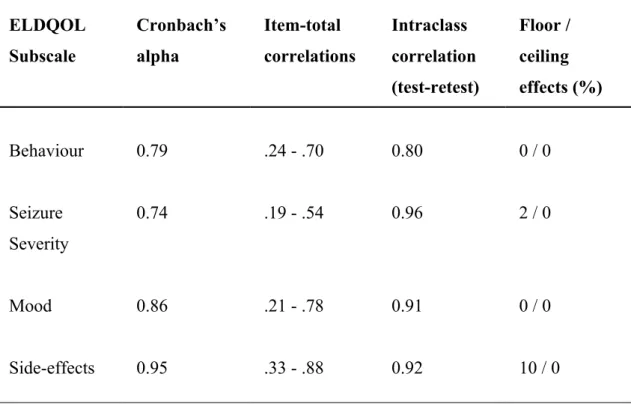
As shown in Table 1, internal consistency of the Behaviour, Seizure Severity, Mood and Side-Effects scales was high (0.74 – 0.95). Item-total correlations exceeded the desired 0.4 for most items, although in each scale there were some items which did not meet this: 3/9 items in the Behaviour Scale (‘problems sleeping‘, ‘being prevented from taking part in normal activities‘, and ‘appetite a problem‘); 7/14 items in the Seizure Severity scale (‘aware of surroundings after seizure‘, ‘blank out/lose
consciousness‘, ‘fall to the ground‘, ‘soil self‘, ‘injure mouth/cheek /tongue‘, ‘upset by injuries‘, ‘appear sleepy/subdued‘); 4/16 items in the Mood scale (‘tearful‘, ‘hyperactive‘, ‘withdrawn‘, ‘cooperative‘); and 3/19 items in the Side-effects scale (‘skin problems‘, ‘shaky hands‘, ‘weight gain.
The test-retest reliability of each subscale was high (range 0.80 - 0.96, Table 1). Floor/ceiling effects were acceptable in the Side Effects scale, low in the Seizure Severity scale, and there were none in the Mood or Behaviour scales (Table 1).
Validity
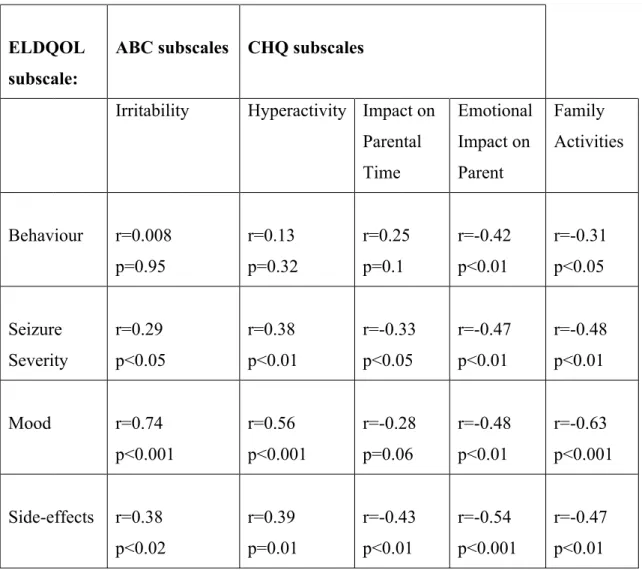
Table 2 shows that all but one of the 4 ELDQOL subscales (Behaviour) were moderately to highly correlated with both the Irritability and Hyperactivity scales of the ABC, and that all 4 were moderately to highly correlated with the Emotional Impact and Family Activities scales of the CHQ. Two of the ELDQOL subscales (Seizure Severity and Side-effects) correlated moderately with the Impact on Parental Time scale of the CHQ.
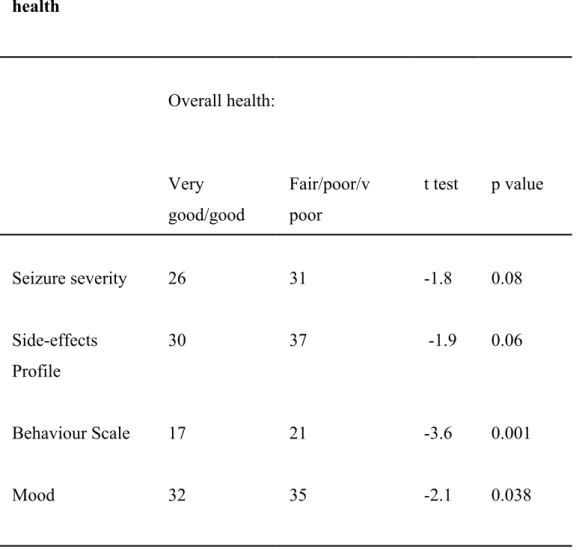
Table 3 shows a significant relationship between mean scores on the Behaviour and Mood subscales by overall health. There was a similar though non-significant trend for the Seizure Severity and Side Effects subscales.
higher mean scores on the ELDQOL scales, although these were not statistically significant.
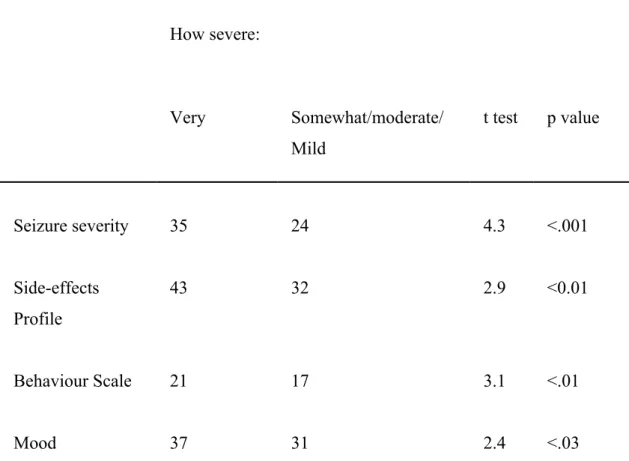
Mean scores on each of the 4 subscales were significantly worse for parents who felt their child’s condition was very severe compared to those who felt it was somewhat or moderately severe (Table 5).
Discussion
ELDQOL was derived using currently accepted standards for scale development, including qualitative and cognitive interview techniques with the target groups. The ongoing involvement of parents and professionals in determining the content and format of the measure has enhanced its acceptability and ease of completion. The final version of ELDQOL has very good evidence of reliability and validity, making it a promising proxy instrument for assessing the QOL of children/young adults with epilepsy and learning disability. Although in this validation exercise parents were not asked to note length of time taken to complete ELDQOL, this was previously
estimated as only around 20 minutes5, a factor which may further contribute to its
acceptability.
In terms of internal consistency, each of the 4 subscales had high Cronbach’s alpha values. For each scale there were some items which did not meet the desired 0.4 level for item to total scale correlation.19However, in each case the effect on Cronbach’s
alpha when these items are removed from the scale is negligible or has no effect and we therefore propose to retain these items on the grounds of
comprehensiveness/content validity.
The test-retest exercise found that each of the 4 subscales achieved ICCs well above the required level of 0.70 for group comparisons, and 3 of the 4 performed well enough for comparing individuals over time (0.90).19 Each scale performed well or
perfectly in terms of floor/ceiling effects.
We found excellent evidence of construct validity as all but one of the 4 ELDQOL subscales (Behaviour) were moderately to highly correlated with both the Irritability and Hyperactivity scales of the ABC, and all were moderately to highly correlated with the Emotional Impact and Family Activities scales of the CHQ. Poorer perceived health was significantly related to poorer mean scores on two of the ELDQOL subscales, and a similar trend was seen for the remaining two, providing further evidence of construct validity. Greater perceived severity of the condition was significantly related to higher scores on each subscale, and disability level was
Table 1 Reliability and floor/ceiling effects of the 4 ELDQOL subscales
ELDQOL Subscale
Cronbach’s alpha
Item-total correlations
Intraclass correlation (test-retest)
Floor / ceiling effects (%)
Behaviour 0.79 .24 - .70 0.80 0 / 0
Seizure Severity
0.74 .19 - .54 0.96 2 / 0
Mood 0.86 .21 - .78 0.91 0 / 0
Table 2 Validity: correlation between the 4 ELDQOL sub-scales and ABC and GHQ sub-scales1
ELDQOL subscale:
ABC subscales CHQ subscales
Irritability Hyperactivity Impact on Parental Time Emotional Impact on Parent Family Activities Behaviour r=0.008 p=0.95 r=0.13 p=0.32 r=0.25 p=0.1 r=-0.42 p<0.01 r=-0.31 p<0.05 Seizure Severity r=0.29 p<0.05 r=0.38 p<0.01 r=-0.33 p<0.05 r=-0.47 p<0.01 r=-0.48 p<0.01 Mood r=0.74 p<0.001 r=0.56 p<0.001 r=-0.28 p=0.06 r=-0.48 p<0.01 r=-0.63 p<0.001 Side-effects r=0.38 p<0.02 r=0.39 p=0.01 r=-0.43 p<0.01 r=-0.54 p<0.001 r=-0.47 p<0.01
Table 3 Validity: mean scores of the 4 ELDQOL subscales by overall health
Overall health:
Very good/good
Fair/poor/v poor
t test p value
Seizure severity 26 31 -1.8 0.08
Side-effects Profile
30 37 -1.9 0.06
Behaviour Scale 17 21 -3.6 0.001
Table 4 Validity: mean scores of the 4 ELDQOL subscales by overall QOL
Overall QOL:
Very god/good
Fair/poor/v poor
t test P value
Seizure severity 29 30 -0.2 0.81
Side-effects Profile
30 36 -1.4 0.16
Behaviour Scale 17 19 -1.8 0.078
Table 5 Validity: mean scores of the 4 ELDQOL subscales by perceived severity of condition
How severe:
Very Somewhat/moderate/
Mild
t test p value
Seizure severity 35 24 4.3 <.001
Side-effects Profile
43 32 2.9 <0.01
Behaviour Scale 21 17 3.1 <.01
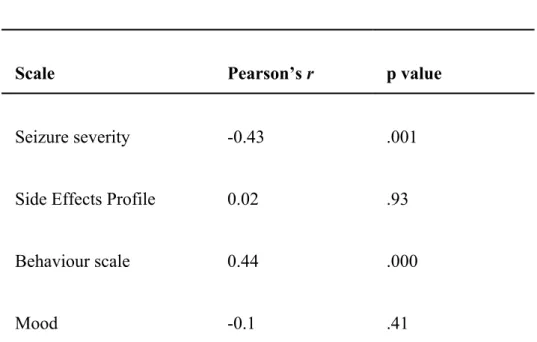
Table 6 Validity: correlation between ELDQOL subscales and disability level
Scale Pearson’sr p value
Seizure severity -0.43 .001
Side Effects Profile 0.02 .93
Behaviour scale 0.44 .000
Acknowledgements
References
1. Cowan J, Baker GA. A review of subjective impact measures for use with children and adolescents with epilepsy. Qual Life Res2004 (8):1435-1443.
2. Buck D, Jacoby A, Massey A, Ford G (2000) Evaluation of measures used to assess quality of life after stroke.Stroke2000;8:2004-2010.
3. Fallowfield L. The Quality of Life: The Missing Measurement in Health Care. London, UK : Souvenir Press, 1990.
4. Baker GA, Camfield C, Camfield P et al. Commission on Outcome
Measurement in Epilepsy, 1994-1997: final report. Epilepsia 1998;39(2):213-231.
5. Espie CA, Kerr M, Paul A et al. Learning disability and epilepsy. 2, A review of available outcome measures and position statement on development priorities.Seizure1997;6(5):337-350.
6. Espie CA, Watkins J, Duncan R. Development and validation of the Glasgow Epilepsy Outcome Scale (GEOS): a new instrument for measuring concerns about epilepsy in people with mental retardation.Epilepsia 2001;42(8):1043-1051.
7. Ronen GM, Streiner DL, Rosenbaum P; Canadian Pediatric Epilepsy Network. Health-related QoL in children with epilepsy: development and validation of self-report and parent proxy measures.Epilepsia 2003;44(4):598-612.
8. Camfield C, Breau L, Camfield P. Assessing the impact of pediatric epilepsy and concomitant behavioral, cognitive, and physical/neurologic disability: Impact of Childhood Neurologic Disability Scale. Dev Med Child Neurol. 2003 Mar;45(3):152-159.
(Lamotrigine) in children and adults with epilepsy and learning disability.
Epilepsia1997;38(Suppl 3):108.
10. Baker GA, Jacoby A, Douglas C. Quality of life outcomes of lamotrigine used in the treatment of patients with severe epileptic syndromes.Epilepsia
1996;37(suppl 4):117.
11. Jacoby A, Baker G, Bryant-Comstock L, Phillips S, Bamford C. Lamotrigine add-on therapy is associated with improvements in mood in patients wirh severe epilepsy.Epilepsia1996;37(Suppl 5):S202.
12. Jacoby A, Baker GA, Appleton R. Quality of life of children with epilepsy. Findings from a UK community study.Epilepsia1996;37(Suppl 4):100.
13. Baker G, Jacoby A, Berney T, Dewey M, Hosking G et al. Development of an instrument to assess quality of life in children with epilepsy and learning disability. Epilepsia 1994; 35(Suppl 7): S47.
14. Donaldson JA, Glauser TA and Olberding LS. Lamotrigine adjunctive therapy in childhood epileptic encephalopathy (the Lennox Gastaut syndrome)
Epilepsia1997;38:68-73.
15. Buck D, Jacoby A, Massey A, Ford G. Pre-testing items in a stroke-specific quality of life measure: the value of cognitive interviewing. Journal of Neurolinguistics 2000; 13: 267-71.
16. Aman MG, Singh NN, Stewart AW, Field CJ. The aberrant behavior checklist: a behavior rating scale for the assessment of treatment effects.Am J Ment Defic1985;89(5):485-491.
17. Langraf NJ, Abetz L, Ware JE. The child health questionnaire (CHQ): A user's manual. Boston : The Health Institute, New England Medical Center, 1996.