Hybrid Evolutionary Techniques for Constrained
Optimisation Design
Thesis submitted in accordance with the
requirements of the University of Liverpool
for the degree of Doctor in Philosophy by
Salam Nema
This research programme was carried out in collaboration
with the Knowledge Support Systems Retails Ltd.
Thesis Supervisors:
Dr. John Yannis Goulermas
Dr. Jason Ralph
Department of Electrical Engineering and Electronics
The University of Liverpool
1
Abstract
This thesis a research program in which novel and generic optimisation methods were developed so that
can be applied to a multitude of mathematically modelled business problems which the standard
optimisation techniques often fail to deal with. The continuous and mixed discrete optimisation methods
have been investigated by designing new approaches that allow users to more effectively tackle difficult
optimisation problems with a mix of integer and real valued variables.
Over the last decade, the subject of optimisation has received serious attention from engineers, scientists,
and modern enterprises and organisations. There has been a dramatic increase in the number of techniques
developed for solving optimisation problems. Such techniques have been applied in various applications,
ranging from the process industry and engineering, to the financial and management sciences, as well as
operational research sectors. Global optimisation problems represent a main category of such problems.
Global optimisation refers to finding the extreme value of a given nonconvex function in a certain feasible
region. Solving global optimisation problems has made great gain from the interest in the industry,
academia, and government.
In general, the standard optimisation methods have difficulties in dealing with global optimisation
problems. Moreover, classical techniques may fail to solve many real-world problems with highly
structured constraints, whereas achieving the exact global solution is neither possible nor desirable. One
of the main reasons for their failure is that they can easily been trapped in local minima. To avoid this, the
use of efficient evolutionary algorithms is proposed in order to solve difficult computational problems
2
traditional optimisation methods, which allow them to be successfully applied in many difficult
engineering problems.
The focus of this thesis presents practical suggestions towards the implementation of hybrid approaches
for solving optimisation problems with highly structured constraints. This work also introduces a
derivation of the different optimisation methods that have been reported in the literature. Major
theoretical properties of the new methods have been presented and implemented. Here we present detailed
description of the most essential steps of the implementation. The performance of the developed methods
is evaluated against real-world benchmark problems, and the numerical results of the test problems are
3
Acknowledgments
I would like to thank my supervisor Dr. Yannis Goulermas for his crucial guidance, constant support and
deep interest all the way through the work of this project. His encouragement and dedication was
invaluable in developing those ideas presented here. I owe special thanks for him for carefully reading
and invaluable suggestions and corrections of all the parts of this thesis.
Additionally, I am grateful to the help and support given by Dr. Phil Cook, for all research facilities that
have been provided to me in KSS Ltd.
I also would also like to thank Mr. Graham Sparrow for his continual suggestions and support during this
research. His suggestions have led to interesting and fertile discussion that made a vital contribution of
the successful completion of this project.
I would like to thank all the staff of the KSS, for their help and encouragement in every little occasion. I
also thank the Department of Electrical Engineering for their support and assistance since the start of my
research work.
4
Contents
Abstract ... 1
Acknowledgments ... 3
Contents ... 4
List of Figures ... 8
List of abbreviations ... 10
Notation
... 111 General Introduction ... 13
1.1 Overview ... 13
1.2 Objectives ... 14
1.3 Organisation and Contributions ... 15
2 Methods for Constrained Optimisation ... 19
2.1 Introduction ... 19
2.2 Deterministic Search Techniques ... 19
2.2.1 Mixed Integer Continuous Programming ... 21
2.2.2 Branch and Bound method ... 24
2.2.3 Outer Approximation method ... 26
2.2.4 Extended Cutting Plane method ... 29
2.2.5 Generalized Bender’s Decomposition method ... 29
5
2.2.7 Integrating SQP with Branch-and-Bound ... 31
2.2.8 Sequential Cutting Plane ... 33
2.2.9 Outer-Approximation based Branch-and-Cut algorithm ... 34
2.3 Comparison of MINLP optimisation methods ... 37
2.4 Evolutionary Programming ... 39
2.4.1 Simulated Annealing... 39
2.4.2 Genetic algorithms ... 40
2.4.3 Differential Evolution ... 41
2.4.4 Particle Swarm Optimisation ... 44
2.4.5 Constraint-handling methods ... 44
2.4.6 Coevolution ... 45
2.5 Summary ... 45
3 Implementation and Numerical Experiments ... 47
3.1 Introduction ... 47
3.2 Optimisation problems models format ... 47
3.3 The model in AMPL ... 48
3.3.1 COP Solvers ... 48
3.3.2 MINLP Solvers ... 51
3.4 COP Numerical Experiments ... 54
3.5 MINLP Numerical Experiments ... 56
3.6 Penalty function approach for the discrete nonlinear problems ... 67
3.7 Constraints Optimisation Experiments ... 72
6
4 A Hybrid Cooperative Search Algorithm for Constrained Optimisation ... 76
4.1 Introduction ... 76
4.2 General Background ... 76
4.3 Cooperative Coevolutionary framework ... 79
4.3.1 Augmented Lagrangian method ... 79
4.3.2 PSO Module ... 82
4.3.3 Gradient search Module ... 83
4.3.4 Coevolutionary Game Theory ... 84
4.3.5 The proposed HCP Algorithm ... 86
4.4 Benchmark problems ... 90
4.5 Analysis of HCP ... 100
4.6. Summary ... 102
5 An Alternating Optimisation Approach for Mixed Discrete Non Linear Programming ... 103
5.1 Introduction ... 103
5.2 General Background ... 103
5.3 Employed Optimisation Models and Algorithms ... 105
5.3.1 The MDNLP formulation... 105
5.3.2 The augmented Lagrangian multipliers method ... 105
5.3.3 Unconstrained optimisation ... 107
5.3.4 The Branch-and-Bound (BB) algorithm ... 107
5.4 The Proposed AO-MDNLP Framework ... 109
5.4.1 Alternating Optimisation (AO) ... 109
7
5.5 Numerical Experimentation ... 114
5.5.1 Results ... 114
5.5.2 Discussion of results ... 119
5.5. Summary ... 122
6 A Hybrid Particle Swarm Branch-and-Bound (HPB) Optimiser for Mixed Discrete Nonlinear Programming ... 123
6.1 Introduction ... 123
6.2. General Background ... 123
6.3 The Proposed Architecture ... 126
6.3.1. The Particle Swarm Optimisation module ... 126
6.3.2 Handling of Constraints ... 128
6.3.3 Treatment of Discrete Variables ... 129
6.3.4 The Sequential Quadratic Programming (SQP) module ... 130
6.3.5 The Branch-and-Bound module ... 131
6.3.6 Integrating and sequencing the PSO and BB ... 135
6.4 Numerical Experiments ... 140
6.5 Discussion ... 151
6.6 Summary ... 153
7 Conclusions and Issues for Further Work ... 154
8
List of Figures
Figure Page
2.1 Linear Outer Approximation algorithm. 28
3.1 Convergence plots for constrained optimisation problem. 55
3.2 Convergence Characteristics plots. 56
3.3 Integrating SQP and BB 57
3.4 Feasible region and objective function in process synthesis problem. 59
3.5 Objective function contours and nonlinear feasible region 61
3.6 Objective function and augmented objective function 68
3.7 Behaviours of F(x) for the various penalty parameters S 68
3.8 Behaviours of F(x) for different discrete requirements. 69
3.9 Convergence Characteristics plots. 74
3.10 Convergence plot. 75
4.1 Flowchart of the proposed HCP algorithm. 89
4.2 Evolution plot for Himmelblau’s Function. 92
4.3 Tension/compression string design problem. 93
4.4 Performance of the minimisation of the weight of a tension spring problem. 94
4.5 Pressure vessel design problem. 95
4.6 Evolution plot of pressure vessel design. 96
4.7 Welded beam design problem. 97
4.8 Evolution plot of welded beam design problem. 98
4.9 The 10-Bar Planar Truss Structure. 99
4.10 Search process comparison for Himmelblau’s function. 102
5.1 Iteration procedure of Alternating Optimisation. 109
5.2 Objective function evaluations during the AO process. 119
6.1 The TVIW-PSO algorithm. 128
9
6.3 Branch-and-Bound tree. 134
6.4 Flowchart of the proposed HPB algorithm. 138
6.5 Performance comparison for the pressure vessel design problem. 142
6.6 Compression coil spring. 144
6.7 Performance comparison for the spring design problem. 145
6.8 Evolution plots of welded beam design. 147
6.9 Speed reducer design. 149
6.10 Evolution plots of speed reducer design. 150
10
List of abbreviations
AO Alternating Optimisation.
BB Branch and Bound.
COP Constrained Optimisation Programming.
DE Differential Evolution.
DF Derivative-Free.
DP Deterministic Programming.
EA Evolutionary Algorithms.
ECP Extended Cutting Plane.
EP Evolutionary Programming.
GBD Generalized Bender’s Decomposition.
GO Global Optimisation.
IP Integer Programming.
GA Genetic Algorithms.
LP Linear Programming.
MDNLP Mixed Discrete Non-Linear Programming.
MILP Mixed Integer Linear Programming.
MINLP Mixed Integer Non-Linear Programming.
MIP Mixed Integer Programming.
MOO Multi-Objective Optimisation.
MIQP Mixed Integer Quadratic Programming.
NLP Non-linear Programming.
OA Outer Approximation.
PSO Particle Swarm Optimisation.
QN Quasi-Newton.
QP Quadratic Programming.
SLP Successive Linear Programming.
SP Stochastic Programming.
11
Notation
The set of real numbers.
Ν The set of non-negative integers.
Ø The empty set (without any element).
The set consisting of the three elements and .
is an element of the set .
is not an element of the set .
The number of elements in the set , the cardinality of .
The set of elements such that …
There exists an element such that …
For any element of .
Cartesian product of and .
A closed interval: , where a and b are real numbers (a ≤ b).
X x
x
)
inf( If has a lower bound, then
X x
x
)
inf( is by definition the largest of the lower bound
of .
If has no lower bound, then by convention inf(x).
x k x }
{ Sequence of elements , for
Cartesian product of the set , multiplied n times by itself.
The vector of with components
,
.Transpose of the vector of .
Scalar product of the vector and .
Euclidian norm of the vector .
n j
m i ij a A
, , 1 , , 1 ] [
Matrix with m rows and n columns, is the element in row i and column j.
12
Rank(A) rank of matrix A ( dimension of the largest regular square submatrix of A).
If is a function of the variables
, then is the gradient
of f at the point x, that is the n-vector with components
.
Equivalent notation to mean , the transposed vector of
is thus the same as the row-matrix with components ,
.
If is a function of the variables
, then is the
Hessian of f at the point x, that is the real (symmetrical) matrix whose
element is .
Subdifferential of f at x: set of the subgradients of f at x( for the convex or a
concave function).
)} ( {
inf f x
X
x By definition, infxX{f(x)}infxX(y) .
where and , y=f(x)}.
)} ( {
sup f x
X x
By definition sup{f(x)} inf{ f(x)}
X x X
x
)} (
{f x
Min X
x Let and . If xinfX{f(x)} and there exists xXsuch
that f(x) inf{f(x)}
X x
,then Min{f(x)} f(x)
X
x . If
)} ( {
inf f x
X
x , then by
convention
{f(x)} f(x)
Min X
x . If , then by convention
{f(x)} f(x)
Min X
x .
)} (
{f x
Max X
x By definition: MaxxX{f(x)}MinxX{f(x)}.
a bc
13
Chapter 1
General Introduction
1.1 Overview
Optimisation problems are generally composed of three parts: an objective function that needs to be
optimised, a set of variables that define the problem and on which the objective function depends, and a
set of constraints that restrict feasible values of these variables. Constraints reduce the feasible space
wherein solutions to the problem can be found. Formulation of an optimisation problem involves taking
statements, defining general goals and requirements of a given activity, and transcribing them into a series
of well-defined mathematical statements. More precisely, the formulation of an optimisation problem
involves: selecting one or more optimisation variables, choosing an objective function, and identifying a
set of constraints. Optimisation algorithms need to ensure that a feasible solution is found. That is, the
optimisation algorithm should find a solution that both optimises the objective function and satisfies all
constraints. If it is not possible to satisfy all constraints, the algorithm has to balance the trade-off
between optimal objective function value and number of constrains violated.
Optimisation can be applied to all disciplines. Many recent problems in Engineering, Science, and
Economics can be presented as computing globally optimal solutions. Using classical nonlinear
programming techniques may fail to solve such problems because these problems usually contain
multiple local optima [1]. Therefore, global search methods should be invoked in order to deal with such
14
1.2 Objectives
In this research, constrained optimisation problem is considered in the continuous and discrete search
space. The overall objectives of the present thesis were to develop novel hybrid versions of hybrid
evolutionary approaches as promising solvers for the considered problems. The designed algorithms
aimed to overcome the drawbacks of slow convergence and random constructions of stochastic methods.
In these hybrid methods, local search strategies are inlaid inside the evolutionary approaches in order to
guide them especially in the vicinity of local minima, and overcome their slow convergence especially in
the final stage of the search.
The optimisation problems exist in many applications and achieving the exact global solution is neither
possible nor desirable. Therefore, using efficient global search methods is highly needed in order to
achieve optimal global solutions. It has been found that evolutionary algorithms produce good results
when applied to these problems and they could obtain highly accurate solutions in many cases [2]. The
power of evolutionary techniques come from the fact that they are robust and can deal successfully with a
wide range of problem areas. However, these methods, especially when they are applied to complex
problems, suffer from the slow convergence and the high computational cost. The main reason for this
slow convergence is that these methods explore the global search space by creating random movements
without using much local information about promising search direction. In contrast, local search methods
have faster convergence due to their using local information to determine the most promising search
direction by creating logical movements. However, local search methods can easily be entrapped in local
minima.
Our work has the objective to combine evolutionary approaches with gradient-based search methods to
design more efficient algorithms with relatively faster convergence than the pure evolutionary methods.
Furthermore, these hybrid methods are not easily entrapped in local minima because they still maintain
15
are developed in order to deal with the global optimisation problems that have the above characteristics.
Specifically, local search guidance in the direct search methods is invoked to direct and control the global
search features of evolutionary approach to design more efficient hybrid methods.
1.3 Organisation and Contributions
In this thesis, details of the implementation are rather technical, thus it makes sense to firstly investigate
the details of the optimisation approaches for solving constrained optimisation problems, and demonstrate
some examples of the implemented algorithms. Secondly, theoretical and technical details of the
developed methods appear towards the end of the thesis detailing the lower level aspects of our
approaches.
The thesis is organised into seven chapters as follows:
The first chapter is introduction to this research program in which novel and generic optimisation
methods were developed and implemented in order to tackle constrained optimisation problems.
In chapter 2, some well-known deterministic and stochastic search methods are introduced to be
used throughout this study. Stochastic search methods are a relatively recent development in the
optimisation field, aimed to tackle difficult problems, such as ones afflicted by
non-differentiability. Although a casual understanding of some deterministic methods will be useful
here, especially where the methods are analogous to certain stochastic approaches.
The third chapter presents the solution of a collection of test models for continuous and
mixed-variables nonlinear programming. It also introduces some modern solvers that are used for
solving such problems. Results are reported for testing a number of existing state-of-the-art
solvers for global constrained optimisation and constraint satisfaction on different test problems,
collected from the literature. This chapter also shows the implementation of different
16
In chapter 4, a new hybrid coevolutionary algorithm is presented. This approach is capable of
solving difficult real-world constrained optimisation problems formulated as min-max problems
with the saddle point solution. A two-group model has been considered; in such models
individuals from the first group interact with individuals from the second through a common
fitness evaluation based on payoff matrix game. The new approach is fast and capable of global
search because of combining particle swarm optimisation and gradient search to balance
exploration and exploitation. When applying this algorithm to specific real-world problems, it is
often found that the addition of gradient-search mechanism can aid in finding a good global
optimal solution. The developed algorithm is particularly suited for difficult optimisation
problems in the sense that the objective function and the constraints are nonsmooth functions and
the problem has multiple local extrema.
The fifth chapter introduces an original method for solving general Mixed Discrete Non-Linear
Programming problems, based on the generic framework of Alternating Optimisation and
Augmented Lagrangian Multipliers method. An iterative solution strategy is proposed by
transforming the constrained problem into two unconstrained components or units; one solving
for the discrete variables, and another for the continuous ones. During the search process, each
unit focuses on minimising a different set of variables while the other type is frozen. While
optimising each unit, the penalty parameters and multipliers are consecutively updated until the
solution moves towards the feasible region. The performance of the algorithm is evaluated against
real-world benchmark problems; the experiment results indicate that the algorithm achieves an
exact global solution with better computational cost compared to the existing algorithms.
The sixth chapter, we developed a hybrid particle swarm optimisation with branch and bound
architecture, which is based on the fact that the evolutionary algorithm has the ability to escape
from local minima, while the gradient-based method exhibits faster convergence rate. The
17
the same time mitigates significantly their aforementioned weaknesses. It is particularly suited for
difficult nonlinear mixed discrete optimisation problems, in the sense that the objective function
and the constraints are non-smooth functions and have multiple local extrema. The algorithm
takes advantage of the rapid search of BB, when the evolutionary method has discovered a better
solution in its globally processed search space. The hybridisation phase of the new algorithm
depends primarily on a selective temporary switching from particle swarm optimisation and
branch and bound methods, when it appears that the current optimum can be potentially
improved. As will be described later, any such potential improvement is recorded and
broadcasted to the entire swarm of the particles via its social component update. The validity,
robustness and effectiveness of the proposed algorithm are exemplified through some well known
benchmark mixed discrete optimisation problems
The seventh chapter presents Conclusions and issues for further work, and indicate the potential
usefulness of the developed approaches.
It has been found that applying a complete local search method in the final stage of the evolutionary
search techniques helps them to obtain good accuracy quickly. The new hybrid methods are promising in
practice and competitive with the other compared methods in terms of computational costs and the
success of obtaining the global solutions. The algorithm developed in chapter 4 shows a superior
performance in terms of the solution qualities against the compared methods. In Chapter 5 and 6, two new
algorithms have been proposed as hybrid methods that combine specific strategies to fit the the
development of the field of general mixed discrete nonlinear programming. Inheriting the advantages of
the deterministic and stochastic approaches, the new methods are efficient and capable of global search.
Simulation results based on well-known mixed continuous-discrete engineering design problems
demonstrate the effectiveness and robustness of the proposed algorithm. The deterministic search method
scheme applied in the final stage can overcome the slowness of the evolutionary algorithm in its final
18
in practice and competitive with some other population-based methods in terms of the solution qualities.
The numerical results shown in chapters 3–6 show that creating gradient-based techniques while applying
stochastic approach in the proposed methods give better performance of metaheuristics. In addition,
accelerating the final stage of the evolutionary methods by applying a complete local search technique
19
Chapter 2
Methods for Constrained Optimisation
2.1 Introduction
This Chapter introduces the reader to elementary concepts of generic formulations for linear and
nonlinear optimisation models, and provide some illustration for different optimisation methods. In
general, there are two classes of optimisation methods for solving continuous and mixed discrete design
problems: stochastic and deterministic ones. Stochastic search methods are a relatively recent
development in the optimisation field, aimed to tackle difficult problems, such as ones afflicted by
non-differentiability, multiple objectives and lack of smoothness. Although a casual understanding of some
deterministic methods will be useful here, especially where the methods are analogous to certain
stochastic approaches. In this chapter, some well-known deterministic methods and metaheuristics are
introduced to be used throughout this study.
2.2 Deterministic Search Techniques
This section has its objective the discussion of techniques, most of which are derived from the
gradient-based algorithms literature. It deals with techniques that are applicable to the solution of the continuous
20
n j
i x
X x
,l , j , x h
,m , i , x g s.t
x f Min
1 0
1 0
(2.1)
where x represents a vector of n real variables subject to a set of m inequality constraints g(x) and a
set of l equality constraints h(x).
There are many techniques available for the solution of a constrained nonlinear programming problem.
All the methods can be classified into two broad categories: direct methods and indirect methods. In the
direct methods, the constraints are handled in an explicit manner, whereas in most of the indirect
methods, the constrained problem is solved as a sequence of unconstrained optimisation problems [3].
In this section, direct search methods are presented in order to deal with the constrained optimisation
problems that have the above characteristics. In this research, local search guidance in the direct search
methods is invoked to direct and control the global search features of metaheuristics to design more
efficient hybrid methods. In the rest of this chapter, some well-known direct and indirect search methods
are introduced briefly to be used throughout this study. These techniques can be classified as follows:
Direct Search Methods
Random search methods.
Heuristic search methods.
Complex methods.
Objective and constraints approximation methods.
Sequential quadratic programming method.
Methods of feasible directions.
Zoutendijk’s method.
Rosen’s gradient projection method.
21
Indirect Search Methods
Transformation of variables techniques.
Sequential unconstrained optimisation techniques.
Interior penalty function method.
Exterior penalty function method.
Augmented Lagrange multiplier method.
These search methods have been designed for solving unconstrained optimisation problems. However,
constrained handling techniques can be used to deal with constrained optimisation problems. More details
about these methods can be found in [4].
2.2.1 Mixed Integer Continuous Programming
Mixed Integer Programming (MIP) refers to mathematical programming with continuous and discrete
variables and linearity or non-linearity in the objective function and constraints. The use of MIP is a
natural approach of formulating problems where it is necessary to simultaneously optimise the system
structure (discrete) and parameters (continuous). These problems arise when some of the variables are
required to take integer values. MIPs have been used in various applications, including the process
industry and the financial, engineering, management science and operations research sectors.
A mixed-integer linear program (MILP) is a mathematical program with linear constraints in which
specified subsets of the variables are required to take on integer values. Although MILPs are difficult to
solve in general, the past ten years has seen a dramatic increase in the quantity and quality of software -
both commercial and non-commercial - designed to solve MILPs. The MILP formulation with 0-1
22 Q
n T
{0,1} y
X x , 0 x
subject to
C min
b By Ax
y d
x T
(2.2)
where, x is a vector of n continuous variables,
y is a vector of q 0-1 variables,
,c d are n1 and q1 vectors of parameters, ,A B are matrices of appropriate dimension, b is a vector of p inequalities.
Mixed Integer Linear programming methods and codes have been available and applied to many practical
problems for more than twenty years. The major difficulty that arises in mixed- integer linear
programming MILP problems for the form (2.2) is due to the combinatorial nature of the domain of y
variables. Any choice of 0 or 1 for the elements of the vector y results in a LP problem on the x variables
which can be solved for its best solution.
One may follow the brute-force approach of enumerating fully all possible combinations of 0 -1 variables
for the elements of the y vector. Unfortunately, such an approach grows exponentially in time with
respect to its computational effort. For instance, if we consider one hundred 0 -1 y variables then we
would have 2100 possible combinations. As a result, we would have to solve 2100 LP problems. Hence,
such an approach that involves complete enumeration becomes prohibitive [1]. MINLP refers to
mathematical programming with continuous and discrete variables and nonlinearities in the objective
function and constraints. MINLP problems are difficult to solve, because they combine all the difficulties
of both, the nature of mixed integer programs (MIP) and the difficulty in solving convex or nonconvex
23
MINLPs have been used in various applications, including the process industry and the financial,
engineering, management science and operational research sectors. As the number of binary variables y
in form (2.2) increase, one is faced with a large combinatorial problem, and the complexity analysis
results characterize the MINLP problems as NP- complete. At the same time, due to the nonlinearities the
MINLP problems are in general nonconvex which implies the potential existence of multiple local
solutions.
Considerable interest was shown for discrete variables engineering optimisation problems in the late
1960s and early 1970s. However, at that time optimisation methods for continuous nonlinear
programming (NLP) problems were not developed, so the focus shifted to the development and evolution
of numerical algorithms for such problems. In the 1970s and 80s, substantial effort was put into
developing and evaluating algorithms for continuous NLP problems. Therefore, in recent years, the focus
has shifted back to applications of optimisation techniques to practical engineering problems that
naturally used mixed discrete and continuous variables in their formulation [4] .The component structure
of MIP and NLP within MINLP provides a collection of natural algorithmic approaches. They can be
classified as:
Classical solution methods
Branch and Bound (BB)
Outer Approximation (OA)
Extended Cutting Plane methods (ECP)
Generalized Bender’s Decomposition (GBD)
Hybrid methods
LP/NLP based Branch and Bound
Integrating SQP with Branch-and-Bound
Sequential Cutting Plane (SCP)
24
In the rest of this chapter, the important details of these methods are explained to be used throughout this
study. Implementation and numerical examples will be presented in the following chapters.
2.2.2
Branch and Bound method
A general branch and bound method for MIP problems is based on the key ideas of separation, relaxation,
and fathoming [2]. The branch and bound (BB) method starts by solving first the continuous NLP
relaxation. If all discrete variables take integer values the search is stopped. Otherwise, a tree search is
performed in the space of the integer variables. Then the algorithm selects one of those integer variables
which take a non-integer value, and branch on it.
Branching generates two new sub problems by adding simple bounds to the NLP relaxation. One of the
two new NLP problems is selected and solved next. If the integer variables take non-integer values then
branching is repeated. If one of the fathoming rules is satisfied, then no branching is required, and the
corresponding node has been fully explored. The fathoming rules are:
- Infeasible solution is detected.
- An integer feasible node is detected.
- A lower bound on the NLP solution of a node is greater or equal than the current upper bound.
Once a node has been fathomed the algorithm backtracks to another node which has not been fathomed
until all nodes are fathomed.
Branching variable selection
Since branching is in the core of any BB algorithm, finding good strategies was important to practical
MIP solving right from the beginning. Suppose we have chosen an active node
i
, associated with it is thenon-linear programming solution
x
i. Next we must choose a variable to define the division. The following25
1. Lowest-Index-First:
It is possible to have some information on the importance of some of the integer variables in a given
model. The integer variables are arranged in order of importance, the most important of these being
processed first. This is accomplished by indexing the variables with the decreasing priorities of the
integer variables and selecting the variable with the lowest index first.
2. Most Fractional Integer variables:
This strategy selects the variable which is farthest from the nearest integer value. This choice is aimed at
getting the largest degradation of the objective when branching is carried out so that more nodes can be
fathomed at an early stage.
3. Use of Pseudo-Costs:
The concept of Pseudo-cost was first developed for solving mixed integer linear programming problems.
The pseudo-costs are used as a quantitative measure of the importance of the integer variables and this
allows the assignment of some priority to the variables. For each integer variablexjtwo quantities are
defined, lower pseudo-cost (pclj) and upper pseudo-cost (pcuj). The values of the lower and upper
pseudo-costs are computed during the tree search.
Selection of Branching Node
The selection method for branching node may significantly affect the performance of branch and bound
algorithm [1]. The most commonly used branching strategies are:
Depth-first:
Whenever a branching is carried out the nodes corresponding to the new problems are given
preference over the rest of the unfathomed nodes. The child nodes are created as the next nodes to
optimise.
Best-first:
In this strategy, the node which currently has the lowest bound in the objective is selected for
26
Breadth-first:
We examine a certain level in the tree entirely before proceeding to the next level in the tree in order
to get shorter search paths in the tree.
Hybrid methods
Depth-first-then-breadth:
In the method a depth first search is performed until the first solution is found. The algorithm then
switches to a breadth first search strategy.
Depth-first-then-best:
As the previous method, a depth first strategy is performed until the first solution is found, then
switching to a best first method.
Depth-first-with-backtracking:
Backtracking is a systematic way to go through all the possible configurations of a space.
2.2.3
Outer Approximation method
This algorithm is based on the concept of defining an MILP master problem. Relaxations of such a master
problem are then used in constructing algorithms for solving the MINLP problem. The method presented
here is a generalization of Outer approximation proposed by Duran and Grossman [5]. We shall next
present the reformulation of P as an MILP master problem. Based on this reformulation an algorithm is
presented which solves a finite sequence of NLP sub problems and a MILP or MIQP master problem,
respectively.
The MINLP model problem P is reformulated as an MINLP problem using Outer approximation; the
reformulation employs projection onto the integer variables and linearization of the resulting NLP sub
problems by means of supporting hyper planes.
It can be shown that it suffices to add the linearisation of strongly active constraints to the master
27
solved in the Outer Approximation Algorithms. In this subsection the simplifying assumption is made that
all are feasible. The first step in reformulating P is to define the NLP sub problem.
min ( , )
( )
. . ( , ) 0 j
x j
j
x X
f x y NLP y
s t g x y
(2.3)
In which integer variables are fixed at the value yyj. By definingv y( j)as the optimal value of the sub
problemNLP y( j)it is possible to express P in terms of a projection onto the y variables, that is
min( ( ))
j
j
y Y
v y
integer ) ( ) ( subject to
minimise
problem Master
,
Y y
Y y y y
fi i T j j
y
(2.4)
The assumption that all are feasible implies that all sub problems are feasible. Letxjdenote an optimal
solution of NLP(yj) for yjY. In order to derive a correct representation it is necessary to consider how
NLP solvers detect infeasibility. Infeasibility is detected when convergence to an optimal solution of a
feasibility problem occurs. At such an optimum, some of the nonlinear constraints will be violated and
other will be satisfied and the norm of the infeasible constraints can only be reduced by making some
feasible constraints infeasible. The equivalent MILP problem is
, ,
j j T
j T
j min
. + [ ]
0 [ ]
y Y , x X , y Y integer
x y
j j j j
j
x x
s t f f
y y
MILP
x x
g g
y y
(2.5)
The relaxation of the master problem can be employed to solve the model problem P. The resulting
algorithm is shown to iterate finitely between NLP sub problems and MILP master problem relaxations.
28
Linear Outer Approximation Algorithm:
- Initialisation
Repeat i0,T1,S1,UBD1
Where T
jNLP(yj)is feasibleandxj isanoptimalsolutiontoNLP(yj)
k NLP(yk)isinfeasibleandxk solvesF(yk)
S
1. Solve NLP(yj) of F(yj),the solution is xj
2. Linearize Objective and constraints function about (xj,yj).
3. If (NLP(yj) feasible ) Then
update current best point by setting x*xj,y*y UBDj, fi
else UBDjUBDj1
4. Solve the current relaxation Mj of the master program M, giving a new .
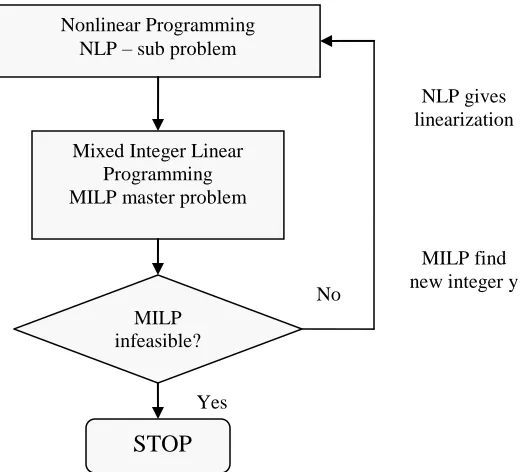
[image:29.612.173.434.359.595.2]5. Set j = j+1 Until (Mj is infeasible).
Fig. 1.1 Linear Outer Approximation algorithm. Nonlinear Programming
NLP – sub problem
Mixed Integer Linear Programming MILP master problem
MILP infeasible?
No
Yes
MILP find new integer y
NLP gives linearization
29
2.2.4
Extended Cutting Plane method
The ECP method, which is an extension of Kelly’s cutting plane algorithm for convex NLP, does not rely
on the use of NLP sub problems and algorithms [2]. It relies only on the iterative solution of the problem
(M-MIP) by successively adding a linearization of the most violated constraint at the predicted point
^ k
j
( k, k) : k { arg {max g ( k,y ) }
j J
x y J J x
(2.6)
Convergence is achieved when the maximum constraint violation lies within the specified tolerance. The
optimal objective value of (M-MIP) yields a non-decreasing sequence of lower bounds. It is possible to
either add to (M-MIP) linearization of all the violated constraints in the setJk, or linearization of all the
nonlinear constraints jJ. In the ECP method the objective must be defined as a linear function, which
can easily be accomplished by introducing a new variable to transfer nonlinearities in the objective as an
inequality.
The ECP method is able to solve MINLP problems, including general integer variables and not only
binary variables, and no integer cuts are needed to ensure convergence. ECP methods are oftenly claimed
to have slow convergence. The number of non-linear function evaluations used to obtain the optimal
solution has in several cases been even magnitudes lower than when using MINLP methods based on
solving NLP sub problems.
2.2.5
Generalized Bender’s Decomposition (GBD) method
The GBD method is similar to the Outer- Approximation method [1]. The difference arises in the
definition of the MILP master problem (M-MIP). The first step is to express P in terms of a projection
onto the integer variables
( )
min
Proj(P) '
yj
j
V v y (2.7)
30
The optimal value of the NLP sub problems defined by:
) ( ,
0 ,
subject to , minimise
NLP ,
Y converged y
X x
y y
y x g
y x f
j y
x
(2.8)
Benders’ Decomposition is able to treat certain nonconvex problems that are not readily solved by other
methods such as BB or OA.
The reformulation does not contain the continuous variables x:
integer
) ( ) ( subject to
minimise
problem Master
,
GBD
Y y
Y y y y
fi i T j j
y
(2.9)
Decomposition models with integer variables usually decompose into a master problem that comprises al
the integer variables and sub problems, which evaluate the remaining variables. Sub problems with
integer variables introduce additional difficulties and require the use of nonlinear duality theory.
2.2.6 LP/NLP based Branch and Bound
This approach covers problems with nonlinearities in the integer variables. The motivation for the
LP/NLP based branch and bound algorithm is that outer approximation usually spends an increasing
amount of computing time in solving successive MILP master problem relaxation. This approach avoids
the re-solution of MILP master problem relaxation by updating the branch and bound tree. Instead of
solving successive relaxations of M, the algorithm solves only one MILP problem which is updated as
new integer assignments are encountered during the tree search [2].
Initially an NLP sub problem is solved and the initial master program relaxation is set up from the
supporting hyperplanes at the solution of the NLP - sub problem. The MILP problem is then solved by a
31
Algorithm
1. Consider MILP branch and bound.
2. Interrupt MILP, when yj found.
3. Solve NLP (yj) to get xj.
4. Linearisef ,c about (xj,yj)
5. Add linearization to tree.
6. Continue MILP tree search.
Until
lower bound > upper bound
As in the two outer approximation algorithms the use of an upper bound implies that no integer
assignment is generated twice during the tree search. Since both the tree and the set of integer variables
are finite the algorithm eventually encounters only infeasible problems and the stack is thus emptied so
that the procedure stops.
This method can also be applied to the GBD and ECP methods. The LP/NLP method commonly reduces
quite significantly the number of nodes to be enumerated. The trade-off is that the number of MLP sub
problems may increase. This method is better suited for problems in which the bottleneck corresponds to
the solution of the MILP master problem.
2.2.7
Integrating SQP with Branch-and-Bound
An alternative to nonlinear branch-and-bound for convex MINLP problems is due Borchers and Mitchell
[6]. They observed that it not necessary to solve the NLP at each node to optimality before branching and
propose d an early branching rule, which branches on an integer variable before the NLP has converged.
The algorithm is based on branch and bound, but instead of solving an NLP problem at each node of the
tree, the tree search and the iterative solution of the NLP are interlaced. Thus the nonlinear part of (P) is
solved whilst searching the tree. The nonlinear solver that is considered in this method is a Sequential
Quadratic Programming (SQP) solver. The basic idea underlying this approach is to branch early –
32
This approach has a similar motivation as the Outer Approximation algorithm [5] but avoids the
resolution of related MILP master problems by interrupting the MILP branch and bound solver each time
an integer node is encountered. At this node an NLP problem is solved and new outer approximations are
added to all problems on the MILP branch and bound tree. Thus the MILP is updated and the tree search
resumes.
Algorithm
1. Initialisation: Obtain the continuous relaxation of P
2. Set the upper bound to infinity
3. While (there are pending nodes in the tree) do
Select an unexplored node
Repeat (SQP iteration)
Solve QPs for a step dk.
if (QPs infeasible) then fathom node and exit
Set ( k 1, k 1) ( k, k) ( k, k)
x y
x y x y d d
if( (y(k1)) integral ) then
Update current best point by setting
( ,x y* *)(xk1,yk1),f* fk1 and U f*
else choose a non integral y(k1) and branch
endif
exit
endif
4. Compute the integrity gap max |i yik1round y( ik1) |
5. if (
) then- Choose a non-integral y(k1)and branch, exit
end if
end while
The value of is suggested for the early branching rule and this value has also been chosen here.
The algorithm has to be modified if a line search or a trust region is used to enforce global convergence
33
by branching is equivalent to the parent problem. This algorithm has two important advantages. First, the
lower bounding can be implemented at no additional cost. Secondly, the lower bounding is available at all
nodes of the branch and bound tree.
2.2.8
Sequential Cutting Plane (SCP)
This algorithm integrates cutting plane techniques with branching techniques. Rather than solving a
linearized MILP problem to feasibility or optimality, it applies cutting planes in each node of the branch
and bound tree. The technique differs from the-ECP method, where the generation of cutting planes is
separated from the branching process [7]. For the NLP sub problems, we solve a sequence of linear
programming (LP) problems. Note that the SCP algorithm could also be considered to be a form of
Successive Linear Programming (SLP). However, a more general version of the SCP algorithm could, if
desired, also retain the cutting planes between the LP sub iterations. The algorithm also generates explicit
lower bounds for each node in the branch and bound tree. The algorithm obtains explicit lower bounds on
the nodes when performing NLP iterations in the nodes.
The first LP sub iteration within NLP iteration provides a lower bound on the node. When branching, the
child nodes inherit the lower bound of the parent node. Whenever the current upper bound is improved,
you may drop any node with a lower bound greater than or equal to the current upper bound. You may,
therefore, in some cases drop nodes in the tree without solving any additional LP problems for those
nodes. Explicit lower bounds have a significant impact on the convergence speed as it means less sub
problems solved.
The algorithm builds a branch and bound tree where each node represents a relaxed NLP sub problem of
the original problem (P). Each NLP sub problem is solved using a sequence of LP problems, but the NLP
sub problem is not solved to optimality. We then choose an integer variable with a non-integral value in
34
problem in an NLP iteration provides a lower bound for the optimal value of the NLP sub problem. The
lower bounds of the nodes can be used for removing nodes from the tree any time we improve the
currently best known solution for the original problem (P).
The algorithm does not solve the NLP sub problems to optimality. It interrupts the NLP procedure before
an optimal point has been found in order to make the branch and bound algorithm faster. If the current
iteration is converging to a non-integral point, we may branch early on any variable in yk that has a
non-integral value, rather than waste effort on finding an optimal, non-integer, solution for the current sub
problem.
The algorithm uses an NLP version of the Sequential Cutting plane algorithm to solve the NLP sub
problems. The difference from the SQP approach is that it solves a sequence of LP problems rather than
QP problems in order to find a solution to the NLP sub problems.
2.2.9
Outer-Approximation based Branch-and-Cut algorithm
The algorithm integrates Branch and Bound, Outer Approximation and Gomory Cutting Planes [5]. Only
the initial Mixed Integer Linear Programming (MILP) master problem is considered. At integer solutions
nonlinear Programming (NLP) problems are solved, using a primal-dual interior point algorithm. The
objective function and constraints are linearised at the optimum solution of those NLP problems and the
linearisations are added to all the unsolved nodes of the enumerations tree. Also, Gomory cutting planes,
which are valid throughout the tree, are generated at selected nodes. These cuts help the algorithm to
locate integer solutions quickly and consequently improve the linear approximation of the objective and
constraints, held at the unsolved nodes of the tree.
The complete algorithm is described in the following:
Algorithm
1. Initialisation: o {0,1}p is given; set 1
^ 1 ^ ,
1T S
i .
35
2.1 If NLP(
o) is feasible, solve it and set^
0 {0}
T .
Otherwise solveF(
0)and set^
0 {0}
S . Let
x
0be the optimum of NLP (
0) orF(
0).2.2 If
x
0 is the optimum of NLP(
0) then setUBD
0
f x
( ,
0
o)
.Otherwise set
UBD
0
.2.3 Linearise objective and constraints about
( ,
x
0
o)
and form the initial 0-1 MILP master problem^ 0
M .
2.4 Define ^
0
M as the root of the search tree. Let be the list which contains the unsolved nodes and set.
3. Node selection: If
, then Stop. Otherwise select a node( 0, 1)i i
R R and remove it from the list.
4. Solve the LP relaxation of the 0-1 MILP problem ^
i
M and let
^ ^
( , , )x be its optimum solution.
5. If ^
{0,1}p
then
5.1 Set ^ i
and solve NLP(i) if it is feasible or F(i) otherwise. Let
x
ibe the optimum of NLP(i)or F(i).
5.2 Linearise objective and constraints around (
x
i,i) and set^ ^
1 { }
i i
T T i or
^ ^
1 { }
i i
S S i as
appropriate.
5.3 Add the linearisations to ^
i
M and to all the nodes in. Place
^ i
M back in.
5.4 Update incumbent solution and upper bound:
If NLP(i) is feasible and ( ,f xii) <
UBD
i then
( ,
x
*
*) ( ,
x
i
i)
and UBDi1 f x( ,ii) OtherwiseUBD
i1
UBD
i5.5 Pruning: Delete all nodes fromwith
UBD
i1.Go to Step 3
6. If ^
{0,1}p
then
6.1 Cutting versus Branching Decision: If cutting planes should be generated then go to Step 6.2.
Otherwise go to Step 6.3
6.2 Cut generation: Generate a round of Gomory mixed integer cuts using every row corresponding to a
36
Add all those cuts to ^
i
M and store them in the pool. Go to step 4.
6.3 Branching: Select a violated 0-1 variable in ^
say (0,1)
) ( ^
r
. Create two new nodes
1 1
0 1 0 1
(Ri,Ri)(Ri { },r Ri) and (R0i1,R1i1)(R R0i, 1i{ })r .
Add both nodes to the list. Go to Step 4.
If
UBD
i
1 upon the termination of the algorithm, then( ,
x
*
*)
is the optimal solution of the original0-1 MINLP problem. Otherwise the problem is infeasible.
Algorithm OA-BC requires an initial 0-1 vector to be given by the user. If such a vector is not available
then the algorithm can start by solving the NLP relaxation of the initial 0-1 MINLP problem. If the
solution of the NLP relaxation satisfies all the integrality constraints then that solution also solves the
initial 0-1 MINLP problem and the algorithm can stop. If the NLP relaxation is infeasible then the initial
0-1 MINLP problem is also infeasible and the algorithm can stop. Finally if the NLP relaxation is feasible
and has a non-integer optimum solution, then the initial 0-1 MILP master problem can be formulated by
37
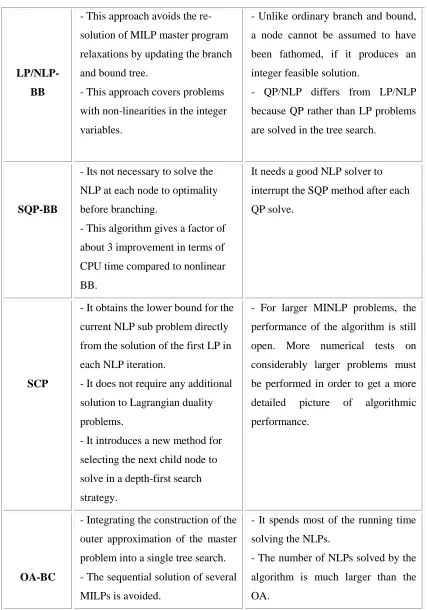
2.3 Comparison of MINLP optimisation methods
The MINLP optimisation methods represent quite different solution approaches. A comparison between
all these methods can be described as the following:
Comparison of MINLP methods
Method Advantages Disadvantages
BB
Finds an optimal solution if the
problem if of limited size and
enumeration can be done in
reasonable time.
Extremely time consuming. The
number of nodes in a branching tree
can be too large.
OA
Avoids solving huge number of
nonlinear programming problems.
- Potentially large number of
iterations.
- Adding Hessian term to the MILP
becomes MIQP.
ECP
- Only solving MILP problems
instead of NLP problems, in each
iteration the nonlinear constraints
need not be calculated at relaxed
values of the integer variables.
- solves MINLP problems
including general integer variables
and not only binary variables.
- It has slow convergence.
- The most time consuming step in
the ECP algorithm is the solution of
the MILP sub problems.
GBD
- Solves a large scale of linear
programs.
- Problems have a special structure
called Block Diagonal structure.
- Only active inequalities are
considered.
The MILP master problem is given
by a dual representation of a
38
LP/NLP-BB
- This approach avoids the re-
solution of MILP master program
relaxations by updating the branch
and bound tree.
- This approach covers problems
with non-linearities in the integer
variables.
- Unlike ordinary branch and bound,
a node cannot be assumed to have
been fathomed, if it produces an
integer feasible solution.
- QP/NLP differs from LP/NLP
because QP rather than LP problems
are solved in the tree search.
SQP-BB
- Its not necessary to solve the
NLP at each node to optimality
before branching.
- This algorithm gives a factor of
about 3 improvement in terms of
CPU time compared to nonlinear
BB.
It needs a good NLP solver to
interrupt the SQP method after each
QP solve.
SCP
- It obtains the lower bound for the
current NLP sub problem directly
from the solution of the first LP in
each NLP iteration.
- It does not require any additional
solution to Lagrangian duality
problems.
- It introduces a new method for
selecting the next child node to
solve in a depth-first search
strategy.
- For larger MINLP problems, the
performance of the algorithm is still
open. More numerical tests on
considerably larger problems must
be performed in order to get a more
detailed picture of algorithmic
performance.
OA-BC
- Integrating the construction of the
outer approximation of the master
problem into a single tree search.
- The sequential solution of several
MILPs is avoided.
- It spends most of the running time
solving the NLPs.
- The number of NLPs solved by the
algorithm is much larger than the
[image:39.612.93.520.65.675.2]OA.
39
2.4 Evolutionary Programming
A large number of Evolutionary Algorithms (EA) have been developed. These EAs can be grouped based
on how individuals are represented, which evolutionary operators are used, and how these are
implemented. This chapter discusses briefly the concepts of Evolutionary and Coevolutionary
Programming. Evolutionary Algorithms can be classified into two classes; population-based methods and
point-to-point methods. In the latter methods, the search invokes only one solution at the end of each
iteration from which the search will start in the next iteration. The population-based methods invoke a set
of many solutions at the end of each iteration. This chapter highlights the principles of genetic algorithms,
particle swarm optimisation, and differential evolution as examples of population-based methods, and
simulated annealing as an example of point-to-point methods.
2.4.1 Simulated Annealing
Simulated annealing is a simple technique that can be used to find a global optimiser for continuous,
integer and discrete nonlinear programming problems. The approach does not require continuity or
differentiability of the problem functions because it does not use any gradient or Hessian information [8].
The SA algorithm successively generates a trial point in a neighbourhood of the current solution and
determines whether or not the current solution is replaced by the trial point based on a probability
depending on the difference between their function values. Convergence to an optimal solution can
theoretically be guaranteed only after an infinite number of iterations controlled by a procedure called
cooling schedule. The main control parameter in the cooling schedule is the temperature parameter T. The
main role of T is to let the probability of accepting a new move be close to 1 in the earlier stages of the
search and to let it be almost zero in the final stage of the search. A proper cooling schedule is needed in
40
2.4.2 Genetic algorithms
A genetic algorithm (GA) is a procedure that tries to mimic the genetic evolution of a species.
Specifically, GA simulates the biological processes that allow the consecutive generations in a population
to adapt to their environment. The adaptation process is mainly applied through genetic inheritance from
parents to children and through survival of the fittest. Therefore, GA is a population-based search
methodology. Nowadays, GAs are considered to be the most widely known and applicable type of
metaheuristics [9].
GA starts with an initial population whose elements are called chromosomes. The chromosome consists
of a fixed number of variables which are called genes. In order to evaluate and rank chromosomes in a
population, a fitness function based on the objective function should be defined. Three operators must be
specified to construct the complete structure of the GA procedure; selection, crossover and mutation
operators. The selection operator cares with selecting an intermediate population from the current one in
order to be used by the other operators; crossover and mutation. In this selection process, chromosomes
with higher fitness function values have a greater chance to be chosen than those with lower fitness
function values. Pairs of parents in the intermediate population of the current generation are
probabilistically chosen to be mated in order to reproduce the offspring. In order to increase the
variability structure, the mutation operator is applied to alter one or more genes of a probabilistically
chosen chromosome. Finally, another type of selection mechanism is applied to copy the survival
members from the current generation to the next one. The GA operators of selection, crossover and
mutation have been extensively studied. Many effective settings of these operators have been proposed to
fit a wide variety of problems. The GA algorithm can be described as follows:
Algorithm