صخلم
:
ةرمتسمو ةقيمع ةحلسم ةيناسرخ تارمك ةعستل ةيبيرحتلا جئاتنلا ليلحتو ضرع ثحبلا اذھ يف مت
.
تاريغتملا
ةبسنلا يھ اھتسارد مت يتلا ةيسيئرلا لاعفلا قمعلا يلإ صقلا ةفاسم نيب
(a/d)
يسأرلا صقلا ديدح ةبسن ؛
(ρv)
؛ ةبسن
يقفلاا صقلا ديدح
(ρh)
و ةناسرخلا ةمواقم ةحلسملا
(fcu)
.
ةلاح يف ةءاسجلا ميق يف ضافخنإ ةساردلا كلت ترھظا دقو
ضافخنإ
(fcu)
ةبسنلا ةدايز و
(a/d)
دق يلفسلاو يولعلا يلوطلا يساسلاا ديدحلا لوط يلع تلااعفنلإا يف ريغتلا ناو
ةبسنلا يلع دمتعإ
(a/d) .
تارمكلل كلذو يسأرلا صقلا ديدح نم ربكا يقفلاا صقلا ديدح ةءافك نا اضيا ةساردلا تتبثاو
نم لقلاا ةبسنلا تاذ
(a/d) .
ةساردلا هذھل ةيبيرجتلا جئاتنلا ةنراقم مت اريخاو يطخلالا ليلحتلا جئاتن عم
مادختسإب
ةددحملا رصانعلا جمانرب
(ANSYS 10)
ريبك قفاوت كانھ نأ دجوو
.
ABSTRACT:
Test results of nine reinforced concrete continuous deep beams are presented and analyzed. The main variables studied were shear span-to-depth ratio (a/d), vertical web reinforcement ratio (ρv), horizontal web reinforcement ratio (ρh), and concretecompressive strength (fcu). The results of this study show that the stiffness reduction was
prominent in case of lower concrete strength and higher shear span-to depth ratio and that the variation of strains along the main longitudinal top and bottom bars was found to be dependent on the shear span-to depth ratio. For beams having small (a/d) ratio, horizontal shear reinforcement was always more effective than vertical shear reinforcement. Finally, the obtained test results are compared to the predictions of finite element analysis using the ANSYS 10 program and a well agreement between the experimental and analytical results was found.
Behaviour and Analysis of Reinforced Concrete Continuous Deep Beams
ةرمتسملا ةقيمعلا ةحلسملا ةيناسرخلا تارمكلا ليلحتو كولس
F.B.A. Beshara 1, I.G. Shaaban 2and T.S. Mustafa 3
1 Associate Professor
2 Professor of Reinforced Concrete Structures 3 Assistance Professor
2
University of Tripoli, Libya The 12th Arab Structural Engineering Conference
INTRODUCTION
Reinforced concrete (RC) continuous deep beams are fairly commonly used as load distribution elements such as transfer girders, pile caps, tanks, folded plates, and foundation walls, often receiving many small loads and transferring them to a small number of reaction points. There have been extensive experimental investigations of simply supported RC deep beams [1-8] but very few tests are presented on continuous RC deep beams [9-13]. Continuous deep beams differ from either simply supported deep beams or continuous shallow beams. In continuous deep beams, the regions of high shear and high moment coincide and failure usually occurs in these regions. In simple RC deep beams, the region of high shear coincides with the region of low moment. Failure mechanisms for continuous RC deep beams are therefore significantly different from failure mechanisms in simply supported beams. Deep beams develop a truss or tied arch action more marked than in shallow beams where shear is transferred through a fairly uniform diagonal compression field.
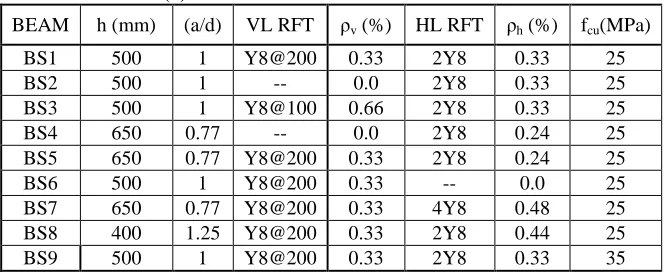
The present paper reports test results of nine two-span RC deep beams [10]. The tested variables were shear span-to-depth ratio, vertical web reinforcement ratio, horizontal web reinforcement ratio, and concrete compressive strength. The specimens were tested in a compression machine where increasing monotonic static loads were at each mid-span. All tested beams were loaded until failure. The failure planes evolved along the diagonal crack formed at the concrete strut along the edges of the load and intermediate support plates. The test results were measured at different loading levels for the span deflection, mid-span bottom steel strain, middle-support top steel strain, middle-support stirrups strain, and end-support stirrups strain. Also, the cracking patterns were identified. The effects of testing variables on the first diagonal crack load, ultimate shear load, deflection, stiffness, and failure mechanisms were studied. Finally, the obtained test results are compared to the predictions of finite element analysis for continuous deep beams and a well agreement between the experimental and analytical results was found.
EXPERIMENTAL PROGRAM
Test Specimens and Materials
3
University of Tripoli, Libya The 12th Arab Structural Engineering Conference
achieve the target compressive concrete strengths of 25 MPa and 35 MPa at 28 days with water/cement ratio (w/c) 0.6 and 0.475, respectively.
Testing Procedure and Instrumentation
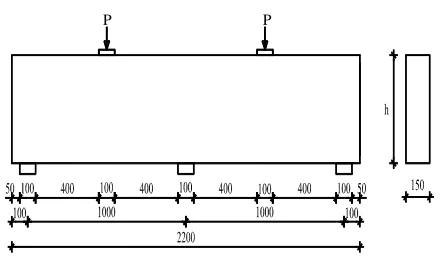
Fig. 3 shows the test setup. Special arrangements had been taken to obtain two point loads and three support reactions. A top steel spreader beam was used to divide the total applied load from the machine head into two equal point loads, one in each span. Another stiffer steel beam was placed underneath the tested beams to collect the three support reactions to the other head of the machine. Each beam was tested as a continuous beam under two vertical concentrated loads using a vertical hydraulic jack. The three supports rested on flat plates to combat instability out of the beam plane as shown in Fig. 3. All tested beams were painted by a thin white coat to facilitate the observation and determination of cracks at different stages of loading. With regard to the two vertical loads, they were similar in their acting position, value and were separated by a distance equal 1000 mm. During testing, the vertical loads were applied in increments equal to about 5% of the expected ultimate load and up to failure. After each load increment, marking of cracks was made and the results were recorded automatically using the data logger.
The loads and reactions have been measured using a load cell of capacity 2000kN and 0.1kN accuracy. The load cell readings were recorded automatically using the data logger. The corresponding vertical deflections of test beams at the locations of the mid-span point were measured using LVDT's of 100 mm capacity and 0.01 mm accuracy. Electrical strain gauges of length 10 mm, with resistance 120.4 ± 0.4 ohm, and a gauge factor of 2.11 were used to measure the strains in the main longitudinal top and bottom flexural steel, vertical stirrups, and horizontal shear reinforcement. The gauges were fixed on the steel bars before casting. The surface of the steel was cleaned and smoothed, and the gauges were installed on the steel bars using adhesive material and then they were covered with a water proofing material for protection. For all beams, two gauges were fixed on the top bar at the interior support and on the bottom bar at the mid span. In addition, four gauges were fixed on two vertical stirrups and horizontal shear reinforcement at intersection points of these stirrups and horizontal reinforcement with the strut lines joining the point load with the internal and external supports. The load, deflections, and steel strains were measured and recorded automatically by connecting the load cell, LVDT's, and the electrical strain gauges to data acquisition system.
[image:3.595.195.416.565.693.2]P P
4
University of Tripoli, Libya The 12th Arab Structural Engineering Conference
4 H 1 6
4 H 1 6 2 Y 8
( a ) B S 1
4 H 1 6
4 H 1 6 2 Y 8
4 H 1 6
4 H 1 6 2 Y 8
4 H 1 6
4 H 1 6 2 Y 8
4 H 1 6
4 H 1 6
2 Y 8 4 H 1 6
4 H 1 6 4 H 1 6
4 H 1 6 2 Y 8
2 Y 8
4 H 1 6
4 H 1 6 2 Y 8
4 H 1 6
4 H 1 6 2 Y 8
( b ) B S 2
( c ) B S 3
( d ) B S 4
( e ) B S 5
( f ) B S 6
( g ) B S 7
( h ) B S 8
[image:4.595.136.476.85.247.2]( i ) B S 9
Fig. 2. Details of Tested RC Deep Beams
T e s t S p e c im e n U p p e r S te e l
P
T e s t i n g M a c h i n e B e d L o a d C e ll
P / 2 P / 2
S p r e a d e r B e a m
H in g e a n d L o a d i n g P la t e
l p = 1 5 0 m m
A B C
H i n g e R o l l e r a n d S u p p o r t in g P l a te
[image:4.595.169.435.278.415.2]1 0 0 0 m m 1 0 0 0 m m L o a d C e l l L V D T L V D T
Fig. 3. Typical test setup and instrumentation for all tested beams Table (1) Details of Reinforcement for the Test Beams
BEAM h (mm) (a/d) VL RFT ρv (%) HL RFT ρh (%) fcu(MPa)
BS1 500 1 Y8@200 0.33 2Y8 0.33 25 BS2 500 1 -- 0.0 2Y8 0.33 25 BS3 500 1 Y8@100 0.66 2Y8 0.33 25 BS4 650 0.77 -- 0.0 2Y8 0.24 25 BS5 650 0.77 Y8@200 0.33 2Y8 0.24 25 BS6 500 1 Y8@200 0.33 -- 0.0 25 BS7 650 0.77 Y8@200 0.33 4Y8 0.48 25 BS8 400 1.25 Y8@200 0.33 2Y8 0.44 25 BS9 500 1 Y8@200 0.33 2Y8 0.33 35
EXPERIMENTAL RESULTS
Specimen Behavior
[image:4.595.132.465.461.598.2]5
[image:5.595.199.412.94.280.2]University of Tripoli, Libya The 12th Arab Structural Engineering Conference
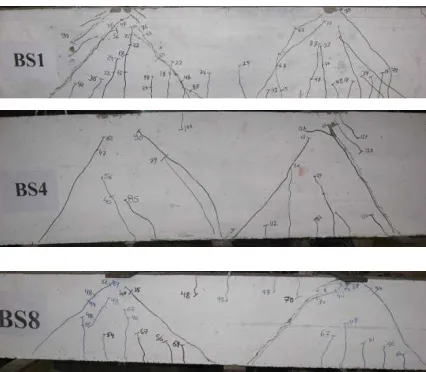
Fig. 4. Crack Patterns and Failure Zones of Tested Beams BS1, BS4, and BS8
Generally, the first crack suddenly developed in the flexural sagging region at approximately 25% of the ultimate strength, and then a crack in the diagonal direction at approximately 30% of the ultimate strength at the mid-depth of the concrete strut within the interior shear span immediately followed. The first flexural crack over the intermediate support generally occurred at approximately 80% of the ultimate strength. As the load increased, more flexural and diagonal cracks were formed and a major diagonal crack extended to join the edges of the load and intermediate support plates. A diagonal crack within the exterior shear span occurred suddenly near the failure load. Just before failure, the two spans showed nearly the same crack patterns. All tested beams developed the same mode of failure as observed in [11]. The failure planes were traced along the diagonal crack formed at the concrete strut along the edges of the load and intermediate support plates. Two rigid blocks separated from original beams at failure due to the significant diagonal cracking. The influence of shear reinforcement on the tested beams behavior was not significant as mentioned before in [14]. In beam without stirrups (BS2), the failure was sudden and was due to crushing of the concrete compression struts. When sufficient stirrups are present, crack fans develop under the loads, and over the interior support; these cracks diminish the effective width of any direct compression strut which might develop.
Mid-Span Deflections
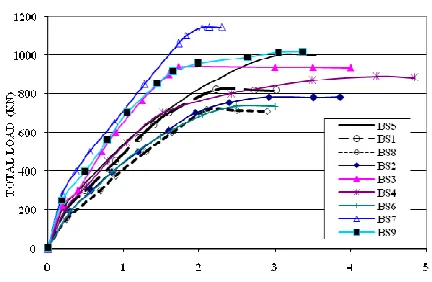
The measured load-deflection curves for all tested beams are shown in Fig. 5. Also, the measured first flexural cracking load at mid-span (Pcrfm), the first flexural cracking load at
internal support (Pcrfs), the first diagonal cracking load (Pcrs), and the ultimate total load
(Pu) are given in Table (2). It can be seen from Fig. 5 and Table (2) that the decrease of
University of Tripoli, Libya
Fig. 5. Total Applied Load and Table (2 BEAM BS1
Pcrfm 200
Pcrfs 600
Pcrs 250
Pu 819
Router 148
Rinner 523
Quinner 262
QuACI 215
QuECP 204
Increasing (a/d) ratio from 1.0 for beam BS1 to 1.25 for beam BS8 resulted in a decrease Pcrfm, Pcrs and Pu by about 25.0%, 12.0%, and 13.0%, respectively. Furthermore, the
enhancement in Pcrfm, Pcrs
decreasing (a/d) ratio from 1.0 for beam BS1 to 0.77 for beam BS3. It can be seen that increasing the concrete compressive strength has a significant improvement effect on the load-deflection response. Increasing the concrete compressive strength led to a more brittle behavior with increased load carrying capacities and stiffness at differen
Pcrfm, Pcrs and Pu were increased respectively by 25.0%, 20.0%, and 24.0% for beam BS9
with (fcu) of 35.0 MPa when compared to beam BS1 with (f
The examination of measured results in Fig. 5 and in Table (2) showed that
carrying capacities at different levels increase with an increase in the ratio of vertical shear reinforcement (ρv). The tested beam BS2 without stirrups showed a minor reduction in P
and Pu by 4.0% and 5.0% when compared to beam BS1 (
flexural cracking load was kept the same. On the other hand, the increase in P Pu was found 25%, 12.0%, and 15.0% respectively for beam BS3 having (
when compared to beam BS1with
vertical stirrups had very little ductility and continuous deep beams with heavy stirrups were ductile while those with light stirrups were fairly brittle.
The horizontal shear reinforcement has generally a moderate effect on the i
the measured load-deflection response of tested deep beams. From comparison of results in Fig. 5 and Table (2), it was found that there is a reduction in P
respectively for beam tested BS6 with ( of 0.0033 with the same (a/d
both beams. In other comparison, beam BS7 with (
Pcrfm, Pcrs and Pu by 16.0%, 15.0%, and 14.5% respectively when compared to beam BS5
with (ρh) of 0.0024 while the other parameters were kept constant.
6
The 12th Arab Structural Engineering Conference
oad and Mid-Span Deflection Relationship for the Tested 2) Experimental Results of the Tested Beams (kN)
BS2 BS3 BS4 BS5 BS6 BS7 BS8 BS9 200 250 300 320 200 370 150 250 585 660 680 740 550 860 540 750 240 280 290 340 240 390 220 300 782 939 889 1001 735 1145 715 1015 141 169 161 181 133 206 129 183 500 601 567 639 469 733 457 649 250 301 284 320 235 367 229 325 201 255 267 280 175 350 174 245 191 218 262 277 173 330 169 238
) ratio from 1.0 for beam BS1 to 1.25 for beam BS8 resulted in a decrease by about 25.0%, 12.0%, and 13.0%, respectively. Furthermore, the
crs and Pu is respectively 60.0%, 36.0%, and 22.0% due to
) ratio from 1.0 for beam BS1 to 0.77 for beam BS3. It can be seen that increasing the concrete compressive strength has a significant improvement effect on the deflection response. Increasing the concrete compressive strength led to a more brittle behavior with increased load carrying capacities and stiffness at differen
were increased respectively by 25.0%, 20.0%, and 24.0% for beam BS9 ) of 35.0 MPa when compared to beam BS1 with (fcu) of 25.0 MPa.
The examination of measured results in Fig. 5 and in Table (2) showed that
carrying capacities at different levels increase with an increase in the ratio of vertical shear ). The tested beam BS2 without stirrups showed a minor reduction in P by 4.0% and 5.0% when compared to beam BS1 (ρv= 0.00335), while the first
flexural cracking load was kept the same. On the other hand, the increase in P was found 25%, 12.0%, and 15.0% respectively for beam BS3 having (
when compared to beam BS1with ρv= 0.00335. Fig. 5 also indicates that beam without
vertical stirrups had very little ductility and continuous deep beams with heavy stirrups were ductile while those with light stirrups were fairly brittle.
The horizontal shear reinforcement has generally a moderate effect on the i
deflection response of tested deep beams. From comparison of results in Fig. 5 and Table (2), it was found that there is a reduction in Pcrs and P
respectively for beam tested BS6 with (ρh) of 0.00 when compared to beam BS1 with (
a/d) while the first flexural cracking load was found the same for both beams. In other comparison, beam BS7 with (ρh) of 0.0048 showed an increase in
by 16.0%, 15.0%, and 14.5% respectively when compared to beam BS5 ) of 0.0024 while the other parameters were kept constant.
Arab Structural Engineering Conference
ested Beams BS9 250 750 300 1015 183 649 325 245 238
) ratio from 1.0 for beam BS1 to 1.25 for beam BS8 resulted in a decrease in by about 25.0%, 12.0%, and 13.0%, respectively. Furthermore, the is respectively 60.0%, 36.0%, and 22.0% due to ) ratio from 1.0 for beam BS1 to 0.77 for beam BS3. It can be seen that increasing the concrete compressive strength has a significant improvement effect on the deflection response. Increasing the concrete compressive strength led to a more brittle behavior with increased load carrying capacities and stiffness at different load levels. The were increased respectively by 25.0%, 20.0%, and 24.0% for beam BS9
) of 25.0 MPa.
The examination of measured results in Fig. 5 and in Table (2) showed that the load carrying capacities at different levels increase with an increase in the ratio of vertical shear ). The tested beam BS2 without stirrups showed a minor reduction in Pcrs
35), while the first flexural cracking load was kept the same. On the other hand, the increase in Pcrfm, Pcrs and
was found 25%, 12.0%, and 15.0% respectively for beam BS3 having (ρv) as 0.0067
cates that beam without vertical stirrups had very little ductility and continuous deep beams with heavy stirrups
The horizontal shear reinforcement has generally a moderate effect on the improvement of deflection response of tested deep beams. From comparison of results in and Pu by 4% and 10%
ed to beam BS1 with (ρh)
[image:6.595.148.451.269.397.2]University of Tripoli, Libya
Steel Strains
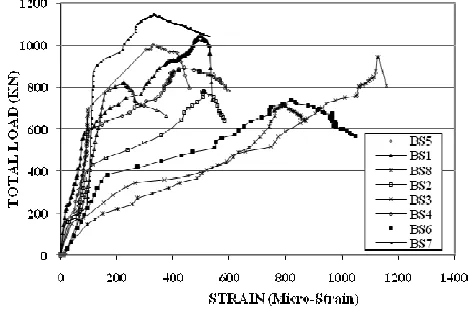
Figs. 6 and 7 show respectively the load
flexural reinforcement of the tested beams. These figures also indicate that tested beams with the same (a/d) ratio shows almost the same total applied load
major strains redistribution in the bottom steel after the first diagonal cracking. The total applied load-strain gradient shows minor strains redistribution in the top steel after the first diagonal cracking and shows also the same similarity for the beams with the same ( ratio. The bottom longitudinal reinforcement was in tension throughout
[image:7.595.186.422.429.585.2]beam, and the top reinforcement was also in tension throughout the length of the interior shear span.
Fig. 6. Total Applied L
Fig. ٧. Total Applied Load and
Neither bottom nor top longitudinal flexural reinforcement was yielded up to failure load for the tested beams due to the over reinforced design of flexural reinforcement. Strains in bottom reinforcement were
increases the field moment and decreases the moment at intermediate support. In beam without stirrup (BS2), the flexural reinforcement strains are constant along the bars between point loads and supports and a compression struts develop in the concrete which carry the loads directly to the supports.
The total load-steel strain curves for vertical and horizontal shear reinforcement at the interior shear span for the tested beams are shown in Figs.
redistribution of strains occurred at the vertical steel after the occurrence of the first
0 200 400 600 800 1000 1200 0 T O T A L L O A D ( K N ) 7
The 12th Arab Structural Engineering Conference
Figs. 6 and 7 show respectively the load-steel strain curves for bottom and top longitudinal rcement of the tested beams. These figures also indicate that tested beams ) ratio shows almost the same total applied load-strain gradient with major strains redistribution in the bottom steel after the first diagonal cracking. The total
strain gradient shows minor strains redistribution in the top steel after the first diagonal cracking and shows also the same similarity for the beams with the same ( ratio. The bottom longitudinal reinforcement was in tension throughout
beam, and the top reinforcement was also in tension throughout the length of the interior
Load and Bottom Steel Strain Relationship for the Tested
Total Applied Load and Top Steel Strain Relationship for the Tested Beams
Neither bottom nor top longitudinal flexural reinforcement was yielded up to failure load for the tested beams due to the over reinforced design of flexural reinforcement. Strains in higher than in top steel due to stress redistribution which increases the field moment and decreases the moment at intermediate support. In beam without stirrup (BS2), the flexural reinforcement strains are constant along the bars supports and a compression struts develop in the concrete which carry the loads directly to the supports.
steel strain curves for vertical and horizontal shear reinforcement at the interior shear span for the tested beams are shown in Figs. 8 and 9, respectively. A minor redistribution of strains occurred at the vertical steel after the occurrence of the first
400 800 1200 1600 2000 2400
STRAIN (Micro-Strain) BS5 BS1 BS8 BS2 BS3 BS4 BS6 BS7 BS9
Arab Structural Engineering Conference
steel strain curves for bottom and top longitudinal rcement of the tested beams. These figures also indicate that tested beams strain gradient with major strains redistribution in the bottom steel after the first diagonal cracking. The total strain gradient shows minor strains redistribution in the top steel after the first diagonal cracking and shows also the same similarity for the beams with the same (a/d) ratio. The bottom longitudinal reinforcement was in tension throughout the length of the beam, and the top reinforcement was also in tension throughout the length of the interior
ested Beams
Steel Strain Relationship for the Tested Beams
Neither bottom nor top longitudinal flexural reinforcement was yielded up to failure load for the tested beams due to the over reinforced design of flexural reinforcement. Strains in higher than in top steel due to stress redistribution which increases the field moment and decreases the moment at intermediate support. In beam without stirrup (BS2), the flexural reinforcement strains are constant along the bars supports and a compression struts develop in the concrete which
University of Tripoli, Libya
diagonal crack for beams BS5 and BS1 having the lower values of ( 1.0 respectively and did not yield. A major s
having (a/d) ratio of 1.25 and reached yield at failure. For the horizontal steel, a redistribution of strains occurred after first diagonal cracking for these three beams but this redistribution was higher for be
horizontal reinforcement for the three test beams reached yield up to failure. Comparison of test results indicate that the influence of web steel on the ultimate shear strength is influenced by the (a/d) ratio, the lower the (
steel and the less effective the vertical steel. Only the vertical steel of beam BS3 having a heavy vertical steel ratio reached yield.
Fig. ٨. Total Applied
Fig. ٩. Total Applied Load and
It was also concluded that tested beam BS6 without horizontal reinforcement showed a higher values of strains in the vertical
the same load level. A major redistribution of strains occurred for the vertical steel at about 70.0% of the ultimate load for beam BS9 but did not yield as the vertical reinforcement for beam BS1. For the horizontal reinforcement, while major strain redistribution was occur for beam BS1 at the first diagonal cracking, similar strain redistribution have been occurred in beam BS9 with higher value of (f
and this is due to the expected higher value of concrete shear contribution. Horizontal steel for beam BS9 almost reached yield point while beam BS1 did not reach that point.
Reaction of Supports
The measured amount of load transferred to the end support is listed in
tested beams. From external equilibrium of forces and symmetry, the measured reaction at intermediate support is evaluated in the table. Linear elastic analysis was performed using SAP program for beams in order to assess the reactions o
the reactions of the exterior and intermediate supports due to the total applied load (P) are
8
The 12th Arab Structural Engineering Conference
diagonal crack for beams BS5 and BS1 having the lower values of (a/d) ratio as 0.77 and 1.0 respectively and did not yield. A major strain redistribution occurred for beam BS8 ) ratio of 1.25 and reached yield at failure. For the horizontal steel, a redistribution of strains occurred after first diagonal cracking for these three beams but this redistribution was higher for beam BS5 having the lowest (a/d) ratio of 0.77. None of the horizontal reinforcement for the three test beams reached yield up to failure. Comparison of test results indicate that the influence of web steel on the ultimate shear strength is ) ratio, the lower the (a/d) ratio; the more effective the horizontal steel and the less effective the vertical steel. Only the vertical steel of beam BS3 having a heavy vertical steel ratio reached yield.
pplied Load and Vertical Shear Reinforcement Strain Relationship
Total Applied Load and Horizontal Shear Reinforcement Strain Relationship
It was also concluded that tested beam BS6 without horizontal reinforcement showed a higher values of strains in the vertical reinforcement than beam BS1 with (
the same load level. A major redistribution of strains occurred for the vertical steel at about 70.0% of the ultimate load for beam BS9 but did not yield as the vertical reinforcement for horizontal reinforcement, while major strain redistribution was occur for beam BS1 at the first diagonal cracking, similar strain redistribution have been occurred in beam BS9 with higher value of (fcu) but at about 50.0% of the ultimate load
due to the expected higher value of concrete shear contribution. Horizontal steel for beam BS9 almost reached yield point while beam BS1 did not reach that point.
The measured amount of load transferred to the end support is listed in
tested beams. From external equilibrium of forces and symmetry, the measured reaction at intermediate support is evaluated in the table. Linear elastic analysis was performed using SAP program for beams in order to assess the reactions of supports. From elastic analysis, the reactions of the exterior and intermediate supports due to the total applied load (P) are
Arab Structural Engineering Conference
) ratio as 0.77 and train redistribution occurred for beam BS8 ) ratio of 1.25 and reached yield at failure. For the horizontal steel, a redistribution of strains occurred after first diagonal cracking for these three beams but this ) ratio of 0.77. None of the horizontal reinforcement for the three test beams reached yield up to failure. Comparison of test results indicate that the influence of web steel on the ultimate shear strength is ) ratio; the more effective the horizontal steel and the less effective the vertical steel. Only the vertical steel of beam BS3 having a
elationship
Shear Reinforcement Strain Relationship
It was also concluded that tested beam BS6 without horizontal reinforcement showed a reinforcement than beam BS1 with (ρh) of 0.0033 at
the same load level. A major redistribution of strains occurred for the vertical steel at about 70.0% of the ultimate load for beam BS9 but did not yield as the vertical reinforcement for horizontal reinforcement, while major strain redistribution was occur for beam BS1 at the first diagonal cracking, similar strain redistribution have been ) but at about 50.0% of the ultimate load due to the expected higher value of concrete shear contribution. Horizontal steel for beam BS9 almost reached yield point while beam BS1 did not reach that point.
9
University of Tripoli, Libya The 12th Arab Structural Engineering Conference
[image:9.595.161.456.277.443.2]0.175P and 0.65P respectively. It was stated before [12] that the differential settlement had no significant effect on the elastic behavior of continuous deep beams, and would have less significance at higher loads in any case. Fig. 10 shows the measured amount of the load transferred to the end and intermediate supports against the total applied load for beams having constant (a/d) value of 1.0 and different web reinforcement ratios. On the same figure, the reactions at support are obtained from elastic analysis are also presented. Although the amount of web steel influences the maximum reaction at support, it has no effect on the total load-support reaction gradient. Before the first diagonal crack, the relationship of the end and intermediate support reactions against the total applied load in all tested beams shows good agreement with elastic prediction. The amount of loads transferred to the end support, however, was slightly higher than that predicted by the elastic analysis after the occurrence of the first diagonal crack within the interior shear span. At failure, the difference between the measured end support reaction and prediction of the elastic analysis was in order of 8%, 10%, and 14%, for beams with (a/d) of 0.77, 1.0, and 1.25, respectively.
Fig. 10. Total Applied Load versus Support Reactions for Beams Having (a/d = 1.0)
The internal redistribution of forces is limited. Also, the distribution of applied load to supports is independent of the amount and configuration of shear reinforcement. This means that the occurrence of diagonal cracks reduces the beam stiffness and the hogging moment over the central support, and increases the sagging bending moment within the span.
Experimental Shear Force Capacities and Comparison with Current Codes
The most critical shearing force in continuous deep beams occurs at the interior support. The shear forces at inner supports of tested deep beams (Quinner) are calculated as half the
vertical support reactions, and are listed in Table (2). It can be seen that the ultimate shear strength of beams with constant shear reinforcement and concrete strength increase significantly with the decrease of (a/d) ratio. The decrease of (a/d) ratio from 1.25 (beam BS8) to 1.0 (beam BS1) increases the shear capacity by 14.4%. For beams with vertical shear steel, the drop of (a/d) ratio from 1.0 (beam BS1) to 0.77 (beam BS5) enhances the shear capacity by 22.1%. For tested deep beams without vertical shear reinforcement, the drop of (a/d) ratio from 1.0 (beam BS2) to 0.77 (beam BS4) enhances the shear capacity by 13.6%. Table (2) indicates that the shear strength for beams with constant (a/d) ratio and shear reinforcement increases remarkably with the increase of concrete compressive strength. The shear capacity of beam BS9 with fcu= 35 MPa is higher than that of beam
BS1 with fcu= 25 MPa by 24%. The analysis of experimental results indicates that the
10
University of Tripoli, Libya The 12th Arab Structural Engineering Conference
reinforcement for different (a/d) ratios. For beams with (a/d)= 1.0, the increase of ρv from
zero (beam BS2) to 0.0033 (beam BS1) and to 0.0066 (beam BS3) enhances the shear capacity by 5% and 20.4%, respectively. For beams (BS4 & BS5) with (a/d) = 0.77, the increase in ρv by 0.0033 increases the shear capacity by 12.7%. Previous test results of
simple deep beams [2] have suggested that horizontal shear reinforcement has little effect on the shear strength improvement. In current test results, horizontal shear steel has a moderate effect on shear carrying capacity, especially for beams with (a/d) < 1. For beams (BS5 & BS7) with (a/d) = 0.77, the shear strength improvement was 14.7% due to 0.0024 increase in ρh ratio. For beams (BS1 & BS6) with (a/d) = 1, the same increase in ρh ratio
improves the shear capacity by 12.7%.
The prediction of shear capacity of tested beams was shown in Table (2) using two design codes; namely ACI 318-08 [15] and the Egyptian concrete code of practice [16]. The shear contributions from concrete, horizontal, and vertical shear reinforcement were evaluated with all safety factors removed. Both design methods show that the amount of shear resisted by horizontal steel is higher than that resisted by vertical steel (contrary to testing results). This prediction indicates that ACI as well as ECP underestimate the shear capacity for continuous deep beams. The average ratios of (Quinner / QuACI) and (Quinner / QuECP) are
1.21 and 1.27 with standard deviations of values 0.11 and 0.12, respectively. The discrepancy in codes predictions may be attributed to the fact that the shear strength equations in both design methods for continuous deep beams are derived from simple deep beam tests.
FINITE ELEMENT PREDECTIONS
11
[image:11.595.217.415.96.298.2]University of Tripoli, Libya The 12th Arab Structural Engineering Conference
Fig. 11. Simulated Crack Propagation for Tested Beam BS5
Fig. 1٢. Simulated Crack Propagation for Tested Beam BS8
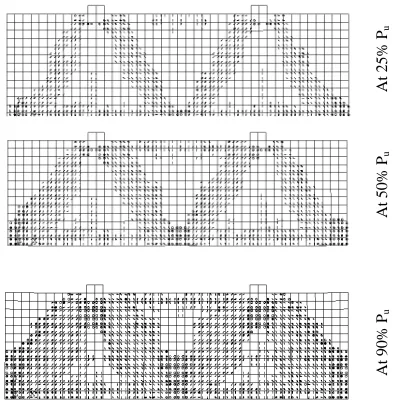
Later, flexural cracking takes place over the middle support. At ultimate stage, failure is initiated by crushing of the concrete in the region adjacent to the middle support (load level 910 kN). There is a good agreement between the simulated crack patterns and the obtained experimental ones. The simulation also successfully predicted the sequence in the crack patterns development and the failure mechanism.
As shown in Fig. 12, the development of the crack pattern for tested beam BS8 with (a/d) ratio of 1.25 is nearly the same as that for tested beam BS5 with (a/d) ratio of 0.77. Compared to BS5, the load levels at which cracks takes place are lower due to increasing (a/d) ratio. First flexural cracking was firstly developed at the mid-span (load level 130 kN) and later over the middle support. At a load level of 170 kN, inclined flexural cracks develop. Afterwards, shear cracking takes place. With further load increase, some secondary flexural cracks are detected. At ultimate stage, the deep beams failed by crushing of the concrete in the regions adjacent to the middle support and the loading point. The simulated and the experimental crack patterns are compared at ultimate load level and it is clear that the finite element analysis simulates the experimental results very well. This can be seen in the internal shear span; going from the middle support to the
A
t
2
5
%
Pu
A
t
5
0
%
Pu
A
t
9
0
%
Pu
A
t
2
5
%
Pu
A
t
5
0
%
Pu
A
t
9
0
%
[image:11.595.199.430.331.510.2]12
University of Tripoli, Libya The 12th Arab Structural Engineering Conference
loading point, the crack direction changes from vertical to inclined, stays constant, and changes back to vertical again.
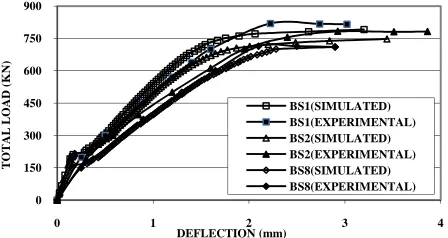
In Fig. 13, test results of total load- deflection curves are compared to the predictions of finite element analysis for tested beams BS1, BS2 and BS8. A good agreement between the experimental and analytical results was obtained at different levels. In simulated curves, there is a sudden increase in the deflection and this is back to formation of the first flexural crack. Also, formation of the first diagonal crack significantly reduced the beam stiffness. Similar to experimental results, simulated curves are significantly affected by the shear span-to-depth ratio. It can be seen from Fig. 13 that the decrease of (a/d) leads to an increase in the load carrying capacity at different levels. All analyzed beams exhibited limited displacement ductility at failure. The degree of ductility varied depending on the (a/d) ratio where the lower (a/d) ratio, the lower is amount of ductility.
Fig. 1٣. Simulated and experimental load-deflection curves for BS1, BS2, and BS8
Increasing either vertical or horizontal shear reinforcement led to an increase in the analytical load carrying capacity and ductility matching with the experimental results. Increasing the concrete compressive strength has a significant improvement effect on the load-deflection response and there is an increase in the first flexural cracking, first diagonal cracking, and ultimate loads.
CONCLUSIONS
From the experimental and the analytical studies in the present work, the following conclusions are drawn:
1. Deep RC beams with smaller (a/d) ratio exhibit higher load carrying capacity, less deformation, and lower ductility than that of higher (a/d) ratio. Increasing concrete compressive strength leads to a more brittle behavior with increased load carrying capacity and stiffness at different levels. Deep RC beams with different variables developed the same mode of failure. The failure planes were traced along the diagonal crack formed along the edges of load and intermediate support plates.
2. Tensile strains in bottom flexural reinforcement were higher than in top flexural steel due to internal stress redistribution. The lower the (a/d) ratio, the less variation is observed. For the vertical web reinforcement, a major redistribution of strains occurred for tested deep beams with (a/d) > 1 only. For the horizontal web reinforcement, major strain redistribution occurred for beams with (a/d) < 1.
3. The ultimate shear strength of continuous beams increases significantly with the decrease of the (a/d) ratio, and the increase of concrete compressive strength or vertical web reinforcement. The shear capacity of horizontal web steel was more prominent in continuous beams than that in simple ones, especially for beams with (a/d) < 1. Due to
0 150 300 450 600 750 900
0 1 2 3 4
T
O
T
A
L
L
O
A
D
(
K
N
)
DEFLECTION (mm)
[image:12.595.194.418.268.387.2]13
University of Tripoli, Libya The 12th Arab Structural Engineering Conference
the limited internal redistribution of forces, the support reaction at interior support is slightly lower than that predicted by linear analysis.
4. The comparison between the obtained experimental results and the predictions of the ACI-318-08 and ECP-203-2007 codes indicated that current design codes underestimate the shear capacity of continuous deep beams. This may be attributed to the fact that the shear strength equation in both codes was derived from simple deep beams tests. Contrary to testing results, current design methods predict that shear resistance of horizontal web steel is higher than that of vertical steel.
5. The predictions of load-deflection response as well as the cracking patterns using the nonlinear finite element program, ANSYS 10, show a good agreement with the testing results. The finite element predicted successfully the ultimate loads, displacement ductility, stiffness changes and failure mechanisms for deep RC beams with different variables.
REFERENCES
1. Ashour, A.F., Yang, K.H.,2007, Influence of inclined web reinforcement on reinforced concrete deep beams with openings, ACI Structural Journal, Vol 104: 580-589.
2. Brown, M.D., Bayark, O.,2007, Investigation of deep beams with various load configurations, ACI Structural Journal, Vol 104: 611-620.
3. Matsuo, M., Yanagawa, A.,2002, Shear behavior of RC deep beams with stirrups, Transactions of the Japan Concrete Institute, Structural Engineering, Vol 23: 385-390.
4. Hong, S.H., Hong, N.K.,2011, Deformation capacity of structural concrete in disturbed regions, ACI Structural Journal, Vol 108: 267-276.
5. Mihaylov, B., Collins, M.,2010, Behavior of large deep beams subjected to monotonic and reversed cyclic shear, ACI Structural Journal, Vol 107: 726-734.
6. Yang, K.H.,2010, Tests on lightweight concrete deep beams, ACI Structural journal, Vol 107: 663-670.
7. Yang, K.H., Eun, H.C., 2006, The influence of web openings on the structural behavior of reinforced high-strength concrete deep beams, Engineering Structures, Structural Engineering, Vol 28: 1825-1834.
8. Yang, K.H.,2002, Evaluation on the shear strength of high-strength concrete deep beams, Ph.D. Thesis, Chungang University, Korea, 120 pp.
9. Ashour, A.F., Yang, K.H.,2008, Effectiveness of web reinforcement around openings in continuous concrete deep beams, ACI Structural Journal, Vol 105: 414-424.
10. Mustafa, T.S.,2012, Behavior of reinforced concrete continuous deep beams, Ph.D. Thesis, Faculty of Engineering at Shoubra, Benha University, Egypt, 185 pp.
11. Ashour, A.F., Yang, K.H.,2007, Influence of shear reinforcement on reinforced concrete continuous deep beams, ACI Structural Journal, Vol 104: 420-429.
12. Ashour, A.F., Rishi, G.,2000, Tests of reinforced concrete continuous deep beams with web openings, ACI Structural Journal, Vol 97: 418-426.
13. Walraven, A.,2000, The behavior of reinforced concrete continuous deep beams, Ph.D. Thesis, Delft University Press, Netherlands, 156 pp.
14. Singh, S.K., Kaushik, K.F.,2006, Design of a continuous deep beam using the strut-and-tie method, Asian Journal, Civil Engineering, Vol 7: 461-477.
15. ACI Committee 318,2008, Building code requirements for structural concrete (ACI 318-08) and Commentary (ACI 318-R-08), American Concrete Institute, Structural Engineering.