White Rose Research Online
Universities of Leeds, Sheffield and York
http://eprints.whiterose.ac.uk/
White Rose Research Online URL for this paper: http://eprints.whiterose.ac.uk/8545/
Conference paper
Tutesigensi, A. and Mohammad, S.A. (2008) A framework for introducing the private finance initiative in Brunei Darussalam construction industry. In: Dainty, A., (ed.) Proceedings of 24th Annual ARCOM Conference. 24th Annual ARCOM Conference, 1-3 September, 2008, Cardiff, UK. Association of Researchers in Construction Management , pp. 497-506.
A FRAMEWORK FOR INTRODUCING THE PRIVATE
FINANCE INITIATIVE IN THE BRUNEI DARUSSALAM
CONSTRUCTION INDUSTRY
Apollo Tutesigensi1and Siti A. Hj Mohammad
Department of Civil Engineering, University of Portsmouth, Portsmouth, PO1 3AH, UK
The Private Finance Initiative (PFI) is a common, and sometimes preferred, approach to funding public projects without immediate recourse to the public purse, in the construction industry in developed countries throughout the world. It is, also, increasingly gaining popularity among developing countries. Brunei Darussalam is a developing country located on the northern coast of the island of Borneo in South East Asia with an interest in exploring how it can effectively employ the PFI approach to project finance in its construction industry. Against this background, a comprehensive desk study was undertaken together with an analysis of the relevant processes of government in Brunei Darussalam and a framework developed to facilitate the smooth introduction of PFI in the country’s construction industry. The framework was built around four main dimensions: organisation, training,
participation and implementation. The framework was evaluated through a survey of managerial level civil servants in Brunei Darussalam’s Ministry of Development. The framework was found to be easy to understand, comprehensive, consistent with government processes and acceptable at all relevant Ministry levels. The framework provides a useful starting point on Brunei Darussalam’s journey towards effective implementation of PFI in its construction industry.
Keywords: Brunei Darussalam, framework, project finance initiative.
INTRODUCTION
The provision of public services has traditionally been organised through contracting out by public to private organisations. Over the last twenty or so years, governments in Western Europe, North America and Asia have developed new forms of public private partnerships (PPP) for public service provision. A form of PPP that has attracted particular attention is the Private Finance Initiative (PFI). PFI contracts cover most forms of public service provision including health, education, defence, prisons and roads. The PFI provider takes responsibility not only for providing the infrastructure but also operating and maintaining it over the concession period. The public sector then pays a regular charge to the concessionaire for using the
infrastructure, subject to provisions of the contract that may stipulate performance standards and penalties. At the end of the concession period, full responsibility for the infrastructure reverts to the public organisation.
Increased competition created by issues such as globalisation, rapid development in information and communication technology as well as advances in construction technology have led many organisations to seek innovative solutions to decrease cost,
1
ensure timely completion, keep pace with current technology development and sustain adequate work volumes in dynamic environments (Brown, Ashley and Riley 2001). For the public sector, the need to sustain development in a dynamic and competitive environment, has called for increased levels of involvement of the private sector in the provision of public services.
Research problem
Brunei Darussalam is one of the countries that have realised the need to increase the involvement of the private sector in the provision of public services. Brunei
Darussalam’s economy is dominated by the oil and liquefied natural gas industry. Over the last few years, Brunei Darussalam has entered a new phase of development which is geared towards economic diversification. As a consequence of this
diversification, the country has realised increasing contribution towards the national economy of industries other than oil and natural gas. Within this new phase, the government has promoted the development of the private sector as the engine for growth to attain economic diversification (Hj Mohammad 2007).
The construction industry is one of the key areas in which the government of Brunei Darussalam seeks to increase private sector involvement through the mechanism of PFI. As part of this endeavour, it was deemed necessary to study what has been happening over the last twenty or so years worldwide as far as PFI in the construction industry is concerned and incorporate the lessons learnt into a bespoke framework that can be employed to introduce PFI in the construction industry in Brunei Darussalam. It was also considered necessary that an evaluation of the proposed framework be undertaken and recommendations put forward for future development, over the medium to long term, of the idea of introducing PFI in the construction industry in Brunei Darussalam.
Many countries (including UK, Australia and South Africa) have developed
frameworks to facilitate the implementation of PFI. The published frameworks tend to address legal, regulatory and risk management issues. In relation to Brunei Darussalam's current situation, these are downstream issues. In the context of this paper, what is at stake is an initial framework to introduce PFI in Brunei Darussalam and set the ball rolling for legal, regulatory and risk management issues to be
addressed in detail.
APPROACH TO DEVELOPING THE FRAMEWORK
In order to study what has been happening over the last twenty or so years worldwide as far as PFI in the construction industry is concerned, an extensive literature review was undertaken. The literature included Tiong, Yeo and McCarthy (1992), Boyfield (1992), Stein (1995), Grant (1996), Frilet (1997), Blackwell (2000), Hickman (2000), HM Treasury (2000), Akintoye, Beck, Hardcastle, Chinyio and Asenova (2001), Qiao, Wang, Tiong and Chan (2001), Li, Akintoye, Edwards and Hardcastle (2005), DLA Piper Rudnick Gray Cary (2005) and Ministry of Finance Singapore (2006).
Introducing PFI
guarantees, well organised public agency, effective technology transfer, social and political support.
In the context of this paper, the above factors were taken as aspirations - features that one would wish the construction industry in Brunei Darussalam to have eventually. The framework for introducing PFI in Brunei Darussalam was therefore designed to facilitate the realisation of these features in the Brunei Darussalam construction industry. It was envisaged that the more opportunities for these features to be present, the better the chances of successful implementation of PFI.
In order to ensure that the proposed framework was consistent with the local context, a study of the structure and systems of governance in Brunei Darussalam was
undertaken. It was established that Brunei Darussalam’s political system lies on the twin pillars of the country’s 1959 Constitution and the tradition of Malay Islamic monarchy. These pillars dominate both formal political life of Brunei Darussalam and its government. An additional underlying feature is the country’s adherence to the rule of law, a system based primarily on English Common Law and the independence of the judiciary (Hj Mohammad 2007). The 1959 Constitution provides for the Sultan as the Head of State with full executive authority. The Sultan is assisted and advised by five councils: the Religious Council, the Privy Council, the Council of Ministers (the Cabinet), the Legislative Council and the Council of Succession. The ministry responsible for infrastructure development is the Ministry of Development (MoD). The framework for introducing PFI in Brunei Darussalam was therefore designed for consistency with the national governance structures and procedures.
THE PROPOSED FRAMEWORK
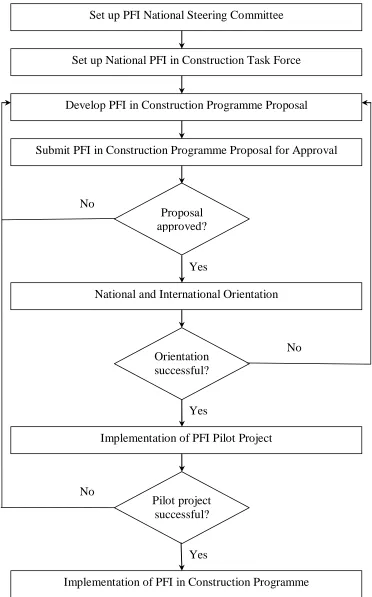
The proposed framework was developed taking into account the generic success factors of PFI projects identified from literature and the governance system in Brunei Darussalam. The framework incorporates five main features namely organisation, training, participation, implementation and iteration as suggested by Tutesigensi and Moodley (1999). A graphical representation (flow chart) of the framework can be seen in Figure 1. The following sections provide a textual description of the key elements of the framework.
Organisation
Organisation refers to bringing together individuals or groups of people to achieve common objectives effectively (Tutesigensi and Moodley 1999). The formation of strong groups of people was considered a crucial element for successful introduction of PFI in the construction industry in Brunei Darussalam. In this case, organisation should involve the following:
1 Set up PFI National Steering Committee
This Committee should consist of key decision makers possibly at the rank of Permanent Secretary or Director General in public service. The main tasks of the Committee should be as follows:
Establishing/formalising the need for PFI in construction in Brunei Darussalam;
Building a network of experts in PFI; and
Set up PFI National Steering Committee
Set up National PFI in Construction Task Force
Develop PFI in Construction Programme Proposal
Submit PFI in Construction Programme Proposal for Approval
National and International Orientation
Implementation of PFI Pilot Project
Implementation of PFI in Construction Programme Proposal
approved?
Orientation successful?
Pilot project successful?
Yes Yes
Yes No
No
[image:5.595.96.468.76.673.2]No
Figure 1: Framework for introducing PFI in the Brunei Darussalam construction industry
2 Set up National PFI in Construction Task Force
Introducing PFI
Co-opting external financial, technical and legal advisors to the Task Force;
Producing a detailed PFI in Construction Programme Proposal; and
Ensuring that the Proposal: builds a robust case for the programme; identifies the responsibilities and risks to be borne by the government and the private sector and the financial implications of such responsibilities; identifies payment mechanisms that offer the optimum balance of responsibilities, risks and rewards for the private sector; develops a PFI tendering procedure; develops legal documents that create cooperation between the public sector and the private sector for the development and operation of infrastructure; defines output/outcome specifications and standards; and defines systems with which to monitor private sector performance.
Training
Training is a planned and systematic approach to developing competence to perform a task (Buckley and Caple 2004). Once the Task Force has been established, it is important that levels of competence within the team are identified and gaps filled with tailored training programmes. Since PFI is likely to be a relatively new concept, to at least some of the Task Force members, the training may take the form of work
experience/placements, perhaps overseas, in order to facilitate the development of the necessary competence among members of the Task Force.
Participation
Participation is geared to getting all the stakeholders involved in ways necessary to deliver a successful PFI programme. It will involve the following:
1 Develop PFI in Construction Programme Proposal
This should be done by the Task Force and should identify, among others, types of projects suitable for PFI, procurement methods in current use, procurement methods evaluation criteria, best value solutions, impact of PFI on existing stakeholders and tariff design.
2 Submit PFI in Construction Programme Proposal for Approval
The Proposal should be submitted for approval by the Task Force to the appropriate government organs (the National Privatisation Committee).
3 National and International Orientation
This should be undertaken once approval of the Proposal has been achieved and should focus on the following:
Enactment of the appropriate law;
Increasing awareness of PFI throughout the construction industry through literature and training events;
Promoting the country internationally in order to attract overseas players; and
Setting up of a national construction PFI procurement team / unit.
4 Implementation of PFI Pilot Project
implement more than one pilot project, depending on the nature of amendments to the systems required initially.
Implementation
Following a successful pilot project (and possibly modifications in the construction PFI programme and/or administrative systems as a result of lessons learnt from the pilot project), the programme should go into full implementation mode. The main element in this stage should be monitoring and reviewing of private sector
performance as well as actual benefits from the projects themselves to the citizenry. This can be facilitated by using key performance indicators appropriate for respective phases of the projects in the programme.
Iteration
Iteration is a key feature of the framework as illustrated by the loops in Figure 1. Problem solving in practical situations often involves revisiting activities before proceeding to the next stages (Tutesigensi and Moodley 1999). The iteration provided in the framework is a mechanism that facilitates successful introduction of PFI in the construction industry in Brunei Darussalam.
EVALUATION OF THE FRAMEWORK
Data collection
The framework was evaluated in a survey of senior professionals in the MoD. This ministry was chosen because in the current governance structure in Brunei
Darussalam, it would be the main public sector organisation involved in PFI in
construction. As the number of senior professionals in the MoD was not too large, 64 in number, all professionals at the position of Assistant Head of Section or above were targeted. All together 12 directors, 12 Assistant Directors, 16 Heads of Section and 24 Assistant Heads of Section were targeted in the survey.
A questionnaire was designed following guidelines from (Gillham 2000, Naoum 1998 and Oppenheim 1992). The variables captured included the following general
variables: profession, position in organization, experience, country of overseas training, duration of overseas training and level of familiarity with aspects of PFI – these general variables were suspected to be potential independent variables. The dependent variables captured were derived from Davis (1989), Mahmood, Burn, Gemoets and Jacquez (2000) and Amoaka-Gyampah (2007) as attributes that would represent the utility of the framework. The dependent variables were user
expectations, ease of use, perceived usefulness, user commitment, perceived attitude of top management and organizational support. The dependent variables were all measured on a five-point Likert scale (1- strongly disagree, 2 – disagree, 3 – neutral, 4 – agree and 5 – strongly agree).
Introducing PFI
Descriptive statistics
Of the 48 respondents:
31 were engineers, 7 were quantity surveyors, 4 were architects and 6 were other professions;
12 were directors, 9 were assistant directors, 7 were heads of section and 20 were assistant heads of section;
11 had ten (or less) years experience, 29 had between eleven and twenty years experience, and 8 had more than twenty years experience;
3 have been to Australia, 31 have been to UK, 1 has been to USA and 13 have been to other overseas countries for training;
17 had overseas training lasting less than 3 months, 1 had overseas training lasting between 3 and 6 months, 28 had overseas training lasting between 6 and 12 months and 2 had overseas training lasting between 12 and 24 months;
6, 10, 32 judged their level of familiarity with PFI to be very low, low and average respectively.
The distribution of the respondents in the different groups in all the six independent variables above is, arguably, typical of any similar ministry in a similar country. The research team was satisfied, especially given the high survey coverage (75% of the whole population) that the sample provides a reliable view of the state of affairs in the MoD.
Table 1 below shows the means and standard deviations of the dependent variables that were used to evaluate the utility of the framework.
Table1: Descriptive statistics of the utility variables
Statement Mean Standard
deviation
Framework meets expectation 3.44 0.65
Framework is informative 3.67 0.69
Framework provides sufficient details 3.54 0.71
Framework is easy to understand 3.67 0.69
Framework is consistent with government procedures 3.52 0.80
Framework has potential to be employed 3.92 0.58
Framework is feasible 3.44 0.74
Framework is recommended 3.71 0.62
Willingness to participate in further development of the framework 3.73 0.64
Top management will be receptive to framework 3.81 0.79
Top management will provide for necessary training 3.85 0.68
Utility of the framework 3.66 0.41
Norusis 2005). A Chronbach’s Alpha value of 0.816 was obtained - this confirms a consistent scale of measurement of the underlying factor, in this case, the utility of the framework (Coleman and Pulford 2006 and Kinnear and Gray 2006). With this result, the average score across the eleven variables can be used as a composite score of the utility of the framework – this figure (3.66) is shown in the last row of Table 1 above.
The individual and composite average scores are rather low. None of the averages hits the 4 (agree) mark. It can be said, however, that the average view of the
respondents tends to the ‘agree’ position on the measurement scale used. A possible explanation for the low score could be the low level of familiarity with aspects of PFI (see last bullet point above).
Normality test
It was important to carry out a normality test in order to establish whether the data on the composite variable, utility of the framework, were parametric or non-parametric. On carrying out the standard normality test (Coleman and Pulford 2006 and Norusis 2005), it was established that the data were non-parametric. Therefore, any tests to determine whether there were differences between groups provided by the six presumed independent variables (profession, position in organization, experience, country of overseas training, duration of overseas training and level of familiarity with aspects of PFI) would have to be non-parametric tests (Coleman and Pulford 2006 and Kinnear and Gray 2006).
Comparison of groups of respondents
To compare the groups of respondents provided by the presumed independent variables, a series of Kruskal Wallis tests (Coleman and Pulford 2006; and Kinnear and Gray 2006) were run. The results showed that there were no differences between any groups. This indicated that the independent variables that were initially presumed did not actually determine the score on the dependent variable (utility of the
framework). Therefore any implementation plans should take into account the fact that the views about the framework do not vary within the key public sector
organisation, the MoD, do not vary according to profession, position in organization, experience, country of overseas training, duration of overseas training or level of familiarity with aspects of PFI.
CONCLUSIONS AND RECOMMENDATIONS
Conclusions
From the work reported in this paper, four conclusions can be drawn thus:
The aim of developing a framework that could be used to introduce PFI in the construction industry in Brunei Darussalam has been achieved. The proposed framework incorporates appropriate experiences and success factors identified from all over the world as published in various pieces of literature over the last twenty or so years. Furthermore, the framework takes into account the public governance structures in Brunei Darussalam.
The framework was presented in two complimentary forms (textual and graphical). It was considered valuable by a significant proportion of senior professionals in the Ministry of Development – a key player in any future PFI in construction in Brunei Darussalam.
Introducing PFI
about the idea that the framework has utility in the construction industry in Brunei Darussalam was obtained from 48 respondents (75% of the target population). The score represents a tendency to value the framework. When one key dimension of the context (that all the respondents evaluated
themselves as having average or less knowledge about PFI) is taken into account, it can be argued that this is a positive result.
There were no differences between any groups provided by the presumed independent variables. The senior professionals in the MoD were united in their judgment of the framework.
Recommendations
Arising from the outcomes from this effort and perceived future needs for the
development of the framework into a better and more useful tool for the introduction of PFI in the construction industry in Brunei Darussalam, three recommendations can be made thus:
Given the low scores, it would be prudent to consider the findings of this work as preliminary findings and conduct a similar study at a later stage when the key stakeholders have had training and improved their knowledge and understanding of the nature of PFI and associated critical success factors.
The framework can be considered as a good starting point. However, the evaluation of the framework should be extended in scope to establish any modifications necessary to increase the utility of the framework. This could be achieved through workshops at which extensive discussion of the strategy should be held. The workshop could include key stakeholders outside the MoD identified in the framework such as the Ministry of Finance and The University of Brunei Darussalam.
The framework has not considered the timescale associated with the different activities. Further development of the framework will be necessary to identify a clear timeframe (with clear milestones) within which specific activities will need to be delivered.
REFERENCES
Akintoye, A, Beck, M, Hardcastle, C, Chinyio, E and Asenova, D (2001) The financial structure of private initiative projects. In: Akintoye, A (Ed.), “17th Annual ARCOM Conference”, 5-7 September 2001, University of Salford. Association of Researchers in Construction Management, Vol. 1, 361-9.
Amoaka-Gyampah, K (2007) Perceived usefulness, user involvement and behavioral intention: an empirical study of ERP implementation. “Computers in Human Behavior”, 23(3), 1232-48.
Blackwell, M (2000) “PFI/PPP and property”. Oxford: Chandos Publishing.
Buckley, R and Caple, J (2004) “The theory and practice of training”. London: Kogan Page.
Brown, D C, Ashley, M J and Riley, M J (2001) New project procurement process. “Journal of Management in Engineering”, 17(4), 76-92.
Boyfield, K (1992) Private sector funding of public sector infrastructure. “Public Money and Management”, 12(2), 41-6.
Davis, F D (1989) Perceived usefulness, perceived ease of use and user acceptance of information technology. “MIS Quarterly”, 13, 310-39.
DLA Piper Rudnick Gray Cary (2005) “European PPP report 2005”. London: DLA Piper Rudnick Gray Cary.
Frilet, M (1997) Some universal issues in BOT projects for public infrastructure. “International Construction Law Review”, 14(4), 499-512.
Gillham, B (2000) “Developing a questionnaire”. London: Continuum.
Grant, T (1996) Keys to successful public-private partnerships. “Canadian Business Review”, 23(3), 27-8.
Hickman, D (2000) “PFI and construction contracts: a commercial guide”. Oxford: Chandos Publishing.
Hj Mohammad, S A (2007) “Private finance initiatives framework for Brunei Darussalam”, Unpublished MSc Thesis, Department of Civil Engineering, University of
Portsmouth.
HM Treasury (2000) “Public private partnerships – the Government’s approach”. London: HM Treasury.
Kinnear, P R and Gray, C D (2006) “SPSS 14 Made Simple”. Hove: Psychology.
Li, B, Akintoye, A, Edwards, P J and Hardcastle, C (2005) Critical success factors or PPP/PFI projects in the UK construction industry. “Construction Management and
Economics”, 23(5), 459-71.
Mahmood, M A, Burn, J M, Gemoets, L A and Jacquez, C (2000) Variables affecting information technology end-user satisfaction: a meta-analysis of the empirical literature. “International Journal of Human-Computer Studies”, 52(4), 751-71.
Ministry of Finance Singapore (2006) “Public private partnership handbook”. Retrieved 30.06.07 from http://www.mof.gov.sg/policies/ppp.html.
Naoum, S G (1998) “Dissertation research and writing for construction students”. Boston: Butterworth-Heinemann.
Norusis, M J (2005) “SPSS 13.0 guide to data analysis”. Upper Saddle River: Prentice Hall.
Oppenheim, A N (1992) “Questionnaire design, interviewing and attitude measurement”. London: Continuum.
Qiao, L, Wang, S Q, Tiong, R L K and Chan, T S (2001) Framework for critical success factors of BOT projects in China. “Journal of Project Finance”, 7(1), 53-61.
Stein, S W (1995) Construction financing and BOT projects. “International Business Lawyer”, 23(4), 173-80.
Tiong, R L K, Yeo, K T, and McCarthy, S C (1992) Critical success factors in winning BOT projects in China. “ASCE Journal of Construction Engineering and Management”, 118(2), 217-28.