Rochester Institute of Technology
RIT Scholar Works
Theses
Thesis/Dissertation Collections
2003
Loathing
Jessica Rose Monsour
Follow this and additional works at:
http://scholarworks.rit.edu/theses
This Thesis is brought to you for free and open access by the Thesis/Dissertation Collections at RIT Scholar Works. It has been accepted for inclusion
in Theses by an authorized administrator of RIT Scholar Works. For more information, please contact
Recommended Citation
Loathing
Graduate Thesis
Master of Fine Arts
School of Photographic Arts and Sciences
Rochester Institute of Technology
By Jessica Rose Monsour
November 2003
Thesis Board Members:
Jeff Weiss, Thesis Chair, Associate Professor, SPAS
Signature
J. Weiss
Date
)/.17.
8
>
Elliott Rubenstein, Professor, SPAS
/
Signature
E. Rubenstein
Date+-i 0)
Susan Lakin, Assistant Professor, SPAS
Signature _ _
S_._L_a_k_i_n ___
DateJ_iJll'U
-=
1
5~""'
_ _
Editors:
Christie Henzel
THESIS REPRODUCTION
PERMISSION STATEMENT
Title of thesis'
loatbing
I, Jessica Monsour, hereby grant permission to the
RIT Library of the Rochester
Institute of Technology to reproduce my thesis in whole or in part. Any
repro-duction will not be for commercial use of profit.
CONTENTS
PAGE
INTRODUCTION
1
INFLUENCES
&
LOATHING
2
CONSTRUCTION
15
EPILOGUE
17
IMAGES
16-35
QUOTE BY
GAUGUIN
36
ENDNOTES
37
Introduction
How do
we perceive ourselves?It is
through
my
thesis, Loathing,
that
I take
this
commonissue
andillustrated it in
a new and unique way.I have
created amethod
to
openup feelings
ratherthan
merely portray
an object.It is
the
collaboration
between
the
environmentin
whichthe
objectis
placed andthe
objectitself that
provideslife
to this
work ofart.As
Francis
Bacon
oncestated,
"an
object
is necessary
to
providethe
problem andthe
discipline
in
the
searchfor
aproblem's solution.
Real imagination is
technical
imagination;
it is in
the
waysyou
bring
an eventto
life
again.It is in
the
searchfor
atechnique
that
traps
an object at a givenmoment,
wherethe technique
andthe
objectbecome insepa
rable.
Art lies in
this
continual struggleto
come nearto the
sensory
side ofthe
objects".1Loathing
is
aboutthe
shadow,
one's unacceptable attributesthat
arelabeled
by
societies'expectations.
Through
the
struggle withfinding
societalacceptance,
onebecomes deranged
in
her insecure
world.It
exploitsthe
artist'sInfluences &
Loathing
David
Hockney
wasthe
first
artist whoinspired
meto
use a camera.In
particular,
his
experimental photo collagePearblossom
Highway,
1986
(FIG.
1)
capti vated me.The
size ofthe
final
image,
which was composed of numerous small er "snapshots,"is
large
and was made atthe time
whenthis large
scale wastra
ditionally
associated with paintings ratherthan
photography.He draws
the
view erinto
a vastdesert
landscape
where oneis
confronted withboth the
beauty
ofa vibrant colored
sky
andthe
trash
discarded along
the highway.
Hockney's
construction anddeconstruction
of spacekeeps
the
viewerdecentered,
sothat
she
is
alwaysquestioning
her
positionin
space.The
abrupt collage of photographs reinforce
the two-dimensional
surface ofthe
image,
yet one can stillenter
the
image
through the
approximated one-point perspective ofthe
highway
receding into
the
horizon,
and yet againthrough
the
multiple one-point perspectives
ofthe
individual
photographs.Throughout
my
workI
digitally
incorporated
Hockney's
collagetechnique
withAdobe Photoshop. I
removedthe
obviousseams associated with
his
collageto
make one uniformimage,
however,
I
pre servethe
sense of rupture andtension
producedby
his
construction anddecon
struction of spacethrough
my
ownuncanny
juxtapositions
ofimagery.
Hockney's
project was ashattering
ofthe
picture plane and anintentional
confusion of
space,
both
of which areprimarily formalist
concerns.Louise
Bourgeois's
workhad Hockeny's
same sense of rupture whichI
found
somoving,
but
alsodealt
directly
with conceptualissues
which wereimportant
to
me such asthe
body,
the
psyche, gender,
and sexuality.Rosalind
Krauss
claimsBourgeois's
workincorporates
the
logic
ofthe
"part-object," and atthe
sametime
attemptsto
eraselogical
categoriesthrough
an operationknown
asinforme
(a term
Krauss
borrows
from
Georges
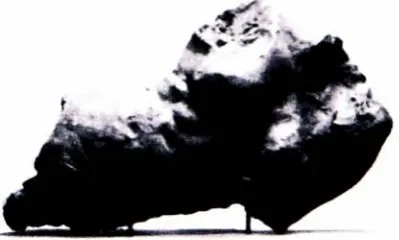
Bataille). In the
work of an artistlike
Constantin
Brancusi,
the
wholeis
reducedto
a singleform. (Take for
examplehis
Newborn
series
in
which cosmicideas
aboutbirth
andlife
are condensedinto
a singlein 1882 (FIG.
2,
3
&
4),
asKrauss
writes,
sothat
its
parts aredisconnected
and dislocated.2Thus allowing
the
viewersto
maketheir
ownintuitive
narrative concerning
the
art piece.Informe
is
a collapse oflogical distinctions
that
we useto
orderthe
world.It is
the
possibility
to
performthings that
do
not make rational sense.The
collapse ofoppositions such
as,
inside/outside, figure/ground,
male/female,
orliving/dead,
into
chaosis
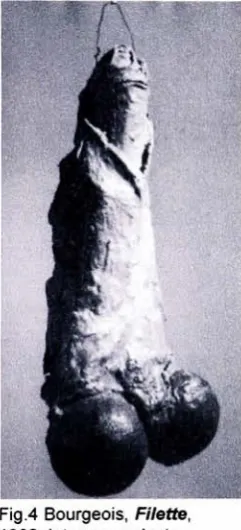
what produces informe.3One
gets a sense ofthis
in
Bourgeois's
Torso Self-Portrait
orTrani Episode (FIG.
5,
& 6). Krauss
citesLucy
Lippard's
description
ofTrani Episode
as a "breast-penis,"that
is,
a confusion of gender.One
can seethrough
my
workthat I
incorporate Bourgeois's
use ofthe
part-object
in
my
creations.The female
torso,
(FIG.
57),
the
potatosack,
(FIG.
56),
the
slab ofmeat,
(FIG.
59),
andthe sculptures,
(FIG. 60 &
61)
alltake the
body
(or in
the
case of meat andpotatoes, take
something
that
suggestsbody
parts)
and
fragment it
anddislocate it
in
space.I
found Bataille's informe
to
be
aliber
ating
notion,
away
ofthinking
the irrational
andletting
the
irrational happen in
form. All
ofthis
worksto
create a psychological and emotional effectthat
canexpress
the
shadow within me and canin
turn
resonate withthe
viewer'spsy
chology.
By
the
shadowI
meanthe
primitive personthat
appearsin
ourpsyche,
someone with unpleasant qualities or someone we
dislike.
This
is
all personifiedby
society."The
narrower and more restrictivethe
society
in
which welive,
the
larger
our shadow.The
shadowis
unavoidable and womanis incomplete
without
it. Woman
must,
in her
view,
find
someway
ofliving
withher dark
side;
her
health depends
onthis.
Trying
to
live
asbetter
and nobler peoplethan
we areinvolves
usin
endlesshypocrisy
anddeceit,
andimposes
such a strain on usthat
we often collapse andbecome
worsethan
we needhave
been"4
Loathing
is
the
culmination ofmy
struggle with selfin
society.Bourgeois
took
informe
andthe
part-object astep
further
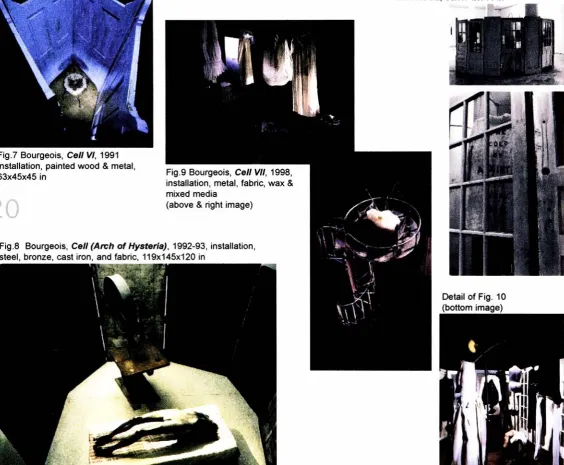
when she createdher
Cell
seriesin
the 1990's
oftwenty-nine
constructed spaces.A few
examples ofseries represents a
physical, emotional, psychological,
mental andintellectual
type
of pain."It's
a continual circlegoing
around and around wherethe
pain canbegin
atany
point andturn
in
either direction".5She
goes onto
say
that
eachcell
deals
withfear
which canbe
perceived aspain, but
oftenit
is
not.These
cells
take
on numerous and ambiguous meanings.They
act asfriendly
orhos
tile
living
spaces.They
contain psychologicalimplications
such asvoyeurism,
anxiety,
confinement,
andthe
illusion
of reality.Her
work stemsfrom her
surroundings.
The
contentis
emotionally
chargedbecause it is
always suspendedbetween
simple orinvolved,
subtle orblunt,
painful or pleasant.Most
importantly
her
workis
realbecause
it
comesfrom
within.Bourgeois
statesthat
withher
work
"the
problems ofrealization,
whetherit is
technical,
formal
oraesthetic,
they
comesecondary;
they
camefrom
afterwards andthey
canbe
solved".6The
impact
that
Bourgeois's Cell
serieshas
created stemsfrom
the
ability
to
physically
enterinto her
world.Upon
entrance oneis
immediately
surroundedby
anxiety. In
my
workI
have found
the
notion of a created environmentimportant. I
do
not create
three-dimensional
spacesfor the
viewer,
but
I do
create a spacethat
feels believable
andthat the
viewercould enter.Through
perspectivaldevices
I
draw the
viewerinto
the
picture.In her installations
the
vieweris
ableto
breathe, touch,
and smellher
torment.
Once
I
have
pulledthe
viewerin,
I
try
to
convey
the
same visceral sensationsthrough two-dimensional
form
that
Bourgeois
createsin her installations
through
a richvariety
oftextures:
concrete,
flesh,
and meat.I
evenbegan
to
photograph objectsI
created assculp
tural
piecesin
orderto
incorporate
more ofthe three-dimensional
real worldinto
my
images.
Park-Harrison's
use of alternative processesis
what attracted meto
his
workbecause
I too
wasinterested in
a morecathartic,
hands-on,
experience withphotography.
Before I began
my
thesis
workI
wascreating
a modernday
version of
the tintype
withliquid
emulsion,
whichis
much saferthan
using
the
tradi
tional
chemicalsto
create such animage.
My
personal objective with photography
was andis
to
unitephotography
with sculpture andinstallation. I
enjoy
be
born.
My
senior undergraduateproject,
Untitled,
consisted of22
(9"x6")
zincetching
plates printed withliquid
emulsion(FIG.
24-29). These
images
were unsuccessfulto
mebecause
they
didn't
exploitmy
intent. I know
you can not controlthe
viewer'sthoughts,
but
these
images
carriedtoo
much ofasexual,
masochisticovertone.
That
was notmy
intention. I
wasinterested in
the
victim'slast
breath,
the
struggle againstthe
final inevitable. The
victimslast
momentcaptured alive.
Park-Harrison
also created propsfrom found
objects(FIG.
11)
and usedthem to
mend
the
earthin his imagery. He
combineslandscape images borrowed from
history
andthe
use ofhimself,
assubject, to
make one unique piece.Isolation
and solitude surroundhim in his desolate landscapes. His
use ofisolation
creates a
tranquil mood,
whilein
all ofmy
workisolation
createsfeelings
ofanxiety
and alienation.The
construction ofhis
imagery
is
through the
use of collage.He
uses
the
paper negative processinstead
of computermanipulation,
asis how
my images
are constructed.This
alternative process allowsfor
the
workto
become
seamlessthrough
atedious
process ofprinting
andcollage,
muchlike
how
aXerox
machine works.To further
the
success ofhis
seamlessimagery
he
paints and uses
layers
of wax overthe
top
ofhis
picturesto
create a uniformsurface.
The final
productis flush
mountedinstead
oftraditionally
displayed
behind
glass andframe. The
resultlooks
muchlike
amisty landscape painting
from
the 1900's.
Park-Harrison found
away
through
hand
manipulationto
bring
the
artist'shand back
into
photography,
something
that
has
plaqued photography's
integrity
as atrue
art sinceit's birth.
Today
withthe
use of computertech
nology
further
pushing
the
artist'shand
out ofthe picture,
one might questionits
authenticity
as art.Since
computers canbe
cold andimpersonal,
I have found
away
to
relatephotography,
computermanipulation,
andthe
artist'shand
through
the
use ofPhotoshop
andhand
crafting.The
end result(FIG.
62)
is
one uniquepiece of art.
I
continuedto
explorethe
Tintype
processfor
my
first
walk-through atRIT
I
crecombines
the
historical
aspect ofthe
Tintype
process withphotography
today,
by
simulating
the
historical
processthrough the
use ofliquid
emulsion.The
con ceptual part ofthis
piece concernsthe
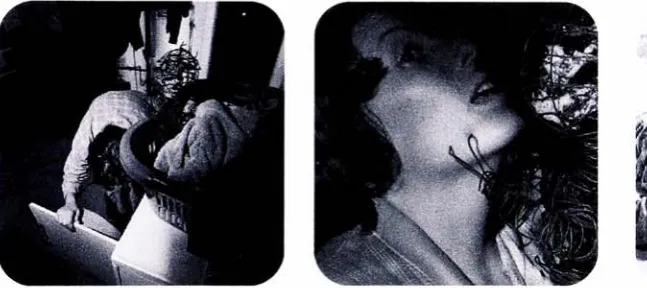
figure in
its
environment.The
narrativestructure of
these
film
stillsdepict
atypical
Hollywood
cliche,
ayoung
lady
whogoes
into
adark
creepy
basement,
the unknown, to
do
her
laundry,
aneveryday
chore.
A
supernaturalbeing
spontaneously
created out of metalwire,
sneaksupon
the
young
lady,
attacks andkills her.
Do
notworry,
the
last
image in
this
sequence shows
the
womanin bed
sleeping,
for
it
wasonly
adream. Whether
afraid of
spiders,
heights,
ordark
creepy
basements,
we oftenlet
our subconscious get
the
best
of us.Someone
asked mewhy
I
usethe tintype
process andI had
noanswer,
exceptto
say
that
I liked
the
processbecause
it
gavethe
images
a unique nostalgic presence and an object quality.So,
I
stoppedworking
with alternative processes and went
digital. The
vivid colors ofreality
began
to
consume
my
thoughts.
Instead
oftrying
to
create a mystical eventthat
occurredin
the past,
I
began
to
createsomething
that
happened
today,
righthere
andnow.
Out
ofthe
darkroom
andinto
the
computerlab,
I began
to
usePhotoshop
whenconstructing my
imagery.
For
the
remainder ofmy
walk-throughs,
I
created spacesfrom
capturedfragments. I
photographedwalls,
floors,
textured
surfaces,
and various objectsto
create one unique space.Once
the
spacewasformed
in
Photoshop
I incorporated
afigure
to
create onetelling
self-portrait.These
images (FIG.
38-51)
pose psychologicalimplications
of emotionalturmoil.
One
can get a sense ofemptiness,
frustration,
entrapment,
anddepression;
allof which are signs of anxiety.
I
usedanxiety
asmy
focus for
eachimage
because
it
plays akey
rolein
my
daily
activities.This
same conceptis
the
basis
for
my
thesis
work.The
problemI had
withthese
images
is
that
they
looked like
storyboards.
The
construction ofthese
images
became
too
animated.I
wantedmy
images
to
existin
the
domain
ofthe
real.I began
to
photograph real spaces and usePhotoshop
as a small componentto
paintin
or outmy
imagination. I
thought
about physicalcollage,
but
whattruly
interested
me was a uniform surthe
image
andbelieve
the
worldit
capturesis
real.When
youlook
closer yousee
traces
ofmanipulation,
the
artistshand left
behind.
Ann
Hamilton's installations have
also shapedmy
conceptualthoughts.
Her
piece
titled,
palimpsests(FIG.
12
&
13),
createdin
association withKathryn
Clark,
is
one ofmy
favorite
pieces andhas
stuckin
my
mindthrough
outmy
thesis
work.There
weretwo
partsto this installation piece,
but
one partin
particular
caughtmy
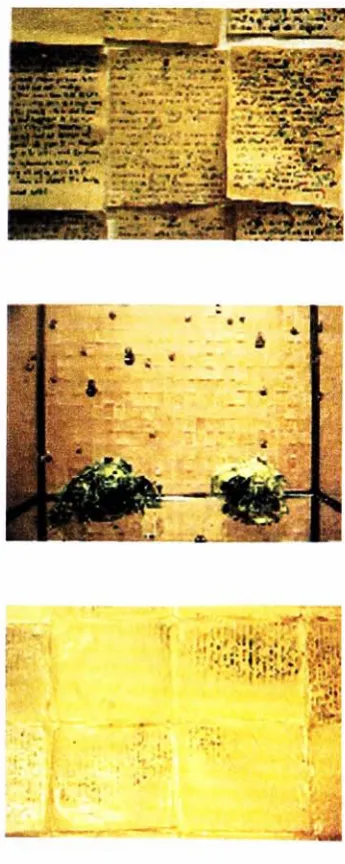
attention.The first
part ofthis installation
piece consists of aroom covered
in
parchmentpaper,
and an aquariumcontaining
two
heads
of cabbagealong
with snails.Memories from
thousands
ofdifferent
people were written onthese
sheets of parchmentpaper,
which werethen
hand
tacked to
the
wall,
floor,
andceiling,
alaborious
process.This
surreal environment aidedin
the
conceptuality
behind
Untitled,
1999.
This
piece wasinstalled
onthe
floor in
a circular pattern with ablue light bulb
dangling
aboveit. The installation
forced
the
viewerto
squatdown towards the
groundinto
a vulnerable positionto
viewthe
images. I
now seethat these
images
arethe
beginning
process of whatI
finally
accomplished atRIT.
In
palimpsest, the
memories overtime
had faded from
the paper,
as well asthe
mind.
At
the
sametime,
the
cabbage wasslowly
deteriorating
asthe
snails ateit.
A
sense ofloss
takes
place asthe
letters
fade from
the
paper andthe
snailsdevour the
food.7It is
this transformation
andthe
inevitable
sense ofloss
that
I
tried to
capturein
all ofmy
work.My
thesis
images
poses a sense ofisolation,
existence/non-existence,
and a sense ofloss. I
convey
this through
isolated
fig
uresin dark
empty
spaces.In
my
exploration ofthe unconscious,
memory is
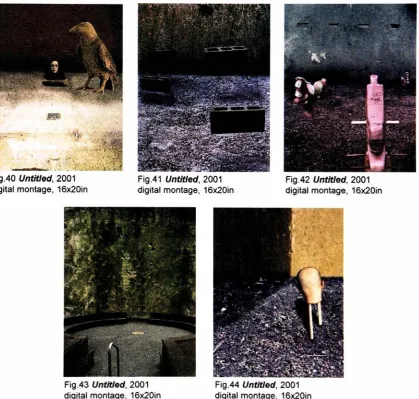
always a paramount concern.Sometimes
I
even use child-likeimagery
such as playgroundrocking
horses (FIG.
42)
which echo a pasttime
nowlost.
Loss
is
communicatedthrough
fragmented bodies.
Figures
aremissing
limbs,
hands
and
legs
(FIG.
50),
in
(FIG.
44)
a man'sbody
is
replacedby
two
prostheticmatchstick
legs
coming
outthe
base
ofhis head.
8
tremendously.
Witkin
confronts and enlightenshis
viewersby
showing
them
aworld
they
might not otherwise see.He does
soin
adisturbing
mannerbecause
he
wantsto
create alink between the
personposing
andthe
mind ofthe
viewerthat
one associates withdanger
andfear. This
type
ofhysteria
people associatewith
death,
andby
reaching
this point,
Witkin
wantshis
viewersto
realizethe
importance
oflife;
he
wantsthe
viewersto
understandthe
pointthat
living
is
the
most sacred gift mankind could have.8
My
undergraduate workUntitled
(FIG.
24-29),
usesthe
same principlesthat
Witkin's
workis
based
from,
panic,
anxiety,
fear
andthe
sense ofdeath.
Witkin's
use of stagedsettings, props,
image
manipulation andthe
sense ofdeath
can allbe
found
incorporated
into my
own work.In (FIG.
58)
the
fish
dan
gles
lifeless
abovethe tub
ofwater,
whichis
its breath
oflife.
The
fragmented
female
body
in (FIG.
54)
cradles a mutilatedpig
head,
which reeks ofdeath,
and
the
fragility
that
life
represents.But
the
rawestform
ofdeath
canbe
seenin
(FIG.
59)
wherethe
cannibalization oflife
manifests.This
image
shows an opendoor
inviting
the
viewerin;
unlikethe
otherpictures,
wherethe
viewer wasalready
trapped
inside
the
image
withthe
figure. A
boat
anchorimpales
the
torso
asit hangs
lifeless
andlimp
along
with allthe
other mundane objectsin
the
garage.Francis
Bacon
painted slabs of meatbecause he
thought
they
werebeautiful.
My
image
is
notto
revealbeauty,
but
to
presentthe
absolute vulnerability.
By
removing
alayer
of clothes andthen
alayer
offlesh
onebecomes
susceptible
to
all atrocitiesthat
plague our society.While
the
slab of meathangs
from
the
supportbeam,
onebegins
to
compareit
withthe
rest ofthe
objectsin
the
garage.By
photographing
these
mundane objects onebegins
to
realizethe
unique
quality
each poses.As
does
the
mundane objectsthat
Bourgeois,
Parke-Harrison
andWitkin
usein
their
imagery.
Lucian
Freud's
paintings such asNaked
Girl
withEgg
andThe
painter'smother, (FIG.
16
&17)
exploitthe
psychological.Instead
ofusing
a professional modelthat
wouldbe
comfortableposing,
Freud
is
ableto
revealanxiety
anddis
the
censorship imposed
by
the
conventions ofseeing
to
revealthe truth
aboutwhat
is
seenby
using
non-professional models.Freud
also plays withthe
psy
chological
by isolating
his figures. In
this way,
he is
ableto
unveilthe
loneliness
of
death
implicit
in
depression.9The malleability
ofthe
paint andFreud's brush
stroketransforms
his
telling
portraitsinto his
own emotionalturmoil.
He is
ableto
createthrough
painting
whatLouise Bourgeois has been
ableto
do
withsculpture.
They
both
bring
to
life
an experience ofanxiety
and scarring.Bourgeois's rupturing
ofthe
figure
andFreud's uncanny flesh is
evidentin
FIG.
54
&
57
In
contemporary
culture newtechnologies
such asfilms
are considered expressive,
where as computers are cold andimpersonal. I have found
away
to
relateboth
technologies to
my
artworkdespite
the
Hollywood
cliche of eroticfantasy
and
technology.
I have incorporated
themes
from
moviesalong
with computer manipulatedinteriors into
my
work.The films
The
Cell
andSeven (FIG.
18-23)
both
exploitthe
vulnerablehuman
condition.They
are about one'sshadow,
allthose
uncivilizeddesires
and unpleasant qualitiesthat
one possesses.The
imagery
in
these two
films is
psychologically
compelling,
eachframe
being
a work of art.The
fantastic
andhorrific
environmentsdepicted in
these
movies arevisually
remarkablein
detail.
They
are uncanny.The
sense ofdeath is
so vividin
Seven
one can smellits
reality,
like
the
odor ofpig
flesh in
FIG.
54
orthe
smell of raw meet
in
FIG.
59.
In
The Cell
the
cold anddesolate
interiors
that
surrounds
the
figure,
isolates her
like
the
estrangedfigures
in
all ofmy
work,the
cold and
desolate interiors
that
surroundsthe
figure,
isolates her like
the
estranged
figures in
all ofmy
work.It is
the
sense ofdeath,
the
enigma of space andtheir
interest in
the
psychological
that
draws
me closerto
all ofmy
influences.
Loathing
is
a reflection onhow
one's mind can
be
inspired.
The
strength ofLoathing
is its
ability
to
be
confrontational, difficult,
and challenging.It
unleashesthe
irrational
and uncontrolledthoughts
andimpulses
that
underpinhuman
existence.In
ourcompetitiveworld,
10
they
areleft
feeling
inadequate
andfull
of anxiety.This
body
of work capturesmy
irrational
fears
ofbeing
unableto
fulfill
anillusion
of perfection.The
resultis
an obsessionto
meet unrealisticdemands. The
failure
in
meeting
these
demands
causes oneto
loathe
oneself.With
the
combination of props andthe
constructed
space,
I have been
ableto
mockhome life
whileevoking
adream
world of
my
reality.Shut doors
are away
to
disconnect
from
the
horrors
ofthe
outside world.They
allow oneto
be
protectedfrom
the
ruthless vulturesthat
constantly
use usto their advantage,
raping
us ofpride,
dignity,
and self-worth.The dismemberment
ofthe
head
allows oneto
pushfurther
away
from
society
into
a state ofdenial,
blindfolding
oneselffrom
acceptance.As
anAmerican
female
in
today's
society
there
are added pressure onthose
whodo
notfit
the
social norm.
Society
placeslabels
on woman.For
instance, "submissive",
"dom
ineering",
"nurturing", "fat", "disgusting", "sexy", "whore",
"slut" and"oinker".
These labels
pigeonhole one'sidentity.
Growing
up
society
labeled fat
womenas
helpless
pigs;
Miss.
Piggy
(FIG.
52)
was always adamsel in distress. Pigs
are considered
the
mostloathsome
ofbarnyard
animalsbecause
oftheir
unattractive traits: gluttony,
sloth, stubbornness,
they
wallowin
muck and eatgarbage.10
As
athin
andbeautiful
woman you could savethe
worldlike Wonder
Woman (FIG.
53),
a"super
hooker"in disguise.
The
victimization of womanhas
been
significantly
induced
by
pejorativelanguage
throughout time.
One
exampleof
this
is
demeaning
animal metaphors wherethe
womanis depicted
as a mindless breeder
blindly following beastly
instincts
andperforming
"animal"functions
of
producing
andrearing
offspring.Women have been
portrayed as"wild
ani mals"in dire
need ofsubjugation,
domestication,
andtight control,
including
aregular regimen of physical
battering.
These
anomalisticimages
canbe
found in
a wide
variety
of sources:poetry, satire, politics, philosophy, the
law,
drama,
andpornography.11
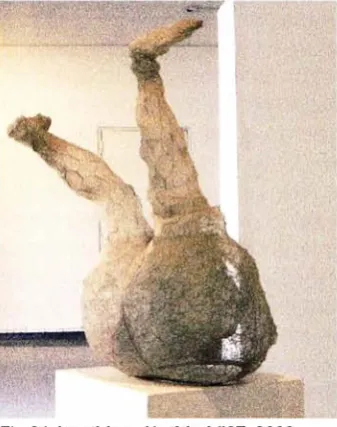
Loathing: Untitled #2 (FIG.
54)
represents psychologicaltorment
causedby
such oppressive
language. The language
of sexismis
more subtle and pervasive
than
racial or ethnicoppression,
whichis
easily
detected. "Our
everyday
resulting
in
a master-subject relationship.The
language
of sexism relegatesthe
womanto the
statusofchildren, servants,
andidiots,
to
being
the
"second
sex"and
to
virtualinvisibility
....The
language
of sexism remains with us andexerts an
influence
onthe
male's attitudestowards
and control overwomen andthe
women's attitudestowards
themselves".12This
attitude of worthlessnessinflicted
on womenby
manis
also portrayed.The innocence
ofthe
female figure
is framed
withinthe
frame
of a pure whitedoorway.
The
shutdoor
makesonewonder
if
there
is
any
hope
onthe
other side.The
princess glovesdrenched in
pig's
blood
representthe
turning
ofage, the
breaking
point at whichsociety
begins
to
view woman as an object.The figure
stands naked andheadless
framed
blatantly
andfrontally
for
the
viewerto
judge her.
Cradling
the
pigshead
in
one set ofhands
while sheaggressively
grabsthe
snoutin
anotherview,
exemplifies
the
subjection of woman as wildbeast
in
dire
needto
produce andrear offspring.
The broom
to the
left
ofthe
figure
personifiesthe
needto
domes
ticate
women.The
nudefigure
acts as one man's sex object and atthe
sametime,
as a repulsivehuman being. The flesh
ofthe
figure
matchesthat
ofthe
pig's
head.
Ironically
the
head is branded
withthe words,
"USA
GRADE A
INSPECTED
MEAT"Looking
closer atthe
pig'shead
one will noticethat the
ears
have
been
removed.This
canbe
analyzed as away
for
the
figure
to
shutout such oppressive
language
that
willonly
lead
to
its detriment.
By turning
the
figure
into
an objectthere
willbe
noharmful
scarring,
no emotionaltrauma.
Loathing: Untitled
#4 (FIG.
55)
alsodeals
withthe
notion of genderissues,
but
goes
further
into
functions
ofthe
body. The figure
wantsto
escapefrom
the
place she
is
in,
into
another,
but locked doors
confineher.
She
constructs wingsout of
found
objectsin hope
that this
will aidin her deviation.
However,
there
areno portals
though
whichto
exit.She
is in
a void world constructedby
man, bar
ren of
any
living
matter.The
planks abovethe three
white chambers mimic prisonbars.
The
whitedoors
representpurity,
whilethe
bars
connect oneto evil;
a subjection of
hope
anddespair.
Once
againthe
figure
is
cannibalizedinto
anobject
through decapitation.
Pictures
that
show people withtheir
heads
removed12
viewed or
judged
by
society.As
a self-defense mechanismthe
individual
trans
forms
itself into
anobject,
riding
itself
of emotions.Red
concealsthe
body,
symbolizing
the
most primalform
ofmenstruation,
rage,
andfrustration.
The
image is
about woman vs.self,
woman vs.nature,
and woman vs. society.The
figure
struggles withself-image,
placementin
society,
and withinnate
functions
of reproduction.
Out
ofthis
sameideology
of woman asinferior
evolvedLoathing:
Untitled
#5
(FIG. 56).
This
image
representsmy
struggle withbeing
afemale. I
wasthe
only
female
childmy
mother conceived.The
expectations and rules applieddifferent
ly
to
each ofmy
siblings.With
my
brothers,
my
parents adopted a permissiveindulgent
parenting
style.For
me,
many
restrictions were made.The
rulesbeing
gender
biased
contributedto
my
perception of self.The underlying
messagethat
was portrayed wasthat
my brothers
couldbe
trusted to
make appropriatechoices and
did
not needmy
parents protection orinfluence,
while as afemale,
I
remained afragile
being
who neededto
be
protectedby
my
parent.My
senseof self
transformed
from
astrong
independent
personto
aninsecure,
ambivalentwoman,
asI
progressedthrough
adolescence and witnessedthe
biases,
perceptions and stereotypes
that
my
motherbegan
to
instill in
me.My
mother'sbeliefs
about woman'sidentity
and roles werebased
ontraditional
domestic
ideals.
The
valuesthat
my
grandmotherinstilled in
my
mother remainedunchanged.
These
valuesincluded
raising
afamily,
taking
care of one'shus
band
andif
a womanhad
to
choose a careerit
wouldbe limited
to
asecretary
or schoolteacher.
As I
have
begun
to
explorethe world,
I have discovered
a newtruth.
I
can nolonger
conformto
my
mother'sidea
of what a woman shouldbe. I
have
createdmy
ownideal
woman.One
whohas
overcomefear
and perseveredthrough
aworld where misperceptions and
biases
suffocate me.This
progressionis
evident in Loathing:
Untitled
#5 (FIG.
56),
wheretwine
mimics a noose wrappedaround
the
neck ofdomesticity.
The
body
ofthe
potatobag
onthe
far
right offrame decapitates
the
woman'shead
removing
her
identity
andbluntly
turning
her into
an object.The
1950's
style swimsuit exemplifies old-fashioned terminology
that
is
embeddedin
my
mother'sbrain.
It is
through education andthe
exploration of self
that
I have been
ableto
overcomethese
obstacles.Loathing: Untitled #3 (FIG.
57)
represents womenfighting
back
againstoppression
trapped
withoutlegs,
stuckin
a maledominated
society.Her
head
decapitated
andin its
place a picklejar
lid,
which representsthe
oppression ofwomen
by
our maledominated
society.Precious
white glovesgraciously
display
bare breast
with atoy
man sandwichedbetween.
The female is
enticing
the
male
by displaying
herself
as an object.One may
ask,
"Is
this
afriendly
invite
orwill
the
malefall
to
his
demise?"One
canthink
ofthis
image
asthe
mating
oftwo spiders,
and after conceptionthe
female
eatsthe
male spider.This image
by
no meansis inviting. The
schizophreniclike
patternedfloor
withblood
redpatches,
andthe deterioration
ofthe
room gives one anuninviting
feeling.
The
bare
shelf representsthe
emptiness sufferedby
women stuckin
a maledomi
nated society.
The first
image in
this
series completed wasLoathing: Untitled
#1
(FIG.
58).
The fish dangles
above atub
ofwater,
suffocating.In
reality,
anxiety
holds
meback
from
completing my
goals.I
am never quite goodenough,
strong
enough,
or
fast
enough.This image
representsmy
struggle withanxiety,
asocially
induced
phobia.A
person with generalizedanxiety
disorder
often unableto
relaxand sleep.
They
oftenfeel fatigued
or willhave
a rapidheart
rate.They
areindecisive,
once adecision is
madethey
worry
whetherthey
madethe
correct choice.People
withthis
disorder
tend
to
feel
nervous andhave
ahard
time
con centrating.They
alsohave
panicattacksdue
to
stressful situations.13Hence
the
fish
suspended aboveits
"air" representsmy
lack
ofbreath
during
a panicattack.
As my
thesis
work evolvedI began
to
create objectsthat
I
photographedinside
14
if
not stronger astheir
own entity.Two
"Part-objects"(FIG.
60 &
61)
I
createdwere of a
female's
bottom
section.I
used women's garments such aspanty
hose,
skirt,
and pantiesto
portray "la
femme".
These
sculptures commented on aninternal perspective,
whilethe
photographs represented an external point ofview.
Through
the transparent
material usedin Loathing:
Untitled
#87
(FIG.
60),
one can see athinner
interior
and an obese exterior.The
substructurecreated out of chicken wire mimics varicose veins covered
by
pantyhose.The
awkwardness of
this
construction embellishesthe
idea
of one's shadow.It rep
resents all
those
overexacerbatedthoughts
onehas
about one'sbody.
These
thoughts
arehowever,
instigated
by
society.One only
becomes
embarrassed ofher
body
if
someone makes a malicious comment aboutit. Loathing:
Untitled
#88 (FIG.
61)
is
a replication of alarge
frumpy
buttocks
made outofpotatoes,
and covered
by
a pair ofenormous white underwear.The
potatoes were usedfor
two reasons, the
first
ofcourse, to
showfrumps
through the
panties.The
second was
to
givelife
to the
sculpture.The
organic componentofthe
potatowould
deteriorate
aftertime,
leaving
an awful smell andnasty
stains onthe
underwear.
When
adding
the
final
touches
I
found
that
every
piece ofthe
artworkis
impor
tant, especially
the
frame (FIG. 62).
It
serves asthe transitional
point atwhichreality
ends andthe
imagination begins. All
frames
protect,
but
it is
the
artisticlink
between
the
image
andthe
worldthat
gives substanceto
a work of art.I
chose
to
frame my
images like
paintings,
instead
ofusing
amat,
because
I
seethese
images
as"art-objects",
notjust
as conventionaldigital
photographs.My
intent
withthe term
"art
object"is frame
andimagery
both
equally important
andtogether
created one wholefinished
piece,
an art-object.Varnish
wasthen
usedto
protect and sealimage
andframe.
Embedding
the
image behind
high
glossy
varnish resulted
in
animage
of solitude andpresence,
protectedfrom its
enviConstruction
The
materials usedfor Loathing:
Untitled
#1-6
consists offilm,
digital print,
wood,
andVarnish.
To
photographthese
images I
used aHassalblad
mediumformat
camera with a38mm lens
and abasic
light kit. Fuji NPL 100
wasthe
film
of choice
because it
gavethe
images
professional colors andsharp
detail. I
then
used ahigh
quality
Flex
tight
scanner and manipulatedthe
image
through
Adobe PhotoShop.
Once
the
image
was completedI
printedthe
image
using
anEpson 7600
pigmentbased ink jet
printer.After the
images
wereprinted,
they
were mountedto
a piece of plywood.My
reason
for
using
plywood wasthat
it
would notwarp
overtime
like
masonite.I
do
not recommend plywoodbecause it
is
not archival andthere
aretoo
many
unknowns with
the
surface consistency.For large
sizeprojects,
one would needto
explore other materials orfind
away
to
brace
the
masonite soit
will notwarp
over
time.
When
making
a cutinto
the plywood,
rememberto
putthe
mounting
side
faced down
onthe table
saw.This
will allowfor
smoother edges andless
chance of
fraying.
One
can printthe
image larger
orslightly
smallerthan the
wood.
If
you makethe
print smallerthan the wood,
you cantrim the
edges aftermounting.
Alternatively,
you cantrim the
excess printfrom
the
board
if
you printthe
image larger
than
the
wood.Once
the
wood was cutto size,
I
cleaned andsprayed
it
withspray
varnish, this
acts as a protective sealer and allowsfor bet
ter
adhesion when mounting.You
could mount your print numerousways,
I
chose
to
usethe
school'sISM
lab facility. Here
there
is
a 48" widemounting
press.
To
operatethe
press one will need a partner and onetraining
session.The basic
steps are asfollows:
setheight
of pressto thickness
ofthe
board,
free
wood and photograph ofdebris,
runboard
through
pressto
attachtwo
sided
sticky
adhesive,
peel protective wax paperfrom
top
surface,
adheretop
edge of photograph
to
adhesion coatedboard,
and runthe
board
through the
press
to
adhereimage.
The
mounting
material provided some archival protecThe frame
canbe
attached oncethe
image
is
mounted.The frames
were made out ofAgethyst
wood.One
piece of12'
x6" wood was purchased and
then
cutdown
to
1.5" x3/4"
x36" planks.
Forty-five degree
angles werethen
cutinto
each end ofthe
boards.
The boards
werethen
putthrough
a routertable,
which made a groovebig
enoughto
slide
the
mounted photographinto
the
plank.The
wood planks werethen
pre-coated with varnish.This
allowsthe
woodto be
sealed sothat the
aristocrat varnish can coverthick
and smoothly.
At this
point minor adjustments were madeto
the
length
ofeach plankaccording
to
eachimage.
Wood
glue,
nails,
and clamps were usedto
reinforce properattachment
between
frame
and mountedimage.
Wood
glue wasthen
used onthe
underside of
the
framed
pictureto
sealthe
slight cracks where varnish couldleak.
Clear
coat varnish was appliedto the
frame,
asrecommend, to
sealthe
wood.To
apply
the
Aristocrat high
gloss varnishthere
are a number of materials and stepsthat
mustbe
taken this
substanceis
highly
toxic.
[image:20.709.304.473.243.457.2]16
Fig.62 Loathing: Untitled #1
digitalmontage, wooden
frame,
varnish [image:20.709.503.656.243.413.2]24.25x24.25in
Fig.61 Loathing: Untitled#87,2002
pantyhose&wire,42x24x24in
Fig.60 Loathing: Untitled#88,2003
lnstallation:potatoes, underwear, & blackskirt
[image:20.709.118.275.244.509.2]Epilogue
Many
artistshave influenced
my
workfrom Louise
Bourgeois
to
Joel-Peter
Witkin. I have
concludedthrough
researchthat
they
all share aninterest in
the
psychological and
the
courageto
deal
withthe
dark
side oftheir
psyches whicheveryday society
tries to
repress.Ann
Hamilton,
Lucian
Freud,
and movies such asThe Cell
by
Tarsem
Singh,
andSeven
by
David Finche
areamong
the
many
18
tv%k-L .Tv.. :'P'^i
Fig.1 Hockney, Pearblossom
Hwy
., 11-18April 1986,photocollage,
78x11in(198x282 cm)
''r\\:.w'
-;n'^--k',. ,*
C.TO
Fig.2
Rodin,
TorsoofAdele, 1882, plaster6 1/5x19 1/2x72/5 in.
Fig.3
Rodin, Torso, 1880-89,
terracotta [image:22.709.420.621.81.179.2] [image:22.709.91.303.199.349.2] [image:22.709.419.619.330.450.2]Fig
.4 Bourgeois,Filette,
1968, latexover plaster22 3/8x10 1/2x7 3/4 in.
Fig. 5 Bourgeois, Torso
Self-Portrait,
1969,
bronzewith whitepatina,24 3/4x16x7 1/2 in.
Fig
.6 Bourgeois, TraniEpisode,
1971-72,
marble, 23 5/8x23 5/8x [image:23.709.90.211.161.427.2] [image:23.709.276.405.212.412.2]Fig. 10
Bourgeois,
Cell(Clothes), 1996,installation,
wood, glass,fabric,
rubber,mixed media, 83x174x144 in
Fig.7
Bourgeois,
CellVI,
1991installation,
painted wood&metal, 63x45x45 in20
Fig. 9
Bourgeois,
CellVII,
1998,installation,
metal, fabric,wax& mixed media(above & right
image)
Fig. 8 Bourgeois, Cell (Archof
Hysteria),
1992-93,installation [image:24.709.77.642.65.530.2]Fig. 11 ParkeHarrison
Restoration,
2001papernegativeprint, wax,
[image:25.709.100.340.264.411.2]paint, size unlisted
Fig. 12-1 3 Hamilton &
Clark,
palimpsests, 1989newsprint,fan, beeswaxtablets,vitrine,cabbages and snails
16x14x22 ft
(above, installationview)
(right,
detail)
---'
*A-*.
""
; "i
22
Fig. 16
Freud,
Nakedgirl withegg,1980/81,
oil oncanvas, 29.5x24inFig.14Witkin, Female
King,
NewMexico, [image:26.709.416.621.54.217.2]1997, silver gelatinprint, 16x20 in
Fig. 17
Freud,
Thepainter'smother,1982/84,
oil oncanvas,41.5x50.25in [image:26.709.134.318.306.511.2] [image:26.709.439.606.308.512.2]Fig. 18 & 19,
Fincher, Seven,
film stills,(above)
Fig.
20-23,
Singh, TheCell,
film stills, [image:27.709.329.542.52.520.2] [image:27.709.130.255.115.244.2]First
Walk-Through
Fig.30-33 Untitled Film
Stills,
2000Fig. 34-37 UntitledFilm
Stills,
2000 tintypes,20x20in. [image:29.709.42.366.215.359.2]Second Walk-Through
26
Fig. 38
Untitled,
2000 digitalmontage 16x20in [image:30.709.152.334.194.360.2] [image:30.709.456.626.202.363.2]Third Walk-Through
Fig.40
Untitled,
2001digital montage, 16x20in
Fig
.41 Untitled, 2001 digitalmontage, 16x20inFig.42Untitled,2001 digitalmontage, 16x20in
Fig.43Untitled, 2001 digitalmontage, 16x20in
Fig.44
Untitled,
2001 [image:31.709.117.537.105.504.2]Fourth Walk-Through
Fig.45Untitled, 2001
digital montage, 16x20in
Fig.46
Untitled,
2001digitalmontage,16x20in
28
Fig.47
Untitled,
2001,digitalmontage, 16x20in
Fig.48Untitled,2001
digitalmontage, 16x20in
Fig.49
Untitled,
2001digitalmontage, 16x20in
Fig.50Untitled,2001
digital montage, 16x20in
Fig.51
Untitled,
2001 [image:32.709.132.640.18.538.2]Loathing
Rochester Instituteof
Technology
SchoolofPhotographic Arts& Science
Gallery
30
Fig
54 Loathing:Untitled#2, 2003 [image:34.709.189.624.54.494.2]Fig.55 Loathing: Untitled#4, 2003
Y..Y,Y.
[image:36.709.141.575.53.486.2]: ,:' "i
Fig.57 Loathing:Untitled
#3,
200334
Fig
.58Loathing: Untitled#1,
2003 [image:38.709.190.626.61.500.2]Fig.59Loathing: Untitled#6, 2003
[image:39.709.142.570.72.507.2]36
"The
publicis
blind,
andindifferent. It is
notinterested in
art,
but in
a conventional view ofreality,
which art must conformto,
and soconfirm,
orbe
ridiculed anddismissed
as nonsense.If
art was notto
become
a refugefor
sensitivefeelings
in
aninsensitive
world,
it
wouldbecome
asheartless
anddeathlike
as civilization".14ENDNOTES
1
Robin
Robertson,
CG.
Jung
andthe
Archetypes
ofthe
Collective Unconscious (New York:
Peter
Lang
Publishing,
Inc.,
1987)
116.
2Herschel
Chipp,
Theories
ofModern Art (Los
Angels: UP
ofCalifornia,
1968)
620.
3RainerCrone,
andPetrus Graf
Schaesberg,
Louise
Bourgeois:
The Secret
ofThe Cells
(New York:
Prestel, 1998)
73.
4Rosalind
Krauss,
Bachelors
(Massachusetts: Massachusetts Institute
ofTechnology,
1999)
73.
5Rainer
Crone,
andPetrus Graf
Schaesberg,
Louis Bourgeois:
The Secret
ofThe
Cells
(New York:
Prestel,
1998)
81.
elbid, 91.
7Michael
Danoff,
andDeborah
Leveton,
Contemplation: Five Installations (Des
Moines:
Holms
Graphics,
1996)
17
sJoel-Peter
Witkin,
"Dance
Macabre."Aperture. Fall
1997.
38.
9Donald
Kuspit,
"Uncensored
Flesh."Artnet
19
August
2002,
<http://www.artnet.com/mag-azine/features/kuspit/kuspit8-19-02.asp?C=1>.
1Marilyn
Nissenson,
andSusan
Jonas,
The Ubiquitous
Pig
(New
York:
Harry
N.
Abrams,
Inc,
1996)
19.
"William
Brennan,
Dehumanizing the Vulnerable: When
Word
Games
Take Lives (Chicago:
UP
ofLoyola,
2000)91.
12Haig
Bosmajian,
The Language
ofOppression
(Washington
D.C.. Public Affairs
Press,
1974)90.
13Rita
Atkins,
etal., Introduction to Psychology. 11th
ed.(Harcourt
Brace
Jovanovich
College
Publishers:
Fort
Worth,
1993)
624.
14Donald
Kuspit,
Signs
ofthe
Psvche
in
Modern &
Postmodern
Art (New York: Press
Syndicate
ofthe
University
ofCambridge,
1993)
5.
._,-Acknowledgements
This Thesis
could nothave
been
done
withoutthe
support ofmy
family
andfriends.
I
wouldlike
to
first
thank
my
parentsfor
their
encouragement andfor
assisting
meemotionally
andfinancially.
I
wouldlike
to
thank
my Aunt
Cindy
for
opening
her home
to
me.Eternal
gratitude goesto my Uncle
Louie
andAunt
Mary
for
allowing
meto
make afew
extrabucks
atthe Shack
during
summer andholiday
breaks. I
warmthanks to my
Uncle Eddie
for
allthose
greatdinners.
My
brothers Eddie
whohas
my love
and admirationfor
his
endlesssupport,
encouragement and
help
withthe
construction ofthe
frames;
Scott
andTeddy
for
their
support.Much thanks to
my friends
for
listening
to
my
endlessrambling
of
ideas,
their support, encouragement,
andfor
just
being
there for
me:Trish
G.,
Christie,
Darcie
&
Brian, KT, Roberto,
Ali,
andKesah.
And
a specialthanks to
my friends
from Rochester for
their patience, encouragement,
andhard
workkeeping
me motivated:Colette,
Moon,
andAngela. Most
importantly
I
wouldlike
to thank my thesis
committeefor
their
intelligence,
goodwill,
and support.Finally,
withoutmy editing
team
this
paper would nothave
been
completed:Rae
Shults,
Christie
Henzel,
Nancy Monsour,
andRobert
Shane.
Thank You!