R E S E A R C H
Open Access
Validation of CLIF-C ACLF score to define
a threshold for futility of intensive care
support for patients with acute-on-chronic
liver failure
Cornelius Engelmann
1,2†, Karen Louise Thomsen
1,3†, Nekisa Zakeri
1, Mohammed Sheikh
1, Banwari Agarwal
1,4,
Rajiv Jalan
1and Rajeshwar P. Mookerjee
1*Abstract
Background:Acute-on-chronic liver failure (ACLF) is a severe complication of cirrhosis and is defined by organ failure and high rates of short-term mortality. Patients with ACLF are managed with multiorgan support in the intensive care unit (ICU). Currently, it is unclear when this supportive care becomes futile, particularly in patients who are not candidates for liver transplant. The aim of this study was to determine whether the currently available prognostic scores can identify patients with ACLF in whom prolonged ICU care is likely to be futile despite maximal treatment efforts.
Methods:Data of 202 consecutive patients with ACLF admitted to the ICU at the Royal Free Hospital London between 2005 and 2012 were retrospectively analyzed. Prognostic scores for chronic liver diseases, such as Child-Pugh, Model for End-Stage Liver Disease (MELD), European Foundation for the study of chronic liver failure (CLIF-C) organ failure (OF), and CLIF-C ACLF, were calculated 48 hours after ICU admission and correlated with patient outcome after 28 days.
Results:The CLIF-C ACLF score, compared with all other scores, most accurately predicted 28-day mortality, with an area under the receiver operator characteristic of 0.8 (CLIF-C OF, 0.75; MELD, 0.68; Child-Pugh, 0.66). A CLIF-C ACLF score cutoff≥70 identified patients with a 100% mortality within 28 days. These patients had elevated inflammatory parameters representing a systemic inflammatory response, most often renal failure, compared with patients below this cutoff.
Conclusions:Patients with ACLF and high CLIF-C ACLF score (≥70) after 48 hours of intensive care may reach a threshold of futility for further ongoing intensive support. The best treatment options in this scenario remain to be determined but may include palliative care.
Keywords:ACLF, Futility, Cirrhosis, Intensive care unit
* Correspondence:[email protected]
†Cornelius Engelmann and Karen Louise Thomsen contributed equally to this
work.
1Institute for Liver and Digestive Health, University College London, Royal
Free Campus, Rowland Hill Street, London NW32PF, UK Full list of author information is available at the end of the article
Background
Acute-on-chronic liver failure (ACLF) is a syndrome that develops in patients with an acute decompensation of liver cirrhosis and is characterized by development of organ failure and high short-term mortality [1]. The diagnostic criteria for organ failure and subsequent ACLF gradation are based on the European Foundation for the study of chronic liver failure (CLIF) organ failure score (CLIF-OF score), a modified version of the Sequential Organ Failure Assessment (SOFA) score [1,2]. Depending on the ACLF grade, 28-day mortality ranges from 23.3% in ACLF grade 1 to 75.5% in ACLF grade 3 [1], and most patients require intensive care and organ support [3,4].
In order to prognosticate mortality in patients with ACLF more accurately, the CLIF consortium derived and validated a new score, the CLIF-C ACLF score [2]. The CLIF-C ACLF score combines CLIF-OF score with patients’age and white blood cell (WBC) count to gen-erate a composite score of 0–100 in a linear range. Val-idation in an external prospective cohort showed that this score was significantly more accurate than Child-Pugh score, Model for End-Stage Liver Disease (MELD) score, and MELD with serum sodium score in predicting 28-day mortality in ACLF [2]. CLIF-C ACLF score predicted short-term mortality 25% better than all listed scores [2]. The 28-day mortality varied from below 20% in CLIF-C ACLF score < 45 to more than 80% in CLIF-C ACLF score≥65 [2].
The utility of CLIF-C ACLF score in patients with ACLF grade 3, and specifically CLIF-C ACLF score > 64, has been discussed [5,6] because these patients may still have a poor prognosis in spite of maximal treatment efforts and the associated high costs. Validating the CLIF-C ACLF score on the dataset of the CANONIC (EASL-CLIF Acute-on-Chronic Liver Failure in Cirrho-sis) study has shown that in a subset of patients with four or more organ failures and/or CLIF-C ACLF score≥65, 3–7 days after ACLF diagnosis, mortality rates were 100%. Single-center experiences in a small subset of such patients with ACLF (n= 23) presented by Cardoso et al. [6] supported this notion, albeit that mor-tality in this cohort was lower at 86% after 90 days [5]. As a consequence, it has been suggested that intensive care support could be withdrawn in patients with this severity of disease. However, because the available data to support this notion are restricted to the CANONIC cohort and one small, single-center, study, further valid-ation is required before this can be considered for trans-lation into clinical practice.
In this study, we aimed to evaluate the short-term out-come of patients with ACLF and compared the predictive value of the CLIF-C ACLF score against other prognostic scores and clinical variables 48 hours after full intensive care support and regardless of when ACLF was first
diagnosed. We also aimed to determine whether the CLIF-C ACLF score could be used to define the futility of ongoing intensive care unit (ICU) support.
Methods
Patients and study design
In this retrospective single-center study, data of 202 con-secutive patients with ACLF admitted to the ICU at the Royal Free Hospital London were analyzed. All patients received organ system support, including mechanical ventilation, renal replacement therapy, and vasopressor support as required. All parameters at 48 hours of ICU admission were used to diagnose ACLF and to calculate prognostic scores. The parameters included demo-graphic and biological variables and the number of organs that failed. Data for this study were obtained through archived patient notes, collected between 2005 and 2012 in the hospital, and the follow-up data 28 days after ICU admission were retrieved through a combin-ation of the follow-up clinic notes, patients’general phy-sicians, and direct telephone contact with patients themselves. This database is updated at regular intervals, and some of the patients have previously been analyzed to determine predisposing factors leading to ACLF [7] for use as the validation cohort for the CLIF-C ACLF study [2] and to clarify the role of ammonia, inflamma-tion, and oxygenation in brain dysfunction in ACLF [8].
Diagnostic criteria for ACLF and management
Criteria for the diagnosis of ACLF was made using the CLIF-OF classification, which is a modification of the CLIF-C SOFA score [1, 2]. Organ failures were defined as follows according to the method of Moreau et al. [1]: renal failure as serum creatinine ≥2 mg/dl and/or re-quirement for renal replacement therapy; brain failure as hepatic encephalopathy graded III/IV according to the West Haven Criteria; liver failure, defined as bilirubin≥ 12 mg/dl; coagulation failure as international normalized ratio (INR)≥2.5; circulation failure, defined as treatment with vasoconstrictors to maintain the arterial blood pres-sure or to increase the cardiac output; and lung failure as a partial pressure of oxygen/fraction of inspired oxy-gen ratio≤200 or peripheral capillary oxygen saturation/ fraction of inspired oxygen ratio≤214. ACLF grade 1 was defined by the presence of single kidney failure or any other organ failure when in combination with either renal insufficiency (serum creatinine ≥1.5 mg/dl) or hepatic encephalopathy grade 1/2. The ACLF grade 2 or 3 was defined by the presence of two or at least three organ failures, respectively.
Prognostic score calculation
following formula: CLIF-C ACLF = 10 × (0.33 × CLI-F-OFs + 0.04 x Age + 0.63 × ln(WBC count) −2 [2]. The MELD score and Child-Pugh score were calculated as described previously [9]. The systemic inflammatory response syndrome (SIRS) score expressed the number of SIRS criteria components that were fulfilled.
Statistics
Variables were tested for a normal distribution using quantile-quantile plots and histograms. Differences in nor-mally distributed continuous variables were evaluated by Student’sttest, whereas variables showing skewed distribu-tions with variance heterogeneity were evaluated by the Mann-WhitneyUtest. Pearsonχ2test was used to compare categorical variables. The accuracy of the CLIF-C ACLF score in predicting survival was assessed by calculating the area under the receiver operating characteristic (AUROC) curve. A cutoff value was chosen to accurately predict fatal-ities with a high specificity. Survival analysis was performed according to the CLIF-ACLF cutoff values by using Kaplan-Meier analysis and log-rank test for group compari-son. Because only one patient was transplanted in the whole cohort, this event was not considered to be a com-peting risk. Univariate analysis was carried out to identify the baseline factors associated with occurrence of death (seeAdditional file1). A multivariate Cox regression model
[image:3.595.57.543.100.350.2]was then fitted individually for each prognostic score with identified potentially confounders of death (p< 0.2) in this cohort. All potential confounders that were part of predict-ive score calculations (MELD, Child-Pugh, CLIF-C ACLF) were not included in the multivariate model. Patients lost to follow-up were censored at the time of last patient Table 1Clinical parameters according to survival status after 28 days
Parameter Alive (n= 103) Dead (n= 99) pValue
Male sex,n(%) 70 (68%) 66 (67%) p= 0.85
Age, years 50 ± 12 53 ± 11 p= 0.19
MELD score 23 ± 9 30 ± 10 p< 0.0001
Child-Pugh score 10.5 ± 1.7 11.9 ± 1.6 p< 0.0001
Child-Pugh classification, A/B/C,n(%)a 2/28/73 (2%/27%/71%) 0/8/90 (0%/8%/92%) p= 0.001
CLIF-OF score 11 (9–12) 13 (11–14) p< 0.0001
CLIF-C ACLF score 50.6 ± 7.3 58.4 ± 9.6 p< 0.0001
Number of organ failures, 1–3/4–6,n(%) 101/2 (98%/2%) 77/22 (78%/22%) p< 0.0001
Renal replacement,n(%) 26 (25%) 41 (41%) p= 0.02
HE classification, 0–2/3–4b,n(%) 91/12 (88%/12%) 78/21 (79%/21%) p= 0.07
Bilirubin, mg/dl;μmol/L 3.4 (1.6–9.1); 58 (27–156) 7.8 (3.5–15.5); 133 (60–265) p< 0.001
INR 1.8 (1.5–2.3) 2.2 (1.9–3.1) p< 0.0001
Albumin, g/dl; g/L 2.6 ± 0.7; 26 ± 7 2.5 ± 0.7; 25 ± 7 p= 0.23
Platelet count, 109
/L 87 (57–137) 80 (53–119) p= 0.17
Sodium, mmol/L 138 ± 9 137 ± 10 p= 0.20
Serum creatinine, mg/dl;μmol/L 0.9 (0.7–1.6); 80 (62–142) 1.5 (0.9–2.4); 133 (80–212) p= 0.002
WBC count, 109/L 9.4 (6.3–15.1) 10.2 (6.3–16.5) p= 0.37
Abbreviations: ACLFAcute-on-Chronic Liver Failure,CLIFEuropean Foundation for the study of chronic liver failure,HEHepatic encephalopathy,INRInternational normalized ratio,MELDModel for End-Stage Liver Disease,OFOrgan failure,WBCWhite blood cell
Categorical variables are displayed in percent and continuous variables as mean ± SD (normally distributed data) or median (IQR) (nonparametric testing) Ascites grades: 0 = no ascites/slight ascites; 1 = moderate ascites; 2 = severe/refractory ascites
a
No patient in ACLF 3 was allocated to Child-Pugh class A b
Classification according to West Haven Criteria [25]
[image:3.595.306.538.503.683.2]contact. Normally distributed data are presented as mean ± SD, and nonparametric data are presented as median (IQR). A two sided pvalue < 0.05 was considered statisti-cally significant.
Results
Clinical characteristics of patients
Of the 202 patients included in the study, 99 died within 28 days and 1 was transplanted. In relation to deaths within 48 hours, of the 202 patients included in the study, 9 ACLF grade 3 and 6 ACLF grades 1 + 2 patients died just within this time point, albeit that their retro-spective ACLF score classifications were based on the last available data points premortem.
Whereas bilirubin levels (3.4 mg/dl vs. 7.8 mg/dl,
p< 0.001), INR (1.8 vs. 2.2, p< 0.0001), and serum creatinine (0.9 mg/dl vs. 1.5 mg/dl, p= 0.002) were higher in patients who died, the sodium level,
[image:4.595.58.538.99.223.2]platelet count, albumin level, and WBC count were not different between survivors and nonsurvivors. Of the patients who survived, 26 (25%) were treated with renal replacement therapy, whereas 41 (41%) (p = 0.02) of the nonsurvivors received this therapy. The gender distribution, age, and prevalence of hep-atic encephalopathy were similar in both groups. Pa-tients who died more often had a higher number of organ failures than the survivors (4–6 organ failures, survivors 2% vs. nonsurvivors 22%,p< 0.0001). The same applied to the CLIF-OF score, which was higher in nonsurvivors (median, 13 [11–14] vs. 11 [9–12]; p< 0.0001). All prog-nostic scores, defining the severity of liver dysfunction, were markedly increased in nonsurvivors. MELD score was 30 ± 10 in nonsurvivors compared with 23 ± 9 in sur-vivors (p< 0.0001). In total, 92% of nonsurvivors and 71% of survivors (p< 0.0001) had Child-Pugh grade C. The CLIF-C ACLF score of 58.4 ± 9.6 was also statistically Table 2Multivariate analysis by Cox regression to adjust prognostic scores with confounders associated with 28-day mortality
MELD score Child-Pugh score CLIF-C ACLF score
Parameter HR pValue Parameter HR pValue Parameter HR pValue
MELD score 1.05 (95% CI 1.03–1.07) < 0.0001 Child-Pugh score
1.35 (95% CI 1.20–1.53) < 0.0001 CLIF-C ACLF score
1.07 (95% CI 1.05–1.09) < 0.0001
Age (years) 1.01 (95% CI 1.00–1.03) 0.12 Age (years) 1.02 (95% CI 1.00–1.04) 0.04
Albumin (g/L)
0.98 (95% CI 0.95–1.01) 0.17 Albumin (g/L) 0.99 (95% CI 0.96–1.02) 0.41
Platelet count
(109/L) 0.97 (95% CI 0.99–1.00) 0.04 Platelet count(109/L) 1.00 (95% CI 0.99–1.00) 0.07 Platelet count(109/L) 0.99 (95% CI 0.99–1.00) 0.002
HE (0–2/3–4) 1.31 (95% CI 0.80–2.15) 0.29
Abbreviations: ACLFAcute-on-Chronic Liver Failure,CLIFEuropean Foundation for the study of chronic liver failure,HEHepatic encephalopathy,MELDModel for End-Stage Liver Disease
[image:4.595.57.540.485.693.2]higher in patients who died, compared with 50.6 ± 7.3 in survivors (p< 0.0001) (Table1, Fig.1).
Predictors of 28-day mortality
All prognostic scores were tested individually with signifi-cant confounders in a Cox regression analysis to assess and compare their respective predictive abilities. Univari-ate analysis was carried out to identify potential predictors of 28-day mortality in a univariate Cox regression model (seeAdditional file1). Variables that were included in the score calculations were not considered for this analysis. Results disclosed CLIF-C ACLF score (HR = 1.07; 95% CI 1.05–1.09; p< 0.0001), the Child-Pugh score (HR = 1.35; 95% CI 1.20–1.53;p< 0.0001), and the MELD score (HR = 1.05; 95% CI 1.03–1.07; p< 0.0001) as the independent predictors of 28-day mortality (Table2).
Predictors of mortality in ACLF grade 3
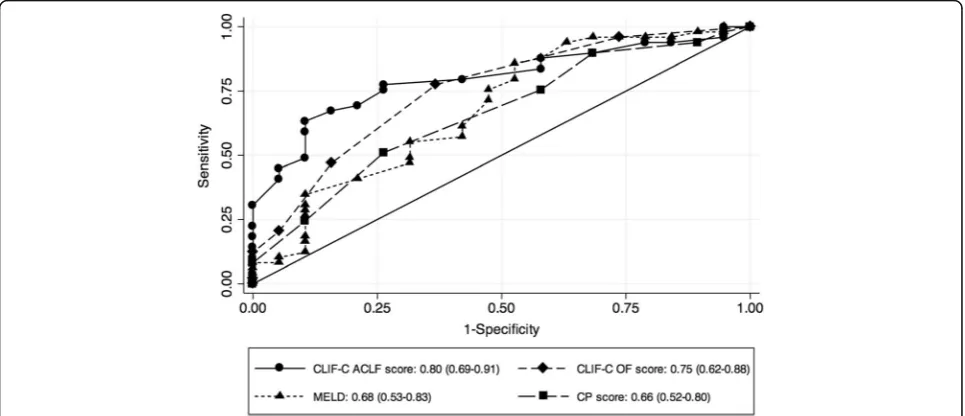
Because a previous study [5] has shown that patients with three or more organ failures incur high mortality, further analyses were conducted in patients with ACLF severity grade 3, which is defined by the presence of three or more organ failures [2]. The 28-day mortality in ACLF grade 3 was 72% (49 of 68), and none were trans-planted. ROC analysis of all prognostic parameters that were significant upon univariate analysis revealed that the CLIF-C ACLF score had an AUROC of 0.80 (95% CI 0.69–0.91) for predicting 28-day mortality in ACLF grade 3 and was superior to MELD score, CLIF-C OF score, and Child-Pugh score (Fig.2).
Survival analysis in ACLF grade 3 according to CLIF-C ACLF score
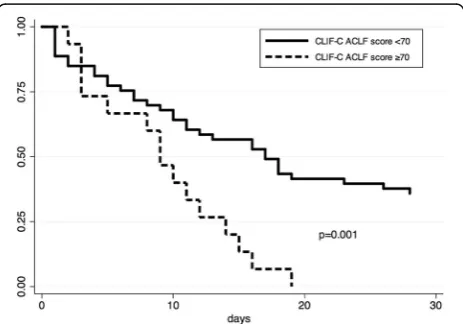
According to the ROC analysis, we depicted different thresholds for the CLIF-C ACLF score to assess their utility in predicting outcome in ACLF 3 patients (Table3). Applying various thresholds for ACLF score in this population managed in the ICU, it is apparent that 28-day mortality varies from 80% in those with ACLF score≥55 up to 100% in those with ACLF scores ≥70. Indeed, the highest specificity for determining 28-day mortality was seen with an ACLF score≥70. Patients with a CLIF-C ACLF score below the threshold of 70 had a mortality of only 64% (34 of 53), which was significantly lower than in patients with ACLF score≥70 (p= 0.006)
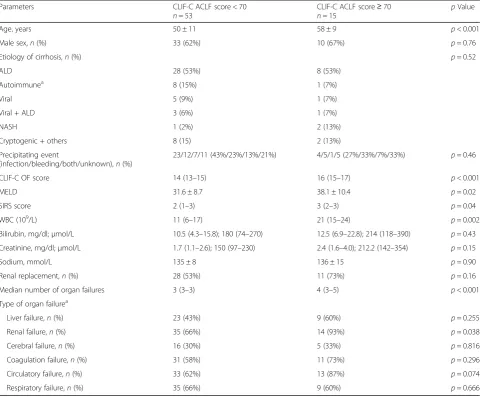
(Fig. 3). The patients with ACLF grade 3 and ACLF score≥70 were significantly older and had a higher num-ber of organ failures. Parameters reflecting an inflamma-tory response (SIRS, WBC count) were also more elevated compared with patients below this cutoff (Table 4). Pa-tients with CLIF-C ACLF score≥70 incurred more renal failure (93.3% vs. 66%, p= 0.038; renal replacement 53% vs. 73%, p= 0.16) and a trend toward circulatory failure (87% vs. 62%; p= 0.07), whereas all other types of organ failure did not differ from CLIF-C ACLF score < 70 (Table4).
Discussion
[image:5.595.58.546.100.169.2]The data presented in this study suggest the CLIF-C ACLF score is the most accurate in predicting short-term (28-day) mortality for patients with ACLF compared with all other tested prognostic scores for chronic liver disease in patients with ACLF, especially for ACLF grade 3. We identified dif-ferent thresholds of CLIF-C ACLF score to predict short-term mortality, and in order to maximize specificity around a threshold that would inform very high mortality and thereby question the benefit of ongoing ICU supportive care, further analyses were performed using a CLIF-C ACLF score cutoff ≥70. Applying a CLIF-C ACLF score cutoff ≥70 had 100% specificity for predicting mortality Table 3Mortality, sensitivity, and specificity for different thresholds of CLIF-C ACLF score
CLIF-C ACLF score 28-Day mortality Sensitivity Specificity
≥55 80% (95% CI 72–85) 88% (95% CI 75–95) 42% (95% CI 20–67)
≥60 88% (95% CI 78–94) 78% (95% CI 63–88) 74% (95% CI 49–91)
≥65 94% (95% CI 79–98) 59% (95% CI 44–73) 89% (95% CI 67–99)
≥70 100% (95% CI 78–100) 31% (95% CI 18–45) 100% (95% CI 82–100)
Abbreviations: ACLFAcute-on-Chronic Liver Failure,CLIFEuropean Foundation for the study of chronic liver failure
[image:5.595.306.538.510.672.2]such that all patients above this threshold died within 28 days after ICU admission, despite maximal treatment ef-forts, including full organ support as per standard of care in our tertiary center. Maximal supportive treatment was provided up to the point that death was thought to be imminent. Despite the relatively limited number of patients with CLIF-C ACLF ≥70 (n= 15), our data suggest that ongoing intensive care support in these patients, in the ab-sence of liver transplant, may be futile, given no improve-ment despite full organ support as needed for 48 hours. Our data are in line with previous reports showing a very poor prognosis in similar cohorts of at-risk patients, in whom dynamic assessments of change in CLIF-C ACLF score showed that those with further progression of ACLF grade or failed improvement had high mortality [5,6]. The best management options in this scenario, given currently
available limited therapies, require further evaluation, including the need for palliative care pathways.
[image:6.595.58.539.99.496.2]The time point at which patients’prognosis is assessed seems to be key. Our data suggest that mortality was relatively low (approximately 35–40%) within the first week after intensive treatment unit (ITU) admission, but beyond this, all remaining patients died quickly (within 2 weeks). This might imply that patients with CLIF-C ACLF ≥70 may have limited reserve and regenerative capacity, even if receiving full intervention support for the initial precipitating event. Moreover, the short sur-vival period is an argument that either palliative care or, if eligible, liver transplant [10–12] should be discussed early after assessing the response to intensive care ther-apy for 48 hours, because the time until death and the window for intervention is very short thereafter.
Table 4Clinical differences in ACLF 3 according to CLIF-C ACLF score
Parameters CLIF-C ACLF score < 70
n= 53
CLIF-C ACLF score≥70
n= 15 p
Value
Age, years 50 ± 11 58 ± 9 p< 0.001
Male sex,n(%) 33 (62%) 10 (67%) p= 0.76
Etiology of cirrhosis,n(%) p= 0.52
ALD 28 (53%) 8 (53%)
Autoimmunea 8 (15%) 1 (7%)
Viral 5 (9%) 1 (7%)
Viral + ALD 3 (6%) 1 (7%)
NASH 1 (2%) 2 (13%)
Cryptogenic + others 8 (15) 2 (13%)
Precipitating event
(infection/bleeding/both/unknown),n(%)
23/12/7/11 (43%/23%/13%/21%) 4/5/1/5 (27%/33%/7%/33%) p= 0.46
CLIF-C OF score 14 (13–15) 16 (15–17) p< 0.001
MELD 31.6 ± 8.7 38.1 ± 10.4 p= 0.02
SIRS score 2 (1–3) 3 (2–3) p= 0.04
WBC (109/L) 11 (6–17) 21 (15–24) p= 0.002
Bilirubin, mg/dl;μmol/L 10.5 (4.3–15.8); 180 (74–270) 12.5 (6.9–22.8); 214 (118–390) p= 0.43
Creatinine, mg/dl;μmol/L 1.7 (1.1–2.6); 150 (97–230) 2.4 (1.6–4.0); 212.2 (142–354) p= 0.15
Sodium, mmol/L 135 ± 8 136 ± 15 p= 0.90
Renal replacement,n(%) 28 (53%) 11 (73%) p= 0.16
Median number of organ failures 3 (3–3) 4 (3–5) p< 0.001
Type of organ failurea
Liver failure,n(%) 23 (43%) 9 (60%) p= 0.255
Renal failure,n(%) 35 (66%) 14 (93%) p= 0.038
Cerebral failure,n(%) 16 (30%) 5 (33%) p= 0.816
Coagulation failure,n(%) 31 (58%) 11 (73%) p= 0.296
Circulatory failure,n(%) 33 (62%) 13 (87%) p= 0.074
Respiratory failure,n(%) 35 (66%) 9 (60%) p= 0.666
Abbreviations: ACLFAcute-on-Chronic Liver Failure,ALDAlcoholic liver disease,CLIFEuropean Foundation for the study of chronic liver failure,MELDModel for End-Stage Liver Disease,NASHNonalcoholic steatohepatitis,OFOrgan failure,SIRSSystemic inflammatory response syndrome,WBCWhite blood cell Categorical variables are displayed in percent and continuous variables as mean ± SD (normally distributed data) and median (IQR) (nonparametric testing) a
Liver transplant in so-called high-MELD patients is highly debated because it is associated with significant posttransplant morbidity [13, 14]. Importantly, in our center, transplant selection aims at > 90% one-year sur-vival, which necessitates the exclusion of urgently listing patients with decompensation or ACLF. However, there are data to suggest that overall survival can be in excess of 80% and comparable to patients transplanted without ACLF [12], which is also substantiated in other studies, in-cluding studies of living donor liver recipients [10,15,16]. By contrast, a retrospective study by Levesque et al. showed in a subgroup of 30 patients with ACLF grade 3 a 12-month survival rate of 43% after cadaveric liver trans-plant [11]. These studies clearly highlight that although it is worthwhile discussing liver transplant in ACLF grade 3, this must be tempered by assessment of factors that may indicate worse outcome after liver transplant, such as in-fections, age, and presence of hepatocellular carcinoma, as proposed by Levesque et al. [11]. In addition, patients through debilitation of their advanced liver disease and a continued severe inflammatory state, as seen with ACLF, would be expected to be frail and may not be rescued by liver transplant [17].
To date, interventions such as extracorporeal liver support, such as the trials with MARS (molecular ad-sorbent recirculation system) [18, 19], have failed to show any clear survival benefit in ACLF 3. When under-taking consideration for such interventions in such an advanced disease cohort, appropriate resource allocation and effectiveness of the intervention must remain major considerations for implementation. Until there are new interventions with proven efficacy, futility of ongoing intensive care support should be discussed early, also taking into consideration that cirrhosis and ACLF repre-sent an increasing health and socioeconomic burden [20]. Such early decision-making processes help facilitate an appropriate and adequate palliative care option in a cohort in whom mortality is high, despite maximal in-tensive treatment support.
It is important to note that a CLIF-C ACLF score≥70 was associated with distinct clinical features. Notably, the SIRS score and WBC count, which are reflective of an in-flammatory response, were significantly higher in those with ACLF score≥70, albeit that infections as specific precipitat-ing events were not overrepresented and patients received antibiotic treatment as part of the standard procedure. This in line with the assertion that increasing disease severity in ACLF is accompanied by a systemic inflammatory response. Claria et al. [21] and others have shown that proinflamma-tory cytokines increase throughout the different severity grades of ACLF and that such inflammation is associated with higher mortality [22–24]. This may imply that strat-egies to lower inflammation and thereby risk of new infec-tion, such as gut decontaminainfec-tion, may improve outcomes,
but further clinical trials of such interventions are needed. Moreover, it remains to be seen whether these strategies are cost-effective in such sick patients.
There are some limitations of this study that need consideration. First, this study is a retrospective analysis of prospectively gathered data, which may be regarded as a weakness because some potential contributory factors that might influence outcome may not have been assessed at the time of enrollment. Second, a further potential limita-tion of this study is that the response to supportive ther-apy in the ICU was evaluated at 48 hours and not beyond. The previously reported outcomes in ACLF grade 3 patients in the CANONIC study by Gustot et al. showed that assessment of CLIF-C ACLF score between days 3 and 7 and a change in score determined longer-term outcome. This supports the idea of repeated assessments to define futility in such patients, in whom a fixed time of assessment may sometimes be difficult [5].
Conclusions
Patients with ACLF who require intensive care support-ive treatment should be assessed early after ITU admis-sion using the CLIF-C ACLF score. In patients with ACLF 3 and a CLIF-C ACLF score≥70, who are not suitable for liver transplant, futility of continued cur-rently available intensive supportive therapy should be considered. The best treatment options in this scenario remain to be determined but may include palliative care.
Additional file
Additional file 1:Table S1.All collected parameters were analyzed using univariate Cox regression to identify potential predictors of 28-day mortality. (DOCX 17 kb)
Abbreviations
ACLF:Acute-on-chronic liver failure; AUROC: Area under the receiver operator characteristic; CLIF: European Foundation for the study of chronic liver failure; CLIF-OF: European Foundation for the study of chronic liver failure organ failure score; CP: Child-Pugh; ICU: Intensive care unit; INR: International normalized ratio; ITU: Intensive treatment unit; MELD: Model for End-Stage Liver Disease; NASH: Nonalcoholic steatohepatitis; SIRS: Systemic inflammatory response syndrome; SOFA: Sequential Organ Failure Assessment; WBC: White blood cell
Funding
This study was performed with institutional funding. CE receives funding support from the German Research Foundation (DFG) (EN 1100/2-1). NZ recieved funding support from Welcome Trust.
Availability of data and materials
The datasets used and analyzed during the current study are available from the corresponding author on reasonable request.
Authors’contributions
manuscript critically for important intellectual content. All authors read and approved the final manuscript.
Ethics approval and consent to participate
The research and development department at the Royal Free Hospital, where this project was undertaken, considers this study a service evaluation, with no requirement for formal ethics approval and consent to participate. All patient data were fully anonymized and archived according to the local data protection guidelines. The study described conformed to the ethical guidelines of the 1975 Declaration of Helsinki. This study was conducted and reported according to the Strengthening the Reporting of Observational Studies in Epidemiology (STROBE) guidelines.
Consent for publication
Not applicable.
Competing interests
RJ has ongoing research collaboration with Yaqrit and Takeda Pharmaceutical Company Ltd. RJ is also inventor of a drug,L-ornithine phenylacetate (OCR-002), which University College London has licensed to Ocera Therapeutics. RJ is also the founder of University College London spin-off companies Yaqrit Ltd. and CYBERLIVER Ltd. CE has an ongoing research collaboration with Sequana Medical, Merz Pharma, and Novartis. CE has received speaker’s fees from Novartis, Gilead Sciences, and Merz Pharma and was a member of the advisory board for Chiesi Farmaceutici. RPM has an ongoing research collaboration with Yaqrit. NZ recieved funding support from Welcome Trust. All other authors declare that they have no competing interests.
Publisher’s Note
Springer Nature remains neutral with regard to jurisdictional claims in published maps and institutional affiliations.
Author details
1Institute for Liver and Digestive Health, University College London, Royal
Free Campus, Rowland Hill Street, London NW32PF, UK.2Section of Hepatology, Department of Internal Medicine, Neurology, Dermatology, University Hospital Leipzig, Liebigstrasse 20, 04103 Leipzig, Germany. 3Department of Hepatology and Gastroenterology, Aarhus University
Hospital, Nørrebrogade 44, 8000 Aarhus C, Denmark.4Intensive Care Medicine, Royal Free Hospital, Pond Street, London NW32QG, UK.
Received: 10 January 2018 Accepted: 10 August 2018
References
1. Moreau R, Jalan R, Gines P, Pavesi M, Angeli P, Cordoba J, et al. Acute-on-chronic liver failure is a distinct syndrome that develops in patients with acute decompensation of cirrhosis. Gastroenterology. 2013;144:1426–37. 2. Jalan R, Saliba F, Pavesi M, Amoros A, Moreau R, Gines P, et al. Development
and validation of a prognostic score to predict mortality in patients with acute-on-chronic liver failure. J Hepatol. 2014;61:1038–47.
3. Olson JC, Wendon JA, Kramer DJ, Arroyo V, Jalan R, Garcia-Tsao G, et al. Intensive care of the patients with cirrhosis. Hepatology. 2011;54:1864–72. 4. Jalan R, Gines P, Olson JC, Mookerjee RP, Moreau R, Garcia-Tsao G, et al.
Acute-on-chronic liver failure. J Hepatol. 2012;57:1336–48.
5. Gustot T, Fernandez J, Garcia E, Morando F, Caraceni P, Alessandria C, et al. Clinical course of acute-on-chronic liver failure syndrome and effects on prognosis. Hepatology. 2015;62(1):243–52.
6. Cardoso FS, Pereira R, Alexandrino G, Bagulho L. Futility of care in patients with acute-on-chronic liver failure. Hepatology. 2017;66(1):292–4. 7. Jalan R, Stadlbauer V, Sen S, Cheshire L, Chang YM, Mookerjee RP. Role of
predisposition, injury, response and organ failure in the prognosis of patients with acute-on-chronic liver failure: a prospective cohort study. Crit Care. 2012;16:R227.
8. Sawhney R, Holland-Fischer P, Rosselli M, Mookerjee RP, Argawal B, Jalan R. Role of ammonia, inflammation, and cerebral oxygenation in brain dysfunction of acute-on-chronic liver failure patients. Liver Transpl. 2016;22:732–42. 9. D’Amico G, Garcia-Tsao G, Pagliaro L. Natural history and prognostic indicators of survival in cirrhosis: a systematic review of 118 studies. J Hepatol. 2006;44:217–31.
10. Moon DB, Lee SG, Kang WH, Song GW, Jung DH, Park GC, et al. Adult living donor liver transplantation for acute-on-chronic liver failure in high-model for end-stage liver disease score patients. Am J Transplant. 2017;17(7):1833–42.
11. Levesque E, Winter A, Noorah Z, Daures JP, Landais P, Feray C, et al. Impact of acute-on-chronic liver failure on 90-day mortality following a first liver transplantation. Liver Int. 2017;37(5):684–93.
12. Artru F, Louvet A, Ruiz I, Levesque E, Labreuche J, Ursic-Bedoya J, et al. Liver transplantation in the most severely ill cirrhotic patients: a multicentre study in acute-on-chronic liver failure grade 3. J Hepatol. 2017;67(4):708–15. 13. Xia VW, Du B, Braunfeld M, Neelekanta G, Hu KQ, Nourmand H, et al.
Preoperative characteristics and intraoperative transfusion and vasopressor requirements in patients with low vs. high MELD scores. Liver Transplant. 2006;12(4):614–20.
14. Marubashi S, Dono K, Asaoka T, Hama N, Gotoh K, Miyamoto A, et al. Risk factors for graft dysfunction after adult-to-adult living donor liver transplant. Transplant Proc. 2006;38(5):1407–10.
15. Bernal W, Jalan R, Quaglia A, Simpson K, Wendon J, Burroughs A. Acute-on-chronic liver failure. Lancet. 2015;386:1578–87.
16. Jalan R, Yurdayclin C, Bajaj JS, Acharya SK, Arroyo V, Lin HC, et al. Toward an improved definition of acute-on-chronic liver failure. Gastroenterology. 2014; 147(1):4–10.
17. Underwood PW, Cron DC, Terjimanian MN, Wang SC, Englesbe MJ, Waits SA. Sarcopenia and failure to rescue following liver transplantation. Clin Transpl. 2015;29(12):1076–80.
18. Banares R, Nevens F, Larsen FS, Jalan R, Albillos A, Dollinger M, et al. Extracorporal albumin dialysis with the molecular adsorbent recirculating system in acute-on-chronic liver failure: the RELIEF trial. Hepatology. 2013; 57(3):1153–62.
19. Hessel FP, Bramlage P, Wasem J, Mitzner SR. Cost-effectiveness of the artificial liver support system MARS in patients with acute-on-chronic liver failure. Eur J Gastroenterol Hepatol. 2010;22:213–20.
20. Allen AM, Kim WR, Moriarty JP, Shah ND, Larson JJ, Kamath PS. Time trends in the health care burden and mortality of acute-on-chronic liver failure in the United States. Hepatology. 2016;64(6):2165–72.
21. Claria J, Stauber RE, Coenraad MJ, Moreau R, Jalan R, Pavesi M, et al. Systemic inflammation in decompensated cirrhosis: characterization and role in acute-on-chronic liver failure. Hepatology. 2016;64:1249–64. 22. Wu W, Yan H, Zhao H, Sun W, Yang Q, Sheng J, et al. Characteristics of
systemic inflammation in hepatitis B-precipitated ACLF: differentiate it from no-ACLF. Liver Int. 2018;38:248–57.
23. Alcaraz-Quiles J, Titos E, Casulleras M, Pavesi M, Lopez-Vicario C, Rius B, et al. Polymorphisms in the IL-1 gene cluster influence systemic inflammation in patients at risk for acute-on-chronic liver failure. Hepatology. 2017;65(1):202–16. 24. Arroyo V, Moreau R, Jalan R, Ginès P, EASL-CLIF Consortium CANONIC Study. Acute-on-chronic liver failure: a new syndrome that will re-classify cirrhosis. J Hepatol. 2015;62(1 Suppl):S131–43.