THE ART OF CONNECTION
R E T H I N K I N G A R T I N A N E T W O R K E D W O R L D
J A N I S L E J I N S - U 5 0 0 6 3 1 3
May, 2016
Bachelor of Arts, Honours in Art History The Australian National University
This thesis is submitted in partial fulfilment of the requirements for the degree of Honours in Art History in the College of Arts and Social Science
ACKNOWLEDGEMENT OF COUNTRY
THIS PROJECT WAS CONDUCTED ON NGUNNAWHAL AND NGAMBRI LAND.
I RESPECT THEIR ELDERS, PAST AND PRESENT.
DECLARATION OF ORIGINALITY
I, Janis Lejins, declare that the material presented here is the outcome of research I
have undertaken during my candidacy.
ACKNOWLEDGEMENTS
BRONWYN OLIVER, MARTIN SHARP
, ROBERT WICKHAM, CHERYL
MCCANN, KATHERINE KYRIACOU, FIONA CRAWFORD, MATTHEW
BRUCE, JOHN HARTLEY, MICHAEL HEANEY, STELLA TALATI,
MARCO BOHR, MARTYN JOLLY, JASON 0’BRIEN, JP DEMARIS,
ALISTAIR RIDDELL, DENISE FERRIS, DAVID BERRIDGE, CATHIE
LAUDENBACH, PETER FITZPATRICK, MICKY ALLEN, FRANK
MACONOCHIE, TONY STEEL, JOHN REID, MARZENA
WASIKOWSKA, ROBERT WELLINGTON, HELEN ENNIS,
CHARLOTTE GALLOWAY, CHAITANYA SAMBRANI, ELISABETH
FINDLAY, ANDREW MONTANNA, GORDON BULL, NIGEL LENDON,
KATE MURPHY, JACQUELINE BRADLEY, ROY MERCHANT, HARRY
TOWNSEND, MARCIA LOCHHEAD, LUCIEN LEON, ROWAN
CONROY, TIM BROOK, KIT DEVINE, RAQUEL ORMELLA, DAVID
BROKER -
AND EVERYONE ELSE WHO HAS TAUGHT ME ART.
THE INNUMERABLE FRIENDS AND FAMILY (
PAST
AND PRESENT)
WHO HAVE GIVEN ME UNRELENTING LOVE AND SUPPORT.
ABSTRACT
This thesis examines how elements of the contemporary artworld can be seen to adapt in relation to an increasingly networked twenty-first century world. Recognising the advent of the World Wide Web as a point of paradigmatic disruption the text develops a selection of theoretical ideas. These ideas reflect that the cultural
landscape is shifting to be evermore network orientated. The concept of a networked world, a cultural space defined by hyper-links, is projected onto the development of two forms of exhibition—the monumental commission and the mega-exhibition. By viewing these two case studies the thesis demonstrates ways in which key artworld structures may be reconsidered within a dynamic twenty-first century world.
The first case study, Shock and Awe, analyses the monumental commission as a
conduit for networking—a site designed to produce a specific sociability. This section considers the development of the Unilever commissions at the Tate Modern’s Turbine Hall. Five monumental artworks are evaluated for the way they can be seen to operate as socialising media.
The second case study, Mega-Forma, explores the development of four
mega-exhibitions by two seperate curators across the last 15 years. Mega-Forma observes
that these exhibitions have redirected their energy and become focused on redistributing cultural agency in a decentralised twenty-first century. These exhibitions
are recognised as developing into a larger sort of gesamtkunstwerk, an all-embracing
art form. The roles of the curators will be seen to shift from a mere arranger of things to a reprogrammer of cultural relations, a cultural auteur—an architect of experience.
CONTENTS
ACKNOWLEDGEMENT OF COUNTRY 2
DECLARATION OF ORIGINALITY 3
ACKNOWLEDGEMENTS 4
ABSTRACT 5
CONTENTS 6
LIST OF ILLUSTRATIONS 7
INTRODUCTION - A NEW WORLD MAP 9
THEORIES OF THE NOW 21
A NETWORKED SOCIETY 22
EMPIRE AND THE AGENCY OF THE MULTITUDE 23
THE AESTHETICS OF RELATIONALITY 25
CURATING THE NOW 26
A WORLD OF NETWORKED PUBLICS 28
SHOCK AND AWE 31
THE HALF|FULL MUSEUM 32
FILLING THE VOID 37
CLIMATE CONTROL 41
THE SLIPPERY SLIDE 48
IMPOTENT SEEDS 53
SPEAK TOGETHER 60
THE SOCIAL MEDIUM 65
MEGA-FORMA 67
DECOLONISING THE EXHIBITION 70
DISRUPTING THE HISTORICAL SCHEMA 75
DECONSTRUCTING THE EXHIBITION 81
WELCOME TO THE AGE OF MEGA-FORMA 88
MAKING WORLDS WITHIN THE WORLD 95
CONCLUSION 98
WORKS CITED 102
LIST OF ILLUSTRATIONS
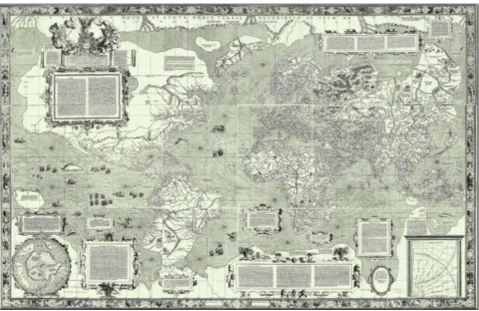
Fig 1. Mercator, Geradus. Nova Et Aucta Orbis Terrae Descriptio Ad Usum Navigantium Emendate Accommodata. Paris: Bibliothèque Nationale de France, 1600. Print.
Fig 2. Nova totius terrarum orbis geographica ac hydrographica tabula, Map, 1630 - From Hondius, Hendrik. Gerardi Mercatoris atlas sive cosmographicae meditationes de fabrica mundi et fabricati figura Nova totius terrarum orbis geographica ac hydrographica tabula. Sumptius Iohannis Cloppenburgij, Amsterdam, 1636.
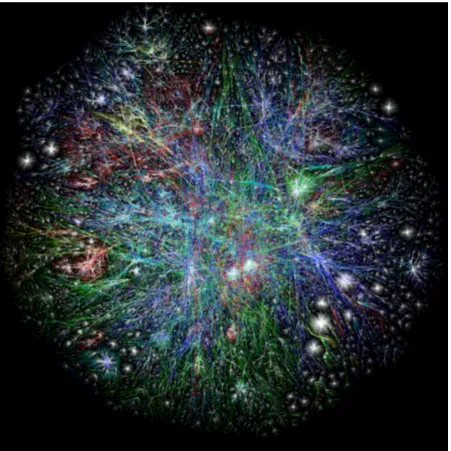
Fig 3. Barrett Lyon, The Opte Project. Mapping the Internet Digital print from photo file, Museum of Modern Art, New York, 2003
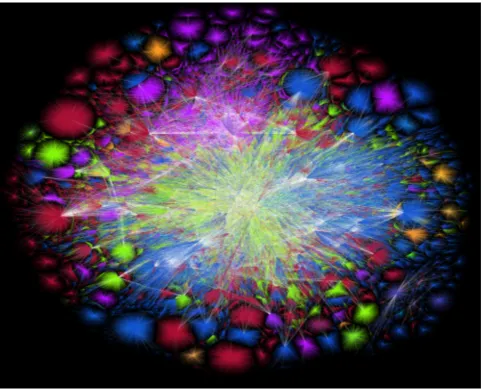
Fig 4. Barrett Lyon, The Opte Project. Visualization of the routing paths of the Internet - 2015. Digital Image File, Opte project.org, California, 2015
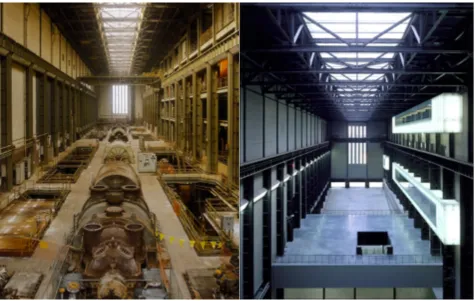
Fig 5. Marcus Leith, Tate Photography. Interior of The Bankside Turbine Hall Before Conversion into The Tate Modern. circa 1994 - 2008. Digital Image File From Webpage, From (Gallery), Tate Modern. "Tate Online - Tate Modern - Turbine Hall." TATE.
Fig 6. Marcus Leith, Tate Photography. Interior of The Turbine Hall After Conversion into The Tate Modern. circa 2000 - 2008. Digital Image File From Webpage, From (Gallery), Tate Modern. "Tate Online - Tate Modern - Turbine Hall." TATE.
Fig 7.Anish Kapoor, Tate Photography. Marsyas Installation, Tate Modern Turbine Hall, 2002 - Digital Image File From Webpage, From (Gallery), Tate Modern. "Tate Online - Tate Modern - The Unilever Series: Anish Kapoor: Marsyas." TATE.
Fig 8. Anish Kapoor, Tate Photography. Marsyas Installation, Tate Modern Turbine Hall, 2002. Digital Image File From Webpage, From (Gallery), Tate Modern. "Tate Online - Exhibition - The Unilever Series: Anish Kapoor: Marsyas." TATE.
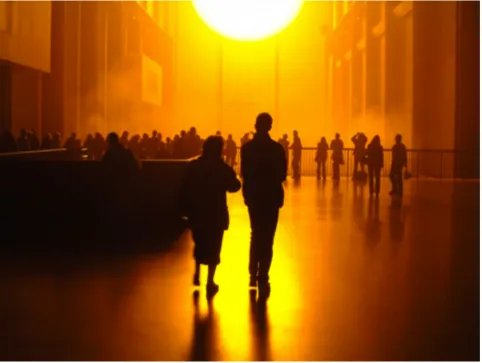
Fig 9. Olafur Eliasson & Studio Olafur Eliasson, The Weather Project, 2003, From Tate Modern. "Tate Online - Exhibition - The Unilever Series: Olafur Eliasson: The Weather Project.”
Fig 10. Carsten Höller & Tate Photography. Test Site Installation, Tate Modern Turbine Hall, 2006. From, Tate Modern. "Tate Online - Exhibition - The Unilever Series: Carsten Höller: Test Site - Images.”
Fig 12. Ai Weiwei & Tate Photography. Sunflower Seeds Installation, Tate Modern Turbine Hall, [Before curatorial intervention] 2010. Digital Image File From Webpage, From (Gallery), Tate Modern. "Tate Online - Learn - Resources - Stargroup.” TATE.
Fig 13. Ai Weiwei & Tate Photography. Sunflower Seeds Installation, Tate Modern Turbine Hall, [After curatorial intervention] 2010. Digital Image File From Webpage, From (Gallery), Tate Modern. "Tate Online - Exhibition - The Unilever Series: Ai Weiwei: Sunflower Seeds - Images.” TATE.
Fig 14. A Bodys Isek Kingelez & Okwui Enwezor. Installation View, dOCUMENTA (11)
2002. From Farago, Jason. "Bodys Isek Kingelez, "New Manhattan City 3021," 2001– 2002, as Seen as [at] Documenta 11." Twitter, 11 Sept. 2015. Web. 21 May 2016.
Fig 15. Carolyn Christov-Bakargiev, Alexander Rodchenko and Maurizio Cattelan. “Installation view Aleksandr Rodchenko, and Maurizio Cattelan”. From Museum of Contemporary Art Australia Online. Museum of Contemporary Art Australia, Web.
Fig 16. Carolyn Christov-Bakargiev, “‘The Brain’ of Documenta 13”. Image From Christov-Bakargiev, Carolyn, and Bettina Funcke. Documenta 13:The Book of Books, Ostfildern, Germany: Hatje Cantz, 2012.
Fig 17. Adel Abdessemed, Bruce Nauman & Okwui Enwezor. Installation View, Room 1 Arsenale, Venice Biennale 2015. From, Art apart of Cult(ure). “Art apart of Cult(ure) -Metafore dell’impegno all’interno della 56 Biennale di Venezia.” Art apart of Cult(ure).
Fig 18. Stewart Smith, Still from Trans_Actions - The Accelerated Art world - Biennale Timeline. Multimedia Data Visualisation Premiered at the Center for Art and Media (ZKM) Karlsruhe, Germany in the exhibition The Global Contemporary: Art Worlds After 1989.
September 2011
INTRODUCTION - A NEW WORLD MAP
The WorldWideWeb (W3) is a wide-area hypermedia information retrieval initiative aiming to give universal access to a large universe of documents. 1
Network culture could only come after postmodernity had run its course. Today the fragmentation of the sign, the end of the subject, and the dissolution of any sense of authenticity in media are fait accompli. If postmodernism celebrated the shattering of the subject, network culture takes that shattering as a given. 2
The seeds of these future world-views are being sown today: whilst contemporary software engineers may perhaps appear to be engaged in discussions of unbridled pedantry, they may actually be in the process of setting the foundations of something far more important and enduring that may subtly influence every subsequent generation.3
Tim Berners-Lee. http://info.Cern.Ch, CERN, 1990.
1
Kazys Varnelis, "The Immediated Now: Network Culture and the Poetics of Reality," The Networked Book Project,
2
http://varnelis.networkedbook.org/the-immediated-now-network-culture-and-the-poetics-of-reality/ Henry Stott, "Ask Me Another," Frieze, April/March 2000.
We have looked at our world from the same perspective for nearly 500 years. In 1569
cartographer Geradus Mercator produced his first map using the ‘Mercator Projection’.
Mercator’s topographical arrangement of geography enables the world to be physically
navigated, and forms the cartographic basis for the world map that has become
commonplace today. Mercator’s worldview presents a physical world which has now been
throughly explored and conquered. This world has been segregated into territories, then
fiefdoms and ultimately nations. For nearly 500 years Mercator’s spatial model defined our
sense of the world and how we operated within it.
Over the last twenty five years another way of modelling the world has risen to
prominence. Computer scientist Tim Berners-Lee brought the world's first webpage online
at The European Organisation For Nuclear Research (CERN) in December 1990. At CERN
the webpage was thought of as an educational tool which would facilitate better sharing of
information between researchers. The premise was to produce a simple hypertext system
that would facilitate arbitrary links between content. The philosophy was any element
designated as a ‘hypertext link’ should be able to point to any other page accessible by
the network and thus produce a dense informational web. Navigation of Berners-Lee's
knowledge web was thematically relational, liberated from the circumscription of space
and geography. The World Wide Web is a model cohered by recognising the shared,
contiguous, connections between things rather than organising objects by segregation
and relative levels of disconnection.
In 1993 CERN announced the World Wide Web would be made open source — free for
anyone to copy. In 1993 there were 50 linked HTTP servers delivering a handful of
websites, by June 1994 there were 155 registered servers. Fast forward to 2013 and 4
Tim Berners-Lee and Mark Fischetti, Weaving the Web : The Original Design and Ultimate Destiny of the World
4
46% of households globally had direct access to the World Wide Web. In 2015 the 5
World Bank estimated there were 3.2 billion Internet users. There are over 50 billion 6
accessible webpages delivered from more than 1 billion separate websites housed on
innumerable interlinked servers. The worldview modelled by Berners-Lee is not to be 7
delineated by the superficiality of geography, race or fiefdom, he insists that the “world
can be seen as only connections, nothing else.”8 The Web’s central ethos of the
hyper-link; a thing enabling connections between arbitrary other content, has now been
multiplied trillions of times across the globe. The hyper-link and the World Wide Web are
fundamentally changing how we interact as a, now networked, society. We now have an
experiential model that is irrevocably centred around a contiguous notion of togetherness
and proximity; focusing on links, rather than surrendering to a geographic reality that is
rationalised by distance and apartness.
This shift to digital communication technology and the World Wide Web is truly a global
phenomenon; it is not solely limited to developed nations. In 1990 mobile cellular
subscriptions had less than 10% global market penetration, by 2015 mobile cellular
subscriptions had 97% global penetration. The most recent World Bank Development 9
Report, Digital Dividends, observed that:
Broadband Commission, The State of Broadband 2013: Universalizing Broadband (ITU/UNESCO Broadband
5
Commission for Digital Development., 2013).
World Bank, World Development Report 2016: Digital Dividends, (Washington, DC: World Bank, 2016).
6
Berners-Lee, Tim (timberners_lee). "http://t.co/D9pwMXuZOa recently passed a billion websites by their count....".
7
16 Sep 2014, 21:20 UTC. Tweet
Berners-Lee and Fischetti, Weaving the Web : The Original Design and Ultimate Destiny of the World Wide Web by
8
Its Inventor.
Sanou, Brahima. "International Telecommunication Union - Facts and Figures 2015." International
9
More households in developing countries own a mobile phone than have access to electricity or clean water, and nearly 70 percent of the bottom fifth of the population in developing countries own a mobile phone. 10
This is not to say that the increasingly networked globe is bereft of inequality. When it
comes to accessing core digital infrastructure a digital divide between developed and
developing areas persists—six billion people do not have high-speed broadband, almost
four billion have no internet access at all and two billion still don’t have a mobile phone.
What access to the World Wide Web does do, to whatever small extent, is connect
people to virtual space beyond their immediate lived experience. A connection to the
World Wide Web reaches beyond the immediate socio-geographic reality—it is a
connection to a global commons; to a global network of knowledge and people. To
whatever small extent a connection to the web gives a greater sense of agency and
constituency with in the broader evermore networked society. Empirically we know that
our societies are better off because of this new form of connection and self-determination.
The World Wide Web has gone from an idea; to an educational tool for scientific research;
to a global phenomenon. In 2011 Frank La Rue, the UN Special Rapporteur On Freedom
Of Expression, asserted the Internet was “an indispensable tool for realising a range of
human rights, combating inequality, and accelerating development and human progress”
and recommended “ensuring universal access to the Internet should be a priority for all
States”. The right to Internet access now has statutory protection in a number of 11
countries including Costa Rica, Estonia, Finland, France, Greece, and Spain. No other
technology in the history of the human race has had such a rapid and profound impact on
global society as the fusion of the Internet with the World Wide Web.
Bank, World Development Report 2016: Digital Dividends, p.2. 10
Frank La Rue, "Report of the Special Rapporteur on the Promotion and Protection of the Right to Freedom of
11
The World Wide Web’s philosophical pronunciamento of a ‘linked’,
hyper-connected, society is been endlessly replicated and amplified across a technocratic
globe. Where Web based technology has been firmly established a network orientated
perspective of the world appears to be a increasingly popular social, economic and
cultural logic. Manuel Castells asserts we have witnessed a shift from the industrial age to
the “information age” . This technology driven epoch has enabled the rise of an evermore 12
dominant form of society; the “network society”, in which “the key social structures and
activities are organised around electronically processed information networks”. In this
epoch Kazys Varenlis asserts that the construction of ‘self’ is now driven by 13
consumption of networked media via the Web:
Today’s self emerges from the network, not so much a whole individual as a composite entity constituted out of the links it forms with others, a mix of known and unknown others it links to via the Net.14
Beyond a technical and social innovation Berners-Lee’s World Wide Web is enabling truly
novel critical paradigms through which global behaviours are rationalised. Highly relational
frameworks like ‘webs’, ‘social networks’ and ‘hyper-links’ are culturally lubricated
concepts that are more prevalent in critical acquittals of the state of things.
This global transition toward a ‘network society’ has happened in lockstep with Moore’s
Law —exponentially growing in population and power every year since the Web’s 15
Manuel Castells, End of Millennium: The Information Age: Economy, Society, and Culture, vol. 3 (John Wiley &
12
Sons, 2010).
The media theorist son of the painter of the same name.
13
Varnelis, "The Immediated Now: Network Culture and the Poetics of Reality".
14
"Moore's law" is the observation that, over the history of computing hardware, the number of transistors in a
15
inception. In 2003, 10 years since the Web became open-source, the Museum of 16
Modern Art hung a new sort of world map the wall — Barrett Lyon & The Opte Project’s
Mapping the Internet. In 2015 Lyon & The Opte Project used the same mapping
technique again to chart an Internet which was infinity more dense. When compared to
Mercator's view Barrett Lyon & The Opte Project’s Mapping the Internet represents an
alternate view of our world. This is a rapidly developing world — it is bereft of geography
and somewhat agnostic to nation states. This is a model of the world defined by nothing
more than the density and quality of connection between arbitrary nodes in the system.
Because of its dynamism and complexity this is a map of the world which probably will
never be able to be fully comprehended let alone conquered by any nominal power.
The disruption of the Web has sent shockwaves throughout both the artworld and global
society more generally since its inception. The Web demands that we rethink and remodel
core institutions some of which have remained relatively unchanged for centuries. We are
living in a world where capital, knowledge and culture can be transmitted across borders
and into the palm of our hands at light speed. We are living in a world where our old
maps are no longer that relevant. The spectre of the Internet and a networked society has
led some to presume the deterritorialisation of the artworld. The logic follows that the 17
artworld, as we know it, will become subsumed into this increasingly pervasive
technocratic status quo. Perhaps whatever distinction there is left between ‘art’ and
‘media’ will disappear. The ascendancy of Mercator's socio-political globe and the
traditional hierarchies, and linear institutional structures therein, will give way to a more
nebulous and fragmented cultural world. Conventional wisdom suggests that the
Zhang Guo-Qing et al., "Evolution of the Internet and Its Cores," New Journal of Physics 10, no. 12 (2008).
16
Deterritorialization can describe any process that decontextualises a set of relations, rendering them virtual and
17
empiricist, and geographically rooted, structures that underpin the biggest artworld
institutions will evaporate as the world becomes network orientated. What then for the
public institutions who act as authoritative corner stones for the production of cultural
capital?
The presumption is that the practice of leading contemporary art institutions will adapt and
accelerate in order not to lag behind a Millennium Falcon-esque world that perennially
rushes from one digitally decried zeitgeist to the next. In many respects this presumed
acceleration hasn’t happened. Instead many key artworld institutions, including major
mega-exhibitions and museums, have slowed down. The global shift in how we
understand and conceptually navigate our world not only has demanded a paradigm shift
from artworld disciplines but it also has made our institutions to rethink how they operate.
The way we write about, curate, collect and distribute Contemporary art is being
reconceptualised and reinvented. The point of this thesis is to examine some ways the
artworld is responding to this new worldview.
Bruno Latour writes that “the notion of network is of use whenever action is to be
redistributed” and in the artworld some centres have begun to shift their focus and 18
initiated the process of redistributing their effort. The first case study in this thesis, Shock
and Awe, will examine the Tate Modern’s development of the Unilever Series in their
Turbine Hall. This section will examine how the contemporary public museum can
metamorphosis into being a public forum and proactive site for cultural production as
much as it is the authoritative receptacle of commodity based art objects. The second
case study in the paper, Mega-Forma, will examine the conceptual evolution of the
biennial exhibition as a unique cultural from. It will focus on four mega-exhibitions spread
Bruno Latour, "Network Theory| Networks, Societies, Spheres: Reflections of an Actor-Network Theorist,"
18
across 15 years by Okwui Enwezor and Carolyn Christov-Bakargiev and observe how a
redirection of curatorial effort has changed both the form the mega-exhibition takes and
the role of the curator. Mega-Forma will observe how the form of the mega-exhibition has
become focused on redistributing cultural agency in a decentralised world by acting as a
gesamtkunstwerk,—an all embracing art form. The refreshed superstructures of the Tate
Turbine Hall and the mega-exhibition will be understood and valued for the way in which,
as larger artistic forms, they operate as a cohering principle for the production of new
connections, new relationships, and ultimately new cultural networks.
The world we live in today is dramatically different to 25 years ago. The point of this thesis
is not to explain, or even fully-comprehend, the explosion of critical and artistic production
in the twenty-first century. Instead this text works through synecdoche - it explores small
parts of the cultural universe of the twenty-first century for the ways in which they might
indicate something about the whole. The thesis examines a rarified selection of cultural
ideas and how two sorts of cultural products, the mega-exhibition and the monumental
installation, have developed. This small selection of things will not be evaluated for the
way they tell the whole story of the twenty-first century and its art. Instead they will be
seen for how they can reciprocate the parallax of a networked society—a world wide web
THEORIES OF THE NOW
A NETWORKED VISIONS OF ‘THE CONTEMPORARY’
Nor would these things be artworks without the theories and histories of the artworld 19
Our economy, society, and culture are built on interests, values, institutions, and systems of representation that, by and large, limit collective creativity, confiscate the harvest of information technology, and deviate our energy into self-destructive confrontation. This state of affairs must not be. 20
Arthur Danto, "The Artworld," The journal of philosophy (1964).
19
Castells, End of Millennium: The Information Age: Economy, Society, and Culture, 3. p.379
A NETWORKED SOCIETY
This chapter will examine four bodies of theorisation produced since the advent of the
world wide web. They will be understood for the way global changes across last 25 years
can be seen to transform the atmosphere of theory shaping the artworld. At some level all
four corpuses investigate how cultural theory and cultural production has become
increasingly network orientated — there is a palpable critical acknowledgement that
“contemporary life is dominated by the pervasiveness of the network.” 21
In 1996, Castells forecast would become “the new social morphology of our societies.” 22
Even during the World Wide Web’s infancy Castells asserted that a widespread diffusion
of networking logic would substantially modify “the operation and outcomes in processes
of production, experience, power, and culture.”23 Castells preordained that the ‘network
society’ would be fundamentally technocratic—its growth underwritten by the rise of the
World Wide Web and electronic media. Later he asserted that the revolutionary thing that
shapes the new networked society is not just technology but the rhetorical focus on
inter-connection that the technological superstructure condones. 24
Throughout The Rise of the Network Society Castells pre-empted developments like social
media. He theorised that in a fully resolved network society social structures and activities
would be “organised around electronically processed information networks.” In a world 25
mediated by electronic information exchange Castells recognised that art plays a vital role
Kazys Varnelis, Networked Publics (The MIT Press, 2012). p.15
21
Manuel Castells, The Rise of the Network Society, 2nd ed., The Information Age : Economy, Society, and Culture
22
(Chichester, West Sussex ; Malden, MA: Wiley-Blackwell, 2010). Ibid., p.500.
23
“—“ The Internet Galaxy: Reflections on the Internet, Business, and Society (Oxford University Press, 2002).
24
The Rise of the Network Society.
as a humanising force. Castells realised that human experiences would increasingly be
processed by nonhuman computational systems and asserted that the role of art in a
network society is vital to restore human feeling and meaning into a world defined by
hyper-productive and decentralised networks:
In a world where the last trench of defence is built from one’s identity (always imagined) without reference to the other. The most fundamental issue is the restoration of meaning…so, when the darkness of senseless politics and aberrant economics and empty culture come on us, we resort to art and to artistic research…to remind us to include human experience in the work we do, to remind us we can still feel and need to share.26
Contemporary art is critically important for the way in which it can retain the human
element of human culture in the twenty-first century. Castells asserts that power
relationships today are defined by the “shaping of the human mind by the construction of
meaning through image-making.”27 At the level of networks artistic production is viewed as
an act of empowerment. Castells sees the twenty-first century defined by the proliferation
of the network and cultural experience as an increasingly electronically mediated model of
togetherness. Within this system art is vital for the way it can re-inject our humanity, our
feelings and subjectivity, into the process of modelling collectivity.
EMPIRE AND THE AGENCY OF THE MULTITUDE
When Antonio Negri and Michael Hardt published Empire (2000) and Multitude (2005)
both texts orbited around an observation of a decentralisation and deterritorialisation of
global power, similar to Castells's Rise of the Network Society. The primary thrust of
Empire is that nation states are no longer the dominant imperialist powers they once were.
Hardt and Negri observe a more nebulous postmodern state of relation between ruling
"Forward," in Witnessing You. On Trust and Truth in a Networked World. Participatory Systems Initiative, ed. C.
26
Nevejan (Delft: Delft University of Technology, 2012).
Communication Power (Oxford ; New York: Oxford University Press, 2009).P,194
powers - they call this state the ‘Empire’. This is a deterritorialized vision of the world, The
‘Empire’, is conceptualised as a model of the world relations “that supports the
globalization of productive networks and casts its widely inclusive net to try to envelop all
power relations within its world order” . 28
Hardt and Negri’s model of the world recognises a delocalisation of power centres and a
divestment of cultural authority away from the nation state. Instead they theorise power
nexuses - construing relationships between groups that make up what they call the
‘monarchy’, the ‘oligarchy' and the ‘democracy’. Both Empire and Multitude focus on the
primacy of the ‘multitude’ as “the real productive force of our social world.” In 29 Multitude
Hardt and Negri posit that the ‘multitude’, the constituents of the ‘empire’, are not unified
under a single authority and instead relate via network structures. Instead of nations there
now are social forums, affinity groups, and decision-making as a result of how groups act
together based on their commonalities. As a result major conflicts increasingly take 30
place away from the nation state - happening between diametrically opposed elements of
networks. Whilst nations may happen to be apart of, or invested in, these conflicts Hardt
and Negri see them as originating from and being transmitted across networks, rather
than borders, writing “all wars today tend to be netwars.” 31
A core postulate is that in the context of the twenty-first century the people who make
new sorts of connections, hyper-links, don’t just overthrow the traditional model of global
relations but become heroic figures:
Michael Hardt and Antonio Negri, Empire (Cambridge, Mass;London;: Harvard University Press, 2000), p.20.
28
Ibid., p.62.
29
Multitude : War and Democracy in the Age of Empire (New York: Penguin Books, 2005), p.86.
30
Ibid., p.56.
We have to construct the figure of a new David, the multitude as champion of asymmetrical combat, immaterial workers who became a new kind of combatants, cosmopolitan bricoleurs of resistance and cooperation. 32
From Hardt and Negri’s paradigm the empowered non-state actor, the networker, is not
not only a core participant in the new networked society but also the key aggressor. It is
the incentivised and empowered multitude who remodel this dynamic new world of the
global network to better to accede to their own image.
THE AESTHETICS OF RELATIONALITY
In Relational Aesthetics Nicolas Bourriaud observed that within the artworld the ‘network’
had become a prevailing socio-cultural logic. Bourriaud noticed that the contemporary
artist was more focused “on the relations that his work will create among his public, and
on the invention of models of sociability.”33 Bourriaud conceptualised artists as
empowered non-state actors in a unique position to reprogram and disrupt the relational
spheres of contemporary society: they operate like Hardt and Negri’s David — social
reprogrammers of the multitude. To this end34 Relational Aesthetics begins by
characterising the ambition of contemporary art in a way that makes it seem analogous to
a hyper-link:
Artistic activity, for it’s part, strives to achieve modest connections, open up (one or two) obstructed passages, and connect levels of reality kept apart from one another.35
Ibid., p.50.
32
Nicolas Bourriaud, Relational Aesthetics, Collection Documents Sur L'art (Dijon: Les Presses du réel, 2002), p.
33
28..
See also Nicolas Bourriaud, Caroline Schneider, and Jeanine Herman, Postproduction : Culture as Screenplay :
34
How Art Reprograms the World (New York: Lukas & Sternberg, 2010). Bourriaud, Relational Aesthetics, p.8.
Central to Relational Aesthetics is an insistence on the primacy of ‘connection’ as the
central defining value of an artwork. The assertion is that the form artworks take can be
evaluated “on the basis of the inter-human relations which they represent, produce or
prompt”36 rather than just their physically innate properties. Relational Aesthetics focuses
on the social relationships that the process of art encodes; it recognises that in the
twenty-first century the artwork spreads beyond ”its material form: it is a linking element, a
principle of dynamic agglutination.” Bourriaud asserts that ‘art’ happens in real-time, it is 37
something to be performed: process- rather than object-orientated. Bourriaud’s
reconceptualisation of artistic form reframes the understanding of how art operates at the
level of the network, it is “typified precisely by it’s generative power; it is no longer a trace
(retroactive) but a programme (active).”38
Bourriaud’s text shifts the role of the artist from just a maker to a facilitator. ‘Art’ is
significant insofar as it enables connections between things. This aesthetic connecting
process creates and alters power structures at the level of the network. The paradigm of
Relational Aesthetics provides both the means and method through which socialising art
forms can be understood to change (reprogram) the world.
CURATING THE NOW
Terry Smith’s recent work can be read to observe implications of a shift toward a network
society for the Visual Arts. Smith's belief is that in the context of the twenty-first century
‘contemporaneity’ has become “the fundamental condition of our times.”39 Smith’s is a
Ibid.
36
Ibid., p.20.
37
Ibid., p.70.
38
Terry Smith, What Is Contemporary Art? (University of Chicago Press, 2009), p.255.
vision of a non-sequitur pluralistic cultural situation. In this ‘contemporaneous’ condition
diverse and sometimes contradictory cultural impulses co-exist within a increasingly
nebulous networked world.
In What is Contemporary Art40 and Thinking Contemporary Curating , 41 Smith identifies
three distinct conceptual currents within the contemporary artworld. Each of Smith's
perceived currents, a ‘remoderninizing’ resistance, the post-colonial constellation, and the
relational (web) turn, vaguely attempt to characterise a redirection of institutional energy in
reaction to a shifting socio-cultural status quo. Smith acknowledges his currents may
suggest a traditional dialectic logic but asserts that in the contemporary “synthesis will
never occur.” Each of these currents is seen as “irreconcilable and indissociable” and 42
“their friction in relation to each other is of their essence, They are, in a word,
antinomies.”43 Smith postulates is that in the twenty-first century no one artworld trend will
become ascendent. There will not be another epoch to supplant ‘post-modernity’ and
‘modernity’ before that. The ‘Contemporary’ is a totally unique and nebulous cultural space
where three, or more, distinct pathways of artistic production can coexist.
Smith critically evaluates three sorts of reactions to a new reality; we are presented with
the cultural resistance, the cultural opportunists, and the cultural devotees (or perhaps
even zealots) of the network society. These three responses are not necessarily confined
to any one sector of the artworld but they are pronounced in certain situations. The urge
to resist comes from those who have the most to lose; major museums - who have a
vested interest in parlaying a major restructure of their collection and radical rethinking of
Ibid.
40
Thinking Contemporary Curating (Independent Curators International New York, 2012).
41
Ibid., p.255.
42
What Is Contemporary Art? p.269
how their organisation operates for as long as possible. Unsurprisingly the urge to take
advantage of the shifting socio-cultural sands comes from those who were
misrepresented and disenfranchised by the previous status quo. They look to engineer
the new cultural situations, often via mega-exhibitions, to reassert their cultural agency
and legitimacy. Lastly Smith presents those who have totally embraced of the new
socio-technological reality. These are artists whose aesthetic education has been a bricolage of
a ‘traditional’ artistic education inescapably fused with the development of the Web. All
three responses react to a world which is being reprogrammed where power is being
redistributed and cultural relationships are being challenged and reconstituted.
A WORLD OF NETWORKED PUBLICS
In the introduction to the collaborative book 44 Networked Publics Mizuko Ito asserts that in
the twenty-first century the ‘networked public’, as a social unit, is a totally different and
more complex entity than the simplistic constructions of an ‘audience’ or ‘consumer’. The
core artworld relationship between artwork and respondent has irrevocably changed. The
‘networked public’ is intrinsically engaged and communicative and exercises greater
agency and effective power as a result. Network publics are, or at least believe they are,
constituents in Castells’s perpetual process of forming and reforming a world wide
network society. It’s the direct agency multitude now assert over spheres of media
consumption which Ito sees as experientially defining contemporary world:
Rather than assume that everyday media engagement is passive or consumptive, the term publics foregrounds a more engaged stance. Networked publics takes this further: now publics are communicating more and more through complex networks that are bottom-up, top-down, as well as side-to-side. Publics can be reactors,
The text of Networked Publics itself is also a product of network integration. — It claims to be the first book written
44
(re)makers and (re)distributors, engaging in shared culture and knowledge through discourse and social exchange as well as through acts of media reception. 45
In Network Publics’s first chapter Kazys Varnelis rejects simplistic demarkations between
real and virtual space and instead asserts a model of casuistry relation between the two.
This conjoined model of contemporary experience echoes the writing of Baudrillard, and
his theory of hyper-reality — that “today the real and the imaginary are confounded in the
same operational totality.”46 However in Network Publics Baudrillard’s hyper-real
experience is extended by recognising the all “pervasiveness of the network” . This 47
pervasiveness not only produces the “everyday superimposition of real and virtual spaces”
but allows Varnelis conceptualise “the rise of the network as a socio-spatial model.” The 48
physical word and the virtual world are seen as equally significant. In the context of ‘art’
this suggests physical art objects are no way inferior to virtual or web-based art. Network
Publics does not propose that ‘old’ methods of art making are redundant in the
twenty-first century. Instead it suggests that out dated ways of thinking about relationship
between art it’s audience are no longer relevant.
The key concept throughout Networked Publics is that the relationships between the self,
the ‘real’, the ‘virtual’, the artwork and the network are no longer independent. These
relationships are co-dependant and casuistry; mutually constituting. Varenlis writes that
though this inflection is “subtle, this shift in society today is real and radical” and that now
“the network has become the dominant cultural logic.” Like Smith Varnelis asserts this 49
Varnelis, Networked Publics.
45
Jean; Baudrillard, "The Hyper-Realism of Simulation," in Art in Theory, 1900-2000 : An Anthology of Changing
46
Ideas, ed. Charles Harrison and Paul Wood (Malden, MA: Blackwell Pub., 1976 (Re-printed 2003)). Varnelis, Networked Publics.
47
Ibid.
48
"Conclusion: The Meaning of Network Culture," Networked Publics (2008): p.145.
not just another artistic movement but a whole new world, requiring a whole new
paradigm to approach both reality and art history:
Today if network culture succeeds postmodernism. It does so in a a more subtle way. No new “ism” has emerged: that would lay claim to the familiar territory of manifestos, symposia, definitive museum exhibitions and so on. 50
Varnelis challenges the inherent value of the physical art object because “in network
theory, a node’s relationship to other networks is more important than its own
uniqueness”51, he goes onto challenge the concept of ‘self’ by asserting “individuals and
more as the product of multiple networks composed of both humans and things.” 52
Varenlis theory reflects the culmination of a re-orientation of the artworld which focuses on
producing new models of sociability as artistic currency. The twenty-first century artworld
may now no longer value art-objects in themselves as much as it prizes the relationship
artworks are encoded with with or are able to encode.
Ibid., p.146.
50
Ibid., p. 155.
51
Ibid., p.155.
SHOCK AND AWE
THE 21ST CENTURY TATE MODERN AND THE
BROBDINGNAGIAN ART SPECTACLE
In societies where modern conditions of production prevail, all of life presents itself as an immense accumulation of spectacles. Everything that was directly lived has moved away into a representation. 53
A great deal of coverage took place in weather reports, for instance. The weather reports in many countries, of course, mostly in England, mentioned the work, and weather reports are among the most-watched programs on TV. I guess they were really happy that someone was finally doing something in their field of expertise. At any rate, this vast media attention, along with the city, the big museum, and the scale of the piece - these really came together to bring the project to people’s attention. So it’s not only the artwork itself, but also a combination of these factors that contributed to its success. 54
Last week, “These Associations,” his most complex piece to date, opened at Tate Modern, in London. At any given moment, the piece requires seventy interpreters —some civilians, some professional dancers—who will engage [in conversation], over the next three months, each of the museum’s estimated million visitors who take them up on the offer.55
Guy Debord, Society of the Spectacle, Rev. ed. (Detroit: Black & Red, 1977). Ch 1 Sc 1
53
Olafur Eliasson and Hans Ulrich Obrist, Olafur Eliasson, vol. 13. (Köln: Walther König, 2008), p.40. p.40
54
Lauren Collins, "The Question Artist. Tino Sehgal’s Provocative Encounters," The New Yorker. Edição de (2012).
THE HALF|FULL MUSEUM
Fig 5.Marcus Leith, Tate Photography. Interior of The Bankside Turbine Hall Before Conversion into The Tate Modern. circa 1994 - 2008. Digital Image File From Webpage, From (Gallery), Tate Modern. "Tate Online - Tate Modern - Turbine Hall." TATE.
In 2000 the Herzog and De Meuron designed Tate Modern changed the way museums
thought about the exhibition of art in the twenty-first century. The conversion of the
Bankside power station into the Tate Modern featured 124,775 cubic meters of empty
space. This vast empty space accounts for half the building’s volume. The vision was to 56
convert the Turbine Hall, that had previously housed electricity generating equipment, into
a grand entrance way — a forthrightly social zone “– a place for people.”57 When the
conversion was complete the Turbine Hall was both entrance area and gallery, regularly
featuring some of the most ambitious installation projects commissioned by a public
institution. The dual role of the space place makes the Tate a monument to one of the
ways the public museum might transition into the ‘information age’. This immense building,
a previously defunct monument to the industrial age, has been repurposed into what
some call the ‘secular cathedral’ — a key centre for cultural production in the twenty-58
first century.
From the outset the conversion from power-plant to a major art gallery was
conceptualised as a deliberately minimal intervention. This in part was the Tate reacting to
the preference of artists. The results of a questionnaire sent out to artists world-wide
indicated they preferred to exhibit in “day-lit conversions of existing buildings, where
architectural intervention was minimal.”59 In the case of the Turbine Hall this meant it was
emptied of it’s machinery and expressly designed for “arriving, for orientation, for moving
out into the outside world and into the museum it’s self; it is designed as a space for
Tate Modern (Gallery), "Tate Online - Tate Modern - Turbine Hall," TATE, http://www.tate.org.uk/visit/tate-modern/
56
turbine-hall. Ibid.
57
Anish Kapoor et al., Anish Kapoor, Marsyas, Unilever Series. (London: Tate Publishing, 2002), p.12.
58
Wouter Davidts, "A Grey Universe: Tate Modern’s Turbine Hall and the Unilever Series," Sculpture and the
59
people.”60 By leaving the Turbine Hall empty the Tate signified a radical reconsideration of
the role of the museum in the twenty-first century. This is an ideological shift - the Tate
conceptualised “the museum as an inherently social space, a museum that is apart of the
community.”61 Thus the engine room of industrial period was replaced with the productive
force of the information age.
However the vision for anything resembling a Unilever Series — a large and impermanent
monumental commission occupying the social zone of the museum — didn’t figure in
Tate’s curatorial policy until late in the process of building the new museum. Unilever,
whose offices faced the Tate, proposed an annual public sculpture competition. The logic
was that the competition would gradually gentrify the public area around both buildings.
The Tate staff resisted the idea of taking on another project beyond the building’s footprint
but, as head of collections Frances Morris noted, they were in need of contributions:
We desperately needed collaborators. Although we were a public institution there was no public funding coming forward except for the lottery… So we went back to Unilever and said…we’d like to work with your idea of a sculptural commissioning project but…within our building itself. 62
This fusion of public and institutional space resulted in a series of commissioned
installations that brought together public and private capital. The Tate did not want to lose
a funding opportunity from Unilever but simultaneously did not want to extend its
institutional footprint beyond the building. In turn Unilever wanted to align their brand with
the Tate but wanted to do so in a way which enforced a very tangible public presence.
Frances Morris, "Rethinking Spectacle – Part 2: Frances Morris on the Unilever Series" (paper presented at the
60
Rethinking Spectacle, TATE Modern, London, 2007). Ibid.
61
Ibid.
In order to convince Unilever the Tate pitched the Turbine Hall not as a part of the
museum but as “a covered street—the outside world inside the institution” ,63 a
re-negotiable public space. The Turbine Hall was sold as a formative liminal zone which could
concatenate the perceived cultural legitimacy of Tate with an individual’s social experience
of the world. Aside from the desire to capitalise on Unilever’s funding offer there was not a
clear curatorial vision of how any work could actually fill the void. According to Frances
Morris the notion of a commissioning process, approaching artists to “take on the
immensity of turbine hall”, was a pragmatic delegation of the problem: “it was a sort of
pass the buck - we can’t think of what what do with this space, let’s ask the artist.”64
When opened in 2000 the Tate Modern’s biggest exhibition space had a corporate
partnership with the gigantic multinational consumer goods company Unilever. The 4.4
million pound commission resulted in 13 commissioned works. To some extent each of 65
the works have followed from the projects initial ambitions and occupied the massive
public space with a unique form visual art spectacle and inso doing have instigated
somewhat of an arms race among major institutions to commission larger and larger
monumental pieces. Increasingly huge commissions are been made for ever-larger
spaces:
This results in all the more colossal artworks, from the Guggenheim Bilbao to Dia:Beacon in New York and the Gasometer in Oberhausen. In 2007, the city of Paris announced a new yearly commission for the central nave of the Grand Palais, appropriately entitled ‘Monumenta’. 66
Ibid.
63
Ibid.
64
(roughly 8.4 million Australian dollars) See David Batty, "Unilever Ends £4.4m Sponsorship of Tate Modern's
65
Turbine Hall," The Guardian, 17/08/2012 2012.
Davidts, "A Grey Universe: Tate Modern’s Turbine Hall and the Unilever Series."
At the outset of the twenty-first century the Tate Modern organised it’s institutional
infrastructure in order to devote a massive amount of money, space and energy to the
production of monumental and highly social artworks. By giving over so much space to
one work the Tate implicitly favoured the production of a single provocative cultural idea
over the re-telling of art historical narratives through a range of exhibitions. As a museum
of the twenty-first century Tate Modern reasserted its agency by focusing on one of the
only things other artworld actors can’t easily do: commission and endorse a truly
monumental work, draw large crowds, and engineer a massive spectacle. What Herzog
and De Meuron’s Tate Modern has done is transform the public museum into a far more
productive force. The Turbine Hall acts as a less regulated, yet still institutional, public and
FILLING THE VOID
Fig 7.Anish Kapoor, Tate Photography. Marsyas Installation, Tate Modern Turbine Hall, 2002 - Digital Image File From Webpage, From (Gallery), Tate Modern. "Tate Online - Tate Modern - The Unilever Series: Anish Kapoor: Marsyas." TATE.
The first two Turbine Hall commissions by Louise Bourgeois then Juan Muanoz, confined
themselves to the the eastern half of the space. It wasn’t until Anish Kapoor’s massive
Marsyas (2003) that an artist occupied the hall’s full volume. Kapoor’s 110 metre long, 35
metre high form used 3500 metres of blood red PVC fabric and over 40 tonnes of
structural steel to link the three distinct spaces of the hall - the entrance to the West, the
bridge in the middle, and the eastern end. 67
Marsyas seems like a surreal assemblage of three massive shoe horns morphed into one
large bizarre shape. Marsyas had 3 large portals, positioned at each of the East, West
and Bridge zones which spatially and aurally linked the experience of the three parts of the
hall. The form acts to apparently unify the communal experience in each distinct zone into
the experiential totality of the sensationally large object. The experience of the installation
and the collective's interaction within the public space seemingly become indivisible. By
titling the work Marsyas, a reference to the ancient Greek allegory, the form of the
installation can be seen to reference both the double headed flute of Athena and flayed
skin of Marsyas. The historical reference suggests bodily experience and seems to “invite
inevitable comparisons with our own humanity.” 68 Marsyas is the fusion of human
imagination with the “seemingly limitless technological possibility may be what could be
called a new Sublime, a technical Sublime.”69 This ‘technically sublime’ commission
occupies the pluralistically institutional, corporate and public arena of the Turbine Hall and
in so doing links both human and material experiences into a single form of monumental
collective experience.
Kapoor et al., Anish Kapoor, Marsyas.
67
Ibid. p.12 — The title makes reference to the Titian painting (and historical allegory) The Flaying of Marsyas in
68
which Marsyas challenged Apollo to a musical contest and lost losing his skin and life in the process. The allegory focus on the hubris of Marsyas and the justice of his punishment.
The socio-spatial transformation of public space into a site for collective experience has
been developed in subsequent large commissions by Kapoor. Leviathan, which filled the
Grand Palais for Monumenta 2011 , employed a similar style of aural and spatial 70
modelling as Marsyas. In Leviathan Kapoor fostered a collective experience of the art
monument through sound by inviting the electronic music producer Richie Hawtin to
perform and close the installation. The point of the free rave, which had thousands of
participants, was to underscore the monumental, trans-figurative, collective nature of the
work. Kapoor and Hawtin both agree that “a sonic atmosphere changes the meaning of
the thing”. Kapoor saw the gesture as socialising the work and saying “come and be
apart of this” noting the fusion “requires the viewer to perform at one level.” This 71
collaborative vertical integration of music, dance, sculpture and forefronts how the
monumental installation can strive to activate collective experience rather than acting as a
inert and passive object for visual consumption.
Marsyas and Leviathan show that the larger-than-life-ness of monumental commissions
can enable the artwork to transgress a individualised experiential model and effect multiple
lives simultaneously. The works show how this sort commission can begin to be
considered as the production of a collective public experience—the Unilever Series can
be digested for the way it engineers new social webs. To produce a new work for the
Turbine Hall is to reconfigure the social relationship between the individual and the
collective as well as the relationship between institutional and public space. In a sense the
commission is the use of installation as a spectacularly huge détournement for the
institution — a repurposing of the museum, as DeBord describes it:
Monumenta is sculpture commission similar to that of the Tate Modern Turbine Hal which annually commissions
70
artist to fill the Grand Palais, it was established in 2007.
The Creators Project, "Richie Hawtin & Anish Kapoor in Conversation," (Vice Magazine & Intel, 2011).
A détournement is the integration present or past artistic productions into a superior construction of a milieu…In a more elementary sense, détournement within the old cultural spheres is a method of propaganda, a method which reveals the wearing out and loss of importance of those spheres. 72
Rather than being an intervention which enables the “possibility of distinguishing true
experience, authentic desire, and real life from their fabricated, manipulated, and
represented manifestations” 73 Marsyas and Leviathan collapse ‘real’ life and a fabricated
experience into the operational totality of the installation space. The Turbine Hall thus
becomes physicalised hyper-real zone blurring the point of demarkation between the 74
space of ‘virtual’ artistic simulation, the museum, and the ‘reality’ of life in the public
sphere.
See “Definitions”. in Guy Debord, "Thèses Sur La Révolution Culturelle," Internationale Situationniste 1(1958).
72
Sadie Plant, The Most Radical Gesture: The Situationist International in a Postmodern Age (Routledge, 2002). p.
73
10
See Baudrillard, "The Hyper-Realism of Simulation."
CLIMATE CONTROL
The blurred lines between virtual and physical, and between the individual and the
collective is a core concern of artist Olafur Eliasson. Eliasson’s 2004 Unilever 75
commission, The Weather Project transacted one of the most collective socialising forces
in daily life; the weather. By covering the roof in mirrors, using lights, fog machines and a
large semi-circular screen Eliasson simulated a micro-climate within the Turbine Hall. The
cultural zone of the Turbine Hall was insulated from “the rigours of the London winter” and
visitors “found themselves facing a dazzling sun, shining in out into a setting almost devoid
of colour, its outlines blurred by mist.” By the artist’s own volition the project’s ambition 76
was to radically rethink the role played by the art object, the exhibition, and the institution
in the twenty-first century. The work sought to produce a social process or in Bourriaud’s
words it was “typified precisely by it’s generative power…no longer a trace (retroactive)
but a programme (active)”77, Eliasson’s version:
An exhibition cannot stand outside its social context, and we have a responsibility to understand that we are apart of what we are evaluating as well as the result of it. Museums can be radical 78
Perhaps no other project from the 13 Unilever commissions better reflects the contingent
relationship between the formal accomplishment and grand socialising effect of the
commissions. By introducing a utopian experience of a controlled climate into the public
space (the sun, at the eastern end, of the hall seemed to be eternally rising) Eliasson
produced a work which self-consciously focused on a collective experience of form. The
collective focus of The Weather Project was extend beyond Turbine Hall as a broader
cultural campaign. Beyond the installation Eliasson commissioned social research,
co-Eliasson and Obrist, Olafur Eliasson, 13.
75
Marcella Beccaria and Eliasson Olafur, Olafur Eliasson : Oe Tate Modern Artists. (London England: Tate Publishing,
76
2013). p.70
Bourriaud, Relational Aesthetics. p. 70
77
Susan May, Olafur Eliasson: The Weather Project, vol. 4 (Tate Gallery Pubn, 2003). p.136
opted the Tate’s advertising campaign and took advantage of the media attention. In
combination with the artwork things like ads in London taxis proclaiming that “73% of
London cab drivers discuss the weather with their passengers” worked to produce a
societal self-consciousness about the models of collectivity both the weather and
institution produce:
Extending The weather project well beyond the already cast Turbine Hall, the entire behind-the-scenes process set up by Eliasson critically addressed broad issues pertaining to the museum’s structure and functions as well as its powers to control information or display art in mediated forms of experience. 79
The Weather Project doesn’t neatly accede to a canonised view of art history and reflects
a more general shift for the Tate Modern away from being a canonistic institution to more
of an incubator for ideas — it is understood a space able to draw on a range of historical
epochs. In Smith’s words the Tate refuses to be typecast and “makes public, in 80
exhibition, the specific ways in which the artwork, each artist, each image out there
accedes to, refuses, or deflects” thematic or temporal impositions and 81 The Weather
Project is no exception. On the one hand it could seem neo-Fluxus as a socially disruptive
work it operates to address and engage the “setting of human experience” by it’s 82
experiential “insistence on the literal presence of the viewer” which is both “the key
characteristic of installation art”83 as well a core tenant of the Fluxus movement. 84
Eliasson’s practice is also seen to reference land art sculptures like Smithson’s Spiral
Jetty.85 Whilst apparently natural The Weather Project exposes it’s inherent artificiality —
Beccaria and Olafur, Olafur Eliasson : Oe. p.71
79
Iwona Blazwick, Simon Wilson, and Tate Modern (Gallery), Tate Modern : The Handbook (London: Tate Gallery
80
Publishing, 2000).
Smith, Thinking Contemporary Curating.
81
Hannah Higgins, Fluxus Experience, (Berkeley: University of California Press, 2002).
82
Claire Bishop, Installation Art (Tate, 2005).
83
Ken Friedman, The Fluxus Reader (New York; Chicester, West Sussex: Academy Editions, 1998).
84
John E. Thornes, "A Rough Guide to Environmental Art," Annual Review of Environment and Resources 33(2008).
the end of the space allows the audience to see “the technical components that created
the installation: a wide semicircular screen back-lit by a battery of about 200 yellow
mono-frequency lamps mounted 7.7 metres from the end wall of the hall”86 Along these
lines the work can then be seen to act as a hyperbole of the sort of sublime illusionism
which is inherent to both the Baroque and Baudrillard’s model of hyper-reality — The
Weather Project folds real space into the virtual and the two become “confounded in the
same operational totality.” From Smith’s parallax87 The Weather Project is distinctly a
‘contemporary’ museological exhibition because it time-lapses a milieu of disparate
references into a singular artistic experience. 88
Acting as both an interventionist and an illusionist Eliasson has recasts the collective
experience of meteorological phenomena as innately cultural. In Eliasson’s words his
interest is not “the relationship between the institution and the weather” but instead he is
preoccupied with the “relationship between the institution and society.” By rerouting and 89
relocating the site for our relationship to the weather, Eliasson develops a collectively
experienced social network:
Fundamentally the work is about people passing information back and forth, at every stage spreading into the next chain, so that a sort of human nuclear reaction is taking place 90
If not for the location of the project it could just as easily be marketed as a science project
or a social experiment. Bruno Latour notes that Eliasson’s experimentation doesn’t try to
assert the “tired old divides between wild and domesticated, private and public, technical
Beccaria and Olafur, Olafur Eliasson : Oe.
86
Baudrillard, "The Hyper-Realism of Simulation."
87
Smith, What Is Contemporary Art?, p.67.
88
Beccaria and Olafur, Olafur Eliasson : Oe.
89
‘Behind the Scenes: a Roundtable discussion” May, Olafur Eliasson: The Weather Project, 4. pp.93-94



![Fig 12. Ai Weiwei & Tate Photography. Sunflower Seeds Installation, Tate Modern Turbine Hall, [Before curatorial intervention] 2010](https://thumb-us.123doks.com/thumbv2/123dok_us/8034340.219663/53.595.58.541.128.458/weiwei-photography-sunflower-installation-modern-turbine-curatorial-intervention.webp)