eurostat
OFICINA ESTADÍSTICA DE LAS COMUNIDADES EUROPEAS
DE EUROPÆISKE FÆLLESSKABERS STATISTISKE KONTOR
STATISTISCHES AMT DER EUROPÄISCHEN GEMEINSCHAFTEN
ΣΤΑΤΙΣΤΙΚΗ ΥΠΗΡΕΣΙΑ ΤΩΝ
ΕΥΡΩΠΑΪΚΩΝ ΚΟΙΝΟΤΗΤΩΝ
STATISTICAL OFFICE OF THE EUROPEAN COMMUNITIES
OFFICE STATISTIQUE DES
COMMUNAUTÉS EUROPÉENNES
ISTITUTO STATISTICO DELLE COMUNITÀ EUROPEE
BUREAU VOOR DE STATISTIEK DER EUROPESE GEMEENSCHAPPEN
SERVIÇO DE ESTATÍSTICA DAS COMUNIDADES EUROPEIAS
L2920 Luxembourg Tél. 43 011 Télex COMEUR LU 3423
B1049 Bruxelles, rue de la Loi 200 Tél. 299 11 11
Las publicaciones de Eurostat están clasificadas por temas y por series. La clasificación se encuentra al final de
la obra. Para mayor información sobre las publicaciones, rogamos se pongan en contacto con Eurostat.
Para los pedidos, diríjanse a las oficinas de venta cuyas direcciones figuran en la página interior de la
contracubierta.
Eurostats publikationer er klassificeret efter emne og serie. En oversigt herover findes bag i hæftet. Yderligere
oplysninger om publikationerne kan fås ved henvendelse til Eurostat.
Bestilling kan afgives til de salgssteder, der er anført på omslagets side 3.
Die Veröffentlichungen von Eurostat sind nach Themenkreisen und Reihen gegliedert. Die Gliederung ist hinten in
jedem Band aufgeführt. Genauere Auskünfte über die Veröffentlichungen erteilt Eurostat.
Ihre Bestellungen richten Sie bitte an die Verkaufsbüros, deren Anschriften jeweils auf der dritten Umschlagseite
der Veröffentlichungen zu finden sind.
Οι
εκδόσεις της Eurostat ταξινομούνται κατά θέμα και κατά σειρά. Η ακριβής ταξινόμηση αναφέρεται στο
τέλος κάθε έκδοσης. Για λεπτομερέστερες πληροφορίες σχετικά με τις εκδόσεις, μπορείτε να
απευθύ-νεσθε στην Eurostat.
Για τις παραγγελίες μπορείτε να απευθύνεσθε στα γραφεία πώλησης, των οποίων οι διευθύνσεις
αναγράφονται στη σελίδα 3 του εξωφύλλου.
Eurostat's publications are classified according to themes and series. This classification is indicated at the end of
the publication. For more detailed information on publications, contact Eurostat.
Orders are obtainable from the sales offices mentioned on the inside back cover.
Les publications d'Eurostat sont
classées par thème et par série. Cette classification est précisée à la fin
de l'ouvrage. Pour des informations plus détaillées sur les publications, contactez Eurostat.
Pour les commandes, adressez-vous aux bureaux de vente dont les adresses sont indiquées à la page 3
de la couverture.
Le pubblicazioni dell'Eurostat sono classificate per tema e per serie. Tale classificazione è precisata alla fine
dell'opera. Per informazioni più dettagliate sulle pubblicazioni rivolgersi all'Eurostat.
Per eventuali ordinazioni rivolgersi a uno degli uffici di vendita i cui indirizzi figurano nella 3a pagina della
copertina.
De publikaties van Eurostat zijn ingedeeld naar onderwerp en serie. Deze indeling is achter in het boek
opgenomen. Voor nadere informatie over de publikaties kunt u sich wenden tot Eurostat.
Gelieve bestellingen op te geven bij de verkoopbureaus, waarvan de adressen op bladzijde 3 van de omslag zijn
vermeld.
As publicações do Eurostat estão classificadas por tema e por série. Esta classificação está indicada no firn da
obra. Para mais informações sobre as publicações é favor contactar Eurostat.
EXTERNAL TRADE
Monthly statistics
Contents
Preface IV
Abbreviations
IX
Trends in European Union trade XI
Analysis of the preceding month
Table OA: Results of seasonal adjustment XII
Table OB: Global trends XIV
Table OC: Trade by partner countries XVIII
Table OD: Trade by products XXII
Trends in indices
Table OE: Indices of value, volume and unit value XXVI
Table OF: Cover rate, volumes ratio and terms of trade XXVIII
Table OG: Development of indices of European Union trade XXX
World trade 1
Table 1A: Trends in world trade 3
Table IB: Comparison of trade patterns of EU, the USA, Japan and EFTA 6
Table 1C: Trends in the trade of the most important third countries 8
Table ID: Main trading partners of third countries 12
Table IE: Main trading partners of the EU 14
Trading partners 15
Table 2A: Development in EU trade 16
with the rest of the world, the USA, Japan and EFTA 17
Table 2B: Trends in the trade of goods with main trading partners - annual data 18
Table 2C: Trends in the trade of goods with main trading partners - monthly data 19
Table 2D: Pattern of trade with main trading partners, by product 24
Products traded 29
Table 3A: Main products traded - annual data 30
Table 3B: Main products traded - monthly data 31
Table 3C: Geographical pattern of trade, by main products 34
Table 3D: Trade in agricultural products (main categories of product) 42
Table 3E: EU trade in petroleum and petroleum derivatives 58
Member States' external trade 67
Table 4A: Trends in the EU's external trade, by Member State 69
Table 4B: Trends in Member States' trade, by geographical zone 70
Table 4C: Geographical pattern of trade of Member States 78
Table 4D: Pattern of trade of Member States by product 86
EU
trade by mode of transport 95
Table 5: EU trade by mode of transport 96
Annexes 99
Table 6: Conversion rates 100
Standard International Trade Classification (SJTC, Rev. 3) 101
Foreword
1. Introduction
The monthly bulletin on external trade, published by Eurostat in the Β series, Short-term trends, sets out to provide
within the shortest possible deadlines data on short-term trends in the European Union's external trade. In particular,
it contains data on the European Union's trade flows with its trading partners and the various economic areas and a
breakdown of this data by major product group. The bulletin also provides an overview, based on data from various
international sources, of the place occupied by the European Union in the external trade of its main trading partners
and of third countries. Trade flows between Member States are recorded under the Intrastat system and will be
published at a later date.
The European Union's external trade statistics at the most detailed classification level are published monthly on
CD-ROM (B series: Intra and extra-EU trade).
Trends in external trade since 1958 and a comparison with world trade are contained in the publication
"External
Trade Statistical Yearbook
(Series A)".
External trade statistics are also available on line via the Eurostat data banks (Comext).
The catalogue of Eurostat publications and a detailed methodological description can be found in
"External Trade
Statistics User's Guide"
published in all languages of the European Union .
2.
Sources
Since 1978, the Member States have transmitted European Union external trade statistics according to a uniform
methodology laid down by Council Regulation (EEC) No 1736/75. This regulation was amended to take account of
the new developments in 1988, i.e. the introduction of the new external trade classification entitled "Combined
Nomenclature" (CN) and the new "Single Administrative Document".
The tables in this bulletin are compiled by Eurostat from the detailed data transmitted on magnetic tape by the
Member States; these data are broken down according to the eight-digit subheadings of the Combined
Nomenclature.
Eurostat wishes to take this opportunity of thanking the relevant departments in the Member States for their
cooperation, which enables it to compile these harmonized European Union statistics and to ensure their quality.
3. Coverage
The results of the European Union statistics relate to special trade. This comprises:
1 ) imports of goods placed in free circulation on their arrival at or on leaving warehouses, imports for inward
processing and imports after outward processing (customs procedures);
2) exports of European Union goods, exports after inward processing and exports for outward processing (customs
procedures).
Transit and warehousing traffic are not covered by European Union statistics.
4. Statistical territory
The statistical territory of the European Union comprises the customs territory of the European Union excluding the
French overseas departments. Thus Greenland, the Canary Islands and Ceuta and Melilla are not covered, while the
Azores and Madeira for Portugal and the Balearics for Spain are.
From October 1990, the external trade data of the Federal Republic of Germany, the other Member States and EUR 12
relate to the Federal Republic of Germany in its borders after 3 October 1990.
5. Goods classification
In this publication the results are broken down by the sections and divisions of the UN Standard International Trade
Classification (SITC Rev. 3 since 1988) by means of correspondence tables drawn up by Eurostat on the basis of the
Combined Nomenclature (CN).
6. Trading partners: countries and economic areas
The results of the European Union are broken down by country of origin, country of consigment and country of
destination in accordance with the "Country nomenclature for statistics on European Union external trade and trade
between its Member States", referred to as the Geonomenclature (Geonom).
When goods that originate in third countries and are not in free circulation in the European Union are imported, EU
statistics state the country of origin. When such goods are exported, the country of destination is specified.
7. Units
Values
The statistical value of goods on import is equal to the customs valuation or to a value determined by reference to the
concept of customs valuation (in the case, for example, of imports from other Member States). It is the CIF value
(cost, insurance, and freight).
The statistical value of goods on export is equal to their value at the place and time at which they leave the statistical
territory of the exporting Member State. It is the FOB value (free on board).
The value is expressed in European units of account (ecus). The ecu is a "basket" currency unit based on the market
exchange rates of a certain quantity of each European Union currency according to a weighting system involving the
five-year average of each Member State's gross national product and intra-EU trade balance. The rates used in this
bulletin are averages of daily rates. The bulletin contains a table showing the conversion rates used.
Quantity
The statistics give the net weight of the goods.
8. Confidentiality
Most Member States take measures to guarantee the confidentiality of certain flows of goods. The relevant
legislation, the procedures for implementing it and the range of goods subject to secrecy vary from one Member State
to another.
This confidentiality applies to the most detailed level of the classification used for collecting the data; it may therefore
refer to all or only part of a subheading of the Combined Nomenclature. Similarly, confidentiality may apply to
imports only or to exports only and to only some of the variables recorded (value, statistical procedure, quantities,
country, partner, etc.).
Measures are taken during collection and during processing by Eurostat to minimise the effect of these headings on
the results for the European Union as a whole; in particular, trade data on these headings are included at higher levels
of aggregation and in the totals.
9. Corrections
Every month the Member States send Eurostat a magnetic tape containing the results for the current month.
In order to correct these results, the Member States also send every month a magnetic tape containing monthly
corrections covering the previous 24-month period.
Indices
1. Introduction
Changes over time in the value of trade are influenced by variations in prices and the quantities marketed. Indices are
used to measure these two effects. In general, a system of indices is chosen so that the product of the volume index and
the price index expresses the value index. Several systems of indices meeting this requirement may be regularly used.
The results obtained by using one system will generally be different from those obtained by using another. For
various reasons the Member States do not use a common system, and the level of breakdown of their indices by
product group and by partner area also varies. Eurostat has therefore devised its own external trade indices which
enable it to calculate, for each Member State, European Union indices on a strictly comparable basis. These indices
may be consulted on the Trend database developed by Eurostat.
2.
Sources of data
There are basically two ways of obtaining information on prices: conducting price surveys by directly approaching
importers and exporters and using data collected by the customs authorities. At present only customs data are
available in all the Member States. Eurostat therefore calculates indices of unit values (values divided by quantities)
and uses them as price variation indicators. The computing programs contain a system for automatically identifying
extreme unit values pointing to unlikely price movements.
3. Extreme values
To avoid a number of restrictions involved in using customs data, Eurostat decided to adopt two basic principles in
calculating unit value indices: using the most detailed data possible and always bearing in mind that the object of the
exercise is to break down variations in value into a "price" component and a "volume" component. Two rules are
applied in order to exclude unlikely price movements. The first is that, given the general level of inflation, the price of
a product should not be very different from its level a year ago. Any variation of five or more points is regarded as
suspect. The second - more restrictive - rule is that the variation in the price of a product in relation to the most recent
month for which data are available should not be very different from the average price variation for similar products.
Applying these rules prevents extreme variations due to factors that are unconnected with prices and would otherwise
distort the unit value index. For products whose unit values are rejected, the variations are taken to be the same as
those for similar products.
4. Classification used
The United Nations Standard International Trade Classification (SITC), revised for the third time in 1988, was drawn
up on the basis of the Harmonized Commodity Description and Coding System (HS). Using tables of correspondence
between the various classifications (Nimexe, Combined Nomenclature and SITC), Eurostat has been able to publish
an uninterrupted time series of external trade indices from 1979 to the present.
From 1994 onwards, external trade publications will give indices calculated from 1989 on the basis of the following
SITC Rev. 3 aggregates:
TOTAL: all commodities;
0+1 : foods, beverages and tobacco;
2+4: crude materials, except fuels;
3: fuels
5+6+7+8: manufactured goods.
By compiling other correspondence tables, Eurostat is able to supply complete time series based on other
classifications.
5. Types of indices and rebasing
Eurostat calculates Fisher's "ideal" annual chain indices. Since the "basket of goods" marketed at international level
varies rapidly over time, the annual chain permits the updating of the index weightings. Each month the changes in
unit values in the product groups at detailed level are weighted in order to obtain the changes in unit values in the
various major product categories. Since these changes are based on the previous year, a chain of unit values is
obtained. The corresponding volume index chain is the ratio of the unit value variation to the variation in value for the
month in question compared with the monthly average for the previous year. The indices published each month are
calculated by multiplying the above-mentioned chains by the annual indices for the previous year, a fixed reference
period having been chosen (at present 1990). The annual unit value chains are obtained by weighting the monthly
chains by the volumes, while the annual volume chains are calculated by dividing the annual value variations by the
unit value chains.
6. General comments
Only data on normal trade (statistical procedure 1 ) are used to calculate the unit value indices; however, data on
total trade (covering all the statistical procedures) are used to calculate the value indices from which the volume
indices are obtained.
The unit value indices are calculated on the basis of values expressed in ecus.
For any further information on the methods used to calculate the indices, please refer to Eurostat's specialised
publications.
Symbols and abbreviations used
EU: Total of the EU member States
UEBL: Belgo-Luxembourg Economic Union (BLEU)
DK: Denmark
D: Federal Republic of Germany
GR: Greece
E: Spain
F: France
IRL: Ireland
I: Italy
NL: Netherlands
P: Portugal
UK: United Kingdom
USA: United States of America
0: Data less than half the unit used
Mio: Million
Mrd: 1000 millions
ECU: European currency unit
Eurostat: Statistical Office of the European Communities
SITC: Standard International Trade Classification
Data sources
European Union
B:
DK:
D:
GR:
E:
F:
IRL:
I:
NL:
P:
UK:
Belgique / Luxembourj
Danmark
Deutschland
Ελλάδα
España
France
Ireland
Italia
Nederland
Portugal
United Kingdom
Institut national de statistiques, Bruxelles
Danmarks Statistik, København
Statistisches Bundesamt, Wiesbaden
Εθνική Στατιστική Υπηρεσία Ελλάδας, Αθήνα
Dirección General de Aduanas e Impuestos Especiales, Madrid
Direction générale des douanes et droits indirects, Paris
Central Statistics Office, Dublin
Istituto centrale di statistica, Roma
Centraal Bureau voor de statistiek, Heerlen
Instituto Nacional de Estatistica, Lisboa
HM Customs and Excise, Statistical Office, Southend-on-Sea
Other countries
International Monetary Fund, Direction of Trade
Commentary and graphs
The commentary refers to the state of the CRONOS database on 04.07.1994
Available data in this issue
December 1993
January 1994
February 1994
March 1994
April 1994
EU
X
UEBL
X
DK
X
D
X
X
X
GR
Χ
E
Χ
Χ
Χ
Χ
F
Χ
Χ
Χ
IRL
Χ
Ι
Χ
Χ
Χ
Χ
NL
Χ
Ρ
Χ
Χ
Χ
Χ
υκ
SEASONAL ADJUSTMENTS: RESULTS
Following a period of relative stability which
began in mid-1991, the European Union's
seasonally adjusted exports to the rest of the
world continually rose in 1993 (+10.5%).
Whilst this trend was already evident during
the first quarter of 1993 (+2.6%), the growth
rate exceeded 10% during the next three
quarters to reach +16.8% during the final
quarter of 1993 (compared to the last quarter
of 1992). The fact that the figure for
De-cember 1993 was up 3.2% on the previous
month confirms this trend.
Despite the considerable fluctuations
ob-served since the beginning of 1993, the
European Union's seasonally adjusted
im-ports from the rest of the world fell quite
steadily from mid-1991 onwards. Whilst this
trend was reversed at the beginning of the
second half of 1993 (+3.3% compared to
1992), the figures for the year as a whole
were still slightly down (-0.2%). The
De-cember figure is in keeping with the trend
towards a further rise in imports (up 2.0% on
November).
The European Union's seasonally adjusted
balance of trade has been improving since
the third quarter of 1991 and in December
1993 was in surplus once again (+ECU 1.9
billion). The strong growth in extra-EU
exports helped reduce the trade deficit from
ECU 51.5 billion in 1992 to ECU 1.4 billion in
1993.
Exports
Mrd. ECU
Imports
Mrd. ECU
1984 1985 1986 1987 1988 1989 1990 1991 1992 1993 1984 1985 1986 1987 1988 1989 1990 1991 1992 1993
Trade Balance
Mrd. ECU
1984 1985 1986 1987 1988 1989 1990 1991 1992 1993
Unadjusted Seasonally Adjusted
TABLE OA - EUR 12 EXPORTS, IMPORTS, TRADE BALANCE (1)
Period
Jan-90 Feb-90 Mar-90 Apr-90 May-90 Jun-90 Jul-90 Aug-90 Sep-90 Oct-90 Nov-90 Dec-90 Jan-91 Feb-91 Mar-91 Apr-91 May-91 Jun-91 Jul-91 Aug-91 Sep-91 Oct-91 Nov-91 Dec-91 Jan-92 Feb-92 Mar-92 Apr-92 May-92 Jun-92 Jul-92 Aug-92 Sep-92 Oct-92 Nov-92 Dec-92 Jan-93 Feb-93 Mar-93 Apr-93 May-93 Jun-93 Jul-93 Aug-93 Sep-93 Oct-93 Nov-93 Dec-93
Seasonally Adjusted Series (2)
-Exports Not Adjusted
34,1 33,6 37,7 33,3 35,6 35,1 35,5 31,4 31,2 38,8 36,9 35,4 32,6 31,7 34,4 34,5 34,4 34,7 38,6 32,1 34,3 40,0 37,5 38,4 32,7 34,2 38,3 37,1 34,0 35,9 39,4 30,1 35,7 39,8 36,6 40,9 31,1 35,1 40,4 38,7 37,7 42,4 41,9 35,3 40,7 44,2 44,1 48,6
Seasonally
Adjusted
37,1 35,8 35,6 34,9 35,0 34,8 34,0 34,5 33,1 35,1 35,1 33,6 35,0 33,8 34,3 34,2 34,1 35,0 36,2 36,5 36,0 35,7 36,8 35,5 35,6 36,2 36,4 37,5 35,8 35,1 36,9 35,7 36,0 36,9 36,1 36,4 35,8 37,7 37,5 39,3 40,1 40,6 40,2 40,3 41.1 41,7 42,2 43,6
■ Bio. ECU
Imports Not Adjusted
39,6 35,6 40,2 37,1 39,4 37,8 36,8 35,2 36,6 43,9 41,9 36,0 43,0 37,3 39,2 43,3 42,3 40,4 43,9 37,0 41,6 44,5 42,2 38,3 41,4 39,8 44,0 42,5 40,0 40,6 42,0 33,3 39,8 41,4 39,4 40,5 36,4 39,6 43,4 40,8 37,8 41,1 39,8 37,9 41,9 41,2 42,5 41,6
Seasonally
Adjusted
39,0 37,6 38,0 37,6 37,8 38,0 36,4 38,3 38,0 40,2 40,0 39,2 42,1 39,4 38,9 41,0 40,8 41,8 42,5 41,9 42,4 40,6 41,7 39,9 40,9 41,7 41,4 41,5 40,9 40,0 40,6 39,2 38,8 39,8 39,2 40,7 37,9 41,4 39,8 39,5 39,4 39,7 39,7 42,4 41,3 40,3 40,9 41,7
Trade Balance Not Adjusted
-5,5 -2,0 -2,5 -3,8 -3,8 -2,7 -1,3 -3,8 -5,4 -5,1 -5,0 -0,6 -10,4 -5,6 -4,8 -8,8 -7,9 -5,7 -5,3 -4,9 -7,3 -4,5 -4,7
0,1
-8,7 -5,6 -5,7 -5,4 -6,0 -4,7 -2,6 -3,2 -4,1 -1,6 -2,8
0,4
-5,3 -4,5 -3,0 -2,1 -0,1
1,3
2,1
-2,6 -1,2
2,9
1,6
6,9
Seasonally
Adjusted
-1,9 -1,8 -2,4 -2,6 -2,8 -3,2 -2,4 -3,8 -4,9 -5,1 -5,0 -5,6 -7,2 -5,6 -4,6 -6,8 -6,7 -6,7 -6,3 -5,4 -6,4 -4,9 -4,9 -4,4 -5,3 -5,4 -5,0 -3,9 -5,1 -4,9 -3,7 -3,5 -2,7 -2,9 -3,2 -4,3 -2,1 -3,7 -2,3 -0,2
0,8
0,9
0,6
-2,0
-0,1
1,4
1,3
1,9
(1 ) As from October 1990, the territory of the Federal Republic of Germany includes the territory of the former German Democratic Republic, including East Berlin.
Community results are drawn up accordingly.
(2) Seasonal Adjustment via X11/ARIMA procedure.
GLOBAL TRENDS IN EXTERNAL TRADE
EXTERNAL TRADE OF THE EUROPEAN UNION: Results for December 1993.
The gap between the rates of change in exports and imports between 1992 and 1993 was +11 points
for the European Union, 5 points for the United States and +3 points for Japan.
The
European Union's
trade deficit in 1993 was ECU
3.4 billion, against 52 billion in 1992, thanks to sharply
higher extraEU exports (+10.8%) and stagnating
imports (0.3%). The cost per barrel in ecus of the
EU's crude oil supplies fell by 3.5% and contributed
to the moderate change in imports.
The trade deficit of the
United States
widened by
some ECU 38 billion in 1993 to ECU 119 billion. US
imports rose by 20.6% in ecus and 9% in dollars
compared with the previous year. Exports increased
more slowly, by 14.5% in ecus and 3.7% in dollars.
The
Japanese
surplus was ECU 20 bill ion higher than
¡n 1992 at ECU 102.3 billion. Exports were sharply up
in ecus (17.3%), due in part to the ecu's appreciation
against the yen. Exports declined by 6.5% in yen and
rose 6% in dollars.
GR.OB I IMPORTS AND EXPORTS (CIF, FOB)
(Annual % change)
20
10
20
■
i
π 1
90
91
92
93
EUR12
91
92
90
91
92
93
USA
Li
Imports
D
JAPAN
Exports
1 billion = 10
COUNTRIES
EUR-12 United States " Japan
BLEU Denmark Germany Greece Spain France Ireland Italy Netherlands Portugal United Kingdom
EUR-12 United States" Japan
BLEU Denmark Germany Greece Spain France Ireland Italy Netherlands Portugal United Kingdom
EUR-12 United States " Japan
BLEU Denmark Germany Greece Spain France Ireland Italy Netherlands Portugal United Kingdom
Memorandum Item
1 USD = ...ECU 1 YEN s ..ECU
1990
-42,9
-95,2 41,2
-6,3
1,6
23,0 -3,3 -11,5 -2,0 -0,1 -5,0 -18,5 -2,8 -18,0
3,6
-9,3 -3,9
0,1
-0,1
8,5
0,8
1,8
5,2
0,5
1,2
6,1
9,7
-1,5
1,6
-6,2 -19,7
-4,1
4,3
5,5
-5,1 -1,0
0,8
-2,6
0,2
-1,7
3,0
-0,6
-13,5 -17,3
TABLE O B I -1991
-70,5 -68,9 62,9
-7,2
1,2
6,2
-4,4 -12,5 -3,9 -0,2 -6,2 -20,5 -2,8 -20,2
TRADE BALANCE, IMPORTS AND EXPORTS (1)
1992 1933 1993 III
1993 IV
TRADE BALANCE (Bn ECU} (2)
-52,0 -80,9 82,2
-5,3
2,2
8,8
-4,1 -11,8
3,2
0,9
-1,5 -20,9 -2,7 -20,3
-3,4 -119,0 102,3
-0,6
2,6
20,1
^,3
-4,8
5,4
1,2
11,0 -13,0 -2,6 -18,4
-0,9 -37,3 26,1
0,0
0,6
3,5
-1,2 -1,1
1,7
0,5
3,6
-3,1 -0,5 -5,0
IMPORTS
10,8 -32,6 26,7
0,3
0,7
8,2
-1,3 -0,8
4,1
0,5
5,1
-2,8 -0,8 -2,5
1992 12
0,4
-7,5
7,7
0,0
0,2
1,5
-0,7 -0,8
1,2
0,1
1,3
-1,5 -0,2 -0,8
% change o n the corresponding period of the previous year
6,8
1,3
4,0
4,7
3,7
15,6 24,1
7,8
6,2
9,9
2,2
6,1
-2,2 -1,9
-1,3
4,2
-5,8
-4,6 -1,9 -0,1 -2,9
1,2
-4,5 -9,3 -4,1
3,1
3,6
0,0
-0,3
20,7 14,0
-0,5 -0,8
0,0
11,8 -14,5
-2,3
37,0
-5,0 -6,3 -5,2
9,6
3,4
29,4 23,5
-1,3 10,6
3,8
25,3 -9,9
3,0
50,3 -3,5 -4,9 -22,7 15,3
EXPORTS
4,2
20,6 16,2
15,2
5,5
2,0
11,8 -7,0 -4,5 43,6 -1,1
3,0
24,2 15,2
5,6
18,2
4,5
1,7
4,3
16,1 28,5 12,3 -0,4 -1,6 -13,4
4,2
6,1
5,5
% change o n the corresponding period of the previous year
0,9
10,1 12,9
2,2
0,6
1,7
12,2
6,9
3,4
6,8
0,3
2,5
-4,2 -5,7
2,9
1,5
3,2
2,2
5,7
1,6
2,5
6,5
5,7
13,0
4,0
4,1
9,3
-0,3
10,8 14,5 17,2
19,7
1,9
7,4
23,6 15,3
0,9
37,1 16,5 19,1 -5,8 15,9
12,7 23,3 27,9
23,9
8,3
4,8
13,4 24,6
7,5
59,6 18,6 22,7 -24,0 19,5
17,0 17,5 16,8
23,1 -2,9 12,4 23,1 19,4
4,8
56,7 25,3 31,7 29,2 28,8
6,4
15,4 10,7
18,0 -1,3
8,8
-8,0 10,4 12,9 27,3 -4,1 13,1 -0,1 -1,7
% change o n the corresponding period of the previous year
2,8
10,4
-4,5
1,4
10,8 26,2
20,6 42,6
11,1 26,2
5,0
8,5
1993 12
6,9
-8,2
9,6
-0,2
0,3
4,2
-0,5 -0,6
2,1
0,2
2,3
-0,6 -0,2 -0,1
2,9
16,5 13,3
32,6 11,2 -0,2 -7,6 -5,1 -5,9 30,4
4,6
^,5
-2,8 11,4
18,9 18,3 17,3
23,5 16,0 19,1 44,9
1,4
8,2
47,1 22,5 27,3 16,8 25,2
9,8
23,8 (1) External Trade Statistics excluding intra flows (Imports CIF, Exports FOB).
(2)Bn=1000.000.000 * Estimate.
" CIF component estimated. : Not available.
GLOBAL TRENDS IN EXTERNAL TRADE
EXTERNALTRADE OF THE MEMBER STATES: Results for December 1993.
The extra-EU surpluses of Italy and Germany were almost ECU 13 billion and ECU 12 billion
higher than their 1992 levels.
Germany
and
Italy
had the highest extra-EU trade
surpluses in 1993, at ECU 20.1 billion and ECU 11
billion respectively. The Italian surplus was up ECU
12.6 billion over 1992. Exports rose by 16.5%, while
imports fell by 5.2%. The German surplus was up by
ECU 11.6 billion. Germany's extra-EU exports pro
gressed by 7.6%, while imports were steady.
The trade deficits of the
Netherlands
and
Spain
fell
by ECU 8 billion and ECU 7 billion respectively be
tween 1992 and 1993. The exports of both countries
advanced sharply, by 19.1% and 15.3% respectively,
while imports fell by 6.3% in the case of the Nether
lands and 14.5% in the case of Spain.
The
BLEU's
extra-EU trade showed a slight deficit
(ECU 0.6 billion) in 1993, but the balance represented
an improvement of ECU 4.7 billion over 1992 as a
result of improved extra-EU exports (+19.7%).
BLEU's extra-EU imports showed little change.
The
United Kingdom
and
France
saw their extra-EU
trade balances for 1993 improve by ECU 2 billion and
ECU 2.3 billion respectively. The United Kingdom
remained the country with the highest extra-EU trade
deficit (ECU 18.4 billion) in 1993. Its extra-EU trade
rose sharply compared with 1992: exports were up by
some 16% and imports by almost 10%. France's
extra-EU exports rose by 1%, while imports fell by
2.3%.
The trade balances of
Denmark, Ireland
and
Portu
gal
improved by less than ECU 0.5 billion compared
with their 1992 levels. Danish imports were down by
0.5%, exports up by 2.4%. Ireland's extra-EU imports
and exports each rose by 37% between 1992 and
1993. Portugal's extra-EU imports fell by 3.4% and its
exports by 2.7%.
The
Greek
trade deficit was the only one to deterio
rate in 1993 (by ECU 0.2 billion), to ECU 4.3 billion,
although the very strong growth in extra-EU exports
(23.6%) outstripped the rise in imports (13.2%).
GR.OB II- MEMBER STATE'S EXTRA-TRADE BALANCE
(BN ECU)
3 0 - ι
2 0
EUR-12
BLEU
DENMARK
GERMANY
GREECE
SPAIN
FRANCE
IRELAND
ITALY
NETHERLANDS
PORTUGAL
UNITED KINGDOM
1990
-42$
-6,3
1,6
23,0
-3,3
-11,5
-2,0
-0,1
-5,0
-18,5
-2,8
-18,0
TABLE OB II - EXTRA - EU TRADE BALANCE (1)
1991
-70,5
-7,2
1,2
6,2
-4,4
-12,5
-3,9
-0,2
-6,2
-20,5
-2,8
-20,2
1992
1993
1993
III
1993
IV
TRADE BALANCE (Bn ECU) (2)
-52,0
-5,3
2,2
8,8
^ , 1
-11,8
3,2
0,9
-1,5
-20,9
-2,7
-20,3
-3,4
-0,6
2,6
20,1
-4,3
-4,8
5,4
1,2
11,0
-13,0
-2,6
-18,4
-0,9
0,0
0,6
3,5
-1,2
-1,1
1,7
0,5
3,6
^3,1
-0,5
-5,0
10,8
0,3
0,7
8,2
-1,3
-0,8
4,1
0,5
5,1
-2,8
-0,8
-2,5
1992
12
0,4
0,0
0,2
1,5
-0,7
-0,8
1,2
0,1
1,3
- 1 5
-0,2
-0,8
1993
12
6,9
-0,2
0,3
4,2
-0,5
-0,6
2,1
0,2
2,3
-0,6
-0,2
-0,1
(1) External Trade Statistics excluding intra flows (Imports CIF, Exports FOB).
(2) Bn=1000.000.000
'Estimate.
: Not available.
EUROPEAN UNION EXTERNAL TRADE BY PARTNER COUNTRY.
TRADE IN TERMS OF VALUE: Results for December 1993.
ECU 25.4 billion improvement in trade deficit with industrialized countries between 1992 and 1993.
In 1993 the extra-EU trade deficit with
industrialized
countries
amounted to 22.6 billion, less than half that
of 1992. The balance of trade with the United States
and Canada improved by ECU 11.8 billion and
re-mained slightly negative (ECU -1.6 billion). Trade
with Japan showed a deficit of ECU 25.1 billion in
1993, an improvement of almost ECU 6 billion
com-pared with 1992. Trade with Eastern Europe showed
a surplus almost ECU 5 billion higher than in 1992.
The European Union balance of trade with the EFTA
countries showed a deficit of ECU 3.3 billion in 1993,
compared with ECU 3.9 billion in 1992.
Imports from industrialized countries fell by 3.3%.
Imports from the United States and Canada and those
from EFTA countries fell slightly compared with 1992
levels (-1.6% and -1.8% respectively). Imports from
Japan fell more sharply: -7.5%. They had become
more expensive owing to the change in the yen-ecu
exchange rate (+ 26%).
Exports from the European Union to industrialized
countries rose by 6.6% between 1992 and 1993.
Exports to the United States and Canada and Japan
rose steadily (by 12.3% and 10.1% respectively).
Exports from the European Union benefited from the
devaluation of the ecu against the dollar and the yen
(by 9.8% and 20.7% respectively).
Trade with
developing countries
showed a surplus
of ECU 24.5 billion in 1993, compared with ECU 7.1
billion in 1992. The EU balance of trade with
Medi-terranean countries was ECU 14.5 billion in 1993,
around ECU 10 billion higher than in 1992. The
bal-ance of trade with OPEC countries, which showed a
deficit of ECU 0.7 billion in 1992, recorded a surplus
of ECU 0.9 billion in 1993. In EU trade with ACP
countries and the countries of Latin America there
was a surplus of around ECU 2 billion for each area
in 1993, whereas in 1992 there was a deficit of
ECU 0.9 billion and ECU 4.5 billion respectively. The
balance of trade with Asian Newly Industrialized
Countries (NICs), which showed a deficit in 1992,
improved by ECU 5 billion and achieved a surplus of
around ECU 3 billion in 1993.
Imports from developing countries into the European
Union fell by 1.7% in 1993, compared with 1992.
Imports from OPEC countries fell by 7.5%, combined
with the drop in the cost of providing the European
Union with crude oil (-3.5% per barrel in ecu terms
between 1992 and 1993). Goods imported from
Mediterranean countries, Latin America and ACP
countries fell by 6.7%, 10.5% and 18.8% respectively.
Imports from Asian NICs were the only ones to rise
(+4.9%). European Union exports to developing
countries rose sharply compared with 1992 (+9.8%).
They were sustained by exports to Asian NICs
(+23.2%) and exports to Mediterranean countries and
countries of Latin America, which rose by around
17%. Exports to ACP countries and OPEC countries
fell by almost 4% compared with 1992.
The balance of trade with the countries of
Central and
Eastern Europe,
which showed a deficit of ECU 1.4
billion in 1992, achieved a surplus of ECU 3.2 billion
in 1993. Imports by the European Union from this
area rose by 5.8%, compared with 18.9% for exports
from the Union to these countries.
Trade with
China
showed a deficit of ECU 8.2 billion
in 1993, an improvement of ECU 9.9 billion compared
with 1992. Exports to China rose sharply in 1993 (+
65%). Imports from China rose by 16.4%.
GR.OC I- EXTRA-TRADE BALANCE BY MAIN PARTNER COUNTRIES
(BN ECU)
USA
EFTA
JAPAN
93
-EFTA * — USA - "
OC
— - "*
JAPAN
92
12 93
TABLE OC I EUR12 TRADE BALANCE AND TRADE FLOWS BY MAIN PARTNERS (1)
EXTRAEU whose
INDUSTRIALIZED THIRD COUNTRIES
United States Canada Japan
EFTA
COUNTRIES IN MIDDLE AND EASTERN EUROPE DEVELOPING COUNTRIES (2)
Asian NICs (3) OPEC
Mediterranean Basin
A C P Latin America CHINA
EXTRAEU whose
INDUSTRIALIZED THIRD COUNTRIES
United States Canada Japan
EFTA
COUNTRIES IN MIDDLE AND EASTERN EUROPE DEVELOPING COUNTRIES (2)
A8ianNICe(3) OPEC
Mediterranean Basin A C P
Latin America CHINA
EXTRAEU whose
INDUSTRIALIZED THIRD COUNTRIES
United States Canada Japan
EFTA
COUNTRIES IN MIDDLE AND EASTERN EUROPE DEVELOPING COUNTRIES (2)
Asian NICs (3) OPEC
Mediterranean Basin A C P
Latin America CHINA
1992 STRUC TURE %
100,0
59,0
19,6 10,6
223
7,5
29,9
6,1 8,8 8,4 3,7
5,0 3,4
100,0
55,1
18,9 4,7 24,7
8,1
35,1
6,3 9,6 10,4 3,9 4,6 1,6
1990
42,9
25,5
8 , 7 2 3 , 5 2,8
2 , 9
9 , 5
3 , 1 9 , 5 3,3 3 , 5
10,3 5 , 3
3,6
2,0
1,2 0 , 2 5,9
10,1
5,0
1 , 3 10,1 13,8 2,7 2 , 7 15,9
1,6
0,9
3 , 2 7,5 3,2
12,6
2,5
1,5 1,2 12,1 0,1 0 , 3 1 6 , 5
1991
70,5
51,1
21,3 29,7
1,9
2,7
7,6
♦,8
7,5 2,4
3,2
8,4
3,4
1992 1993 1992
IV
1993
IV
TRADE BALANCE (Bn ECU)
62,0
48,0
13,4 31,0 3,9
1,4
7,1
2,1 0,7
4,2 0,9 4,5 9,9
3,4
22,6
1,6 25,1 3,3
3,2
24,5
2,9 0,9 14,5
1,9 1,6 3,2
0 3
3,0
1,6 5,8 0,9
0,2
4,5
0,4
0,2 3,4
0,2 0,3 2,4
IMPORTS
10,8
0,2
3,1 5,8 0,3
2,1
10,4
1,5
1,1 5,3 0,3
1,0
1,9
1992
12
0,4
2,3
0,2 2,2 0,6
0,6
2,5
0,1 0,6 1,3 0,0
0,0 0,4
% change on the corresponding period of the previous year
6,8
6,2
7,6
12,1 2,0
15,1
4,4
15,9 4,2 2,8
4,9
2,2 41,2
1,3
1,9
6,0 0,6 0,8
5,7
3,1
2,7 8,8 5,4 6,2 5,4
12,1
0,3
3,3
1,6
7,5
1,8
5,8
1,7
4,9
7,5
6,7
18,8
10,5 16,4
3,4
1,1
3,4 6,3 0,2
5,7
4,6
12,0 3,3 -4Λ 9,1 Λ7 20,2
EXPORTS
4,2
0,8
4,2 2,6 2,1
1,5
3,9
5,9 10,5 2,8 7,4 6,6 15,7
5,6
0,5
4,2 2,1 4,9
25,6
8,4
13,3 0,0
1,2 1,7 5,3 33,6
% change on the corresponding period of the previous year
0,9
3,4
6,2 2,5 2,2
17,2
6,1
10,3 10,9 0,5 4,3 16,2 5,4
2,9
1,0
2,3 7,4
1,1
10,4
7,1
7,5 6,9 1,0 7,0 14,5 22,2
10,8
6,6
12,3 10,1 1,2
18,9
9,8
23,2 3,8 16,6 3,6 17,5 65,0
12,7
8,9
16,2 11,6
1,6
14,7
11,7
25,5 1,2 25,3 11,2 16,8 71,4
17,0
14,9
20,9 28,4
4,2
21,7
14,4
32,1 ^ , 6 22,8 6,1 19,7 38,6
6,4
4,1
9,1 4,5 0,3
19,5
5,2
8,4 3,6 5,4 6,5 9,7 31,5
1993
12
6,9
1,0
0,9 1,5 0,2
1,3
5,0
0,9 0,8 2,3
0,1 0,4 0,3
2,9
3,7
6,9
3,1 4,0
5,3
2,8
4,0 13,3 1,6 9,0
1,1 18,2
18,9
19,8
21,2
33,1 123
14,6
14,3
33,4 7,0 21,1 5,0 21,9 42,2
(1) External Trade Statistics (Imports CIF, Exports FOB). Bn = 1000.000.000. * Estimate. (2) Some countries belong to several zones.
(3) Asian NICs include the following countries: Singapore, South Korea, Taiwan and Hong Kong.
[image:21.595.58.532.34.759.2]EUROPEAN UNION EXTERNAL TRADE BY PARTNER COUNTRY
TRADE IN TERMS OF VOLUME: Results for quarter four 1993.
Exports to developing countries rise by 11.3% in 1993.
Imports fell by 3.9% in 1993. The drop was particu
larly marked for imports from industrialized countries
(- 9.3%). While the drop in imports from EFTA coun
tries was limited (- 3.4%), imports from the United
States and Japan fell to a greater extent (-10.1% and
-19% respectively). The volume of exports to indus
trialized countries rose by 2.6% in 1993, slower than
the increase in total volumes (9.3%). The volume of
exports to the United States and Japan rose by 7.8%
and 4.1% respectively. Exportsto EFTA countries fell
in terms of volume by 4.1%.
The volume of imports from developing countries fell
by 3.4%. Imports from ACP countries fell by 17.3%,
those from OPEC countries and Asian NICs by 5%.
Imports from the Mediterranean countries rose
sharply in 1993 (+14.9%).
The volume of exports to developing countries rose
by 11.3%. The volume of exports to Mediterranean
countries and Asian NICs rose by 19.2% and 22.9%
respectively between 1992 and 1993. The volume of
exports to ACP countries and OPEC countries, which
fell by 5%, tempered the growth in exports to the
above-mentioned areas.
GR. OC II- EXTRA-COMMUNITY TRADE IN VOLUME BY MEMBER STATES
(% change on the corresponding period of the previous year)
E X T R A - E U
Ί 5
1 O
9 2 I V 9 3 I
I N D U S T R I A L I Z E D C O U N T R I E S
»3 II 9 3 III 9 3 I V
D E V E L O P I N G C O U N T R I E S
m
n
-.
w
" L
w
-92 IV 93 I 93 II 93 III 93 IV 92 IV 93 I 93 II 93 HI 93 IV
TABLE OCH - EUR-12 IMPORTED AND EXPORTED VOLUMES BY MAIN PARTNERS (1)
EXTRA-UE whose
INDUSTRIALIZED THIRD COUNTRIES
- United States -Japan -EFTA
DEVELOPING COUNTRIES -Asian NICs (2)
-OPEC
- Mediterranean Basin -ACP
EXTRA-UE whose
INDUSTRIAUZED THIRD COUNTRIES
- United States -Japan -EFTA
DEVELOPING COUNTRIES -Asian NICs (2)
-OPEC
- Mediterranean Basin -ACP
1992
STRUC-TURE
%
100,0
59,4
173
10,5 23,4
31,9
6,0
10,0
7,5
4,8
100,0
62,0 18,8
5,7
27,8
31,0
5,6
8,2
10,5
4,5
1991
6,9
4,6
5,3
6,1
2,4
7,1
-11,1
3,1
-4,8
-0,2
-6,8 -12,8 -7,3 -4,1
4,4
-9,6
-2,9 -13,4
1992
1993
1992
IV
1993
I
IMPORTS
1993
II
1993
III
%
change on the corresponding period of the previous year
0,8
-3,0
-6,8
-6,8
2,2
2,6
-2,6
0,3
1,0
0,9
-3,9
-9,3
-10,1
-19,0
-3,2
^3,4
-5,2
-5,5
14,9
-17,3
-1,7
-7,0
-10,0
-9,8
0,2
0,6
0,3
-4,3
-1,7
-12,8
-6,3
-12,3
-10,0
-18,8
-9,7
-6,4
-9,4
-8,5
7,3
-26,4
EXPORTS
-5,5
-11,3
-13,8
-20,3
^ , 1
-5,4
-3,7
-7,6
11,9
-27,1
^ , 3
-9,9
-10,9
-19,9
-4,3
-3,4
-8,2
-3,7
14,2
-11,7
% change on the corresponding period of the previous year
1,3
-2,5
1,7
-10,2
-2,3
5,6
6,3
4,5
0,1
4,3
9,3
2,6
7,8
4,1
-4,1
11,3
19,2
-1,6
22,9
-5,3
-1,1
-3,5
3,3
-5,0
-2,5
-0,2
6,1
-0,8
-1,2
-5,8
1,5
-7,1
-4,7
-9,7
-9,6
7,8
8,3
-5,9
11,5
3,0
10,1
2,3
10,2
1,8
-5,5
12,0
19,8
-2,2
24,8
-2,3
8,9
2,8
9,3
2,0
-5,7
9,7
18,4
-5,1
29,4
-14,5
1993
IV
-1,2
-6,2
-9,0
-20,7
2,5
0,4
-6,5
-2,1
25,0
-3,5
14,4
9,5
12,5
18,3
1,1
15,2
27,4
-4,8
27,7
-9,8
(1) Data Source: TREND. Products of SITC 9 are excluded.
Volume indices of aggregated partner groups may fluctuate because of the instability of the partner breakdown of trade.
(2) Asian NICs include the following countries: Singapore, South Korea, Taiwan and Hong Kong.
* Estimate.
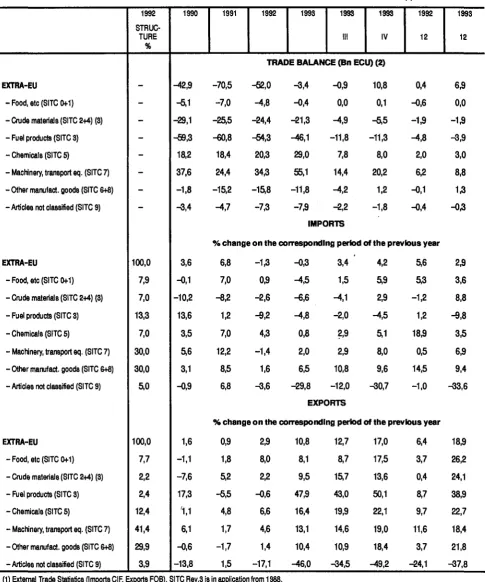
EUROPEAN UNION EXTERNAL TRADE BY PRODUCT
TRADE IN TERMS OF VALUE: Results for December 1993.
Exports of machinery and transport equipment (SITC 7) rise by 13.1% in 1993.
The surplus in
machinery and transport equipment
(SITC 7) was over ECU 55 billion in 1993, compared
with almost ECU 33 billion in 1992. The external
trade balance in chemical products (SITC 5) showed
a surplus of ECU 29 billion, up by almost ECU 9 billion
compared with 1992. The deficit in other manufac
tured products (SITC 6 + 8) improved by ECU 4
billion, amounting to ECU 11.8 billion for 1993. The
deficit in energy products (SITC 3) amounted to al
most ECU 46 billion in 1993, compared with ECU 54.3
billion in 1992. Trade in raw materials (SITC 2 + 4)
showed a deficit of ECU 21.3 billion, an improvement
of ECU 3.1 billion compared with 1992. The deficit in
food products (SITC 0 + 1) was absorbed between
1992 and 1993, amounting to ECU 4.8 billion in 1992
and ECU 0.4 billion in 1993.
Imports of
machinery and transport equipment
rose by 2% in 1993, those of chemical products also
rose slightly (0.8%). Imports of
other manufactured
products
rose more sharply (+6.5%). Imports of
energy products and food products fell by around 5%,
while those of raw materials were down by 6.6%.
Exports of machinery and transport equipment rose
by 13.1% compared with 1992. Exports of other
manufactured products increased by 10.4%, while
exports of chemical products grew by 16.4%. Exports
of food products were 8.1% up on 1992.
GR.OD I EXTRATRADE BALANCE (PRODUCTS GROUPS)
(BN ECU)
4 0
2 0
0
■20
•40
•60
Manufactures
15τ
1 0
-Prim.goods
•5
Fuels
Manufactures
Prim.goods
Fuels
92
93
92 9312
TABLE OD I - EUR-12 TRADE BALANCE AND TRADE FLOWS BY BROAD PRODUCT GROUPS (1)
EXTRA-EU
- Food, etc (SITC 0+1) - Crude materials (SITC 2+4) (3) - Fuel products (SITC 3) -Chemicals (SITC 5)
- Machinery, transport eq. (SITC 7) - Other manufact. goods (SITC 6+8) - Articles not classified (SITC 9)
EXTRA-EU
-Food, etc (SITC 0+1) - Crude materials (SITC 2+4) (3) - Fuel products (SITC 3) -Chemical8(SITC5)
- Machinery, traneport eq. (SITC 7) - Other manufact. goods (SITC 6+8) - Articles not classified (SITC 9)
EXTRA-EU
- Food, etc (SITC 0+1) - Crude materials (SITC 2+4) (3) - Fuel products (SITC 3) - Chemicals (SITC 5)
- Machinery, transport eq. (SITC 7) - Other manufact. goods (SITC 6+8) - Articles not classified (SITC 9)
1992
STRUC-TURE
%
-100,0
7,9
7,0
13,3
7,0
30,0 30,0
5,0
100,0
7,7
2,2
2,4
12,4 41,4 29,9
3,9
1990
-42,9 -5,1 -29,1 -59,3 18,2 37,6 -1,8 -3,4
3,6
-0,1 -10,2 13,6
3,5
5,6
3,1
-0,9
1,6
-1,1 -7,6 17,3 '1,1
6,1
-0,6 -13,8
1991
-70,5 -7,0 -25,5 -60,8 18,4 24,4 -15,2
-4,7
1992 1993 1993
111
1993
IV
TRADE BALANCE (Bn ECU) (2)
-52,0 -4,8 -24,4 -54,3 20,3 34,3 -15,8 -7,3
-3,4 -0,4 -21,3 -46,1 29,0 55,1 -11,8
- 7 5
-0,9
0,0
-4,9 -11,8
7,8
14,4 -4,2 -2,2
IMPORTS
10,8
0,1
-5,5 -11,3
8,0
20,2
1,2
-1,8
1992
12
0,4
-0,6 -1,9 -4,8
2,0
6,2
-0,1 -0,4
% change o n the corresponding period of the previous year
6,8
7,0
-8,2
1,2
7,0
12,2
8,5
6,8
-1,3
0,9
-2,6 -9,2
4,3
-1,4
1,6
-3,6
-0,3 -4,5 -6,6 -4,8
0,8
2,0
6,5
-29,8
3,4 '
1,5
-4,1 -2,0
2,9
2,9
10,8 -12,0
EXPORTS
4,2
5,9
2,9
-4,5
5,1
8,0
9,6
-30,7
5,6
5,3
-1,2
1,2
18,9
0,5
14,5 -1,0
% change o n the corresponding period of the previous year
0,9
1,8
5,2
-5,5
4,8
1,7
-1,7
1,5
2,9
8,0
2,2
-0,6
6,6
4,6
1,4
-17,1
10,8
8,1
9,5
47,9 16,4 13,1 10,4 -46,0
12,7
8,7
15,7 43,0 19,9 14,6 10,9 -34,5
17,0 17,5 13,6 50,1 22,1 19,0 18,4 ^49,2
6,4
3,7
0,4
8,7
9,7
11,6
3,7
-24,1
1993
12
6,9
0,0
- 1 5
-3,9
3,0
8,8
1,3
- 0 5
2,9
3,6
8,8
-9,8
3,5
6,9
9,4
-33,6
18,9 26,2 24,1 38,9 22,7 18,4 21,8 -37,8
(1) External Trade Statistics (Importe CIF, Exports FOB).
(2) Bn = 1000.000.000
(3) Petroleum not included.
* Estimate.
SITC Rev.S is in application from 1988.
EUROPEAN UNION EXTERNAL TRADE BY PRODUCT
TRADE IN TERMS OF VOLUME: Results for quarter four 1993.
Volume of exports of manufactured products rises by almost 10% between 1992 and 1993.
Total imports fell by 3.9% in terms of volume between
1992 and 1993. The volume of imports of machinery
and transport equipment fell by 8.6% in 1993 com
pared with 1992. This drop affected, to a lesser
extent, chemical products ( 5.9%) but not other
manufactured products, which rose slightly (+ 1.3%).
In terms of volume, imports of energy products fell by
2.4%, and those of raw materials by 5.2%. Imports
of food products fell by 4.3% in volume terms com
pared with 1992.
Total volumes exported by the European Union rose
by 9.3% in 1993. The volume of exports of machinery
and transport equipment rose by 7.5% in 1993, that
of other manufactured products by 10.3%. The vol
ume of exports of chemical products also rose (+
9.1%). The volume of exports of food products rose
by 10.8% in 1993 compared with 1992.
GR. OD II EXTRACOMMUNITY TRADE IN VOLUME
(% change on the corresponding period of the previous year)
20
15
10
10
Food,etc..
SITC 0+1
Chemicals
SITC 5
10
5
0
-5
10
_
-Wi
W:
Wl
ι??:
:§:¿:
93 I 93 III 93 IV
Machinery, transport eq
SITC 7
10
92 IV 93 I 93 II 93 III 93 IV
Other manufactured goods
SITC 6+8
92 IV 92 I 92 II 93 III 93 IV 92 IV 93 I 93 II 93 III 93 IV
[ãlãj
Exports
Imports
TABLE OD II - EUR-12 IMPORTED AND EXPORTED VOLUMES BY BROAD PRODUCT GROUPS (1)
EXTRA-EU
-Food, etc (SITC 0+1) - Crude materials (SITC 2+4) (2) - Fuel products (SITC 3) -Chemical8(SITC5)
- Machinery, transport eq. (SITC 7)
- Other manufact. goods (SITC S+8)
EXTRA-EU
- Food, etc (SITC 0+1)
- Crude materials (SITC 2+4) (2) - Fuel products (SITC 3) - Chemicals (SITC 5)
- Machinery, transport eq. (SITC 7) - Other manufact. goods (SITC 6+8)
1992 STRUC
TURE %
100,0
9,5 5,4 8,4
9,5 32,2
29,4
100,0
7,0 2,0
2,6 11,6 39,9 31,2
1991
6,9
4,0
-2,1 9,8 4,1 7,2
7,9
-0,2
4,6 7,0
-4,9 1,8 -0,9 -1,4
1992 1993 1992
IV
1993
I
IMPORTS
1993
II
1993
111
% change o n the corresponding period of the previous year
0,8 -3,9
3,9 -4,3
2,5 -5,2
0,5 -2,4
3,3 -5,9
- 5 , 0 -8,6
4,4 1,3 -1,7
1,2
-2,9
-3,0
3,9
-8,9
3,7
-6,3
-7,1 -7,3 -7,2
-θ,6 -10,5
0,1
EXPORTS
- 5 , 5 -7,8
-6,1 -4,7
-5,8 -9,2 -1,3
-4,3
-4,1 -6,9 -0,8 -6,6 -11,7 2,2
% change o n the corresponding period of the previous year
1,3 9,3 5,7 10,8
5,8 13,2 8,1 28,5 3,9 9,1 -0,1 7,5
1,6 10,3 -1,1
5,4
0,6 7,5 -10,7
-2,6
-1,2
1,5 7,7
10,0
23,0 4,2
-2,1 3,4
10,1 5,9 9,3
29,8 9,8 9,5 10,7
8,9 7,7
143
17,6 8,9
7,9 9,4
1993
IV
-1,2 -0,2 -0,2 3,5 -3,4
-7,1 3,0
14,4
17,0 19,8
36,5 11,8 12,1 15,9
(1) Data Source: TREND. SITC Rev.S is in application from 1988. Products of SITC 9 are excluded. (2) Petroleum not Included.
* Estimate.