DOI 10.1007/s00394-015-1143-3
REVIEW
Examining techniques for measuring the effects of nutrients
on mental performance and mood state
Mark Hamer1 · Louise Dye2 · E. Siobhan Mitchell3 · Sophie Layé4,5 · Caroline Saunders6,7 · Neil Boyle2 · Jeroen Schuermans8 · John Sijben9
Received: 11 March 2015 / Accepted: 16 December 2015 / Published online: 7 January 2016 © The Author(s) 2016. This article is published with open access at Springerlink.com
Methods A multi-stakeholder expert group was invited by ILSI Europe to come to a consensus around the util-ity of objective and subjective measurement in this field, which forms the basis of the paper. Therefore, the present review reflects a succinct overview of the science but is not intended to be a systematic review.
Results The proposed approach extends the traditional methodology using standard ‘objective’ measurements to also include the consumers’ subjective experiences in rela-tion to food. Specific recommendarela-tions include 1) using contemporary methods to capture transient mood states; 2) using sufficiently sensitive measures to capture effects of nutritional intervention; 3) considering the possibility that subjective and objective responses will occur over different
Abstract
Purpose Intake of specific nutrients has been linked to mental states and various indices of cognitive performance although the effects are often subtle and difficult to inter-pret. Measurement of so-called objective variables (e.g. reaction times) is often considered to be the gold stand-ard for assessing outcomes in this field of research. It can, however, be argued that data on subjective experience (e.g. mood) are also important and may enrich existing objec-tive data. The aim of this review is to evaluate methods for measuring mental performance and mood, considering the definition of subjective mood and the validity of measures of subjective experience.
* Jeroen Schuermans [email protected]
Mark Hamer [email protected]
Louise Dye [email protected]
E. Siobhan Mitchell
[email protected] Sophie Layé
[email protected] Caroline Saunders
[email protected] Neil Boyle
[email protected] John Sijben
1 Department Epidemiology and Public Health, Psychobiology
Group, University College London, 1 - 19 Torrington Place, London WC1E 7HB, UK
2 Human Appetite Research Unit, Institute of Psychological
Sciences, University of Leeds, Leeds, UK
3 Nestlé Institute of Health Sciences, EPFL Campus,
Lausanne, Switzerland
4 Nutrition et Neurobiologie Intégrée, UMR 1286, INRA,
33000 Bordeaux, France
5 Nutrition et Neurobiologie Intégrée, UMR 1286, Université
Bordeaux, 33000 Bordeaux, France
6 PepsiCo, 450 South Oak Way, Green Park, Reading RG2
6UW, UK
7 Present Address: Lucozade Ribena Suntory Ltd, 2 Longwalk
Road, Stockley Park, Uxbridge UB11 1BA, UK
8 ILSI Europe, Brussels, Belgium, International Life Sciences
Institute, Europe, 83 Avenue E. Mounier, B6, Brussels, BE 1200, USA
9 Nutricia Research, Nutricia Advanced Medical Nutrition,
time frames; and 4) recognition of the importance of expec-tancy and placebo effects for subjective measures.
Conclusions The consensus reached was that the most informative approach should involve collection and consid-eration of both objective and subjective data.
Keywords Mood · Cognition · Objective · Subjective · Food · Mental health · Affective assessment
Abbreviations
ANCOVA Analysis of covariance ANOVA Analysis of variance DHA Docosahexaenoic acid
EMA Ecological momentary assessment ESM Experience sampling methods
fMRI Functional magnetic resonance imaging POMS Profile of mood states
PUFA Polyunsaturated fatty acid
RVIP Rapid visual information processing TSST Trier social stress test
Introduction
Nutrition plays an important role in brain function throughout the entire lifespan. Appropriate nutrient intake allows normal brain growth and neurodevelopment in early life and reduces the risk of cognitive decline and Alz-heimer’s disease in older age [1, 2]. Our knowledge about nutrition has greatly evolved over the last 50 years, and in developed countries, food is no longer seen uniquely as a survival necessity and a primary need, but is associ-ated with promotion of mental fitness [3–5]. The effects of nutrients on cognitive performance—mental processes (e.g. attention, memory, reasoning, problem solving, deci-sion-making) related to the processing of information and application of knowledge—have been widely examined usually by employing objective outcomes measures such as reaction time and accuracy. The effects of nutrition on subjective measures of psychological functions, such as self-reported mood, have received relatively less atten-tion. The aim of this review is to provide a comprehensive overview of the theoretical frameworks that link subjec-tive experience of mood to cognition and, from this under-standing, identify the most promising methods to measure the individual experience of mood and its relationship to cognitive function. This will be illustrated with examples from studies that have examined the effects of nutritional interventions on cognitive performance and mood. How-ever, the effects of nutritional manipulations are often subtle and inconsistently reported (e.g. Halyburton et al. [6]; Hellhammer et al. [7]; Rogers et al. [8]). Therefore, this review will also draw upon examples from the stress,
cognition and mood literature, since stress induction [e.g. the use of sensory overload (excessive noise) or perform-ing a task under social evaluation to provoke a psycho-physiological stress response] is both robust and reliable in the provocation of mood change and moderation of cognitive function [9, 10]. Whilst stress response can be termed as any alteration to homoeostasis in an organism, for the purposes of this review, stress is defined as a mis-match between the demands of a task/context/stimuli and perceived ability to cope. If a context/stimuli is perceived as stressful, this will provoke a subjective response (e.g. negative affect/mood) and a physiological response (e.g. the release of the hormone cortisol to orchestrate the neu-roendocrine response to stress). The main topics that will be addressed are: (1) how to best measure mental perfor-mance and mood, i.e. which measures are most reliable and validated under which conditions, (2) how placebo effects may affect subjective state and response to nutri-ent intervnutri-ention, (3) the relationship between objective and subjective measures, (4) the ability to detect meaningful effects and elucidate their mechanism of action and (5) how nutrient effects on subjective experience, measured by standardised questionnaires, translate into everyday life and the clinical relevance of these. The proposed approach extends the traditional empirical approach of using solely standard “objective” measurements to also consider sub-jective state in a more integrated manner using advances in technology and appropriate analytical strategies. Such data on subjective experience may enrich our understanding and interpretation of objective measures and as such these recommendations are expected to help guide researchers from academia and industry when studying the effects that foods or specific product consumption can have on mood and mental performance.
Definition and measurement of subjective mood state
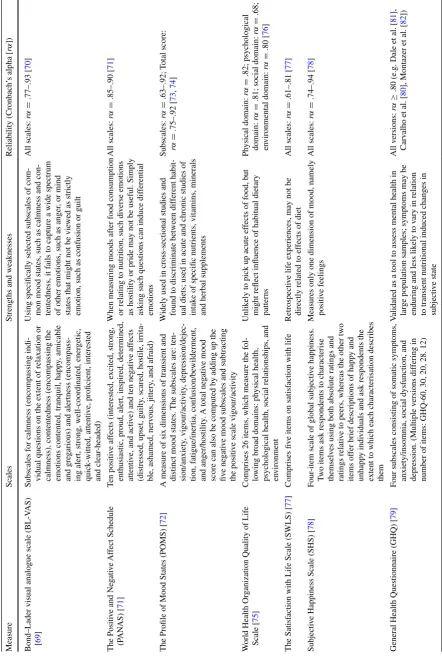
separated into protracted (e.g. depressed mood) and tran-sient, fluctuating affective states (e.g. a momentary state of increased vigour). As mood is inherently phenomeno-logical, it is perceived as an inconsistent measure of the brain’s output, despite demonstrations that mood can be consistently measured. For example, specific drugs (e.g. Brown and Chandler [13]; Mula and Sander [14]) and stimuli (e.g. stress [15]) have been shown to have very consistent effects on mood, as measured by ratings on scales and questionnaires. In addition to well-being ques-tionnaires, which often capture protracted, generalised affective mood states, there are several validated tools available to assess transient mood states which have been able to capture changes in mood as a result of a number of different nutritional interventions [16, 17]. For example, relative to placebo, a 30-day high-flavanol chocolate drink improved self-rated calmness and contentedness, meas-ured by Bond–Lader mood scales [16] and the Profile of Mood States (POMS) captured changes in tension–anxiety scores following intervention with L-theanine under con-ditions of induced stress [17]. Table 1 provides examples of questionnaire/scale measures of subjective mood state and well-being and their potential suitability for nutritional interventions.
Moods can be linked to specific events, such as those caused by artificial mood inductions, but more commonly they occur somewhat independently of second-by-second, or minute-by-minute circumstances. Ecological momen-tary assessment (EMA) or experience sampling methods (ESM) are alternative mood measurement tools which may more realistically capture sequential, transient states by requiring brief inputs of mood state during daily activi-ties. EMA data can be captured, for example, via mobile devices such as smart phones, where participants are periodically asked to fill in short questionnaires. Psycho-logical research has established that recollected effect may diverge from actual experience because it is influenced by errors in recollection, recall biases, focusing illusions and salient memory heuristics [18]. This “memory–experience gap” between life as it is remembered and life as it is expe-rienced may be important to the processes through which the past impacts on future behaviour. Moreover, effects resulting from interventions with nutrients may not be noticeable after acute administrations commonly applied in laboratory settings, but may give rise to improved well-being over time, especially if the intervention has other benefits such as cardiovascular health. One recent study, which endeavoured to measure daily fluctuations in mood via cell phone questionnaires, reported an effect of a multi-vitamin supplement on alertness after 4-week supplemen-tation [19]. Others have validated cardiovascular biomark-ers against the mood reports acquired during daily life. For instance, Steptoe and colleagues found that systolic blood
pressure correlated with positive effect in men during work hours [20].
Validity of measures of subjective states
There are numerous types of validity, but in this context, the most important is construct validity—are we actually measuring what we think we are measuring? Evaluation of construct validity involves demonstrating that the meas-ure correlates with variables that are known to be related to the construct (purportedly measured by the instrument being evaluated or for which there are theoretical grounds for expecting it to be related). Thus, identifying the “gold standard” against which to validate is crucial. Employing the stress induction model to illustrate this point, the semi-nal work of Seyle [21] explained that many stressors placed upon us have neutral effects until, by our own thinking, we appraise the experience as subjectively negative or positive. Thus, when measuring stress in individuals, it is important to acknowledge that a self-report of stress will need to be evaluated against the baseline of an individual (i.e. person-ality, past experience, as well as physiological state). This explains why different people may have profoundly different reactions to the same basic source of stress. In other words, it is one’s own perception that is crucial. However, both physi-ological and subjective mood responses to stress are rela-tively stable individual traits and can thus be accurately and consistently measured after exposure to stressful stimuli. For example, good correlations between subjective and physi-ological stress increases are shown in participants after the Trier Social Stress Test (TSST) [15]. Yet measurement of stress elicited by the TSST can be modulated by genetics, lifestyle, etc., and thus, validity of any subjective measure-ment will need to be evaluated in the context of these types of variables.
Table
1
Examples of measures of subjecti
ve mood state and well-being
Measure
Scales
Strengths and weaknesses
Reliability (Cronbach’
s alpha [
r
α
])
Bond–Lader visual analogue scale (BL-V
AS)
[
69
]
Subscales for calmness (encompassing indi
-vidual questions on the e
xtent of relaxation or
calmness), contentedness (encompassing the emotions contented, tranquil, happ
y, amicable
and gre
garious) and alertness (encompass
-ing alert, strong, well-coordinated, ener
getic,
quick-witted, attenti
ve, proficient, interested
and clear
-headed)
Using specifically selected subscales of com
-mon mood states, such as calmness and con
-tentedness, it f
ails to capture a wide spectrum
of other emotions, such as anger
, or mind
states that might not be vie
wed as strictly
emotion, such as confusion or guilt
All scales: r α = .77–.93 [ 70 ] The Positi
ve and Ne
gati ve Af fect Schedule (P AN AS) [ 71 ] Ten positi ve af
fects (interested, e
xcited, strong,
enthusiastic, proud, alert, inspired, determined, attenti
ve, and acti
ve) and ten ne
gati
ve af
fects
(distressed, upset, guilty
, scared, hostile, irrita
-ble, ashamed, nerv
ous, jittery
, and afraid)
When measuring moods after food consumption or relating to nutrition, such di
verse emotions
as hostility or pride may not be useful. Simply asking such questions can induce dif
ferential emotions All scales: r α = .85–.90 [ 71 ]
The Profile of Mood States (POMS) [
72
]
A measure of six dimensions of transient and distinct mood states.
The subscales are: ten
-sion/anxiety , vigour/acti vity , depression/dejec -tion, f atigue/inertia, confusion/be wilderment, and anger/hostility
. A total ne
gati
ve mood
score can also be computed by adding up the five ne
gati
ve mood subscales and subtracting
the positi
ve scale vigour/acti
vity
W
idely used in cross-sectional studies and found to discriminate between dif
ferent habit
-ual diets; used in acute and chronic studies of intak
e of specific nutrients, vitamins, minerals
and herbal supplements
Subscales: r α = .63–.92; Total score: r α = .75–.92 [ 73 , 74 ] W
orld Health Or
ganization Quality of Life
Scale [
75
]
Comprises 26 items, which measure the fol
-lo
wing broad domains: ph
ysical health,
psychological health, social relationships, and environment
Unlik
ely to pick up acute ef
fects of food, b
ut
might reflect influence of habitual dietary patterns
Ph ysical domain: r α = .82; psychological domain: r α =
.81; social domain:
r α = .68; en vironmental domain: r α = .80 [ 76 ] The Satisf
action with Life Scale (SWLS) [
77
]
Comprises fiv
e items on satisf
action with life
Retrospecti
ve life e
xperiences, may not be
directly related to ef
fects of diet
All scales: r α = .61–.81 [ 77 ] Subjecti
ve Happiness Scale (SHS) [
78
]
Four
-item scale of global subjecti
ve happiness.
Tw
o items ask respondents to characterise
themselv
es using both absolute ratings and
ratings relati
ve to peers, whereas the other tw
o
items of
fer brief descriptions of happ
y and
unhapp
y indi
viduals and ask respondents the
extent to which each characterisation describes them Measures only one dimension of mood, namely positi
ve feelings All scales: r α = .74–.94 [ 78 ]
General Health Questionnaire (GHQ) [
79
]
Four subscales consisting of somatic symptoms, anxiety/insomnia, social dysfunction, and depression. (Multiple v
ersions dif
fering in
number of items: GHQ-60, 30, 20, 28. 12)
V
alidated as a tool to assess mental health in large population samples; symptoms may be enduring and less lik
ely to v
ary in relation
to transient nutritional induced changes in subjecti
ve state All v ersions: r α ≥
.80 (e.g. Dale et
al. [ 81 ], Carv alho et al. [ 80
], Montazer et
al. [
82
[image:4.595.77.520.63.725.2]Detection and interpretation of meaningful effects
A common problem in this field is how to interpret null effects. Detecting no effect on a measure of subjective state following a nutritional intervention could mean that the intervention really does not influence the mood parameter measured. Alternatively, it could reflect a lack of sensitiv-ity of that measure to small or subtle changes in state or that the intervention prevented a degradation that would otherwise have been observed. An effect may also fail to be detected because of inadequate power which is also related to the magnitude of the experimental effect, or individual differences in the use of a scale which increase variability and decrease sensitivity of the measure [5]. Large inter- and intra-subject variability in subjective measures such as mood mean that larger sample sizes to detect the effects of a nutrient against this relatively noisy background may be required. Null or inconsistent effects may also be attrib-utable to the use of insensitive experimental designs (e.g. between subjects) or inappropriate selection of baseline measures and the failure to include these in the statistical analysis. Two psychological measures of mood may claim to measure the same subjective state, but it may be that only one is sufficiently sensitive to detect effects of a nutri-tional manipulation. It is feasible that commonly employed measures may be inadequate to assess subjective state in relation to nutrient intervention and mask real effects. A lack of effect on some measures could be due to a subtle effect of a nutrient on only one component of the subjec-tive state which when computed into a “scale score” is no longer detected. Many studies have simply administered “off the shelf” measures and report the factor scores or summed items based on previous validation studies or fac-tor analyses which are not based on the same populations in the same state, e.g. following a nutrition intervention.
Appropriate analyses of data from studies where sub-jective state is the outcome variable pose some unique problems. Even where participants can be randomised to nutrient or placebo interventions, it cannot be assumed that baseline measures will not differ and hence change from baseline or inclusion of baseline as a covariate is the recommended statistical approach. In these randomised studies, both analysis of variance (ANOVA) on change from baseline and analysis of covariance (ANCOVA) with baseline as a covariate will be unbiased [23]. In non-ran-domised studies where baseline differences may pre-exist and samples may be more heterogeneous, both methods may contradict each other since neither can be unbiased. True randomisation is therefore the preferred approach. Moreover, the overuse and over-interpretation of subgroup analyses poses further problems in this field [24], as does the splitting of samples using median splits [21] since these
may exaggerate or even produce effects which are actually artefacts of the reduction of a continuous variable such as mood to a categorical group.
Expectancy and placebo effects
Placebo effects are a concern for all scientific research and well-designed clinical studies go to great lengths to avoid potential bias introduced by these effects by “blinding”. However, via expectations, placebos influence a variety of outcome measures including physiological responses. Despite continuing efforts to fully understand the psycho-logical mechanisms of placebo effects, it is well recognised that expectation is a major contributor to study outcomes in response to treatment in intervention studies [25]. Expec-tancy effects can be described as changes in behaviour that occur in an experiment due to the anticipation of results that unconsciously affect the outcome. The observation that these effects may be one of the main mechanisms that underlie the placebo effect has been supported by neuroim-aging studies which have shown that the placebo response is associated with widespread frontal and prefrontal activa-tion which is consistent with the processing of expectaactiva-tion and executive function [26]. Most of our knowledge about placebo mechanisms comes from investigations of pla-cebo effects in the domain of pain [27] where patients have repeatedly experienced significant pain relief from place-bos when the placebo is described as an analgesic medica-tion compared to when it is not [28]. This is an example of a verbal cue that can create a strong expectancy effect which results in behavioural, clinical or physiological changes [29]. Another example of this is where caffeine-associated stimuli such as the smell and taste of coffee have been shown to elicit both self-reported and physiological arousal [30] and where the expectation of having consumed caffeine can result in improvements in cognitive perfor-mance and mood [18]. In this particular study, participants were randomly allocated to both a drink (caffeinated coffee vs. decaffeinated coffee) and an expectancy (told caffeine vs. told decaffeinated) condition. Both caffeine and expec-tation of having consumed caffeine improved attention and psychomotor speed.
greater. In this study, taste also resulted in expectation of better performance on the task; however, these expectan-cies did not carry through to influence actual performance, which is contradictory to Green et al.’s study [32]. They did find that expectancy effects were able to influence per-formance on a cognitive task. Green et al. [32] gave study participants either glucose or aspartame on two occasions in a counterbalanced manner. On one occasion, for each treat-ment, participants were misinformed about the treatment they were going to receive (glucose or aspartame). Improve-ments in the Bakan vigilance task were observed after glu-cose consumption, but only when participants were told they were going to receive glucose. No task improvements were observed when participants thought that they were consuming aspartame. Similar effects were observed by Stollery and Christian [33] who found a subtle improvement in a task of delayed free recall when participants believed they had consumed glucose. Whilst the authors concluded that the expectancy effects were small and unlikely to be confused with glucose enhancements, they did suggest that routine collection of product beliefs should be carried out in future studies. This is particularly important when test-ing commercial products, on potential consumers. Whilst typically substantial effort is invested to control for placebo effects (by having a placebo), expectancy effects are also important for subjective and objective state post-ingestion. Moreover, it is these effects reinforced by repeated exposure which will guide consumers into making a decision to pur-chase a product. Hence, expectancy effects also need to be measured in studies of nutrient interventions. These obser-vations also emphasise the importance of an appropriate, well-matched placebo, particularly in experiments where the product could easily be recognised by the consumer, and post-study debriefing may be useful to assess the effective-ness of blinding of the treatment conditions (although this is rarely reported in published studies). It should also be noted that use of objective measures will not cancel or even ame-liorate placebo effects. Thus, the expectancy of the study participants is an important factor in the design of nutri-tional intervention studies.
Relationships between subjective and objective mental performance measures
Whilst mood states are subjective in the sense that they occur in a person’s experience, manifestations of mood can also be observed objectively in physical actions, cog-nition and behaviour. Mood-influenced cogcog-nition is most often studied in patients with depression or those who have recovered from depression. In such studies, depres-sion has been shown to correlate with worse performance in attention and memory tasks. The definition of clinical
depression is defined by the Diagnostic and Statistical Manual of Mental Disorders, Fifth Edition (DSM V) as a “depressed mood or a loss of interest or pleasure in daily activities for more than 2 weeks, where mood represents a change from the person’s baseline”. This rather qualita-tive definition is made quantitaqualita-tive in clinical intervention studies by establishment of threshold scores in depression checklists or questionnaires (such as the Beck Depression Inventory) which measure particular levels of impaired function in social, occupational and educational settings. Due to the concrete criteria of clinical depression, com-parison of depressed vs healthy participant behaviour is a useful approach for understanding mood–cognition inter-actions. For instance, depressed study participants dem-onstrate attentional negative bias towards stimuli such as words or facial expressions as compared to non-depressed participants [34] and show a slowing down of response times compared to non-depressed participants. Interest-ingly, researchers have shown that participants with familial history of depression, but with no prior diagnosis of depres-sion, also exhibit attentional bias towards negative stimuli that is greater than that of participants with no familial his-tory of depression. These “emotional bias” cognition tests have been proposed as an early detection method to iden-tify participants with a predisposition to depression. Simi-larly, functional magnetic resonance imaging (fMRI) meas-urements of amygdala reactivity to negative stimuli appear to be greater in participants with family history of depres-sion or carriers of putative “depresdepres-sion genes” such as the 5-HTTLPR short alleles or met MAO alleles [35].
objective measures are not considered concomitantly and independently. For example in an acute study by Scholey et al. [19], cognitive performance and self-reported mental fatigue were measured after two doses of cocoa flavanols. Both doses improved performance on the Serial Threes task, whilst only the low dose improved mood. In addition, the high acute dose improved response times in a Rapid Visual Information Processing Task (RVIP) but showed no effects on mood. It is plausible that the effects of a nutrient on sub-jective state in the longer term may produce acute changes in cognition or that such changes are not related temporally. Hence, it is advisable to consider acute on chronic studies and more frequent assessments to ensure that these effects and the relationships between acute and chronic effects in both subjective and objective outcomes are captured.
Linking subjective states to mechanisms of action
Demonstration of biological plausibility is crucial when linking the effects of specific nutrients to subjective mood states; however, there is a paucity of studies which have attempted to link these two types of outcome within the same study. We will use the example of n − 3 PUFA to describe potential mechanisms. Animals fed a diet contain-ing low levels of n− 3 PUFA display impaired emotional and cognitive behaviour [38–47]. Metabolism of monoam-ines [48], neuronal plasticity [49], neuroinflammation [50, 51] and stress response [52] are impaired in the brains of these animals. In humans, an impaired stress response has been repeatedly associated with low n− 3 PUFA [44, 53– 57]. Promising data obtained in humans and animal models show that docosahexaenoic acid (DHA) dietary supplemen-tation lowers self-reported cognitive (e.g. feeling unease and fear) and physiological (e.g. sweating) anxiety symp-toms [58], cortisol response to mental stress [55, 59] and to inflammatory stimuli [60], and peripheral and brain inflam-mation, especially in healthy older adults [50, 61–65]. The activity of proinflammatory cytokines in the brain are involved in the development of somatic symptoms (fatigue, attention, etc.) known to alter mental performance and mood as described above [66–68]. To conclude, preclinical studies have highlighted plausible biological mechanisms relating to neurobiological systems involved in mood and cognitive disorders, possibly underlying the effects of vari-ous nutrients on subjective mood state.
Recommendations and conclusions
In this paper, we argue that the subjective effects of foods on self-reported mood and cognition can enrich our understand-ing and interpretation of gold-standard “objective outcome
measures” (cognitive test outcomes, e.g. reaction times, the number of words recalled and physiological markers, e.g. salivary cortisol concentrations) and should be consid-ered both concomitantly and independently. Thus, we make the case that measures of subjective states are a valid and appropriate methodology for assessing the effects of nutri-tional intake on mood and mental performance. The pro-posed approach extends the traditional cognitive approach of using standard “objective” performance measurements to also include consumers’ subjective experiences in relation to food. Our specific recommendations are as follows:
• Consideration of both traditional mood questionnaires or the use of ecological momentary assessment (EMA) or experience sampling methods (ESM), which may more realistically capture transient mood states. Identifying which are best and most reliable under which condition.
• Use measures sufficiently sensitive to detect effects of a nutritional manipulation and to evaluate the magnitude and meaningfulness of changes demonstrated, e.g. by comparison with effects induced by drugs or alcohol or variations in mood which occur over the course of a day.
• Consider the possibility that subjective and objective measures will occur within different time frames and in response to different doses. Acute on chronic studies may help capture transient effects on mood or cognitive function which may result in longer-term measureable benefits.
• Recognition of the importance of expectancy and pla-cebo effects when measuring subjective mood states and behaviour generally and selection of well-matched pla-cebos.
• Demonstrating biological plausibility is crucial when linking the effects of specific nutrients to subjective mood states and behaviour.
Acknowledgments This work was conducted by an expert group of the International Life Sciences Institute, Europe (ILSI Europe). The expert group received funding from the ILSI Europe Nutrition and Mental Performance Task Force. Industry members of this task force are listed on the ILSI Europe Web site at www.ilsi.eu. For fur-ther information about ILSI Europe, please email [email protected] or call +32 2 771 00 14. The opinions expressed herein and the con-clusions of this publication are those of the authors and do not nec-essarily represent the views of ILSI Europe nor those of its member companies.
Author’s contribution M. Hamer, L. Dye, E. Siobhan Mitchell, S. Layé, C. Saunders, N. Boyle and J. Sijben contributed to the concep-tualisation and writing of the manuscript. J. Schuermans coordinated the work of the group and assisted with writing, condensing and for-matting the draft.
Compliance with ethical standards
E. Siobhan Mitchell is a full-time employee of Nestlé Institute of Health Sciences. S. Layé, E. Siobhan Mitchell and J. Schuermans have no competing interests. M. Hamer has received funding from industry for research on physical activity and well-being. L. Dye and N. Boyle have received funding from various food companies for contract research on the effects of food on cognitive function and mood.
Open Access This article is distributed under the terms of the Creative Commons Attribution 4.0 International License ( http://crea-tivecommons.org/licenses/by/4.0/), which permits unrestricted use, distribution, and reproduction in any medium, provided you give appropriate credit to the original author(s) and the source, provide a link to the Creative Commons license, and indicate if changes were made.
References
1. Anderson JW, Johnstone BM, Remley DT (1999) Breast-feed-ing and cognitive development: a meta-analysis. Am J Clin Nutr 70:525–535
2. Singh B, Parsaik AK, Mielke MM, Erwin PJ, Knopman DS, Petersen RC, Roberts RO (2014) Association of Mediterranean diet with mild cognitive impairment and Alzheimer’s disease: a systematic review and meta-analysis. J Alzheimers Dis 39:271 3. Ordovas JM (2015) Genetics of brain and cognition and their
interactions with dietary and environmental factors. In: Best T, Dye L (eds) Nutrition for brain health and cognitive perfor-mance, 1st edn. CRC Press, Boca Rotan, pp 41–74
4. Gómez-Pinilla F (2008) Brain foods: the effects of nutrients on brain function. Nat Rev Neurosci 9:568–578
5. de Jager CA, Dye L, de Bruin EA, Butler L, Fletcher J, Lamp-ort DJ, Latulippe ME, Spencer JP, Wesnes K (2014) Criteria for validation and selection of cognitive tests for investigating the effects of foods and nutrients. Nutr Rev 72:162–179
6. Halyburton AK, Brinkworth GD, Wilson CJ, Noakes M, Buckley JD, Keogh JB, Clifton PM (2007) Low-and high-carbohydrate weight-loss diets have similar effects on mood but not cognitive performance. Am J Clin Nutr 86:580–587
7. Hellhammer J, Waladkhani AR, Hero T, Buss C (2010) Effects of milk phospholipid on memory and psychological stress response. Br Food J 112:1124–1137
8. Rogers PJ, Appleton KM, Kessler D, Peters TJ, Gunnell D, Hayward RC, Heatherley SV, Christian LM, McNaughton SA, Ness AR (2008) No effect of n − 3 long-chain polyunsaturated fatty acid (EPA and DHA) supplementation on depressed mood and cogni-tive function: a randomised controlled trial. Br J Nutr 99:421–431 9. Lupien SJ, Maheu F, Tu M, Fiocco A, Schramek TE (2007)
The effects of stress and stress hormones on human cognition: implications for the field of brain and cognition. Brain Cogn 65:209–237
10. Lupien SJ, McEwen BS, Gunnar MR, Heim C (2009) Effects of stress throughout the lifespan on the brain, behaviour and cogni-tion. Nat Rev Neurosci 10:434–445
11. Russell JA (1980) A circumplex model of affect. J Pers Soc Psy-chol 39:1161
12. Watson D, Tellegen A (1985) Toward a consensual structure of mood. Psychol Bull 98:219
13. Brown ES, Chandler PA (2001) Mood and cognitive changes during systemic corticosteroid therapy. Prim Care Companion J Clin Psychiatry 3:17
14. Mula M, Sander JW (2007) Negative effects of antiepileptic drugs on mood in patients with epilepsy. Drug Saf 30:555–567
15. Campbell J, Ehlert U (2012) Acute psychosocial stress: does the emotional stress response correspond with physiological responses? Psychoneuroendocrinology 37:1111–1134
16. Pase MP, Scholey AB, Pipingas A, Kras M, Nolidin K, Gibbs A, Wesnes K, Stough C (2013) Cocoa polyphenols enhance posi-tive mood states but not cogniposi-tive performance: a randomized, placebo-controlled trial. J Psychopharmacol 27:451–458 17. Yoto A, Motoki M, Murao S, Yokogoshi H (2012) Effects of
L-theanine or caffeine intake on changes in blood pressure under physical and psychological stresses. J Physiol Anthropol 31:28
18. Dawkins L, Shahzad FZ, Ahmed SS, Edmonds CJ (2011) Expec-tation of having consumed caffeine can improve performance and mood. Appetite 57:597–600
19. Scholey AB, French SJ, Morris PJ, Kennedy DO, Milne AL, Haskell CF (2010) Consumption of cocoa flavanols results in acute improvements in mood and cognitive performance during sustained mental effort. J Psychopharmacol 24:1505–1514 20. Steptoe A, Wardle J, Marmot M (2005) Positive affect and
health-related neuroendocrine, cardiovascular, and inflammatory processes. Proc Natl Acad Sci USA 102:6508–6512
21. Selye H (1936) Thymus and adrenals in the response of the organism to injuries and intoxications. Br J Exp Pathol 17:234 22. Hamer M, Kivimaki M, Steptoe A (2012) Longitudinal patterns
in physical activity and sedentary behaviour from mid-life to early old age: a substudy of the Whitehall II cohort. J Epidemiol Community Health 66:1110–1115
23. Van Breukelen GJ (2006) ANCOVA versus change from baseline had more power in randomized studies and more bias in nonran-domized studies. J Clin Epidemiol 59:920–925
24. Pocock SJ, Assmann SE, Enos LE, Kasten LE (2002) Subgroup analysis, covariate adjustment and baseline comparisons in clinical trial reporting: current practice and problems. Stat Med 21:2917–2930
25. Finniss DG, Kaptchuk TJ, Miller F, Benedetti F (2010) Bio-logical, clinical, and ethical advances of placebo effects. Lancet 375:686–695
26. Benedetti F, Mayberg HS, Wager TD, Stohler CS, Zubieta JK (2005) Neurobiological mechanisms of the placebo effect. J Neurosci 25:10390–10402
27. Colloca L, Benedetti F (2005) Placebos and painkillers: is mind as real as matter? Nat Rev Neurol 6:545–552
28. Wager TD, Atlas LY, Leotti LA, Rilling JK (2011) Predicting individual differences in placebo analgesia: contributions of brain activity during anticipation and pain experience. J Neurosci 31:439–452
29. Co Colloca L, Miller FG (2011) How placebo responses are formed: a learning perspective. Philos Trans Roy Soc B 366:1859–1869
30. Flaten MA, Blumenthal TD (1999) Caffeine-associated stimuli elicit conditioned responses: an experimental model of the pla-cebo effect. Psychopharmacology 145:105–112
31. Rogers PJ, Law J, Sanderson C (2012) Modelling the psycho-stimulant effects of an energy drink. Label and taste influence expectations, but only caffeine delivers. Appetite 59:634 32. Green Green MW, Taylor MA, Elliman NA, Rhodes O (2001)
Placebo expectancy effects in the relationship between glucose and cognition. Br J Nutr 86:173–179
33. Stollery B, Christian L (2013) Glucose and memory: the influ-ence of drink, expectancy, and beliefs. Psychopharmacology 228:685–697
35. Roiser JP, Sahakian BJ (2013) Hot and cold cognition in depres-sion. CNS Spectr 18:139–149
36. Hockey GR, John Maule A, Clough PJ, Bdzola L (2000) Effects of negative mood states on risk in everyday decision making. Cognition Emotion 14:823–855
37. Hammar A, Lund A, Hugdahl K (2003) Long-lasting cognitive impairment in unipolar major depression: a 6-month follow-up study. Psychiat Res 118:189–196
38. DeMar JC, Ma K, Bell JM, Igarashi M, Greenstein D, Rapoport SI (2006) One generation of n − 3 polyunsaturated fatty acid deprivation increases depression and aggression test scores in rats. J Lipid Res 47:172–180
39. Fedorova I, Hussein N, Baumann MH, Di Martino C, Salem N Jr (2009) An n − 3 fatty acid deficiency impairs rat spatial learning in the Barnes maze. Behav Neurosci 123:196
40. Francès H, Coudereau JP, Sandouk P, Clément M, Monier C, Bourre JM (1996) Influence of a dietary α-linolenic acid defi-ciency on learning in the Morris water maze and on the effects of morphine. Eur J Pharmacol 298:217–225
41. Lafourcade M, Larrieu T, Mato S, Duffaud A, Sepers M, Matias I, De Smedt-Peyrusse V, Labrousse VF, Bretillon L, Matute C (2011) Nutritional omega-3 deficiency abolishes endocannabi-noid-mediated neuronal functions. Nat Neurosci 14:345–350 42. Larrieu T, Madore C, Joffre C, Layé S (2012) Nutritional n − 3
polyunsaturated fatty acids deficiency alters cannabinoid recep-tor signaling pathway in the brain and associated anxiety-like behavior in mice. J Physiol Biochem 68:671–681
43. Levant B, Radel JD, Carlson SE (2006) Reduced brain DHA content after a single reproductive cycle in female rats fed a diet deficient in N − 3 polyunsaturated fatty acids. Biol Psychiat 60:987–990
44. McNamara RK, Jandacek R, Rider T, Tso P, Cole-Strauss A, Lipton JW (2010) Omega-3 fatty acid deficiency increases constitutive pro-inflammatory cytokine production in rats: rela-tionship with central serotonin turnover. Prostag Leukotr Ess 83:185–191
45. Moranis A, Delpech JC, De Smedt-Peyrusse V, Aubert A, Guesnet P, Lavialle M, Joffre C, Layé S (2012) Long term ade-quate n − 3 polyunsaturated fatty acid diet protects from depres-sive-like behavior but not from working memory disruption and brain cytokine expression in aged mice. Brain Behav Immun 26:721–731
46. Rao JS, Ertley RN, Lee HJ, DeMar JC, Arnold JT, Rapoport SI, Bazinet RP (2007) n − 3 polyunsaturated fatty acid deprivation in rats decreases frontal cortex BDNF via a p38 MAPK-dependent mechanism. Mol Psychiatry 12:36–46
47. Vancassel S, Aïd S, Pifferi F, Morice E, Nosten-Bertrand M, Chalon S, Lavialle M (2005) Cerebral asymmetry and behavioral lateralization in rats chronically lacking n − 3 polyunsaturated fatty acids. Biol Psychiatry 58:805–811
48. Chalon S (2006) Omega-3 fatty acids and monoamine neuro-transmission. Prostag Leukotr Ess 75:259–269
49. Zainuddin MSA, Thuret S (2012) Nutrition, adult hippocampal neurogenesis and mental health. Br Med Bull 103:89–114 50. Layé S (2010) Polyunsaturated fatty acids, neuroinflammation
and well being. Prostag Leukotr Ess 82:295–303
51. Mingam R, Moranis A, Bluthé R-M, De Smedt-Peyrusse V, Kelley KW, Guesnet P, Lavialle M, Dantzer R, Layé S (2008) Uncoupling of interleukin-6 from its signalling pathway by die-tary n − 3-polyunsaturated fatty acid deprivation alters sickness behaviour in mice. Eur J Neurosci 28:1877–1886
52. Denis I, Potier B, Vancassel S, Heberden C, Lavialle M (2013) Omega-3 fatty acids and brain resistance to ageing and stress: body of evidence and possible mechanisms. Ageing Res Rev 12:579–594
53. Lin PY, Huang SY, Su KP (2010) A meta-analytic review of pol-yunsaturated fatty acid compositions in patients with depression. Biol Psychiat 68:140–147
54. Mocking RJ, Assies J, Bot M, Jansen EH, Schene AH, Pouwer F (2012) Biological effects of add-on eicosapentaenoic acid sup-plementation in diabetes mellitus and co-morbid depression: a randomized controlled trial. PLoS one 7:e49431
55. Assies J, Pouwer F, Lok A, Mocking RJ, Bockting CL, Visser I, Abeling NG, Duran M, Schene AH (2010) Plasma and erythro-cyte fatty acid patterns in patients with recurrent depression: a matched case-control study. PLoS one 5:e10635
56. Laugero KD, Smilowitz JT, German JB, Jarcho MR, Mendoza SP, Bales KL (2011) Plasma omega 3 polyunsaturated fatty acid status and monounsaturated fatty acids are altered by chronic social stress and predict endocrine responses to acute stress in titi monkeys. Prostag Leukotr Ess 84:71–78
57. Mocking RJ, Ruhé HG, Assies J, Lok A, Koeter MW, Visser I, Bockting CL, Schene AH (2013) Relationship between the hypothalamic-pituitary-adrenal-axis and fatty acid metabolism in recurrent depression. Psychoneuroendocrinology 38:1607–1617 58. Kiecolt-Glaser JK, Belury MA, Andridge R, Malarkey WB,
Glaser R (2011) Omega-3 supplementation lowers inflammation and anxiety in medical students: a randomized controlled trial. Brain Behav Immun 25:1725–1734
59. Delarue JOCP, Matzinger O, Binnert C, Schneiter P, Chiolero R, Tappy L (2003) Fish oil prevents the adrenal activation elicited by mental stress in healthy men. Diabetes Metab 29:289–295 60. Orr SK, Palumbo S, Bosetti F, Mount HT, Kang JX, Greenwood
CE, Ma DW, Serhan CN, Bazinet RP (2013) Unesterified doco-sahexaenoic acid is protective in neuroinflammation. J Neuro-chem 127:378–393
61. Farzaneh-Far R, Harris WS, Garg S, Na B, Whooley MA (2009) Inverse association of erythrocyte n − 3 fatty acid levels with inflammatory biomarkers in patients with stable coronary artery disease: the Heart and Soul Study. Atherosclerosis 205:538–543 62. Ferrucci L, Cherubini A, Bandinelli S, Bartali B, Corsi A,
Lau-retani F, Martin A, Andres-Lacueva C, Senin U, Guralnik JM (2006) Relationship of plasma polyunsaturated fatty acids to circulating inflammatory markers. J Clin Endocrinol Metab 91:439–446
63. Kalogeropoulos N, Panagiotakos DB, Pitsavos C, Chrysohoou C, Rousinou G, Toutouza M, Stefanadis C (2010) Unsaturated fatty acids are inversely associated and n − 6/n − 3 ratios are posi-tively related to inflammation and coagulation markers in plasma of apparently healthy adults. Clin Chim Acta 411:584–591 64. Kiecolt-Glaser JK, Belury MA, Porter K, Beversdorf D,
Leme-show S, Glaser R (2007) Depressive symptoms, n − 6: n − 3 fatty acids, and inflammation in older adults. Psychosom Med 69:217–224
65. Labrousse VF, Nadjar A, Joffre C, Costes L, Aubert A, Gregoire S, Bretillon L, Laye S (2012) Short-term long chain omega3 diet protects from neuroinflammatory processes and memory impair-ment in aged mice. PLoS one 7:e36861
66. Capuron L, Miller AH (2011) Immune system to brain signal-ing: neuropsychopharmacological implications. Pharmacol Ther 130:226–238
67. Dantzer R, O’Connor JC, Freund GG, Johnson RW, Kelley KW (2008) From inflammation to sickness and depression: when the immune system subjugates the brain. Nat Rev Neurol 9:46–56 68. Dantzer R, Heijnen CJ, Kavelaars A, Laye S, Capuron L (2014)
The neuroimmune basis of fatigue. Trends Neurosci 37:39–46 69. Bond A, Lader M (1974) The use of analogue scales in rating
subjective feelings. Br J Med Psychol 47:211–218
of reasoned action and planned behaviour. Eur J Soc Psychol 29:419–433
71. Watson D, Clark LA (1999) The PANAS-X: manual for the posi-tive and negaposi-tive affect schedule-expanded form. University of Iowa Press, Iowa City
72. McNair DM, Lorr M, Droppleman LF (1971) EITS manual for the profile of mood states. Educational and Industrial Testing Service, San Diego
73. Norcross JC, Guadagnoli E, Prochaska JO (1984) Factor struc-ture of the profile of mood states (POMS): two partial replica-tions. J Clin Psychol 40:1270–1277
74. Nyenhuis DL, Yamamoto C, Luchetta T, Terrien A, Parmentier A (1999) Adult and geriatric normative data and validation of the profile of mood states. J Clin Psychol 55:79–86
75. WHOQOL group (1995) The World Health Organization quality of life assessment (WHOQOL): position paper from the World Health Organization. Soc Sci Med 41:1403–1409
76. Skevington SM, Lotfy M, O’Connell KA (2004) The World Health Organization’s WHOQOL-BREF quality of life assess-ment: psychometric properties and results of the international field trial. A report from the WHOQOL group. Qual Life Res 13:299–310
77. Diener ED, Emmons RA, Larsen RJ, Griffin S (1985) The satis-faction with life scale. J Pers Assess 49:71–75
78. Lyubomirsky S, Lepper HS (1999) A measure of subjective hap-piness: preliminary reliability and construct validation. Soc Indic Res 46:137–155
79. Goldberg DP (1972) The detection of psychiatric illness by questionnaire: a technique for the identification and assessment of non-psychotic psychiatric illness. Oxford University Press, London
80. Carvalho HWd, Patrick CJ, Jorge MR, SrB Andreoli (2011) Vali-dation of the structural coherency of the General Health Ques-tionnaire. Rev Bras Psiquiatria 33:59–63
81. Dale B, Sævareid HI, Söderhamn O (2009) Testing and using Goldberg’s General Health Questionnaire: mental health in rela-tion to home nursing, home help, and family care among older, care-dependent individuals. Int J Ment Health Nurs 18:133–143 82. Montazeri A, Harirchi AM, Shariati M, Garmaroudi G, Ebadi