COMMISSION OF THE EUROPEAN COMMUNITIES
COM(93) 194 final
Brussels, 10 May 1993
---REPORT OF TilE COMMISSION
This report is divided into three main parts:
- Part One, the SUMMARY, begins on page 5 and presents a brief review of the Programme's activities in 1992 within the scope of its Decentralized and Centralized Actions as well as that of the Inter-university Cooperation Programmes. Brief mention is also made of the partnerships which were set up, the languages targeted by the projects and the budgets allocated to the various ·
measures. Part One fmishes with a cursory glance at the coherence of LINGUA, its Community impact and, fmally, its monitoring and evaluation.
- Part Two, entitled DEVELOPMENT, begins on page 14 and places LINGUA in its context before providing a detailed analysis for 1992 of the operation of the Programme and the various Actions it comprises. Part Two also provides information on the management, monitoring, evaluation and promotion of the Programme.
- Part Three, the CONCLUSION, can be found on page 44. This part draws the lessons to be learnt from the LINGUA activities for 1992, underscores the value of the Programme and contemplates the prospects for the years ahead.
The table of contents is found on pages 3 and 4.
L
2.
CONTENTS
CONTEXT
1.L Wlult is UNGUA?
1~ 'The ObjediftS
or
LINGUATHE UNGUA PROGRAMME :
CHARACI'ERISTICS, DEVELOPMENT AND RESULTS IN 199Z 2.L Opentioaal Compooents
2.2.1. Mobility aad Trainiag Graa.ts for Laaguage Teachers (Adioa lA)
a) Definition and Objectives of the Action b) Review of 1991 Figures
c) Development and Results in 1992
l.l.l. VISits aad Exchanges of Y ouag People: Joint Educational Projects (AdioaiV)
a) Definition and Objectives of the Action b) Review of 1991 Figures
c) Development and Results in 1992
2.3. Ceatralized Actioas
2.3.1. 'The Network of European Cooperatioa Prognmmes
s
14
14
14
14
16 16 17
17 17 17 17
20 20 21 21
24
(Actioa ffi) 24
a) Definition and Objectives of the Action 24
b) Review of the 1991 Figures 25
c) Development and Results in 1992 25
2.3.2. 'The European Network of Inter-uaiversity Cooperatioa Prognmmes aad tlae Mobility of Studeats aad Higher Education Staff (Actioa
m
27a) Definition and objectives of the Action 27
b) Review of 1991 Figures 27
c) Development and Results in 1992 28
2.3.3. laaguages and economic life
(Adioa Dl) 28
a) Definition and Objectives of the Action 28
b) Review of 1991 Figures 29
2.3.4. Complemeatary measuns
• Put Oae - Prom.otillg the Objectives ol LINGUA
(Adioa VA) 31
a) Definition and Objecth·es of the Action 31
b) Review of 1991 Fi~ 31
c) Development and R !992 31
• Put
Two - Geaeral Teachiag · <~ for the Least Widely Used ud LeastTaught Luguages (Adioa ' 33
a) Definition and Objectives of L. ~tion 33
b) Review of 1991 Figures 33
c) Development and Results in 1992 33
35
3. PROGRAMME MANAGEMENT
36
3.L Seledioa Procedures ia 1992
36
3.LL Ceatralized Adioas 36
3.1..2.Deceatralized Adioas 36
3.Z.The UNGUA Committee
36
3.3. Natioaal Ageacies 37
3.4. Group
or
Experts 383.5. Tedmical assistance 38
3.6. IlDks with other Commuaity prognumoes
39
4. MONITORING AND EVALUATION 40
4.L Follow-up, Moaitoriog aad Iateraal Evaluatioa 40
4.Ll. Follow-up aad Moaitoriog
or
Prnieds 404.1.2. Iatenaal Evaluatioa
or
the ... c41
4.l. EneraaJ. evaluatioa 42
S. INFORMATION AND PROMOTION 43
44
LINGUA, the Community Action Programme for the qualitative and quantitative promotion of the eleven Community languages taught or learnt as foreign languages in the twelve Member States, was adopted by the Council Decision 89/489/EEC of 28 July 1989 as published in the Official Journal of the European Communities No 1239124. The Programme was initially set up for a five-year period from 1 January 1990 to 31 December 1994. The budget allocated to implement this initial phase was estimated at 200 million ecus.
With a budget allocation of six million ecus, 1990 was essentially a preparatory year and the whole Programme, with all Actions taken together, only became operational in 1991. 1992 was therefore the second year that LINGUA was actually in operation.
1991 benefited from a total budget allocation of 23 million ecus. The results proved favourable overall and promised even more encouraging results for the future. 1992, with a budget of 38 million ecus, lived up to the promises of the previous year. The Programme grew and developed both in quantity and quality in all sectors and in all Actions.
Decentralized· Actions of the Progranune
(Run by the Member States in cooperation with the Commission of the European Communities)
- The number of mobility grants for the in-service training of language teachers increased tenfold in relation to the previous year. With an available overall budget of 5.6 million ecus and an average general LINGUA grant of some 1000 ecus (approaching the maximum of 1500 ecus set out in the Decision) in 1991/92, mobility grants thus enabled 5,255 teachers to benefit from in-service training courses abroad, compared to 516 teachers who had received grants in 1990/91.
As is mentioned in the reports submitted by grant recipients to the LlNGUA National Agencies of the Member States, these grants have not only given teachers the possibility to visit the country whose language they teach, which some were doing for the first time, but in particular they have enabled them to substantially improve their language skills together with their competence in cultural and methodological areas. ln the courses they attended, grant recipients have thus managed to increase ·their overall professional know-how and their specific competence as language teachers.
The fact that teacher participation has increased tenfold demonstrates · both the interest of the teachers concerned (for in many countries grant applications largely exceeded the opportunities available under the budgets allocated) and the positive Action taken by the Commission and the Member States with regard to providing information on and promoting this Action.
An increasing number of Joint Educational Projects (JEP~) are truly original in their choice of working topics and directed to an ever greater extent towards proposals combining both the intercultural dimension and the linguistic dimension. The many possible examples that could be mentioned include the following:
the 'NIJMEGEN Exchange Scheme' which brings together six countries in the same exchange network and which is assigned the task of promoting tolerance, cooperation and communication among young people within the framework of bilateral projects;
a joint Action between the establishments of two Member States to write two plays in two languages which were then produced and presented in the two countries;
the joint construction, by establishments of two Member States, of a mobile information unit with its own electricity supply, enabling it to be used anywhere.
ln this and in the previous Actions, the substantial overall increase in participants, even if a few Member States are still experiencing difficulties in absorbing all the financial support granted them, stems both from the increased interest of the establishments, teachers and pupils and a good promotional campaign. It should also be emphasized that the opportunity offered by the Member States to the general education schools (while in some cases reserving priority for vocational training centres) to join the Joint Educational Programmes (JEPs) has certainly contributed to the development of this Action.
Centralized Actions of the Programme
(Globally administered by the Commission of the European Communities)
369 large-scale projects were submitted in 1992, bringing together 1,419 partners and involving:
the in-service training of language teachers within the scope of European Cooperation Projects (ECPs) (62 projects received); ·
the promotion of languages in economic life (170 projects received);
the creation of general teaching materials for the teaching and learning of the least widely used and least taught Community languages (52 projects received);
the promotion of LINGUA objectives by transnational associations or bodies (22 projects received) and study visits or preparatory visits for setting up European Cooperation Programmes (ECPs) or language Action projects in economic life (63 projects received).
Of these 369 applications, 164 were accepted and supported (ie almost 45% of the projects submitted in
1992 and about twice as many as in 1991). The 164 accepted applications involved 769 coordinators and partners.
This increase in projects supported by Community funds is distributed relatively evenly across all of the Actions. P,articular ipcreases were noted for:. . .··
-··--·--·· projects related to economic life (86 major projets supported ·in 1992 compared to 58 in 1991) teaching materials for the least widely used and least taught languages (23 projects in 1992 compared to IS in 1991) or the Actions for promoting the LINGUA objectives (14 in 1992 and 8
in 1991).
~·
Taking all Centralized Actions together, the general increase in the budget available in 1992 - irrespective of the larger number of supported projects - enabled higher average levels of grants per project supported than in 1991. ln 1992, the average grant amounted to almost 50% of the total costs·authorized by the Decision. This enabled worthwhile projects to come about and considerably reduced the number of accepted projects that might not have been set up due to a lack of Community support.
However, this increase also reflects the excellent quality of the very large majority of applications submitted, whatever the sectors and Actions concerned. Owing to a wealth of good projects which could not aU be supported, a reserve list has had to be drawn up in case any of the accepted projects do not materialize.
As regards European Cooperation Programmes (ECPs), there is no doubt that the success of the Symposium organised in Veldhoven at the end of 1991 largely contributed to the significant increase in projects submitted, in the high quality of the training content offered and, consequently, in the number of projects the Commission decided to support.
Inter-university Cooperation Programmes (/CPs)
(run by the Commission of the European Communities on the model of the £nter-university Cooperation Programmes of the ERASMUS Programme)
There were 232 applications for the Inter-university Cooperation Programmes (ICPs) in 1992, of which 211 were accepted (compared to 149 in 1991, ie an increase of more than 40%). With a budget of just over seven million ecus, 6,724 students and 774 teachers were able to take advantage of the mobility offered.
These 211 Inter-university Cooperation Programmes (ICPs) enabled 972 partners from higher education centres to participate. 48 of these Programmes concerned the study of the least widely used and least taught Community languages.
Partnerships
Within the context of the Centralized Actions of the Programme, transnational groups and networks of experts and institutions, bringing together more than 1,742 partners in 1992, were set up to develop projects in all the Actions and sectors covered by LINGUA. ·
The networks set up are, as a whole, more concerned with the problems of training content and developing quaJity training materials which best suit Community requirements .than .with .the .problems posed .by the simple encouragement of physical mobility among European citizens. In this context, 'mobility is considered to be more a· means than an end.
Although universities and various university training and research departments and institutes have monopolized all available places in the Inter-university Cooperation Programmes (ICPs), as was to be expected, they also represented around 31% of the partners in Centralized Actions concerning the in-service training of language teachers, the development of the language skills of those involved in economic life and the development of teaching materials for the general promotion of the least widely used and )east taught Community languages. Enterprises and vocational training centres counted for 30% in these Actions, the ministries and local and regional authorities for more than 10%, and publishers and other promoters of teaching materials for almost 5%.
Target Languages
Most applications for support among Decentralized Action projects were received for English, French and German, as these are the target languages that more than 81% of in-service training grant recipients have in view. Similarly. 68% of applications for Joint Educational Projects involve the United Kingdom, France and Germany. The same result is found in the Inter-university Cooperation Programmes where English, French and German account for 77% of the languages targeted.
Worrying as this situation may be, it is hardly surprising since the figures merely reflect the place these languages still hold in the national curricula. The general trend in several Member States is certainly towards a development and more significant ·~fJt:r of the least widely used and least taught languages in
these curricula. But some time is require~: ;.-.~.,:;:;-., ~tm, trend is reflected in the habits and choices of potential beneficiaries.
Nevertheless, Spain is more in demand than Germany for in-service training grants and Denmark is among the leading countries visited within the context of Joint Educational Projects.
On the other hand, the predominance of the most widely taught and most widely learnt languages in the Community is considerably less marked in the Centralized Actions of the Programme. Here the variety of applications submitted and the selection made by the Commission ensure that the three most widespread languages only represent 45% of the languages targeted by all supported projects.
The least widely used and least taught languages comprise 55% of applications and are in the majority
here, a figure which is more than encouraging.
Budget
The total budget for 1992 amounted to 38 million ecus. compared to 23 million ecus in 1991.
This budget has been used as follows:
- In-service training for teachers (individual grants, support for European Cooperation Programmes and preparatory visits)
- Mobility in higher education
(support for Inter-university Cooperation Programmes and individual grants) - Languages and economic life
(projects relating to language audits, teaching materials and preparatory visits
- Mobility of young people aged between 16 and 25 (Joint Educational Projects)
- Complementary measures
(grants for associations, seminairs, publications and projects concerning teaching materials for the least widely used and least
taught languages
8.52 million ecus
7.53 million ecus
7.02 million ecus
8.40 million ecus
II
- Programme management
(technical assistance and subsidies to National Agencies
Total
The Coherence of LINGUA
4.68 milJions ecus
38.00 million ecus
Experience gained in the LINGUA Programme's fust few years of operations has shown that an effective quantitative and qualitative promotion of foreign language competence can only be achieved in a coherent overall context.
At fust glance, the problem of language communication in a multilingual Community is a complex one since there are many and, apparently, quite different targets and objectives. It would appear, however, that the solution largely lies in defming coherent national language policies and a coherent Community approach. These should be reflected in specific measures which are linked by an overall strategy.
The LINGUA Programme offers this coherence and· tackles the problems as a whole, aHowing it to have a real impact on Member State policies.
LINGUA aims to tackle the language problem facing Europe overall and not on the basis of randomly identified requirements (the various Programme users and coordinators are dedicated to this approach). The LINGUA Programme consists of a series of Community Actions which aim to develop mobility, on the one hand, and training content and materials, on the other hand, all Actions being linked together by an internal logic and closely interdependent.
Although this logic and interdependence of Programme Actions are dearer with regard to the Actions for teacher training and young people's mobility (vocational training pupils, secondary school pupils or students), they are just as real in the context of relations between these Actions (and the strategies they involve) and those concerning the promotion of languages in economic life or the production of teaching materials.
Although the economic world does have its own strategies and its own means of training its various staff in foreign languages, it is equaHy true that this sector defmes its strategies and adapts its means to fit their students' competence. This in tum clearly depends on the quality of the education they have received and the opportunities of mobility given to them. Their competence is generally the result of a school education.
The connection between those who develop teaching materials - who tend to be language education experts and therefore often teachers or former teachers - the way in which they have been trained (initially or· through in-service training) and their pedagogical experience is clear enough not to require further elaboration.
It is therefore essential that in these two particularly important aspects of the Programme (languages in economic life and the development of teaching materials), all those who contribute to make language teaching and learning more efficient and learning strategies more effective should combine forces and work together: from the theoretical linguistics researcher to the appJied linguistics expert, from the teacher to the non-linguist responsible for company training and the fmal user of the products designed for him, from the psycholinguist to the teacher trainer, from the audiovisual expert to the computer technician, and from the mobility expert to the intercultural specialist. The force and skill of each component in this synergy,
and the opportunities and facilities provided for them to cooperate, are guarantees for the success of Community action in these sectors.
All these forces, that have just begun working together within the scope of a coherent overall Programme, must also ensure that they are given the opportunity of continuing to work together for the same common Community good in the future.
The Impact of LINGUA
The results of the Programme can now be quantified significantly in the sector of Decentralized Actions concerning the mobility of teachers and young people. The figures demonstrate this (see the paragraph on the Programme's Decentralized Actions in 1992, pages 5 and 6 of this report).
Results can also be quantified in the Centralized Actions which are concerned with the content of in-service training intended for teachers, with languages in higher education and projects intended for economic life or the general public. This is of particular interest for partnerships bringing together hundreds of institutions and thousands of individuals with little or no experience of working together, and who have only been able to engage in active cooperation through the Programme. The figures substantiate
this as well (see the paragraph on the Centralized Actions of the Programme and Inter-university Cooperation Programmes in 1992, pages 6 and 7 of this report).
For the time being, however; these results are less easy to evaluate in terms of quality.
With regard to the Decentralized Actions, the questionnaires drawn up by the Commission and by the representatives of each country have been distributed to the participants. At the time of distribution, they reached some 50% of all teachers and young people concerned by these Actions in 1992. The questionnaires were completed and returned to the Commission via the national structures for Programme management at the beginning of 1993. The results of entering and processing the data furnished in these questionnaires by computer and their qualitative analysis will be ready at the end of the fust half of 1993.
With regard to Centralized Actions and the teaching materials they are in the process of developing, the very fust results of the projects supported by the Programme are just beginning to emerge. Almost all of the reports from the end of the fust phase to be drafted for the fust projects supported by LINGUA and, consequently, the product samples or the products themselves, are only expected at the beginning of 1993. Their dissemination will also begin in 1993. In this way, a serious study of their impact on the Community can only begin in 1994.
Nonetheless, the fust indications received by the Commission in the fust interim reports are already showing a particularly favourable cost-benefit ratio. Convincing evidence has been provided by:
the large scale of most of the projects,
the large number, diversity and quality of the partnerships they have generated,
their great potential multiplier effect (since many of them use new information technologies enabling optimum use and dissemination, and also on account of the setting up of large national or transnational networks which some team members belong to),
the Community gain achieved (the great majority of products being developed had very little chance of being produced without the Commission's intervention and the additional support provided by LINGUA).
As of 1993, the Commission will be able to start an in-depth evaluation of the impact of the fust European Cooperation Programmes for the in-service training of teachers. Almost all of the fmal reports on phase 1 were submitted during the last quarter of 1992. Since again most of the projects are the object of a three-year Action plan, the fust modules or training products for dissemination will only become available after 1993.
Although only a few of these European Cooperation Programmes existed in 1991, the fmal reports on phase 1 demonstrate their effectiveness.
In the same way as the projects relating to teaching materials mentioned above, these Programmes already serve as excellent examples of a very positive cost-benefit ratio thanks to:
their scale,
the partnerships they have formed,
their great multiplier effect (owing to their impact, in the very short term, on thousands of teachers who have begun to exercise their Community mobility with LINGUA in-service training grants and who are potential users of the products generated by these projects), the obvious gain, both in quantity and quality, they provide with regard to transnational cooperation between specialist institutions (which, without the Programme, would have contj.nued to be unaware of each other and work alone, each in their own country, region and sector) and with regard to the foundations they lay for a large transnational network for the in-service training of language teachers.
To give an idea of the types of projects supported by the Commission within the scope of the Centralized Actions of the Programme and their potential impact on the Community, reference can be made to the two compendia of LINGUA projects accepted in 1991 and 1992. The 1991 compendium has been available for almost a year, while the 1992 compendium wiiJ be available in April 1993.
A more accurate assessment of the general impact of the Programme on the language policy of the Member States can be made once the reports to be provided during the fust six months of 1993 by the aforesaid Member States at the request of the Commission have been received and evaluated. These reports will also enable the Commission to report to the Council on its experience with implementing the Programme at the end of its second year of operation, in accordance with Article 13 of the Decision of the Council of Ministers of 28 July 1989.
The Programme was already the subject of debate in the Council of Ministers on 1 June 1992. The discussions during that meeting related, in particular, to the question of administrative obstacles to the smooth development of the Programme and the problems related to language diversification.
Particular mention was made of administrative obstacles involving the availability of teachers for in-service training courses during the academic year and their replacement during training courses. Also mentioned were the problems of integrating Joint Educational Projects intended for young people aged between 16 and 25, the work they involve and the visits or exchanges they generate within the scope of the educational programmes of the participating establishments.
The Council noted difficulties in achieving language diversification. It also noted that the teaching of two foreign languages in educational programmes was not compulsory in all Member States, and that efforts were generally focused on the more common languages.
While awaiting the reports on the evaluation and effectiveness of the Programme planned for 1993, the Council assigned the Education Committee the task of monitoring the situation.
Monitoring and Evaluation
In addition to monitoring the projects and making regular internal evaluations by means of reports, discussions and coordination meetings in Brussels, and site inspections, the Commission launched an invitation to tender in 1992 for the external evaluation of the Programme, its structures and its impact in the twelve Member States. The fmal report of this evaluation is expected during the second half of 1993.
LINGUA
QUANTITATIVE AND QUAUTATIVE DEVELOPMENT
OF lANGUAGE SKILLS IN EUROPE
by
- generalizing the use of foreign languages
- supporting the promotion of all Community languages
- integrating foreign languages into university courses
- improving the skills of language teachers
- promoting foreign languages in economic life
- encouraging innovation in teaching methods
- fostering exchange programmes for young people
by building on pedagogical projects
1. CONTEXT
1.1. What is UNGUA?
While reflection on its objectives began as early as 1976, the LINGUA Programme was adopted on 28 July 1989 at the proposal of the Commission and came into being on 1 January 1990 for a five-year period with an estimated budget of 200 million ecus.
At meetings held in Stuttgart in July 1983, then in Fontainebleau in June 1984 and in Milan in June 1985, these initial reflections led to an official adoption of the view that languages constitute an appropriate field of Community activity. Declarations on European Union subsequently underscored the need for the Community to improve the language skills of its citizens.
This process of reflection was spurred by declarations from all those involved in the building of Europe. They have in fact regularly and clearly indicated their concern to safeguard and promote the cultural identity of all the· components of the Community and of each of its citizens. As languages represent one of the best means to express the culture of peoples and individuals, the preservation of the European cultural environment and the safeguarding of a true multicultural character necessarily entail the defense of multilingualism across the Community. The task is to ensure that all Community languages can live together and enjoy equal opportunities, to promote the multilingualism of our citizens, so as to give each of us the means to master one or more foreign languages ·in addition to our mother tongue.
This movement was also fostered by the strong belief that improved foreign language skills among Europeans would help them to overcome communication barriers, thus constituting one of the keys to achieving overall Community objectives. In particular, foreign language skills can facilitate the introduction of the internal market and realization of the free movement of persons, goods, services and capital within the single market.
l.l. The Objectives of UNGUA
Article 4 of the Decision of 28 July 1989 states that:
''The principal objective of the-LINGUA Programme shall be to promote a quantitative and qualitative improvement in foreign language competence with a view to developing communication skills within the Community. To that end, it shall, by means of Community-wide measures, provide opportunities for supporting and complementing Member States' policies and schemes aimed at achieving this objective."
Article 5 insists on the aspects of subsidiarity and complementarity emphasizing the fact that the
Programme aims "to promote the implementation of those policies adopted by the Member States, applied within the scope of their internal structures and the characteristics and opportunities of their education and training system" which aim to achieve this principal objective.
Article 5 describes this principal objective in greater detail and indicates the following specific objectives:
- generalize the practice of foreign languages
"encourage all citizens to acquire a working knowledge of foreign languages"
- help promote aU Community languages
"increase the opportunities of teaching and learning foreign languages in the Community and, in particular, encourage competence with the least widely used and least taught foreign languages"
- incorporate foreign languages into the largest possible number of university courses "promote the provision of opportunities for university students to combine foreign language studies with the pursuit of their main disciplines as a recognized component of their degree, diploma or other qualification"
- improve the skills of foreign language teachers
"raise the standard of foreign language teaching by improving the initial and in-service training of foreign-language teachers and trainers, by increasing the -opportunities for them to reap the benefits of appropriate preparation abroad"
- promote foreign languages in economic life
"encourage employers and professional organizations to promote training in foreign languages for the workforce in order to take full advantage of the internal market, with particular reference to the needs of the small and medium-sized enterprises and of the peripheral and least-developed regions of the Community"
- encourage methodological innovation
"promote innovation in methods of foreign language training and in the exploitation of the communication technologies used"
The information collected from the Member States at the end of the flCSt phase of operation of the Programme clearly shows that pursuing these objectives has already had a certain effect on their language policy and that the iinpact of the Programme is starting to be felt.
Four examples spring to mind to illustrate this, although they only represent some of the measures or steps inspired by LINGUA in one Member State or another:
the almost systematic and compulsory inclusion of languages in all secondary education and vocational training curricula
a wi~er range oflanguages ,~f[er~-" to pJJpiJ~ ,or S!~dents_. in, ~-cjl,lcationa,l establishments the increasing inclusion ot'tanguages in non-language. university courses
the spread of early language teaching in most Member States.
2. THE UNGUA PROGRAMME:
CHARACfERISTICS, DEVELOPMENT AND RESULTS IN 1992
2.1. Operational Components
To achieve its objectives, the LINGUA Programme is divided into five Actions which boast several characteristics in common. On the one hand, they all aim somehow and to some extent in one sector or another to promote competence in the eleven Community languages which are learned or taught as foreign languages. On the other hand, they all involve transnational partnerships with the countries in which the languages targeted by the projects are spoken and/or include mobility to those countries. And fmally, for projects of equal quality and when budgets require priorities to be set, all five Actions give preference to the least widely used and least taught languages.
These five Actions, as described in the Annex to the Decision of the Council of Ministers, _are as follows:
-Action I:
-Action II :
- Action III :
-Action N:
-Action V:
Measures intended to promote the in-service training of foreign-language teachers
Measures intended to promote the learning of foreign languages at university and, in particular, to develop the initial training of foreign-language teachers Measures- intended to promote competence in foreign languages used in working relations and in economic life
Measures intended to promote the development of exchanges of young people following specialist, vocational or technical training courses in the Community Complementary measures, in particular those intended to promote innovation in foreign language teaching methods
Despite their heterogeneous appearance, these five Actions of the Programme are closely related. very interdependent and create a synergy by bringing together all those who are essential to an effective promotion of language skills among Europeans. The complementarity of the design and content of these Actions as well as that of the people implementing them ensure the coherence of the Programme as a whole.
These five Actions belong to two different categories at management level: the Decentralized Actions and the Centralized Actions.
The fust part of Action I (relating to mobility grants for language teachers, all categories combined, except for higher education teaching staff) and Action IV are decentralized, ic they are run as a whole by the Member States in cooperation with the Commission. However, their general guidelines and overall budget are defmed by the Commission with the assistance of the LINGUA Committee.
The second part of Action I (relating to the setting up of European Cooperation Programmes for improving the in-service training of language teachers), and also Actions U, UI and V are centralized, ie they are run as a whole by the Commission.
The general guidelines for the Decentralized Actions and their respective budgets are also defined by the Commission with the assistance of the LINGUA Committee.
(4)
2.2. Decentralized Actions
2.2.1. Mobility and Training Grants for Language Teachers (Action lA)
a) Definition and Objectives of the Action
Action lA aims to raise the level of foreign language teaching in the Community by improving the in-service training of teachers and increasing the opportunities offered to them for obtaining suitable trainuig abroad. Supported by LINGUA grants, foreign-language teachers should be able to improve their linguistic, cultural and teaching skills, in particular by following in-service training courses or by spending periods in a Member State in which the language they teach is spoken, so as to gain professional experience.
One of the priorities of this Action is to promote the diversification of the foreign languages offered and to include the least widely used and least taught languages by encouraging teachers specializing or interested in teaching and learning the least widely used languages to follow courses in the countries where these languages are spoken.
b) Review of 1991 Figures
In the 1991 activity report, the figures provided by the Member States showed that 516 teachers received grants.
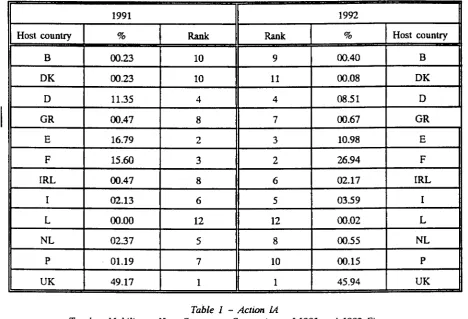
An analysis of the figures given by the Member States on these 516 participants showed that 0.23% of them went to Belgium, 0.23% to Denmark, 11.35% to Germany, 0.47% to Greece, 16.79% to Spain, 15.60% to France, 0.47% to Ireland, 2.13% to Italy, 2.37% to the Netherlands, 1.19% to Portugal and 49.17% to the United Kingdom. No teachers applied to go to Luxembourg.
c) Development and Results in 1992
(see also Annexes 1 and 2 in the Statistical Overview at the end of the report)
The number of grant recipients increased more than tenfold in 1992, with 5,257 teachers receiving LINGUA grants.
Table 1 below shows, as a percentage, the breakdown of these teachers by countries in which the courses were held (see also Annex 1 - Statistical Overview -at the end of the report) and enables a comparison to be made with the figures for 1991. This latter series of figures, however, is given purely as an indication and we should be careful about how we interpret them. As there were far more participants in 1992 than in 1991, very different figures are being compared.
Although several changes can be noted, certain constants are of particular significance.
When the number of projects increases, the significance of the United Kingdom falls slightly
(by 6.56% ), but this country remains well in the lead since almost half the teachers go there to follow a training course. This percentage is higher still if we add to it the teachers who went to Ireland. We can assume that, for the most part, these teachers went there to follow an English rather than an Irish language course.
France is a good way behind. But for the second year running, Spain is making considerable
progress on Germany. ·
rtaly is also improving its percentage (68% more than in 1991 ), even if it is still a fair way behind the 'big' four. However, if we take into account that the overall number of participants is much higher this year, the result is encouraging.
The Danish, Greek, Dutch and Portuguese languages together account for 1.45% of applications. This figure should be credited to the LINGUA Programme which has enabled some one hundred teachers to go to Denmark, Greece, the Netherlands and Portugal to follow courses which they would not have had the means to attend withoUI Community incentive. This dynamic appears to be developing well and applications relating to the least widely used and least taught languages are likely to increase in the months and years to come.
1991 1992
Host country % Rank Rank % Host country
B OK
D
GR
E
F IRL
I
L
NL
p
UK
00.23 10 9 00.40 B
00.23 10 11 00.08 OK
11.35 4 4 08.51 D
00.47 8 7 00.67 GR
16.79 2 3 10.98 E
15.60 3 2 26.94 F
00.47 8 6 02.17 IRL
02.13 6 5 03.59 I
00.00 12 12 00.02 L
02.37 5 8 00.55 NL
01.19 7 10 00.15 p
49.17 1 1 45.94 UK
Table 1 -Action 1A
Teacher Mobility - Host Country - Comparison of 1991 and 1992 Figures
-The Commission's budget commitments, by country, under contracts covering the 1991192 and 1992/93 fmancial years were as follows:
(Note: the Programme's Decentralized Actions do not operate in calendar years, but in school or academic years. They thus make it possible to support, for example, projects undertaken during the period running from 1 August one year to 31 July the next. But these dates may vary depending on the Member States. Some projects which span 1991 and 1992 are taken into account in this 1992 activity report, although these projects were fmanced under the 1991 budget (for the record: the 1991 LINGUA activity report showed figures relating to projects implemented in 1990/91 and fmanced under the 1990 budget). The 1992 budget will be used during the 1992/93 school or academic year. The figures relating to the amounts made available to the Member States within the scope of this 1992 budget are shown in Table 2a, for information and to offer a point of comparison with 1991).
[image:18.580.49.518.226.545.2]Country Budget Country Budget Country Budget Belgium 176,080 ecus Spain 495,238 ecus Luxembourg 21,427 ecus Denmark 89,543 ecus France 689,303 ecus The 173,509 ecus
Netherlands
Germany • 2,071,253 ecus Ireland 62,554 ecus Portugal 164,940 ecus Greece 155,088 ecus Italy 912,436 ecus United 588,629 ecus
Kingdom
(• including the exceptional special grant in favour of the five new Lander)
Country Belgium Denmark
Germany Greece
Table 2 -Action lA - Budget by Country in 1991/92
Budget Country Budget Country Budget
277,610 ecus Spain 783,926 ecus Luxembourg 39,923 ecus 137,670 ecus France 1,059,587 ecus The 275,500 ecus
Netherlands
1,739,598 ecus Ireland 106,728 ecus Portugal 270,578 ecus 255,107 ecus Italy 1,107,406 ecus United 946,369 ecus
Kingdom
Table 2a -Action lA - Budget by Country in 1992/93
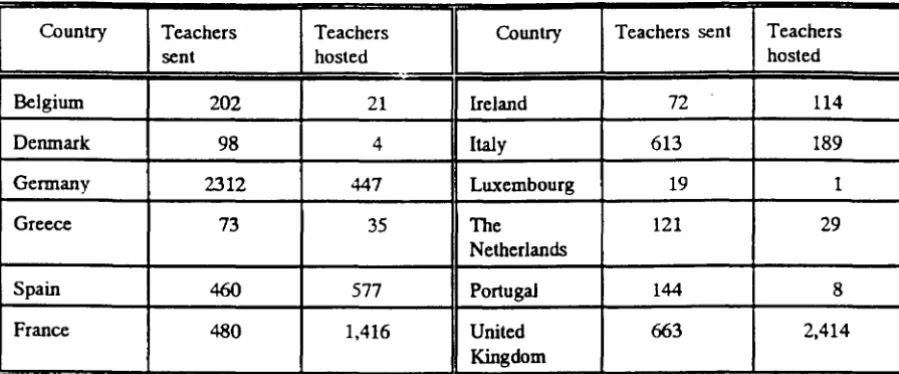
-The flows of teachers sent and hosted, by country, are indicated in Table 3 below (see also Annex 1 - Statistical Overview - at the end of the report). [t can be seen from this table that, among those countries with more widely used and more widely taught languages, the United Kingdom and France hosted more teachers than they sent abroad. Germany completely reversed the trend by sending abroad more than five times the number of teachers it hosted. Spain is the only country to show a near balance
[image:19.584.69.522.99.239.2] [image:19.584.70.523.308.446.2]Country
Belgium
Denmark
Germany
Greece
Spain
France
For those countries with Jess widely used Ia__ :.1ges, Denmark and Portugal sent between 18 and 25 times the number of teachers they ho~L.:.d, the Netherlands four times and Italy three times as many.
Teachers Teachers Country Teachers sent Teachers
sent hosted hosted
202 21 Ireland 72 114
98 4 Italy 613 189
2312 447 Luxembourg 19 1
73 35 The 121 29
Netherlands
460 577 Portugal 144 8
480 1,416 United 663 2,414
Kingdom
Table 3 - Action IA - Incoming and Outgoing Flows
- Through its mobility grants, Action lA of LINGUA has certainly provided a significant number of teachers the opportunity of a European experience they would probably not have had without the Programme. Teachers were thus able to improve their language skills in the foreign country and experience the culture of the countries whose languages they teach.
This Action also contributes towards developing and strengthening a network of contacts between academic establishments abroad, a network which will contribute significantly to the setting up of new Joint Educational Projects within the scope of Action IV of the Programme.
- The administrative problems posed by this Action and brought to the attention of the Council of Ministers on 1 June 1992 (see end of paragraph 'The impact of LINGUA', pages 11 and 12 in the 'Summary') do not appear to have stemmed the rise in applications for training courses in 1992.
2.2.2. Visits and Exchanges of Young People: Joint Educational Projects (Action IV)
a) Definition and Objectives of the Action
Action £V aims to promote the participation of young people, aged between 16 and 25 and who follow specialist, technical or vocational training courses, in exchange programmes based on pedagogical projects called Joint Educational Projects.
The Decision specifies that it is up to each Member State to defme the concept of specialist, technical or vocational training and to limit or expand it as they see fit. As a whole, the twelve countries have decided to give the Decision a broad interpretation and involve general education schools as well.
[image:20.584.66.516.131.318.2]of the host country, and they should if possible acquire a mmtmum amount of technical vocabulary with regard to the topic of the joint activity. These objectives are achieved by setting up educational projects prepared with the utmost care prior to the visit or the exchange and which are fully integrated into the participants' school activities. The educational projects are technical or cultural in nature, but should all comprise a strong linguistic component. b) Review of 1991 Figures
ln the 1991 activity report, the figures supplied by the Member States showed that 4,018 young people had benefited from grants which generally covered a maximum of 50% of the total cost of the projects.
An analysis of the data provided by the Member States and relating to 3, 754 of the 4,018 participants showed that 1.97% went to Belgium, 4.40% to Dertmark, 8.63% to Germany, 1.84% to Greece, 5.91% to Spain, 12.79% to France, 3.30% to Ireland, 6.05% to ltaly, 0.53% to the Netherlands, 4.26% to Portugal and 50.32% to the United Kingdom. No applications were made for Luxembourg.
c) Development and Results in 1992
(see also Annexes 3 and 4 in the Statistical Overview at the end of the report)
The number of beneficiaries increased virtually fivefold in 1992, since 911 projects involving 17,891 young people and 1,829 teachers, ie 19,720 people, were set up and received LINGUA support. Grants for 811 preparatory visits were also awarded.
Table 4 below shows, as a percentage, the breakdown of these young people by countries visited (see also Annex 3 - Statistical Overview - at the end of the report) and enables a comparison to be made with the 1991 figures. As in the case of Action lA, this second series of figures is given purely as an indication and should not be used to draw conclusions which ignore the obvious incongruities between the numbers compared.
1991 1992
Host country % Rank Rank % Host country
Belgium 01.97 9 7 03.39 Belgium
Denmark 04.40 6 6 05.61 Denmark I
Germany 08.63 3 3 08.74 Germany
Greece 01.84 10 11 01.40 Greece
Spain 05.91 5 4 07.85 Spain
France 12.79 2 2 21.42 France
lreland 03.30 8 8 02.80 lreland
[taly 06.05 4 5 07.13 Italy
Luxembourg 00.00 12 12 00.21 Luxembourg
The 00.53 11 9 02.15 The
Netherlands Netherlands
Portugal ·united
Kingdom
04.26 7 10 01.42
50.32 1 1 37.88
Table 4 Action W Mobility of Young People Host Country -Comparison of 1991 and 1992 Figures
Portugal United Kingdom
When participation levels increase and the sample thus becomes more relevant, the percentage for the United Kingdom decreases (by 24.72% compared to 1991) while the percentage for France increases (by 67.47% compared to 1991).
In this way, the United Kingdom and France together hosted more than 59% of participants in Joint Educational Projects.
Germany, Spain and ltaly are far behind, although, split fairly evenly between them, they host almost 24% of the total number of participants.
Danish, Greek, Dutch and Portuguese - the four least widely used languages of the Programme (apart from Irish and Letzeburgesch) - account for almost 11%. The figure is still fairly low, but it is no less encouraging. Considering the range of main languages offered in the school curricula of the Member States, the LINGUA Programme has every reason to be pleased with the contribution it is making in terms of opening up to young Europeans the countries where the least widely used and least taught languages are spoken. Although the impact is still low, it is clear that nothing would have happened without LINGUA. The trend has been set, and only needs now to be strengthened.
The case of Denmark is eXtremely interesting since this country has attracted 5.61% of the total number of participants. This figure ref1ects the attraction that Scandinavian countries continue to hold for other Member States, and more particularly perhaps for the Mediterranean countries. Although Danish has not been the essential language of communication during the visits and work meetings, course reports show that some of the
[image:22.582.56.511.83.401.2]Country Belgium Denmark
Germany • Greece
time has been set aside for the initial immersion of participants in a language that is certainly hardly known or used in Europe.
-The Commission's budget commitments, by country, under contracts covering the 1991/92 fmancial year and the forecasts for 1992/93 were as follows:
(Note: see page 18, first comment in the paragraph on budget commitments relating to Action lA The sums made available to the Member States within the scope of the 1992 budget are shown in Table Sa, for information and to offer a point of comparison with 1991.)
Budget Country Budget Country Budget
159,707 ecus Spain 749,280 ecus Luxembourg 26,712 ecus 102,111 ecus France 721,006 ecus The 254,478 ecus
Netherlands
1,807,423 ecus Ireland 89,544 ecus Portugal 276,471 ecus 226,204 ecus Italy 803,226 ecus United 783,838 ecus
Kingdom
(* including the exceptional special grant in favour of the five new Under)
Country Belgium Denmark
Germany • Greece
Table 5 -Action W- Budget by country in 1991!92
Budget Country Budget Country Budget
241,753 ecus Spain 1,179,376 ecus Luxembourg 41,807 ecus 149,012 ecus France 1,098,546 ecus The 390,650 ecus
Netherlands
1,622,662 ecus Ireland 135,399 ecus Portugal 394,053 ecus 363,423 ecus Italy 1,552,893 ecus United 1,230,426 ecus
Kingdom
Table Sa -Action W- Budget by country in 1992/93
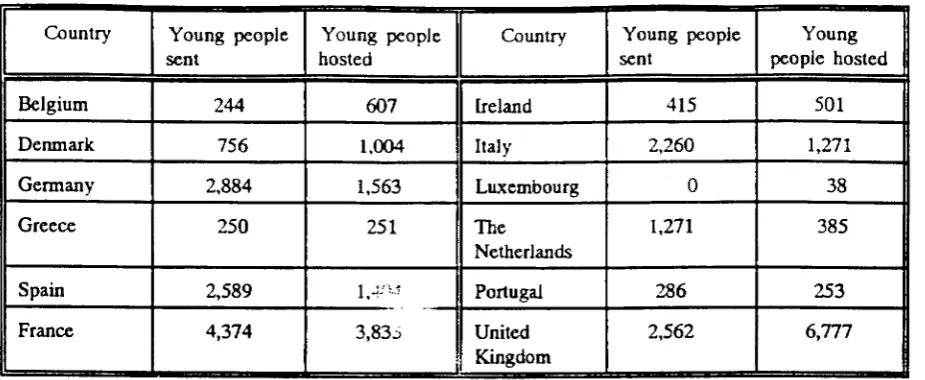
-The flows of young people sent and hosted, by country, are shown in Table 6 below (see also Annex [ - Statistical Overview - at the end of the report). It can be seen from this table that most of the 'big' countries (Germany, Spain, France and Italy) sent more young people than they hosted. The United Kingdom alone provides an exception to this rule with almost three times fewer young Britons leaving than young people coming from other Member States. The smaller countries, however, hosted more young people than they sent, except for the Netherlands (three times more Dutch young people leaving than other nationalities coming). Greece and Portugal have had almost the same number of young people coming as going.
[image:23.588.60.522.211.350.2] [image:23.588.73.528.432.569.2]Country
Belgium Denmark Germany Greece
Spain France
Young people Young people Country Young people Young
sent hosted sent people hosted
244 607 lreland 415 501
756 1,004 Italy 2,260 1,271
2,884 1,563 Luxembourg 0 38
250 251 The 1,271 385
Netherlands
2,589 1.~..: ~ .. 1 Portugal 286 253
-
. ..4,374 3,83.:i United 2,562 6,777
Kingdom
Table 6 - Action W - Incoming and Outgoing Flows
- The dynamics of Action IV are now well in place, even if a few Member States have still experienced difficulties in using up their total budget. This Action contributes largely, and in an entirely original manner, to the development of language skills and the European dimension in very different types of educational establishments.
The fact that in 1992 the Commission simplified the procedures for the Member States to run this Action, by asking the same National Agency to fmance both the costs of sending and hosting project participants, contributed to the development of new initiatives.
Reciprocating visits within projects continues to be a problem. Although reciprocity is not compulsory, it is strongly encouraged. lf the principle of reciprocity were generalized and systematized, it would risk creating serious problems for those Member States which are very much 'in demand'. The United Kingdom, in particular, would have great difficulty fmancially in reciprocating with all its partner establishments. On the other hand, establishing this reciprocity in projects initiated by other countries would risk preventing British establishments from encouraging and setting up the kinds of projects they would like.
- As was the case for Action lA, the administrative problems posed by this Action and which were brought to the attention of the Council of Ministers on 1 June 1992 (see end of paragraph 'The impact of LINGUA', pages 11 and 12 of the 'Summary') do not appear to have impeded the development of Projects.
2.3. Centralized Actions
(Note: unlike the Decentralized Actions, these Actions are run in calendar years and have generated projects submitted and supported in 1992.)
2.3.1. The Network of European Cooperation Programmes (Action IB)
a) Definition and Objectives of the Action
The European Cooperation Programmes constitute an entirely new approach to the in-service training of foreign-language teachers.
[image:24.581.51.514.81.271.2]{51
environment of the target language and their mastery of various teaching methods not only in their national context but also in a transnational environment.
This priority objective is achieved by means of active cooperation between the in-service training establishments of at least two Member States. Innovations in the field of the methodologies of teaching and learning foreign languages and the use of new information technologies are important aspects to be considered in the joint development of a European Cooperation Programme.
b) Review of the 1991 Figures
In 1991 (contract period running from 1 September 1991 to 31 August 1992), twelve projects received fmancial support.
1bree projects were coordinated by France, two by ltaly, one by Portugal and six by the United Kingdom. These four countries also participated as partners in several projects along with Germany (seven partner institutions in the projects) and Spain (six partner institutions). The languages targeted by the projects were Spanish (six times), German (six times), Greek (once), English (seven times), French (ten times), Italian (six times) and Portuguese (twice).
c) Development and Results in 1992
- 62 applications were submitted in 1992, bringing together 187 partner institutions. Of these 62 applications, 25 Programmes (including seven renewed Programmes accepted in 1991) were set up (or continued to operate) with LINGUA _support for a contract period running from 1 September 1992 to 31 August 1993. The amount of support from the LINGUA Programme requested by these 25 partnerships amounted to 1,733,187 ecus, and a total Community support of 1,431,000 ecus was granted.
-These 25 Programmes involved 110 different establishments. The most frequent partners in the teams were universities or official, national or local teacher training institutions.
-The languages targeted by the projects were Spanish (10 times), Danish (3 times), German (14 times), Greek (6 times), English (14 times), French (18 times), lrish (3 times), ltalian (10 times), Dutch (5 times) and Portuguese (8 times).
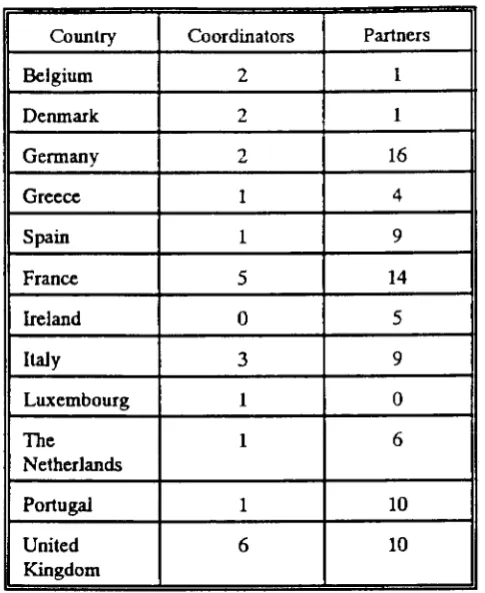
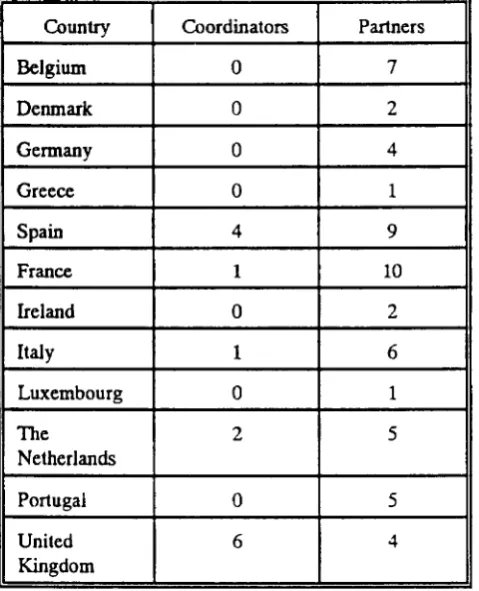
- As shown in the following table, all the Member States were represented in the projects either as coordinators (all except for lreland) or as partners (all except for Luxembourg).
Country Coordinators Partners
Belgium 2 1
Denmark 2 1
Germany 2 16
Greece 1 4
Spain 1 9
France 5 14
Ireland 0 5
Italy 3 9
Luxembourg 1 0
The 1 6
Netherlands
Portugal 1 10
United 6 10
Kingdom
Table 7 -Action IB - Coordinators and Partners by Country
- The criteria for selecting new projects were essentially based on:
. the quality of the applications in terms of potential and original contribution to an improvement in the in-service training of foreign language teachers and their trainers . the priority given to joint curricula development for the in-service training of foreign language teachers and their trainers
. the importance of transnational partnerships and the effort to have all Member States represented as either coordinators or partners.
-The same criteria were adopted for renewal applications. However, in the absence of fmal phase one reports at the time of selection, (as specified in the contracts, reports were received after the period for evaluating applications), renewal applications were examined in the light of interim reports and the evaluators' knowledge of results and progress already achieved and recorded.
- The selection of all Programmes supported by the Commission took into account the impact these training projects could have on the general quality of the professional development of teachers and their trainers, in particular when the content and established partnerships enable participants, through the experience they have acquired in the projects, to develop new expectations, new attitudes or new strategies with regard to the training of foreign language trainers, and enable them to question themselves and to challenge and refocus their own expertise.
[image:26.581.161.404.126.423.2]- The Commission also selected the European Cooperation Programmes in such a way that they could in future begin innovative training activities so as to offer support to grant-holders under Action IA of the Programme (see Decentralized Actions).
- Not much use was made of preparatory visits leading to the setting up of European Cooperation Programmes as provided for by the Decision, as only 41 applications were submitted in all, of which only four were accepted (most of the rejected applications came from language teachers applying for support to follow a training course abroad which fell outside the scope of Action IA of the Programme). .
Seven applications for additional visits were submitted by 31 December 1992, of which three were accepted. However, these visits were supported by the 1993 budget and are not taken into account here.
These preparatory visits are currently undergoing much promotion. By enabling possible future partners to meet and contemplate the advisability and feasibility of a project together, the visits serve as a good means of setting up well motivated and suitably prepared European Cooperation Programmes in the future.
2.3.2. The European Network of Inter-university Cooperation Programmes and the Mobility of Students and Higher Education Staff (Action II)
a) Defmition and objectives of the Action
This Action incorporates a set of measures intended to promote the learning of foreign languages at university and in other higher education establishments and in particular to fmance the initial training of future foreign-language teachers.
More specifically, these measures consist of providing grants favouring the creation of Inter-university Cooperation Programmes and fostering the mobility of students and teachers. Grants are also available to support study visits made by members of teaching and administrative staff in higher education.
The objective of student mobility programmes is to enable students to complete a study period in another Member State of at least three months duration fully which is recognized in their own Member State.
The support provided for mobility programmes for foreign-language teachers is intended to enable them to practise in another Member State for a period lasting one week to one year. The study visit grants should be used by staff for preparing and implementing mobility programmes or increasing their competence in language teaching.
b) Review of 1991 Figures
ln 1991, grants were awarded to 149 Inter-university Cooperation Programmes bringing together 627 institutions and involving 4,180 students.
Of these 149 programmes, 144 were student mobility programmes and 32 teacher mobility programmes. 56 study visits were also accepted.
c) Development and Results in 1992
(see also Annex 12 in the Statistical Overview at the end of the report)
- 232 applications bringing together 1,040 partner institutions were submitted in 1992. Of these, 211 programmes (including 162 renewals and 49 new applications) were set up (or continued to operate) with LINGUA support for the 1992/93 academic year. The fmancial support permitted for this Action amounted to 7.53 million ecus in 1992.
- These 211 programmes involved 972 different partner institutions and 6, 724 eligible students. Given the definition and objectives of this Action, all the partners were universities or similar higher education establishments.
- 54 applications were received for study visits, of which 40 were accepted (nine for Germany, eight for the United Kingdom, five for France, four for Spain, three for Denmark, Italy and Portugal respectively, two for Greece and one for Belgium, Ireland and the Netherlands respectively.
Special attention was again paid to projects intending to promote the least widely used and least taught languages and those relating to the initial training of language teachers.
As for the preparatory visits for the setting up of Action IB (see 2.3.1.) or Action IIf projects (see 2.3.3.), the study visits for Action II were insufficiently used and a promotional effort should be made for the future.
- ln selecting projects for support, preference was systematically given to those concerned with the least widely used and least taught languages, and 48 of the 211 projects selected were dedicated to them.
As in previous years, the 1992 selection policy paid particular attention to ensuring that the priorities of the LINGUA Programme are scrupulously observed. It confirmed its multiannual commitment to most of the projects accepted for 1991/92, but nevertheless continued to encourage universities to develop new inter-university cooperation initiatives.
The policy also ensured that preference was given to programmes giving an important place to the initial training of future language teachers. 53 out of 211 programmes clearly noted this specific dimension, and most of them (193 out of 211) indicated the likelihood that the participating students would become language teachers.
The main characteristics of the selection were as follows:
. the number of prl)grammes accepted increased by 41.6% compared to the previous year . there were also considerably more institutions participating in the programmes (55% more than in 1991)
. student mobility programmes increased by 41%, and the number of eligible students by 61% compared to 1991
. teacher mobility programmes increased by 81% compared to the previous year.
2.3.3. Languages and economic life (Action Ill)
a) Defmition and Objectives of the Action
The Action provides for the following measures:
. a language audit, whereby the programme contributes to the design, development and dissemination of techniques for analysing the foreign language requirements of economic life, particularly the requirements of enterprises, professional organizations and workers;
. the development of teaching materials to be used on the spot, in distance learning or self-tuition;
. the establishment of transnational reference systems to recognize the language skills of those involved in economic life, particularly those skills acquired by learners on language training courses;
. the development of mobility for foreign language trainers in economic life, representatives of small and medium-sized enterprises and professional organizations concerned with the problems of foreign language training by promoting study visits.
b) Review of 1991 Figures
In 1991 (contract periods running from 1 July 1991 or 1 January 1992 to 31 December 1992); 58 projects were awarded grants.
Two projects were coordinated by Belgium, four by Qenmark, ten by Germany, seven by Greece, two by Spain, ten by France, two by lreland, six by ltaly, one by Luxembourg, three by the Netherlands and 11 by the United Kingdom. No projects were coordinated by Portuguese establishments. However, all the Member States without exception were represented as partners.
All of the Community languages were targeted on several occasions: Spanish (12 times), Danish (6 times), German (17 times), Greek (11 times), English (20 times), French (24 times), Irish (4 times), Italian (14 times), Letzeburgesch (twice), Dutch (9 times) and Portuguese (7 times).
c) Development and Results in 1992
- 170 applications were submitted in 1992 bringing together 774 partner institutions, out of which 86 projects (including 34 renewals to projects set up in 1991) were set up (or continued to operate) with LINGUA support for contract period-; running from 1 July 1992 to 30 June 1993 for projects submitted during the 15 March 1992 selection round, or from 1 January to 31 December 1993 for projects submitted during the 15 September 1992 selection round. Grants applied for under the LINGUA Programme by these 86 partnerships amounted to 8,359,193 ecus and total Community support of 7,003,500 ecus was awarded.
- These 86 projects involved 441 different institutions.
The universities or university centres conducting research on language teaching were those most largely represented (102 institutions), with vocational training institutes in second place (74 institutions), foiJowed by adult training centres (53 institutions). Partnerships also included small and medium-sized enterprises, Chambers of Commerce and various sectoral organizations (47), language centres (43), professional associations and trade unions (32), ministries and local and regional authorities (22), publishers and those involved in developing and disseminating teaching materials (16), and to a lesser extent language examination centres, various teaching and applied linguistics institutes, associations and federations of language teachers and various other institutions.
- The type of projects submitted most often related to teaching materials, distantly foiJowed by several projects for auditing and analysing language requirements and for certifying and setting up training courses. However, it should be noted that in almost all projects concerning