Full Terms & Conditions of access and use can be found at
http://www.tandfonline.com/action/journalInformation?journalCode=rhpb20
Download by: [2.31.225.213] Date: 15 June 2017, At: 04:25
Health Psychology and Behavioral Medicine
An Open Access Journal
ISSN: (Print) 2164-2850 (Online) Journal homepage: http://www.tandfonline.com/loi/rhpb20
Determinants of objective adherence to nebulised
medications among adults with cystic fibrosis: an
exploratory mixed methods study comparing low
and high adherers
Z. H. Hoo , J. Boote, M. J. Wildman, M. J. Campbell & B. Gardner
To cite this article: Z. H. Hoo , J. Boote, M. J. Wildman, M. J. Campbell & B. Gardner (2017) Determinants of objective adherence to nebulised medications among adults with cystic fibrosis: an exploratory mixed methods study comparing low and high adherers, Health Psychology and Behavioral Medicine, 5:1, 299-316
To link to this article: http://dx.doi.org/10.1080/21642850.2017.1338958
© 2017 The Author(s). Published by Informa UK Limited, trading as Taylor & Francis Group
View supplementary material
Published online: 15 Jun 2017.
Submit your article to this journal
View related articles
Determinants of objective adherence to nebulised
medications among adults with cystic fibrosis: an exploratory
mixed methods study comparing low and high adherers
Z. H. Hoo a,b, J. Bootea,c, M. J. Wildmana,b, M. J. Campbellaand B. Gardner d
a
School of Health and Related Research (ScHARR), University of Sheffield, Sheffield, UK;bSheffield Adult CF Centre, Northern General Hospital, Sheffield, UK;cCentre for Research into Primary and Community Care, University of Hertfordshire, Hertfordshire, UK;dDepartment of Psychology, Institute of Psychiatry, Psychology and Neuroscience (IoPPN), King’s College London, London, UK
ABSTRACT
Objectives: Adherence to nebulised treatment is typically low among people with cystic fibrosis (CF). This study sought to identify factors differentiating high or low nebuliser adherence patterns (i.e.≥80% or <50% of all nebulised treatments over one year) among adults with CF.
Design: A mixed methods cross-sectional exploratory comparison of low and high adherers to nebulised medications.
Methods: Of 36 eligible adults invited from a UK CF centre, 20 were recruited (10 high, 10 low adherers). Adherence was objectively measured using electronic data capture. Participants completed a self-report questionnaire comprising measures of hypothesised predictors (habit, self-control, life chaos, perceived treatment burden, capability, motivation and opportunity), then took part in a semi-structured interview. Quantitative data were compared between groups, and interview data were thematically analysed. Results: High adherers reported stronger habit and greater opportunities, though habit and perceived opportunity scores were highly positively correlated. No other quantitative measure distinguished between groups. Habitual instigation tendency attenuated the relationship between treatment complexity and perceived treatment burden. Indeed, in interviews, high adherers reported that routinisation and greater automaticity made treatment burden more manageable.
Conclusions: High adherers seized more opportunities for nebuliser use, adapted their lives more effectively to using nebulisers and were more likely to make nebuliser use habitual. Nebuliser adherence interventions among adults with CF might usefully target development of routines for instigating nebuliser use, and identification of opportune moments for nebuliser use.
ARTICLE HISTORY
Received 9 April 2017 Accepted 2 June 2017
KEYWORDS
Medication adherence; cystic fibrosis; habits; qualitative research; mixed methods
© 2017 The Author(s). Published by Informa UK Limited, trading as Taylor & Francis Group
This is an Open Access article distributed under the terms of the Creative Commons Attribution License (http://creativecommons.org/ licenses/by/4.0/), which permits unrestricted use, distribution, and reproduction in any medium, provided the original work is properly cited. CONTACT Z. H. Hoo [email protected] Sheffield adult CF Centre, Northern General Hospital, Room 1.03, Innovation Centre, 217, Portobello, Sheffield S1 4DP, UK
Introduction
Cystic fibrosis (CF), which affects around 10,000 people in the UK, is a genetic condition which causes the lungs and digestive system to become clogged with thick mucus (UK Cystic Fibrosis Trust,2016). This leads to many challenging symptoms, including recur-rent lung infections and reduced nutrient absorption from food (O’Sullivan & Freedman,
2009). Median survival is around 45–50 years (Burgel et al.,2015). Over 80% of mortality is due to progressive lung function decline and respiratory failure (O’Sullivan & Freedman,
2009).
Inhaled treatments are vital to prevent acute deterioration in lung health (i.e. pulmon-ary exacerbations) and so reduce the rate of lung function decline (Agent & Parrott,2015). These treatments are usually delivered via a nebuliser, and typically consist of once or twice-daily mucolytics to augment airway clearance and twice-daily antibiotics to eradi-cate infection or to prevent pulmonary exacerbations. High adherence is associated with reduced lung function decline, fewer pulmonary exacerbations and lower treatment costs (Eakin, Bilderback, Boyle, Mogayzel, & Riekert, 2011; Quittner et al., 2014). However, in the US and UK, adherence is only around 30–50% (Daniels et al.,2011; Quitt-ner et al.,2014). At present, there are no effective nebuliser adherence interventions for people with CF (Glasscoe & Quittner,2008; Savage et al.,2011).
Improving adherence requires understanding the determinants of adherence to inhaled treatments among people with CF. There is, however, scant research in this area.
Qualitative studies in CF have tended to identify‘treatment burden’ –that is, the dur-ation, frequency and complexity of treatment regimes –and competing work or social demands as most problematic for nebuliser use (George et al., 2010; Hogan, Bonney, Brien, Karamy, & Aslani, 2015; Sawicki, Heller, Demars, & Robinson, 2015). People with CF typically spend 2–3 hours daily preparing and using treatments, with airway clearance and inhaled treatments particularly time-consuming (Hafen, Kernen, & De Halleux, 2013; Sawicki, Sellers, & Robinson, 2009). Similarly, quantitative studies have suggested that ‘lack of time’, ‘forgetting’ and‘being too busy’ are significant barriers to nebuliser use, especially among adolescents (Bregnballe, Schiøtz, Boisen, Pressler, & Thastum,2011; Dziuban, Saab-Abazeed, Chaudhry, Streetman, & Nasr,2010). Yet, objec-tive adherence data, collected using the I-neb®adaptive aerosol delivery nebuliser system, which accurately logs every nebuliser use episode (Geller & Madge,2011), have demon-strated that adolescents with CF are most adherent during school term-time weekdays (Ball et al.,2013). This is when adolescents are likely to be busiest, and so most susceptible to lapse due to treatment burden. Furthermore, alternative treatments developed to alle-viate burden–such as dry powder inhalers, which are quicker to inhale and do not require cleaning – have produced only short-term improvements in self-reported adherence (Brown et al.,2015; Harrison et al.,2014). Treatment burden may not therefore offer a sufficient explanation for low adherence.
Most studies of adherence determinants among people with CF have eschewed explicit psychological theory (but see Hogan et al.,2015). Yet pertinent medication adherence the-ories are available. For example, the Necessity-Concerns Framework posits that patients adhere where perceived necessity exceeds concerns around medication (Horne et al.,
& Cottrell,2016; Horne et al.,2013). The Perceptions and Practicalities Approach (PAPA) proposes that non-adherence can be intentional, arising from attitudinal barriers (e.g. lack of necessity, overwhelming concerns), or unintentional, arising from practical barriers (e.g. lack of time). Intentional non-adherence has been cited as a major treatment barrier in CF (George et al.,2010; Hogan et al.,2015; Sawicki et al.,2015).
Both empirical studies of nebuliser use barriers among people with CF, and dominant broader theories of medication adherence, have assumed that adherence arises from rational deliberation. Yet, dual process theories propose that behaviour may be directed either via conscious deliberation, or through more rapid, automatic processing (e.g. Strack & Deutsch, 2004). The Capability, Opportunity and Motivation (COM-B) model, which incorporates all potential determinants of action (Michie, van Stralen, & West,2011), posits three factors necessary for any behaviour to occur: perceptions of capa-bility, opportunity and motivation. Each of these may be subdivided: capability may be psychological (e.g. knowledge) or physical (e.g. dexterity); opportunity may be social (e.g. permission to use nebulisers at the workplace) or physical (e.g. medication avail-ability) and, in light of dual process models, motivation may be reflective and deliberative (e.g. necessity, concerns) or non-reflective, drawing on automatic processes (e.g. habit associations). Factors such as intentional non-adherence represent inaction arising from a lack of reflective motivation for nebuliser use.
The COM-B model demands explanations for low adherence over and above treatment beliefs, which are one component of reflective motivation. In addition, understanding nebuliser adherence requires focusing not only on those with low adherence, but those who consistently adhere. Some people can maintain consistently high adherence for many years (McNamara, McCormack, McDonald, Heaf, & Southern, 2009). ‘High adherers’ may have better self-regulatory skills or resources (i.e. greater psychological capability). Self-regulation is effortful and uses up limited mental resources (Baumeister & Alquist, 2009). Previous studies have identified adults with CF intentionally not using nebuliser, to better cope with other concurrent treatments (Hogan et al., 2015). Others have found alternating regimes of inhaled tobramycin (28 days on treatment fol-lowed by 28 days off) to be more tolerable than continuous regimes of inhaled mucolytics (Dziuban et al., 2010), which may reflect a need to replenish self-regulatory capacity during non-use periods (Baumeister & Alquist,2009).
High adherers may perhaps also be better able to routinise nebuliser use.‘Routinisation’
(Lally & Gardner, 2013). ‘Chaotic’ lifestyles, which lack structure and predictability (Wong, Sarkisian, Davis, Kinsler, & Cunningham,2007), are associated with lower medi-cation adherence (Wong et al.,2007; Zullig et al.,2013).
Habitual actions can be discerned into two types: habitually instigated sequences (action sequence automatically initiated without deliberation) and habitually executed
actions (action performed to completion without conscious input; Gardner, 2015; Gardner, Phillips, & Judah, 2016; Phillips & Gardner, 2016). Habitual instigation does not necessitate habitual execution, and vice versa; a nebuliser use episode may be habitu-ally instigated but the nebuliser used non-habituhabitu-ally (e.g. triggered at the same time of day, but performed mindfully in a varying sequence) or the episode non-habitually instigated but habitually performed (e.g. mindfully triggered, but performed in an automated and unvarying sequence; Gardner, 2015). While habitual instigation tendency is likely to predict the frequency of nebuliser use episodes (Gardner et al., 2016; Phillips & Gardner, 2016), habitual execution tendencies may perhaps also support adherence, by making progression through the procedural intricacies of nebuliser use easier to perform (Gardner et al.,2016).
The present study
Previous studies of the determinants of nebuliser adherence among people with CF have focussed on self-reported adherence, reflective motivational constructs and barriers among low adherers, rather than facilitators among high adherers. Theory suggests that both reflective and non-reflective processes influence medication adherence among adults with CF, but this has yet to be empirically explored. The present study therefore used objective adherence data to identify both low and high adherers, and explored reflec-tive and non-reflecreflec-tive processes that may discriminate between these two groups. This exploratory study, designed to generate ideas for testing in a larger sample, could point to potentially valuable avenues of future research A mixed methods design was used (Curry et al.,2013) with quantitative analyses of relationships between potential determi-nants and adherence, and a realist qualitative analysis to offer in-depth insights into the specific beliefs, attitudes and values that may underpin such relationships.
Method
Procedure
This was a mixed methods cross-sectional exploratory study among adults with CF, selected to represent high nebuliser adherence (≥80% annual adherence), and low nebu-liser adherence (<50% annual adherence). Adherence of≥80% is considered‘high’because such an adherence rate yields better health outcomes (Eakin et al.,2011; Karve et al.,2009). Adherence of <50% indicates a general tendency not to adhere, and is considered ‘low’ (Eakin et al.,2011).
and invited them to take part. Details of all prescribed treatments were collected from those who consented and checked against medical records. Next, participants completed a questionnaire comprising measures of potential adherence predictors, and subsequently a face-to-face semi-structured interview. Interviews lasted 30–60 minutes to broadly explore patients’ experiences around nebuliser use. The interview topic guide was suffi-ciently open to allow emergence of new insights (see Appendix). The topic guide was informed by the extant literature in similar clinical areas (e.g. Hogan et al., 2015), and the clinical experience and expertise of the research team. It was refined after the first four interviews, taking into account the results of those initial interviews. Digitally recorded interviews were transcribed verbatim. Participants were offered the option to review their own interview transcript for data verification. All the participants were known to HZH who performed the interviews and analysed the data, since he worked as a doctor with the CF clinical team for∼18 months prior to data collection. However, nebuliser adherence is not an issue that typically entails detailed discussion between doctors and adults with CF in the centre, with physiotherapists taking a lead on this for the multidisciplinary team. Approval for the study was granted by a National Research Ethics Service Committee.
Participants
Participants were recruited from an adult CF Centre in the North of England, which at the time of data collection (May–August‘15) had∼200 registered patients aged≥16 years diagnosed, to UK CF Trust criteria, as having CF. Eligible participants with CF used I-neb® as part of their treatment and had baseline objective annual adherence of either
≥80% or <50%. People in the palliative phase of disease, pregnant women, those with transplanted lungs or actively listed for lung transplantation, or lacking capacity to consent were excluded.
We set a target sample size of 20–24 patients (i.e. 10–12 people with≥80% adherence, 10–12 with <50% adherence). This was deemed sufficient to achieve theoretical saturation in qualitative analysis (Guest, Bunce, & Johnson, 2006; Onwuegbuzie & Leech, 2007), while also feasible given a limited pool of eligible participants within a single CF centre. Of 36 eligible adults with CF (18 high, 18 low adherence) attending clinical reviews in May–August 2015, 20 participated (10 high, 10 low adherence; 56% recruitment rate).
Measures
Health outcomes
Health data were obtained from medical notes.Best lung functionwas operationalised as the highest % predicted forced expiratory volume in 1 second (FEV1) calculated with the Knudson equation (Knudson, Lebowitz, Holberg, & Burrows,1983) for a 1-year period up to the day of recruitment.Pulmonary exacerbations severity and frequencywere captured via total intravenous (IV) antibiotic days over the same 1-year period.
Nebuliser adherence
Hypothesised predictors of adherence
These were chosen based on a review of previous literature (see Introduction, paragraphs 7–9). Unless stated, all hypothesised predictors were self-reported using statements with which participants rated agreement from 1 (strongly disagree) to 7 (strongly agree). These statements are listed in the Appendix.
Treatment burdenwas measured in two ways.‘Objective’burden was measured via the Treatment Complexity Score (Sawicki et al.,2013), which assigns a value of 1, 2 or 3 (3 = highest burden) to the 37 CF maintenance therapies, producing a single score from 0 (no burden) to 72 (highest burden).‘Subjective’burden was self-reported using two statements modified from the CF Questionnaire-Revised (CFQ-R; Quittner, Buu, Messer, Modi, & Watrous, 2005; e.g. ‘My nebuliser treatment makes my daily life more difficult’; α = .74). These two statements were chosen from the three statements in CFQ-R that measure treatment burden, since they have the best face validity.
Self-regulationwas measured with all eight statements from the Brief Self-Control Scale (Tangney, Baumeister, & Boone,2004; e.g.‘I am good at resisting temptation’;α= .68).
Life chaoswas measured via all six statements from the Modified Confusion, Hubbub and Order Scale Life (Wong et al.,2007; e.g.‘My life is organised’;α= .68).
Habitwas measured in three ways. The habitual nature of nebuliser use was measured using all four statements from the Self-Report Behavioural Automaticity Index (SRBAI; Gardner, Abraham, Lally, & de Bruijn, 2012), a validated subscale of the Self-Report Habit Index (Verplanken & Orbell, 2003). A sequence of ‘habitual’ behaviour can be habitually triggered (habitual instigation) and/or automatically performed to completion after being triggered (habitual execution; Gardner et al.,2016). As originally formulated however, the SRBAI does not distinguish between habitual instigation or execution, but rather offers a non-specific habit measure that potentially incorporates elements of insti-gation and execution (Gardner et al.,2016). The original SRBAI wording formulation was used to measurenon-specific habitwith four items (e.g.‘Using my nebuliser is something I do automatically’;α= .82). To aid identification of the precise location of habit in nebuliser use sequences, habitualinstigationand habitualexecutionwere also measured. To mini-mise participant burden, habitual instigation and execution were each measured using a single item from the SRBAI, which differed only in the item stem (instigation:‘Deciding to use my nebuliser… ’; execution: ‘Once I have decided to use my nebuliser, using my nebuliser … ’ [‘ …is something I do without having to consciously remember’]; Gardner et al.,2016). This item was selected on the basis that, of four SRBAI items, it showed the strongest item-total agreement in pilot data among 15 adults with CF (Curley,2014).
Intention(e.g.‘I intend to use my nebuliser’;α= .88),opportunity(α= .38) and capa-bility (α=–.43) were each measured using two statements with the best face validity to represent nebuliser use adapted from the COM-B, Self-Evaluation Questionnaire (Michie, Atkins, & West,2015). Lack of reliability suggested that items were measuring different facets of opportunity and capability (e.g. control over external barriers vs self-efficacy; Ajzen, 2002). Opportunity and capability were thus represented in the analysis by two single items, labelled according to which specific facet was assessed (opportunity:
using my nebuliser’[‘capability, external control’],‘I could overcome barriers to using my nebuliser if I invest the necessary effort’[‘capability, self-efficacy’]).
Analysis
Integration between qualitative and quantitative components
Quantitative and qualitative data were collected concurrently (Curry et al.,2013). The‘ fol-lowing a thread’technique was used to integrate analyses, since this technique preserves the value of the open qualitative data whilst incorporating the focus of the quantitative data (Moran-Ellis et al., 2006; O’Cathain, Murphy, & Nicholl, 2010). Key differences (‘threads’) observed in the initial quantitative analysis between high and low adherers prompted consultation of qualitative data to aid interpretation; and key insights (‘threads’) obtained from initial qualitative analysis prompted consultation of quantitative data.
Quantitative data analysis
This involved describing and comparing characteristics of‘high’and‘low adherers’. Due to the pragmatic but small sample size, null-hypothesis significance testing was not per-formed. Thus, effect sizes and confidence intervals are reported, but not p-values (Cumming, 2014). Due to a non-normal data distribution and presence of outliers, non-parametric methods (Campbell & Gardner,1988) were used to estimate group differ-ences and confidence intervals for all continuous variables. This method assumes the two groups have the same distribution shifted by a fixed parameter. The shift parameter is not necessarily the difference in median, rather it is the median of all possible differences. For categorical data, difference in proportions and confidence intervals were calculated using the Wilson procedure without continuity correction (Newcombe, 1998). Linear corre-lation between continuous variables was determined using non-parametric method (Spearman’s rho; Altman & Gardner,1988). All pertinent effects observed for non-specific habit were followed up with analyses to determine whether such effects were attributable to habitual instigation or habitual execution.
In light of a‘thread’that emerged from qualitative analysis, further exploratory analyses of habit were run. In these analyses, the sample was dichotomised into those who‘had habit’(high level of automaticity, habit score≥4, that is, at or above the scale midpoint; see Lally, Van Jaarsveld, Potts, & Wardle,2010) or‘had no habit’(habit score < 4), on each of the three habit measures (i.e. had non-specific habit vs no non-specific habit, had insti-gation habit vs no instiinsti-gation habit, had execution habit vs no execution habit). Analyses were run using R v3.3.0 (www.r-project.org). Graphs were generated using Prism v7 (GraphPad Software).
Qualitative data analysis
for themes and verified that theoretical saturation had been reached at 17 interviews, as no further insights emerged from subsequent analyses. A shared analytic framework was agreed upon through discussions between the two coders. HZH then extracted pertinent data using the agreed coding framework. At this stage, it was apparent that some of the emergent themes tied up closely with the concepts addressed in the questionnaire, and this helped the organisation of codes into broader themes. These themes were reviewed and refined in discussion with BG.
Results
Quantitative results
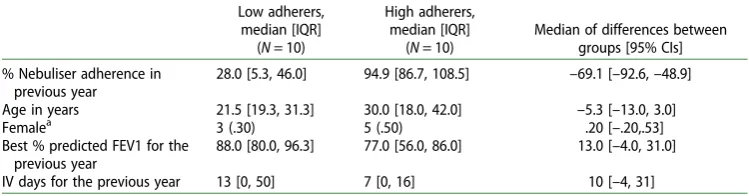
Low adherers tended to be younger and had higher lung function (% predicted FEV1), yet had more severe or frequent pulmonary exacerbations (i.e. greater IV antibiotics use; median of differences 10 days [95% CIs: –4, 31]; see Table 1). Participants seemed to have similar demographic and clinical characteristics to the local population of adults with CF that have similar adherence levels (see Appendix Table 1).
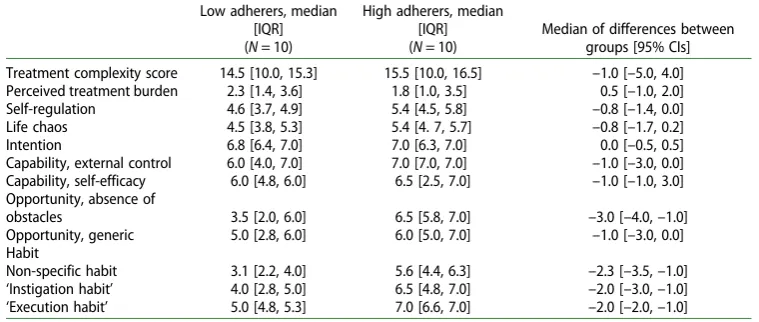
Scores on most potential predictors were similar across both groups (seeTable 2and Appendix Figure 1). However, low adherers had slightly lower self-regulation scores (median of differences –0.8; [–1.4, 0.0]). There were moderate to large differences in opportunity and non-specific habit scores between the two groups of participants, and a strong positive correlation between those two variables (‘Opportunity, absence of obstacles’ r= .66 [.30,.85]; ‘Opportunity, generic’ r= .75 [.46,.90]). Follow-up analyses suggested that opportunity-habit correlations were for instigation habit (‘Opportunity, absence of obstacles’r= .47 [.03,.75];‘Opportunity, generic’r= .51 [.09,.78]) rather than execution habit (‘Opportunity, absence of obstacles’ r= .43 [–.01,.73]; ‘Opportunity, generic’r= .34 [–.11,.68]).
[image:9.493.59.434.539.637.2]Low adherers reported non-specific habit scores that were on average 2.3 points lower than high adherers [–3.5,–1.0] on a 1–7 scale.‘Instigation habit’ may have better differ-entiated between high adherers (median 6.5 [4.8, 7.0]) and low adherers (median 4.0 [2.8, 5.0]; median of differences 2.0 [1.0, 3.0]) than did‘execution habit’(high adherers median 7.0 [6.6, 7.0]; low adherers median 5.0 [4.8, 5.3]; median of differences 2.0 [1.0, 2.0]). High adherers were more likely to ‘have non-specific habit’ (9/10 high adherers vs 3/10 low adherers; difference in proportion = .60 [.17,.81]). High adherers (9/10) tended to be more likely to ‘have instigation habit’ than did low adherers (6/10; difference in pro-portion = .30 [–.08,.60]). All participants were classified as‘having execution habit’.
Table 1.Clinical characteristics and outcomes of high (n= 10) and low (n= 10) adherers. Low adherers,
median [IQR] (N =10)
High adherers, median [IQR]
(N =10)
Median of differences between groups [95% CIs]
% Nebuliser adherence in previous year
28.0 [5.3, 46.0] 94.9 [86.7, 108.5] –69.1 [–92.6,–48.9]
Age in years 21.5 [19.3, 31.3] 30.0 [18.0, 42.0] –5.3 [–13.0, 3.0]
Femalea 3 (.30) 5 (.50) .20 [–.20,.53]
Best % predicted FEV1 for the previous year
88.0 [80.0, 96.3] 77.0 [56.0, 86.0] 13.0 [–4.0, 31.0]
IV days for the previous year 13 [0, 50] 7 [0, 16] 10 [–4, 31]
Qualitative results
Four themes underpinned participants’experience of using inhaled therapy:‘awareness & experiences of health consequences’, ‘cues, routinisation & automaticity’,‘prioritisation’, and‘coping with treatment burden’.
Awareness & experiences of health consequences
Knowledge and experience of the health benefits of using, and not using nebulised treat-ments appeared important in motivating use among both low and high adherers.
Acute periods of ill-health reportedly made nebuliser use seem more effortful. However, high adherers took steps to persist with treatments in spite of difficulties (‘If I’ve got to take it, doesn’t matter if I’m unwell or well, I’ve still got to take it in that day’; Participant 3 [P3], high adherence), and indeed, for some, ill-health increased motivation to use nebuliser treatment, as a means to avoid health worsening further.
Two low adherers relied exclusively on experiencing symptoms to prompt their nebu-liser treatment, and did not use nebunebu-lisers when they felt well. Most nebulised treatments have no immediate noticeable impact, and two low adherers reported that the relative
‘invisibility’ of health benefits made it difficult for them to appreciate the necessity of using nebuliser.
Some preferred treatments with immediate and tangible benefits (i.e. hypertonic saline, which typically stimulates vigorous coughing and increases sputum expectoration) over those with less visible outcomes (dornase alfa or DNase, which more effectively improves lung function but generally produces no immediate perceivable changes; Suri et al.,2001).
DNase I don’t know if it [makes a difference] or not, but I just believe in it. […] Hypertonic
saline definitely has a massive positive effect on my chest. So for that reason, I don’t miss
[opportunities to use my hypertonic saline]…but [this is] not [necessarily the case for]
my DNase. (P13, high adherence)
High adherers often reported experiencing benefits of nebulised treatments, or had experi-enced consequences of previous low adherence (‘I don’t get half as chesty using [my nebu-liser regularly] now, than when I didn’t use it’; P1, high adherence).
[image:10.493.57.437.64.225.2]While high adherers reported having previously been prompted by experiencing symp-toms, for most, nebuliser motivation appeared to focus on anticipation of ill-health arising
Table 2.Psychological factors among high (n= 10) and low (n= 10) adherers. Low adherers, median
[IQR] (N =10)
High adherers, median [IQR] (N =10)
Median of differences between groups [95% CIs]
Treatment complexity score 14.5 [10.0, 15.3] 15.5 [10.0, 16.5] –1.0 [–5.0, 4.0] Perceived treatment burden 2.3 [1.4, 3.6] 1.8 [1.0, 3.5] 0.5 [–1.0, 2.0] Self-regulation 4.6 [3.7, 4.9] 5.4 [4.5, 5.8] –0.8 [–1.4, 0.0] Life chaos 4.5 [3.8, 5.3] 5.4 [4. 7, 5.7] –0.8 [–1.7, 0.2] Intention 6.8 [6.4, 7.0] 7.0 [6.3, 7.0] 0.0 [–0.5, 0.5] Capability, external control
Capability, self-efficacy
6.0 [4.0, 7.0] 6.0 [4.8, 6.0]
7.0 [7.0, 7.0]
6.5 [2.5, 7.0] –
1.0 [–3.0, 0.0] –1.0 [–1.0, 3.0] Opportunity, absence of
obstacles
Opportunity, generic
3.5 [2.0, 6.0] 5.0 [2.8, 6.0]
6.5 [5.8, 7.0] 6.0 [5.0, 7.0]
–3.0 [–4.0,–1.0] –1.0 [–3.0, 0.0] Habit
Non-specific habit ‘Instigation habit’ ‘Execution habit’
3.1 [2.2, 4.0] 4.0 [2.8, 5.0] 5.0 [4.8, 5.3]
5.6 [4.4, 6.3] 6.5 [4.8, 7.0] 7.0 [6.6, 7.0]
from non-use. For example, two high adherers reported that previous highly aversive experi-ences of severe pulmonary exacerbation due to non-adherence served as motivational remin-ders of the importance of nebuliser use. However, experiencing or recalling symptoms did not appear to be the predominant trigger for high adherers; rather, for most, nebuliser use had become embedded within everyday routines and was no longer deliberately regulated.
Cues, routinisation & automaticity
Nebuliser use was commonly incorporated into existing CF-related treatment routines or as a standalone medication activity routine within ostensibly unrelated daily activities.
First thing in a morning, I take my dogs out, come back, then the first thing I do is go to the
fridge, get my DNase out. It’s just a habit, every day. (P3, high adherence)
All high adherers described automatically ‘remembering’ to use their nebuliser. High adherers seemed to have more durable routines and describedfinding treatments less bur-densome due to routinisation (‘Once I havefixed a routine that works for me…, I can [use my treatments] all the time. I don’t have to think about it’; P12, high adherence).
Although low adherers also described automaticity to a certain extent, they tended to describe a more‘reflective’process of remembering to use their nebuliser.
[Nebulised medication] is probably the only drug I have to have, where I have to think about doing it, I have to gear myself up to using it. With my oral medications, basically I just incor-porate that into my lifestyle. (P16, low adherence)
Some low adherers struggled to incorporate nebuliser use into their existing routines due to irregular lifestyle, sometimes due to busy and unpredictable working patterns. In the absence of routine, low adherers were more dependent on external reminders, such as from family and friends, or short-lived motivational boosts from meeting health professionals.
Historical experiences of consistent nebuliser use, such as in childhood, may have con-tributed to the development of good‘nebuliser routines’among high adherers.
I do my DNase in the afternoon […]. It is just how I have always done it,…when I was
younger I always did my Promixin before school and then as soon as I got home from
school about four o’clock I used to do my DNase. (P20, high adherence)
Both high and low adherers described using self-regulatory techniques, such as using objective feedback from the nebuliser to monitor their adherence, or environmental restructuring to support their nebuliser routines (‘I always put my I-neb near where I sit for my breakfast in the morning as a prompt’; P10, low adherence). Similarly, both high and low adherers reported that weekends, evenings out, holidays, or other‘ unex-pected’events could disrupt typical behaviour patterns, by removing contextual triggers to nebuliser use, thus increasing the amount of conscious effort required to use the nebu-liser. However, high adherers seemed better able to create routines less amenable to dis-ruption, or to shield routines against disruptions, by planning preparatory behaviours in newfound circumstances. Perhaps as a consequence of better planning, high adherers reported that their lifestyle was more‘supportive’ of nebuliser use.
Prioritisation
adherence). A high adherer reported prioritising her treatment routine when taking a new job:
When I started the new job, [I chose my hours to fit] the routine that I have got going. I do try
and fit around other people but ultimately, I wouldn’t commit to something I couldn’t
manage whilst also doing all my treatments. (P12, high adherence)
Placing a low priority on nebuliser use was problematic for two reasons. Firstly, pursuit, and at least temporary prioritisation, of other tasks could lead to forgetting to use nebu-liser. Forgetting on one occasion led, for some, to longer-term derailment of adherence:
If maybe I had a couple of days off nebulisers, because I forgot it or run out, or left my
nebu-liser at home…then it just snowballs from there. (P15, low adherence)
Secondly, the completion of prioritised tasks could mentally exhaust people, so that by the time all higher-priority tasks were completed they lacked the motivation or self-regulatory capacity to use nebulised treatments (‘[nebuliser use] just seemed less important because I’ve had a lot of exams at university’; P6, low adherence).
Low mood, depression and stressful life circumstances reportedly led to temporary shifts in goal prioritisation, or depleted self-regulatory capacity to use nebulised treatment, so potentially leading to participants‘losing [their] routine’(P4, low adherence).
Coping with treatment burden
Treatment was seen as burdensome by both high and low adherers, based on the number of medications required, sequence and timing of medication, and time and effort required to prepare and use the nebuliser and other concurrent CF treatments.
Cleaning [the nebuliser] is definitely something that gets side-lined…I just don’t do that
enough. And I think it’s because it’s about priorities and I definitely prioritise actually
doing the nebuliser over the maintenance side of it. (P12, high adherence)
Perceived treatment burden was heightened when participants were tired, stressed or other-wise mentally depleted. However, those with high adherence appeared to cope better with the burden. Those with significant amounts of other CF treatments also reported struggling to understand and resolve potentially inconsistent information from health professionals about using their nebuliser, and balancing nebuliser with other CF treatments.
Due to perceived burden, both high and low adherers described various‘short-cuts’to help them make their treatments more manageable, such as using technology or pre-mixing nebulised medications to reduce treatment time, using extra medications to compen-sate for missed doses, taking‘treatment holidays’to replenish self-regulatory capacity and using distractions to deal with boredom experienced when inhaling nebulised medication.
With my promixin […] sometimes what I find myself doing is when I’ve run out, I’ll mix 30
vials up or so. […] Mixing them all up and doing them so I know they’re all here ready to go,
makes me think: right, I’ll take them. (P18, low adherence)
in using the nebuliser, for example with cleaning the nebuliser, or indirect help to free up time to use their nebulised treatments (‘for instance my mum comes and cleans for me every Friday so that means that I can spend time doing my treatment […] there is lots of other stuff that can be done to help me dedicate my time to that, and that is essential’; P12, high adherence).
Follow-up quantitative analysis
In light of qualitative findings that routinisation reduced perceived treatment burden, follow-up quantitative analyses were run to explore whether relationships between treat-ment complexity and perceived burden differed according to the presence or absence of non-specific habit and instigation habit. No such analysis was run for execution habit, since every participant ‘had execution habit’. Participants ‘with no non-specific habit’ (n= 8) showed a moderately strong linear correlation between objective treatment com-plexity and perceived treatment burden (r= .64 [–.12,.93]). Those ‘with non-specific habit’ (n= 12) showed no such relationship (r=–.29 [–.74,.34]), (see Appendix Figure 2). Similar results were obtained according to instigation habit, with a strong linear correlation between treatment complexity and perceived burden (r= .79 [–.31,.99]) among those ‘with no instigation habit’ (n= 5), but no relationship between the two variables (r= .04 [–.48,.54]) among those‘with instigation habit’(n= 15).
The consistency of findings across the two habit measures suggests that effects of non-specific habit on burden may be more precisely attributed to habitual instigation.
Discussion
Adults with low (<50%) annual nebuliser adherence patterns were typically younger and had better lung function (and so generally healthier), yet still required more IV antibiotics than did ‘high adherers’ (≥80%). High adherers reported stronger habit and described habit helping to alleviate treatment burden. Habitual instigation–that is, automatically
‘remembering’ to use nebulisers – appeared to differentiate between high and low adherers, and reduced the impact of treatment complexity on perceived burden, such that even complex treatment was not seen as burdensome. High adherers reported having and seizing more opportunities to use nebuliser, and perceived opportunities cor-related positively with habit. Due to small sample size, findings should be considered pre-liminary, and require replication in adequately powered studies. Nonetheless, they offer tentative evidence that adherence interventions in adults with CF might be more effective by targeting development of routines to instigate nebuliser use, and identifying opportune moments for nebuliser use.
outcomes thus appear to trigger nebuliser use. Second, some of the low adherers depended almost exclusively on the actual experience of ill-health to prompt nebuliser use, such that nebuliser was used only when pulmonary exacerbation has occurred. By contrast, high adherence was more typically motivated by the anticipation of ill-health arising from non-use, such that nebulisers were actually used to prevent exacerbation. This echoes a literature demonstrating that anticipating regret for choosing one course of action (or inaction) can serve as a powerful motivator for choosing alternative actions (Abraham & Sheeran,2003). The accrual of experiences of aversive ill-health episodes arising from non-adherence may shift the motivation source for nebuliser use, such that people with CF come to better understand and fear the consequences of non-adherence, which in turn stimulates adherence. Life experience may thus represent an important determinant of adherence. Encouraging young adults with better lung function to anticipate ill-health arising from not using nebulised treatments, before they actually experience such ill-health, might therefore offer a fruitful technique for them to persist with more consistent nebuliser use.
Three key findings speak to the importance of habit formation in sustaining nebuliser use. Firstly, high and low adherers notably differed in their habit strength, and in particu-lar, the strength of tendencies to habitually instigate nebuliser use. All high adherers described, in interviews, having‘routinised’ nebuliser use, such that they automatically
‘remember’to use their nebulisers, and reported markedly stronger tendencies to habitu-ally instigate nebuliser use episodes than did low adherers. This supports theoretical prop-ositions that habit formation may maintain behaviour (Rothman et al., 2009), and empirical research suggesting habitual instigation supports frequent action (Gardner et al.,2016; Phillips & Gardner,2016). As habit forms, control over initially deliberative and effortful action is delegated to environmental cues, and instigating action becomes easier (Lally & Gardner,2013; Lally et al.,2010). Our data suggest that some low adherers may be stuck in the effortful early stages of habit formation, unable to develop the auto-maticity that sustains high adherence. Indeed, younger participants–who were typically less adherent–reported lesser habitual instigation than did older participants. Secondly, high adherers reported that habitual instigation made treatment less burdensome. Partici-pants‘with instigation habit’ –that is, tending to agree that nebuliser use episodes are trig-gered automatically, without thinking – reported low perceived treatment burden regardless of the objective complexity of their treatment regimes. Conversely, participants
greater opportunity to act makes action more likely (Michie et al.,2011), thus enhancing the likelihood of habit formation (Lally & Gardner,2013). Alternatively, participants who form habits may have been better placed to subsequently act on opportunities, where such opportunities operated to automatically activate stored cue-behaviour associations. The habit–opportunity relationships could also be bi-directional. Together, these findings suggest that nebuliser adherence interventions might usefully focus on habit formation. Specifically, people with CF should be encouraged to identify opportune moments in their everyday routines, and plan to respond to such moments so that nebuliser use might be consistently triggered, thus fostering habit associations (Lally & Gardner,
2013). Our data suggest that forming instigation habit would support adherence by not only automating nebuliser use, but also alleviating the perceived burden of using nebuliser. Other limitations of this study must be acknowledged. The hypothesised behaviour pre-dictors were measured via self-report. Self-reporting habit is particularly problematic: it has been argued that people may not reliably reflect on non-reflective processes such as habit (Hagger, Rebar, Mullan, Lipp, & Chatzisarantis,2015; but see Orbell & Verplanken,
2015). Participants may also have been confused by the subtly different wordings of insti-gation and execution habit items. However, the two previous studies in this domain suggest that people can reliably discern between the concepts of habitual instigation and execution (Gardner et al.,2016; Phillips & Gardner, 2016). Secondly, participants’ familiarity with the interviewer (HZH) may perhaps have prompted socially desirable responses (Neeley & Cronley,2004). Conversely however, familiarity between the inter-viewer and participants may have encouraged participants to speak more freely and openly. Indeed, between-participant variation was found on predictor variables scores, indicating that participants did not consistently self-report values to portray themselves in a positive light. Although nebuliser use was objectively measured, only the proportion of doses taken was considered in the calculation of ‘unadjusted’ adherence. Inadequate prescription, brief periods of nebuliser overuse or taking nebulised antibiotics with insuf-ficient dose spacing could inflate‘unadjusted’adherence (Hoo et al.,2016), and it is poss-ible that a person with moderate levels of effective adherence was inadvertently labelled as a high adherer in this study. Technique errors with using nebuliser were also not con-sidered, although I-neb® is a third-generation adaptive aerosol delivery system designed to optimised technique by only releasing aerosol when an inhalation of sufficient quality is detected (Collins,2009).
Previous research has focused predominantly on treatment burden and reflective motivation concepts such as treatment beliefs. This exploratory study, which investigated a broader range of potential adherence predictors, demonstrates the importance of both reflective and automatic processes in determining adherence. While our findings require replication among larger samples, they nonetheless suggest that nebuliser adher-ence interventions for adults with CF might usefully target the development of routines to instigate nebuliser use, identify opportune moments for using nebuliser, and utilise antici-pated regret as a technique to support asymptomatic low adherers, especially among younger adults with good lung function.
Disclosure statement
Funding
This report is independent research arising from a Doctoral Research Fellowship, Zhe Hui Hoo (DRF-2014-07-092) supported by the National Institute for Health Research. The views expressed in this publication are those of the authors and not necessarily those of the NHS, the National Insti-tute for Health Research or the Department of Health.
ORCID
Z. H. Hoo http://orcid.org/0000-0002-7067-3783
B. Gardner http://orcid.org/0000-0003-1223-5934
References
Abraham, C., & Sheeran, P. (2003). Acting on intentions: The role of anticipated regret.British
Journal of Social Psychology,42, 495–511.doi:10.1348/014466603322595248
Agent, P., & Parrott, H. (2015). Inhaled therapy in cystic fibrosis: Agents, devices and regimens.
Breathe (Sheffield, England),11, 110–118.doi:10.1183/20734735.021014
Altman, D. G., & Gardner, M. J. (1988). Calculating confidence intervals for regression and
corre-lation. British Medical Journal (Clinical Research Ed.), 296, 1238–1242. doi:10.1136/bmj.296.
6631.1238
Ajzen, I. (2002). Perceived behavioral control, self-efficacy, locus of control, and the theory of
planned behavior.Journal of Applied Social Psychology, 32, 665–683.doi:10.1111/j.1559-1816.
2002.tb00236.x
Ball, R., Southern, K. W., McCormack, P., Duff, A. J., Brownlee, K. G., & McNamara, P. S. (2013). Adherence to nebulised therapies in adolescents with cystic fibrosis is best on week-days during
school term-time.Journal of Cystic Fibrosis, 12, 440–444.doi:10.1016/j.jcf.2012.12.012
Baumeister, R. F., & Alquist, J. L. (2009). Is there a downside to good self-control?Self and Identity,
8, 115–130.doi:10.1080/15298860802501474
Braun, V., & Clarke, V. (2006). Using thematic analysis in psychology. Qualitative Research in
Psychology, 3, 77–101.doi:10.1191/1478088706qp063oa
Bregnballe, V., Schiøtz, P. O., Boisen, K. A., Pressler, T., & Thastum, M. (2011). Barriers to adher-ence in adolescents and young adults with cystic fibrosis: A questionnaire study in young patients
and their parents.Patient Preference and Adherence, 5, 507–515.doi:10.2147/PPA.S25308
Brown, C. J., Cameron, S., Carrolan, V., Ahitan, B., Phull, S., Rashid, R.,…Nash, E. (2015). Longer
term tolerance and likely adherence to TOBI Podhaler in CF adults.Journal of Cystic Fibrosis,15
(S1): S46.doi:10.1016/S1569-1993(15)30148-X
Burgel, P. R., Bellis, G., Olesen, H. V., Viviani, L., Zolin, A., Blasi, F., & Elborn J. S. (2015). Future
trends in cystic fibrosis demography in 34 European countries.European Respiratory Journal, 46,
133–141.doi:10.1183/09031936.00196314
Campbell, M. J., & Gardner, M. J. (1988). Calculating confidence intervals for some non-parametric
analyses.British Medical Journal (Clinical Research Ed.), 296, 1454–1456.doi:10.1136/bmj.296.
6634.1454
Collins, N. (2009). Nebulizer therapy in cystic fibrosis: An overview.Journal of the Royal Society of
Medicine,102(Suppl 1), 11–17.doi:10.1258/jrsm.2009.s19003
Cumming, G. (2014). The new statistics: Why and how. Psychological Science, 25,7–29.doi:10.
1177/0956797613504966
Curley, R. (2014).A feasibility study in adults with cystic fibrosis aiming to increase adherence to
inhaled treatments by making treatment visible and support behaviour change through problem
solving and implementation intention plans. Unpublished manuscript.
Curry, L. A., Krumholz, H. M., O’Cathain, A., Plano Clark, V. L., Cherlin, E., & Bradley, E. H.
(2013). Mixed methods in biomedical and health services research. Circulation.
Daniels, T., Goodacre, L., Sutton, C., Pollard, K., Conway, S., & Peckham, D. (2011). Accurate assessment of adherence: Self-report and clinician report vs electronic monitoring of nebulizers.
Chest, 140, 425–432.doi:10.1378/chest.09-3074
Dziuban, E. J., Saab-Abazeed, L., Chaudhry, S. R., Streetman, D. S., & Nasr, S. Z. (2010). Identifying barriers to treatment adherence and related attitudinal patterns in adolescents with cystic
fibro-sis.Pediatric Pulmonology,45, 450–458.doi:10.1002/ppul.21195
Eakin, M. N., Bilderback, A., Boyle, M. P., Mogayzel, P. J., & Riekert, K. A. (2011). Longitudinal association between medication adherence and lung health in people with cystic fibrosis.
Journal of Cystic Fibrosis,10, 258–264.doi:10.1016/j.jcf.2011.03.005
Foot, H., La Caze, A., Gujral, G., & Cottrell, N. (2016). The necessity-concerns framework predicts
adherence to medication in multiple illness conditions: A meta-analysis.Patient Education and
Counselling, 99, 706–717.doi:10.1016/j.pec.2015.11.004
Gardner, B. (2015). A review and analysis of the use of‘habit’ in understanding, predicting and
influencing health-related behaviour. Health Psychology Review, 9, 277–295. doi:10.1080/
17437199.2013.876238
Gardner, B., Abraham, C., Lally, P., & de Bruijn, G. J. (2012). Towards parsimony in habit measure-ment: Testing the convergent and predictive validity of an automaticity subscale of the
Self-Report Habit Index. International Journal of Behavioral Nutrition and Physical Activity, 9,
102.doi:10.1186/1479-5868-9-102
Gardner, B., de Bruijn, G. J., & Lally, P. (2011). A systematic review and meta-analysis of
appli-cations of the Self-Report Habit Index to nutrition and physical activity behaviours.Annals of
Behavioral Medicine,42, 174–187.doi:10.1007/s12160-011-9282-0
Gardner, B., Phillips, L. A., & Judah, G. (2016). Habitual instigation and habitual execution:
Definition, measurement, and effects on behaviour frequency. British Journal of Health
Psychology. Advanced online publication.21(3), 613–630.doi:10.1111/bjhp.12189
Geller, D. E., & Madge, S. (2011). Technological and behavioral strategies to reduce treatment
burden and improve adherence to inhaled antibiotics in cystic fibrosis. Respiratory Medicine,
105(Suppl. 2), S24–S31.doi:10.1016/S0954-6111(11)70024-5
George, M., Rand-Giovannetti, D., Eakin, M. N., Borrelli, B., Zettler, M., & Riekert, K. A. (2010). Perceptions of barriers and facilitators: Self-management decisions by older adolescents and
adults with CF.Journal of Cystic Fibrosis, 9, 425–432.doi:10.1016/j.jcf.2010.08.016
Glasscoe, C. A., & Quittner, A. L. (2008). Psychological interventions for people with cystic fibrosis
and their families. The Cochrane Database of Systematic Reviews, 3, CD003148. doi:10.1002/
14651858.CD003148.pub2
Guest, G., Bunce, A., & Johnson, L. (2006). How many interviews Are enough?: An experiment with
data saturation and variability.Field Method, 18, 59–82.doi:10.1177/1525822X05279903
Hafen, G. M., Kernen, Y., & De Halleux, Q. M. (2013). Time invested in the global respiratory care
of cystic fibrosis paediatrics patients.The Clinical Respiratory Journal, 7, 338–341.doi:10.1111/
crj.12011
Hagger, M. S., Rebar, A. L., Mullan, B., Lipp, O. V., & Chatzisarantis, N. L. (2015). The subjective experience of habit captured by self-report indexes may lead to inaccuracies in the measurement
of habitual action.Health Psychology Review,9, 296–302.doi:10.1080/17437199.2014.959728
Harrison, M. J., McCarthy, M., Fleming, C., Hickey, C., Shortt, C., Eustace, J. A.,…Plant, B. J.
(2014). Inhaled versus nebulised tobramycin: A real world comparison in adult cystic fibrosis
(CF).Journal of Cystic Fibrosis, 13, 692–698.doi:10.1016/j.jcf.2014.04.004
Hogan, A., Bonney, M. A., Brien, J. A., Karamy, R., & Aslani, P. (2015). Factors affecting nebulised
medicine adherence in adult patients with cystic fibrosis: A qualitative study. International
Journal of Clinical Pharmacy,37, 86–93.doi:10.1007/s11096-014-0043-6
Hoo, Z. H., Curley, R., Campbell, M. J., Walters, S. J., Hind, D., & Wildman, M. J. (2016). Accurate
reporting of adherence to inhaled therapies in adults with cystic fibrosis: Methods to calculate“
nor-mative adherence”.Patient Preference and Adherence,10, 887–900.doi:10.2147/PPA.S105530
Horne, R., Chapman, S. C., Parham, R., Freemantle, N., Forbes, A., & Cooper, V. (2013).
conditions: A meta-analytic review of the necessity-concerns framework.PLoS One, 8, e80633. doi:10.1371/journal.pone.0080633
Karve, S., Cleves, M. A., Helm, M., Hudson, T. J., West, D.S., & Martin, B. C. (2009). Good and poor
adherence: Optimal cut-point for adherence measures using administrative claims data.Current
Medical Research and Opinion, 25, 2303–2310.doi:10.1185/03007990903126833
Knudson, R. J., Lebowitz, M. D., Holberg, C. J., & Burrows, B. (1983). Changes in the normal
maximal expiratory flow-volume curve with growth and aging. The American Review of
Respiratory Disease,127, 725–734.doi:10.1164/arrd.1983.127.6.725
Lally, P., & Gardner, B. (2013). Promoting habit formation.Health Psychology Review, 7(Suppl. 1),
S137–S158.doi:10.1080/17437199.2011.603640
Lally, P., Van Jaarsveld, C. H. M., Potts, H. W. W., & Wardle, J. (2010). How are habits formed:
Modelling habit formation in the real world.European Journal of Social Psychology, 40, 998–
1009.doi:10.1002/ejsp.674
McNamara, P. S., McCormack, P., McDonald, A. J., Heaf, L., & Southern, K. W. (2009). Open adherence monitoring using routine data download from an adaptive Aerosol delivery nebuliser
in children with cystic fibrosis.Journal of Cystic Fibrosis, 8, 258–263.doi:10.1016/j.jcf.2009.04.00
Michie, S., Atkins, L., & West, R. (2015).The behaviour change wheel: A guide to designing
inter-ventions. London: Silverback Publishing.
Michie, S., van Stralen, M. M., & West, R. (2011). The behaviour change wheel: A new method for
characterising and designing behaviour change interventions. Implementation Science, 6, 42.
doi:10.1186/1748-5908-6-42
Moran-Ellis, J, Alexander, V. D., Cronin, A., Dickinson, M., Fielding, J., Sleney, J., & Thomas, H.
(2006). Triangulation and integration: Processes, claims and implications. Qualitative
Research,6, 45–59.doi:10.1177/1468794106058870
Neeley, S. M., & Cronley, M. L. (2004). When research participants don’t tell it like it is: Pinpointing
the effects of social desirability bias using self vs. Indirect-questioning. Advances in Consumer
Research, 31, 432–433. Retrieved fromhttp://www.acrwebsite.org/volumes/v31/acr_vol31_130.pdf
Newcombe, R. G. (1998). Interval estimation for the difference between independent proportions:
Comparison of eleven methods.Statistics in Medicine, 17, 873–890.doi:10.1002/(SICI)1097-0258
(19980430)17:8<873::AID-SIM779>3.0.CO;2-I
O’Cathain, A., Murphy, E., & Nicholl, J. (2010). Three techniques for integrating data in mixed
methods studies.BMJ (Clinical Research Ed.), 341, c4587–c4587.doi:10.1136/bmj.c4587
Onwuegbuzie, A. J., & Leech, N. L. (2007). A call for qualitative power analyses.Quality & Quantity,
41, 105–121.doi:10.1007/s11135-005-1098-1
Orbell, S., & Verplanken, B. (2015). The strength of habit.Health Psychology Review,9, 311–317.
doi:10.1080/17437199.2014.992031
O’Sullivan, B. P., & Freedman, S. D. (2009). Cystic fibrosis.Lancet, 373, 1891–1904.doi:10.1016/
S0140-6736(09)60327-5
Phillips, L. A., & Gardner, B. (2016). Habitual exercise instigation (vs. execution) predicts healthy
adults’exercise frequency.Health Psychology,35, 69–77.doi:10.1037/hea0000249
Quittner, A. L., Buu, A., Messer, M. A., Modi, A. C., & Watrous, M. (2005). Development and vali-dation of the Cystic Fibrosis Questionnaire in the United States: A health-related quality-of-life
measure for cystic fibrosis.Chest, 128, 2347–2354.doi:10.1378/chest.128.4.2347
Quittner, A. L., Zhang, J., Marynchenko, M., Chopra, P. A., Signorovitch, J., Yushkina, Y., & Riekert,
K. A. (2014). Pulmonary medication adherence and health-care use in cystic fibrosis.Chest, 146,
142–151.doi:10.1378/chest.13-1926
Rothman, A. J., Sheeran, P., & Wood, W. (2009). Reflective and automatic processes in the initiation
and maintenance of dietary change.Annals of Behavioral Medicine, 38(Suppl. 1), S4–S17.doi:10.
1007/s12160-009-9118-3
Savage, E., Beirne, P. V., Ni Chroinin, M., Duff, A., Fitzgerald, T., & Farrell, D. (2011).
Self-manage-ment education for cystic fibrosis.The Cochrane Database of Systematic Reviews, 7, CD007641.
Sawicki, G. S., Heller, K. S., Demars, N., & Robinson, W. M. (2015). Motivating adherence among
adolescents with cystic fibrosis: Youth and parent perspectives.Pediatric Pulmonology, 50, 127–
136.doi:10.1002/ppul.23017
Sawicki, G. S., Ren, C. L., Konstan, M. W., Millar, S. J., Pasta, D. J., & Quittner, A. L. (2013). Treatment complexity in cystic fibrosis: Trends over time and associations with site-specific
out-comes.Journal of Cystic Fibrosis, 12, 461–467.doi:10.1016/j.jcf.2012.12.009
Sawicki, G. S., Sellers, D. E., & Robinson, W. M. (2009). High treatment burden in adults with cystic
fibrosis: Challenges to disease self-management.Journal of Cystic Fibrosis, 8, 91–96.doi:10.1016/
j.jcf.2008.09.007
Strack, F., & Deutsch, R. (2004). Reflective and impulsive determinants of social behavior.
Personality and Social Psychology Review, 8, 220–247.doi:10.1207/s15327957pspr0803_1
Suri, R., Metcalfe, C., Lees, B., Grieve, R., Flather, M., Normand, C.,…Wallis, C. (2001).
Comparison of hypertonic saline and alternate-day or daily recombinant human
deoxyribonu-clease in children with cystic fibrosis: A randomised trial.Lancet, 358, 1316–1321.doi:10.1016/
S0140-6736(01)06412-1
Tangney, J. P., Baumeister, R. F., & Boone, A. L. (2004). High self-control predicts good adjustment,
less pathology, better grades, and interpersonal success. Journal of Personality, 72, 271–324.
doi:10.1111/j.0022-3506.2004.00263.x
UK Cystic Fibrosis Trust. (2016).What is cystic fibrosis?Retrieved fromhttps://www.cysticfibrosis.
org.uk/what-is-cystic-fibrosis
Verplanken, B., & Orbell, S. (2003). Reflections on past behavior: A self-report index of habit
strength. Journal of Applied Social Psychology, 33, 1313–1330. doi:10.1111/j.1559-1816.2003.
tb01951.x
Wong, M. D., Sarkisian, C. A., Davis, C., Kinsler, J., & Cunningham, W. E. (2007). The association
between life chaos, health care use, and health status among HIV-infected persons.Journal of
General Internal Medicine,22, 1286–1291.doi:10.1007/s11606-007-0265-6
Zullig, L. L., Shaw, R. J., Crowley, M. J., Lindquist, J., Grambow, S. C., Peterson, E.,…Bosworth, H.
B. (2013). Association between perceived life chaos and medication adherence in a
postmyocar-dial infarction population. Circulation: Cardiovascular Quality and Outcomes, 6, 619–625.