This is a repository copy of Can Stochastic Discount Factor Models Explain the Cross Section of Equity Returns?.
White Rose Research Online URL for this paper: http://eprints.whiterose.ac.uk/94216/
Version: Accepted Version
Article:
Abhakorn, Pongrapeeporn, Smith, Peter Nigel orcid.org/0000-0003-2786-7192 and Wickens, Mike (2016) Can Stochastic Discount Factor Models Explain the Cross Section of Equity Returns? Review of Financial Economics. pp. 56-68. ISSN 1058-3300
https://doi.org/10.1016/j.rfe.2016.01.001
[email protected] https://eprints.whiterose.ac.uk/
Reuse
This article is distributed under the terms of the Creative Commons Attribution-NonCommercial-NoDerivs (CC BY-NC-ND) licence. This licence only allows you to download this work and share it with others as long as you credit the authors, but you can’t change the article in any way or use it commercially. More
information and the full terms of the licence here: https://creativecommons.org/licenses/
Takedown
If you consider content in White Rose Research Online to be in breach of UK law, please notify us by
Can Stochastic Discount Factor Models Explain the Cross Section of
Equity Returns?
Pongrapeeporn Abhakorna Peter N. Smith
Fiscal Policy Office Department of Economics and Related Studies
Ministry of Finance of Thailand University of York, UK
Phayatai Road, Thailand, 10400 YO10 5DD
E-mail:[email protected] E-mail:[email protected]
Tel.: +66851234466 Fax: +6626183374
Michael R. Wickens
Cardiff Business School and Department of Economics and Related Studies University of York, UK
YO10 5DD
E-mail:[email protected]
Abstract
We propose a multivariate test based on no-arbitrage conditions under the stochastic discount factor approach, which compares cross-sectional variation in equity returns to the cross-sectional variation in their conditional covariance with the discount factors. Using the multivariate generalized heteroskedasticity in mean model to estimate the 25 portfolios formed on size and book-to-market ratio, together each with its own arbitrage condition, we find that the no-arbitrage test rejects the consumption-based capital asset pricing model (C-CAPM). Although the conditional covariances of returns with consumption exhibit negative variation across size, they do not vary across the book-to-market ratio. Thus, the C-CAPM can capture size effect, but not value effect. Allowing the coefficients on the consumption covariances to be different largely improves the fit of the C-CAPM, however. The value effect appears to be associated with book-to-market ratio as well as size. Book-to-market ratio separately does not generate information about average returns that cannot be explained by the C-CAPM. One possible explanation for this extra dimension of risk is the investment growth prospect of firms. Low book-to-market ratio firms may be expected to have higher rates of growth while small firms may also be expected to behave similarly.
JEL Classification: G12, G14, C32, E44
Keywords: Risk Premium; Equity Return; Stochastic Discount Factor; No-arbitrage Condition
a
1. Introduction
Size and value effects have long been recognized as “anomalies” both in the capital
asset pricing model (CAPM) literature (summarized in Fama and French, 2006 and
2008), and in the consumption-based CAPM (C-CAPM) framework with power
utility (see Cochrane, 2008). This paper tests whether stochastic discount factor (SDF)
models that satisfy no-arbitrage restrictions can explain the behavior of a cross section
of returns on 25 portfolios sorted by firm size and their book-to-market ratio ratio (the
25 Fama-French portfolios). We examine whether portfolios of stocks have different
returns due to different conditional covariances between the returns and the relevant
discount factors, or because the coefficients of the discount factors vary by portfolio
characteristic. This provides a test of no-arbitrage as finding either effect would imply
that no-arbitrage does not hold.
Instead of modelling separate no-arbitrage conditions for the returns on the
25 Fama-French portfolios, we model them simultaneously employing an SDF
framework. We use a multivariate generalized autoregressive conditional
heteroskasticity in mean model (MGM) as in Smith and Wickens (2002). This
methodology is in contrast to most of the time-series econometric models of equity
returns in the literature, which are univariate models and do not include conditional
covariances (see for example Ludvigson, 2012). Smith, Sorensen, and Wickens (2008)
used the approach adopted in this paper, examining various SDF models, including
the standard C-CAPM, to generate models involving macroeconomic variables.
Abhakorn, Smith, and Wickens (2013) estimate the MGM for the standard C-CAPM
for each of the 25 Fama-French portfolios, and find that the fit of the model is
significantly improved by the inclusion of the firm book-to-market value ratio (HML)
factor. This paper extends their analysis by estimating the all 25 Fama-French
portfolio returns simultaneously and testing for each asset-pricing model whether the
conditional covariances of these returns with the relevant discount factors can
adequately explain the excess returns of these portfolios.
We find that C-CAPM is rejected by the no-arbitrage test. The model can
explain the size effect, as the conditional covariance of consumption with firm size is
the book-to-market ratio does not vary as required across the book-to-market
quintiles. We find that the value effect tends to be slightly lower for portfolios in the
highest book-to-market quintile - indicating that a lower risk premium - than for
portfolios with the lowest book-to-market quintiles. Allowing the coefficients on the
conditional covariances to vary across the portfolios improves fit markedly. As
C-CAPM restricts them to be the same, this too is an indication of the failure of the
model.
The paper is set out as follows. In Section 2, we briefly review the relevant
literature on CAPM and C-CAPM. In Section 3 we describe our theoretical
framework for asset pricing and in Section 4 we explain our econometric
methodology. In Section 5, we report our empirical results. Section 6 summarizes the
findings of this paper.
2. Some relevant literature on CAPM and C-CAPM
Evidence that the accounting variables firm size and the book-to-market ratio would
be significant if included in the standard CAPM in addition to the market return was
first presented by Fama and French (1993 and 2008). This cast doubt on the
empirical validity of the CAPM as it suggested that additional pricing factors to the
market return were required to successfully explain the cross-section of stock returns.
This raises the question of whether such anomalies would also be significant in
alternative models to CAPM such as C-CAPM which takes into account the
intertemporal nature of the investor optimization problem. Cochrane (2008) found
that size and value effects are not significant in C-CAPM
More recently, however, a number of studies have attempted to explain the
cross-section of equity returns using modified versions of C-CAPM that included either
different or additional factors. Lettau and Ludvigson (2001) use the ratio of aggregate
consumption to wealth as a conditioning variable in C-CAPM in order to better
capture variations in expected returns over time. An alternative way to overcome the
slowness of the consumption adjustment process was suggested by Parker and Julliard
(2005) who measured the risk premium by its covariance with consumption growth
cumulated over many quarters after the return period, see also Jagannathan and Wang
durable consumption growth. He found that the size and value effects are due to
small and value stocks having higher durable consumption betas than large and
growth stocks. Savov (2011) suggested the use of household garbage production as a
proxy for consumption; as all forms of consumption produce waste, garbage growth
should be informative about rates of consumption growth. These modified versions of
C-CAPM seem to explain the cross-section of equity returns equally well to the Fama
and French three-factor model (Fama and French, 1993). In this paper, rather than
asserting that there are alternative or missing factors in C-CAPM, we exploit
implications of C-CAPM that are ignored in the papers discussed above while keeping
close to the ideas of Fama and French. In particular, we include the two additional
factors of Fama and French, and do so using C-CAPM instead of CAPM, Thus we
explore the validity of the model but in a multivariate no-arbitrage framework by
estimating the 25 Fama-French portfolios simultaneously.
It appears from the results of Abhakorn, Smith, and Wickens (2013) that in
order to capture the value effect using C-CAPM it is necessary to include both firm
size and the book-to-market ratio as when including them individually C-CAPM
cannot explain small growth portfolios. They find that HML helps explain the 25
Fama-French portfolios across size quintiles as well as across book-to-market ratio
quintiles, and suggest that HML may be associated with the investment growth
prospects of firm. This could be the reason why the investment-based asset pricing
models of Brennan, Wang, and Xia (2004) and Li, Vassalou, and Xing (2006) are able
to explain well the cross-section of equity returns but traditional CAPM is not able to
(e.g. Fama and French, 1992 and 2006 and Lewellen and Nagel, 2006). This suggests
that consumption contains information about these firm characteristics that is not
available through market return.
3. Theoretical Framework
3.1 Stochastic Discount Factor Representations of Asset Pricing Models
The basic no-arbitrage pricing equation for a risky asset defines a relationship
between the Stochastic Discount Factor (SDF) Mt1 and the risky return, Rt1.
1 1
where Mt1 is the real stochastic discount factor for period t1 and for equity, the
rate of return in real terms is Rt1 (Pt1Dt1) /Pt , where Dt1 are real dividend
payments assumed to be made at the start of period t1 and Pt is the real price of
equity (see Cochrane, 2008). If the logarithms of Mt1, Rt1 and the risk free rate
( 1, 1, f t t t
m r r ) are jointly normally distributed, then (1) implies that the expected
excess real return on equity is given by
1 1 1 1
1
( ) ( ) ( , )
2
f
t t t t t t t t
E r r V r Cov m r . (2)
where the right-hand side is the risk premium and the variance term is the Jensen
effect.
Equation (2) can also be expressed in terms of nominal returns. If it1 is the
nominal return on equity, f t
i is the nominal risk-free rate, c t
P is the consumer price
index, and inflation is1t1 Ptc1/Ptc, the pricing equation (1) becomes
1 1 1
1E Mt t (Ptc/Ptc)(1it ).
The no-arbitrage condition for nominal returns is:
1 1 1 1 1 1
1
( ) ( ) ( , ) ( , )
2
f
t t t t t t t t t t t
E i i V i Cov m i Cov i . (3)
Comparing (3) and (2), the no-arbitrage condition for the nominal return involves one
additional term in the conditional covariance of returns with inflation.
More generally, if mt can be represented as a linear function of n1 factors
, 1,..., 1
i t
z i n so that mt
in11i i tz, , then a general representation of (3) is1 0 1 1 , 1 1
( f) ( ) n ( , )
t t t t t i i t i t t
E i i V i
Cov z i , (4)where zn t, t . The differences between many asset pricing models are in their
stochastic discount factor, zi t,1, and the restrictions imposed on the coefficients. We
consider three pricing models that are special cases of equation (4):
(a) C-CAPM with power utility
The discount factor in this case is Mt1
Ct1/Ct
where the consumer./investorhas utility function, 1
( t) ( t 1) /(1 )
U C C over real expenditure Ct with
constant coefficient of relative risk aversion (CRRA). The nominal no-arbitrage
1 1 1 1 1 1 1
( ) ( ) ( ln , ) ( , )
2
f
t t t t t t t t t t t
E i i V i Cov C i Cov i , (5)
where lnCt1 Ct1/Ct is the growth rate of consumption. C-CAPM with power
utility implies that excess returns of different portfolios of equities differ due to their
conditional covariance with consumption with a common CRRA.
(b) CAPM
The CAPM implies that the expected return of an asset must be linearly related to the
covariance of its return with the return on the market portfolio through
1 1 1
( f) ( m, )
t t t t t t t E r r Cov r r
where ( m1 f) / ( m1)
t E rt t rt V rt t
is the market price of risk and can be interpreted as
the CRRA (Merton, 1980). There is no Jensen effect because log-normality is not
assumed. The corresponding no-arbitrage condition for nominal returns is
1 1 1
( f) ( m , )
t t t t t t t
E i i Cov i i (6)
where m1 t
i is the nominal return on the market portfolio.
(c) General Stochastic Discount Factor Models
General SDF models are based on macroeconomic factors and particular versions of
the multifactor model in (4) which also allow the factors to have unrestricted
coefficients. We consider general SDF model with up to three macroeconomic factors.
Smith, Sorensen, and Wickens (2008) suggest the use of factors that are associated
with the business cycle and inflation. They argue that as financial institutions, such as
pension funds, are the main holders of equity and act on behalf of investors and often
focus on short-term business cycle considerations rather than on longer term
performance associated with the utility of their investors. The authors, therefore, use
output growth as an additional source of risk to consumption and inflation, but
without seeking to give the model a general equilibrium interpretation.
3.2 Testing the Discount Factor Models
In all of the SDF models previously discussed, the discount factors are functions of
aggregate variables, and thus it is possible to hold the properties of the discount
factors constant as one individual asset is compared to another. As the risk premium is
represented by the conditional covariance of the returns with the discount factor, we
conditional covariances with the factors. The implication is that the coefficients on
these conditional covariances should be the same across the cross-section of equity
returns and stocks have different returns because they have different conditional
covariances with the relevant factors. Our estimation method allows these covariances
also to vary through time. This relation provides testable restrictions on no-arbitrage
conditions, and therefore, it can be interpreted as a no-arbitrage test.
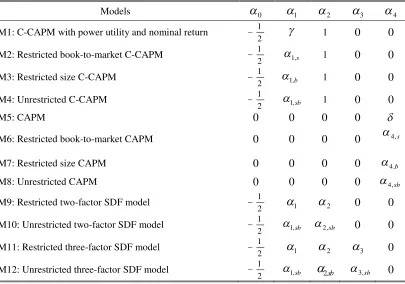
Table 1 provides a summary of restrictions for each asset pricing models
implied by its no-arbitrage condition. C-CAPM with power utility and nominal
returns (M1) implies that the CRRA is constant and should be the same across the
cross-section of expected returns for no arbitrage opportunities in the market. M1 is
the restricted version of C-CAPM. On the other hand, allowing the coefficients on the
conditional covariances of returns with consumption to be different generates an
unrestricted version of C-CAPM (M4). The double-sorted, 25 size and
book-to-market equity ratio portfolios generate two more versions of C-CAPM with power
utility: restricted book-to-market model (M2) and restricted size model (M3). M2
allows portfolios with different size groups to have different coefficients on the
consumption covariances, while M3 allows the coefficients for portfolios with
different book-to-market-equity ratio groups to be different. Similarly, these
restrictions of C-CAPM are applied to the CAPM, where the market price of risk is
expected to be the same across assets, (M5-M8). In addition, the restricted and
unrestricted general SDF models, based on two (consumption growth and inflation)
and three macroeconomic variables (consumption growth, inflation and industrial
production growth), are given by M9-M12. In sum, all the above asset pricing models
can be represented as restricted versions of the SDF model,
1 0, 1 1, 1 1 2, 1 1
( sb f) ( sb) ( , sb) ( , sb)
t t t sb t t sb t t t sb t t t
E i i V i Cov c i Cov i
3, ( 1, 1) 4, ( 1, 1)
sb m sb
sbCovt qt it sbCov it t it
(7)
where s and b indicate size and book-to-market ratio groups that the characteristics
portfolios belong to, respectively, and qt is industrial production. The different asset
Table 1
Restrictions on the No-arbitrage Condition
sandbindicate size and book-to-market groups for the characteristics portfolios. The numbers are in ascending order of magnitude. The smallest size is denoted bys= 1 while the lowest book-to-market ratio is represented by b = 1. denotes constant coefficient of relative risk aversion (CRRA).i represents a coefficient for each conditional covariance in Equation 8.
Models 0 1 2 3 4
M1: C-CAPM with power utility and nominal return 1
2
1 0 0
M2: Restricted book-to-market C-CAPM 1
2
1,s 1 0 0
M3: Restricted size C-CAPM 1
2
1,b 1 0 0
M4: Unrestricted C-CAPM 1
2
1,sb 1 0 0
M5: CAPM 0 0 0 0
M6: Restricted book-to-market CAPM 0 0 0 0 4,s
M7: Restricted size CAPM 0 0 0 0 4,b
M8: Unrestricted CAPM 0 0 0 0 4,sb
M9: Restricted two-factor SDF model 1
2
1 2 0 0
M10: Unrestricted two-factor SDF model 1
2
1,sb 2,sb 0 0
M11: Restricted three-factor SDF model 1
2
1 2 3 0
M12: Unrestricted three-factor SDF model 1
2
4. Econometric Framework
We follow the same econometric approach here as in Smith and Wickens (2002), and
Smith, Sorensen, and Wickens (2008, 2010), and Abhakorn, Smith, and Wickens
(2013) by using the multivariate generalized autoregressive conditional
heteroskedasticity in mean model (MGM) to estimate the joint distribution of the
excess return on equity with macroeconomic factors in such a way that the return
satisfies the no-arbitrage condition under the SDF framework. This approach is
achieved by including conditional covariances of the excess equity returns and the
macroeconomic factors in the mean of the asset pricing equations and constraining the
coefficients on these time-varying, conditional covariances according to the
no-arbitrage condition implied by each asset-pricing model.
Let xt 1 (r1, 1t rtf,...,ri t, 1 rtf,ct1,t1,qt1) ' which contains n variables and i
returns, as several portfolios are estimated at the same time. This specification is an
extension of the MGM in Smith and Wickens (2002). Consumption, inflation, and
industrial productions are included, as they give rise to the discount factors in the SDF
model, M1-M12 in Table 1, through their conditional covariances with the excess
returns. Additional macroeconomic variables can be included in this vector if they
improve the estimate of the joint distribution. The MGM model can then be written as
t +1 t t +1 t +1
x = + x + g + ,
where
|It ~ N(0, )
t+1 Ht+1 ,
( )
vech
t+1 t+1
g H .
where, is a n1 vector of constant, is a nn matrix of coefficients in the
vector autoregressive (VAR) part (included to obtain better representation of the error
terms), is a nn matrix of coefficients of in-mean component, t+1 is an n1
vector of errors, and i number of equity returns. The vech operator converts the
lower triangle of a symmetric matrix into a vector. The error term, t+1 , is
conditionally normally distributed with mean zero and with conditional covariance
matrix Ht+1. The first i rows of the model is restricted to satisfy the no-arbitrage
condition as follows: 1) the first i rows of must be zero; 2) the first i rows of
i+1 to i+3 rows of are all zero; and 4) the first i elements of is zero. A
likelihood ratio test is used to provide test statistics for the restrictions implied by the
no-arbitrage condition in M1-M12 as given in Table 1.
While the MGM model is convenient, it is heavily parameterized, which can create
numerical problems in finding the maximum of the likelihood function due to the
likelihood of being relatively flat, and hence uninformative. Therefore, to complete
the model parameterization for the conditional covariance matrix Ht+1 with the view
toward restricting the number of coefficients being estimated, the specification of the
conditional covariance matrix is chosen to be the vector diagonal model with variance
targeting (Ding and Engle, 2001), which can be written as follows,
/
( ) ( )
/ / / / /
t+1 0 t t t
H H ii - aa - bb aa bb H
where denotes Hadamard product, H0 is the observed sample covariance matrix,
and a and b are n1 vectors. The number of parameters to be estimated reduces to
2n. This model is particularly attractive when we estimate several excess returns
simultaneously, each with its own arbitrage condition. In addition, the zero
restrictions on the coefficients for excess returns in the VAR part of the
macroeconomic variables are imposed to further reduce the number of parameters in
the MGM model. Estimating the restricted and unrestricted C-CAPM (M1 and M4)
for the 25 portfolios sorted by size and book-to-market ratio involve 69 and 93
parameters, respectively, while for the CAPM (M5 and M8) involving 53 and 78
parameters; we need to include only the market return, instead of the macroeconomic
factors, in the joint distribution. We are unable to estimate M10 and M12 for the 25
portfolios, as doing so involves estimating too many parameters for our sample size
(118 and 143 parameters, respectively); hence we include the two data sets of the 10
portfolios formed for size and book-to-market ratio separately to test for these general
two- and three-factor SDF models, in addition to using these one-sorted portfolios to
5. Estimation Results
5.1 Data
The data are monthly from 1960.2 to 2004.11 for the U.S. (538 observations). The
return on the market portfolio is the value-weighted return on all stocks. The return on
a risk-free asset is the one-month Treasury bill rate. Table 2 shows the summary
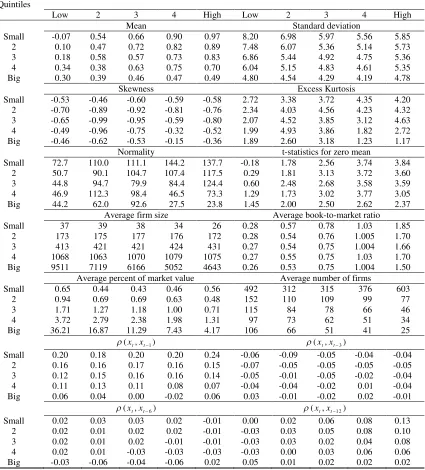
statistics for the 25 value-weighted portfolios, which are the intersections of 5
portfolios formed on size and 5 portfolios formed on the ratio of book-to-market ratio.
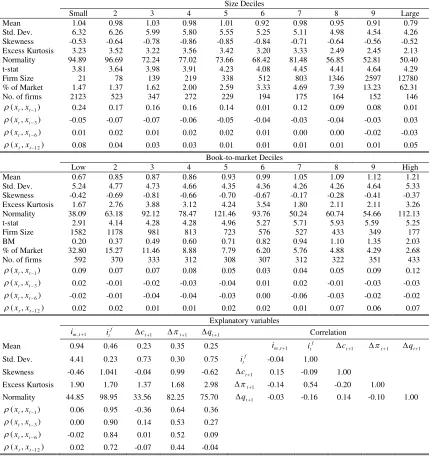
There are also two sets of ten portfolios sorted by size and book-to-market ratio
separately (Table 3). All of the return variables are obtained from Kenneth French’s
websiteb. Real non-durable growth consumption is from the Federal Reserve Bank of
St. Louis. CPI inflation and the volume index of industrial production are both from
Datastream.
b
Table 2
SummaryStatistics: 25 Size and Book-to-Market Portfolios
The table presents descriptive statistics for the excess returns on the 25 portfolios formed as the intersections of the five size and book-to-market ratio groups. Data and full definition of the returns can be found on Kenneth French’s webpage. The returns are monthly value-weighted from 1960.2 to 2004.11, 538 observations. t-stat is the test statistics for zero mean hypothesis.(xt, xt-i) represents the autocorrelation coefficients over the time intervalimonth (s).
Size Quintiles
Book-to-Market Equity Quintiles
Low 2 3 4 High Low 2 3 4 High
Mean Standard deviation
Small -0.07 0.54 0.66 0.90 0.97 8.20 6.98 5.97 5.56 5.85 2 0.10 0.47 0.72 0.82 0.89 7.48 6.07 5.36 5.14 5.73 3 0.18 0.58 0.57 0.73 0.83 6.86 5.44 4.92 4.75 5.36 4 0.34 0.38 0.63 0.75 0.70 6.04 5.15 4.83 4.61 5.35 Big 0.30 0.39 0.46 0.47 0.49 4.80 4.54 4.29 4.19 4.78
Skewness Excess Kurtosis
Small -0.53 -0.46 -0.60 -0.59 -0.58 2.72 3.38 3.72 4.35 4.20 2 -0.70 -0.89 -0.92 -0.81 -0.76 2.34 4.03 4.56 4.23 4.32 3 -0.65 -0.99 -0.95 -0.59 -0.80 2.07 4.52 3.85 3.12 4.63 4 -0.49 -0.96 -0.75 -0.32 -0.52 1.99 4.93 3.86 1.82 2.72 Big -0.46 -0.62 -0.53 -0.15 -0.36 1.89 2.60 3.18 1.23 1.17
Normality t-statistics for zero mean
Small 72.7 110.0 111.1 144.2 137.7 -0.18 1.78 2.56 3.74 3.84 2 50.7 90.1 104.7 107.4 117.5 0.29 1.81 3.13 3.72 3.60 3 44.8 94.7 79.9 84.4 124.4 0.60 2.48 2.68 3.58 3.59 4 46.9 112.3 98.4 46.5 73.3 1.29 1.73 3.02 3.77 3.05 Big 44.2 62.0 92.6 27.5 23.8 1.45 2.00 2.50 2.62 2.37
Average firm size Average book-to-market ratio Small 37 39 38 34 26 0.28 0.57 0.78 1.03 1.85
2 173 175 177 176 172 0.28 0.54 0.76 1.005 1.70 3 413 421 421 424 431 0.27 0.54 0.75 1.004 1.66 4 1068 1063 1070 1079 1075 0.27 0.55 0.75 1.03 1.70 Big 9511 7119 6166 5052 4643 0.26 0.53 0.75 1.004 1.50
Average percent of market value Average number of firms
Small 0.65 0.44 0.43 0.46 0.56 492 312 315 376 603 2 0.94 0.69 0.69 0.63 0.48 152 110 109 99 77 3 1.71 1.27 1.18 1.00 0.71 115 84 78 66 46 4 3.72 2.79 2.38 1.98 1.31 97 73 62 51 34 Big 36.21 16.87 11.29 7.43 4.17 106 66 51 41 25
1
(x xt, t )
(x xt, t3)
Small 0.20 0.18 0.20 0.20 0.24 -0.06 -0.09 -0.05 -0.04 -0.04 2 0.16 0.16 0.17 0.16 0.15 -0.07 -0.05 -0.05 -0.05 -0.05 3 0.12 0.15 0.16 0.16 0.14 -0.05 -0.01 -0.05 -0.02 -0.04 4 0.11 0.13 0.11 0.08 0.07 -0.04 -0.04 -0.02 0.01 -0.04 Big 0.06 0.04 0.00 -0.02 0.06 0.03 -0.01 -0.02 0.02 -0.01
6
(x xt, t )
(x xt, t12)
Table 3
Summary Statistics: 10 Industry Portfolios and Explanatory Variables
The table presents descriptive statistics for the returns on the 10 portfolios and explanatory variables. The returns are monthly value-weighted from 1960.2 to 2004.11, 538 observations. Data and full definition of the 10 portfolios can be found on Kenneth French’s webpage.im,t+1anditfare the returns on the market portfolios and one-month Treasury bill rate respectively. Consumption growth, inflation, and industrial production growth are represented byct+1,t+1, andqt+1respectively. Std. Dev is the standard deviation. t-stat is the t-statistic for zero mean hypothesis. t-stat is the test statistics for zero mean hypothesis. ( xt , xt-i ) represents the autocorrelation coefficients over the time interval i month(s). BM denotes book-to-market equity ratio. Firm size, book-to-market equity ratio, percent of the market, and number of firms are in average terms.
Size Deciles
Small 2 3 4 5 6 7 8 9 Large
Mean 1.04 0.98 1.03 0.98 1.01 0.92 0.98 0.95 0.91 0.79
Std. Dev. 6.32 6.26 5.99 5.80 5.55 5.25 5.11 4.98 4.54 4.26
Skewness -0.53 -0.64 -0.78 -0.86 -0.85 -0.84 -0.71 -0.64 -0.56 -0.52
Excess Kurtosis 3.23 3.52 3.22 3.56 3.42 3.20 3.33 2.49 2.45 2.13
Normality 94.89 96.69 72.24 77.02 73.66 68.42 81.48 56.85 52.81 50.40
t-stat 3.81 3.64 3.98 3.91 4.23 4.08 4.45 4.41 4.64 4.29
Firm Size 21 78 139 219 338 512 803 1346 2597 12780
% of Market 1.47 1.37 1.62 2.00 2.59 3.33 4.69 7.39 13.23 62.31
No. of firms 2123 523 347 272 229 194 175 164 152 146
1
(x xt, t )
0.24 0.17 0.16 0.16 0.14 0.01 0.12 0.09 0.08 0.01
3
(x xt, t )
-0.05 -0.07 -0.07 -0.06 -0.05 -0.04 -0.03 -0.04 -0.03 0.03
6
(x xt, t )
0.01 0.02 0.01 0.02 0.02 0.01 0.00 0.00 -0.02 -0.03
12
(x xt, t )
0.08 0.04 0.03 0.03 0.01 0.01 0.01 0.01 0.01 0.05
Book-to-market Deciles
Low 2 3 4 5 6 7 8 9 High
Mean 0.67 0.85 0.87 0.86 0.93 0.99 1.05 1.09 1.12 1.21
Std. Dev. 5.24 4.77 4.73 4.66 4.35 4.36 4.26 4.26 4.64 5.33
Skewness -0.42 -0.69 -0.81 -0.66 -0.70 -0.67 -0.17 -0.28 -0.41 -0.37
Excess Kurtosis 1.67 2.76 3.88 3.12 4.24 3.54 1.80 2.11 2.11 3.26
Normality 38.09 63.18 92.12 78.47 121.46 93.76 50.24 60.74 54.66 112.13
t-stat 2.91 4.14 4.28 4.28 4.96 5.27 5.71 5.93 5.59 5.25
Firm Size 1582 1178 981 813 723 576 527 433 349 177
BM 0.20 0.37 0.49 0.60 0.71 0.82 0.94 1.10 1.35 2.03
% of Market 32.80 15.27 11.46 8.88 7.79 6.20 5.76 4.88 4.29 2.68
No. of firms 592 370 333 312 308 307 312 322 351 433
1
(x xt, t )
0.09 0.07 0.07 0.08 0.05 0.03 0.04 0.05 0.09 0.12
3
(x xt, t )
0.02 -0.01 -0.02 -0.03 -0.04 0.01 0.02 -0.01 -0.03 -0.03
6
(x xt, t )
-0.02 -0.01 -0.04 -0.04 -0.03 0.00 -0.06 -0.03 -0.02 -0.02
12
(x xt, t )
0.02 0.02 0.01 0.01 0.02 0.02 0.01 0.07 0.06 0.07
Explanatory variables
, 1
m t
i itf ct1 t1 qt1 Correlation
Mean 0.94 0.46 0.23 0.35 0.25 im t,1 itf ct1 t1 qt1
Std. Dev. 4.41 0.23 0.73 0.30 0.75 itf -0.04 1.00
Skewness -0.46 1.041 -0.04 0.99 -0.62 ct1 0.15 -0.09 1.00
Excess Kurtosis 1.90 1.70 1.37 1.68 2.98 t1 -0.14 0.54 -0.20 1.00
Normality 44.85 98.95 33.56 82.25 75.70 qt1 -0.03 -0.16 0.14 -0.10 1.00
1
(x xt, t )
0.06 0.95 -0.36 0.64 0.36
3
(x xt, t )
0.00 0.90 0.14 0.53 0.27
6
(x xt, t )
-0.02 0.84 0.01 0.52 0.09
12
(x xt, t )
The descriptive statistics for the excess returns for the 25 portfolios in Table 2 are
similar to those in Fama and French (1993 and 2006) for the periods 1963-1991 and
1963-2004 respectively, thus indicating the value effect and relatively weak size
effect. This relatively weak size effect is also seen in Table 3 where one-characteristic
sorted portfolios are considered. In general, all excess returns and macroeconomic
variables appear to have negative skewness, excess kurtosis, and non-normality,
except for the risk-free rate and inflation, which display positive skewness and show
persistent volatility.
5.2 Estimates
5.2.1 C-CAPM
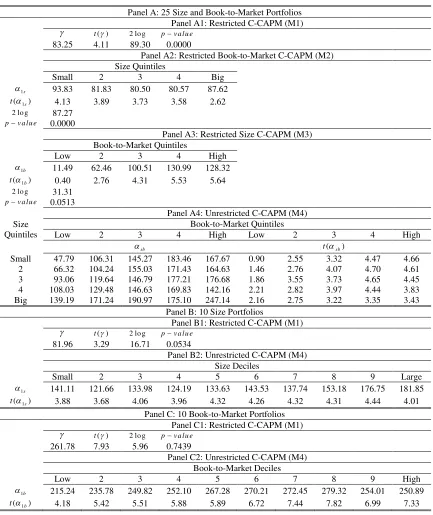
A full set of model estimates with their restricted versions for C-CAPM with power
utility and nominal returns is reported in Table 4. A likelihood ratio test is used to
examine the hypothesis implied by each restricted model against the unrestricted
model, M4. For M1, the conditional covariance of returns with consumption is highly
significant, but the size of the coefficient, 83.25, implies an implausibly large CRRA,
which is a common feature of consumption-based models (Campbell, 2002,
Cochrane, 2008, Yogo (2006), Smith, Sorensen, and Wickens, 2008, 2010) except for
C-CAPM with garbage growth of Savov (2011).
For M2, all five consumption coefficients are significant, and the likelihood ratio
rejects the hypothesis that portfolios within different book-to-market equity ratio
quintiles have the same coefficient at any conventional levels. The test statistic for the
restrictions against the unrestricted model M4 is close to that for M1, implying that
the differences in the coefficients across size have little weight on the behavior of the
estimated returns. On the other hand, the likelihood ratio test marginally fails to reject
M3 (pvalue0.0513); restricting the consumption coefficients for portfolios within
the same size quintiles to be the same does not exclude significant information about
the excess returns. In other words, size has no, or a relatively weak, relation to the
consumption coefficient. In fact, the coefficients in M2 for each size quintile look
very similar, while those in M3 for each book-to-market equity ratio quintiles increase
consumption covariance coefficient for the lowest book-to-market equity ratio
quintiles in M3 is not significantly different from zero.
M4 has 23 coefficients that are significant at conventional significance levels. All
coefficients range widely from 47.79 to 247.14. Looking down each column, there is
no clear pattern in the values of the coefficients across the size quintiles, whilst when
looking across each row; the coefficients tend to rise as the book-to-market ratio
increases. Like the insignificance of the consumption coefficient on the lowest
book-to-market quintile in M3, the remaining 2 coefficients for the lowest book-book-to-market
quintile and the first 2 smallest size quintiles are not significantly different from zero.
The insignificance of the coefficients for the lowest book-to-market quintiles of the 25
portfolios is consistent with the evidence from other empirical asset pricing studies on
the 25 portfolios (Fama and French, 2008, Lettau and Lugvigson, 2001, Parker and
Julliard, 2005, Yogo, 2006, and Savov, 2011) where the pricing models they propose
also have difficulty explaining the portfolios in the smallest size and lowest
book-to-market quintiles (small growth portfolio). This inability may be due to limits to
arbitrage from short-sale constraints for these portfolios, and thus frictionless
equilibrium models, including C-CAPM, cannot explain the returns on these small
growth portfolios (Yogo, 2006).
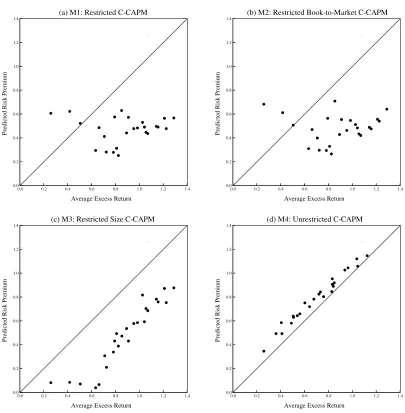
Figure 1 shows a scatter plot of average actual and estimated excess returns in M1
to M4 for the 25 portfolios. If the pricing model fits the data well, the points should
all lie on a 45-degree line. In Figure 1(d), M4 appears to best explain the excess return
on these portfolios and is more or less as good as the modified versions of C-CAPM
and the Fama and French three-factor model. The differences in the estimated risk
premium and actual excess return ranges from 0.01% to 0.18% per month, which is
lower than those in M1-M4.
Figures 1(a) and 1(b) show that the estimated risk premia from M1 and M2 are
similar, implying that imposing the restrictions on size quintiles does not affect the
behavior of risk premia. On the other hand, allowing the consumption coefficients to
be different, as in M3, improves the performance of the model sharply, except for the
that book-to-market equity ratio seems to have additional information about the
[image:17.595.83.516.237.752.2]average excess returns that is not captured by C-CAPM.
Table 4
Estimates of C-CAPM
The table presents the estimates of the C-CAPM (M1-M4): 1960.2-2004.11, 538 observations.
denotes the coefficient relative risk aversion and i represents a coefficient for each conditional covariance in Equation 8. ( )t andt( )i are their corresponding t–statistics respectively. The pricing
models (M1-M4) are tested against each other using the log-likelihood ratio test. 2log represents the likelihood ratio statistic. The corresponding p-value at 5% significance level is denoted byp-value.
Panel A: 25 Size and Book-to-Market Portfolios Panel A1: Restricted C-CAPM (M1) t( ) 2 lo g pva lu e
83.25 4.11 89.30 0.0000
Panel A2: Restricted Book-to-Market C-CAPM (M2) Size Quintiles
Small 2 3 4 Big
1s
93.83 81.83 80.50 80.57 87.62
1
( s)
t 4.13 3.89 3.73 3.58 2.62
2 lo g 87.27
pva lu e 0.0000
Panel A3: Restricted Size C-CAPM (M3) Book-to-Market Quintiles
Low 2 3 4 High
1b
11.49 62.46 100.51 130.99 128.32
1
( b)
t 0.40 2.76 4.31 5.53 5.64
2 lo g 31.31
pva lu e 0.0513
Panel A4: Unrestricted C-CAPM (M4) Size
Quintiles
Book-to-Market Quintiles
Low 2 3 4 High Low 2 3 4 High
sb
t(sb)
Small 47.79 106.31 145.27 183.46 167.67 0.90 2.55 3.32 4.47 4.66 2 66.32 104.24 155.03 171.43 164.63 1.46 2.76 4.07 4.70 4.61 3 93.06 119.64 146.79 177.21 176.68 1.86 3.55 3.73 4.65 4.45 4 108.03 129.48 146.63 169.83 142.16 2.21 2.82 3.97 4.44 3.83 Big 139.19 171.24 190.97 175.10 247.14 2.16 2.75 3.22 3.35 3.43
Panel B: 10 Size Portfolios
Panel B1: Restricted C-CAPM (M1) t( ) 2 lo g pva lu e
81.96 3.29 16.71 0.0534
Panel B2: Unrestricted C-CAPM (M4) Size Deciles
Small 2 3 4 5 6 7 8 9 Large
1s
141.11 121.66 133.98 124.19 133.63 143.53 137.74 153.18 176.75 181.85
1
( s)
t 3.88 3.68 4.06 3.96 4.32 4.26 4.32 4.31 4.44 4.01 Panel C: 10 Book-to-Market Portfolios
Panel C1: Restricted C-CAPM (M1) t( ) 2 lo g pva lu e
261.78 7.93 5.96 0.7439
Panel C2: Unrestricted C-CAPM (M4) Book-to-Market Deciles
Low 2 3 4 5 6 7 8 9 High
1b
215.24 235.78 249.82 252.10 267.28 270.21 272.45 279.32 254.01 250.89
1
( b)
Figure 1
Cross-Sectional Fit: C-CAPM for the 25 Size and Book-to-Market Portfolios The figure plots average actual versus predicted excess returns (% per month) for the 25 size and book-to-market portfolios. The estimated models are (a) M1, (b) M2, and (c) M3, and (d) M4. The average excess returns are adjusted for the Jensen effect.
We estimate M1 and M4 for the two one-characteristic sorted portfolios to
investigate whether these provide similar information to the double-sorted portfolios.
Panels B and C in Table 4 show that C-CAPM with power utility performs better, as
neither of the M1 is rejected, suggesting that sorting stocks according to size and
book-to-market ratio may more accurately distinguish stocks. For the 10 size
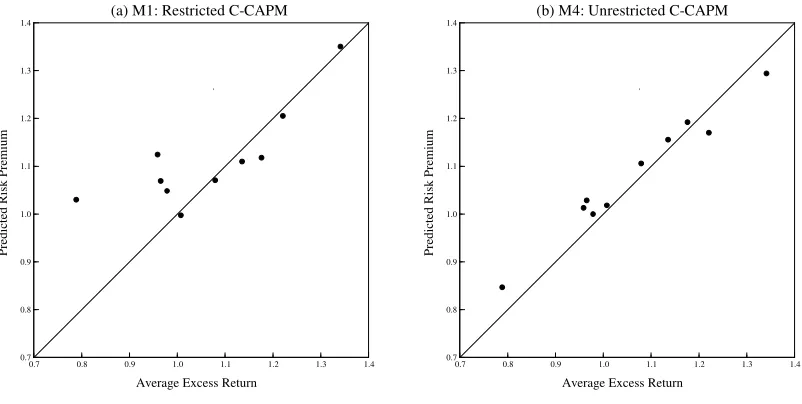
portfolios, all coefficients on the consumption covariances in M4 are significant, and
the model fits the data better than M1 (Figure 2). This is also true for the 10
book-to-market ratio portfolios (Figure 3). In addition, the consumption coefficient for the
portfolio in the lowest book-to-market quintile is highly significant, while those for 0.0 0.2 0.4 0.6 0.8 1.0 1.2 1.4
0.0 0.2 0.4 0.6 0.8 1.0 1.2 1.4 P re d ic te d R is k P re m iu m
Average Excess Return
(a) M1: Restricted C-CAPM
0.0 0.2 0.4 0.6 0.8 1.0 1.2 1.4 0.0 0.2 0.4 0.6 0.8 1.0 1.2 1.4 P re d ic te d R is k P re m iu m
Average Excess Return
(b) M2: Restricted Book-to-Market C-CAPM
0.0 0.2 0.4 0.6 0.8 1.0 1.2 1.4 0.0 0.2 0.4 0.6 0.8 1.0 1.2 1.4 P re d ic te d R is k P re m iu m
Average Excess Return
(c) M3: Restricted Size C-CAPM
0.0 0.2 0.4 0.6 0.8 1.0 1.2 1.4 0.0 0.2 0.4 0.6 0.8 1.0 1.2 1.4 P re d ic te d R is k P re m iu m
Average Excess Return
the small growth portfolios in the 25 portfolios are not. The descriptive statistics in
Table 2 show that the average book-to-market ratios for these two portfolios are
similar, while their average firm sizes are very different. Firms in the smallest size
and the lowest book-to-market quintiles seem to be much smaller than other firms in
the lowest book-to-market quintiles. Therefore, additional information that is not
captured by C-CAPM may be associated with both book-to-market equity ratio as
well as size. One possible explanation is that this extra dimension of risk arises from
the investment growth prospect of firms. Abhakorn, Smith, and Wickens (2013) find
that, in the C-CAPM framework, the mimicking return factor related to
book-to-market ratio (HML) can explain the 25 Fama-French portfolios across size quintiles as
well as across book-to-market ratio quintiles. In this regard, they assert that HML may
represent risk associated with the investment growth prospects of firm as low
book-to-market ratio firms may be expected to have higher rates of growth while small firms
may also be expected to behave similarly. This interpretation of the extra dimension
of risk is also consistent with Brennan, Wang, and Xia (2004) and Li, Vassalou, and
Xing (2006). These two studies propose asset pricing models based on investment
related factors that can explain the cross-section of equity returns well.
Figure 2
Cross-Sectional Fit: C-CAPM for the 10 Size Portfolios
The figure plots average actual versus predicted excess returns (% per month) for the 10 size portfolios. The estimated models are (a) M1 and (b) M4. The average excess returns are adjusted for the Jensen effect.
0.2 0.4 0.6 0.8 1.0 1.2
0.2 0.4 0.6 0.8 1.0 1.2
P
re
d
ic
te
d
R
is
k
P
re
m
iu
m
Average Excess Return
(a) M1: Restricted C-CAPM
0.2 0.4 0.6 0.8 1.0 1.2
0.2 0.4 0.6 0.8 1.0 1.2
P
re
d
ic
te
d
R
is
k
P
re
m
iu
m
Average Excess Return
[image:19.595.297.497.521.712.2]Figure 3
Cross-Sectional Fit: C-CAPM for the 10 Book-to-Market Ratio Portfolios The figure plots average actual versus predicted excess returns (% per month) for the 10 book-to-market ratio portfolios. The estimated models are (a) M1 and (b) M4. The average excess returns are adjusted for the Jensen effect.
5.2.2 CAPM
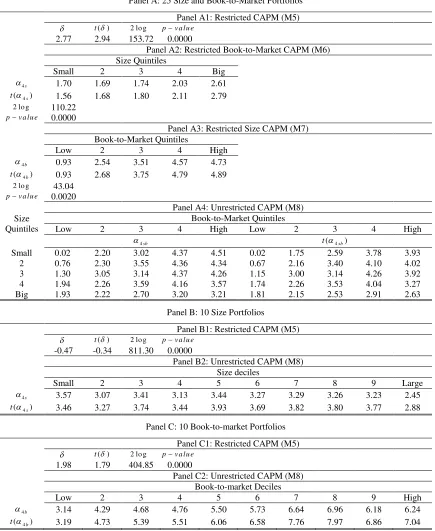
Table 5 reports the estimation results for all versions of CAPM. The market price of
risk in M5 is 2.77 with a t-statistics of 2.94 and is lower than those reported in earlier
related studies for the U.S. market (Harvey (1989) and Ng (1991)). Comparing M6 to
M2, where the coefficients for the first three size quintiles are relatively less
significant, suggests that CAPM cannot price relatively small portfolios well and that
there is more information in these portfolio returns related to size left unexplained by
CAPM than by C-CAPM discussed above. This inability to price small portfolios has
nothing to do with the book-to-market ratio. Moreover, as in M3, the coefficient on
the market return for the portfolios in the lowest book-to-market ratio in M7 is not
significant.
0.7 0.8 0.9 1.0 1.1 1.2 1.3 1.4 0.7
0.8 0.9 1.0 1.1 1.2 1.3 1.4
P
re
d
ic
te
d
R
is
k
P
re
m
iu
m
Average Excess Return
(a) M1: Restricted C-CAPM
0.7 0.8 0.9 1.0 1.1 1.2 1.3 1.4 0.7
0.8 0.9 1.0 1.1 1.2 1.3 1.4
P
re
d
ic
te
d
R
is
k
P
re
m
iu
m
Average Excess Return
Table 5
Estimates of the CAPM
The table presents the estimates of the CAPM (M5-M8): 1960.2-2004.11, 538 observations. denotes the market price of risk andi represents a coefficient for each conditional covariance in Equation 8.
( )
t andt( )i are their corresponding t–statistics respectively. The pricing models (M5-M8) are tested against each other using the log-likelihood ratio test. 2log represents the likelihood ratio statistic. The corresponding p-value at 5% significance level is denoted byp-value.
Panel A: 25 Size and Book-to-Market Portfolios
Panel A1: Restricted CAPM (M5) t( ) 2 lo g pva lu e
2.77 2.94 153.72 0.0000
Panel A2: Restricted Book-to-Market CAPM (M6) Size Quintiles
Small 2 3 4 Big
4s
1.70 1.69 1.74 2.03 2.61
4
( s)
t 1.56 1.68 1.80 2.11 2.79
2 lo g 110.22
pva lu e 0.0000
Panel A3: Restricted Size CAPM (M7) Book-to-Market Quintiles
Low 2 3 4 High
4b
0.93 2.54 3.51 4.57 4.73
4
( b)
t 0.93 2.68 3.75 4.79 4.89
2 lo g 43.04
pva lu e 0.0020
Panel A4: Unrestricted CAPM (M8) Size
Quintiles
Book-to-Market Quintiles
Low 2 3 4 High Low 2 3 4 High
4sb
t(4sb)
Small 0.02 2.20 3.02 4.37 4.51 0.02 1.75 2.59 3.78 3.93 2 0.76 2.30 3.55 4.36 4.34 0.67 2.16 3.40 4.10 4.02 3 1.30 3.05 3.14 4.37 4.26 1.15 3.00 3.14 4.26 3.92 4 1.94 2.26 3.59 4.16 3.57 1.74 2.26 3.53 4.04 3.27 Big 1.93 2.22 2.70 3.20 3.21 1.81 2.15 2.53 2.91 2.63
Panel B: 10 Size Portfolios
Panel B1: Restricted CAPM (M5) t( ) 2 lo g pva lu e
-0.47 -0.34 811.30 0.0000
Panel B2: Unrestricted CAPM (M8) Size deciles
Small 2 3 4 5 6 7 8 9 Large
4s
3.57 3.07 3.41 3.13 3.44 3.27 3.29 3.26 3.23 2.45
4
( s)
t 3.46 3.27 3.74 3.44 3.93 3.69 3.82 3.80 3.77 2.88 Panel C: 10 Book-to-market Portfolios
Panel C1: Restricted CAPM (M5) t( ) 2 lo g pva lu e
1.98 1.79 404.85 0.0000
Panel C2: Unrestricted CAPM (M8) Book-to-market Deciles
Low 2 3 4 5 6 7 8 9 High
4b
3.14 4.29 4.68 4.76 5.50 5.73 6.64 6.96 6.18 6.24
4
( b)
M5, M6, and M7 are rejected relative to the unrestricted model M8 based on their
likelihood ratio statistics of 153.72, 110.22, and 43.04 respectively. The likelihood
ratio statistics for CAPM are all larger than those for C-CAPM. As in C-CAPM,
allowing the coefficients on conditional covariances of market return with individual
excess return to be different offers extra information about the cross-section of the
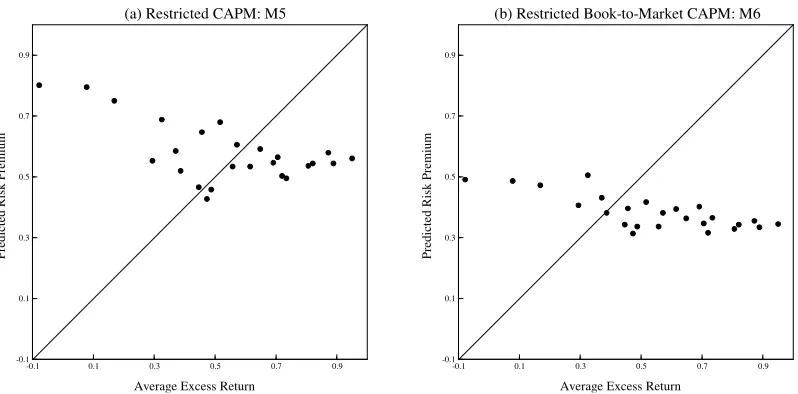
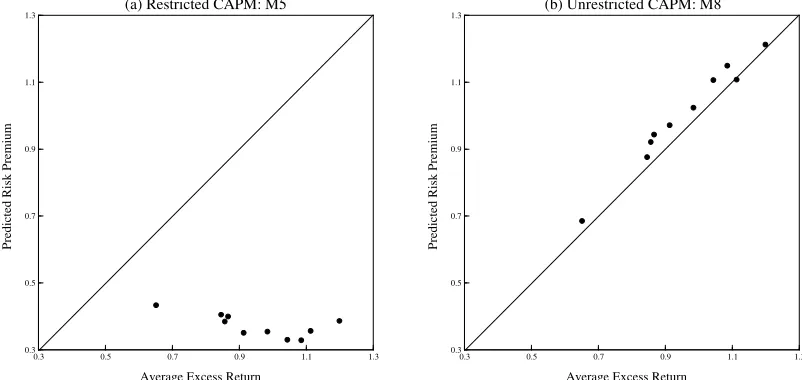
equity returns. As can be seen from Figure 4, M8 can explain the variation in the cross
section well while M5 is not able to explain both size and value effects as in previous
studies (e.g. Fama and French , 1992 and 2006 and Lewellen and Nagel, 2006).
In M8, 20 coefficients on conditional covariances of returns with the market return,
including one for the market return (the coefficient on the variance), are more than 2
standard errors different from zero, while the other 3 coefficients are significant at the
10% significance level. The coefficients for the first 3 size and lowest book-to-market
quintiles are insignificant at any conventional level. These coefficients range from
0.02 to 4.51, exhibiting a clear positive relation with book-to-market ratio. However,
any relation between the coefficients and size can be seen only from the portfolios in
[image:22.595.98.497.507.704.2]the last two book-to-market quintiles.
Figure 4
Cross-Sectional Fit: CAPM for the 25 Size and Book-to-Market Portfolios The figure plots average actual versus predicted excess returns (% per month) for the 25 size and book-to-market portfolios. The estimated models are (a) M5, (b) M6, and (c) M7, and (d) M8. The average excess returns are adjusted for the Jensen effect.
-0.1 0.1 0.3 0.5 0.7 0.9
-0.1 0.1 0.3 0.5 0.7 0.9
P
re
d
ic
te
d
R
is
k
P
re
m
iu
m
Average Excess Return
(a) Restricted CAPM: M5
-0.1 0.1 0.3 0.5 0.7 0.9
-0.1 0.1 0.3 0.5 0.7 0.9
P
re
d
ic
te
d
R
is
k
P
re
m
iu
m
Average Excess Return
M5 for the two sets of 10 portfolios does not perform well since the market
price of risk is of relatively low significance and in the case of the 10 size portfolios,
the market price of risk has the wrong sign. Therefore, the likelihood ratio test rejects
M5 for both 10 portfolios. M8 fits the data better than M5 (Figures 5 and 6), but its
coefficients exhibit a negative relation with size and a negative relation with
book-to-market ratio for both 10 portfolios as in the case of the 25 portfolios. On the other
hand, the relation between the consumption coefficients and firm characteristics in
C-CAPM can be seen only in the case of the 25 portfolios. Thus, C-C-CAPM can explain
size effect, but it has difficulty explaining the value effects; this exposure to the value
premium appears to be associated with both the book-to-market ratio and, to some
extent, with size.
-0.1 0.1 0.3 0.5 0.7 0.9
-0.1 0.1 0.3 0.5 0.7 0.9
P
re
d
ic
te
d
R
is
k
P
re
m
iu
m
Average Excess Return
(c) Restricted Size CAPM: M7
-0.1 0.1 0.3 0.5 0.7 0.9
-0.1 0.1 0.3 0.5 0.7 0.9
P
re
d
ic
te
d
R
is
k
P
re
m
iu
m
Average Excess Return
Figure 5
Cross-Sectional Fit: CAPM for the 10 Size Portfolios
The figure plots average actual versus predicted excess returns (% per month) for the 10 size portfolios. The estimated models are (a) M5 and (b) M8. The average excess returns are adjusted for the Jensen effect.
Figure 6
Cross-Sectional Fit: CAPM for the 10 Book-to-Market Portfolios
The figure plots average actual versus predicted excess returns (% per month) for the 10 book-to-market ratio portfolios. The estimated models are (a) M5 and (b) M8. The average excess returns are adjusted for the Jensen effect.
5.2.3 C-CAPM and CAPM
We further investigate the ability of C-CAPM (M1) and CAPM (M4) by comparing
the behavior of the conditional covariances in both models, as given in Table 6 below,
with the average excess returns of the 25 portfolios shown in Table 2. The -0.2 0.0 0.2 0.4 0.6 0.8 1.0
-0.2 0.0 0.2 0.4 0.6 0.8 1.0 P re d ic te d R is k P re m iu m
Average Excess Return
(a) Restricted CAPM: M5
-0.2 0.0 0.2 0.4 0.6 0.8 1.0 -0.2 0.0 0.2 0.4 0.6 0.8 1.0 P re d ic te d R is k P re m iu m
Average Excess Return
(b) Unrestricted CAPM: M8
0.3 0.5 0.7 0.9 1.1 1.3
0.3 0.5 0.7 0.9 1.1 1.3 P re d ic te d R is k P re m iu m
Average Excess Return
(a) Restricted CAPM: M5
0.3 0.5 0.7 0.9 1.1 1.3
0.3 0.5 0.7 0.9 1.1 1.3 P re d ic te d R is k P re m iu m
Average Excess Return
[image:24.595.95.496.457.647.2]consumption covariance obtained from the estimation of C-CAPM decreases, as we
move down the column, indicating a negative relation with size. Thus, C-CAPM can
capture the size effect. However, in the lowest book-to-market quintiles, average
excess returns increase as the size of the portfolios grows larger. This result is
consistent with the results in Table 4 where the coefficients for these portfolios in M3
[image:25.595.126.474.284.462.2]and M4 are not significant from zero.
Table 6
Conditional Covariances of the Returns on the 25 Portfolios in M1 and M5 The table shows the average conditional covariances of the returns with consumption and market returns as implied by the C-CAPM and CAPM, respectively. Each conditional covariance is given in percent per month and estimated by the multivariate GARCH in the mean.
Book-to-market ratio Quintile Size
Quintile Low 2 3 4 High
Panel A: Conditional covariance of consumption
Small 0.32218 0.28800 0.31130 0.22016 0.27699
2 0.24066 0.23827 0.23237 0.17594 0.20899
3 0.19671 0.17586 0.16247 0.15597 0.17918
4 -0.00131 -0.00166 -0.00138 0.00593 0.00496
Big 0.00304 0.00001 -0.00133 -0.00127 -0.00040
Panel B: Conditional covariance of market return
Small 0.32143 0.35714 0.25829 0.25272 0.28785
2 0.24282 0.22963 0.21088 0.24303 0.17777
3 0.23056 0.18894 0.18875 0.17934 0.16103
4 0.18551 0.21742 0.20223 0.15693 0.20226
Big 0.27074 0.24804 0.19669 0.16809 0.16478
C-CAPM appears to miss the value premium completely by not producing
dispersion in the consumption covariance across the book-to-market quintiles. In fact,
the consumption covariances for the 5 portfolios in the highest book-to-market
quintile seem to be slightly lower than those in the lowest book-to-market quintiles,
indicating lower risk premium is implied by C-CAPM. On the other hand, the
condition covariances of the returns with the market returns in CAPM, in addition to
having a similar behavior across book-to-market quintiles as consumption covariances,
appear not to be able to capture the size effect as well. The dispersion of the market
covariances is not big enough to explain the differences in the excess returns across
size, confirming our previous results where the coefficients for the first two size
We add a constant term in M1-M8 for the estimation of the 25 portfolios to
measure variation in excess returns that was left unexplained in each model. In
general, we expect the constant term in C-CAPM to be of more significance than in
those in CAPM because pricing asset returns with market return is expected to be
more precise than using aggregate consumption data. However, Table 7 shows that for
the magnitude of the constant terms in CAPM, 1.98 is larger than that for C-CAPM at
0.86. This larger magnitude of CAPM is present in every restricted version. The
magnitude of the constant is also larger than in Fama and French (1993) with a
[image:26.595.135.459.345.444.2]constant for the CAPM being 0.04 to 0.57 (in absolute terms).
Table 7 Constant term
The table presents the estimates for the constant term, in all versions of the C-CAPM and CAPM, M1-M8 in Table 1, for the 25 portfolios formed based on size and book-to-market ratio. The number in the parentless is the t-statistic associated with each constant term.
Panel A: C-CAPM
M1 M2 M3 M4
Constant 0.84
(5.36)
1.14 (6.39)
0.52 (2.75)
0.87 (1.75) Panel B: CAPM
M5 M6 M7 M8
Constant 1.98
(9.13)
1.75 (6.79)
0.56 (1.85)
0.94 (1.70)
The information about the cross-section of equity returns left unexplained in
C-CAPM seems to be less than that in the CAPM. Moving from M1 to M4 decreases
the significance of the constant terms (except for moving from M1 to M2), suggesting
that allowing coefficients of conditional covariances within the same book-to-market
ratio to be different is more important than allowing the coefficients to be different
across size quintiles; the magnitude and level of significance of the constant terms
reduces more when moving from M2 to M3 than when moving from M1 to M2. This
argument is also true for CAPM when moving from M5 to M8.
5.2.4 General SDF Models
Table 8 reports the estimates of the general two- and three-factor SDF models based
on consumption, inflation, and industrial production. We are unable to estimate M10
and M12 for the 25 portfolios due to the high parameterization of the MGM. As in
in evaluating asset returns, but inflation is significant. The coefficient on the
conditional covariance of inflation for the 10 book-to-market portfolios is positive
because the contribution to the risk premium by consumption is higher than it is for
actual excess return. The estimation of M9 and M11 for both 10 portfolios shows that
the restrictions they provide on M10 and M12 cannot be rejected by the likelihood
ratio test, implying that the coefficients for conditional covariance of consumption
and inflation with the returns are similar across size and book-to-market deciles.
However, M9 does not explain the data better than C-CAPM and the CAPM (Figure
[image:27.595.96.502.401.576.2]7).
Table 8
Estimates for Restricted Macro SDF Models
The table presents the estimates for the restricted general SDF models (M9 and M11): 1960.2-2004.11, 538 observations.i represents a coefficient for each conditional covariance in Equation 8.t( )i is its corresponding t–statistics respectively. The pricing models (M9 and M11) are tested against their respective unrestricted alternatives (M10 and M12) using the log-likelihood ratio test. 2log represents the likelihood ratio statistic. The corresponding p-value at 5% significance level is denoted byp-value.
Model 1 2 3 2 lo g pva lu e
Panel A: 25 Size and Book-to-Market Portfolios
M9 72.93 (3.40)
-115.72 (-1.74) M11 72.82
(3.40)
-116.47 (-1.73)
1.42 (0.06) Panel B: 10 size portfolios
M9 59.29 (2.18)
-130.87
(-2.01) 23.66 0.1666 M11 59.62
(2.17)
-137.76 (-2.08)
16.84
(0.55) 33.43 0.1832 Panel C: 10 Book-to-market portfolios
M9 307.12 (8.00)
147.29
(1.92) 23.27 0.1805 M11 305.17
(7.87)
141.17 (1.82)
8.58
Figure 7
Cross-Sectional Fit: Two-Factor SDF Model for the 25 Portfolios
The figure plots average actual versus predicted excess returns (% per month) for the 25 size and book-to-market ratio portfolios. The estimated model is M9. The average excess returns are adjusted for the Jensen effect.
6. Conclusion
This paper examines the behavior of the cross-section of equity returns based on the
no-arbitrage condition derived from the Stochastic Discount Factor approach to asset
pricing. We test whether the conditional covariances of the equity returns across
portfolios formed on size and book-to-market ratio with discount factors in each asset
pricing model can sufficiently explain the excess returns in these portfolios. Our
results indicate that the no-arbitrage test rejects C-CAPM as the model can explain the
size effects, but not the value effect. Although the consumption covariances exhibit a
negative relation with size, but they do not vary with the book-to-market ratio. This
behavior explains why the likelihood ratio test indicates that the coefficients for the
consumption covariances are not similar across book-to-market ratios.
Allowing the coefficients on the conditional covariances with consumption to be
different across portfolios generally improves the fit of C-CAPM. Even without
adding any factor to the model, the performance of the resulting unrestricted
C-CAPM is comparable to the modified version of C-C-CAPM of Lettau and Ludvigson
(2001), Parker and Julliard (2005), Yogo (2006) and Savov (2011). The unexplained
variation in excess returns is less than for unrestricted C-CAPM as the significance of
the constant term is lower than that in standard C-CAPM. Unrestricted C-CAPM does 0.0 0.2 0.4 0.6 0.8 1.0 1.2 1.4
0.0 0.2 0.4 0.6 0.8 1.0 1.2 1.4
P
re
d
ic
te
d
R
is
k
P
re
m
iu
m
Average Excess Return
not explain the small growth portfolios well, but this phenomenon is common to most
asset pricing models.
Our results confirm the findings of Abhakorn, Smith, and Wickens (2013) that
both firm size and the book-to-market ratio need to be included in the model in order
discover a value effect. Firm size or the book-to-market ratio on their own does not
generate information about average returns that improves on C-CAPM. This requires
the double sorting of stocks according to size and the book-to-market ratio for the 25
Fama-French portfolios. This finding suggests that there is an additional dimension of
risk left unexplained by C-CAPM or by an SDF model with only one of these factors .
This extra dimension of risk seems to be associated with both (small) size and a (low)
book-to-market ratio. A possible explanation for this extra dimension of risk is the
investment growth prospect of firms, see Abhakorn, Smith, and Wickens (2013), and
could be the reason that the investment-based asset pricing models of Brennan, Wang,
and Xia (2004) and Li, Vassalou, and Xing (2006) are able to explain the
cross-section of equity returns.
Our results indicate that C-CAPM with size and the book-to-market ratio as
additional factors contains information about cross-section average returns that is not
captured by CAPM in previous studies by, for example, Fama and French (1992 and
2006) and Lewellen and Nagel (2006). In general, SDF models suggest that inflation
seems to be significant in determining stock returns, but industrial production plays
no role in determining stock returns. However, pricing models that include inflation
References
Abhakorn P., Smith, P.N., Wickens M. R., 2013. What do the Fama and French factors add to the C-CAPM?, Journal of Empirical Finance, 22, 113-127.
Breeden D.T., Gibbons, M.R., Litzenberger, R.H., 1989. Empirical tests of the consumption-oriented CAPM, Journal of Finance 44, 231−262.
Brennan, M. J., Wang A.W. and Xia Y., 2004. Estimation and test of a simple model of intertemporal capital asset pricing, Journal of Finance 59, 1743−1775.
Campbell, J.Y., 2002. Consumption-based asset pricing, in: Constantinides, G., Harris, M., Stulz, R. (Eds), Handbook of Economic and Finance, Elsevier.
Cochrane, J. 2008. Financial markets and the real economy, in R.Mehra (ed), Handbook of the Equity Premium, Ch 7, North Holland, 237-325.
Ding, Z., Engle, R.F., 2001. Large scale conditional covariance matrix modeling, estimation and testing, Academia Economic Papers 29, 157-184.
Fama, E.F., French, K.R., 1992. The cross-section of expected stock returns, Journal of Finance 47, 427−465.
Fama, E.F., French, K.R., 1993. Common risk factors in the returns on stocks and bonds, Journal of Financial Economics 33, 3−56.
Fama, E.F., French, K.R., 2006. The value premium and the CAPM, Journal of Finance, 61, 2163-2185.
Fama, E.F., French, K.R., 2008. Dissecting anomalies, Journal of Finance, 63, 1653-1678.
Harvey, C. R., 1989. Time-varying conditional covariances in tests of asset pricing models, Journal of Financial Economics 24, 289-317.
Jagannathan, R. Wang, Y., 2007. Lazy investors, discretionary consumption and the cross-section of stock returns, Journal of Finance, 62, 1623-1661.
Lewellen, J., Nagel, S., 2006. The conditional CAPM does not explain asset pricing anomalies, Journal of Financial Economics 82, 289−314.
Lettau, M., Ludvigson, S., 2001. Resurrecting the (C)CAPM: A cross-sectional test when risk premia are time-varying, Journal of Political Economy 109, 1238-1287.
Li, Q., Vassalou M. and Xing Y., 2006. Sector investment growth rates and the cross–section of equity returns, Journal of Business 79, 1637–1665.
Ludvigson S., 2012. Advances in consumption-based asset pricing: empirical tests, in Handbook of the Economic of Finance, ed by G. Constantinides, M. Harris and R. Stulz, Vol. 2. Elsevier.
Merton, R. C., 1980. On estimating the expected returns on the market: An exploratory investigation, Journal of Financial Economics 8, 323−361.
Ng, L., 1991. Tests of the CAPM with time-varying covariances: A multivariate GARCH approach, Journal of Finance 46, 1507−1521.
Parker, J. A., Julliard, C. 2005. Consumption risk and the cross -section of expected returns, Journal of Political Economy 113, 185-222.
Savov, A., 2011. Asset pricing with garbage, Journal of Finance 66, 177–201. Smith, P. N., Wickens, M. R., 2002. Asset pricing with observable stochastic discount factors, Journal of Economic Surveys 16, 397-446.
Smith, P. N., Sorensen S., Wickens M. R., 2008. General equilibrium theories of the equity risk premium: Estimates and Tests, Quantitative and Qualitative Analysis Social Sciences 2, 35-66
Smith, P.N., Sorensen S., Wickens M. R., 2010. The equity premium and the business cycle: the role of demand and supply shocks, International Journal of Finance and Economics, 15, 134-152.