Iowa State University Patents
Iowa State University Research Foundation, Inc.
9-2-1997
Soybean designated A89-259098
Walter R. Fehr
Iowa State University, [email protected]
Earl G. Hammond
Iowa State UniversityFollow this and additional works at:
http://lib.dr.iastate.edu/patents
Part of the
Agricultural Science Commons
,
Agriculture Commons
, and the
Agronomy and Crop
Sciences Commons
This Patent is brought to you for free and open access by the Iowa State University Research Foundation, Inc. at Iowa State University Digital Repository. It has been accepted for inclusion in Iowa State University Patents by an authorized administrator of Iowa State University Digital Repository. For more information, please [email protected].
Recommended Citation
Soybean designated A89-259098
Abstract
A method is described for producing soybean varieties and lines exhibiting palmitic acid contents of at least
about 18.0% up to 30.0% or more. The novel soybean lines are obtained from a soybean seed designated
A1937NMU-85 and its descendants, particular desirable progeny resulting from the cross of A1937NMU-85
with ElginEMS-421, and further with the cross of selected progeny with A89-259098.
Keywords
agronomy
Disciplines
Agricultural Science | Agriculture | Agronomy and Crop Sciences | Plant Sciences
United States Patent [19]
Fehr et a].
US005663485A
5,663,485
Sep. 2, 1997
[11] Patent Number:
[45] Date of Patent:
[54] SOYBEAN DESIGNATED A89-259098
[75] Inventors: Walter R. Fehr; Earl G. Hammond.
both of Ames. Iowa
[73] Assignee: Iowa State University Research
Foundation, Inc.. Ames. Iowa
[21] Appl. No.: 681,980
[22] Filed: Jul. 30, 1996
Related US. Application Data
[62] Division of Ser. No. 376,466, Jan. 20, 1995, Pat. No.
5,6m,311, which is a continuation of Ser. No. 180,114, Ian. 12, 1994, abandoned, which is a continuation of Ser. No.
839,328, Feb. 20, 1992, abandoned, which is a continuation in-part of Ser. No. 461,341, Jan. 5, 1990, abandoned.
[51] nn. Ci.6 ... .. A01H 5/00; AOIH 5/10 [52] U.S. Cl. ... .. 800/200; 800/230; 800/255;
800/DIG. 26; 800/DIG. 69; 435/172.1; 426/601; 47/58
[58] Field of Search 800/200. 230.
800/255. DIG. 26. DIG. 69; 426/601; 47/58;
435/1721
[56] References Cited
PUBLICATIONS
“Notice to Plant Breeders and Seed Producers Relative to
Release of Soybean Germplasm N85-2124. N85-213 1. and
N85-2176". Dr. R]. Kuhr et a1. (1987).
“Notice of Release of Soybean Germplasm with Altered Levels of Pahnitic Acid”. M.E. Carter et al.. (1988). “Chapter 21 Processing and Utilization". T.L. Mounts et al..
Soybeans: Improvement, Production, and Uses -—Agron0my
Monograph, No. 16. (1987). pp. 819-845. 860-865. “Old and New in Winterin‘ng”. George M. Neumunz. J. Am. Oil Chemists’ Society, (1978). vol. 55: 396A-398A.
“Fatty Acid Composition of Margarines. Processed Fats. and
Oils: A New Compilation of Data for Tables of Food
Composition”. John L. Weinrauch et al.. Food Technology, Feb. 1977. vol. 31. pp. 80-85 and 91.
“Fatty Acid Development in a Soybean Mutant with High
Stearic Aci ", G.L. Graef et aL, Journal of American Oil
Chemists’ Society vol. 62. No. 4. Apr. 1985. pp. 773-775.
“Genetic Alteration of Soybean Oil Composition by a Chemical Mutagen”. LR. Wilcox et al.. Journal of American
Oil Chemists Society, vol. 61. N0. 1. (Jan. 1984). pp.
97-100.
“Progress in the Selection For Altered Fatty Acid Compo sition in Soybeans". Richard F. Wilson et al.. Crop Science, vol. 21. Sep.-Oct. 1981. pp. 788-791.
“Recurrent Selection in Soybeans. IV. Selection for Increased Oleic Acid Percentage in Seed Oil”. 1W. Burton et a1. Crop Science, vol. 23. Jul-Aug. 1983. pp. 744-747. “Fatty Acid Composition of the Oil in Reciprocal Crosses Among Soybean Mutants”. E.A. Erickson et al.. Crop Sci ence, vol. 28. Jul-Aug. 1988. pp. 644-646.
“Inheritance of Palmitic and Stearic Acid Mutants of Soy bean”. D.M. Bubeck et al.. Crop Science, vol. 29. May-Jun.
1989. pp. 652-656.
“Soybean Protein and Oil Quality”. LR. Wilcox. IV Con ferencia Mundial de Investigacion en Soja (World Soybean
Research Conference IV) Mar. 5-9. 1989.. Buenos Aires. Argentina. pp. 28-39.
Harmnond et a1. (1983) Crop Sci 23 2 192-193. Registration
of A6 Germplasm Line of Soybean.
Primary Examiner—Elizabeth McElwain
Attorney, Agent, or Firm-—Burns. Doane. Swecker & Mathis. L.L.P.
[57] ABSTRACT
A method is described for producing soybean varieties and
lines exhibiting palmitic acid contents of at least about
18.0% up to 30.0% or more. The novel soybean lines are
obtained from a soybean seed designated A1937NMU-85 and its descendants. particular desirable progeny resulting
from the cross of A1937NMU-85 with ElginEMS-421. and further with the cross of selected progeny with A89-259098.
5,663,485
1
SOYBEAN DESIGNATED A89-259098 This application is a division of Ser. No. 081376.466. ?led Jan. 20. 1995. (now US. Pat. No. 5.602.311). which is a continuation of Ser. No. 08/180,114, ?led Jan. 12. 1994
(now abandoned). which is a continuation of Ser. No.
07/839328. ?led Feb. 20. 1992 (now abandoned). which is a continuation-in-part of Ser. No. 07/461341. ?led Ian. 5.
1990 (now abandoned).
FIELD OF THE INVENTION
This invention relates to novel soybean seeds and prod ucts of soybean seeds. such as soybean oil. and. more
particularly. to soybeans seeds and products characterized
by extremely high levels of palmitic acid.
BACKGROUND OF THE H‘IVENTION
Soybean seeds represent perhaps the most signi?cant
oilseed in the world. Soybean oil makes up approximately 28% of the world supply of fats and oils. has been consid ered to be the major vegetable oil produced and consumed in the United States. and more than 90% of the soybean oil
is used in food products (World Soybean Research Confer ence D1 Proceeding. Shibles. R. (Ed) 1985).
Soybeans thus represent a signi?cant world-wide food
source. providing an excellent source of protein. As such.
soybeans represent potential alternatives to meats. Tofu and soymilk are two principal food products derived
from soybean seeds. More than one billion people in China and Southeast Asia. it has been stated. rely on tofu as a major
food protein source. (Proc. Int. Soya Protein Food Conf..
American Soybean Assoc. p. 35 (1970)). Soymilk is simi
larly an important source for food protein.
One application for which soybean oil may be used is the
production of plastic fats (e.g.-shortenings and
margarines). Such plastic fats are made with a matrix of
solid fats whose interstices are ?lled with liquid oil. Solid
fats can crystallize in several forms wi?r different melting
points and physical properties. The forms are commonly
designated alpha. beta’ and beta. with the beta form having
the highest melting point and the greatest stability. Forms
other than these three may also be present. The beta’ form generally has the properties that are most usually desired in
a plastic fat.
If the solid portion of the plastic fat contains about 15%
or more of palmitic acid and the rest is stearic acid. it will
stabilize in the beta’ form. If the ratio of steariclpalrnitic is
higher. then the fat may convert to the beta form with its less
desirable physical structure.
Soybean oil will most usually contain a level of about 10% palmitic acid or so. Accordingly, if such soybean oil is hydrogenated and made into a plastic fat. it will likely
crystallize in the beta form. To prevent this. an oil such as
cottonseed or palm oil that is richer in palmitic acid is blended with the soybean oil.
The use of either palm oil or cottonseed oil presents some di?iculties. Some users thus consider palm oil to be unde
sirable based upon perceived health considerations. On the other hand. cottonseed oil is generally available only in limited amounts at a higher price than that of soybean oil. It
would accordingly be highly desirable to be able to provide
soybean varieties having su?iciently elevated palmitac acid
contents so that plastic fats can be produced such that such
products will stabilize in the beta’ form.
Further. some producers for some plastic fat applications believe that soybean oil having a palmitic acid content in the
5 10 25 30 35 45 55
2
range of about 13% or 14% to about 16% or so is preferred
For such applications. it would be highly desirable to be able
to provide soybean varieties having a su?iciently high level
of palmitic acid to use for blending with soybean varieties having more conventional palmitic acid contents to provide the desired intermediate range of palmitic acid content.
The palmitic acid levels in soybean seed oil range from
9.3% to 17.4% within the world collection (Erickson et al..
Journal of Heredity, 79. p. 465. 1988). The Erickson et al. article reports the inheritance of altered palmitic acid per centages in two soybean mutants. C1726 and C1727. The level of palmitic acid in C1727 reported averages 17.3% palmitic acid in comparison to 11.5% in the oil of the parent
cultivm “Century."
Despite the clear need for soybeans having a level of
palmitic acid above that present in the world collection at the present time. this objective still remains to be achieved.
SUMJWARY OF THE INVENTION
It has been discovered that a mutant line obtained from the
parent variety Asgrow A1937 provides a population of soybean seeds exhibiting high levels of palmitic acid. The palmitic acid concentration capable of being obtained is
about 18% of the total fatty acid present. even up to 20% or
more.
Further. it has been discovered that crossing the Asgrow
A1937 mutant with a second mutant provides a population
of soybean seeds exhibiting signi?cantly higher levels of palmitic acid than have been capable of being achieved. More particularly. soybean seeds having palmitic acid con
tents above about 20%. and. more preferably. of at least about 25% or more. have been achieved. Still further. it has
been discovered that soybean seeds having palmitic acid
contents of 30.0% or more may be obtained by crossing
selected progeny with line A89-259098.
If desired. the soybeans of the present invention can be
used as a donor parent in a backcrossing program with any
desired commercial cultivar as a recurrent parent to isolate
a commercial variety having desirable seed yield and other agronomic characteristics in addition to the high level of
palmitic acid.
DETAILED DESCRIPTION OF PREFERRED EMBODIMEN I
According to one aspect of the present invention. the
novel soybean seeds and plants characterized by palmitic
acid contents of at least 18% were obtained by preparation of a mutant line developed by treating the cultivar Asgrow A1937 with nitroso methyl urea (NMU). The mutation
procedure utilized will be described in detail hereinafter in
the Examples. The mutant line has been designated Al937NMU-85.
Pursuant to a further aspect of the present invention.
crossing of the parent mutant line A1937NMU-85 with a
second mutant line. ElginEMS-421. has been found to
provide a population of soybean seeds with palmitic acid contents signi?cantly above that of the parent line Asgrow A1937. The preparation of the mutant line. ElginEMSAZl. will be described in conjunction with the Examples.
Crossing of the parent mutant lines Al937NMU-85 and ElginEMS-421 to obtain the soybean lines of the present
invention can be carried out by any desired hybrid formation
technique. Standard hybridization techniques are. of course.
well known and may be utilized As an illustrative example.
5,663,485
3
York. 1987. which hybridization techniques are herein incor
porated by reference.
Progeny from the crossing of Al937NMU-8S and
ElginEMS-42l yielded soybean seeds wherein the palmitic
acid content is greater than 18%. preferably greater than about 20%. and more preferably. greater than about 25%.
The fatty acid composition was determined by gas-liquid chromatography using the method as generally outlined in Graef et al. (Crop Sci, 25:1076-1079. 1985). Thus. in general, the method comprises (1) crushing the seed sample.
(2) putting the crushed. sample into a test tube with a hexane
solvent and extracting the oil into the hexane. (3) the fatty
acids in the oil are converted to their methyl esters using sodium methoxide and methanol. (4) water is added to
inactivate the sodium methoxide catalyst, and (5) the methyl
esters. which ?oat to the top of the water layer. are diluted
with hexane and become the sample that is introduced into the column of the gas chromatography apparatus.
As may be appreciated. this general methodology may be employed. and speci?c aspects changed to lessen the time
needed as desired. For example. the stationary phase
selected for the columns will dictate the temperature at which the sample can be introduced.
None of the speci?cs utilized. e.g.—capilla1y versus
packed columns. are considered to affect to any appreciable extent the results obtained for an analysis. Rather. such
speci?cs affect the time required for sample preparation and
analysis.
The percentages of the fatty acids set forth herein. unless
otherwise designated. thus are on a weight basis and refer to
the percentage of the methyl ester of palmitic acid or other fatty acid compared to the total methyl esters of the fatty
acid composition in the sample being analyzed. This can
also be taken as the weight percentage of the fatty acid itself because the dilftn'ence between the palmitic acid content and that of its methyl ester as determined in the gas chromatog raphy technique described herein is so minimal as may be ignored. as is commonly done in this ?eld.
The gas chromatography techniques described herein are
routinely used for analysis of the fatty acid composition of
soybeans. The experimental error is considered to be within
the range of from about 1 to 5% or so. depending upon the
magnitude of the peak. For example. with a relatively larger
peak indicative of an oleic acid content of 50% or so. the
experimental error may be as low as about 1% of the value.
viz.-50i0.5%. At the other extreme. a small peak indica tive of a stearic acid content of 4.0% may have an experi mental error of about 5.0% of the value. viz..—4.0%i0.2. A
palmitic acid content of about 20% lies in the middle. with
the expected error being about 2-3% of the reported value.
viz.—20% J$0.4 or 0.6%.
As may be appreciated. the palmitic acid levels of the soybeans of the present invention set forth herein were
obtained ?rom soybeans grown in Iowa and Puerto Rico.
Growth under climatic conditions cooler or warmer may
result in a somewhat altered fatty acid composition. However. while the speci?c results may vary somewhat
depending upon the speci?c growing conditions
experienced. the progeny of the present invention will be
characterized by extremely high palmitic acid contents rela
tive to other soybean lines grown under similar conditions.
Progeny exhibiting the desired high palmitic acid trait can
be crossed with other progeny to provide a population of
soybean seeds having extremely high palmitic acid contents.
It can be expected that crosses utilizing the more desirable
progeny should be capable of providing lines having palm
itic acid contents up to about 30.0% or so.
10 20 25 35 40 50 55
4
Indeed. soybean lines having palmitic acid contents of
30.0% or more have been obtained by crossing selected progeny with line A89-259098. Parent line A89-259098 is
described in our copending application. Ser. No. 07/643 .277.
the disclosure of said line being herein incorporated by
reference. It can thus be expected that crosses utilizing the
more desirable progeny should be capable of providing lines
having palmitic acid contents up to about 35.0% or so.
Ftnther. progeny can be crossed. if desired. with other
progeny. or with any other soybean line or cultivar to yield
a soybean cultivar having the desired seed yield or other desired agronomic traits as well as the desired high palmitic acid trait. Self-pollination of selected progeny may likewise yield lines having characteristics desired for some applica
tions.
Any hybridization technique may be used. and many are known as has been described herein. For example. the
selection of progeny having the desired high palmitic acid
trait can be obtained by conducting backcrossing with a commercial variety until a desirable commercial variety has
been isolated. Backcrossing techniques are known. as dis
closed in Fehr. Principles of Cultivar Development. Vol. 1. Theory and Technique. Chapter 28. pp. 360-376. the dis
closln'e of which is herein incorporated by reference. As one example. backcrossing using the desired F2 seeds obtained by natural self-pollination of the F1 plants could be
carried out as follows:
(1) Plant F1 seeds obtained by crossing a parent with the
desired high palmitic acid trait to the desired commer
cial cultivar (recurrent parent). Sample F2 seeds ?'om Fl plants are analyzed for fatty acid concentration. and
seeds with the desired high palmitic acid content are
planted for backcrossing.
(2) Cross-pollinate the desired commercial cultivar (recurrent parent) with an F2 plant having the high
palmitic acid content.
(3) Plant the BCIFl seeds and obtain BC1F2 seeds by
natural self-pollination. Sample BCIF2 seeds are ana
lyzed for fatty acid concentration. and those displaying
the high palmitic acid trait are backcrossed to the recurrent parent.
(4) The backcross and selection procedure herein described (Step 3) can be repeated until lines with the
desired high palmitic acid composition and agronomic
performance are recovered. It is believed that four of these backcross cycles should serve to transfer the high
palmitic acid trait to the desired cultivar (viz.—
recurrent parent). although the number of such cycles
can be fewer. or more. as is desired. The result is the
production of a soybean line quite similar to the com
mercial cultivar except having the desired high palmitic
acid content.
Any commercial cultivar (recurrent parent) desired may
be employed for backcrossing. Factors such as. for example.
seed yield. geographical area. and many others. as is known.
will generally dictate the cultivar selected from the several hundred commercial eultivars available.
The following Examples are illustrative. but not in
limitation, of the present invention. The gas chromatography
results obtained from the instrument itself are reported to
two decimal points (i.e.—“0.00”). As reported herein. the
fatty acid values are set forth to one decimal point. Values of
6 or more in the second decimal point were raised (e.g.—— 4.29 is reported herein as 4.3). values of 4 or less are ignored (e.g.-—4.24 is reported as 4.2). values of 5 are raised if the
5,663,485
5
EXAMPLEI
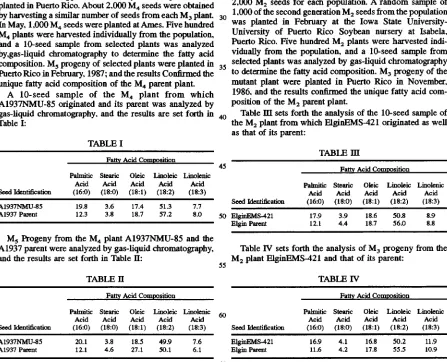
This Example describes the preparation of the mutant line A1937NMU-85.
Mutant line A1937NMU-85 was obtained from nitroso
methyl urea (NMU) treatment of the parent variety Asgrow
A1937. In May. 1985. 2.500 seeds of A1937 were soaked in
2.5 L distilled water in a 6 L ?ask for 9 hours at room
temperature. The ?ask was aerated for the 9 hours of soaking. The water was drained from the ?ask. and 2.5 L of
2.5 mM NMU in 0. 1 molar [“M”] phosphate bu?er at pH 5.5
were added. The seeds were soaked with aeration for 3
hours. the solution was drained and the seeds were rinsed twice with distilled water. Treated seeds were placed in
containers to prevent drying and transported to the Agricul
tural Engineering and Agonomy Research Center near Ames. Iowa. The seeds were planted 2.5 cm deep in moist
soil within 4 hours after the last rinse. The soil was watered
regularly to keep it moist until seeding emergence. The
properties of the mutant seed and their progeny were evalu
ated beginning with the M4 generation.
A similar number of seeds was harvested from each of the
M1 (?rst mutant generation) plants in the population to
obtain 2.000 M2 seeds. A random sample of 1.000 of the
second generation M2 seeds from the population was planted
in October at the Iowa State University-University of Puerto Rico soybean nursery at Isabela. Puerto Rico. About 2.000 M3 seeds were obtained by harvesting a similar number of
seeds from each M 2 plant. In February. 1.000 M3 seeds were planted in Puerto Rico. About 2.000 M4 seeds were obtained
by harvesting a similar number of seeds from each M3 plant. In May. 1.000 M4 seeds were planted at Ames. Five hundred
M4 plants were harvested individually from the population.
and a 10-seed sample from selected plants was analyzed
by.gas-liquid chromatography to determine the fatty acid composition. Ms progeny of selected plants were planted in
Puerto Rico in February. 1987; and the results Con?rmed the
unique fatty acid composition of the M4 parent plant.
A 10-seed sample of the M4 plant from which A1937NMU-85 originated and its parent was analyzed bygas-liquid chromatography. and the results are set forth in
10
25
30
35
6
Culture Collection (ATCC) at 12301 Parklawn Drive.
Rockville. Md. 20852. USA. More speci?cally 2.500 seeds
of A1937NMU-85 were deposited on Jun. 18. 1996 and have
been assigned ATCC Accession No. 97618.
EXAMPLE 2
This Example describes the preparation of the mutant line
ElginEMS-42l.
Mutant line ElginEMS-421 was obtained from ethyl methane sulfonate (EMS) treatment of the parent variety Elgin. In May. 1984. 2.500 seeds of Elgin were soaked in 2.5
L distilled water in a 6 L ?ask for 9 hours at room
temperature. The ?ask was aerated for the 9 hours of
soaking. The water was drained from the ?ask. and 2.5 L of 0.025 molar EMS in 0.1M phosphate buffer at pH 7 were
added. The seeds were soaked for 9 hours. the solution was drained and the seeds were rinsed twice with distilled water.
Treated seeds were placed in containers to prevent drying
and transported to the Agricultural Engineering and
Agronomy Research Center near Ames. Iowa. The seeds were planted 2.5 cm deep in moist soil within 4 hours after
the last rinse. The soil was watered regularly to keep it moist until seedling emergence. The properties of the mutant seed and their progeny were evaluated beginning with the M2
generation.
A similar number of seeds was harvested from each of the
M1 (?rst mutant generation) plants in a population to obtain
2.000 M2 seeds for each population. A random sample of
1.000 of the second generation M2 seeds from the population
was planted in February at the Iowa State University~ University of Puerto Rico Soybean nursery at Isabela. Puerto Rico. Five hundred M2 plants were harvested indi vidually from the population. and a l0-seed sample from
selected plants was analyzed by gas-liquid chromatography
to determine the fatty acid composition. M3 progeny of the mutant plant were planted in Puerto Rico in November. 1986. and the results con?rmed the unique fatty acid com
position of the M2 parent plant.
Table 111 sets forth the analysis of the 10-seed sample of
40 . . . .
Table I: the M2 plant from wh1ch Elg1nEMS-42l originated as well
as that of its parent: TABLE I
TABLE 111 Fag-1 Acid Comgsition
45 Fag! Acid 062E518»
Palmitic Stearic Oleic Linoleic Linolenic
Acid Acid Acid Acid Acid Palmitic Stearic Oleic Linoleic Linolenic
Seed Identi?cation (16:0) (18:0) (18:1) (18:2) (18:3) Acid Mid Acid Acid Acid
Algmmms 19.8 16 17A 513 7'7 Seed Identi?cation (16:0) (18:0) (18:1) (18:2) (18:3)
A1937 Parent 12.3 3.8 18.7 57 .2 8.0 50 3W4” 179 39 18.6 503 39
Elgin Parent 12.1 4.4 18.7 56.0 8.8
Ms Progeny from the M4 plant A1937NMU-85 and the
A1937 parent were analyzed by gas-liquid chromatography. Table IV sets forth the analysis of M3 progeny from the
and the results are set forth in Table II: 55 M2 plant E1ginEMS-42l and that of its parent: TABLE ]I TABLE IV
Fag! Acid Compgsition Fag! Acid ComEsition
Palmitic Stearic Oleic Linoleir: Linolenic 6O Palmitic Stearic Oleic Linoleic Linolenic
Acid Acid Acid Acid Acid Acid Acid Acid Acid Acid
Seed Identi?cation (16:0) (18:0) (18:1) (18:2) (18:3) Seed Identi?cation (16:0) (18:0) (18:1) (18:2) (18:3)
A1937NMU-85 20.1 3.8 18.5 49.9 7.6 ElginEMS4-21 16.9 4.1 16.8 50.2 11.9
A1937 Parent 12.1 4.6 27.1 50.1 6.1 Elgin Parent 11.6 4.2 17.8 55.5 10.9
65
Seeds of the soybean A1937NMU-85 have been deposited under the terms of the Budapest Treaty at the American Type
Seeds of the soybean Elgin EMS~421 have been deposited
[image:6.557.53.500.363.725.2]5,663,485
7
Culture Collection (ATCC) at 12301 Parklawn Drive. Rockville. Md. 20852. U.S.A. More speci?cally 2.500 seeds
of Elgin EMS-421 were deposited on Jun.18. 1996 and have
been assigned ATCC Accession No. 97617.
EXANIPLE 3
This Example describes the crossing of A1937NMU-85 and ElginmS-421 to obtain the soybean lines of the present invention characterized by high palrnitic acid contents.
Crosses were made between individual plants of
A1937NMU-85 and ElginEMS-421 at the Agricultural Engineering and Agronomy Research Center near Ames. Iowa. in the summer of 1987. The hybrid 1"‘1 seeds obtained from the dilferent plant-to-plant crosses were kept separate. and were designated AX4659 through AX4663 and AX4676.
The F1 seed was planted in the Iowa State University
University of Puerto Rico nursery at Isabela. Puerto Rico. in October. 1987. F2 seeds were obtained by natural self
pollination. Each F1 plant was harvested individually, and
the F2 seeds of each were maintained as a separate subpopu lation.
Forty F2 seeds from each of the six crosses were planted in Puerto Rico in February. 1988. F3 seeds were obtained by natural self-pollination. F2 plants were harvested individu ally. A S-seed sample from each F2 plant was analyzed for
fatty acid composition by gas chromatography.
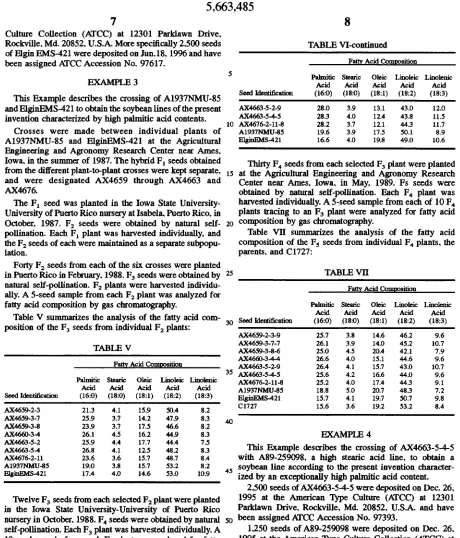
Table V summarizes the analysis of the fatty acid com
position of the F3 seeds from individual F2 plants:
TABLE V
Fag! Acid Comgsition
Pnlmitic Stcaric Oleic Linoleic Linolenic Acid Acid Acid Acid Acid
Seed Identi?cation (16:0) (18:0) (18:1) (18:2) (18:3)
AX4659-2-3 21.3 4.1 15.9 50.4 8.2 AX4659-3-7 25.9 3.7 14.2 47.9 8.3 AX4659-3-8 23.9 3.7 17.5 46.6 8.2 AX4660-3-4 26.1 4.5 16.2 44.9 8.3
AX4663-5-2 25.9 4.4 17.7 44.4 7.5
AX4663-5-4 26.8 4.1 12.5 48.2 8.3
AX4676-2-11 23.6 3.6 15.7 48.7 8.4
A1937NMU-85 19.0 3.8 15.7 53.2 8.2
ElginEMS-421 17.4 4.0 14.6 53.0 10.9
Twelve F3 seeds from each selected F2 plant were planted in the Iowa State University-University of Pnerto Rico nursery in October. 1988. F4 seeds were obtained by natural
self-pollination. Each F3 plant was harvested individually. A
10-seed sample from each F3 plant was analyzed for fatty
acid composition by gas chromatography.
Table VI summarizes the analysis of the fatty acid com
position of the F4 seeds from individual F3 plants:
TABLE VI
Fem Acid Coggsition
Palmitic Stcaric Oleic Linclcic Linclenic Acid Acid Acid Acid Add
Seed Identi?cation (16:0) (18:0) (18:1) (18:2) (1&3)
AX4659-2-3-9 21.3 3.8 13.9 44.1 10.3
AX4659-3-7-7 21.4 3.5 15.1 44.4 9.6
AX4659-3-8-6 27.4 3.4 16.1 42.8 10.3
AX4660-3-4-4 21.1 3.8 15.6 43.2 9.1
[image:7.557.45.505.57.595.2]25 30 35 45 50
8
TABLE VI-continued Fm Acid mitionPalmitic Stearie Oleic Linoleic Linolenic Acid Acid A6111 Acid Acid
Seed Idcmi?catim (16:0) (18:0) (18:1) (1&2) (1&3)
AX4663-5-2-9 28.0 3.9 13.1 43.0 12.0 AX4663-S-4-5 23.3 4.0 12.4 43.8 11.5 AX4676-2-11-8 28.2 3.1 121 44.3 11.1
A1937NMU-85 19.6 3.9 11.5 50.1 8.9
ElginEMS-421 16.6 4.0 19.8 49.0 10.6
Thirty F4 seeds from each selected F3 plant were planted at the Agricultural Engineering and Agronomy Research
Center near Ames. Iowa. in May. 1989. Fs seeds were
obtained by natural self-pollination. Each F4 plant was harvested individually. A S-seed sample from each of 10 F4 plants tracing to an F3 plant were analyzed for fatty acid
composition by gas chromatography.
Table VII summarizes the analysis of the fatty acid
composition of the F5 seeds from individual F4 plants. the
parents. and C1727:
TABLE VII
Fag! Acid Comggition
Palmitic Stearic Oleic Linoleic Linolenic Acid Acid Acid Acid Acid
Seed Identi?cation (16:0) (18:0) (18:1) (18:2) (18:3)
AX4659-2-3-9 25.7 3.8 14.6 46.2 9.6
AX4659-3-7-7 26.1 3.9 14.0 45.2 10.7
AX4659-3-8-6 25.0 4.5 20.4 42.1 7.9
AX466J-3-44 26.6 4.0 15.1 44.6 9.6
AX4663 -5 -2-9 26.4 4.1 15.7 43.0 10.7
AX4663-5-4-5 25.6 4.2 16.6 44.0 9.6
AX4676-2-1l-8 25.2 4.0 17.4 44.3 9.1
A1937NMU-85 18.8 5.0 20.7 48.3 7.2
ElginEMS-421 15.7 4.1 19.7 50.7 9.8 C1727 15.6 3.6 19.2 53.2 8.4
EXAMPLE 4
This Example describes the crossing of AX4663-5-4-5
with A89-259098. a high stearic acid line. to obtain a
soybean line according to the present invention character
ized by an exceptionally high palrnitic acid content.
2.500 seeds of AX4-663-5-4-5 were deposited on Dec. 26.
1995 at the American Type Culture (ATCC) at 12301 Parklawn Drive. Rockville, Md. 20852. U.S.A. and have been assigned ATCC Accession No. 97393.
1.250 seeds of A89-259098 were deposited on Dec. 26.
1995 at the American Type Culture Collection (ATCC) at
12301 Parldawn Drive, Rockville. Md. 20852. U.S.A.. and have been assigned ATCC Accession No. 97391. An addi
tional 1.250 seeds of A89-259098 were deposited on Apr.
22. 1996.
Parent line AX4663-5-4-5 was obtained as described in
Example 3. Parent line A89-259098 was obtained as
described in our copending application. Serial No. 07/643.
60 277. The hybrid Fl seeds obtained from the cross were
65
designated AX7016-AX7019.
F1 seeds of the cross were planted in February. 1990. in the Iowa State University-University of Puerto Rico nursery at Isabela. Puerto Rico. F2 seeds were obtained by natural
self-pollination. Each Fl plant was harvested individually.
and the F2 seeds of each were maintained as separate
5,663,485
Four individual F2 seeds from each F1 plant were split so that the embryonic axis was left intact. The portion without
the embryonic axis (approximately one-third of the seed) was analyzed for fatty acid composition by gas chromatog
raphy.
Table VIII summarizes the analysis of the fatty acid
composition of an F2 seed having the desired high palrnitic
acid content and that of the parent lines: TABLE V111
Fat_ty Acid Commsition
Palmitic Stcaric Olcic Linoleic Linolenic Acid Acid Acid Acid Acid
Seed Identi?cation (16:0) (18:0) (18:1) (18:2) (18:3)
AX7O 17-1 -3 30.4 5.2 10. l 416 11.7
AX4663-5 -4—5 28.6 4.0 11.9 43 .0 12.4
A89-259098 8.0 30.3 21.5 34.6 5.6
15
10
What is claimed is:
1. A soybean seed designated A89-259098 having ATCC
Accession No. 97391 and its descendants wherein the veg
etable oil endogenously formed therein contains palmitic
acid in a concentration of approximately 8.0 percent by weight, stearic acid in a concentration of approximately 30.3 percent by weight. oleic acid in a concentration of approxi mately 21.5 percent by weight. linoleic acid in a concentra
tion of approximately 34.6 percent by weight. and linolenic
acid in a concentration of approximately 5.6 percent by
weight as determined by gas chromatography.
2. Soybean seeds according to claim 1 that are provided
as an assemblage of such seeds.