Iowa State University Patents
Iowa State University Research Foundation, Inc.
7-27-1993
Modified resins for solid-phase extraction
James S. Fritz
Iowa State University
Jeffrey J. Sun
Iowa State UniversityFollow this and additional works at:
http://lib.dr.iastate.edu/patents
Part of the
Analytical Chemistry Commons
This Patent is brought to you for free and open access by the Iowa State University Research Foundation, Inc. at Iowa State University Digital Repository. It has been accepted for inclusion in Iowa State University Patents by an authorized administrator of Iowa State University Digital Repository. For more information, please [email protected].
Recommended Citation
Modified resins for solid-phase extraction
Abstract
A process of treating aqueous solutions to remove organic solute contaminants by contacting an aqueous
solution containing polar organic solute contaminants with a functionalized polystyrene-divinyl benzene
adsorbent resin, with the functionalization of said resin being accomplished by organic hydrophilic groups
such as hydroxymethyl, acetyl and cyanomethyl.
Keywords
Chemistry
Disciplines
Analytical Chemistry | Chemistry
o . , US0052308O6A
Unlted States Patent [19]
[11] Patent Number:
5,230,806
Fritz et a1.
1451
Date of Patent:
* Jul. 27, 1993
[54] MODIFIED RESINS FOR SOLID-PHASE
[561
References Cited
EXTRACHON 7' us. PATENT DOCUMENTS
. - . 3,531,463 9/1970 0651315611 ... .. 210/692
[75] .Invenmrs'
slbfatz’hmey J's'm’both of
4,154,674 5/1979 Warshawsky et a1.
210/668
’ 4,220,726 9/1930 Warshawsky ... .. 210/679
. _ _ 4,895,662 1/1990 Stevens ... .. 210/692
[73] Ass1gnee= 10" Sim Umerslty Research 4,927,539 5/1990 Stevens et al.. 210/635 Foundation, Inc, Amcs, Iowa 5,019,269 5/1991 Letoumeur et a1. 210/656 5,030,352 7/1991 Varady ct a1. 2l0/502.1
[ ‘ ] Notice; The portion of the term of this patent ‘5,071,565 12/1991 Fritz et a1. .... .. 210/692 subsequent to Dec_ 10, 2008 has been 5,114,591 5/ 1992 Patzelt et a1. ... .. 210/692
dlsclalmed- Primary Examiner-Wilbur Bascomb, Jr.
Assistant Examiner-Cynthia L. Nessler
[21] APPL N°~= 8031135
Attorney, Agent, or Firm-Zarley, McKee, Thomte,
Voorhees, & Sease
[22] Filed. Dec. 5, 1991 [57] ABSTRACT
_ _ A process of treating aqueous solutions to remove or
R-elated U'S' Apphcamm Dm‘ ganic solute contaminants by contacting an aqueous [63] Continuation of Set. N0. 650,289, Feb. 4, 1991, Pat. solution containing polar organic solute contaminants
No. 5,071,565. with a functionalized polystyrene-divinyl benzene ad
sorbent resin, with the functionalization of said resin [51] Int. Cl.5 ... .. B01D 15/04 being accomplished by organic hydrophilic groups such [52] vs. C]. ... .. 210/692; 210/909 as hydroxymethyl, acetyl and cyanomethyl
[58] Field of Search ... .. 210/692, 693, 690, 691,
5,230,806
1
MODIFIED RESINS FOR SOLID-PHASE
EXTRACTION
This is a continuation of copending application Ser. No. 07/650,289, ?led on Feb. 4, 1991, now US. Pat. No.
5,071,565, dated Dec. 10, 1991.
BACKGROUND OF THE INVENTION
Sold-phase extraction is now widely used for precon
centration and cleanup of analytical samples, for puri?
cation of various chemicals, and for large-scale applica
tions such as removal of toxic or valuable substances from a variety of predominately aqueous solutions.
Typical applications include methods for determination
of trace amounts of pesticides, for determination of
trace organic contaminants in water, for analysis of
industrial waste water, determination of azaarenes in water, evaluation of porous polymers, isolation of or
ganic compounds from ground water, sampling of pri
ority pollutants in waste water, collection and concen
tration of environmental samples, and for pretreatment of urine samples.
For analytical purposes, solid phase extraction is
usually performed using a small column or cartridge
containing an appropriate resin. However, membranes loaded with appropriate resins have also been used for
solid phase extraction. Following uptake of extractable
solutes from a predominantly aqueous sample, it is com mon practice to elute the adsorbed materials from the resin by a small amount of an organic solvent such as
ethyl acetate.
Chemically-bonded silica, usually with a C13 or C3 organic group, is by far the most commonly used mate rial for solid phase extraction. Minor use has been made of porous polystyrene or other polymeric resins in solid
phase extraction. However, these materials have several
shortcomings for use in solid phase extraction. First, they are hydrophobic and therefore do not make good surface contact with predominately aqueous solutions.
Secondly, pretreatment of the solid phase extraction
materials with an activating solvent (such as methanol, acetone, or acetonitrile) must be used to obtain better surface contact with the aqueous solution being ex
tracted; and, the activating solvent can be gradually leached out of the resin, thereby causing the extraction
to become ineffective. This is particularly true if the
solid phase extraction column inadvertently goes dry,
causing air to be sucked into the column. Third, many
types of organic compounds are incompletely extracted from predominately aqueous solutions. This is espe cially true with chemically-bonded silica resins.
In sum, it can be seen that the usual solid phase ex
traction adsorbent resin, that is chemically-bonded sil ica, often with the C13 or C3 organic group, has serious
drawbacks. There is, therefore, a continuing need for a new type of chemically derivatized resin which over comes the de?ciencies of chemically-bonded silica,
particularly for use with removal of polar organic sol
utes. The primary objective of the present invention is to ful?ll this need.
The method and means of accomplishing the primary objective, as well as others will become apparent from the detailed description of the invention will follows hereinafter. 15 20 25 30 45 55 65
2
SUMMARY OF THE INVENTION
The invention is a process for treating aqueous solu tions to remove organic solutes from the solution. The process comprises the step of contacting an aqueous solution containing some organics with a modi?ed or
functionalized polystyrene-divinyl benzene adsorbent
resin. The resin is modi?ed or functionalized by neutral, organic, hydrophilic groups. , Preferably the organic moieties are selected from the group consisting of hy
droxymethyl, acetyl and cyanomethyl. Acetyl is pre
ferred. The process can be used to purify aqueous solu tions ‘of contaminants and it can be used for analytical determinations to determine levels on a parts per million or even parts per billion basis of organic contaminants
present in aqueous solutions. The process is particularly useful for removal of phenols.
DETAILED DESCRIPTION OF THE INVENTION
In the present invention, a new chemically-modi?ed
polystyrene-divinyl benzene resin is prepared, which is hydrophilic and easily wetted by water while still keep ing its extraction ability. In the examples described below, various organic compounds were tested by solid
phase extraction using this new resin. The recovery results were compared with that of sic“; and un-deriva tized polystyrene-divinyl benzene resin. This new resin
showed superior recoveries for test compounds in solid
phase extraction.
Polystyrene-divinyl benzene adsorbent resin is well known and there need not be any speci?c description
provided herein. It is chemically available from many
different sources and thus a description need not be given herein. It should however be of large surface area, typically 200 mZ/gram or more,
In accordance with the process of this invention, modi?cation of the polystyrene-divinyl benzene adsor bent resin is accomplished in a Friedel Crafts reaction by conventional reaction techniques with a source for a
neutral organic hydrophilic group. The groups used
and thus satisfactory for this invention are hydroxy
methyl, acetyl and cyanomethyl. It is important to note
that these functionalized groups are neutral, that is they bear no positive or negative charge. This is important in order to allow for effective contaminant removal of the organics since either anionic or cationic charged resins may often pick up undesirable materials that are present such as inorganics. However, neutral functionalized or modi?ed resins such as those described herein not differ
ently than charged resins and take up the organics by
adsorbtion rather than ion exchange. ’
The amount of functional group relative to the amount of polystyrene-divinyl benzene is not critical. Preferably the amount is from about 0.5 to about 1.5
millimoles per gram of resin.
As those skilled in the art know, the adsorbent resin can be used in the form of beads, pellets or any other form desirable for use, most often in a column. The adsorbent resin and the aqueous solution containing the
polar organics may be contacted using conventional
methods which result in intimate contact between the resin and the eluant. Suitable methods include ?uidized beds, stirred tanks, batch tanks and cocurrent counter current ?ow columns. The contacting may occur batch
5,230,806
3
contacted with the resin continuously in a packed col umn, as described in the examples below.
The residence time required for contact between the adsorbent resin and the aqueous solution depends on the
properties of the resin, the particle size of the resin, the level of contaminants present initially, the level of puri ?cation desired, etc. Preferably, the required residence
time is very short, probably the order of a few seconds or even less.
When the resin is packed in a column and aqueous
solution containing organic solutes is passed there through, the organicsolute is adsorbed onto the resin. The resin can be regenerated by using known tech niques of washing out the organics. For example, wash
ing can occur with common eluent solvents such as ethylacetate, methanol or acetone. After this is done, the resin is then ready for reuse.
The following examples, and data presented in tabu
lar form show and demonstrate the effectiveness of
various chemically modi?ed polystyrene-divinyl ben
zene resins in solid phase extraction.
The polystyrene-divinyl benzene type resin (Amber
chrome 161 or XAD-4 from Rohm and Haas Co., Phila delphia) with 50 um particle size and surface area of about 720 mZ/g was cleaned by Soxhlet-extraction with methanol, ether and acetonitrile over night, dried and
underwent following synthetic procedures.
For purposes of the test described in these examples, the polystyrene-divinyl benzene type resin was modi ?ed or functionalized with three different groups: ace
tyl, hydroxymethoxy and cyanomethyl. These samples
of the resin, modi?ed with each of the functionalized groups previously described were prepared in the fol
lowing manner. First, the acetyl modi?ed group was
prepared as next described.
To 5.1 g of resin 30 ml of carbon disul?de was added, 9.5 g of anhydrous aluminum chloride was added and, 5.5 g of acetyl chloride were added dropwise. It was kept at 50° C. for 24 h. The product was then poured into ice water. The resin was isolated, washed with acetone, methanol and water, then dried. The presence of a carbonyl group was proved by a good band at 1690 cm"1 on the spectrum obtained by FT-IR. The concen tration of acetyl on the resin was determined as 1.2
mmol/g by derivatization of the —CO-— group.
The hydroxy-methyl derivative was prepared in the following manner:
1.2 grams of paraformaldehyde, 16 ml of acetic acid, and 4 ml of ‘acetic anhydride were added to 5.2 g resin. This was stirred for a few minutes, then 6.0 g of anhy drous zinc chloride was added and it was kept at 60° C. overnight. The resin was then ?ltered, rinsed with methanol, then heated with a solution of 90% methanol 10% cone. I-ICl for l h. The ?nal product was washed with methanol and dried. The concentration of hy droxymethyl on the resin was 1.3 mmol/g. This was
determined by a standard acetylation procedure using
acetic anhydride in pyridine as the reagent.
The cyanomethyl derivative was prepared in the following manner. To 5.4 g of resin was added 30 ml of tetrachloroethane and 20 ml of chloroacetonitrile. It was kept at 85‘ C. for 24 h. The product was poured into ice water, then washed and dried. The concentra tion of cyanomethyl on the resin was 0.9 mmol/g, as
determined by nitrogen analysis.
All solid phase extractions were performed on small
columns (solid phase extraction columns) packed with
100 mg of resin. Different resins were used in this exper
20 25 35 45 60 65
4
iment. The commercial SiC18 solid phase extraction
column with resin of 40 um size was obtained from
Alltech Associates, Inc. (Deerfield, Ill.). The inside diameter and the length of the solid phase extraction
column were 6 and 55 mm. Approximately 100 mg of derivatized and underivatized Amberchrome 161 resins were packed into empty columns, which were obtained
from P. J. Cobert Associates, Inc. (St. Louis, Mo.), of
the same size as the SiC18 solid phase extraction column. The solid phase extraction column was connected to a
home-made reservoir by an adaptor (P. J. Cobert Asso ciates, Inc.) for solid phase extraction. The flow rate of the sample solution from the reservoir through the solid
phase extraction column was controlled by air pressure on the top of the reservoir.
The organic compounds eluted from solid phase ex
traction column by ethyl acetate were collected and then analyzed by a HP5880A gas chromatography in strument with a ?ame ionization detector, a HP5880A series level 4 integrator, and a HP7673A automatic
sample (Hewlett-Packard Co., Avondale, Pa.). The gas
chromatography columns used were J. & W. fused silica
capillary megabore DB-5 and minibore DB-l (Alltech
Associates, Inc.).
A Bruker FT-IR 98 instrument (USA Bruker Instru ments Inc., San Jose, Calif.) was used for structure determination.
The solid phase extraction columns were cleaned
with methanol, ethyl acetate and acetonitrile, and then
dried. Two loading methods were compared: wet col
umn loading and dry column loading. In wet .column
loading, which can also be called conditioned loading, the solid phase extraction column was wetted with methanol and then the sample solution was forced
through the solid phase extraction column. In dry col
umn loading, the solid phase extraction column was totally dried before the sample solution was forced
through the solid phase extraction column.
In the solid phase extraction experiments, the sample
organic compounds to be tested were added into 20 ml
of pure water. The concentration of sample compounds
were about 5 ppm. The sample solution was then added into a reservoir and the air pressure on the top of the reservoir was adjusted to make the ?ow rate of the
sample solution to be 5 ml/min when passing through the solid phase extraction column. After the sample solution was passed through the solid phase extraction
column, the column was washed with 1 ml of pure water. After the last drop of water was passed through, air was blown through the column for a few seconds to
ensure that all the water was removed.
To elute the columns, they were taken off from the reservoir and 1 ml of ethyl acetate was added. The column was connected to the reservoir again and the air pressure was adjusted to make the eluate to pass through the column at the ?ow rate of 1 ml/min. The retained organic compounds were eluted and the eluate was collected in a small vessel until the last drop of
ethyl acetate passed through the column. An internal
standard of exact amount was added into the vessel, which was capped immediately, mixed well, and was
ready for gas chromatographic determination.
The vessel was directly used in the automatic injec tion sampler which was equipped on the HP5880A gas
chromatography instrument. The injection volume was
5,230,806
5
of the loading standard samples dissolved in 1 ml of ' ethyl acetate with the same amount of internal standard were also made, mixed well in another vessel, and in
jected immediately into gas chromatography instru
ment under the exact same conditions. The relative peak areas were used for quanti?cation and the percentage
recoveries of the organic compounds were calculated
from relative peak areas directly. Recoveries were cal culated as average values and represented more than two different analysis.
Resins containing various hydrophilic organic func
tional groups were prepared as earlier described. The
ability of the resins to retain various organic compounds in solid-phase extraction was surveyed by packing a
column with each resin and passing a very dilute (about
5 ppm) aqueous solution of the organic compounds
through each column. Columns containing the un
derivatized resin (Amberchrome 161, a polystyrene divinylbenzene resin) and a widely-used C13 silica resin
10
were also compared with the derivatized resins. Each of 20 the resin columns was ?rst treated with an “activating”
organic solvent (l-2 ml of methanol) before adding the
aqueous sample. After passing the aqueous sample
through the columns, the adsorbed organic solutes were
eluted by passing a small volume of ethyl acetate through each column. The amount of each organic solute in this eluate was then determined by gas chro
matography.
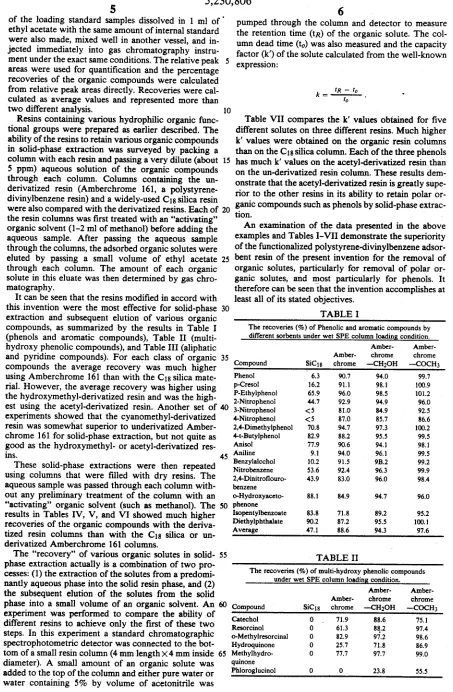
It can be seen that the resins modi?ed in accord with this invention were the most effective for solid-phase
extraction and subsequent elution of various organic
compounds, as summarized by the results in Table I
(phenols and aromatic compounds), Table II (multi
hydroxy phenolic compounds), and Table III (aliphatic
and pyridine compounds). For each class of organic
compounds the average recovery was much higher using Amberchrome 161 than with the C18 silica mate rial. However, the average recovery was higher using the hydroxymethyl-derivatized resin and was the high
25
est using the acetyl-derivatized resin. Another set of 40
experiments showed that the cyanomethyl-derivatized
resin was somewhat superior to underivatized Amber chrome l6l for solid-phase extraction, but not quite as good as the hydroxymethyl- or acetyl-derivatized res
ins.
These solid-phase extractions were then repeated using columns that were ?lled with dry resins. The
aqueous sample was passed through each column‘ with
out any preliminary treatment of the column with an
“activating” organic solvent (such as methanol). The
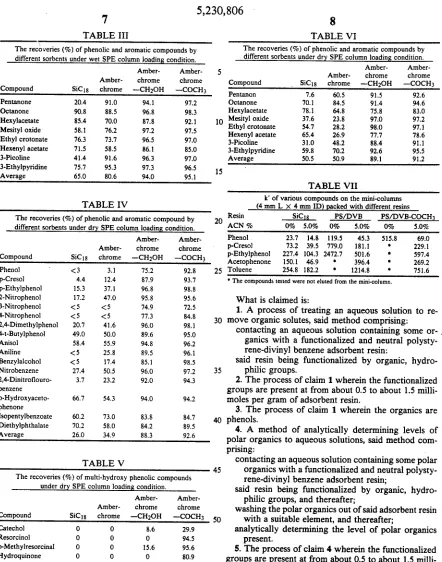
results in Tables IV, V, and VI showed much higher
recoveries of the organic compounds with the deriva
tized resin columns than with the C18 silica or un derivatized Amberchrome 161 columns.
The “recovery” of various organic solutes in solid
phase extraction actually is a combination of two pro cesses: (1) the extraction of the solutes from a predomi
nantly aqueous phase into the solid resin phase, and (2) the subsequent elution of the solutes from the solid
phase into a small volume of an organic solvent. An experiment was performed to compare the ability of different resins to achieve only the ?rst of these two
steps. In this experiment a standard chromatographic
spectrophotometric detector was connected to the bot tom of a small resin column (4 mm length X4 mm inside diameter). A small amount of an organic solute was added to the top of the column and either pure water or water containing 5% by volume of acetonitrile was
45
55
60
65
6
pumped through the column and detector to measure the retention time (tR) of the organic solute. The col umn dead time (to) was also measured and the capacity factor (k') of the solute calculated from the well-known
expression:
Table VII compares the k' values obtained for ?ve different solutes on three different resins. Much higher k’ values were obtained on the organic resin columns than on the C13 silica column. Each of the three phenols has much k’ values on the acetyl-derivatized resin than on the un-derivatized resin column. These results dem onstrate that the acetyl-derivatized resin is greatly supe rior to the other resins in its ability to retain polar or
ganic compounds such as phenols by solid-phase extrac
tion.
An examination of the data presented in the above
examples and Tables I-VII demonstrate the superiority of the functionalized polystyrene-divinylbenzene adsor
bent resin of the present invention for the removal of
organic solutes, particularly for removal of polar or ganic solutes, and most particularly for phenols. It
therefore can be seen that the invention accomplishes at
least all of its stated objectives.
TABLE I
The recoveries (%) of Phenolic and aromatic compounds by
different sorbents under wet SPE column loading condition.
Amber- Amber Amber- chrome chrome Compound SiC1g chrome -—CH2OH —-COCH3
Phenol 6.3 90.7 94.0 99.7
p-Cresol 16.2 91.1 98.1 100.9
P-Ethylphenol 65.9 96.0 98.5 101.2
Z-Nitrophenol 44.7 92.9 94.9 96.0
3-Nitrophenol < 5 81.0 84.9 92.5
4-Nitrophenol <5 87.0 85.7 86.6
2,4-Dimethylpheno1 70.8 94.7 97.3 100.2
4-t-Butylphenol 82.9 88.2 95.5 99.5
Anisol 77.9 90.6 94.1 98.1
Aniline 9.1 94.0 96.1 99.5
Benzylalccho] 10.2 91.5 98.2 99.2
Nitrobenzene 53.6 92.4 96.3 99.9
2,4-Dinitro?ouro- 43.9 83.0 96.0 98.4 benzene
o-Hydroxyacetm 88. 1 84.9 94.7 96.0
phenone
Isopentylbenzoate 83.8 71.8 89.2 95.2 Diethylphthalate 90.2 87.2 95.5 100. 1
Average 47.1 88.6 94.3 97.6
TABLE II
The recoveries (%) of multi-hydroxy phenolic compounds
under wet SPE column loadirlg condition. Amber- Amber Amber- chrome chrome
Compound SiCrg chrome '—CI-12OH —COCH 3
Catechol 0 71.9 88.6 75.1
Resorcinol 0 61.3 88.2 97.4
o-Methylresorcina] 0 82.9 97.2 98.6
Hydroquinone 0 25.7 71.8 86.9
Methylhydro- 0 77.7 97.7 99.0
quinone
[image:6.557.58.511.63.755.2]TABLE III
7
5,230,806
The recoveries (%) of phenolic and aromatic compounds by different sorbents under wet SPE column loading condition.
. er.
Amber'
Amber‘
5
Amber-
$219,171;
3:63:11‘:
Amber- chrome chrome Compound 81C“; chrome —CH;OH _c0cn3
Compound SiC 1 g chrome —CH2OH -—-COCH3 Penwnon 7'6 60. 5 91.5 91 6
Pentanone 20.4 91.0 94.1 97.2 0994110118 ‘10-1 84-5 9l-4 94-6
Ocmone 9&8 88.5 968 98.3 Hexylacetate 78.1 64.8 75.8 83.0
Hexylacetate
85.4
70.0
87.8
92.1
10 gigylrggiim
if,
33:8
3;?
mm‘ Wide 58-‘ 76-2 97-2 97-5 Hexenyl acetate 65.4 26.9 77.7 78.6
Ethyl crotonate 76.3 73.7 96.5 97.0 3_pic°1ine 3L0 43‘; 834 gm
Hexenyl acetate 71.5 58.5 86.1 85.0 3~Ethylpyridine 59.8 70.2 92.6 95.5
3-Picoline 41.4 91.6 96.3 97.0 Average 50.5 50.9 89.1 91.2
3-Ethylpyridine 75.7 95.3 97.3 96.5 15 -
Average 65.0 80.6 94.0 95.1
TABLE VII
k’ of various compounds on the mini-columns
TABLE IV (4 mm 1. X 4 mm ID) backed with different resins
The recoveries (%) of phenolic and aromatic compound by 20 Resm S‘CIS Ps/DVB PS/DVB‘COCHI’
different sorbents under dry SPE column loadignuondition. ACN % 0% 50% 0% 50% 0% 50%
me" We"
“5M1
i3‘; $3‘? $33 13?‘? “5'8
233'?
. Amber’ chmme chmme gstriisyiphenoi 2274 1043 2472.7 501:6 ' 597.4
c°mp°und s‘cls chmme “CHZOH _COCH3 Acetophenone 150.1 46.9 ' 396.4 9 269.2
Phenol <3 31 75,2 913 25 Toluene 254.8 182.2 ‘ 1214.8 ' 751.6
p-Cresol 4.4 12.4 87.9 93.7 ' The compounds tested were not eluted from the mini-column.
p-Ethylphenol 15.3 37.1 96.8 98.8
2-Nitrophenol 17.2 47.0 95.8 95.6 what is claimed is;
3'Ni"°Phe"°l <5 <5 74-9 72-5 1. A process of treating an aqueous solution to re 4-Nitrophen0l <5 <5 77-3 34-8 30 move organic solutes, said method comprising:
itgxleggiggeml 2(9):;
2(1)::
:32
32:2)
contacting an aqueous solution containing some or- _
Anise} 58A 559 943 96.2 gamcswtth a functionalized and neutral polysty
Aniline <5 25.8 895 961 rene-divinyl benzene adsorbent resm: _
Benzylalcohol <5 17.4 Bil 985 said resin being functionahzed by organic, hydro
Nitrobenzene 27.4 50.5 96.0 97.2 35 philic groups.
2,4.Dinhm?oum. 3,7 23,2 9250 943 2. The process of claim 1 wherein the functionalized
benzene groups are present at from about 0.5 to about 1.5 milli
o-Hydroxyaceto- 66.7 54.3 94.0 94.2 moles per gram of adsorbent resin.
Phcnone 3. The process of claim 1 wherein the organics are
Isopentylbenzoate 60.2 73.0 83.8 84.7 40 phenols_
Die‘hylphlhalale 703 580 84'2 89-5 4. A method of analytically determining levels of Average 2&0 34'9 83'3 92'6 polar organics to aqueous solutions, said method com
prising:
contacting an aqueous solution containing some polar
TABLE V . . . .
45 organics with a functionalized and neutral polysty The recoveries (%) of mulii-hydroxy phenolic compounds rene-diviny] benzenc adsorbent resin;
under dry SPE °°1umn wading “million said resin being functionalized by organic, hydro Amber- Amber- philic groups, and thereafter;
Amber' chrome chrome washing the polar organics out of said adsorbent resin c‘mllm"d sicl? chmme 432°“ —COCH3 50 with a suitable element, and thereafter;
Catechol 0 0 8.6 29.9 analytically determining the level of polar organics
Resorcinol 0 0 0 94.5 present.
@Melhylresorcinal 0 0 l5-6 95-6 5. The process of claim 4 wherein the functionalized
Hydroquinone 0 0 0 809 groups are present at from about 0.5 to about 1.5 milli
Mfalhylhydw' 0 o 4'9 93-8 55 moles per gram of adsorbent resin.
qu‘nc’ne _ 6. The process of claim 4 wherein the organics are Phloroglucmol 0 0 0 42.0 phenols
8 t i i i
60
65
8
TABLE VIThe recoveries (%) of phenolic and aromatic compounds by