Iowa State University Patents
Iowa State University Research Foundation, Inc.
1-12-1999
Process for the synthesis of α, β-unsaturated esters
Robert J. Angelici
Iowa State University, [email protected]
Kuo-Chen Shih
Follow this and additional works at:
http://lib.dr.iastate.edu/patents
Part of the
Chemistry Commons
This Patent is brought to you for free and open access by the Iowa State University Research Foundation, Inc. at Iowa State University Digital Repository. It has been accepted for inclusion in Iowa State University Patents by an authorized administrator of Iowa State University Digital Repository. For more information, please [email protected].
Recommended Citation
Angelici, Robert J. and Shih, Kuo-Chen, "Process for the synthesis of α, β-unsaturated esters" (1999).Iowa State University Patents. 96.
Abstract
The present invention provides a process for the synthesis of an α,β-unsaturated ester from a
mono-olefin-ester using Fe(CO).sub.5.
Keywords
Chemistry
Disciplines
Chemistry
United States Patent [19]
Angelici et al.
US005859268A
5,859,268
Jan. 12, 1999
[11]
Patent Number:
[45]
Date of Patent:
[54] PROCESS FOR THE SYNTHESIS OF (X, [3
UNSATURATED ESTERS
[75] Inventors: Robert J. Angelici, Ames, Iowa; Kuo-Chen Shih, Kaohsiung, Taiwan
[73] Assignee: Iowa State University Research Foundation, Inc., Ames, IoWa
[21] Appl. No.: 826,946
[22] Filed: Apr. 8, 1997
Related US. Application Data [60] Provisional application No. 60/015,395 Apr. 9, 1996.
[51] Int. Cl.6 ... .. C07C 51/347; C07C 69/74;
C11C 1/00
[52] US. Cl. ... .. 554/126; 554/75; 560/205 [58] Field of Search ... .. 554/126, 75; 560/205
[56] References Cited
PUBLICATIONS
C. Adams et al., “Synthesis and 1H—, 13C—, and 57Fe—NMR Spectra of Mono— and Bis[tricarbonyl(n4—diene)iron], and
(113—Allyl)tetracarbonyliron Tri?uoroborate Complexesl)”,
Helvetica Chimica Acta, 71, pp. 1116—1142 (1988). SJ. AinsWorth, “Personal Care Products”, Chemical &
Engineering News, pp. 34—45 (17 Apr. 1995).
T. Akiyama et al., “Photolytic Cleavage and Isomerization
Reactions of (1—o,4—6—113—Organo)tricarbonyliron Com
plexes Involving an (114—Diene) (nz?’le?mFewo)2 Intermedi
ate. Quantum Yields and Mechanistic Studies”, Organome
tallics, 2, pp. 157—160 (1983).
J .A. Barve et al., “Fatty Acids, Part 33: The Synthesis of all
the Octadecynoic Acids and all the Trans—Octadecenoic Acids”, Chem. Phys. Lipids, 7, pp. 311—323 (1971).
F. BirencWaig et al., “Amminotetracarbonyl Iron (O) Com
plexes”, Tetrahedron Letters, 31, pp. 2947—2950 (1979).
A]. BoWles et al., “Mass Spectra of Some Acyclic ot,[3—Un saturated Aldehydes, Ketones and Esters”, Organic Mass
Spectrometry, 2, pp. 809—818 (1969).
AM. Brodie et al., “Some rt—Hetero—1,3—diene Complexes of Iron Carbonyl”, Journal of the Chemical Society, 18, pp.
2031—2035 (1972).
G. Cardaci et al., “Kinetics and Mechanism of Substitution
of Ole?nic Ligands by Carbon Monoxide in
Tetracarbonyl—rt—ole?niron Complexes”, Journal of the Chemical Society, 19, pp. 2289—2293 (1972).
G. Cardaci, “Mechanism of Formation of (01,6) Unsaturated
Aldehyde— and Ketone—Iron Tricarbonyl Complexes from
the Corresponding Iron—Tetracarbonyl Complexes”,Journal
of the American Chemical Society, 97, pp. 1412—1415
(1975).
PA. Chaloner, Handbook of Coordination Caralysis in
Organic Chemistry, ButterWorths; London, pp. 403—450
(1986).
FA. Cotton et al., “Reactivity of Diiron Nonacarbonyl in
Tetrahydrofuran. I. The Isolation and Characterization of
Pyridinetetracarbonyliron and Pyrazinetetracarbonyliron”,
Journal of the American Chemical Society, 96, pp.
3438—3442 (1974).
R. Damico, “Iron Carbonyl Catalyzed Isomerization of
Unsaturated Ethers and Esters. The Effect of Carbomethoxy
and Methoxy Groups on Ole?n Equilibria”, The Journal of
Organic Chemistry, 33, pp. 1550—1556 (1968).
J. Elzinga et al., “Intermediate Complex in the Reduction of Trimethylamine Oxide by Pentacarbonyl Iron: Its Use as
Catalyst in the Addition of Carbon Tetrachloride to Carbon—
Carbon Double Bonds”, J.C.S. Chem Comm., 20, pp.
705—706 (1977).
Fatty Acids in Industry, edited by R.W. Johnson et al., Marcel Dekker, NeW York, NeW York, 1989, Title Page and Table of Contents only.
H. Fleckner et al., “Tricarbonylbism 2—cis—cyclooctene)iron: Photochemical Synthesis of a Versatile Fe(CO)3 Source for
Ole?n Isomerization and Preparative Applications”, J. Am. Chem. Soc., 106, pp. 2027—2032 (1984).
MB. France et al., “An Iridium—based Catalyst System for
Metathesis/Isomerization of Acyclic Ole?ns, including
Methyl Oleate”, J. Chem. Soc., Chem. Commun., pp.
1307—1308 (1994).
EN. Frankel et al., “Catalytic Hydroformylation and Hydro carboxylation of Unsaturated Fatty Compounds”,J. Am. Oil
Chemists’ Soc., 54, pp. 873—881 (1977).
EN. Frankel et al., “Conjugation of Soybean Oil by Decom position of Its Iron Tricarbonyl Complex With Carbon Mon oxide”, J. Am. Oil Chemists’ Soc., 44, pp. 37—39 (1967).
EN. Frankel et al., “Isomerization of Unsaturated Fatty
Esters by Iron Pentacarbonyl, Preparation of Iron Tricarbo nyl Complexes of Polyunsaturated Fats”, J. Am. Oil Chem ists’ Soc., 43, pp. 307—311 (1966).
DJ. Frost et al., “The PMR Analysis of Non—Conjugated Alkenoic and Alkynoic Acids and Esters”, Chemistry and
Physics ofLipids, 15, pp. 53—85 (1975).
W. Gerhartz et al., “LoW—Temperature Photochemistry of
Matrix—Isolated Fe(CO)4 Complexes of ot,[3—Unsaturated
Esters: C=C vs. Ester Group Coordination”, Organometal
lics, 6, pp. 1850—1856 (1987).
F.—W. Grevels et al., “Photochemical Synthesis of
Bis(n—methyl acrylate)tricarbonyliron”, Angew. Chem.
internat. Edit., 13, pp. 534—536 (1974).
WP. Grif?th et al., “Vibrational Spectra of Metal—Metal Bonded Complexes of Group VIII”,J. Chem. Soc. (A), 5, pp. 834—839 (1969).
G. Grimmer et al., “Synthese von cis—Formen ot,[3—Ungesat tigter Carbonsauren”, LiebigsAnnalen Der Chemie, 685, pp. 154—160 (1965).
J. Hine et al., “Double Bond Stabilizing Abilities of Formyl,
Carbo—tert—butoxy, and Carbomethoxy Substituents”, J. Org. Chem., 47, pp. 2745—2748 (1982).
J. Hine et al., “Electronic Effects of Substituents on the
Stabilities of Carbon—Carbon Double Bonds”,J ournal of the American Chemical Society, 95, pp. 1179—1185 (1973).
(List continued on next page.) Primary Examiner—Paul J. Killos
Attorney, Agent, or Firm—Mueting, Raasch & Gebhardt,
PA.
[57] ABSTRACT
The present invention provides a process for the synthesis of
an ot,[3-unsaturated ester from a mono-ole?n-ester using
Fe(CO)5.
PUBLICATIONS
D.R. HoWton, “Preparation of trans—2—Octadecenoic Acid”, Organic Preparations and Procedures Int., 6, pp. 175—178
(1974).
A]. Hubert et al., “The IsomeriZation of Ole?ns Part I.
Base—Catalysed IsomeriZation of Ole?ns”, International
Journal of Methods in Synthetic Organic Chemistry, 3, pp. 97—112 (1969).
A]. Hubert et al., “The IsomeriZation of Ole?ns Part II.
Thermal and Catalytic IsomeriZation of Ole?ns using Acids,
Metals, Metal Complexes, or Boron Compounds as Cata lysts”, International Journal of Methods in Synthetic Organic Chemistry, 8 pp. 405—430 (Aug. 1970).
M. Khan et al., “Allylic Oxidation of Methyl trans—2—Octadecenoate by Chromium Trioxide”, Indian
Journal of Chemistry, 25B, pp. 321—323 (1986).
Kerber, Comprehensive Organometallic Chemistry, Abel et al., Pergamon Press, 7, (1995), Title Page and Table of Contents only.
J .S. Kristoff et al., “Adduct Formation and Carbonyl Rear
rangement of Polynuclear Carbonyls in the Presence of
Group III Halides”, Inorganic Chemistry, 13, pp. 499—506
(1974).
P]. Kropp et al., “Photochemistry of Cycloalkenes. IV.
Comparison With Crotonic Acid”, The Journal of Organic Chemistry, 32, pp. 3222—3223 (1967).
T. Kruck et al., “Uber das Reaktionsverhalten von Pentaki
s(tri?uorophosphin)—eisen(0)
gegeniiber
aktivierten
Monoole?nen”, Chemische Berichte, 106, pp. 3578—3587
(1973).
W. LauWers et al., “Studies in Organic Mass Spectrometry— XIII: Investigation of Electron—Impact—Induced Isomerisa
tion of ot,[3— and [3,Y—Unsaturated Esters”, Organic Mass Spectrometry an Internat’l Journal, 7, pp. 1027—1037
(1973).
CF. LochoW et al., “Nickel—Promoted IsomeriZations of Alkenes Bearing Polar Functional Groups”, J. Org. Chem., 41, pp. 3020—3022 (1976).
TA. Manuel, “Some Reactions of Monoole?ns With Iron Carbonyls”, J. Org. Chem., 27, pp. 3941—3944 (1962).
DE. McGreer et al., “PyraZolines. Part II”, Can. J. Chem.,
38, pp. 2410—2416 (1960).
DE. McGreer et al., “Thermal rearrangement of ot,[3— to [3,y—unsaturated esters. Evidence for a 1,5—hydrogen transfer
mechanism”, Can. J. Chem., 46, pp. 2225—2232 (1968).
R]. McKinney, “Kinetic Control in Catalytic Ole?n Isomer iZation. An Explanation for the Apparent Contrathermody namic IsomeriZation of 3—Pentenenitrile”, Organometallics,
4, pp. 1142—1143 (1985).
Miginiac et al., “Action D’OrganoZinciques ot—Ethyleniques sur le Chloroformiate D’Ethyle: Preparation D’Esters
[3—Ethyleniques”, Journal of Organometallic Chemistry, 96,
pp. 163—168 (1975).
Norman, Inorganic Reactions and Methods, 16, VCH Pub lishers; NeW York, NeW York 1993, Title Page and Table of
Contents only.
B. Palameta et al., “Erythro and Threo—1,2,3—Octadecan
etriols”, Tetrahedron, 19, pp. 1463—1470 (1963).
A]. Pearson, “Iron Compounds in Organic Synthesis”,
Academic Press, San Diego, CA, 1994, Title page and Table of Contents only.
S. Rafat Husain et al., “Synthesis of Sulfur—Containing Derivatives from Ole?nic Fatty Esters”, JAOCS, 60, pp.
1340—1344 (1983).
R.G. Salomon, “Tetrahedron Report No. 143”, Tetrahedron,
39, pp. 485—575 (1983).
MA. Schroeder et al., “Pentacarbonyliron(0) Photocata lyZed Hydrogenation and IsomeriZation of Ole?ns”, J. Am.
Chem. Soc., 98, pp. 551—558 (1976).
EH. Schubert et al., “The Photochemical Synthesis of
Pentacarbonyliron(0) Derivatives”, Inorganic Chemistry, 5,
pp. 1071—1074 (1966).
J.—K. Shen et al., “Kinetic studies of CO substitution of metal carbonyls in the presence of O—atom transfer reagents”, Coordination Chemistry Review, 128, pp. 69—88
(1993).
K.—C. Shih et al., “Iron Carbonyl—Promoted IsomeriZation
of Ole?n Esters to Their ot,[3—Unsaturated Esters: Methyl Oleate and Other Examples”, T heJ ournal of Organic Chem
istry, 61, pp. 7784—7792 (1996).
H. Singer et al., “Isomerisierungen Ole?niseher Carbonsau reester mit rhodiumkomplexen”, Tetrahedron, 28, pp.
5769—5777 (1972).
H.K. van Dijk et al., “LoW temperature photochemistry of
[Fe2(CO)6(bipy)—(P(n—Bu)3)]. StabiliZation of an interme
diate photoproduct in a decomposition reaction” Journal of
Organometallic Chemistry, 340, pp. 227—238 (1988). von Gustorf et al., “Tri— und Tetracarbonyleisen—Komplexe
der Isobutyliden—meldrumsaure”, Zeitschrift fur Naturfors
U.S. Patent
Jan. 12, 1999
5,859,268
2190
z'ora
2645
2074
/9'82
1950
37/5
PROCESS FOR THE SYNTHESIS OF (X, [3 UNSATURATED ESTERS
This application claims priority from a provisional patent
application ?led on Apr. 9, 1996 entitled “Process for the
Synthesis of the Alpha,Beta-Isomer of Methyl Oleate” and assigned Provisional Serial No. 60/015,395, Which is incor
porated herein by reference.
BACKGROUND OF THE INVENTION
The isomeriZation of ole?ns is catalyZed by a variety of agents including bases, acids, and a plethora of transition
metal complexes. These catalysts yield a thermodynamic
mixture of isomeric ole?ns if the isomeriZations are alloWed
to proceed to equilibrium. Non-thermodynamic distributions
of products are obtained if equilibrium is not achieved, but it is rare that ole?n isomeriZation leads to high yields of one
isomer unless it is highly favored thermodynamically.
As there is considerable commercial interest in transfor mations of ole?n-esters to their ot,[3-unsaturated esters, par ticularly the transformation of esters of oleic acid, it Would
be highly desirable to perform the isomeriZation in Equation
This is a particularly challenging isomeriZation because of the many ole?n isomers that are possible Within the seventeen-carbon hydrocarbon chain. Because none of these isomers is highly favored thermodynamically, the ot,[3
unsaturated ester isomer has been prepared by very elaborate
methods. See, for example, HoWton, Org. Prep. Proc. lnt., 6, 175, 1974; Barve et al., Chem. Phys. Lipids, 7, 311, 1971,
Grimmer et al., Lieb. Annt. Chem., 685, 154, 1965; and Palameta et al., Tetrahedron, 19, 1463, 1963. Aless complex method for such syntheses Would be highly desirable. A less complex method that Would promote the isomeriZation in Equation 1 could presumably also be used for the isomer
iZation of other mono-ene esters to ot,[3-unsaturated esters.
Such reactive products Would be useful intermediates for the
synthesis of other neW compounds.
Iron carbonyls have been used extensively as catalysts for the isomeriZation of ole?ns. For example, 1-pentene isomer iZes to give an equilibrium mixture of cis-2-pentene (21%) and trans-2-pentene (76%) in the presence of Fe(CO)5 in
CGH6 solvent under ultraviolet photolysis (Schroeder et al.,
J. Am. Chem. Soc., 98, 551, 1976). The same product distribution is obtained When Fe(CO)3(cis-cyclooctene)2
catalyZes 1-pentene isomeriZation Without photolysis
(Fleckner et al., J. Am. Chem. Soc., 106, 2027, 1984). A mixture of isomers is obtained from the Fe3(CO)12 catalyZed isomeriZations of n-hexenes, n-pentenes, and
methyl-1-pentenes under re?ux (Manuel et al., J. Org.
Chem., 27, 3941, 1962). Similarly, Fe(CO)5 catalyZes the
isomeriZation of n-alkenyl- and cyclohexenylcarboxylate
esters and ethers to a mixture of isomers When re?uxed
(125 °—150° C.) in hydrocarbon solvents or photolyZed at 20°
10
15
20
25
30
35
40
45
50
55
60
65
C. (Damico,J. Org. Chem., 33, 1550, 1968). Methyl oleate
itself has been reported to give a very complex mixture of ole?n isomers When heated at 185° C. With Fe(CO)5; hoWever, in this mixture the amount of the ot,[3-ester isomer Was too small to be detected (Frankel et al.,]. Am. Oil Chem.
Soc., 43, 307, 1966).
Not only do the iron carbonyls catalyZe ole?n isomeriZa
tion but there is evidence that under the proper conditions
they might Weakly stabiliZe the ot,[3-ester isomer (Equation
1) by coordinating it as an n4-oxadiene to Fe(CO)3 as in A.
OMe A
Isolable Fe(CO)3 complexes of 114 ot,[3-unsaturated alde
hydes (RCH=CH—C(=O)H), ketones (RCH=CH—C
(=O)R‘) and imines (RCH=CH—C(=NR‘)H) are Well
knoWn. The ole?n-esters, 114 methyl acrylate and methyl
trans-crotonate, also form 114 complexes, Fe(CO)3(114
H2C=CHCO2Me)
and
Fe(CO)3
(114
CH3CH=CHCO2Me), that have been detected in
ultraviolet-irradiated, loW temperature matrices (10—12 K)
containing Fe(CO)5 and the ot,[3-unsaturated esters. Even at
—5° C., Fe(CO)3 (114-H2C=CHCO2Me) has been observed
in n-hexane Where it is in equilibrium With Fe(CO)3(n2 H2C=CHCO2Me)2, Whose concentration depends on the concentrations of the complex and added methyl acrylate.
Although such studies suggest that it may be possible to stabiliZe the ot,[3-ester isomer of methyl oleate by 114 coor
dination to Fe(CO)3 if the complex (of type A) is produced at relatively loW temperatures, this Would mean that
Fe(CO)5 must catalyZe the isomeriZation at loW temperature.
HoWever, Fe(CO)5 is knoWn to be inactive as an ole?n
isomeriZation catalyst at loW temperatures (e.g., at tempera tures beloW about 00 C. Furthermore, although at high temperatures (e.g., at temperatures greater than about 125° C.), Fe(CO)5 is an ole?n isomeriZation catalyst, the ot,[3
ester isomer cannot be stabiliZed by 114 coordination to
Fe(CO)3 because the complex of type Ais not stable at such
high temperatures.
SUMMARY OF THE INVENTION
The present invention provides processes for the synthesis
of an ot,[3-unsaturated ester from a mono-ole?n-ester using
Fe(CO)5. In one embodiment, the process includes the steps of: exposing a mixture of a mono-ole?n-ester and Fe(CO)5 to ultraviolet radiation; and adding a coordinating ligand or oxidiZing agent to the mixture under conditions effective to produce an ot,[3-unsaturated ester. In another embodiment, the process includes the steps of: combining a mono-ole?n ester and Fe(CO)5 under conditions effective to form Fe(CO)3(n4-ot,[3-ester); and adding a displacing reagent
(e.g., a coordinating ligand or oxidiZing agent such as O2) to
the Fe(CO)3(n4-ot,[3-ester) to displace the ot,[3-ester ligand and form free ot,[3-unsaturated ester. In yet another
embodiment, the process includes the steps of: exposing
Fe(CO)5 to ultraviolet radiation in the presence of a Weakly
coordinating ligand to form Fe(CO)3Lx, Wherein L repre sents the Weakly coordinating ligand and x=1 or 2; adding a mono-ole?n-ester to the Fe(CO)3Lx to form F6(CO)3(T]4-(X,
[3-ester); and adding a displacing reagent to the Fe(CO)3(n4 ot,[3-ester) to displace the ot,[3-ester ligand and form free
ot,[3-unsaturated ester.
The present invention also provides a process for the
5,859,268
3
includes the steps of: combining a mono-ole?n-ester and
Fe(CO)5 under conditions effective to form F6(CO)3(T]4-(X,
[3-ester); and treating Fe(CO)3(n4-ot,[3-ester) With an elec trophile to form an ester. The electrophile is preferably an
acid of the form HX, Wherein X is F, Cl, Br, I, CH3CO2, RSO3, R3PO4, and the like.
BRIEF DESCRIPTION OF THE DRAWINGS
FIG. 1a. FTIR Spectrum of the UV-irradiated solution of
CH3CH=CHCO2Me (13.3 mM) and F¢(co)5 (13.3 mM) in
hexanes at 0° C. after 0.5 hour irradiation. 1=Fe(CO)4(112
methyl crotonate); 2=Fe(CO)3(n4-methyl crotonate); *=Fe
(CO)5.
FIG. 1b. FTIR Spectrum of the UV-irradiated solution of
CH3CH=CHCO2Me (13.3 mM) and F¢(co)5 (13.3 mM) in
hexanes at 0° C. after 1 hour irradiation. 1=Fe(CO)4(112
methyl crotonate); 2=Fe(CO)3(n4-methyl crotonate); *=Fe
(CO)5.
FIG. 1c. FTIR Spectrum of the UV-irradiated solution of
CH3CH=CHCO2Me (13.3 mM) and F¢(co)5 (13.3 mM) in
hexanes at 0° C. after 5 hours irradiation. 1=Fe(CO)4(112
methyl crotonate); 2=Fe(CO)3(n4-methyl crotonate); *=Fe
(c0).
DETAILED DESCRIPTION OF THE INVENTION
As noted above, the isomeriZatin of ole?ns is catalyZed by
numerous transition metal complexes as Well as strong acids
and bases. HoWever, these isomeriZations normally result in
the formation of a mixture of ole?n isomers because they all have similar thermodynamic stabilities. The process of the
present invention preferably solves this problem by using
ultraviolet radiation to photolyZe a mixture of Fe(CO)5 and mono-ole?n-esters (i.e., molecules in Which the C=C bond
is not in conjugation With the C=O bond). Alternatively, the Fe(CO)5 can be initially exposed to ultraviolet radiation When in the presence of a Weakly coordinating ligand (e.g., cis-cyclooctene) that is effective at stabiliZing the Fe(CO)5_x moiety (x=1 or 2) until the mono-ole?n-ester is added to the
mixture, although this is not the preferred Way to carry out
the photolysis step. Once the photolysis step has been
carried out, it is folloWed by a step of treating the reaction
mixture With a coordinating ligand to give the free (i.e.,
uncoordinated) ot,[3-ester.
The process of the present invention (e.g., the photolysis
step and the treatment step) is carried out for a time and at a temperature effective to produce the corresponding free ot,[3-unsaturated ester (also referred to herein as the ot,[3
ester). Preferably, the process of the present invention is carried out under conditions that produce the free (i.e.,
uncoordinated) ot,[3-ester in an amount of at least about 25% yield, more preferably, at least about 40% yield, and most
preferably, in at least about 70% yield, With yields as high as 90% often being possible.
The mono-ole?n-ester is one in Which the C=C bond is
not in conjugation With the C=O bond. It is of the general
formula (R1)(R2)C=C(R3)—R4—CO2R5. The R groups can be a Wide variety of organic groups (or H for R1, R2, and R3) optionally including functional groups that are not capable of coordinating With the iron center. That is, the
functional groups can be any that do not contain coordinat
ing atoms such as O, S, N, P, Sb, and As. Such mono-ole?n
esters include a variety of vegetable oils, such as soybean,
corn, etc., and animal fats. Partially hydrogenated vegetable
oils can also be converted to ot,[3-esters. For example, the fatty acid groups in soybean oil are 53% linoleic acid, Which
10
15
20
25
30
35
40
45
50
55
60
65
4
contains an ester group and tWo ole?n groups. Upon partial
hydrogenation, linoleic acid can be converted to a molecule
With an ester group and one ole?n group, Which can then be
used in the process of the present invention.
Preferably, in the formula (R1)(R2)C=C(R3)—R4—
COZRS, each R1, R2, and R3 is independently H or an alkyl
group, R4 is a divalent alkylene grou that does not contain any quaternary carbon atoms, and R is an alkyl group. The alkyl groups can include functional groups. R4 may have functional groups in the side chains but not in the main chain, and may have aromatic groups in the side chains but not in the main chain (i.e., in the chain betWeen the C=C and the ester group). As stated above, the functional groups can be any that are not capable of coordinating With the iron
center. That is, the functional groups can be any that do not
contain coordinating atoms such as O, S, N, P, Sb, and As.
It is believed that the process involves the isomeriZation of the mono-ole?n ester to a conjugated ot,[3-ester With
formation of the intermediate Fe(CO)3(n4-ot,[3-ester). In this intermediate complex, the ot,[3-unsaturated ester isomer of
the mono-ole?n ester is stabiliZed by n4-oxadiene at coor dination of the ole?n and ester carbonyl groups to the Fe(CO)3 unit. This Was unexpected in that a variety of other
products Were expected to have been formed (e.g., the 112 product). Although it is not intended to be limiting to the claimed invention, it is believed that, upon photolysis, there
is initial dissociation of one CO group and coordination of
the ole?n group of the ole?n-ester to the Fe(CO)4 unit.
Additional photolysis is believed to remove another CO
ligand Which alloWs the double bond to migrate to the ot,[3-position and the ester carbonyl group to bind to the metal to give the Fe(CO)3(n4-ot,[3-ester) complex.
Alternatively, if the photolysis can be carried out initially in the presence of a Weakly coordinating ligand, it is believed that Fe(CO)3Lx is formed, Wherein L represents the Weakly
coordinating ligand and x=1 or 2. Subsequently, the mono
ole?n-ester is added to the Fe(CO)3Lx to displace the Weakly
coordinating ligand(s) and form Fe(CO)3(n4-ot,[3-ester).
Such Weakly coordinating ligands are effective at stabiliZing the Fe(CO)5_x moiety (x=1 or 2) until the mono-ole?n ester
is added to the mixture. These include, for example, cis cyclooctene, other alkenes, ethers (RZO), alkyl or aryl halides, and esters.
Once the mono-ole?n-ester has been reacted With the photolyZed Fe (CO)5, presumably forming a Fe (CO)3(114 ot,[3-ester) complex, the reaction mixture is treated With a
ligand that is more strongly coordinating than the n4-oxadiene at ligand, e.g., pyridine or CO, to displace the
ot,[3-ester ligand and form free (i.e., uncoordinated) ot,[3
unsaturated ester. Alternatively, the intermediate Fe(CO)3 (n4-ot,[3-ester) complex could be treated With another type of displacing reagent, such as an oxidiZing agent (e.g., O2 or
cerium(IV) ammonium nitrate), to displace the ot,[3-ester ligand, or an electrophile capable of adding to the ole?n bond and forming an ester. Such electrophiles include, for
example, acids of the form HX, Wherein X is F, Cl, Br, I,
CH3CO2, RSO3, R3PO4, and the like.
The optimum time for the photolytic reaction depends, for
example, upon the intensity of the UV source and the arrangement of the source and the reaction mixture, and the
temperature of the reaction mixture. Preferably, the photoly
Fe(CO)5 and the ole?n-ester. Preferably, the photolysis step
of the process is carried out for no greater than about 24
hours, more preferably, for no greater than about 6 hours,
even more preferably, for no greater than about 4 hours, and
most preferably, for no greater than about 3 hours. Typically, the longer the photolysis time, the higher the yield (see Table
2, beloW), although photolysis times that are too long can
result in loWer yields. Although it is not intended to be limiting, this is believed to be due to decomposition of the
intermediate Fe(CO)3(n4-ot,[3-ester) and isomeriZation of
the ot,[3-ester to a mixture of ole?n-ester isomers.
The temperature of the reaction mixture during the pho
tolysis step is Within a range effective to produce an ot,[3
ester. It is believed that this is a temperature that is effective
to stabiliZe the intermediate n4-oxadiene at complex.
Preferably, this reaction is carried out at a temperature of no
greater than about 50° C., more preferably, at a temperature
of no greater than about 20° C., even more preferably, at a
temperature of no greater than about 10° C., and most preferably, at a temperature of no greater than about 0° C.
Typically, the higher the temperature of the reaction mixture
during photolysis, the loWer the yield (see Table 2, beloW). Although it is not intended to be limiting, this is believed to
be due to decomposition of the intermediate Fe(CO)3 (114
ot,[3-ester) and isomeriZation of the ot,[3-ester to a mixture of ole?n-ester isomers. Preferably, the temperature of the reac tion mixture during the photolysis step of the process is no less than about —80° C., although it does not appear that
yields are decreased With even loWer temperatures.
Another consideration in the process of the present inven tion is the concentration of the Fe(CO)5 and mono-ole?n
ester reactants. The Fe(CO)5 and mono-ole?n-ester are
typically used in approximately stoichiometric (i.e.,
equimolar) amounts (i.e., 110%), hoWever, one of the reac
tants can be used in excess. Preferably, the concentration of
each is initially present in the reaction mixture in no greater than about 500 mM, more preferably, no greater than about 50 mM, and most preferably, no greater than about 15 mM. If the concentrations are too high, photolysis of Fe(CO)5 can
produce insoluble Fe2(CO)9, Which can produce loW yields of the ot,[3-ester.
The photolysis step of the process of the present invention
can be carried out With a neat reaction mixture (i.e., in Which
the Fe(CO)5 acts as the solvent), although preferably, the
reaction mixture includes an organic solvent. The organic solvent is preferably a noncoordinating solvent (i.e., one that is not coordinating to the iron center), such as a hydrocarbon
solvent, a per?uorocarbon solvent. Examples of suitable
hydrocarbon solvents include hexanes, toluene, as Well as
other alkanes and arenes. More preferably, the solvent is an
alkane, such as pentane, heptane, hexanes, and the like.
Typically, a coordinating solvent, such as THF, is believed
to be undesirable because it may compete With the mono
ole?n-ester for coordination to the iron With the result that the ot,[3-ester is produced in loW yield.
Subsequent to photolysis, the reaction mixture is treated With a coordinating ligand (i.e., a ligand capable of coordi nating to the iron center) or other type of displacing reagent.
Because it is believed that the intermediate product is
Fe(CO)3(n4-ot,[3-ester), this coordinating ligand is one that
is more strongly coordinating to the iron center than the
ot,[3-ester. That is, it is a ligand that is capable of displacing
the ot,[3-ester from the iron center. Examples of such coor dinating ligands include pyridine, CO, PMe3 and other
phosphines, as Well as arsines, amines, sul?des (RZS), diene ole?ns, and the like. Typically, a large excess (e.g., 20-fold excess) of this coordinating ligand is used. It is added to the
10
15
20
25
30
35
40
45
50
55
60
65
6
reaction mixture under conditions effective to produce the
free (i.e., uncoordinated) ot,[3-ester. The preferred coordinat
ing ligand is CO because it reforms Fe(CO)5, Which can be
reused in the process. The other complexes Fe(CO)5(py)2 or
Fe(CO)3(PMe3)2, for example, are expensive and not easily recycled. Alternatively, O2 or other oxidiZing agents, such as
cerium(IV) ammonium nitrate, can be used in place of a
coordinating ligand, Which Would likely oxidiZe the com plex to Fe2O3. This iron oxide could be separated from the desired product by ?ltration, hoWever, it Would not alloW for easy recycling of the iron to Fe(CO)5.
The optimum time for this step (e.g., displacement step) of the process depends, for example, upon the nature and
amount of the coordinating ligand or oxidiZing agent, and the temperature of the reaction mixture. Preferably, this step
of the process is carried out for at least about 0.5 minute,
more preferably, for at least about 1 minute, even more
preferably, for at least about 5 minutes, and most preferably,
for at least about 10 minutes. Preferably, this step of the
process is carried out for no greater than about 1 hour, more preferably, for no greater than about 30 minutes, even more
preferably, for no greater than about 20 minutes, and most preferably, for no greater than about 10 minutes.
The temperature of the reaction mixture during this step (e.g., displacement step) of the process is Within a range effective to produce free ot,[3-ester. Preferably, this reaction
is carried out at a temperature of no greater than about 50° C., more preferably, at a temperature of no greater than about 30° C., even more preferably, at a temperature of no greater
than about 20° C., and most preferably, at a temperature of no greater than about 0° C. Preferably, the temperature of the reaction mixture during this step of the process is no less than about —40° C., more preferably, no less than about —30°
C., even more preferably, no less than about —20° C., and
most preferably, no less than about 0° C.
In order to prevent isomeriZation of the ot,[3-ester during
decomposition of Fe(CO)3(n4-ot,[3-ester) at temperatures above 0° C., CO or another coordinating ligand or oxidiZing
agent, for example, is preferably added to the reaction
mixture at an initial temperature of about 0° C. or beloW. It
is believed that this treatment results in displacement of the
coordinated ester group from the metal to give Fe(CO) 4(112
ot,[3-ester). In order to completely displace the ot,[3-ester, this
complex is preferably heated in the presence of the displac
ing reagent (e.g., coordinating ligand or oxidiZing agent) at
elevated temperatures for an extended period of time (e.g.,
50° C. for 12 hours). If the ot,[3-ester ligand is displaced by CO, Fe(CO)5 can be reformed. The Fe(CO)5 can then be separated from the ot,[3-ester product by distillation. Furthermore, the free ot,[3-unsaturated ester can be puri?ed by recrystalliZation. Alternatively, the ot,[3-unsaturated ester can be used in the mixture of other isomers produced in the
reaction (i.e., isomers resulting from migration of the C=C bond to sites other than the ot,[3- position).
The process of the present invention Was applied to the
isomeriZation of methyl 3-butenoate to give methyl croto nate in 94% yield. This isomeriZation is favored thermody
namically at 250° C.: methyl traus-crotonate (83%), methyl cis-crotonate (12%), and methyl 3-butenoate (5%). At 0° C.,
the equilibrium amount of methyl trans-crotonate is likely to be even greater. In the Fe(CO)5-promoted reaction, stabili
Zation of traits-methyl crotonate as the F6(CO)3(T]4-(X,[3
ester) complex is not necessary for the formation of this
product.
5,859,268
7
favored thermodynamically. In fact the equilibrium distri
bution of isomers at 25° C. is as follows: ethyl 4-methyl
3-pentenoate (90%) and ethyl 4-methyl-2-pentenoate (10%).
Despite this adverse equilibrium, ethyl 4- methyl-trans-2
pentenoate is obtained in 90% yield using the process of the present invention. The isomeriZation of ethyl 4-methyl-4
pentenoate also shoWs that this method accommodates the isomeriZation of ole?n-esters that contain a tertiary carbon. Finally, the Fe(CO)5-promoted isomeriZation of methyl oleate to its ot,[3-isomer occurs in 70% yield. This yield is far greater than that expected thermodynamically. Using RhCl
(PPh3)3/SnCl2 to catalyZe the isomeriZation of methyl oleate
at 115° C. in chlorobenZene solvent, the equilibrium amount
of the ot,[3-ester isomer is only about 3.5%.
The process of the present invention is advantageous
because the starting materials and reagents used are gener ally relatively inexpensive. For example, methyl oleate can be obtained from vegetable oils and animal fats, as Well as
from trees, and is a relatively inexpensive starting material.
Fe(CO)5 is also a relatively inexpensive liquid.
Because of the relatively high cost of producing ot,[3
esters using conventional procedures, their uses have been
limited. HoWever, With the process of the present invention,
it is anticipated that many applications Will be found, some of Which Will be similar to the uses of methyl oleate. Methyl
oleate and its derivatives are used Widely as surfactants in
soaps, industrial and household laundry products, and food
emulsi?ers. They are also used in oil-?eld chemicals, metal Working chemicals, cosmetics, and textiles. Other applica
tions for the ot,[3-esters produced by the process of the
present invention include those in Which fatty acids are used,
such as in personal care products (e.g., shampoos, skin
creams, etc.).
The invention Will be further described by reference to the
folloWing detailed example. This example is offered to
further illustrate the various speci?c and illustrative embodi
ments and techniques. It should be understood, hoWever,
that many variations and modi?cations may be made While
remaining Within the scope of the present invention.
EXPERIMENTAL SECTION
All reactions Were performed under a nitrogen atmo
sphere in reagent grade solvents using standard Schlenk techniques. Hexanes and toluene Were distilled under N2
from CaH2; tetrahydrofuran (THF) Was distilled from Nat
benZophenone. Silica gel (Davisil 62; 150 mesh, 58A) Was purchased from Davison Chemical, Baltimore, Md. Fe(CO)5
Was purchased from Aldrich Chemical Co., Milwaukee, Wis,
and used immediately after puri?cation by bulb-to-bulb
distillation. Methyl oleate (99%), methyl palmitate (99%),
ethyl 4-methyl-4-pentenoate (98%), methyl trans-crotonate
(98%), methyl 3-butenoate (97%), pyridine, cis-cyclooctene
(99%), and Fe2(CO)9 (98%) Were purchased from Aldrich
and used Without further puri?cation.
The photochemical reactions Were performed in a quartZ tube equipped With a nitrogen bubbler using a 450 W
mercury UV lamp. The temperatures (—35° C. to 20° C.) of
the photochemical reaction solutions Were maintained by a Lauda RK 20 constant temperature circulator. Infrared spec
tra Were obtained on a Nicolet 710 FTIR spectrophotometer
using a solution cell With NaCl salt plates (0.2 Gas
chromatographic analyses Were performed With a temperature-programmed Varian 3400 GC using a 25 m
HP-1 (cross-linked methylsilicone gum phase) capillary
column (OV-101) With a ?ame ioniZation detector. AVarian 3400 GC interfaced to a Finnigan TSG 700 high resolution
10
15
20
25
30
35
40
45
50
55
60
65
8
magnetic sector mass spectrometer With electron ioniZation
(70 eV) Was used for all GC-MS measurements. For analy
ses of methyl oleate and its isomers, the GC column tem perature Was held at 120° C. for 1 minute, folloWed by a 50°
C./minute ramp to 200° C. After a 1 minute hold, a ?nal
ramp (2° C./minute) to 220° C. Was used. For analyses of
ethyl 4-methyl-4-pentenoate and its isomers, the column
temperature Was held at 50° C. for 5 minutes, folloWed by
a 20° C./minute ramp to 150° C. The 1H NMR spectra Were recorded on a Nicolet NT-300 spectrometer using a deute riated solvent as the internal lock and internal reference
(CDCl3: 6 7.25 ppm; CGDG: 6 7.16 ppm for 1H).
Irradiation (UV) of Fe(CO)5 and Methyl trans-Crotonate. Asolution of methyl trans-crotonate (28 pL, 0.27 mmol) and Fe(CO)5 (35 pL, 0.27 mmol) in hexanes (20 mL) Was
alloWed to come to temperature equilibrium at 0° C. for 30
minutes. Irradiation (UV) of the slightly yelloW solution
With a continuous nitrogen ?oW over the surface of the solution to remove the evolved CO gave a red solution.
Approximately every 30 minutes, about 0.2 mL of the
solution Was removed by syringe for immediate FTIR analy
sis.
Irradiation of Fe(CO)5 and Methyl 3-Butenoate. The same procedures Were used for this reaction as for methyl trans
crotonate. After 6 hours of irradiation, the solution Was
treated With CO ?rst at 0° C. for 1 hour and then at 50° C.
for 12 hours as described in detail beloW in order to liberate
the free methyl crotonate; the resulting product mixture
(With a capillary containing reference C6D6) Was identi?ed by its 1H NMR spectrum as being 94% methyl trans crotonate and 6% of the starting methyl 3-butenoate. Their
1H NMR spectra are as folloWs: methyl trans-crotonate (6
7.47, d of q, J=15.6 and 6.9 HZ, ole?n H at C3; 6.35, d of
q, J=15.6 and 1.7 HZ, ole?n H at C2; 4.19, s, OCH3) and 6% of the starting methyl 3-butenoate (6 5.65, d of apparent q,
J=10.2, 1.5 and 1.5 HZ, ole?n H at C4; 5.66, d of apparent
q, J=17.1, 1.5 and 1.5 HZ, ole?n H at C4; 6.51, d of d of t, J=16.8, 10.2 and 6.9 HZ, ole?n H at C3; 3.57, d of t, J=6.9
and 1.5 HZ, H at C2; 4.17, s, OCH3). Although not observed in this reaction, the 1H NMR spectrum of methyl cis
crotonate in C6D6 is as folloWs: 6 7.47 (d of q, J=15.6 and
6.9 HZ, ole?n H at C3), 6.35 (d of q, J=15.6 and 1.7 HZ,
ole?n H at C2), 4.19 (s, OCH3).
Irradiation of Fe(CO)5 and Methyl Oleate. A solution of
methyl oleate (90 pL, 0.27 mmol) and Fe(CO)5 (35 pL, 0.27
mmol) in hexanes (20 mL) at 0° C. Was irradiated under a
continuous nitrogen ?oW. The solution turned from pale
yelloW to red during the irradiation. As the irradiation Was prolonged, the color of the solution turned to deep red.
Periodically 0.5 mL of the solution Was removed by syringe
for analysis. Aportion of the solution (0.2 mL) Was syringed into the NaCl IR cell for immediate FTIR analysis. The other
portion of the solution (0.3 mL) Was added to a vial (1.5 mL)
containing a 20-fold amount of pyridine; this solution Was
stirred at room temperature for 10 minutes and then ana
lyZed by GC for the organic compounds. Similar procedures
Were used in irradiation experiments With different concen
trations of Fe(CO)5 and methyl oleate in different solvents (toluene and THE) and at a higher reaction temperature (20°
C.).
9
(114-CH3(CH2)14CH=CHCO2Me). Then CO Was bubbled
through the solution at 0° C. for 1 hour, followed by stirring
under the CO atmosphere at 50° C. for 12 hours. The
resulting Fe(CO)5 and solvent Were vacuum distilled (bulb
to-bulb) from the reaction mixture. The residue Was then chromatographed in hexanes through a short (1><10 cm)
column (silica gel) to remove the iron impurities. The composition of the resulting solution Was analyZed by GC as described above. The compounds present in the mixture Were identi?ed by the folloWing 1H NMR spectra in CDCl3,
Which are very similar to those reported in the literature (McGreer et al., Can. J. Chem, 46, 2225, 1968; and Mig iniac et al., J. Organoiomet. Chem., 96, 163, 1975): methyl
octadec-trans-2-enoate: 6 2.18 (apparent q of d, J=7.2, 7.2 and 1.5 HZ, H at C4), 6.96 (d of t, J=15.5 and 7.2 HZ, ole?n H at C3), 5.81 (d of t, J=15.5 and 1.5 HZ, ole?n H at C2),
3.71 (s, OCH3); methyl octadec-cis-2-enoate: 6 2.63
(apparent q of d, J=7.5, 7.5 and 1.5 HZ, H at C4), 6.22 (d of t, J=11.4 and 7.5 HZ, ole?n H at C3), 5.70 (d of t, J=11.4 and
1.5 HZ, ole?n H at C2), 3.69 (s, CH3); methyl octadec-trans
3-enoate: 6 2.02 (m, H at C5), 5.52 (m, H at C3 and C4), 3.02
(d, J=5.4 HZ, H at C2), 3.67 (s, OCH3); methyl octadec-cis
3-enoate: 6 2.02 (m, H at C5), 5.52 (m, H at C3 and C4), 3.08
(d, J=5.1 HZ, H at C2), 3.67 (s, OCH3). The 1H NMR
spectrum of the starting methyl oleate in CDCl3 folloWs: 6
5.32 (m, 2 H, ole?n H), 1.99 (m, 4 H, CH2 at C8 and C11), 1.60 (m, 2 H, CH2 at C3), 2.28 (t, J=7.5 HZ, 2 H, CH2 at C2), 3.64 (s, 3 H, OCH3), 0.86 (t, J=6.6 HZ, 3 H, CH3 at C18),
1.25—1.28 (m, 20 H, remaining CH2 groups).
Reaction of CO With an Irradiated Solution of Fe(CO)5 and Ethyl 4-Methyl-4-Pentenoate. A hexanes solution (20
mL) of Fe(CO)5 (35 pL, 0.27 mmol) and ethyl 4-methyl-4
pentenoate (43 pL, 0.27 mmol) Was irradiated at 0° C. for 3 hours With a continuous N2 How to produce Fe(CO)3(n4 PriCH=CHCO2Et). The solution Was then purged With CO
at 0° C. for 1 hour, folloWed by stirring under CO at 50° C.
overnight. Volatile compounds including Fe(CO)5 produced
during the reaction, free ethyl 4-methyl-4-pentenoate and its isomers, and hexanes Were transferred to another vessel by bulb-to-bulb vacuum distillation. The Fe(CO)5 and hexanes in this transferred solution Were then removed by distillation at 0° C. under vacuum (0.1 mm Hg) leaving a mixture of esters, Which Were analyZed by GC and GC-MS. These
compounds Were identi?ed by the folloWing 1H NMR
spectra in CDCl3 Which are very similar to those reported in the literature (Frost et al., Chem Phys. Lipids, 15, 53, 1975):
ethyl-4-methyl-4-pentenoate: 6 4.65 (s, ole?n H at C5), 4.70
(s, ole?n H at C5), 1.70 (s, CH3 at C4), 2.40 (t, J=7.8 HZ, CH2 at C3), 2.29 (t, J=7.8 HZ, CH2 at C2), 4.09 (q, J=7.2 HZ,
OCH2CH3), 1.21 (t, J=7.2 HZ, OCH2CH3); ethyl 4-methyl
3-pentenoate: 6 1.74 (s, CH3 at C4), 1.63 (s, CH3 at C4),
5.31 (t, J=6.9 HZ, ole?n H at C3), 3.02 (d, J=6.9 HZ, CH2 at
C2), 4.09 (q, J=7.2 HZ, OCH2CH3), 1.21 (t, J=7.2 HZ,
OCH2CH3); ethyl 4-methyl-trans-2-pentenoate: 6 1.06 (d,
J=6.6 HZ, CH3 at C4), 2.45 (m, H at C4), 6.94 (d of d, J=15.6 and 6.6 HZ, ole?n H at C3), 5.76 (d, J=15.6 HZ, ole?n H at
C2); ethyl 4-methyl-cis-2-entenoate: 6 1.06 (d, J=6.6 HZ,
CH3 at C4), 2.34 (m, H at C4), 6.00 (d of d, J=11.4 and 9.2 HZ, ole?n H at C3), 5.65 (d, J=11.4 HZ, ole?n H at C2).
Thermal Reaction of Fe(CO)3(112-cis-cyclooctene)2 With
Methyl Oleate. Cis-cyclooctene (2.7 mmol) and Fe(CO)5
(0.27 mmol) in hexanes (20 mL) Were irradiated at —35° C.
While a continuous N2 How Was maintained over the surface of the solution in order to remove liberated CO. Irradiation
Was continued (2 hours) until Fe(CO)5 and the intermediate
Fe(CO)4(n2-cis-cyclooctene) had largely disappeared, and
Fe(CO)3(112-cis-cyclooctene)2 Was the only major product,
10
15
20
25
30
35
40
45
50
55
60
65
10
as established by FTIR spectroscopy (Fleckner et al., J. Am. Chem Soc., 106, 2027, 1984). See Table 1, beloW. Then,
methyl oleate (2.7 mmol) Was added to the solution, fol
loWed by Warming to 0° C. This solution Was stirred at 0° C.
for 3 hours, during Which time samples Were removed periodically for FTIR and GC analysis.
Thermal Reaction of Fe2(CO)9 With Methyl Oleate. To a Schlenk tube containing Fe2(CO)9 (97 mg, 0.27 mmol) suspended in toluene (20 mL) Was added methyl oleate (0.27 mmol). The mixture Was stirred at 50° C. Periodically the
solution Was analyZed by GC for the organic compounds and
by FTIR spectroscopy for the iron carbonyl compounds.
Synthesis and Isolation of Methyl Octadec-trans-2
enoate. A hexanes solution (20 mL) of methyl oleate (0.27 mmol) and pentacarbonyl iron (0.27 mmol) in a quartZ ?ask
Was irradiated for three hours at 0° C. using a 450 W
mercury ultraviolet lamp While the solution Was stirred and purged With nitrogen in order to remove liberated carbon
monoxide. The solvent Was removed under reduced pressure
to produce tricarbonyl(114-methyl octadec-trans-2-enoate)
iron and a mixture of tetracarbonyl(n2-methyl
octadecenoate)iron internal isomers in yields of 70% and
30%, respectively. The residue Was treated With an ethanol solution (20 mL) of cerium(IV) ammonium nitrate (CAN, 10 mmol) at room temperature for one hour to give a bright orange solution containing a mixture of the unsaturated fatty acid methyl esters The solvent Was removed
under reduced pressure and the solid residue Was dissolved in 20 mL of Water; this solution Was extracted With
n-pentane (3><20 mL). The organic layer Was evaporated, the
semisolid product Was puri?ed by ?ash chromatography on
silica gel using hexanes/methylene chloride (3:1). The semi solid product Was dissolved in a minimal amount of hot
methanol. The mixture Was cooled to 0° C. and White
crystals formed, Which Were collected by ?ltration, and
Washed With cold methanol. The recrystalliZation Was repeated tWice. The resultant ot,[3-unsaturated isomer,
methyl octadec-trans-2-enoate, Was isolated using double
recrystalliZation from methanol in a 13—18% yield of 94%
pure product (by 1H NMR).
The electron WithdraWing ester group in this compound
makes the C=C bond more reactive to Michael type nucleo
philic addition and [4+2] cycloaddition reactions.
Methyl octadec-trans-2-enoate undergoes nucleophilic
addition of various amines, such as piperidine, to afford the
[3-aminoester derivative. This reaction can also be accom
plished With the FAMEs mixture as folloWs. A mixture of methyl octadec-trans-2-enoate (or the mixture of FAMEs)
(0.5 mmol) and neat piperidine (1.0 mmol) Was heated in an
oil bath at 50° C. for 10 hours. The excess of piperidine Was
removed under reduced pressure to yield a dark yelloW residue. This residue Was dissolved in hexanes (5 mL) and extracted With 18% solution of hydrochloric acid (5 mL).
The acid layer Was separated, treated With sodium hydroxide
(25% aqueous solution) to give pH 7, and extracted With
hexanes (4><10 mL). The solvent Was removed under reduced pressure to afford methyl 3-(1-piperidino) octadecanoate in 26—30% yield.
Methyl octadec-trans-2-enoate also reacts With 2,3 dimethylbutadiene at elevated temperatures to give the
methyl 3,4-dimethyl-6-pentadecylcyclohex-2
enecarboxylate. Although this cycloaddition reaction can be
carried out With FAMEs, the product Was not isolable When
the mixture of FAMEs Was used. This reaction Was carried out as folloWs. A mixture of methyl octadec-traits-2-enoate
5,859,268
11
dimethylbutadiene (0.5 mmol) Was heated in a sealed tube at 150° C. for 10 hours. The excess of 2,3-dimethylbutadiene
Was removed under reduced pressure. The residue Was
puri?ed by ?ash chromatography using silica gel and
hexanes/methylene chloride (1:1) in a 71% yield.
Results
Irradiation of Fe(CO)5 and Methyl trans-Crotonate in Hexanes. When a hexanes solution of Fe(CO)5 (13 mM) and methyl trans-crotonate (13 mM) at 0° C. is irradiated With UV light, the FTIR
O (2)
CH CH—CH(|IOMe 3 _+ hexanes CH CH-CHCO Me hv% 3 _ 2 —CO
Fe(CO)5
—CO
Fi(CO)4
OMe
We
(co)32
spectrum (FIG. 1a) of the solution after 0.5 hour of irradia
tion shoWs a decrease in the intensities of the Fe(CO)5 bands
(see Table 1, beloW) at 2023 cm-1 and 2000 cm-1 due to the
reaction of Fe(CO)5. FIG. 1a also shoWs the appearance of
several neW bands indicating the formation of Fe(CO)4(n2
CH3CH=CHCO2Me) (1) and Fe(CO)3(n4
CH3CH=CHCO2Me) The bands at 2059 (m), 1991 (s), and 1976 (s) cm-1 are assigned to the v(CO) absorptions of
Fe(CO)3(n4-CH3CH=CHCO2Me) (2) by comparing them
With v(CO) bands of the knoWn complex Fe(CO)3(n4 CH2=CHCO2Me) at 2064 (m), 1994 (s), and 1979 (s) cm'1 (see Table 1, beloW). The absorptions at 2096 (m), 2029 (s),
2014 (s) and 1991 (s) cm-1 are assigned to the v(CO) bands
of Fe(CO)4(112-CH=CH=CHCO2Me) (1) folloWing the
previous assignments for this compound. The decrease in intensity of the 1735 cm'1 v(C=O) band for free methyl
trans-crotonate after 0.5 hour of irradiation indicates that
approximately 28% of the methyl trans-crotonate has
reacted. Compound 2 also exhibits a band at 1504 cm'1 Which is assigned to v(C=C) of the n4-coordinated CH3CH=CHCO2CH3 in 2 based on the analogous band in Fe(PF3)3(n4-CH3CH=CHCO2CH3) as shoWn in Kruck et
al., Chem. Ber., 106, 3578, 1973. AneW band at 1717 cm'1
is assigned to v(C=O) of the nz-coordinated methyl trans crotonate in 1; this assignment is based on the v(C=O) value (1710 cm_1) of the coordinated CH2=CHCO2Me in Fe(PF3)4(112-CH2=CHCO2Me) disclosed in Koerner von
Gustorf et al., Z. Naturforschg, 27b, 575, 1972 and Kruck et al., Chem. Ber., 106, 3578, 1973.
After 1 hour of irradiation, the FTIR spectrum (FIG. 1b)
of the solution shoWs that the concentration of 2 increases While the concentration of 1 decreases, and about 24% of the
free methyl crotonate is left in solution. Upon further
irradiation (5 hours) (FIG. 1c), the concentrations of both 1
and 2 decrease, but free methyl crotonate increases (30%). AfeW bands in the spectra (FIG. 1) could not be assigned to
speci?c compounds. After the 5 hour-irradiated solution Was
armed to room temperature for one hour, the concentration
of 2 decreased signi?cantly While the concentrations of 1
and Fe(CO)5 increased. Irradiated hexanes solutions of Fe(CO)5 and the other ole?n-esters discussed herein exhibit
FTIR spectra that are very similar to those in FIG. 1.
Irradiation of Fe(CO)5 and Methyl 3-Butenoate in Hex
anes. In order to study ole?n isomeriZation under the same
10
15
20
25
30
35
40
45
50
55
60
65
12
conditions used in the formation of 2 from Fe(CO)5 and
methyl trans-crotonate (Equation 2), a hexanes solution of
Fe(CO)5 (13.3 mM) and methyl 3-butenoate (13.3 mM) Was
irradiated at 0° C. (Equation 3).
_ hv, 0° C. * hv (3)
Fe(CO)5 + CH2 — CHCHZCOZMe hexanes 1 _CO 2
—CO
The v(CO) bands (see Table 1, beloW) in the FTIR spectrum of the solution after 0.5 hour of irradiation indicate that complexes 1* and 2 are formed. The intermediate
Fe(CO)4(112-ole?n ester) (1*) is likely to be a mixture of 1, as indicated by the v(C=O) band at 1717 cm'1 and v(CO) band at 2096 cm_1, and Fe(CO)4(112
CH2=CHCH2CO2Me), as indicated by the band at 2087
cm_1. During the initial 0.5 hour of irradiation, the decrease in intensity of the v(C=O) band for free methyl 3-butenoate
at 1752 cm-1 indicates that 33% of the methyl 3-butenoate remains uncoordinated. Free methyl trai7s-crotonate is also produced, as shoWn by a band at 1735 cm_1. This establishes that the C=C double bond in methyl 3-butenoate isomeriZes to the ot,[3-position during the irradiation in the presence of Fe(CO)5. Upon longer irradiation, the concentration of 1 decreases While the concentration of 2 increases. The highest concentration of 2 Was obtained after 1.5 hours; it then
decreased With further irradiation (6 hours). The concentra tion of the free methyl 3-butenoate decreases throughout the irradiation also; only 12% of the free methyl 3-butenoate
remains after 1.5 hours, but its concentration does not increase upon prolonged irradiation (6 hours). HoWever, the concentration of free methyl trans-crotonate does increase during longer irradiation (6 hours). When after 6 hours of
irradiation, the solution Was treated With CO to liberate the
methyl crotonate from 2, the reaction mixture consisted of 94% methyl trans-crotonate and 6% of the starting methyl 3-butenoate. When methyl 3-butenoate, in the absence of Fe(CO)5, is irradiated under the same conditions (hexanes solvent, 00 C., 6 hours), no methyl trans-crotonate is pro
duced. It might be noted that UV-photolysis (5 hours) of methyl trans-crotonate in hexanes at 0° C. gave 27% methyl
cis-crotonate, 4% methyl 3-butenoate and 69% unreacted
methyl trans-crotonate; UV-promoted isomeriZation of methyl trans-crotonate has been previously reported by Kropp et al., J. Org. Chem., 32, 3222, 1967.
Irradiation of Fe(CO)5 and Ethyl 4-Methyl-4-Pentenoate
in Hexanes. When the branched-chain ole?n-ester, ethyl
4-methyl-4-pentenoate (13.3 mM), is irradiated for 0.5 hour With Fe(CO)5 (13.3 mM) in hexanes at 0 ° C., an FTIR spectrum shoWs that Fe(CO)3(n4-PriCH=CHCO2Et) (3) is formed (Equation 4) as indicated by the v(CO) peaks at
2058, 1990, and 1973 cm_1.
OEt (4)
(IE3
hv, 0° C.f‘
/ OF6(CO)5 + CHZ=C(CHZ)ZCOZEt hexanes Pf \ F /
-2co 3 e
(CO)3
There are also bands for Fe(CO)4(n2-ole?n-ester) com plexes. Upon treatment With excess pyridine, the bands for
3 completely disappear, and a strong v(C=O) band at 1731
cm'1 for the free ot,[3-ester trans-PriCH=CHCO2Et is
observed; the formation of the ot,[3-ester Was con?rmed by
a GC-MS analysis of the reaction solution (LauWers et al., Org. Mass Spect., 7, 1027, 1973; and BoWles et al., Org.
Mass Spect., 2, 809, 1969). The concentration of 3 increases initially, then decreases after longer irradiation times, as
13
show that the highest concentration of 3 is obtained after 3
hours of irradiation; GC analysis of the pyridine-treated solution also shoWs that the highest yield of trans PriCH=CHCO2Et (90%) is obtained after 3 hours of irra
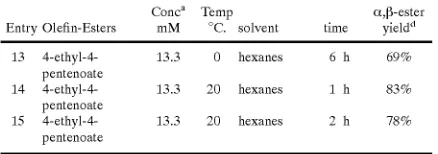
diation. The yield decreases to 69% after 6 hours of irra diation. When the reaction Was conducted at 20° C. (see Table 2, entries 14,15, beloW), the maximum yield (83%)
Was loWer than at 0° C. and Was achieved in 1 hour.
Reaction of CO With an Irradiated Solution of Fe(CO)5
and Ethyl 4-Methyl-4-Pentenoate. In order to release ethyl
4-methyl-2-pentenoate from 3 produced during the irradia tion (Equation 4) and to recycle the starting Fe(CO)5, the hexanes solution of Fe(CO)5 (13.3 mM) With ethyl 4-methyl-4-pentenoate (13.3 mM) that had been irradiated for 3 hours at 0° C. Was purged With CO at 0° C. (Equation
An FTIR spectrum of the solution after 1 hour of reaction
With CO shoWed that 3 disappeared completely, and the
concentration of the Fe(CO)4(n2-ot,[3-ester) complex 4 increased signi?cantly. Further purging (2 hours) of the solution With CO at 0° C. did not convert 4 to Fe(CO)5. HoWever, after the CO-saturated solution had been stirred at 50° C. for 12 hours, the FTIR spectrum of the solution then
shoWed that 4 had completely disappeared. The major Fe
product in the solution Was Fe(CO)5; its concentration Was
approximately 12.5 mM, Which is slightly less than the 13.3 mM used in the initial reaction (Equation 4). A GC analysis
of the solution shoWed that 90% of the product Was the ot,[3-ester, ethyl 4-methyl-trans-2-pentenoate; the other iso
mers Were present in small amounts. A 1H NMR spectrum of the ester mixture shoWed that more than 99% of the
ot,[3-ester is the trans isomer as indicated by the character istic chemical shifts and coupling constants of the C3 and C2
ole?nic protons at 6 6.94 (J=15.6 and 6.6 HZ) and 5.76
(J=15.5 HZ).
Irradiation of Fe(CO)5 With Methyl Oleate in Hexanes. A
hexanes solution of Fe(CO)5 (13.3 mM) and the long chain
ole?n-ester methyl oleate (13.3 mM) Was irradiated at 0° C.
(Equation 6).
6
An FTIR spectrum of the solution after 0.5 hour of irradia tion shoWed that Fe(CO)3(11“-CH3(CH2)14
10
15
20
25
30
35
40
45
50
55
60
65
CH=CHCO2Me) (6) Was the major product as indicated by bands at 2058, 1990, and 1975 cm_1. A mixture of Fe(CO)
4(nz-ole?n-ester) intermediates 5 Were also observed; a v(CO) band at 2077 cm-1 suggests that most of these compounds contain the non-ot,[3-unsaturated isomers, While
the Weak band at 2094 cm-1 indicates the presence of some
of the 112-ot,[3-unsaturated ester complex 8. Complex 6 is
stable at 0° C. for at least 1 hour as FTIR spectra of the
stirred solution in the dark for 1 hour shoW no signi?cant
change. HoWever, signi?cant decomposition of 6 occurs
When the solution is stirred at room temperature for 1 hour, as the concentrations of Fe(CO)5 and 5 increase. If the
solution (Equation 6) obtained from 0.5 hour of irradiation at 0° C. is stirred With 20-fold pyridine (py) for 10 minutes,
all of 6 disappears and neW bands at 2051, 1968, 1942, and
1863 cm-1 are observed, indicating the formation (van Dijk et al., J. Organomet. Chem, 340, 227, 1988; and Schubert
et al., Inorg. Chem, 5, 1071, 1966) of Fe(CO)3(py)2 and
Fe(CO)4(py) (Equation 7).
(7) Fe(CO)4(Py)
+
7
The band at 1717 cm'1 for v(C=O) of the ester group in 5
disappears completely. And the intensity of the band at 1735
cm'1 for v(C=O) of the free ot,[3-ester, methyl octadec trans-2-enoate (7), increases signi?cantly.
The identity of 7 formed in reaction (7) Was con?med by
GC-MS studies. GC analysis of the reaction solution shoWed ?ve peaks at retention times ranging from 9 minutes to 11 minutes. The peak at 10.5 minutes shoWed lines in the mass spectrum at e/m 87 and 113 for methyl acrylate and an
oxacyclohexadiene, respectively, Which are characteristic fragments observed in mass spectra of ot,[3-unsaturated
methyl esters (LauWers et al., Org. Mass Spect., 7, 1027, 1973; and BoWles et al., Org. Mass Spect., 2, 809, 1969).
Other GC fractions shoWed mass spectra characteristic of
other isomers of methyl oleate in Which the ole?n is not in
the ot,[3-position. These non-ot,[3-ester isomers in the four remaining GC peaks Were not assigned to speci?c isomers. Quantitative GC analysis of the mixture shoWed that >97%
of the original methyl oleate Was recovered from reactions
(6) and (7) as methyl oleate or its isomers; for this deter mination a knoWn amount of methyl palmitate CH3(CH2)
14COZCH3 Was added to the reaction solution as the internal
standard.
The reaction (Equation 6) of Fe(CO)5 (13.3 mM) and
methyl oleate (13.3 mM) in hexanes at 0° C. Was monitored by FTIR spectroscopy for the production of the iron carbo
nyl complexes and examined by GC for the yield of 7 by treating samples from the reaction solutions With excess
pyridine (Equation 7) at times ranging from 0.5 hour to 7
hours from the beginning of the reaction. FTIR spectra of the solutions shoWed that the concentration of 6 increases during the ?rst three hours of irradiation but then decreases upon further irradiation (7 hours). The v(C=O) absorbance
at 1749 cm-1 for methyl oleate and its non-ot,[3-ester isomers
decreases during the ?rst three hours and then increases at
longer irradiation times. Yields of the ot,[3-ester obtained from GC analyses parallel those obtained by FTIR using the
v(C=O) band of the free methyl oleate and Fe(CO)4(n2
non-ot,[3-ester) at 1749 cm_1; the intensity of this band
5,859,268
15
after 7 hours (see Table 2, entries 1—3, below). When a solution of methyl oleate (13.3 mM) in hexanes Was irradi
ated for 6 hour Without Fe(CO)5, the ot,[3-ester 7 Was not detected.
When technical grade methyl oleate (containing 76%
methyl oleate as determined by GC) and Fe(CO)5 Were
irradiated under the same conditions (13.3 mM, hexanes solvent, 0° C., folloWed by pyridine displacement), the
maximum yield (67%, based on the initial methyl oleate) of
the ot,[3-ester 7 Was achieved after 3 hours. The yields after 2 hours and 4 hours Were 62% and 61%, respectively.
Besides pyridine (Equation 7), CO Was also used to liberate the ot,[3-ester 7 from its iron complex 6 produced during the irradiation; this treatment also regenerates the
starting Fe(CO)5 (Equation 8).
Fe(CO)5 (s)
+ co, 0° c. _ + co, 50° c.
6 W
RCH|_CHCO2Me W
8 Fe(CO)4
7
Ahexanes solution of Fe(CO)5 (13.3 mM) and methyl oleate (13.3 mM) that had been irradiated for 3 hours at 0° C. Was purged With CO at 0° C. An FTIR spectrum of the solution, after reaction With CO for 1 hour, shoWed that 6 disappeared completely While the concentration of Fe(CO)4(112-ot,[3 ester) (8) increased signi?cantly. Further purging of the
solution With CO for 2 hours at 0° C. did not convert 8 to
Fe(CO)5; nor did stirring the CO-saturated solution at room
temperature for 12 hours. HoWever, stirring the
CO-saturated solution at 50° C. for 12 hours resulted in the complete disappearance of Fe(CO)4(n2-ot,[3-ester) (8) as
indicated by the FTIR spectrum. The major iron product in
the solution Was Fe(CO)5, and its concentration as deter
mined by the intensity of its 2023 cm'1 band Was approxi mately 12.5 mM, Which is 94% of the initial Fe(CO)5 used in the reaction shoWn in Equation 6. GC analysis of the
solution shoWed that more than 99% of the initial methyl oleate Was recovered as its isomeric esters (primarily 7). A 1H NMR spectrum of the ester mixture demonstrated that more than 98% of the ot,[3-ester 7 Was the trans isomer; this assignment is based on the chemical shifts and characteris
tically large coupling constants of the trans ole?nic protons at 6 6.96 (J=15.5 and 7.2 HZ) and 5.81 (J=15.5 and 1.5 HZ).
Concentration Effects. When a hexanes solution of rela
tively high concentration Fe(CO)5 (40 mM) and methyl
oleate (40 mM) Was irradiated according to Equation 6 at 0°
C., yelloW Fe2(CO)9 precipitated from solution. Its FTIR spectrum (nujol mull) contained v(CO) bands at 2081 (s),
2017 (vs), 1985 (sh), and 1826 (s) cm-1 that are identical to those obtained of a knoWn sample of Fe2(CO)9 (Grif?th et al., J. Chem. Soc. (A), 834. 1969; and Kristoff et al., Inorg.
Chem, 13, 499, 1974). The yield of 7 obtained by GC analysis of the solution treated With excess pyridine
increases during irradiation and reaches its highest value of 42% after 5 hours (see Table 2, entry 6, beloW); this is less than the 70% yield of the ot, [3-ester (7) obtained from the reaction at loWer concentrations (13.3 mM) of Fe(CO)5 and
methyl oleate.
Solvent Effect. In an attempt to improve the yield of the
ot,[3-ester and inhibit the formation of Fe2(CO)9 at the higher
reactant concentrations, toluene and THE solutions of Fe(CO)5 (40 mM) and methyl oleate (40 mM) Were irradi
ated at 0° C. (see Table 2, entries 7, 8, beloW). In the experiment using toluene as the solvent, much yelloW Fe2
(CO)9 precipitated, and the highest yield (38%) of the
ot,[3-ester Was obtained after 5 hours of irradiation; this yield is slightly smaller than that (42%) obtained in hexanes
10
15
20
25
30
35
40
45
50
55
60
65
16
solvent. In the experiment using THF as the solvent, there Was no yelloW precipitate, but the FTIR spectrum of the irradiated solution shoWed no bands indicating the formation
of 8 or 6. The only neW band occurred at 2075 cm'1 Which
may be assigned (Table 1) to Fe(CO)4(L) (L=non-ot,[3-ester
isomers of methyl oleate or THF). GC analysis of the solution shoWed that the methyl oleate isomeriZed, but the yield of the ot,[3-ester (5% after 5 hours) Was very loW. It
increased throughout the irradiation until it reached a maxi
mum at 5% after 5 hours. Further irradiation of the solution
(17 hours) did not change the yield of the ot,[3-ester but
isomeriZation of the methyl oleate and its non-ot,[3-ester
isomers continued as determined by GC. In another experiment, no solvent Was used. Equal volumes of Fe(CO)5 (0.25 mL) and methyl oleate (0.25 mL) Were mixed and then
irradiated. Much precipitation of Fe2(CO)9 occurred and the
maximum yield of the ot,[3-ester Was about 5%. Based on
these studies, hexanes solvent gave the highest yield of the
ot,[3-ester.
Irradiation of Fe(CO)5 With Methyl Oleate in the Presence
of THF or cis-Cyclooctene. In an attempt to improve the
yield of the ot,[3-ester and prevent the formation of Fe2(CO)9 at relatively high reactant concentrations, the Weakly coor
dinating ligands THF (80 mM) or cis-cyclooctene (40 mM)
Were added to the hexanes solution of Fe(CO)5 (40 mM) and
methyl oleate (40 mM) for irradiation at 0° C. (see Table 2,
entries 9, 10, beloW). Added THE (80 mM) gave a maximum
yield (36%) of the ot,[3-ester Which is loWer than that (42%)
obtained in the absence of THF. With cis-cyclooctene (40 mM), the maximum yield Was only 30%. In both experiments, a yelloW precipitate of Fe2(CO)9 Was observed. Temperature Effect. The temperature of the reaction also had an important effect on the yield (see Table 2, entries 4,5, beloW). During the irradiation of 13.3 mM Fe(CO)5 and
methyl oleate in hexanes at 20° C., the highest yield (58%) of the ot,[3-ester (7) Was obtained after 1 hour; this is a loWer yield than that (70%) obtained after 3 hours of irradiation at 0° C. Prolonged irradiation (4 hours) reduces the yield of the
ot,[3-ester to 49%. Stirring the solution (after 4 hours of
irradiation) in the dark at 20° C. for 1 hour loWers the concentration of 6 by 60% as determined by FTIR, and the ?nal yield of the ot,[3-ester (7) is only 42%.
In an experiment at 20° C. using higher concentrations (40 mM) of Fe(CO)5 and methyl oleate, only a small amount of Fe2(CO)9 recipitate Was observed during irradiation.
HoWever, the highest yield (47%) of 7, obtained after 1.5
hour of irradiation, Was only slightly larger than that obtained at 0° C. (42%). When another portion of Fe(CO)5
(40 mM) Was added to the solution after 1.5 hour of irradiation, much Fe2(CO)9 precipitated during further irra
diation (1 hour), but the yield of 7 did not improve.
Irradiation of Methyl Oleate With a Catalytic Amount of Fe(CO)5. Ahexanes solution of Fe(CO)5 (13.3 mM) With 10
equivalents of methyl oleate (133 mM) Was irradiated at 0° C. The yield (based on the amount of methyl oleate) of 7
determined by GC increased during the initial 5.5 hours to
a maximum of 13%. Additional irradiation (21 hours) did not change the yield. The 13% yield is similar to that expected for 70% conversion of one equivalent of methyl
oleate to 7 and 4—5% conversion of 9 equivalents to a
thermodynamic yield of 7.
Thermal IsomeriZation of Methyl Oleate Promoted by
Fe(CO)3(cis-cyclooctene)2. Fe(CO)3(cis-cyclooctene)2 Was
synthesiZed in situ by irradiating a hexanes solution of
CgH14= cis-cyclooctene
(excess)
After the addition of methyl oleate (133 mM), the solution
Was Warmed to 0° C. during Which time the color of the
solution gradually turned from pale yelloW to red. The FTIR
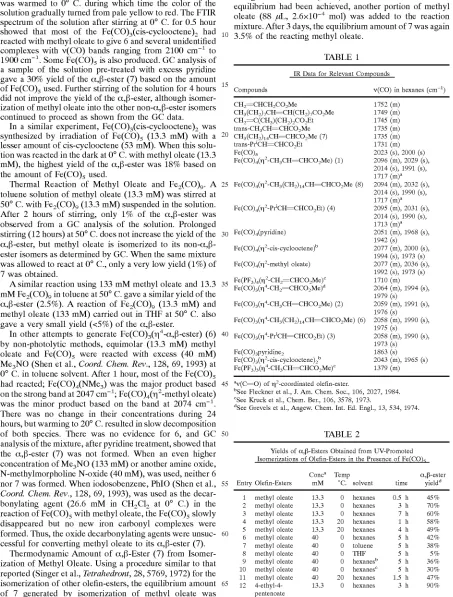
[image:14.557.60.513.144.741.2]spectrum of the solution after stirring at 0° C. for 0.5 hour showed that most of the Fe(CO)3(cis-cyclooctene)2 had reacted With methyl oleate to give 6 and several unidenti?ed
complexes With v(CO) bands ranging from 2100 cm-1 to 1900 cm_1. Some Fe(CO)5 is also produced. GC analysis of
a sample of the solution pre-treated With excess pyridine gave a 30% yield of the ot,[3-ester (7) based on the amount
of Fe(CO)5 used. Further stirring of the solution for 4 hours did not improve the yield of the ot,[3-ester, although isomer iZation of methyl oleate into the other non-ot,[3-ester isomers
continued to proceed as shoWn from the GC data.
In a similar experiment, Fe(CO)3(cis-cyclooctene)2 Was synthesized by irradiation of Fe(CO)5 (13.3 mM) With a
lesser amount of cis-cyclooctene (53 mM). When this solu
tion Was reacted in the dark at 0° C. With methyl oleate (13.3
mM), the highest yield of the ot,[3-ester Was 18% based on
the amount of Fe(CO)5 used.
Thermal Reaction of Methyl Oleate and Fe2(CO)9. A toluene solution of methyl oleate (13.3 mM) Was stirred at
50° C. With Fe2(CO)9 (13.3 mM) suspended in the solution.
After 2 hours of stirring, only 1% of the ot,[3-ester Was
observed from a GC analysis of the solution. Prolonged
stirring (12 hours) at 50° C. doe