Dynamic Characteristics and Processing of Fillers in Polyurethane Elastomers for Vibration Damping Applications
A. R Mackintosh1*, R A Pethrick1 and W M Banks2.
1- WestCHEM, Department of Pure and Applied Chemistry, University of Strathclyde, Thomas Graham Building, 295 Cathedral Street, Glasgow G1 1XL
and
2- Department of Mechanical Engineering, University of Strathclyde, James Weir Building, 75 Montrose Street, Glasgow G1 1XJ.
* - To whom communications should be addressed E-mail:- [email protected] Fax 0141 548 4822
Tel no:- 0141 548 2795
Keywords:- polyurethane elastomers, fillers, wollastonite, barium sulphate, processing, relaxation.
Address for correspondence:- Department of Pure and Applied Chemistry,
University of Strathclyde,
Thomas Graham Building, 295 Cathedral Street,
Glasgow G1 1XL
ABSTRACT
be independent of temperature and frequency. In practice, this is not possible and the creation of materials with a broad spectrum response is desirable.
In this paper, the effects of various fillers on the breadth and temperature dependence of the vibration damping characteristics of a filled and crosslinked polyurethane elastomer are explored. The fillers studied are wollastonite, barium sulphate and talc. These materials have different shapes, sizes and surface chemistry and undergoe different types of interaction with the matrix. The vibration damping characteristics were further varied by the use of a crosslinking agent.
Data presented on the rheological characteristics indicate the strength of the filler –polyol interactions. Dielectric relaxation and dynamic mechanical thermal analysis demonstrate the way in which changes in the type of filler, concentration and amount of crosslinker lead to changes in the location and breadth of the energy dissipation process in these elatomers. The vibration damping characteristics of a selected material are presented to demonstrate the potential of these materials.
1 INTRODUCTION
Solid PUs can be used directly as part of vibrational damping systems where load-bearing characteristics are important. There are at least two approaches to the problem of vibration damping; firstly, constrained layer damping in which an intermediate material is used to couple a high modulus layer to the substrate to be damped and secondly, surface layer damping where the coating attempts to remove the energy through a dissipative process. [5-12]. In both cases the damping characteristics are dictated by the energy dissipation characteristics of the polymer used. In this paper, the focus will be on the design of the material which can be used with either approach.
A large number of polymer systems have been investigated in the context of energy damping media and include epoxy, [5,11] epoxy/carbon fibre [5], polymethylmethacrylate – PMMA [6,9], polytetrafluoroethylene - PTFE [6] and nylon 6,6’ [10] with varying degrees of success. PU systems have a significant advantage for energy damping applications in that it is relatively easy to change the formulation of the elostomer to achieve the desired match between energy loss and the vibration characteristics of the system concerned [8,11] The damping characteristics of PUs can be varied by changing the isocyanate composition and type of diol to yield materials with different damping characteristics. [8,13]. However, the breadth of the loss peak for the typical PU is relatively narrow which imparts a significant temperature dependence of the damping behaviour. In order to use PUs for load bearing applications it is desirable to have a material with a high modulus yet retain the high loss characteristics. These are apparently contradictory requirements but can be designed into a material if phase separation occurs [14,15]. Additional increases in the modulus can be achieved by the incorporation of fillers [5]. The effects which will be produced will depend on the shape, volume fraction and surface chemistry of the filler used [5]. This paper describes a study in which the effects of incorporation of talc, silica, wollastonite and barium sulphate on the damping characteristics of a typical PU are explored. An additional variable explored is the effect of change in the crosslink density by the additional of a poly functional alcohol to the formulation.
The fillers investigated have the following characteristics. Wollastonite is a natural calcium meta-silicate (CaSiO3), formed by the metamorphism of siliceous limestone at temperatures around 450oC and higher [16]. Wollastonite is an example of a tri-clinic crystal with no symmetry elements. The surface of wollastonite readily absorbs water and hydroxylated by the Ca2+/2H+ exchange reaction resulting in a surface characterized by a twisted, three silica tetrahedra unit. The chains formed by these silica tetrahedral are connected side by side through calcium in octahedral coordination and results in wollastonite growing as acicular crystals, having a high density and modulus (16). Densified hydrophilic fused silica, AEROSIL® 200 VV 50 has a specific surface area of ~200 m2
/g and is spherical in structure. Talc is hydrated magnesium silicate and usually has a distribution of particle sizes. Barium sulphate has a nodular particle structure, which is processed from Barytes ore to have a BaSO4 content of 86.9%.
The paper explores the rheological characteristics of the polyol filled resins as a means of characterising the nature of the dispersion achieved and the strength of the interactions between polyol and filler. Dielectric relaxation and dynamic mechanical thermal analysis are used to demonstrate the way in which formulation changes influence the breadth and location of the energy loss processes. Finally a study of the damping characteristics of one of the materials will be presented to show how these materials may be used in vibration damping applications.
2 EXPERIMENTAL DETAILS 2.1 Materials
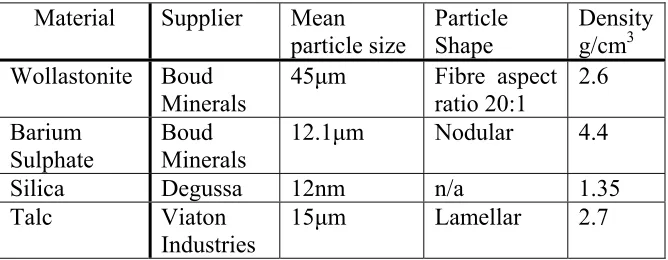
Material Supplier Mean particle size Particle Shape Density g/cm3 Wollastonite Boud
Minerals
45 m Fibre aspect
ratio 20:1 2.6 Barium Sulphate Boud Minerals
12.1 m Nodular 4.4
Silica Degussa 12nm n/a 1.35
Talc Viaton Industries
15 m Lamellar 2.7
Table (1) Characteristics of fillers used in creating the composite PU elastomers.
2.2 Synthesis of polyurethane elastomeric materials
The PTMEG and TMP, were heated to +60oC and degassed for 20 minutes at <1 mbar. The fillers were added and the mix stirred under vacuum for 10min. The isocyanate, Hyperlast M143 or Suprasec 5005, were added at the stochiometric ratio, mixed at room temperature under vacuum, for 12 min, and then poured into the mould. The mould was constructed of mild steel, with a base plate 1 cm thick. Side bars of 10 mm x 10 mm are added to create a rectangular test specimen of dimensions 80 mm x 100 mm x 10 mm. The cure temperature was 60ûC and cure occurred over a period of 16 hours. The amount of filler was recorded as the volume percentage of poly(tetramethylene glycol) used as the dispersion phase.
2.3 Rheological measurements
Rheological measurements were carried out using a CSL-2 TA instrument with a 2cm parallel plate with a 500 m gap at 40ûC. Care was taken to ensure that the fluid filled the gap at all times.
2.4 Dielectric relaxation measurements
Thin films for dielectric measurements were created by pouring the PU mixture onto PTFE coated glass and uniform films were created using a spreader bar. Aluminium electrodes were evaporated onto the samples using an Edwards Coating System E306A. A Novocontrol frequency response analyser was used to cover the frequency range 0.1 Hz to 6.5 x 10⁵ Hz and the temperature was controlled to better than + 0.5°C.
[image:5.612.140.474.90.220.2]2.5 Dynamic Mechanical Thermal Analysis – DMTA.
Dynamic mechanical measurements were conducted using a Polymer Laboratories Ltd DMTA. Rectangular samples 10 mm x 20 mm and ~2mm thickness were clamped using a single cantilever mode of action and knife-edge clamping arrangement with a clamping torque of 40Nm. The scanning frequency was 10Hz and the samples were re-clamped at low temperatures to minimise slippage. In the case of multi-frequency DMTA, frequencies of 0.3, 3, 10 and 30 Hz were used.
2.6 Optical microscopy
To assess the shapes of the fillers optical microscopy was performed on samples deposited on slides. The wollastonite samples were prepared in acetone and placed on a glass slide after sonicating for 5 min in an ultrasonic bath and the acetone allowed to evaporate. Optical microscopy was carried out using a bifocal microscope at 120x magnification with a Nikon digital camera.
2.7 Vibration damping analysis.
Samples were prepared for vibration analysis by coating metal substrates of dimensions 50 x 10 x 1cm with the test formulations. The coated beam was excited at various frequencies and the energy dissipation measured over a temperature range from 0-30oC.
3.0 RESULTS AND DISCUSSION 3.1Microscopy
In order to understand the effects of various fillers on the observed physical properties it is essential that the typical shapes of these materials are determined. The optical microscopy of barium sulphate (Figure (1A)) has a granular structure and a rough surface topography. The optical microscopy of Wollastonite (Figure(1B)) indicates that it exists as long needle of varying particle sizes and aspect ratios and confirm the data in Table (1).
3.2 Rheology
The effect of a filler on the polymer system to which they are added, depends critically on the nature of the dispersion which is initially achieved. In order to assess the effects of the
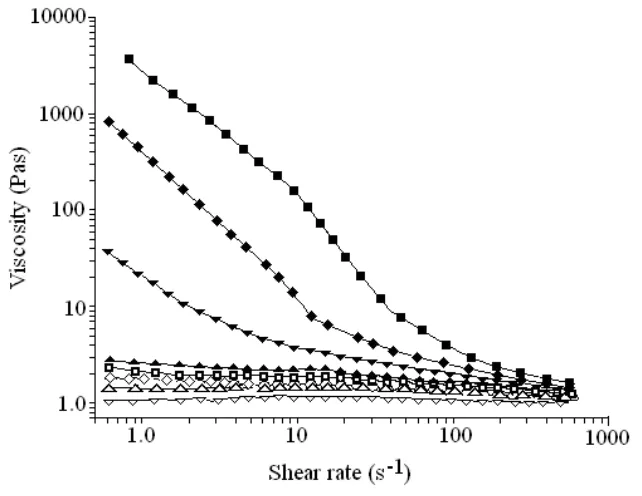
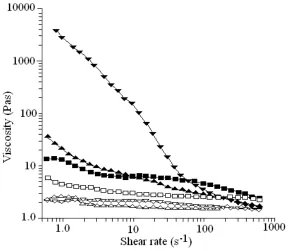
fillers on the monomers, rheological measurements were carried out over shear rates from 0.6 to 600 s-1, as a function of filler concentration, Figure (2A).
[A] [B]
Figure (1) Optical Micrographs of the filler materials; [A] Barium Sulphate stirred with acetone; spherical particles and aggregates, [B] Wollastonite and Barium Sulphate sonicated with acetone for 10min, showing distribution of rod and spherical particles.
The addition of low levels of wollastonite to the poly(tetra-methylene glycol) up to 13 vol%, has little effect on the viscosity of the system and little shear thickening is observed.
[image:7.612.93.531.121.271.2] [image:7.612.149.470.395.643.2]and – 23.5 vol%, -22.3 vol%, - 21.2vol%, – 20vol% with decreasing shear rate (600 -0.6 s-1).
At higher loading levels > 20 vol %, the initial viscosity at low shear rates is several orders of magnitude greater than that at high shear rates, indicating the thickening effect of filler on the polyol phase. The thickening effect is associated with filler – filler interactions creating a network structure in the liquid phase. Increasing the shear rate leads to a marked reduction in the viscosity and at a shear rate of 600 s-1, the viscosity is close to that of the polyol. Measurement of the sample which has been sheared and then the shear rate is reduced from 600 – 0.6 s-1 indicate values which are close to those of the polyol. This behaviour is indicative of the filler forming a temporary network which leads to the observed initial high viscosity but is reduced by flow alignment of the particles. The wollastonite with an aspect ratio typically of 20:1 is very effective in creating transient structures and enhances the viscosity at low shear rates. Repeating the experiments on dispersions which had been allowed to rest for five minutes indicated that the structure had almost completely recovered over this period. This enhancement in the low shear viscosity can potentially produce problems for mixing of the components to form the final reaction mixture.
In order to reduce the structure forming effects three samples of fillers with mixed shapes were prepared. The viscosity curves for these samples are shown in Figure (3). The addition of as little as 2.5 vol% of silica markedly reduces the ability for the wollastonite to form a network structure and decreases the initial value of the low shear viscosity. The addition of the barium sulphate leads to a further reduction in the low shear viscosity and a lower shear dependence. The apparent increase in the high shear values reflects the higher solid loading of the system. It is envisaged that the silica particles interfere with the structure build up of the wollastonite fibres, and acts as a lubricant easing the relative movement of the fibres passed one another hindering the build up of the structure. The addition of barium sulphate decreases the initial viscosity still further.
The rheological studies indicate that the critical level for the addition of wollastonite is ~ 20 vol%, although the network forming tendency of this filler in liquid dispersions can be reduced by the addition of small amounts of spherical fillers, hence allowing the total solids content to be significantly increased in the formulations without encountering mixing problems.
3.3 Relaxation behaviour of filled systems
The principal aim of this investigation was to explore the effects of the functionality of the isocyanate, effects of cross linker and possible interactions with fillers on the energy loss characteristics of the PU matrix composites. In the design of a final material all the influences can be brought into play in adjusting the characteristics of the composite to be fit for purpose.
Figure (3) Variation of viscosity with shear rate of initial samples, with sample 1; (0.6 – 600s-1) and (600 – 0.6s-1) flow curves. Sample 2; (0.6 – 600s-1) and (600 – 0.6s-1) flow curves. Sample 3; ̈(0.6 – 600s-1) and (600 – 0.6s-1) flow curves.
[image:9.612.164.453.331.582.2]Sample 1 represents a 23.5 vol% of wollastonite; sample 2, contains 1.0 vol% of silica, 23.2% wollastonite and sample 3, contains 21.7vol% of wollastonite, 0.99 vol% silica, 6.4 vol% barium sulphate (spherical form).
3.3.1 Effect of filler on the PU matrix relaxation
Dielectric relaxation and DMTA measurements were performed on a Hyperlast M143: polyol of unfilled and uncross linked PU matrix (Figure (4)). The main feature in the dielectric spectrum, is a strong dipolar relaxation feature associated with the reorientation of the ether linkage of the poly(tetramethyleneoxide)- TMO segment.
[A]
[B]
[C]
Figure (4) Dielectric relaxation permittivity [A] and loss [B] as a function of temperature between 213 K and 248 K and multi frequency DMTA [C] for unfilled uncrosslinked PU. Key for dielectric measurements:- ̈ -600
C, -55oC, - 50oC, -45oC,
+
-35oC, x –
30oC,*
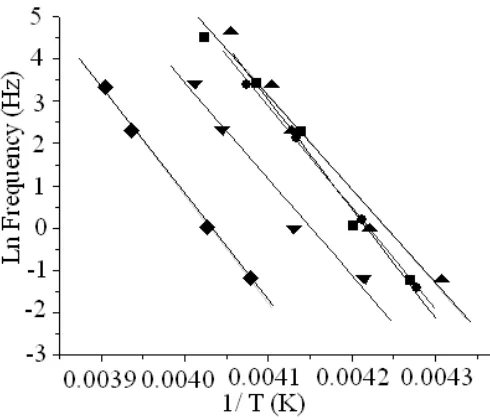
-25oC. Key for DMTA measurements:- Modulus at - 0.3 Hz, - 3 Hz, -10 Hz, and ̈ – 30 Hz and loss:- – 0.3 Hz, - 3 Hz,∆ - 10 Hz, – 30 Hz.The relaxation spreads over three decades of frequency and is typical of a simple thermally activated segmental reorientation process. The sharp rise in the dielectric loss at very low frequencies is associated with ionic conduction in the material and increases in amplitude as the temperature is increased. The corresponding DMTA traces are shown in Figure (4C). From the shift of the dielectric or mechanical loss peak with temperature it is possible to determine the Arrhenius activation energy for the segmental reorientation of the TMO segment which dictates the temperature dependence of the energy dissipation. The linearity of the Arrhenius plot (Figure (5)), indicates that the process is thermally activated and values of the derived energy are presented in Table (2). It is apparent that wollastonite has the ability to interact strongly with the PU matrix and significant shifts are observed in the relaxation frequency plot and the temperature dependence with increasing filler content. Interestingly, barium sulphate does not appear to shift the relaxation in the same way reflecting significantly weak interactions between PU and filler. It is clear that the barium
[image:11.612.176.437.74.309.2]
sulphate has little effect on either the dynamic mechanical or dielectric relaxation of the resin.
Figure (5) Arrhenius plots for the dielectric relaxation data for various filled PU composites. Key:- ̈ - unfilled PU, – 3wt% Barium sulphate, - 6wt% Barium sulphate, - 3wt% wollastonite, – 6wt% wollastonite.
Wollastonite by % volume
BaSO4 by % volume
Aerosil 200 by % volume
Activation Energy kJ mol-1
0 0 0 223 + 25
3 0 0 200 + 25
6 0 0 185 + 25
0 3 0 189 + 25
0 6 0 214 + 25
Table (2) Variation of activation energy with filler content.
This is confirmed in the dielectric relaxation with a shift towards higher temperatures and
[image:12.612.181.426.126.336.2]reorientational motion. It appears that the weak interactions between the ether linkages and the filler allow the filler to act as a heat sink and reduce the pre-exponential factor in the Arrhenius equation. The reduced energy flow produces a lower probability of activation of the reorientational process and a shift of the relaxation feature along the temperature axis.
3.3.2 Effect of crosslinker.
The increasing levels of cross linker TMP will influence the ability for MDI to form a hard phase structure and leads to changes in the density of packing and also changes the dielectric relaxation behaviour (Figure (6)).
[A]
[B]
Figure (6) Dielectric permittivity [A] and dielectric loss [B] for 10% cross linked PU system. Key:- -30oC, ̈ - 40oC, – 50oC, - 60oC, + - 700C, x – 750C * - 800C.
The change in the distribution of MDI structural types will impact on the nature of the distribution of TMO which will consequently broaden the dipole relaxation and consequently reduce the temperature dependence of the overall process. The phase separated nature of the PU leads to observation of polarization effects associated with the heterogeneous nature of the polymer. Ionic impurities can migrate within the polymer and become trapped at the interfaces created by the phase separated MDI and gives rise to the so-called Maxwell Wagner Sillars process. Unfortunately, this latter process dominates the low frequency relaxation region (Figure (6)) and makes analysis of the breadth of the dipolar relaxation associated with the ether segments difficult. The relaxation can be seen as the broad peak in the dielectric loss in Figure (6B). The polyurethane entities are phase separated, and because they are extensively hydrogen bonded will not contribute to the dipole relaxation until the hard phase ‘melts’, which occurs at ~ 150oC. It is however clear from the plots that the relaxation is broad and extends over several decades of frequency. The DMTA analysis gives a direct indication of the mechanical properties and was used to explore the effects of changes of filler and crosslinker.
3.4 Dynamic Mechanical Thermal Analysis 3.4.1 Effects of filler
Damping of metallic structures depends on the efficiency of being able to couple energy into the structure and is primarily controlled by being able to match the modulus of the coating layer to that of the substrate. Wollastonite is a fibrous material with an aspect ratio of 20:1; and a small volume fraction of fibres can increase both the low and high temperature modulus of the system (Figure (7)) which will improve the match with the rigid substrate. The high temperature modulus is determined by two factors; the extent of cross linking in the material and the degree of interaction between matrix and filler. Barium sulphate at low levels of addition has little effect on the high temperature modulus or tan
indicating relatively weak interaction between filler and matrix. In contrast, wollastonite shifts the relaxation to higher temperatures showing significant interaction between the fibre surface and the resin matrix.
Figure (7) DMTA of uncrosslinked system with 6w/v% BaSO4 and 6 w/v% Wollastonite. Key:- Modulus - ̈ - unfilled PU, ♦- 6wt/v% BaS04, -6wt/v% Wollastonite; Loss –
unfilled PU, -6wt/v% BaSO4, Δ -6wt/v% Wollastonite.
3.4.2 Effect of change of functionality of the MDI
[image:15.612.151.462.142.347.2]value of ~ 50oC for 14% of TMP. From the point of view of matching of the peak to the optimum value for the damping of the vibration changing of the level of crosslinker is a relatively simple procedure.
[A]
[B]
Figure (8) DMTA traces for various levels of crosslinker (trimethylolpropane) TMP with [A] Suprasec MDI, functionality - 2.7, Key:- Modulus ♦ - 4% TMP, • - 6% TMP, - 8% - 12% and ̈ -14%, Loss -4%, – 6%, - 8%, ∆ - 12% and and – 14%. [B] Hyperlast MDI, functionality - 2, Key:- Modulus – 6%, ̈ - 10%, – 12%, – 14%, Loss – 6%, – 10%, ∆ - 12%, - 14%.
[image:16.612.151.468.140.624.2]The effect of variation of the level of crosslinker for the Hyperlast MDI was also investigated. The Hyperlast MDI is created by end capping a TMO polymer and has a functionality of two. Polymerisation with the TMO will create a very regular structure which phase separates to form regions of polyurethane which are extensively hydrogen bonded. The phase separation produces a well defined environment for the TMO and the relaxation which is observed is fairly narrow (Figure (8B)). As in the case of the polymeric MDI the crosslinker TMP will increase the variety of environments experienced by the TMO and this is reflected in a broadening of the relaxation peak and a shift to higher temperatures. The effects of the crosslinker as less marked than with the polymeric MDI, the peak being shifted from a temperature of ~-200C to 200C by the addition of 8% of TMP. However as in the case of the polymeric MDI the possibility of tuning the peak to a particular temperature is also possible.
3.4.3 Combining filler and cross linked effects
It is apparent that changes in the damping behaviour can be achieved by either variation of the type of filler or the level of cross linker (Figure (9)).
) The DMTA traces for Suprasec 5005, with 6vol% Wollastonite with variation in
Wollastonite filled material. e shift is clearly related to the effect of the crosslinker which is not significantly
To explore the effect of variation of the filler, samples were created at low - 6% and higher -14% crosslinker level and with variation of the filler type (Figure (10)).
Figure (9
cross linker TMP, Key:- Modulus - 6% TMP, - 8% TMP, ♦- 12%and ̈ -14%, Loss ∆ -6%, – 6%, - 8%, ∆ - 12% and and – 14%.
Increasing the level of the crosslinker TMP has the expected effect of increasing the temperature at which the loss peak is observed for the 6 vol%
Th
influenced by the presence of the fibrous Wollastonite filler.
[A]
[image:18.612.161.460.293.522.2][B]
igure (10) The DMTA traces for Suprasec 5005, with Wollastonite , Wollastonite and 6% TMP. Key:-
sulphate, - Wollastonite + talc.
It is apparent that variation of the filler type has a very small effect on the location of the relaxation which is controlled primarily by the level of cross linker which is incorporated in the matrix. The insensitivity to the type of filler therefore allows both the level and the filler to be varied to achieve a better match between the substrate and the absorber for damping applications.
3.4.4 Vibration damping behaviour of the filled PU matrix materials.
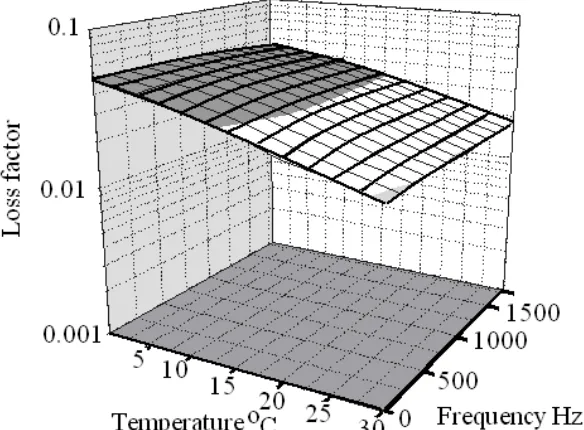
Using the above data a series of beams were prepared and explored to determine the damping characteristics. An example of the data obtained for a sample that contains 22vol % of Wollastonite, 20vol% of barium sulphate and 6% cross linker as shown in Figure (11).
F
barium Sulphate and Wollastonite with talc. [A] low crosslinker density
Modulus ̈ - Wollastonite, – Wollastonite + Barium sulphate, – Wollastonite + talc. Loss – Wollastonite, ∆ - Wollastonite + Barium sulphate, - Wollastonite + talc. [B] high crosslinker density -14% TMP, Key:- Modulus ̈ - Wollastonite, – Wollastonite + Barium sulphate, – Wollastonite + talc. Loss – Wollastonite, ∆ - Wollastonite + Barium
Figure (11) Plots of the loss factor, frequency and temperature dependence of the loss ed of 22 vol% of Wollastonite, 20vol% of barium sulphate and
this formulation would have a loss feature which ans the frequency and temperature range. It is apparent that the interaction between the factor for a matrix compos
6% cross linker.
Over the frequency range 1Hz to 1500Hz and over the temperature range 0 to 300C there is a significant damping of the vibration. The observed behaviour is consistent with the predictions from the DMTA data that
sp
PU and the metallic substrate has aided the achievement of the desired breadth of vibration damping. This example illustrates the ability to design damping systems with a broad frequency response based on data obtained using DMTA data.
4 CONCLUSIONS
This study illustrates how by changing the formulation of the PU it is possible to change the location, breadth and amplitude of the mechanical loss to suit the requirements of a material for effective vibration damping. This study has therefore a large number of potential applications in the use of materials for damping a variety of structures used in mechanical engineering applications.
[image:20.612.153.445.80.295.2]uires control of the density and the modulus of the material. By ppropriate selection of the barium sulphate, which imparts a significant density increase ch helps control the loss characteristics and the location of the loss
rm this study is the ability to shift the loss feature by use of cross linker, but the ss characteristics are sensitive to the nature of the isocyanate used. The polymeric
ith its restricted ability to pack is influenced more extensively by the addition
MO exists at se esult in a greater sensitivity of
ements
., Acoustic and mechanical properties of polyurethanes based on
AK, Davies P, J. Sound & Vibration 264 (2003) 49.
ing applications, Deng R, Davies P, Bajaj AK, J. Sound &Vibration 262
ghi F, Plumtree A, International J. of Fatigue 23 (2001) 491
layers in a polymer-matrix composite, Carbon, 33 (1995) p1626
For effective vibration damping the material requires to have a good impedance match to the substrate and this req
a
and Wollastonite whi
feature and enhancement of the stiffness – bending modulus. A striking feature which emerges fo
lo
isocyanate w
of the cross linker than the simpler chain extended isocyanate. The low temperature dependence is a result of the broad distribution of environments in which the T
a molecular level. The chain extended isocyanate tends to be more effective at pha separation and exhibits narrower loss features which will r
the loss to temperature.
Acknowledg
The authors wish to acknowledge the support of EPSRC for part of the period of this research.
References
(1) Burke M, Townend D.J
polybutadiene soft segment, Plastics Rubber and Composites 28 (1999) 185.
(2) Simplified models of the vibration of mannequins in car seats, Kim SK, White SW, Bajaj
(3) Flexible polyurethane foam modelling and identification of viscoelastic parameters for automotive seat
(2003) 391.
(4) Modelling compressive cyclic stress-strain behaviour of structural foam, Shen Y, Golnara
(5) S.W. Hudnut and D.D.L. Chung, Use of submicron diameter carbon filaments for reinforcement between continuous carbon- fibre
thylmethacrylate and polytetrafluoroethylene, Polym. Polym. Compos, 6 (2001) p
echanical damping 1 (2001)
acetate-n-butyl acetate
J. Mat. Sci, 36 (2001)
roperties of polyether urethane and epoxy composites, J. Appl. Poly. Sci., 50 (1993) p227 2) C.J. Tung and C.J. Hsu. Vibration damping with urethane acrylate simultaneous semi-terpenetrating polymer networks, J. Appl. Poly. Sci., 46 (1992) p1759
3) J. Kylma and J. Seppala, Ternary-phase poly(ester-urethane)/elastomers/filler omposites, J. Appl. Poly. Sci., 79 (2001) p1531
(14) C. Delides, R. A. Pethrick European Polymer J. 17 (1981) 675
(15) Characterization of Polyurethane Elastomers by C-13 Nmr-Spectroscopy, C. Delides, R. A. Pethrick A. V. Cunliffe, P. G. Klein Polymer 22 (1981) 1205
(16) T.K. Kundu, K. Hanumantha Rao and S.K. Parker, Atomistic simulation of the surface structure of wollastonite. Chem. Phys. Let. 337 (2003) p81
(6) W. Fu and D.D.L. Chung, Vibration reduction ability of polymers, particularly polyme
423.
(7) X. Luo and D.D.L Chung,. Vibrational damping using flexible graphite. Carbon, 38 (2000) p1510
(8) M. Song, D.J. Hourston, and F-U Schafer, Correlation between m
and interphase content in interpenetrating polymer networks J. Appl. Poly. Sci., 8 p2439
(9) H.H. Chu, C.M. Lee and W.G. Huang, Damping of vinyl copolymers, J. Appl. Poly. Sci., 91 (2004) p1396
(10) D.D.L. Chung, Review: Materials for vibrational damping, p5733
(11) W.B. Huang and F.C Zhan, Studies on the dynamic-mechanical and vibration damping p
![Figure (4) Dielectric relaxation permittivity [A] and loss [B] as a function of temperature](https://thumb-us.123doks.com/thumbv2/123dok_us/1685705.121959/11.612.176.437.74.309/figure-dielectric-relaxation-permittivity-loss-b-function-temperature.webp)