Scottish Journal of Residential Child Care ISSN 1478-1840
Key working and the quality of
relationships in secure accommodation
Amy McKellar & Andrew Kendrick
Abstract
This article discusses the findings of a study which aimed to gain an insight into the views of young people in secure accommodation and their residential workers about the quality of relationships and, in particular, to explore the role of the key worker. Five themes were identified in the research: participation in the matching process between young people and residential workers; the level of consistency in the relationship between key worker and young person; the scope of the key worker role in secure care; the frequency and purpose of key time; and the barriers to achieving key time. The findings are located in the broader literature about the importance of relationships in social work and residential child care.
Key words: Looked after children; key worker role; secure care; worker-child relationships
Introduction
47
Relationships in Secure Accommodation
Over twenty years ago, the Skinner Report stated that in residential child care, ‘… the role of the establishment can only be achieved through positive relationships between staff and young people in a safe, stable and caring environment’ (Skinner, 1992, pp. 18 -19). However, there has been a concern that the focus on the scandals of abuse in care has led to a distancing of this relationship which has hampered residential care practice (Kendrick & Smith, 2002; Kendrick, 2013). Similarly, in the youth justice field there has been a shift from relationship-based practice to a focus on risk assessment and programmed interventions (Batchelor & McNeill, 2002). There is a wide variety of programmed interventions used in secure care and this type of intervention is generally credited as being effective in changing offending behaviour. Some, however, have questioned the appropriateness of this type of intervention with young people who experience emotional and behavioural difficulties (Pitts, 2002; Bullock et al, 1998). McNeill et al. (2005) contend that ‘relationship skills in particular are at least as critical in reducing re-offending as the programme content’ (McNeill et al. 2005, p. 5).
Relationships can therefore be viewed as fundamental in enabling positive change to occur (Burnett & McNeill, 2005). However, building strong, positive relationships with young people is not an inevitable consequence of being in secure accommodation. While the locked and closed setting has been described as ‘fertile ground’ for relationship building, the ‘enforced nature of the placement could lead to superficial rather than meaningful engagement on the part of the young person’ (Smith & Milligan, 2004, p. 188). It is the qualities and skills in relationship building possessed by residential workers which have been asserted as fundamental.
Research has consistently shown that young people evaluate a service primarily on the personal qualities of residential workers and the relationships established with them (Hill, 1999; Kendrick & Smith, 2002). However, research also indicates that many young people struggle with the residential worker’s ‘dual remit of care and control’ (Barry & Moodie, 2008, p. 60).
Positive and effective working relationships should be strived for. The reality of working in residential care, however, can make this a difficult aspiration to achieve, particularly in light of high levels of staff absence and restrictions on the time residential workers have to allocate to building good quality relationships.
48 A further significant barrier to building positive relationships is the effect of the numerous scandals and inquiries into residential care. These have highlighted the potential for relationships between residential workers and young people to become abusive (Kendrick, 1998; 2008, 2012). The fear of possible allegations has become a significant deterrent for residential workers in building close, working relationships with young people (Kendrick & Smith, 2002; Whittaker, Archer & Hicks, 1998). However, Kent (1997) illustrates the consequences of discouraging close relationships and the potential for this to lead to, ‘sterile care environments that may be equally abusive in terms of their impact on children and young people’ (Kent, 1997, p. 23).
Key Working
The Skinner Report (1992) emphasised the importance of every young person having a ‘special person’ during their placement in residential care. Within secure accommodation this ‘special person’ criterion is fulfilled through the allocation of a key worker (Scottish Executive, 2005).
The concept of key working was introduced in a report published by the Residential Care Association (RCA) and the British Association of Social Workers (BASW). This concept was based on ‘link worker schemes’ operating during the 1960s in children and families services and was an attempt to blur the boundaries between practice in field social work and residential care. It was proposed that a key worker would be allocated and the key worker would have full responsibility, including decision making, for the care of a service user admitted to a residential establishment (Mallinson, 1995).
This document promoted accountability in decision making and collaborative working as a means of improving standards of practice and providing continuity of care for service users. Despite the endorsement given to the importance of joint working between field and residential workers, this report was criticised for ignoring the, ‘power and value dimensions of entrenched cultural and organisational rigidities’ (Mallinson, 1995, p. 13). Sinclair and Gibbs (1998) highlighted the point that the role of the residential worker has historically been characterised by low status, poor pay and conditions, high staff turnover and low staff morale. As a result, the role of the key worker became increasingly ambiguous with a focus on key working as an internal function of residential care (Mallinson, 1995).
Within this limited scope each residential establishment began to interpret and develop their own general description of key worker duties. In essence, the key worker became an individual worker with whom the service user could relate to whilst in placement and who would enable their individual day-to-day needs to be met within a group care setting. Key workers were involved in activities such as supporting daily living, acting as an advocate, counselling, recording, arranging activities and liaison with family members (Mattison & Pistrang, 2000).
49 key worker becomes a crucial and integral part of the service user’s network. There has been a renewed drive to strengthen and develop the role of the key worker and it has been proposed that the key worker should become involved before, during and after a young person’s admission to residential care (Mallinson, 1995; Mattison & Pistrang, 2000).
Methodology
The research was carried out in one secure care unit and involved six interviews with young people and six interviews with residential workers. While this is a small scale study, given the lack of research focused on the role of key worker, it offers useful insights into the benefits and tensions of key working from the perspectives of young people and residential workers.
Participants and the Secure Unit
Six residential workers participated in this study; five were female and one was male. All of the residential workers had HNC and SVQ Level 3 qualifications and two were undertaking the SVQ Level 4 qualification. The six young people who were involved in this research were all male, ranging in age from 15 to 17. For five of the young people this was the first time they had been placed in secure accommodation; the other young person had been admitted to secure care on one previous occasion. The length of time the young people had been placed in secure care ranged from two weeks to 21 months.
The secure unit in which this research took place is part of a network of schools operated by a non-profit organisation. At the time of the research, the secure unit had 24 secure beds divided into four units of six, each with distinct and specific objectives.
Research Method and Design
Semi-structured interviews were considered the most appropriate tool for use in this study as they allowed specific areas to be covered whilst providing the opportunity for participants to discuss matters important to them. This also allowed for participants’ responses to be probed and explored further (Robson, 2011).
Two activities were incorporated into the interview process. Barker and Weller (2003) suggest that the incorporation of informal participatory techniques may reduce young people’s anxieties and encourage them to participate. However, they caution that activities created by an adult researcher may not be viewed by young people as ‘fun’. This may provide an explanation for the reluctance of the young people and residential workers to participate in these activities during the interview process.
50 sheets were provided and informed written consent was sought and obtained from each young person, their parents if they were under age 16 and the residential workers who participated. The information provided to the young people was designed to be age appropriate.
The participants’ and the parents’ permissions were sought to allow the interviews to be recorded and all agreed, except one young person who agreed for handwritten notes to be taken. It was explained that their responses would remain confidential and identifying information would be withheld. However, it was made clear that if any child protection concerns were disclosed this would have to be shared.
Analysis
All of the interviews were transcribed verbatim using the interview schedule as the initial framework. Thematic analysis was carried out, and primary themes of relationships and key work were used to organise analysis. Further sub-themes were identified: participation in the matching process; consistency in relationships; the scope of the key worker role; the frequency and purpose of key time; and barriers to key time. The responses of residential workers and young people were compared and contrasted (Miles & Huberman, 1994).
Findings
Participation in the Matching Process between Young People and Residential
Workers
The effectiveness of key working has been directly linked to the quality of relationship between service user and residential worker. Mallinson asserts that the matching process between residential worker and young person, ‘is not an end in itself’ but ‘marks the beginning of a relationship’ (Mallinson, 1995, p. 126). However, the majority of residential workers and half of the young people who participated in this study stated that their views had not been sought regarding the matching process.
...I didn’t really have a say...because when you move in (the Unit Manager) tells you, tells...the staff who’s gonna be your key worker... (Young Person).
51 the significance of this process, discussion and negotiation between the young person, residential worker and management should be promoted.
The young people who participated in this study suggested their Key Worker should be:
...the person you get on best with... (Young Person).
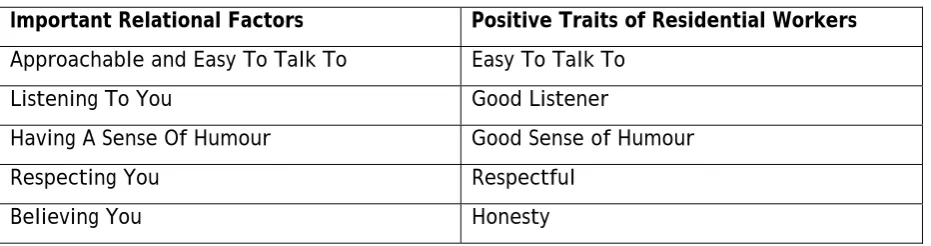
[image:6.595.67.533.286.409.2]The young people in the study identified a number of relational factors as significant in a positive relationship with a residential worker, as shown in Table 1.
Table 1: Relational factors identified by young people
Important Relational Factors Positive Traits of Residential Workers Approachable and Easy To Talk To Easy To Talk To
Listening To You Good Listener
Having A Sense Of Humour Good Sense of Humour
Respecting You Respectful
Believing You Honesty
These are consistent with findings of previous research into important positive traits of residential workers (Hill, 1999; Kendrick & Smith, 2002).
However, there may be tensions in allowing young people to select their key worker according to these criteria, for example in terms of the relative popularity of residential workers. Such potential difficulties serve to highlight the importance of open discussions and negotiations between the young person, residential worker and management (Mallinson, 1995).
Level of Consistency in the Relationship between Key Worker and Young Person
At the time the interviews were being conducted all of the young people had an allocated key worker. Only two, however, had been allocated the same key worker throughout their placement. The other four young people stated they had experienced numerous changes in their allocated key worker. The reason for experiencing a number of changes in allocated key worker was explained by a residential worker and young person.
They (young people) go to the Assessment Unit and they have a worker there and then they are put in a unit, it could be the Remand Unit and then they are
52 That’s just it, you get a worker in every unit...(Young Person)
This exemplifies not only the potential number of key workers a young person could be allocated but also highlights the number of units within the secure campus a young person could be resident in. Therefore, it can inferred that the young person does not only experience the relationship with one key worker ending and beginning with another, but also the relationships they had built with residential workers and young people are terminated and established dependent on their experience of changes in unit. A study carried out by Garfat (1998) showed the importance of continuity in relationships for young people and the detrimental impact this level of instability could have on the quality of relationships between residential workers and young people.
The relationships established in residential care have been shown to assist young people to break the cycle of poor relationships and provide them with a secure base (Gilligan, 2009). However, given the level of variance and unpredictability of relationships in secure care, a young person’s ability to trust others may be compromised and their reluctance to commit and invest in relationships with residential workers may be reinforced. Research has consistently highlighted trust as an important characteristic of the relationship between a young person and residential worker. (Barry & Moodie, 2008). For the most part, young people this was reflected in this study, although some young people who participated felt that residential workers were reluctant to trust them.
...most of the time they don’t give you much trust, like with the cutlery and stuff...they always, always check… (Young Person)
It would appear that although the residential workers stated it was important to trust the young people in their care, the safe care measures they undertake as part of their remit to ensure safety within the unit are perceived by the young people as acts of mistrust. This could make the establishment of positive working relationships increasingly difficult and their use as a catalyst for change less likely, particularly as it has been shown that reparative work with young people is embedded in the relationship with the worker and can not easily be taken over by another (Batchelor & McNeill, 2002).
The Scope of Key Worker Role in Secure Care
The key worker role has been firmly established as an internal function of residential care. Within secure accommodation, however, the scope of this role appears to be further reduced to within an individual unit. The key worker should provide continuity in the care experience of the young person, although it would appear the practical implications of being resident in secure accommodation prevents this from being achieved (Mallinson, 1995).
53 ...it’s like another worker but they do your paperwork and phone your social worker (Young Person).
Although this perhaps minimises the role of the key worker, the responses gained from the residential workers also tended to describe administrative tasks such as writing reports, liaising with other agencies and attending meetings.
Another function of the key worker role highlighted by both the residential workers and young people was to ensure that key time with the young person was undertaken. Key time is generally defined as the young person and key worker spending individual one-to-one time together.
Frequency and Purpose of Key Time
All of the young people who participated in this study advised they did receive key time. However, the frequency of this varied significantly, ranging from once every two weeks to once every back shift, which could potentially be four times per week. Although all participants agreed that a young person could request key time, it would appear the frequency is primarily dependent on the key worker.
The importance of this one to one time with the young person was discussed by a residential worker:
...it maybe makes them feel good that you want to spend time, you’re actually signalling I want to listen to you, so come on it’s our time... (Residential Worker).
It can, therefore, be inferred that key time can assist a young person to feel important and appears to be a key element in ensuring an individualised service is provided in a group care setting. However, given the variance in the frequency of key time, there is the potential to signal to the whole resident group that some young people are viewed as more important than others dependent on how often their key worker makes individual time to spend with them (Barry & Moodie, 2008).
There was general agreement between all of the participants that both the residential worker and the young person could contribute in deciding what was covered during key time. The Social Work Services Inspectorate (SWSI) (1996) concentrated on the implementation of services to address the difficulties that had resulted in a young person’s admission to secure care. The extent to which these difficulties could be addressed during a secure placement, however, has been challenged (Walker et al., 2002). It has been argued that being resident in secure accommodation can make it more difficult to address the reasons for placement because of the need to focus on the priorities for the institution rather than the individual young person (Walker et al., 2005).
54 placed in secure care but rather it seems there is a reliance on identifying and implementing programmed interventions to target these issues.
All of the residential workers consulted felt that key time was beneficial for young people and provided them with an opportunity to ‘offload’. However, for most young people, there was more ambivalence about the benefits of key time.
Doesn’t make a difference... (Young Person).
Barriers to Key Time
Difficulties in ensuring key time was undertaken were attributed to what was happening in the unit during a shift, including shortages in residential workers, family visits, mobility and leisure activities. It was suggested by a residential worker that there should be
...a slot for key time...and say that’s so and so’s key time...even if it means bringing in another member of staff to cover... (Residential Worker).
This suggestion could ensure every young person is allocated individual time with their key worker. In residential child care there tends to be a greater focus on what could be described as informal key time and working within the life space using day–to-day interactions to both build relationships and effect change (Smith, 2009). However, the need to have specific, allocated one to one time may be indicative of the drive to evidence work being undertaken with young people.
Conclusion
This article gives an insight into the views of young people in secure accommodation and their residential workers about the key worker role and the quality of relationships.
The original concept of key working was introduced as a means of bridging the gap between field social work and residential care. However, the scope of this role became limited to an internal function of residential care (Mallinson, 1995). This study found that the key worker role within secure accommodation appears to be further limited to within a single unit of the secure campus, and that a young person may move unit on a number of occasions during their placement. Subsequently, relationships between a young person and key worker, residential worker or other residents are established and terminated on a regular basis during placement. This could potentially lead to a high degree of inconsistency and instability for a young person which has been shown to be detrimental to the quality of relationships established, and reduces the continuity of the young person’s care experience. This may also reduce the ability to effectively promote a reduction in reoffending as it has been shown that young people require consistent and enduring relationships to meet this objective.
55 literature, which suggests that the key worker is the person who meets the day-to-day needs of the young person and is their main point of contact. An important function highlighted by all participants was to ensure that key time was undertaken with the young person. However, this study shows there is a high degree of variance in the frequency in which this occurs. This could potentially lead to difficulties within the resident group, particularly if the young people perceive the level of one-to-one time with a key worker as dependent on the relative value placed on some residents over others.
Within key time it would appear the predominant task is to review the young person’s day-to-day needs and there appears to be no direct work undertaken to address the difficulties which resulted in placement, a predominant function of secure care. This may be indicative of research which suggests that the needs of the institution take priority over the needs of the young person. There also appear to be a reliance on identifying and implementing structured programmes to address the difficulties resulting in admission which reflects the current trend emerging in the youth justice system.
Overall, there appears to be a high level of inconsistency and instability within the young person and key worker relationships in the research site and changes can occur frequently over a short period of time. There could also be more clarity on the role and function of the key worker and key time. These insights point the way to improving and strengthening policy and practice in relation to the key worker role in residential care and in focusing on the relationship between residential worker and young person.
References
Barclay, A. & Hunter, L. (2008). Blurring the boundaries: The relationship between secure accommodation and ‘alternatives’ in Scotland. In A. Kendrick (Ed.), Residential child care:
Prospects and challenges. London: Jessica Kingsley Publishers.
Barker, J., & Weller, S. (2003). Is it fun? Developing children centred research methods.
International Journal of Sociology and Social Policy, 23(1/2), 33 – 58.
Barry, M. & Moodie, K. (2008). This isn’t the road I want to go down: Young people’s
experiences of secure care. Glasgow: Who Cares? Scotland.
Batchelor, S. and McNeill, F. (2002). Chaos, containment and change: Responding to persistent offending by young people. Youth Justice, 2(1), 27-43.
Bullock, R., Little M., & Millham, S. (1998). Secure care outcomes. Aldershot: Ashgate.
Harris, R. & Timms, N. (1993). Secure acccommodation in child care: Between
hospital and prison or thereabouts. London: Routledge.
Burnett, R. & McNeill, F. (2005.) The place of the officer–offender relationship in assisting offenders to desist from crime. Probation Journal, 52(3), 247–268 .
56 Garfat,T. (1998), The effective child and youth care intervention: A phenomenological inquiry. Journal of Child and Youth Care, 12(1–2), 1–122.
Gilligan, R. (2009). Promotingresilience: Supporting children and young peoplewho are in care,adopted or inneed. London: BAAF.
Goldson, B. (2000). ‘Children in need' or 'young offenders'? Hardening attitudes, organisational change and new challenges for social work with children in trouble.
Child and Family Social Work, 5, 255-265.
Hill, M. (1999). What’s the problem? who can help: The perspective of children and young people on their well-being and on helping professionals. Journal of Social Work Practice,
13(2), pp. 135–145.
Kendrick, A. (1998). In their best interest? protecting children from abuse in residential and foster care. International Journal of Child & Family Welfare, 3(2), 169-185.
Kendrick, A. (Ed.) (2008). Residential child care: Prospects and challenges. London: Jessica Kingsley Publishers.
Kendrick, A. (2012). What research tells us about residential child care. In M. Davies (Ed.),
Social work with children and families. Basingstoke: Palgrave Macmillan.
Kendrick, A. (2013). Relations, relationships and relatedness: Residential child care and the family metaphor. Child and Family Social Work, 18(1), 77–86.
Kendrick, A., & Smith, M. (2002). Close enough? Professional closeness and safe caring.
Scottish Journal of Residential Child Care, 1(1), 46-54.
Kent, R. (1997). Children’s Safeguards Review. Edinburgh: Scottish Office.
McNeill, F., Batchelor, S., Burnett, R. & Knox, J. (2005). Reducing re-offending: Key
practice skills. Edinburgh: Scottish Executive.
Mallinson, I. (1995). Keyworking in social care: A structured approach to provision. London: Whiting & Birch.
Mattison, V. & Pistrang, N. (2000). Saying goodbye: When keyworker relationships end. London: Free Association Books.
Miles, M.B. & Huberman, A.M. (1994). Qualitative data analysis: An expanded sourcebook (2nd ed.). Thousand Oaks: Sage.
O'Neill, T. (2001). Children in secure accommodation: A gendered exploration of
locked institutional care for children in trouble. London: Jessica Kingsley Publishers.
Pitts, J. (2002). The end of an era. In J. Muncie, G. Hughes, & E. McLaughlin (Eds.),
Youth Justice Critical Readings. London: Sage.
Robson, C. (2011). Real world research: A resource for users of social research in applied
settings (3rd ed.), Chichester: John Wiley & Sons.
57 Sinclair, I. & Gibbs I. (1998). Children’s homes: A study in diversity. Chichester:
John Wiley & Sons.
Skinner, A. (1992). Another kind of home: A review of residential child care in Scotland. Edinburgh: HMSO.
Smith, M. (2009). Rethinking residential child care: Positive perspectives. Bristol: Policy Press.
Smith, M. & Milligan, I. (2004). The expansion of secure accommodation in Scotland: In the best interests of the child? Youth Justice, 4(3), 178-191.
Smith, M., Forrest, B., Garland, P. & Hunter, L. (2005). Secure in the knowledge:
perspectives on practice in secure accommodation, Glasgow: Scottish Institute for
Residential Child Care.
SWSI (1996). A secure remedy: A review of the role, availability and quality of secure
accommodation for children in Scotland. Edinburgh: Social Work Services Inspectorate for
Scotland.
Walker, M., Barclay, A., Hunter, L., Kendrick, A., Malloch, M., Hill, M. & McIvor,
G. (2005). Secure accommodation in Scotland: Its role and relationship with ‘alternative’ services. Edinburgh: The Stationery Office.
Walker, M., Hill, M. & Triseliotis, J. (2002). Testing the limits of foster care:
Fostering as an alternative to secure accommodation. London: BAAF.
Whitaker D., Archer, L. & Hicks, L. (1998). Working in children’s homes: Challenges
and complexities. Chichester: John Wiley & Sons.
Professor Andrew Kendrick
Andrew Kendrick is professor of residential child care with the Scottish Institute of Residential Child Care. He is also head of School of Applied Social Sciences within the University of Strathclyde.