Available Online atwww.ijcsmc.com
International Journal of Computer Science and Mobile Computing
A Monthly Journal of Computer Science and Information Technology
ISSN 2320–088X
IMPACT FACTOR: 6.017
IJCSMC, Vol. 6, Issue. 4, April 2017, pg.253 – 258
PERFORMANCE ANALYSIS OF
LONG TERM EVOLUTION
Kiran, Gaurav Soni
Electronics and Communication Engineering, Amritsar College of Engineering and Technology, Amritsar
ABSTRACT: Long Term Evolution (LTE) has been introduced by 3rd Generation Partnership
Project and dominates the 4th generation of mobile telecommunication network. In this paper
our work is unique in providing a detailed performance study based on NI PXIe – 5644 KIT. Our performance study includes FDD and TDD operation modes for uplink and downlink transmission in physical channel, data modulation, EVM, SEM etc. This paper discusses practical constraints of Error Vector Magnitude (EVM) measurements for high-coverage Radio Frequency Integrated Circuit (RFIC) device testing. Noise, distortion, spurious signals, and phase noise all degrade EVM, and therefore EVM provides a comprehensive measure of an RFIC’s quality of use in digital communications.
KEYWORD: - LTE, EVM, SEM.
1. INTRODUCTION
The LTE specification provides downlink peak rates of 300 Mbit/s, uplink peak rates of 75 Mbit/s and QoS provisions permitting a transfer latency of less than 5 ms in the radio access network. LTE has the ability to manage fast-moving mobiles and supports multi-cast and broadcast streams. LTE supports scalable carrier bandwidths, from 1.4 MHz to 20 MHz and supports both frequency division duplexing(FDD) and time-division duplexing (TDD).
High throughput: High data rates can be achieved in both downlink as well as uplink. This causes high throughput.
Low latency: Time required to connect to the network is in range of a few hundred milliseconds and power saving states can now be entered and exited very quickly. FDD and TDD in the same platform: Frequency Division Duplex (FDD) and Time Division Duplex (FDD), both schemes can be used on same platform. Seamless Connection: LTE will also support seamless connection to existing networks such as GSM, CDMA and WCDMA.
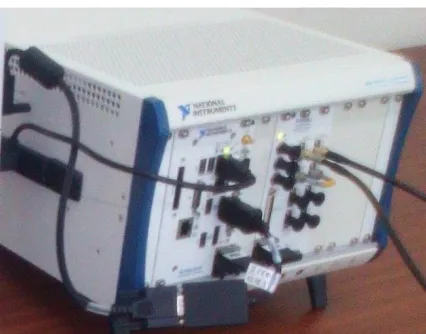
Figure : 1 NI PXIe
2. RELATED WORK
2.1. Result Analysis
Error Vector Magnitude
EVM (Error Vector Magnitude) “The Error Vector Magnitude is a measure of the difference between the reference waveform and the measured waveform. This difference is called the error vector. Both waveforms pass through a matched Root Raised Cosine filter with bandwidth Both waveforms are then further modified by selecting the frequency, absolute phase, absolute amplitude and chip clock timing so as to minimize the error vector. The EVM result is defined as the square root of the ratio of the mean error vector power to the mean reference power expressed as a %.
In figure4 EVM (also called relative constellation error) is a measure used to quantify the performance of a digital communication channel. An digital communication channel would have all constellation points precisely at the ideal locations. Imperfections cause the actual constellation points to deviate from ideal, and EVM is a measure of how far the points are from those ideal locations. The constellation diagram of the measured signal is normalized, in other words the mean distance between the origin and the sampling points is set to one.
The Error Vector Magnitude is defined in the base station conformance testing technical specifications of the Third Generation Partnership Program (3GPP). It is defined as a of-merit for the transmit modulation, however, the goal of this project is to use the EVM as a figure-of-merit of the 3G base station’s receivers.
A good measurement of the quality of a received digital signal is Error Vector Magnitude, or EVM (Figure 4). This is the ratio of the received signal’s amplitude and phase compared to its Ideal amplitude and phase.
The IEEE 802.11 standard defines the EVM test as an average measurement over 20 frames using preamble-only equalization and pilot phase tracking, with a minimum of 16 data symbols per frame. The various EVM thresholds for a WLAN system using the various modulation coding schemes is shown in Figure 4.
EVM requirements for the low-density constellations are very relaxed, and for the highest density 256-QAM an EVM of -32 dB is required. This implies that test equipment EVM floor must be much less than -32 dB to provide measurement margin for 256-QAM signals. EVM measurement is defined over one sub frame (1ms) in the time domain and 12 subcarriers (180 kHz) in the frequency domain
Spectral Emmision mask
Spectral Emmision Mask (SEM) Spectrum emissions mask is also known as “Operating Band Unwanted emissions”. These unwanted emissions are resulting from the modulation process and non-linearity in the transmitter but excluding spurious emissions.
Spectral measurements for some of the latest communication standards like IEEE 802.11, LTE and LTE Advanced, such as spectral emission mask (SEM) and adjacent channel leakage ratio (ACLR), require wide bandwidth acquisitions. Traditionally, such spectral measurements can be performed using tune able narrowband analyzers and work well when the signal is continuous since the signal is present throughout the measurement duration.
Figure:5 Spectral Emmision Mask
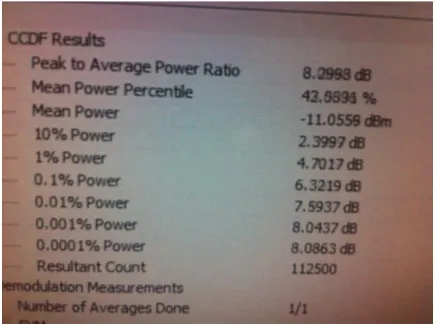
Complementry commulative distribution function
Figure : 6 Complementry Commulative Distribution Function Result
Shown in figure 6 in which red line shows only physical uplink control channel(pucch) configuration and white line shows only physical uplink shared channel (pusch) and when decrease the power then increase the result
Figure : 7 Complementry Commulative Distribution Function Result
3. FUTURE WORK
In future we will consider some more modulations techniques in order to evaluate the effectiveness of the proposed technique further. Also limited numbers of quality parameters are considered therefore in near future some more quality parameters will be considered for better evaluation.
REFERENCES
[1] Sonia BenRejeb, Nidal Nasser, SamiTabbane, A novel resource allocation scheme for LTE network in the presence of mobility, Journal of Network and Computer Applications 46(2014)352–361,
[2] Salam Doumiatia, Hassan Artaila*, David M. Gutierrez-Estevez, A framework for LTE-A Proximity-based Device-to-Device Service Registration and Discovery, Procedia Computer Science, 34 (2014) 87 – 94,
[3] Rohit Prasad , Rajat Kathuria, The value of 1800 MHz and 2100 MHz spectrums in India and implications for auction design, Telecommunications Policy38(2014)223–235,http://dx.doi.org/10.1016/j.telpol.2013.08.003
[5] Nora A. Ali , Mohamed A. El-Dakroury , Magdi El-Soudani, Hany M. ElSayed , Ramez M. Daoud , Hassanein H. Amer, New hybrid frequency reuse method for packet loss minimization in LTE network, Journal of Advanced Research (2014) xxx, xxx–xxx, http://dx.doi.org/10.1016/j.jare.2014.10.008
[6] Mourad Abdeljebbar, Rachid El Kouch, Fast Authentication during Handover in 4G LTE/SAE Networks, IERI Procedia 10 ( 2014 ) 11 – 18, http://dx.doi: 10.1016/j.ieri.2014.09.06
[7] Liljana Gavrilovska, Jaap van de Beek , Yong Xie, Erik Lidström, Janne Riihijärvi, Petri Mähönen,Vladimir Atanasovski, Daniel Denkovski, Valentin Rakovic , Enabling LTE in TVWS with radio environment maps: From an architecture design towards a system level prototype, Computer Communications 53 (2014) 62–72
[8] Ji-Su Kim a, Jae-Hyun Kim a, Sunghyun Cho, Enhanced handoff scheme based on efficient uplink quality estimation in LTE-Advanced system, Computer Networks 69 (2014) http://dx.doi.org/10.1016/j.comnet.2014.05.002 [9] Giovanni Stea ⇑, Antonio Virdis, A comprehensive simulation analysis of LTE Discontinuous Reception (DRX), Computer Networks 73 (2014) 22–40
[10] Bahattin Karakaya a,∗, Hakan A. Çırpan b,1, Hüseyin Arslan, Channel interpolation for LTE uplink systems with high mobility using Slepian sequences, Physical Communication 10 (2014) 169–178, http://dx.doi.org/10.1016/j.phycom.2013.11.005
[11] Wei Kuang Lai ⇑, Chang-Lung Tang, QoS-aware downlink packet scheduling for LTE networks, Computer Networks 57 (2013) 1689–1698,
http://dx.doi.org/10.1016/j.comnet.2013.02.017