INTERNATIONAL CONFERENCE ON ENGINEERING DESIGN, ICED'09
24-27AUGUST2009,STANFORDUNIVERSITY,STANFORD,CA,USA
TOWARDS AN U N DERSTAN DI N G OF T H E I M PACT
OF RESOU RCES ON T H E DESI GN PROCESS
Iain Boyle, Alex H.B. Duffy, R. Ian Whitfield, and Shaofeng Liu
Department of Design, Manufacture and Engineering Management, University of Strathclyde
ABSTRACT
Considerable effort has been devoted within the design research community to understanding the structure of design processes and their development for different design problems. Whilst much work has examined the impact of design goals upon the structure of a design process, less attention has been paid to the role that design resources can play. This paper describes an experiment directed towards gaining an understanding of the impact that both active resources (which perform design tasks) and passive resources (which are used by active resources) can have upon design process structure. Main outcomes from the experiment were the conclusive identification that resources can significantly impact design process structure and a number of examples of how these impacts manifest themselves. The main conclusion of the paper is that given the sizeable impact resources can have upon process structure, there is a considerable need to obtain a greater understanding of these impacts to facilitate the development of techniques that can support design process definition based upon an understanding of the design resources being used to solve a design problem.
Keywords: design process, design resources, domain knowledge, observational analysis, process development
1 I N T RODU CT I ON
Within the field of design research, considerable effort has been devoted to understanding the nature of design as a reasoning process directed towards problem solving [1]. At an abstract level such reasoning has been considered in terms of whether it is deductive, abductive, or inductive in nature [2]. Conversely reasoning has been considered at a more detailed level in terms of understanding the specific problem solving approaches employed during design. The study of analogical reasoning, in which experiential knowledge is recalled and adapted to solve design problems [3], and constraint-based reasoning, in which reasoning is performed over constraints that impinge on a design problem [4], represent two such examples of understanding reasoning at this earthier level of detail in which greater emphasis is placed upon what the design process structure is: i.e., of what does it consist. Reyment et al. [5] consider a design process as a finite sequence of a number of activities that if completed will satisfy a design goal or set of goals in which design tasks are descriptions of the current design situation and the design goal. Design activities are the means by which design tasks are performed, thus the execution of activities represents transitions from one state to another on a path towards meeting a design goal, and obviously for different types of reasoning different activities will be undertaken. Along similar lines, Duffy [6] defines a design process as consisting of a number of tasks (each of which can contain one or more activities) that are performed in a specific order to satisfy a design goal, and provides some clarification on the distinction between goals, activities, and tasks (Figure 1). A design goal reflects a desire or need. An activity is a physical or cognitive action that creates an output from a set of passive resources which are used by active resources to produce the outputs that should satisfy the design goals. Thus a finance manager (active resource) might analyse (activity) market data (passive resource) to identify potential markets for exploitation (output) to increase the financial performance of a company (goal).
investigating the impact that resources can have upon the structure of design processes. Following this introduction, Section 2 presents a review of research efforts in the area of design process development. Section 3 outlines the scope and methodology of the experiments, and is followed in Section 4 by a summary of the experimental results. These results are subsequently discussed in Section 5, before some final concluding thoughts on future research directions are proffered in Section 6.
Goal
Output Passive
resource
Active resource
Design task
[image:2.595.210.387.125.242.2]Activity
Figure 1: A design task (adapted from [6])
2 LI T ERAT U RE REV I EW
A number of different design systems and methods have been developed for assisting the design of design processes. These vary both in terms of the detail to which processes are defined as well as the scope considered in so doing. For example at one extreme lie systems that indicate what the design process may look like, whereas at the other the design process is defined in significant detail in terms of tasks and their active and passive resources, goals, activities, and outputs. An example of the former stems from research performed on managing the propagation of design changes within systems under design [7]. Such methods do not explicitly state a design process, but rather can be used to determine the order in which elements of the system should be designed to effectively manage the propagation of design changes thereby simplifying the design process. Design processes are not provided by such approaches, but they do provide process related information in terms of what needs to be designed and in what order.
At a more detailed level, approaches have been developed to support the development of design processes in which this development is undertaken in real-time in response to the wicked nature of design where development of the design process and the design solution are linked and occur in tandem [8]. Multiple techniques have been applied to achieve such incremental, real-time, process development, and use the status of the design solution with regard to the design goals as the driver behind process development. Case-based reasoning [9][10] is one technique that has been applied, in which a design solution is evaluated in its current form against design goals to identify necessary design "repairs" that need to be executed to ensure these goals are met. Subsequently, experiential design knowledge (i.e., a design case) is recalled that typically takes the form of processes that need to be executed to successfully achieve the repair. In contrast, MYCIN [11] adopts a rule-based approach to determine its next step to ensure that its solutions (treatments for blood infections) meet their goals. These approaches focus on using the design goals and status of a design solution relative to those goals during the development of the design process. Further research efforts have sought to initiate an embryonic understanding of the effect that resources can have on the structure of the design process. Typically such research has focused on scheduling design processes in terms of which resources should perform certain tasks, and when these tasks should be performed given resource availability. Genetic algorithms have been adopted for such design process scheduling problems, and seek to optimize resource allocation to predefined design tasks [6][12]. Such determination of the design process structure (in terms of its resource scheduling and task ordering) need not necessarily be done in advance of the design process starting, but can be undertaken incrementally in real-time [13]. Other approaches used in a similar vein include simulated annealing [14] and Tabu search [15]. It is worth noting that much research has been undertaken within the manufacturing research community in support of manufacturing process optimisation [16] through the application of both knowledge lean (such as genetic algorithms) and more knowledge intensive (such as model-based [17] and rule-based [18] reasoning) approaches.
• Firstly, research efforts examining the impact of resources on the structure of design process are largely restricted to scheduling of pre-defined tasks. Thus given the availability and capability of resources, design processes can be scheduled accordingly but the actual design tasks are specified prior to scheduling. They remain the same but their order of execution may change.
• Secondly, although research efforts support the incremental, dynamic definition of design processes in response to the status of a design solution with regard to its design goals, such approaches include little (if any) consideration of resources within their reasoning process. Rather the assumption is made that the resources required to perform the identified tasks exist.
Thus, greater effort is required to understand the impact that resources can have upon the design process structure. This can subsequently lead to the development of techniques that incorporate this understanding into their reasoning process during the development of design processes such that the design tasks are suited to the resources available for solving the design problem. The remaining sections of this paper detail an experiment that seeks to identify the impacts that resources can have upon design processes.
3 SCOPE AN D M ET H ODOLOGY
The experimental scope focused upon investigating the following two research questions, both of which are concerned with understanding the impact of resource features upon the design process:
RQ-1: How can a design process be affected by dynamic variations in passive resource
availability within a design situation?
RQ-2: How can a design process be affected by the level of expertise associated with active resources?
There were two restrictions on the experimental scope. The first of these was that the design situation under examination was restricted to consideration of a group of designers working together in a co-located manner, thus distributed design issues were not considered. Secondly, the experiments were restricted to consideration of "domain novice" and "domain experienced" designers only, and expert designers (characterized by high levels of domain knowledge) were not considered. For the experiment, domain novice designers were defined as being experienced decision-makers, but not within the experiment's design domain (the experimental scenario is discussed in greater detail in Section 3.1). Domain experienced designers were defined as having reasonable experience of making decisions within the experiment's design domain.
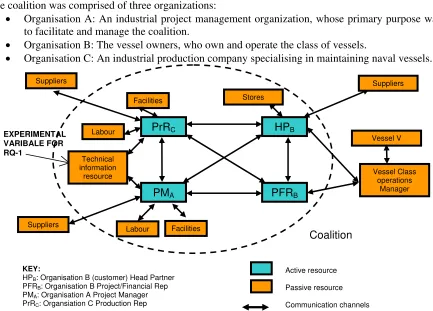
The methodology adopted for the experiment focused on using an observational analysis of two role-play exercises into which experimental resource variables were introduced. For the role-role-plays a network of design resources was defined in which voluntary participants assumed the role of active resources (i.e., designers) with a number of passive resources (i.e., information resources) at their disposal (Figure 2). As highlighted in Table 1, to examine the effect that dynamically changing passive resources had upon the design process (RQ-1), the availability of the information resources within the network was varied in a controlled manner during the role-play execution. To examine the effect of domain knowledge levels upon the design process (RQ-2), the role play was executed several times, each time using participants with different levels of general knowledge concerning the relevant design domain. Section 3.1 provides details of the scenario used within the role-play, while Section 3.2 describes in greater depth the experimental methodology.
Table 1: Experimental variables
Research question Associated experimental variable
RQ-1 (impact of passive resource) Availability of passive (information) resources RQ-2 (impact of active resource) Domain knowledge of role-play participants
3.1 Scenario
into slightly unfamiliar territory in the sense that it was being asked to design a ship repair plan that lay outside its normal maintenance remit: i.e., the design was not "routine" in nature.
For the purposes of the role-play, a simplified coalition and a design network were defined (Figure 2). The coalition was comprised of three organizations:
• Organisation A: An industrial project management organization, whose primary purpose was to facilitate and manage the coalition.
• Organisation B: The vessel owners, who own and operate the class of vessels.
• Organisation C: An industrial production company specialising in maintaining naval vessels.
PrRC
PMA
HPB
PFRB
Vessel V
KEY:
HPB: Organisation B (customer) Head Partner
PFRB: Organisation B Project/Financial Rep
PMA: Organisation A Project Manager
PrRC: Organsiation C Production Rep
Suppliers Suppliers
Labour
Labour Facilities
Facilities
Stores
Coalition Suppliers
Technical information
resource Vessel Class operations
Manager
Active resource Passive resource
Communication channels
[image:4.595.83.516.96.407.2]EXPERIMENTAL VARIBALE FOR RQ-1
Figure 2: The design network
Within the role-play exercise, roles existed for four participants. One role represented Organisation A
and essentially acted as a Project Manager (PMA) throughout the exercise. There were two
representatives from the customer (Organisation B), one of whom was the joint Head Partner (HPB) of the coalition together with the PMA from Organisation A. The other customer representative was the Project/Finance Representative (PFRB) whose responsibilities were to ensure that the vessel in the scenario (Vessel V) was repaired on time at a reasonable cost. The final member of the quartet was a project/production management representative from Organisation C (PrRC), whose role focused on providing technical input on production matters. Each of these roles had access to a number of passive resources (information) that they could call upon during the role-play execution (Figure 2).
3.2 Processes used
Before commencing the role-play, the participants were presented with a briefing pack containing information on the design problem, their role within the coalition, information resources to which they had access, and what they were expected to design – which was a repair plan for the vessel and a list of risks associated with their designed plan. They were then given two hours to complete the exercise, and were observed throughout those two hours.
twice. The first time, domain novice participants assumed the roles, and for the second execution domain experienced participants assumed the roles. This resulted in the generation of four data sets containing the design process data:
• DNNTR – Data set for domain novice participants with technical resource absent
• DNTR – Data set for domain novice participants with technical resource present
• DENTR – Data set for domain experienced participants with technical resource absent
• DETR – Data set for domain experienced participants with technical resource present
Each data set consisted of observed decision, task, and interaction timelines. The decision timelines listed the decisions made, a description of each decision's content and type, and the times they were made. The task timelines listed the design tasks that were observed and included details of the fundamental nature of the tasks performed, their motivation, the methods adopted during their execution, their outcome, the persons performing them, and their duration. The interaction timelines detailed which roles were interacting with each other, the subject of the interaction, how long these interactions lasted, when they occurred, and the relative dominance of each role within the interaction. These data sets (each covering approximately two hours of design activity) were compared (Figure 3) to identify how the variables affected the design process.
DNNTR DENTR
DNTR DETR
comparison (RQ-1)
comparison (RQ-1) comparison
[image:5.595.161.430.261.342.2](RQ-2) comparison (RQ-2)
Figure 3: Analysing the data sets to obtain answers to the research questions
4 RESU LT S AN D OBSERV AT I ON S
This section presents the results from an analysis of the role-play data sets. The significant size of these four sets prohibits their full presentation, so instead selected results and observations with respect to research questions RQ-1 and RQ-2 are described. Whilst the role-play paradigm is limited by its dependence on the character of those assuming the roles, a number of tangible effects caused by resource availability and domain knowledge were still positively observed.
4.1 Results and observations on the effect of passive resource availability (RQ-1)
Passive resource availability had a number of interesting effects on the design process. Consider for example the decision timeline for the first role play execution (DNNTR and DNTR data sets), which involved the domain novice participants (Figure 4). A particular point of interest was that without the technical information resource within the network, few design decisions were actually made. In the first half hour of the exercise (when the technical information resource was not present), three decisions were made but once the resource was provided, the number of decisions made in the next half hour increased to seven (Figure 4). Prior to the information resource entering the network, a fairly abstract level of decision-making existed that had little focus. There was a lot of general discussion (which is to be expected at the start of an activity while everybody tries to get to grips with the problem) but there was no real design strategy in place at this stage. Essentially the discussion was not in a form significantly directed towards creating design outputs.
However, resources existed within the network that would have allowed them to progress their decision-making to a deeper level, whereby they could have started to identify what repair tasks would be involved in repairing the ship and make decisions about those tasks. For example, one available resource within their briefing material was a drawing of the ship’s damaged drive arrangement – it was this drive arrangement for which a repair plan was to be designed. A possible approach could therefore have been to interrogate the drive layout drawing to identify:
• The components that had to be removed to allow access to and removal of the shaft.
• The order in which the components needed to be removed and replaced.
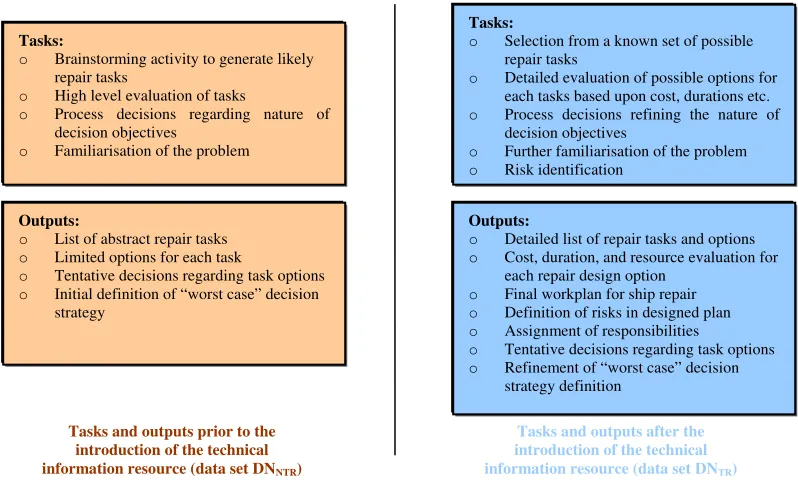
how long a certain repair task might take and what resources are required for it, to which answers could have been obtained from other resources within the network. It was only upon introduction of the technical information resource (which contained this type of information) that the participants began to make design decisions regarding the repair plan, and it was the information resource itself that spurred on this decision-making and resulted in a significant change to the types of design tasks being performed and the types of design outputs that were created (Figure 5).
0 2 4 6 8 10 12
0.00 10.00 20.00 30.00 40.00 50.00 60.00 70.00
Time (mins)
Accu
mu
lat
iv
e d
eci
si
o
n
co
u
n
t
[image:6.595.148.448.135.278.2]technical resource introduced
Figure 4: Decision count prior to and after introduction of the technical resource
Tasks and outputs prior to the introduction of the technical information resource (data set DNNTR)
Tasks:
o Brainstorming activity to generate likely repair tasks
o High level evaluation of tasks
o Process decisions regarding nature of decision objectives
o Familiarisation of the problem
Outputs:
o List of abstract repair tasks
o Limited options for each task
o Tentative decisions regarding task options
o Initial definition of “worst case” decision strategy
Tasks:
o Selection from a known set of possible repair tasks
o Detailed evaluation of possible options for each tasks based upon cost, durations etc. o Process decisions refining the nature of
decision objectives
o Further familiarisation of the problem
o Risk identification
Outputs:
o Detailed list of repair tasks and options
o Cost, duration, and resource evaluation for each repair design option
o Final workplan for ship repair
o Definition of risks in designed plan
o Assignment of responsibilities
o Tentative decisions regarding task options
o Refinement of “worst case” decision strategy definition
Tasks and outputs after the introduction of the technical information resource (data set DNTR)
Figure 5: Influence of the technical information resource on design process
Upon introduction of the technical information resource, the fundamental nature of the design process changed from being abstract to detailed, and the participants began to address the specifics of the problem at hand (Figure 5). Indeed the number and depth of design decisions they made increased. Their decision-making changed from being brainstorming with some limited, qualitative consideration between whatever design options they generated, to one that was based upon selection from a defined set of alternatives contained within the technical information resource. Evaluation was quantitative in nature, focusing on numerical calculation and comparison. Thus the design decision-making moved from being loose to something more appropriately focused to the problem at hand and began to produce a greater number of detailed design outputs and more informed design decisions.
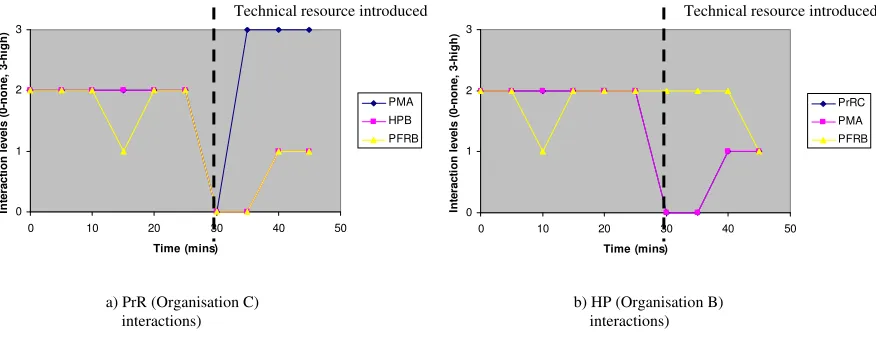
[image:6.595.98.497.303.546.2]to the introduction of the technical information resource at thirty minutes, the interaction levels between the four designers were reasonably equal and consistent, but this changed considerably once the technical information resource became available. Immediately upon introducing the resource into the network, the PrRC and PMA (who were the only designers granted access to this resource) actually removed themselves from any active "designing" for a period of time (approximately five minutes) while they studied this new resource, and the design environment was reduced from four to two active reasoners (the PFRB and the HPB), who carried on with the abstract discussions that had characterised the design process up to that point.
The introduction of the technical information resource introduced information overload to the participants, so much so in fact that the PrRC actually expressed a desire to remove himself from active decision-making such that the content of the information resource could be absorbed, saying “Can I take a bit of time out to go through this and analyse what each option involves?” Thus the immediate impact of adding in the resource was that the number of active reasoning resources was reduced from four to two as a result of information overload. After a short interval of five minutes though, the PrRC and PMA began to discuss the information together. A third effect occurred when the PrRC and PMA rejoined the decision-making process at the forty minute mark. When they did so, they joined together effectively as a mini-team within the network and began to drive the design process forward and to dominate the activity. The PMA and the PrRC assumed a greater level of involvement in the design process and worked much more closely together for the remainder of the role-play. The HPB role was diminished in terms of the level of contribution made, as was the case for the PFRB, and at times the HPB and PFRB were not always aware of what the PMA and PrRC were doing. Thus the introduction of the technical information resource had a significant impact on the nature of the interactions and dominance of certain roles within the design process.
0 1 2 3
0 10 20 30 40 50
Time (mins) In ter ac ti o n l evel s ( 0-n o n e, 3-h ig h ) PMA HPB PFRB 0 1 2 3
0 10 20 30 40 50
Time (mins) In te ra c tio n l e v e ls ( 0 -n o n e , 3 -h ig h ) PrRC PMA PFRB
Technical resource introduced Technical resource introduced
a) PrR (Organisation C) interactions)
[image:7.595.81.519.351.520.2]b) HP (Organisation B) interactions)
Figure 6: Interaction impact of the technical information resource addition (DNNTR and DNTR
data sets)
4.2 Results and observations on the effect of varying domain knowledge levels (RQ-2)
The experiments similarly revealed a number of interesting effects caused by varying levels of domain knowledge. Figure 7 illustrates the number of design decisions for both role-plays prior to the introduction of the technical resource. The figure indicates that the design process of the domain experienced designers was more robust to the absence of the technical resource, and they were able to progress the development of the design solution and make design decisions within a shorter timeframe. For example, within twelve minutes they were making decisions that the bearings within the drive arrangement of the vessel were to be replaced and that the preferred option would likely be to repair the drive propeller rather than replace it. The earlier addressing of these design decisions was in direct contrast to their domain novice counterparts who did not start to make these types of design decisions until after the introduction of the technical information resource. Indeed, the domain experienced participants were able to complete the entire exercise in a shorter time (one hour thirty-five minutes) than their domain novice counterparts, who took over two hours (Table 2).
able to quickly evaluate some of the options as being more or less favourable than others. The most notable example of this occurred when they discarded the idea of repairing a bearing almost instantaneously. This had been decided prior to the information resource being introduced but when the technical resource indicated this as an option, they disregarded it without any significant discussion on the matter. The domain novice decision-makers did however spend several minutes evaluating whether or not to mend or simply replace the bearing.
0 1 2 3 4 5 6 7 8 9 10
0 5 10 15 20 25
Time (mins)
A
c
cu
m
u
lat
iv
e d
e
ci
si
o
n
co
u
n
t
[image:8.595.164.433.141.282.2]Novice Experienced
Figure 7: Accumulative decision counts for both role-plays (DNNTR and DENTR data sets)
Role-play run Duration
[image:8.595.138.455.315.356.2]1 (domain novice decision makers) 2 hours, 16 minutes 2 (domain experienced decision makers) 1 hour 30 minutes
Table 2: Comparison of timelines for role play runs 2 and 3
Overall the design process of the domain experienced participants was more structured than that used by their domain novice counterparts, and they were less affected by the introduction of the technical information resource (Figure 8). They identified early on within the exercise the type of decisions that were required and were able to identify possible solutions to those design decisions, neither of which were achieved by the domain novice participants until the technical resource became available. However the design process was not sufficiently structured in terms of defining these decisions and their associated design tasks as reasoning was still qualitative in nature. It was only when the resource was present that the design process structure matured (as illustrated by ADJUSTMENTE in Figure 8) such that the tasks being performed allowed reasoning at a deeper level of detail that included for example quantitative assessment of design options.
BeforeE ADJUSTMENTE AfterE
BeforeN ADJUSTMENTN
AfterN
Level of design process structure
Figure 8: Design process structure adjustments for domain novice (N) and domain experienced (E) participants in response to addition of technical information resource
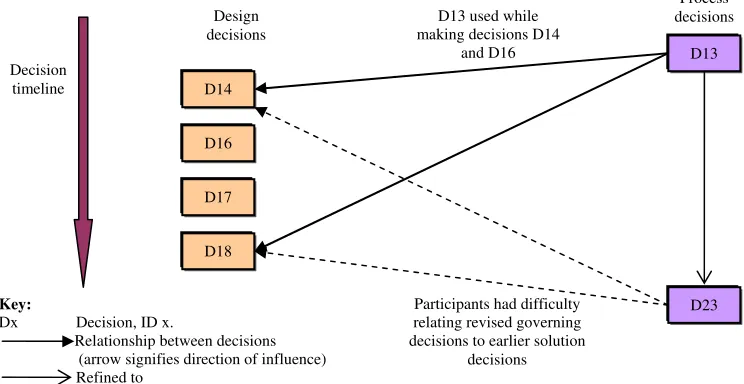
[image:8.595.114.472.509.574.2]original (or unaltered) process decisions. For example, the novice participants continually made decisions in which they refined the definition of the worst case strategy they were adopting (Figure 9). When, during decision D23, they updated this strategy from that originally determined by decision D13, they did not immediately recognize that design decisions D14 and D18 (that were dependent on D13 and thus also D23) needed to be re-checked. Rather, decision-making continued without the realization of the possible effect this decision update might have had.
D16
D17
D18 D14
Key:
Dx Decision, ID x.
Relationship between decisions (arrow signifies direction of influence)
Refined to
Design decisions
Process decisions
Decision timeline
D13
D23 D13 used while
making decisions D14 and D16
Participants had difficulty relating revised governing decisions to earlier solution
[image:9.595.112.484.142.334.2]decisions
Figure 9: The observed dynamic nature of decisions
5 DI SCU SSI ON
Section 4 listed some of the results and observations obtained from the observational analyses. The focus of this section is to phrase those results within the context of the two research questions driving the experiment (see Section 3) and develop an understanding of the different types of support required when developing design processes to ensure their success with respect to the available resources. RQ-1 was concerned with identifying the impact that dynamic availability of a passive resource could have on the design process. As Table 3 illustrates, adding in the information resource during the role-play was found to have a number of significant effects on the design process, some of which were advantageous, others not so. Specific changes observed during the role-plays were discussed in Section 4, but can be summarized as:
• The level of structure and focus of the design process increased in response to the
introduction of the passive resource, as evidenced by:
o Greater numbers of design decisions being made.
o The increasing level of detail at which design decisions were made.
o The change in the nature of design tasks from being generative (based upon
brainstorming) to those that were based upon selection from identified design options contained within the technical resource.
• When the technical information resource was absent, available passive resources were
underused, whereas information overload became an issue after its introduction.
• The manner of interactions between the reasoning resources altered upon introduction of the passive resource and became unequal – some participants had a very clear idea of their role, others less so. Prior to the resource introduction, the interactions were reasonably equal. In terms therefore of providing support for the definition of the design process in the face of changing passive resource availability, three requirements have been identified:
2. There is need to develop techniques that can determine what the impacts will be of passive resource changes. As mentioned in bullet point 1, the impacts observed in these experiments are not universally applicable but serve to demonstrate that passive resources can have a significant impact on design. There are a number of variables that can contribute to the determination of the impacts caused by a change in passive resource availability, including the nature of that resource, the design problem, the current status of the design, and so on. Although the ultimate impact may be upon the ability of the design process to satisfy the design goals driving it (e.g., in terms of timeliness, quality, etc.), it is necessary to identify which tasks within the process are directly and indirectly affected by the resource change, such that subsequently these impacts can be handled. 3. There is a need to develop techniques that can handle any identified impacts through restructuring
[image:10.595.65.531.283.393.2]the design process, for example through introducing new design tasks (and possibly deleting existing ones) or modifying existing tasks (in terms of their activities, or possibly through using alternative resources) that can account for the identified impacts. In addition, such techniques would need to able to exploit advantageous as well as redress disadvantageous impacts (e.g., the introduction of the information resource had a positive impact that was exploited by the participants within the role-plays).
Table 3: Summarised observations on the influence of passive resources
Observed information-lean design characteristics
Observed information-rich design characteristics
High levels of abstraction Decisions made at a deeper level of detail
Generative design tasks prevalent Selection design tasks prevalent
Unstructured design process Somewhat structured design process
Few design decisions made Higher numbers of decisions made
Equal interaction levels Unequal interaction levels
Under use of available passive resources Information overload becomes a problem
The second research question (RQ-2) focused on investigating the impact of active resource domain knowledge levels on the design process. Again, this was found to have a significant effect upon the design process and specifically greater levels of domain experience were found to be advantageous in defining the structure of a design process. Specific effects observed during the role-plays were discussed in Section 4.2, but can be summarized as (Table 4):
• The domain experienced designers were more robust to the changing availability of the technical information resource, were not as highly dependent upon it as the novice designers, and were able to make quicker progress with development of the design solution. The introduction of the resource did still affect their design process and pushed it to a yet greater level of structure, thus they were not entirely immune to its presence or absence.
• The experienced designers had a more structured design process than their novice counterparts, and were able to identify in advance the types of design decisions they would have to make. It is worth noting however that they did not fully define the structure of their design process
• The experienced designers often called upon their experiential knowledge to quickly evaluate relevant information and design options.
Table 4: Summarised observations on the influence of passive resources
Observed novice-designer characteristics Observed experienced-designer characteristics
High levels of abstraction Design decisions made at a deeper level of detail
Unstructured design process Somewhat structured design process
Progress of design development was slow Quicker design development progress
Difficulty identifying required design decisions Able to identify decisions that need to be made
Under-use of available resources Domain knowledge used to prune options
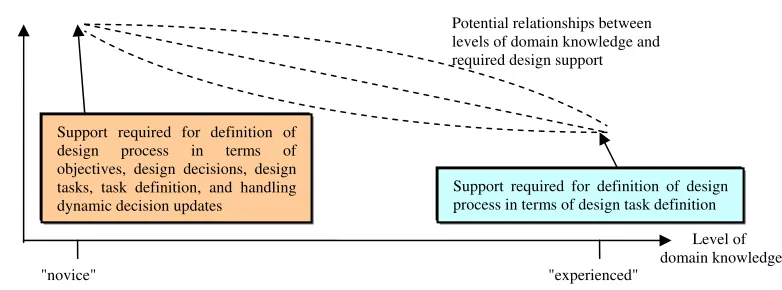
[image:10.595.63.531.618.703.2]illustrated that the novice designers required support to develop the design process structure in terms of defining the design decisions that had to be made, the tasks that needed to be performed, the definition of those tasks (in terms of goals, resources, and outputs), etc., the domain experienced designers required less support but still needed assistance in terms of developing the structure of the design process tasks (in terms of their activities, goals, and resources) to ensure that they could generate outputs to satisfy the overarching design goals. The experiments outlined in this paper did not seek to define the nature of the relationship between domain knowledge and design process development support, but rather to establish the existence of a relationship. A greater understanding of its nature, whether it be linear or non-linear (as indicated in Figure 10) would be an important focus of work within the development of techniques to support the definition of design process structure.
Level of support required
Level of domain knowledge Support required for definition of
design process in terms of objectives, design decisions, design tasks, task definition, and handling dynamic decision updates
Support required for definition of design process in terms of design task definition Potential relationships between levels of domain knowledge and required design support
[image:11.595.109.500.207.352.2]"novice" "experienced"
Figure 10: Reduction in support needed as levels of general domain knowledge increase
6 CON CLU SI ON
While much research within the design community has sought to focus upon understanding the nature of the design process and the impact of design goals upon its structure, less attention has been paid to the impact that resources can have. Detailed within this paper are the main findings obtained from an experiment aimed at developing a greater understanding of such resource impacts. The impact of both active and passive resources on design processes has been examined through an observational analysis involving a role-play into which the following experimental resource variables were passed: the availability of a passive resource (in this case a technical information resource), and the level of domain experience of active resources (i.e., designers of differing experience levels).
The significant outcome from this experiment was confirmation that active and passive resources do have the capacity to affect the structure of the design process. Within the role-plays, both the availability of the technical information resource and the level of domain knowledge of the designers had a significant impact, thus indicating that both active and passive resources can affect the structure of the design process. The addition of the technical information (passive) resource had a generally positive impact, causing designers to modify their current design process to take advantage of its availability. The domain knowledge levels of the active resources also impacted the design process, where higher levels of knowledge had a positive impact. Therefore having established that resources can affect the design process, further research is required to develop a greater understanding of the fundamental nature of the relationship that exists between resources and design processes. Once obtained, this understanding can be used to develop techniques for supporting the development of design processes that incorporate an understanding of the resources being used to solve design problems.
ACKNOWLEDGEMENTS
This research has been conducted as part of the Network Enabled Capability Through Innovative Systems Engineering (NECTISE) program funded by BAE Systems and the UK Engineering and Physical Sciences Research Council (EPSRC) under grant number EP/D505461/1.
REFERENCES
(Springer-Verlag, London).
2. Brazier, F.M.T., van Langen, P.H.G., Ruttkay, Zs., and Treur, J., On formal specification of design tasks, Proceedings of Artificial Intelligence in Design '94, 1994, pp.535-552.
3. Daugherty, J. and Mentzer, N., Analogical reasoning in the engineering design process and technology education applications, J. of Technology Education, Spring 2008, 19(2), pp.7-28. 4. Bowen J., and Bahler. D., Supporting multiple perspectives: A constraint-based approach to
concurrent engineering, Proceedings of Artificial Intelligence in Design '92, 1992, pp.85-96, (Kluwer Academic Publishers).
5. Reymen, I.M.M.J., Hammer, D.K., Kroes, P.A., van Aken, J.E., Dorst, C.H.,Bax, M.F.T., and Basten, T., A domain-independent descriptive design model and its application to structured reflection on design processes, Research in Engineering Design, 2006, 16(4), pp.147-173.
6. Duffy, A.H.B., Designing design, Proceedings of the Third International Seminar and
Workshop on Engineering Design in Integrated Product Development, 2002, pp.37-46.
7. Yan, X.T., Stewart, B., Wang, W., Tramsheck, R., Liggat, J., Duffy, A.H.B., and Whitfield, I., Developing and applying an integrated modular design methodology within a SME,
Proceedings of the International Conference on Engineering Design 2007 (ICED '07).
8. Rittel, H, and Webber, M., Dilemmas in a General Theory of Planning, Policy Sciences, 1973, 4, pp.155-169.
9. Boyle, I., Rong, Y., and Brown, D.C., CAFixD: A case based reasoning fixture design methods.
Framework and indexing mechanisms, Proceedings of the ASME DETC and CIE Conferences
2004, Salt Lake City, USA, 2004, paper DETC2004-57689.
10. Kim, G.J., Case-based design for assembly, Computer Aided Design, 1997, 29(7), pp.497-506. 11. Shortliffe, E.H., Computer-Based Medical Consultation: MYCIN, 1981 (Elsevier, New York). 12. Coates, G., Duffy, A.H.B., Whitfield, R.I., and Hills, W., An integrated agent-oriented approach
to real-time operational design coordination, Journal of Artificial Intelligence for Engineering, Design, Analysis, and Manufacturing, 2003, 17, pp.287-313.
13. Whitfield, R.I., Duffy, A.H.B., and Coates, G., Real time resource scheduling within a
distributed collaborative design environment, Proceedings of ICED'07, Paris, France, 2007. 14. Kirkpatrick, S., Gelatt, C.D., and Vecchi, M.P., Optimisation by simulated annealing, Science,
1983, 220(4598), pp.671-680,.
15. Glover, F. and Laguna, M., Tabu search in Modern heuristic techniques for combinatorial problems, 1993, pp.70-150, (Blackwell Scientific Publications, Oxford, UK).
16. Alting, L. and Zhang, H-C., Computer-aided process planning: the state of the art survey,
International Journal of Production Research, 1989, 27(4), pp.553-585.
17. Francas, D. and Minner, S., Manufacturing network configuration in supply chains with product recovery, Omega, 2009, 37, pp.757-769.
18. Usher, J.M. and Fernandes, K.J., Dynamic process planning, Journal of Materials Processing Technology, 1996, 61, pp.53-58.
Contact: Alex H.B. Duffy University of Strathclyde,
Department of Design, Manufacture, and Engineering Management 75 Montrose Street,
G1 1XJ, Glasgow UK
Phone: +44 (0)141 548 3005 Fax: +44 (0)141 552 7986
E-mail Address: [email protected]
URL: http://www.strath.ac.uk/dmem/dmempeople/duffyprofessoralex/
Alex Duffy is a professor within the Department of Design, Manufacture, and Engineering Management at the University of Strathclyde in the UK. In addition to his involvements as a
![Figure 1: A design task (adapted from [6])](https://thumb-us.123doks.com/thumbv2/123dok_us/1699204.123299/2.595.210.387.125.242/figure-a-design-task-adapted-from.webp)