Final Report
Tadpoles Evaluation
Dr Andressa M Gadda
Research Associate
Permanence and Care Team
2
Introduction
Since January 2013 Scottish Adoption has been running a new programme that aims to support the development of attachment between adoptive parents and children through play. The programme is being funded by a grant from the Communities and Families Fund. As part of its commitment to its funders, Scottish Adoption asked the Permanence and Care Team (PaCT) at the Centre for Excellence for Looked After Children in Scotland (CELCIS) to evaluate the programme. The aim of the evaluation is to consider the impact the programme has on parent/child interactions and the development of attachment.
Background
Decisions to remove children from their birth families and to place them for adoption are not taken lightly. One of the key principles of the Children (Scotland) Act 1995 is that of minimal intervention, or the ‘no order’ principle. This establishes that no requirement or order should be made unless a Children’s Hearing or the Sheriff consider that ‘it would be better for the child that the requirement or order be made than that none should be made at all.’ (Section 16.3). Operating under the principle of minimal intervention, practitioners will remove children from their families only in the most serious and/or recurring cases.
Children who are placed for adoption are likely, therefore, to have experienced some significant form of neglect, abuse and/or trauma. These experiences can have widespread and long-term implications for the child’s development,
particularly if experienced during the first three years of a child’s life [1]. For example, research has consistently shown that looked after children are more likely to experience physical and mental health problems as a consequence of a history of neglect of their needs [2].
In some instances the complex emotional needs of looked after children result in adoptive placements breaking down before the child is legally adopted [2]. Biehal and colleagues [3] suggest that one of the key predictors of placement disruption is the severity of a child’s emotional and behavioural difficulties. They found that one of the key protective factors against placement disruption was ‘the ability of carers and children to become closely attached to one another’ [3] (p. 3).
Research evidence shows the fundamental importance of secure attachment between a child and his or her primary caregiver for healthy child development [1, 4]. The process of attachment formation begins at birth and is strongly
influenced by the characteristics of caregivers[4]. Children who experience inconsistent caregiving and maltreatment, particularly at the early stages of development, are more likely to develop insecure patterns of attachment [1, 4]. Insecure patterns of attachment ‘can have lifelong physical, emotional and social consequences’ [4] leading to ‘later psychopathology’ [1].
The Tadpoles programme
The Tadpoles programme aims to support the development of secure attachment between adoptive parents and children through play. The programme is based on the principles of
Theraplay®. Theraplay® is ‘a child and family therapy for building and enhancing attachment, self-esteem, trust in others and joyful
engagement.’ [5]. As Wettig et al. [6] explain, Theraplay®
…differs from traditional play and talk therapies by emphazising parental
involvement through structured, attachment-based play, guided challenge, social
engagement, playful regulation of affect, and high levels of nurture. (p.28)
It is modelled upon the types of interactions parents naturally engage in with their child, focusing on four key dimensions of attachment building [6]:
Nurturing ‘to produce an environment for the child that is caring, calming and predictable’ Engagement ‘to connect with the child in a
3
Structure ‘to assure the child that the parent is in charge and the child is safe with them’ Challenge ‘to give a child a challenge, but not
to make that challenge undoable’ (p. 179-80).
Theraplay® shows parents how to use play to communicate love, increasing the emotional connection between the child and parent. It aims to teach and/or improve on parents’ capacity to parent in attachment-savvy and affect-co-regulating ways that can support the child’s behavioural regulation [7]. According to Wettig et al. these characteristics of Theraplay® make it a particularly useful therapeutic approach in the treatment of adoptive families as they are more likely to experience issues relating to attachment.
A number of recent studies have explored the effectiveness of Theraplay® in treating, amongst other things, adoptive families [5, 6], socially withdrawn children [6], children at risk of
developing internalising disorder, and attachment disorder in adolescence[8]. The results of these studies have shown great potential and the California Evidence-Based Clearinghouse for Child Welfare (CEBC)[9] has rated Theraplay® as demonstrating ‘promising researchevidence’ supporting the benefits of this intervention*.
Format of the Programme
The Tadpoles programme consists of six sessions delivered to groups of up to six families over a six-month period. In the first session, one of four Senior Practitioners from Scottish Adoption visits the family home to meet with the parent(s) and the child in order to explain and demonstrate some of the techniques to be used during the
*
The CEBC reviews and evaluates child welfare programs used in California by assessing the available research evidence. For an intervention to be ranked as ‘promising research evidence’ data has to be available from a number of peer reviewed studies (at least one of which having used some form of control, such as a placebo group), have to show that they pose no risk and that the overall weight of evidence supports the benefit of the practice.
group sessions. This is also an opportunity for workers to do an initial assessment of the nature of attachment between the parent(s) and the child.
The home visit is followed by four group sessions that take place once a month at Scottish
Adoption’s office. Group sessions are facilitated by two Senior Practitioners who, during the first part of the session, show parents the play techniques and assist them in practising these with their children. The second part of these sessions is more informal with children having an opportunity for free play supported by the Senior Practitioners, whilst parents have an opportunity to socialise with each other. Following each session, parents receive written information about the activities they practised that day and the principles informing these.
The final session of the programme is a home visit by the same Senior Practitioner that visited the family the first time – the family key worker. During this visit the key worker goes over the same activities that were carried out on the first visit. This is an opportunity for the key worker to assess whether there have been any changes to the level of attachment between the parent(s) and the child’ and for parents to reflect on
whether and how these have been integrated into everyday routines.
All of the Practitioners involved in the Tadpoles groups were trained in Theraplay® Level 1, and two of them had also completed Level 2 training.
Recruitment for the Programme
At the end of 2012 Scottish Adoption contacted all the families it was supporting with a child under the age of four who had been adopted or who was waiting for the adoption order to be granted. Of the 69 families contacted, eight went on to start the programme at the end of January 2013, with six completing the programme in May 2013. Two families had to end their involvement with the programme shortly after it had started due to changes in circumstances (such as work
4
In September 2013 a further seven families took part in the programme, with four completing it in January 2014. As with the previous group, three families had to end their involvement with the programme due to changes in circumstances.
Both in the first and second cohort, participating families were grouped according to their child’s age.
The evaluation
The evaluation followed a realist approach which seeks to identify ‘what works, for whom and in what circumstances' [10]. It adopted a multi-method approach including observations, questionnaires, diaries and interviews.
Information about the evaluation was sent to Senior Practitioners and parents before the start of the programme. The researcher met with Senior Practitioners in order to answer any questions and to co-produce a ‘recording tool’ and questionnaires. At the time of their first visit to the families, Senior Practitioners explained the aims and objectives of the research and
highlighted the voluntary nature of participation. Parents were then asked to complete and sign the consent form to indicate whether or not they were willing to take part in the evaluation activities.
With the consent of parents, Senior Practitioners were asked to record their observations made at the time of the first and last visits to the family using the recording tool. Parents were asked to complete questionnaires at the start and end of the programme. The first questionnaire asked for background, demographic information about the child and the family, further details about the child’s behaviour and relationships, and parents’ expectations of the programme. The exit
questionnaire asked similar questions in order to establish whether there had been any changes in the child’s behaviours and relationships and whether parents’ expectations had been met.
Parents were also asked to keep a diary throughout the duration of the programme to document the implementation of the techniques learned during the programme in their day-to-day
routines. The objective was to obtain detailed, longitudinal information about the impact of the programme on parent/child daily interactions.
Two months after the completion of the
programme, parents were invited to take part in a semi-structured in-depth interview. The key objective of the interviews was to explore the impact of the programme over time.
Sample
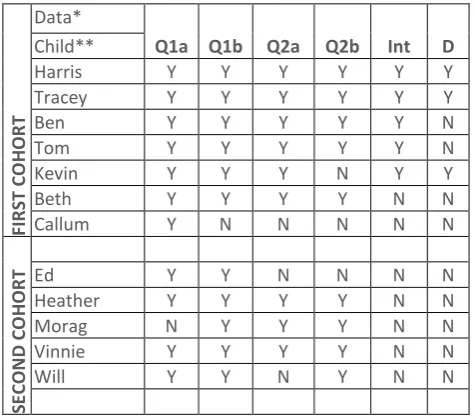
[image:4.595.304.542.331.540.2]Seven of the eight families in the first cohort, and five out of the seven families in the second cohort agreed to take part in the evaluation. These 12 families took part in one or more of the evaluation activities, as illustrated by Table 1.
Table 1: Available sources of data for each child
FI
R
ST C
O
H
ORT
Data*
Q1a Q1b Q2a Q2b Int D Child**
Harris Y Y Y Y Y Y
Tracey Y Y Y Y Y Y
Ben Y Y Y Y Y N
Tom Y Y Y Y Y N
Kevin Y Y Y N Y Y
Beth Y Y Y Y N N
Callum Y N N N N N
SE
CON
D
C
O
H
ORT
Ed Y Y N N N N
Heather Y Y Y Y N N
Morag N Y Y Y N N
Vinnie Y Y Y Y N N
Will Y Y N Y N N
*Q1a and Q2a: questionnaire completed by parents at the start and end of the programme. Q1b and Q2b: questionnaire completed by Senior Practitioners at the start and end of the programme. Int: Interviews. D: Diaries. **All names used are pseudonyms
Sample characteristics
At the start of the programme the children had an age range between 23 and 59 months and had been placed with their (prospective†) adoptive
†
5
families for periods ranging from two weeks to 20 months. All of the children were White British and had no known disabilities.
Their paths into adoption varied considerably, with some experiencing relatively high levels of disruption (eg three placements in as many years), whilst others were matched with their adoptive families following one single stable placement. Independent of the child’s previous experiences, none had been diagnosed as having an attachment disorder.
Most families included in the final analysis were composed of professional, White, heterosexual couples where the mother was the child’s principal carer.
Five families were first-time parents and five had previous children, with three of these five having had previous experience of adopting a child. Information about the existence or otherwise of siblings was not available for two families.
Findings
The format of the programme
The format of the programme suited most parents. Of the nine parents who completed the exit questionnaire all agreed that the length of the sessions was ‘about right’. Six of these nine parents agreed that the duration of the
programme was ‘about right’; two felt that it was too short and one that it was too long. With regard to the frequency of the sessions, four parents agreed that meeting once a month was ‘about right’. Two parents suggested that more frequent group sessions (eg once a week rather than once a month) would have been preferred as this would have helped the children to adjust to the programme and engage with the activities more quickly.
Parents also commented on the free play period which followed the structured play. A couple of parents felt that the less structured part of the group experience was a good opportunity for professionals to observe the children interacting with one another in order to identify any behavioural issues that may require addressing.
Many parents also noted that it was during the free play that they had the opportunity to talk to other parents and share experiences, which was one of the aspects of the group sessions which they most enjoyed. In addition, a few parents and professionals noted that the children really enjoyed this part of the programme.
Two parents, however, found this to be the least helpful aspect of the group experience. One of the parents explained that this was because it
distracted the child from the structured play part of the session:
At the sessions, as I say, his behaviour, he didn’t want to join in some games, the very first session after we had done the games they had a drink of juice and a bit of cake and were chasing each other with balloons and were more interested, and this is what I think was in Kevin’s mind. He was wanting to do the fun bit at the end, he was wanting to get this over with, you know. (Interview with Kevin’s mum)
It seems that, for these parents, the Tadpoles sessions were such a vital opportunity for them to bond with their child that nothing else should distract them from that objective.
The group sessions posed some difficulties, at least initially, for four of the children. This seemed to be due to the sessions being carried out in an environment and with people with which the children were not familiar:
Mm, there was a lot of newness. It was new games, it was new people, it was a new place that he hadn’t been to […] so yeah, it was just quite a lot of new things happening all at once. I think it did take him quite a while […] it took a good three sessions probably before he was really joining, starting to join in with stuff. (Interview with Harris’ mum)
As the quote above illustrates, over time three of the four children become used to their
surroundings and the group and engaged better with the activities, suggesting that early
6
discussed below, ‘familiarity’ was an important aspect of children’s and parents’ engagement with the programme.
The activities
Parents views about, and children’s interactions with, the activities were diverse and there was not one single activity which was liked or disliked by all. This is no surprise given the different ages and stages of development of the children, and the parents’ own preferences and experiences.
All parents who completed the exit questionnaire reported practising some of the activities (the ones they and their children enjoyed the most) at home. The frequency with which they did so varied from every day to a couple of times a week. Activities were most often initiated by parents but in some cases the children would initiate the games on their own. At the time of the interview with the first cohort of participants, four parents reported that they were still practising some of the activities, albeit less frequently than during the time the programme was running.
Six out of the nine parents who completed the exit questionnaire reported referring back to the written instructions provided by the Senior Practitioners following the group sessions and finding these very useful:
Parents found the learning about the rationale behind each of the games particularly useful.
I think that the games and the nurture or attachment behind the games was very interesting. It wouldn’t have been something that I would have personally thought about. (Interview with Kevin’s mum)
Three parents observed that by learning the principles behind the activities they were able to, firstly, understand how some of what they were already doing promoted attachment and, secondly, incorporate these principles into other activities which the child enjoyed engaging in with them. Moreover, parents report that once they understood the principles of the games they were able to modify these according to their and their child’s preferences and/or familiarity with similar activities:
But yeah, understanding why you were doing it and what you were trying to test or see or encourage made it easier for us to do that. So yeah, that’s good. (Interview with Harris’ mum)
It seems therefore that the programme was successful in training parents to be therapists for their children [5].
A factor which seems to impact greatly on how well children and parents engage with the programme is their level of familiarity with the activities:
Tracey seemed to relax when [Practitioner] brought out the lotion […] this is a familiar activity that Tracey does at bath time and is just as happy to have the lotion rubbed into her. (Diary, record of Practitioner’s first visit)
The game [Tracey’s mum] was most
comfortable with was cotton ball hide as this was a variation of a game that she was familiar with and I think knowing that Tracey enjoyed hide and seek gave her the
confidence to take more of a lead with this. (Practitioner, Q1b)
Lack of familiarity seems to result in some resistance to engagement with the activities as prescribed. This is most clearly illustrated by Practitioners’ (and some parents’) observations made at the time of the first visit to the family, where children were often described as wanting to be in charge or take control of the games:
Heather understood and followed
instructions but with each game she pushed to be in charge rather than Denise. […] I don’t think that this was because she didn’t want to play the game – I think it was absolutely about her being in control of what was happening. (Practitioner, Q1b)
With time, children become more familiar with the activities and by the time of the final visit practitioners noticed that children felt more comfortable in ceding control to their parents:
7
taking the lead and giving her instructions – she wasn’t pushing to take the lead as she had done before. (Practitioner, Q2b)
As aforementioned, familiarity with the activities is an important factor in determining how children will react to and engage with the activities.
Attachment
The main aim of the programme was to develop and enhance attachment between parents and child.
At the outset of the programme some parents and professionals noted a few concerns about the children’s general moods and behaviours. These concerns were generally around children’s perceived indiscriminate behaviour, difficulties in self-regulating, over anxious/controlling
behaviour, and bouts of aggression, both to self and others. These issues may be linked to poor attachment patterns, and the programme could therefore have a lot to offer for these families.
The parents who took part in the programme were, from the beginning, well aware of the importance of building strong attachments with their child. At the time of the first visit, Senior Practitioners noted that families had worked hard to establish routines to promote secure
attachment, including the use of funnelling‡ [11]. Parents mentioned attending previous learning and development sessions provided by Scottish Adoption, as well as reading on the topic.
By the end of the programme, six of the parents who completed the programme reported improvements in their relationships with the child:
‡
Funnelling is a technique adoptive parents are encouraged to use to build attachment when the adopted child first moves in with the family. During the funnelling period the child should be held, fed and comforted only by the parent/s until the child consistently goes to them to meet his/her needs.
…our relationship is more relaxed and is developing well. (Parent, Q2a)
Five of these also reported improved relationships between the child and other family members.
Parents were, however, unsure about the extent to which these improvements had been a result of their engagement with the programme, or simply a consequence of the passage of time and the child becoming more used to, and comfortable with, her or his new family.
Beth was home six months when group started. Difficult to say what was group and what was having longer time to settle with us. I don’t think the group, on its own, was responsible for huge bonding - all part of bigger picture. (Beth’s mum, Q2a)
Nonetheless, most found the programme helpful in providing new techniques to support the development of attachment:
I think that they [the activities] help in that they give you other tools to achieve good attachment. (Interview with Harris’ mum)
All professionals reported improvements at the time of the final visit, both in terms of parents’ relationships with their children, and on parents’ and children’s self-confidence:
I think there was better eye contact and more smiles between Heather and mum than when we first met. (Professional, Q2b)
…far more eye contact and chat between the two of them. Mum was very warm with Morag – showed enjoyment in the activity with her and they both seemed really relaxed with each other – physically and emotionally. (Professional, Q2b)
Reassurance
One way in which the programme seems to have indirectly supported the building of attachment between parents and their children was by providing parents with reassurance.
Adoptive parents go through a thorough
8
approved as prospective adopters. As part of this process some parents seem to reflect critically on their ability to parent and their ability to build attachment with their child as the following passage illustrates:
One of the things that they tell you in the training, the preparation courses, is that attachment is a big thing, a big big issue, and we do, it did make me almost like paranoid that maybe we wouldn’t have that, that it wouldn’t happen…’ (Interview with Tom’s mum)
Reassurance was obtained in a number of ways. First and foremost, Senior Practitioners played a key role in this process. Parents were keen to have an expert opinion about the extent to which they had been able to build attachment with their child:
It was nice to be able to sit with the social workers and for them to look at him playing and him checking in with us coz you probably don’t notice those things […] That was really helpful as well having, you know, experts in the room telling us what the signs are and telling us it is positive… (Interview with Tom’s mum)
Second, parents were also reassured by their peers. Being part of the programme meant that parents could meet with other individuals who were going through similar experiences (of adoption) to their own. By belonging to a group of individuals in a similar situation parents felt reassured that what they had been experiencing during the adoption process, both emotionally and practically, were ‘normal’ experiences:
I mean I definitely think that parents are receptive to these things because it’s a support for them you know, you’re doing it for the children, that’s your priority but you’re actually doing it for yourself as well because you need to hear that somebody’s having a bad time like you are, because then you actually feel better. (Interview with Tracey’s mum)
For parents, being able to take part in a group with other parents with an understanding of the
adoption process was one of the most valuable aspects of the programme. Most agreed that it would have been helpful to have had this kind of support earlier on in the adoption process.
By providing reassurances in these multiple ways the programme has aided parents to feel less stressed about parenting and their relationship with the child:
I am very grateful to have been part of the sessions and believe that they have helped us relax more about attachment and stress less. (Tom’s mum – Q2a)
Even better if…
Parents were asked to indicate whether there were any aspects of the programme that could be improved on.
Two parents would have liked to have received feedback about how they were doing in terms of building an attachment with their children following each session:
At the sessions I would say that we didn’t really get a lot of feedback on the activities at the end of it, towards the parent, you know.[…] not anything to say to myself that there was something missing or something good, not a direct response to me.(Interview with Kevin’s mum)
These parents felt that getting regular feedback would have helped them to address any issues that might have come up during the sessions at home:
More review of progress as we went along would have been useful to help tease out anything in particular we could have been working on at home. (Interview with Harris’ mum)
9
Comments were also made with regard to the activities. One parent felt the activities were better suited to toddlers than to children over four. One parent would have liked the addition of activities to support the child to learn to self-regulate. Some parents felt that some activities may be counterproductive. This suggests that it might be beneficial to have a suite of activities from which parents can draw, according to their and their children’s needs and preferences.
Conclusion
Overall parents were positive about their
experiences of taking part in the programme and could identify a number of benefits of
participation.
The two most valuable aspects of the programme were the opportunity to be part of a group of parents going through similar experiences, and the opportunity to be observed, and reassured, by the Senior Practitioners. The findings suggest that, by reassuring parents, the programme has
contributed to a reduction in the stress they were feeling with regard to the adoption process and building attachment with their child. A reduction in stress is likely to have a positive impact on parents’ relationships with the child and others.
As observed above, one of the key aims of
Theraplay® is to teach and/or improve on parents’ capacity to parent in attachment-savvy and affect-co-regulating ways that can support the child’s behavioural regulation[7]. By learning about the principles behind the activities parents gained a deeper understanding of how everyday
interactions and play support the development of attachment. They were also then able to modify and adjust the activities to suit their children’s preferences, thus showing greater attunement with their child’s needs. The programme seems therefore to have been successful in training parents to be therapists for their children[5].
It may be helpful to demonstrate these skills to adoptive parents at an earlier stage of the
adoption process. All parents interviewed were of the view that it would be beneficial to learn about the Theraplay® principles applied earlier on as this
could have supported those very early interactions they had with their child.
References
1. Brown, R. and H. Ward, Decision-making within a child ’ s timeframe: An overview of current research evidence for family justive professionals concerning child development and the impact of
maltreatment. 2012, London: Childhood Wellbeing Research Centre (CWRC). 2. Clark, J., Theraplay and Play Therapy
Interventions within a project offering services to looked after children assessed as having attachment related difficulties. 2011.
3. Biehal, N., et al., Characteristics, outcomes and meanings of three types of permanent placement - adoption by strangers,
adoption by carers and long-term foster care, in DCSF Research Brief, DCSF-RBX-09-11. 2009, Department for Children, Schools and Families: London.
4. Furnivall, J., Attachment-informed practice with looked after children and young people. 2011, Glasgow: IRISS.
5. Weir, K., et al., Whole Family Theraplay: Integrating Family Systems Theory and Theraplay to Treat Adoptive Families. Adopt Quarterly, 2013. 16(3-4): p. 175-200.
6. Wettig, H., A. Coleman, and F. Geider, Evaluating the effectiveness of Theraplay in treating shy, socially withdrawn
children. International Journal of Play
Therapy, 2011. 20(1): p. 26-37.
7. Laakso, M., Parent session in Therapaly: A way to consolidate therapeutic alliance and joint focus. In: , in Applications of family and group Theraplay, E. Munns, Editor. 2009, Jason Aronson: Lanham. p. 183-196.
8. Robison, M., et al., “I Deserve a Family”: The Evolution of an Adolescent’s Behavior and Beliefs About Himself and Others
When Treated with Theraplay in Residential Care. Journal of Child and Adolescent Social Work, 2009. 26(4): p. 291-306.
9. The California Evidence-Based
Clearinghouse for Child Welfare. April 10, 2013].
10. Pawson, R. and N. Tilley, Realistic
evaluation. 1997, London: Sage.
11. Van Gulden, H. and A. Sutton, And You Are Still You: Developing and Maintaining a
Stable Sense of Self. 2013, Edinburgh: