City, University of London Institutional Repository
Citation
:
Baronchelli, A., Caglioti, E., Loreto, V. and Pizzi, E. (2004). Dictionary-based methods for information extraction. Physica A: Statistical Mechanics and its Applications, 342(1-2), pp. 294-300. doi: 10.1016/j.physa.2004.01.072This is the unspecified version of the paper.
This version of the publication may differ from the final published
version.
Permanent repository link:
http://openaccess.city.ac.uk/2652/Link to published version
:
http://dx.doi.org/10.1016/j.physa.2004.01.072Copyright and reuse:
City Research Online aims to make research
outputs of City, University of London available to a wider audience.
Copyright and Moral Rights remain with the author(s) and/or copyright
holders. URLs from City Research Online may be freely distributed and
linked to.
City Research Online: http://openaccess.city.ac.uk/ [email protected]
arXiv:cond-mat/0402581v2 [cond-mat.stat-mech] 14 Sep 2004
Dictionary based methods for information
extraction
A. Baronchelli
a, E. Caglioti
b, V. Loreto
a,∗
, E. Pizzi
c,
a“La Sapienza” University, Physics Department,
P.le A. Moro 5, 00185, Rome, Italy
b“La Sapienza” University, Mathematics Department,
P.le A. Moro 2, 00198, Rome, Italy
cIstituto Superiore di Sanit`a
Viale Regina Elena 299, 00161 Rome, Italy
Abstract
In this paper we present a general method for information extraction that exploits the features of data compression techniques. We first define and focus our attention on the so-called dictionary of a sequence. Dictionaries are intrinsically interesting and a study of their features can be of great usefulness to investigate the properties of the sequences they have been extracted from (e.g. DNA strings). We then describe a procedure of string comparison between dictionary-created sequences (orartificial texts) that gives very good results in several contexts. We finally present some results on self-consistent classification problems.
Key words: Information extraction, Data compression, Sequence analysis
PACS:89.70, 87.10.+e
1 Introduction
Strings or sequences of characters appear in almost all sciences. Examples are written texts, DNA sequences, bits for the storage and transmission of digi-tal data etc. When analysing such sequences the main point is extracting the information they bring. For a DNA sequence this could help in identifying regions involved in different functions (e.g. coding DNA, regulative regions,
∗ Corresponding author
structurally important domains) (for a recent review of computational meth-ods in this field see (Jiang et al. 2002)). On the other hand for a written text one is interested in questions like recognizing the language in which the text is written, its author or the subject treated.
When dealing with information related problems, the natural point of view is that offered by Information Theory (Shannon 1948; Zurek 1990). In this context the word information acquires a precise meaning which can be quan-tified by using the concept of entropy. Among several equivalent definitions of entropy the best one, for our purposes, is that of Algorithmic Complexity proposed by Chaitin, Kolmogorov and Solomonoff (Li and Vitanyi 1997): the Algorithmic Complexity of a string of characters is the length, in bits, of the smallest program which produces as output the string and stop afterward. Though it is impossible, even in principle, to find such a program, there are algorithms explicitly conceived to approach such theoretical limit. These are the file compressors or zippers. In this paper we shall investigate some prop-erties of a specific zipper, LZ77 (Lempel and Ziv 1977), used as a tool for information extraction.
2 The dictionary of a sequence
It is useful to recall how LZ77 works. Let x = x1, ...., xN be the sequence
to be compressed, where xi represents a generic character of sequence’s
al-phabet. The LZ77 algorithm finds duplicated strings in the input data. The second occurrence of a string is replaced by a pointer to the previous string given by two numbers: a distance, representing how far back into the window the sequence starts, and a length, representing the number of characters for which the sequence is identical. More specifically the algorithm proceeds se-quentially along the sequence. Let us suppose that the first n characters have been codified. Then the zipper looks for the largest integer m such that the stringxn+1, ..., xn+m already appeared inx1, ..., xn. Then it codifies the string
found with a two-number code composed by: the distance between the two strings and the length m of the string found. If the zipper does not find any match then it codifies the first character to be zipped, xn+1, with its name.
This eventuality happens for instance when codifying the first characters of the sequence, but this event becomes very infrequent as the zipping procedure goes on.
This zipper has the following remarkable property: if it encodes a text of lengthL emitted by an ergodic source whose entropy per character ish, then the length of the zipped file divided by the length of the original file tends to h when the length of the text tends to infinity (Wyner and Ziv 1994). In other words LZ77 does not encode the file in the best way but it does it better and better as the length of the file increases. Usually, in commercial
10
length
100
101
102
103
104
105
106
frequency
16384 262144 1048576 10.000.000 digits of π
1 10 100
length
100
101
102
103
104
frequency
log-normal fit
I Promessi Sposi
win. 32768
100
101
102
103
104
length
100
102
104
106
frequency
true sequence log-normal fit randomized sequence
Mesorhizobium loti
[image:4.612.96.499.71.175.2]win: 65536
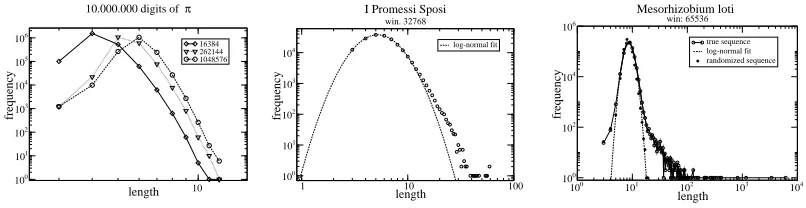
Fig. 1. Frequency-Length distributions for words in the dictionaries of different sequences. Left: The sequence of the first 106 characters of
π. Dictionaries extracted
with different window lengths. Center: The Italian book “I Promessi Sposi”, with a log-normal fit of the peak of the distribution. Right:Mesorhizobium loti original and reshuffled sequences, with the log-normal fit of the peak.
mentations of LZ77 (like for instance gzip), substitutions are made only if the two identical sequences are not separated by more than a certain number nof characters, and the zipper is said to have an-long sliding window. The typical value of n is 32768. The main reason for this restriction is that the search in very large buffers could be not efficient from the computational time point of view. A restriction is often given on the length of a match, too, avoiding substitution of repeated subsequences shorter than 3 characters.
We define dictionary (Baronchelli and Loreto 2003) of a string the whole set of sub-sequences that are substituted with a pointer by LZ77 and we refer to these sub-sequences as dictionary’s words. From the previous discussion it is clear that the same word can appear several times in our dictionary (the mul-tiplicity being limited by the length of the sequence). Moreover, the structure of a dictionary is determined by the size of the LZ77 sliding window. In partic-ular, it has been shown (Wyner and Ziv 1994; Wyner 1994) that the average word length l found by an n-long sliding window LZ77 goes asymptotically as l = logn
h , where h is the the entropy of the (ergodic) source that emitted
the sequence. It follows that the size of the sliding window does not affect the number of characters in the dictionary, but the way they are combined into words.
101 102 103 length
100 101
102 103
104 105
frequency
whole sequence coding
10 length 100
0 0.2 0.4 0.6 0.8 1
[image:5.612.127.456.71.185.2]coding fraction
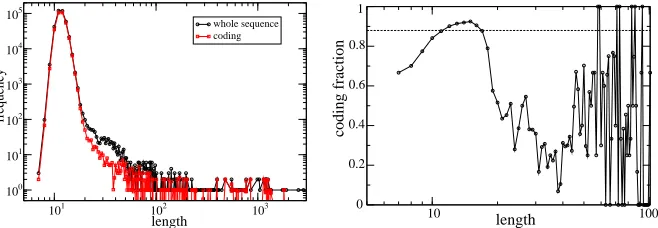
Fig. 2. Fraction of words extracted from coding regions (Escherichia coli). This dictionaries were extracted giving LZ77 the possibility of finding repeated sequences in the whole string. Words of lengths between 20 and 90 characters are found to belong mainly to non-coding regions.
absent in the dictionary of the reshuffled sequence.
Since a genome is composed of regions coding for proteins (genes) and of in-tergenic non-coding tracts, we have analysed in more detail the contribution of these parts to the distributions of repeated “words”. In Figure 2 results obtained in the case of Escherichia coli genome are reported. This genome is approximately 4.500.000 base pairs long; the 87% belongs to coding re-gions (see dotted line in the figure on the right). In the figure on the left, the frequency-length distributions for the entire genome and for the coding tracts are reported. The two distributions appear as completely overlapped up to 20 base pairs of length, while for the next lengths they deviate from each other. This fact is highlighted in the figure on the left, where the fraction of words of each length coming from coding regions is reported. It is clearly visible that within a range of approximately 20 - 90 base pairs, most words come from non-coding tracts. We observed an analogous behavior in the
Vib-rio cholerae second chromosome analysis (data not shown). It is a well known
fact that non-coding sequences are characterized by the presence of repeated “words”, however, at least for the analysed prokaryotic genomes, our results seem to suggest that these tracts are not more repetitive than genes but, more precisely, that they are characterized by repeated words longer than those oc-curring within coding parts. Furthermore these preliminary results suggest our approach as an useful tool to study genomes and their organization.
3 Dictionary-based self classification of corpora
Data compression schemes can be also used to compare different sequences. In fact it has been shown (Loewenstern et al. 1995; Kukushkina et al. 2000; Benedetto et al. 2002) that, compressing with LZ77 a file B appended to a file A, it is possible to define a remoteness between the two files. More precisely the difference between the length of the compressed file A+B and the length
23 4 5 8 910 13 14 15 16 20 21 22 7 1 6 11 25 26 30 34 40 41 42 43 44 45 46 48 49 50 51 53 56 57 58 59 60 61 62 63 64 65 66 68 72 75 77 78 79 80 8182 83
84 85 86 87 32 31 27 28 24 67 71 69 70 23 73 5554 39 29 47 35 74 76 33 37 38 36 12 Grazia Deledda Italo Svevo Alessandro Manzoni Dante Alighieri Niccolo’ Machiavelli Francesco Guicciardini Luigi Pirandello Emilio Salgari Antonio Fogazzaro 52 Giovanni Verga 17 18 Gabriele D’Annunzio 19 M. genitalium A. pernix M. thermoautotrphicum A. aeolicus
T. maritimaP.abyssi P. horikoshii
C. pneumoniae C. trachomatis
Synechocistis sp. B. halodurans
H. pylori BH. pylori A M. pneumoniae L. lactis H. influenzae C. jejeuni M. jannaschii R. prowazekii E. coli S. typhi Y. pestis V. cholerae
N. meningitidis B N. meningitidis A
M. leprae
M. tubercolosis
[image:6.612.115.466.70.274.2]D. radiodurans B. subtilis
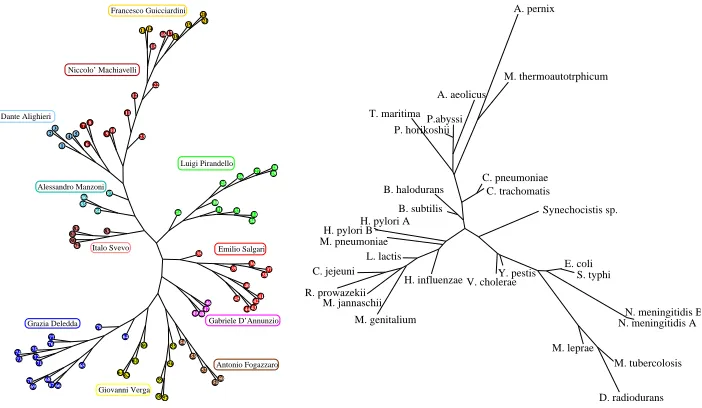
Fig. 3. Self-consistent classification. Left: a tree obtained from a corpus of 87 works of 11 Italian writers. Right: a species similarity tree for 27 procariotes. Both trees have been obtained from distance matrices constructed with the artificial texts comparison method.
of the compressed file A, all divided by the length of the file B, can be related to the cross entropy1 between the two files (Puglisi et al. 2003).This method
is strictly related to the algorithm by Ziv and Merhav (Ziv and Merhav 1993) which allows to obtain a rigorous estimate of the cross entropy between two files A and B by compressing, with an algorithm very similar to LZ77, the file B in terms of the file A. In (Benedetto et al. 2002) experiments of lan-guage recognition, authorship attribution and lanlan-guage classification are per-formed exploiting the commercial zipper gzip to implement the technique just discussed. In this paper we use a natural extension of the method used in (Benedetto et al. 2002), devised to measure directly the cross entropy be-tween A and B: in particular the LZ77 algorithm only scans the B part and looks for matches only in the A part. In experiments of features recognition (for instance language or authorship) a text X is compared with each textAi
of a corpus of known texts. The closest Ai sets the feature of the X text (i.e.
its language or author). In classification experiments, on the other hand, one has no a priori knowledge of any texts and the classification is achieved by the construction of a matrix of the distances between pairs of sequences. A suitable tree representation of this matrix can be obtained using techniques mutuated from phylogenetics. It must be underlined that, for self-consistent classification problems, a true mathematical distance is needed (see for a dis-cussion (Li and Vitanyi 1997; Bennett et al. 1998; Benedetto et al. 2002)).
Our idea (see also (Baronchelli and Loreto 2003)) is that of creating
artifi-cial texts by appending words randomly extracted from a dictionary and to
compare artificial texts instead of the original sequences. The comparison of artificial texts is made using the modified version of LZ77 discussed above. One of the biggest advantages of our artificial text method is the possibility of creating an ensemble of artificial texts all representing the same original se-quence, thus enlarging the original set of sequences. Comparing artificial texts we performed the same experiments described in (Benedetto et al. 2002) ob-taining better results.
In Figure 3 we present a linguistic tree representing the self-classification of a corpus of 87 texts belonging to 11 Italian authors (liberliber). The texts belonging to the same author clusterize quite well, with the easily-explainable exception of the Machiavelli and Guicciardini clusters. The other tree pre-sented in Figure 3 is obtained by a whole-genome comparison of 27 prokaryotic genomes. This kind of analysis are now definitely possible thanks to the avail-ability of completely sequenced genomes (See for a similar approach (Li et al. 2001)). Our results appear as comparable with those obtained through other com-pletely different ”whole-genome” analysis (see, for instance, (Pride et al. 2003)). Closely related species are correctly grouped (as in the case of E.coli and
S.typhimurium,C.pneumoniaeandC. trachomatis,P. abyssi andP. horikoshii, etc), and some main groups of organisms are identified. It is known that the mono-nucleotide composition is a specie-specific property for a genome. This compositional property could affect our method: namely two genomes could appear as similar simply because of their similar C+G content. In order to rule out this hypothesis we performed a new analysis after shuffling genomic sequences and we noticed that the resulting new tree was completely different with respect to the one based on real sequences.
In conclusion we have defined the dictionary of a sequence and we have shown how it can be helpful for information extraction purposes. Dictionaries are intrinsically interesting and a statistical study of their properties can be a useful tool to investigate the strings they have been extracted from. In partic-ular new results regarding the statistical study of DNA sequences have been presented here. On the other hand, we have proposed an integration of the string comparison procedure presented in (Benedetto et al. 2002) that exploits dictionaries by means of artificial texts. This method gives very good results in several contexts and we have focused here on self-classification problems, showing two similarity trees for corpora of written texts and DNA sequences.
References
[Baronchelli and Loreto 2003] Baronchelli A and Loreto V (2003) A data com-pression approach to information retrieval. Information Retrieval.
ted for publication.
[Benedetto et al. 2002] Benedetto D, Caglioti E and Loreto V (2002) Lan-guage trees and zipping. Physical Review Letters 88:048702-048705. [Bennett et al. 1998] Bennett CH, G`acs P, Li M, Vitanyi PMB and Zurek W
(1998) Information Distance. IEEE Transactions on Information Theory, 44:1407-1423.
[Jiang et al. 2002] Jiang T, Xu Y and Zang M eds. (2002) Current Topics in Computational Molecular Biology, (MIT Press Cambridge, Massachusetts London, England).
[Lempel and Ziv 1977] Lempel A and Ziv J (1977) A Universal Algorithm for sequential Data Compression. IEEE Transactions on Information Theory, IT-23:337-343.
[Kukushkina et al. 2000] Kukushkina OV, Polikarpov AA and Khmelev DV (2000) Using Literal and Grammatical Statistics for Authorship Attribu-tion. Problemy Peredachi Informatsii, 37:96-108 (in Russian). Translated in English (2001) in: Problems of Information Transmission, 37,172-184. [Li et al. 2001] Li M, Chen X, Badger JH, Kwong S, Kearney P and Zhang H (2001) An information based sequence distance and its application to whole mitochondria genome distance. Bioinformatics, 17:149-154.
[liberliber] Liberliber homepage: http://www.liberliber.it.
[Li and Vitanyi 1997] Li M and Vitanyi PMB (1997) An introduction to Kol-mogorov complexity and its applications (2nd. ed.). Springer.
[Loewenstern et al. 1995] Loewenstern D, Hirsh H, Yianilos P and No-ordewieret M (1995) DNA Sequence Classification using Compression-Based Induction. DIMACS Technical Report, 95-04.
[Pride et al. 2003] Pride DT Meinersmann RJ Wassenaar TW and Blaser (2003) Evolutionary implications of microbial genome tetranucleotide fre-quency bias. Genome Research, 13:145-158.
[Puglisi et al. 2003] Puglisi A, Benedetto D, Caglioti E, Loreto V and Vulpi-ani A (2003) Data compression and learning in time sequences analysis. Physica D, 180:92.
[Shannon 1948] Shannon CE (1948) A mathematical theory of communica-tion. The Bell System Technical Journal, 27:379-423 and 623–656. [Wyner and Ziv 1994] Wyner AD and Ziv J (1994) The sliding-window
Lempel-Ziv algorithm is asymptotically optimal. Proceedings of the IEEE, 82:872-877.
[Wyner 1994] Wyner AD (1994) Shannon Lecture. Typical sequences and all that: Entropy, Pattern Matching and Data Compression. IEEE Informa-tion Theory Society Newsletter.
[Ziv and Merhav 1993] Ziv J and Merhav N (1993) A measure of relative en-tropy between individual sequences with applications to universal classi-fication. IEEE Transactions on Information Theory, 39:1280-1292. [Zurek 1990] Zurek WH (editor) (1990) Complexity, Entropy and Physics of