City, University of London Institutional Repository
Citation: Mondragon, E. ORCID: 0000-0003-4180-1261 and Hall, G. (2002). Analysis of
the perceptual learning effect in flavour aversion learning: evidence for stimulus
differentiation. Quarterly Journal of Experimental Psychology, 55(2), pp. 153-169. doi:
10.1080/02724990143000225
This is the accepted version of the paper.
This version of the publication may differ from the final published
version.
Permanent repository link: http://openaccess.city.ac.uk/22062/
Link to published version: http://dx.doi.org/10.1080/02724990143000225
Copyright and reuse: City Research Online aims to make research
outputs of City, University of London available to a wider audience.
Copyright and Moral Rights remain with the author(s) and/or copyright
holders. URLs from City Research Online may be freely distributed and
linked to.
City Research Online:
http://openaccess.city.ac.uk/
[email protected]
Analysis of the perceptual learning effect in
flavour aversion learning: Evidence for
stimulus differentiation
Esther Mondragón and Geoffrey Hall
University of York, York, UK
Rats received exposure to two compound flavours, AX and BX, where A and B were sucrose and saline and X was acid. For group intermixed (I), exposure consisted of alternating trials with AX and BX; group blocked (B) received a block of AX trials and a separate block of BX trials. Experi-ment 1 showed that generalization to BX after conditioning with AX was less profound in group I than in group B. Separate examination of the elements of the compoundshowed that the source of this difference lay in the strength acquired by the X element. X acquired less strength in group I than in group B (Experiments 1 and 2), whereas for the A element (Experiments 3 and 4) the reverse pattern was obtained. These results support the proposal that the perceptual learning effect (restricted generalization from AX to BX in group I) dependson a process that enhancesthe effectiveness of unique stimulus elements (A and B) and reduces that of common elements (such as X).
Nonreinforced preexposure to a pair of flavours will reduce the extent to which an aversion established to one of them will generalize to the other. For example, Symonds and Hall (1995, Experiment 1) gave rats preexposure, on separate, alternating trials, to two compound fla-vours, AX and BX (where A and B represent sucrose and saline, and X represents a small amount of acid added to each in order to render the compounds more similar). The rats then received conditioning trials with AX as the conditioned stimulus (CS) and an injection of lith-ium chloride (LiCl) as the reinforcer. A subsequent generalization test showed that these ani-mals consumed BX relatively readily, compared with control aniani-mals that received the conditioning trials but no preexposure. Similar results have been reported by Honey and Hall (1989), Mackintosh, Kaye, and Bennett (1991), and Symonds and Hall (1997).
This result is of interest because it may be an instance of a perceptual learning effect; that is, an attenuation of generalization between AX and BX is what would be expected if preexposure to these stimuli enhanced their discriminability (see, e.g., Hall, 1991). Rather less interesting, but clearly plausible, is an alternative interpretation in terms of latent inhibition. The
Requests for reprints should be sent to G. Hall, Department of Psychology, University of York, York, YO10 5DD, UK. Email: [email protected]
This work was supported by a grant from the UK Biotechnology and Biological Sciences Research Council. We thank C. Bonardi and M. Symonds for helpful discussion.
Ó2002 The Experimental Psychology Society
performance shown to BX on the generalization test will depend on the associative strength acquired by those features of the test stimulus that it holds in common with the CS (i.e., fla-vour X plus any intrinsic elements common to the two fluids). The preexposure procedure will allow these common elements to undergo latent inhibition, and retarded acquisition to them during conditioning with AX would thus be enough to explain the test performance shown by the preexposed rats.
In an attempt to address this issue, Symondsand Hall (1995, Experiment 2) compared gen-eralization from AX to BX in two groups that were both given preexposure but with different schedules of stimulus presentation. Group intermixed (I) experienced AX and BX on alter-nate trials during preexposure;group blocked (B) experienced a block of AX trials followed by a block of BX trials (or vice versa). As the total amount of exposure to the two compounds was the same in both groups there were no obvious grounds for expecting any difference in latent inhibition between them, and indeed there was no consistent difference between the groups in the rate at which the aversion to AX was acquired. Nonetheless, the groups differed when tested with BX, with group I showing less evidence of an aversion than group B (see also, Bennett & Mackintosh, 1999; Bennett, Scahill, Griffiths, & Mackintosh, 1999; Honey & Bateson, 1996; Honey, Bateson, & Horn, 1994). Symondsand Hall (1995) concluded that here was evidence for a perceptual learning effect that could not be explained in terms of the latent inhibition suffered by common stimulus elements. They suggested, in explanation, that the opportunity for stimulus comparison offered by the intermixed preexposure procedure brought into play a process of stimulus differentiation (see Gibson, 1969) that increased the perceptual effectiveness of unique features of the compounds (i.e., A and B) and reduced that of their common elements (i.e., of X and the intrinsic common elements). The notion of “per-ceptual effectiveness” is open to interpretation, but it seems reasonable to assume that differ-ences in the effectiveness of stimulus elements will be reflected in differdiffer-ences in the ease with which subsequently they are learned about.
The aim of the experiments to be reported in this article is to assess the validity of this gen-eral interpretation by evaluating separately the associative strength acquired by the compo-nent parts of the AX compound when conditioning is given after intermixed or blocked preexposure to AX and BX. If intermixed preexposure reduces the effectiveness of the X ele-ments common to the two flavours then it is to be expected that conditioning to X would pro-ceed slowly after such preexposure (an outcome that could explain the basic perceptual learning effect given that the generalized responding controlled by BX will depend on the strength acquired by X). In Experiment 1, rats received conditioning with AX and were then tested with X presented alone; Experiment 2 investigated the effects of the two forms of preexposure on conditioning with X as the CS. If intermixed preexposure enhances the effec-tiveness of unique stimulus elements then it is to be expected that conditioning to A would proceed readily after this form of preexposure. Experiment 3 assessed the strength acquired by the A element after conditioning with the AX compound as the CS; Experiment 4 investi-gated the effects of the two forms of preexposure on conditioning with A as the CS.
EXPERIMENT 1
preexposure consisting of a block of AX trials followed by a block of BX trials. (We did not include subjects given the blocks in the reverse order. Previous published experiments, e.g., Bennett & Mackintosh, 1999; Symonds & Hall, 1995, along with unpublished studies from our own laboratory, have uniformly failed to find any differences between these two versions of blocked preexposure.) All rats then received aversion conditioning with AX as the CS, the procedures used being those that have previously been found to be effective in generating the perceptual learning effect. In order to confirm this, two of the groups then received a general-ization test with flavour BX. (These groups will be referred to as I:AX–BX and B:AX–BX. I and B indicate the type of preexposure, AX that this stimulus was used as the CS, and BX that this event was presented on test.) We anticipated that group I:AX–BX would consume more (i.e., show less evidence of generalization) than group B:AX–BX. The remaining two groups (I:AX–X and B:AX–X) served to test the associative strength of X. These rats received preexposure, conditioning with AX, and then a test trial in which flavour X was presented alone.
Method
Subjects and apparatus
The subjects were 48 naïve male hooded Lister rats with a mean ad libitum weight of 369 g (range: 320–495 g) at the start of the experiment. They were singly housed with continuous access to food in a colony room that was artificially lit from from 08:00 to 20:00 hours each day. Access to water was restricted as detailed later. The experiment was conducted in two identical replications.
The solutions used as experimental stimuli were administered, in the home cages, at room tempera-ture in a 50-ml plastic centrifuge tube with a rubber stopper fitted with a stainless steel,
ball-bearing-TABLE 1 Experimental designs
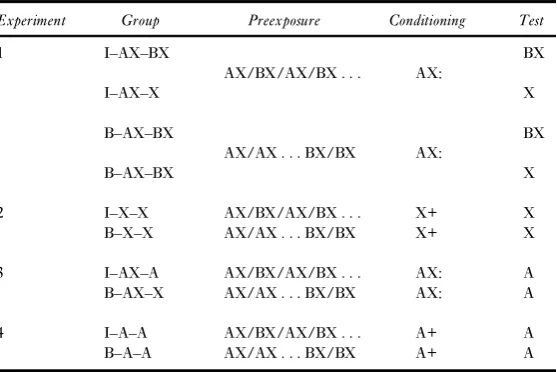
Experiment Group Preexposure Conditioning Test
1 I–AX–BX BX
AX/BX/AX/BX . . . AX:
I–AX–X X
B–AX–BX BX
AX/AX . . . BX/BX AX:
B–AX–BX X
2 I–X–X AX/BX/AX/BX . . . X+ X
B–X–X AX/AX . . . BX/BX X+ X
3 I–AX–A AX/BX/AX/BX . . . AX: A
B–AX–X AX/AX . . . BX/BX AX: A
4 I–A–A AX/BX/AX/BX . . . A+ A
B–A–A AX/AX . . . BX/BX A+ A
[image:4.416.70.349.62.248.2]tipped spout. The following flavoured solutions were used: a compoundconsisting of 0.01 M hydrochlo-ric acid (HCl) and 0.16 M saline (NaCl); a compound of 0.01 M HCl and 0.33 M sucrose; and a 0.01 solu-tion of HCl. Consumpsolu-tion was measured, by weighing, to the nearest 0.01 ml. The uncondisolu-tioned stimulus (US) for the conditioning trials was an intraperitoneal injection of 0.3 M LiCl at 10 ml/kg of body weight.
Procedure
A schedule of water deprivation was initiated by removing the standard water bottles overnight. On each of the following three days access to water was restricted to two daily sessions of 30 min, at 10:00 and 17:00 h. Presentation of fluids continued to be given at these times throughout the experiment. The rats were then randomly assigned to one of the four equal-sized experimental groups.
Over the next four days (the preexposure phase), all rats received four 9-ml presentations of each compound flavour AX and BX. Animals in the I groups were given access to the fluids in alternation, with AX being presented during the first daily drinking period and BX during the second. The B groups received the compoundflavours in two blocksof trials: AX on the first two days in both daily sessions and BX on the last two days. For half the animals in each group flavour A was saline and flavour B was sucrose; for the remainder the arrangement was reversed. For all rats, flavour X was HCl.
Two conditioning trials followed. The first was given in the morning session of the next day. It con-sisted of a 30-min presentation of 9 ml of AX followed immediately by an injection of LiCl. The rats were given free access to water in the afternoon session. The next day was a recovery day on which the rats were givenunrestricted access to water on both drinking sessions. The second conditioningtrial, given in the morning session of the next day, was identical to the first except that the animals were given free access to AX for 30 min prior to the injection (allowing an assessment of the aversion established by the first trial). Water was available in the afternoon session following this conditioning trial, and a further recovery day preceded the test phase of the experiment.
On the next morning half of the rats in each preexposure condition received a single test with the BX solution (groups I:AX–BX and B:AX–BX). The other half (groups I:AX–AX and B:AX–AX) received a single test trial with the X solution. On each of these trials the animals received free access to the solution for 30 min.
Results and discussion
There was some evidence of neophobia on the early trials, but thereafter the rats reliably con-sumed all of the fluid offered on each trial of preexposure. The conditioning procedure suc-cessfully established an aversion to AX. On the first trial all animals consumed the full amount offered, but consumption was substantially reduced on Trial 2. The group mean score on this trial for all subjects given intermixed preexposure was 4.27 ml; that for the subjects given blocked preexposure was 4.20 ml. These scores did not differ reliably (F< 1; here and else-where a criterion of statistical significance ofp< .05 was adopted).
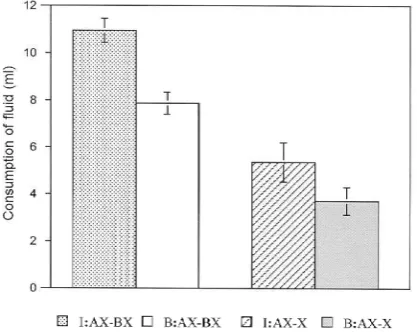
presence of the B element; alternatively, or additionally, the compound of acid and sucrose or saline (BX) may be more palatable than acid (X) alone. The important finding, however, was that consumption of X also differed according to preexposure condition, with group I:AX–X drinking more than group B:AX–X. An overall analysis of variance (ANOVA) with replica-tion, preexposure condireplica-tion, and flavour as the variables confirmed these observations, reveal-ing only significant main effects of preexposure (I or B),F(1, 40) = 12.40, and of flavour (X or BX),F(1, 40) = 50.61. There were no other significant effects (largestF= 1.09). Further analyses were conducted in order to assess the contribution of the effect of preexposure on each flavour, BX or X, on the significant main effect. In both cases a reliable effect of preexposure was found: For the comparison of the groups tested with BX,t(22) = 3.12; for the groups tested with X,t(22) = 2.21.
[image:6.416.104.313.40.206.2]In a study conceptually parallel to that just described, Bennett and Mackintosh (1999, Experiment 1b) tested both BX and X alone after conditioning with AX in animals given either intermixed or blocked preexposure, and, although they found the usual difference on the BX test, the groups showed no difference in consumption of X. Their experiment differed from ours, however, in that the same animals received both tests, that with BX being given first. It is possible, therefore, that their failure to find an effect on the X test simply reflects the fact that the difference between the groups in their response to X becomes attenuated over the course of the first nonreinforced test trial. Some support for this suggestion comes from the results of a second test trial with X that we gave to animals in groups I:AX–X and B:AX–X on the day following the first. Although a numerical difference in the amount consumed persisted (the I group drank 6.69 ml, and the B group drank 5.24 ml), the difference was no longer statis-tically reliable,t(22) = 1.79. We conclude that the test procedure used here (which we suggest is likely to be more sensitive than that used by Bennett & Mackintosh, 1999) demonstrates that X acquires less strength from AX conditioning in animals given intermixed as opposed to blocked preexposure. This difference in the strength of X is enough in itself to explain the basic perceptual learning effect—more consumption of BX in group I than in group B. It is
Figure 1. Experiment 1: Group mean consumption on the test trial with BX (left-hand pair of columns) or with X
important therefore to confirm the reliability of the effect of intermixed and blocked preexposure on learning about X and to attempt to determine its origin.
EXPERIMENT 2
The results of Experiment 1 are consistent with the proposal that intermixed preexposure produces a decline in the perceptual effectiveness of stimulus elements common to the preexposed stimuli, with the result that the X element is less readily learned about on the rein-forced AX trials. But differentiation theory, from which this proposalis derived, also supposes that such preexposure will enhance the effectiveness of unique stimulus elements. The proce-dure used in Experiment 1, in which conditioning was given to the AX compound, thus leaves open the possibility that the difference between the groups in their test performance to X might be a secondary consequence of a difference between them in the effectiveness of A to overshadow learning about X. The present experiment investigates this matter by assessing the effects of the two types of preexposure on conditioning when X alone is used as the CS. This experiment included just two groups, groups I:X–X and B:X–X, given intermixed or blocked preexposure to AX and BX followed by conditioning with X as the CS (see Table 1). (We did not include groups tested with BX as our previous experiments have satisfactorily demonstrated that our preexposure procedures reliably produce a difference between the groups on this test.) In the hope of seeing a difference in the course of acquisition itself we increased the number of conditioning trials and used a reinforcer of reduced magnitude in an attempt to produce a slower rate of conditioning than that seen in Experiment 1. These changes were not successful in that total suppression of consumption was quickly obtained in both groups; accordingly the acquisition phase was followed by a test in which X was presented in extinction.
Method
The subjects were 16 male naïve hooded Lister rats with a mean free-feeding weight of 383 g (range 350–415 g) maintained in the same way and on the same water deprivation schedule as that in Experi-ment 1. They were randomly assigned to one of the two preexposure conditions.
The preexposure phase proceeded exactly as in Experiment 1. There followed three conditioning tri-als on each of which consumption of flavour X was followed by an injection of 0.15 M LiCl at 10 ml/kg of body weight. Testing of X in extinction occurred over the next 4 days, on each of which the animals were given free access to the acid solution for 30 min in the morning drinking session. In any respect not specified here, the procedure was identical to that used in Experiment 1.
Results and discussion
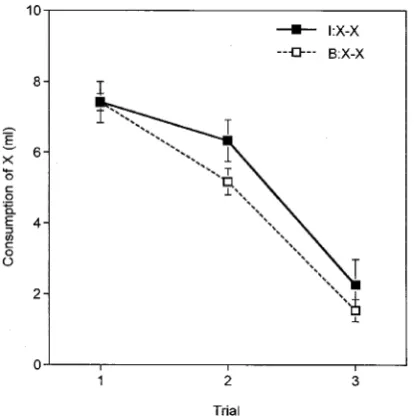
Mackintosh (1999, Experiment 1c). In both experiments, however, it is possible that the fail-ure to find a difference simply reflects the insensitivity of the measfail-ure used. Support for this interpretation comes from the results of the test phase in which X was presented in extinction (a test not included in the Bennett & Mackintosh study).
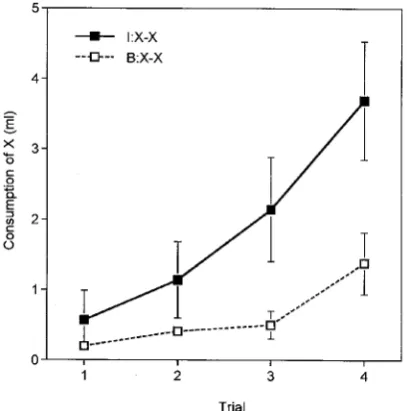
Figure 3 presents group means for consumption of X over the four trials of the test phase. Consumption was depressed on the first trial but as testing continued recovery began to occur and did so more rapidly in group I than in group B. An ANOVA was performed on the data summarized in the figure, with group and trial as the variables. The main effect of group fell short of significance,F(1, 14) = 4.05, but there was a significant effect of trial,F(6, 84) = 23.57, and a significant interaction between the variablesF(6, 84) = 4.44. An analysis of simple effects revealed that rats in group I drank more than did rats in group B on Trial 3,F(1, 23) = 5.47, and Trial 4,F(1, 23) = 9.74.
[image:8.416.105.313.38.248.2]If we accept that the difference evident in the extinction test reflects a difference between the groups in the associative strength acquired by X during conditioning, then the results of this experiment accord with the hypothesis under test. This interpretation requires us to accept the (surely plausible) assumption that the difference in strength was obscured by “floor effects” during the conditioning phase. We need to consider the alternative possibility, how-ever, that the test results reflect a difference between the groups in the rate at which they learn during extinction. According to the account of latent inhibition proposed by Pearce and Hall (1980), a preeexposed stimulus will lose associability only slowly when it is accompanied by inconsistent consequences.The intermixed procedure, in which X is sometimes paired with A and sometimes with B, might thus be expected to restrict the development of latent inhibition to the X element. If the associability of X is higher in group I than in group B then more rapid extinction can be expected in the former group, producing the result obtained here.
Figure 2. Experiment 2: Group mean consumption over three conditioning trials with flavour X. I: intermixed
It is difficult to choose between these alternatives on the basis of the evidence currently available. Symondsand Hall (1997) reported a study showing that subjects conditioned with X as the CS after intermixed preexposure showed relatively rapid acquisition, and they inter-preted this result in terms of the Pearce and Hall (1980) theory of latent inhibition. Their experiment was, however, not directly comparable with that reported here in that comparison was made with a control group given, not blocked preexposure to AX and BX, but exposure only to BX. What is more, in their experiment a difference between the groups was obtained over the course of conditioning to X, and suppression of consumption to X in group I was sus-tained in a subsequent extinction test. These observations, therefore, do little to resolve the issue and leave open the possibility that the test performance shown by group I in the present experiment indicates a higher level of associability rather than a lower level of associative strength. Perhaps the best argument in favour of the latter possibility is that it accords well with the results of Experiment 1 in which the difference between groups I and B was evident on the very first test trial.
EXPERIMENT 3
[image:9.416.106.310.40.246.2]Relatively poor learning about X after intermixed preexposure is enough to explain the atten-uation of generalization (compared with the blocked condition) seen on the BX test in Experi-ment 1. It remains possible, however, that the two forms of preexposure also produce differences in the ease with which animals will learn about other elements of the compound stimuli to which they have been preexposed. Indeed, our interpretation of Gibson’s (1969)
Figure 3. Experiment 2: Group mean consumption during extinction test trials with flavour X for animals
differentiation theory leads to the expectation that the unique elements of the preexposed stimuli will be particularly well perceived after intermixed preexposureand thus to the predic-tion that the A element should be learned about readily. This issue, the effects of intermixed and blocked preexposure on the status of the A element, has important implications for theo-retical interpretations of the perceptual learning effect. These will be taken up in the General Discussion, after we have described two experiments designed to determine what effects, if any, these preexposure procedures might have on learning about A.
The procedures used in Experiment 3 were identical to those used for the I:AX–X and B:AX–X groups of Experiment 1, apart from the fact that the test was given with stimulus A. Thus two groups received intermixed (group I:AX–A) or blocked (group B:AX–A) preexposure to AX and BX followed by reinforced trials with AX as the CS and then extinc-tion test trials with A. The design of the experiment is summarized in Table 1.
Method
The subjects were 16 naïve male hooded Lister rats with a mean ad libitum weight of 338 g (range 300– 360 g). Once the water deprivation schedule had been established the rats were randomly assigned to the two equal-sized groups, I:AX–A and B:AX–A. The preexposure procedure was identical to that described for the previous experiments. Preexposure was followed by two conditioning trials with AX. The conditioning procedure was the same as that used in Experiment 1; that is, there were two presenta-tions of AX each followed by an injection of 0.3 M LiCl at 10 ml/kg of body weight. After the last recov-ery day all rats received three daily test trials in which free access to A was given. Details of the method that have not been specified here were identical to those described for the previous experiments.
Results and discussion
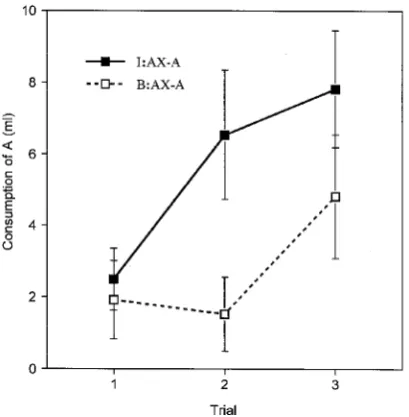
An aversion to AX was readily established during the conditioning phase. All subjects drank the full amount of fluid offered on the first reinforced AX trial. On Trial 2, group I:AX–A drank 3.41 ml, and group B:AX–A drank 2.20 ml. This difference was not statistically reliable,
F(1, 14) = 3.68.
Group means for consumption of A are shown in Figure 4. Suppression of consumption was less profound than that observed in the experiments that employed X as the test stimulus, presumably because the solutions used as A (sucrose or saline) are intrinsically more palatable than the acid solution used as flavour X. Substantial extinction occurred within three test trials and revealed a clear difference between the groups, with group I:AX–A consuming more than group B:AX–A. An ANOVA with preexposure condition and trial as the variables revealed no significant main effect of preexposure,F(1, 14) = 2.50, but a significant effect of trial,F(2, 28) = 16.29, and a significant interaction between these variables,F(2, 28) = 4.75. Analysis of simple main effects showed that the groups differed significantly on Trial 2,F(1, 20) = 6.31.
and so on). Experiment 2 may be taken to show that conditioning of common elements occurs less readily after intermixed than after blocked preexposure. As the solution that we have labelled as flavour A necessarily includes many of these intrinsic common elements, it follows that the performance shown on the test in the present experiment could simply reflect a differ-ence between the groups in the strength acquired by these elements. There is no need to assume that the preexposure procedures have any effect at all on learning about A itself (when by this we mean the unique stimulus features that distinguish AX from BX).
[image:11.416.106.311.39.248.2]A second possibility emerges from consideration of the role of within-compound associa-tions. Exposure to a compound stimulus that consists of a mixture of two flavours will allow an aversion subsequently conditioned to one of the elements to be elicited by the other (e.g., Rescorla & Cunningham, 1978). This effect is readily interpreted as being a version of sensory preconditioning in which an excitatory association formed between the two flavours in the first stage of training allows the test flavour to activate a representation of the conditioned fla-vour and thus to gain access to the representation of the reinforcer. The training procedures used in the present experiment might be expected to establish within-compound A–X associa-tions both in group I and in group B. In both groups, therefore, presenting A on test can be expected to activate the representation of X, and the magnitude of the aversion obtained will be determined, in part, by the associative strength controlled by X. We have already estab-lished (in Experiments 1 and 2) that X controls less strength in group I than in group B. The test results of the present experiment could thus be largely a consequence of this effect and do not require the conclusion that the groups differ at all in the amount they have learned about A itself. Experiment 4 was designed to evaluate this interpretation.
Figure 4. Experiment 3: Group mean consumption during extinction test trials with flavour A for animals
EXPERIMENT 4
This experiment parallels Experiment 2 (see Table 1). Two groups of animals (groups I:A–A and B:A–A) were given intermixed or blocked exposure followed by conditioning and test with just one of the elements of the compound. In this case, however, it was A that was used as the CS rather than X. This procedure is likely to give a more accurate indication of the associa-tive strength acquired by A itself when it is reinforced after one or other of the forms of preexposure. The test will not be completely “pure”—the intrinsic common elements shared by AX and BX will still be present both during the test and during the conditioning phase, and group differences in the strength acquired by these will still be capable of influencing the test results. But X itself will not have undergoneconditioning, and the potential contribution from the A–X association will be absent on this test.
Method
The subjects were 16 male naïve hoodedLister rats with a mean free-feeding weight of 335 g (range 310– 360 g) maintained on the same water deprivation schedule as in previous experiments. They were ran-domly assigned to one of two equal-sized groups. Group I:A–A received intermixed preexposure, and group B:A–A received blocked preexposure. This was followed by conditioning with A as the CS. As in Experiment 2, there were three conditioning trials, and the reinforcer was an injection of 0.15 M LiCl at 10 ml/kg of body weight. Six test trials followed with A presented in extinction. In each of them, animals were given free access to the flavour for 30 min in the morning session. In all other respects the procedure was identical to that used in the previous experiments.
Results and discussion
Group mean consumption of A during the conditioning trials is shown in Figure 5. Acquisi-tion of the aversion proceeded somewhat less readily than when X was trained as the CS in similar circumstances (compare Figure 3), suggesting that the A element is less salient than the X element; alternatively, or additionally, the difference between A and X may reflect that the latter is intrinsically less palatable than the former. It was still the case, however, that for A, as for X, consumption was almost completely suppressed by the third trial of conditioning and that no difference between the groups was detectable. An ANOVA conducted on these data with group and trial as the variables revealed only a significant effect of trial,F(2, 28) = 80.19. Neither the effect of group nor the interaction between the variables was significant (Fs < 1).
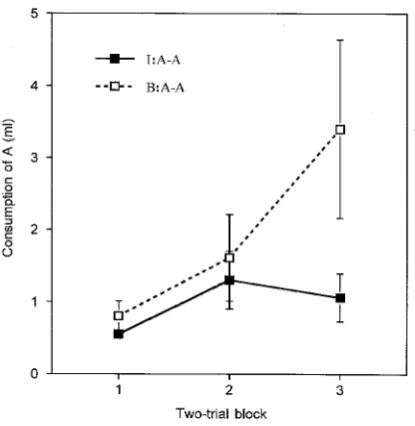
Figure 6 presents group mean scores for consumption of A over three 2-trial blocks of the test phase. Both groups showed an initial aversion; this declined over the course of extinction in group B:A–A, but suppression of consumption remained profound in group I:A–A. An ANOVA performed on the data summarized in the figure showed there to be no main effect of group,F(1, 14) = 1.98, but there was a significant effect of block,F(2, 28) = 6.22, and a signifi-cant interaction between these variables,F(2, 28) = 3.65. An analysis of simple effects revealed that rats in group I:A–A drank less fluid than did rats in group B:A–A on the last block of the test,F(1, 29) = 7.49. Furthermore, this analysis showed also that the effect of extinction was reliable in group B:A–A,F(2, 28) = 9.12, but not in group I:A–A (F< 1).
164
Figure 6. Experiment 4: Group mean consumption during extinction test trials with flavour A for animals
[image:13.416.105.313.333.546.2]experiments was that in Experiment 3 conditioning was given with the AX compound as the CS whereas in this experiment the CS was flavour A alone. As we have already noted, the for-mer procedure allows the associative strength acquired by X to contribute to the conditioned response governed on test by flavour A. And, as previous experiments have established that X acquires more strength from conditioning after blocked than after intermixed preexposure, this factor can explain the outcome of Experiment 3. When this factor is eliminated (by giving conditioning with just flavour A), the true effects of the preexposure procedures on learning about A can be seen—that is, better learning about A in group I than in group B.
GENERAL DISCUSSION
Generalization from a compound flavour, AX, to a similar flavour, BX, is less in animals given intermixed preexposure to AX and BX (group I) than in animals given AX and BX on separate blocks of trials during preexposure (group B). This effect was confirmed in the present Experiment 1. The new results reported here come from experiments designed to evaluate the effects of these two forms of preexposureon the acquisition of associative strength by the sepa-rable elements of the AX compound. They showed, for animals conditioned with AX as the CS, that both X (Experiment 1) and A (Experiment 3) appeared to acquire more strength in group B than in group I. It was pointed out, however, that the formation of a within-compound association during preexposure (or during the conditioning trials themselves) might allow the performance shown on test, after conditioning with AX, to be influenced by the associative strength acquired by the other element of the compound.When this possibility was eliminated by giving conditioning trials with each element in isolation it was found that X still acquired more strength in group B than in group I (Experiment 3), but that the effect was reversed for stimulus A (Experiment 4). We conclude from these results that X is learned about less readily after intermixed than after blocked preexposure and that the contribution of this salient stimulus element dominates the effect seen when A is tested alone after AX condi-tioning. Appropriate testing can reveal, however, that the effects of preexposure are reversed for stimulus A and that this element is learned about more readily in group I than in group B.
We now consider the implications of these findings for current theories of the perceptual learning effect obtained with this procedure (that is, for the difference between groups I and B in generalization between AX and BX). We argue that our results are problematic for the asso-ciative interpretation offered by the theory proposed by McLaren et al. (1989) and developed by McLaren and Mackintosh (2000). They are, however, entirely consistent with an explana-tion derived from Gibson’s (1969) noexplana-tion of stimulus differentiaexplana-tion.
stimulus preexposure. There is no obvious reason, however, to suppose that unitization will proceed differently under intermixed and blocked conditions of preexposure, making it diffi-cult to see how this process could account for the present results. In order to explain the differ-ing effects of these two schedules of preexposure, McLaren and Mackintosh (2000) make use of their third mechanism, one that postulates the formation of inhibitory links between certain features of the stimuli.
This third mechanism has been applied to this version of the perceptual learning effect by Bennett et al. (1999; see also McLaren & Mackintosh, 2000). They point out that the training proceduresused in these experiments will establish within-compound, A–X and B–X, associ-ations in both groups and that these associassoci-ations could help determine the magnitude of the conditioned response evoked by BX. Specifically, the X element present in the BX compound will be able, by way of the A–X association, to activate the representation of A, a stimulus that has been directly paired with the US in the conditioning phase of the experiment. Generalized responding on test could thus be produced not only by the direct X–US association but also by way of the chain X–A–US. It is also argued, however, that further associative learning occur-ring duoccur-ring the preexposure phase could act to eliminate this second source of generalization. Once the A–X and B–X associations have been formed during preexposure, presentations of AX will evoke the representation of B (by way of the B–X association), and presentations of BX will evoke the representation of A (by way of A–X). According to standard associative theory (e.g., Rescorla & Wagner, 1972; Wagner, 1981), this will lead to the formation of an inhibitory association between the event that is present and the representation that is activated only associatively; thus A will acquire the power to inhibit B, and B the power to inhibit A.
The final step in argument is the suggestion that inhibitory links between A and B will form more readily in group I than in group B. An inhibitory link will form on a BX trial only when there is already in existence an excitatory A–X link of some strength (and vice versa for the for-mation of inhibitory links on AX trials). The alternating schedule used in group I is an ideal arrangement for ensuring that the appropriate connection has strength on each trial. For group B, on the other hand, there is only one transition between trial types. No inhibitory learning will occur during the first block of trials; during the second, the excitatory connec-tions established during the first will extinguish, and the opportunity for inhibitory learning will be restricted. Thus in group B, X will be able to activate the A representation on the test trials whereas in group I the A representation will be inhibited by the presence of B, producing the observed difference in generalization to the test stimulus BX.
mechanism gives no reason to expect (what was observed) a difference between the groups when A was not present during conditioning (Experiment 2). Equally problematic is the find-ing (Experiment 4) that when A has been conditioned alone, the aversion generated by this stimulus on test is more substantial in group I than in group B. The associative links controlled by A in the two groups could well differ—for group B, A will activate the representation of X, which could in turn activate that of B; for group I, the presence of A itself will presumably inhibit any tendencyof B to be activated. But as B was notpresent during conditioning and will possess no associative strength, it is difficult to see why this difference between the groups should generate any difference in the size of the aversion exhibited to A.
In applying the associative theory to our results we have made use only of those principles that were used in providing an explanation of the basic perceptual learning effect (i.e., that preexposure establishes excitatory A–X and B–X associations in both groups, but inhibitory associations between A and B only in the intermixed condition). It is possible that we have overlooked some way in which these principles might be manipulated, but our attempt to apply them has failed to generate a satisfactory explanation for the finding that, after condi-tioning, A appears to control more, and X less, strength in group I than in group B. In contrast, the account of the perceptual learning effect that can be derived from Gibson’s (1969) theory expects stimulus elements A and X to show just these properties—indeed, the result obtained in the generalization test with BX is explained by this theory in terms of the effects of preexposure on the properties acquired by the stimulus elements.
Although the terminology used was somewhat different, the essence of the notion of per-ceptual learning put forward by Gibson (e.g., 1969) was that mere exposure to a stimulus is capable of producing a change in the way that the stimulus is perceived. Specifically, exposure to a pair of stimuli, particularly when it is given in such a way that the subject is able to compare them, will increase the effectiveness of those features of the stimuli that distinguish between them (their unique elements) and will reduce the effectiveness of the elements that they hold in common. If it is allowed that the intermixed preexposure procedure is more likely to gener-ate comparison between AX and BX than is the blocked procedure, then this account accords perfectly with the results reported here. For group I, the A element (being a unique feature) will become more effective as a result of preexposure and thus will be more readily learned about when it comes to the conditioning phase. The X element (a feature common to the stim-uli) will lose effectiveness and be less readily learned about. Critically for our present pur-poses, the conditioned response evoked by BX, which will be chiefly determined by the associative strength acquired by X, will be less in group I than in group B—that is, generaliza-tion between the preexposed stimuli will be restricted in animals given the chance to compare the stimuli during preexposure.
process. For animals given alternating presentations of AX and BX, however, the interval between presentations of the unique elements of these compounds will be double that between presentations of the common elements, with the result that the effective amount of exposure to these unique elements will be greater than that received either by the X elements or by either of the elements in the blocked procedure. If the animal’s subsequent ability to perceive a stimu-lus element is determined by the amount of prior exposureit has received to that element, then animals given the intermixed procedure will be better able to perceive A when given the AX compound and B when given the BX compound.
Honey and Bateson (1996) developed their account in order to deal with data from an experimental procedure in which the stimuli were presented in fairly rapid succession during preexposure (the longest interval between trials in their experiments was no more than 60 s). It is not impossible, but it seems implausible that the nonassociative processes they envisage could be effective with the intertrial intervals used in the experiments reported here. Although we have argued that our results are best accommodated by differentiation theory, we have not said that associative processes do not operate during the preexposure phase of those experi-ments. We have accepted that repeated exposure to a compound stimulus is likely to establish excitatory links among its elements; indeed, we made use of this principle in explaining the results of Experiment 3. It seems possible that these within-compound links could play an important part in producing the differentiation effect itself. We have suggested that the inter-mixed schedule produces a perceptual learning effect because it allows the opportunity for stimulus comparison to occur and that comparison is more likely when the critical events are presented in alternation rather than in separate blocks of trials. It might still be felt, however, that even in the intermixed case, the gap of several hours between successive trials might be enough to rule out the operation of an effective comparison process—comparison is usually supposed to proceed most readily when the events to be compared are simultaneously present. If comparison does occur with the intermixed schedule, it must be between the stimulus that is currently present and the memory of what has been experienced on the previous trial. Associa-tive principles supply a mechanism by which this might occur. The formation of within-com-pound associations means that the presence of X on AX trials will be able to activate a representation of B; similarly A will be activated on BX trials. That is, the set of circumstances that, according to McLaren et al. (1989) should produce inhibitory learning between the unique elements of two similar stimuli is also ideal for arranging that the animal will experi-ence both elements at the same time—one element will be physically present, and the repre-sentation of the other will be activated associatively. To the extent that an associatively activated representation can substitute for the event itself (see Hall, 1996), comparison, and thus stimulus differentiation, should be possible in these conditions.
REFERENCES
Bennett, C.H., & Mackintosh, N.J. (1999). Comparison and contrast as a mechanism of perceptual learning?
Quarterly Journal of Experimental Psychology,52B, 253–272.
Bennett, C.H., Scahill, V.L., Griffiths, D.P., & Mackintosh, N.J. (1999). The role of inhibitory associations in perceptual learning.Animal Learning & Behavior,27, 333–345.
Hall, G. (1996). Learning about associatively activated stimulus representations: Implications for acquired equiva-lence and perceptual learning.Animal Learning & Behavior,24, 233–255.
Honey, R.C., & Bateson, P. (1996). Stimulus comparison and perceptual learning: Further evidence and evaluaton from an imprinting procedure.Quarterly Journal of Experimental Psychology,49B, 259–269.
Honey, R.C., Bateson, P., & Horn, G. (1994). The role of stimulus comparison in perceptual learning: An investiga-tion with the domestic chick.Quarterly Journal of Experimental Psychology,47B, 83–103.
Honey, R.C., & Hall, G. (1989).Enhanced discriminability and reduced associability following flavour preexposure.
Learning and Motivation,20, 262–277.
Mackintosh, N.J., Kaye, H., & Bennett, C.H. (1991).Perceptual learning in flavour aversion conditioning.Quarterly Journal of Experimental Psychology,43B, 297–322.
McLaren, I.P.L., Kaye, H., & Mackintosh, N.J. (1989). An associative theory of the representation of stimuli: Applications to perceptual learning and latent inhibition. In R.G.M. Morris (Ed.),Parallel distributed processing: Implications for psychology and neurobiology(pp. 102–130). Oxford: Clarendon Press.
McLaren, I.P.L., & Mackintosh, N.J. (2000). An elemental model of associative learning: I. Latent inhibition and perceptual learning.Animal Learning & Behavior,28, 211–246.
Pearce, J.M., & Hall, G. (1980).A model for Pavlovian learning: Variation in the effectiveness of conditioned but not of unconditioned stimuli.Psychological Review,87, 532–552.
Rescorla, R.A., & Cunningham, C.L. (1978). Within-compound flavor associations. Journal of Experimental Psychology: Animal Behavior Processes,4, 267–275.
Rescorla, R.A., & Wagner, A.R. (1972). A theory of Pavlovian conditioning: Variations in the effectiveness of reinforcement and nonreinforcement. In A.H. Black & W.F. Prokasy (Eds.),Classical conditioning II: Current research and theory(pp. 64–99). New York: Appleton-Century-Crofts.
Symonds, M., & Hall, G. (1995). Perceptual learning in flavor aversion conditioning: Roles of stimulus comparison and latent inhibition of common stimulus elements.Learning and Motivation,26, 203–219.
Symonds, M., & Hall, G. (1997). Stimulus preexposure, comparison, and changes in the associability of common stimulus features.Quarterly Journal of Experimental Psychology,50B, 317–331.
Wagner, A.R. (1981). SOP: A model of automatic memory processing in animal behavior. In N.E. Spear & R.R. Miller (Eds.),Information processing in animals: Memory mechanisms(pp.5–47). Hillsdale, NJ: Lawrence Erlbaum Associates, Inc.