R E S E A R C H A R T I C L E
Open Access
‘
Talking a different language
’
: an exploration of
the influence of organizational cultures and
working practices on transition from child to
adult mental health services
Susan McLaren
1, Ruth Belling
1*, Moli Paul
2, Tamsin Ford
3, Tami Kramer
4, Tim Weaver
4, Kimberly Hovish
5,
Zoebia Islam
6, Sarah White
7and Swaran P Singh
2Abstract
Background:Organizational culture is manifest in patterns of behaviour underpinned by beliefs, values, attitudes and assumptions, which can influence working practices. Cultural factors and working practices have been
suggested to influence the transition of young people moving from child to adult mental health services. Failure to manage and integrate transitional care effectively can lead to young people losing contact with health and social care systems, resulting in adverse effects on health, well-being and potential.
Methods:The study aim was to identify the organisational factors which facilitate or impede transition of young people from child and adolescent mental health services (CAMHS) to adult mental health services (AMHS) from the perspective of health professionals and representatives of voluntary organisations. Specific objectives were (i) to explore organizational cultures, structures, processes and resources which influence transition from child to adult mental health services; (ii) identify factors which constitute barriers and facilitators to transition and continuity of care and (iii) make recommendations for service improvements. Within an exploratory, qualitative design thirty four semi-structured interviews were conducted with health and social care professionals working in CAMHS and AMHS in four NHS Mental Health Trusts and four voluntary organizations, in England.
Results:A cultural divide appears to exist between CAMHS and AMHS, characterized by different beliefs, attitudes, mutual misperceptions and a lack of understanding of different service structures. This is exacerbated by working practices relating to communication and information transfer which could impact negatively on transition, relational, informational and cross boundary continuity of care. There is also evidence of a cultural shift, with some positive approaches to collaborative working across services and agencies, involving joint posts, parallel working, shared clinics and joint meetings.
Conclusions:Cultural factors embodied in mutual misperceptions, attitudes, beliefs exist between CAMHS and AMHS. Working practices can exert either positive or negative effects on transition and continuity of care. Implementation of shared education and training, standardised approaches to record keeping and information transfer, supported by compatible IT resources are recommended, alongside management strategies which evaluate the achievement of outcomes related to transition and continuity of care.
Keywords:Transition, Culture, Working practices, Care continuity, Mental health
* Correspondence:[email protected] 1
Faculty of Health and Social Care, London South Bank University, London, United Kingdom
Full list of author information is available at the end of the article
Background
Organisational culture is‘that which is shared by mem-bers of groups and expressed in patterns of behaviour’ [1] and can be conceptualised as‘shared values, beliefs, understandings and norms that bind organisational members into a collective endeavour’ [1,2]. Dimensions of organisational culture as embodied in approaches to cultural assessment can encompass leadership, orga-nisational attributes, attitudes to change, safety, team orientation and working, collaboration, collegial and in-terdisciplinary relationships [3]. Culture is explicit in patterns of behaviour which can be reflected in working practices and rituals; beliefs, values, attitudes which jus-tify behaviour patterns and are influential in decision making and assumptions based on beliefs, values and expectations [2,4]. Organisational culture is influential in shaping identities and role enactment by individuals [5]; in turn, professional roles, identities and working practices can create social boundaries which can hinder inter-professional relationships impeding the diffusion of innovation and change within and across organisations [6]. Recent interest has focussed on the possible rela-tionship between organisational culture, performance (quality outcomes) and the potential for reshaping cul-tures as a lever for health care improvement. Currently, evidence supporting this is limited [2,7] and no convin-cing evidence of generalizable strategies to change cul-ture have been found [8].
Although few studies have specifically investigated the influence of cultural factors and working practices, rec-ognition that these could adversely influence the transi-tion of young people from CAMHS to AMHS rests on variable sources of evidence relating to the evolution of separate child and adult mental health systems [9], com-plexity of organisational structures across which transfer takes place [10], differing provision of services [11-14], espousal of different models of health, illness and service delivery by CAMHS and AMHS [15,16] and working practices marked by lack of shared planning, poor com-munication and lack of formal arrangements to support transition [17-21]. Concerns have arisen that failure to manage and integrate care effectively during the process of transition can result in young people losing contact with health and social care systems, with adverse effects on health, well-being and potential [22-27].
Investigation of continuity of care in AMHS has highlighted emergent cultures in patterns of integrated, multi-disciplinary working by community mental health teams (CMHT) within and across organisational bound-aries [28,29]. Integrated working in relation to commu-nication, information transfer and decision making was a facilitator for cross-boundary, team and informational continuity of care. Barriers for cross boundary and team continuity were leadership styles, blurred professional
roles, medical models of decision making, lack of train-ing for role development and resources to support infor-mation transfer. Service users and carers identified both positive and negative‘depersonalized transitions’ charac-terised in negative cases by poor communication and in-formation transfer between services, users, carers and voluntary agencies [30].
Effective management of transition requires CAMHS and AMHS managers to face the challenge of implemen-ting and monitoring uptake of standards and guidelines contained within national service frameworks, recent policy reviews and recommendations of professional bo-dies [31-34]. These encompass the appointment of key workers to co-ordinate the process, the development of transition protocols and care plans supported by joint strategic planning and multi-agency working aligned with the engagement of young people and families. Intrinsic to successful implementation and change management is an understanding of the influence of organizational cultures and working practices and if ne-cessary, their reshaping through structural reform, to achieve aspirations for transition to be the ‘smooth process offering uninterrupted continuity of care with consideration of the young persons’physical, social and psychological development [34]’. Given the limited evi-dence on cultural factors relating to transition, this paper presents findings from an exploratory study designed to illuminate cultures and working practices across the CAMHS/AMHS interface.
Aim
The aim was to identify the organizational factors which facilitate or impede effective transition of young people from CAMHS to AMHS from the perspective of health professionals and representatives of voluntary organiza-tions. Specific objectives were:
To explore the organizational cultures, structures, processes and resources which could influence the transition from CAMHS to AMHS;
To identify specific organizational factors which constitute barriers and facilitators to transition and continuity of care;
To make recommendations for changes in services which could improve young people and carers’ experiences of transition and experienced continuity of care.
Methods
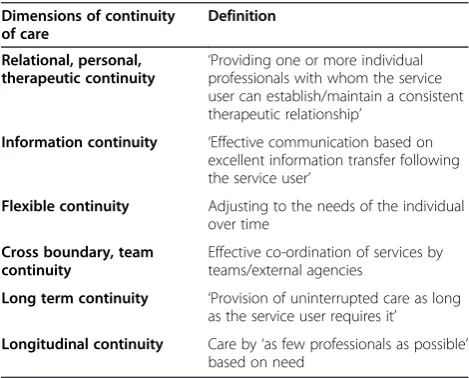
Organisation, Policies, Process, User and Carer Perspec-tives]. Wider objectives of TRACK included the conduct of a mapping study auditing policies and procedures rela-ting to transition between NHS Mental Health CAMHS and AMHS; evaluation of the process of transition uti-lising a retrospective case note survey and exploration of the views of users, carers and mental health professionals on the process of transition. Findings of the organizational strand presented in this paper focus on two core themes of organisational culture, communication and working practices and nine related sub-themes, comprising the fifth in a series of papers reporting findings from the TRACK study [35-38]. The definition of continuity of care utilised in this paper is a multi-axial definition [39,40]; (Table 1).
Ethical approval
The study received ethical approval from Wandsworth Local Research Ethics Committee.
UK mental health services configuration
In the United Kingdom, the National Health Service (NHS) provides a service free at the point of delivery fi-nanced through taxation. Mental health care for children and adolescents is delivered through a multi-agency model, encompassing community based Child and Ado-lescent Mental Health Services (CAMHS) delivering both medical and psycho-social care, together with a range of statutory and voluntary health and social care providers and education services. In terms of age cut-offs, CAMHS provide care up to 16–18 years and most AMHS have a lower age limit of 18 years [33]. AMHS are separate from CAMHS, but also work within a mul-tiagency model, linked to other statutory and voluntary
providers: both CAMHS and AMHS are separate from agencies responsible for housing support.
Within AMHS, health and social care are integrated, with continuity of care an important quality benchmark. In addition to acute in patient services, CMHT are in-trinsic to the delivery of a multidisciplinary service to adult service users. Approaches to modelling com-munity care have resulted in the inception of generic CMHT delivering a range of interventions to adults and specialist teams with specific remits for assertive outreach (difficult to engage service users), crisis reso-lution/ home treatment (avert hospitalisation in crisis) and early intervention teams (provide interventions for individuals 14–35 years with first presentation of psychotic symptoms).
Sample
A total of thirty-four health and social care professionals working in four NHS Mental Health Trusts in Greater London and the Midlands and four staff each repre-senting local voluntary sector organisations were recrui-ted by RB (Tables 2 and 3) from February 2007 to April 2008. The rationale for including voluntary sector re-presentation was their vital role in multi-agency working in mental health care, encompassing local provision of counselling services for young people and parents, school outreach services and parent support groups. The original intention was to purposively select equal num-bers of staff from different professional groups repre-senting CAMHS and AMHS from the two regions. Despite efforts to increase recruitment, (three follow-up mailings of invitations to participate) the intended re-cruitment target was not reached. In the final sample, there is under-representation from the Midlands and CAMHS are more strongly represented.
Semi-structured interviews
A semi-structured interview schedule was developed based on pilot fieldwork and review of the literature. In-terviews of 40–60 minutes duration were conducted by telephone, arranged at a time convenient to the partici-pant. Interviews were audio-recorded and transcriptions were independently checked for accuracy prior to analysis. Qualitative data analysis was conducted using a structured thematic approach [41] to systematically code, classify and
Table 1 Defining continuity of care arr. Freeman et al. (2000) and (2002)
Dimensions of continuity of care
Definition
Relational, personal,
therapeutic continuity ‘
Providing one or more individual professionals with whom the service user can establish/maintain a consistent therapeutic relationship’
Information continuity ‘Effective communication based on excellent information transfer following the service user’
Flexible continuity Adjusting to the needs of the individual over time
Cross boundary, team continuity
Effective co-ordination of services by teams/external agencies
Long term continuity ‘Provision of uninterrupted care as long as the service user requires it’
[image:3.595.305.539.679.733.2]Longitudinal continuity Care by‘as few professionals as possible’ based on need
Table 2 Sample descriptors by sector and geographical location (n)
Geographic area Statutory sector Voluntary sector Total (n)
London 20 2 22
Midlands 10 2 12
organize interview content into key themes. Transcripts were read repeatedly by RB to identify recurring concepts and categories. These, together with issues incorporated within the interview topic guide, formed the basis of a conceptual thematic framework. This framework was used to code and classify data and modified and re-fined (by RB) throughout the analysis to reflect the content and issues expressed by respondents across the whole dataset. These coded categories and themes were then sorted and grouped into broader or higher-order themes (core themes) based on similarity of content (checked by SMcL).
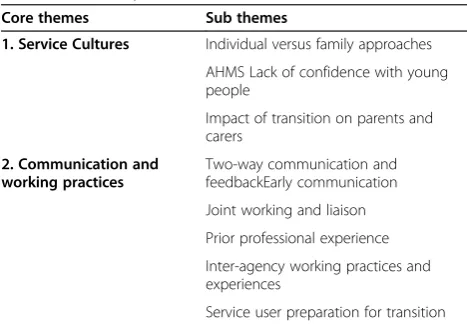
Transcripts were imported to QSR Nu*Dist v.6.0 soft-ware to assist systematic and consistent coding and to identify patterns within the data suggesting possible differences in perceptions between Trusts, professio-nal groups and/or CAMHS/AMHS. Illustrative quotes are provided to aid transparency of categorisation and theme representation (see Additional file 1: Core Theme: Service Cultures and Additional file 2: Core Theme: Communication and Working Practices). To protect anonymity, respondents are identified solely by pro-fessional group and whether working in CAMHS or AMHS. Trusts are not identified due to small numbers within some professional groups. Findings emanating from two core themes of service cultures, communica-tion and working practices and nine related sub themes (Table 4) are reported below.
Results
Core theme 1: Service cultures
A CAMHS Psychiatrist, CAMHS Trust Manager and voluntary sector participant all expressed the view that CAMHS and AMHS have different cultural approaches to service delivery, manifest in different beliefs, approa-ches, attitudes; the expression‘talking a different language’ conveyed a powerful image (1a, 1b, 1c). CAMHS was per-ceived as more family-oriented, inclusive and holistic than adult services, which were perceived as focused more ex-clusively on the individual service user. CAMHS services were therefore seen as enabling a more proactive ap-proach in engaging young people within their broader context of care. In contrast, AMHS were seen as crisis and medication intervention focused by the voluntary sec-tor participant (1c). This raised issues about carers’ expec-tations of communication and level of involvement with AMHS, during and post-transition and how and by whom those expectations are managed.
However, whilst an AMHS nurse participant acknow-ledged a tendency not to engage with families (1e), both AMHS nurses and a psychologist stated that they con-sidered family involvement, acknowledging the benefits of inclusion subject to the wishes of the young person (1d, 1e, 1f ). One AMHS nurse also perceived that dif-ferences in professional background might impact on AMHS counterparts’approaches to service users’families and carers (1e). Ethical issues of confidentiality in relation to sharing of information were also raised by this parti-cipant. However, no reference was made to the use of ethical guidelines on sharing confidential information.
Psychiatrists from CAMHS and AMHS managers all perceived anxiety and lack of confidence in AMHS staff in managing young people which has important implica-tions for continuing professional development and train-ing (2a, 2b, 2c, 2d). From the perspective of one AMHS manager, this was partly explained by the shift toward post qualifying specialization, reducing staff confidence in their skills and abilities (2c). In contrast, the other AMHS manager suggested that AMHS staff possessed the skills to work with young people, but acknowledged a need for more generic training and practice aimed at anxiety reduction and restoration of confidence (2d).
[image:4.595.55.540.101.183.2]There was also recognition, particularly by a CAMHS nurse (participant 2g), that the transition period from
Table 3 Sample descriptors by service sectors and professional group (n)
Nurses Social workers Psychiatrists Psychologists Service Managers Other sector Total (n)
CAMHS 5 3 4 2 2 - 16
AMHS 3 4 2 - 2 - 11
CAMHS & AMHS - - - - 3 - 3
Voluntary sector - - - 4 4
Total (n) 8 7 6 2 7 4 34
Table 4 Summary of core and sub-themes
Core themes Sub themes
1. Service Cultures Individual versus family approaches
AHMS Lack of confidence with young people
Impact of transition on parents and carers
2. Communication and working practices
Two-way communication and feedbackEarly communication
Joint working and liaison
Prior professional experience
Inter-agency working practices and experiences
[image:4.595.56.290.569.732.2]CAMHS to AMHS was difficult not only for young people, but also for parents. Psychiatrist and nurse CAMHS participants referred to the impact on parents and carers in terms of ‘loss’ or feeling ‘cut out (2e, 2f ). As a consequence, from the perspective of a CAMHS nurse preparing families for the withdrawal of CAMHS input and with it a form of support they were unlikely to receive once a young person had left CAMHS needed to be carefully managed (2g).
Core theme 2: Communication and working practices
CAMHS nurse and social worker participants identified a lack of two-way communication, whether verbal or written, with AMHS as a challenge affecting transitions (3a, 3b). A CAMHS psychologist explained that often administrators and gatekeepers to CMHTs were not co-located with the rest of the team, hindering effective communication (3c). Where communication was re-ciprocal it was perceived as facilitating transition by a CAMHS psychologist (3f ). Another related challenge for communication between CAMHS and AMHS was seen by AMHS nurses to be different approaches to record keeping and care planning (3d, 3e). Different electronic record keeping systems between AMHS and CAMHS were cited as partly responsible, but also a lack of mutual understanding of formal Care Programme Ap-proaches (CPA; [42]) processes more generally. Despite initial AMHS responsiveness in allocating young people to waiting lists, this could be seen as a hindrance to cross-service dialogue by a CAMHS psychologist (3f ).
An AMHS manager and CAMHS nurse stressed the need for, and benefits of, early communication with re-gard to smooth and effective transition, allowing more time for the young person and their families to adjust to coming changes (4b, 4a). The importance of not leaving it too late to commence transition was also emphasized. An AMHS psychiatrist emphasised the importance of sharing information by all concerned in transition, to-gether with a need for transparency on risks and care planning at handovers between professionals (4c).
Besides joint working (see below), three nurse par-ticipants from AMHS and CAMHS all agreed that staff having experience of working in the other ser-vice was very helpful in resolving day to day problems (4d, 4e, 4f ). Having a shared professional identity with AMHS was helpful to two CAMHS nurse partic-ipants (4e, 4f ) whilst prior knowledge and experience of the other teams working practices, information re-quirements, expectations and use of appropriate docu-mentation was also found to be helpful to transition by CAMHS nurse (4f ).
Psychiatrists from AMHS (5a) and CAMHS (5b) both described the benefits of having joint posts with a remit to enhance transition seamlessly between CAMHS and
AMHS. However, the latter described how staff turnover, funding delays and cuts had resulted in loss of one post with a negative impact on transition (5b). Other ap-proaches to joint working and liaison which facilitated transition included formal meeting arrangements be-tween CAMHS and AMHS staff identified by a CAMHS nurse (5c) and from a CAMHS management perspective, AMHS psychiatrists holding clinics to facilitate joint as-sessments with CAMHS colleagues (5e). Proactive ap-proaches by CAMHS staff to foster liaison with a range of mental health and learning disability teams identified as helpful by an AMHS manager (5d).
Shared responsibilities between AMHS and CAMHS care co-ordinators for a period of 3 months were found to be helpful in facilitating transition for the young per-son by a CAMHS social worker (6a), whilst a CAMHS manager and psychologist suggested a need not only for more shared meetings with AMHS, but the inception of joint training (6b, 6c).
A CAMHS psychiatrist (7a) and AMHS psychologist (7b) cited positive examples of inter-agency working with education services. A voluntary sector participant (7c) also described the positive benefit of CAMHS hav-ing had an educational psychologist seconded from the education service to work with parents and children in managing children and young people with Attention Deficit Hyperactivity Disorder (ADHD).
A CAMHS psychologist (8a) and AMHS nurse (8b) both recognised the challenges for young people en-countering transition which, as noted by a CAMHS so-cial worker (8e) and a CAMHS psychiatrist (8f ) could lead to resistance to moving to AMHS. Most partici-pants indicated a willingness to improve preparation of service users for transition, with some attempts being more successful than others; AMHS nurses (8b and 8c) noted the importance of clear accountability for care co-ordination and realistic expectations of AMHS provi-sion. An AMHS manager (8c) identified the value of early involvement of parents and carers in visiting in-patient AMHS facilities, in reducing anxiety about trans-fer. Acknowledging the daunting nature of attending CPA meetings (8b), a CAMHS psychiatrist (8f ) and psy-chologist (8g) also agreed that it was helpful for a CAMHS worker familiar to the young person to attend initial meetings with AMHS.
Discussion
AMHS. Positive and negative working practices which could impact on continuity of care and transition were also identified, with reference to a multiaxial definition of continuity [39,40]. It is evident in these findings that factors other than cultural differences can impact on working practices, transition and continuity of care. Lack of resources, notably in relation to staff transition posts and IT provision were influential and other findings of TRACK identified wider staff shortages and heavy case-loads as problematic for organizational working [43]. It should also be borne in mind that the nature of the boundary between organisations and services can involve cultural, geographical, structural and financial dimen-sions, all of which can influence collaborative working and other outcomes.
A number of limitations are also acknowledged: these include under-representation in the sample of Trusts from the Midlands region and AMHS. The sample was drawn solely from health professionals and representatives of voluntary organizations; wider findings of TRACK, in-vestigated experiences of service users, parents and other factors influencing transition [36-38].
The existence of a cultural divide in terms of attitudes, beliefs, understanding and some mutual perceptions bet-ween CAMHS and AMHS was evident: CAMHS was characterised (by CAMHS) as more person-centred, fa-mily oriented, positively focussed in terms of encoura-ging user resilience and utilizing talking therapies, but
‘talking a different language’from AMHS. The latter was perceived by others as not such a good service, with a focus on crisis and medication management, problem-atic attitudes and a skill deficit underpinning staff lack of confidence in caring for young people. These findings extend those of others which have identified cultural dif-ferences present at the CAMHS/AMHS interface [15-17] and resonate with other TRACK findings relating to users and carers experiences, that AMHS care was medication oriented, psychiatrists dealt with medication but not emo-tional issues and that enduring mental health problems and taking medication were significant predictors of tran-sition [36].
Indicators of more positive attitudes were evident in the acknowledgement by some AMHS staff of the im-portance of family involvement, notwithstanding the need to maintain confidentiality, which other studies have indicated can create an ethical dilemma for inter-professional working [44]. Other TRACK findings [38] established that many young people reported less in-volvement in care by parents and welcomed the new, post-transition confidential arrangements with AMHS. Given the different understandings, beliefs, mutual mis-perceptions, problematic attitudes and acknowledgement of skills deficits, a way forward could be to invest in common multidisciplinary training in adolescent health
and transitional care, an approach to continuing pro-fessional development which has been advocated in guidance issued by policy makers. professional bodies and others [20,24,33]. Within a joint educational setting, CAMHS and AMHS professionals could explore cultural values, beliefs and assumptions and achieve a better un-derstanding of their shared endeavour of promoting safe transition and continuity.
In relation to communication and working practices across the CAMHS/AMHS interface, findings revealed a mutual lack of understanding about service structures, location of key personnel and communication. The use of waiting lists was a source of frustration if it hindered further dialogue and different approaches to CPA mana-gement, documentation and electronic information trans-fer were evident. These findings are congruent with others [21] which have identified variable patterns of communi-cation, limited opportunities for joint discussions between services and incompatibility of software systems as prob-lematic, impacting negatively on transition and both infor-mation and cross boundary continuity of care [28,29]. A need to address the delay in national IT systems has been acknowledged [45] and clear accountability for key worker co-ordination of information transfer within care plans is advocated in policy guidance [33]. Enhancement of cross boundary and team continuity by providing training in communication skills as part of a wider educational pro-gramme on transitional care should also be implemented.
participants referred to the transition protocols, care pathways and care plans advocated in policy and profes-sional body guidance intended to facilitate relational, in-formational and cross boundary continuity [24,25,31-34]. Other TRACK findings confirmed that protocols had been developed but were variable in their content and patterns of use [37]. No protocol specified how young people should be prepared for transition or detailed pro-cedures to maintain continuity of care for those not ac-cepted by AMHS. This is sometimes referred to as the policy-practice gap and raised questions about protocol utility and monitoring implementation in practice. Alter-native models of transitional care, designed to overcome the policy-practice gap inherent in a protocol based ap-proach have been suggested, ie the‘Shared Management Framework’ focused on a transitions team and transi-tions co-ordinator [46].
A number of working practices were identified which were supportive of smoother and more efficient transi-tion, enhancing cross boundary, informatransi-tion, personal and relational continuity of care and consistent with po-licy guidance [31-34]. These included the appointment of transition workers who worked across service bound-aries, facilitating decision making on referrals, working with new care co-ordinators in AMHS for some time, joint appointments between services, shared meetings, co-working by psychiatrists and periods of parallel wor-king by care co-ordinators. An interesting finding was that where staff had a shared professional identity and previous experience of either working in or managing both services, this was helpful in understanding working cultures and fostering joint working. Other very positive, proactive initiatives had been implemented, including the arrangement of pre-transition visits to AMHS by young people and families, working across organisational boundaries to foster joint working with external agencies and service providers, notably educational services, lear-ning disability teams and family health liaison services; some of the managers who participated in this study had joint responsibilities for managing CAMHS and AMHS which could have facilitated these initiatives.
With emerging evidence that the bulk of adult mental health problems begin at a young age, the current CAMHS AMHS divide has produced a care pathway with maximum weakness where it should be most ro-bust [47]. A radical redesign of youth mental health ser-vices has been suggested, but may be difficult to achieve in the short-term. Meanwhile it is imperative on services to improve transitional care and address the organisa-tional factors that produce suboptimal care [36].
Conclusions
Findings have demonstrated evidence of a cultural divide between CAMHS and AMHS, marked by different beliefs,
attitudes, understanding and some negative mispercep-tions. Some working practices could constitute barriers to effective transition, relational, informational and cross boundary continuity of care. However, indications of a shift in bridging the cultural divide were also evident in positive approaches to collaborative working between ser-vices and external agencies which can support transition and continuity. Recommendations are that shared, multi-disciplinary, continuing professional development should be implemented which is linked to appraisal and com-petency frameworks and focuses on transitional care. In context, this should encompass updating on service struc-tures, utilisation of protocols, models of ‘best practice’in transition, multi-agency working, communication skills, networking, and the acquisition of skills in working with young people and carers. Improvements in information transfer could be achieved by standardised approaches to record keeping supported by compatible IT resources.
Bearing in mind the growing independence of young people, family/carer involvement in transition needs to be sensitively negotiated between professionals, young people and families/carers. In the absence of generaliza-ble strategies to foster cultural change [8] it is recom-mended that managers develop and implement service evaluation frameworks which identify and monitor out-comes of transition and continuity longitudinally. Com-bined strategies to implement change based on leadership, education and consistent application of guidelines and protocols are also recommended [48-50].
RATS guidelines
This study meets the requirements of the RATS guide-lines for the conduct of qualitative research.
Additional files
Additional file 1:Core Theme: Service Cultures.
Additional file 2:Core Theme: Communication and Working Practices.
Competing interests
The authors declare that they have no competing interests.
Authors’contributions
SMcL and RB collected analysed and interpreted data. SMcL drafted the paper and RB, SPS, MP, TF, TK, TW, KH, ZI, SW contributed revisions to content and approved the final version. All authors contributed to the conception and design of the wider TRACK study (Principal Investigator Professor Swaran P Singh). All authors read and approved the final manuscript.
Acknowledgements
The TRACK study team included Professor Swaran Singh, Dr Ruth Belling, Dr Jenny Dale, Dr Navina Evans, Dr Tamsin Ford, Dr Nicole Fung,
Ms Katherine Harley, Dr Daniel Hayes, Ms Kimberley Hovish, Dr Zoebia Islam, Dr Bob Jezzard, Dr Tami Kramer, Professor Susan McLaren, Dr Moli Paul, Dr Anne Rourke, Dr Tim Weaver, Dr Sarah White.
Funding
The TRACK study was funded by the National Institute of Health Research (NIHR) Service and Delivery Organisation (SDO) programme. (http://www. netscc.ac.uk/hsdr/projdetails.php?ref=08-1613-117). The views and opinions expressed therein are those of the authors and do not necessarily reflect those of the NIHR SDO programme or the Department of Health.
Author details
1Faculty of Health and Social Care, London South Bank University, London,
United Kingdom.2Division of Mental Health and Well Being, Warwick Medical School, The University of Warwick, Coventry, United Kingdom.
3
Peninsula Medical School, University of Exeter, Exeter, United Kingdom.
4Faculty of Medicine, Imperial College, London, United Kingdom.5Institute of
Education, University of London, London, United Kingdom.6Research and Innovation Department, Birmingham and Solihull Mental Health Foundation Trust, Birmingham, United Kingdom.7St. George’s University of London, London, United Kingdom.
Received: 14 September 2012 Accepted: 22 May 2013 Published: 3 July 2013
References
1. Alvesson M:Cultural Perspectives on Organisations.Cambridge: Cambridge University Press; 1995.
2. Scott T, Mannion R, Marshall M, Davies H:Does organisational culture influence health care performance? A review of the evidence.J Health Serv Res Policy2003,8(2):105–117.
3. Jung T, Scott T, Davies H, Bower P, Whalley D, McNally R, Mannion R: Instruments for exploring organisational culture: a review of the literature.Public Administration Review2009,69(6):1087–1096.
4. Schein E:Organisational Culture and Leadership.San Francisco: Jossey-Bass; 1995.
5. Fitzgerald L, Cerian L, Ferlie E, Addicot R, McGiven R, Buchanan D:Managing Change and Role Enactment in the Professionalised Organisation. Report to the National Co-ordinating Centre for NHS Service Delivery and Organisation (NCCSDO).London: NCCSDO; 2006.
6. Ferlie E, Fitzgerald L, Wood M:Hawkins C The non-spread of innovations: the mediating roles of professionals.Acad Manage J2005,48(1):117–134. 7. Mannion R, Konteh FH, Davies H:Assessing organisational culture for
safety improvement: a national survey of tools and tool use.Qual Saf Health Care2009,18(2):153–156.
8. Parmelli E, Flodgren G, Bryer F, Baillie N, Schafsma M, Eccles M:The effectiveness of strategies to change organisational culture to improve healthcare performance: a systematic review.Implementation Science 2009,6:33.
9. Davis M, Sondheimer DL:State child mental health efforts to support youth in transition to adulthood.The Journal of Behavioural Health Services Research2005,32(1):27–42.
10. Treasure J, Schmidt U, Hugo P:Mind the gap: transition and interface problems for patients with eating disorders.Br J Psychiatry2005,167:398– 400.
11. Davis M, Geller JL, Hunt B:Within-state availability of transition to adulthood services for youths with serious mental health conditions. Psychiatr Serv2006,57(11):1594–1599.
12. Audit Commission:Children in Mind.London: Audit Commission; 1999. 13. Select Committee on Health Transitions Between Child/Adolescent and
Adult Services:Fourth Report. Provision of NHS Mental Health Services. London: HMSO; 2000.
14. Singh SP, Evans N, Sireling L, Stuart H:Mind the gap: the interface between child and adult mental health services.Psychiatric Bulletin2005, 29:292–294.
15. Singh SP:Running an effective community mental health team.Advances in Psychiatric Treatment2000,6:414–422.
16. Kipps S, Bahu T, Ong K, Ackland FM, Brown RS, Fox CT:Current methods of transfer of young people with type 1 diabetes to adult services. Diabet Med2002,19:649–654.
17. Lotstein DS, McPherson M, Strickland B:Transition planning for youth with special health with special health needs: results from a national survey of children with special health needs.Pediatrics2000, 115:1562–1568.
18. Maitra B, Jolley A:Liaison between child and adult psychiatric services.In Family Matters: Interface Between Child and Adult Mental Health.Edited by Reder P, McLure M, Jolley A. London: Routledge; 2000:285–302.
19. McDonagh J, Kelly DA:Transiting care of the paediatric recipient to adult care givers.Paediatric Clinics of North America2003,50:1561–1583. 20. McDonagh J, Viner R:Lost in transition? Between paediatric and adult
services.Br Med J2006,332:435–436.
21. Richards M, Vostanis P:Interprofessional perspectives on transitional mental health services for young people aged 16–19 years.J Interprof Care2004,18(2):115–128.
22. American Academy of Paediatrics, American Academy of Family Physicians, American College of Physicians-American Society of Internal Medicine:A consensus statement on health care transitions for young adults with special health care needs.Paediatrics2002,110:1304–1306.
23. Kennedy A, Sloman F, Douglass JA, Sawyer SM:Young people with chronic illness: the approach to transition.Intern Med2007,37(8):555–560. 24. Royal College of Nursing:Adolescent transition care.London: RCN
Publications; 2003.
25. Royal College of Paediatrics and Child Health:Bridging the Gap: Healthcare for Adolescents.London: RCPCH Publications; 2003.
26. Forbes A, While A, Ullman R, Lewis S, Mathes L:Griffiths P A multi-method review to identify components of practice which may promote continuity in the transition from child to adult care for young people with chronic illness or disability.London: Report for the NCCSDO; 2001.
27. While A, Forbes R, Ullman S, Lewis S, Mathes L, Griffiths P:Good practices that address transition from child to adult care: synthesis of the evidence.Child Care Health Dev2004,30:439–452.
28. Burns T, Catty J, Clement S, Harvey K, Rees-Jones I, McLaren S, Rose D, White S:Wykes T Experiences of continuity of care and health and social care outcomes: the ECHO study.London: Report for the NCCSDO; 2007. 29. Belling R, Whittock M, McLaren S, Burns T, Catty J, Rees-Jones I,
Rose D, Wykes T:Achieving continuity of care: facilitators and barriers in community mental health teams.Implementation Science 2011,6:23.
30. Rees-Jones I, Ahmed N, Catty J, McLaren S, Rose D, Wykes T, Burns T:Illness careers and continuity of care in mental health services: a qualitative study of users and carers.Soc Sci Med2009,69:632–639.
31. Department of Health National Service:Framework for Children, Young People and Maternity Services.London: Department of Health; 2004. 32. Department of Health:Good transitions for good people.London:
Department of Health; 2006.
33. A Good Practice Guide for Health Professionals and their Partners on Transition Planning for Young People with Complex Health Needs or a Disability.London: Department of Health; 2008.
34. Lamb C, Hall D, Kelvin R:Van Beinum M Working at the CAMHS/Adult Interface: Good Practice Guidelines for the Provision of Psychiatric Services to Adolescents/Young Adults.Joint Paper: Interfaculty Working Group. London. Royal College of Psychiatrists; 2008.
35. Singh SP, Paul M, Islam Z, Weaver T, Kramer T, McLaren S, Belling R, Ford T, White S, Hovish K, Harley K:Transition from CAMHS to Adult Mental Health Services: A Study of Service Organisation, Policies, Process, User and Carer Perspectives.London: NETSCC; 2009. SDO Project Reference 08/1613/117. 36. Singh SP, Paul M, Ford T, Kramer T, Weaver T, McLaren S, Hovish K, Islam Z,
Belling R, White S:Process, outcome and experience of transition from child to adult mental healthcare: a multi-perspective study.Br J Psychiatry 2010,197:305–312.
37. Singh S, Paul M, Ford T, Kramer T, Weaver T:Transitions of care from child and adolescent mental health services to adult mental health services (TRACK Study): a study of protocols in greater London.BMC Health Serv Res2008,8:135–142.
38. Hovish K, Weaver T, Islam Z, Paul M, Singh S:Transition experiences of mental health service users, parents and professionals in the United Kingdom: a qualitative study.Psychiatr Rehabil J2012,35(3):251–257. 39. Freeman G, Sheppard S, Robinson I, Ehrich K:Richards S Continuity of Care:
Report of a Scoping Exercise for the NCCSDO Programme.London: NCCSDO; 2000.
41. Ritchie J, Spencer L:Qualitative data analysis for applied policy research. InAnalysing Qualitative Data.Edited by Bryman A, Burgess R. London: Routledge; 1994:172–194.
42. Department of Health:Making the Care Programme Approach Work for You. London: Department of Health; 2008. http://webarchive.nationalarchives. gov.uk/+/www.dh.gov.uk/en/publicationsandstatistics/publications/ dh_083650.
43. Belling R, McLaren S, Paul M, Ford T, Kramer T, Weaver T, Hovish K, Islam Z, White S, Singh SP:Effects of organisational resources and eligibility issues on transition from child and adolescent to adult mental health services. J Health Serv Res & Policy. in press.
44. Whittington C, Leathard A, McLaren S:Whittington M Ethics and Social Care: Political, organisational and interagency dimensions. Chapter 6: 83–96. InEthics: Contemporary Challenges in Health and Social Care.Bristol: Policy Press; 2007.
45. Department of Health:NHS Care Records Service: Connecting for Health; 2006. http://systems.hscic.gov.uk/.
46. Vloet M, Davidson S, Capelli M:We suffer from being lost: formulating policies to reclaim youth in mental health transitions.Healthc Q2011, 14:32–38.
47. McGorry P:The specialist youth mental health model: strengthening the weakest link in the public mental health system.Medical Journal of Australia2007,187(7):S53–S56.
48. Forsetlund L, Bjørndal A, Rashidian A, Jamtvedt G, O’Brien MA, Wolf F, Davis D, Odgaard-Jensen J, Oxman AD:Continuing education meetings and workshops: effects on professional practice and health care outcomes. Cochrane Database Syst Rev2009. http://apps.who.int/rhl/reviews/CD003030.pdf. 49. Paterson K, Henderson A, Trivella A:Educating for leadership: a
programme designed to build a responsive health care culture.J Nurs Manag2006,18(1):78–83.
50. Gattellari DG, Grimshaw J, O’Brien MA:Local opinion leaders: effects on professional practice and healthcare outcomes.Cochrane Database Syst Rev2006. Issue 4 Art. No CD 000125.
doi:10.1186/1472-6963-13-254
Cite this article as:McLarenet al.:‘Talking a different language’: an exploration of the influence of organizational cultures and working practices on transition from child to adult mental health services.BMC Health Services Research201313:254.
Submit your next manuscript to BioMed Central and take full advantage of:
• Convenient online submission
• Thorough peer review
• No space constraints or color figure charges
• Immediate publication on acceptance
• Inclusion in PubMed, CAS, Scopus and Google Scholar
• Research which is freely available for redistribution