154 ER = estrogen receptor; MEK = MAP kinase/ERK kinase; mTOR = mammalian target of rapamycin; VEGF = vascular endothelial growth factor.
Introduction
Until recently, anticancer drug development has mainly involved the screening of libraries of frequently unselected compounds against tumor cell lines in vitro [1]. Active agents in this screen were then assessed preclinically before their assessment in clinical trials. This nonspecific process proved expensive, lengthy and inefficient, with paclitaxel taking three decades to progress from bench to bedside [2]. The earliest exception to this drug develop-ment paradigm was the successful developdevelop-ment of hormone therapy after the discovery by Sir George Beatson that mammary carcinomas regressed after bilat-eral oophorectomy [3]. This led to the use of tamoxifen, the development of aromatase inhibitors and the selective estrogen receptor (ER) modulators, which remain arguably the most successful therapeutics for the treatment of breast cancer. Another exception was the successful
development of the monoclonal antibody trastuzumab (Herceptin) [4]. This followed the identification of erbB2 (HER2) amplification in a subgroup of breast cancers and the recognition that erbB2 signaling has an important role in driving the proliferation of this variant of the disease
These rationally designed and target-based agents are characterized by low toxicity, clinical efficacy and wide therapeutic indices. This is due to their ability to induce selective tumor cell cytotoxicity, inducing disease regres-sion in cancers by targeting aberrations that contribute to the tumor’s proliferative advantage, while sparing normal tissue. Preferential cytotoxicity against malignant tissues remains tantamount to the Holy Grail in oncologic thera-peutics because it portends improved patient tolerance and overall quality of life. This would result in selective killing of tumor cells, affecting the equilibrium between
Commentary
The future of cytotoxic therapy: selective cytotoxicity based on
biology is the key
Johann S de Bono, Anthony W Tolcher and Eric K Rowinsky
Institute for Drug Development, Cancer Therapy and Research Center, University of Texas Health Science Center at San Antonio, San Antonio, Texas, USA
Corresponding author: Johann S de Bono (e-mail: [email protected]) Published: 27 March 2003
Breast Cancer Res2003, 5:154-159 (DOI 10.1186/bcr597)
© 2003 BioMed Central Ltd (Print ISSN 1465-5411; Online ISSN 1465-542X)
Abstract
Although mortality from breast cancer is decreasing, 15% or more of all patients ultimately develop incurable metastatic disease. It is hoped that new classes of target-based cytotoxic therapeutics will significantly improve the outcome for these patients. Many of these novel agents have displayed cytotoxic activity in preclinical and clinical evaluations, with little toxicity. Such preferential cytotoxicity against malignant tissues will remain tantamount to the Holy Grail in oncologic therapeutics because this portends improved patient tolerance and overall quality of life, and the capacity to deliver combination therapy. Combinations of such rationally designed target-based therapies are likely to be increasingly important in treating patients with breast carcinoma. The anticancer efficacy of these agents will, however, remain dependent on the involvement of the targets of these agents in the biology of the individual patient’s disease. Results of DNA microarray analyses have raised high hopes that the analyses of RNA expression levels can successfully predict patient prognosis, and indicate that the ability to rapidly ‘fingerprint’ the oncogenic profile of a patient’s tumor is now possible. It is hoped that these studies will support the identification of the molecules driving a tumor’s growth, and the selection of the appropriate combination of targeted agents in the near future.
155 tumor cell proliferation and cell death and leading to
disease regression, the patient’s symptomatic improve-ment, and a survival advantage, while sparing normal tissues and inducing minimal toxicity. It also allows more ‘breathing room’ or capacity to develop combinations of these agents. This is critically important: effective anti-cancer treatment is likely to involve combinations of multi-ple agents because carcinogenesis is a multi-step process involving several genes and pathways [5]. The primary thesis of this commentary is that the future of cyto-toxic anticancer therapy lies with the development of biology-based combinations of molecularly targeted agents that can induce selective tumor cell death.
Non-toxic target-based cytotoxics
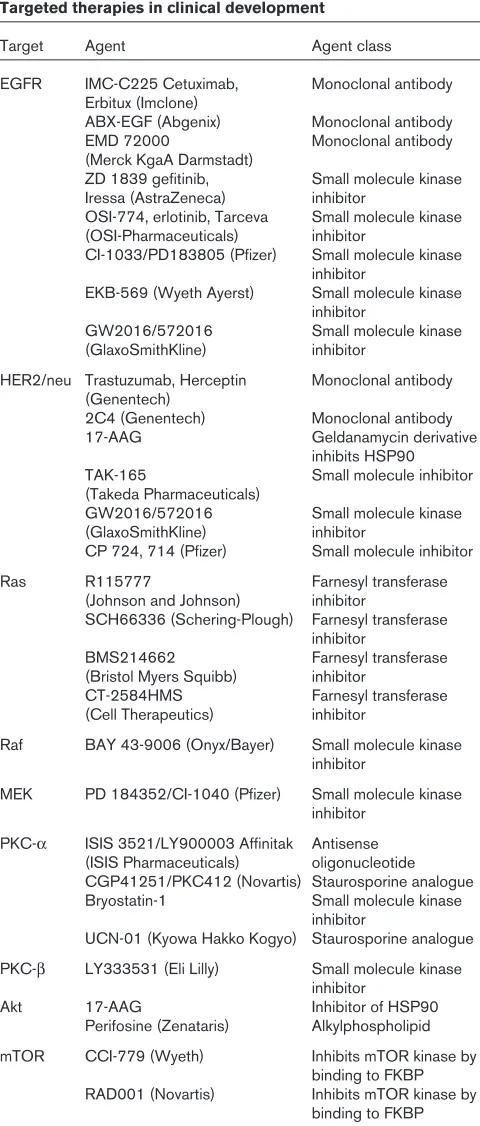
The successful development of these selectively cytotoxic, rationally targeted, antitumor agents resulted directly from observations demonstrating the critical biological rele-vance of ER and erbB2 in subgroups of breast cancers. The development of similar anticancer therapeutics tar-geted to specific oncogenic molecules is becoming the norm, with drug discovery efforts being increasingly focused on such therapies. This has accelerated the pre-clinical discovery of target-based compounds with demon-strable activity against their target, and has rapidly increased the number of antitumor agents in clinical devel-opment. These include monoclonal antibodies, small mole-cules, and synthetic nucleic acid sequence-based approaches targeting a variety of pathways associated with cancer (see Table 1).
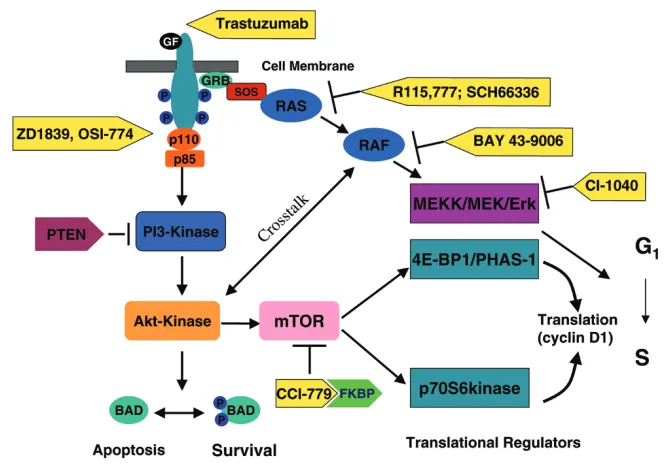
A large, and rapidly increasing, number of potential molec-ular targets have been described. Mechanisms being exploited by these agents include the modulation of cellu-lar signaling, programmed cell death, the cell cycle, and angiogenesis. Although the specific roles of many of these potential molecular targets in driving tumor growth in breast cancers remains frequently unknown, drugs target-ing an increastarget-ingly large number of putative oncoproteins are now available for clinical evaluation. The attraction of developing agents against these targets is the potential to induce selective tumor cytotoxicity, sparing normal tissues and therefore resulting in little toxicity, with their success being largely dependent on the magnitude of this speci-ficity. Agents targeting for example the signaling proteins erbB1, Ras, Raf, MAP kinase/ERK kinase (MEK), Akt, mTOR (mammalian target of rapamycin), the nuclear factor NF-κB, apoptotic transducers such as bcl-2 and TRAIL, and angiogenic factors such as vascular endothelial growth factor (VEGF) are currently being evaluated (Fig. 1). Promising tolerability has already been demon-strated in many early clinical trials with agents targeting the erbB receptors, Ras, Raf, MEK, mTOR, bcl-2, and both VEGF and its receptor (VEGFR) signaling; many of these studies have confirmed effective clinical target blockade [6–16].
[image:2.612.315.555.107.670.2]Optimal efficacy requires drug combinations
Our clinical expectations with these targeted compounds remain similar to those associated with the development Table 1Targeted therapies in clinical development
Target Agent Agent class
EGFR IMC-C225 Cetuximab, Monoclonal antibody Erbitux (Imclone)
ABX-EGF (Abgenix) Monoclonal antibody EMD 72000 Monoclonal antibody (Merck KgaA Darmstadt)
ZD 1839 gefitinib, Small molecule kinase Iressa (AstraZeneca) inhibitor
OSI-774, erlotinib, Tarceva Small molecule kinase (OSI-Pharmaceuticals) inhibitor
CI-1033/PD183805 (Pfizer) Small molecule kinase inhibitor
EKB-569 (Wyeth Ayerst) Small molecule kinase inhibitor
GW2016/572016 Small molecule kinase (GlaxoSmithKline) inhibitor
HER2/neu Trastuzumab, Herceptin Monoclonal antibody (Genentech)
2C4 (Genentech) Monoclonal antibody 17-AAG Geldanamycin derivative
inhibits HSP90 TAK-165 Small molecule inhibitor (Takeda Pharmaceuticals)
GW2016/572016 Small molecule kinase (GlaxoSmithKline) inhibitor
CP 724, 714 (Pfizer) Small molecule inhibitor
Ras R115777 Farnesyl transferase
(Johnson and Johnson) inhibitor
SCH66336 (Schering-Plough) Farnesyl transferase inhibitor
BMS214662 Farnesyl transferase (Bristol Myers Squibb) inhibitor
CT-2584HMS Farnesyl transferase (Cell Therapeutics) inhibitor
Raf BAY 43-9006 (Onyx/Bayer) Small molecule kinase inhibitor
MEK PD 184352/CI-1040 (Pfizer) Small molecule kinase inhibitor
PKC-α ISIS 3521/LY900003 Affinitak Antisense (ISIS Pharmaceuticals) oligonucleotide CGP41251/PKC412 (Novartis) Staurosporine analogue Bryostatin-1 Small molecule kinase
inhibitor
UCN-01 (Kyowa Hakko Kogyo) Staurosporine analogue PKC-β LY333531 (Eli Lilly) Small molecule kinase
inhibitor
Akt 17-AAG Inhibitor of HSP90
Perifosine (Zenataris) Alkylphospholipid mTOR CCI-779 (Wyeth) Inhibits mTOR kinase by
binding to FKBP RAD001 (Novartis) Inhibits mTOR kinase by
156
of nonspecific therapeutics. These relevant therapeutic endpoints include increasing overall survival, regressing tumor lesions in association with clinical benefit, and/or palliating disease-related symptoms [17]. However, it is likely that the clinical benefit from these agents used indi-vidually as single agents will be of low magnitude because most cancers have multiple defects driving tumor cell growth. This has in fact already been observed in efficacy studies with many targeted agents. Low-level response rates in patients with unselected metastatic breast carci-noma have been documented with agents targeting erbB1 (ZD1839; Astra-Zeneca Pharmaceuticals), Ras (R115,777; Johnson and Johnson Pharmaceuticals), mTOR (CCI-779; Wyeth Pharmaceuticals) and VEGF (bevacizumab; Genentech) [8,13,16,18]. Nevertheless, the low incidence of severe nonspecific toxic effects of these agents enhances their overall appeal and supports a rationale for preferentially focusing on the development of these agents. However, it is likely that maximal benefit from these agents will not be attained until they are used in combinations that can, overall, reverse the malignant drive of the tumor cell.
Realistic expectations from early clinical trials with these agents, based on an understanding of cancer biology, are required to avoid the rejection of valuable agents due to perceived inefficacy in single-agent efficacy trials. To maxi-mize the clinical benefit from these agents they will need
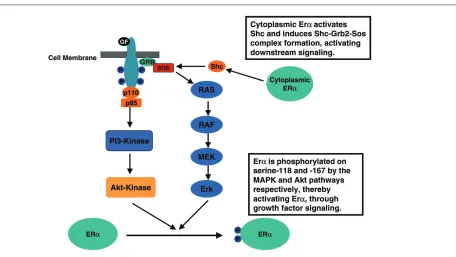
[image:3.612.138.470.106.340.2]to be administered in combination to patients with tumors with the appropriate molecular signatures. For example, preclinical data indicate that trastuzumab resistance in erbB2-positive breast carcinoma might be due in part to signaling by the insulin growth factor-I receptor [19]. Blockade of downstream receptor signaling by, for example, a farnesyltransferase inhibitor might therefore potentiate the anticancer activity of trastuzumab (see Fig. 1). Combination therapy with trastuzumab and the far-nesyltransferase inhibitor R115,777 is being investigated in the clinic; initial clinical studies indicate that full doses of both agents can be concurrently administered in the clinic with minimal toxicity [20]. Growth factor signaling has also been demonstrated to have a role in the develop-ment of endocrine-resistant breast carcinoma. Preclinical studies suggest that growth factor receptor signaling can activate the estrogen receptor in the absence of estrogen ligand, thereby mediating hormone resistance (Fig. 2) [21–23]. It has therefore been postulated that growth factor signaling blockade might enhance the antitumor activity of hormone therapy, and could potentially reverse hormone resistance in patients with estrogen-receptor-positive disease. Combination studies with erbB receptor tyrosine kinase inhibitors are therefore being pursued, including Phase II studies of ZD1839 and anastrazole, and GW572016 and letrozole, in patients that have previously failed aromatase inhibition. Preclinical data also support combination clinical studies of hormonal agents and Figure 1
157 downstream signaling inhibitors such as the
farnesyltrans-ferase inhibitors or the mTOR inhibitors in treatment-naïve, estrogen-receptor-positive, disease. These preclinical studies indicate that cytoplasmic estrogen receptor acti-vates Shc directly, generating Shc–Grb2–Sos complex formation and downstream signaling through activated Src and Ras (see Fig. 2) [24]. Clinical data from these combi-nation studies are likely to become available in the very near future.
Optimal efficacy requires patient selection
Inherent in the development of target-based therapeutics is also the notion that this anticancer activity may be maxi-mized by selectively treating patients whose tumors are particularly driven by the target aberration and would therefore be expected to respond most profoundly. This can be achieved by screening tumors for the relevant target, or targets, and either structural or functional deter-minants that can predict antitumor activity. For trastuzumab, the study of tumor cell HER2 gene amplifica-tion, based on screening by fluorescence in situ hybridiza-tion (FISH) or immunohistochemistry, allows the selechybridiza-tion of the patients most likely to benefit from therapy [25]. For other rationally designed target-based therapeutics such as the erbB1 inhibitors, the farnesyltransferase inhibitors, and the mTOR kinase inhibitors, similar screening test determinants predicting anticancer activity, therebyallow-ing patient selection, have not yet been refined. It is envis-aged, for these inhibitors of kinase signaling, that immuno-histochemical studies of tumor tissue, perhaps using phosphorylation-specific antibodies for the respective sig-naling targets, might allow the oncologist to select the optimal rationally designed targeted agent for the individ-ual patient. For example, studies are needed to evaluate whether screening for phosphorylated tumor-cell Akt expression could portend benefit from mTOR inhibitors such as CCI-779 [12].
Although these simple screening approaches could opti-mize the clinical benefits imparted from a single agent, a more comprehensive understanding of the critically impor-tant differences between breast cancer cells and normal cells may be essential to affect patient outcome substan-tially. In particular, understanding target function, and the impact of target blockade, in the overall molecular frame-work of normal and cancer cells, may be crucial in select-ing the most clinically relevant molecular targets for the individual patient.
Target selection must be based on tumor
biology
[image:4.612.97.553.94.351.2]Overall, it is envisaged that the future successful develop-ment of these target-based cytotoxic agents will depend on a detailed understanding of breast cancer biology. Figure 2
158
These target-based drugs might not achieve their full ther-apeutic potential until the oncogenic role of their targets, in the biology of a specific variant of breast cancer, is ascertained. The dissection of the biology of breast cancer remains a major challenge, particularly because of the considerable interpatient and intrapatient molecular heterogeneity in tumor cells. Nevertheless, major inroads into precise molecular profiling of this disease using DNA microarrays are being rapidly made through the study of the entire set of genes expressed in these tumor cells. These studies indicate that gene expression signatures can distinguish between good prognosis and poor prog-nosis patients through the analyses of a small subset of 70 predictor genes, with the majority of genes not influ-encing clinical outcome [26,27].
These encouraging results have identified that a small number of genes regulating the cell cycle, invasion, meta-stasis, and angiogenesis predict poor clinical outcome. They raise high hopes that the analyses of RNA expression levels by DNA microarray can successfully predict patient prognosis, and suggest that the ability to rapidly ‘finger-print’ the oncogenic profile of a patient’s tumor might soon become reality. It is probable that these studies will support the identification of the molecular aberrations contributing to the tumor’s proliferative advantage, and the selection of the appropriate combination of targeted agents in the near future. This would then direct the future successful clinical application of the rapidly increasing numbers of targeted therapeutics being developed.
Conclusion
It is hoped that the development of target-based therapeu-tics, coupled with an increased understanding of tumor biology, will allow the delivery of tailored and highly effica-cious tolerable combinations of these agents. These com-binations, selected for the individual patient through the molecular profiling of the individual tumor, might then be able to maximize tumor cell kill, tumor regression, and patient benefit. The earlier evaluation of combinations of well-tolerated target-based compounds that have not demonstrated sufficient anticancer efficacy as single agents to warrant regulatory approval must be encour-aged. This will help to ensure that potentially valuable agents are not discarded because of the inefficacy of a single agent, when these agents could impart clinically significant benefit when used in combination.
Competing interests
None declared.Acknowledgements
The authors are indebted to their patients and to all current and past members of the clinical trials and translational research teams at the Institute for Drug Development, Cancer Therapy and Research Center and UTHSCSA. JSdB is supported by the American Society of Clinical Oncology, the Breast Cancer Research Foundation, Doris Duke Chari-table Foundation, MARF and NIH. The Institute for Drug Development is supported by an NIH UO1 grant.
References
1. Garrett MD, Workman P: Discovering novel chemotherapeutic drugs for the third millennium.Eur J Cancer 1999, 35 :2010-2030.
2. Rowinsky EK, Donehower RC: Paclitaxel (Taxol).N Engl J Med 1995, 332:1004-1014.
3. Forrest AP: Beatson: hormones and the management of breast cancer.J R Coll Surg Edin1982, 27:253-263.
4. Slamon DJ, Leyland-Jones B, Shak S, Fuchs H, Paton V, Baja-monde A, Fleming T, Eiermann W, Wolter J, Pegram M, Baselga J, Norton L: Use of chemotherapy plus a monoclonal antibody against HER2 for metastatic breast cancer that overexpresses HER2.N Engl J Med2001, 344:783-792.
5. Vogelstein B, Fearon ER, Hamilton SR, Kern SE, Preisinger AC, Leppert M, Nakamura Y, White R, Smits AM, Bos JL: Genetic alterations during colorectal-tumour development. N Engl J Med1988, 319:525-532.
6. de Bono JS, Rowinsky EK: The ErbB receptor family: a thera-peutic target for cancer. Trends Mol Med2002, 8(Suppl 4): S19-S26.
7. Rowinsky EK, Windle JJ, Von Hoff DD: Ras protein farnesyl-transferase: A strategic target for anticancer therapeutic development.J Clin Oncol1999, 17:3631-3652.
8. Johnston SR, Kelland LR: Farnesyl transferase inhibitors – a novel therapy for breast cancer. Endocr Rel Cancer 2001, 8:227-235.
9. Strumberg D, Bauer R, Moeller J, Hilger R, Richly H, Kredtke S, Beling C, Faghih M, Heinig R., Hedley D, Scheulen M, Seeber SL: Final results of a phase I pharmacokinetic and pharmacody-namic study of the Raf kinase inhibitor BAY 43-9006 in patients with solid tumours [abstract]. Proc Am Soc Clin Oncol2002, 21:A121.
10. Mitchell D, Reid J, Parchment R, Meyer M, Leopold J, Herrera R, Piens J, Bruzek L, Hanson L, Van Becelaere K, Carlson T, Packard C, Adjei A, LoRusso P: Pharmacokinetics and pharmacody-namics of the oral MEK inhibitor, CI-1040, following multiple dose administration to patients with advanced cancer [abstract].Proc Am Soc Clin Oncol2002, 21:A320.
11. LoRusso P, Adjei A, Meyer M, Wozniak A, Gadgeel S, Hanson L, Reid J, Mitchell D, Bruzek L, Leopold J, Herrera R, Becelaere K, Carlson T, Packard C, Gulyas S, Erlichman C: A phase I clinical and pharmacokinetic evaluation of the oral MEK inhibitor, CI-1040, administered for 21 consecutive days, repeated every 4 weeks in patients with advanced cancer [abstract]. Proc Am Soc Clin Oncol2002, 21:A321.
12. Hidalgo M, Rowinsky EK: The rapamycin-sensitive signal trans-duction pathway as a target for cancer therapy. Oncogene 2000, 19:6680-6686.
13. Chan S, Johnston S, Scheulen M, Mross K, Morant M, Lahr A, Feussner A, Berger M, Kirsch T: A phase II study of the safety and activity of CCI-779 for patients with locally advanced or metastatic breast cancer failing prior chemotherapy [abstract].Proc Am Soc Clin Oncol2002, 21:A175.
14. de Bono JS, Rowinsky EK, Kuhn J, Basler J, Ochoa L, Schwartz G, Patnaik A, Hammond L, Smetzer L, Smith L, Fingert H, Weitman S., Thompson I, Tolcher AW: Phase I, pharmacokinetic, and pharmacodynamic trial of bcl-2 antisense (Genasense) and docetaxel in hormone-refractory prostate cancer [abstract]. Proc Am Soc Clin Oncol2001, 20:A297.
15. Tolcher A, Karp D, O’Leary JJ, de Bono JS, Caulkins J, Molpus K, Sutula K, Ferrante K, Gualberto A., Noe D, Huberman M, Rowin-sky EK, Healey D: A Phase I and biologic correlative study of an oral vascular endothelial growth factor receptor-2 (VEGFR-2) tyrosine kinase inhibitor, CP-547,632, in patients (pts) with advanced solid tumours [abstract]. Proc Am Soc Clin Oncol 2002, 21:A334.
16. Cobleigh MA, Miller KD, Langmuir VK, Reimann JD, Vassel AV, Novotny WF, Sledge GW: Phase II dose escalation trial of Avastin™ (bevacizumab) in women with previously treated metastatic breast cancer. Breast Cancer Res Treat2001, 70 (Suppl):A520.
17. Gelmon KA, Eisenhauer EA, Harris AL, Ratain MJ, Workman P: Anticancer agents targeting signaling molecules and cancer cell environment: challenges for drug development? J Natl Cancer Inst1999, 91:1281-1287.
159 Phase II multicenter trial of ZD1839 in patients with advanced
breast cancer.Breast Cancer Res Treat2002, 76(Suppl 1):A20. 19. Lu Y, Zi X, Zhao Y, Mascarenhas D, Pollak M: Insulin-like growth factor-I receptor signaling and resistance to trastuzumab (Herceptin).J Natl Cancer Inst2001, 93:1852-1857.
20. de Bono JS, Schwartz G, Hammond L, Smith L, Patnaik A, Berg K, Izbicka E, Rowinsky E, Tolcher A: Concomitant HER2 and far-nesyltransferase blockade by R115777 and trastuzumab in patients with advanced cancer.Br J Cancer2002, 86(Suppl 1): S110.
21. Sun M, Paciga JE, Feldman RI, Yuan Z, Coppola D, Lu YY, Shelley SA, Nicosia SV, Cheng JQ: Phosphatidylinositol-3-OH kinase (PI3K)/AKT2, activated in breast cancer, regulates and is induced by estrogen receptor-alpha via interaction between ER-alpha and PI3K.Cancer Res2001, 61:5985-5991.
22. Kato S, Endoh H, Masuhiro Y, Kitamoto T, Uchiyama S, Sasaki H, Masushige S, Gotoh Y, Nishida E, Kawashima H: Activation of the estrogen receptor through phosphorylation by mitogen-activated protein kinase.Science1995, 270:1491-1494. 23. Nicholson RI, McClelland RA, Robertson JF, Gee JM:
Involve-ment of steroid hormone and growth factor cross-talk in endocrine response in breast cancer. Endocr Relat Cancer 1999, 6:373-387.
24. Song RX, McPherson RA, Adam L, Bao Y, Shupnik M, Kumar R, Santen RJ: Linkage of rapid estrogen action to MAPK activa-tion by ERalpha-Shc associaactiva-tion and Shc pathway activaactiva-tion. Mol Endocrinol2002, 16:116-127.
25. Vogel CL, Cobleigh MA, Tripathy D, Gutheil JC, Harris LN, Fehrenbacher L, Slamon DJ, Murphy M, Novotny WF, Burchmore M, Shak S, Stewart SJ, Press M: Efficacy and safety of trastuzumab as a single agent in first-line treatment of HER2-overexpressing metastatic breast cancer.J Clin Oncol2002, 20:719-726.
26. van de Vijver MJ, He YD, van’t Veer LJ, Dai H, Hart AA, Voskuil DW, Schreiber GJ, Peterse JL, Roberts C, Marton MJ, Parrish M, Atsma D, Witteveen A, Glas A, Delahaye L, van der Velde T, Bartelink H, Rodenhuis S, Rutgers ET, Friend SH, Bernards R: A gene-expression signature as a predictor of survival in breast cancer.N Engl J Med2002, 347:1999-2009.
27. van ‘t Veer LJ, Dai H, van de Vijver MJ, He YD, Hart AA, Mao M, Peterse HL, van der Kooy K, Marton MJ, Witteveen AT, Schreiber GJ, Kerkhoven RM, Roberts C, Linsley PS, Bernards R, Friend SH: Gene expression profiling predicts clinical outcome of breast cancer.Nature2002, 415:530-536.