
RESEARCH NOTE
Using incentives to recruit physicians
into behavioral trials: lessons learned from four
studies
Deepika Mohan
1*, Matthew R. Rosengart
2, Baruch Fischhoff
3, Derek C. Angus
1, David J. Wallace
1,
Coreen Farris
4, Donald M. Yealy
5and Amber E. Barnato
6Abstract
Objective: To describe lessons learned from the use of different strategies for recruiting physicians responsible for trauma triage, we summarize recruitment data from four behavioral trials run in the United States between 2010 and 2016.
Results: We ran a series of behavioral trials with the primary objective of understanding the influence of heuristics on physician decision making in trauma triage. Three studies were observational; one tested an intervention. The trials used different methods of recruitment (in-person vs. email), timing of the honorarium (pre-paid vs. conditional on completion), type of honorarium [a $100 gift card (monetary reward) vs. an iPad mini 2 (material incentive)], and study tasks (a vignette-based questionnaire, virtual simulation, and intervention plus virtual simulation). We recruited 989 physicians, asking each to complete a questionnaire or virtual simulation online. Recruitment and response rates were 80% in the study where we approached physicians in person, used a pre-paid material incentive, and required that they complete both an intervention plus a virtual simulation. They were 56% when we recruited physicians via email, used a monetary incentive conditional on completion of the task, and required that they complete a vignette-based questionnaire.
Trial registration clinicaltrials.gov; NCT02857348
Keywords: Recruitment, Response rates, Physicians, Questionnaires, Behavioral trials, Heuristics, Video games, Trauma, Guidelines, Physician adherence
© The Author(s) 2017. This article is distributed under the terms of the Creative Commons Attribution 4.0 International License (http://creativecommons.org/licenses/by/4.0/), which permits unrestricted use, distribution, and reproduction in any medium, provided you give appropriate credit to the original author(s) and the source, provide a link to the Creative Commons license,
and indicate if changes were made. The Creative Commons Public Domain Dedication waiver (http://creativecommons.org/
publicdomain/zero/1.0/) applies to the data made available in this article, unless otherwise stated.
Introduction
Understanding how physicians think is necessary to ensure that patients receive timely, safe, efficient, and effective care [1]. Behavioral trials allow insight into phy-sician decision making. For example, they have revealed the influence of social networks on referral patterns, dis-cretionary interventions on variation in cost, and social norms on treatment decisions for critically ill patients [2–5]. One major challenge to the successful completion of these studies is the recruitment of physician subjects [6, 7].
Reasons for reluctance to participate may include lim-ited time, concerns about study validity, and reluctance to contribute to research that might reflect negatively on physicians’ own practice patterns [7–9]. Multiple studies have found that monetary incentives increase completion rates [7, 9, 10]. Much less is known about the effects of non-monetary material incentives.
In this paper, we report our experience recruiting and retaining physicians in four trials designed to understand how physicians make trauma triage decisions [11–14] We describe recruitment and retention rates in studies that used different: (a) modes of recruitment, (b) types of incentives, (c) timing of incentives, and (d) type of study tasks.
Open Access
*Correspondence: [email protected]
1 Department of Critical Care Medicine, University of Pittsburgh, 638
Main text
Materials and methods
Overview
We conducted four behavioral trials in the United States, between 2010 and 2016, to understand the influence of heuristics in trauma triage [11–14] Trauma triage involves a decision made under conditions of time-pres-sure and uncertainty, which has a well-accepted refer-ence standard [15]. As such, it is a useful exemplar of a time-sensitive condition. These studies included: the development of a vignette-based instrument to analyze determinants of decision making (Study 1); [11] valida-tion of the instrument by measuring retest reliability (Study 2a), known group performance (Study 2b), and external validity (Study 2c); [12] the development and validation of a virtual simulation (Study 3) [13], and a randomized trial evaluating a video game intervention for recalibrating heuristics (Study 4) [14].
We recruited physicians responsible for trauma tri-age, including physicians staffing emergency medicine departments and trauma surgeons. The study protocols were approved by the University of Pittsburgh Institu-tional Review Board, and informed consent was obtained before inclusion in the studies. Study 4, a clinical trial, was registered on clinicaltrials.gov (NCT 02857348).
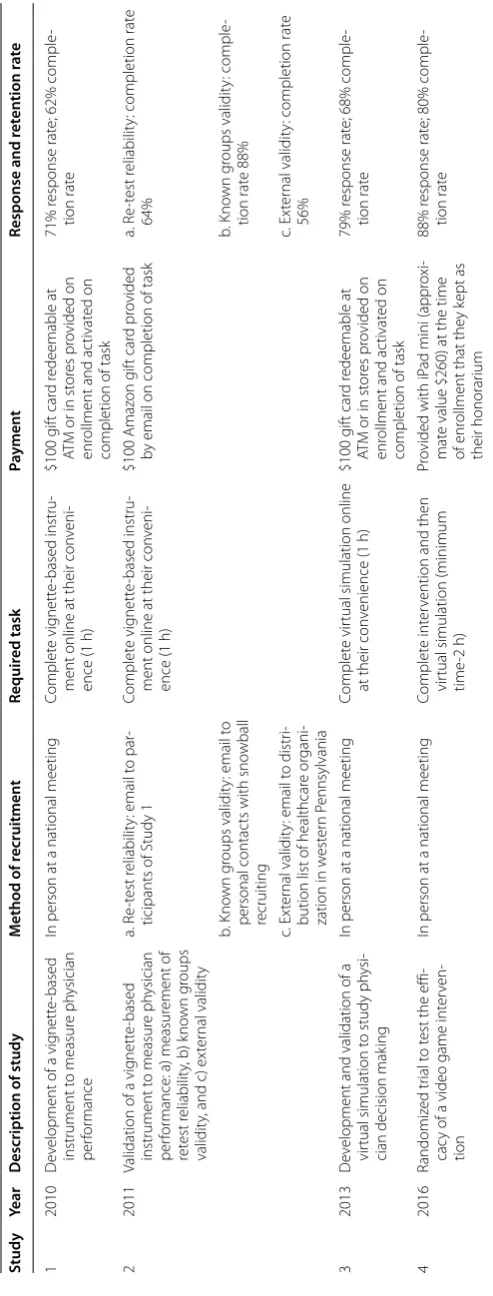
We summarize key elements of each study in Table 1. Major differences among the four studies include: the method of recruitment, type of honorarium, timing of the honorarium, and nature of the study tasks. We describe these in detail, below.
Participants
In Studies 1, 3, and 4, we recruited national convenience samples of physicians working at non-trauma centers, while attending three different meetings of the Ameri-can College of Emergency Physicians (2011–Las Vegas; 2013–Seattle; 2016–Las Vegas). Physicians were eligible if they practiced in non-trauma centers in the United States and made triage decisions for adult patients, regardless of their primary board certification. The cohort consisted primarily of emergency medicine physicians, but also included those with board certification in family prac-tice, internal medicine, and general surgery. Physicians were ineligible if they practiced solely at Level I/II trauma centers, worked outside the United States, or managed only pediatric patients. In Study 2, we recruited with email letters: in Study 2a, we approached physicians who had participated in Study 1; in Study 2b, we approached a national convenience sample of trauma surgeons work-ing at Level I/II trauma centers in the United States uswork-ing personal contacts and snowball recruiting; in Study 2c, we approached physicians working at in the emergency
department of UPMC non-trauma facilities in Pitts-burgh, using a staff distribution list.
In each study, we established the sample size required to answer the study question by using Cohen’s method of estimating power for behavioral trials, and assuming a 60 (Studies 1, 2, 3) to 70% (Study 4) completion rate.
Recruitment strategies
For Studies 1, 3, and 4, we hired a booth in the Exhibition Hall of the meeting. When physicians approached us, we described the study procedure, noting both our National Institutes of Health (NIH) support and the scientific value of the research. Finally, we mentioned the hono-rarium for participation. For Studies 1 and 3, we provided a $100 University of Pittsburgh WePay MasterCard gift card at the time of enrollment, and activated the card once the participants completed the task. For Study 4, we provided an iPad mini 2 (approximate value $260) at the time of enrollment, which physicians could keep at the conclusion of the trial.
For Study 2, we recruited physicians through email messages describing the study, also noting the $100 hon-orarium. We sent participants an Amazon gift card by email after they had completed the task.
Retention strategies
The principal investigator (PI) sent personalized email reminders to physicians at 1 week intervals for 1 month after enrollment. These messages reminded participants about study procedures and emphasized the value of their participation.
Study procedures
In Studies 1–3, we asked physicians to log into a secure website, respond to a demographic survey, and com-plete an instrument designed to assess their perfor-mance in triage decisions. That instrument was either a vignette-based questionnaire or a virtual simulation. We scored responses against the reference standard set by the American College of Surgeons. In Study 2, we addi-tionally compared within-subject responses to the ques-tionnaire at two separate time points (Study 2a: re-test reliability), compared the responses of trauma surgeons and emergency physicians enrolled in the study (Study 2b: construct validity), and compared responses to deci-sions these same physicians had made in practice (Study 2c: external validity). Completion of the study procedures took approximately 1 h.
Table 1 Summar y of char ac teristics of studies Study Year Description of study M ethod of recruitmen t Requir ed task Pa ymen t Response and ret en tion r at e 1 2010 D ev
elopment of a vig
nett e-based instrument t o measur e ph ysician per for mance
In person at a national meeting
Complet
e vig
nett
e-based instru
-ment online at their con
veni -ence (1 h) $100 g ift car d r edeemable at
ATM or in st
or
es pr
ovided on
enr
ollment and ac
tivat
ed on
completion of task
71% r
esponse rat
e; 62% comple
-tion rat
e
2
2011
Validation of a vig
nett e-based instrument t o measur e ph ysician per for
mance: a) measur
ement of
ret
est r
eliabilit
y, b) k
no
wn g
roups
validit
y, and c) ex
ter nal validit y a. R e-t est r eliabilit
y: email t
o par
-ticipants of Study 1
Complet
e vig
nett
e-based instru
-ment online at their con
veni -ence (1 h) $100 Amaz on g ift car d pr ovided
by email on completion of task
a. R
e-t
est r
eliabilit
y: completion rat
e 64% b. K no wn g roups validit
y: email t
o
personal contac
ts with sno
wball recruiting b. K no wn g roups validit y: comple -tion rat e 88% c. Ex ter nal validit
y: email t
o distr
i-bution list of healthcar
e or
gani
-zation in w
est er n P ennsylvania c. Ex ter nal validit
y: completion rat
e 56% 3 2013 D ev
elopment and validation of a
vir
tual simulation t
o study ph
ysi
-cian decision mak
ing
In person at a national meeting
Complet
e vir
tual
simulation online
at their con
venience (1 h) $100 g ift car d r edeemable at
ATM or in st
or
es pr
ovided on
enr
ollment and ac
tivat
ed on
completion of task
79% r
esponse rat
e; 68% comple
-tion rat e 4 2016 Randomiz ed tr ial t o t
est the effi
-cac
y of a video game int
er
ven
-tion
In person at a national meeting
Complet
e int
er
vention and then
vir
tual simulation (minimum
time
-2
h)
Pr
ovided with iP
ad mini (appr
oxi
-mat
e value $260) at the time
of enr
ollment that the
y k ept as their honorar ium 88% r esponse rat
e; 80% comple
-tion rat
[image:3.595.180.427.87.736.2]simulation developed in Study 3. We scored responses, and then compared performance between groups and determine the effect of the video game on performance. Completion of the study procedures took a minimum of 2 h.
Statistical analyses
We summarize recruitment and retention rates among studies using descriptive statistics. We avoided further statistical analysis since we did not have a priori hypoth-eses to test. We used Stata 13.0 (Statacorp, TX, USA) for data management and analysis.
Results
Participant characteristics
We recruited 280 physicians for Study 1, 132 physicians for Study 2, 209 physicians from Study 3, and 368 physi-cians for Study 4. As shown in Table 2, physicians who completed the studies had a mean age of 41 years (SD 9.5) and approximately 10 years (SD 9.2) of experience. They were mostly male (76%), white (75%), and trained in emergency medicine (93%). Most had received certifi-cation in Advanced Trauma Life Support (ATLS) (76%), and worked exclusively at non-trauma centers (83%).
Participant recruitment
Figure 1 shows recruitment rates, over time, of the three studies that used an in-person strategy. Over the entire recruitment period, that rate ranged from 15 participants/h (Study 3) to 39/h (Study 4). In Studies 1 and 3, accrual occurred slowly. Two members of the study team stopped conference attendees who passed by the booth to screen for interest and eligibility. For Study 4, participants independently exchanged social media messages about the study after approximately 4 h, which increased our recruitment rates from 35/h (hours 2–4) to 61/h (hours 5–6).
Qualitatively, we made several observations during the recruitment process for Study 4 that suggested that the material incentive we provided (an iPad) assumed value disproportionate to its cost. First, physicians demonstrated a willingness to wait in lines of 50–60 people to undergo screening procedures. Second, they retained interest in participating despite external barri-ers to enrollment. At one point, we halted recruitment at the request of conference organizers, since the size of the crowd around our booth violated fire safety regula-tions. Physicians returned multiple times to determine whether and when we would re-open enrollment. Third, physicians expressed anger and frustration if they did not meet eligibility criteria, describing our explanation as “unfair.”
Participant retention
As shown in Table 1, completion rates were 56% in Study 2c, where we used email to recruit physicians with whom we had no prior relationship, required that participants complete a vignette-based questionnaire, and provided the honorarium at the conclusion of the task. Comple-tion rates were 80% in Study 4, where we recruited phy-sicians in person, required that participants complete an intervention and virtual simulation, provided the hono-rarium at the time of enrollment, and used a material, rather than a monetary incentive.
Discussion
Physicians represent a particularly challenging group to recruit into behavioral trials, given their limited time and frequent skepticism about the value of such research. Rates of participation typically range from 35 to 54%. We learned that approaching physicians at a national confer-ence allowed us to maximize the efficiency of recruit-ment, providing access to a large (albeit not necessarily representative) sample of physicians. Several systematic reviews describe the importance of variables such as such as contact with participants, the appeal of the study tasks, and incentives on recruitment and retention of subjects [10]. Our results validate these observations. However, in contrast to prior studies, we also learned that material incentives may work as well as monetary ones to encour-age participation.
Prior efforts to use material incentives to increase response rates have had mixed success [10, 16]. Token non-monetary incentives (e.g. informational brochures, pencils) typically prove ineffective [17]. More substantial inducements, such as the opportunity to enter a lottery with a large payout, have sometimes, but not reliably, increased response rates [16, 18]. In contrast, our results suggest that certain non-monetary material incentives can encourage participation in a behavioral trial. Our choice of the particular incentive reflected practical con-siderations: pre-loading interventions on iPads facilitated completion of study tasks. We worried that many physi-cians would not be strongly motivated by this offer. Unex-pectedly, we found that physicians found the honorarium extremely attractive, as demonstrated by our qualitative observations of subject behavior during the enrollment process of Study 4.
Table 2 P ar ticipan t char ac teristics pr esen ted with number of par ticipan ts (per cen tage per
study [%]) and
means (standar d de via tion [SD ]) Variable O ver all (N = 674)
Study 1 dev
elop -men t of vig nett e-based question -nair e (n = 168)
Study 2 v
alida tion of vig nett e-based questionnair e
Study 3 dev
elopmen t and v ali -da tion of a vir tual simula tion (n = 142)
Study 4 t
esting the efficac y of a video game t o reduc e diag nostic err or among ph ysicians (n = 295) a Ret est r eliabilit y (n = 32) b K no wn g roups (n = 28) c Ex ternal v alidit y (n = 28) A ge
, mean (SD)
41 (9.5) 42 (9.6) 43 (8.7) 44 (6.9) 47 (8.8) 43 (10.7) 40 (8.9) M ale
, n (%)
511 (76) 141 (84) 26 (81) 21 (75) 19 (68) 112 (79) 192 (65) Race
, n (%)
Whit e 503 (75) 127 (76) 27 (84) 20 (71) 23 (82) 105 (74) 201 (68) Black 21 (3) 8 (5) 0 (0) 0 (0) 3 (2) 10 (3) A sian 95 (14) 20 (12) 4 (13) 3 (11) 5 (19) 18 (13) 50 (17) Latino 38 (6) 9 (5) 0 (0) 0 (0) 6 (4) 23 (8) Nativ e Amer ican or Pacific Islander 10 (1) 3 (2) 0 (0) 0 (0) 2 (1) 5 (2) O ther 21 (3) 1 (1) 1 (3) 2 (7) 8 (6) 8 (3) Pr imar y specialt y Emer genc y M edi -cine 625 (93) 157 (93) 30 (94) – 20 (71) 135 (95) 283 (96) F amily P rac tice/ Int er nal M edicine 36 (5) 10 (5) 1 (3) – 8 (29) 7 (5) 10 (4) T rauma Sur ger y 28 (4) – – 28 (100) – – – O ther 5 (1) 1 (1) 1 (3) – – – 3 (1) Years exper ience , mean (SD) 10.1 (9.2) 11.8 (9.2) 12 (8.9) 11.3 (7) 16 (9.8) 11.1 (10.6) 8.4 (8.5) ATLS cer tified
, n (%)
512 (76) 125 (74) 20 (63) 28 (100) 19 (68) 113 (80) 207 (70) Ph
ysician also w
or
ks
at a L
ev
el I/II trauma
cent
er
, n (%)
[image:5.595.129.465.108.728.2]an (additional) iPad, but were not willing to purchase it themselves when faced with the opportunity costs of spending fungible cash or time shopping. Second, it made the utility of the honorarium transparent for a population whose economic status might otherwise lead them to dismiss the value of a financial incentive. Finally, it expressed trust in participants to complete the task. Distinguishing the relative roles of these effects would require systematic experimental manipulation.
Behavioral research must distribute limited resources across task design, data collection, and data analy-sis. Those resources include investigators’ time and energy. Experiences like those summarized here provide inputs to the complex calculus of how to spend those resources. Our results suggest the potential value of pro-viding attractive material rewards when attempting to recruit physicians into behavioral trials. However, they should be interpreted with caution given the homogene-ity of our population and the descriptive nature of our observations.
Limitations
The generalizability of these observations is limited by the type of decision we studied and the tasks involved. In addition, we used a wage payment model to set the size of our incentive and to limit the potential for undue inducement. In contrast, most other studies that use monetary incentives implicitly use either a free mar-ket or an appreciation model of reimbursement [19, 20]. We do not know how many physicians would have responded in the absence of any incentive, or to a pay-ment set using a different model of reimbursepay-ment. However, we speculate that use of an incentive allows for the recruitment of a more generalizable population than reliance on altruism alone. Finally, our recruit-ment strategy, tailored to address our research question, resulted in the selection of a homogenous population. Some evidence exists that physician characteristics can influence response rates to questionnaires (e.g. intern-ists typically have a higher response rate than general surgeons) [21]. Therefore, we cannot speculate on the generalizability of our results to other groups or types of physicians.
Abbreviations
NIH: National Institutes of Health; PI: principal investigator; ATLS: Advanced Trauma Life Support.
Authors’ contributions
DM, AEB: study concept and design. DM: drafting of the manuscript. MRR, BF, CF, DCA, DMY, DJW, AEB: analysis and interpretation of the data and critical revision of the manuscript for important intellectual content. All authors read and approved the final manuscript.
Author details
1 Department of Critical Care Medicine, University of Pittsburgh, 638 Scaife
Hall, 3550 Terrace St, Pittsburgh, PA 15261, USA. 2 Department of Surgery,
University of Pittsburgh, Pittsburgh, PA, USA. 3 Department of Engineering
and Public Policy, Carnegie Mellon University, Pittsburgh, PA, USA. 4 RAND,
Pittsburgh, USA. 5 Department of Emergency Medicine, University of
Pitts-burgh, PittsPitts-burgh, PA, USA. 6 The Dartmouth Institute, Geisel School of
Medi-cine at Dartmouth, Lebanon, NH, USA.
Acknowledgements None.
Competing interests
The authors declares that they have no competing interests.
Availability of data and materials
Access to the de-identified dataset will be made available upon written request to the corresponding author.
Consent for publication Not applicable.
Ethics approval and consent to participate
The University of Pittsburgh Institutional Review Board approved the four studies described in this manuscript (PRO10050110, PRO11060622, PRO13090138, PRO16070572). We received a waiver of written consent under US Code 45 CFR 46.117(c)(2).
0
100
200
300
Number of physicians
0
10
0
200
300
Number of physicians
0
10
0
20
0
30
0
Number of physicians
9 11 13 15
Time of day
9 11 13 15
Time of day
9 11 13 15
Time of day Day 1
Day 2
Day 3
1. Participants begin discussing study on social media
2. Study enrollment suspended because the crowd posed a fire hazard
5. Study enrollment suspended until we ensure that all participants have their assigned iPads
6. Study enrollment reopens and concludes when target reached
STUDY 1 STUDY 3 STUDY 4
3. Resume enrolling participants but defer distribution of iPads until Day 2 to maximize efficiency.
4. End enrollment for the day
[image:6.595.57.290.87.420.2]• We accept pre-submission inquiries
• Our selector tool helps you to find the most relevant journal
• We provide round the clock customer support
• Convenient online submission
• Thorough peer review
• Inclusion in PubMed and all major indexing services
• Maximum visibility for your research
Submit your manuscript at www.biomedcentral.com/submit
Submit your next manuscript to BioMed Central
and we will help you at every step:
Funding
This work was supported by the National Institutes of Health through grants DP2 LM012339 (Mohan), K23 GM101292 (Mohan), 1KL2RR024154 (Mohan), and K08 HL122478 (Wallace). The funding agencies reviewed the studies but played no role in their design, analysis or interpretation of data.
Publisher’s Note
Springer Nature remains neutral with regard to jurisdictional claims in pub-lished maps and institutional affiliations.
Received: 24 September 2017 Accepted: 16 December 2017
References
1. Institute of Medicine. Crossing the quality chasm. Washington D.C.: National Academy of Sciences; 2001.
2. Barnett ML, Landon BE, O’Malley J, Keating NL, Christakis NA. Mapping physician networks with self-reported and administrative data. JAMA. 2011;46:1592–609.
3. Sirovich B, Gallagher PM, Wennberg DE, Fischer ES. Discretionary decision making by primary care physicians and the cost of US health care. Health Aff. 2008;27:813–23.
4. Detsky AS, Stricker SC, Mulley AG, Thibault GE. Prognosis, survival and the expenditure of hospital resources for patients in an intensive-care unit. N Engl J Med. 1981;305:667–72.
5. Barnato AE, Mohan D, Lane RK, et al. Advance care planning norms may contribute to hospital variation in end-of-life ICU use. Med Decis Mak. 2014;34(4):473–84.
6. Sahin D, Yaffe MJ, Sussman T, McCusker J. A mixed studies litera-ture review of family physicians participation in research. Fam Med. 2014;46:503–14.
7. Kellerman SE, Herold J. Physician response to surveys: a review of the literature. Am J Prev Med. 2001;20:61–7.
8. Pit SW, Vo T, Pyakurel S. The effectiveness of recruitment strategies on general practitioner’s survey response rates—a systematic review. BMC Med Res Method. 2014;14:76.
9. Sudman S. Mail surveys of reluctant professionals. Eval Rev. 1985;9:349–60.
10. Edwards P, Roberts I, Clarke M, DiGuiseppi C, Pratap S, Wentz R, Kwan I. Increasing response rates to postal questionnaires: systematic review. BMJ. 2002;324:1183–5.
11. Mohan D, Rosengart MR, Farris C, et al. Sources of non-compliance with clinical practice guidelines in trauma triage: a decision science study. Implement Sci. 2012;7:103.
12. Mohan D, Fischhoff B, Farris C, et al. Validating a vignette-based instru-ment to study physician decision making in trauma triage. Med Decis Mak. 2014;34:242–52.
13. Mohan D, Angus DC, Ricketts D, et al. Assessing the validity of using seri-ous game technology to analyze physician decision making. PLoS ONE. 2014;9:e105445.
14. Mohan D, Rosengart MR, Fischhoff B, et al. Testing a videogame interven-tion to recalibrate physician heuristics in trauma triage: study protocol for a randomized controlled trial. BMC Emerg Med. 2016;16:44.
15. American College of Surgeons Committee on Trauma. Advanced trauma life support for doctors. Chicago: American College of Surgeons; 2008. 16. Halpern SD, Kohn R, Dornbrand-Lo A, Metkus T, Asch DA, Volpp KG.
Lottery-based versus fixed incentives to increase clinicians’ response to surveys. Health Serv Res. 2011;46:1663–74.
17. Bonito AJ, Samsa GP, Akin DR, Matchar DB. Use of a non-monetary incentive to improve physician responses to a mail survey. Acad Med. 1997;72:73.
18. Vangeest JB, Johnson TP, Welch VL. Methodologies for improving response rates in surveys of physicians. Eval Health Prof. 2007;30:303–21. 19. Resnick DB. Increasing the amount of payment to research subjects. J
Med Ethics. 2008;34:e14.
20. Dickert N, Grady C. What’s the price of research subject? Approaches to payment for research participation. N Engl J Med. 1999;341:198–202. 21. Cunningham CT, Quan H, Hemmelgarn B, et al. Exploring physician
![Table 2 Participant characteristics presented with number of participants (percentage per study [%]) and means (standard deviation [SD])](https://thumb-us.123doks.com/thumbv2/123dok_us/8274185.281542/5.595.129.465.108.728/table-participant-characteristics-presented-participants-percentage-standard-deviation.webp)

