IJEDR1503104
International Journal of Engineering Development and Research (www.ijedr.org)1
Recognition of License Plate Numbers using
Connected Component Analysis
B.Leelarani1, B.Rameshnaidu2
1M.Tech, Department of Information Technology ,AITAM, Tekkali, A.P,India. 2Assoc.Professor,Department of Information Technology,AITAM,Tekkali,A.P,India.
________________________________________________________________________________________________________
Abstract - In traditional system identify the license plate detection is the most critical step to identify the number plate. Many researchers have done so much work to overcome all the challenges to detect the objects, but found that no general method is best suitable for the detection of license plate models from different areas. In the Existing system the fixed parameters cannot be identified because scale invariant license plate number images. It can identify only fixed parameters license plate number. In this paper we propose a new technique which finds the both fixed parameter and scale invariant license plate image. It achieved by using Connected Component Analysis (CCA) and Hit and Miss Algorithms. By using these algorithms we can improve the lighting, remove the shadows, and camera position and orientation can be done. The system is implemented using MATLAB and the result of number plate images is successfully detected.
Keywords - Connected Component Analysis (CCA), Vehicle License Plate Detection (VLPD), Hit and Miss (HM).
________________________________________________________________________________________________________
1. Introduction
Human can perform usual target recognition Without too much effort. However, by computer the task of recognizing specific object in an image is one of the most difficult topics in the field of computer vision or digital image processing. License Plate Recognition System (LPRS) is a challenging problem in the field of machine vision and automation with various applications including law enforcement, parking lot ticketing systems, automated hands free toll collection, automated vehicle access insecure establishments etc. Vehicle License Plate Recognition(VLPR) errand of vehicle images is truly challenging because of the multi-style plate formats, view point changes and the non uniform out way enlightenment conditions. Besides (Vehicle License Plate Detection) VLPD framework ought to work sufficiently quick to satisfy the needs of smart transportation frameworks and not to miss a solitary interest item from the vehicle image. In the same way (Vehicle license plate detection) VLPD is fascinating in discovering tag zone from vehicle image. The (Vehicle license detection) VLPD is broadly utilized for identifying speeding cars, security control in confined areas, in unattended parking zones, for activity law requirement and electronic toll collection, with the fast improvement of roadway and the wide utilization of vehicles, people have begun to give careful consideration to the advance, efficient, and precise ITSs. Recently, the need of vehicle tag acknowledgment (Vehicle License Plate Recognition) VLPR has expanded significantly. The tag discovery is a urgent and basic segment of (Vehicle License Plate Recognition) VLPR system. One of the real issues in (License Plate) LP recognition is determining (License Plate) LP systems. This framework must guarantee strong identification under different and lighting conditions independent of introduction and size of the plate as shown in Figure 1.
Figure 1: Frame work of license plate number detection 2. Literature Survey
Dr.L.M.VaralakshmiandRadha Ramalingam [1] in their work, Dynamic picture handling procedures combined with Genetic Algorithm are utilized for perceiving the tag numbers from a picture containing it. Acknowledgment of tag in a photo which are inclined to light issues is done utilizing this procedure. The framework discovers multi style number plates in a picture by utilizing Multistyle License Plate Number Using hereditary calculation and Dynamic Image Processing methods. The tags
IMAGE ACQUISITION
LICENSE PLATE DETECTION
LICENSE PLATE SEGMENTATION
IJEDR1503104
International Journal of Engineering Development and Research (www.ijedr.org)2
location stage is the most is the most discriminating stride in the programmed tag distinguishing proof framework. Every single existing system or calculations accessible can be arranged in view of the elements utilized for the identification.Distinctive existing calculations that have been looked into are a Color-based method that uses particular altered shading coding utilized by diverse nations. Reza Azad et al [2] in their work, License Plate Recognition assume an essential part on the movement checking and stopping administration. Organization and limitation of those transportation devices for their better administration turns out to be extremely vital. A quick and constant technique has a proper application to discover plates that the plat has tilt and the photo quality is poor. The picture is changed over into paired mode with utilization of versatile edge. Furthermore, with utilization of edge recognition and morphology operation, plate number area has been indicated and if the plat has tilt; its tilt is uprooted away. At that point its characters are recognized utilizing picture handling strategies. At last, K Nearest Neighbor (KNN) classifier was utilized for character acknowledgment. Osslan Osiris Vergara Villegas et al[3], in their work to tackle the issue of tag acknowledgment utilizing a three layer fluffy neural system. In the first stage the plate is identified inside the computerized picture utilizing rectangular edge identification and the finding of an example by example coordinating, after that, the characters are removed from the plate by method for flat and vertical projections. At long last, a fluffy neural system is utilized to perceive the tag. The tests were made in an uncontrolled situation in a parking area and utilizing Mexican and American plates. C.Subha and S.Sudha [4] in their work , they utilized Neural Network to identify number plate. This discovery procedure used to recognize right and inaccurate number plate characters. For this system Indian number plates are taken for different procedures. To begin with picture preprocessing then division procedure and acknowledgment procedure are occurred. Parcel of pictures are taken for this procedure these are put away in the database.
3. Methodology
Hit and Miss Algorithm
The hit-and-miss transform is a general binary morphological operation that can be used to look for particular patterns of foreground and background pixels in an image. It is actually the basic operation of binary morphology since almost all the other binary morphological operators can be derived from it. As with other binary morphological operators it takes as input a and produces another binary image as output. Used to extract pixels with specific neighbourhood configurations from an image Grey scale extension exist Uses two structure elements B1 and B2 to find a given foreground and background configuration, respectively.
HMT B X ={x∣ B1 x⊆X , B2 x⊆XC}
The new Hit and Miss Algorithm we are using morphological method. This method containing two operations Erosion
Dilation Erosion:
The erosion of a binary image f by a structuring element s (denoted f s) produces a new binary image g = f s with ones in all locations (x, y) of a structuring element's origin at which that structuring element s fits the input image f, i.e. g(x,y) =1 is s fits f and 0 otherwise repeating for all pixel coordinates (x,y).
A B ≠ S B
Erosion with small (e.g. 2×2 - 5×5) square structuring elements shrinks an image by stripping away a layer of pixels from both the inner and outer boundaries of regions. The holes and gaps between different regions become larger, and small details are eliminated.
X B= {P€Z2/P+b€X for every b€B}
Dilation:
The dilation of an image f by a structuring element s (denoted f s) produces a new binary image g = f s with ones in all locations (x,y) of a structuring element's origin at which that structuring element shits the the input image f, i.e. g(x,y) = 1 if s hits f and 0 otherwise, repeating for all pixel coordinates (x,y). Dilation has the opposite effect to erosion it adds a layer of pixels to both the inner and outer boundaries of regions.
A (B D) = (A B) D A B= {X€Z2/P- a€A for every a€A}
ConnectedComponentAnalysis (CCA)
In the Connected Component Analysis pixel connectivity and Connected Components Labeling can be classified.
Pixel Connectivity:
Pixel connectivity is a central concept of both edge- and region- based approaches to segmentation. The notation of pixel connectivity describes a relation between two or more pixels. For two pixels to be connected they have to fulfill certain conditions on the pixel brightness and spatial adjacency. First, in order for two pixels to be considered connected, their pixel values must both be from the same set of values V. For a grayscale image, V might be any range of gray levels, e.g. V= {22, 23,...40}, for a binary image we simple have V={1}. To formulate the adjacency criterion for connectivity, we first introduce
the notation of neighborhood. For a pixel p with the coordinates (x,y) the set of pixel scan be calculated.
IJEDR1503104
International Journal of Engineering Development and Research (www.ijedr.org)3
Figure 2: 4-connectivity binary image Results
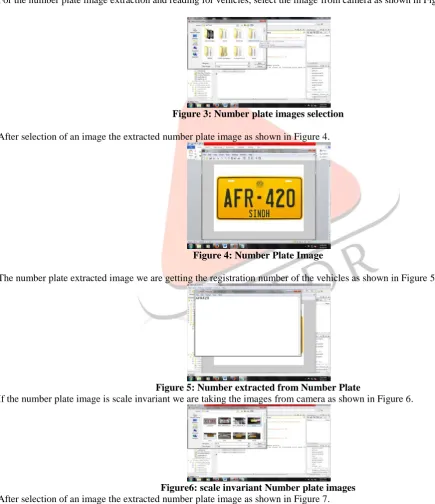
For the number plate image extraction and reading for vehicles, select the image from camera as shown in Figure 3.
Figure 3: Number plate images selection
After selection of an image the extracted number plate image as shown in Figure 4.
Figure 4: Number Plate Image
The number plate extracted image we are getting the registration number of the vehicles as shown in Figure 5.
Figure 5: Number extracted from Number Plate
If the number plate image is scale invariant we are taking the images from camera as shown in Figure 6.
Figure6: scale invariant Number plate images
IJEDR1503104
International Journal of Engineering Development and Research (www.ijedr.org)4
Figure 7: Extracted Scale Invariant Number Plate Image
The number plate extracted image we are getting the registration number of the vehicles as shown in Figure 8.
Figure 8: Number extracted from Number Plate
Figure 9: Extracted Scale Invariant Number Plate Image
Figure 10: Number extracted from Number Plate Conclusion
In this paper Vehicle License Plate Detection(VLPD),Hit-and-missAlgorithm was used to locate the plate vertically after detecting the left and right limits based on horizontal symmetry of the vertical texture histogram around the plate’s area. License Plate symbols detection without using any information associated with the plate’s outer shape or internal color distortion either physically or due to capturing conditions, such as poor lighting, shadows, and camera position and orientation can be done. To search the vehicle image objects and to allow tolerance in the localization process for the extraction and reading, a new Hit and Miss Algorithm and Connected Component Analysis (CCA) has been designed with a new flexible fitness function.
References
[1]Dr.L.M.Varalakshmi,RadhaRamalingm, “Recognition of License Plate Numbers Using Image Processing Technique andGenetic Algorithm”, International Journal of Engineering Research and General Science Vol 3, Issue 2, 2015, pp.438-445.
[2]Reza Azad, Babak Azad, Hamid Reza ,Shayegh Brojeeni, Shahid Rajaee, “Real-Time and Efficient Method for Accuracy Enhancement of Edge Based License Plate Recognition System” , International Conference on computer, Information TechnologyandDigitalMedia(CITADIMP proceeding-Scientific),2013,pp. 146-155.
[3]Osslan Osiris Vergara Villegas, Daniel González Balderrama, Humberto de Jesús Ochoa Domínguez and Vianey Guadalupe Cruz Sánchez, “License Plate Recognition Using a Novel Fuzzy Multilayer Neural Network”, International Journal Of Computers Issue 1, Vol 3, 2009,pp.31-40.
[4]C.Subha, S.Sudha , “An Efficient Way of Detecting Numbers in Car Number Plate Using Neural Network”, International Journal of Electrical, Computing Engineering and Communication (IJECC), Vol. 1, Issue. 3, 2015, pp. 28-31.
[5]S.Namitha,M.Deepa “Automatic License Plate Recognition For Ambigious Character Using Template Matching With Fuzzy Classifiers” ,International Journal of Emerging Technology and Advanced Engineering, Vol 4, Special Issue 3, 2014,pp.84-88. [6]Hamid Mahini, Shohreh Kasaei, Faezeh Dorri, Fatemeh Dorri, “An Efficient Features–Based License Plate Localization Method”,IEEE Transactions,pp.1-4.
IJEDR1503104
International Journal of Engineering Development and Research (www.ijedr.org)5
[8]AnujaP. Nagare, “License Plate Character Recognition System using Neural Network”, International Journal of Computer Applications, Volume 25– No.10, July 2011,pp.36-39.Authors
B.Rameshnaidu recieved M.Sc in Computer Science from Andhra University and M. Tech degree in Computer Science and Engineering from Andhra University,. He is a Associate professor in the department of Information Technology, Aditya Institute of Technology and Management, Tekkali.
B.Leelarani received B.Tech degree in information technology and Engineering from JNTU, Kakinada. She is currently pursing (M.Tech) degree in Information Technology from an autonomous institute Aditya Institute of Technology and Management, Tekkali, India. affilaiated to JNTU, Kakinada. Her areas of interests include Image Processing, Data Mining and Network Security