COMMISSION OF THE EUROPEAN COMMUNITIES
Memorandum on a Community Policy
on Development Cooperation
' I
~-Memorandum on a Community Policy
on Development Cooperation
__,. Synoptic and programme for initial actions
.::::;:;
~
/ (Communications of the Commission to the Council
of 27 July 1971 and 2 February 1972)
.:::---Contents
Page
Foreword 11
SYNOPTIC DOCUMENT 13
Introduction 15
I - Need, Urgency and Significance of a Community Policy for
Develop-ment Cooperation 1 7
A - Need for a Community Policy 17
1. The Community's growing personality and its attraction for
developing countries 1 7
2. Risks of incoherent action arising from the present division of responsibilities between the Member States and the Community 18
B - The time has come to define a Community policy 18
C - The significance of a Community policy 19
II - Cooperation of the Member States and the Community with
Develop-ing Countries 20
A - Action by Member States 20
B - Action by the Community 21
1. Association with the AASM 21
2. Community policy towards the countries of the Mediterranean
Basin 21
3. Community policy towards Latin America 22
4. Trade and commercial policy 22
5. Food aid 23
6. Points of contact between development cooperation policy and
other policies 24
C - Present pattern of the instruments of cooperation 25
III - Principles and Guidelines of a Community Development Cooperation
Po&cy 27
A - Principles 2 7
Page 2. Interdependence of the instruments of cooperation 28 3. Coherence and coordination - necessary conditions for the
effectiveness of Community policy 30
4. Complementary nature of national and Community action in
the field of technical and financial cooperation 30
B - Guidelines 30
1. Development cooperation should be taken into consideration
in the common policies 31
2. National cooperation policies should be progressively
coordi-nated 31
3. What the Community has already achieved in the sphere of
cooperation policy should be carried fu11ther 3 3
4. Additional possibilities for financial and technical cooperation
should be made available to the Community 35
IV - Main Types of Action 3 8
A - Action either arising from decisions taken before the
memoran-dum or connected with approaching deadlines 38
B - Other action to be started or continued 39
1. Action connected with trade 3 9
2. Cooperation on the social and on the human plane 40
3. Technical and financial cooperation 40
4. Other measures 40
Conclusions 43
PROGRAMME FOR INITIAL ACTIONS 45
Introduction 4 7
I - Measures to benefit Exports from Developing Countries 49
A - Commodity agreements 49
1. 1973 International Coffee Agreement 49
2. Negotiations for an international cocoa agreement 50 3. Consideration of the interests of developing countries
Page
B - Trade promotion 51
C - Gradual abolition of excise duties on tropical produce 53
D - Protection of the guarantee of origin of foodstuffs 53
II - Other Measures favouring Economic Development of Developing
Countries 55
A - Intensification and regularity of public efforts in aid 55
1. Statement of facts 55
2. Aims and proposed actions 56
B - Relaxing of financial conditions attached to aid 51
1. Statement of facts 57
2. Proposed actions 59
C - Gradual untieing of aid at Community level 60
1. Statement of facts 60
2. Proposed action 60
D - Coordination at Community level of aid and technical assistance 61
1. Statement of facts 61
2. Proposed action 62
E - Encouragement of better regional cooperation between
develop-ing countries 63
1. Statement of facts 63
2. Proposed actions 64
REVIEW OF TWELVE YEARS OF COOPERATION WITH TJIE
DEVELOPING COUNTRIES 65
CHAPTER 1: The National Policies of the Member States towards the
Developing Countries 6 7
Section 1: Financial and general technical cooperation of the Member States with the developing countries 68
§ 1: Belgium 71
§ 2: Federal Republic of Germany 72
Page
§ 4: Italy 76
§ 5: The Netherlands 78
§ 6: Outline of the evolution of the volume of aid in 1970 80
Section 2: The cooperation of the Member States with the developing
countries in specific fields other than financial and technical
assistance 81
§ 1: Cultural cooperation 82
§ 2: Cooperation in the social field 89
§ 3: Incentives for foreign private investment in the developing
coun-tries 92
§ 4: Monetary cooperation within the Franc Area 97
§ 5: The policy of the Member States on scientific technical and
tech-nological research 1 01
§ 6: Public opinion in the Member States on the question of
coope-ration with the developing countries 1 07
CHAPTER II: Relations between the Community and the Developing
Countries 1 09
Section 1: Historical background 109
Section 2: The associations 110
§ 1: The AASM association 11 0
§ 2: The associations with African developing countries whose
struc-tures and production are comparable to those of the AASM 143
Section 3: The policy of the Community towards the countries of the
Mediterranean Basin 145
§ 1: The underlying motives 145
§ 2: The first achievements 146
Section 4: Commercial policy 149
§ 1: The development of the trade of the EEC with the developing
countries 149
§ 2: Agreements coveriJng individual products 150
§ 3: General preferences 151
§ 4: The use of the tariff instrument 15 3
Section 5 : Food aid § 1: Grain aid
§ 2: Food aid in milk products
Section 6: Other activities
§ 1: Community social measures
§ 2: Measures for the benefit of Latin America § 3: Action by the High Authority of the ECSC § 4: Action by the EAEC
APPENDICES
Page 158
158
160
161
161
162
163
164
FOREWORD
In introducing this 'Memorandum on a Community policy on development coope-ration' the Commiss,ion recalls that one of the basic objectives of the wOTk of European integration is to seek a fair distribution of the world's wealth and well-being. This pursuit will be one of the more urgent tasks that the Commission intends to put before the Community for the second ten-year development period. By this memorandum the Commission wishes to open a debate in depth within the Community institutions and in the Member States on the direction to be taken by a policy of cooperation and the means of implementing it. Such a policy would in future enable the Community to shoulder its responsibilities with greater co-herence and efficiency as a large economic entity with a political role to play. This debate must be started as soon as possible. Indeed, at a time when the Community is embarking on economic and monetary union and preparing to expand, it should state its intent to establish a better balance between its own progress and progress in the developing countries.
*
**
The present memorandum contains a summary which sets out, in particular, the direction and general plan of campaign which, in the Commission's opinion, should characterise the Community's policy for cooperation in development, and it also outlines their practical implications.
The first set of measures whic4 such a policy calls for is explained in more detail in an initial plan of action which follows the summary. ·
*
**
The memorandum is largely the fruit of twelve years of cooperation between the Community and the Member States on one hand, and the developing countries on the other. It is also based on a number of statistical and other studies. It
INTRODUCTION
1. The Treaty of Rome, which organized between the Member States of the European Economic Community the stronges1t internal ties, so as to bind together their ma:tedal interests and thus prepare them for a common political destiny, did not in so doing neglect the external ties established between certain members and many developing countries.
On the basis orf Part IV of the Treaty and various protocols .annexed to it, links of association have been created and developed-links calculated to en-courage, by a variety of methods, the economic and social development of the Associated Afr,ican States and Madagascar (AASM), of three East African countries, and of several other countries, particularly in the Caribbean area. Furthermore, a start has been made on a region-wide policy within the Medi-terranean Basin, beginning with the declarations of intent appended to the Treaty.
2. There is no doubt that what is known as the 'Yaounde' Association policy has been for the Community the technical testing-ground-and a clear indication-of its political will to take increasingly into account its responsibilities towards all developing countries.
For most of these countries, while :they had active links of cooperation with each of the Member States on a bilateral basis, the Community only seemed to be a customs and agricultural organization liable to be an obstacle to the expansion of their trade and, in any event, without the means of actively cooperating in the solution of their development problems.
Such an initial, excessively negative image of the Community has been corrected, as has been amply proved by the rapid growth of its trade with the Third World. The favourable direction this trend has taken has been deliberately promoted by the commercial policy measures which the Communi,ty has taken, mainly in the form of various preferential and trade agreements, of independent tariff con-cessions on products of importance to the Third World, of the policy of world agreements, and finally of the elaboration of generalized preferences for finished and semi-finished products, which came into force ,this year.
3. It is noteworthy that several of these measures were most often taken simultaneously and, to some extent, in connection with the different stages and solutions which have marked the growth of the Yaounde Association.
It is important to stress this fact because it disposes of a fruitless quarrel between regional and universal solutions to the problems of development.
4. Because underdevelopment is not uniform throughout the world, because of the special links shaped by geography and by history, and because the means of actions which it could deploy hitherto were limited, the Community embarked on a regional policy of development cooperation which is now part of the Community patrimony and must be maintained, improved and reinforced.
But it has also progressively begun taking other Third World interests into consideration, it has engaged in a regular dialogue with other regions such as Latin America and in cooperation in measures of worldwide scope such as those which are the raison d' etre of UNCT AD. This policy is not a substitute for the association policy mentioned above, but mus•t be ilts necessary complement.
5. Though this is the case, it must be added that the developing countries as a whole expect more from the Community, especially in view of its enlargement and the second Development Decade, while the Community recognizes that the tariff policy instruments used hitherto no longer offer more than limited possibilities.
That is why the Commission considers that the time has come for the Community to work out a development cooperation policy which is at the same time general and selective (that is, suited to particular cases). Its guidelines would be a better coordination of the resources of Member States and those of the Community, so as to improve on what has already been achieved and take it further by new activities and by new instruments of more general application.
6. The Community's interests, the commitments it has already undertaken, the prospects of enlargement and of the next UNCT AD already make such a policy imperative for the coming years.
In this connection, it is enough to mention the adaptation of the Mediterranean agreements to an enlarged Community, the renewal of the agreements with the Maghreb countries on a broader basis, the negotiation of the association with the AASM and with some Commonwealth countries under the enlarged Community, the measures relating to commodities, to generalized preferences, etc.
But while all the subjects that have been mentioned are, in a certain sense, the core of the programme for action, there are others that should not be neglected; these the Commission is also presenting in this memorandum, .in the hope that they will be considered in depth, and as constructively as possible, by the Com-munity's institutions.
7. The Commission is aware that a genuinely common policy for development cooperation will only be possible when important new steps have been taken towards economic and political union.
I.
Need, Urgency and Significance
of a Community Policy for Development Cooperation
A - NEED FOR A COMMUNITY POLICY
1. THE COMMUNITY'S GROWING PERSONALITY AND ITS ATTRACTION
FOR DEVELOPING COUNTRIES
Through the position of principal partner which it has achieved in international trade, through the growing influence which it enjoys in the world as a powerful economic entity approaching completion and tending towards political unification, and through its declared will to give its backing to the growth of the developing countries, made known both in the international bodies and by its association with the AASM, the East African States and certain Mediterranean countries, the Community exerts a genuine attraction on these countries as a whole.
This force of attraction will inevitably tend to increase over the next few years. The progress which is expected in the formation of the economic and monetary union, and that hoped for in the political field, is bound to give the Community added weight and increased responsibilities towards the rest of the world, and therefore to encourage developing countries to turn increasingly towards it.
It would not be reasonable that an entity whose integration is to be taken to the stage of a common currency and of common economic policies, and whose political personality will no doubt tend to become more explicit over the years, should remain as ill-equipped as it now is, when it comes to assisting the progress of the developing countries as a whole.
enlargement of the Community, which is going to enhance its international significance and could increase the number of associated countries, will appre-ciably reinforce the need to give the Community means to cooperate in develop-ments that are more in keeping with its weight and with the responsibilities attaching to its growing personality.
2. RISKS OF INCOHERENT ACTION ARISING FROM THE PRESENT DIVISION
OF RESPONSIBILITIES BETWEEN THE MEMBER STATES AND THE COMMUNITY
Increasing recours,e to commercial policy as a means of development cooperation has brought about a de facto division of responsibilities between the Member States, which control the levers of technical and financial cooperation, and the Community, which establishes the common commercial policy. Since, moreover, the Member States exercise their national responsibilities independently, starting from different historical and economic backgrounds and without adequate coor-dination, the Community and the Member States, to a greater extent than other developed countries, are exposed to the risk of divergent and incoherent strategies whose damaging consequences for the effectiveness of international cooperation have rightly been stressed by international experts (Pearson Report, etc.).
At the present stage of European unification, the Community and the Member States must make a very special effort to meet the requirement of greater coherence which the United Nations has made one of the major themes of the second Development Decade and the necessity of which has also been stressed by the European Parliament: greater coherence in the joint use of the specific instruments of cooperation which they now share, but also greater coherence between internal economic policies (agriculture, indus~trial, social, etc.) and cooperation policy. Consequently, the Commission thinks it necessary to carry out an overall survey of this mixed bag of policies currently applied by the Community and the Member States towards developing countries, so as to arrive at greater coherence within the Community-the essential prerequisite for the effectiveness of everybody's efforts, and for the very existence of a Community policy.
B - THE TIME HAS COME TO DEFINE A COMMUNITY POLICY
The Commission did not want the drawing up of this memorandum to be put off till later because it is convinced that, at a moment when the Community is starting on the road to economic and monetary union, and at a time when it is prepar,ing for its own enlargement, it is important that the Community should also express .its will to link its own progress more closely to that of the developing countries, and to include among its basic aims the systematic pursuit of a better interna-tional distribution of prosperity and the multiplication of opportunities for social fulfilment offered to ever wider groups of human beings who were previously underprivileged.
should be sufficiently conclusive and sufficiently encouraging for hope to take the place of doubt, and tenacity to take the place of disappointment, in the industrial-ized countries and in the developing countries.
Furthermore, by making the second Decade the joint responsibility of the developing countries and of the industrialized countries, and by giving both, as term:s of reference, the international strategy which they worked out and adopted together, the United Nations General Assembly is ghdng mankind an additional chance to base relationships between industrialized and developing countries on close cooperation and on organized solidarity rather than on con-frontation.
The Commission recommends to the Community institutions that they define without delay, on the basis of this memorandum, the means that will enable the Community to shoulder more effectively its responsibilities as a major economic unit and to make its own contribution to the establishment of a more just international order.
It should be noted that a good many of the points worked out in the strategy have a direct bearing on the Community as such and impose upon it the obligation of defining a common line of action for the purpose of implementing them. In this connection, a first deadline is nearly upon us: the third UNCTAD will be held next spring.
C - THE SIGNIFICANCE OF A COMMUNITY POLICY
While it does not claim that by the end of the seventies-the horizon for this memorandum-the Community should take the place of the Member States and conduct a common development cooperation policy, the Commission is never-theless of the opinion that during the next ten years, though the Community's achievements should be maintained and taken further, its possibilities for co-operation should be gradually enlarged, the individual countries' policies should be progressively harmonized, and a Community conception of international cooperation should little by little see the light of day. Action by the countries individually will continue to exist, but its effectiveness will be improved by being concerted, and the guidelines will be defined jointly.
The body of reflections and actions which this requires is set out in detail in a memorandum, of which this note is a summary. In this summary we present, in the first place, the main lessons to be drawn from twelve years of cooperation between the Member States and the Community on the one side and developing countries on the other; we then specify the general guidelines and the main types of action for a Community development policy.
This summary is accompanied by two working documents, one of which contains a detailed analysis of twelve years of cooperation with developing countries, while the other contains information and statistics.
II.
Cooperation of the Member States
and the Community with Developing Countries
A. ACTION BY MEMBER STATES
Action by individual Member States falls mainly under the heading of financial and technical aid in the broad sense and has the following characteristics:
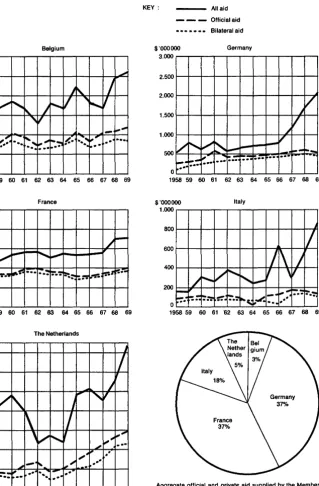
1. The composition, the geographical distribution, the purpose and the amount of official and private aid flowing from Member States to developing countries vary substantially from one Member State to the next. While in 1969 1 all achieved
the objective of transferring at least 1% of their GNP to developing countries, taking official and private aid together, they did not all manage the target of 0. 7% in official aid: on this point quite considerable inequalities exist between Member States. Quite substantial differences may also be noted as regards the ratio of grants to loans in bilateral official aid and as regards the terms of official loans. Finally the volume of aid has been subject to fairly wide variations over a period of time.
These divergences reflect the fact that Member States take into account historical, economic and political considerations, which are often different from state to state, and the lack of adequate coordination between bilateral policies.
2. While Member States have made an undoubted effort to increase the amounts which they allocate to developing countries, it remains a fact that the depreciation of currencies diminishes the real impact of this effort on the recipients, and that the growth in their aid is not always proportional to that of their GNP.
3. Action by Member States to assist developing countries involves some
im-balances in so far as some sectors which are important to developing countries-for instance the social aspects of relations between Member States and developing countries, or transport problems-have not been considered as attentively as others.
4. Cooperation with developing countries is part of the foreign policy of the Member States. They do not go in for multilateral aid to any great extent, and keep most of their resources for bilateral action, being concerned, to a varying degree, to take commercial and economic considerations into account through the practice of tied aid.
1 The first provisional figures available for 1970 show a decline in the financial effort of
B - ACTION BY THE COMMUNITY
1. ASSOCIATION WITH THE AASM
(a) The policy of association with the AASM has gradually taken on a character that goes far beyond the mere application of preferential trade measures and of technical and financial aid. The most authoritative voices in the AASM stress, unceasingly and emphatically, the fact that association is in the first place a political option, which aims at the maintenance and development of privileged relationships of every kind between Europe and Africa: the AASM say that they have deliberately preferred the Community as the first foreign partner in their development.
At the same time, and increasingly, they express the view :that the Community, despite the magnitude of its effort, does not seem to attach the same significance to its commitment in the association.
Having suffered at various times in the past an erosion of the preferences which they enjoyed on the Communi<ty market, and faced today with the gene-ralized system of preferences, they fear the disappearance of the trade element of the association. Yet the economic effectiveness, the political significance and the distinctive character of the association depend, precisely, on the combined use of trade and financial instruments, and on .the joint institutional machinery which has its main raison d' etre in the overall character of the association. (b) The difficulties encountered by the association are not helped by the constant criticism on the part of certain industrialized countries and the Communist countries. This criticism, which has focused on the trade arrangements of the association, must however be assessed in terms of the general economic situation of the AASM and of the real volume of this trade, which on a world scale is marginal.
(c) In the sector of financial and technical cooperation, the Community's contri-bution to the economic and social development of the AASM is continuous and free from the disturbances which sometimes arise in the political relations between some of these countries and one or other of the Member Statles. The AASM have on several occasions expressed their satisfaction with the objectivity and effectiveness of .this cooperation.
The association agreement with the three East African countries is another Com-munity achievement and is, through some of its aspects, closely linked to the association agreement with the AASM.
2. COMMUNITY POLICY TOWARDS THE COUNTRIES OF THE MEDITERRANEAN
BASIN
balanced European policy in the Mediterranean (Israel, UAR, Lebanon). Preferen-tial relations have already been established with most of these countries iJn the form of associations (Greece, Turkey, Morocco, Tunisia, Malta), preferential agreements (Spain, Israel) or non-preferential agreements (Yugoslavia, Lebanon).
These countries' will to cooperate results from certain identities of interests and from a multiplicity of links due to proximity and tradition. This proximity and these affinities imply a considerable degree of interdependence, going beyond trade and extending to labour, tourism and all manner of invisible trade.
The close interconnection of the political and economic interests involved, and the influence that Europe can exert in this region, contribute to making the development of the Mediterranean Basin a natural extension of European integration.
The Commission considers that, taken as a whole, the agreements concluded with the Mediterranean countries are no more than an inadequate expression of Europe's interest in this region. Through these agreements the Community has so far made only a limited contribution to the economic development of this part of the world.
3. COMMUNITY POLICY TOWARDS LATIN AMERICA
The Community's relations with Latin America differ in a number of important ways from those with Africa and the Mediterranean Basin.
(i) Though long-standing and involving strong aHinities of various kinds, these relations are less close, if only because of geographical distance.
(ii) The human and economic dimensions of Latin America are several times greater than those of the AASM and the M,editerranean countries. This raises in acute form the problem of the disproportion between this region's needs and the Community's resources, and therefore that of selec.tivi:ty. (iii) Very great differences exist between the levels of development and the
econo-mic prospects of the various countries and regions, differences which call for a policy that is broken down by regions.
For the last two years, the Community's policy towards Latin America has been taking shape: in July 1969 the Commission sent a memorandum to the Counc.il on relations with the countries of Latin America, systematically analysing the questions arising from these relations. The Council cons,idered this document, which gives an overall view of the problems and makes it possible to assess the diversity
in the economic structures and needs of the individual countries, to be an appropriate starting-point for the Community's further studies on the matter. Such studies were undertaken in 1970 and 1971.
On the initiative of the Latin American countries, permanent machinery for dialogue between them and the Community was decided upon on 1 June 1971.
4. TRADE AND COMMERCIAL POLICY
The growth in purchases by the EEC from developing countries has been very rapid, while its exports .towards these countries as a whole have grown muoh less fast. The Community's trading deficit has enabled developing countries to finance a very large share of their purchases from other developed countries and to fill part of their overall trade gap. Hence these countries have a credit balance with the Community, which is to be set beside their trade deficit with the rest of the world. It is therefore clear :that developing countries, taken as a whole, have ga,ined considerably from European economic growth, which has greatly strengthened the Community's import capacity.
Nevertheless these results, though favourable from an overall standpoint, should be evaluated in the light of the structure of the Community's imports (relatively large share of petroleum among the commodities, and the rather small share, as yet, of manufactured goods in total imports from developing countries) and also the sometimes very unequal growth of the different flows of trade with the various groups of developing countries.
(b) Positive results could not have been achieved if the general character of the Community's commercial policy had not been as liberal as it has been and if the Community had not consistently endeavoured .to reconcile the ,interests of other developing countries with those of i:ts associates. In any event, the opening-up of the Community market is only one instrument of commercial policy. The very success of these measures of tariff and quota disarmament condemns this instrument to the gradual loss of its effectiveness. This only serves to make recourse to other instruments more necessary and urgent.
The Community has made extensive use of the opportunities offered to it by the Treaty to weave a fairly complex web of bilateral, regional and worldwide commit-ments. Some of the Community's partners tend of course to reproach it with failing to have a coherent strategy in undertaking this action. This reproach is at the same time well-founded and exaggerated; while it is sometimes difficult to find a guiding thread in the Community's action, it nevertheless remains true that the problems which the Community has played a part in solving could not be settled satisfactorily through the dismantling of tariffs and quotas alone. In its use of this instrument the Community has gone as far as it could.
Its action has reached a culminating point in the decision which it has taken to put into practice, from 1 July 1971, its offer of generalized tariff preferences. The outcome of concerted action at international level, first between developed countries-among which the Community and its Member States played a leading role-then between developed and developing countries, this decision is the most important initiative through which the Community has chosen to show that it is ready .to shoulder its responsibilities on a world scale. This decision is accompanied by terms and conditions which make it possible to take into account the diversity of typical underdevelopment situations, and to prevent the generalized preferences from widening the gap between the more advanced and less advanced developing countries, particularly the Associated States.
5. FOOD AID
(i) As regards cereals, the subdivision of annual aid running at one million tons between a Community share and national programmes has entailed a definite lack of coherence in the selection of action to be undertaken; it has also had detrimental effects on the management of the cereals market. It is regrettable that it has not yet been possible to achieve a substantial increase in the Community's share, even though food aid is linked with the common agricul-tural policy and its subdivision causes lack of coherence. Nor has it been possible to resolve the problems of liaison between development aid and food aid, and those of supervision of the utilization of the Community's share of the aid, in an entirely satisfactory manner.
(ii) The Community has channelled the greater part of its aid in the form of milk products through the World Food Programme. Experience here once again shows the need for better coordination between bilateral and multilateral action.
6. POINTS OF CONTACT BETWEEN DEVELOPMENT COOPERATION POLICY
AND OTHER POLICIES
Cooperation policy goes beyond the mere use of the .traditional financial and com-merciill instruments. Its effectiveness also depends on the compatibility of economic and social policies with the objectives sought through development cooperation. In this connection, the present distribution of powers between national decision-making centres and the Community varies considerably: agriculture, for exampk, falls entirely within a Community policy system, whereas the other sectors of economic and social activity are still mainly the responsibility of the domestic authorities, whose policies are scarcely coordinated at all.
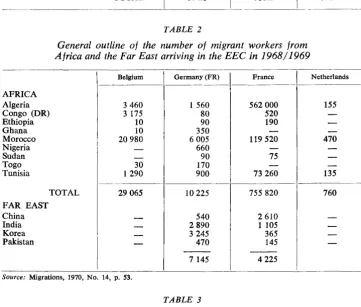
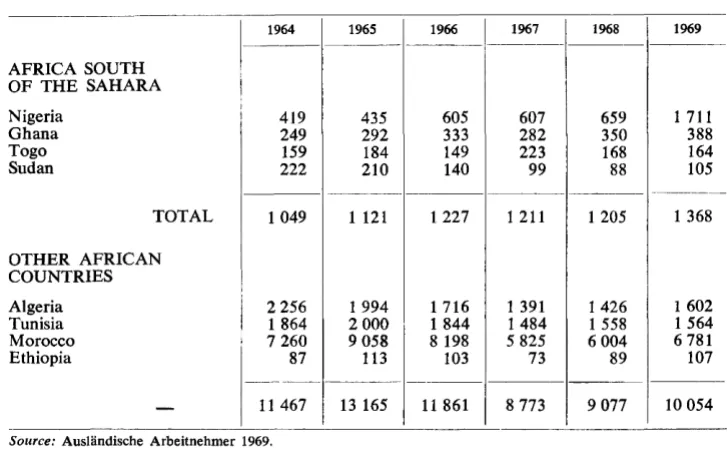
Community decisions in fields such as soc.ial affairs, transport, research and taxation show little sign of any consideration being given to the problems of developing countries, even if work on the Medium-term Economic Policy Programme is beginning to give some place to the problems of mutual relations between the Community and developing countries. In the social sector, for instance, it is found at present that the attitudes of Member States are often quite different towards migrant workers from non-member countries, even if, among guidelines for the future, the Commission proposes in its memorandum on Community social policy that priority should be given to the improvement of living and working conditions for migrant workers, especially those from developing countries.
The same goes for the agricultural sector, whose products only occupy a small place as yet .in the Community's offer on generalized preferences, and which is open to international competition to a limited extent only. It must be recognized, however, that agriculture has to face the grave difficulties that are encountered by any sector in process of rapid change and that, under this heading, the Com-munity's institutions have had only restricted scope for manoeuvre so far. For example, the Community has as yet been unable to accede to the International Sugar Agreement, an instrument of cooperation which is particularly important for many developing countries. This state of affairs is fortunately being changed by the possibility of enlargement of the Community.
C - PRESENT PATTERN OF THE INSTRUMENTS OF COOPERATION
1. Currently powers and responsibilities in the field of cooperation are divided
in the Community as follows.:
(a) Technical and financial cooperation
(i) Each Member State defines, on its own authority, the total amount of official resources which it allocates to technical and financial cooperation, the composition of this amount, its geographical distribution, the aims and principl~ that direct the use of these resources, and the proportion that is channelled through multilateral organizations.
Each Member State also plays the main part as regards measures to encourage the private sector to contribute to the economic development of developing countries: taxation, credit, investment guarantees.
(ii) The Community's scope in this field is limited: i1t has been able to act on a relatively large scale only in the case of Turkey, Greece,the AASM and the Overseas Countries and Territories, and even then within the limits of the resources available to the European Development Fund (EDF) and the European Investment Bank (EIB).
By virtue of its te.chnical and financial cooperation activities, the Commission is a member of the OECD Development Assistance Committee (DAC). Further-more, the Community participates, with observer status, in .the work of international bodies such as UNCTAD, ECOSOC, ECA and UNIDO.
(b) Commercial policy
Since the Common Market entered its definitive stage, the Community has had a major instrument of cooperation with developing countries as a whole; it also embraces credit insurance and export credits. Systematic efforts to harmonize and coordinate domestic policies on the latter had been made at Community level even before the end of the transitional period.
through a JOint delegation of the Community and the Member States when the issues being discussed cover at the same time Community matters or matters of interest to the Community and matters under the jurisdiction of the Member States (negotiation of the Sugar Agreement, international arrangements on grains, etc.).
(c) Food aid
In food aid the Community has an additional instrument for cooperation with developing countries as a whole; however, the amount to be distributed under the Food Aid Convention, particularly in the form of cereals, is spUt between Community action and bilateral action by the Member States.
(d) Economic and social policies
The decisions taken on the establishment of economic and monetary union, and the current discussions, par:ticularly on common policies in the social sector (e.g. reorganization of the European Social Fund) and in the industrial and technological sectors, are such as to encourage a gradual change i!n the pres,en:t situation towards a more thorough coordination of domestic policies and towards ,the allocation of new respensibilities to the Community institutions.
2. If one had to summarize the present situation very broadly, one could say that in the common commercial policy the Community has an instrument which tends to have increasing weight in international cooperation, while the Member States still retain the essential powers as regards technical and financial cooperation, and as regards economic policies, with the e~ception of the common agricultural policy.
As a result of this splitting of responsibilities, the cooperation policies of the Com-munity and of the Member States show, at present, three obvious weaknesses: (i) lack of common viewpoints and of coordination between the Member States on their domes,tic cooperation policies, which leads to duplication of efforts, conflicts and, as a result, loss of efficiency;
(ii) the special situation of the Community whkh, because its integration is still incomplete, can only reconcile the latter gradually with the requirements of international cooperation for development;
III. Principles and Guidelines
of a Community Development Cooperation Policy
A - PRINCIPLES
The basic purpose of any development cooperation policy is the systematic pursuit of a more harmonious distribution-and better adapted to modem times-of well-being throughout the world, in other words the pursuit of better conditions of life and of fulfilment for mankind. This presupposes that cooperation is not confined to the application of a series of measures or of means intended to develop economic pmential alone in .the countries of the Third World: for while human progress is largely dependent on the economic take-off which is needed to make available the resources that are necessary to social, health and cultural progress, it is equally clear that no lasting economic development is possible unless it goes hand in hand with improvements in the standard of education and health of the people at whom it is aimed. Hence even though it is for the governments of the developing countries to establish the priorities and the guidelines of their action, it is the industrialized countries' duty to help achieve them as well as cooperating in econo-mic development.
1. THE OBJECTIVES OF COOPERATION ARE INDIVISIBLE
In a nutshell, the purpose of any Community cooperation policy can only be achieved through the attainment of interdependent objectives.
(a) Diversification of the developing countries' economies
It is necessary to modernize the economy of developing countries and to diversify their production not only horizontally but also vertically, that is they must process their raw products industrially. This naturally presupposes the gradual creation or development of essential infrastructure, especially industrial. It also presupposes the taking of measures-on a social and on a human plane-that are necessary for the full utilization of such infrastructure, and particularly the taking into account, from the outset, of the need to provide the indispensable vocational and technical ttaining and further training.
All these measures must fit into development plans which are the prime responsi-bility of the developing countries themselves. But they will only be fully effective
if, going beyond national limits, which are often narrow, they are undertaken in
a wider and preferably regional perspective.
to rely exclusively on import substitution, their economic growth would be deprived of an essential mainspring and the deterioration in their terms of trade would be remedied only in part.
(b) Reorganization of economic structure within the Community
It follows that the Community, along with the other developed countries, must accept and even encour:age the privileged access to its market of products exported by developing countries.
This liberalization of trade with the developing countries, the potential of which cooperation is intended to increase, obliges the Community to accept that its economic structure should gradually change in a way that will be helpful to the economic diversification and indus~trialization of developing countries, and that it should take .the internal measures that will make it oossible to foresee and to soften the impact of these structural changes on the sectors affected by diversifica-tion and liberalizadiversifica-tion of trade. Otherwise the changes in the productive apparatus of developing countries promoted by economic growth would be slow, would scarcely affeot world trade and would not, therefore, encourage a satisfactory international division of labour.
(c) Concerted action
Diversification must be achieved through concerted action at three levels: between developing countries, between developed countries, and between the former and the latter. This will make it possible to respect the sovereignty of States in the matter, while ensuring greater effectiveness of any action considered. This concerted a.;tion may be organized in appropriate regional frameworks (association) and at world level.
These goals must be achieved progressively as European integration is achieved.
It will therefore be necessary to establish a close liaison between the progress of the Community's integration and that of development cooperation.
2. INTERDEPENDENCE OF THE INSTRUMENTS OF COOPERATION
The interdependence between the aims is inevitably also to be found between the instruments and the policies required to attain the aims according to schedule. (a) The experience of the past ten years shows that the external factors which influence the economic growth· of developing countries do not arise exclusively from financial and technical cooperation. They arise as much, and even more, from world demand for products, by reason of the dynamic relationship between exports and growth. Hence it is appropriate that, in addition to technical and financial cooperation, there should be the conditions for a more vigorous expansion and a ·speedier diversification of exports from the developing countries: this means trade between the developing countries themselves and the economic cooperation that this implies, and their exports to the industrialized countries generally and the Community in particular.
developing countries, to organize their economic cooperation at regional level, this requirement being the more imperative the lower their level of development and of
per capita income, and the smaller their population-and in Africa it is often small. (ii) Exports from developing countries to the Community will not increase and become sufficiently diversified, even if they are competitive in some sectors, unless the Community makes an effort in three directions:
First it must maintain .its own economic growth at a high level. It is because the Community has promoted the economic expansion of the Member States that its establishment has proved so beneficial for the developing countries in their trade with the Community.
Secondly it must step up the liberalization of trade, on a programmed basis so as to avoid unfavourable social repercussions, for all exports from developing countries, but differentiating the steps taken according to four categories of products: industrial products, processed agricultural products, similar and competing commodities, and tropical products. For the first two categories, the application of the generalized system of preferences will be a step forward which would probably not have been achieved without the impetus which the Community gave to the negotiations; for products in the third category, the granting of preferences should be backed, in the context of a policy for the organization of international markets, by the conclusion of world or regional agreements, already strongly supported by the Community; for tropical pro-ducts, it is through a prices policy within the framework of world or even regional arrangements, rather than through further reductions in the CET, that the Community will endeavour to reconcile its obligations towards asso-ciated countries with its responsibilities towards other developing countries. In the third place it must combine the gradual liberalization of the commercial policy in respect of the developing countries with a number of accompanying measures such as:
• cooperation and sales promotion to facilitate the penetration into the Community of products exported by developing countries;
• measures of aid, integrated into the medium-term economic policy, to facilitate the structural changes which would result for the Community from the progressive liberalization of the common commercial policy, and to absorb their social impact more effectively. It must be recalled that such liberalization implies that the Community's internal economic policies should be compatible with the aims of cooperation.
(b) For financial and technical cooperation, the Community and the Member States cannot limit themselves to ,the instrument of official aid alone. While such aid is necessary-and generally speaking it is a prerequisite~to encourage the diversification and modernization of the developing countries' economies, it is not however sufficient by itself.
The Community's development cooperation policy must take into account the desire of the hos:t country to ensure that the progress of the modern productive apparatus should not in various ways be controlled wholly from outside.
That is why, in addition to the traditional forms of entirely private investments, there are increasingly to be found mixed forms, which permit :the participation of domestic capital from the host country, progres8ive transfers of property and participation in management by nationals of the host country. Experiments are also being made with the participation of private foreign capital in the development of resources which themselves remain the property of the host country.
The Commission considers that the Member States and the Community should adopt an open-minded attitude to :these various kinds of relations between the private sector and developing countries, which means in particular that the various methods of inducing private investment must be as flexible as possible in order to be adaptable to the particular situations that might occur.
Effectiveness of the private sector's contribution also requires that, in order to encourage the export to developing countries of goods and products that will be helpful to growth, for example plant and machinery, more should be done to
coordinate export credit insurance and selective guarantees and to improve selectively the terms of export credits.
3. COHERENCE AND COORDINATION-NECESSARY CONDITIONS FOR
THE EFFECTIVENESS OF COMMUNITY POLICY
Since the instruments of cooperation are closely interconnected and complementary, the first condition .that must be fulfilled in order to achieve an effective cooperation policy is that the instruments should be used in a coherent manner. The splitting of instruments and responsibilities and the coexistence of independent national policies demand special vigilance in .this connection from the Community and from the Member States, which win have to bring about this essential coherence through appropriate coordination measures.
4. COMPLEMENTARY NATURE OF NATIONAL AND COMMUNITY ACTION
IN THE FIELD OF TECHNICAL AND FINANCIAL COOPERATION
As a result of the growing responsibilities which flow from the Community's spreading international influence and from its power of attraction over the developing countries, it is not possible to impose strict geographical limits on its activity in the field of financial and technical cooperation. The second imperative which the Community and the Member States must therefore accept is to organize among themselves a distribution of the means and tasks of technical and financial cooperation in the light of objective criteria which ensure satisfactory dovetailing of national and Community action and, as a consequence, better overall effective-ness.
B - GUIDELINES
(i) development cooperation should be taken into consideration in the common policies;
(ii) national policies and action should be progressively coordinated;
(iii) what the Community has already achieved in the sphere of development cooperation should be carried further;
(iv) additional possibilities for financial and technical cooperation should be made available to the Community.
1. DEVELOPMENT COOPERATION SHOULD BE TAKEN INTO CONSIDERATION
IN THE COMMON POLICIES
Up till now circumstances have not allowed development cooperation as such to be treated as a priority objective in the process of European integration. It follows that most of the measures undertaken under the heading of development cooperation are of a somewhat subsidiary nature.
The Community and the Member States must in future ensure, more attentively than in the pas,t, ,that common and Community policies are consistent with the aims which they intend to pursue ,through the specific instruments of development cooperation and that they encourage and facilitate the attainment of these aims. This necessary integration of development cooperation aims into internal policies will of course have to come about gradually and according to a programme so that abrupt social and economic repercussions within the Community are avoided. But it is indispensable if the effectiveness of cooperation is ,to be secured and the Community's credibility in the developing countries ensured.
2. NATIONAL COOPERATION POLICIES SHOULD BE
PROGRESSIVELY COORDINATED
In order to reduce the internal and external disadvantages which arise from the splitting of responsibilities between the Member States and the Community institu-tions, and from the coexistence of independent national policies, it is necessary first to strengthen operational coordination between the EDF and BIB and the bilateral aid bodies by giving this coordination a Community form and then gradually to coordinate the cooperation policies of the Member States and the Community.
Community position. Hence divergences of views between them are frequent and sometimes lead to open conflicts which tarnish the Community's image. It is paradoxical, to say the least, that it has not been possible up till now to make such efforts systematically within the Community institutions.
It would therefore be illogical for the Community not to concert its action in this vital sphere from now on. The need for concerted action is of course reinforced by the possibility of the Community's enlargement and an increase in the number of Associated States, for enlargement will inevitably enhance the risk of incoherent action and divergences at the same time as it increases the Community's responsibi-lities towards developing countries; the need is also heightened by the implemen-tation of an international strategy for the second Development Decade, which is going to make coordination more necessary in the DAC and in the United Nations bodies.
All these prospects warrant, and indeed require, the progressive harmonization of national and Community policies of development cooperation and the elaboration of a Community concept of development cooperation.
In this connection it will be noted that cooperation, while required generally, is particularly necessary in a number of priority sectors such as social matters, health and culture. The inadequacy of resources available for development activities as a whole, and the competition between different aims make it imperative that, in these fields above all, everything should be done to avoid duplication of effort and to make the best possible use of available resources.
In all these fields it is wise to act progressively and by stages.
One could start by organizing, on a permanent basis, exhaustive and reciprocal information between the Member States and the Community institutions on every-thing relating to development cooperation policy, if necessary region by region (AASM, Mediterranean countries, Latin America, Asia, Far East, etc.). This information service could be based on an improved formula of the commercial counsellors' reports.
But it will be necessary to supplement the exchange of information by confronting objectives and policies, so as gradually to reduce overlapping, divergences and gaps which may be identified as damaging to the overall effectiveness of cooperation, and so as to lay the foundations for a Community concept, taking national interests and differences into account.
To this end the following should be introduced successively at Community level: (i) confrontation of the intentions of all the Member States and the Community as regards the general pattern of their policies towards developing countries; (ii) elaboration within the Community orf a position to be upheld in all the
international bodies responsible for cooperation;
3. WHAT THE COMMUNITY HAS ALREADY ACHIEVED IN THE SPHERE OF
COOPERATION POLICY SHOULD BE CARRIED FURTHER
While conscious of its general responsibilities towards the developing countries as a whole, the Community has up till now given a privileged position in its external relations to certain countries in Black Africa, to Madagascar and to
countries in the Mediterranean area.
This main line of Community policy towards Africa to the south of ,the Sahara and towards the Mediterranean Basin must be maintained and, subject to certain conditions, developed. Starting from what it has already achieved, the Community will have to conceive and implement a policy of cooperation towards the developing countries as a whole.
(a) Association with Africa and Madagascar
During the negotiations for enlargement, the Community has reaffirmed its com-mitment to the original formula of association, which involves three facets-trade, financing and institutions-and its continuity, with express reference to this structure.
The free trade system established by the association is in conformity with GATT rules; it has operated without disturbing world trade or harming the interests of the rest of the world, as can be seen from the comparative growth of exports from the AASM and :third countries to the Community, and those from the Community and other developed countries to the AASM.
While this system of free trade has in no way been damaging to third countries, far from it, it is an irreplaceable feature of the association, because on it largely depends ,the association's economic effectiveness and especially its political significance. It must therefore be maintained.
The association in no way prevents the Community from actively participating in the implementation of the international development strategy, as is shown by the leading part which it has taken in the elaboration and application of the generalized system of preferences. In fact regional cooperation is a necessary complement to worldwide policies as it offsets their levelling effect and permits greater subtlety of action.
Everything therefore tends to the conclusion that the Community should go ahead with its policy of association with Black Africa and Madagascar on the basis of the present threefold structure, for this cooperation is a positive and lasting contribution to the growth of the AASM and to world equilibrium. Furthermore, the continuity of the association is important not only for the maintenance of political relations between Europe and Africa, but also as a powerful factor in inter-African relations.
And if, as a result of the Community's enlargement, the extension of the asso-ciation modifies some of the present basic features and makes adjustments necessary, the partners in the association should together seek fresh practical solutions which do not call its basic structure into question.
(b) Cooperation with the countries of the Mediterranean Basin
The countries that border the Mediterranean are impelled by urgent needs to seek cooperation with the Community, for it is their principal partner and their principal opportunity for development in commerce, tourism, employment, capital movements and the transfer of know-how.
For the Community, the Mediterranean area as a whole is of very considerable economic and commercial interest.
The Commission therefore considers that it is in the Community's interest to seek the means of making the existing commitments more homogeneous and more effective by progressively supplementing the trade provisions of the agreements by technical and financial cooperation to take in certain social aspects. This would endow the Community's Mediterranean policy with the instruments re-quired for a balanced cooperation that is reciprocal in the broad sense of the term.
(c) Cooperation with developing countries as a whole
The policy of preferential access which the Community pursues in its relations with some developing countries corresponds to special obligations and interests, created not only by history and geography but by the clearly complementary nature of their economies and by a host of traditional links which are not exclusively commercial.
Cooperation of this type, however, is feasible only if it covers a relatively small proportion of world trade and if it is confined to countries in relatively homo-geneous geographical areas.
Taken beyond this point, the policy of association would tend to become diluted and would cease to be complementary to international cooperation; indeed it would be inimical to it because of the scaJe of the distorsions and difficulties which it would lead to in world trade.
Cooperation with the developing countries as a whole, which is desirable, should be on the following broad lines:
(i) The Community's action regarding exports from developing countries to the Community will not be confined to tariff measures but will also have to deal with non-tariff aspects, restrictive commercial practices, sales promotion and commodity prices (preferably within the context of the economy of each commodity).
(ii) As regards the Community's exports to developing countries, the Com-munity should harmonize :the use made of commercial credits and aid credits, by selectively improving the terms, and reinforce measures to coordinate insurance and ·guarantees for export credit. These different steps should tend to encourage the supply of goods and products helpful to development, particularly plant and machinery.
(iii) For direct private investments from the Member States, national incen-tive measures will be aligned if possible on the model that offers the widest range of possibilities, generalized so as to cover all developing coun-tries. At Community level the first step will be to encourage the conclusion of bilateral agreements between the Community and developing countries in order to promote and protect investments on a joint basis, and the next step will be the establishment of a Community investment guarantee system.
4. ADDITIONAL POSSIBILITIES FOR FINANCIAL AND TECHNICAL
COOPERATION SHOULD BE MADE AVAILABLE TO THE COMMUNITY
Besides the resources required to strengthen cooperation with tilie African and Mediterranean countries, the Commission considers it necessary that the Com-munity should progressively be given the resources it now lacks to conduct a genuine development cooperation policy better adapted to the responsibilities and interests of the Community, better balanced geographically, and tailored to the diverse situations of the developing countries.
In present circumstances the Community clearly cannot be expected to embark on a world cooperation policy, involving considerable resources, from which any country, so long as it is developing, would be entitled to benefit. The Community should imply be given additional possibilities enabling it to respond appropriately to the requests for cooperation which developing countries, or groups of countries, are addressing to it and will tend to address to it increasingly in the years to come.
In order to decide on cooperation measures and the direction they are to take, reference must be made to a number of criteria that make for better dovetailing and greater coherence between Community and national action, so that their overall effectiveness is enhanced.
(a) Nature of Community action
Two such general criteria which must guide the choice of additional cooperation action to be undertaken by the Community are as follows:
(i) the first is that the scale of Community is objectively better suited than the national scale to the effective pursuit of certain cooperation activities, for instance sales promotion;
(b) Pattern of Community action
Since it is wished to keep Community cooperation free of any hegemonic intent of domination and any strictly mercantile considerations, the funds available should be allocated first and foremost in relation to the needs of the developing countries and to the sources, other than the Community, of privileged aid which they receive. Within each region, furthermore, preference should be given to the least advanced countries, their degree of development being of course assessed on a comparative basis in terms of factors such as their potential wealth in natulial resources, their advantages as regards geographical situation, and their external payments possibilities.
Moreover, the fullest account should be taken of their real will to pursue· an effective policy of general growth; one of ·the yardsticks could be their degree of commitment to regional economic cooperation.
A criterion relating to various affinities, historical and cultural for instance, would also be worth adopting for reasons of effectiveness, especially for technical cooperation; a certain preference being given to developing countries with which these affinities exist rather than to others.
These criteria could lead the Community to conclude, with some third countries, 'cooperation agreements' establishing an intermediate position between association agreements and the general system applicable to other developing countries. Such agreements could cover financial and technical cooperation, especially in the case of Mediterranean countries.
By way of illustration of such additional possibilities, the following points can be made on cooperation with Latin America and Asia:
Latin America
Because of the concession of generalized preferences and successive reductions of duties on tropical products, there is only minimal room for manoeuvre in the tariff and quota sector where Latin America is concerned.
The importance of other forms of cooperation, particularly financial and tech-nical, seems correspondingly greater. Action under these headings must be coordinated with commercial policy measures such as the generalized preferences. To achieve maximum effectiveness of the Community's poUcy, and in view of the considerable differences between the degrees of development and resources of the ·Countries and regions of Latin America, this policy must be structured on a regional basis and closely adapted to the characteristics of each region. The degree of reciprocity expected from these countries should be in relation to their level of development. Precise rules of selectivity must be applied to the choice of actions.
Special attention should be paid to assisting subregional integration.
Asia
to its relations with this immense continent and to the possibility of contributing to its development.