This is a repository copy of
The Complexity of Reasoning for Fragments of Default Logic
.
White Rose Research Online URL for this paper:
http://eprints.whiterose.ac.uk/74809/
Proceedings Paper:
Beyersdorff, O, Meier, A, Thomas, M et al. (1 more author) (2009) The Complexity of
Reasoning for Fragments of Default Logic. In: Theory and Applications of Satisfiability
Testing 2009. 12th International Conference, SAT 2009, 30 June - 03 July 2009, Swansea.
Lecture Notes in Computer Science, 5584 (Lectur). Springer Verlag , 51 - 64 . ISBN
978-3-642-02776-5
https://doi.org/10.1007/978-3-642-02777-2_7
[email protected] https://eprints.whiterose.ac.uk/ Reuse
See Attached
Takedown
If you consider content in White Rose Research Online to be in breach of UK law, please notify us by
arXiv:0808.3884v3 [cs.CC] 17 Nov 2008
THE COMPLEXITY OF REASONING FOR FRAGMENTS OF DEFAULT LOGIC
OLAF BEYERSDORFF AND ARNE MEIER AND MICHAEL THOMAS AND HERIBERT VOLLMER
Institut f¨ur Theoretische Informatik, Gottfried Wilhelm Leibniz Universit¨at Appelstr. 4, 30167 Hannover, Germany
E-mail address: {beyersdorff,meier,thomas,vollmer}@thi.uni-hannover.de
Abstract. Default logic was introduced by Reiter in 1980. In 1992, Gottlob classi-fied the complexity of the extension existence problem for propositional default logic as Σp2-complete, and the complexity of the credulous and skeptical reasoning problem as Σp
2-complete, resp. Π p
2-complete. Additionally, he investigated restrictions on the de-fault rules, i.e., semi-normal dede-fault rules. Selman made 1992 a similar approach with disjunction-free and unary default rules. In this paper we systematically restrict the set of allowed propositional connectives. We give a complete complexity classification for all sets of Boolean functions in the meaning of Post’s lattice for all three common decision problems for propositional default logic. We show that the complexity is a trichotomy (Σp2-, NP-complete, trivial) for the extension existence problem, whereas for the credulous and sceptical reasoning problem we get a finer classification down to NL-complete cases.
1. Introduction
Reiter’s default logic is one of the best known and most successful formalisms to model common-sense reasoning. Default logic extends the usual logical (first-order or proposi-tional) derivations by patterns for default assumptions. These are of the form “in the absence of contrary information, assume . . . ”. Reiter argued that his logic is an adequate
formalization of the human reasoning under the closed world assumption. In fact, today
default logic is widely used in artificial intelligence and computational logic.
What makes default logic computationally presumably harder than propositional or first-order logic is the fact that the semantics (i. e., the set of consequences) of a given set of premises is defined in terms of a fixed-point equation. The different fixed points (known asextensions orexpansions) correspond to different possible sets of knowledge of an agent, based on the given premises.
In a seminal paper from 1992, Georg Gottlob formally defined three important decision problems for default logic:
(1) Given a set of premises, decide whether it has an extension at all.
(2) Given a set of premises and a formula, decide whether the formula occurs in at least
one extension (so called brave orcredulous reasoning).
(3) Given a set of premises and a formula, decide whether the formula occurs in all
extensions (cautious orsceptical reasoning).
While in the case of first-order default logic, all these computational tasks are undecidable,
Gottlob proved that forpropositional default logic, the first and second are complete for the
class Σp2, the second level of the polynomial hierarchy (Meyer-Stockmeyer hierarchy), while
the third is complete for the class Πp2 (the class of complements of Σp2 sets).
In the past, various semantical and syntactical restrictions have been proposed in or-der to identify computationally easier or even tractable fragments (see, e. g., [Sti90, Sti92, KS91]). This is the starting point of the present paper. We propose a systematic study of fragments of default logic defined by restricting the set of allowed propositional connec-tives. For instance, if we look at the fragment where we forbid negation and allow only
conjunction and disjunction, the monotone fragment of default logic, we show that while
the first problem is trivial (there always is an extension, in fact a unique one), the second
and third problem become coNP-complete. In this paper we look at all possible sets B of
propositional connectives and study the three decision problems defined by Gottlob when
all involved formulas contain only connectives from B. The computational complexity of
the problems then, of course, becomes a function ofB. We will see thatPost’s lattice of all
closed classes of Boolean functions is the right way to study all such setsB. Depending on
the location ofB in this lattice, we completely classify the complexity of all three reasoning
tasks, see Figs. 1 and 2. We will show that, depending on the setB of occurring connectives,
the problem to determine the existence of an extension is either Σp2-complete, NP-complete,
or trivial, while the other two problems are complete in one of the classes Σp2 (or Πp2), NP,
coNP, P or NL (under first-order reductions).
The motivation behind our approach lies in the hope that identifying fragments of default logic with simpler reasoning procedures may help us to understand the sources of hardness for the full problem and to locate the boundary between hard and easy fragments. Our improved algorithms for easier fragments could lead to better tools than we have today. This paper is organized as follows. After some preliminary remarks in Sect. 2, we introduce Boolean clones in Sect. 3. At this place we also provide a full classification of the complexity of logical implications for fragments of propositional logic, as this classification will serve as a central tool for subsequent sections. In Sect. 4, we start to investigate propositional default logic. Section 5 then presents our main results on the complexity of the decision problems for default logic. Finally, in Sect. 6 we conclude with a summary and a discussion. Due to space restrictions, some proofs are deferred to the appendix.
2. Preliminaries
In this paper we make use of standard notions of complexity theory. The arising
com-plexity degrees compass the classes NL, P, NP, coNP, Σp2 and Πp2 (cf. [Pap94] for
back-ground information). For the hardness results we useconstant-depth reductions, defined as
follows: A languageAisconstant-depth reducible to a languageB (A≤cdB) if there exists
a logtime-uniform AC0-circuit family {Cn}n≥0 with unbounded fan-in {∧,∨,¬}-gates and
oracle gates forB such that for allx, C|x|(x) = 1 iffx∈A(cf. [Vol99]).
We also assume familiarity with propositional logic. The set of all propositional
formu-lae is denoted by L. For A⊆ L and ϕ ∈ L, we write A |=ϕ iff all assignments satisfying
all formulas in A also satisfy ϕ. By Th(A) we denote the set of all consequences of A,
BF
R1 R0
R2
M
M1 M0
M2
S2 0
S2 02 S201
S3 0
S2 00
S3 02 S301
S3 00
S0
S02 S01
S00
D
D1
D2
V
V1 V0
V2
L
L1 L3 L0
L2
N
N2
I
I1 I0
I2
S2 1
S2 12
S2 11
S3 1
S2 10
S3 12
S3 11
S3 10
S1
S12 S11
S10
E
E0 E1
E2
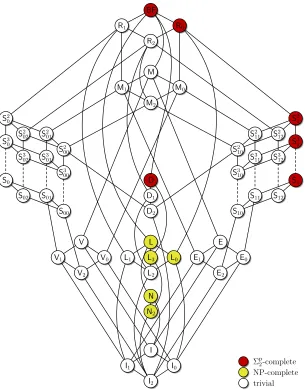
[image:4.612.155.460.140.530.2]trivial NP-complete Σp2-complete
Figure 1: Post’s lattice. Colors indicate the complexity of EXT(B), the Extension Existence
Problem for B-formulae.
expression∼las∼l:=x ifl=¬xand ∼l:=¬xifl=x. For a formulaϕ, letϕ[α/β] denote
ϕwith all occurrences of α replaced byβ, and let A[α/β]:={ϕ[α/β]|ϕ∈A} forA⊆ L.
3. Boolean Clones and the Complexity of the Implication Problem
A propositional formula using only connectives from a finite setB of Boolean functions
is called aB-formula. The set of all B-formulae is denoted byL(B). In order to cope with
the infinitely many finite sets B of Boolean functions, we require some algebraic tools to
classify the complexity of the infinitely many arising reasoning problems. A clone is a set
B of Boolean functions that is closed under superposition, i. e., B contains all projections
and is closed under arbitrary composition. For an arbitrary set B of Boolean functions,
we denote by [B] the smallest clone containing B and call B a base for [B]. In [Pos41]
BF
R1 R0
R2
M
M1 M0
M2
S2 0
S2 02 S201
S3 0
S2 00
S3 02 S301
S3 00
S0
S02 S01 S00
D
D1 D2
V V1 V0
V2
L L1 L3 L0
L2
N
N2
I I1 I0
I2 S2 1 S2 12 S2 11 S3 1 S2 10 S3 12 S3 11 S3 10 S1 S12 S11 S10 E E0 E1 E2
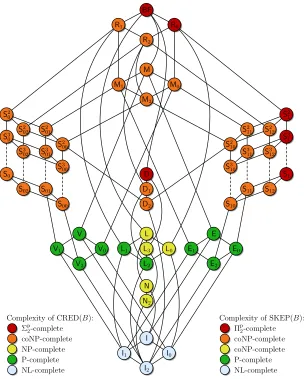
Complexity of SKEP(B):
NL-complete P-complete coNP-complete coNP-complete Πp 2-complete
Complexity of CRED(B):
[image:5.612.154.458.140.519.2]NL-complete P-complete NP-complete coNP-complete Σp 2-complete
Figure 2: Post’s lattice. Colors indicate the complexity of CRED(B) and SKEP(B), the
Credulous and Skeptical Reasoning Problem forB-formulae.
In order to introduce the clones relevant to this paper, we define the following notions for
n-ary Boolean functionsf:
• f isc-reproducing iff(c, . . . , c) =c,c∈ {0,1}.
• f ismonotone ifa1 ≤b1, a2 ≤b2, . . . , an≤bnimplies f(a1, . . . , an)≤f(b1, . . . , bn).
• f isc-separating if there exists ani∈ {1, . . . , n}such thatf(a1, . . . , an) =cimplies ai =c,c∈ {0,1}.
• f isself-dual iff ≡dual(f), where dual(f)(x1, . . . , xn) =¬f(¬x1, . . . ,¬xn).
• f islinear iff ≡x1⊕ · · · ⊕xn⊕cfor a constantc∈ {0,1}and variablesx1, . . . , xn.
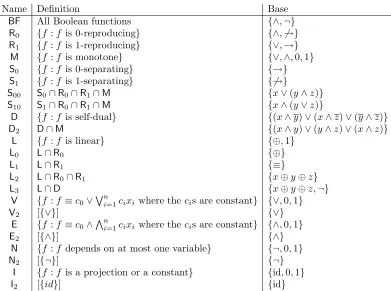
The clones relevant to this paper are listed in Table 1. The definition of all Boolean clones can be found, e. g., in [BCRV03].
For a finite setBof Boolean functions, we define theImplication ProblemforB-formulae
IMP(B) as the following computational task: given a setAofB-formulae and aB-formula
ϕ, decide whether A |= ϕ holds. The following theorem provides a classification of the
Name Definition Base
BF All Boolean functions {∧,¬}
R0 {f :f is 0-reproducing} {∧,6→}
R1 {f :f is 1-reproducing} {∨,→}
M {f :f is monotone} {∨,∧,0,1}
S0 {f :f is 0-separating} {→}
S1 {f :f is 1-separating} {6→}
S00 S0∩R0∩R1∩M {x∨(y∧z)}
S10 S1∩R0∩R1∩M {x∧(y∨z)}
D {f :f is self-dual} {(x∧y)∨(x∧z)∨(y∧z)}
D2 D∩M {(x∧y)∨(y∧z)∨(x∧z)}
L {f :f is linear} {⊕,1}
L0 L∩R0 {⊕}
L1 L∩R1 {≡}
L2 L∩R0∩R1 {x⊕y⊕z}
L3 L∩D {x⊕y⊕z,¬}
V {f :f ≡c0∨Wni=1cixi where thecis are constant} {∨,0,1}
V2 [{∨}] {∨}
E {f :f ≡c0∧Vni=1cixi where thecis are constant} {∧,0,1}
E2 [{∧}] {∧}
N {f :f depends on at most one variable} {¬,0,1}
N2 [{¬}] {¬}
I {f :f is a projection or a constant} {id,0,1}
[image:6.612.111.502.139.430.2]I2 [{id}] {id}
Table 1: A list of Boolean clones with definitions and bases.
Theorem 3.1. LetB be a finite set of Boolean functions. ThenIMP(B) iscoNP-complete if S00⊆[B],S10⊆[B]or D2 ⊆[B], and in P for all other cases.
In the above theorem, we can further classify the tractable part into⊕L-complete and
AC0-complete cases, but this refined analysis is not needed for the results of this paper.
4. Default Logic
Fix some finite setB of Boolean functions and letα, β, γ be propositional B-formulae.
A B-default (rule) is an expression d= α:βγ ;α is calledprerequisite,β is called justification
and γ is called consequent of d. A B-default theory is a pair hW, Di, where W is a set of
propositional B-formulae and D is a set of B-default rules. Henceforth will we will omit
the prefix “B-” ifB=BFor the meaning is clear from the context.
For a given default theoryhW, Di and a set of formulaeE, let Γ(E) be the smallest set
of formulae such that
(1) W ⊆Γ(E),
(2) Γ(E) is closed under deduction, i.e. Γ(E) = Th(Γ(E)), and
(3) for all defaults α:βγ ∈Dwith α∈Γ(E) and ¬β /∈E, it holds that γ ∈Γ(E). A (stable) extension of hW, Di is a fixpoint of Γ, i. e. a setE such thatE = Γ(E).
The following theorem by Reiter provides an alternative characterization of extensions:
(1) Let E0=W and Ei+1 = Th(Ei)∪γ
α:βγ ∈D, α∈Ei and ¬β /∈E .Then E is a
stable extension of hW, Di iffE =Si∈NEi.
(2) LetG=α:βγ ∈Dα∈E and ¬β /∈E . IfE is a stable extension ofhW, Di, then
E= Th(W ∪ {γ | α:βγ ∈G}).
In this case,G is also called the set of generating defaults for E.
Note that stable extensions need not be consistent. However, the following proposition
shows that this only occurs if the set W is inconsistent already.
Proposition 4.2. Let hW, Di be a default theory. Then L is a stable extension of hW, Di iff W is inconsistent.
Proof. LethW, Di be a default theory. We compute the set Γ(L) from the above definition
of Γ. The third condition does not apply, because for E = L, ¬β /∈ E is never fulfilled.
Therefore, Γ(L) = Th(W) by conditions 1 and 2. Now,Lis a fixpoint of Γ iff Th(W) =L,
i.e., if W is inconsistent.
As a consequence we obtain:
Corollary 4.3. Let hW, Di be a default theory.
• If W is consistent, then every stable extension of hW, Di is consistent. • If W is inconsistent, then hW, Di has a stable extension.
The main reasoning tasks in nonmonotonic logics give rise to the following three decision problems:
(1) the Extension Existence Problem EXT(B)
Instance: a B-default theory hW, Di Question: Has hW, Di a stable extension?
(2) the Credulous Reasoning Problem CRED(B)
Instance: a B-formula ϕand aB-default theoryhW, Di
Question: Is there a stable extension of hW, Dithat includes ϕ?
(3) the Skeptical Reasoning Problem SKEP(B)
Instance: a B-formula ϕand aB-default theoryhW, Di Question: Does every stable extension of hW, Di includeϕ?
The next theorem follows from [Got92] and states the complexity of the above decision
problems for the general case [B] =BF.
Theorem 4.4. LetB be a finite set of Boolean functions such that[B] =BF. ThenEXT(B)
and CRED(B) are Σp2-complete, whereas SKEP(B) is Πp2-complete.
Proof. The upper bounds given in [Got92] do not depend on the Boolean connectives allowed and thus hold for any finite setB of Boolean functions. For Σp2- and Πp2-hardness, it suffices to note that if [B] = BF, then there exist B-formulae f(x, y), g(x, y) and h(x) such that f(x, y)≡x∧y,g(x, y)≡x∨y,h(x) ≡ ¬xand bothx andyoccur at most once inf,g and
h [Lew79]. Hence, the hardness results proved by Gottlob [Got92] generalize to arbitrary
5. The Complexity of Default Reasoning
In this section we will classify the complexity of the three problems EXT(B), CRED(B),
and SKEP(B) for all choices of Boolean connectives B. We start with some preparations
which will substantially reduce the number of cases we have to consider.
Lemma 5.1. Let P be any of the problems EXT, CRED, or SKEP. Then for each finite set B of Boolean functions, P(B)≡cdP(B∪ {1}).
Proof. The reductions P(B)≤cdP(B∪{1}) are obvious. For the converse reductions, we will
essentially substitute the constant 1 by a new variabletthat is forced to be true (this trick
goes already back to Lewis [Lew79]). For EXT, the reduction is given byhW, Di 7→ hW′, D′i,
where W′ =W
[1/t]∪ {t}, D′ =D[1/t], and t is a new variable not occurring in hW, Di. If
hW′, D′i possesses a stable extensionE′, then t∈E′. Hence,E[t/1]′ is a stable extension of
hW, Di. On the other hand, ifEis a stable extension ofhW, Di, then Th(E[1/t]∪{t}) =E[1/t]
is a stable extension ofhW′, D′i. Therefore, each extension E ofhW, Dicorresponds to the
extensionE[1/t] of hW′, D′i, and vice versa.
For the problems CRED and SKEP, it suffices to note that the above reductionhW, Di 7→
hW′, D′ihas the additional property that for each formulaϕand each extensionEofhW, Di,
ϕ∈E iff ϕ[1/t]∈E[1/t].
The next lemma shows that, quite often,B-default theories have unique extensions.
Lemma 5.2. Let B be a finite set of Boolean functions such that[B]⊆R1 or [B]⊆M. Let hW, Di be a B-default theory with finite D. Then hW, Di has a unique stable extension.
Proof. For [B]⊆ R1, every premise, justification and consequent is 1-reproducing. As all consequences of reproducing functions are again reproducing and the negation of a
1-reproducing function is not 1-1-reproducing, the justifications inDbecome irrelevant. Hence
the characterization of stable extensions from the first item in Theorem 4.1 simplifies to the
following iterative construction: E0 =W and Ei+1 = Th(Ei)∪γα:βγ ∈D, α∈Ei .As
Dis finite, this construction terminates after finitely many steps, i.e., Ek=Ek+1 for some
k≥0. ThenE=Si≤kEi is the unique stable extension of hW, Di.
For [B] ⊆M, every formula is either 1-reproducing or equivalent to 0. As rules with
justification equivalent to 0 are never applicable, each B-default theoryhW, Di with finite
Dhas a unique stable extension by the same argument as above.
As an immediate corollary, the credulous and the sceptical reasoning problem are equiv-alent for the above choices of the underlying connectives.
Corollary 5.3. Let B be a finite set of Boolean functions such that [B]⊆R1 or [B]⊆M.
Then CRED(B)≡cdSKEP(B).
5.1. The Extension Existence Problem
Now we are ready to classify the complexity of EXT. The next theorem shows that this
is a trichotomy: the Σp2-completeness of the general case [Got92] is inherited by all clones
aboveS1andD, for a number of clones the complexity of EXT reduces to NP-completeness,
and, due to Lemma 5.2, for the majority of cases the problem becomes trivial.
(1) Σp2-complete if S1 ⊆[B]⊆BF or D⊆[B]⊆BF, (2) NP-complete if [B]∈ {N,N2,L,L0,L3}, and
(3) trivial in all other cases (i. e., if[B]⊆R1 or [B]⊆M).
Proof. ForS1 ⊆[B]⊆BF or [B] =D, observe that in both cases BF= [B∪ {1}]. Claim 1 then follows from Theorem 4.4 and Lemma 5.1.
For the second claim, it suffices to prove membership in NP for EXT(B) for every finite
B ⊆Land NP-hardness for EXT(B) for every finite B withN⊆[B]. The remaining cases
[B]∈ {N2,L0,L3} all follow from Lemma 5.1, because [N2∪ {1}] =N, [L0 ∪ {1}] =L, and [L3∪ {1}] =L.
We start by showing EXT(L) ∈ NP. Given a default theory hW, Di, we first guess a
set G ⊆ D which will serve as the set of generating defaults for a stable extension. Let
G′ =W ∪ {γ | α:βγ ∈G}. We use Theorem 4.1 to verify whether Th(G′) is indeed a stable
extension of hW, Di. For this we inductively compute generators Gi for the sets Ei from
Theorem 4.1, until eventuallyEi =Ei+1 (note, that becauseDis finite, this always occurs).
We start by setting G0 =W. Given Gi, we check for each rule α:βγ ∈ D, whetherGi |= α
and G′6|=¬β (as all formulas belong to L(B), this is possible by Theorem 3.1). If so, then
γ is put into Gi+1. If this process terminates, i.e., if Gi = Gi+1, then we check whether
G′ =Gi. By Theorem 4.1, this test is positive iffGgenerates a stable extension of hW, Di.
To show NP-hardness of EXT(B) for N⊆[B], we will ≤cd-reduce 3SAT to EXT(B).
Letϕ=Vni=1(li1∨li2∨li3) andlij be literals over propositions{x1, . . . , xm}for 1≤i≤n,
1≤j≤3. We transformϕto theB-default theory hW, Dϕi, whereW :=∅ and
Dϕ :=
1 :xi
xi
1≤i≤m
∪
1 :¬xi
¬xi
1≤i≤m
∪
∼l
iπ(1):∼liπ(2) liπ(3)
1≤i≤n, π is a permutation of {1,2,3}
.
To prove the correctness of the reduction, first assumeϕto be satisfiable. For each satisfying
assignmentσ :{x1, . . . , xm} → {0,1} forϕ, we claim that
E := Th({xi|σ(xi) = 1} ∪ {¬xi |σ(xi) = 0})
is a stable extension ofhW, Dϕi. We will verify this claim with the help of the first part of
Theorem 4.1. Starting with E0 =∅, we already get E1 =E by the default rules 1:xixi and
1:¬xi
¬xi inDϕ. Asσ is a satisfying assignment forϕ, each consequent of a default rule inDϕ is
already in E. HenceE2 =E1 and thereforeE =Si∈NEi is a stable extension ofhW, Dϕi.
Conversely, assume that E is a stable extension of hW, Dϕi. Because of the default
rules 1:xi
xi and 1:¬x i
¬xi , we either get xi ∈E or¬xi ∈E for all i= 1, . . . , m. The rules of the
type ∼li1:∼li2
li3 ensure thatE contains at least one literal from each clauseli1∨li2∨li3 inϕ.
AsE is deductively closed, E contains ϕ. By Corollary 4.3, the extensionE is consistent,
and therefore ϕis satisfiable.
Finally, the third item of the theorem directly follows from Lemma 5.2.
5.2. The Credulous and the Sceptical Reasoning Problem
is indeed a finite characterization of some stable extension — a task that requires to test for
formula implication. Whence the Σp2-completeness of CRED(B) and the Πp2-completeness of
SKEP(B) if [B] =BF. Depending on the Boolean connectives allowed, one or both tasks can
be performed in polynomial time. We obtain coNP-completeness for clones that guarantee the existence of a stable extension but whose implication problem remains coNP-complete. Conversely, if the implication problem becomes easy, but determining an extension
candi-dates is hard, then CRED(B) is NP-complete, while SKEP(B) has to test for all extensions
and is coNP-complete. This is the case for the clones [B]∈ {N,N2,L,L0,L3}. Finally, for
clonesBthat allow for solving both tasks in polynomial time, CRED(B) and SKEP(B) are
in P. The complete classification of CRED(B) is given in the following theorem.
Theorem 5.5. Let B be a finite set of Boolean functions. ThenCRED(B) is
(1) Σp2-complete if S1 ⊆[B]⊆BF or D⊆[B]⊆BF,
(2) coNP-complete if X⊆[B]⊆Y, where X ∈ {S00,S10,D2} and Y ∈ {R1,M}, (3) NP-complete if [B]∈ {N,N2,L,L0,L3},
(4) P-complete if V2⊆[B]⊆V, E2 ⊆[B]⊆E or [B]∈ {L1,L2}, and (5) NL-complete if I2⊆[B]⊆I.
The proof of Theorem 5.5 follows from the upper and lower bounds given in the Propo-sitions 5.6 and 5.7 below.
Proposition 5.6. LetB be a finite set of Boolean functions. Then CRED(B) is contained
(1) in Σp2 if S1 ⊆[B]⊆BF or D⊆[B]⊆BF, (2) in coNPif [B]⊆R1 or [B]⊆M,
(3) in NP if [B]⊆L,
(4) in P if[B]⊆V, [B]⊆Eor [B]⊆L1, and (5) in NL if [B]⊆I.
Algorithm 1 Determine existence of a
stable extension of hW, Di containing ϕ.
Require: hW, Di, ϕ
1: Gnew←W 2: repeat
3: Gold←Gnew 4: for all αγ:β ∈D do
5: if Gold|=αthen 6: Gnew←Gnew∪ {γ} 7: end if
8: end for
9: untilGnew=Gold 10: if Gnew|=ϕthen 11: return true
12: else
13: return false
14: end if Proof. Part 1 follows from Theorem 4.4 and
Lemma 5.1.
For [B] ⊆ R1, let hW, Di be an R1-default
theory andϕ∈ L(R1). As for every default rule
α:β
γ ∈Dwe can never derive¬β (as¬β is not
1-reproducing), the justifications β are irrelevant
for computing a stable extension. Thence, using the characterization in the first part of Theo-rem 4.1, we can iteratively compute the
appli-cable defaults and eventually check whether ϕ
is implied by W and those generating defaults.
Algorithm 1 implements these steps on a deter-ministic Turing machine using a coNP-oracle to
test for implication of B-formulae. Clearly,
Al-gorithm 1 terminates after a polynomial num-ber of steps. Moreover, Algorithm 1 is a
mono-tone ≤pT-reduction from CRED(B) to IMP(B),
in the sense that for any deterministic oracle
Turing machine M that executes Algorithm 1,
A⊆B impliesL(M, A)⊆L(M, B), where L(M, X) is the language recognized by M with
For [B] ⊆ M, Algorithm 1 can be easily adopted, because we are restricted to 1-reproducing functions and the constant 0. Thus, before executing Algorithm 1, we just
delete all rules α:βγ withβ ≡0 fromD, as these rules are never applicable.
For [B]⊆L, we proceed similarly as in the proof of item 2 in Theorem 5.4. First, we
guess a setGof generating defaults and subsequently verify that both Th(W∪{γ | α:βγ ∈G})
is a stable extension and thatW ∪ {γ | α:βγ ∈G} |=ϕ. Using Theorem 3.1, both conditions
may be verified in polynomial time.
For [B]⊆V, [B]⊆E, and [B] ⊆L1, we again use Algorithm 1. As for these types of
B-formulae, we have an efficient test for implication (Theorem 3.1), CRED(B)∈P.
For [B]⊆I, we show that CRED(B) is constant-depth reducible to the graph
accessi-bility problem, GAP, a problem that is ≤cd-complete for NL. Let hW, Di be an I-default
theory with D={αi:βiγi |1≤i≤ k} and let ϕ be an I-formula. We transform (hW, Di, ϕ)
to the GAP-instance (G,Vψ∈Wψ, ϕ), whereG= (V, E) is a directed graph with
V :={αi |1≤i≤k} ∪ {γi|1≤i≤k} ∪ {Vψ∈W ψ, ϕ}and E :={(αi, γi)|1≤i≤k} ∪ {(u, v)∈V |u|=v} .
Then ϕ is included in the (unique) stable extension of hW, Di iff G contains a path from
V
ψ∈Wψto ϕ. As implication testing for allB⊆Iis possible in AC0, CRED(B)≤cdGAP.
We will now establish the lower bounds required to complete the proof of Theorem 5.5.
Proposition 5.7. Let B be a finite set of Boolean functions. ThenCRED(B) is
(1) Σp2-hard if S1 ⊆[B]or D⊆[B],
(2) coNP-hard if S00⊆[B], S10⊆[B]or D2 ⊆[B], (3) NP-hard if N2 ⊆[B]or L0 ⊆[B],
(4) P-hard ifV2 ⊆[B], E2 ⊆[B]or L2 ⊆[B], and
(5) NL-hard for all other clones.
Proof. Part 1 follows from Theorem 4.4 and Lemma 5.1.
For S00 ⊆ [B], S10 ⊆ [B], and D2 ⊆ [B], coNP-hardness is established by a ≤cd
-reduction from IMP(B). Let A⊆ L(B) and ϕ∈ L(B). Then the default theoryhA,∅i has
the unique stable extension Th(A), and henceA|=ϕiff (hA,∅i, ϕ)∈CRED(B). Therefore,
IMP(B)≤cdCRED(B), and the claim follows with Theorem 3.1.
For the third item, it suffices to prove NP-hardness for N2 ⊆ [B]. For L0 ⊆ [B], the
claim then follows by Lemma 5.1. For N2 ⊆ [B], we obtain NP-hardness of CRED(B)
by adjusting the reduction given in the proof of item 2 of Theorem 5.4. Consider the
mapping ϕ 7→ (h{ψ}, Dϕi, ψ), where Dϕ is the set of default rules constructed from ϕ
in Theorem 5.4, and ψ is a satisfiable B-formula such that ϕ and ψ do not use common
variables. By Theorem 5.4,ϕ∈3SAT iffh{ψ}, Dϕihas a stable extension. As any extension
of h{ψ}, Dϕi contains ψ, we obtain 3SAT≤cdCRED(B) via the above reduction.
To prove P-hardness forE2 ⊆[B],V2⊆[B], and [B]∈ {L1,L2}, we provide a reduction from the accessibility problem for directed hypergraphs, HGAP. HGAP is P-complete under
≤cd-reductions [SI90]. In directed hypergraphsH = (V, E), hyperedges e∈E consist of a
set of source nodes src(e) ⊆V and a destination dest(e) ∈V. Instances of HGAP contain
We transform such an instance (H, S, t) to the CRED({∧})-instance (hW, Di, ϕ), where
W :={ps|s∈S}, D:=
V
v∈src(e)pv : Vv∈src(e)pv pdest(e)
e∈E
, ϕ:=pt
with pairwise distinct propositions pv forv∈V. For V2⊆[B], we set
W :={_
s /∈S
ps}, D:=
W
v∈V\src(e)pv : Wv∈V\src(e)pv
W
v∈V\(src(e)∪{dest(e)})pv
e∈E
, ϕ:= _
v∈V\{t} pv.
For [B]∈ {L1,L2}, we again modify the above reduction and map (H, S, t) to the CRED(B )-instance
W :={ps|s∈S}, D:=
≡
v∈src(e) pv : ≡v∈src(e)pv pdest(e)
e∈E
, ϕ:=pt.
The correctness of these reductions is easily verified.
Finally, it remains to show NL-hardness for I2 ⊆ [B]. We give a ≤cd-reduction from
GAP to CRED({id}). For a directed graphG= (V, E) and two nodess, t∈V, we transform
the GAP-instance (G, s, t) to the CRED(I2)-instance
W :={ps}, D:=
pu:pu pv
(u, v)∈V
, ϕ:=pt.
Clearly, (G, s, t)∈GAP iffϕis contained in all stable extensions ofhW, Di.
Finally, we will classify the complexity of the sceptical reasoning problem. The analysis is similar to the classification of the credulous reasoning problem (Theorem 5.5).
Theorem 5.8. Let B be a finite set of Boolean functions. ThenSKEP(B) is
(1) Πp2-complete if S1⊆[B]⊆BF or D⊆[B]⊆BF,
(2) coNP-complete if X⊆[B]⊆Y, where X ∈ {S00,S10,N2,L0} and Y ∈ {R1,M,L}, (3) P-complete if V2⊆[B]⊆V, E2 ⊆[B]⊆E or [B]∈ {L1,L2}, and
(4) NL-complete if I2⊆[B]⊆I.
Proof. The first part again follows from Theorem 4.4 and Lemma 5.1.
For [B]∈ {N,N2,L,L0,L3}, we guess similarly as in Theorem 5.4 a setGof defaults and
then verify in the same way whether W and Ggenerate a stable extension E. If not, then
we accept. Otherwise, we check if E |=ϕand answer according to this test. This yields a
coNP-algorithm for SKEP(B). Hardness for coNP is achieved by modifying the reduction
from Theorem 5.4 (cf. also the proof of Proposition 5.7): mapϕto (h∅, Dϕi, ψ), whereDϕ
is defined as in the proof of Theorem 5.4, andψ is a B-formula such that ϕand ψ do not
share variables. Then ϕ /∈3SAT iffh∅, Dϕi does not have a stable extension. The latter is
true iffψis in all extensions of h∅, Dϕi. Hence 3SAT≤cdSKEP(B), establishing the claim.
For all remaining clones B, observe that [B] ⊆ R1 or [B]⊆ M. Hence, Corollary 5.3
and Theorem 5.5 imply the claim.
6. Conclusion
nonmonotonic reasoning. The complexity of the extension existence problem shows an in-teresting similarity to the complexity of the satisfiability problem [Lew79], because in both
cases the hardest instances lie above the cloneS1 (with the exception that instances fromD
are still hard for EXT, but easy for SAT). The complexity of the membership problems, i.e., credulous and skeptical reasoning, rests on two sources: first, whether there exist unique extensions (cf. Lemma 5.2), and second, how hard it is to test for formula implication. For
this reason, we also classified the complexity of the implication problem IMP(B).
In the light of our present contribution, it is interesting to remark that by results of Konolige [Kon88], propositional default logic and Moore’s autoepistemic logic are essentially equivalent. Even more, the translation is efficiently computable. Unfortunately, this trans-lation requires a complete set of Boolean connectives, whence our results do not immediately transfer to autoepistemic logic. It is nevertheless interesting to ask whether the exchange of
default rules with the introspective operatorLyields further efficiently decidable fragments.
Acknowledgements
We thank Ilka Schnoor for sending us a manuscript with the proof of the NP-hardness
of EXT(B) for allB such thatN2 ⊆[B]. We also acknowledge helpful discussions on various
topics of this paper with Peter Lohmann.
References
[BCRV03] E. B¨ohler, N. Creignou, S. Reith, and H. Vollmer. Playing with Boolean blocks, part I: Post’s lattice with applications to complexity theory.SIGACT News, 34(4):38–52, 2003.
[Got92] G. Gottlob. Complexity results for nonmonotonic logics.Journal of Logic Computation, 2(3):397– 425, 1992.
[Kon88] K. Konolige. On the relation between default and autoepistemic logic. Artificial Intelligence, 35(3):343–382, 1988. Erratum: Artificial Intelligence, 41(1):115.
[KS91] H. A. Kautz and B. Selman. Hard problems for simple default logics. Artificial Intelligence, 49:243–279, 1991.
[Lew79] H. Lewis. Satisfiability problems for propositional calculi.Mathematical Systems Theory, 13:45– 53, 1979.
[Pap94] C. H. Papadimitriou.Computational Complexity. Addison-Wesley, Reading, MA, 1994.
[Pos41] E. Post. The two-valued iterative systems of mathematical logic.Annals of Mathematical Studies, 5:1–122, 1941.
[Rei80] R. Reiter. A logic for default reasoning.Artificial Intelligence, 13:81–132, 1980.
[Rei03] S. Reith. On the complexity of some equivalence problems for propositional calculi. InProceedings of the 28th International Symposium on Mathematical Foundations of Computer Science, pages 632–641, 2003.
[Sel82] A. L. Selman. Reductions on NP and p-selective sets.Theoretical Computer Science, 19:287–304, 1982.
[SI90] R. Sridhar and S. Iyengar. Efficient parallel algorithms for functional dependency manipulations. In Proceedings of the 2nd International Symposium on Databases in Parallel and Distributed Systems, pages 126–137, 1990.
[Sti90] J. Stillman. It’s not my default: The complexity of membership problems in restricted propo-sitional default logics. In Proceedings of the 8th National Conference on Artificial Intelligence, pages 571–578, 1990.
[Sti92] J. Stillman. The complexity of propositional default logics. In Proceedings of the 10th National Conference on Artificial Intelligence, pages 794–800, 1992.
Appendix A. The Complexity of the Implication Problem
LetB be a finite set of Boolean functions. The Implication Problem forB-formulae is
defined as
Problem: IMP(B)
Instance: A setA ofB-formulae and aB-formulaϕ.
Question: Does A|=ϕhold?
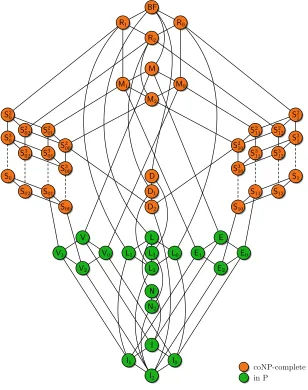
We have already stated the classification of the complexity of IMP(B) in Theorem 3.1
(cf. also Fig. 3):
Theorem 3.1. LetB be a finite set of Boolean functions. ThenIMP(B) iscoNP-complete if S00⊆[B],S10⊆[B]or D2 ⊆[B], and in P for all other cases.
We split the proof of Theorem 3.1 into several lemmas.
BF
R1 R0
R2
M
M1 M0
M2
S2 0
S2 02 S201
S3 0
S2 00
S3 02 S301
S3 00
S0
S02 S01
S00
D
D1
D2
V
V1 V0
V2
L
L1 L3 L0
L2
N
N2
I
I1 I0
I2
S2 1
S2 12
S2 11
S3 1
S2 10
S3 12
S3 11
S3 10
S1
S12 S11
S10
E
E0 E1
E2
in P
[image:14.612.153.461.327.717.2]coNP-complete
Figure 3: Post’s lattice. Colors indicate the complexity of IMP(B), the Implication Problem
Lemma A.1. Let B be a finite set of Boolean functions. The implication problem for propositional B-formulae, IMP(B), is coNP-complete if S00⊆[B]or S10⊆[B].
Proof. Membership in coNP is apparent, because givenAandϕ, we just have to check that
for all assignmentsσ to the variables of Aand ϕ, eitherσ 6|=Aor σ|=ϕ.
The hardness proof is inspired by [Rei03]. Observe that IMP(B)≡cd IMP(B∪ {1}) if
∧ ∈[B], and that IMP(B)≡cdIMP(B∪ {0}) if∨ ∈[B] (becauseϕ|=ψ ⇐⇒ ϕ[1/t]∧t|=
ψ[1/t] and ϕ|=ψ ⇐⇒ ϕ[0/f]|=ψ[0/f]∨f wheret, f are new variables). It hence suffices to
show that IMP(B) is coNP-hard for M0 = [S00∪ {0}] and M1 = [S10∪ {1}]. We will show
that IMP(B) is coNP-hard for each base B with M2 ⊆ [B]. To prove this claim, we will
provide a reduction from TAUTDNF to IMP(B), where TAUTDNF is the coNP-complete
problem to decide, whether a given propositional formula in disjunctive normal form is a tautology.
Let ϕ be a propositional formula in disjunctive normal form over the propositions
X = {x1, . . . , xk}. Then ϕ = Wni=1Vmj=1lij, where lij are literals over X. We take new
variables Y = {y1, . . . , yk} and replace in ϕ each negative literal lij = ¬xl by yl. Let ϕ′
be the resulting formula. Now define ψ1 := Vki=1(xi ∨yi) and ψ2 := ϕ′. We claim that
ϕ∈TAUTDNF ⇐⇒ ψ1 |=ψ2.
Let us first assume ϕ∈ TAUTDNF and let σ:X∪Y → {0,1} be an assignment such
that σ |= ψ1. As ϕ is a tautology, σ |= ϕ. But also σ |= ϕ′, as we simply replaced the
negated variables in ϕ by positive ones and ϕ′ is monotone. As σ was arbitrarily chosen,
ψ1|=ψ2.
For the opposite direction, letϕ /∈TAUTDNF. Then there exists an assignmentσ:X →
{0,1} such that σ 6|= ϕ. We extend σ to an assignment σ′: X ∪Y → {0,1} by setting
σ′(y
i) = 1−xi for i = 1, . . . , k. Then σ′(xi) = 0 iff σ′(yi) = 1, and consequently σ′
simulates σ on ϕ′. As a result, σ′ 6|=ϕ′ =ψ2. Yet, either σ′(xl) = 1 or σ′(yl) = 1 and thus σ′ |=ψ1, yielding ψ16|=ψ2.
Lemma A.2. Let B be a finite set of Boolean functions. Then IMP(B) is coNP-complete if D2⊆[B].
Proof. Again we just have to argue for coNP-hardness of IMP(B). As D2 ⊆[B], we know thatg(x, y, z) := (x∧y)∨(y∧z)∨(x∧z)∈[B]. Clearly,g(x, y,0) =x∧yandg(x, y,1) =x∨y.
Denote by ψB
i , i∈ {1,2}, the formula ψi with all occurrences of x∧y and x∨y replaced
with a B-representation of g(x, y, f) and g(x, y, t), resp.
We give a reduction from the general coNP-hard implication problem IMP(B) for [B] =
BFto IMP(B) for [B]⊆D2 by a modification of the reduction given in the proof of Lemma
A.1. We map a pair (ψ1, ψ2) of propositional formulae to ({ψ1′, t}, ψ′2) where
ψ′1:=g(g(ψB1 , t, f), f, t) andψ2′ :=g(g(ψ2B, t, f), f, t).
As the variables x and y may occur several times in g, ψB
1 and ψ2B might be exponential
in the length ofϕ (recall thatψ2 isϕ with all negative literals replaced by new variables).
That this is not the case follows from the associativity of∧and∨: insert parentheses in such
a way that we get a tree of logarithmic depth. We claim thatψ1|=ψ2 ⇐⇒ {ψ1′, t} |=ψ2′.
Let σ be an arbitrary assignment for the variables in ϕ. Then σ may be extended to
{f, t} in the following ways:
σ(t) := 0: Then{ψ′
1, t} ≡0 and{ψ′1, t} |=ψ′2.
σ(t) := 1, σ(f) := 1: In this case,g(g(ψ1B, t, f), f, t)≡1≡g(g(ψB2 , t, f), f, t) and thus
σ(t) := 1, σ(f) := 0: Then ψ1′ = g(g(ψB1 , t, f), f, t) ≡ (ψ1B ∧t) ∨f ≡ ψ1 and ψ2′ = g(g(ψB
2 , t, f), f, t)≡(ψ2B∧t)∨f ≡ψ2. Thusψ1|=ψ2 iff{ψ′1, t} |=ψ′2.
Hence, as claimed, ψ1 |=ψ2 ⇐⇒ {ψ′1, t} |=ψ′2.
Lemma A.3. Let B be a finite set of Boolean functions such that [B] ⊆ V, [B] ⊆ E or [B]⊆L. Then IMP(B) is in P.
Proof. Consider the case [B]⊆Vfirst. LetB be a finite set of Boolean functions such that
[B]⊆V. Let A be a finite set ofB-formulae and let ϕ be aB-formula such thatA and ϕ
only use the variables x1, . . . , xn. Let ϕ≡c0∨c1x1∨ · · · ∨cnxn with constants ci ∈ {0,1}
for 0 ≤ i ≤ n. Equally, every formula from A is equivalent to an expression of the form
c′0∨c′1x1∨ · · · ∨c′nxnwithc′i ∈ {0,1}. Then,A|=ϕiff either c0= 1 or there exists a formula ψ≡c′
0∨c′1x1∨ · · · ∨c′nxn from A such thatc′i ≤ci for all 0≤i≤n.
The value ofc0can be determined by evaluatingϕ(0, . . . ,0). Furthermore, for 1≤i≤n, ci = 0 iffc0 = 0 and
ϕ(0, . . . ,0 | {z }
i−1
,1,0, . . . ,0) = 0.
The values of the coefficients of formulae inA can be computed analogously. Thus IMP(B)
can be computed in constant depth using oracle gates for B-formula evaluation. As B
-formula evaluation is in P, the claim follows.
In the case [B]⊆E, the proof is analogous to the above proof for [B]⊆V.
For the remaining case, letBbe a finite set of Boolean functions with [B]⊆L. In order
to show thatB-implication is polynomial-time solvable, observe thatF |=αiffF∪ {α⊕1}
is inconsistent. Let F′ denote F∪ {α⊕1} rewritten such that for allϕ∈F′,
ϕ=c0⊕c1x1⊕ · · · ⊕cnxn,
where c0, . . . , cn ∈ {0,1}. F′ is polynomial-time constructible, sincec0 can be determined
by evaluatingϕ(0, . . . ,0), and fori= 1, . . . , n,ci = 1 iff ϕ(0, . . . ,0) 6≡ϕ(0, . . . ,0
| {z }
i−1
,1,0, . . . ,0).
F′ can now be transformed into a system of linear equationsS via
c0⊕c1x1⊕ · · · ⊕cnxn 7→ c0+c1x1+· · ·+cnxn= 1 (mod 2).
Clearly, the resulting system of linear equations has a solution iff F′ is consistent. The
equations are furthermore defined over the fieldZ2 and can thence be solved in polynomial