promoting access to White Rose research papers
White Rose Research Online
[email protected]
Universities of Leeds, Sheffield and York
http://eprints.whiterose.ac.uk/
This is an author produced version of a paper published in
10th IEEE
International Conference on Computer and Information Technology
White Rose Research Online URL for this paper:
http://eprints.whiterose.ac.uk/74969/
Published paper:
Sargeant, AJ, Webster, DE, Djemame, K and Xu, J (2010)
Testing the
Effectiveness of Dynamic Binding in Web Services.
In: 10th International
conference on computer and information technology. International Workshop on
Dependable Service-Oriented Computing (DSOC 2010) at the 10th IEEE
International Conference on Computer and Information Technology (CIT 2010),
29 June - 1 July 2010, Bradford.
Testing the Effectiveness of Dynamic Binding in Web Services
Anthony Sargeant, David Webster, Karim Djemame and Jie Xu
School of Computing
University of Leeds
LS2 9JT
United Kingdom
{
scs5ajs, d.e.webster, k.djemame, j.xu
}
@leeds.ac.uk
Abstract
In recent years, Service Oriented Architectures (SOA) have risen in use as an architectural style for distributed systems. They have many desirable features such as flexi-bility, software reuse and cost benefits. In addition to this, SOA enables and indeed encourages the binding of ser-vices at runtime in the form of dynamic binding. Here, services are bound to service requests at runtime and the choice of service is determined with minimal user interven-tion. Presently, Web Services have risen as the de facto implementation of SOA and existing research for the test-ing of Web Services have assumed the choice of service at design-time. However, dynamic binding of services raises several additional challenges, such as managing complex-ity in service compositions using dynamic binding and non-deterministic behaviour in service selection. Few research exists that involve dynamic binding but with limitations as they do not consider the dynamic binding system itself. This paper focusses on the importance of the dynamic binding system and proposes a technique that can be used to test dynamic binding systems such that the behaviour of the al-gorithm can be determined.
1 Introduction
Service Oriented Computing (SOC) represents a move from traditional computer architectures such as mainframe computing, to more distributed architecture styles such as Service Oriented Architectures. Service Oriented Architec-ture (SOA) offers an architecArchitec-ture where software function-ality is encapsulated in discrete services, each of which can be discovered and bound to at either design time, or runtime [1].
Services within SOAs are considered to be software that is used, but not owned and traditionally offer functionality on a per-use basis [2]. Each service can be either a single
oratomic service, or a composite service, itself made up from one or more atomic/composite services which are ag-gregated as a workflow. Service consumers are loosely cou-pled to services via well defined interfaces, and use standard methods for intercommunication. Over recent years, Web Services technology has emerged as the de facto implemen-tation of SOA [3] and is experiencing widespread adoption, along with Web Services Business Process Execution Lan-guage (WS-BPEL) — an XML-based workflow composi-tion language — as a popular orchestracomposi-tion language [4].
With the introduction of this new paradigm, comes new challenges. In particular as services are potentially de-veloped independently, consumers can have a variety of functionally-equivalent services to choose from, each hav-ing a different Quality of Service. Moreover, traditional software testing techniques have been shown to be inappro-priate with respect to SOAs due to the black-box nature of
services [2]. One of the promises of SOA isDynamic
Bind-ing of services, where service requests are bound to
con-crete services at runtime [3, 5, 6, 7].
Existing research considers the challenges of testing in SOA through a variety of test frameworks. In each of these frameworks, the focus is on SOA through static binding of services, where requests are bound to services that are cho-sen at design time. This paper examines these approaches and considers their suitability with respect to implementing SOA through dynamic binding of services.
to be deterministic and compared against expected output. The structure of this paper is as follows: Section 2 dis-cusses the characteristics of SOA both in terms of static and dynamic binding. Section 3 gives a brief overview of software testing and existing approaches to the testing of Web Services. Section 4 discusses the limitations of current work and suggests approaches that can be used to test the behaviour of dynamic binding algorithms in Web Services. Section 5 proposes a prototype implementation of a system that will be a platform for the testing of dynamic binding algorithms in Web Services. Finally we present our conclu-sions and proposed future work in Section 6.
2 Service Oriented Architecture (SOA)
SOA uses a ‘service-centric’ approach which enables the composition of applications by binding together discov-ered services that are located across a network to achieve a particular goal. Services themselves reside in a heteroge-nous environment and are linked together using standard, message-based protocols and thus the composed service is ultimately platform independent [9]. As a result of these service compositions, one service may be the client of an-other.
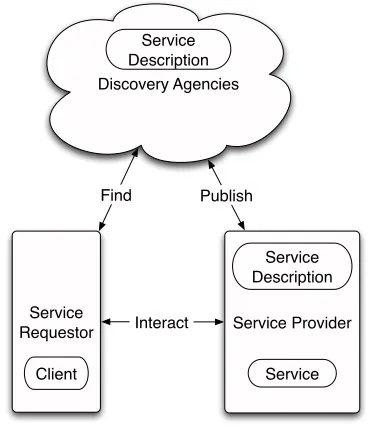
The Web Services model has three clear roles [10]: Ser-vice Requestor, SerSer-vice Provider and Discovery Agency.
The Service Requestor (also referred to as a consumer)
is the requestor of a particular service. In order to find the required service that meets the needs of the consumer, they can consult a Directory Agency (also referred to as a registry), such as a Universal Description Discovery and Integration (UDDI) registry, which acts like a ‘yellow pages’ of services offered by various providers. Finally, services are delivered by Service Providers (referred to as
providers) and registered with the directory agency so that consumers can find them. [10]
2.1 Dynamic Binding of Web Services
The Web Services Architecture as illustrated in Figure 1, is an example of services that are discovered at design time and which are then statically bound at runtime. This is the form of binding that features in existing research. In this instance, the consumer binds to exactly one provider for all service requests of a given type at runtime. This method of very early binding results in a tight-coupling of consumers to services as re-binding requires the selection of a new ser-vice and connection to that new serser-vice by the user [11].
SOA enables and promotes the late-binding of service requests to services at runtime in the form of dynamic bind-ing. In contrast to static binding, dynamic binding pro-vides the ability to bind to services dynamically at runtime
Discovery Agencies
Service
Requestor Service Provider
Client
Service Description
Service Service
Description
Publish Find
[image:3.595.334.519.79.292.2]Interact
Figure 1. The Web Services Architecture as defined by the W3C in [10].
whereby a request for a service is bound to a suitable con-crete service [3, 5]. One of the key aspects of dynamic bind-ing that most literary sources agree on, is the need to have a broker to manage the binding of a service request, to a provider. In this instance, a consumer forms an abstract re-quest, that is to say that they need to use a particular service of a given type, and at runtime, they delegate the decision of which concrete service to use to the broker. The broker, via a discovery mechanism, will discover candidate services that best meet the request and choose the most appropriate service to bind to. The response from the concrete service is then able to be passed back to the consumer via the broker. The challenge here is because the service provider is not known in advance, the choice of service to bind to must be delegated at runtime. This requires the use of a service broker that can connect service requests to the concrete ser-vice implementation. To achieve this, the broker chooses the most appropriate service using an algorithm. An exam-ple of a simexam-ple algorithm would be: 1. Select candidate services; 2. Rank services in a particular order; 3. Select the top service to bind to.
Choosing the most appropriate service is not as straight-forward when we consider multiple services in a workflow such as those defined using BPEL. An example of this is in the work of Mabrouk et al. in [7]. The authors state that de-cisions made at runtime are subject to time-constraints and that choosing an optimal service composition from a pool of services is NP-hard.
algo-rithm is the choice of service to bind to, we must consider the factors that affect the decision. In the literature, factors such as functional and nonfunctional requirements of the user, the scenario context and fluctuations in the Quality of Service (QoS) attributes of the candidate services all con-tribute to the behaviour of the dynamic binding algorithm [12].
3 Software Testing and Web Services
Software Testing is a relatively new discipline, with a short history beginning in the 1950s. Most sources agree the purpose of software testing is to prove that a piece of software is fit for the purpose to which it is intended [13].
3.1 Testing Strategies
In the present literature, there are three key strategies
for the testing of software systems; Unit Testing aims to
test small programs or, in the case of object-oriented pro-gramming, individual objects of a program. Unit tests are in no way a guarantee that when two objects are combined to form a program, the subsequent combination is free of
faults. It is for this reason thatIntegration Testingis the next
stage of a traditional test plan and aims to find emergent faults that arise from interactions between objects. Finally
System Testingis described by [14] to be the most complex phase of testing and can be considered to be a higher level of integration testing. However, it also involves many other types of testing such as user-acceptance testing which is be-yond the scope of our research.
3.2 Web Services Test Frameworks
Web Services can be distributed across networks and de-veloped by various vendors. Consequently, when vendors implement Web Services, service consumers may not have access to the source code or the execution environment [2]. Furthermore, if the service composition is particularly com-plex, the number of services and possible combinations of services could be large [7]. It is for these reasons that tradi-tional testing techniques are not applicable as they require access to the system source code [15]. To overcome some of these issues, several authors have suggested new test-ing techniques and/or frameworks that help consumers to assert a level of trust upon a service or composition of ser-vices. Despite this, there are common patterns of test frame-work: Service-based, Middleware-based, Model-based, and Development-based.
With a service-based framework, the focus is aimed at testing the services themselves. Due to the challenges as-sociated with testing remote services, many research efforts consider Web Services as black-box systems. Test cases are
generated by deriving information about the services inter-face [16].
In middleware-based frameworks, the emphasis shifts away from testing the services themselves, to testing aspects of the middleware such as the workflow composition, or us-ing a broker-architecture as launchpad for testus-ing of services [3, 1].
Model-based testing, for instance the work of [1], aims to test services by using a modelling language to generate test cases that are then applied to the services themselves.
Development-based test frameworks such as proposed by Canfora and Di Penta in [2] look to create test services based around existing services. When there is a need to test the service, the test interface is called.
It is worth noting the increasing use of ontologies to give semantic meaning to services. Work by [3] suggests that ap-plying semantic meaning to services, will aid the automatic selection and testing of services and hence dynamic bind-ing. Despite ongoing research efforts, semantic approaches are still not widely used in practice [17] therefore, imple-menting a semantic framework for the selection of services is beyond the scope of this research.
4 Dynamic Binding in Web Services —
Test-ing Challenges and Opportunities
As we have seen thus far, there are many approaches to testing a service-oriented system. What is evident from the literature is that current research efforts have not ap-proached the testing of Web Services from a dynamic bind-ing perspective. Indeed, only Karam et al. in [1] considers creating a methodology for testing dynamically composed Web Services as part of their future work. Due to the ben-efits that a dynamic binding brings however, it is necessary to incorporate the testing of the dynamic binding system in addition to using existing techniques.
Many of the existing test frameworks for Web Services assume static binding of services. That is to say that the ser-vices requested are known at design time and as such these testing approaches can be employed. These approaches can still be applied to the dynamic binding of Web Services but with the drawback that none of these approaches consider the dynamic binding system.
As in a static context, service-based testing focuses on the testing of the services themselves. Although testing an individual service does not require the use of a dynamic binding mechanism, the use of dynamic binding can be used to select a service either randomly or based on certain cri-teria such as nonfunctional requirements, i.e. Service Level Agreement (SLA) or functional requirements, such as a par-ticular operation to be tested.
dynamic binding system might be in the form of an Enter-prise Service Bus (ESB) or intelligent UDDI registry. By incorporating dynamic binding into the testing strategy, it is possible to test the system’s ability to rebind services or the ability to execute the workflow correctly. Alternatively, it can be used to assert a level of confidence on the workflow composition itself. In model-based testing approaches, the test cases are generated based on modelling the behaviour of the service under test, or the composition of services under test. In this instance, dynamic binding can be incorporated by using a dynamic modelling language such as Petri nets which help to model nondeterministic systems [3]. Using a dynamic binding system, the selection of a service to be bound, is determined by certain factors (response time, cost, etc) if a truly random choice is not employed. Even so, it is still possible to assign probabilistic values to services based on those factors.
Development-based frameworks seek to incorporate el-ements of testing and/or create separate test interfaces for the purposes of testing services. In this instance, dynamic binding would allow the selection of a test interface based on similar criteria as with selecting a normal service.
In each of the above examples the common factor is how to incorporate dynamic binding into these frameworks. In each instance, the way the binding system works changes according to the desired outcome of each test framework. Given the outcome and the number of factors that can affect the behaviour of the binding system, it is clear that the im-plementation of the system itself, is just as important as de-termining the validity of the resulting bound services. Yet, previous work in this area does not consider the behaviour of the system beyond the output of the system — the sys-tem is treated as a ‘black-box’ with the assumption that if the output is what is expected, then the system is function-ing correctly.
To illustrate this, let us consider the dynamic binding system itself. Consequently the system potentially may be subject to faults like any other system. For example, con-sider two candidate services that have functionally and se-mantically equivalent operations. In this instance, the dy-namic binding system can choose to use either services. We acknowledge that were one service to change its interface, then there is a risk of an interface mismatch that can lead to an“interaction fault”as per the taxonomy by Avizienis et. al in [18]. In this current work, we are not addressing this problem, but is scheduled to be the subject of future work.
5 Prototype Solution
It is the focus of current and future research to assess the dependability of dynamic binding in Web Services as it provides us with a convenient real-world implementation of SOA in which to conduct our experimentation. Our
pro-posed methodology is to use a simulation-based approach in order to implement and assess binding systems. Much like the work of [19], this research will focus on the middleware layer, such as an intelligent broker or ESB-based solution as it is here where the dynamic binding system resides.
5.1 System Model
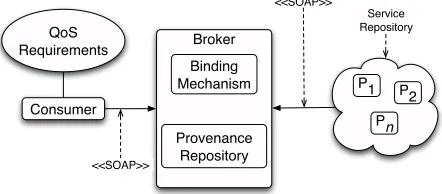
The system model for our proposed solution, as illus-trated in Figure 2, is based on the models by [8] and consists of three entities: A consumer, who is requesting a service; A broker who manages consumer requests and binds those requests to concrete service instances; and service providers
such that2≤p≤nwherepis a concrete service instance
and nis the number of service instances available to the
broker.
In this model, the system works as follows: 1. The con-sumer sends a request for a service to the broker. 2. The bro-ker analyses the request and then finds the most appropriate services from the service repository. 3. The broker ranks the services according to some criteria. This criteria can be specified by the consumer in the form of QoS requirements. 4. The broker selects a service from the list of ranked ser-vices and consumes the service on behalf of the consumer. 5. The result is sent back to the consumer. Our model makes the following assumptions: Firstly all services have been discovered by some mechanism - dynamic service discov-ery is beyond the scope of this research. Secondly there are at least two concrete service instances for every service request in the repository. Where QoS attributes are not ad-vertised, the service selection may looked to historical data via a monitoring mechanism such as used by [11].
<<SOAP>>
Broker
P1 P2
Pn Consumer
QoS Requirements
<<SOAP>>
Binding Mechanism
Provenance Repository
[image:5.595.316.537.470.567.2]Service Repository
Figure 2. System Model showing one con-sumer, an intelligent broker and nproviders in a service repository.
assess whether or not the message needs to be processed for faults.
In order to force the dynamic binding mechanism to re-bind, two possible techniques can be used. The first in-volves simulating faults with the services such as that em-ployed by Looker [16]. For example, by introducing faults such as service availability faults, we can force the binding mechanism to choose an alternative service. The second ap-proach would be to vary the individual QoS parameters of the SLA such that the binding mechanism has to be either more or less selective when choosing a service to bind to in the presence of faults.
5.2 Fault Model for Dynamic Binding Systems
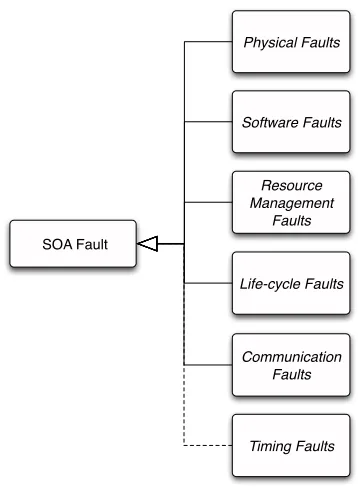
In order to inject the correct types of faults, Looker in [16] considered the types of fault that can affect Web Ser-vices. The high-level fault model included Physical Faults, Software Faults, Resource Management Faults, Commu-nication Faults and Life-cycle faults. However, Looker’s work considered binding from a static perspective thus the fault model does not consider dynamic binding. When we consider a dynamic binding system, then we must extend the fault model to include additional classes of faults such asTiming Faultsas in Figure 3. For example, when using a dynamic binding system, timing is crucial if we are to bind to the best possible service. If an ideal service is selected, but unavailable at the time of binding then a fault will occur and we must rebind to another service. A detailed taxon-omy of faults associated with a Dynamic Binding System will be the subject of future work.
5.3 Evaluation Measures and Metrics
In order to evaluate this work, it is important to have a series of measures and metrics by which to judge the be-haviour of a dynamic binding system. In the work of [20], measures are defined as being derived from interpretations of one or more metrics with metrics being indicators of sys-tem, user, and group performance that can be observed, singly or collectively, while executing scenarios. Conse-quently, future experimentation for this work will focus on key dependability attributes as defined in [18] for instance, availability, reliability and integrity, etc. as metrics and can be captured as measures of QoS. It should be noted at this point, that the evaluation strategy for services will differ from the evaluation strategy for a dynamic binding system.
In the case of testing services, the focus can be either upon the functional requirements — i.e. the output of the service, or the nonfunctional requirements — i.e. the per-formance of the service, or both. For example, in [16], the authors focus on two metrics; correctness and timeliness. Correctness is described as verifying whether or not a
ser-Physical Faults
Software Faults
Resource Management
Faults
Communication Faults Life-cycle Faults
Timing Faults
[image:6.595.337.516.73.318.2]SOA Fault
Figure 3. High-level fault model.
vice returns a correct result. Timeliness is described as ver-ifying whether or not the service returns a result within a certain timeframe.
When testing dynamic binding systems, it should be noted that although the system involves services, the mea-sures and metrics associated with services will still apply to the dynamic binding system itself, but the context is differ-ent. For example, in a dynamic binding system, timeliness refers to whether or not a service was bound within a given timeframe — specified as a nonfunctional requirement. and correctness refers to whether or not the correct type of ser-vice was bound at runtime — specified as a functional re-quirement.
As discussed, the intention of future work is to create a simulated network of services in an environment where faults can be inserted to test the dynamic binding system. By repeated runs of these experiments we will be able to statistically analyse the results to ascertain the behaviour of the dynamic binding system under test.
6 Conclusions
We believe that by manipulating the operating environment through the simulation of faults, we will be able to assess and monitor the behaviour of a dynamic binding system which will result in benefits with respect to the testing of dynamically bound Web Services. A prototype system is presently in development that will enable the testing of dy-namic binding systems via a middleware solution that in-corporates a fault injection framework.
References
[1] M. Karam, H. Safa, and H. Artail, “An abstract workflow-based framework for testing composed web
services,” in Computer Systems and Applications,
2007. AICCSA ’07. IEEE/ACS International Confer-ence on, pp. 901–908, 2007.
[2] G. Canfora and M. Di Penta, “Testing services and service-centric systems: challenges and
opportuni-ties,”IT Professional, vol. 8, no. 2, pp. 10–17, 2006.
[3] A. Bertolino, G. De Angelis, and A. Polini, “A QoS
test-bed generator for web services,”Lecture Notes in
Computer Science, vol. 4607, p. 17, 2007.
[4] P. Wohed, W. van der Aalstand Marlon Dumas, and
A. H.M. ter Hofstede,Analysis of Web Services
Com-position Languages: The Case of BPEL4WS, pp. 200– 215. Springer Berlin, 2003.
[5] X. Gu and K. Nahrstedt, “Dynamic qos-aware mul-timedia service configuration in ubiquitous computing
environments,”Distributed Computing Systems,
Inter-national Conference on, vol. 0, p. 311, 2002.
[6] M. Di Penta, R. Esposito, M. L. Villani, R. Codato, M. Colombo, and E. Di Nitto, “Ws binder: a frame-work to enable dynamic binding of composite web
services,” inSOSE ’06: Proceedings of the 2006
inter-national workshop on Service-oriented software en-gineering, (New York, NY, USA), pp. 74–80, ACM, 2006.
[7] N. B. Mabrouk, S. Beauche, E. Kuznetsova, N. Geor-gantas, and V. Issarny, “Qos-aware service compo-sition in dynamic service oriented environments,” in Middleware ’09: Proceedings of the 10th ACM/IFIP/USENIX International Conference on Mid-dleware, (New York, NY, USA), pp. 1–20, Springer-Verlag New York, Inc., 2009.
[8] N. Looker, Dependability Analysis of Web Services.
PhD thesis, Durham University, 2006.
[9] G. Hohpe and B. Woolfe,Enterprise Integration
Pat-terns: Designing, Building and Deploying Messaging Solutions. Boston: Addison-Wesley, 2004.
[10] The World Wide Web Consortium W3C, “Web
Ser-vices Architecture.” http://www.w3.org/TR/
2002/WD-ws-arch-20021114/, November
2009.
[11] A. Erradi and P. Maheshwari, “Dynamic binding
framework for adaptive web services,” inProceedings
of the 2008 Third International Conference on Inter-net and Web Applications and Services, pp. 162–167, IEEE Computer Society, 2008.
[12] L. Baresi, E. Di Nitto, and C. Ghezzi, “Toward
open-world software: Issue and challenges,” Computer,
vol. 39, no. 10, pp. 36–43, 2006.
[13] G. J. Myers,The Art of Software Testing. New York:
John Wiley & Sons, 1979.
[14] J. Abbott,Software Testing Techniques. Manchester:
NCC Publications, 1986.
[15] N. Looker, M. Munro, and J. Xu, “A comparison of network level fault injection with code insertion,” inComputer Software and Applications Conference, 2005. COMPSAC 2005. 29th Annual International, vol. 1, 2005.
[16] N. Looker, J. Xu, and M. Munro, “Determining the
dependability of service-oriented architectures,”
In-ternational Journal of Simulation and Process Mod-elling, vol. 3, no. 1, pp. 88–97, 2007.
[17] L. Cavallaro and E. Di Nitto, “An approach to adapt service requests to actual service interfaces,” in SEAMS ’08: Proceedings of the 2008 interna-tional workshop on Software engineering for adaptive and self-managing systems, (New York, NY, USA), pp. 129–136, ACM, 2008.
[18] A. Avizienis, J. C. Laprie, B. Randell, and C. Landwehr, “Basic concepts and taxonomy of
de-pendable and secure computing,”Dependable and
Se-cure Computing, IEEE Transactions on, vol. 1, no. 1, pp. 11–33, 2004.
[19] P. Mayer and D. L¨ubke, “Towards a bpel unit
test-ing framework,” inTAV-WEB ’06: Proceedings of the
2006 workshop on Testing, analysis, and verification of web services and applications, (New York, NY, USA), pp. 33–42, ACM, 2006.
[20] D. Russell, N. Looker, and J. Xu, “SOA, Dependabil-ity, and Measures and Metrics for Network Enabled
Capability,” inIET Forum on Capability Engineering: