Coles, A.I. and Smith, A.J. (2006) Simulating the use of macro-actions through
action reordering. In: The 25th Workshop of the UK Planning and Scheduling
Special Interest Group (PlanSig 2006), 14-15 Dec 2006, Nottingham, United
Kingdom.
http://eprints.cdlr.strath.ac.uk/
3151
/
Strathprints is designed to allow users to access the research
output of the University of Strathclyde. Copyright © and Moral
Rights for the papers on this site are retained by the individual
authors and/or other copyright owners. Users may download
and/or print one copy of any article(s) in Strathprints to facilitate
their private study or for non-commercial research. You may not
engage in further distribution of the material or use it for any
profitmaking activities or any commercial gain. You may freely
distribute the url (http://eprints.cdlr.strath.ac.uk) of the Strathprints
website.
Simulating the use of Macro-Actions Through Action Reordering
Andrew Coles and Amanda Smith
Department of Computer and Information Sciences, University of Strathclyde,
26 Richmond Street, Glasgow, G1 1XH
email:[email protected]
Abstract
The use of macro-actions in planning introduces a trade-off. Macro-actions can offer search guidance by suggesting se-quences of actions; but can potentially make search more ex-pensive by increasing the branching factor. In this paper we present a technique for simulating the use of macro-actions by altering the order in which actions are considered for ap-plication during enforced hill-climbing search. Actions are ordered based on the number of times they have occurred, in past solution plans, following the last action added to the plan. We demonstrate that the action-reordering technique used can offer improved search performance without the neg-ative performance impacts often observed when using macro-actions.
Introduction
The use of macro-actions in planning has been widely ex-plored. Macro-actions consist of an ordered sequence of ac-tions taken from the planning domain. The motivation for using macro-actions is intuitive: if a sequence of actions oc-curs many times in solution plans it is logical to suggest to the planner that this may be a good action sequence to con-sider.
Using macro-actions when planning gives the potential for increased efficiency in solving problems, as many steps can be planned by the application of one macro-action; thus avoiding search that would otherwise have to be done. There is, however, a cost associated with this potential gain: the increased branching factor at each action choice point in the search. In addition to considering the applicable instantia-tions of the acinstantia-tions in the domain, instantiainstantia-tions of macro-actions must also be considered.
The number of instantiations of an action is exponential in the number of parameters. Macro-actions consisting of two or more actions include the necessary parameters of their constituent actions. In general macro-actions have many more preconditions than the other actions in the domain and are therefore expensive to instantiate.
For a planning problem with solution lengthl and
num-ber of possible action instantiations (branching factor)bthe number of nodes expanded to solve the problem, in the worst case, will be O(bl). Ifmmacro-actions are added to the do-main, withnbeing the total number of possible instantia-tions of all of the macro-acinstantia-tions, the worst case complexity
is O((b+n)l
). It is, however, important to note that if a macro-action is used in solving the problem then the depth,
l, to which the search space needs to be explored (i.e. the
plan length) is decreased. Thus, if a macro-action of length
kis used the complexity will be reduced to O((b+n)l−k
). We present a technique to simulate the use of macro-actions, without increasing the branching factor, by chang-ing the order in which actions are considered for applica-tion during search. This avoids the potential problems typ-ically associated with using macro-actions. Actions are or-dered according to past records of action sequences occur-ring in solution plans. Our technique is implemented in the planner Marvin (Coles & Smith 2006) that uses an FF-style planning framework (Hoffmann & Nebel 2001): enforced hill-climbing search with best-first, rather than breadth-first, search on plateaux.
Related Work
Macro-actions were first conceived in the early stages of planning research when solution plans were used as macro-actions for solving future problems. The use of macro-actions was developed by many researchers, some concen-trating on pruning techniques and selecting which macro-actions to use (Minton 1985; Iba 1989; McCluskey 1987) and others on techniques for extracting macro-actions from the domain itself (Dawson & Siklossy 1977; McCluskey & Porteous 1997). Research into the use of macro-actions has enjoyed a recent surge in popularity, with two planners in the Fourth International Planning Competition making use of macro-actions. Macro-FF (Botea, Muller, & Schaeffer 2004) uses an offline learning process to learn macro-actions for each domain. In the most successful version, macro-actions are lifted from solution plans and then filtered us-ing an offline trainus-ing process that involves solvus-ing small problem instances. Marvin (Coles & Smith 2006) uses an online learning technique to generate macro-actions, based on plateaux in the search landscape. The macro-actions are generated online and can also be stored for use in solving later problems (Coles & Smith 2005). Work on evolving macro-actions (M.A.H. Newton 2005) has also been done. As with Macro-FF, this process is another that uses offline learning, using a genetic algorithm to generate and filter macro-actions.
achieve two different objectives: to increase the efficiency of the planning process; and to allow the introduction of con-currency into solution plans. Work on symmetry in planning (Fox, Long, & Porteous 2005) has been used to suggest an action ordering to a planner. The helpful actions, as gener-ated by FF, are ordered to consider first those actions that are ‘almost symmetric’ with actions applied at some previous time point in the plan. Almost symmetry attempts to cap-ture similarities between objects in the domain that are not functionally symmetrical but are in very similar situations. Such objects are likely to require similar action applications in order to reach their desired goal state; hence, actions are reordered to consider actions that have already been applied to an almost symmetric object before other actions.
CRIKEY (Halsey 2004) is a temporal planner that cre-ates its plans by first generating a sequential plan using FF and then using a scheduler to parallelise and schedule the actions in the plan. CRIKEY uses action reordering, when planning in an FF style planner, to maximise the potential for parallelisation of the finished plan. Actions are ordered dynamically at each stage in planning according to the last action in the plan. The ordering of the helpful actions (the only actions to be considered) is such that all actions that are not mutex with the action currently at the end of the plan are considered first. The result is that if an action that can be performed at the same time as the previous action leads to a strictly better state, it will be used in favour of an action that cannot. The action reordering allows for greater parallelisa-tion of the final plan and improved makespans of the plans generated by CRIKEY.
The action reordering presented here is also related to work on control rules (Bacchus & Kabanza 2000; Martin & Geffner 2004). Control rules suggest to the planner the next action to apply, usually based on propositions that are true in the current state. The action reordering in this work also suggests the next action to apply, but this suggestion is based on the previous action in the plan.
Action Reordering
Macro-actions that are used frequently represent sequences of actions that follow each other often. An action order-ing strategy based on the number of past occurrences of a given action following another action can be used to im-plicitly suggest macro-actions to the planner, without actu-ally adding the macro-actions to the domain. By noting the number of times a given action follows another in the plan, and ordering actions based on this, it is possible to simulate the addition of macro-actions to the domain without actually having to add additional actions.
For example, the macro-actionpickup-move-dropin the Gripper domain might be extracted by a macro-action-generating planner due to its frequent occurrence, it being a plateau in the search space, or due to it improving search performance. It is also possible, however, to simply observe that so far during search to solve a problem (and indeed in search to solve previous problems) that every time amove action has been applied, adropaction was applied after-wards; and thus, it would be sensible to considerdrop ac-tions aftermoveactions in future search. Similarly, amove
action may have followed apickupaction 50% of the time; the other 50% of the time apickupaction is likely to have been followed by another pickup action (one pickup for each gripper). Thus, it is sensible to consider applying moveandpickupactions after following the application ofpickupactions, before considering other actions.
The basis of the action reordering strategy is to order the list of potential action choices by an estimate of the likeli-hood that it is correct to order them after the last chosen ac-tion in the plan, based on the frequency with which the two actions have occurred one after the other. The frequencies for each action following each other action are initialised to zero. As planning progresses, each time a given action fol-lows another its ‘following frequency’ is increased. When a node is to be expanded in search, actions leading to succes-sors are ordered according to this frequency metric, and their corresponding successor states are expanded in the given or-der. In EHC, as the first action which leads to a state with a strictly better heuristic value is chosen, if the first ordered action leads to such a state, a great deal of search effort will be saved.
The implicit macro-actions suggested are a slightly weaker form of macro-actions than those in the traditional sense. Although a sequence of actions is suggested to the planner, which parameters should be shared between adja-cent actions is not explicitly enumerated, as would be the case when using a macro-action. Maintaining the data of shared parameters for action ordering would become very expensive; the ordering is therefore based only on the action types and not on any shared parameters. For example, in the gripper domain, if the learnt action data suggests thatdrop is the most likely action to follow move then, if a move action has just been added to the plan, the actions will be or-dered such that all thedropactions occur before the others, irrespective of their parameter bindings. Macro-actions, on the other hand, would effectively order a specific instantia-tion of adropaction first.
Identifying the Most-Likely Preceding Action
Plans generated by an FF-style planner often have inde-pendent threads of execution interleaved. For example, in a logistics-style domain it is possible that a plan is comprised of interleaved actions to perform tasks in several distinct locations. For one package, the plan fragment may be: (load package1 truck1 location1) (drive truck1 location1 location2)
(unload package1 truck1 location2); and similarly, for another package in another location: (load package2 truck2 location3) (drive truck2 location3 location4) (unload package2 truck2 location4). This could be further interleaved with the end of another earlier se-quence concluding with (unload package3 truck3 location5). These plan fragments can be interleaved arbitrarily to create the overall plan; an example is given in Figure 1.
0: (load package1 truck1 location1) 1: (unload package3 truck3 location5) 2: (drive truck1 location1 location2) 3: (load package2 truck2 location3) 4: (drive truck2 location3 location4) 5: (unload package1 truck1 location2) 6: (unload package2 truck2 location4)
Figure 1: Example Plan Segment for the Driverlog Domain
would state thatloadfollowed byunloadwas a promis-ing action sequence for the planner to consider in the gen-eral case. Although the interleaving could occur in this way again, it is largely arbitrary and in general it is not the case that it is good guidance to follow aload action with an unloadaction. Indeed, if the two actions share a common package parameter, it is actually an unwise action choice, simply undoing the previous action and introducing redun-dancy into the plan. The strategy of updating ordering data between adjacent pairs of actions in the plan, regardless of threads of execution, is referred to as U1 in the evaluation. To attempt to address issues regarding thread independence in plans, further reordering strategies have been developed and are described in the following sections.
Update if the Previous Action Shares A Parameter
In first of these more sophisticated strategies, U2, action fre-quency data is only updated between pairs of actions in the plan which share a common parameter. Actions sharing a parameter are often reliant on some common object in the world, and so can be considered linked as part of a sequence of execution. Updating the data between only pairs of ac-tions that share parameters allows the cached data to better represent real interdependencies between actions.
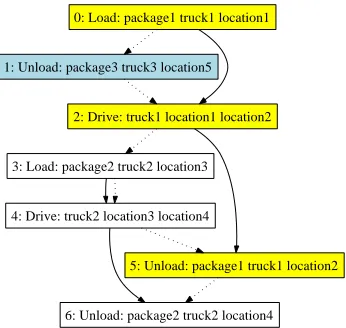
A problem with this strategy is that in only updating the action-following data between adjacent pairs of actions if they share a common parameter, information is potentially lost about orderings between related but non-adjacent action pairs.. Suppose, during the planning process to find a solu-tion to a driverlog problem, acsolu-tions are added to the plan in the sequence shown in Figure 1. Using this update strategy the data thatunloadfollowsload(steps 0-1),drive fol-lowsunload(steps 1-2) andloadfollowsdrivewill not be added, since the parameters are pairwise unrelated. Be-tween steps 3 and 4 the fact thatdrivefollowedloadwill be noted as these actions share a parameter. Between steps 4 and 5 no information will be added since the parameter sets do not overlap; Similarly, no information is recorded be-tween steps 5 and 6. It can be seen that the fact thatunload followsdrivewould not be recorded anywhere due to the interleaving of the plan. Looking at the independent threads, however, it can be seen that unload has in fact followed drive twice in the individual sequences of execution in the plan.
Update Based on Last Non-Mutex Actions In the
Plan
To address this issue the final strategy, U3, has a slightly more complex update rule. Instead of simply looking at a
0: Load: package1 truck1 location1
1: Unload: package3 truck3 location5
2: Drive: truck1 location1 location2
3: Load: package2 truck2 location3
4: Drive: truck2 location3 location4
[image:4.612.353.526.52.216.2]6: Unload: package2 truck2 location4 5: Unload: package1 truck1 location2
Figure 2: Threads of Execution in Driverlog Plan Seg-ment. Dotted lines indicate dependencies implied by the plan structure; solid lines indicate true dependencies.
single action A before an action B, all the actions immedi-ately before A that are pairwise non-mutex with each other and A are considered. The pairwise non-mutex actions rep-resent a collection of actions which could have been ordered arbitrarily in the plan: there are no ordering constraints be-tween them. An action added after these could follow on from any one of these actions; not just from the action that happens to be ordered last. To identify these potential prede-cessors when ordering the actions to be considered, the algo-rithm reverses through the plan built so far collecting actions until one is found that is mutex with any of the actions that follow it. At this point, regression stops and the action mu-tex with one or more of those following it is excluded from the set of potential predecessors, as it necessarily precedes another action in the predecessor set.
step 4(drive truck2 location3 location4)is in the set, and has parameters in common with the last added action; thus, the number of times that an unload action has followed a drive action is incremented accordingly.
Cached Probabilistic-Observation-Based
Action Reordering
Having now described how action-following data can be recorded, online, during planning, the strategy can be ex-tended to cache the table of action-following data between runs of the planner in a given domain. This data can then be used to suggest orders in which to consider actions when solving subsequent problems. Unlike the libraries of cached macro-actions, the size of these tables does not increase as more problems are solved: the information stored in the ta-ble simply becomes a more-accurate reflection of the action orderings observed when planning. There is, therefore, no need to employ any library management or pruning strate-gies in order to maintain the library.
Results
The techniques discussed have been implemented in the planner Marvin (Coles & Smith 2006). The plateau-escaping macro-action generation techniques and concur-rent planning framework are disabled throughout these ex-periments; resulting behaviour analogous to FF, other than using best-first search, instead of breadth-first search, on plateaux. Tests have been performed across a wide range of domains with very different properties. All experiments have been performed on a Linux machine with 1GB of RAM and a 3.4 GHz Intel Pentium 4 processor. Each run of the planner is subjected to time and memory limitations: if the planner does not solve the problem within 30 minutes or uses more than 800MB of memory it is deemed to have failed to solve the problem. Where available the ADL version of each domain is used; if not, the typed STRIPS version of the domain is used. All problems are taken from the recent competition benchmark suites in IPC 3, 4 and 5; except for Briefcase (which did not feature in these competitions) in which 20 randomly generated problems are used with the number of objects being increased from 50 to 240 (in incre-ments of 10). These competition problems are the standard benchmarks used in the comparison of planners. Some of the problems were designed to model matters of academic interest; others model real world problems, for example, the Airport domain is concerned with managing airport ground traffic in Munich airport.
Using Reordering Data on a Per-Problem Basis
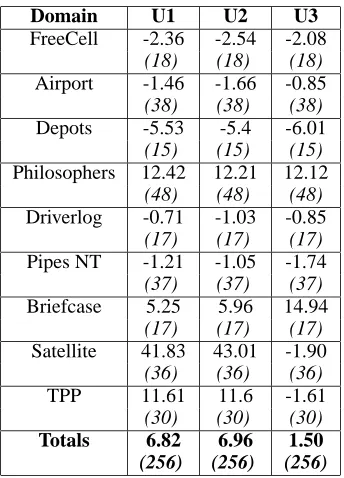
The results shown in table 2 show the improvement in time taken to solve problems using each of the update strate-gies with action reordering, relative to the control version of the planner. Precisely, the data presented in the table is X
i=0..n
(T(Ci)−T(Vi)), wherenis the number of
prob-lems in the domain and T(Ci)and T(Vi)represent the time
taken by the control and version of the planner to be consid-ered, respectively. Only problems solved by both the
indi-Domain control U1 U2 U3
FreeCell 18 18 18 18 Airport 38 41 41 41
Depots 15 15 15 15
Philosophers 48 48 48 48 Driverlog 17 17 17 17 Pipes NT 37 37 37 38 Briefcase 17 17 17 17 Satellite 36 36 36 36
TPP 30 30 30 30
[image:5.612.345.534.52.175.2]Totals 256 259 259 250
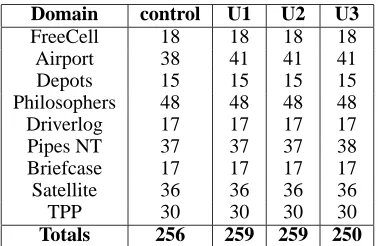
Table 1: Coverage Across Evaluation Domains Using Ac-tion Reordering with Different Update Strategies
vidual configuration and the control are included in calculat-ing these results: the figures in brackets indicate the number of mutually solved problems.
In the Airport domain the planner manages to solve three more problems using the action reordering strategies: the control version of the planner only solves 38 of the 50 prob-lems; whereas each of the reordering strategies allows the planner to solve 41 problems (see table 1). The additional problems solved using the reordering strategies are problems 28, 31 and 33. In these problems the action reordering strate-gies allow the planner to avoid getting into deadlock situa-tions, those in which two planes mutually block each others’ forward progress due to the exclusion zones around them. In these situations the planner must abort EHC and resort to best-first search. The action reordering strategies cause the planner to consider actions in a different order which does not lead to this situation in these three problems. In do-ing so, the planner is able to successfully solve these prob-lems via EHC; using best-first search to solve the probprob-lems is not successful within the 30 minute time limit. The data for mutually solved problems shows that the reordering con-figurations are on average between 1 and 2 seconds slower at solving problems in this domain; however, the three reorder-ing configurations have successfully solved three problems in under 40 seconds that the other configuration was unable to solve in 30 minutes. These problems were not included in the average as the control did not successfully solve them.
In the Philosophers domain the performance of the plan-ner is consistently improved over the problems in the evalu-ation suite. Solving the problems up to that with 49 philoso-phers gives the configurations making use of action reorder-ing a mean improvement in time taken of just over 12 sec-onds. The time taken by each of the configurations grows according to a regular function, and the time taken by the reordering version is consistently lower.
find-Domain U1 U2 U3
FreeCell -2.36 -2.54 -2.08
(18) (18) (18)
Airport -1.46 -1.66 -0.85
(38) (38) (38)
Depots -5.53 -5.4 -6.01
(15) (15) (15)
Philosophers 12.42 12.21 12.12
(48) (48) (48)
Driverlog -0.71 -1.03 -0.85
(17) (17) (17)
Pipes NT -1.21 -1.05 -1.74
(37) (37) (37)
Briefcase 5.25 5.96 14.94
(17) (17) (17)
Satellite 41.83 43.01 -1.90
(36) (36) (36)
TPP 11.61 11.6 -1.61
(30) (30) (30)
Totals 6.82 6.96 1.50
[image:6.612.88.260.51.290.2](256) (256) (256)
Table 2: Mean of time taken by control version minus time taken using each update strategy with action reordering. Re-sults are calculated on mutually solved problems.
ing a strictly better state at every choice point. The planner does not, however, make the same gains that are observed when using macro-actions as action reordering does not of-fer a major benefit during best-first search on plateaux. The search will have to explore all states with equal heuristic value before others regardless of whether the action order-ing data suggests that it is a good path to take through the search space.
In the Depots and Driverlog domains the action reordering strategies have very little impact on performance. Although it appears in table 2 that the version using no reordering per-forms better than the version using reordering in Driverlog, the difference in performance is only on one problem, prob-lem 19. The only reason for the improved performance in problem 19 is that EHC fails using both configurations, and the planner resorts to best-first search. The version using no action reordering is not able to make as much progress using EHC and thus fails slightly more quickly, resorting to best-first search sooner. A similar phenomenon occurs in some problems in the Depots domain.
In the Briefcase domain a slight improvement in perfor-mance can be observed on some problems; however, the do-main only consists of three actions, the ordering of which is frequently interchanged so although reordering has some positive impact it does not greatly enhance performance. The planner is unable to solve further problems after prob-lem 17 as the memory requirements exceed the limit.
In the Satellite domain the U1 and U2 configurations of the planner demonstrate a significant performance improve-ment over the control version. EHC search in this domain consists mostly of states where a strictly-better state can be
found at each choice point, with a small number of plateaux that are escapable in very few (usually two) action steps. With good action ordering guidance the planner is able to proceed more quickly though this search giving a perfor-mance improvement.
The version using the U3 strategy is, however, learning closely the mistakes that the planner makes in this domain when guided by the RPG heuristic. Quite often, despite the fact that a satellite can turn directly from one phenomenon to any other phenomenon, a chain ofturn-toactions are in-serted into the plan. The U3 reordering strategy learns from this, since it looks in detail at previous actions in the plan to find predecessor actions, and suggests in the future us-ing aturn-toaction to follow anotherturn-toaction. The other learning strategies learn from this phenomenon less frequently as a different action, involving a different en-tity, is often applied betweenturn-toactions in a chain. Although the performance of the planner is not greatly im-proved by using the U3 reordering strategy it is not made significantly worse: the planner is only learning from the mistakes it would usually make, and the mistakes are still made in search whether they are reinforced or not. The re-sults in the TPP domain show a similar pattern to those in the Satellite domain with reordering showing a positive im-pact in the U1 and U2 strategies, and a slight negative imim-pact when using the U3 strategy.
In the FreeCell domain the performance of the planner is not greatly improved or worsened by the reordering strate-gies. Problem 10 is solved slightly faster by all of the config-urations using reordering techniques; whereas problem 14 is solved slightly more slowly by these configurations. This is due to the action ordering the planner is using being better suited to those particular problems at that time: no regular pattern emerges showing action reordering to produce gen-erally better, or worse, behaviour. Most problems in this domain are solved in the same length of time for all config-urations. In the Pipes No-Tankage domain the performance of all the configurations is again similar. The U3 configu-ration succeeds in solving one more problem than the other versions, problem 47. All other versions reach a plateau that is not escapable within the 30 minute time limit; due to the different order in which actions are considered the search the U3 version proceeds in a different direction and does not encounter the same plateau.
Caching Reordering Data
In this section the configurations of the planner presented differ from the previous section only in that the action-following data is cached between problems. Caching allows the planner to learn the appropriate ordering of actions over a number of problems. Further, the planner can learn from successful plans that have completed in the past rather than from experience in solving the current problem which may, of course, not represent the correct way to reach the goal.
Domain Control U1 U2 U3
Cach- Cach-
Cach-ing ing ing
FreeCell 18 20 20 19
Airport 38 41 41 41
Depots 15 16 15 16
Philosophers 48 48 48 48
Driverlog 17 18 18 18
Pipes NT 37 37 36 35
Briefcase 17 17 17 17
Satellite 36 36 36 36
TPP 30 30 30 30
[image:7.612.332.543.51.302.2]Totals 256 263 261 260
Table 3: Coverage Across Evaluation Domains Using Ac-tion Reordering with each of the Update Strategies, Caching Reordering Data
learn. Furthermore, the information is presented to the plan-ner at the start of search and can be used throughout solv-ing the problem; in the case where the planner learns based on each problem instance it must first make a reasonable advance in solving the problem before the action-following data becomes meaningful.
Table 3 shows that the planner solves additional problems in 5 out of the 8 evaluation domains when caching reorder-ing data. In two of the remainreorder-ing three domains, Philoso-phers and Satellite, all problems are solved but a perfor-mance improvement is seen for at least two of the config-urations. This indicates that should further more difficult problems be posed the reordering versions are more scal-able. In the remaining domain, Briefcase, all configurations of the planner are not able to solve the final three problems as a result of exceeding the memory limit imposed.
The performance in the Airport domain is very similar to that exhibited by the equivalent versions not caching action data. The same number of problems are solved because the action data discovered in each problem is sufficient to guide the planner away from making the decision that causes dead-lock of planes and forces the control version of the planner to resort to best-first search. When solving problem 39 the U3 caching version is able to maintain the performance that was exhibited in the no-caching versions and by the control. All three versions resort to best-first search within a second of each other, however the fact that the actions are consid-ered in the suggested order in best first search means that the U3 and control versions reach the solution in the search space more quickly.
In the Briefcase domain the technique is again showing a slight positive impact in the U1 and U2 versions with a negative impact being observed in the U3 version. The per-formance of the U3 version is degraded as the planner is treating the subgoals with too much independence due to the update strategy. The U1 and U2 versions learn that when putting an object in a briefcase the next thing to do is to put another object in the briefcase. The U3 version, however, learns to consider moving the briefcase next, leaving
uncol-Domain U1 U2 U3
Caching Caching Caching
FreeCell -13.52 13.32 -13.97
(18) (18) (18)
Airport -5.08 -5.01 -1.15
(38) (38) (38)
Depots 17.87 17.56 19.71
(15) (15) (15)
Philosophers 12.53 12.65 12.66
(48) (48) (48)
Driverlog 0.41 -7.94 -7.97
(17) (17) (17)
Pipes NT 0.05 -0.49 0.26
(36) (35) (33)
Briefcase 7.32 7.19 -36.18
(17) (17) (17)
Satellite 45.96 46.45 0.02
(36) (36) (36)
TPP 9.83 9.82 13.04
(30) (30) (30)
Totals 8.55 10.46 -1.31
(255) (254) (252)
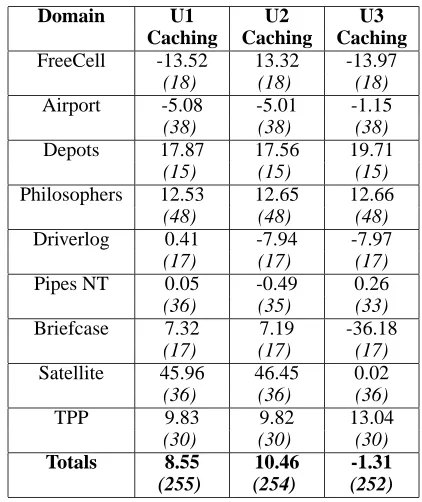
Table 4: Mean of time taken by control version minus time taken using each update strategy with action reordering, caching reordering data. Results are calculated on mutually solved problems.
lected items at locations which must later be collected. All versions of the planner have solved all the problems in the Philosophers and Satellite domains; therefore, the data in Figures 2 and 4 are directly comparable (the control used is identical). The performance in the Philosophers domain is almost identical to the performance of the no caching ver-sions. Search in this domain follows a regular pattern of ac-tion ordering that the planner is able to learn quickly on each problem. The caching versions have a very slight perfor-mance improvement brought about by the search guidance being available from the very start of problem solving.
The Satellite domain shows a similar pattern but with a greater performance improvement being gained by caching the data, as opposed to learning it on each problem. The consistent improvements made in this domain can be seen in Figure 3. The version using the U3 reordering has improved by caching action ordering to give a slight performance en-hancement; rather than the slight degradation that was found without caching. Caching the data is allowing the planner to learn from good decisions on smaller problems, in which less redundancy is introduced. Caching the helpful data in the U1 and U2 strategies improves the mean performance of the planner by around 4 seconds. In these two domains the makespans of the plans generated are almost identical, slightly improved in Satellite and identical in the Philoso-phers domain, so the planner is finding plans of the same quality in less time.
[image:7.612.61.288.51.199.2]per-0.01 0.1 1 10 100 1000 10000
5 10 15 20 25 30 35
sec.
task nr. Satellite
[image:8.612.332.543.50.302.2]Control U1 Caching U2 Caching U3 Caching
Figure 3: Using Action Reordering in the Satellite Domain
formance on almost all problems. The results for U1 and U2 caching show that the caching versions using this update strategy do not perform as well as those learning the reorder-ing data on a per-problem basis. The U3 version, however, shows better performance when caching the reordering data allowing for a positive impact on performance, rather than the slight negative impact seen when not caching data.
In the Driverlog domain each of the caching versions is able to solve one more problem than the control version. The action reordering allows the planner to find the correct solution to the problem using EHC; the control version fails to find a plan via EHC and resorts to best-first search. In the Pipes No-Tankage domain the behaviour of the different versions of the planner is more varied. On the easier prob-lems all three configurations of the planner that are doing action reordering solve a number of problems more quickly; most noticeably, problems 12, 14 and 15. In problem 15 the action reordering in best first search allows the reordering versions to solve the problem more quickly after resorting to best-first search; whilst in problems 12 and 14 the action reordering versions are able to solve the problem via EHC without the need to resort to best-first search.
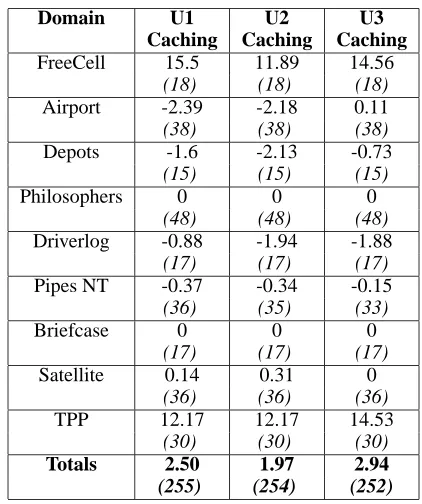
Caching the action reordering data in the FreeCell domain leads to the U1 and U2 versions of the planner being able to solve all problems. In problem 18 all versions of the planner resort to best-first search but the cached action reordering data, used in the reordering versions of the planner, allows the problem to be solved using best first search within the time limit. Problem 20 is solved by EHC in the U1 and U2 caching versions of the planner whilst the U3 and con-trol versions remain stuck on a plateau that is not escapable within the time limit. The plans generated by the reorder-ing configurations of the planner are shorter in all but one of the problems. The planner is able to learn a good order-ing strategy on the smaller problems where the trajectory taken is more likely to be closer to the optimal one (as there are fewer possible trajectories). This good ordering strat-egy is then used when solving the harder problems allowing the planner to generate shorter plans. This is supported by the fact that the makespan of plans is improved when using
Domain U1 U2 U3
Caching Caching Caching
FreeCell 15.5 11.89 14.56
(18) (18) (18)
Airport -2.39 -2.18 0.11
(38) (38) (38)
Depots -1.6 -2.13 -0.73
(15) (15) (15)
Philosophers 0 0 0
(48) (48) (48)
Driverlog -0.88 -1.94 -1.88
(17) (17) (17)
Pipes NT -0.37 -0.34 -0.15
(36) (35) (33)
Briefcase 0 0 0
(17) (17) (17)
Satellite 0.14 0.31 0
(36) (36) (36)
TPP 12.17 12.17 14.53
(30) (30) (30)
Totals 2.50 1.97 2.94
(255) (254) (252)
Table 5: Mean of makespan of the solution plan generated by control minus makespan of plan generated using action reordering strategies, caching reordering data. Results are calculated on mutually solved problems.
reordering techniques with no caching but not to the same extent as it is in the case of caching.
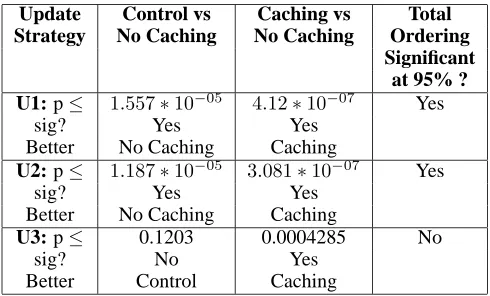
Table 6 shows the results of performing a Wilcoxon signed-rank significance test on the data generated across all domains. The table shows that over the varied collection of evaluation domains using reordering data can offer sig-nificant improvement in time taken to solve problems when using the U1 and U2 strategies. Furthermore, caching action reordering data can allow a significant improvement over learning the data on a per-problem basis using each strat-egy. For the U1 and U2 versions the final column shows that a total ordering, caching being better than not caching and in turn not caching being better than using no data at all, has been shown to be significant with 95% confidence (since the individual comparisons were shown to be significant with probability greater than√0.95).
Conclusions
We have presented a technique for simulating the use of macro-actions through action reordering and shown that it can enhance planner performance across a diverse range of domains. In some domains the performance improvement is slight; in others it is more significant. Unlike when using macro-actions, however, the performance is rarely signifi-cantly degraded by reordering the actions as the branching factor is not increased.
[image:8.612.61.284.57.217.2]Update Control vs Caching vs Total
Strategy No Caching No Caching Ordering
Significant at 95% ?
U1: p≤ 1.557∗10−05 4.12∗10−07 Yes
sig? Yes Yes
Better No Caching Caching
U2: p≤ 1.187∗10−05 3.081∗10−07 Yes
sig? Yes Yes
Better No Caching Caching
U3: p≤ 0.1203 0.0004285 No
sig? No Yes
[image:9.612.53.298.52.200.2]Better Control Caching
Table 6: Significance table for the action reordering strate-gies: p is the probability that the null hypothesis, that the versions perform the same, cannot be rejected; sig? denotes whether or not the null hypothesis can be rejected with prob-ability≥0.975; Better is the best performing of the two con-figurations being compared.
very little impact on the makespan of solution plans. The makespan data across all domains, shown in Figure 5, shows pleasingly that the action reordering strategy is offering a slight improvement in makespan and not leading to longer plans, a problem often associated with macro-action use.
When learning action reordering data on a per-problem basis performance improvements can be seen in some do-mains; the guidance offered by action reordering is, how-ever, improved when the data is stored for use on future problems. Caching action ordering data can improve cover-age on several domains under EHC compared to learning the data on each problem instance and transitively not learning action reordering data. Caching the data allows the planner to build a more accurate representation of the correct order-ing strategies based on known successful plans and a much larger collection of successful choices.
The U1 caching strategy has greater overall coverage than the U2 and U3 strategies; this is likely to be a consequence of the way the planner naturally considers actions. The U2 and U3 strategies reorder based only on common parame-ters, the U3 strategy even searching back through the plan to do so; whereas the simpler U1 strategy reorders based on the natural order that the actions appear following each other in the plan. Since it is quite often the case that the next ac-tion considered by the planner does not share a parameter with the previous action the U1 strategy is pre-empting the behaviour of the planner more successfully.
Future Work
Currently the action reordering only simulates macro-actions of length 2 as only a single previous action is con-sidered. Macro-actions of other lengths could be simulated, by the consideration of the preceding n actions, rather than just the one immediately preceding action. The table of ac-tion reordering data would, however, grow rather large as each pairwise combination of actions would have to be con-sidered to precede each action. A strategy to select
promis-ing combinations of actions, and only consider these, would therefore be required. Another similar extension would be to investigate extending the technique to reason about shared parameters to simulate macro-actions more strongly.
References
Bacchus, F., and Kabanza, F. 2000. Using temporal logics to express search control knowledge for planning. Artificial
Intelligence 116(1–2):123–191.
Botea, A.; Muller, M.; and Schaeffer, J. 2004. Us-ing component abstraction for automatic generation of macro-actions. In Proceedings of the Fourteenth
Interna-tional Conference on Automated Planning and Scheduling (ICAPS-04), 181–190.
Coles, A. I., and Smith, A. J. 2005. On the inference and management of macro-actions in forward-chaining plan-ning. In Tuson, A., ed., Proceedings of the 24th UK
Plan-ning and Scheduling SIG.
Coles, A., and Smith, A. 2006. MARVIN: A heuristic search planner with online macro-action learning. Journal
of Artificial Intelligence Research. Accepted for
publica-tion.
Dawson, C., and Siklossy, L. 1977. The role of prepro-cessing in problem solving systems. In Proceedings of the
Fifth International Joint Conference on Artificial Intelli-gence, IJCAI 77, 465–471.
Fox, M.; Long, D.; and Porteous, J. 2005. Abstaction-based action ordering in planning. In Proceedings of
In-ternational Joint Conference on Artificial Intelligence (IJ-CAI).
Halsey, K. 2004. CRIKEY! It’s Co-ordination in Temporal
Planning: Minimising Essential Planner–Scheduler Com-munication in Temporal Planning. Ph.D. Dissertation,
Uni-versity of Durham.
Hoffmann, J., and Nebel, B. 2001. The FF planning sys-tem: Fast plan generation through heuristic search. Journal
of Artificial Intelligence Research 14:253–302.
Iba, G. A. 1989. A heuristic approach to the discovery of macro-operators. Machine Learning 3:285–317.
M.A.H. Newton, J. Levine, M. F. 2005. Genetically evolved macro-actions in A.I. planning problems. In Tu-son, A., ed., Proceedings of the 24th UK Planning and
Scheduling SIG.
Martin, M., and Geffner, H. 2004. Learning generalized policies from planning examples using concept languages.
Applied Intelligence 20(1):9–19.
McCluskey, T. L., and Porteous, J. M. 1997. Engineering and compiling planning domain models to promote validity and efficiency. Artificial Intelligence 95(1):1–65.
McCluskey, T. L. 1987. Combining weak learning heuris-tics in general problem solvers. In Proceedings of the
Tenth International Joint Conference on Artificial Intelli-gence (IJCAI ’87).
Minton, S. 1985. Selectively generalizing plans for problem-solving. In Proceedings of the ninth International