Ta, C.H. and Weiss, S. (2007) Shortening the order of paraunitary
matrices in SBR2 algorithm. In: 6th Conference on Information,
Communications, and Signal Processing, 2007-12-10 - 2007-12-13. ,
http://dx.doi.org/10.1109/ICICS.2007.4449828
This version is available at
https://strathprints.strath.ac.uk/37110/
Strathprints is designed to allow users to access the research output of the University of Strathclyde. Unless otherwise explicitly stated on the manuscript, Copyright © and Moral Rights for the papers on this site are retained by the individual authors and/or other copyright owners. Please check the manuscript for details of any other licences that may have been applied. You may not engage in further distribution of the material for any profitmaking activities or any commercial gain. You may freely distribute both the url (https://strathprints.strath.ac.uk/) and the content of this paper for research or private study, educational, or not-for-profit purposes without prior permission or charge.
Any correspondence concerning this service should be sent to the Strathprints administrator: [email protected]
The Strathprints institutional repository (https://strathprints.strath.ac.uk) is a digital archive of University of Strathclyde research outputs. It has been developed to disseminate open access research outputs, expose data about those outputs, and enable the
Shortening the Order of Paraunitary Matrices in
SBR2 Algorithm
Chi Hieu Ta and Stephan Weiss
Institute for Communications & Signal Processing Dept. of Electronic & Electrical Engineering University of Strathclyde, Glasgow, United Kingdom
{chi.ta, stephan.weiss}@eee.strath.ac.uk
Abstract— The second order sequential best rotation (SBR2) algorithm has recently been proposed as a very effective tool in decomposing a para-Hermitian polynomial matrixR(z) into a diagonal polynomial matrix Γ(z) and a paraunitary matrix B(z), extending the eigenvalue decomposition to polynomial matrices,R(z) =B(z)Γ(z) ˜B(z). However, the algorithm results in polynomials of very high order, which limits its applicability. Therefore, in this paper we evaluate approaches to reduce the order of the paraunitary matrices, either within each step of SBR2, or after convergence. The paraunitary matrix B(z) is replaced by a near-paraunitary quantityBN(z), whose error will be assessed. Simulation results show that the proposed truncation can greatly reduce the polynomial order while retaining good near-paraunitariness ofBN(z).
I. INTRODUCTION
The second order sequential best rotation (SBR2) algorithm was proposed by McWhirter et al. in [1], [2]. It is an iterative algorithm which aims to decompose a polynomial para-Hermitian matrix R(z) ∈ CP×P(z) into a diagonal
polynomial matrixΓ(z)and a polynomial paraunitary matrix B(z), such that R(z) =B(z)Γ(z) ˜B(z)can be regarded as a generalisation of the standard eigenvalue decomposition to the broadband case [2]. Different from the conventional methods which often perform the diagonalisation of polynomial matri-ces in the frequency domain, the SBR2 algorithm diagonalises para-Hermitian matrices in the time domain by applying a sequence of suitably chosen delays and Givens rotations.
The algorithm has been demonstrated to be very robust in diagonalisingR(z)such that ideally
Γ(z) =diag{Γ0(z),Γ1(z),· · ·ΓP−1(z)} (1)
with on-diagonal elements Γi(z), which are spectrally
ma-jorised, i.e. the power spectral densities fulfill
Γi(ejΩ)≥Γi+1(ejΩ) ∀Ω . (2)
The SBR2 algorithm has been applied to a number of prob-lems, such as source separation of array data [2], subband-based source coding [4], subspace-subband-based channel coding in the presence of structured noise [6], or precoding and equalisation for MIMO systems [8]. However, the iterative SBR2 algorithm often results in matrices of rather high polynomial order, which for many applications results filter banks of considerable delay and computational complexity.
In [3], [2], the authors address the truncation of the para-Hermitian matrix during the diagonalisation process and show
that with a small loss in Frobenius norm, the order of the para-Hermitian matrix can be significantly reduced. The truncation of the extracted paraunitary matrix B(z) is not considered there, although the matrix is utilised for a number of appli-cations [6], [8]. The order ofB(z) can be prohibitively high, although generally the coefficient matrices corresponding to high and low powers of z, which will be reffered to as outer coefficients matrices, in B(z) can be observed to tail off to very small values.
In this paper we proposed a method to shorten the order of the paraunitary matrixB(z). This method will discard the outer coefficient matrices which have the smallest Frobenius norm, thus replacing the paraunitary matrixB(z)withB(z) ˜B(z) =I by a near-paraunitary matrixBN(z)such thatBN(z) ˜BN(z)≈
I. We aim to keep the loss in paraunitariness bounded, with simulation results showing that the order of BN(z) can be
significantly reduced even with a low error threshold. The paper is organised as follow. In Sec. II, a brief description of SBR2 algorithm will be laid out. Sec. III addresses the proposed method for shortening the order of paraunitary matrices. Simulation results are given in Sec. IV and conclusions are drawn in Sec. V.
In our notation, we use lower- and uppercase boldface fonts for vector and matrix quantities, respectively. The operator{·}˜ denotes the parahermitian transpose, e.g. A˜(z) = AH(z−1).
The operator · F denotes the Frobenius norm of a matrix.
II. SBR2 ALGORITHM[2]
The SBR2 algorithm is an iterative broadband eigen-value decomposition technique, which in each step eliminates the largest off-diagonal element at a specific lag value of R[τ]◦—•R(z),
R(z) =
L
τ=−L
z−τR[
τ]. (3)
by means of an elementary paraunitary operation. After a sufficient amount of iterations, the algorithm converges to a diagonalised version of the para-Hermitian matrixR(z). Note that since R(z) is a para-Hermitian polynomial matrix, the elements of its coefficient matricesR[τ] satisfy
rij[τ] =r ∗
ji[−τ] . (4)
The algorithm commences its operation on the original parahermitian matrix,Γ(0)(z) =R(z)withB(0)(z) =I, while at theith iteration the gradually diagonalised matrix is denoted Γ(i)(z)with coefficient rkl(i)[τ].
At the ith iteration, the algorithm finds the two largest off-diagonal polynomial coefficients — suppose rkl(i−1)[T] ∈ Γ(i−1)
[T] and according to (4)r(i−1)
lk [−T]∈ Γ
(i−1)
[−T]. A delay of T can be applied to all kth rows of Γ(i−1)
(z) by means of
Λi(z) =IP×P −vivHi +z −Tv
ivHi (5)
with vi = [0 · · ·0 1 0 · · · 0]T containing zeros except for
a unit element in the kth position. Thus Λi(z) is an identity
matrix with thekth diagonal element replaced by a delayz−T.
In conjunction with advanding all kth columns of Γ(i−1)
(z), the maximum off-diagonal elements at lagsT and−T are now brought to lag zero ofΛi(z)Γ(i
−1)
(z) ˜Λi(z).
In the sameith step, the above mentioned maximum ele-ments now in lag zero are eliminated by a Givens rotationQi,
which is an identity matrix with elements at the intersections of thekth andlth rows and thekth and lth columns given by
q(lli) q
(i)
lk
q(kli) q
(i)
kk
=
cos(θ) sin(θ)eiφ
−sin(θ)e−iφ cos(θ)
(6)
where
φ= arg{r(lki−1)[−T]} (7)
θ=1 2arctan
2|rlk(i−1)[−T]|
rll(i−1)[0]−rkk(i−1)[0]
. (8)
Therefore, the overall operation in the ith step is charac-terised by
Γ(i)(z) = QiΛi(z)Γ(i −1)(
z) ˜Λi(z)QHi (9)
= B˜(i)(z)R(z)B(i)(z) (10)
˜
B(i)(z) = QiΛi(z) ˜B(i
−1)(z) =
i
j=1
QjΛj(z) .(11)
Through the appropriate choice ofθ, diagonalisation of the given para-Hermitian matrixR(z)can be achieved, while the parameter φ ensures spectral majorisation. The algorithm is stopped either after reaching a certain measure for suppressing off-diagonal terms or after exceeding a specified number of iterations [1], [2].
AfterN iterations, the original matrix is decomposed as
R(z) =B(N)(z)Γ(N)(z) ˜B(N)(z) (12)
where Γ(N)(z) is an approximately diagonalised polynomial matrix andB(N)(z)is the paraunitary matrix given by
B(N)(z) =
N
i=1
QiΛi(z) . (13)
Example.Fig. 1 characterises a para-Hermitian matrixR(z)∈
C4×4(
z) of order 20. This matrix may for example emerge
0 10 20 0
0.1 0.2
0 10 20 0
0.1 0.2
0 10 20 0
0.1 0.2
0 10 20 0
0.1 0.2
0 10 20 0
0.1 0.2
0 10 20 0
0.1 0.2
0 10 20 0
0.1 0.2
0 10 20 0
0.1 0.2
0 10 20 0
0.1 0.2
0 10 20 0
0.1 0.2
0 10 20 0
0.1 0.2
0 10 20 0
0.1 0.2
0 10 20 0
0.1 0.2
0 10 20 0
0.1 0.2
0 10 20 0
0.1 0.2
0 10 20 0
[image:3.612.334.546.60.228.2]0.1 0.2
Fig. 1. Coefficients of a para-Hermitian matrixR(z)∈C4×4(z).
0 50 100150 0
0.5
0 50 100150 0
0.5
0 50 100150 0
0.5
0 50 100150 0
0.5
0 50 100150 0
0.5
0 50 100150 0
0.5
0 50 100150 0
0.5
0 50 100150 0
0.5
0 50 100150 0
0.5
0 50 100150 0
0.5
0 50 100150 0
0.5
0 50 100150 0
0.5
0 50 100150 0
0.5
0 50 100150 0
0.5
0 50 100150 0
0.5
0 50 100150 0
[image:3.612.330.546.268.436.2]0.5
Fig. 2. Coefficients of the para-Hermitian matrixΓ(N)(z) after applying
SBR2.
from a signal vector x[n] ∈ C4 obtained from a
4-element sensor array, by correlating R(z)•—◦R[τ] =
E x[n]xH[n−τ]
, whereby E{·}is the expectation operator. In this case, the responses on the main diagonal of Fig. 1 are the auto-correlation sequences of each sensor signal, while off-diagonal responses are the cross-correlation sequences between the various sensors. Fig. 1 shows the modulus of each — potentially complex valued — element in the para-Hermitian matrix.
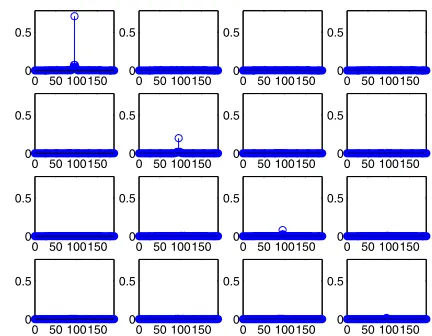
Fig. 2 shows the modulus of the elements of the resulting Γ(N)(z) = ˜B(N)(z)R(z)B(N)(z)obtained by applying SBR2
as described above. It is evident that off-diagonal elements have been eliminated, and only on-diagonals remain. Note however that the order of the systemΓ(N)(z)has significantly increased as compared toR(z)in Fig. 1.
[image:3.612.46.300.313.412.2]−0.5 0 0.5 −80
−70 −60 −50 −40 −30 −20 −10 0
Normalised frequency Ω/2π
|
Γii
(e
j
Ω)|
2 [dB]
Γ11(ejΩ)
Γ22(ejΩ)
Γ33(ejΩ)
[image:4.612.325.548.60.236.2]Γ44(ejΩ)
Fig. 3. Power spectral densitiesΓ(iN)(ejΩ) along the main diagonal of
Γ(N)(z)in Fig. 2.
the diagonalisation ofR(z).
Due to the delays applied in the diagonalisation process, the order of the polynomial matrix Γ(N)(z) as well as the order of paraunitary matrix B(N)(z) grow as the number of
iterations increases [1], [3]. This growth requires large memory to accomodate a record of both the para-HermitianΓ(i)(z)and the paraunitaryB(i)(z)within SBR2. Also, the computational
complexity to perform one iteration step of SBR2 increases with the iteration number. In order to avoid this, [3] have proposed to discard the outer coefficient matrices of Γ(i)(z)
while allowing an acceptable small loss in its Frobenius norm. This approach can help to significantly reduce the order of para-Hermitian matrix, while the order of the paraunitary matrix remains unaltered. Note that despite of truncation, Γ(i)(z) will retain its parahermitian property. However, the order of the paraunitary matrix B(N)(z) remains very high, which affects the speed of SBR2 and is likely to inhibit the application of B(N)(z) in practical senarios where long
paraunitary filter banks with large delay and complexity are undesired. Therefore problem of lowering the order of the paraunitary matrixB(N)(z)will be treated in the next section.
III. TRUNCATION OFPARAUNITARYMATRIX
The truncation B(i)(z)to a matrix B(Ti)(z)of lower order in the course of SBR2 leads to a loss of paraunitarity. We therefore refer to B(Ti)(z) as a near-paraunitary matrix, pro-vided that the deviation from a paraunitary matrix can be kept small. In order to quantify how closeB(Ti)(z)is to a paraunitary matrix, we therefore define a cost function
ξ= 1
P
∞
τ=−∞
Q[τ]2F (14)
where Q[τ]◦—•Q(z) = IP×P −B
(i) T (z) ˜B
(i)
T (z). In the
case of no truncation, B(Ti)(z) = BN(i)(z) and ξ equals to zero. Truncation of B(i)(z)will lead to a positive error. The
truncation of B(i)(z), either during each SBR2 step or after
0 20 40 60 80 100
0 50 100 150 200 250
Number of iterations
Length of near−paraunitary matrix
Length of paraunitary matrix without truncation Truncation with ξ≤ 10−6
[image:4.612.54.278.62.235.2]Truncation with ξ≤ 10−5
Fig. 4. Length of the paraunitary matrix with and without truncation.
convergence, can be performed under the condition
ξ≤ǫ . (15)
A second measure evaluates by how much the matrix R′(z) = ˜B(Ti)(z)Γ(i)(z)B(Ti)(z) deviates from the original para-Hermitian matrixR(z)due to truncation of B(i)(z), for
which we consider the normalised error
χ=R
′
(z)−R(z)2
F
R(z)2
F
. (16)
Again, this error depends on whetherB(i)(z)is truncated only after convergence, i.e. fori=N, or as an ongoing operation in each step of SBR2. Unlike ξ, the error χ is not a design parameter which permits control, but a true output to assess the impact of truncation. Note that if we perform the truncation of Γ(i)(z)in each step of SBR2 as proposed in [3], it causes another deviation in addition to the deviation caused by the truncation of B(i)(z). Thus, in such case the error χ has two
sources, whereby one is from the truncation ofΓ(i)(z)and the other is from the truncation ofB(i)(z).
IV. SIMULATIONS ANDRESULTS
To highlight the advantage of the proposed truncation scheme, we consider the diagonalisation of a covariance matrix R(z), which is generated from a 4×4 polynomial MIMO channel matrix C(z) based on an indoor statistical channel model in [5]. The channel order is chosen to be 10 which leads toR(z) =C(z) ˜C(z)to be of order21. Simulation are performed over an ensemble of 50 randomly generated MIMO channels.
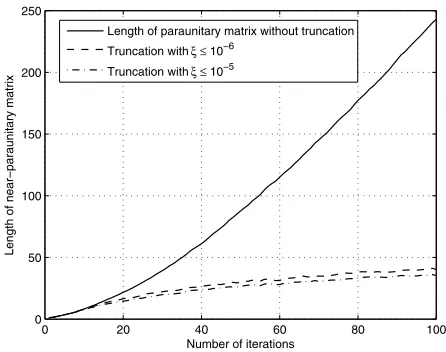
First consider the case when there is no truncation of Γ(i)(z)in the diagonalisation process. The length of the near-paraunitary matrix as a function of the number of iterations in different cases is illustrated in Fig. 4. The error function for the truncated cases has been chosen to be ξ ≤ 10−6
and ξ ≤ 10−5. As one can see from the figure, without
0 20 40 60 80 100 0
1 2 3 4 5 6 7 8 9x 10
−6
Number of iterations
Cost function
ξ ξ≤ 10−6
[image:5.612.60.279.51.442.2]ξ≤ 10−5
Fig. 5. Value of the cost function.
0 20 40 60 80 100
0 0.5 1 1.5 2 2.5x 10
−5
Number of iterations
Error function
χ
ξ≤ 10−6
ξ≤ 10−5
Fig. 6. Distortion caused by truncation ofBN(z).
the paraunitariness. Fig. 5 shows the dependence of the cost function on the number of iterations with the upper bound to be
10−6and10−5. We see from the figure that the cost function is
always kept under the given upper bound. The dependence of the error funtionχon the number of iterations is illustrated in Fig. 6. From the figure, one can see that the distortion caused by the truncation of paraunitary matrix is very small. Fig. 7 and Fig. 8 show the length of near-paraunitary matrix and the error function in two cases when the truncation of paraunitary matrix is performed after the diagonalisation and during the diagonatisation. One can see from the figures that performing the truncation during the diagonalisation process results in a higher order of truncated near-paraunitary matrix. The error caused by truncation in this case is also higher but more stable than that of the case when the truncation is performed after diagonalisation process.
Next we consider the case when the truncation ofΓ(i)(z)
is performed during diagonalisation process as proposed in [3] with a lost of 10−5 in Frobenius norm of Γ(i)(z)after each
iteration. As one can see from Fig. 9, the truncation ofΓ(i)(z)
does not have a big effect on the length of near-paraunitary
0 20 40 60 80 100
0 20 40 60 80 100 120 140 160
Number of iterations
Length of near−paraunitary matrix
[image:5.612.325.549.59.234.2]Truncation after diagonalisation Truncation during diagonalisation
Fig. 7. Length of the near-paraunitary matrices truncated after and during diagonalisation.
0 20 40 60 80 100
0 0.5 1 1.5 2 2.5
3x 10 −6
Number of iterations
Error function
χ
Truncation after diagonalisation Truncation during diagonalisation
Fig. 8. Error function in two cases of truncation (before and during the diagonalisation).
matrix, but it makes the error function increase with the number of iterations, which means the error function χ is dominated by the error component caused by the truncation of para-Hermitian matrix.
V. CONCLUSION
[image:5.612.328.548.272.448.2]0 20 40 60 80 100 0
5 10 15 20 25 30 35 40 45
Number of iterations
Length of near−paraunitary matrix
[image:6.612.62.279.62.234.2]without truncation of parahermitian matrix with truncation of parahermitian matrix
Fig. 9. Length of the near-paraunitary matrices with and without truncation of para-Hermitian matrix.
0 20 40 60 80 100
0 1 2
x 10−4
Number of iterations
Error function
χ
without truncation of parahermitian matrix with truncation of parahermitian matrix
Fig. 10. Error function with and without truncation of para-Hermitian matrix.
The future works will concern the implementation issues of the algorithm in DSP hardware such as the accuracy in different number formats.
REFERENCES
[1] J. G. McWhirter and P. D. Baxter. A Novel Technqiue for Broadband SVD. In12th Annual Workshop on Adaptive Sensor Array Processing, MIT Lincoln Labs, Cambridge, MA, 2004.
[2] J. G. McWhirter, P. D. Baxter, T. Cooper, S. Redif, and J. Foster. An EVD Algorithm for Para-Hermitian Polynomial Matrices. IEEE Transactions on Signal Processing, to appear, 2007.
[3] J. Foster J.G. McWhirter and J. Chambers. Limiting the Order of Polynomial Matrices Within the SBR2 Algorithm. IMA International Conference on Mathematics in Signal Processing, Cirencester, 2006. [4] S. Redif and T. Cooper. Paraunitary Filter Bank Design via a Polynomial
Singular Value Decomposition. InProc. IEEE International Conference on Acoustics, Speech, and Signal Processing, volume 4, pages 613–616, Philadelphia, PA, March 2005.
[5] A.A.M Saleh and R.A. Valenzuela. A Statistical Model for Indoor Mul-tipath Propagation.IEEE Journal on Selected Areas in Communications, 5(2):128–137, February 1997.
[6] S. Weiss, S. Redif, T. Cooper, C. Liu, P. D. Baxter and J. G. McWhirter. Paraunitary Oversampled Filter Bank Design for Channel Coding. EURASIP Journal on Applied Signal Processing, 2006.
[7] S. Weiss, C. H. Ta and C. Liu. A Wiener Filter Approach to the Design of Filter Bank Based Sigle-Carrier Precoding and Equalisation. Proc. IEEE International Symposium on Powerline Communications and Its Applications, Pisa, Italy, March 2007.
[8] C.H. Ta and S. Weiss. A Design of Precoding and Equalisation for Broadband MIMO Systems. Proc. 15th International Conference on Digital Signal Processing, Cardiff, UK, July 2007.
ACKNOWLEDGMENT
[image:6.612.64.281.271.447.2]