Development co-operation,
maDe in Germany
Development co-operation,
maDe in Germany
WARSAW
SEPTEMBER 2015
© Copyright by Ośrodek Studiów Wschodnich im. Marka Karpia Centre for Eastern Studies
CONTENT EDITORS
Olaf Osica, Anna Kwiatkowska-Drożdż
EDITOR
Katarzyna Kazimierska
CO-OPERATION
Halina Kowalczyk, Anna Łabuszewska
TRANSLATION Ilona Duchnowicz
CO-OPERATION Timothy Harrell
CHARTS
Wojciech Mańkowski
GRAPHIC DESIGN PARA-BuCH
PHOTOGRAPH ON COvER Shutterstock
DTP
GroupMedia
PuBLISHER
ośrodek Studiów Wschodnich im. marka Karpia Centre for Eastern Studies
ul. Koszykowa 6a, Warsaw Tel. + 48 /22/ 525 80 00 Fax: + 48 /22/ 525 80 40 osw.waw.pl
Contents
IntroductIon /5
tHESES /6
IntroductIon: tHE compEtIng approacHES In gErman
dEvElopmEnt polIcy /9
I. gErman objEctIvES and IntErEStS In dEvElopmEnt polIcy /11
1.
Support for the german economy
/11
2.
the stabilisation of international security
/13
3.
co-forming the international development policy agenda
/14
4.
‘post-development’ co-operation
/16
5.
reinforcing the global governance system
/18
II. tHE prIncIplES of gErman dEvElopmEnt polIcy /20
1.
Win-win
/20
2.
a fishing rod instead of a fish
/20
3.
bilateral co-operation
/21
4.
reinforcing diplomacy
/22
5.
regional priorities of german development policy
/23
III. InStrumEntS and actorS of dEvElopmEnt polIcy /26
1.
bilateral co-operation
/26
2.
multilateral co-operation
/28
3.
the actors of german development policy
/30
AppendIx 1.
THE SECTORAL CONCEPT FOR SuPPORTING PRIvATE
COMPANIES
/37
AppendIx 2.
SECuRITy vS. DEvELOPMENT: DEvELOPMENT
CO-OPERATION WITH AFGHANISTAN AFTER 2014
/38
AppendIx 3.
PLANNING AND IMPLEMENTATION OF FINANCIAL AND
AppendIx 4.
GERMAN DEvELOPMENT POLICy SCHEME –
INSTITuTIONS AND INTEREST GROuPS
/41
AppendIx 5.
DEvELOPMENT CO-OPERATION AND CONSuLTING
IN uKRAINE
/42
AppendIx 6.
DEvELOPMENT CO-OPERATION AND POLITICAL
FOuNDATIONS IN NORTH AFRICA
/46
AppendIx 7.
THE BMZ’S STRATEGIES AND CONCEPTS
CONCERNING DEvELOPMENT POLICy
/49
AppendIx 8.
FORMS OF CO-OPERATION BETWEEN GERMAN
PR
A
C
E O
SW
09
/20
12
O
SW R
EP
O
R
T
09
/20
15
IntroductIon
In January 2015, Chancellor Angela Merkel announced that development pol-icy would be among the priorities of the German presidency of the G7 group, and promised to continue measures against poverty as part of the UN so as to eliminate it by 2030. Development policy has attracted increasing attention for many years and is strongly supported by the German public. According to a survey conducted by TNS Emnid in July 2013, 81% of respondents backed Ger-many’s engagement in the fight against poverty, and 80% wanted public ex-penses on development co-operation to be raised. Even though these exex-penses have been growing every year, they are still not even close to the level of 0.7% of GNP, as has on numerous occasions been set as Germany’s goal. However, de-velopment co-operation is not viewed by Germans as a form of humanitarian aid but rather as an agreement between equal partners who mutually benefit from this co-operation.
This report presents the most important trends in German development policy and analyses how Germany utilises this policy to promote its own economic and political interests. The research methods used are primarily observation of political developments and analysis of German governmental documents. Some German experts have also been interviewed. Most of the data presented in this report are sourced from the Federal Ministry for Economic Co-opera-tion and Development (BMZ) and the OrganisaCo-opera-tion for Economic Co-operaCo-opera-tion
and Development (OECD)1.
The report is divided into three parts. The first part analyses the objectives of German development policy and its evolution. The second part presents the principles by which Germany is guided in its development policy, together with its regional priorities. The third part discusses individual instruments of German development policy, such as development loans, consultancy for de-veloping countries and German equipment supplies. The report also shows the significance of the key actors in German development policy, the links existing between them and the resulting problems.
1 OECD reports on development policies of the member countries of the OECD’s Development
PR
A
C
E O
SW
09
/20
12
O
SW R
EP
O
R
T
09
/20
15
tHESES
1. German development policy is intended primarily to support the German
economy. Development co-operation and the state’s significant share in de-velopment projects reduce the investment risk for German entrepreneurs who operate in the developing countries. The development policy is also aimed at building economic and political ties, and this makes the partners partly dependent on German technologies. This is essential for Germany, given the fact that its economy heavily relies on exports. One proof for the existence of this approach is the choice of German priorities in develop-ment policy towards individual countries, which allows continued co-op-eration without any restrictions even after development co-opco-op-eration has formally ended.
2. Germany’s development policy is guided by two key principles: win-win and
conditionality. The first principle means that both the developing countries and Germany benefit from the projects. This approach guarantees support from the German public and also encourages private companies to become actively involved in development policy. The second principle of the Ger-man development policy is conditionality of granting funds. If a partner fails to implement the goals set under the agreements, the funds are cut, and further co-operation may be suspended. This has a disciplining effect on Germany’s partners and ensures that its objectives are strictly enforced.
3. Germany’s development policy is implemented primarily along bilateral
lines. Around two thirds of the German development policy budget is al-located on the basis of inter-state agreements. This guarantees a precise definition of both the project goals and the conditions on which funds are granted. Furthermore, bilateral co-operation builds up the ‘made in Ger-many’ brand as part of both development projects and further economic co-operation, thus indirectly making Germany’s partners dependent on German goods and services. Bilateral agreements cement lasting relations with developing countries. This also has an impact on the perception of Germany as a country engaged in solving global problems and contributes to its positive image in the international community.
4. The selection of the objectives, the long-term operation and the
PR
A
C
E O
SW
09
/20
12
O
SW R
EP
O
R
T
09
/20
15
primarily with those countries which have an average level of income and which are likely to become strictly economic partners for Germany within a shorter timeframe, rather than with the poorest countries which require the highest level of financial support and where investment risk is the
highest. The pragmaticchoice of priorities also enables a smooth
transi-tion from development to economic co-operatransi-tion. This approach is also in line with Berlin’s consistent reduction of the number of countries which are classified as developing countries with which it co-operates; and this makes Germany’s moves more effective.
5. The greatest share of Germany’s development budget goes to Africa. It
con-sumes more than one third of expenditure as part of German development policy. Africa is viewed by Germany on the one hand as a continent with a substantial but often undiscovered economic potential, and on the other as an area of instability and risk, potentially posing a threat to Germany also. In connection with the Arab Spring, Germany has launched special transformation programmes for North Africa and has increased its share in development co-operation in relations with other countries. Germany thus wants to prevent a wave of refugees coming from this area to Germa-ny, offering them the opportunity to find jobs at home, and to stabilise se-curity in the region. At the same time, Germany would like its development policy projects to help it reinforce its economic position in North Africa and compete with France and Italy, which are strong in this region, and also with the expansive Chinese economy.
6. Development policy, along with German diplomacy and defence policy,
is the third element of Germany’s foreign policy. Within this framework it plays above all a preventive role against international conflicts. Invest-ing funds as part of development projects in the areas affected by military conflicts or at high risk of such conflicts is viewed by Germany as a contri-bution to overcoming crises or removing their causes. Such measures also stem from the conviction that international conflicts, wherever they ap-pear, are harmful to the German economy which heavily relies on exports. Engagement in development policy is also viewed in a positive light by the German public and is supported as one of the key elements of Germany’s foreign policy.
7. The greatest challenges of development policy include the multitude of
PR
A
C
E O
SW
09
/20
12
O
SW R
EP
O
R
T
09
/20
15
PR
A
C
E O
SW
09
/20
12
O
SW R
EP
O
R
T
09
/20
15
I
ntroductIon: tHE compEtIng approacHES
In gErman dEvElopmEnt polIcy
German development policy was one of the first foreign activities of the Ger-man government after World War II. In 1952, GerGer-many co-financed the budget of the UN Expanded Program of Technical Assistance for the economic devel-opment of under-developed countries, and the first German fund for develop-ment co-operation worth DM50 million was established four years later. The Ministry for Economic Development (at present, the Ministry for Economic Co-operation and Development, BMZ) was established in November 1961 and was headed by Walter Scheel (FDP), who later served as Germany’s president. German development policy from its onset served to support German foreign and economic policy, which was quite restricted after World War II. Since it was conducted in the reality of the Cold War, the principles of the Hallstein Doctrine were also followed in contacts with developing countries in order to restrict the recognition of the GDR under international law. This meant that co-operation was established only with those countries which had no diplomatic relations with Eastern Germany. German development co-operation from the very beginning performed the function of promoting the German economy. This approach allowed an expansion of the list of countries to which this kind of support was provided.
Two main approaches to Germany’s development policy can be distinguished: social and economic. The former, mainly represented by the bloc of left-wing parties, is focused on the needs of the countries receiving aid. This policy was adopted between 1969 and 1974 by the SPD–FDP coalition and Chancellor Willy
Brandt2 (the BMZ was at that time headed by Erhard Eppler from the SPD) and
between 1998 and 2009 by the SPD–Green Party and the
CDU–SPD coalition, when the ministry was led by Heidemarie Wieczorek-Zeul (SPD). Since 1998, German development policy has been treated as part of the
‘global structural policy’3. In the SPD’s opinion, development should
engen-2 Willy Brandt from 1980 chaired the Independent Commission on International Development
Issues appointed by the World Bank. The results of the commission’s work were presented at the UN forum. They provoked a discussion on the need to change the approach in develop-ment policy and to place a greater emphasis on such values as security, human dignity, justice and equality rather than countries becoming richer. Cf: Brandt Report: Das Überleben sichern, 1980, http://www.nachhaltigkeit.info/artikel/brandt_report_1980_519.htm
3 The SPD–Green Party coalition agreement of 1998, http://www.spd.de/linkableblob/1850/
PR
A
C
E O
SW
09
/20
12
O
SW R
EP
O
R
T
09
/20
15
der structural reforms in the developing countries for which they themselves should be responsible in the first place, while the responsibility for reforms of international financial and trade institutions rests mainly with the OECD
countries4.
The second approach, promoted by politicians from the CDU and the FDP5,
places the economy foremost in development policy. This approach was formed partly by the economic crisis in the late 1960s, as a consequence of which Ger-man governments focused much more on their own economic interests than before, including on guaranteeing access to fossil fuels. Germany has also re-mitted part of the debts of the developing countries on conditions set by the IMF (International Monetary Fund) and the World Bank, imposing on these countries the obligation to conduct structural reforms. The tendency to em-phasise German interests in development policy continued until the end of Helmut Kohl’s term in office, even though an ideological element was added to it – the protection of human rights in developing countries. The Christian-Liberal coalition in 2009–2013 (Dirk Niebel from the liberal FDP was the min-ister in charge of development policy then) also stressed the economic aspect of development policy and placed an increasing emphasis on co-operation with countries with a large economic potential in a given region, which were re-ferred to as emerging markets (Schwellenländer).
The new vision of the policy was aimed at improving development conditions for example through adopting new global trade rules, more beneficial for developing countries, and en-couraging richer countries to become engaged in sustainable development.
4 The catalogue of the basic elements of the ‘global structural policy’ includes concentration
of funds allocated for development policy, above all on reducing poverty, protection of the natural environment, prevention in military conflicts, investments in renewable energy sources, a greater focus on regional projects rather than only on bilateral ones, greater role of the state in development policy and refraining from putting the burden of this policy on private firms, and the search for new forms of Public-Private Partnerhsips. Cf: F. Nuscheler, Globale Strukturpolitik: Entwicklungspolitik unter den Bedingungen der Globalisierung, [in] S. Schmidt, G. Hellmann, R. Wolf, Handbuch zur deutschen Außenpolitik, Wiesbaden 2007, pp. 680-682.
5 One exception to this rule was the approach adopted by Helmut Schmidt (SPD), who after
PR
A
C
E O
SW
09
/20
12
O
SW R
EP
O
R
T
09
/20
15
I. gErman objEctIvES and IntErEStS
In dEvElopmEnt polIcy
Development policy in Germany is referred to as Entwicklungszusammen-arbeit (development co-operation) and not Entwicklungshilfe (development aid). The ministry in charge of this policy established in 1961 was named the Ministry for Economic Co-operation, which from the very beginning suggest-ed that the tasks of its staff would be primarily focussuggest-ed on economic relations with developing countries. The term ‘development co-operation’ also suggests that negotiations and agreements between Germany and a developing coun-try are conducted on terms of equal co-operation, and fits in with the slogan of ‘assistance for self-assistance’ (Hilfe zur Selbsthilfe) promoted by Germany. It implements the main objectives of its development co-operation through of-fering tools for combating poverty (understood in an increasingly broad con-text, including energy poverty), creating workplaces and building lasting eco-nomic growth in developing countries (for example, by means of low-interests loans or consultancy and training).
According to the coalition agreement, the goals of German development policy include “combating hunger and poverty, and strengthening democracy and
the rule of law, while respecting our own values and interests”6. Reduction of
poverty has been accorded top priority in this policy since the very beginning. The objectives of development co-operation are linked to the main interests of Germany:
− support for the German economy;
− stabilisation of international and German security; − co-forming the global development policy agenda;
− preparation for maintaining relations with developing countries ‘post-de-velopment assistance’ (such as in the case of China);
− reinforcing the global governance system.
1. Support for the german economy
One of the main tasks of the German development policy is to support the Ger-man economy. GerGer-many believes that significant involvement of companies is
6 The coalition agreement between the CDU, the CSU and the SPD of 2013, p. 126; https://www.
PR
A
C
E O
SW
09
/20
12
O
SW R
EP
O
R
T
09
/20
15
a necessary condition for an effective development policy. Private enterprises hus improve the economic condition of the developing countries and have the opportunity to increase their exports to these countries (see Appendix 1). Sec-ondly, German firms have facilitated access to new markets where the invest-ment risk is often high but the developinvest-ment potential is also significant. Fur-thermore, firms build networks of informal connections while implementing the projects, which helps them gain new contracts in the future. Politicians also frequently emphasise the significance of German economic interests in
development co-operation7.
Development policy is also expected to help ensure raw material supplies to Germany. This became essential during the oil crisis in 1973, and this ten-dency strengthened when the prices of raw materials increased in 2004/2005. Furthermore, critical raw materials are gaining significance in the German economy (including cobalt, platinum, germanium, niobium, tantalum and tungsten) as well as rare-earth metals (such as cerium, zirconium, dyspro-sium, europium, yttrium and lanthanum) which are necessary in the process
of creating modern technologies8. Development policy in this area is expected
to support the actions of other ministries, including in building raw material partnerships and conducting the ‘raw materials dialogue’ hand in hand with the Ministry for Economic Affairs and Energy (BMWi). Its another objective is to lead to the strengthening of the economies of developing countries through the modernisation of their natural resources sectors. BMZ supports developing countries in commodities production through consulting, the improvement of education quality, strengthening of state structures and support for develop-ment of co-operation with private companies and for combating corruption
and improving transparency in the cash flow on commodities markets9.
7 The coalition agreements contain provisions indicating that German development policy is
aimed at contributing to creating new jobs in Germany, Ibidem, p. 162, http://www.cdu.de/ sites/default/files/media/dokumente/05_11_11_Koalitionsvertrag_Langfassung_navigier-bar_0.pdf ; an approach like this was presented for example by Dirk Niebel in an interview for Handelsblatt daily newspaper, http://www.handelsblatt.com/politik/deutschland/dirk-niebel-entwicklungspolitik-darf-auch-interessengeleitet-sein/3498804.html
8 Cf. Anna Kwiatkowska-Drożdż, The natural resources deficit: the implications for German
politics, http://www.osw.waw.pl/en/publikacje/osw-commentary/2011-02-08/natural-re-sources-deficit-implications-german-politics
9 BMZ, Entwicklungspolitisches Strategiepapier Extraktive Rohstoffe, 2010, pp. 8, 22-23 http://
PR
A
C
E O
SW
09
/20
12
O
SW R
EP
O
R
T
09
/20
15
2. the stabilisation of international security
Development policy performs preventive functions in the regions facing the risk of conflict and stabilises the areas where conflicts already exist. This stems from the belief that conflicts – wherever they occur – adversely affect the Ger-man economy, and their consequences can also be felt in GerGer-many (for example, organised crime or fights between various ethnic groups). The connection be-tween German development policy and security policy was initiated by Chan-cellor Gerhard Schröder, who stated at the World Economic Forum in New York
in February 2002 that “there is no global security without global justice”10. At
present, 50% of the countries with which Germany is engaged in development
co-operation are affected by conflicts or have an unstable situation11.
The impact of development policy on German security policy is manifested for example by the fact that the BMZ (along with the Chancellor’s Office, the Federal Foreign Office, the Ministry of Defence and the BMWi) co-decides on exports of German weapons, and participates along with the Federal Foreign Office and the Ministry of Defence in developing guidelines for the German government on strategies to be adopted with regard to unstable countries
and regions12. Germany also tries to match the interests of development
pol-icy and security polpol-icy with the international community, for example by chairing together with France the World Bank’s working group in charge of policy towards unstable countries and through engagement in the prepara-tion of the World Bank’s World Development Report 2011: Conflict, Security and Development.
10 F. Nuscheler, Entwicklungspolitik. Lern- und Arbeitsbuch, Bonn 2012, p. 37.
11 Entwicklung für Frieden und Sicherheit. Entwicklungspolitisches Engagement im Kontext
von Konflikt, Fragilität und Gewalt, p. 3; http://www.bmz.de/de/mediathek/publika-tionen/reihen/strategiepapiere/Strategiepapier328_04_2013.pdf
12 Since 1998, the BMZ has participated in the meeting of the Federal Security Council
PR
A
C
E O
SW
09
/20
12
O
SW R
EP
O
R
T
09
/20
15
Development policy is also an important element of the German ‘integrated se-curity’ concept (vernetzte Sicherheit) – the civilian-military approach to chal-lenges and risks in the area of security. This approach means the use of civilian instruments in foreign operations, including those utilising diplomacy (media-tions and negotia(media-tions), police and the administration of justice (training for po-lice, judges and public prosecutors) and projects covering development and
eco-nomic co-operation to the same extent as military measures13 (see Appendix 2).
3. co-forming the international development policy agenda
Berlin has actively co-formed the UN development agenda by holding interna-tional conferences devoted to development policy issues and through partici-pation in the group of experts working on the Post-2015 Development Agenda
intended to replace the United Nations Millennium Development Goals14. The
BMZ also has its representatives in the WTO directorate and in the Develop-ment Banks: African, Asian, Inter-American and Caribbean and inside vari-ous international organisations operating in the area of development policy, including the UN in Geneva and New York, the OECD and the FAO.
The former German president, Horst Köhler (supported by a team of advisors from the Federal Foreign Office, the BMZ, the GIZ (Association for International Develop-ment) and KfW (Kreditanstalt für Wiederaufbau) has taken part in the High-Level Panel of Eminent Persons initiated in 2012 in the process of creating the future pol-icy of the UN (Post-2015 Development Agenda). In this new agenda, Germany wants to combine the eradication of poverty (which is a binding element of the agenda as a whole) with the promotion of ecological sustainable development, and to in-clude Global Governance issues within it. Both developed countries and those who aspire to join this group (Schwellenländer) and developing countries should each
hold an equal share of the responsibility for the implementation of this policy15. The
13 Justyna Gotkowska, W połowie drogi do pełnoletności – niemiecka polityka bezpieczeństwa.
Między presją sojuszników i ambicjami politycznymi a brakiem strategii i sceptycyzmem społeczeństwa, Biuletyn Niemiecki, No. 4 10 March 2010, pp. 5-6, and Justyna Gotkowska, A weak link? Germany in the Euro-Atlantic security system, Point of View, OSW, 15 January 2015, pp. 16-18.
14 Bonn is frequently chosen as the venue of conferences devoted to development issues,
part-ly because the UN agencies are located there. Conferences concerning Afghanistan have been held there (in 2001, 2002 and 2011; the one in 2004 was held in Berlin). Bonn also host-ed the conference Advancing the Post-2015 Sustainable Development Agenda, which was co-financed by the BMZ, where the interests of the civil society concerning Post-2015 Devel-opment Agenda were emphasised.
15 Cf. BMZ, Die post-2015 Entwicklungsagenda. Unser Beitrag, http://www.bmz.de/de/was_
PR
A
C
E O
SW
09
/20
12
O
SW R
EP
O
R
T
09
/20
15
Public-Private Partnerships (PPP) concept, which is based on co-operation between private companies and public institutions in development projects, would also be
strengthened in the new agenda16. In the opinion of some German think tanks, the
new UN concept should also be aimed at combining a number of topics (for example, creating so-called green workplaces based on ecological economy and cities of the future) and utilising the experiences of the Bonn conference in 2011, which led to several issues being conjoined: security of clean water reserves, energy issues and
food issues. Experts have also appealed for a better evaluation of the new agenda17.
Chart 1. German Official Development Assistance (ODA) as compared to the
other OECD countries in 2008, net in billions US$
0 5 10 15 20 25 30
USA
Germany
United Kingdom
France Japan Holland Spain Italy Canada Sweden Norway
Australia Denmark Belgium
Switzerland
Austria Ireland Finland Greece Portugal
Luxembourg New Zealand
[US$ billion]
4.8 26.8
14.0
11.5 10.9 9.6
7.0 6.9
4.9 4.7 4.0
3.0 2.8 2.4 2.0 1.7 1.3 1.2 0.7 0.6 0.4 0.4
Source: OECD, Entwicklungsausschuss (DAC), PEER REVIEW 2010
16 Dirk Niebel (FDP) has supported and propagated it. He wanted to turn this instrument into
a driving engine of German development policy. Cf. Armutsbekämpfung Nebensache, http://www.sueddeutsche.de/politik/kritik-an-entwicklungshilfe-armutsbekaempfung-nebensache-1.1021032; Wir betreiben doch keine Kolonialpolitik, http://www.theeuropean. de/dirk-niebel/7263-deutsche-entwicklungskooperation
17 Cf. M. Beisheim, ‘Ein Review-Mechanismus für die Post-2015-Ziele nachhaltiger
PR A C E O SW 09 /20 12 O SW R EP O R T 09 /20 15
Chart 2. German ODA as compared to the other OECD countries in 2008, net % GNP
0.0 0.1 0.2 0.3 0.4 0.5 0.6 0.7 0.8 0.9 1.0 Sw eden Luxembourg N or way
Denmark Holland Ireland Belgium Spain Finland
United Kingdom
Austria
Switzerland
France
Germany Canada Australia
New Zealand
Por
tugal Italy
Greece Japan USA
[%] 0.44 0.98 0.97 0.88 0.82 0.80 0.59 0.48 0.45
0.43 0.43 0.42 0.390.38
0.32 0.32 0.30 0.27
0.22 0.21 0.19 0.19
Source: OECD, Entwicklungsausschuss (DAC), PEER REVIEW 2010
4. ‘post-development’ co-operation
Through its development policy Germany has been laying the foundations for co-operation with those countries which will join the group of developed coun-tries in the future. Germany has been building both economic and political contacts between the donor state and the developing country. By implementing joint projects (bi- or trilateral), Germany has been developing a model of co-op-eration and dependence (on equipment, services and maintenance provided) which continues to operate when post-development co-operation in the strict meaning of the term ceases. This approach provides additional grounds for the term used by the BMZ of ‘development co-operation’ and not ‘development aid’, which would have ended when the project ends. To reinforce this effect, Ger-many co-operates primarily with so-called Lower Middle Income Countries (LMIC), which in 2007–2008 received 48.4% of German Official Development
Assistance (ODA)18. In the case of these countries, the infrastructure
neces-sary to implement development projects is better adjusted to German needs. Furthermore, co-operation with LMIC does not require making everything
18 Deutschland. Entwicklungsausschuss (DAC). Peer Review, OECD 2010, p. 56, http://www.
PR
A
C
E O
SW
09
/20
12
O
SW R
EP
O
R
T
09
/20
15
from scratch (and is thus not a copy of humanitarian aid) and enables switch-ing to the post-development phase and embarkswitch-ing on business projects within a shorter timeframe.
Chart 3. ODA share according to income groups in beneficiary countries in %
LDC LIC LMIC UMIC
[%]
0 5 10 15 20 25 30 35 40 45 50 55
60 1997–1998 2007–2008
31.1
9.1
52.2
7.6 31.3
9.0
48.4
11.4 LDC – Least Developed Countries
LIC – Low Income Countries
LMIC – Lower Middle Income Countries UMIC – Upper Middle Income Countries
Source: OECD, Entwicklungsausschuss (DAC), PEER REVIEW 2010
One example of such an approach is Germany’s development policy towards China. For 30 years, until 2009, Germany offered China 4.034 billion euros as part of development co-operation and 635 million euros as part of technical co-operation, focusing on projects aimed at improving the rule of law, better-conditions for foreign investment and climate and natural environment pro-tection. A strategic partnership was established between the governments in Beijing and Berlin in 2009. Since this moment, China is no longer classified as a country with which Germany is engaged in development co-operation. This is due to the perception that a country which has a reputation of an eco-nomic power hould not be covered by the orthodox instruments of German development policy, and that Germany benefits less from such co-operation than for example from supporting foreign trade. However, the fact that devel-opment co-operation has ended does not mean that Germany no longer sub-sidises development projects from the budgets of other ministries or federal
states19. This new form of co-operation allows Germany and China be involved
19 Even though development co-operation between Germany and China has ended, part of the
PR
A
C
E O
SW
09
/20
12
O
SW R
EP
O
R
T
09
/20
15
in development projects according to the trilateral formula20. This concerns for
example Africa, where Germany views China’s economic expansion as a threat to its own interests, and trilateral co-operation could contain this expansion. The institution which guarantees the continuity of economic and institutional contacts after the end of development co-operation is the Association for In-ternational Co-operation (GIZ) which has operated in China for 25 years (until 2011 it was known as GTZ – Association for Technical Co-operation), which acts as an intermediary between German and Chinese institutions as part of both development co-operation and strategic partnership. The GIZ employs around
200 people in China and was in charge of around 50 projects in 201421. The top
priorities of the GIZ’s engagement in China after 2009 include: sustainable eco-nomic development, environmental protection, energy and natural resources
issues22. Political contacts with Beijing have also intensified since 2011 partly
through holding intergovernmental consultations. Previously, Germany took similar action with regard to Saudi Arabia, which since 2008 is no longer clas-sified as a country with which Germany would engage in development co-op-eration either.
5. reinforcing the global governance system
Germany has also aimed at reinforcing global governance through develop-ment policy, for example the presence of developing countries in such forums as G20 and their participation in the decision-making process concerning glob-al economy. Germany wants more and more developing countries to join globglob-al governance forums and to coordinate their stances at international forums. This approach is implemented as part of the BMZ’s programme ‘Global Part-nership’ (it is coordinated by the GIZ), which has two components: the train-ing project aimed at developtrain-ing contact networks named Managtrain-ing Global Governance and a project designated for the exchange of views named Globale Maßnahmen. As part of Managing Global Governance, Germany has since
20 Trilateral co-operation in the BMZ’s development policy means co-operation in the joint
implementation of projects by a partner with Germany, an emerging power and a develop-ing country. Owdevelop-ing to this, the costs of the project and the investment risk are shared. Each party may also capitalise on the previous experience and contacts of their partners.
21 GIZ-Büro China, http://www.giz.de/de/weltweit/377.html
22 Part of the funds are still sent to China as part of co-operation with federal states. German
PR
A
C
E O
SW
09
/20
12
O
SW R
EP
O
R
T
09
/20
15
PR
A
C
E O
SW
09
/20
12
O
SW R
EP
O
R
T
09
/20
15
II. tHE prIncIplES of gErman dEvElopmEnt polIcy
1. Win-win
German development policy is guided by the win-win principle, which means that co-operation must be beneficial to both parties. The benefits developing countries receive include the necessary expertise, management capabilities, new technologies and capital; and all this contributes to building new work-places and raising residents’ incomes, and thus helps eliminate poverty. Ger-man entrepreneurs view this as an opportunity to gain new markets and build contacts and networks. The degree of risk is limited in their case, considering the strong engagement of the state (partly through loans granted). This also brings benefits to German taxpayers (owing to new jobs in Germany), for whom
this is a good argument to invest more in development policy23. This
princi-ple also applies to trilateral co-operation (a developed country, a developing
country and Schwellenländer, like India, Brazil, Mexico), where co-operation
should also result in a win-win situation.
2. a fishing rod instead of a fish
Germany emphasises the need to shift an increasing burden onto the develop-ing countries themselves. Guided by the principle of ‘assistance for self-assis-tance’ (Hilfe zur Selbsthilfe), it offers developing countries tools to overcome problems linked to poverty or environmental protection by themselves. Ger-many also wants lower middle income countries to become involved to a great-er extent than before in development projects, so that these become a driving engine for economic development in their respective regions.
Furthermore, the BMZ has reduced the number of beneficiaries of develop-ment co-operation in the strict meaning of the term, treating them as Global Development Partners (GEP), and thus also reducing the availability of BMZ
technical and financial assistance to them24. This allows some of the German
development aid measures (including PPP and grant funding) to be combined
23 Cf. An interview with Dirk Niebel, minister for economic co-operation and development,
Entwicklungspolitik darf auch interessengeleitet sein, http://www.handelsblatt.com/poli- tik/deutschland/dirk-niebel-entwicklungspolitik-darf-auch-interessengeleitet-sein-seite -2/3498804-2.html
24 The list of countries defined by Germany as partners to which the Global Development
PR
A
C
E O
SW
09
/20
12
O
SW R
EP
O
R
T
09
/20
15
with those aimed at supporting the German economy abroad (including the mobilisation of private funds, support for private firms, sectoral dialogue and support for scientific research). Germany intends to intensify co-operation with international organisations by promising to change the distribution of votes at such institutions as the World Bank and the IMF to the benefit of GEP countries. Germany has emphasised the need for GEP countries to make a sig-nificant contribution to joint projects with Germany and wants them to par-ticipate more actively in trilateral co-operation (Germany–GEP–developing country).
3. bilateral co-operation
German development co-operation is predominantly of a bilateral nature. This is important because a provision setting out proportions between devel-opment co-operation taking place under the aegis of international organisa-tions and for bilateral agreements between Germany and a developing state was included, for example, in the coalition agreement of 2009. It stipulates that one third of the funds must be allocated as part of multilateral organisa-tions, while two thirds as part of bilateral agreements between Germany and
developing countries25.
Bilateral co-operation promotes German solutions branded as ‘made in Ger-many’. By entering into bilateral agreements, Berlin influences the conditions of co-operation and sets the priorities for expenditure and the allocation of technical co-operation. In this meaning, bilateral co-operation is a successful political tool for propagating German interests, such as in international organ-isations. This is particularly important at the UN, where each country has one vote at the General Assembly, and developing countries can support Germany’s candidates for non-permanent’ embers of the UN Security Council or its other bodies (such as the Human Rights Council).
25 Koalitionsvertrag zwischen CDU, CSU und FDP, Wachstum. Bildung. Zusammenhalt. http://
PR
A
C
E O
SW
09
/20
12
O
SW R
EP
O
R
T
09
/20
[image:23.496.61.264.75.460.2]15
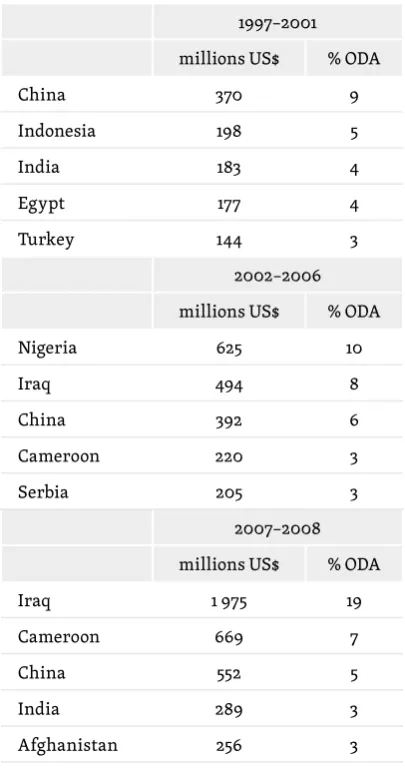
Table 1. The largest individual beneficiaries of co-operation
1997–2001 millions US$ % ODA
China 370 9
Indonesia 198 5
India 183 4
Egypt 177 4
Turkey 144 3
2002–2006 millions US$ % ODA
Nigeria 625 10
Iraq 494 8
China 392 6
Cameroon 220 3
Serbia 205 3
2007–2008 millions US$ % ODA
Iraq 1 975 19
Cameroon 669 7
China 552 5
India 289 3
Afghanistan 256 3
Source: OECD, Entwicklungsausschuss (DAC), PEER REVIEW 2010
4. reinforcing diplomacy
German public opinion polls indicate that Germans support an active
for-eign policy above all in the non-military area26. Public support is traditionally
26 According to surveys published in May 2014 ordered by the German Federal Foreign Office
PR
A
C
E O
SW
09
/20
12
O
SW R
EP
O
R
T
09
/20
15
strong for humanitarian aid (which is a prerogative of the Federal Foreign
Of-fice27) and international negotiations are reinforced with the desire to
inten-sify development co-operation as a manifestation of “taking a greater respon-sibility” for the global order.
Building the foreign policy / defence policy / development policy triad is a Ger-man response to crisis Ger-management in military conflicts. This is evident in the ‘integrated security’ (vernetzte Sicherheit) concept, which combines various elements of crisis management: from the use of military force through peace negotiations to economic and development co-operation, which in Germany’s opinion contributes to building secure and stable countries and regions.
Development policy is an inseparable element of German foreign policy (hence the appeals for placing these issues on the agenda of the Federal Foreign Of-fice), which is always present in dealing with international crises or unstable regions. This is backed by the conviction that economic development and the improvement of social conditions lead to stability, security and peace.
5. regional priorities of german development policy
In 2012, European developing countries received 948 million euros as part of German development policy. In turn, Germany spends most of its funds on Af-rican countries – in 2012 total German ODA for Africa was worth 3.761 billion euros. On the one hand, Germany views Africa as an unstable continent, and the consequences of this instability as a threat to Europe, including Germany (refugees, terrorism, piracy, organised crime). On the other hand, it can see Af-rica’s increasing importance in terms of economy (both rapid economic growth and increasing middle class), demography, raw materials and agriculture. Germany sees this as an opportunity for its own products, technical exper-tise and investments and expanding political influence in Africa. Germany di-vides Africa into two areas: Sub-Saharan Africa and North African countries.
(57%) as the most important tasks for German foreign policy. According to polls, in order to make sure that German foreign policy goals are achieved, Germans are ready to accept that their country could intensify civilian international measures for example as part of hu-manitarian aid (86%), diplomatic negotiations (85%) and support for civil society (80%). They would, however, reject any possibility of greater military engagement of the Bun-deswehr (82% respondents oppose this) and more intensive supplies of weapons to allied countries (82% respondents are against this.
27 The BMZ also has a programme in the area between classical development policy and
PR
A
C
E O
SW
09
/20
12
O
SW R
EP
O
R
T
09
/20
15
It focuses in both cases above all on consultancy offered to state administration
and supporting sustainable economic growth28. Partnerships for
modernisa-tion have been established with North African countries which will stabilise and secure the southern borders of the EU, and thus indirectly also of Germany (see Appendix 7).
Germany pursues two major goals in its development policy towards Africa: it wants to increase its own economic engagement and to prevent an inflow of
ref-ugees29. Berlin has employed for this purpose, for example, the promotion of raw
materials production as a leverage for the economic development of these coun-tries. Germany views assistance in the use and modernisation of infrastructure as an opportunity to anchor itself in the African market. Berlin has also made attempts to use the formats of multilateral co-operation (such as the Germany– East Africa–China–India forum) so as to remain in close dialogue concerning the region with these countries. Furthermore, Germany has made efforts to improve investing conditions for its small and medium-sized companies. Germany has employed employed around 2,000 advisors engaged in African countries to have an influence on new regulations, by offering advice to both companies and state
institutions30. In the opinion of the BMZ, one of the ways to scale down the wave
of refugees from North Africa to Germany is to improve socio-economic
condi-tions in the countries covered by development policy31 byprogrammes aimed at
eliminating poverty, developing agriculture and running German-African cen-tres at universities in Tanzania, South Africa, Ghana, Congo and Namibia). In addition to this, to ensure security and improve crisis management, Germany has appealed for African organisations to be allowed to play a more important
role as part of the UN32. A deeper partnership with Africa has been one of the
priorities of the German presidency in the G7 group in 2014–2015.
28 The main goals set by the BMZ in 2004 with regard to Africa; these are used as the basis for
guidelines for politics adopted with regard to individual countries, http://www.bmz.de/de/ was_wir_machen/laender_regionen/subsahara/index.html
29 Cf. Artur Ciechanowicz, Kamil Frymark, Szlaban do ziemi obiecanej. Niemcy walczą
z imigracją socjalną, http://www.osw.waw.pl/pl/publikacje/komentarze-osw/2014-11-19/ szlaban-do-ziemi-obiecanej-niemcy-walcza-z-imigracja-socjalna
30 Afrikapolitische Leitlinien der Bundesregierung, p. 12, Berlin 2014,
http://www.bundesre-gierung.de/Content/DE/_Anlagen/2014/05/2014-05-21-afrikapolitische-leitlinien.pdf?__ blob=publicationFile&v=1
31 Cf. Bundesminister Müller reist in den Nordirak – die Menschen brauchen eine
Perspek-tive vor Ort, http://www.bmz.de/de/presse/aktuelleMeldungen/2014/oktober/141001_pm_ 094_Bundesminister-Mueller-reist-in-den-Nordirak-die-Menschen-brauchen-eine-Pers-pektive-vor-Ort/index.html
PR
A
C
E O
SW
09
/20
12
O
SW R
EP
O
R
T
09
/20
15
Chart 4. Geographic distribution of German ODA in 2012
Africa Asia Europe America Oceania
0.0 0.5 1.0 1.5 2.0 2.5 3.0 3.5
4.0 [bn euro]
0.031 3.761
2.862
0.948 0.865
Source: Deutsche Entwicklungspolitik in Zahlen und Fakten – BMZ (2014)
Asia is the second most important area in German development policy. Ger-man ODA in 2012 was worth 2.862 billion euros. Co-operation priorities in-clude: professional training (in 2009, Asian countries received 52% of all the
funds allocated for this purpose33), protection of intellectual property and
en-vironmental protection issues. As with Africa, in the case of Asia Germany has also made efforts to reinforce regional co-operation and has appealed to Asian countries to resolve most problems concerning development policy. Support for Afghanistan is an essential part of development co-operation in Asia (Ap-pendix 2). India and Indonesia have been classified by Germany as ‘develop-ment co-operation partners’. Germany expects these countries to become more active in development co-operation projects in Asia, offering them support in
the form of know-how and funds34.
South America (with the exception of Oceania, which received 31 million euros in 2012) has been given the lowest priority as a region by Germany. In 2012, it received 865 million euros as part of ODA. This is because Germany has less economic and political interests in this region. Mexico and Brazil, like India and Indonesia, have been classified as ‘development co-operation partners’.
UN Security Council as an impermanent member in 2011–2012, in particular considering the outbreak of the Arab Spring.
33 Deutsche Entwicklungspolitik in Asien BMZ Strategiepapier Neues Fenster, Berlin 2011,
p. 10, http://www.bmz.de/de/mediathek/publikationen/reihen/strategiepapiere/Strate-giepapier310_10_2011.pdf
PR
A
C
E O
SW
09
/20
12
O
SW R
EP
O
R
T
09
/20
15
III. InStrumEntS and actorS of dEvElopmEnt polIcy
1. bilateral co-operation
Bilateral co-operation is the most important part of German development policy. The BMZ allocated 3.041 billion euros for this purpose (47.2% of its budget). However, if subsidies from other ministries and federal states are taken into account, this amount is higher and reaches around two thirds of the total sum allocated for development co-operation, which in 2013 reached
US$14.06 billion35.
The most important issues on which German bilateral development co-opera-tion is focused are:
1) eliminating poverty,
2) securing peace and democratic development, 3) fair development of globalisation,
4) environmental protection.
These are described in more detail and with greater precision in the ten areas
defined in the governmental Guidelines for bilateral technical and financial
co-operation with the partners of German development co-co-operation in force since
200736 .
The most important documents relate to strategies for individual countries - these are used as the basis for setting specific goals and conducting bilateral policy with regard to developing countries formulated by the BMZ (often in
35 This is confirmed by data presented by the OECD in: Deutschland. Entwicklungsausschuss
(DAC). Peer Review, OECD 2010, p. 55, http://www.oecd.org/berlin/46270433.pdf. The minis-tries concerned include above all: AA, BMU, BMBF, BKM, BMELV, BMG, BMWi, BMVg, BMAS, BMF, BMI, BMFSFJ, BMJ and BMVBS. According to information from the BMZ, the total sum engaged in Germany’s bilateral co-operation in 2012 reached around 6.765 billion euros. http://www.bmz.de/de/mediathek/publikationen/reihen/infobroschueren_flyer/ flyer/Faltblatt_FaktenMDG.pdf
36 This concept mentions the following focal points: democratic and civil governance
PR
A
C
E O
SW
09
/20
12
O
SW R
EP
O
R
T
09
/20
15
co-operation with other ministries). They are used by the BMZ, in tandem with the countries covered by development co-operation, to develop the so-called State Concept (Länderkonzept), which defines more precisely and
nar-rows down this co-operation to three priorities37. The concepts also indicate
concrete instruments of development co-operation (technical and financial) designed to implement them. Germany, as part of the intergovernmental con-sultations prior to concluding an agreement with a developing country, re-quires the other party to undertake to “create structural and framework con-ditions for the acceptance of development funds”, and to provide a guarantee of tax exemption in the partner state for the German institution involved in development co-operation. Furthermore, the partner state should guarantee the German staff involved in development co-operation indemnity from penal liability while carrying out their tasks and unrestricted entry and exit to and
from the partner state38.
German bilateral development co-operation is implemented with the use of two key instruments: technical co-operation (Technische Zusammenarbeit, TZ) and financial co-operation (Finanzielle Zusammenarbeit, FZ). In 2012, the BMZ allocated the greater part of its funds to FZ (2.775 billion euros), while 2.277 billion euros were spent on TZ. The term TZ covers inter-state agreements which are implemented on the German part by the BMZ, and on its behalf by implementing organisations, including the GIZ primarily. TZ is effected mainly through consulting, financial support for consulting, equipment supplies and expert opinions. TZ is used by Germany to promote its know-how in the area of technical solutions, economy and management. One component of development co-operation, above all its technical aspect, are numerous tenders. The assumption is that German entrepreneurs are the first to find out about these tenders. The Federal Agency for Foreign Trade (BFAI) is in charge of this.
37 In cases where co-operation with a given country is focused on a specific issue and is not
based on a general approach and also in the case of regional co-operation, German bilateral development co-operation is restricted to one issue. Auswahl der Kooperationsländer, http://www.bmz.de/de/was_wir_machen/laender_regionen/laenderliste/
PR
A
C
E O
SW
09
/20
12
O
SW R
EP
O
R
T
09
/20
15
Chart 5. German net spending on ODA in % of GNP
2005 2006 2007 2008 2001
2000 1999 1998 1997 1996 1995
1994 2002 2003 2004
0.20 0.25 0.30 0.35 0.40 [%]
0.33
0.31 0.32
0.28
0.26 0.26 0.27 0.27 0.28
0.28
0,36 0.36 0.37
0.38
0.27
Source: OECD, Entwicklungsausschuss (DAC), PEER REVIEW 2010
Financial co-operation is another type of bilateral development co-operation. It is coordinated by the state-controlled bank KfW (Kreditanstalt für Wieder-aufbau), while the political conditions governing co-operation with developing countries are set by the BMZ, taking into account opinions from the Federal Foreign Office, the BMF and the BMWi. Loans are granted depending on their investment nature, how the investment is related to the goals set in the de-velopment co-operation agreement and the degree of involvement of German employees. In the case of projects being carried out improperly, FZ agreements provide for the possibility of launching sanction mechanisms (for example, limiting or withholding payments). Germany offers FZ in several categories: non-returnable support is provided to the least-developed countries (LDC); loans with the annual interest rate at 0.75% are offered for 40 years to those de-veloping countries which are on the World Bank’s list; in the case of the other countries, loans with an annual interest rate set at 2% are offered for 30 years. Germany also offers loans on market conditions for economic development projects (mainly for the development of economic infrastructure, environ-mental protection and support for the financial sector), which are intended to be an offer combining business projects with development policy. In 2011, KfW
conducted 1,800 projects in over 100 countries39.
2. multilateral co-operation
The second part of German development co-operation is multilateral co-oper-ation. The EU is the greatest beneficiary of German multilateral co-operation
39 KfW Entwicklungsbank, http://www.bmz.de/de/was_wir_machen/wege/bilaterale_ez/
PR
A
C
E O
SW
09
/20
12
O
SW R
EP
O
R
T
09
/20
15
(1.891 billion euros in 2012), followed by the World Bank group (0.614 billion euros in 2012) and the UN (0.262 billion euros in 2012). Germany also supports regional development banks and smaller international organisations, spend-ing over 3 billion euros annually on this (3.389 billion euros in 2012).
In German development policy, multilateral co-operation is complementary to bilateral co-operation and allows development funds to be utilised in places where the political and financial risk of applying them would be too high for Germany by itself. By offering funds to international organisations, Germany applies the win-win principle. It takes into account above all the compliance of a given organisation’s agenda with German development policy, the areas of
its operation40 and to what extent it is complementary to German bilateral
co-operation. Germany also takes into consideration its influence on the forming of a given organisation’s programme, the strength of voting among its deci-sion-makers, the financial contribution of its budget and the human resources
policy on both worker and managerial levels41.
By holding conferences for development co-operation donors and forming working groups at the BMZ, Germany is engaged in shaping the framework of
multilateral development policy42. Berlin wants, amongst other things,
emerg-ing powers to increase their share in the fundemerg-ing of development co-operation and to set the conditions for spending the funds. Furthermore, Germany has made efforts to ensure that the key international organisations keep close con-tacts with German organisations involved in the implementation of projects
funded by international organisations43.
Over the past few years, Germany has limited (partly under the influence of the OECD’s criticism) the number of international organisations it supports. This was intended to improve the effectiveness of funds offered.
40 In the case of multilateral co-operation Germany has focused on: the water and sewage
sec-tor, the energy secsec-tor, agriculture, food, sustainable development, human rights and good governance.
41 Eckpunktepapier für die multilaterale Entwicklungspolitik, BMZ-Strategiepapier, 2013, p. 12. 42 The tasks of the working groups created at the BMZ include setting the conditions for
spending EU funds as part of development co-operation.
PR
A
C
E O
SW
09
/20
12
O
SW R
EP
O
R
T
09
/20
15
Chart 6. German ODA: contribution to the development budgets of
interna-tional organisations in 2012 Total: 2.77 billions of euro
EU– 68%
UN– 10%
World Bank group– 22%
Source: Deutsche Entwicklungspolitik in Zahlen und Fakten – BMZ (2014)
3. the actors of german development policy
German development policy is determined by several institutions (see Appen-dix 4), and various ministries and Bundestag commissions have this policy among their responsibilities. The lack of ready patterns of effective communi-cation between all the actors of development policy and the political competi-tion between individual offices make its coordinacompeti-tion difficult, thus being one
of the major challenges this policy needs to face44.
The BMZ is the largest institution which co-decides on German development policy. This ministry has the most staff – around 800 people at the central of-fice in Bonn and over 100 at foreign agencies (including in embassies which form special sections in charge of development policy and agencies
operat-ing at international organisations45) and the largest budget. In domestic
poli-tics, the BMZ is an essential ministry in the process of government coalition forming. If a coalition party has its people among its staff, it gains guarantee of participation in foreign policy and thus attracts the attention of the media. The BMZ – through its participation in secret meetings of the Federal Security Council – also influences the granting of licences for arms exports nd is able to delegate its representatives to diplomatic agencies.
44 This aspect has also been emphasised by German experts. This was pointed out in a
conver-sation with the OSW by Professor Theo Rauch from FU Berlin and Doctor Marianne Beisheim from SWP, Berlin, 18–20 June 2014.
PR
A
C
E O
SW
09
/20
12
O
SW R
EP
O
R
T
09
/20
15
The Federal Foreign Office also has a strong influence on development policy, first of all by setting the political criteria of co-operation with individual countries, developing inter-ministerial strategies and guidelines concerning development policy (for example, with regard to countries with unstable government struc-ture ‘Fragile Staatlichkeit’). A separate section in charge of economic issues and sustainable development also functions within the organisational structure of the Federal Foreign Office. Furthermore, the Federal Foreign Office has created a working group which takes part in the preparation of development goals for the new agenda of the UN, post 2015. The Federal Foreign Office is also the second largest contributor to the German development policy budget, after the BMZ. In 2012, it allocated 0.9391 billion euros (9.3% of German ODA) for this purpose.
Other ministries, such as the Ministry for the Environment and Nuclear Safe-ty (this ministry spent 0.1274 billion euros, i.e. 1.3% of German ODA on devel-opment policy in 2012), the Ministry for Education and Research (0.1127 billion
euros; 1.1% of German ODA in 2012)46 and the Ministry for Economic Affairs
and Energy (partly through the coordination of the German government’s
ini-tiatives linked to raw materials)47 are involved in financial and organisational
terms in development policy (for example, they have their own special depart-ments in charge of development policy).
Chart 7. ODA expenses of individual ministries in 2012
0 1 2 3 4 5 6 7
BMZ
[%]
6.10
0.94
0.72
0.13
0.11
Federal Foreign Office
Federal states
Ministry for the Environment
Ministry for Education
Source: Deutsche Entwicklungspolitik in Zahlen und Fakten – BMZ (2014)
46 Deutsche Entwicklungspolitik in Zahlen und Fakten, http://www.bmz.de/de/mediathek/
publikationen/reihen/infobroschueren_flyer/flyer/Faltblatt_FaktenMDG.pdf
47 Stärkung rohstoffpolitischer Ansätze in der Entwicklungspolitik, Zwischenbilanz der
PR
A
C
E O
SW
09
/20
12
O
SW R
EP
O
R
T
09
/20
15
It has been debated for years in Germany whether the BMZ should become part of the Federal Foreign Office so that to improve the effectiveness and coordina-tion of development policy and reduce its handling costs. However, given the political significance of this ministry, none of the cabinets has decided to make
this move as yet48 .
The CDU/CSU-SPD coalition is unlikely to place the Federal Foreign Office in charge of development policy and liquidate the BMZ, especially after the ini-tiative of the new minister for economic co-operation and development, Gert Müller (CSU). He puts greater emphasis than his predecessor, Dirk Niebel (FDP), on humanitarian issues, labour conditions in developing countries (es-pecially in the textile industry) and food and agriculture issues (before this he served as a secretary of state at the Ministry for Agriculture). One of Mül-ler’s key projects at the BMZ is the debate concerning the future of German development policy. This debate has been branded as ‘Future Card’ (Zukunft s-charta) and is intended to make Germans aware of development policy issues, convince them that development policy begins at home (for example by buying fair trade products) and contribute to the formulation of new United Nations Millennium Development Goals – Post 2015. One of the main goals of the new minister is to join in the preparation and implementation of the German presi-dency of the G7 in 2015, where development is mentioned as one of Germany’s
priorities49.
Since the election to the Bundestag in 2013, the parliamentary commissions in charge of development policy, i.e. the commission for economic co-operation and development, the budget commission, the commission for human rights and humanitarian aid and the commission for foreign affairs have lost
signifi-cance50. This is partly down to the lack of adequate staff among the deputies.
Some of the deputies who were most strongly engaged in development issues
48 Plans to make the BMZ part of the Federal Foreign Office were pushed through in the
previ-ous coalition by the liberal FDP. For example, it developed a document titled ‘Papier zur politischen Positionierung von AA und BMZ’, which prepared complete integration in three stages. However, in practice, only part of the BMZ’s previous competences concerning hu-manitarian aid were transferred to the Federal Foreign Office. In effect, all responsibilities in the area of humanitarian aid are now the prerogative of the Federal Foreign Office. Nie-bels Plan, http://www.zeit.de/2012/03/BMZ/komplettansicht
49 Pressekonferenz von Bundeskanzlerin Merkel zum G7-Gipfel am 4. und 5. Juni 2014, Brüssel,
http://www.bundesregierung.de/Content/DE/Mitschrift/Pressekon feren zen/2014 /06/ 2014 -06-05-merkel-pk.html
50 This was pointed out in a conversation with the OSW amongst others by Klaus Brückner
PR
A
C
E O
SW
09
/20
12
O
SW R
EP
O
R
T
09
/20
15
lost their mandates, while the newly elected ones view development policy (like foreign policy) as an unattractive area to operate in, since they would rather become involved in domestic policy and thus build their position among the electorate and within their political parties. The Bundestag since 1998 has also been the scene of debates devoted as a whole to the issues and implementa-tion of German development policy.
German federal states also have development policies of their own, thus decen-tralising this policy on the federal level and making it difficult to coordinate. Each of the sixteen federal states has its own development policy guidelines, and attempt to coordinate them during annual meetings of the commission for development policy of the federal states and the federation. Federal states are involved in development policy first of all by funding grants for students from developing countries at German universities (in Germany, education is a re-sponsibility of the federal states). In 2012, overall expenditure of the federal
states on development policy reached 722 million euros (7.5% of total ODA)51.
This policy is conducted through the establishment of co-operation partner-ships between individual federal states and developing countries, e.g. Lower
Saxony and Tunisia or North Rhine-Westphalia and Ghana52. Furthermore, an
agency of GIZ, the main German implementing agency, operates in each fed-eral state.
The BMZ’s co-operation with non-governmental organisations, political foun-dations and churches (Catholic and Protestant) plays a great role in German development policy. The great variety of organisations (over 2,000 NGOs) in-volved in development policy and subsidies from the BMZ (in 2012, political foundations received 247 million euros, churches received 218 million euros
in 2014, and NGOs received 60 million euros in 2012)53 guarantee the base for
long-term development projects. This also concerns the countries which have no adequate institutional and legal infrastructure to conduct co-operation or
51 BMZ, Zahlen und Fakten,
http://www.bmz.de/de/mediathek/publikationen/reihen/info-broschueren_flyer/flyer/Faltblatt_FaktenMDG.pdf
52 A detailed list of activities in which individual federal states are engaged can be found in:
Deutsche Länder in der Entwicklungspolitik, http://www.entwicklungspolitik-deutsche-laender.de/deutsche-l%C3%A4nder
53 Nichtregierungsorganisationen (Private Träger und Sozialstrukturträger), http://www.