games ISSN 2073-4336 www.mdpi.com/journal/games
Article
Toward a Theory of Play:
A Logical Perspective on Games and Interaction
Johan van Benthem1,?, Eric Pacuit1 and Olivier Roy2
1 TiLPS, Tilburg University, Tilburg, The Netherlands
2 Faculty of Philosophy, University of Groningen, The Netherlands
? Author to whom correspondence should be addressed; [email protected]
Version February 9, 2011 submitted toGames. Typeset by LATEX using class file mdpi.cls
Abstract: Logic and game theory have had a few decades of contacts by now, with the classical results of epistemic game theory as major high-lights. In this paper, we emphasize a recent new perspective toward “logical dynamics”, designing logical systems that focus on the actions that change information, preference, and other driving forces of agency. We show how this dynamic turn works out for games, drawing on some recent advances in the literature. Our key examples are the long-term dynamics of information exchange, as well as the much-discussed issue of extensive game rationality. Our paper also proposes a new broader interpretation of what is happening here. The combination of logic and game theory provides a fine-grained perspective on information and interaction dynamics, and we are witnessing the birth of something new which is not just logic, nor just game theory, but rather aTheory of Play.
Keywords: Dynamic Epistemic Logic; Games; Interaction
For many contemporary logicians, games and social interaction are important objects of investigation. Actions,strategiesandpreferencesare central concepts in computer science and philosophical logic, and their combination raises interesting questions of definability, axiomatization and computational com-plexity[1–4]. Epistemic game theory, c.f. [5], has added one more element to this mix, again familiar to logicians: the role of factual and higher-order information. This much is well-understood, and there are excellent sources, that we need not reproduce here, though we will recall a few basics in what follows.
emphasizing actions that make information flow, change beliefs, or modify preferences – in ways to be explained below. For us, understanding social situations as dynamic logical processes where the participants interactively revise their beliefs, change their preferences, and adapt their strategies is a step towards a more finely-structured theory of rational agency. In a simple phrase that sums it up, this joint off-spring “in the making” of logic and game theory might be called aTheory of Playinstead of a theory of games.
The paper starts by laying down the main components of such a theory, a logical take on the dynamics of actions, preferences, and information (Sections 1 and 2). We then show that this perspective has already shed new light on the long-term dynamics of information exchange, Section 3, as well as on the question of extensive game rationality, Section4. We conclude with general remarks on the relation between logic and game theory, pleading for cross-fertilization instead of competition. This paper is introductory and programmatic throughout. Our treatment is heavily based on evidence from a number of recent publications demonstrating a variety of new developments.
1. An Encounter Between Logic and Games
A first immediate observation is that games as they stand are natural models for many existing logical languages: epistemic, doxastic and preference logics, as well as conditional logics and temporal logics of action. We do not aim at encyclopedic description of these systems — [2] is a relatively up-to-date overview. This section just gives some examples setting the scene for our later more detailed dynamic-logic analyses.
1.1. Strategic Games
Even simple strategic games call for logical analysis, with new questions arising at once. To a logi-cian, a game matrix is a semantic model of a rather special kind that invites the introduction of well-known languages. Recall the main components in the definition of astrategic gamefor a set ofnplayers
N: (1) a nonempty setAi of actions for eachi∈ N, and (2) a utility function or preference ordering on
the set of outcomes. For simplicity, one often identifies the outcomes with the setS=Πi∈NAiofstrategy
profiles. As usual, given a strategy profile σ ∈ S withσ = (a1, . . . , an), σi denotes theith projection
(i.e.,σi =ai) andσ−idenotes the choices of all agents except agenti:σ−i = (a1, . . . , ai−1, ai+1, . . . , an).
Games as models. Now, from a logical perspective, it is natural to treat the setS of strategy profiles as a universe of “possible worlds”.1 These worlds then carry three natural relations, that are entangled in various ways. For eachσ, σ0 ∈S, define for each playeri∈N:
• σ ≥i σ0iff playeriprefers the outcomeσat least as much as outcomeσ0,
• σ ∼i σ0 iff σi = σi0: this epistemic relation represents player i’s “view of the game” at the ex
interimstage wherei’s choice is fixed but the choices of the other players’ are unknown,
1We could also have more abstract worlds, carrying strategy profiles without being identical to them. This additional
• σ ≈i σ0 iffσ−i = σ−i: this relation of “action freedom” gives the alternative choices for playeri
when the other players’ choices are fixed.2 This can all be packaged in a relational structure
M=hS,{∼i}i∈N,{≈i}i∈N,{i}i∈Ni
withSthe set of strategy profiles and the relations just defined.
Matching modal game languages. The next question is what is the “right” logical language to reason about these structures? The goal here is not simply to formalize standard game-theoretic reasoning. That could be done in a number of ways, often in the first-order language of these relational models. Rather, the logician will aim for a well-behavedlanguage, with a good balance between the level of formaliza-tion and other desirable properties, such as perspicuous axiomatizaformaliza-tion, low computaformaliza-tional complexity of model checking and satisfiability, and the existence of an elegant meta-theory for the system. In particular, the above game models suggest the use of modal languages, whose interesting balance of expressive power and computational complexity has been well-researched over the last decades.3
Our first key component — players’ desires orpreferences— has been the subject of logical analysis since at least the work of [10].4 Here is a modern take on preference logic [cf.12,14]. A modalbetterness modelfor a setN of players is a tupleM=hW,{≥i}i∈N, ViwhereW is a nonempty set of states, for
eachi∈ N,≥i ⊆W ×W is apreference ordering, andV is a valuation functionV :At →℘(W)(At
is a set of atomic propositions describing the ground facts about the situation being modeled). Precisely which properties≥i should have has been the subject of debate in philosophy: in this paper, we assume
that the relation is reflexive and transitive. For each≥i, the corresponding strictpreference ordering is
written>i.
A modal language to describe betterness models uses modalitiesh≥iiϕsaying that “there is a world
at least as good as the current world satisfyingϕ”, and likewise for strict preference:
• M, w |=h≥iiϕiff there is av withv ≥i wandM, v |=ϕ
• M, w |=h>iiϕiff there is av withv ≥i w,w6≥i v, andM, v |=ϕ
Standard techniques in modal model theory apply to definability and axiomatization in this modal preference language: we refer to [9, Chapter 3] and [13] for details. Both [12] and [13] show how this language can also define “lifted” generic preferences between propositions, i.e., properties of worlds.
Next, the full modal game language for the above models must also include modalities for the relations that we called the “view of the game” and the “action freedom”. But this is straightforward, as these are even closer to standard notions studied in epistemic and action logics.
2We have borrowed the appealing term “freedom” from [7].
Again, we start with a set At of atomic propositions that represent basic facts about the strategy profiles.5 Now, we add obvious modalities for the other two relations to get a full modal logic of strategic games:
• σ |= [∼i]ϕiff for allσ0, ifσ ∼i σ0thenσ0 |=ϕ.
• σ |= [≈i]ϕiff for allσ0, ifσ ≈i σ0thenσ0 |=ϕ.
• σ |=h≥iiϕiff there existsσ0 such thatσ0 ≥i σandσ0 |=ϕ.
• σ |=h>iiϕiff there is aσ0 withσ0 ≥i σ,σ 6≥i σ0, andσ0 |=ϕ
Some issues in modal game logic for strategic games. A language allows us to say things about structures. But what about a calculus of reasoning: what is the logic of our modal logic of strategic games? For convenience, we restrict attention to 2-player games. First, given the nature of our three relations, the separate logics are standard: modalS4for preference, and modalS5for epistemic outlook and action freedom. What is of greater interest, and logical delicacy, is the interaction of the three modalities. For instance, the following combination of two modalities makesϕtrue in each world of a game model:
[∼i][≈i]ϕ
Thus, the language also has a so-called “universal modality”. Moreover, this modality can be defined in two ways, since we also have that:
the equivalence[∼i][≈i]ϕ↔[≈i][∼i]ϕis valid6in game models.
This validity depends on the geometrical “grid property” of game matrices that if one can gox∼i y≈i z,
then there exists a pointuwithx≈i u∼i z.
This may look like a pleasant structural feature of matrices, but its logical effects are delicate. It is well-known that the general logic of such a bi-modal language on grid models is not decidable, and not even axiomatizable: indeed, it is “Π11-complete”.7 In particular, satisfiability in grid-like models can encode computations of Turing machines on their successive rows, or alternatively, they can encode geometrical “tiling problems” whose complexity is known to be high. From a logical point of view, simple-looking strategic matrix games can be quite complex computational structures.
However, there are two ways in which these complexity results can be circumvented. One is that we have mainly looked at finite games, where additional validities hold8– and then, the complexity may be lower. Determining the precise modal logic of finite game matrices appears to be an open problem.
Here is another interesting point. It is known that the complexity of such logics may go down dras-tically when we allow more models, in particular, models where some strategy profiles have been ruled out. One motivation for this move has to do withdependenceandindependenceof actions.9 Full matrix
5For example, a propositionpa
i might say “agentiplays actiona”.
6A formula is valid in a class of model whenever it is true at all states in all models of that class. C.f. [9, chap.1] for
details.
7Cf. [15–18] for formal details behind the assertions in this paragraph. 8Cf. [4] for some concrete examples of modal “Gregorczyk axioms’.
9Cf. [19] for this, and what follows. Game theorists have also studied correlations extensively, c.f. [20,21]. The precise
models make players’ actions independent, as reflected in the earlier grid property. By contrast, general game models omitting some profiles can represent dependencies between players’ actions: changing a move for one may only be possible by changing a move for another. The general logic of game models allowing dependencies does not validate the above commutation law. Indeed, it is much simpler: being just multi-agent modal S5. Thus, complexity of logics matches interesting decisions on how we view players: as independent, or correlated.
Against this background of available actions, information, and freedom, the preference structure of strategic games adds further interesting features. One benchmark for modal game logics has been the definition of the strategy profiles that are in Nash Equilibrium. And this requires defining the usual notion ofbest response for a player. One can actually prove10 that best response is not definable in the language that we have so far. One extension that would do the job is taking anintersection modality:
M, σ |=h≈i ∩>iiϕiff for eachσ0 ifσ(≈i ∩>i)σ0 thenM, σ0 |=ϕ
Then the best response for playeriis defined as¬h≈i ∩>ii>.
Questions of complexity and complete axiomatization then multiply. But we can also deal with prefer-ence structure in other ways. Introduce proposition letters“Best(i)”for playersisaying that the profiles where they hold are best responses foriin the game model. Then one finds interesting properties of such models reflected in the logic. One example is that each finite game model has a cycle of points where (for simplicity assume there are only two playersiandj):
σ ∼i σ1 ∼j σ2 ∼i · · · ∼i σn ∼j σ
whereσ |=Best(i),σ1 |=Best(j),σ2 |=Best(i),. . .,σn |=Best(j). Such loops represent subgames
where all players are “strongly rational” in the sense of considering it possible that their current move is a best response to what their opponent is doing. Thus, the logic encodes basic game theory.11
Our main point with this warm-up discussion for our logical Theory of Play it that the simple matrix pictures that one sees in a beginner’s text on game theory are already models for quite sophisticated logics of action, knowledge and preference. Thus, games of even the simplest sort have hidden depths for logicians: there is much more to them than we might think, including immediate open problems for logical research.12
1.2. Extensive Games
Just like strategic games, interactive agency in the more finely-structured extensive games offers a natural meeting point with logic. We will demonstrate this with a case study ofBackwards Induction, a famous benchmark at the interface, treated in a slightly novel way. Our treatment in this section will be
10We omit the simple modal “bisimulation”-based argument here.
11Cf. [22] for technical details, including connections to epistemic “fixed-point logics” over game models, as well as
applications to game solution procedures.
rather classical, that is static and not information-driven. However, in Section 4we return to the topic, giving it a dynamic, epistemic twist.
Dynamic logic of actions and strategies. The first thing to note is that the sequential structure of play-ers’ actions in an extensive game lends itself to logical analysis. A good system to use for this purpose is propositional dynamic logic(P DL), originally designed to analyze programs and computation [see27, for the original motivation and subsequent theory]. LetActbe a set of primitive actions. Anaction model is a tuple M = hW,{Ra |a ∈ Act}, Vi whereW is an abstract set of states, or stages in an extensive
game, and for eacha ∈Act,Ra ⊆W ×W is a binarytransition relationdescribing possible transition
from states w to w0 by executing the action a. On top of this atomic repertoire, the tree structure of extensive games supports complex action expressions, constructed by the standard regular operations of “indeterministic choice” (∪), “sequential composition” (;) and “unbounded finitary iteration” (∗: Kleene star):
α := a|α∪β |α;β |α∗
This syntax recursively defines complex relations in action models:
• Rα∪β :=Rα∪Rβ
• Rα;β :=Rα◦Rβ
• Rα∗ :=∪n≥0Rn
α. R0α =Id(the identity relation) andRαn+1 =Rnα◦Rα.
The key dynamic modality[α]ϕnow says that “after the move described by the program expressionαis taken,ϕis true”:
M, w |= [α]ϕiff for eachv, ifwRαv thenM, v |=ϕ
P DLhas been used for describing solution concepts on extensive games by many authors [cf.2,4,28]. An extended discussion of logics that can explicitly define strategies in extensive games is found in [29].
Adding preferences: the case of Backwards Induction. As before, a complete logical picture must bring in players’ preferences on top of P DL, along the lines of our earlier modal preference logic. To show how this works, we consider a key pilot example: the Backwards Induction (BI) algorithm. This procedure marks each node of an extensive game tree withvaluesfor the players (assuming that distinct end nodes have different utility values):13
BI Algorithm: At end nodes, players already have their values marked. At further nodes, once all
daughters are marked, the player to move gets her maximal value that occurs on a daughter, while the other, non-active player gets his value on that maximal node.
The resulting strategy for a player selects the successor node with the highest value. The resulting set of moves for all players (still a function on nodes given our assumption on end nodes) is the “bistrategy”.
13In what follows, we shall mainly work withfinite games, though current dynamic and temporal logics can also deal with
Relational strategies and set preference. But to a logician, a strategy is best viewed as a subrelation of the total moverelation. It is an advice to restrict one’s next choice in some way, similar to the more general situation where our plans constrain our choices. Mathematically, this links up with the usual way of thinking about programs and procedures in computational logic, in terms of the elegant algebra of relations and its logicP DLas defined earlier.
When the above algorithm is modified to a relational setting—we can now drop assumptions about unicity at end-points—we find an interesting new feature: special assumptions about players. For in-stance, it makes sense to take a minimum value for the passive player at a node over all highest-value moves for the active player. But this is a worst-case assumption: my counter-player does not care about my interests after her own are satisfied. But we might also assume that she does, choosing a maximal value for me among her maximum nodes. This highlights an important feature: solution methodsare not neutral, they encode significant assumptions about players.
One interesting way of understanding the variety that arises here has to do with the earlier modal preference logic. We might say in general that the driving idea ofRationalitybehind relationalBIis the following:
I do not play a move when I have another whose outcomes I prefer.
But preferences between moves that can lead to different sets of outcomes call for a notion of “lifting” the given preference on end-points of the game to sets of end-points. As we said before, this is a key topic in preference logic, and here are many options: the game-theoretic rationality behind BI has a choice point. One popular version in the logical literature is this:
∀y∈Y∃x∈X x <i y
This says that we choose a move with the highest maximal value that can be achieved. A more demanding notion of preference for a setY overX in the logical literature [10] is the∀∀clause that
∀y∈Y∀x∈X x <i y
Here is what relationalBIlooks like when we follow the latter stipulation, which makes Rationality less demanding, and hence the method more cautious:
First mark all moves asactive. Call a moveadominatedif it has a sibling move all of whose reachable endpoints via active nodes are preferred by the current player to all reachable end-points viaaitself. The second version of theBI algorithm works in stages:
At each stage, mark dominated moves in the∀∀ sense of preference aspassive, leaving all others active.
Here “reachable endpoints” by a move are all those that can be reached via a sequence of moves that are still active at this stage.
Defining Backwards Induction in logic. Many logical definitions for theBI strategy have been pub-lished [cf. again the survey in2, Section 3]. Here is a modal version combining the logics of action and preferences presented earlier – significantly, involving operator commutations between these:
Theorem 1.1([30]). For each extensive game form, the strategy profileσis a backward induction solu-tion iffσ is played at the root of a tree satisfying the following modal axiom for all propositions pand playersi:
(turni∧ hσ∗i(end∧p))→[movei]hσ∗i(end∧ h≥iip)
Heremovei =Sais ani-movea,turni is a propositional variable saying that it isi’s turn to move, and
endis a propositional variable true at only end nodes. Instead of a proof, we merely develop the logical notions involved a bit further.
The meaning of the crucial axiom follows by a modal frame correspondence [9, Chapter 3].14 Our notion of Rationality reappears:
Fact 1.2. A game frame makes(turni∧[σ∗](end →p)) →[movei]hσ∗i(end∧ hprefiip)true for all i
at all nodes iff the frame has this property for alli:
RAT: No alternative move for the current playeriguarantees outcomes via further play usingσthat are all strictly better for ithan all outcomes resulting from starting at the current move and then playingσ
all the way down the tree.
A typical picture to keep in mind here, and also later on in this paper, is this:
x
y z
σ
viaσ viaσ
≥
u v
More formally,RAT is thisconfluence propertyfor action and preference:
CF ^
i
∀x∀y((turni(x)∧x σ y)→
(x move y∧ ∀z(x move z→ ∃u∃v(end(u)∧end(v)∧y σ∗ v∧z σ∗ u∧u≤i v)))
Now, a simple inductive proof on the depth of finite game trees shows for our cautious algorithm that: Theorem 1.3. BI is the largest subrelationSof themoverelation in a game with (a)Shas a successor at each intermediate node, (b)SsatisfiesCF.
This result is not very deep, but it opens a door to a whole area of research.
The general view: fixed-point logics for game trees. We are now in the realm of a well-known logic of computation, viz. first-order fixed-point logicLF P(F O)[31]. The above analysis really tells us: Theorem 1.4. TheBI relation is definable as a greatest-fixed-point formula in the logicLF P(F O).
Here is the explicit definition inLF P(F O):
BI(x, y) = νS.xy·x move y∧^
i
(T urni(x)→ ∀z(x move z →
∃u∃v(end(u)∧end(v)∧S.yv∧S.zu∧u≤i v)))
The crucial feature making this work is a typical logical point: the occurrences of the relationS in the property CF are syntactically positive, and this guarantees upward monotonic behaviour. We will not go into technical details of this connection here, except for noting the following.
Fixed-point formulas in computational logics like this express at the same time static definitions of the bi relation, and procedures computing it.15 Thus, fixed-point logics are an attractive language for extensive games, since they analyze both the statics and dynamics of game solution.
This first analysis of the logic behind extensive games already reveals the fruitfulness of putting to-gether logical and game-theoretical perspectives. But it still leaves untouched the dynamics of delib-eration and information flow that determine players’ expectations and actual play as a game unfolds, an aspect of game playing that both game theorists and logicians have extensively studied in the last decades. In what follow we make these features explicit, deploying the full potential of the fine-grained Theory of Play that we propose.
2. Information Dynamics
The background to the logical systems that follow is a move that has been called a “Dynamic Turn” in logic, making informational acts of inference, but also observations, or questions, into explicit first-class citizens in logical theory that have their own valid laws that can be brought out in the same mathematical style that has served standard logic so well for so long. The program has been developed in great detail in [19,33] drawing together a wide range of relevant literature, but we will only use some basic components here: single events of information change and, later on in this paper, longer-term interactive processes of information change. Towards the end of the paper, we will also briefly refer to other dynamic components of rational agency, with dynamic logics for acts of strategy change, or even preference change.
Players’ informational attitudes can be broadly divided into two categories:hardandsoftinformation [34,35].16 Hard information, and its companion attitude, is information that isveridicalandnot revisable.
15One can use the standard defining sequence for a greatest fixed-point, starting from the totalmoverelation, and see that
its successive decreasing approximation stages Sk are exactly the ‘active move stages’ of the above algorithm. This and related connections have been analyzed in greater mathematical detail in [32].
16 Note that the distinction “hard” versus “soft” information has to do with the way agents take an incoming new signal
that some proposition is true. Despite a similarity in terms, this is orthogonal to the standard game-theoretic contrast between
This notion is intended to capture what agents are fully and correctly certain of in a given game situation. So, if an agent has hard information that some factϕis true, thenϕreally is true. In absence of better terminology and following common usage in the literature, we use the termknowledgeto describe this very strong type of informational attitude. By contrast, soft informationis, roughly speaking, anything that is not “hard”: it is not necessarily veridical, and it is revisable in the presence of new information. As such, it comes much closer tobeliefsor more generally attitudes that can be described as “regarding something as true” [36]. This section introduces some key logical systems for describing players’ hard and soft information in a game situation, and how this information can change over time.
2.1. Hard Information and Public Announcements
Recall thatN is the set of players, andAta set of atomic sentencespdescribing ground facts, such as “playerichoose actiona” or “the red card is on the table”. A non-empty setW ofworldsorstatesthen represent possible configurations of plays for a fixed game. Typically, players have hard information about the structure of the game – e.g., which moves are available, and what are their own preferences and choices, at least in theex interimstage of analysis.
Static epistemic logic. Rather than directly representing agents’ information in terms of syntactic statements, in this paper, we use standard epistemic models for “semantic information” encoded by epistemic “indistinguishability relations”. Setting aside some conceptual subtleties for the purpose of exposition, we will assume that indistinguishability is an equivalence relation. Each agent has some “hard information” about the situation being modeled, and agents cannot distinguish between any two states that agree on this information. This is essentially what we called the player’s “view of the game” in Section1. Technically, we then get well-known structures:
Definition 2.1. [Epistemic Model] An epistemic modelM= hW,{∼i}i∈N, Vihas a non-empty set of
worldsW; for eachi∈N, ∼i⊆W ×W is reflexive, transitive and symmetric; andV :At →℘(W)is
a valuation map. o
A simple modal language describes properties of these structures. Formally, LEL is the set of
sen-tences generated by the grammar:
ϕ := p| ¬ϕ|ϕ∧ϕ|Kiϕ
wherep∈Atandi∈N. The propositional connectives→,↔,∨are defined as usual, and the dualLiof
Ki is¬Ki¬ϕ. The intended interpretation ofKiϕis “according to agenti’s current (hard) information,
ϕis true” (in popular jargon, “iknows thatϕis true”). Here is the standard truth definition:
Definition 2.2. LetM=hW,{∼i}i∈N, Vibe an epistemic model. For eachw ∈ W, ϕis true at state
w, denotedM, w |=ϕ, is defined by induction:
• M, w |=piffw ∈V(p)
• M, w |=¬ϕiffM, w 6|=ϕ
• M, w |=Kiϕiff for allv ∈W, ifw∼i v thenM, v |=ϕ
We callϕsatisfiableif there is a modelM=hW,{∼i}i∈N, Viandw ∈W withM, w |=ϕ, and sayϕ
is valid inM, denotedM |=ϕ, ifM, w|=ϕfor allw∈W. o
Given the definition of the dual ofKi, it is easy to see that:
M, w |=Liϕiff there is av ∈W such thatM, v |=ϕ.
This says that “ϕis consistent with agenti’s current hard information”.
Information update. Now comes a simple concrete instance of the above-mentioned “Dynamic Turn”. Typically, hard information canchange, and this crucial phenomenon can be added to our logic explicitly. The most basic type of information change is apublic announcement[37,38]. This is an event where some proposition ϕ (in the language of LEL) is made publicly available, in full view, and with total
reliability. Clearly, the effect of such an event should be to removeall states that do not satisfyϕ: new hard information shrinks a current range of uncertainty.
Definition 2.3. [Public Announcement.] Let M = hW,{∼i}i∈N, Vi be an epistemic model and ϕ
an epistemic formula. The model updated by the public announcement of ϕis the structure Mϕ =
hWϕ,{∼ϕ
i}i∈N, VϕiwhereWϕ = {w ∈ W | M, w |=ϕ}, for eachi ∈ N, ∼ϕi=∼i ∩Wϕ ×Wϕ, and
for all atomic propositionp,Vϕ(p) = V(p)∩Wϕ.
o
Clearly, ifMis an epistemic model then so isMϕ. The two models describe two different moments
in time, with M the current information state of the agents and Mϕ the information state after the
information that ϕ is true has been incorporated in M. This temporal dimension can be represented explicitly in our logical language:
Let LP AL extend LEL with expressions of the form [ϕ]ψ with ϕ ∈ LEL. The intended
interpretation of[ϕ]ψ is “ψ is true after the public announcement ofϕ” and truth is defined asM, w |= [ϕ]ψ iff ifM, w|=ϕthenMϕ, w |=ψ.
Now, in the earlier definition of public announcement, we can also allow formulas from the extended language LP AL: the recursion will be in harmony. As an illustration, a formula like ¬Kiψ ∧[ϕ]Kiψ
says that “agent icurrently does not know ψ but after the announcement of ϕ, agent i knows ψ”. So, the language of LP AL describes what is true both before and after the announcement while explicitly
mentioning the informational event that achieved this.
While this is a broad extension of traditional conceptions of logic, standard methods still apply. A fundamental insight is that there is a strong logical relationship between what is true before and after an announcement, in the form of so-calledreduction axioms:
[ϕ]p ↔ ϕ→p, wherep∈At
[ϕ]¬ψ ↔ ϕ→ ¬[ϕ]ψ
[ϕ](ψ∧χ) ↔ [ϕ]ψ∧[ϕ]χ
[ϕ][ψ]χ ↔ [ϕ∧[ϕ]ψ]χ
[ϕ]Kiϕ ↔ ϕ→Ki(ϕ→[ϕ]ψ)
Going from left to right, these axioms reduce syntactic complexity in a stepwise manner. This recur-sive style of analysis has set a model for the logical analysis of informational events generally. Thus, information dynamics and logic form a natural match.
2.2. Group Knowledge
Both game theorists and logicians have extensively studied a next phenomenon after the individual notions considered so far: groupknowledge and belief.17 We assume that the reader is familiar with the relevant notions, recalling just the merest basics. For a start, the statement “everyone in the (finite) group
G⊆N knowsϕ” can be defined as follows:
EGϕ :=
^
i∈G
Kiϕ.
Following [41]18, the intended interpretation of “it is common knowledge in G that ϕ” (CGϕ) is the
infinite conjunction:
ϕ∧EGϕ∧EGEGϕ∧EGEGEGϕ∧ · · ·
In general, we need to add a new operatorCGϕto the earlier epistemic language for this. It takes care
of all iterations of knowledge modalities by inspecting all worlds reachable through finite sequences of epistemic accessibility links for arbitrary agents. Let M = hW,{∼i}i∈N, Vi be an epistemic model,
withw∈W. Truth of formulas of the formCϕis defined by:
M, w |=CGϕ iff for allv ∈W, ifwR∗GvthenM, v |=ϕ
whereRG∗ := (S
i∈G ∼i)∗ is the reflexive transitive closure of
S
i∈G ∼i. As for valid laws of reasoning,
the complete epistemic logic of common knowledge expresses principles of “reflective equilibrium”, or mathematically, fixed-points:19
• Fixed-Point Axiom: CGϕ→EGCGϕ
• Induction Axiom: ϕ∧CG(ϕ→EGϕ)→CGϕ
Studying group knowledge is just a half-way station to a more general move in current logics of agency. Common knowledge is a notion of group information that is definable in terms of what the individuals know about each others. But taking collective agents—a committee, a scientific research community—seriously as logical actors in their own right brings us beyond this reductionist perspective.
17[39] and [40] provide an extensive discussion. 18Cf. [42] for an alternative reconstruction.
Finally, what about dynamic logics for group modalities? Baltag, Moss and Solecki [44] proved that the extension of LELwith common knowledge and public announcement operators is strictly more
expressive than with common knowledge alone. Nonetheless, a technical reduction axiom-style recursive analysis is still possible, as carried out in [45].
2.3. Soft Information and Soft Announcements
But rational agents are not just devices that keep track of hard information, and produce indubitable knowledge all the time. What seems much more characteristic of intelligent behaviour, as has been pointed out by philosophers and psychologists alike, is our creative learning ability of having beliefs, perhaps based on soft information, that overshoot the realm of correctness. And the dynamics of that is found in our skills in revising those beliefs when they turn out to be wrong. Thus, the dynamics of “correction” is just as important to rational agency as that of “correctness”.
Models of belief via plausibility. While there is an extensive literature on the theory of belief re-vision, starting with [46], truly logical models of the dynamics of beliefs, hard and soft information have only been developed recently. For a start, we need a static base, extending epistemic models with softer, revisable informational attitudes. One appealing approach is to endow epistemic ranges with a plausibility ordering for each agent: a pre-order (reflexive and transitive) w i v that says
“player i considers world v at least as plausible as w.” As a convenient notation, for X ⊆ W, we setM ini(X) ={v ∈W |v i wfor allw∈X}, the set of minimal elements ofX according toi.
The plausibility orderingi represents which possible worlds an agent considers more likely, encoding
soft information. Such models representing have been used by logicians [35,47,48], game theorists [49], and computer scientists [50,51]:
Definition 2.5(Epistemic-Doxastic Models). Anepistemic-doxastic modelis a tuple:
M=hW,{∼i}i∈N,{i}i∈N, Vi
wherehW,{∼i}i∈N, Viis an epistemic model and, for eachi∈N,i is a well-founded20reflexive and
transitive relation onW satisfying, for allw, v ∈W:
• plausibility implies possibility: ifwi v thenw∼i v.
• locally-connected: ifw∼i vthen eitherwi v orv i w.21 o
These richer models can define many basic soft informational attitudes:
• Belief: M, w |=Biϕiff for allv ∈M ini([w]i),M, v |=ϕ.
This is the usual notion of belief which satisfies standard properties,
20Well-foundedness is only needed to ensure that for any setX,M in
i(X)is nonempty. This is important only whenW is infinite – and there are ways around this in current logics. Moreover, the condition of connectedness can also be lifted, but
we use it here for convenience.
21We can even prove the following equivalence:w∼
• Safe Belief:M, w|=iϕiff for allv, ifv i wthenM, v |=ϕ.
Thus,ϕis safely believed ifϕis true inallstates the agent considers more plausible. This stronger notion of belief has also been calledcertaintyby some authors [cf.52, Section 13.7].22
Soft attitudes in terms of information dynamics. As noted above, a crucial feature of soft informa-tional attitudes is that they are defeasiblein light of new evidence. In fact, we can characterize these attitudes in terms of the type of evidence which can prompt the agent to adjust them. To make this precise, consider the natural notion of aconditional beliefin a epistemic-doxastic modelM. We sayi
believesϕgivenψ, denotedBiψϕ, if
M, w|=Biψϕiff for allv ∈M ini([[ψ]]M∩[w]i), M, v |=ϕ
where [[ϕ]]M = {w | M, w |= ϕ} is the usual truth set of ϕ. So, ‘Biψ’ encodes what agent i will
believe upon receiving (possibly misleading) evidence thatψistrue.23 Unlike beliefs, conditional beliefs may be inconsistent (i.e., Bψ⊥ may be true at some state). In such a case, agenti cannot (on pain of
inconsistency) revise by ψ, but this will only happen if the agent has hard information that ψ is false. Indeed,K¬ϕis logically equivalent toBϕi⊥over the class of epistemic-doxastic models. This suggests the following dynamic characterization of hard information as unrevisable belief:
M, w |=KiϕiffM, w |=Bψi ϕfor allψ
Safe belief can be similarly characterized by restricting the admissible evidence:
• M, w |=iϕiffM, w |=Biψϕfor allψwithM, w |=ψ.
I.e.,isafely believesϕifficontinues to believeϕgiven any true formula.
Baltag and Smets [55] give an elegant logical characterization of all these notions by adding the safe belief modalityito the epistemic languageLEL.
Belief change under hard information. Let us now turn to the systematic logical issue of how beliefs change under new hard information, i.e., the logical laws governing [ϕ]Biψ. One might think this is
taken care of by conditional beliefBiϕψ, and indeed they are whenψ is aground formulanot containing any modal operators. But in general, they are different.
Example 2.6. [Dynamic Belief Change versus Conditional Belief] Consider state w1 in the following
epistemic-doxastic model:
p, q
w1
p,¬q
w2
¬p, q
w3
1 2
22Another notion isStrong Belief:M, w|=Bs
iϕiff there is avwithw∼ivandM, v|=ϕand{x| M, x|=ϕ} ∩[w]ii
{x| M, x|=¬ϕ} ∩[w]i, where[w]iis the equivalence class ofwunder∼i. This has been studied by [53,54].
23We can define beliefB
In this model, the solid lines represent agent 2’s hard and soft information (the box is 2’s hard information
∼2 and the arrow represent 2’s soft information2) while the dashed lines represent 1’s hard and soft
information. Reflexive arrows are not drawn to keep down the clutter in the picture. Note that at state
w1, agent 2knowspandq(eg.,w1 |=K2(p∧q)), and agent 1 believespbut notq(w1 |=B1p∧ ¬B1q).
Now, although agent 1 does notknowthat agent 2 knowsp, agent 1 does believe that agent 2 believesq
(w1 |= B1B2q). Furthermore, agent 1 maintains this beliefconditional on p: w1 |= B1pB2q. However,
public announcing the true factp, removes statew3 and so we havew1 |= [p]¬B1B2q. Thus a belief in
ψ conditional onϕis notthe same as a belief inψ afterthe public announcement ofϕ. The reader is invited to check thatBip(p∧ ¬Kip)is satisfiable but[!p]Bi(p∧ ¬Kip)is not satisfiable.24
The example is also interesting as the announcement of atruefact misleads agent 1 by forcing her to drop her belief that agent 2 believesq [cf. 33, pg. 182]. Despite these intricacies, the logical situation is clear: The dynamic logic of changes in absolute and conditional beliefs under public announcement is completely axiomatizable by means of the static base logic of belief over plausibility models plus the following complete reduction axiom:
[ϕ]Bψi χ↔(ϕ→Biϕ∧[ϕ]ψ[ϕ]χ)
Belief change under soft information. Public announcement assumes that agents treat the source of the incoming information asinfallible. But in many scenarios, agentstrustthe source of the information up to a point. This calls forsofterannouncements, that can also be brought under our framework. We only make some introductory remarks: see [33, Chapter 7] and [55] for more extensive discussion.
How to incorporate less-than-conclusive evidence that ϕ is true into an epistemic-doxastic model
M? Eliminating worlds is too radical for that. It makes all updates irreversible. What we need for a soft announcement of a formulaϕis thus not to eliminate worlds altogether, but rathermodify the plausibility ordering that represents an agent’s current hard and soft information state. The goal is torearrangeall states in such a way thatϕis believed, and perhaps other desiderata are met. There are many “policies” for doing this [cf. 57], but here, we only mention two, that have been widely discussed in the literature on belief revision. The following picture illustrates the setting:
A B
C D E
ϕ
Suppose the agent considers all states inC as least as plausible as all states inA∪D, which she, in turns, considers at least as plausible as all states inB∪E. If the agent gets evidence in favor ofϕfrom a source that she barely thrusts. How is she to update her plausibility ordering?
24The key point is stated in [56, pg. 2]: “Bψ
Perhaps the most ubiquitous policy is conservative upgrade, which lets the agent only tentatively accept the incoming information ϕ by making the best ϕ the new minimal set and keeping the old plausibility ordering the same on all other worlds. In the above picture a conservative upgrade with ϕ
results in the new orderingA ≺i C ≺i D≺i B∪E. The general logical idea here is this: “plausibility
upgrade is model reordering”.25 This view can be axiomatized in a dynamic logic in the same style as we did with earlier scenarios [cf.33, Chapter 7 for details].
In what follows, we will focus on a more radical policy for belief upgrade, between the soft conser-vative upgrade and hard public announcements. The idea behind suchradicalupgrade is to moveallϕ
worlds ahead of all other worlds, while keeping the order inside these two zones the same. In the picture above, a radical upgrade byϕwould result inA≺i B ≺i C ≺i D≺i E.
The precise definition of radical upgrades goes as follow. Let[[ϕ]]wi ={x| M, x|=ϕ} ∩[w]i (where
[w]i is the equivalence class ofwunder∼i) denote this set ofϕworlds:
Definition 2.7(Radical Upgrade.). Given an epistemic-doxastic modelM=hW,{∼i}i∈N,{i}i∈N, Vi
and a formula ϕ, the radical upgrade of M with ϕ is the model M⇑ϕ = hW⇑ϕ,{∼⇑ϕ
i }i∈N,{
⇑ϕ i
}i∈N, V⇑ϕiwithW⇑ϕ =W, for eachi,∼i⇑ϕ=∼i,V⇑ϕ =V and finally, for alli∈N andw∈W⇑ϕ:
• for allx∈[[ϕ]]w
i andy∈[[¬ϕ]]wi , setx≺
⇑ϕ i y,
• for allx, y ∈[[ϕ]]w
i , setx
⇑ϕ
i yiffxi y, and
• for allx, y ∈[[¬ϕ]]w
i , setx
⇑ϕ
i yiffxi y. o
A logical analysis of this type of information change uses modalities[⇑iϕ]ψmeaning “afteri’s radical
upgrade ofϕ,ψis true”, interpreted as follows:
M, w |= [⇑iϕ]ψiffM⇑iϕ, w |=ψ.26
Here is how belief revision under soft information can be treated:
Theorem 2.8. The dynamic logic of radical upgrade is completely axiomatized by the complete static epistemic-doxastic base logic plus, essentially, the following recursion axiom for conditional beliefs:
[⇑ϕ]Bψχ↔(L(ϕ∧[⇑ϕ]ψ)∧Bϕ∧[⇑ϕ]ψ[⇑ϕ]χ)∨(¬L(ϕ∧[⇑ϕ]ψ)∧B[⇑ϕ]ψ[⇑ϕ]χ)
This result is from [58], and its proof shows how revision policies as plausibility transformations really give agents not just new beliefs, but also new conditional beliefs – a point sometimes overlooked in the literature.
2.4. The General Logical Dynamics Program
Our logical treatment of update with hard and soft information reflects a general methodology, central to the Theory of Play that we advocate here. Information dynamics is about steps of model transforma-tion, either in their the universe of worlds, or their relational structure, or both.
25The most general dynamic point is this: “Information update is model transformation”. 26Conservative upgrade is the special case of radical upgrade with the modal formula best
i(ϕ, w) := M ini([w]i ∩
Other dynamic actions and events. These methods work much more generally than we are able to show here, including model update with information that may be partly private, but also for various other relevant actions, such as inference manipulating finer syntactic information, orquestions modifying a current agenda of issues for investigation. These methods even extend beyond the agents’ informational attitudes, such as the dynamics of preferences expressing their “evaluation” of the world.27
From local to global dynamics. One further important issue is this. Most information flow only makes sense in a longer-term temporal setting, where agents can pursue goals and engage in strategic interaction. This is the realm of epistemic-doxastic temporal logics that describe a “Grand Stage” of histories unfolding over time. By now, there are several studies linking up between the dynamic logics of local informational step that we have emphasized, and abstract long-term temporal logics. We refer to [33,59] for these new developments, that are leading to complete logics of information dynamics with “protocols” and what may be called procedural informationthat agents have about the process they are in. Obviously, this perspective is very congenial to extensive games, and in the rest of this paper, it will return in many places, though always concretely.28
3. Long-term Information Dynamics
We now discuss a first round of applications of the main components of the Theory of Play outlined in the previous sections. We leave aside games for the moment, and concentrate on the dynamic of information in interaction. These applications have in common that they use single update steps, but then iterate them, according to what might be called “protocols“ for conversation, learning, or other relevant processes. It is the resulting limit behavior that will mainly occupy us in this section.
We first consider agreement theorems, well known to game theorists, showing how repeated condi-tioning and public announcements lead to consensus in the limit. This opens the door a general analysis of fixed-points of repeated attitude changes, raising new questions for logic as well as for interactive epistemology. Next we discuss underlying logical issues, including extensions to scenarios of belief merge and formation of group preferences in the limit. Finally we return to a concrete illustration: viz. learning scenarios, a fairly recent chapter in logical dynamics, at the intersection of logic, epistemology, and game theory.
3.1. Agreement Dynamics
Agreement Theorems, introduced in [60], show that common knowledge of disagreement about pos-terior beliefs is impossible given a common prior. Various generalizations have been given to other informational attitudes, such as probabilistic common belief [61] and qualitative non-negatively intro-spective “knowledge” [62]. These results naturally suggest dynamic scenarios, and indeed [63] have shown that agreement can be dynamically reached by repeated Bayesian conditioning, given common prior beliefs.
27See [12] on dynamic logics for agents’preference changesbetween worlds, triggered by commands or other actions with
evaluative or moral force.
The logical tools introduced above provide a unifying framework for these various generalizations, and allow to extend them to other informational attitudes. For the sake of conciseness, we will not cover static agreement results in this paper. The interested reader can consult [64,65].
For a start, we will focus on a comparison between agreements reached via conditioning and via public announcements, reporting the work of [65]. In the next section, we show how generalized scenarios of this sort can also deal with softer forms of information change, allowing for diversity in update policies within groups.
[image:18.595.188.406.296.400.2]Repeated Conditioning Lead to Agreements. The following example, inspired by a recent Holly-wood production, illustrates how agreements are reached by repeated belief conditioning:
Figure 1. Cobb and Mal on the window ledge.
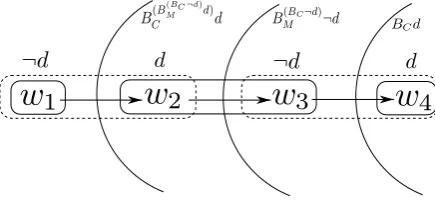
Example 3.1. Cobb and Mal are standing on a window ledge, arguing whether they are dreaming or not. Cobb needs to convince Mal, otherwise dreadful consequences will ensue. For the sake of the example, let us assume that Cobb knows they are not dreaming, but Mal mistakenly believes that they are: statew1
in Figure1. The solid and dashed rectangles represent, respectively, Cobb’s and Mal’s hard information. The arrow is their common plausibility ordering.
With some thinking, Mal can come to agree with Cobb. The general procedure for achieving this goes as follows: Asequence of simultaneous belief conditioning actsstarts with the agents’ simple belief aboutϕ, i.e. for alli, the first elementB1,iin the sequence isBiϕifM, w |=Biϕ, and¬Biϕotherwise.
Agenti’s beliefs aboutϕat a successor stage are defined by taking her beliefs aboutϕ, conditional upon learning the others’ belief aboutϕat that stage. Formally, for two agentsi, j then: Bn+1,i =BBn,j
ϕ
i ϕif
M, w |=BBn,jϕ
i ϕ, and¬B Bn,jϕ
i ϕotherwise.29
Following the zones marked with an arc in Figure1, the reader can check that, atw1, Mal needs three
rounds of conditioning to switch her belief about their waking, and thus reach an agreement with Cobb. Her belief stays the same upon learning that Cobb believes that they are not dreaming. Let us call this factϕ. The turning point occurs when she learns that Cobb would not change his mind even if he would learn ϕ. Conditional on this, she now believes that they are indeed not dreaming. Note that Cobb’s beliefs stay unchanged throughout, since he knows the true state at the outset.
Iterated conditioning thus leads to agreement, given common priors. Indeed, conditioning induces a decreasing map from subsets to subsets, which guarantees the existence of a fixed points, where all
29This definition is meant to fix intuition only. Full details on how to deal withinfinite scenarios, here and later, are in the
agent’s conditional beliefs stabilize. Once the agents have reached this fixed-point, they have eliminated all higher-order uncertainties concerning the posteriors beliefs about ϕof the others. Their posteriors beliefs are now common knowledge:
Theorem 3.2 ([65]). At the fixed-pointnof a sequence of simultaneous conditioning acts onϕ, for all
w∈W andi∈I, we have that:
M, w |=CI(
^
i∈I
Bn,iϕ)
The reader accustomed to static agreement theorems will see that we are now only a small step away from concluding that sequences of simultaneous conditionings lead to agreements, as it is indeed the case in our example. Since common prior and common belief of posteriors suffice for agreement, we get:
Corollary 3.3. Take any sequence of conditioning acts for a formula ϕ, as defined above, in a finite model with common prior. At the fixed point of this sequence, either all agents believeϕor they all don’t believeϕ.
This recasts, in our logical framework, the result of [63], showing how “dialogs” lead to agreements. Still, belief conditioning has a somewhat private character.30 In the example above, Cobb remains painfully uncertain of Mal’s thinking process until he sees her changing her mind, that is until she makes the last step of conditioning. Luckily for Cobb, they can do better, as we will now proceed to show.
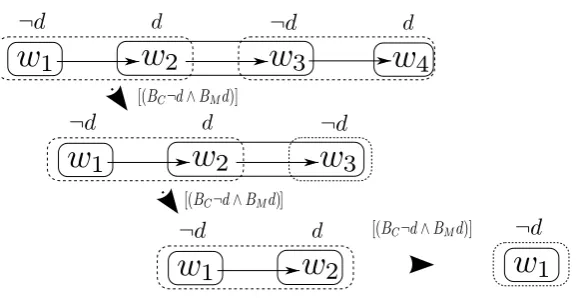
Repeated Public Announcements Lead to Agreements. Figure 2 shows another scenario, where Cobb and Mal publicly and repeatedly announce their beliefs at w1. They keep announcing the same
[image:19.595.156.448.555.704.2]thing, but each time, this induces important changes in both agents’ higher-order information. Mal is led stepwise to realize that they are not dreaming, and crucially, Cobb also knows that Mal receives and processes this information. As the reader can check, at each step in the process, Mal’s beliefs are common knowledge.
Figure 2. Cobb and Mal’s discussion on the window ledge.
One again, Figure2exemplifies a general fact. We first define adialogue aboutϕas a sequence of public announcements. LetM, wbe a finite pointed epistemic-doxastic model.31 Now let
Bw1,i,i’s
origi-nal belief state at w, beBiϕif this formula holds atw, and¬Biϕ, otherwise. Agenti’sn+ 1belief state,
written Bwn+1,i, is defined as [V
j∈IB w
n,jϕ]Biϕif M, w |= [
V
j∈IB w
n,jϕ]Biϕ, and as [
V
j∈IB w
n,jϕ]¬Biϕ,
otherwise. Intuitively, a dialogue about ϕ is a process in which all agents in a group publicly and re-peatedly announce their posterior beliefs about ϕ, while updating with the information received in each round.
In dialogues, just like with belief conditioning, iterated public announcements induce decreasing maps between epistemic-doxastic models, and thus are bound to reach a fixed point, where no further discussion is needed. At this point, the protagonists are guaranteed to have reached consensus:
Theorem 3.4([65]). At the fixed-pointMn, wof a public dialogue aboutϕamong agents in a groupI:
Mn, w |=CI(
^
i∈I
Bn,i)
Corollary 3.5([65]). For any public dialogue aboutϕ, if there is a common prior that is a well-founded plausibility order, then at the fixed-pointMn, w, either all agents believeϕor all do not believeϕ.
As noted in the literature [cf. 63,64], the preceding dynamics of agreement is one of higher-order information. In the examples above, Mal’s information about the ground facts of dreaming or not dream-ing, does not change until the very last round of conditioning or public announcement. The information she gets by learning about Cobb’s beliefs affects her higher-order beliefs, i.e., what she believes about Cobb’s information. This importance of higher-order information flow is a general phenomenon, well-known to epistemic game theorists, which the present logical perspective treats in a unifying way.
Agreements and Dynamics: Further Issues. Here are a few points about the preceding scenarios that invite generalization. Classical agreement results require the agents to be “like-minded” [66]. Our analysis of agreement in dynamic-epistemic logic reveals that this like-mindedness extends beyond the common prior assumption: it also requires the agents to process the information they receive in the same way.32 One can easily find counter-examples to the agreement theorems when the update rule is not the same for all agents. Indeed, the issue of “agent diversity” is largely unexplored in our logics (but see [12] for an exception).
A final point is this. While agreement scenarios seem special, to us, they demonstrate a general topic, viz. how different parties in a conversation, say a “Skeptic” and an ordinary person, can modify their positions interactively. In the epistemological literature, this dynamic conversational feature has been neglected – and the above, though solving things in a general way, at least suggests that there might be interesting structure here of epistemological interest.
3.2. Logical Issues about Hard and Soft Limit Behavior
One virtue of our logical perspective is that we can study the above limit phenomena in much greater generality.
Hard information. For a start, for purely logical reasons, iterated public announcement of any formula
ϕin a model Mmust stop at a limit modellim(M, ϕ)whereϕhas either become true throughout (it
has become common knowledge), or its negation is true throughout.33 This raises an intriguing open model-theoretic problem of telling, purely from syntactic form, when a given formula is uniformly “self-fulfilling” (the case where common knowledge is reached), or when “self-refuting” (the case where common knowledge is reached of the negation). Game-theoretic assertions of rationality tend to be self-fulfilling, as we shall see in Section 4 below. But there is no stigma attached to the self-refuting case: e.g., the ignorance assertion in the famous Muddy Children puzzle is self-refuting in the limit. Thus, behind our single scenarios, there is a whole area of limit phenomena that have not yet been studied systematically in epistemic logic.34
In addition to definability, there is complexity and proof. Van Benthem [4] shows how announcement limit submodels can be defined in various known epistemic fixed-point logics, depending on the syntactic shape of ϕ. Sometimes the resulting formalisms are decidable, e.g., when the driving assertion ϕ has “existential positive form”, as in the mentioned Muddy Children puzzle, or simple rationality assertions in games.
But these scenarios are still quite special, in that the same assertion gets repeated. There is large variety of further long-term scenarios in the dynamic logic literature, starting from the “Tell All” proto-cols in [69–71] where agents tell each other all they know at each stage, turning the initialdistributed knowledgeof the group into explicitcommon knowledge.
Soft information. In addition to the limit dynamics of knowledge under hard information, there is the limit behavior of belief, making for more realistic dialog scenarios. This allows for more interesting phenomena in the earlier update sequences. An example is iterated hard information dovetailing agents’ opinions, flipping sides in the disagreement until the very last steps of the dialogue (cf. [33] and [72, p.110-111]). Such disagreement flips can occur until late in the exchange, but as we saw above, they are bound to stop at some point.
All these phenomena get even more interesting mathematically with dialogs involving soft announce-ments[⇑ϕ], when limit behavior can be much more complex, as we will see in the next section. Some relevant observations can be found in [71], and in Section4below. First, there need not be convergence at all, the process can oscillate:
Example 3.6. Suppose that ϕ is the formula (r ∨ (B¬rq ∧ p) ∨ (B¬rp ∧ q)) and consider the one
agent epistemic-doxastic models pictured below. Since [[ϕ]]M1 = {w
3, w1}, we have M
⇑ϕ
1 = M2.
Furthermore, [[ϕ]]M2 = {w
2, w1}, so M⇑2ϕ = M3. Since, M3 is the same model as M1, we have a
cycle:
33We omit some details with pushing the process through infinite ordinals. The final stage is discussed further in terms of
“redundant assertions” in [67].
r
w1
q
w2
p
w3
M1
⇑ϕ
=
⇒
r
w1
p
w3
q
w2
M2
⇑ϕ
=
⇒
r
w1
q
w2
p
w3
M3
⇑ϕ
=
⇒ · · ·
In line with this, players’ conditional beliefs may keep changing along the stages of an infinite dia-log.35 But still, there is often convergence at the level of agents’ absolute factual beliefs about that the world is like. Indeed, here is a result from [71]:
Theorem 3.7. Every iterated sequence of truthful radical upgrades stabilizes all simple non-conditional beliefs in the limit.
Belief and Preference Merge. Finally, we point at some further aspects of the topics raised here. Integrating agents’ orderings through some prescribed process has many similarities with other areas of research. One is belief mergewhere groups of agents try to arrive at a shared group plausibility rder, either as a way of replacing individual orders, or as a way of creating a further group agent that is a most reasonable amalagam of the separate components. And this scenario is again much like those of social choice theory, where individual agents have to aggregate preference orders into some optimal public ordering. This naturally involves dynamic analysis of the processes ofdelberationthat lead to the eventual act of voting.36 Thus, the technical issues raised in this section have much wider impact. We may be seeing the contours of a systematic logical study of conversation, deliberation and related social processes.
3.3. Learning
We conclude this section with one concrete setting where many of the earlier themes come together, viz. formal learning theory: see [76–78]. The paradigm we have in mind is identification in the limit of correct hypotheses about the world (cf. [79] on language learning), though formal learning theory in epistemology has also studied concrete learning algorithms for inquiry of various sorts.
The learning setting shows striking analogies with the dynamic-epistemic logics that we have pre-sented in this paper. What follows is a brief summary of recent work in [80,81], to show how our logics link up with learning theory. For broader philosophical backgrounds in epistemology, we refer to [82]. The basic scenario of formal learning theory is one of an agent trying to formulate correct and infor-mative hypotheses about the world, on the basis of an input stream of evidence (in general, an infinite
35Infinite iteration of plausibility reordering is in general a non-monotonic process closer to philosophical theories of truth
revision in the philosophical literature [cf. 73,74]. The technical theory developed on the latter topic in the 1980s may be
relevant to our concerns here [cf.75].
history) whose totality describes what the world is like. At each finite stage of such a sequence, an agent outputs a current hypothesis about the world, which can be modified as new evidence comes in. Success of such a learning function in recognition can be of two kinds: either a correct hypothesis is identified uniformly on all histories by some finite stage (the strong notion of “finite identifiability”), or more weakly, each history reaches a point where a correct hypothesis is stated, but when that is may vary according to the history (“identifiability in the limit”). There is a rich mathematical theory of learning functions and what classes of hypotheses can, and cannot, be described by them.
Now, it is not hard to recognize many features here of the logical dynamics that we have discussed. The learning function outputs beliefs, that get revised as new hard information comes in (we think of the observation of the evidence stream as a totally reliable process). Indeed, it is possible to make very precise connections here. We can take the possible hypotheses as our possible worlds, each of which allows those evidence streams (histories of investigation) that satisfy that hypothesis. Then observing successive pieces of evidence is a form of public announcement allowing us to prune the space of worlds. The beliefs involved can be modeled as we did before, by a plausibility ordering on the set of worlds for the agent, which may be modified by successive observations.
On the basis of this simple analogy, [83] prove results like the following, making connections very tight:
Theorem 3.8. Public announcement-style eliminative update is a universal method: for any learning function, there exists a plausibility order that encodes the successive learning states as current beliefs. The same is true, taking observations as events of soft information, for radical upgrade of plausibility orders.
Theorem 3.9. When evidence streams may contain a finite amount of errors, public announcement-style update is no longer a universal learning mechanisms, but radical upgrade still is.
With these bridges in place, one can also introduce logical languages in the learning-theoretic uni-verse. [80] show how many notions in learning theory then become expressible in dynamic-epistemic or epistemic-temporal languages, say convergence in the limit as necessary future truth of knowledge of a correct hypothesis about the world. 37 Thus, we seem to be witnessing the beginning of merges between dynamic logic, belief revision theory and learning theory.
Such combinations of dynamic epistemic logic and learning theory also invite comparison with game theory. Learning, for instance, to coordinate on a Nash equilibrium in repeated games, has been exten-sively studied, with many positive and negative results—see, for example, [84].38
This concludes our exploration of long-term information dynamics in our logical setting. We have definitely not exhausted all possible connections, but we hope to have shown how a general Theory of Play fits in naturally with many different areas, providing a common language between them.
37The logical perspective can actually define many further refinements of learning desiderata, such as reaching future stages
when the agent’s knowledge becomes introspective, or when her belief becomes correct, or known.
38Many of these results live in a probabilistic setting, but dynamic logic and probability is another natural connection, that
4. Solution Dynamics on Extensive Games
We now return to game theory proper, and bring our dynamic logic perspective to bear on an earlier benchmark example: Backwards Induction. This topic has been well-discussed already by eminent authors, but we hope to add a number of new twists suggesting broader ramifications in the study of agency.
In the light of logical dynamics, the main interest of a solution concept is not its “outcome”, its set of strategy profiles, but rather its “process”, the way in which these outcomes are reached. Rationality seems largely a feature of procedures we follow, and our dynamic logics are well-suited to focus on that. 4.1. First scenario: iterated announcement of Rationality
Here is a procedural line on Backwards Induction as a rational process. We can take BI to be a process of prior off-linedeliberationabout a game by players whose minds proceed in harmony, though they need not communicate in reality. The treatment that follows was proposed by [22] (which mainly deals with strategic games), and studied in much greater detail by [85].
As we saw in Section 3, public announcements saying that some propositionϕis true transform an epistemic modelMinto its submodelM|ϕwhose domain consists of just those worlds in M that satisfy
ϕ. Now the driving assertion for the Backwards Induction procedure is the following assertion. It states essentially the notion of Rationality discussed in our static analysis of Section 1. As before, at a turn for player i, a moveais dominatedby a siblingb (a move available at the same node) if every history throughaends worse, in terms ofi’s preference, than every history throughb:
“at the current node, no player ever chose a strictly dominated move coming here” (rat)
This makes an informative assertion about nodes in a game tree, that can be true or false. Thus, announc-ing this formularatas a fact about the players will in general make the current game tree smaller. But then we get a dynamics of iteration as in our scenarios of Section 3. In the new smaller game tree, new nodes may become dominated, and hence announcingratagain (saying that it still holds after this round of deliberation) makes sense, and so on. As we have seen, this process must reach a limit:
Example[Solving games through iterated assertions of Rationality.] Consider a game with three turns, four branches, and pay-offs forA,E in that order:
A
x E
y A
z u
1,0
0,5
6,4 5,5
A
x E
y A
z
1,0
0,5
6,4
Rat
=
⇒
A
x E
y A
1,0
0,5
Rat
=
⇒
A
x
1,0
We see how theBI solution emerges from the given game step by step. The general result follows from a simple correspondence between subrelations of the totalmoverelation and sets of nodes ([85] has a precise proof with full details):
Theorem 4.1. In any game tree M, the model (rat,M)# is the actual subtree computed by the BI
procedure.
The logical background here is just as we have seen earlier in our epistemic announcement dynamics. The actualBI play is the limit sub-model, whereratholds throughout. In terms of our earlier distinc-tion, this means that Rationality is a “self-fulfilling” proposition: its announcement eventually makes it rue everywhere, and hence common knowledge of rationality emerges in the process. Thus, the algo-rithmic definition of the BI procedure in Section 1 and our iterated announcement scenario amount to the same thing. One might say then that our deliberation scenario is just a way of “conversationalizing” a mathematical fixed-point computation. Still, it is of independent interest. Viewing a game tree as an logical model, we see how repeated announcement of Rationality eventually makes this property true throughout the remaining model: it has made itself into common knowledge.
4.2. Second scenario: belief and soft plausibility upgrade
Many foundational studies in game theory view Rationality as choosing a best actiongiven what one believes about the current and future behaviour of the players. An appealing alternative take on theBI
procedure does not eliminate any nodes of the initial game, but rather endows it with “progressive ex-pectations” on how the game will proceeed. This is the plausibility dynamics that we studied in Section 3, now performing a soft announcement of rat, where the appropriate action is the “radical upgrade” studied earlier. The essential information produced by the algorithm is then in the binary plausibility relations that it creates inductively for players among end nodes in the game, standing for complete his-tories or “worlds”:
Example [The BI outcome in a soft light.] A soft scenario does not remove nodes but modifies the plausibility relation. To implement this, we start with all endpoints of the game tree incomparable.39 Next, at each stage, we compare sibling nodes, using this notion:
A move x for player i dominates its sibling y in beliefs if the most plausible end nodes reachable after xalong any path in the whole game tree are all better for the active player than all themost plausibleend nodes reachable in the game aftery.