A good generic object detection method will be effective on a variety of datasets. Three
image collections were used in testing the object detection algorithms in this thesis.
For the first (face detection) an existing cascade was used, so the only dataset required
was a collection of test images distinct from its training images. For the other sets
(fish and seahorse detection), cascades had to be trained before they were tested. This
required sufficient images to create separate training and testing sets.
It should be noted that both marine animal image sets contain multiple animals
per image, and therefore have more positive training samples than images. Also,
sec-tion 2.6.3 explains how the Haar Classifier Cascade training process searches through
its negative training images at different positions and scales to create negative training
samples for each stage. Each negative training image therefore offers a large number
of negative training samples.
4.1
Faces
Face detection is a common application for object detection algorithms, so cascades
already exist for detecting faces, and datasets already exist for testing them. A
com-monly used image set is the MIT/CMU frontal face testing dataset (Rowley et al.,
2003). These images were assembled to test a neural network-based face detector
(Rowley et al., 1998a), but are suitable for testing any frontal face detection
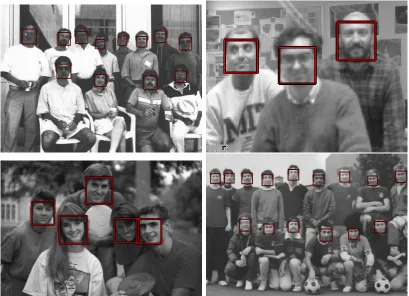
algo-rithm. All face detection testing in this thesis used MIT/CMU test sets A, B, and
C. These contain 130 images, including those in fig. 4.1, which between them contain
511 faces. Existing annotations giving the coordinates of both eyes and the left, centre
and right part of the mouth are provided. OpenCV requires rectangular annotations,
which were from the eye and mouth points as follows:
−−−−−→
eyecentre= −−−→eyelef t+−−−−→eyeright 2
−−−−−→
facecentre = −−−−−→eyecentre+
−−−−−−−→
mouthcentre
2
facewidth =
!
(eyelef tx −eyerightx)
2+ (eye
lef ty−eyerighty)
2
faceheight=!(eyecentrex −mouthcentrex)2+ (eyecentrey −mouthcentrey)2
facesize = 1.2×(facewidth+faceheight)
facex1 =facecentrex −facesize 2
facex2 =facecentrex +facesize 2
facey1 =facecentrey− facesize 2
facey2 =facecentrey+
facesize 2
Figure 4.1: Example face images
[image:3.595.113.523.441.737.2]4.1.1
Cascade selection
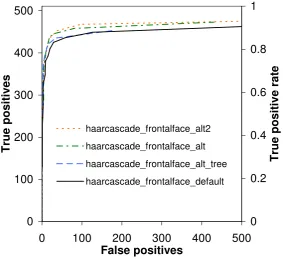
OpenCV is provided with four face detectors trained by Lienhart et al. (Lienhartet al.,
2003a): three cascades and a tree (Lienhartet al., 2003b). These were each run on the
MIT/CMU faces; the resulting ROC curves are plotted in fig. 4.3. The best overall
detector was haarcascade frontalface alt2, so it was used in the chapter 6 face detection
experiments. 0 100 200 300 400 500
[image:4.595.192.476.228.487.2]0 100 200 300 400 500 False positives Tr ue pos it iv e s 0 0.2 0.4 0.6 0.8 1 Tr ue pos it iv e r a te haarcascade_frontalface_alt2 haarcascade_frontalface_alt haarcascade_frontalface_alt_tree haarcascade_frontalface_default
4.2
Fish
The fish detection problem was part of a project in automated salmon farm monitoring.
The intention is to determine average fish size by detecting a sample of unoccluded
fish in each image and matching a shape model to each fish. For this purpose, 235
images of salmon in a fish farm cage were provided by AQ1 Systems Pty Ltd; fig. 4.4
shows two examples. This thesis is an extension of previous work on these images
(Williams et al., 2006). In general, the fish cage environment is less varied than many
object detection environments, but the underwater images have poor contrast and are
frequently crowded (Lines et al., 2001), which has sometimes led to the use of sonar
and laser measurements to supplement image data for fish detection (Mueller et al.,
2006). There are also many fish to detect in each image, in comparison to work such
as (Zhou & Clark, 2006), where fish are detected in a natural lake environment, but
each image is assumed to contain at most one fish.
4.2.1
Required and optional annotations
Many of the fish were faint, blurred or occluded. Some were hard to count even by a
human annotator. To train classifiers to detect them would confuse the trainer as it
tried to find features which differentiated between blurry grey net and blurry grey fish.
Therefore, only mostly (90%–100%) visible fish were used as positive training samples.
During classification, an object detector should only be expected to find objects
comparable to those in its training set. For this reason, the testing annotations it
is expected to find only contain mostly-visible fish. However, since detections on the
remaining fish are possible, and should not be counted as false positives, a separate set
of annotations was created with every fish in the image.
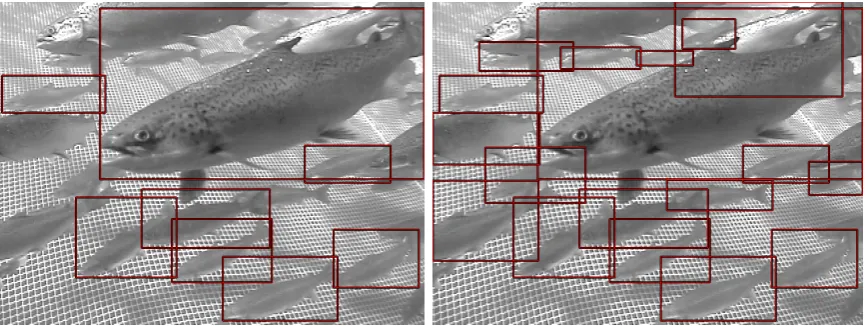
In total, the 119 testing images were randomly selected from the 235 provided
and annotated with 597 ‘mostly’ (90%–100%) visible fish, and 1,759 ‘partially’ (50%–
90%) visible fish. If fish from the latter set were missed they were not counted as
false negatives, but detections in their area were also not counted as false positives.
Fig. 4.5(a) is an example of mostly-visible fish annotations, while fig. 4.5(b) shows all
Figure 4.4: Example fish images
(a) Annotations for mostly-visible fish (b) Annotations for all possible fish
[image:6.595.116.549.495.658.2]4.3
Seahorses
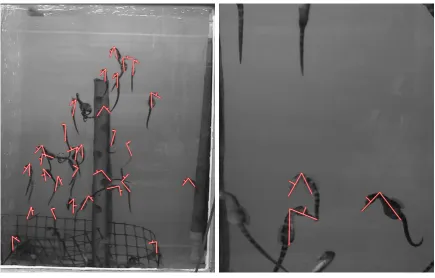
Another marine animal imaging application was to detect seahorses in tanks within
an aquaculture research facility. The intention is to detect and track seahorses over
time for behavioural analysis; ideally the seahorse poses will be found as well as their
presence. For this purpose, a seahorse tank maintained by the University of Tasmania
School of Aquaculture was filmed with a digital video camera. From this video, 263
still images were extracted, containing seahorses at two different scales. Examples of
both are shown in fig. 4.6.
Seahorses are very flexible, so their shapes vary widely. Haar Classifier Cascades
are trained on rectangular image regions, and patterns within those rectangles that are
consistent across the positive samples. Even annotating entire seahorses with
consis-tent rectangles would be difficult, and the cascade training process would have serious
difficulty finding consistent features. For these reasons, the seahorses were broken into
two segment detection problems: heads and bodies. Tails alone were still too flexible
and lacking in features, so were ignored.
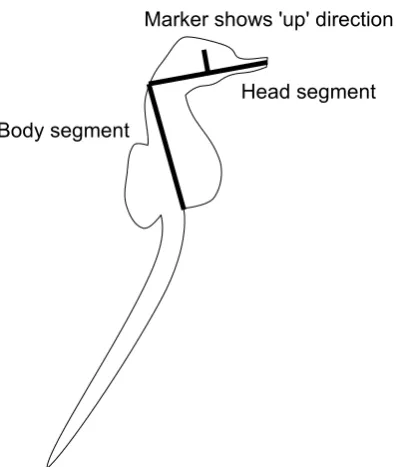
The segments were annotated by marking a line segment from the tip of the nose
to the back of the head, and from there to the base of the stomach; fig. 4.7 shows
where these points lie on a sideways-facing seahorse. The additional marker on the
head segment shows which way is ‘up’; this is ignored during evaluation but is needed
on the training images for the positive sample extraction described in section 5.2.2.
The 263 seahorse images were randomly divided into training and testing image
sets. Within the 131 testing images, 823 complete (head and body segment visible,
unoccluded and clearly connected) seahorses were marked. A second set was also
created, adding 519 partially visible or incomplete seahorses. As with the fish described
in section 4.2.1, segments and seahorses from the latter set were considered too hard
to precisely detect; even definitively annotating them was difficult. If missed they were
not counted as false negatives, but detections in their area were not counted as false
positives. Fig. 4.8(a) shows examples of the ‘required’ seahorses in two images, while
Figure 4.6: Example seahorse images
[image:8.595.235.434.463.697.2](a) Annotations for complete, visible seahorses
[image:9.595.117.553.115.393.2](b) Annotations for all possible seahorses and seahorse parts
4.3.1
Matching and merging seahorse segment detections
The neighbouring detection merging described in section 2.6.6 and the
detection-to-annotation matching described in section 2.7.2 assume that all detections and
anno-tations are in approximately the same orientation. This is not the case for seahorse
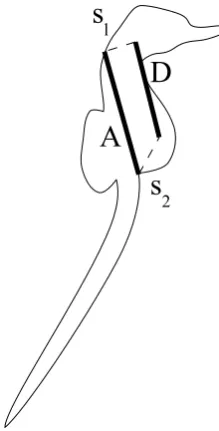
segments, which could be oriented in any direction. A new formula was therefore
cre-ated for both these situations. Given an annotationA and a detection D, it definess1
as the separation between the ‘top’ ends ofAand D, ands2 as the separation between
the ‘bottom’ ends of A and D. These properties are illustrated in fig. 4.9.
D is considered to successfully detect A if:
s1+s2 <
Alength+Dlength
2
The same formula is used when merging neighbouring detections. If two segment
detections A and D are close enough to satisfy this formula, they are placed in the
[image:10.595.271.381.409.625.2]same set.
Figure 4.9: Values measured to compare a seahorse segment annotation A against a
4.4
Conclusions
This chapter has described the three image sets used in this thesis. For the face dataset,
it also explained how an existing face detection cascade was chosen. Chapter 5 will
now describe how cascades were trained on the fish and seahorse sets. All three image
sets and cascade sets will then be used in chapter 6, where Haar Classifier Cascade
confidence measures are implemented and tested. The seahorse detections made in
those two chapters are of the individual head and body segments; chapter 7 explains