The Norm Implementation Problem
in Normative Multi-Agent Systems
Davide Grossi1, Dov Gabbay2,3, Leendert van der Torre3
1ILLC, University of Amsterdam
[email protected] 2King’s College London
[email protected] 3ICR, University of Luxembourg
Abstract. The norm implementation problem consists in how to see to it that the agents in a system comply with the norms specified for that system by the system designer. It is part of the more general problem of how to synthesize or create norms for multi-agent systems, by, for example, highlighting the choice between regimentation and enforcement, or the punishment associated with a norm violation. In this paper we discuss how various ways to implement norms in a multi-agent system can be distinguished in a formal game-theoretic framework. In particular, we show how different types of norm implementation can all be uniformly specified and verified as types of transformations of extensive games. We introduce the notion of retarded preconditions to implement norms, and we illustrate the framework and the various ways to implement norms in the blocks world environment.
Keywords.Normative systems, multi-agent systems, extensive games, logic.
1
Introduction
sanction says how agents can be motivated to comply with the norms such that the ideal will (probably) be reached. The paper moves the first steps towards a formal understanding of the norm implementation problem, defined as follows.
The norm implementation problem.How to make agents comply with a set
of norms in a system?
In this paper we introduce a formal framework that can represent various solutions to the norm implementation problem, which can be used to analyze them, or to make a choice among them. For example, in some cases a norm cannot be regimented, such as the norm to return books to the library within two weeks, but in other cases there is the choice between regimentation and enforcement. It is often assumed that regimenting norms makes the system more predictable, since agents cannot violate the norms, but as a consequence it also makes the system less flexible and less efficient. Conceptually, regimen-tation is easier than enforcement, and since agents are bounded reasoners who can make mistakes, regimentation is often favored by policy makers. How-ever, policy makers are bounded reasoners too, who have to make norms in uncertain circumstances, and therefore most people prefer enforcement over regimentation—at least, when the legal system is reliable. As another example, it is often assumed that very high punishments make the system less efficient than lower ones, due to the lack of incentives for agents once they have violated a norm. Such assumptions are rarely studied formally.
Although ideas about norm implementation can be found scattered over, in particular, the multi-agent systems literature (for instance, in OperA [27],
Moise+ [41], AMELI [29], J-Moise+[42], and in programming languages for
multi-agent system programs [26]), they have not yet been presented in a sys-tematic and uniform way. One of the aims of the paper is to do so, providing a formal overarching framework within which it becomes possible to place and compare existing contributions. So the first requirement on a framework for norm implementation is that it can represent existing widely discussed norm implementation methods such as regimentation and enforcement via sanction-ing. Moreover, a second requirement is that such a framework can also repre-sent and reason about new ways of norm implementation, such as changing the existing norms or the method, which we will study in detail, of retarded preconditions. A formal framework may even suggest new ways to implement norms, not discussed before. Our research problem therefore breaks down into the following sub-questions:
1. How is the specification and verification of norm implementation methods related to general specification and verification of multiagent systems? 2. Which formal model can we use to specify and verify norm implementation,
and more generally study the norm implementation problem?
3. How to model regimentation in the general formal model of norm imple-mentation?
5. How to model norm change in the general formal model of norm imple-mentation?
The specification of normative multi-agent systems often considers a set of agents and a set of norms or organization, which can be specified and verified independently. However, when the set of norms is not designed off-line, but created dynamically at run-time, then this approach does not work. Instead, one can only specify the way in which norms are implemented in a system.
The perspective assumed for the formal framework is based on formal logic and the primary aim of the paper is to present a simple class of logical models, and of transformations on them, as salient representations of the implementation problem. Moreover, we use a game-theoretic approach. We use the simplest approach possible, so we can focus on one same framework for many kinds of norm implementation, and are not lost in technical details about individual approaches. As in classical game theory, our actions are abstract and we do not consider issues like causality. We consider only perfect information games, and we thus do not consider the problem of how norms are distributed and communicated to a society. Moreover, we do not consider concurrent actions of the agents in the composition of actions in plans, although this feature could easily be added. However, we do represent the order of actions, that is, we use extensive form games, because we need to do so to distinguish some of the norm implementation methods, and thus we do not use the more abstract strategic form used in most related work (such as Tennenholtz and Shoham’s artificial social systems [62]). We do not go into details of solution concepts of game theory, and we thus basically use a kind of state automata or process models. Within a game-theoretic approach, we need to represent four things: the game without the implemented norm, the game together with the implemented norm, the procedure to go from the former to the latter, and the compliance criterion stating the conditions when norms are fulfilled.
forbid throwing the dice. We distinguish norm regimentation from automatic enforcement and enforcement agents, assuming actions can be taken only if pre-conditions hold. Some of such actions are forbidden, so all actions in order to be taken must satisfy the precondition. For regimentation we consider violation conditions as retarded preconditions of actions. In this action model, assumed actions can be taken in some cases even though the preconditions do not hold. When a violation occurs, i.e., when the retarded precondition does not hold, the various strategies to implement norms follow as a consequence.
We illustrate the framework and the various ways to implement norms in the blocks world environment, because the well-known planning environment explains the use of normative reasoning and the challenges of norm implemen-tation for a large AI audience. There are many variants of the blocks world around, we use a relatively simple one with deterministic actions and without concurrent actions. An alternative well-known example we could have chosen is the Wumpus world from Russel and Norvig’s textbook [60].
We assume that all norms and their implementations are known once they are created, and we thus do not study the norm distribution problem. Moreover, we assume that everyone accepts the existence of a new norm, even when he does not comply with it. Thus, we do not consider the norm acceptance problem. We do not consider cognitive aspects of agents, and we thus do not consider the bridge between our framework for MAS and existing BDI frameworks for cognitive agents (see, e.g., [14]).
The paper follows the research questions and proceeds as follows. In Sec-tion 2 we give a short introducSec-tion in the use of normative systems in computer science in general, and specification and verification of normative multi-agent systems in particular. In Section 3 we start with the game-theoretic framework for norm implementation and a logic for representing extensive games, and we introduce a running example. Sections 4, 5, 6, and 7 provide formal semantics to the four implementation strategies of regimentation, enforcement, enforcers, and, respectively, normative change. In presenting such semantics due care will be taken to relate our framework to existing literature showing how the framework is general enough to categorize, at a higher abstraction level, the various contributions available in the literature. The findings of each section is illustrated by means of the running example. In Section 8 related work at the intersection of norms and multi-agent systems is discussed. Conclusions follow in Section 9.
2
Normative multi-agent systems
2.1 Normative systems in computer science
The survey of the role of normative systems in computer science in this section is taken from [7]. For a discussion on philosophical foundations for normative multi-agent systems, see [8, 37].
There is an increasing interest in normative systems in the computer science community, due to the observation five years ago in the so-called AgentLink Roadmap [51, Fig. 7.1], a consensus document on the future of multi-agent systems research, that norms must be introduced in agent technology in the medium term (i.e., now!) for infrastructure for open communities, reasoning in open environments and trust and reputation. The first definition of a normative multi-agent system emerged after two days of discussion at the first workshop on normative multi-agent systems NorMAS held in 2005 as a symposium of the Artificial Intelligence and Simulation of Behaviour convention (AISB) in Hatfield, United Kingdom:
The normchange definition. “A normative multi-agent system is a multi-agent system together with normative systems in which agents on the one hand can decide whether to follow the explicitly represented norms, and on the other the normative systems specify how and in which extent the agents can modify the norms” [15].
A distinction has been made between systems in which norms must be ex-plicitly represented in the system (the ‘strong’ interpretation) or that norms must be explicitly represented in the system specification (the ‘weak’ interpretation). The motivation for the strong interpretation of the explicit representation is to prevent a too general notion of norms. Any requirement can be seen as a norm the system has to comply with; but why should we do so? Calling every require-ment a norm makes the concept empty and useless. The weak interpretation is used to study the following two important problems in normative multi-agent systems.
Norm compliance. How to decide whether systems or organizations comply with relevant laws and regulations? For example, is a hospital organized according to medical regulations? Does a bank comply with Basel 2 regula-tions?
Norm implementation. How can we design a system such that it complies with a given set of norms? For example, how to design an auction such that agents cannot cooperate?
making), how norms are created by a legislator, emerge spontaneously or are negotiated among the agents, how norms are enforced, how constitutive norms are used to describe institutions, how norms are related to other social and legal concepts, how norms structure organizations, how norms coordinate groups and societies, how contracts are related to contract frames and contract law, how legal courts are related, and how normative systems interact?
Norms can be changed by the agents or the system, which distinguishes this definition of normative multi-agent system from the common framework used in the Deontic Logic in Computer Science (or ∆EON) community, and led to the identification of this definition as the “normchange” definition of normative multi-agent systems. For example, a norm can be made by an agent, as legislators do in a legal system, or there can be an algorithm that observes agent behavior, and suggests a norm when it observes a pattern. The agents can vote on the acceptance of the norm. Likewise, if the system observes that a norm is often violated, then apparently the norm does not work as desired, and it undermines the trust of the agents in the normative system, so the system can suggest that the agents can vote whether to retract or change the norm.
After four days of discussion, the participants of the second workshop on normative multi-agent systems NorMAS held as Dagstuhl Seminar 07122 in 2007 agreed to the following consensus definition:
The mechanism design definition. “A normative agent system is a multi-agent system organized by means of mechanisms to represent, communi-cate, distribute, detect, create, modify, and enforce norms, and mechanisms to deliberate about norms and detect norm violation and fulfilment.” [17]
According to Boellaet al., “the emphasis has shifted from representation issues to the mechanisms used by agents to coordinate themselves, and in gen-eral to organize the multi-agent system. Norms are communicated, for example, since agents in open systems can join a multi-agent system whose norms are not known. Norms are distributed among agents, for example, since when new norms emerge the agent could find a new coalition to achieve its goals. Norm violations and norm compliance are detected, for example, since spontaneous emergence norms of among agents implies that norm enforcement cannot be delegated to the multi-agent infrastructure.” [17] They refer to game theory in a very liberal sense, not only to classical game theory studied in economics, which has been criticized for its ideality assumptions. Of particular interest are alternatives taking the limited or bounded rationality of decision makers into account.
Games can explain that norms should satisfy various properties to be ef-fective as a mechanism to obtain desirable behavior. For example, the system should not sanction without reason, as the norms would loose their force to mo-tivate agents. Moreover, sanctions should not be too low, but they also should not be too high. Otherwise, once a norm is violated, there is no way to prevent further norm violations.
operation is performed by different authorities at different levels of the hierarchy. Lewis “master and slave” game [48] shows that the notion of permission alone is not enough to build a normative system, because only obligations divide the possible actions into two categories or spheres: the sphere of prohibited actions and the sphere of permitted (i.e., not forbidden) actions or “the sphere of permissibility”. More importantly, Bulygin [22] explains why permissive norms are needed in normative systems using his “Rex, Minister and Subject” game. “Suppose that Rex, tired of governing alone, decides one day to appoint a Minister and to endow him with legislative power. [...] an action commanded by Minister becomes as obligatory as if it would have been commanded by Rex. But Minister has no competence to alter the commands and permissions given by Rex.” If Rex permits hunting on Saturday and then Minister prohibits it for the whole week, its prohibition on Saturday remains with no effect.
As another example, Boella and van der Torre’s game theoretic approach to normative systems [16] studies the following kind of normative games.
Violation games: interacting with normative systems, obligation mechanism, with applications in trust, fraud and deception.
Institutionalized games: counts-as mechanism, with applications in distributed systems, grid, p2p, virtual communities.
Negotiation games: MAS interaction in a normative system, norm creation ac-tion mechanism, with applicaac-tions in electronic commerce and contracting. Norm creation games: multi-agent system structure of a normative system,
permission mechanism, with applications in legal theory.
Control games: interaction among normative systems, nested norms mecha-nism, with applications in security and secure knowledge management systems.
Norms are not only seen as the mechanism to regulate behavior of the system, but they are often also part of a larger institution. This raises the question what precisely the role of norms is in such an organization. Norms are rules used to guide, control, or regulate desired system behavior. However, this is not unproblematic, since norms can be violated, and behavior of agents may change in unexpected ways when norms are introduced due to self organization. Norms can also be seen as one of the possible incentives to motivate agents, which brings us again back to economics. The fact that norms can be used as a mechanism to obtain desirable system behavior, i.e., that norms can be used as incentives for agents, implies that in some circumstances economic incentives are not sufficient to obtain such behavior. For example, in a widely discussed example of the so-called centipede game, there is a pile of thousand pennies, and two agents can in turn either take one or two pennies. If an agent takes one then the other agent takes turn, if it takes two then the game ends. A backward induction argument implies that it is rational only to take two at the first turn. Norms and trust have been discussed to analyze this behavior, see [40] for a discussion.
mod-ular design. While in traditional software systems, modmod-ularity is addressed via the notions of class and object, in multi-agent systems the notion of organiza-tion is borrowed from the ontology of social systems. Organizing a multi-agent system allows to decompose it and defining different levels of abstraction when designing it. Norms are another answer to the question of how to model orga-nizations as first class citizens in multi-agent systems. Norms are not usually addressed to individual agents, but rather they are addressed to roles played by agents [12]. In this way, norms from a mechanism to obtain the behavior of agents, also become a mechanism to create the organizational structure of multi-agent systems. The aim of an organizational structure is to coordinate the behavior of agents so to perform complex tasks which cannot be done by individual agents. In organizing a system all types of norms are necessary, in particular, constitutive norms, which are used to assign powers to agents play-ing roles inside the organization. Such powers allow to give commands to other agents, make formal communications and to restructure the organization itself, for example, by managing the assignment of agents to roles. Moreover, norma-tive systems allow to model also the structure of an organization and not only the interdependencies among the agents of an organization. Roles are played by other agents, real agents (human or software) who have to act as expected by their role. Each of these elements can be seen as an institution in a normative system, where legal institutions are defined by Ruiter [59] as “systems of [reg-ulative and constitutive] rules that provide frameworks for social action within larger rule-governed settings”. They are “relatively independent institutional legal orders within the comprehensive legal orders”.
The second NorMAS workshop identified a trend towards a more dynamic interactionist view: “This shift of interest marks the passage of focus from the more static legalistic view of norms (where power structures are fixed) to the more dynamic interactionist view of norms (where agent interaction is the base for norm related regulation).” This ties in to what Strauss [64] called “negotiated order”, Goffman’s [33] view on institutions, and Giddens’ [32] structuration theory. See [17] for a further discussion.
2.2 Specification and verification of normative multi-agent systems
The motivation of our work is to provide an answer to the more general issue of finding a logical formalism that could play for programming NMAS the role that BDI logics (e.g. [57]) have played for the programming of single agents. Such an issue was recognized as central for the NMAS community during the NorMAS’07 Datstuhl Seminar [16], and it was raised in the following incisive form:
BDI : Agent Programming = ? : NMAS Programming.
is some consensus that instead of cognitive concepts, for normative multi-agent systems social and organizational concepts are needed, such as trust, norms and roles. Second, from a logical perspective, it raises the question which logical languages used for specification and verification can be used for NMAS, like BDI-CTL is used for single agents. Thus far, only partial answers have been given to this question. For example, deontic logic can be used to represent norms, but it cannot be used to say how agents make decisions in normative systems, and about the multi-agent structure of normative systems.
In the traditional framework of artificial social systems, norms are designed off-line [62]. Thus, a norm is part of the specification of the multi-agent sys-tem, and the normative multi-agent system can be specified and verified using traditional techniques. For example, since BDI-CTL [23] is used as a formal specification and verification language for agent programming, and it has been extended with deontic concepts such as obligations and permissions, called BOID-CTL [20,21]. Such a logic is simply a modal combination of an agent logic and a modal deontic logic. One drawback of this approach is that the norms are not represented explicitly, see Section 8. However, a more fundamental problem with this approach for the specification and verification of normative multi-agent systems is that it is difficult to generalize this approach to the case where norms are created or synthesized at run-time.
The main challenge of specification and verification of normative multiagent systems is the specification and verification of norm change, and in particular the specification and verification of norm creation. Norm creation distinguishes between the creation of the obligation or prohibition, and the creation of the associated sanction. For example, the obligation may be to return books to the library within three weeks, and the sanction associated with its violation is that a penalty has to be paid, and no other books can be borrowed. The creation of the obligation is often called the norm design or synthesis problem [62], and the creation of the sanction is an example of what we call the norm implementation problem. Thus, in the library example, the norm implementation problem is that given that we want people to return their books within three weeks, how can we build a system such that they will actually do so? However, introducing sanctions is not the only way to implement norms. In other cases, the norm can be regimented, or instead of penalties, rewards can be introduced.
govern-ing the behavior of a set of individuals. Institutions are identified with a social purpose and permanence, with the enforcing of rules governing cooperative human behavior. The figure visualizes the three submodels which group the concepts of their ontology.
Fig. 1.The conceptual metamodel [18].
As Boellaet al.observe, such a decomposition is common in organizational theory, because an organization can be designed without having to take into account the agents that will play a role in it. For example if a node with the role of simple user becomes a VO administrator, then this remains transparent for the organizational model. Likewise, agents can be developed without knowing in advance in which institution they will play a role. As shown in Figure 1, the agent view is composed by concepts like agent, goal and skill or ability and they are represented by means of a social dependence networks in which nodes are the agents and the edges are the representation of goal-based dependencies. The institutional view, instead, is composed by the notion of role and its institu-tional goals, skills and facts. As for the agent view, also the instituinstitu-tional one is represented by means of a social institutional dependence network representing the norm-based dependency relations among roles. The role assignment view associates to each agent the roles it plays, depending on the organization in which the agent is playing. All these notions are unified in the combined view where the dependence network represents at the same time both goal-based dependencies and norm-based ones connecting the agents playing roles.
rationale that organizations must be designed independently of the agents that will play a role in it. The decomposition for the norm implementation problem is based on the rationale that in specifying a normative system, it makes sense to first specify the sub-ideal states the system should avoid, and thereafter how to ensure that the system avoids these sub-ideal states. If one norm implemen-tation method does not work, then it can be replaced by another one, without changing the underlying norms.
2.3 Assumptions of norm implementation
Summarizing, the norm implementation problem is the part of the more gen-eral problem of norm creation which lends itself to specification and verifica-tion, since it focusses on the well-defined choice between regimentation and enforcement, or the punishment associated with a norm violation. For example, whether it is hard to give general guidelines for the violation states, since they can be defined by the agents at run-time, it is more straightforward to specify how these violation states must be avoided.
The assumption underlying our research problem is that the norm imple-mentation problem can be studied in isolation. We thus disagree with the com-mon idea that norm implementation can be studied only together with the norm design problem, in the context of norm creation. For example, when a system designer has to choose among various kinds of norms, at the same time he has to take into account how the norm can be implemented. If a norm is chosen which cannot be implemented, such that it will not be complied with, then the norm may even be counterproductive, undermining the belief or faith into the normative system (in particular, this holds for legal systems). Though we agree that a choice among norms also has to take the available implementations into account, we believe that this is not an argument against studying norm implementation in isolation.
3
Formal framework and running example
The present section sets the stage of our formal investigations.
3.1 Norms and logic
The formal representation of norms by means of logic has a long-standing history. In the present paper we assume a very simple perspective based on [2, 47, 53] representing the content of norms as labeling of a transition systems in legal and illegal states, which we will call violation states. In this view, the content of a normative system can be represented by a set of statements of the form:
pre→[a]viol (1)
that is, under the conditions expressed inpre, the execution of actiona
on the labeling of transition systems. Restating Formula (1), all states which are labelledpreare states such that by executing ana-transition, states which are labelledviolare always reached.1
It follows that a set of formulae as Formula (1) defines a set of labelled transi-tion systems (i.e., the set of transitransi-tion systems satisfying the labeling constraints stated in the formulae), and such a set of transition systems can be viewed as representing the content of the normative system specified by those formulae.
Now, within a set of transition systems modeling a set of labeling constraints, transition systems may make violation states possibly reachable by transitions in the systems, and others possibly not. So, from a formal semantics perspective, we can think of the implementation problem as the problem of selecting those transition systems which:
1. Model a given normative system specification in terms of labeling con-straints like Formula (1);
2. Make some violation states unreachable within the transition system, hence
regimenting[46] the corresponding norms;
3. Make other violation states reachable but, at the same time, disincentivizing the agents to execute the transitions leading to those states, for instance by triggering appropriate systems reactions such as sanctioning, thusenforcing
the corresponding norms [35].
To sum up, normative systems can be studied as sets of labeling constraints on the systems’ transitions generated by agents’ interaction, and the implemen-tation problem amounts to designing the NMAS according to those transition systems which, on the one hand, model the labeling constraints and, on the other hand, make the agents’ access to violation states either impossible (regi-mentation), or irrational (enforcement). What we mean by the term “irrational” is precisely what is studied by game theory [56], because due to punishments for norm violations the agent is motivated to fulfill the norm. Of course, this does not exclude the possibility that in some circumstances an agent may ignore this incentive and violate the norm. On the contrary, this is one of the reasons why sometimes enforcement is preferred to regimentation, because the creator of the norm cannot foresee all possible circumstances, and it is left to the rational agent to accommodate the local circumstances. The next section moves to the fundamental role that —we think— game theory can play for the analysis of the norm implementation problem.
3.2 Norm implementation and games
In a social setting, like the one presupposed by NMAS, action essentially means interaction. Agents’ actions have repercussions on other agents which react ac-cordingly. Norm enforcement takes care that agents’ actions leading to violation states happen to be successfully deterred, either by a direct system reaction or,
as we will see, by means of other agents’ actions. The readily available formal framework to investigate this type of social interaction is, needless to say, game theory. The present paper uses the term implementation in the technical sense of implementation theory, i.e., that branch of game theory which, together with mechanism design [43–45, 52], is concerned with the design of the interaction rules—the “rules of the game” [54] ormechanisms—to be put into place in a society of autonomous self-interested agents in order to guarantee that the in-teractions in the society always result in outcomes which, from the point of view of the society as a whole (or from the point of view of a social designer), are considered most desirable (e.g., outcomes in which social welfare is realized).2
In this paper we are going to work with games in extensive forms [56]. Games in extensive form have recently obtained wide attention as suitable tools for the representation of social processes [3]. However, the key advantage for us of choosing games in extensive form is that such games are nothing but tree-like transition systems. This allows us to directly apply the logic-based rep-resentation of norms exposed in Section 3.1, thus obtaining a uniform formal background for talking about both norms and games and, hence, for formulat-ing the norm implementation problem in an exact fashion. To ease such exact formulation, we will make use of a simple running example.
3.3 Running example: ruling the Blocks World
We assume a multi-agent variant of the blocks world, where agents cannot do concurrent actions (so we do not consider the issue of lifting a block simultane-ously). Therefore we assume that the agents have to take actions in turn.
In the standard blocks world scenario [60], the pre- and postcondition spec-ification of the actionmove(a,b,c) (“move blockafrom the top ofbto the top of blockc”) runs as follows:
(on(b,a)∧clear(c)∧clear(b)∧turn(i))↔ hmove(b,a,c)(i)i> (2)
(on(b,a)∧clear(c)∧clear(b)∧turn(i))→[move(b,a,c)(i)]((on(b,c)
∧clear(b)∧clear(a)) (3)
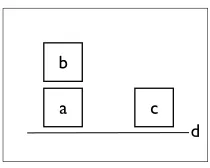
that is to say: the robotic armican execute actionmove(b,a,c) iffit is the case that both blocksbandcare clear, and it is its ‘turn’ to move;and the effect of such action is that blockbends up to the top of blockcwhile blockabecomes clear. By permutation of the block identifiers, it follows that actionmove(a,d,c) cannot be executed in the state depicted in Figure 2, in which blockdrepresents the floor. We assume background knowledge such that, for example,on(b,c) implies¬clear(c).
Suppose now the robotic arm to be in state of executing actionmove(a,d,c) also if blockais not clear, thus possibly moving a whole stack of blocks at one
a c b
[image:14.612.255.360.118.202.2]d
Fig. 2.Initial state.
time. Suppose also that the system designer considers such actions as undesir-able. In this case the robotic arm can be considered as an autonomous agent, and the designer as a legislator or policymaker. In order to keep the example perspicuous, the scenario is limited to one agent, but we can express multiple agents analogously. The actionmove(a,d,c) would get the following specifica-tion. Formula (4) does no longer demandclear(a), but Formula (5) does not specify the effect when this is the case, i.e., when two or more blocks are moved simultaneously.
(on(a,d)∧clear(c)∧turn(i))↔ hmove(a,d,c)(i)i> (4)
(on(a,d)∧clear(c)∧clear(a)∧turn(i))→[move(a,d,c)(i)](on(a,c)
∧clear(a)
∧¬clear(c)) (5)
(on(a,d)∧clear(c)∧ ¬clear(a)∧turn(i))→[move(a,d,c)(i)](on(a,c)
∧¬clear(a)
∧¬clear(c)
∧viol(i)) (6)
where viol(i) intuitively denotes a state brought about by agent i which is undesirable from the point of view of the system designer.
Suppose also that the system designer wants to implement the norm ex-pressed by Formula (6).3The paper tackles this question displaying a number of strategies for norm implementation (Sections 4, 5, 6 and 7).
3.4 Talking about norms and extensive games in the Blocks World
In this section we bring together the logic-based perspective on norms sketched in Section 3.1 with the game-theoretic setting argued for in Section 3.2. This will be done in the context of the Blocks World scenario of the previous section. As a result we obtain a very simple modal logic language4 which suffices to
3Notice that Formula (6) is an instance of Formula (1).
express the properties of extensive games relevant for the purpose of the norm implementation analysis of the Blocks World.
Language. The language is the standard propositional modal logic language withnmodal operators, wheren =|Act|, that is, one modal operator for each
available transition label. In addition, the non-logical alphabet of the language, consisting of the set of atomic propositionsPrand of atomic actionsAct, contains at least:
– Atoms inPrdenoting game structure: for all agentsi∈I,turn(i),payoff(i,x),
labeling those states where it is player’siturn, and where the payoff for playeriisx, wherexis taken from a finite set of integers. The set of atoms denoting payoffs is referred to asPrpay.
– Atoms inPr denoting Blocks World states-of-affairs: for all blocks a,b ∈ B,on(a,b),clear(a), labeling those states where blockais on blockb, and where blockahas no block on it.
– Atoms inPrdenoting normative states-of-affairs: for all agentsi∈I,viol(i), labeling those states where playerihas committed a violation.
– Atoms inAct denoting deterministic transitions: for all agentsi ∈ I and
blocks a,b,c ∈ B: move(a,b,c)(i), labeling those state transitions where playerimoves blockafrom the top of blockbto the top of blockc.
The inductive definition of the set of formulae obtained from compounding via the set of Boolean connectives{⊥,¬,∧}and the modal connectives{hai}a∈Act
is the standard one.
Semantics. Models are labelled transition systems m = hW,Wend,{Ra}a∈Act,Ii
such that:
– Wis a non-empty set of system states;
– {Ra}a∈Act is a family of labelled transitions forming a rooted finite tree, i.e.
there is a node such that there is a unique path from this node to all other nodes;
– Wendare the leaves of the finite tree; – I:Pr−→2Wis the state labeling function.
The standard satisfaction relation|=between pointed models (m,w) and modal
formulae is assumed [6]. In addition, the models are assumed to satisfy the determinism condition, for alla∈Act:
haiφ→[a]φ.
Please note that such a condition is typical of the representation of actions within games in extensive form.5
Now everything is put into place to formulate with exactness the question that will be addressed in the next sections. Consider a modelmas represented
w1
w3 w2
payoff(i,1)
payoff(j,0)
payoff(i,0)
viol(i) turn(i) +
-Fig. 3.Initial model.
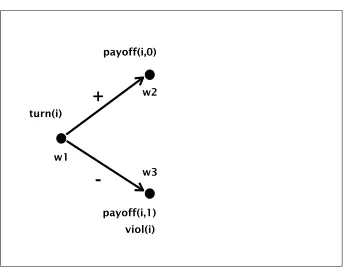
in Figure 3. Statew1is assumed to satisfy the relevant Blocks World description of Figure 2: (m,w1) |=on(a,d)∧clear(c)∧clear(b)∧ ¬clear(a).6 Notice that in the model it is also assumed that agentileans towards executing the action “−” leading to theviol(i)-state which has got a higher payoff. The actions and the violation conditions are given in the norm implementation problem. For example, there may have been an obligation to do+, a prohibition to do −,
an obligation to reach statew2, or a prohibition to reach w3. Which norm is created is part of the norm synthesis or creation problem, but not part of the norm implementation problem. For the latter problem discussed in this paper, the structure of Figure 3.
Consider now a normative specification as represented by formulae like Formula (6), together with an initial model (such as the one in Figure 3). What are the transformations of the model m, guaranteeing that the agents in the system will comply with the normative specification? This is, in a nutshell, what we are going to investigate in the remainder of the paper.
3.5 Two important caveats
Before starting offwith our analysis, we find it worth stating explicitly also what this work is not about.
The issue of norm implementation as intended here has already received attention in the literature on MAS in the form of the quest for formal languages able to specify sanctioning and rewarding mechanisms to be coupled with nor-mative systems specifications. An example in this sense—but not the unique
[image:16.612.222.395.121.260.2]one—is [50], where authors are concerned with the development of a whole framework for the formal specification of NMAS. Such a framework is able to capture also norm-implementation mechanisms such as sanctioning and re-warding systems. As our research question discussed in Section 1 shows, our aim in this paper differs from all such studies which can be found in the litera-ture. The purpose of the paper is not to develop a formalism for the specification of one or another mechanism which could be effectively used for implement-ing norms in MAS. Rather, the paper aims at movimplement-ing a first step towards the development of a comprehensive formal theory of norm implementation. Such a theory should be able to capture all forms of norm implementation mecha-nisms highlighting their common features and understanding them all as system transformations.
Finally, we want to stress that the present contribution abstracts completely from the issue concerning the motivating aspect of norms, that is to say, their capacity to influence and direct agents’ mental states and actions. We are not assuming here that agents have the necessary cognitive capabilities to au-tonomously accept or reject norms [24]. To put it yet otherwise, the perspective assumed here is the one of a social designer aiming at regulating a society of agents by just assuming such agents to be game-theoretic agents. We are of course aware of this simplification, which is on the other hand necessary as we are facing the very first stage of the development of a formal theory.
4
Making violations impossible
The present sections studies two simple ways of making illegal states unreach-able within the system.
4.1 Regimentation
Regimentation [46] is the simplest among the forms of implementation. Con-sider our running example, and suppose the social designer wants to avoid the execution ofmove(a,d,c) by (i) in the case blockais not clear, as expressed in Formula (6).
The implementation via regimentation for a transitionacan be represented by a transformation (or update)m7−→m0
of the modelminto the modelm0
such that:
Rma0:=Rma− {(w,w0)|(m,w)|=prea& (m,w0)|=viol(i)}
wherepreaare the preconditions of the execution ofaleading to a violation. In other words, it becomes inm0impossible to execute a transition with labelain
prea-states leading to a violation state.
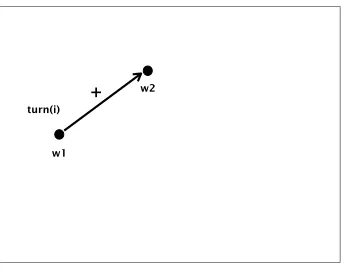
In the running example, wherea = move(a,d,c)(i), such update results in pruning away the edges labeled by “−” (i.e.,move(a,d,c)(i) form the frame of
m (Figure 4). The regimentation of the prohibition expressed in Formula (6) corresponds therefore to the validity of the following property:
w1
w2
[image:18.612.223.395.123.262.2]payoff(j,0) turn(i) +
Fig. 4.Regimentation.
and hence, by modal logic and some additional background knowledge on the Blocks World:
(on(a,d)∧clear(c)∧ ¬clear(a)∧turn(i))↔ hmove(a,d,c)(i)i>
which, notice, is a strengthening of Formula (4). In other words, regimentation is an update restricting the possibility of actions of the agents by limiting them exactly to the ones generating legal states. It is instructive to notice that the standard Blocks World scenario can be viewed precisely as a result of the reg-imentation of the normative variant of the scenario which we are considering here.
Within multi-agent systems, regimentation has been the first technique used for norm implementation. A typical example of this is AMELI [29], where all executable actions of agents are actions which are allowed according to the rule of the institutions. A formal semantics for a multi-agent program capturing regimentation is also studied in [26].
4.2 Retarded preconditions
Ordinary action logic describes the actions using preconditions and postcondi-tions. Ifais an action with preconditionpreaand postconditionpostathen
prea↔ hai> (7)
prea→[a]posta (8)
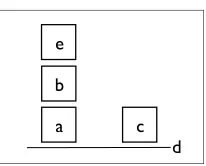
a c b
[image:19.612.257.360.117.200.2]d e
Fig. 5.Retarded preconditions. Initial state.
According to the normative perspective we have assumed in the running example, instead of imposing logically strong preconditions, we state logically weak preconditions for action, which means allow their execution in a wider range of states and assuming indeterminacy. In addition, we label states reached by performing actions as violation states when they are executed under unde-sirable conditions (see Section 3.3). In short, actions are allowed to be executed under circumstances which can possibly lead to violations, but only if the effects are still acceptable. If they are not, then nothing has happened.
These intuitions lead us to introduce, within the framework exposed in Section 3.4, two new modal operators:hφ|aiψand [φ|a]ψ. The semantics of
these new operators is defined as follows:
m,w|=[φ|a]ψ iff ∀w0∈WifwRa|
~φw
0
thenm,w0|=ψ m,w|=hφ|aiψ iff ∃w0∈Wsuch thatwRa|
~φw
0
andm,w0|=ψ
where~φ denotes, as usual, the truth-set ofφandRa|~φ is the subset of Ra containing those state pairs (w,w0
) such that the second elementw0
of the pair satisfies φ.7 Notice, therefore, that the new modal operators take an action (e.g.,a) and a formula (e.g.,φ) yielding a new complex action type (e.g.,φ|a).
Such action type corresponds, semantically, to those state transitions which are of the given action type (a) and which end up in the given states (φ). So, retarded preconditions are represented, rather than as a formula, as part of an action type. This is in fact natural, as retarded preconditions are a way to further specify an action type.
Note that if we consider only a single update, then it would suffice to in-troduceRa|
~φ as the subset ofRa containing pairs (w,w
0
) such thatw0 |= φ
. However, for sequential actions we have multiple updates and this would not suffice. This illustrates that we have a reduction from our logic to the fragment without the dynamic operators, as usually done in update logic (see, e.g., [28]).
7It might be instructive to notice that such operators are definable within standard dynamic logic [38] by means of the sequencing operator ; and the test operator ?: [φ|a]ψ:=[a; ?φ]ψ. However, the full expressivity of dynamic logic is not required
a c b
[image:20.612.154.481.119.207.2]d e
Fig. 6.Situation A
a c b
d e
Fig. 7.Situation B
a c b
d e
Fig. 8.Situation C
By means of this newly introduced operators, we can express that the exe-cution of a given actionais possible only under the condition that it has certain precise effectsφ(Formula (9)), and that each time it is executed having such effectsφ, it also guarantees thatψholds (Formula (10)):
prea → hret prea|ai> (9)
prea →[ret prea|a]posta (10)
whereprearepresents the precondition ofawhere the execution ofapossibly leads to a violation;ret preathe postcondition ofpreawhich are tolerated, i.e.,
itsretarded preconditions; andpostathe postconditions ofret prea|a.
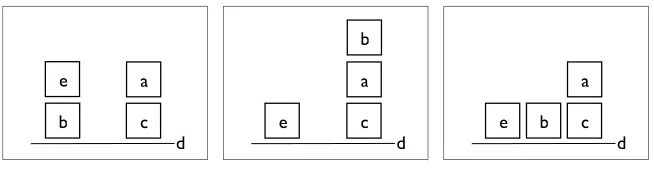
Let us now give an example. Suppose we have the situation depicted in Figure 5. We move a, and we might end up with one of the three options in Figures 6-8. Suppose also that only the situation depicted in Figure 6 is tolerable to us. That is,acan be moved onconly if it is slid out carefully from the tower composed bya,b,e. Such tolerance can be expressed by means of
retarded precondition, that is, a precondition which is evaluated as a result of the
action performed. In the example at hand, the execution of actionmove(a,d,c) is tolerated in the caseais moved from within a tower only if the result of the action yields the situation depicted in Figure 6:8
on(a,d)∧on(e,b)∧clear(c)→ hon(e,b)|move(a,d,c)i> (11)
on(a,d)∧on(e,b)∧clear(c)→[¬on(e,b)|move(a,d,c)]⊥ (12)
on(a,d)∧on(e,b)∧clear(c)→[on(e,b)|move(a,d,c)]on(a,c). (13)
Blockacan be moved also in the case it is not clear, provided that this does not change the respective disposition of other blocksbande(Formula 11). If that is not the case, than it will not be possible to move it (Formula 12). The effect of the execution ofaunder the retarded precondition that the stack ofbandeis left intact results inabeing placed onc(Formula 13).
The specification of retarded preconditions for actions can be viewed as a smoothening of regimentation requirements. As shown in the example above,
instead of regimenting the non-execution of actionmove(a,d,c) in case blocka
as positioned within a tower, we can express that the execution can be tolerated, provided it gives rise to specific results (Figure 6).
In a nutshell, the use of retarded preconditions is typical of situations where the execution of a given actiona under certain circumstances φcan possibly lead to a violation state:
φ∧ haiviol.
In such cases, we might not want to impose a regimentation, requiring that:
φ→[a]⊥
but we would rather still allow the agent to perform the action, provided that it does not end up in violation states, that is, we allow the execution of the action under the potentially problematic conditionsφbut only by assuming the retarded precondition¬viol:
φ→ h¬viol|ai>
φ→[viol|a]⊥
We conclude spending a few more words on the notion of retarded precondi-tion. Such notion of retarded precondition is implicit in our culture. The saying “you can’t argue with success” illustrates that way of thinking. An agent can take action without following the rules and if he is successful then we have to accept it. A major example is Admiral Nelson defying command and defeat-ing the Spanish fleet. He is a hero. Had he failed, he would have been court marshalled.
5
Perfect enforcement
Perfect enforcement takes place when the execution of an action leading to a violation state is directly deterred by modifying the payoffs that the agent would obtain from such an execution. The following condition says that the best action does not imply a violation of the norm. It covers both penalties and rewards, or combinations of them.
LetPrpaydenote the set of payoffatoms and letMax(i) denote the maximum
payoffan agentigets at a violation end state, if such a state exists. The imple-mentation forivia perfect enforcement with respect to a transitiona, is a model update changingm=(W,{Ra}a∈Act,I) tom0=
(W0,{
R0
a}a∈Act,I0) as follows:
– W=W0
; – Wend=W0end; – {Ra}a∈Act ={R0
a}a∈Act;
– ImdPr−Prpay = Im0
dPr−Prpay, where d denotes the domain restriction
operation on functions;
– Im0dPrpayis such that ifWend∩ −I(viol(i))
,∅, then for some payoffatom
payoff(i,x) withx>Max(i) and statew∈W0
end,w∈ I
0
Notice that the update does not modify the interpretation of atoms which are not payoffatoms nor the frame of the model. What it does is to changeIto a
valuationI0
which guarantees that at least one state in the end states of the game which are not violation states (if such states exist), the payoffforiis higher than the payoffin any of the violation states. Intuitively, such an update guarantees that each agent faced with a decision between executing a transition leading to a violation state, and one leading to a legal one, will—if they act rationally from a decision-theoretic perspective—choose for the latter.
A number of different implementation practices can be viewed as falling under this class such as, for instance, fines or side payments. However, the com-mon feature consists in viewing the change in payoffs as infallibly determined by the enforcement, thereby giving rise to perfect deterrence. The next section will show what happens if such an assumption is dropped.
Getting back to our running example, the perfect enforcement of the prohi-bition expressed in Formula (6) results, therefore, in the validity of the following property:
on(a,d)∧clear(c)∧on(b,a)∧turn(i)→([+]payoff(i,1)∧[−]payoff(i,0))
where+ =move(b,a,c)(i) and−=move(a,d,c)(i).
We deem worth stressing again the subtle difference between perfect en-forcement and regimentation. While regimentation makes it impossible for the agents to reach a violation state, automatic enforcement makes it just irrational in a decision-theoretic sense. In other words, it is still possible to violate the norm, but doing that would be the result of an irrational choice. As such, per-fect enforcement is the most simple form of implementation which leaves the game form (i.e., the frame of the modal logic models) intact. Although the ex-tensive game considered is a trivial one-player game, it should be clear that taking more player into consideration would not be a problem. In such case, the application of solution concepts such as sub-game perfect Nash [56] would become relevant.
In the multi-agent systems literature, perfect enforcement is used to provide a formal semantics to multi-agent programs in [26].
6
Enforcers
Commonly, perfect deterrence is hard to realize as each form of sanctioning re-quires the action of some third-party agent whose role consists precisely in mak-ing the sanctions happen. Enforcement via agents (the enforcers) corresponds to the update of modelmto a modelm0
defining a new game form between a playeriand enforcer j. The actions of enforcerjarepunish(i) andreward(i). As a result of such an update, the original modelmresults in a sub-model ofm0
. The update is defined as follows:
– W0 =
W∪W0
end, that is, each dead end ofWis copied twice and added to
the domain; – {R0
a}a∈Act ={Ra}a∈Act, that is, the labeling viaActremains the same;
– R0
reward(i) = {(w,w
0
) | w∈ Wend &w0 =
(w,1)}and R0
punish(i) = {(w,w
0
) | w∈ Wend&w0 =
(w,2)}, that is, the added transitions are labeled as rewarding
and punishing; – I0=I
for all states inW; – I0 for the states in W0
end is such that ∀w,w
0
s.t.w ∈ Wend and (m0,w) |= payoff(i,x)) and wRm0
reward(i)w
0
: (m0,
w0
) |= payoff(i,y) with x ≤ y; and ∀w,w0
s.t.w∈Wendand (m0,
w)|=payoff(i,x)) andwRm0 punish(i)w
0
: (m0,
w0
)|= payoff(i,y) withx>y;
What the definition above states is that the update consists in adding to every dead end inma trivial game consisting of a binary choice by enforcerjbetween punishing or rewarding agent i. The result of a reward leaves the payoffof i
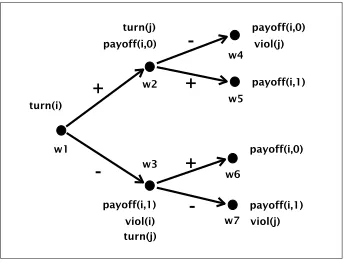
intact (or it increases it), while the result of a punishment changesi’s payoffto a payoffwhich is lower than the payoffiwould have obtained by avoiding to end up in a violation state. In the running example, the action of the enforcer swaps the payoffs of agentifrom 0 to 1 or from 1 to 1 in case of a reward; from 1 to 0 or from 0 to 0 in case of a punishment, just like in the case of automatic enforcement.
However, the use of agents as enforcers implies the introduction of a further normative level, since the enforcer can choose whether to comply or not with its role, that is, punish ifidefects, and reward ificomplies:
(turn(j)∧viol(i))→[reward(i)]viol(j) (14)
(turn(j)∧ ¬viol(i))→[punish(i)]viol(j) (15)
Whether the enforcement works or not, depends on the payoffs of the enforcerj. We are, somehow, back to the original problem of guaranteeing the behavior of an agent (the enforcer in this case) to comply with the wishes of the social designer. The implementation of norms calls for more norms (Figure 9). Enforce-ment via enforcing agents lifts the impleEnforce-mentation problem from the primary norms addressed to the agents in the system, to norms addressed to special agents with ‘institutionalized’ roles.
To the best of our knowledge, the only systematic multi-agent system frame-works addressing norm implementation at the level of enforcement isMoise+
and its variants (e.g., [42]), although not providing a formal semantics for it.
6.1 Regimenting enforcement norms.
payoff(i,0)
payoff(i,1) payoff(i,0)
payoff(i,1)
w1
w4
w3 w2
w7 w6 w5
payoff(i,1)
payoff(j,0)
payoff(i,0)
viol(i) turn(j) turn(j)
turn(i)
viol(j)
+
-+
+
[image:24.612.222.394.125.259.2]
-viol(j)
Fig. 9.Enforcement norms.
corresponds to an updatem7−→m0
ofmwhere:
Rmpunish(i)0 =R
m
punish(i)− {(w,w
0
)|m,w|=turn(j)∧viol(i) &m,w0|=viol(j)} Rmreward(i)0 =R
m
reward(i)− {(w,w
0
)|m,w|=turn(j)∧ ¬viol(i) &m,w0|=viol(j)}
As a result, the enforcerjalways complies with what expected from its role. In a way, regimented enforcement can be viewed as an equivalent variant of perfect enforcement since its result is an adjustment of the payoffs of agentiw.r.t. to the system’s norms.
6.2 Enforcing enforcement norms.
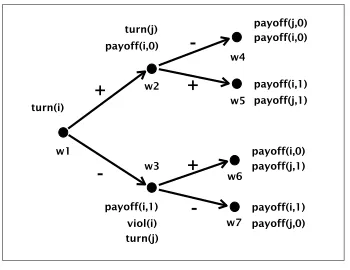
If the payoffs of the enforcer are appropriately set in order for the game to deliver the desired outcome, then the system is perfectly enforced by enforcerjwho au-tonomously complies with the enforcement norms expressed in Formulae (14) and (15), punishing playeriwhenicommits a violation and rewardingiwheni
complies (Figure 11). In the running example, perfect enforcement of enforce-ment norms can be defined by a simple updatem7−→m0
of the interpretation functions of the two models such that:
Im0(payoff(j,0))=Im(viol(j))
Im0(payoff(j,1))=W− Im(viol(j))
payoff(i,0) payoff(i,1)
w1
w3 w2
w6 w5
payoff(i,1)
payoff(j,0)
payoff(i,0)
viol(i) turn(j) turn(j)
turn(i) +
-+
[image:25.612.222.397.124.259.2]+
Fig. 10.Regimentation of enforcement norms.
at this level that a number of concepts and techniques could be imported from Mechanism Design and Implementation Theory [43–45,52] to the formal theory of NMAS.
6.3 Who controls the enforcers?
Our analysis clearly shows the paradox hiding behind norm implementation. In order to implement norms, it is likely to need more norms.
The implementation of a set of norms can be obtained either via regimen-tation or via automatic enforcement or by the specification of an enforcement activity to be carried out by an enforcer. Enforcement specification happens at a normative level, i.e., via adding more norms to the prior set which, in turn, also require implementation. Schematically, supposeXto be the non-empty set of to-be-implemented norms,Regiment(X) to denote the set of norms fromXwhich are regimented or automatically enforced, andEnforce(X) to denote the set of norms containingXtogether with all the norms specifying the enforcement ofX
(X⊆Enforce(X)). The implementation ofSis the enforcement of the norms inS
which are not regimented:Implement(X)=Enforce(X\Regiment(X)).
In other words, to implement a set of norms amounts to implement the set of unregimented norms together with their enforcement. These observations clearly suggest that the implementation of a set of norms yields a set of norms. Somehow, it is very difficult to get rid of norms when trying to implement them. The only possibility is via full regimentation or automatic enforcement.
If Regiment(X) = Xthen there is no norm left to be implemented. Instead if
Regiment(X)⊂Xthen∅ ⊂Implement(S), which means that the implementation
payoff(i,0)
payoff(i,1) payoff(i,0)
payoff(i,1)
w1
w4
w3 w2
w7 w6 w5
payoff(i,1)
payoff(j,0)
payoff(i,0)
viol(i) turn(j) turn(j)
turn(i) +
-+
+
-payoff(j,1)
payoff(j,0) payoff(j,0)
[image:26.612.221.396.124.259.2]payoff(j,1)
Fig. 11.Perfect enforcement.
@
@@
i j
- +
- (1,0) (0,1) + (0,0) (1,1)
Fig. 12.Enforcement of the Blocks World scenario in strategic form
7
Implementation via norm change
This section concerns the ways of obtaining desired social outcomes by just modifying the set of norms of the system. The formal analysis of such phenom-ena, which is pervasive in human normative systems, is strictly related with the formal study of counts-as [34] and intermediate concepts [49].
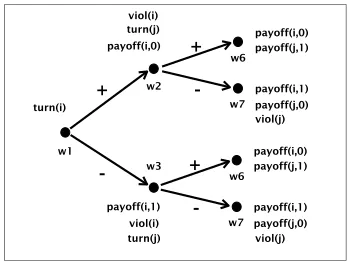
As an example, consider the modelm0obtained via the update of the initial modelmcorresponding to perfect enforcement (Figure 11). Suppose now the social designers wants to punish playerino matter what it does. One way for doing this would be to go back to the initial modelm, to replace the enforcer norms expressed in Formulae (14) and (15) by the following norm:
turn(j)→[reward(i)]viol(j) (16)
and then updatemto implement the norm expressed in Formula (16), for in-stance via perfect enforcement.
A much quicker procedure would consist in updating modelm0
payoff(i,0)
payoff(i,1) w1
w3 w2
w7 w6
payoff(i,1) payoff(i,0)
viol(i) turn(j) turn(j)
turn(i) +
- +
-payoff(j,1)
payoff(j,0) viol(i)
payoff(i,0)
payoff(i,1) w7 w6 +
-payoff(j,1)
payoff(j,0)
[image:27.612.220.395.124.255.2]viol(j) viol(j)
Fig. 13.Implementation via norm change.
free” by simply changing the meaning ofviol(i) (Figure 13). As you can see, the payoffs for enforcerjare different from Figure 11.
The update of the extension of viol(i) can be obtained, for instance, by adding the following norm to the system:
on(b,a)∧clear(b)∧clear(c)∧turn(i)→[move(b,a,c)(i)]viol(i) (17)
To put it otherwise, such procedure exploits the nature ofviol(i) as an interme-diate concept occurring as precondition of other norms. In this case the norms involved are the enforcement norms expressed in Formulae (14) and (15).
8
Related work
In this section we consider whether existing work in normative multi-agent systems is able to answer the equation discussed in the introduction.
BDI : Agent Programming = ? : NMAS Programming.
Since BDI-CTL [23] is used as a formal specification and verification lan-guage for agent programming, an obvious candiate for our question mark is an extension of this language with deontic concepts such as obligations and per-missions, called BOID-CTL [20, 21]. Such a logic is simply a modal combination of an agent logic and a modal deontic logic. The drawback of this approach is that the norms are nor represented explicitly.
the agents in the society at hands. The problem of how a social law can be implemented in the society is not discussed.
Another obvious candidate for the question mark is a theory of normative systems [1]. The key feature of normative systems is that they make norms explicit in such a way that we can say, at a given state of the system, whether a norm is active, in force, violated, and so on [67]. See [36] for an up to date review on the distinction between a theory of normative systems and deontic logic, and the challenge to bridge the two. A theory of normative systems is useful for norm representation and reasoning, but not for the representation of aspects such as the multi-agent structure of a normative system.
A third candidate is Boella and van der Torre’s game-theoretic approach to normative multi-agent systems, which studies the more general problem of norm creation [9, 11, 14]. For example, the introduction of a new norm with sanctions is modeled as enforceable norms in artificial social systems as the choice among various strategic games [10]. They focus in particular on the enforcement of norms using enforcers, and discuss the role of procedural norms to motivate the enforcers [13]. They consider the creation of a new norm into a system of norms, whereas in this paper we do not consider the effect of norm implementation on existing norms. They argue that the infinite regression of enforcers can be broken if we assume that enforcers control each other and do not cooperate [10]. Since they use strategic rather than extensive games they cannot distinguish some subtle features of implementation such as retarded preconditions. Moreover, they do not give a procedure to go from a norm to its implemented system. Finally, they do not consider other methods than sanctioning and rewarding to implement their norms. They do consider also cognitive extensions of their model, which we do not consider in this paper. See [14] for a detailed discussion on their approach.
There are many organizational and institutional theories, such as the ones proposed in [34], and there is a lot of work on coordination and the environ-ment [25, 58]. Institutions are built using constitutive norms defining interme-diate concepts. However, this work is orthogonal to the work presented in this paper in as much as, although sporadically addressing one or another form of implementation, it never aims at laying the ground of an overarching formal framework.
9
Conclusions
for instance the fact that by implementing new norms, the implementation of other norms might end up being disrupted.
Moreover, we introduce two views on representing forbidden actions, the classical one in which the precondition has to be satisfied before the action can be executed, and one based on so-called retarded preconditions. The two views coincide if the language allows for action names, and we can include as part of the state a list of which actions are allowed in this state. This can be formalised by the predicateallowed(X), whereXare names for actions. Theallowed(X) predicate can be part of the preconditions ofX. We can use the feedback arrows of retarded preconditions in Kripke models to change accessibility. This will implement the severed connections in the diagrams, and the semantics would then bereactive
Kripke models. Consider for example the restriction ”you should not take any
action three times in a row.” With retarded preconditions, we can do a “roll-back” when the action occurs three times in a row, whereas with regimentation we have to predict whether the action is going to be executed three times rather than two or four times. A further comparison of the two views is topic for further research.
Finally, topics for further research are also the development of a more de-tailed classification of norm implementation methods, the application of re-tarded preconditions to the analysis of ambiguous norms.
Acknowledgments. The authors would like to thank the reviewers of the vol-ume for their helpful comments. Davide Grossi wishes to acknowledge sup-port by Minist`ere de la Culture, de L’Enseignement Sup´erieur et de la Recherche,
Grand-Duch´e de Luxembourg (grant BFR07/123) and by Nederlandse Organisatie
voor Wetenschappelijk Onderzoek(VENI grant 639.021.816).
References
1. C. E. Alchourr ´on and E. Bulygin.Normative Systems. Springer Verlag, 1971. 2. A.R. Anderson. A reduction of deontic logic to alethic modal logic.Mind, 22:100–103,
1958.
3. J. van Benthem. Extensive games as process models. Journal of Logic, Language and Information, 11:289–313, 2002.
4. J. van Benthem. Logic in games. Lecture Notes of the ILLC graduate course on Logic, Language and Information, Universiteit van Amsterdam, Amsterdam, The Netherlands, 2005.
5. J. van Benthem, J. van Eijck, and V. Stebletsova. Modal logic, transition systems and processes.Journal of Logic and Computation, 4(5):811–855, 1994.
6. P. Blackburn, M. de Rijke, and Y. Venema.Modal Logic. Cambridge University Press, Cambridge, 2001.
7. G. Boella, G. Pigozzi, and L. van der Torre. Five guidelines for normative multi-agent systems. InProceedings of JURIX’09, 2009.
![Fig. 1. The conceptual metamodel [18].](https://thumb-us.123doks.com/thumbv2/123dok_us/8385873.321894/10.612.169.450.186.360/fig-the-conceptual-metamodel.webp)